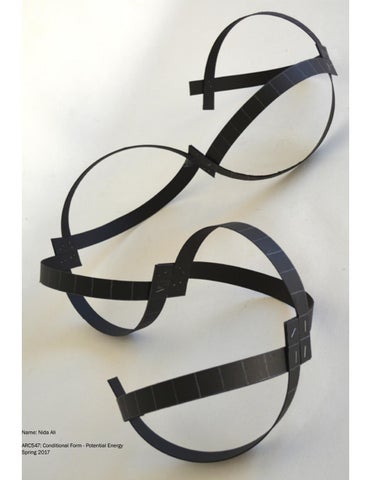
Name: Nida Ali Name: Nida Ali ARC547: Conditional Form - Potential Energy ARC547: Conditional Form - Potential Energy Spring 2017 Spring 2017
Wings - Bending Ribbons
Wings.
A1
B1
Fig 1. Front View (Elevation) of Module
A
B
Fig 2. Detail Overlapping Connection
Fig3. Module Overlapping connection Fig 1. Fig 4. Process
Module was formed by two ribbons connected at both ends, The form of connection forces the material to bend at an angle. By forcing the ribbons to stay in position at that angle the overlapping connection was necessary. B1 overlaps with A1 and A overlaps with B. First iteration consisted of two points of connection one at the center and the other formed at the end. Both have a 4 point overlapping connection.
Fig 4. Elevation- Symmetry and Axis
Fig 2.
Fig 4.
Fig 3.
Fig 5.
Butterfly- Bending Ribbons
The Butterfly. Fig 1. Front View
Fig 2. Axonometric
Fig3. Connection between Modules
Fig 4. Process
Second iteration consisted of one connection which was formed at the center. Forcing the 4 loops to connect at the center. Symmetrical in the X and Y axis plane.
Fig 1.
Fig 3.
Fig. 5 Connection between 2 modules
Fig 4.
Fig 2.
Fig 5.
Butterfly- Bending Ribbons
The Butterfly. Fig 1. Axonometric
Fig 2. Elevation
Fig 3. Plan
Fig 4. Symmetrical in X and Y Axis. Fig 5. Connection at the center, Equidistant distance between ribbons. Fig 1. Fig 6. Movement and direction of Module when connected with another module.
Fig 4.
Fig 5. Fig 2.
Fig 3.
Fig 6.
Butterfly Inverse - Bending Ribbons
The Butterfly Inverse. Fig 1. Elevation Fig 4. Fig 2. Plan
Fig 3. Axonometric
Fig 4. Module
Fig 5. Inverse connection between modules
Fig 1.
Fig 6. Movement and direction of ribbons within a module. Fig 5.
Fig 7. Movement and direction of ribbons when connected with another module.
Fig 2.
Fig 3.
Fig 6.
Fig 7.
Pinwheel - Bending Ribbons
The Pinwheel.
Fig 1. Elevation
Fig 2. Plan
Fig 3. Axonometric
Fig 4. Connection and Angle between ribbons
Fig 1.
Fig 5. Symmetry and Axis
Fig 6. Direction and angle of ribbons when connected. Fig 4.
Fig 2.
Fig 5.
Fig 3.
Fig 6.
Catapult - Bending Ribbons
The Catapult
Fig 1. Elevation
Fig 2. Plan
Fig 3. Axonometric
Fig 4. Symmetry and Axis within Form Fig 1. Fig 5. Direction and angle of ribbons when connected, using the same connection detail.
Fig 4.
Fig 2.
Fig 3.
Fig 5.
Dragonfly - Bending Ribbons
The Dragonfly
Fig 1. Elevation
Fig 2. Plan
Fig 3. Axonometric
Fig 4. Direction and angle of ribbons when connected, using the same connection detail. Symmetry along x and y axis. Fig 1.
Fig 4.
Fig 5. Connecting modules along an axis to form a pattern. Ribbons weave forming the same overlapping connection.
Fig 2.
Fig 3.
Fig 5.
Infility Loops - Bending Ribbons
The Infinity Loops
Fig 1. Elevation
Fig 2. Plan
Fig 3. Axonometric
Fig 4. Symmetry and Axis within form
Fig 5. Direction and angle of ribbons when connected, using the same connection detail. Symmetry along x and y axis.
Fig 1.
Fig 4.
Fig 2.
Fig 5.
Fig 3.
Snake - Bending Ribbons
The Snake
Fig 1. Elevation
Fig 2. Plan Fig 1. Fig 3. Axonometric
Fig 4. Symmetry and Axis within form. Direction and angle of ribbons when connected to another module using the same connection detail. Forming a pattern through interlocking modules.
Fig 2.
Fig 3.
Fig 4.
Hammock - Bending Ribbons
The Hammock Fig 1. Elevation (Small Scale Module)
Fig 2. Plan ( Large Scale Module)
Fig 3. Axonometric (Large Scale Module) Fig 1. Fig 4. Using 1/32� Plywood, to test bending capabilities of wood forming 2 loops with overlapping connections. Symmetry and Axis within form.
Fig 2.
Fig 3.
Fig 4.
Leaf - Bending Ribbons
The Leaf Fig 1. Fig 1. Axonometric (Front View)
Fig 2. Plan
Fig 3. Axonometric (Right View)
Fig 4. Using 1/32� Plywood, to test bending capabilities of wood forming by bending 2 strips of wood using toverlapping connection joint. Symmetry and Axis within form. One end pulls upward because of the type of connection and the bending angle and direction within the wood, while the other end pushed down.
Fig 2.
Fig 3.
Fig 4.