portfolio

Year:2023
Student: Camila Spray
Teacher: Alfredo Torres
Course: Methodology 01

Institute: ICPNA

INDEX Analysis of a language sample..............1 A summary of methods and approaches......3 Analysis of a coursebook activity............6 Classroom management of route map.......8 Example of how to prevent learning........10 Multiple intelligences.....................12 Sensory preferences........................14 Screenshots of the quiz results.............16 Route map..................................18 Overall reflection and outlook.............21
Analysi language




REFLECTION
1
OUTLOOK
In the long-term future, I’m going to use language sytems in my classes since it’s required for language learning. For instance: I could create a activity when they can reinforce their listening, speaking, reading and writing since a language is made up of all these skills and systems. Bear in mind that a teacher can not teach a skill without employing other skills However, to be good at the skills, a learner can not easily master those skills without considering the rules of the language, inasmuch as language is system of sounds, words, pattern, etc. used by human to communicate thoughts and feelings As a teacher, I’m going to have to teach what and how the system works. Or else, the students will not be able to communicate successfully since there are differences between the systems of students’ first language and English

2
A summary of methods and approaches
The Grammar-Translation Method: It’s a method where students learn grammatical rules and then apply those rules by translating sentences between the target language and the native language
The Audio-Lingual Method: It’s a method which emphasizes the teaching of listening and speaking before reading and writing It uses dialogues as the main form of language presentation and drills as the main training techniques.
Communicative Language Teaching (CLT): It’s defined as an approach of teaching a second or a foreign language that focuses on learners' interaction whether as the means or the ultimate goal of learning a target language. Interaction here means an activity in which two or more parties affect upon one another.
Total Physical Response (TPR): It’s a method of teaching language or vocabulary concepts by listening and it’s linked to physical activities which are designed to reinforce comprehension.
Community Language Learning (CLL): It’s a language teaching method which involves psychological aspect and students work together to develop what skill of a language they would like to learn
3
tural Approach: It’s a method is based on ions of how children acquire their native language. It s to adapt this process of language acquisition to an rning environment.


Task-Based Learning (TBL): It’s an approach to language learning where learners are given interactive tasks to complete. In order to do this, they need to communicate. Once the task is complete, then the teacher discusses the language used
The Silent Way: It’s a method of language teaching based on the premise that the teacher should be silent as much as possible in the classroom but the learner should be encouraged to produce as much language as possible.
Person-Centred Approaches:It’s an approach by being person-centred regarding the needs of individual (i e people’s preferences,needs and values).


Lexical Approaches: It’s a method of teaching based upon the idea that an important part of learning a language consists of being able to understand and produce lexical phrases as chunks
Dogme: It’s an approach to teaching that argues that teaching should focus on the learner and not be driven by the resources available, including course books
4
REFLECTION
The method is a way of teaching, and your choice of method is dependent on your approach; that’s to say, what you believe about, what language is, how people learn, how teaching helps people learn Hence, based on such beliefs ,you will then make methodological decisions about (e.g. the aims of a course, what to teach, teaching techniques, activity types,ways of relating with students, ways of assesisng) In spite of the grand list of methods above, the reality is that very few teachers have ever followed a single method in its entirety, because they don’t want to take someone else’s prescriptions into class and apply them. But rather they work out form themselves what is effective in their own classroom. Usually, they choose items from a range of methods and construct a collage methodology- that is known as principled eclecticism.

OUTLOOK
In my forthcoming lessons, I personally will consider all of these methods since I consider that they all are paramount for student’s learning. Though some of them could be more used on lower level (ie,pre-beginners o beginners). For instance, the Grammar Translation method, the Natural approach or the Total Physical Response are the most suitable methods for basic levels (ie A1-A2) Moreover, my choice of method will be dependent on the class students; that’s to say, on how students learn,or on their multiple intelligence. Hence, it’s important to bear in mind that all of these methods don’t have to use neccesarily at a time, but depending on how the class goes.
5
analysis of a coursebook activity
Analysis of Description
1.Language content
The language sytems and skills are speaking,writing and reading because it allows students to have a greater knowledge of the subject by perfoming the respective exercises
2 Other content
This activity might serve so that students can learn to continue developing better speaking and writing since the practice of exercises is a great tool.
3 Preparation
Before class, you anticípate what the main topic will be and prepare a mini-presentation on these areas Futhermore, it’s important to bring special material, such as clear images or visual aids like slides
4 Steps
The steps are base don choosing from the list the things that you want to talk about (e g your daily life)
5. Instructions
If I want to give instructions orally, some important points are the following: introduce task by dictating instructions dictating answers back to the whole class and speaking up so all the students can understand
6 Organization Organize the students in pairs or groupworks, seating movement.
6
REFLECTION OUTLOOK


This topic about looking at one simple activity in detail This help you to similarly analyse your own teaching material in future so that you can be prepared and without not having likely issues This is made up of six areas for analysing (language system, other content, preparation, steps,instructions and organization. All of these areas are neccesary and essential to take into account ahead of planning a lesson. Futhermore, all of these ones have an order, starting from language content (language systems and skills will the students be practicing) and finishing up from organization (organisational arregements could use in class).
In my future lesson, I’m going to plan ahead in detail how to adapt a unit lesson into my class approach. By doing this I could reorder the activities, combining activities, omitting activities, rewriting or supplementing exercise material, etc. Occasionally an activity is regarded as valuable, but if it is not well-designed or it is not feasible in a particular class, I can give up the activity or just adapt it. Very often, adaptation involves supplementation, and hence I’d have to add materials from other resources to the coursebook activity It’s believed that authentic materials are better than non-authentic materials for supplementation So I’m going to make a point of collecting authentic materials to find it much easier to adapt.
7
Classroom management of route map
REFLECTION
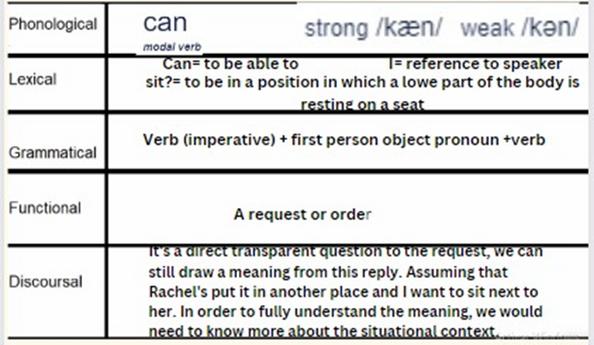
This task makes me know that we can analyse any sentence in five different ways, and all of these different ways are named language systems. When talking upon language systems you could consider the sounds (phonology), the meaning of the individual words or groups of words (lexis or vocabulary), how the words interact with each other within the sentence (grammar),the use to which the words are put in particular situations (function), analysing how the sentences relate (or don't relate)to each other (discourse).
In short, you have to consider teaching an item of language; in other words, we need to decide is which sytem(s) we are going to offer our learners information about.
8
OUTLOOK

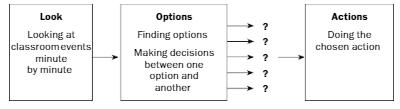
To my mind, the classroom management is the key to have a successful class Bear in mind, that the most important role of a teacher is to create the conditions in which learning can take place (i e help learning to happen) Additionally, you cannot know whether alternatives routes are more effective, but the post-lesson reflects on what you did and didn´t to, and hence this can inform you about your future lessons In my long-term classes, I’m going to apply the basic skills for classroom management, these are looking at the classroom events as they occur and think of possible options available to you, to make appropiate decisions between these options, and to turn them into effective and efficient actions. As you grow in experience, your awareness of possible options will grow
9
ample of how to event learning

REFLECTION
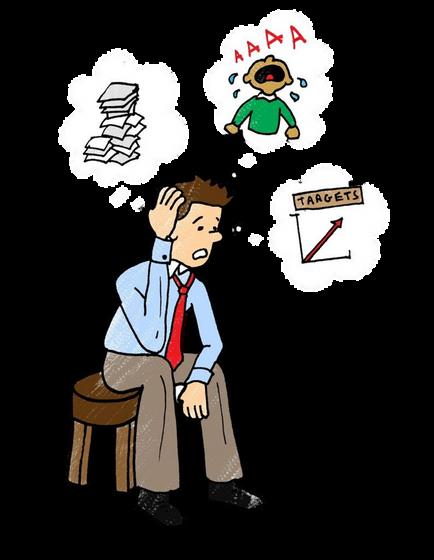
There are many ways that teachers commit unintencionally when learning, and this hinder or prevent learning to happen So as to have a successful class is required that teacher bear in mind these commonly mistakes In this class task my group and I do a mini presentation doing these common mistakes when teaching to be able to distinguish them. The one that draw my attention the most was ‘’fear of genuine feedback’’ I’ve consider that it’s important to know that the more you see feedback as a ou and to your position and your confidence, the will attempt to avoid feedback, or to defend yourself ceived attack. So that you can try opening yourself ossibilites of really listening to what students have to view to simply hearing them, and hence you may find n start to find out what they are really thinking,and n work on responding appropriately to that.
10
OUTLOOK
In my forthcoming class, I’m going to steer clear of insufficient authority or over-politeness, since It’s important that teachers feel their own natural authority in order to students respect them , but also to have a possitive rapport with students

Another one, it’s the unnecesary running commentary, this is boring and tough to follow for students, you just have to tell the instructions about they have to do-and stop Lastly, I’ve consider that all teachers and future teacher have to overcome their fear of genuine feedback. Teachers must understand when they are getting feedback by their students, they just have to listent to them attentively, because they can start to find out that students may really thinking in a unconscious way, and then work on that
11
ultiple intelligences

12
REFLECTION
The MI theory suggests that all humans possess eight intelligences (in contradiction to the traditional theory, where it is accepted that there is only one intelligence) These eight intelligences exist as a unique combination in each and every one of us, something I would like to call an intelligence “mindprint” . Moreover, Gardner regards these intelligences not as skills,but as “biological potentials which are realized to a greater or lesser extent depending upon opportunities and motivation I especially appreciate the fact that Gardner suggests that intelligences can be improved throughout human life. Of course it will be a choice on expanding knowledge in areas (intelligences) where the person has a natural potential or improving on ones that the same person is experiencing deficiency in.
OUTLOOK
To me personally, Multiple Intelligences is a fascinating theory that I truly believe in, have seen the benefits of, and I am planning to continue using (I have used it without realizing before) to help my forthcoming students grow and live up to their full potential. I appreciate Gardner’s theory for one more reason as well- I wholeheartedly believe that people can improve on their intelligence(s). In the long term, I’m thinking about supporting my students with these eight kinds of intelligences By giving them out some MI assessment tools can provide me a fascinating snapshot of students’ innate abilities. In short, personally speaking, I consider that all schools shouldn’t focus primarily on linguistic and logical-mathematical intelligences, but on the eight kinds of intelligence, that’s to say, Logical-Mathematical, Spatial, Linguistic, Bodily –Kinesthetic, Musical, Interpersonal, Intrapersonal and Naturalistic to make learning easier to students.


13
Sensory preferen
Visual preference
A visual sensory preference means that the individual takes in through sight typically registers most quickly and intensely in the brain. It gets their attention more quickly and may even require less energy to decode the data.
The term visualizing describes an ability to create internal mental pictures. This is different from possessing a visual sensory preference. Most people can train themselves to visualize, although an individual with biochemical preference in the right frontal lobe of the cerebrum may be able to hone this ability to a more competent degree.

REFLECTION
The visual preference is one sort of sensory preferences. Having a visual sensory preference means that visual stimuli typically register more quickly in your brain than either auditory or kinesthetic sensory stimuli, although there might be specific situations when you are more aware of auditory (symphony program) or kinesthetic (eating Thanksgiving dinner) stimuli. You could use these as general guidelines for discussion in your class, but remembering that each brain is as different as the person’s thumbprint and you may be more aware of one system than another at any given moment depending on the environment in which you find yourself
14
OUTLOOK

In my long-term future classes I’m going to support my visual learners by making a habit of writting down new vocabulary and adding a few quick context clues (e.g., putting the part of speech in brackets or underling the stressed syllable) will help immensely Another practical way is using the whiteboard efficiently. Case in point, designating roles to certain areas of the board and using colors to organize information during the lesson To wrap this up, the way that I prefer the most is experimenting with realia (i.e. bringing real life items over the class to make new concepts memorable) (e g maps, brochures, business cards, advertisements, packaging, menus, and photos) Visual learners will appreciate being able to see and touch these items, and find cues within to retain language

15
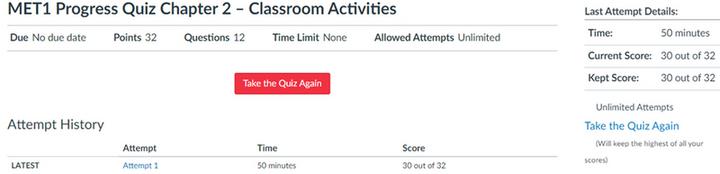
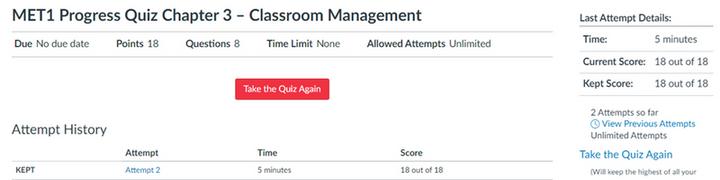
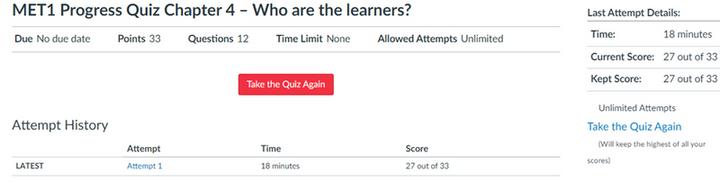
Screenshots of q results
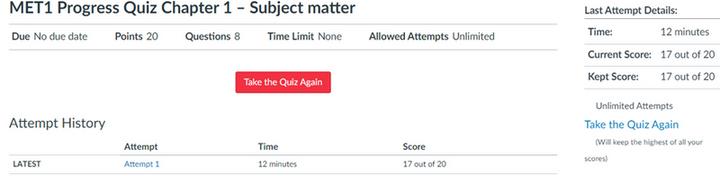
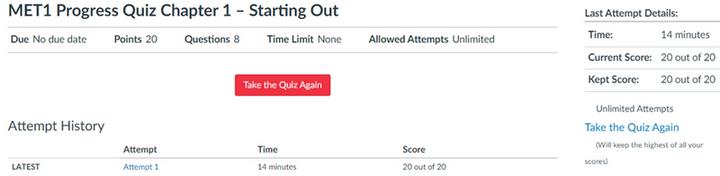
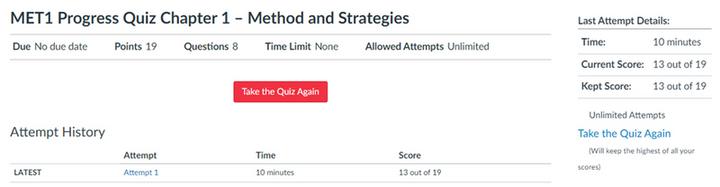
Methods and Strategies

Starting Out
Subject matter
16
Classroom Activities


Classroom Management
Who are the learners?

17
Teacher’s Name
route map

Camila Spray Ariana Tejeda
Class Level Basic 01
Book / Unit/ Lesson/ Activity
Lesson B
Length of Activity 30 min
Materials PPTs, book Activity Aim(s)
By the end of the activity, students will be able to describe new places by using new lexis
18
Route Map Instructions
1 Pre-Class
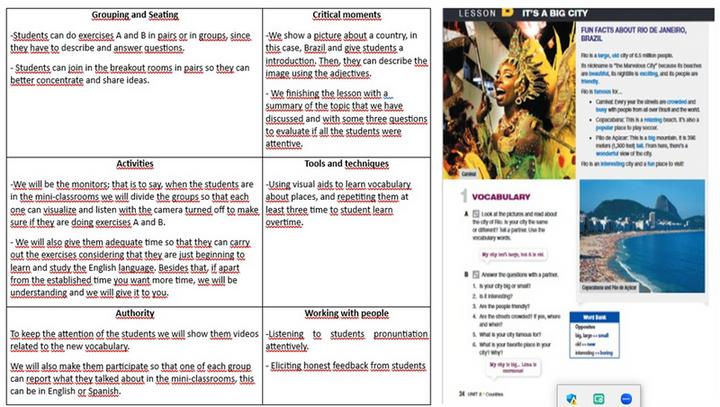
Prepare the material and texts to follow Thinking about the arrangement of the class and how we are going to divide them for each activity
Present pictures from two different cities Subsequently, ask students: can you recognize these cities?
2 Lead-in
Ask students: ‘‘what city do you like the most? -why?’’ in order to elicit some adjectives to describe places Write thewords at the screen as they come up Make sure that a number of useful words from the task picture are mentioned Otherwise,add new lexis (not to ‘‘preteach’’everything exhaustively)
Time: 3 min
Display pictures of the new vocabulary (also additional lexis that is not included in the book), then proceed to give them the meaning of each words using some synonyms
Ss read a text about fun facts about Rio de Janeiro,Brazil so as to brush up on the vocabulary above
3A Set up
Put students into pairs to discuss if their city is the same or different from Rio de Janeiro (ss will have to use the vocabulary words)
Check if the students know what to do, display the prompts for them to produce complete sentences
Time:4 min
4A Run
Ss work in pairs and discuss the question above They must use the vocabulary The teacher monitors discreetly in breakout rooms to check that they are following the instructions properly
Time: 2 min
Bring Ss back to the main room and get them to report their answers, and give them feedback if necessary
5A Close
3B Set up
4B Run
5B Close
6 Post
Time: 3 min
Give instructions and model the exercise “Answer the questions” (activity in group) Check if the Ss know what to do, display the prompts for them to produce complete sentences
Time: 3 min
Ss work in pairs and discuss different topics The teacher supervises silently by entering the breakout rooms
Time: 4 min
Bring Ss back to the main room and get them to report their answers, it could be in Spanish or English, since they are beginning to use the language, then give them feedback if necessary
Time: 3 min
To conclude, the post activity is based on the fact that Ss will have to answer two general questions on the subject Then, the teacher will divide them into pairs in breakout rooms, so that when they return to the main room, they can report
Time: 2 min
19
Possible problems/solutions:
Students may use Spanish instead of English. Students may also need extra vocabulary to describe places.
Keep:
Using visuals as a good way to clarify meaning
Making comprehension checks
Modeling
Using prompts
You may want to reflect on :
Students may not be able to give complete definitions. The definitions seem to be harder than the words themselves, so that use Grammar Translation method.
20
overall reflection and outlook
REFLECTION
I’ve really enjoyed this methodology course since It provided me a foundation about teaching a language. I’ve know already how to manage a classroom activity when drawbacks come up (eg students need more time for finish up, there’s not enough students to make activity, students don’t understand the instructions). It’s import to looking at the students at the momento of the activity, and finding out different options that can be convenient, then choose one, and make the action. Moreover, other things that I’ve learned is being able to recognize the mistakes from teaching a language, and put into practice in the next classes since the most of these ones are making unconsciously, but they could hinder learning and undermine onself


OUTLOOK
Along this month, I’ve learned serveral essential things for teaching a language I’m quite sure that all of these ones are going to take it account when elaborating my lesson The topic that I enjoyed the most and makes me mesmerized was Multiple Intelligences I deem that It is important to know it since this makes you realize that all humans being are different with each other, since the brain is like a mindprint. So that by knowing the multiple intelligence from students, I could make them learn in a straightforward way since they’re going to be able to pick up the language naturally, with not stress or anxiety
21
