Virtual tour of
The paintings of
San Donato Church of Ripacandida
Traslation by Barbara Tricarico
By Pro Loco “Prof. Donato Phillips – Nobel 1997 per la Fisica”
Ripacandida – September 2005 1
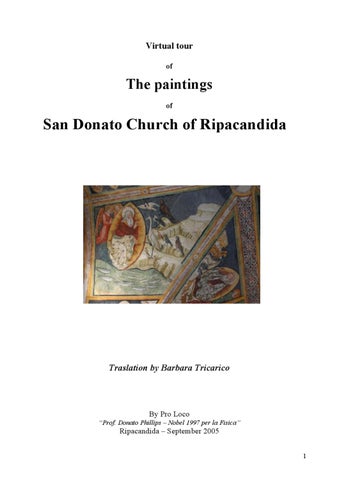
The church of San Donato has been defined by Sabino Iusco as the “little Assisi of Basilicata”. The order of Franciscan saints portrayed on the pillars, Francesco, Antonio, Ludovico, Bonaventura, leaves no doubt that it was originally meant for a Franciscan community. It looks like it was built on a pre-existent church, stated by the “Rationes decimarum” in the year 1325, as part of the property of the bishop of Rapolla, and committed to a clergyman. The same church is mentioned in a former document of Eugene III of the year 1152. The cycle of the Genesis starts in the last section of the nave, and continues throughout the middle section, with the stories of the Bible, up to those of Joseph’s. The first section is dedicated to the New Testament, instead, from the Annunciation to the Resurrection.
2
It should be noticed that between the paintings of the last and middle section and those of the first there’s a sharp difference of style and age, and according to the records there has been a new painter. Therefore the organized distribution of the biblical stories, which implies the intervention of a clergyman, and the perfect symmetry of spaces are followed by randomly arranged episodes of the Gospel. However, the Gospel scenes in the first section of the nave, especially the “empty Grave” on the first pillar on the right hand and the “Resurrected Christ” on the one on the left, suggest a profound theological reflection, that is the “omega” lecture of the history of redemption, starting from Resurrection and the Gospel, to better understand Genesis and the other biblical stories, and the lives of the saints themselves, through the passion, death and resurrection of Jesus. The second part of the works could have been determined by a seismic event, which especially damaged the first section of the nave. The painting of the church has been concluded around the half of the eighteenth century with more images of Franciscan saints: San Diego, San Giovanni da Capestrano, San Giacomo 3
della Marca, them, too, placed on pillars but only portrayed up to their bust in fake niches, in big shells and with orders of amoretti concentrated in the front of the triumphal arch. Many paintings have been lost or damaged in time, sometimes covered with altars or tombstones; you can especially see it in the side walls one of which has, in the middle section of the aisle, fragmentary stories of San Antonio, probably just as old as those of the Genesis. Therefore, we can tell at least three different painters, aside from the minor Pietro di Gianpetro da Brienza on the pillars and front of the triumphal arch. Starting backwards, from the latest to the oldest paintings, we’ll analyze the order of Franciscan saints which, being placed on the pillars of the nave, must have been realized after the scenes of the Bible and of Jesus. The order includes the most valuable piece in the church, “The ecstasy of Saint Francis�. The praying saint is staring at the Seraphim Christ who stands in the Sky with his open arms and with one foot on top of the other, like hung to the cross, wrapped in wings that look like flames.
4
The astonishment of the saint is emphasized by his gesture and the rip in his frock that shows the wound in his chest. The multiple-level-perspective is defined by Friar Leon, who is meditating in the back with a book on his knees, and by the little Porziuncola church set in a hollow of the rocks of the barren Verna. The quality of the work is showed by the arrangement of images in the limited space, and by the smooth shift from the vitality of the folds of the frock to the quiet ecstasy. Very similar to San Francesco San Antonio and San Bonaventura, both holding the lily and the book. They all have a golden aureole with sharp spears, emaciated faces, bony cheeks and thin lips. The same features we find in the image of a Precursor, him too confined on a pillar. A strange style, unusual for the area but more popular in Rome, represents him wrapped up in a mantle with red lining that, with big folds, goes all the way down to the floor and winds up under the saint’s foot. The mantle uncovers a gown made out of goat skin. John’s message that should be contained in the small paper roll, is replaced by the saint’s gesture pointing to the Holy Lamb. The image is lively and the definition of the mantle shows more details than the chastity of the Franciscan frock could offer. Three more saints on pillars, Lorenzo, Ludovico e Lucia, seem to be less accurate in realization: they were probably commissioned to some other artist but they still follow the 5
pattern of the master. In the images of Lorenzo and Ludovico we can notice the natural look of the folds falling on the tiles of the floor. Except for Lucia, which is wearing a Franciscan dress and holding the usual cup with the eyes and a stick that made a wound in her throat, the saints can be attributed to a great artist of the time. This artist could be Nicola da Novi, the same painter that in 1513 signs a Christ in Pity and a shameless Eve in Senise, in the old cloister of the Minors. He follows the patterns of the international Gothic, with hints of the Spanish Naples: it’s like a blend of Spanish and Dutch style, flourishing in the capital but also in Basilicata. That would confirm what has recently been stated by “La Bautta” Publications of Irsinia: that Nicola da Novi is from Novi Velia, in province of Salerno, a town that has been called just Novi up to the nineteenth century. The painting of the pillars of San Donato church shows a later intervention of Nicola da Novi, dated in the third decade of the sixteenth century. We can notice further borrowings from the capital. The author of the Jesus cycle in the first section of the nave is Antonello Palumbo from Chiaromonte sul Sinni, whose name has appeared lately at bottom of a painting representing a Madonna in Majesty in San Francesco a Pietrapertosa, dated 1498. But let’s go back to the Jesus cycle. People and places are clearly taken from a humble country world.
6
In the Nativity a shepherd is playing his pipe to the sheep while his dog is lying down next to his feet and a little barrel and a donut are hanging from the tree. In the Annunciation, Gabriel’s wings almost look like hawk’s wings and he’s wearing a gown with a multitude of folds, in order to clarify the meaning of the Incarnation, it’s the Eternal that hovers to bring the offer of the grown boy. The meaning is explained by the writings in vulgar Latin underneath, that sometimes go outlines when there isn’t enough space. They are old sayings of traditional wisdom: <In inferno non abet redecio> (‘There’s non redemption in Hell’) or <L’omo vole essere forte contra lo dimonio> (‘Man wants to be stronger than Satan’), that goes through(?) the next frame. On the paper roll of a “Sebilla” it says: <Vade retro Satana>, (‘Back up, Satan’), with the rest of the writing underneath the roll. It is just obvious that Antonello had other artists helping him. They took care of the Hell section on the right hand. This section, though lower in quality, shows a good creativity in the satanic dance. 7
We only need to find out, now, the identity of the first master, the author of the biblical stories. It seems to be a painter from the area since he uses familiar scenes and turns historical events into images that could be used for a vaudeville. In “Jacob running away from Labano’s house” the sheep are feeding themselves on the grass and the shepherd is playing his pipe on a bridge. At the bottom of the picture another shepherd is pushing a bunch of calves whose shapes are a little personalized. But the most genuine scene is the one of the little family of the countryman, who’s walking from the fields after a day of hard work, holding by the leash his donkey ass rode by his wife and children. Three brothers are riding another mare led by the voice of the man following her, while another countryman is talking to his family from the back of his horse. We find more vignettes of everyday life and country world in “Abram’s Sacrifice”: two servants are sitting on a rock and, their donkey 8
ass being fastened, they fight over a little barrel of water they took out of the bag on the ground. The building of the ark and of the Babel tower tells us about the works of carpentry. We can see workers at the winch or arranging bricks.
In some scenes, like “The blaze of Sodom�, drama is turned into comedy: flames are coming out of the angioino castle like fireworks.
9
The same could be said about “The murder of Abel” where blood squirting from his head hit by Cain, is going straight to Heaven along with his soul. Everything is familiar and shows good feelings. In the wedding of Jacob and Rachel, Labano joins the hands of the bride and groom, both wearing regular everyday clothes. The struggle between Jacob and the angel turns into a loving hug. The fairy tale atmosphere is conveyed by the moonscape background with silica rocks, and chivalric gentlemen and shy maidens wearing XV century outfits. Women wearing long gowns with big belts, and a shawl wrapped around their head that falls on the side or goes around their neck. Men in jacket, little skirt and tights, wearing a small hat or a hood. Studies on the author of the biblical paintings say he’s from the area but was educated in the capital. It’s worth noticing, though, the similar features between the unknown author of the paintings of the Old Testament and the works of Nicola da Novi.
10
Cain’s mask in the scene of “The reproach of the Eternal” looks exactly like the one in “The Ecstasy of San Francis”; the same can be said about the multiple level rock. The golden aureoles of the Eternal and of the angels remind us of those of Saint Francis and the Franciscan saints. The multitude of folds in the Eternal and Jacob’s mantle resembles the frock of Saint Francis as well as those of Saint Lawrence and Ludovico, whose soft hair looks like the hats of Noah’s family entering the ark. Moreover, the two artists have in common the dark outlining of the single images to better highlight them, and the sharp definition of the buildings. All of the above can’t be a coincidence. These considerations bring us to the conclusion that the painter of the Old Testament is Nicola da Novi himself, in 1506, in the first season of his career. The interruption of the biblical cycle, probably due to a seismic event, determined the intervention of Antonello, which probably happened, in the Jesus cycle, between the first and second decade of the century. When Nicola eventually came back, in the beginning of the third decade, it’s the period when the order of Franciscan saints on the pillars can be dated.
11
Bibliography
12