For my children Nettle, Flo, Harley and Nathan and for grandbaby Kitto... the loves of my life.
Published to accompany the exhibition
GRAVITY
Nick Grellier
The Chapels of Rest, Stroud June 2026
text by Dr Paul Harper, Dr Emily Lucas, Nick Grellier
Text © the authors 2026
No part of this book may be reproduced, stored in a retrieval system or transmitted in any form, or by any means, electronic, mechanical, photocopying, recording, or otherwise, without the written permission of the publisher, except for the purposes of research or private study, or criticism or review.
Produced and designed by Nick Grellier
Printed by Mike Horan Printing UK
With thanks to Stroud Preservation Trust for use of the Chapels of Rest
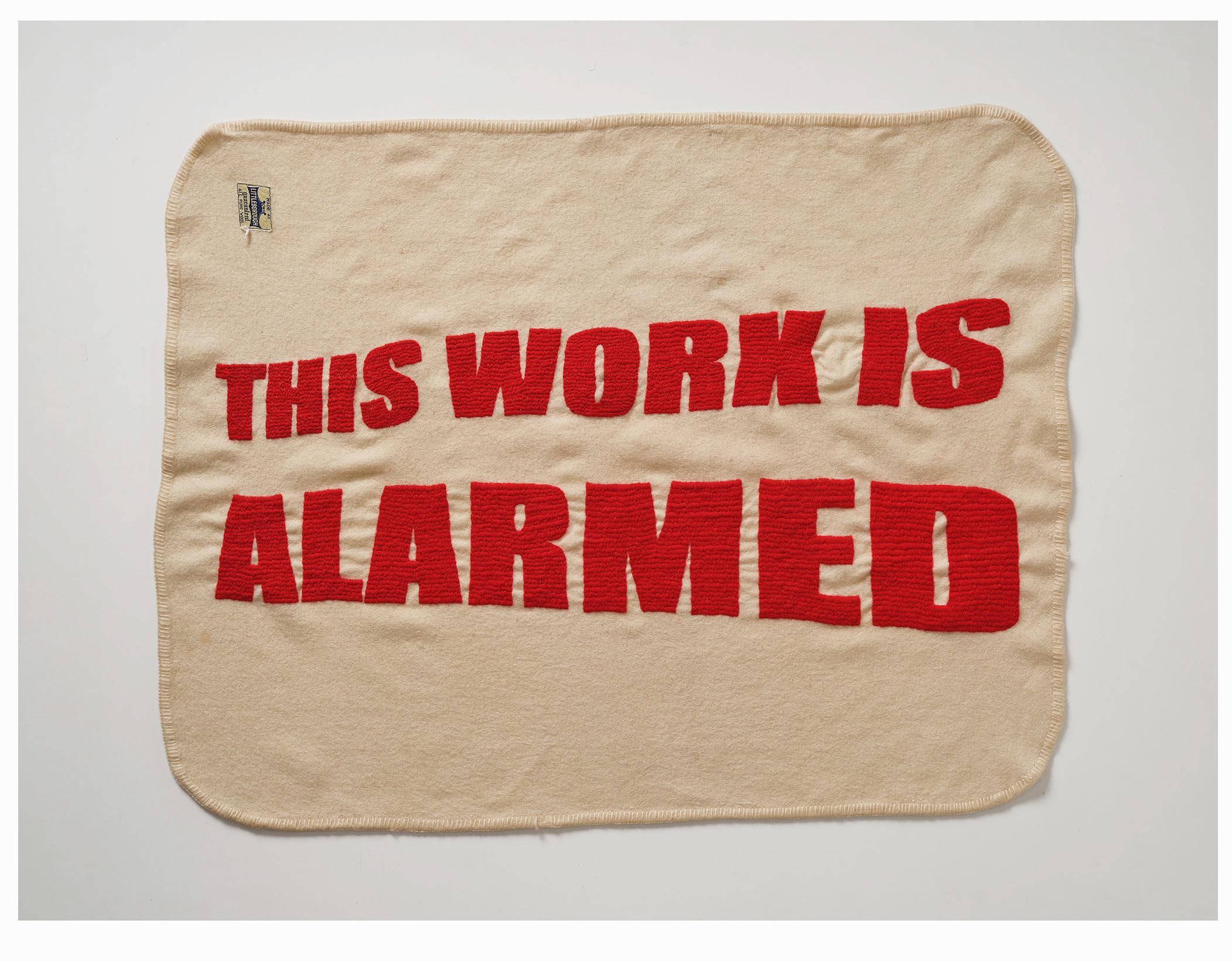
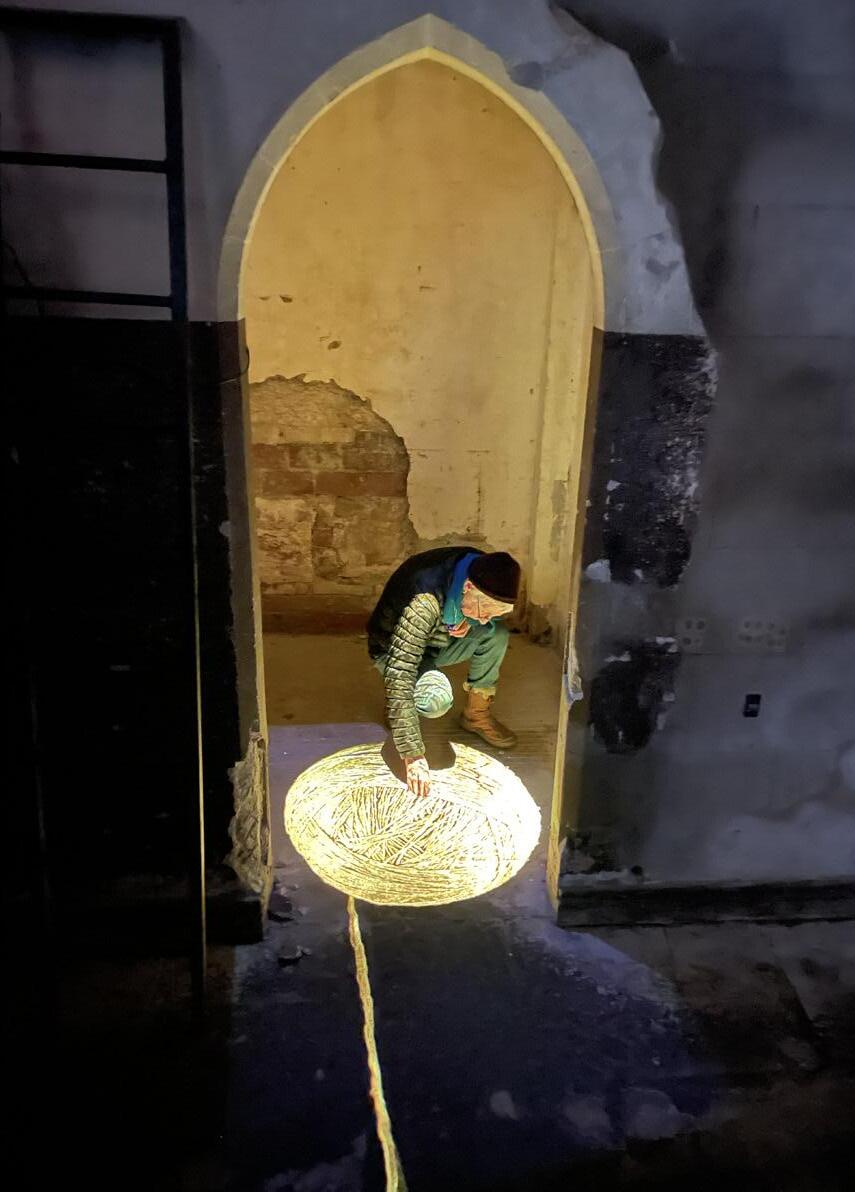
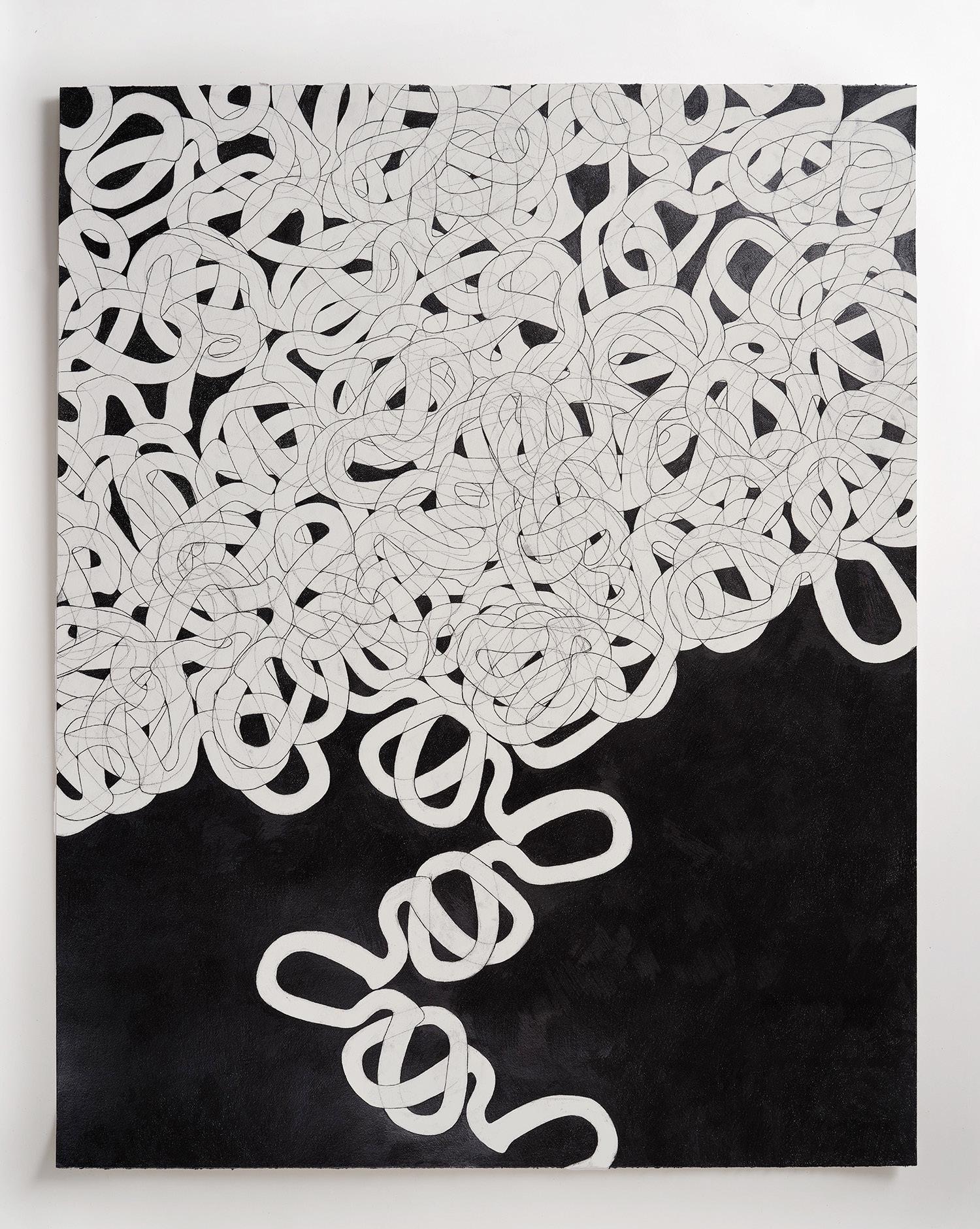
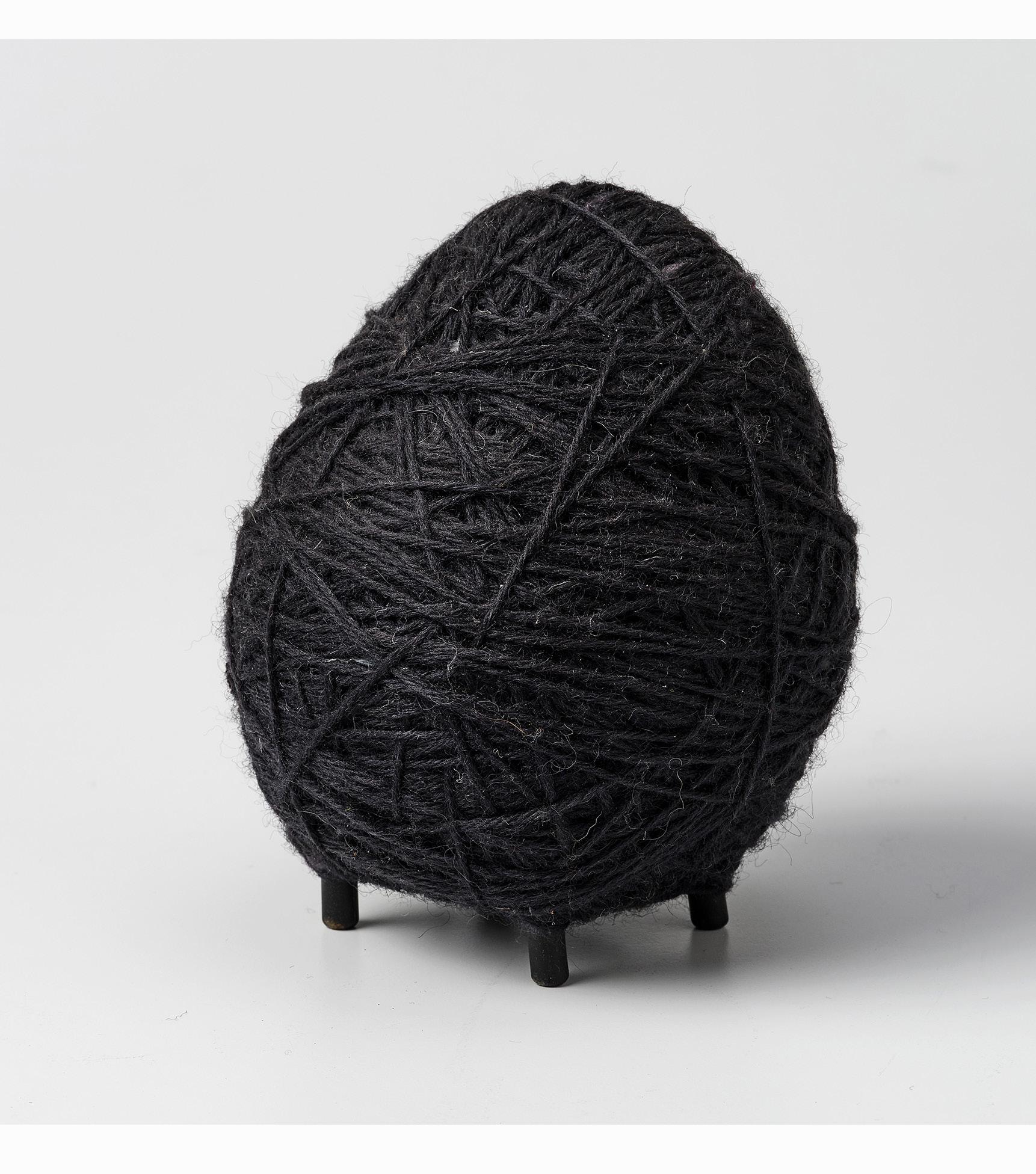
Warning! 2025, wool yarn and blanket, 85cm x 110 cm
/’graviti/
the force that attracts a body towards the centre of the earth, or towards any other physical body having mass
extreme importance; seriousness
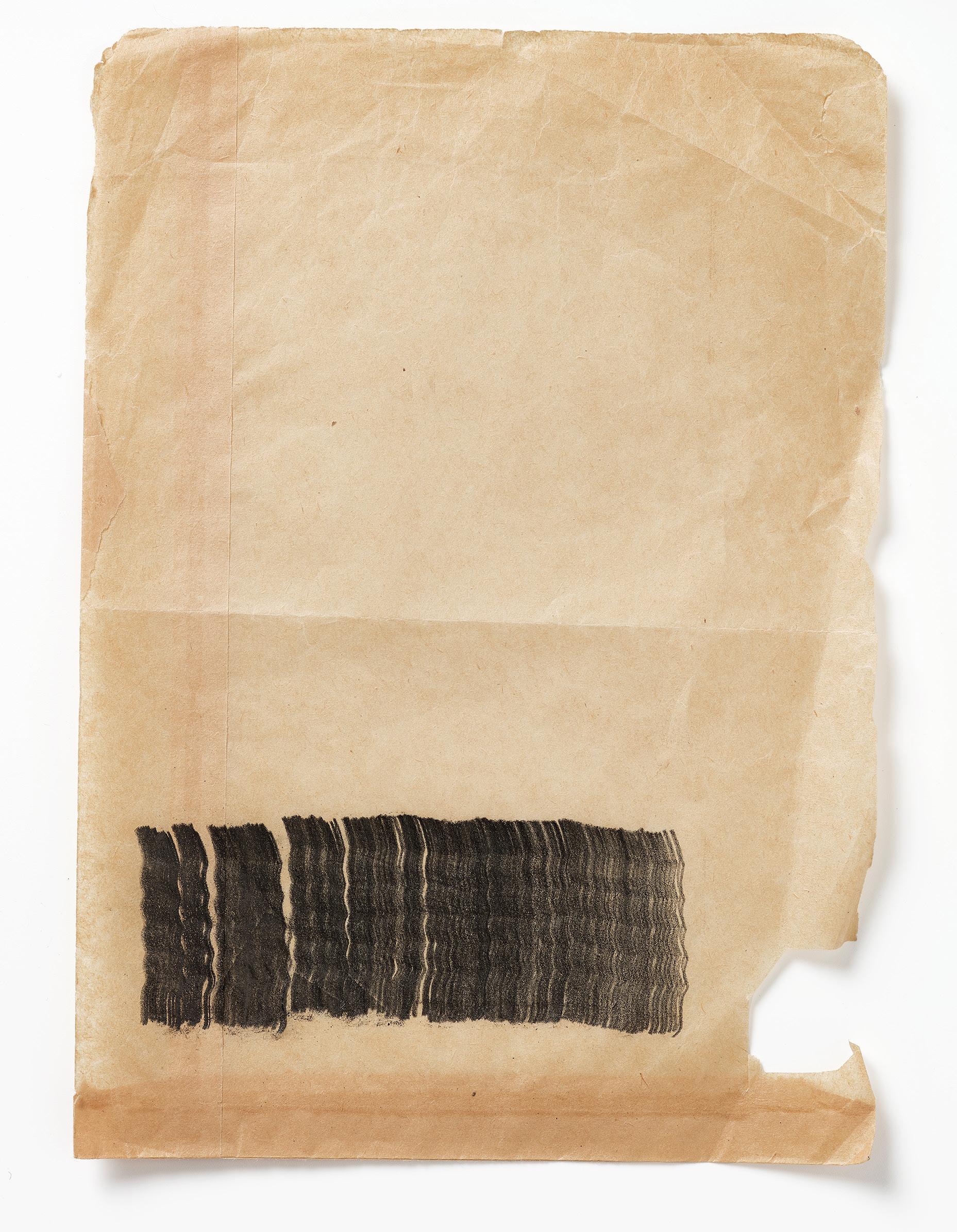
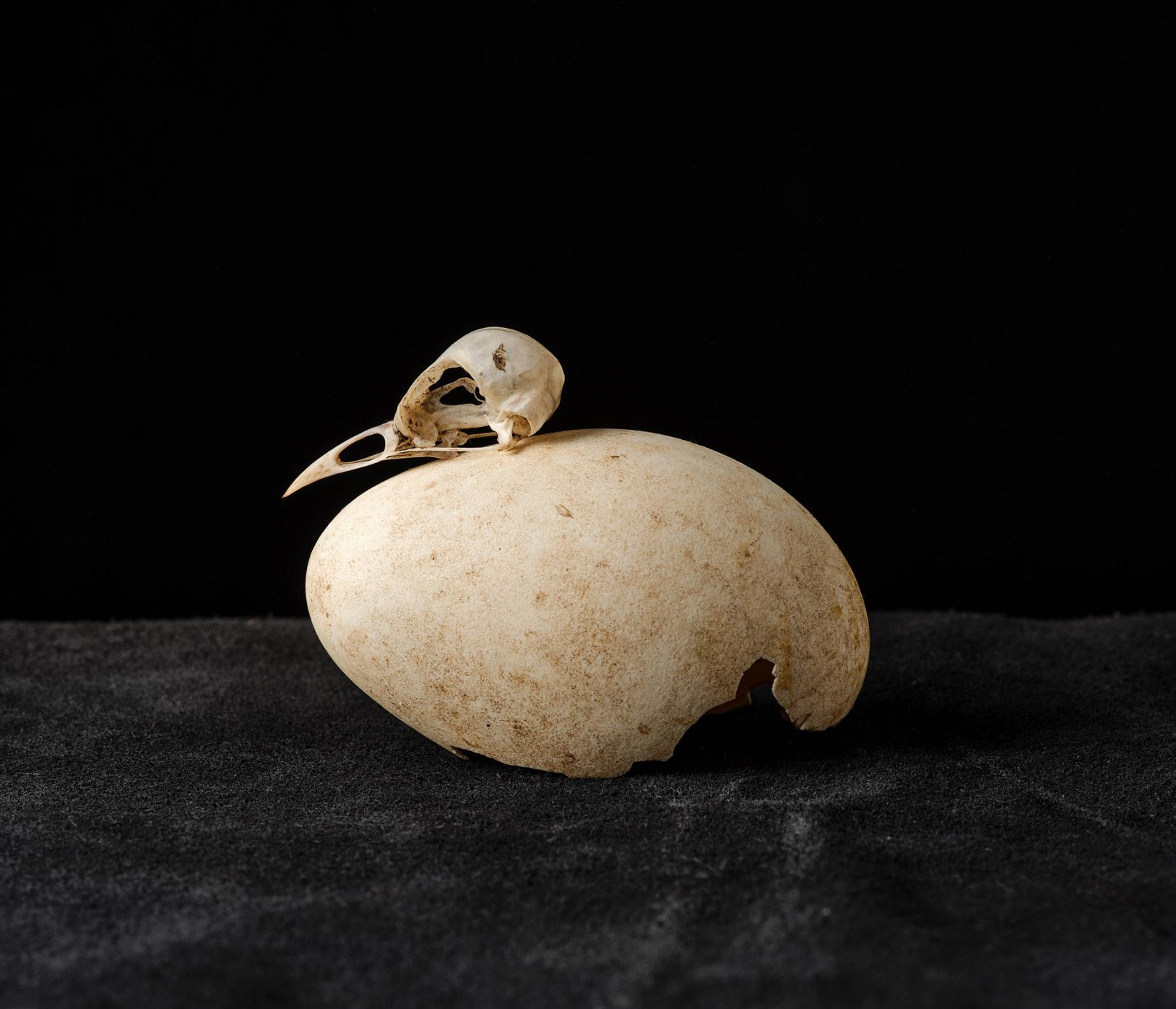
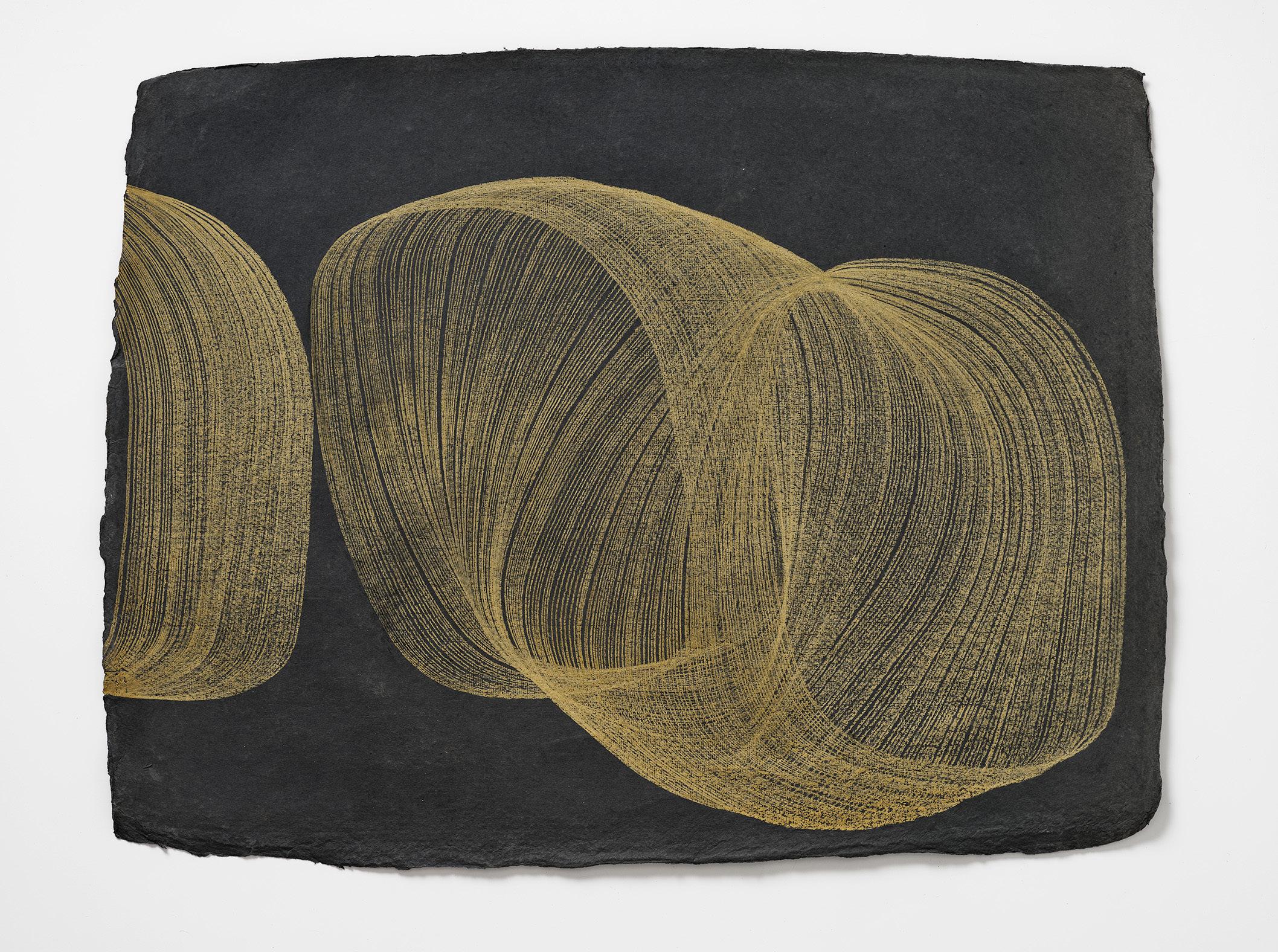
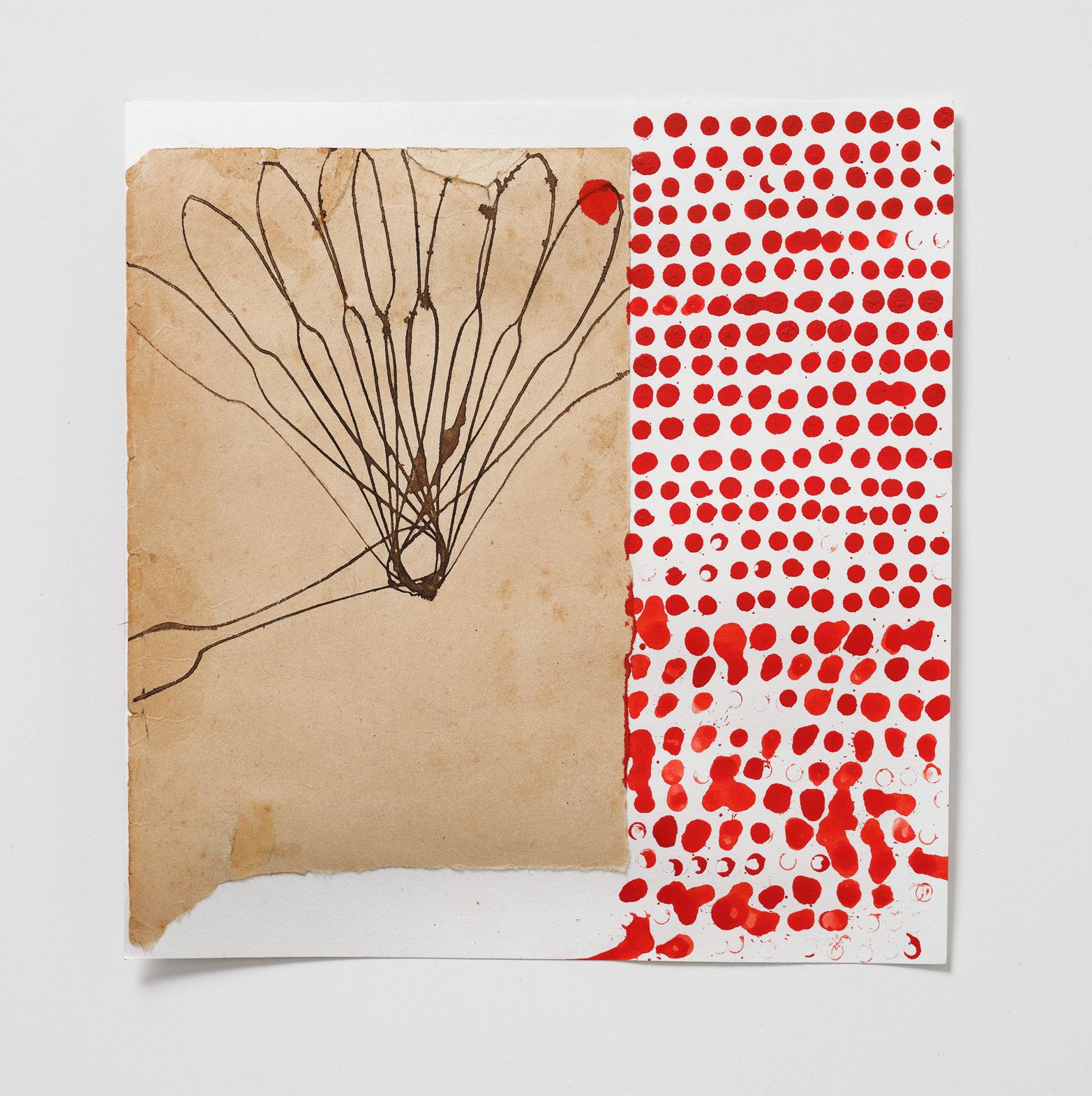
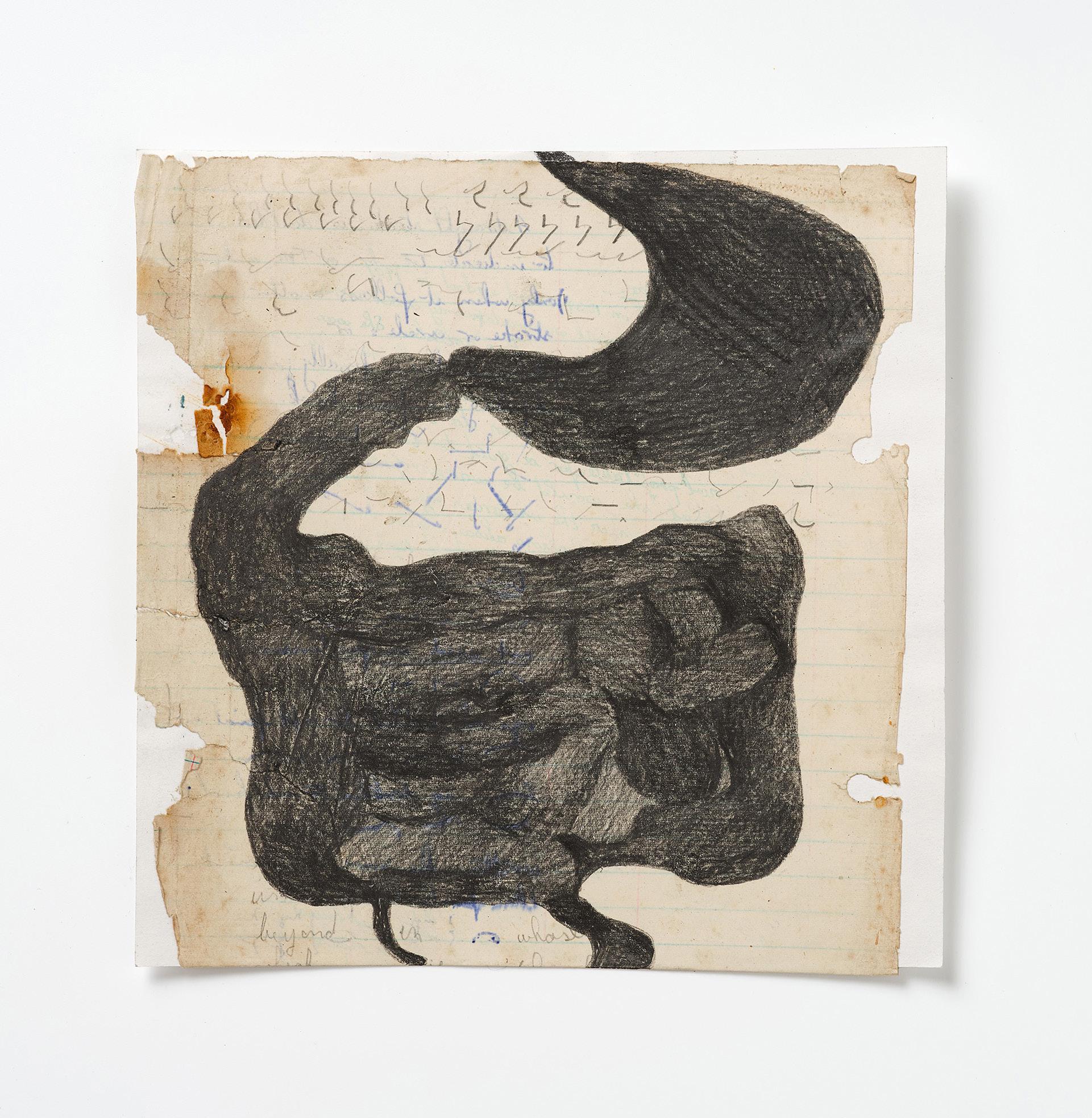
Mothering, 2026, blackbird skull, goose egg, giclee print on hahnemuhle paper 20cm x 17cm, ed. 20 previous page: meditation on Larry Grenadier The Gleaners #6, 2025, graphite, found paper, 25cm x 18cm
Text by Dr Paul Harper
The following text has been shaped by a series of conversations between Nick and myself, which took place in her home and studio over a period of several months. The luxury of this extended, discursive exchange allowed me to see the work that she has gathered for this exhibition within the broader context of family relationships and history, her unfolding career as an artist, her creative routines and habits, and the generally messy practice of everyday life.
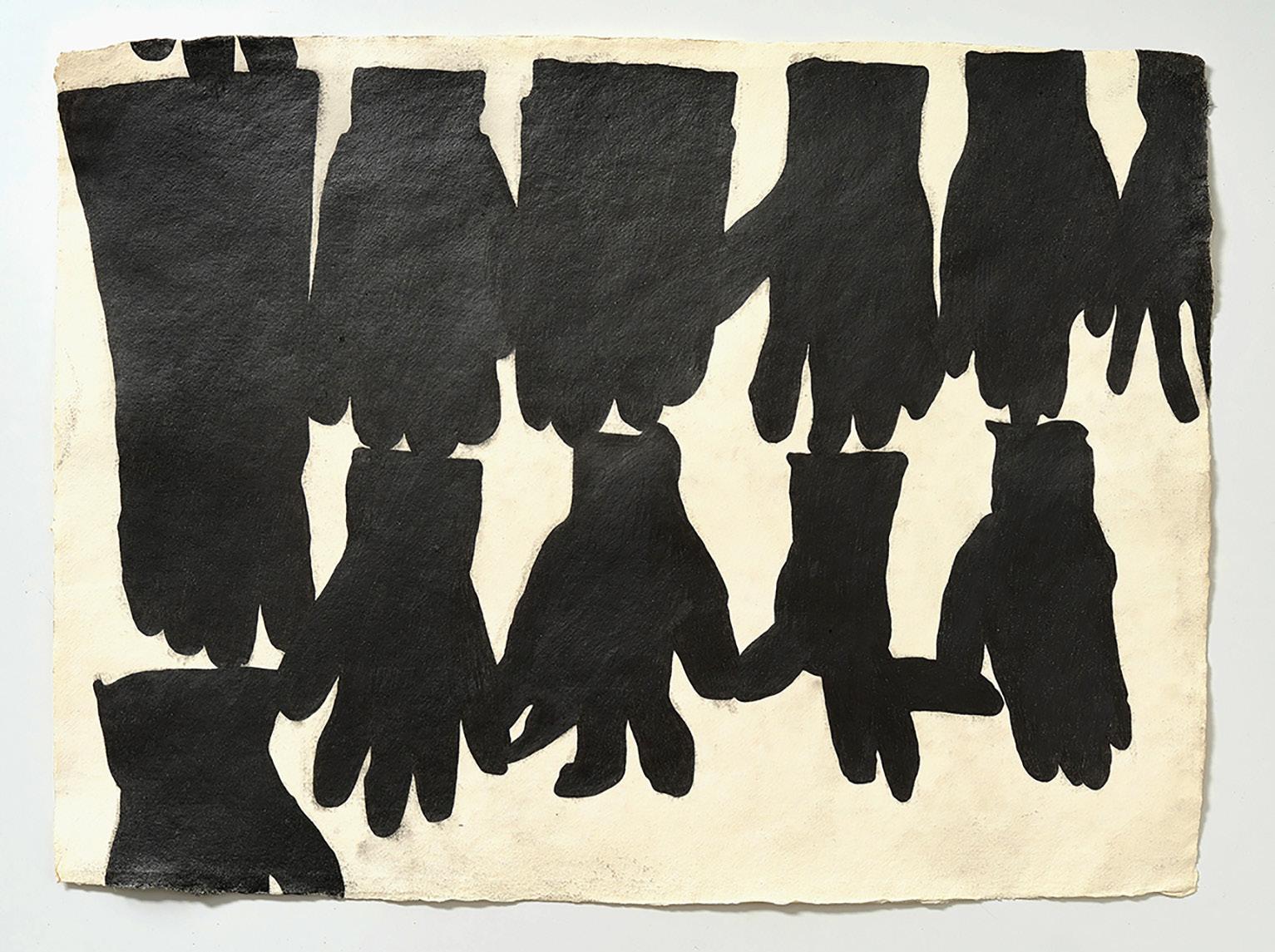
One of Nick’s daily routines is walking. As she walks she is compelled to pick up rubbish, amongst which she finds discarded treasures – including plastic figures and bottle tops, and a bulging sack of single builders gloves. In the course of my visits to the studio I see some of the collection, stored in bags and boxes, transformed into new work. But Nick’s habit is more than gathering raw material for work. Rather it is a way to be actively engaged in the world. When she is walking she is looking, alive to the world. Since being astonished by this collection, every time I leave the house I seem to find a single builders glove lying in the street. Looking can be cultivated. Perhaps this is a significant point about art: that experiencing it as artist or audience can make us more attentive, more present, it can help us to see the world.
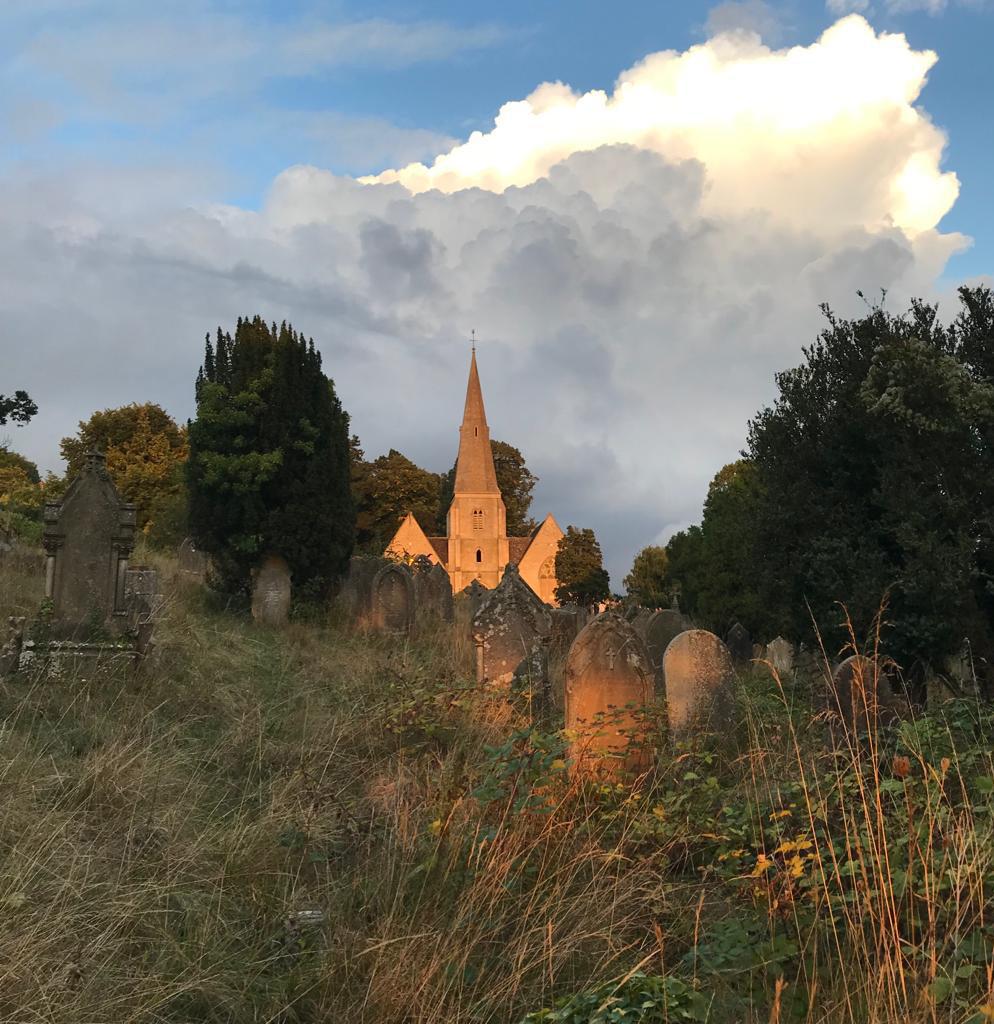
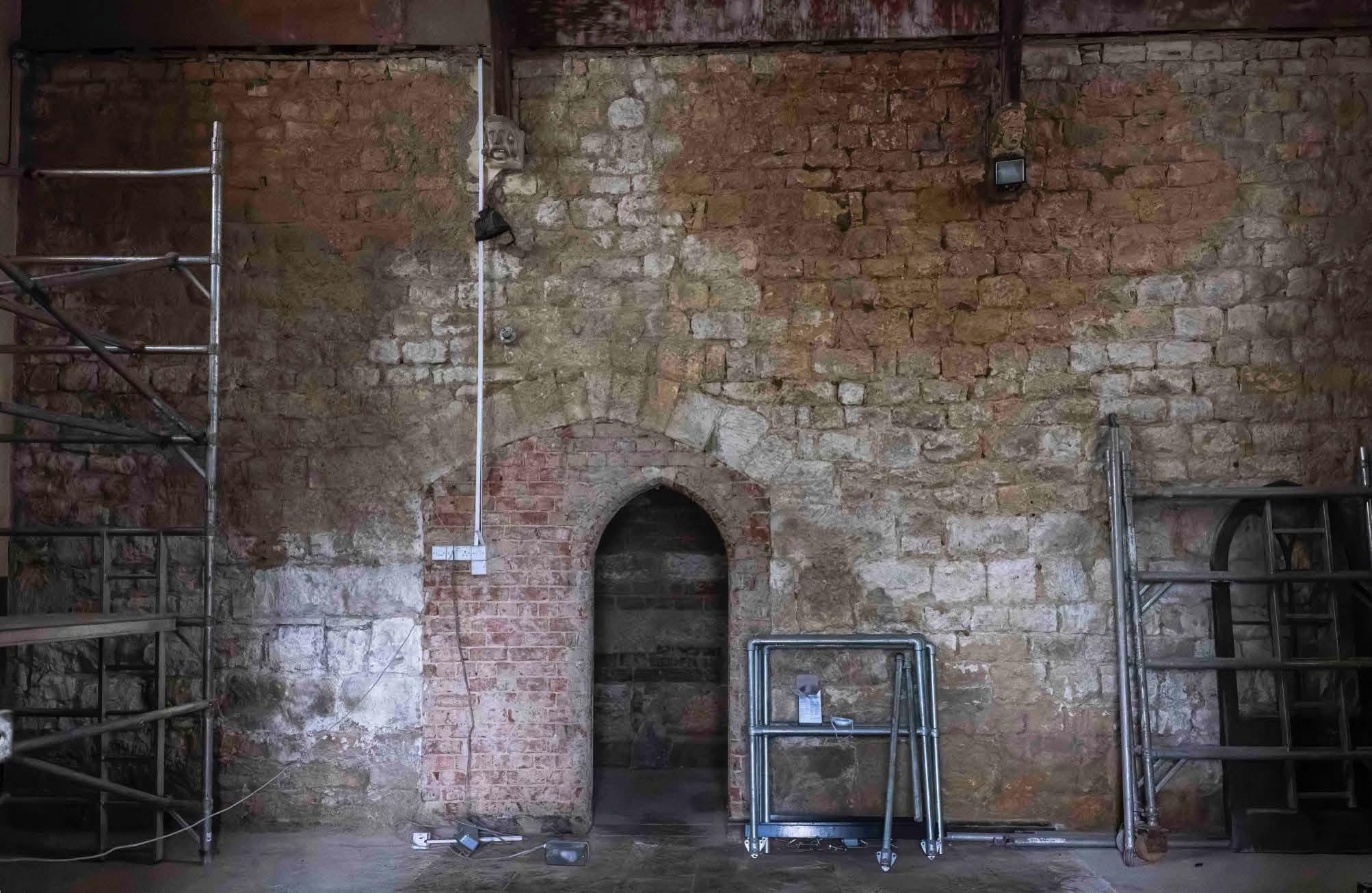
The exhibition is often seen as an end point, separated from the flow of life and the actual day to day experience of art making – it’s exact methods, propensities, sensations and competences. In this conception the artwork is placed in a gallery to be viewed as a detached object of pure contemplation. However, in my conversations with Nick it is clear that the exhibition is really more like a resting point, a point of reflection, a drawing in of breath in an endless process of making that is continuous with those other aspects of her life. It also becomes clear that this process, indivisible from Nick, her workspace, and the wider context of making, is not merely a means to an end, but that it is a way of being, and that all of these things are, inevitably, embedded somehow in the content of her work. Vitally, this exhibition is part of an ongoing relationship that Nick has developed with a particular site – a physical context –the twin Chapels of Rest, which sit within the Stroud Cemetery. The building has been brought back into use as a community resource in recent years after a long period of neglect. When Nick has made exhibitions here in the past it was cold and damp, with crumbling plaster and a dim crepuscular light. The building is undergoing a programme of improvements, but it will retain its specific sense of place, linked to location as well as it’s unique character. The Chapels of Rest plays an active part in the construction of meaning - it is not a neutral white cube gallery space.
Another central site is the studio. Shaped by distinctive practices and reflecting something of the artist’s personality, studios are all different, and yet they are all familiar, human spaces animated by the presence of the artist. They have evolved on a human scale, everything within reach. They may have tools and materials in common of course, and a kind of disordered order, a ready-at-handness, a system that is linked to action and purpose. There are drawings, scribbled notes, models, experiments, some that have been set aside, temporarily abandoned or rejected. There are works in progress, and their associated waste materials, all the detritus of making. There are images and objects that represent reference points for the work. The studio becomes a repository of memory and a kind of feedback loop. But alongside these things, all studios share a sense of intimate introspection. The artist has gathered this space around themselves to facilitate reverie as well as production. It contains not only the tools and materials for meeting the immediate needs of making, but it contains the seeds of future projects, it evokes or stimulates possibilities for new work.
Nick’s studio shares all of these properties. It is an oddly angled room in her oddly angled, labyrinthine house. There are large windows on two sides that look up towards Folly Lane and across the valley towards Hawkwood. On my last visit, the view from one window is filled by a cherry tree in blossom, a harbinger of spring. Inside, there is also a sense of imminence as work for the exhibition accumulates.
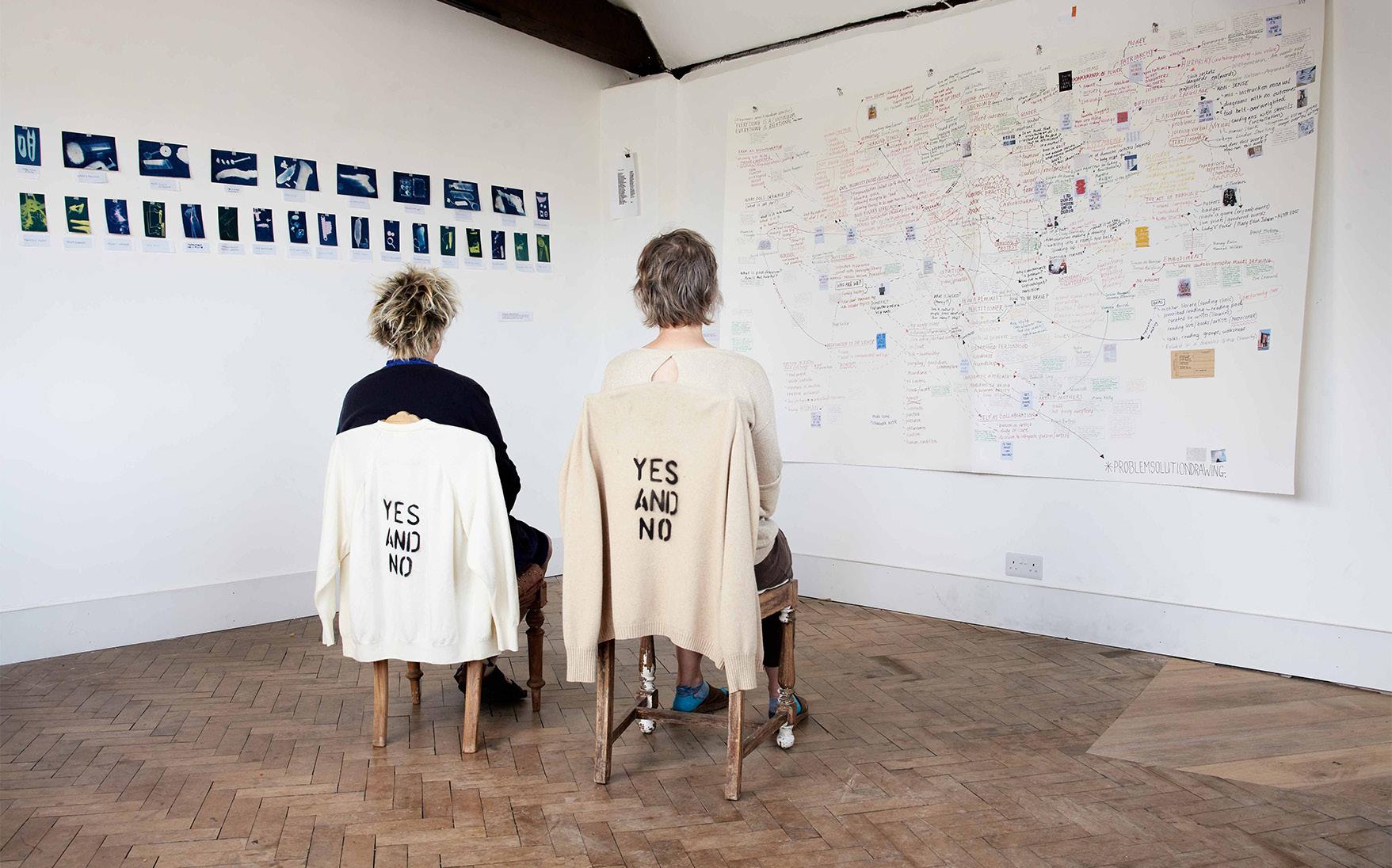
On the walls there are layered notes, lists, drawings and paintings, scrawled words and sentences – prompts, statements of intent, puns, jokes, slogans, graffiti? The accumulation of image and text becomes a poetic, collaged externalisation of Nick’s thought processes. A paradoxically chaotic and coherent picture.
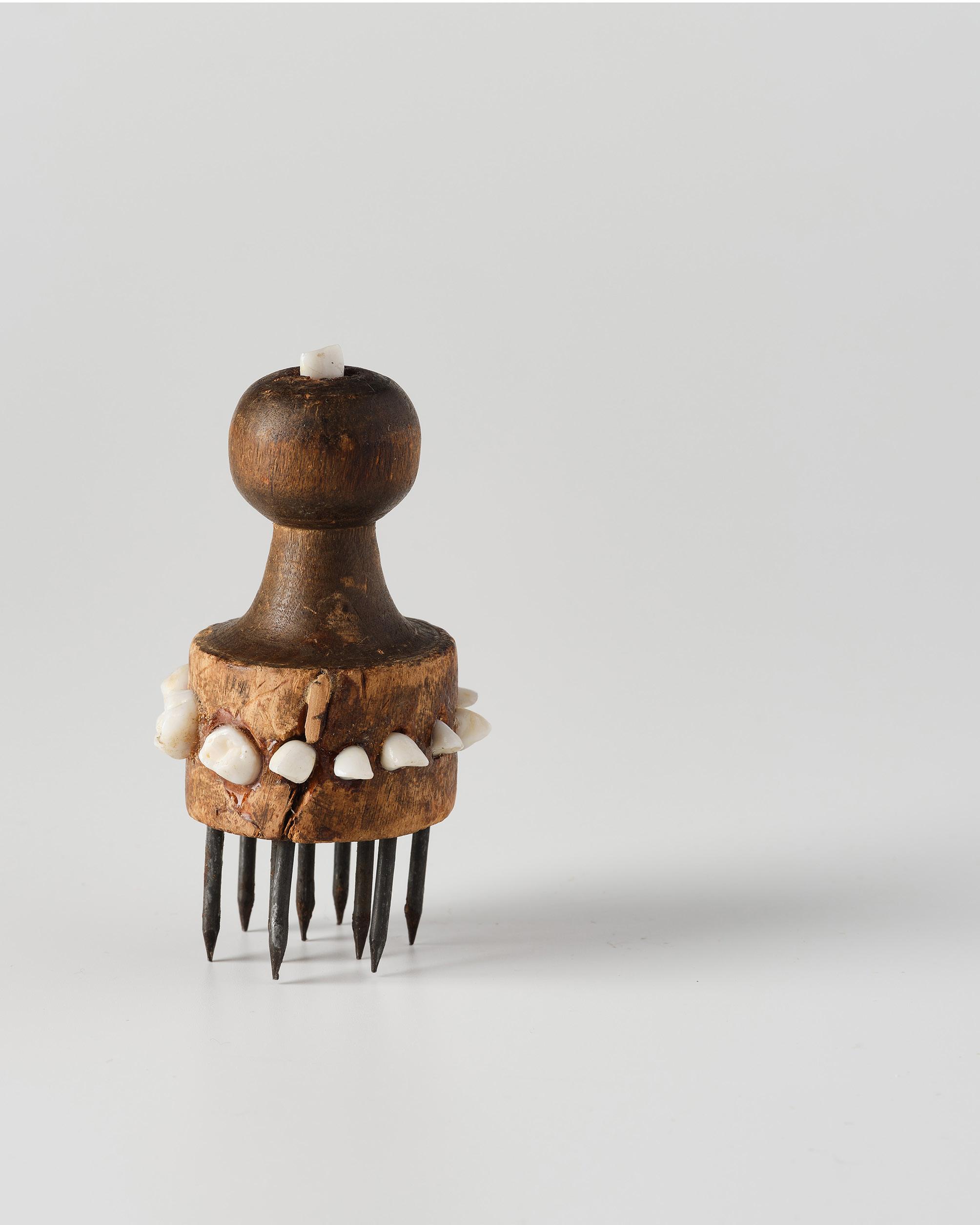
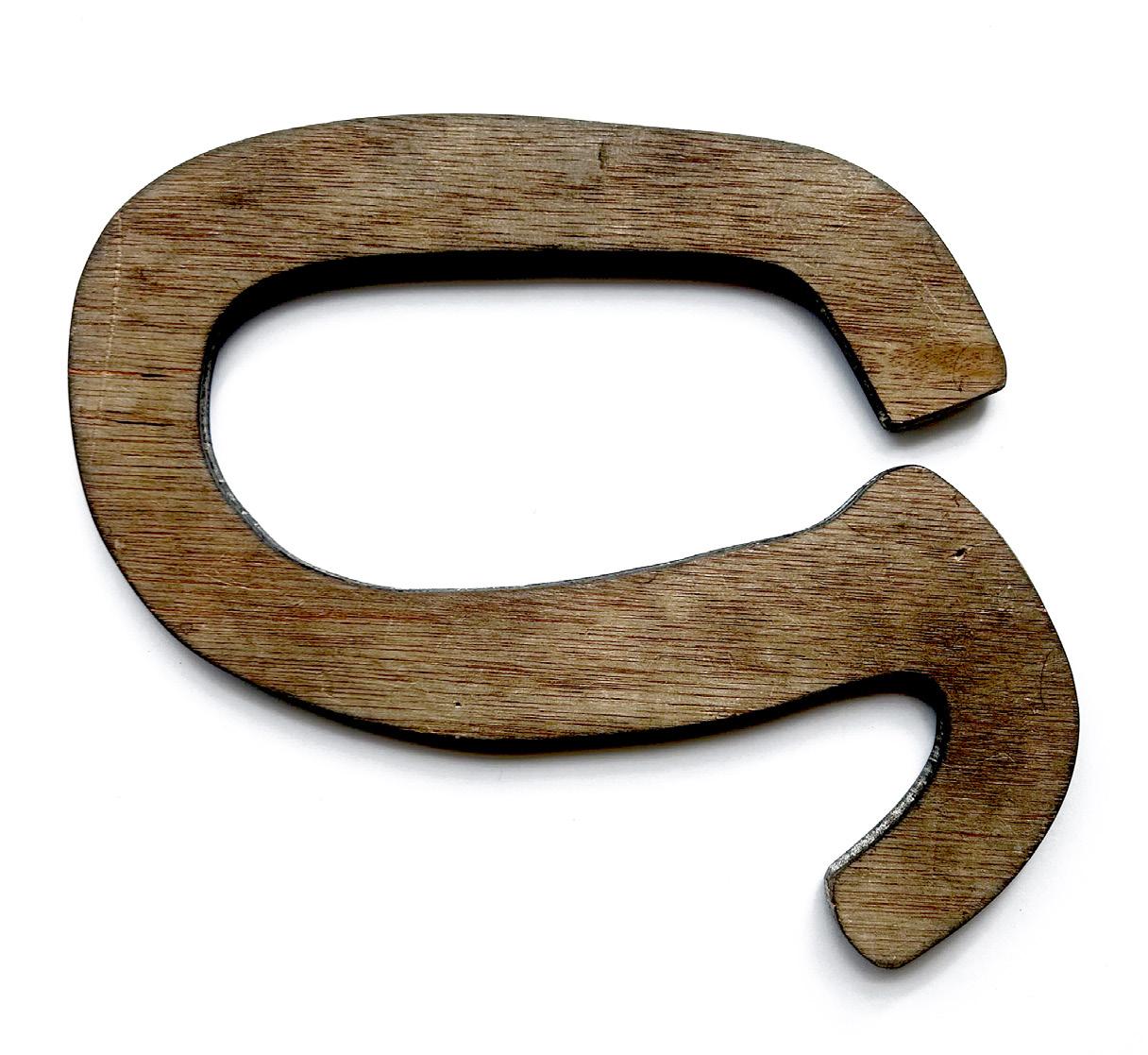
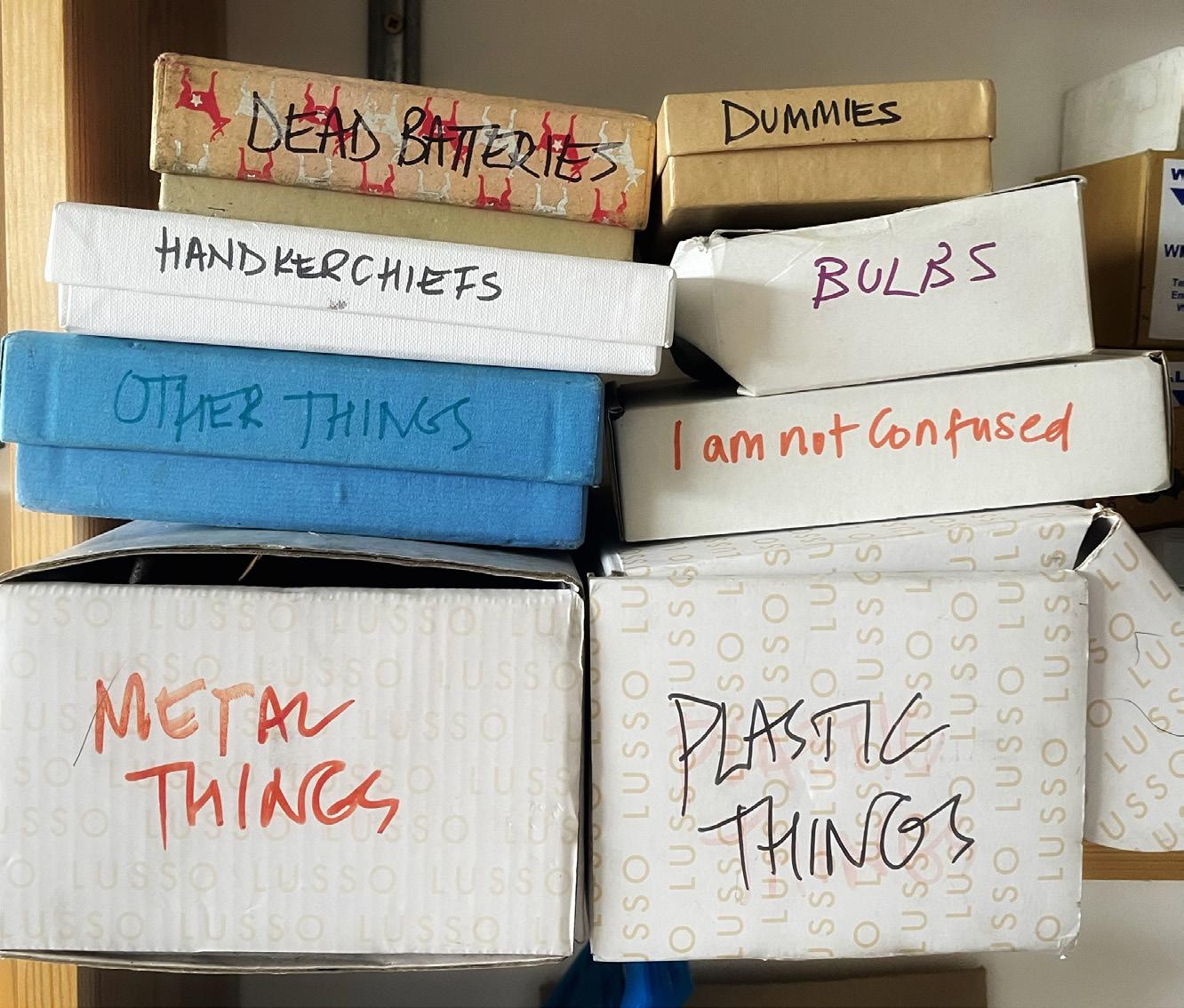
From a drawer under a work bench that bisects the space Nick pulls out a box to show me a selection of improvised drawing tools that correspond to shapes and textures that are familiar from the drawings.
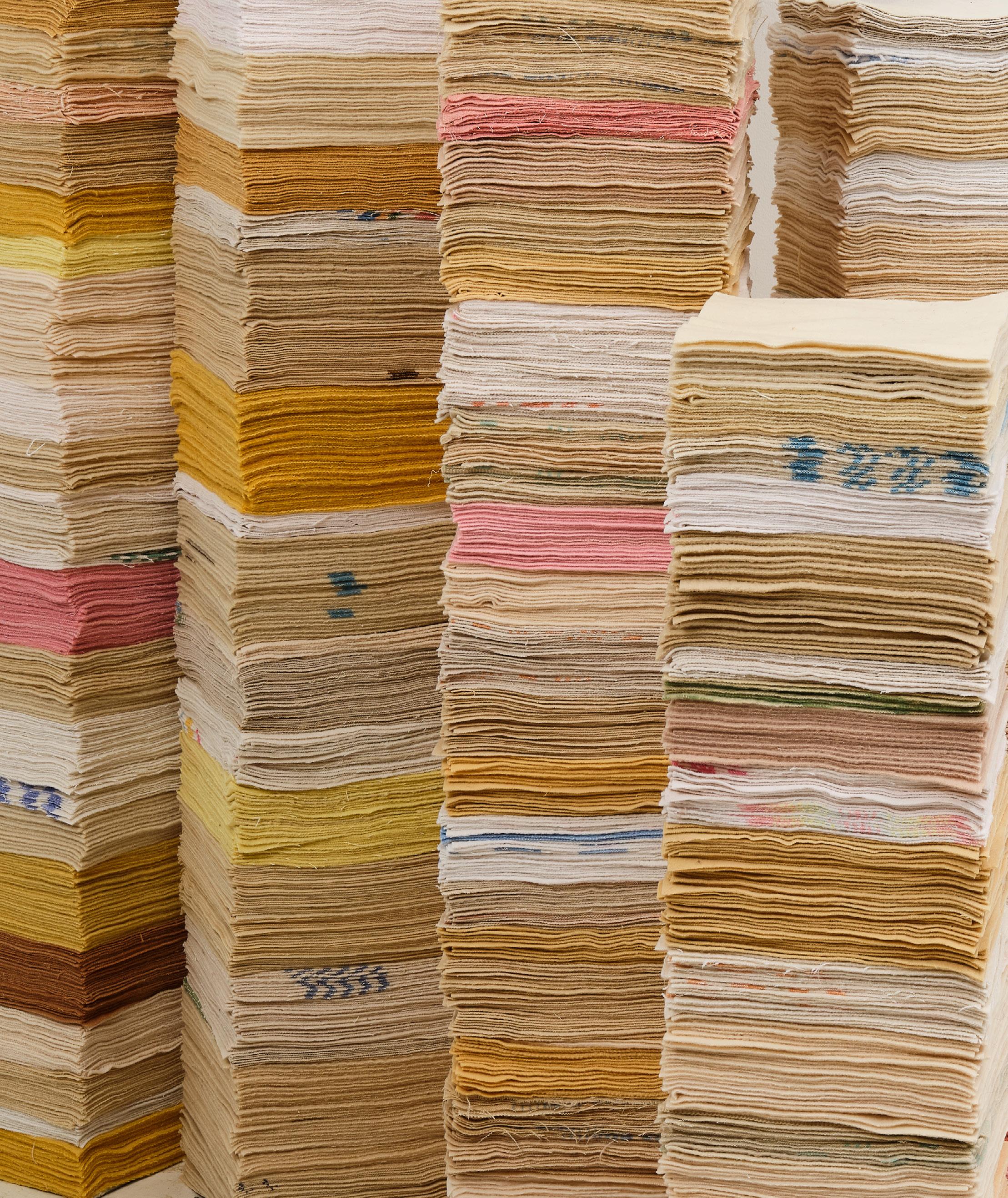
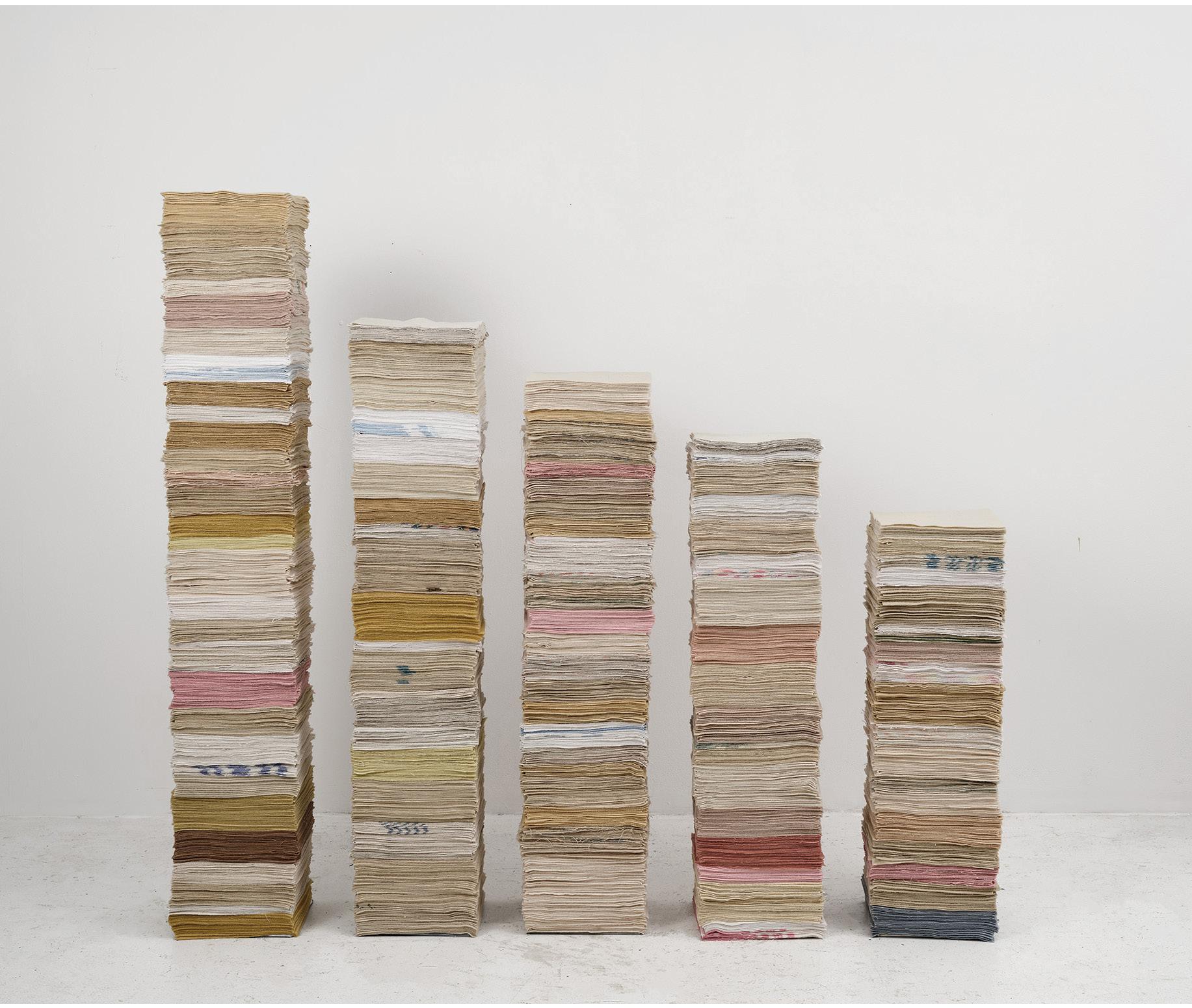
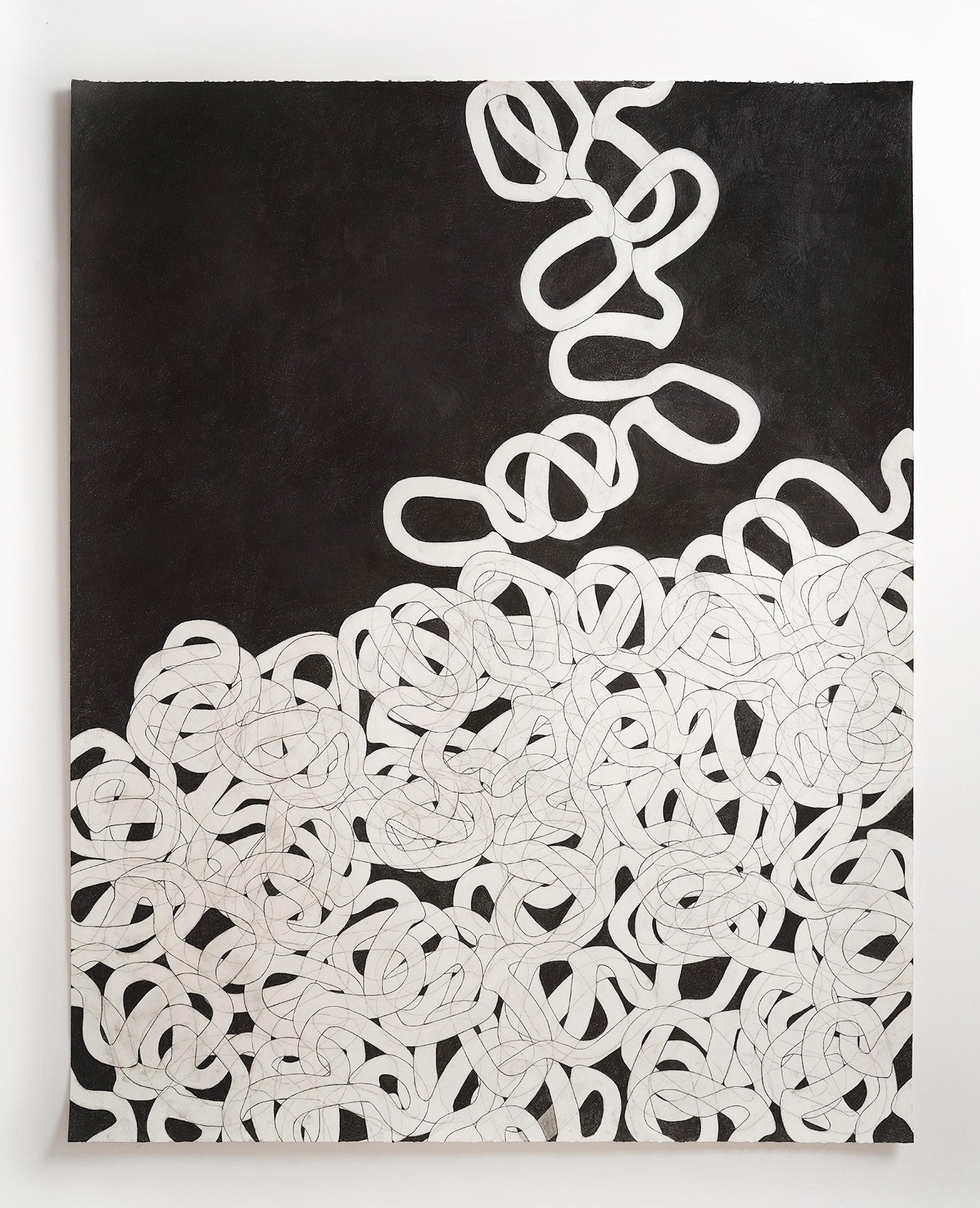
On the floor of the studio stand several tall, slender columns formed of blankets, cut into squares and stacked, neatly secured by a central metal pole. They are both monumental and domestic, geometrically formal and sensual. The small discs of blanket left from punching the holes to accommodate the armature, essentially waste material, have been strung into long coils that evoke intestines, a motif that is repeated elsewhere in recent drawings.
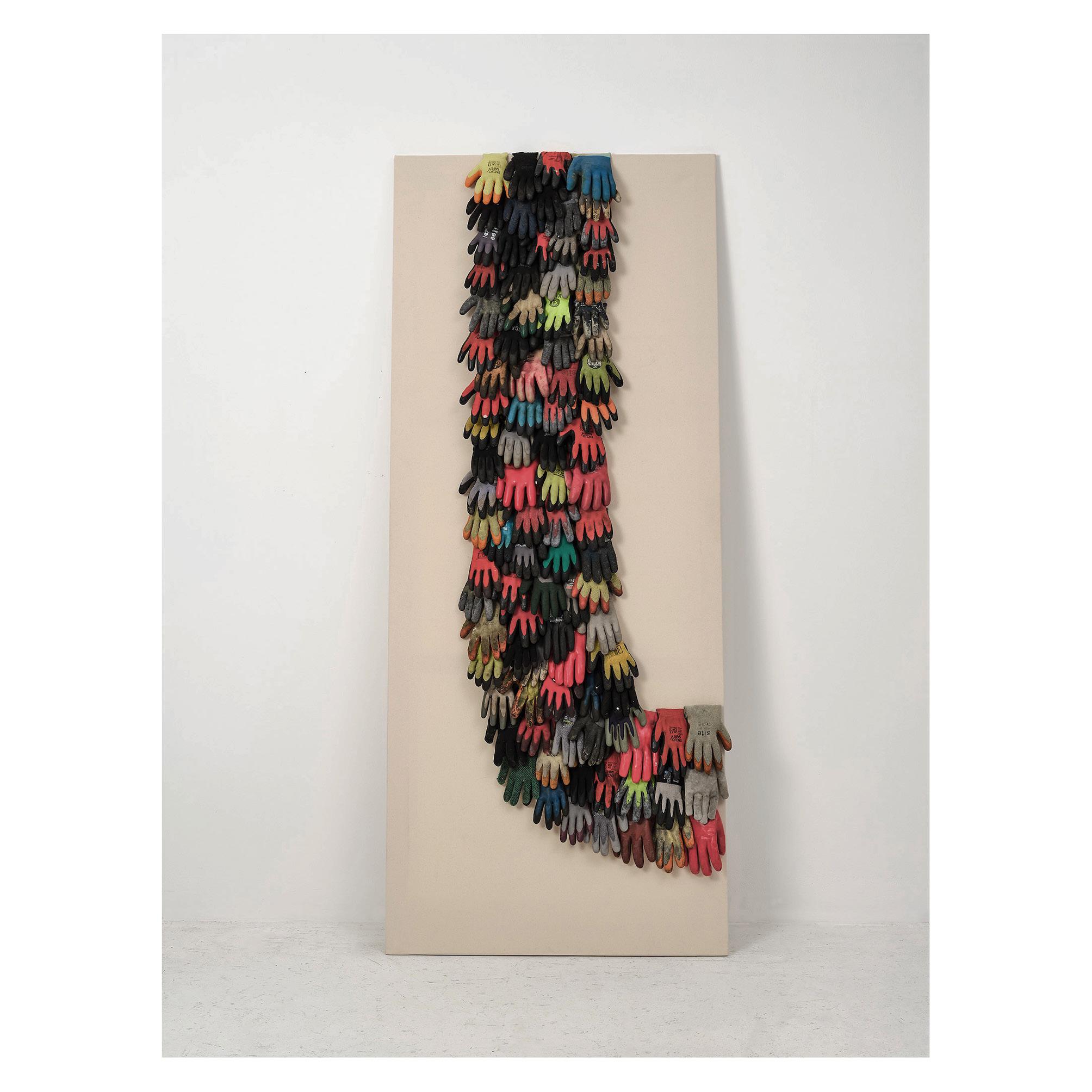
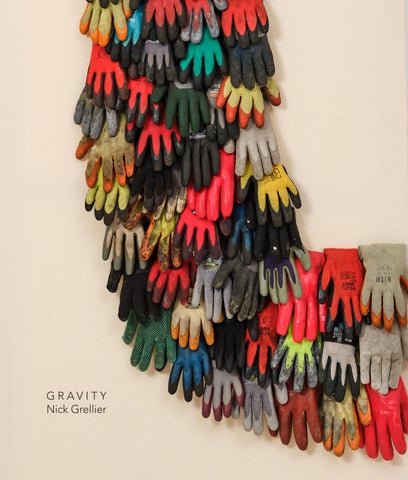
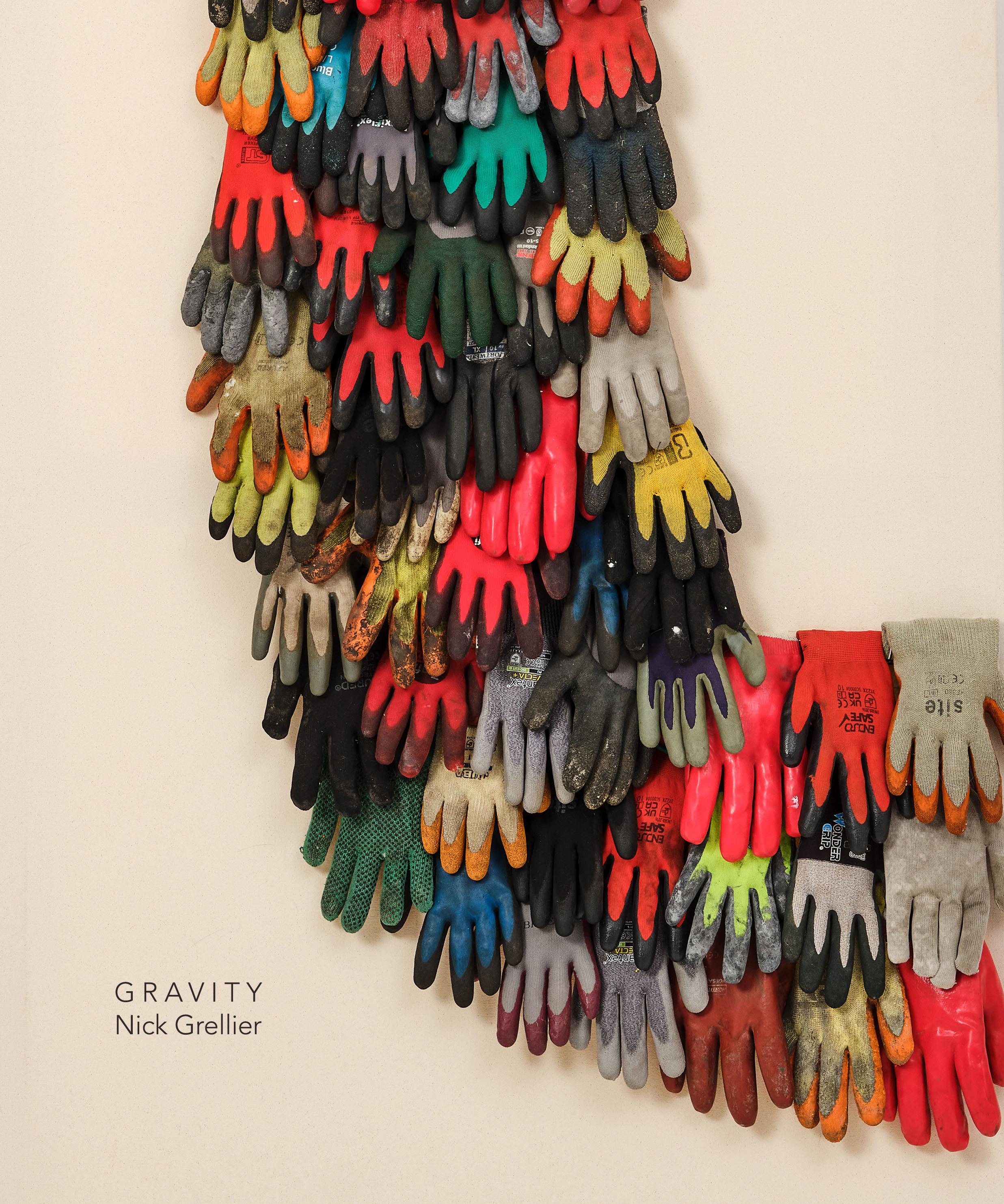
Smile (give us one), 2026, builders gloves, canvas, 100cm x 240cm x 8cm
The glove collection has been meticulously stitched onto a huge canvas so that they resemble a multicoloured cascade – of carelessly misplaced or discarded detritus perhaps. There is craft, playful humour and beauty and critique in these works.
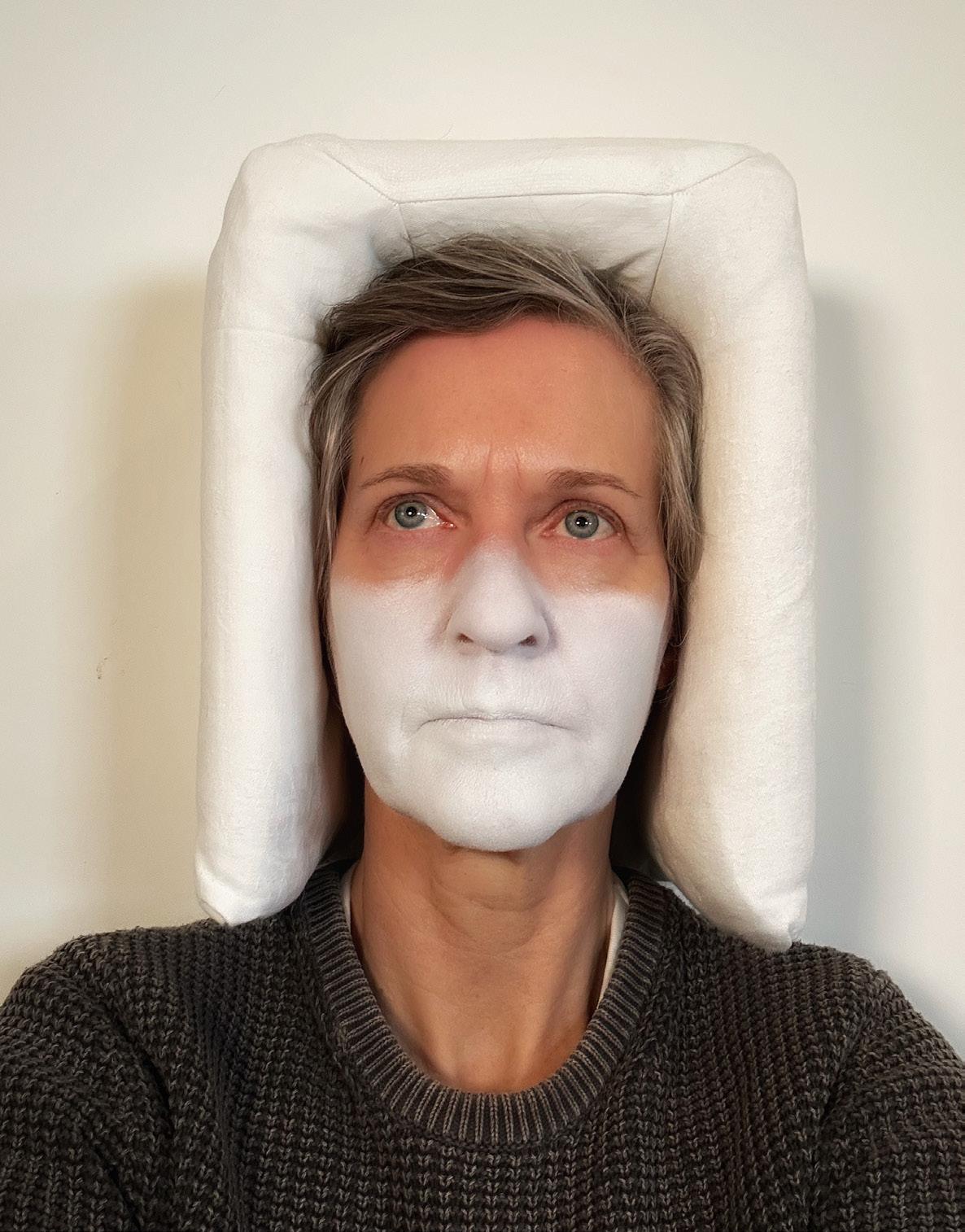
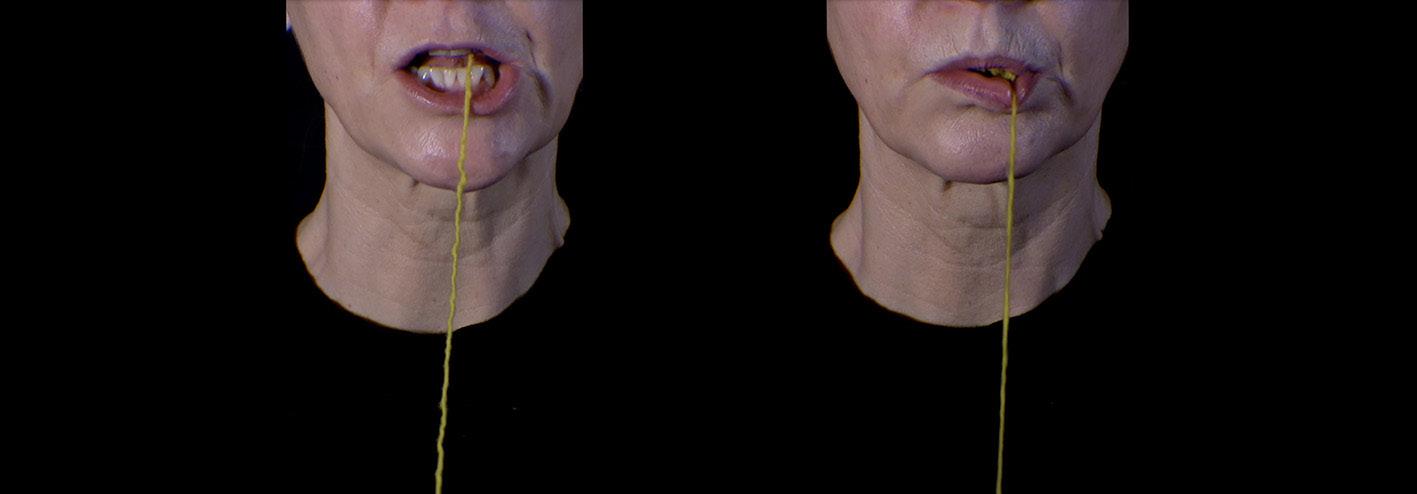
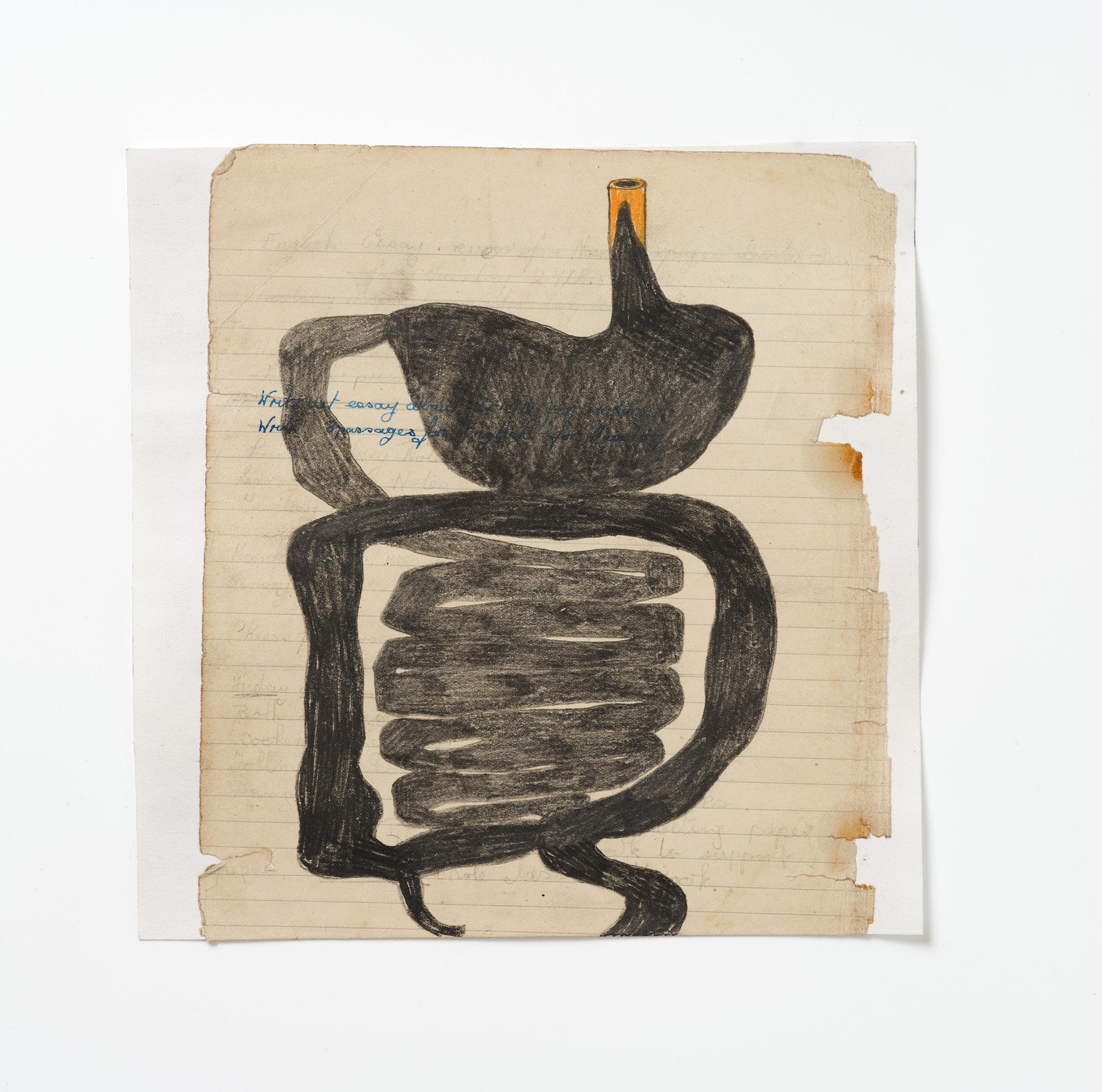
Attached to one wall is a cushioned contrivance, fixed at roughly head height. It makes sense when Nick stands against the wall to demonstrate that it was made to position her head exactly for continuity purposes. She was making a film that relates to an earlier work, made as part of the show in the Chapels of Rest, Richard, in which we saw two identical faces side by side, identifiable as Nick, cut off below the eyes so only the lower half showed. In one we saw an unravelled strand of wool spooling out of the mouth, whilst in the other the wool was consumed, drawn smoothly into the mouth. That film spoke about grief, language and kinship. In the new film, the camera is focused closely on Nick’s mouth. Her face has been whitened, highlighting in detail the texture of her skin, pores and wrinkles exposed. After a pause, the muscles of the face contract, convulse and slowly disgorge a snooker ball, followed by another, and on. Spittle gathers and clings to the balls as they emerge from the mouth. Like the intestinal motif, it speaks of the body, of bodily processes, digestion and excretion. There is a characteristic frankness here and an empathetic gesture. It provokes an intersubjective response, shared, felt in our own body, our own digestive system. The act is visceral, sensual in a related but different way to the blanket towers. In all of Nick’s work there is a highly developed material imagination that is equivalent to looking, as described earlier. Her art places her in her body and in the physical world, and through our encounter with the work our own material imagination is aroused.
Ectoplasm, 2024, moving image (still), Anna Cady & Nick Grellier, audio Sebastiane Hegarty, 2.48 mins
Since my last visit Nick has moved her studio to a larger space in an old bookshop, with a window that opens on to the street. It will be interesting to see how this new space, with it’s very public shopfront, will impact on her work. She says that she won’t be able to sit and “do nothing”, a statement that belies the complexity of the immersive experience of being in the studio, amidst the materials and mechanics of making, thinking, dreaming. This is something that eludes precise description, but which comes up throughout our conversations.
When I first saw Nick’s work, over 25 years ago, she was primarily a painter, largely figurative, skilful. Whilst drawing is absolutely crucial to her practice, she says that painting has become “peripheral” to what she does. She now works with an expanded toolkit, with a freer approach to materials and techniques. She is a story-teller, a woman and a mother, as well as a concerned and sometimes angry follower of world events, who still seeks to represent the world as she experiences it, but she wants to catch it obliquely. Which is not to say that her artworks are intended to be cryptic, symbolic or metaphorical, they stand for themselves and they speak directly – sometimes bluntly even. Nevertheless, I’m reminded of Italo Calvino’s discussion of precision, or ‘exactitude’ in writing. He asserts that the more vague and imprecise language is, the more poetic it becomes. In his argument the word ‘vague’ carries a positive idea of movement, mutability, uncertainty, and beauty. These are all words that seem apt in describing Nick’s ‘oblique’, truthful observations.
So, a point of reflection. Drawing on a long sustained practice and an accumulation of experience, driven by curiosity and a workman-like habit of picking up her tools and going to work each day, Nick’s work could be seen as exemplifying movement and mutability – always evolving. Nick is making work that deals confidently with uncertainty, that is honest and truthful, serious, literate and often very funny. She has constructed a convivial social context for her work as an active member of a creative community, seeking out opportunities for collaboration, experimentation and stimulation. She places great value on friendships and family relations.
One of the peculiar features of the working lives of artists is that whilst in most professions recognition (and income) tends to peak shortly before retirement, research has shown that visual creators are typically seen as reaching the peak of their careers remarkably early: in the 35-44 year age bracket. The cult of youth and novelty perhaps? Nevertheless, it is unsurprising that at this point in her life Nick looks like an artist at the height of her powers.
Paul Harper 2026
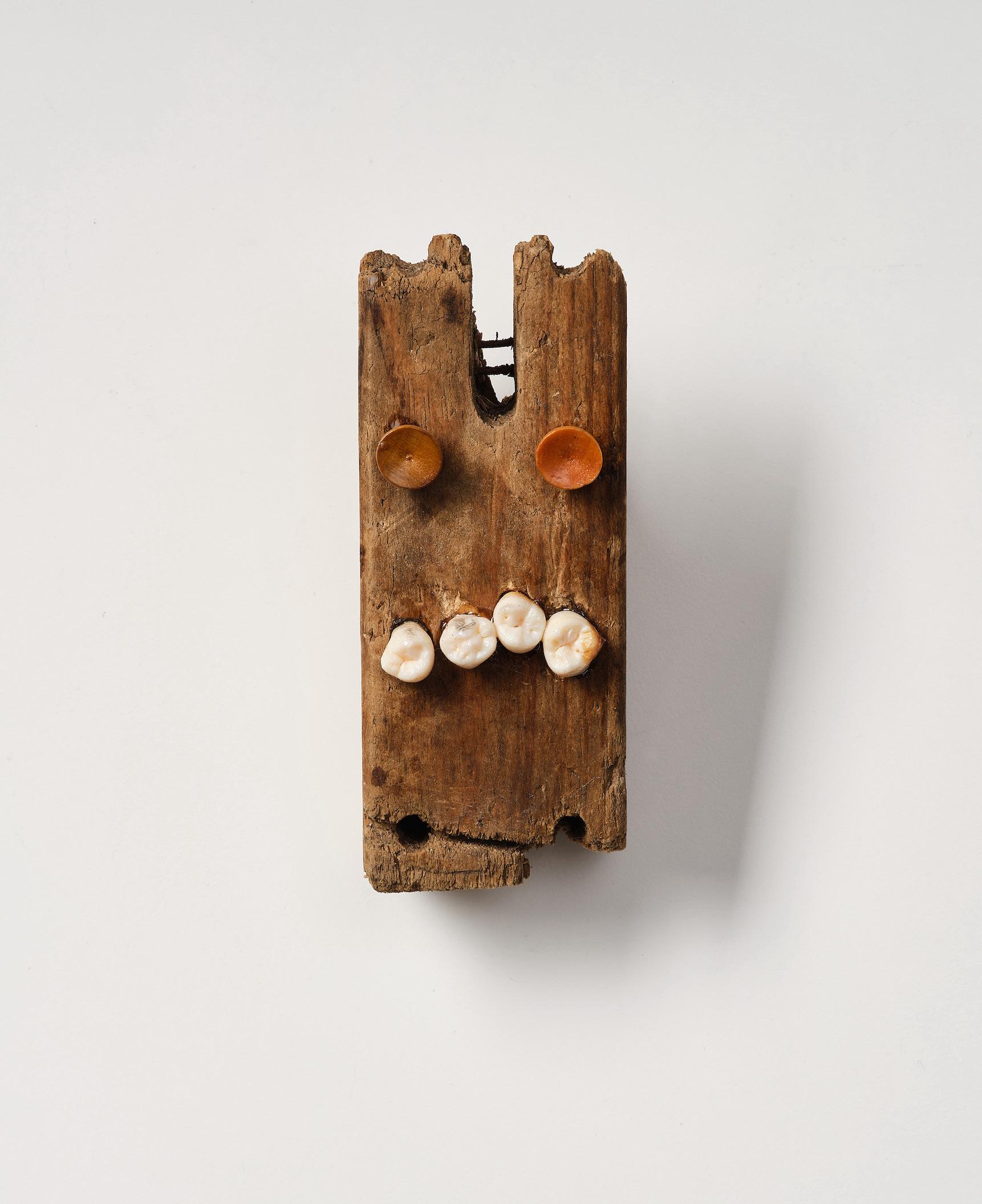
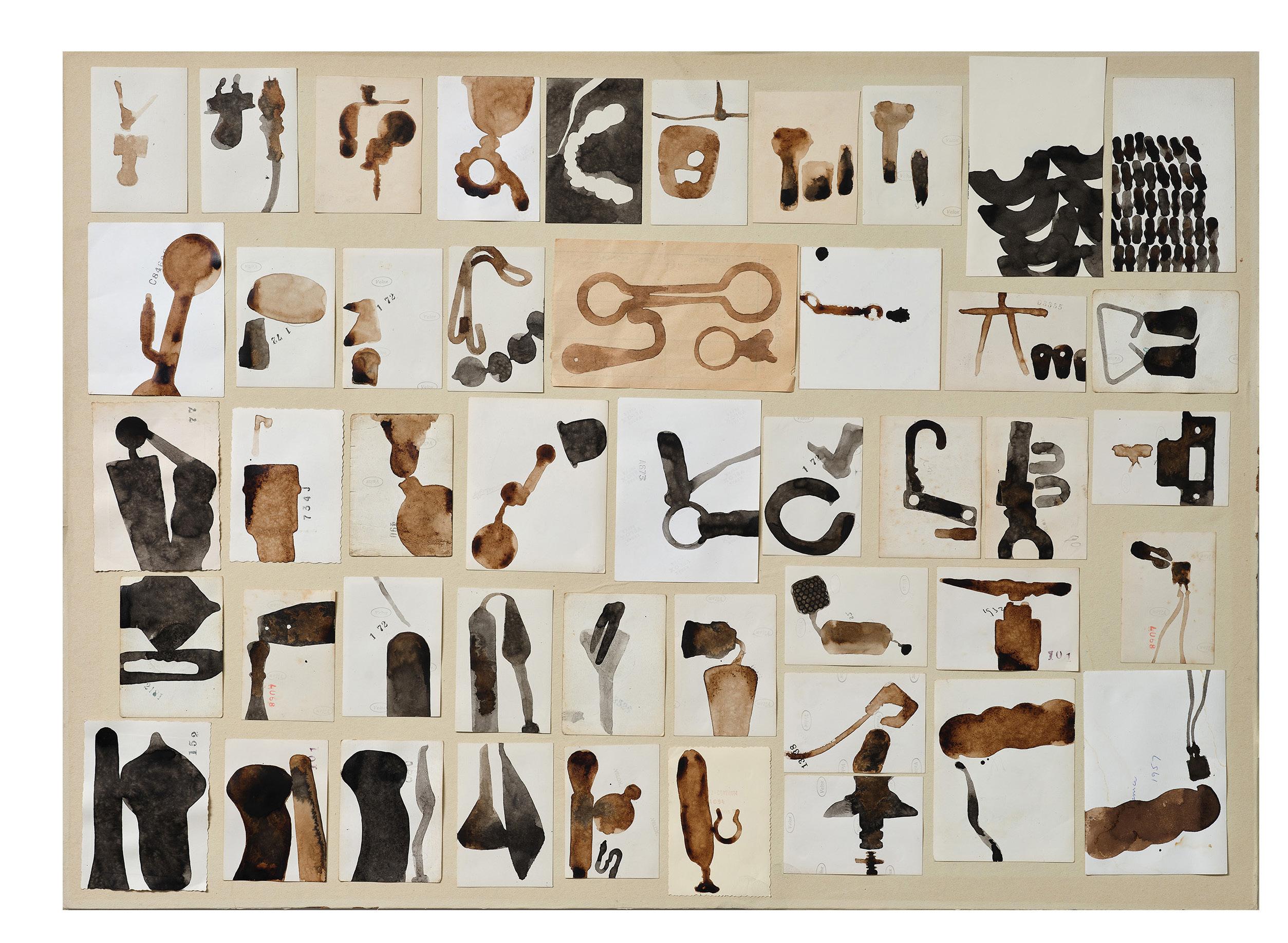
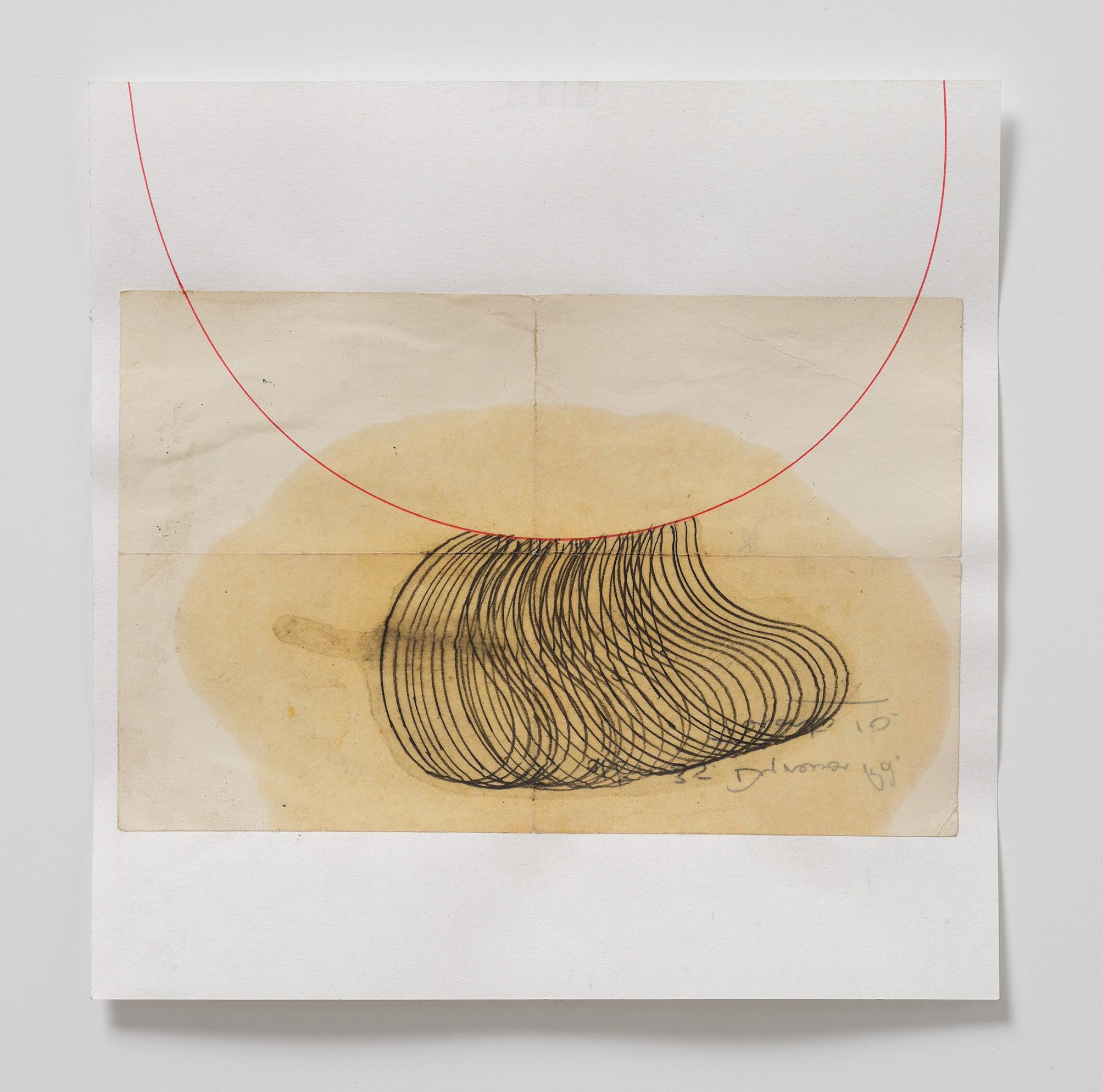
Devices 1, 2023, ink, found paper, 60.5cm
In Conversation with Nick Grellier and Emily Lucas Getting It?
Nick’s art practice includes making, as well as an ongoing engagement with writers and other artists. Reading, writing and talking are an important ingredient in the production of her artwork. Here, I do not attempt to explain Nick’s work but to explore why she feels compelled to be a maker and then how that work is produced. This, I hope, will provide a glimpse under the surface of the artwork she makes to the deeper, richer ideas, concerns and feelings that lie beneath.
In our many conversations we have asked questions about why artists make work, and how they can make artwork that matters in a world that constantly feels teetering on the brink of disaster. Discussions have centred around how Nick’s artwork is imbued with a politics of care. We have observed how her work explores the body, what happens in, with and to it, and how that can be seen to reflect wider societal subjects. We have discussed how intuition and not knowing play a large part in the making of Nick’s work, and how Nick’s use of materials and methods can be seen to be political acts. Lastly, we have talked about the way that artists work in collaboration with the person looking at the artwork. Do viewers need to ‘get it’, or is that a reductive way of looking at any piece of art?
A Politics of Care
Writer, Arundhati Roy, suggests that ‘an understanding of “the density of being human” is the only antidote to the crass, mind-numbing and crushing simplifications of resurgent fascism’ 1 .
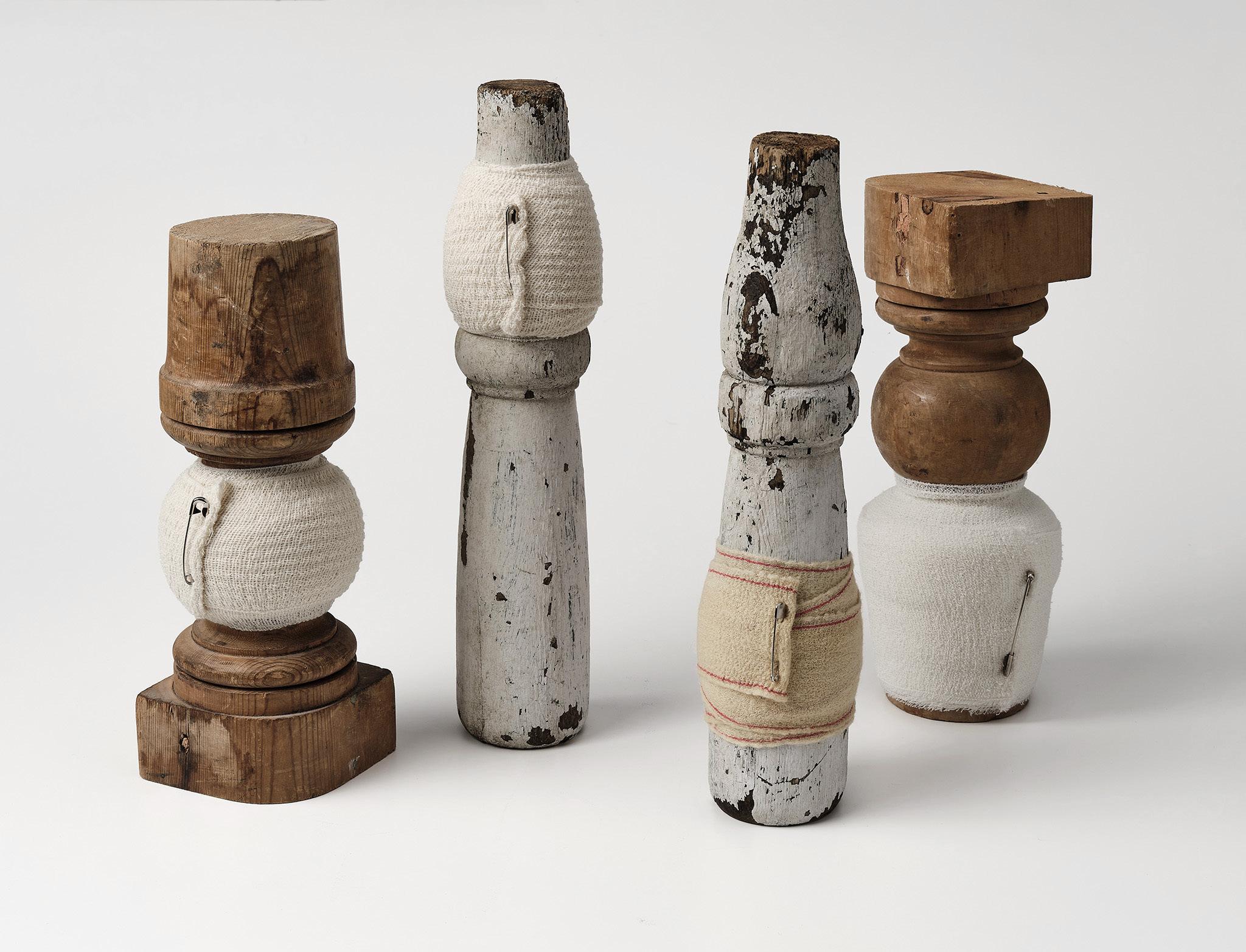
Limp, (work in progress), 2026, table legs, bandages, safety pins
EL: So why are you making work at the moment? You don’t have to answer!
NG: Because I don’t think it’s possible to not, especially as women, while we still live in an imbalanced society. Social media, fascism, heteronormativity, social hierarchies and family relationships are impossible to separate from my art making. Why do controllers need to control? The unending crushing of humanity.. is it worse than before.. is it just a cycle? Will it ever change? There’s a frightening slide backwards which we can all see. A deep fear of care and feeling which means that people get repeatedly crushed. We’re letting people with personality disorders dictate what happens everywhere.
Poet, Simone White, asks if we can think about art ‘as a kind of “reparative” practice that might intervene in a deeply hostile and violent public’ 2. I believe that Nick’s artwork can be seen as reparative gestures imbued with care. A good example of this is the blanket stacks Bed. The making of these soft pillars can be framed as feminist actions. The first was initially made as a base for projecting Small Hours, a film about insomnia and creativity. A soft, malleable stand, rather than a solid, monumental one for an edified sculpture. However, it rapidly became apparent that it could be a stand-alone artwork. Bed not only critiques the traditional systems of power with its materiality, but also with the parameters of its construction.
EL: They are not hard, solid objects. I wondered if there was something feminist about that – we talked last time about things being non-monumental and whether Bed is an antidote to monumental, massive structures?
NG: I am making a series of them based on the UK standard widths of bed sizes, which implies a coded hierarchy in their titles – super-king, king, double, queen, then single then maybe camp (laughing) and they are tower shapes – but it’s a joke – they are soft and blankety.
EL: Are they plinths that are not holding anything up? Maybe plinths is the wrong word – they started out like that, monumental in themselves but not...
NG: The first one was an ironic gesture that also functioned as a plinth.
EL: An anti-plinth? They are structures made of blankets which are soft and...
NG: ...the softness – but they are upright.
EL: There is strength that can be found in soft things - which makes me think of tenderness and care – and I love that quote in the Ed Atkins book (the catalogue from his exhibition at Tate Britain) – that he is protecting the tender parts of himself, by making things.
NG: I don’t know how one protects the tender parts of oneself...
EL: You laugh at things?
NG: Yes – I think that is it, but I also think that’s dangerous as well because it...
EL: ...it’s like you’re not taking it seriously?
NG: But actually, that side of what I do is an action against power, so that is the way that care is protected by humour.
EL: It also makes it accessible – it’s another layer in the work, but if you look underneath the humour there is other stuff going on underneath.
NG: I think it’s truth as well, isn’t it? I still find humour a difficult word to describe what it’s doing.
EL: Is it pathos?
NG: Is it empathy? No, it’s not – because it’s funny...
EL: Maybe – that’s going on underneath it, because it’s not just funny, or just humorous
NG: It’s never just anything is it? I think that’s one of the fundamentally important things.
EL: Maggie Nelson 3 writes about the way that everything has to be categorised and when you move away from that categorisation it opens things up and gives you freedom – opens it up to nuance and difficulty...
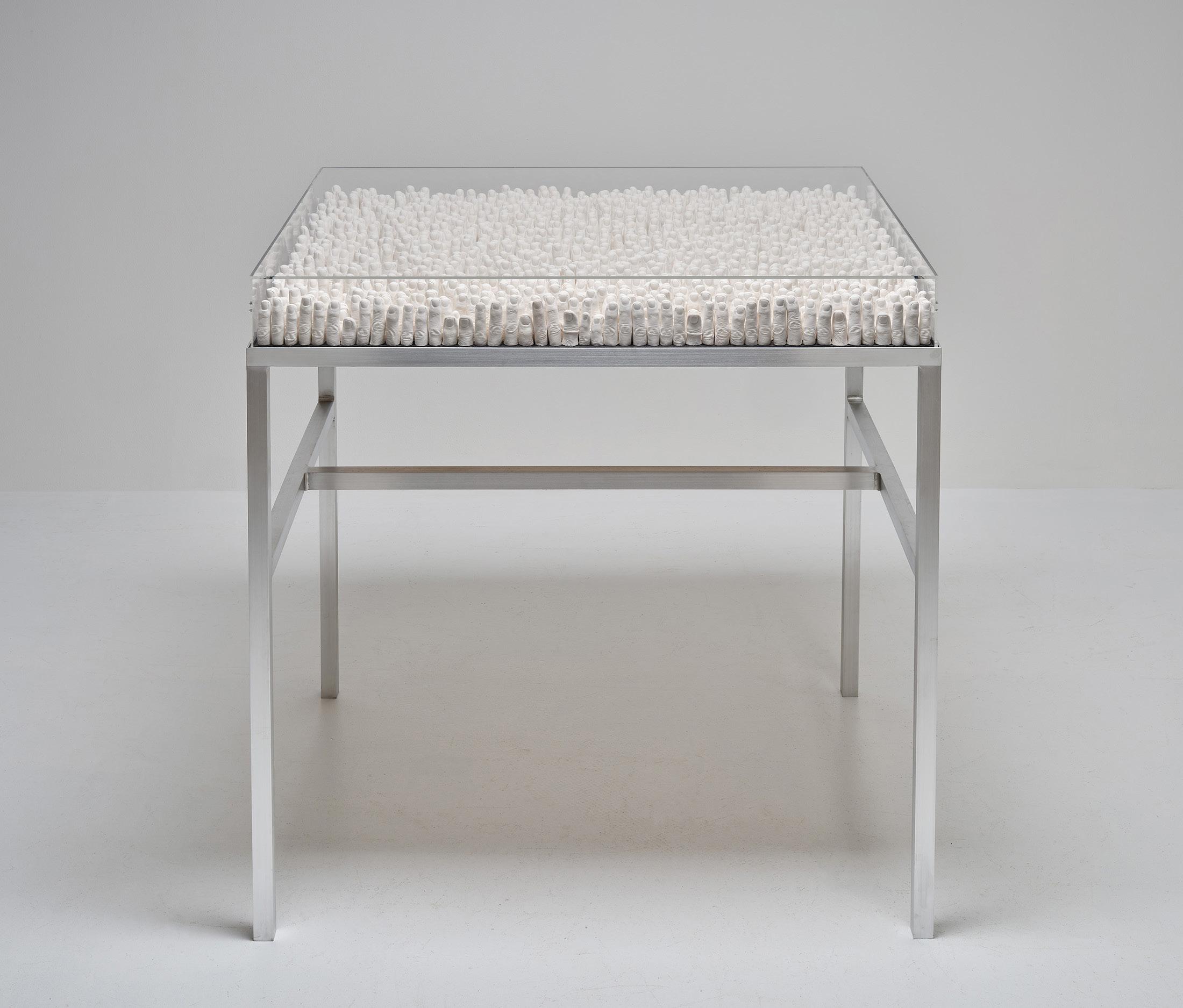
20:22, 2022, cast plaster, aluminium and acrylic vitrine, 102cm x 100.5cm x 82cm
There are things that aren’t Settled, and don’t need to be Settled
A very dense milieu shuts out alternative cosmic possibilities and is occupied with a high degree of certainty, whereas a more translucent milieu lets in the light of other possible worlds 4 .
NG: I suppose one of the things that I continue understanding about the work that I am making is that it has multiple layers of things that aren’t settled, that don’t need to be settled, and I don’t need to know what they all are.
Psychoanalyst, Donald Winnicott, believed that the capacity to engage in free and spontaneous play can provide an alternative to feelings of futility and despair, both for children and for adults. “It is in playing and only in playing that the individual child or adult is able to be creative and to use the whole personality, and it is only in being creative that the individual discovers the self” 5 .
The making of Nick’s work can be seen as spontaneous play. Intuition plays an enormous role within Nick’s art practice. “Teetering on the edge of” or “getting close to” is a part of the intuitive process. This leaves openness and room for consideration over time, and as Carlisle writes, possibilities can be closed off when certainty comes into play.
NG: I was thinking overnight about the fingers (20:22, around 2000 cast fingers arranged in a vitrine) because I’ve recently been writing about them, thinking about what they were – this sort of rigor mortis, memento (my father died in 2022 after a long illness), and an anthropomorphic mass. I’ve expanded how I see them now, as part of that time of – well, partly everybody squashed into the world but not touching during Covid, and, given the distance of time, thoughts about separation, isolation, and crowd control, as well as recording and marking time, and the tenderness of touch and knowledge through fingertips.
Feminist Scholar, Eve Kosofsky Sedgwick, wrote: ‘It’s hard to recognize that your whole being, your soul doesn’t move at the speed of your cognition. That it could take you a year to really know something that you intellectually believe in a second’ 6. Intuitively playing with materials also means that resolving pieces of work can also take time. In Nick’s studio there are several unsettled pieces of work waiting for something to complete them.
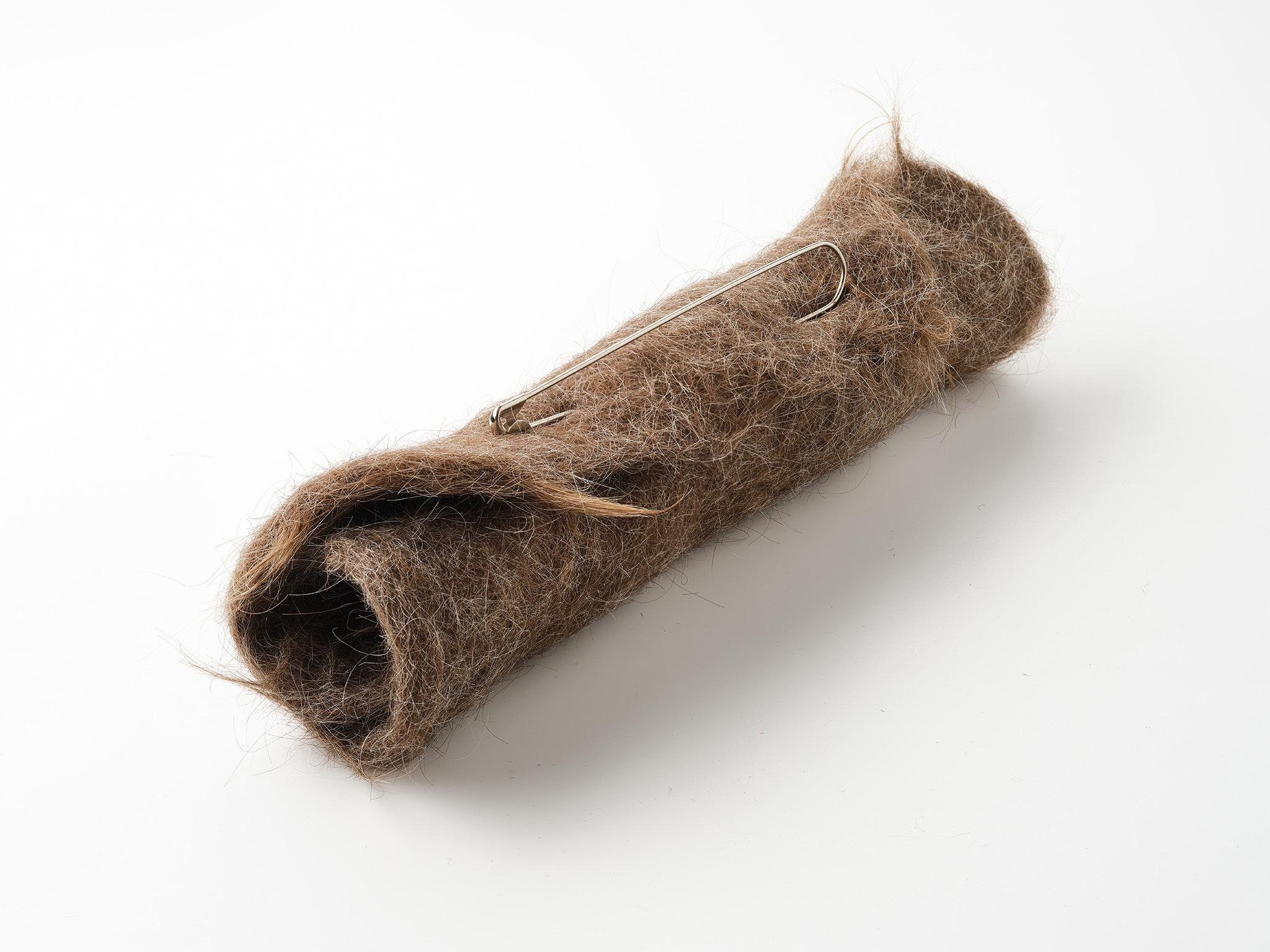
NG: (talking about Helmet – A felted mat made of Nick’s hair) - (laughing) - I let it sit there hiding under a towel for ages after I’d felted it.
EL: You literally hid it? (laughing)
NG: It was on my desk under a towel.
EL: Okay...
NG: It was kind of disgusting as well...
EL: Was it in the corner of your head somewhere?
NG: Yes – it was flirting with me – making me scratch it every now and again – and then one day it came together with the stitch holder I’d found at Vintage Mary that morning – and trying something out– playing... it just had a feeling of rightness and then – that’s it. It made me write about hair and what hair is.
EL: I’m thinking about the length of time – in between thinking about something and then finally resolving it - or potentially resolving it...
NG: It’s altered so much since I started collecting my hair – materially not at all – it’s hair – but it’s a lot of time between the first impetus and the resolution.
Gut Feelings
If we want to get some idea of Nature, we can look at, and into, ourselves: these bodies and our consciousness of our bodies; our intelligence, our desire, our fluctuating energies and emotions, our elan vital or will to thrive, our capacity to imagine what might be or might have been, our sensitivity and suffering, our creativity, our resilience, our aliveness, our power. (Spinoza, quoted in Carlisle 7).
How we live in our bodies dictates how we feel things and how we think about things. In Nick’s work the inclusion of parts of the body (hair, teeth, the mouth, fingers, intestines, the brain) has the power to describe feelings such as tenderness, shame and disgust.
EL: We said we would talk more about the body that occurs in your work and why making work about the body is important for you.
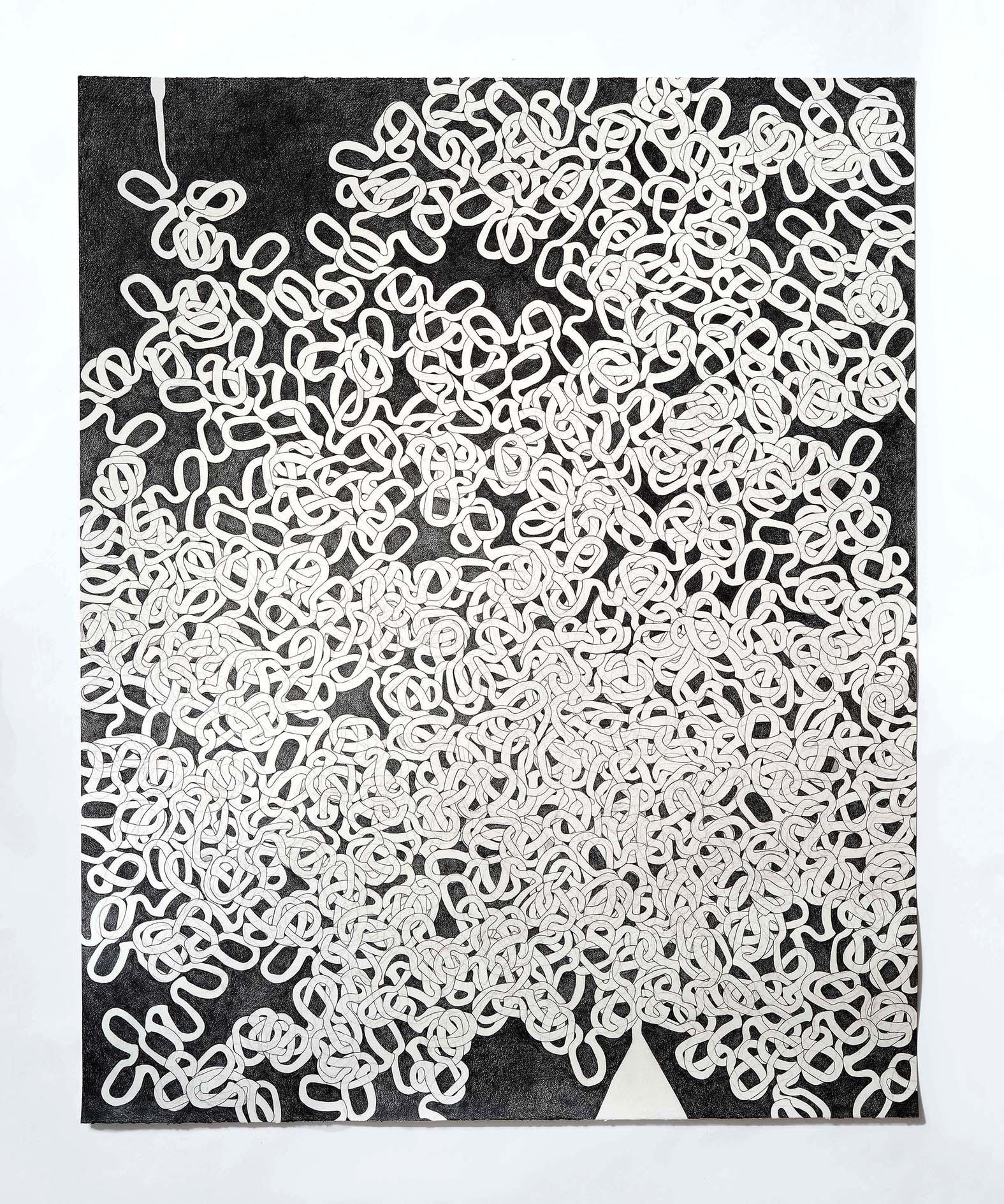
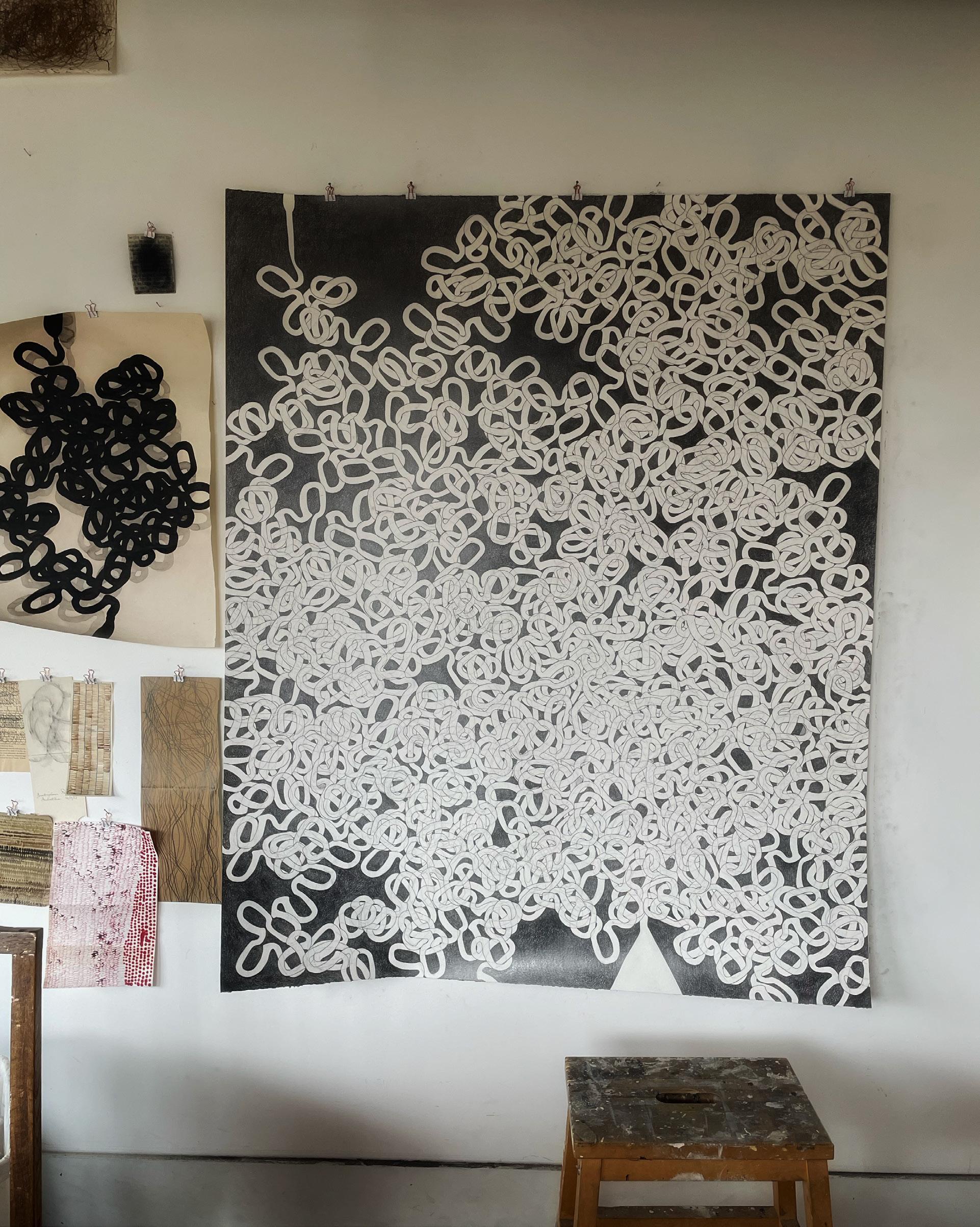
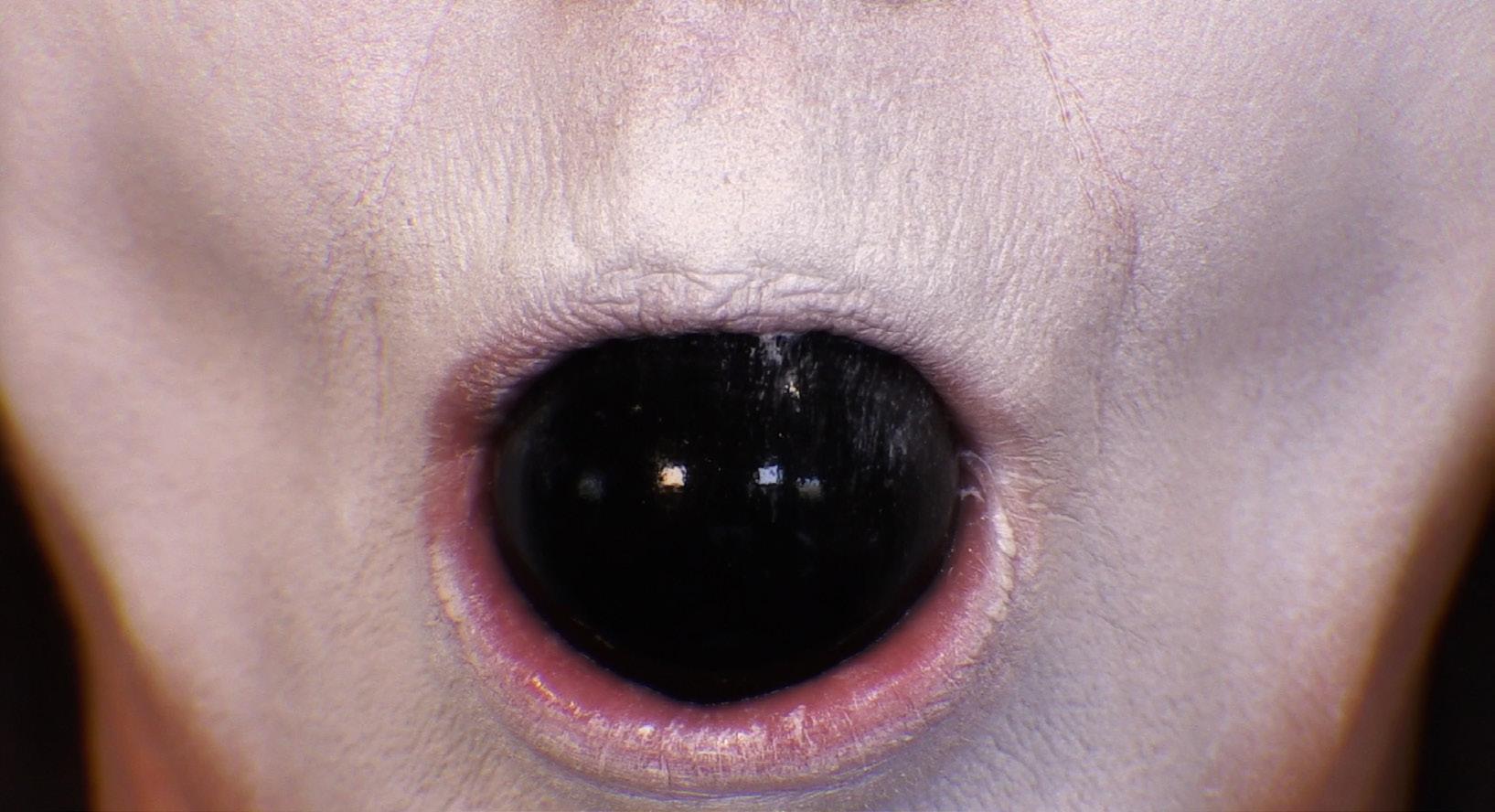
NG: I’m not thinking about my body in a performative way – sometimes I am performing with it, but I don’t think that’s my driver. I think it’s bound up with power and empathy. I’m not thinking about the whole body necessarily – just bits of it and the things that they do. The hair – things about hair that are human – it’s not just a substance it’s what hair does and what you do with it and how it makes you feel that are the important factors – and thinking about the fingers 20:22 as anthropomorphic – but then the impulse to make the big drawings Levity/Gravity 1 & 2 and Dark Grey Matter was again, a gut thing – a gut thing (laughing). My work is raw in terms of method and materials. Home-made. I hope it portrays tenderness in all its meanings. Particularly in my films Globus and Ectoplasm (with filmmaker Anna Cady). Both are looped very short films, with objects in the mouth coming out, and in again in the case of Ectoplasm. The awful-funny-tender thing is so overt. They speak to orifices, birth and death, accessing the spirit side, eternity, the perception of colour, even the comedic. They are very personal. One is about losing and yearning, the other about blockage and illness as well as accumulating and consuming. Are they funny? Are they too difficult to watch? Are they too intimate to watch? I’ve got this... fascination – what is it when you can’t pull yourself away because it’s so disgusting?
EL: Yes!
NG: You have to look at it – you can’t believe it, but you have to. There was a programme on the radio the other day about trigger warnings – and in the end they were saying that it’s actually ineffective (laughing) because ninety two percent of people, even if they are the kind of person who is going to be triggered – they look- they always look - it’s human nature to look and that’s – (she talks about showing the film Globus to someone who had to look away because it made them uncomfortable)... Do you want to see it?
EL: Yes! (both laughing).
Artist, Ed Atkins, says that his intention when we encounter his work is that ‘we might be afforded access to otherwise unavailable feelings’ 8 . I believe that this is also true of Nick’s work. Images and objects can do more for me than words alone to provoke sensation and thoughts that I may not otherwise have. This happens both in the making of the work, in this case for Nick, and in the viewing of the work, for me. Can this paying of attention to feelings and sensation be seen to be an integral part of engaging with visual art?
Drawing - Shifting Hierarchies
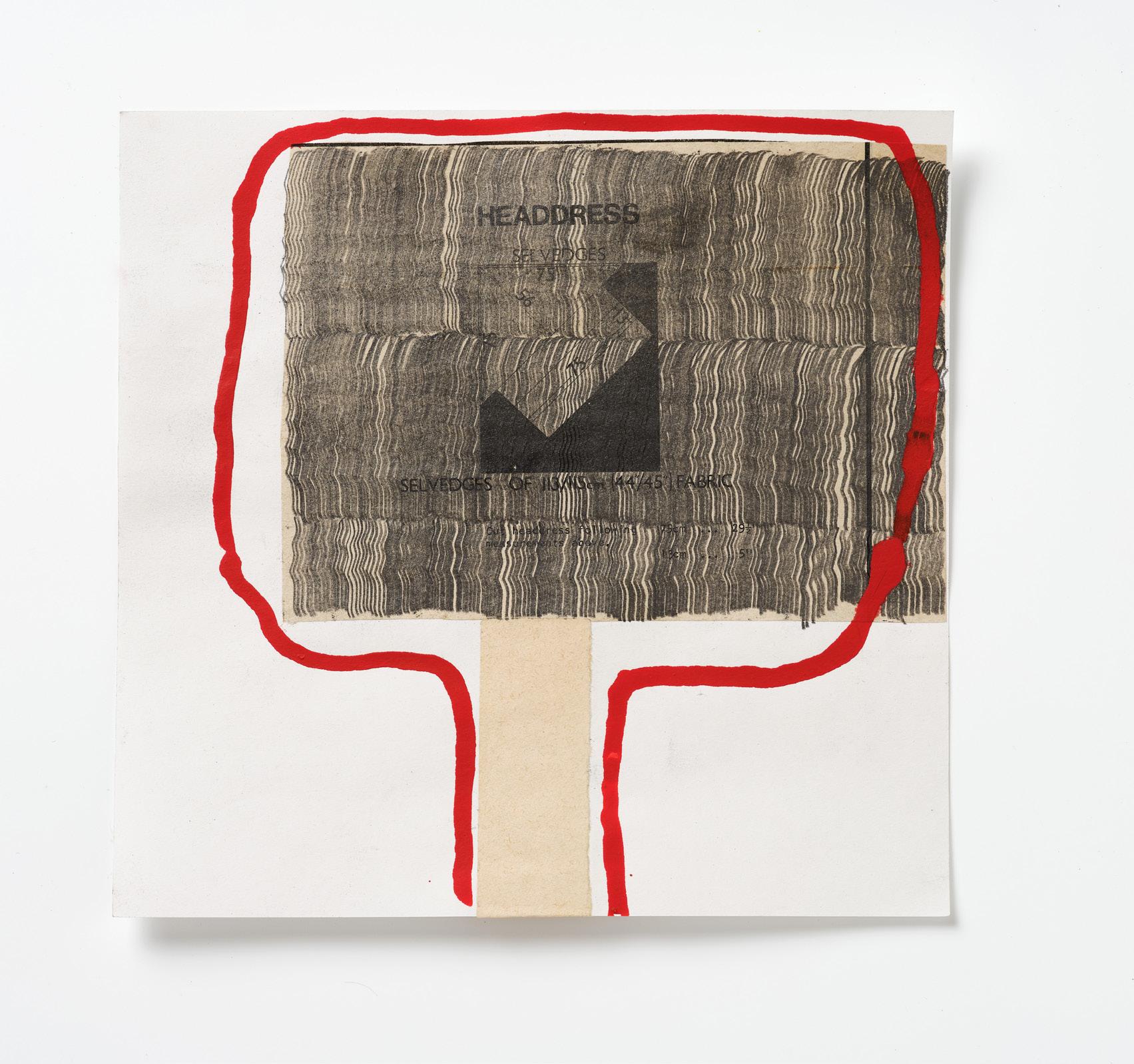
Drawing can also be seen as a mechanism to process thoughts and make meaning. It is an integral part of Nick’s practice. Traditionally regarded as a lesser means of art production, drawing has been seen to be the gesture that is done before the ‘real’ piece of painting or sculpture. Using drawing as the artwork itself challenges these hierarchies. Rather than a recording of something, drawing can be seen as a construction, often using simple, inconsequential materials. Unlike painting, there is no covering over in a drawing. It is possible to see the hand of the draw-er when a line or a gesture is made. This gives drawing an intrinsic significance beyond its material value and lowly status. The uncomplicatedness of a drawing can be beguiling, producing meaning for the maker and the viewer beyond more elaborate and expansive gestures.
Globus 2025-2026, moving image (still), Nick Grellier and Anna Cady, audio Harley Grellier, 5.45 mins
EL: What is drawing to you?
NG: Drawing is so many things: accessible, immediate, simple, akin to writing (both materially and with the making of marks as language), diagrams, code, understanding, noting and an almost universal magical activity of childhood. Drawing can be any size, on any surface, it can be collage, it can be moving image. You know, even talking about just drawing – it’s elevating those things that might be seen to be lower value or less important or less high art – as being important. And I don’t really use feminist to describe my work – I don’t really think about it because I think it’s inherent, particularly in my small drawings.
EL: How is drawing important within the exhibition?
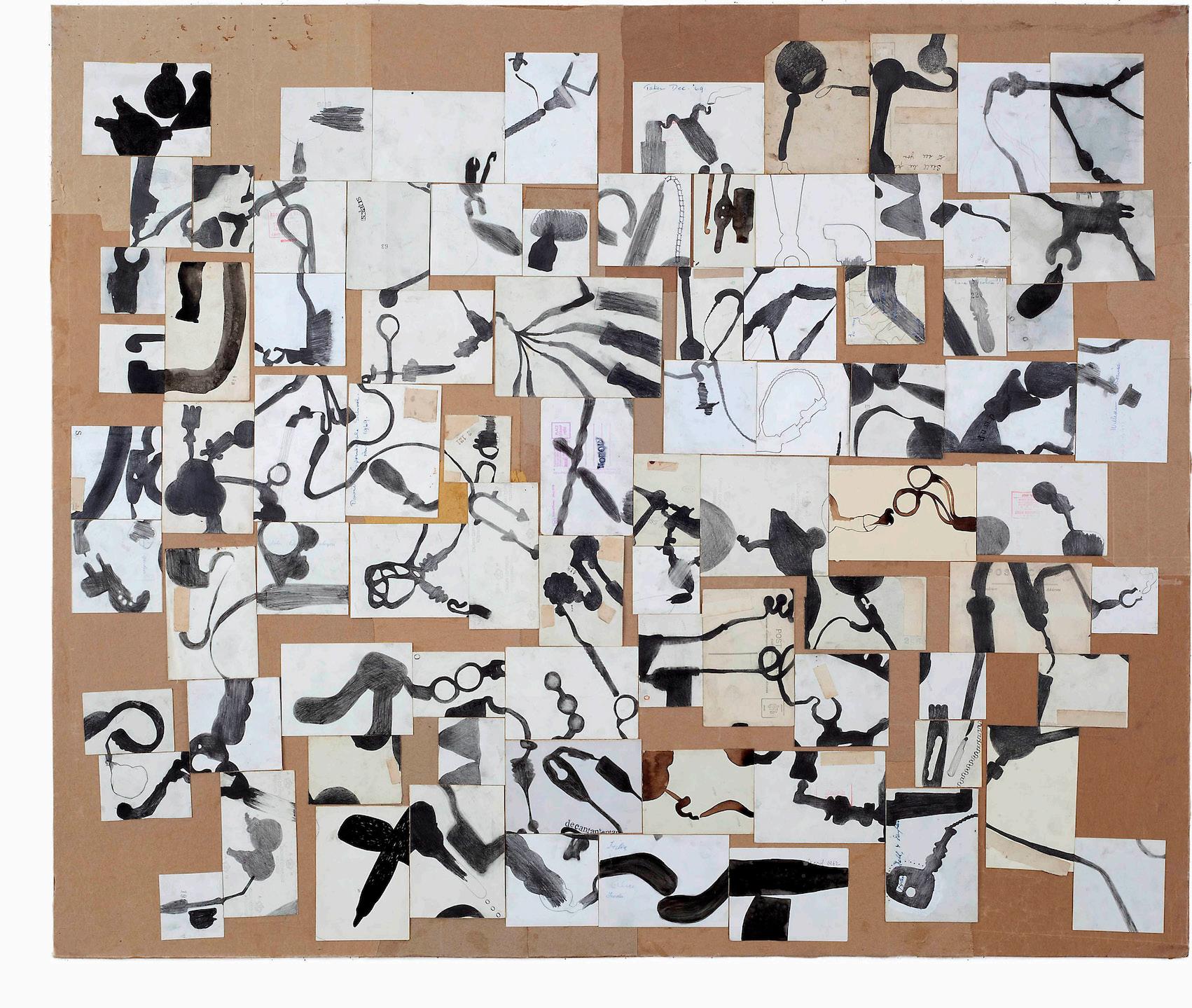
NG: I wasn’t originally going to put any of the smaller drawings (there are around 900 19.5cm square drawings ongoing) in the exhibition.
EL: Why were you going to leave them out?
NG: I’ve shown them before (Today 2020 / SPacejUNK 2022) as a daily practice where one followed on from another.
EL: A complete set?
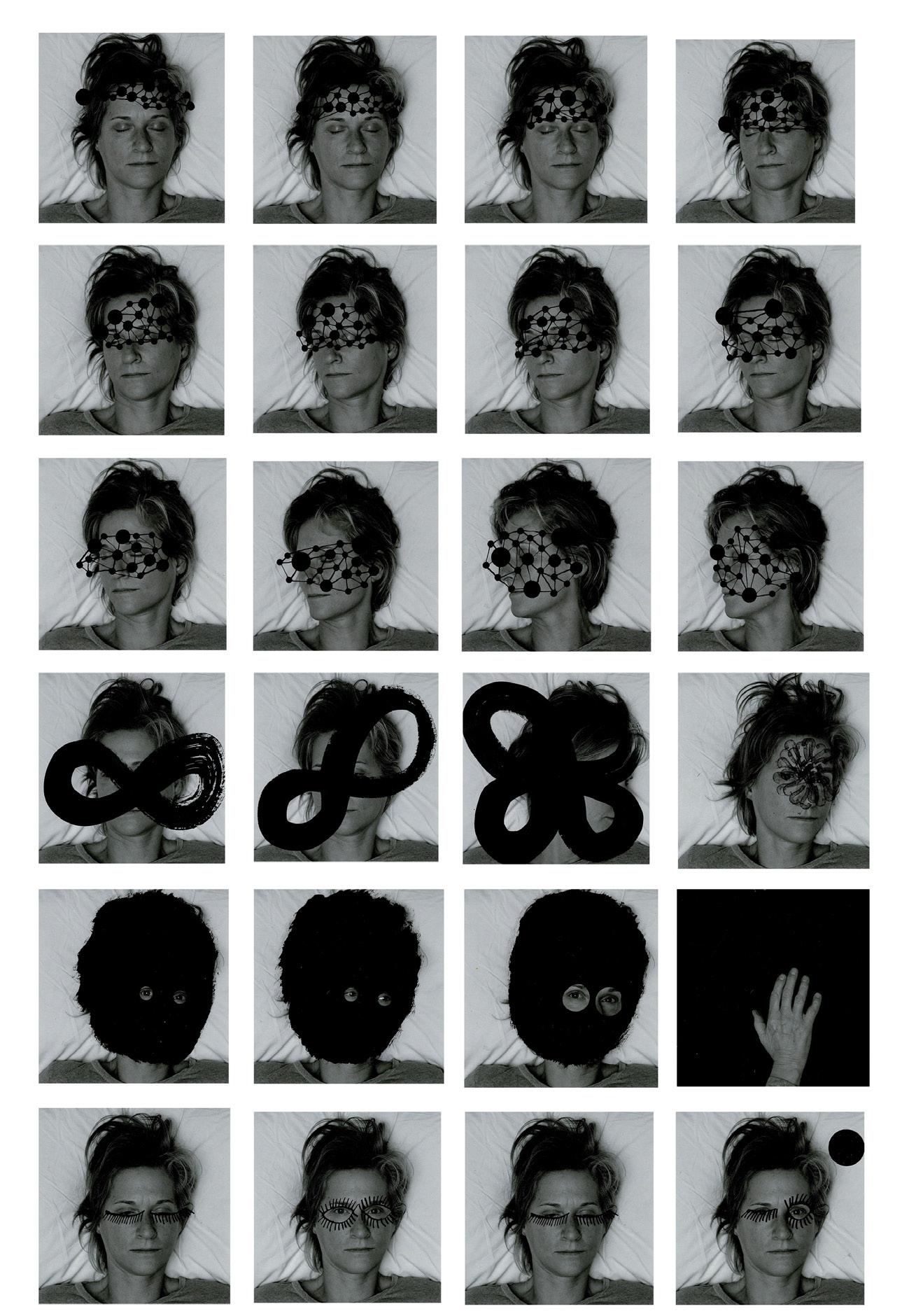
NG: Yes, as a set (never complete!). But through conversations and critique I’ve let go of them needing to say something as a whole. They have the capacity to say something substantial on their own, even though they are small. I started making these drawings in 2019. They are the backbone to everything I’ve made in the last six years. They are both personal and political, referencing all the things that we’ve talked about in our discussions. There’s a sense of freedom in placing those ideas into small time-based works. The way I’ve shown them to people has been like having a conversation (daily posting and twice showing the body of work as year long series). I want to see how all my works interrelate as I curate the exhibition. I hope the smaller drawings will be powerful.
EL: So not just as a support to the other work?
NG: No, no – They are like the oxygen and the thing that everything else comes from. Without them my practice would be have developed differently . I can’t leave them out.
Artist, Amy Sillman, writes about sculptor, Phillip G Pavia, who regarded drawing as the answer to questions about ‘what are we doing here, why and how?’ “As Pavia lays it out, drawing is the answer to The Problem. By ‘drawing’, he didn’t mean a preparatory act or rehearsal, a sketch, doodle, plan, or cartoon. Drawing was a mythic and materialist form of engagement, the bones of thinking itself, the tool for stripping down, the exercise and the equipment for getting into shape. Drawing was ‘attitudes become form’ way before that phrase existed’ 9 .
Shifting hierarchies using drawing can be seen to be a political act, a way of thinking through and about things with the choice of method. The choice of materials is also a way to challenge traditional categories and add further layers of meaning to a piece of work.
The Politics of Found Materials
Philosopher, Clare Carlisle, believes that creative activity such as writing, philosophising or making art helps to give some insight into ‘the elusive, work-to-be-made quality of our own existence’ 10. The use of materials in Nick’s works play a crucial role in this understanding.
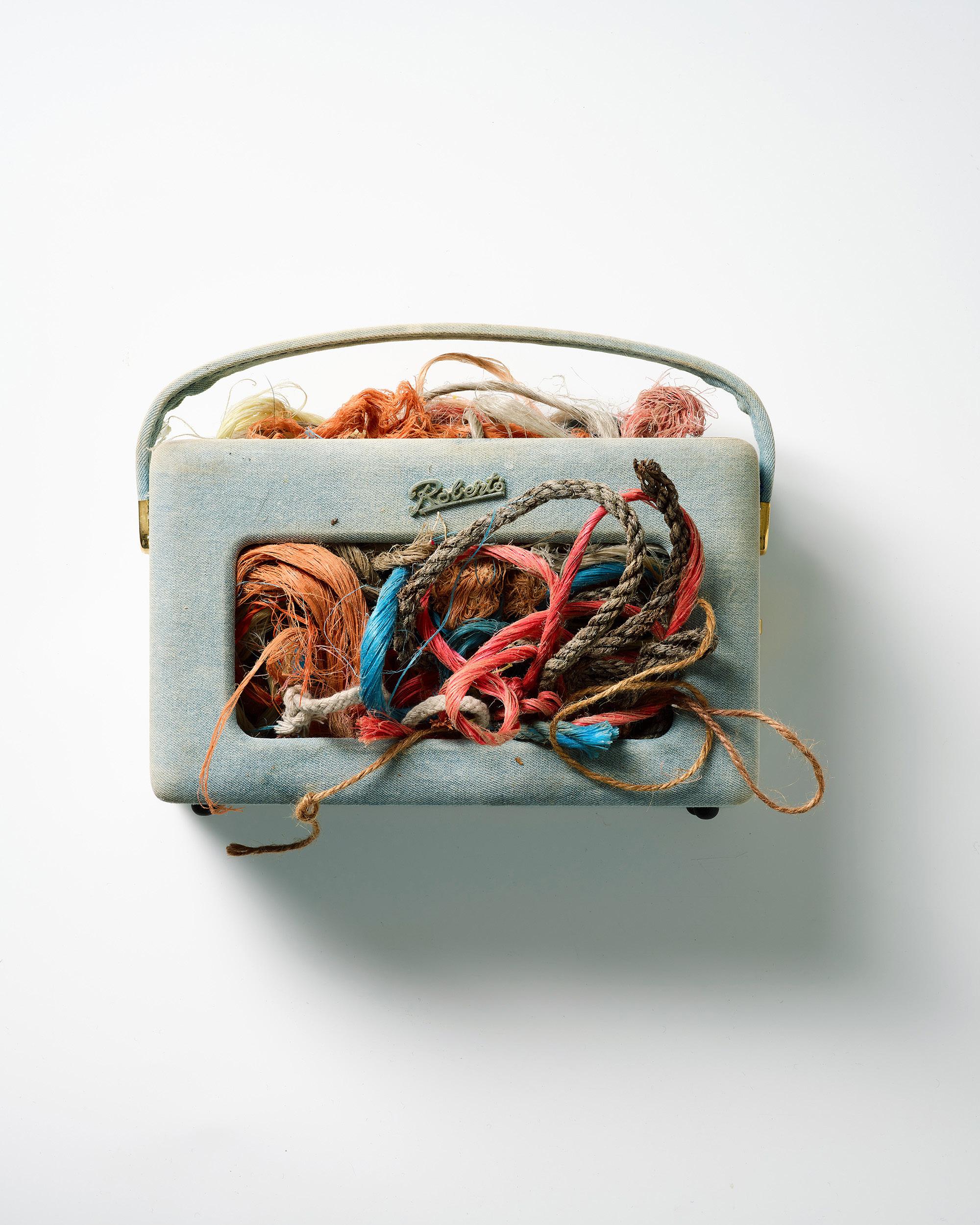
NG: When I began making work with domestic materials, I didn’t think that the resulting works had much value. It took me years to understand that those everyday materials are equal to, and have more depth for me, than traditional art materials. The blankets (used in the Bed sculptures) have all been lain under and used by multiple people for warmth and comfort. They have stains and rips. They have travelled around and they’ve been used for moving household items – they are the things that stop things from bumping into other things – they have had all these different lives – they have ended up in charity shops – and now (laughing) they are transformed into sculpture. We’ve talked about that before – the hierarchy of materials, and how it’s often women who are using whatever is to hand and the systems of power that’s to do with. Materially simple work with everyday objects is political.
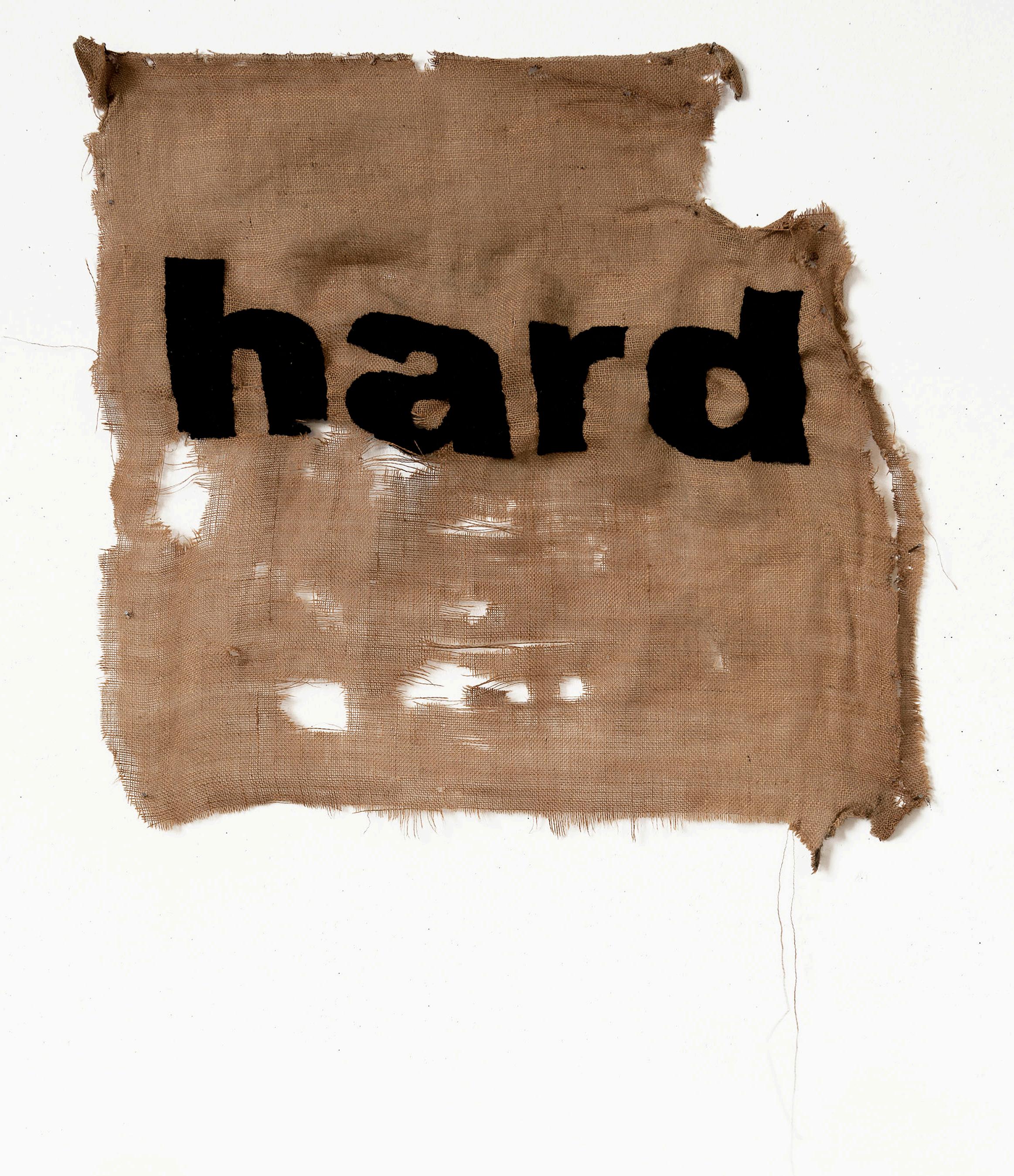
Ideas of density, nuance, difficulty and multiple layers infuse Nick’s work. Her drawings use repurposed paper such as old letters and envelopes as a ground. Sculptures are constructed utilising materials found when out walking or discovered in charity shops. These objects are then used to make the drawings themselves as tools and templates. This use of found and pre-used materials adds layers of significance to her work. The passing of time is inherently implied with objects and drawings. Humanity is an integral part of an artwork when it uses pre-used objects, thereby asking questions about what it is to be a human being. The suggestion of other lives within the work makes me curious. Who were the people that dropped the objects or wrote the letters? Whose bodies lay under those blankets? Why were the objects discarded? The materials also elicit memory for me – of the scratchy feeling of having a woollen blanket next to my skin. The heaviness of it when made up on a bed. Having tea and biscuits in my grandparent’s bed on a Sunday morning as a child. This response will be different for everybody who engages with the work.
Getting It
Ed Atkins writes that the idea of “getting it” is ‘the de facto reductive coherency of convenient interpretation and [is] ostensibly violent’ 11. This idea resonates with me. How important is it to work out exactly what the artist is doing in any given piece of work? Is that the end point of looking at a piece of art? What about pleasure, confusion, ambivalence, the touching of a memory, or any other sensation that the engagement brings. When an artist takes their work out of the studio or place of making, they are handing it over to an audience to make of it what they will, and the artist ceases to be able to dictate how it is viewed or understood. The idea that there is only one meaning to ‘get’ is unfortunate. Pieces of work can mean different things to different viewers depending on their experience, their own politics and values and even the mood they are in on the day they are looking. Often there is not just one meaning for any creative act. Maggie Nelson writes: ‘I don’t like dogma that prevents us from being able to take new account – socially, sexually, politically – of what’s going on, and instead leads us to simply say, “I know what’s going on; it’s this thing; and I judge it as X” 12. The acknowledgement of nuance, grey area and difficulty are a more interesting way of exploring creative acts. As our conversations have revealed, Nick’s work is multi-faceted.
EL: What do you think is the function of your work? For people looking at it...
NG: I hope – I don’t know...
EL: It’s a really difficult question.
NG: I hope people have a feeling – a feeling of human-ness – or maybe sometimes a leap of understanding or connection.
EL: And as you said before, some people can have a feeling that can be discomfort as a reaction...
NG: – oh yes –
EL: You don’t have to answer it now, but it might be worth thinking about – we’ve talked about not providing answers as being okay and as questions as part of the not knowing – but what are the big questions that your work is asking? Not that it needs to answer any of them, but what are you asking in your work? Or are you?!
NG: I’m asking how I feel – if I feel, then how you feel, and how the person over there feels and are we okay about the balance of power, and the systems of power –patriarchal systems or hierarchies in things like schools or religion or relationships – are we okay with that – are we alright to just let that be – or can we look at it? Are we okay with the imbalance of power held by some and not all. It seems like a grandiose thing but it’s actually really personal.
EL: Is it grandiose to ask a question? It’s an important question to ask.
NG: And we make stuff to ask the question, and we don’t have to have the answer because there isn’t one (laughing).
Carlisle writes about the importance of making reciprocal connections in our lives: ‘we transcend our habitually circumscribed selves through our interconnectedness with other beings, which can flow into us and change our nature’ 13. When feelings are prompted and questions about what it is to be human are asked, I contend that creative acts, and specifically here, Nick’s artwork, has the capacity to make that interactive connection, both with the artist and other viewers of the work.
Why does it matter?
Nick’s work can be seen to be questioning work, both for her and for the viewer of the work. It is irreverent, sometimes funny and sometimes sad. Questions about life’s meaning and purpose can be asked through the filter of visual art that are hard to debate with language alone. What is it to be alive? What should our concerns be? How much responsibility do we have to address them? Her art does not provide any neat answers to these questions but can be seen as a prompt for provoking reactions in those engaging with the work. In that way Nick’s artwork acts as a human undertaking, making reparative gestures that can potentially offer solace, enlightenment or even amusement.
1 Rose, Jacqueline (2024) The Longest Road: Conversation with Jacqueline Rose. In: Nelson, Maggie (2024) Like Love, London: Fern Press, p.226.
2 Nelson, Ibid, p.248.
3 Nelson Ibid, p.157.
4 Carlisle, ibid, p.68.
5 Nelson, Ibid, Pp. 260-261.
6 Sedgewick, Eve Kosofsky (2011) The Weather in Proust, Durham, North Carolina: Duke University Press. Quoted In: Nelson, Maggie (2024) Like Love, London: Fern Press, p.19.
7 Carlisle, Ibid, p.25).
8 Atkins (ibid) p.14.
9 Sillman, Amy (2020) Faux Pas: Selected Writings and Drawings, Paris: After 8 Books, pp.91-92.
10 Carlisle, Clare (2025) Transcendence for Beginners: Life Writing and Philosophy, London: Fitzcarraldo, p.48.
11 Atkins, Ed (2025) Ed Atkins, London: Tate Publishing, p.18.
12 Nelson, Maggie (2024) Like Love, London: Fern Press, p.243.
13 Carlisle, ibid, p.23.
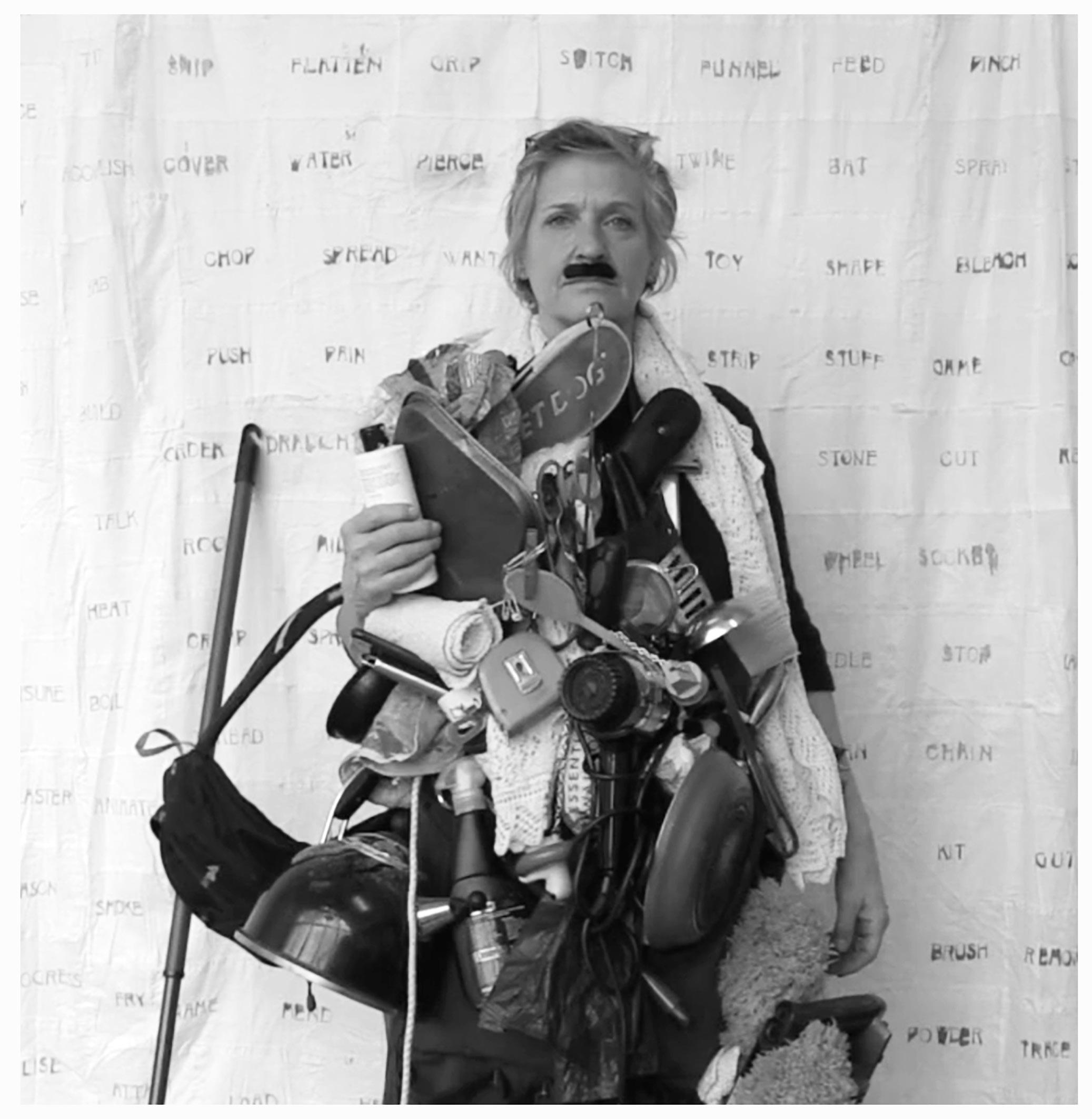
Paul Harper is a retired lecturer. He taught art history and theory, and supervised student research at Middlesex University and London Metropolitan University. His own research interests are primarily concerned with understanding the experience of creative practice and the social value of art and craft. He combines his academic work with writing.
He originally trained and worked as a furniture maker, and has an abiding interest in making and makers, but subsequently worked in a variety of roles in the visual arts before becoming an academic. He was a founding director of Alias Arts CIC, which provided advice and support to artist-led organizations. He was Chair of The Forest of Dean Sculpture Trust from 2003-2011 and is currently a board member for The Craft Study Centre, a museum and archive, and research centre based at The University of Creative Arts.
Emily Lucas lives and works in Stroud, Gloucestershire. She finished her PhD, researching drawing as a feminist practice in November 2024. Emily studied Drawing and Applied Arts at UWE in Bristol and continued with a Multi-Disciplinary Printmaking MA. She has been shortlisted for the Trinity Buoy Wharf Drawing Prize (2023), The John Ruskin Prize (2024) and exhibited in the Royal Academy Summer Exhibition (2022).
She regularly exhibits at the RWA Open Exhibition in Bristol. She has exhibited her work in London, Poland, Greece and Hong Kong. Her work is held in public and private collections including The Tate Britain Collection and The Royal Academy. She has also exhibited as (both laughing) Collaborative with artist, Nick Grellier.
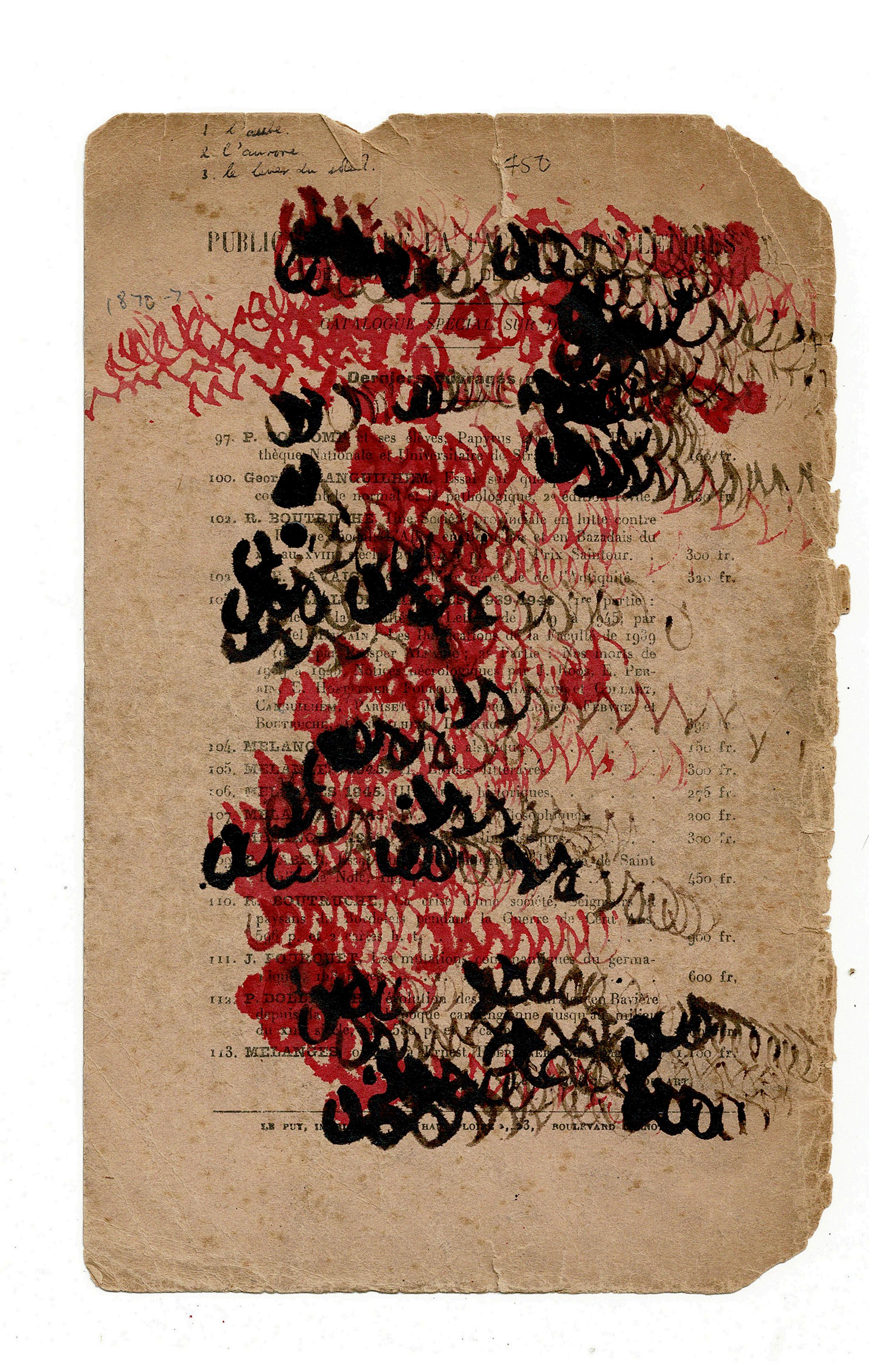
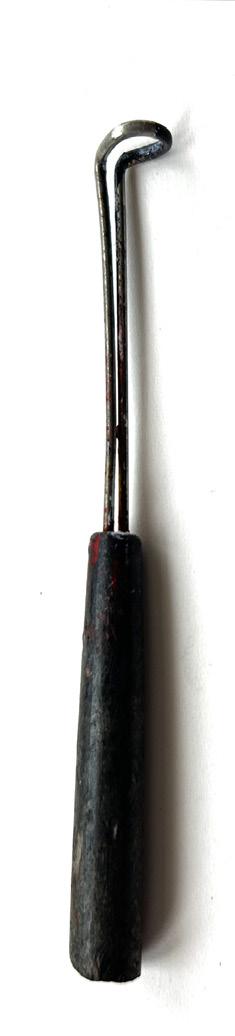
meditation, 2025, ink, found paper, 25cm x 16cm, drawing tool, 8cm
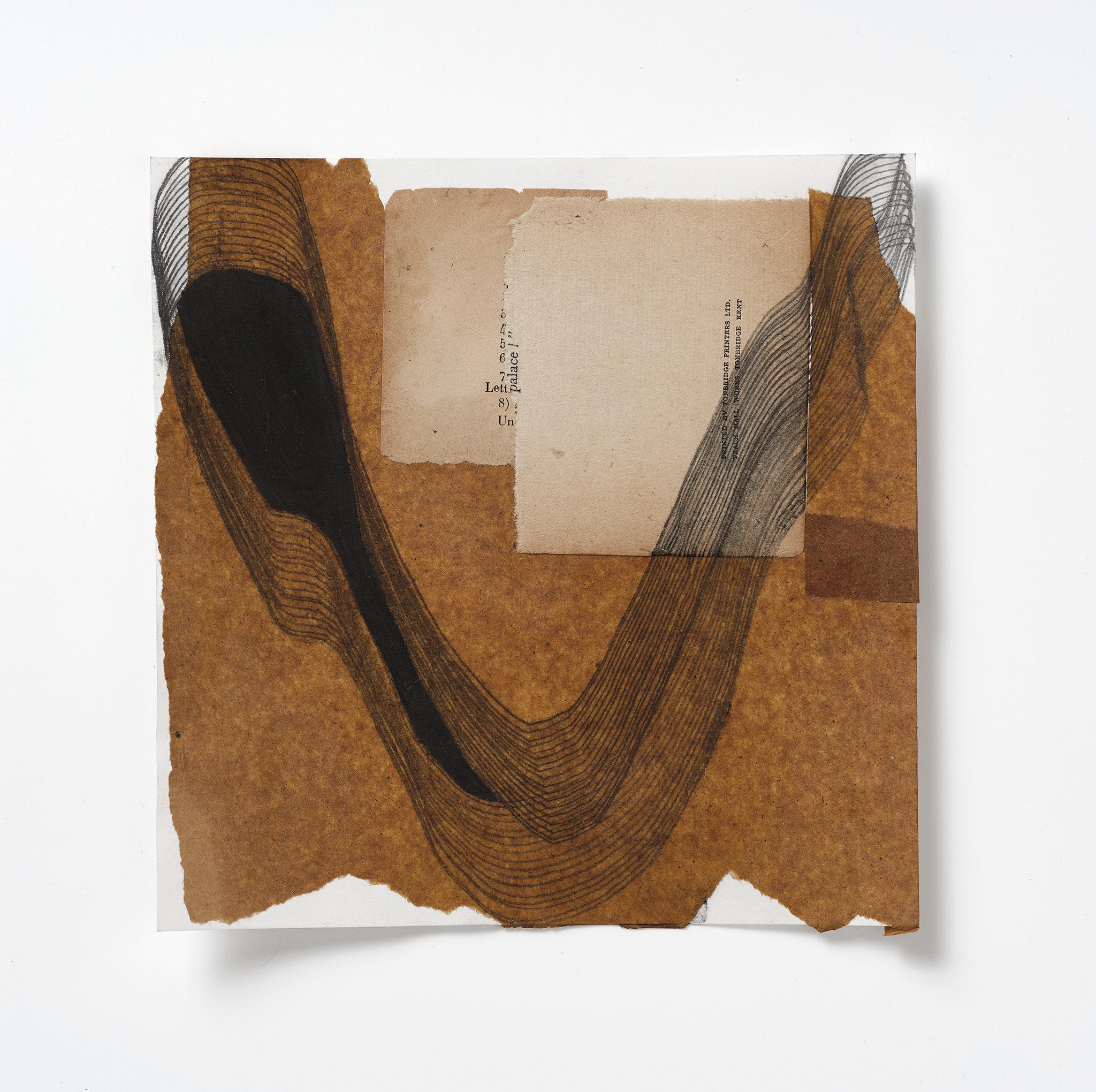
Swallowing Words 1, 2025, graphite, oil, found paper, 19.5cm x 19.5cm