Jack C. Richards with Jonathan Hull and Susan Proctor
WITH EBOOK
CAMBRIDGE UNIVERSITY PRESS
University Printing House, Cambridge cB2 88s, United Kingdom
One Liberty Plaza, 20th Floor, New York, Ny 10006, USA
477 Williamstown Road, Port Melbourne, vic 3207, Australia
314-321, 3rd Floor, Plot 3, Splendor Forum, Jasola District Centre, New Delhi - 110025, India
79 Anson Road, #06-04/06, Singapore 079906
Cambridge University Press is part of the University of Cambridge. It furthers the University s mission by disseminating knowledge in the pursuit of education, learning and research at the highest international levels of excellence.
www.cambridge.org
Information on this title: www.cambridge.org/9781316620441
This publication is in copyright. Subject to statutory exception and to the provisions of relevant collective licensing agreements, no reproduction of any part may take place without the written permission of Cambridge University Press.
First published 2013
20 19 18 17 16 15 14 13 12 11 109
Printed in Poland by Opolgraf
A catalogue record for this publication is available from the British Library
ISBN 9781316620311 Student's Book with Online Self-Study 1
ISBN 9781316620359 Student's Book with Online Self-Study 1A
ISBN 9781316620427 Student's Book with Online Self-Study 1B
ISBN 9781316620441 Student's Book with Online Self-Study and Online Workbook 1
ISBN 9781316620458 Student s Book with Online Self-Study and Online Workbook 1A
ISBN 9781316620472 Student's Book with Online Self-Study and Online Workbook 1B
ISBN 9781316622476 Workbook 1
ISBN 9781316622544 Workbook 1A
ISBN 9781316622667 Workbook 1B
ISBN 9781316622681 Teacher's Edition with Complete Assessment Program 1
ISBN 9781316622261 Class Audio CDs 1
ISBN 9781316623909 Full Contact with Online Self-Study 1
ISBN 9781316623916 Full Contact with Online Self-Study 1A
ISBN 9781316623923 Full Contact with Online Self-Study 1B
ISBN 9781108403054 Presentation Plus Level 1
Additional resources for this publication at www.cambridge.org/interchange
Cambridge University Press has no responsibility for the persistence or accuracy of URLs for external or third-party internet websites referred to in this publication, and does not guarantee that any content on such websites is, or will remain, accurate or appropriate. Information regarding prices, travel timetables, and other factual information given in this work is correct at the time of first printing but Cambridge University Press does not guarantee the accuracy of such information thereafter.
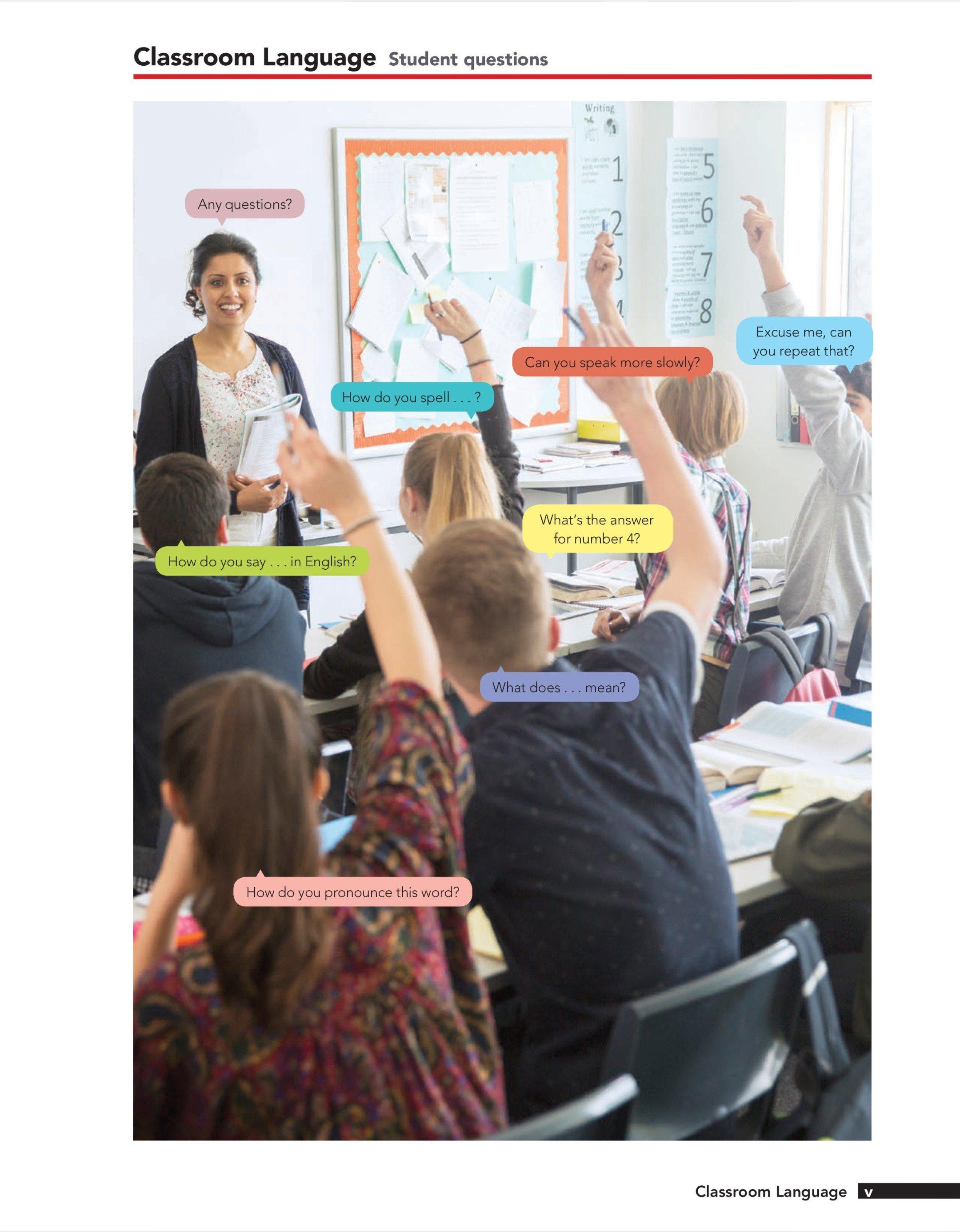
Any questions?
What's the answer for number 4? How do you pronounce this word?
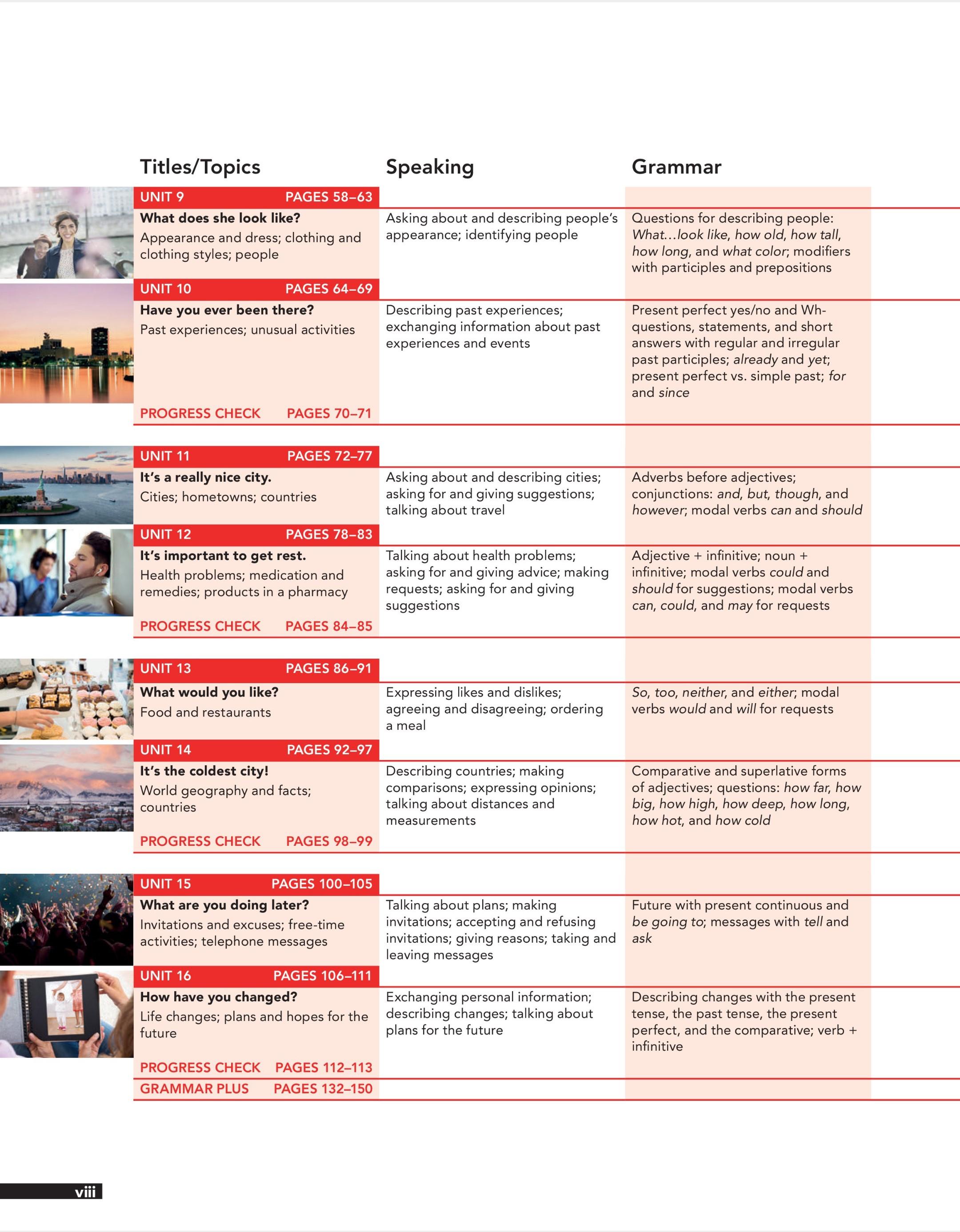
Titles/Topics
UNIT 9 PAGES 58-63
» > What does she look like? see Appearance and dress; clothing and clothing styles; people
UNIT 10 PAGES 64-69
Have you ever been there? Past experiences; unusual activities
Speaking
Asking about and describing people's appearance; identifying people
Grammar
Questions for describing people: What...look like, how old, how tall, how long, and what color; modifiers with participles and prepositions
PROGRESS CHECK PAGES 70-71
Describing past experiences; exchanging information about past experiences and events
Present perfect yes/no and Whquestions, statements, and short answers with regular and irregular past participles; already and yet; present perfect vs. simple past; for and since UNIT 11
It s a really nice city. Cities; hometowns; countries PAGES 72-77 UNIT 12 PAGES 78-83
It s important to get rest. Health problems; medication and remedies; products in a pharmacy
PROGRESS CHECK PAGES 84-85
VEE
\, What would you like? " Xt rq Food and restaurants ee
Asking about and describing cities; asking for and giving suggestions; talking about travel
Talking about health problems; asking for and giving advice; making requests; asking for and giving suggestions
Adverbs before adjectives; conjunctions: and, but, though, and however; modal verbs can and should
Adjective + infinitive; noun + infinitive; modal verbs could and should for suggestions; modal verbs can, could, and may for requests PAGES 86-91
Expressing likes and dislikes; agreeing and disagreeing; ordering a meal
So, too, neither, and either; modal verbs would and will for requests
owe Vv F wee: PAGES 92-97
It s the coldest city! sem World geography and facts; Saag, Countries
PROGRESS CHECK PAGES 98-99
15 be What are you doing later?
Describing countries; making comparisons; expressing opinions; talking about distances and measurements
Comparative and superlative forms of adjectives; questions: how far, how big, how high, how deep, how long, how hot, and how cold PAGES 100-105
Invitations and excuses; free-time activities; telephone messages
UNIT 16 PAGES 106-111
How have you changed?
Life changes; plans and hopes for the future
PROGRESS CHECK PAGES 112-113
GRAMMAR PLUS _ PAGES 132-150
Talking about plans; making invitations; accepting and refusing invitations; giving reasons; taking and leaving messages
Exchanging personal information; describing changes; talking about plans for the future
Future with present continuous and be going to; messages with tell and ask
Describing changes with the present tense, the past tense, the present perfect, and the comparative; verb + infinitive
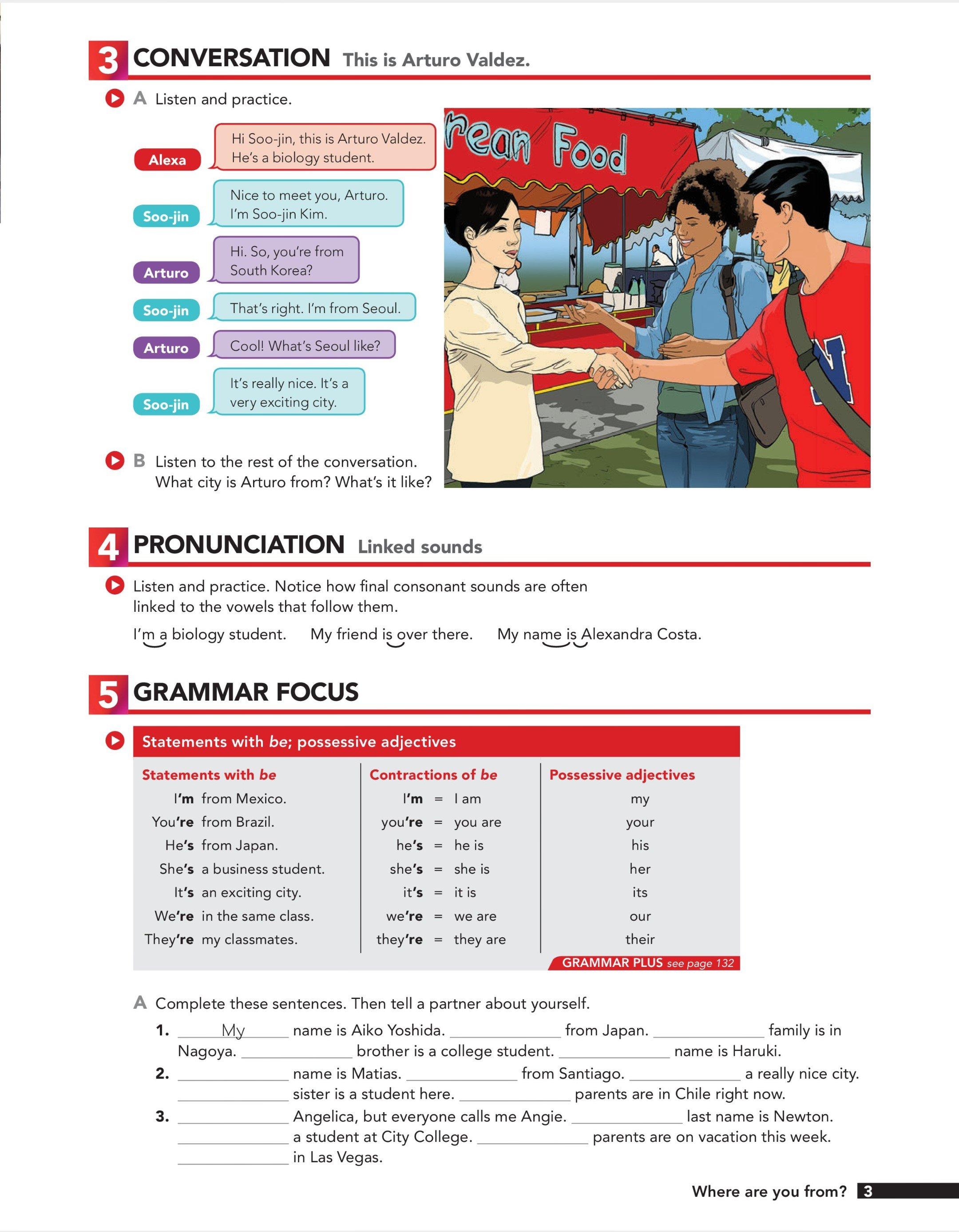
Hi Soo-jin, this is Arturo Valdez. ] CD } He's a biology student.
Nice to meet you, Arturo. cD I'm Soo-jin Kim.
Hi. So, you're from Ca South Korea?
ca» f That s right. I'm from Seoul. ]
Cam Cool! What's Seoul like?
Its really nice. It's a cD very exciting city.
>) B Listen to the rest of the conversation. What city is Arturo from? What's it like?
ry PRONUNCIATION
Linked sounds
eo Listen and practice. Notice how final consonant sounds are often linked to the vowels that follow them.
I'm a biology student. My friend is over there. | My name is Alexandra Costa. es A ery
GG GRAMMAR FOCUS
>)
Statements with be; possessive adjectives
Statements with be Contractions of be Possessive adjectives I'm from Mexico. I'm = lam my
You're from Brazil. you re = you are your He s from Japan. he s = heis his She s a business student. she s = she is her It s an exciting city. it s = itis its We're in the same class. we're = weare our They re my classmates. they're = they are their GRAMMAR PLUS see page 132
A Complete these sentences. Then tell a partner about yourself.
1. My name is Aiko Yoshida. from Japan. family is in Nagoya. brother is a college student. name is Haruki.
2. name is Matias. from Santiago. a really nice city. sister is a student here. parents are in Chile right now.
3. Angelica, but everyone calls me Angie. last name is Newton. a student at City College. parents are on vacation this week. in Las Vegas.
Where are you from?
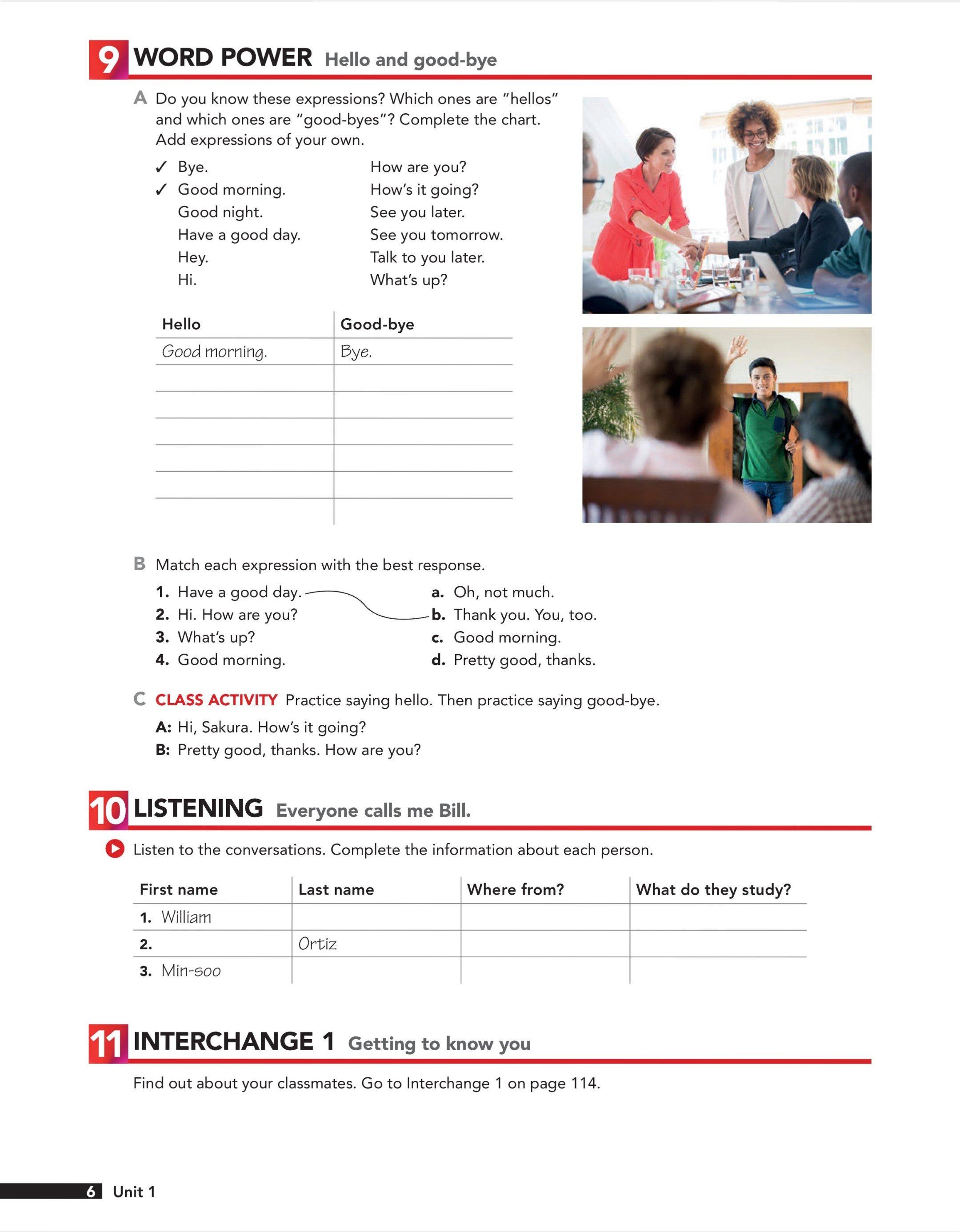
Cc WORD POWER Hello and good-bye
A Do you know these expressions? Which ones are hellos and which ones are good-byes ? Complete the chart. Add expressions of your own.
v Bye.
How are you?
Y¥ Good morning. How's it going? Good night. See you later. Have a good day. See you tomorrow. Hey. Talk to you later. Hi. What's up?
Hello Good-bye
Good morning. Bye.
B Match each expression with the best response.
1. Have a good day.
a. Oh, not much.
2. Hi. How are you?~ s._e Thank you. You, too.
3. What's up?
4. Good morning.
c. Good morning.
d. Pretty good, thanks.
C CLASS ACTIVITY Practice saying hello. Then practice saying good-bye.
First name Last name Where from? What do they study?
1. William
2. Ortiz
3. Min-soo
11 INTERCHANGE 11 Getting to know you
Find out about your classmates. Go to Interchange 1 on page 114.
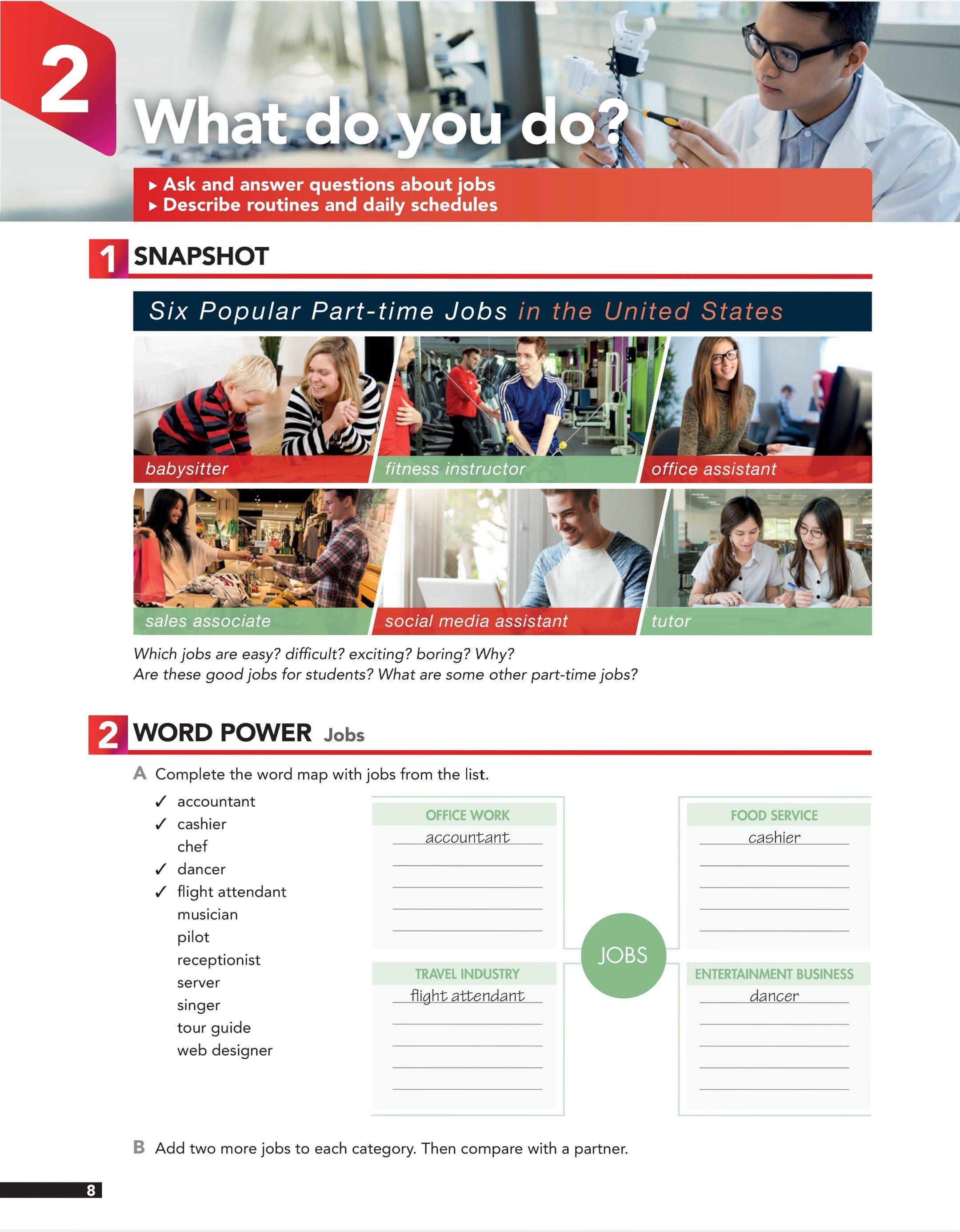
> Ask and answer questions about jobs
» Describe routines and daily schedules
Which jobs are easy? difficult? exciting? boring? Why?
Are these good jobs for students? What are some other part-time jobs?
PJ worp POWER Jobs
A Complete the word map with jobs from the list.
Y accountant OFFICE WORK
Y cashier accountant chef
Y dancer
¥ flight attendant musician pilot receptionist
TRAVEL INDUSTRY server
flight attendant singer tour guide
web designer
B Add two more jobs to each category. Then compare with a partner.
FOOD SERVICE cashier
ENTERTAINMENT BUSINESS dancer
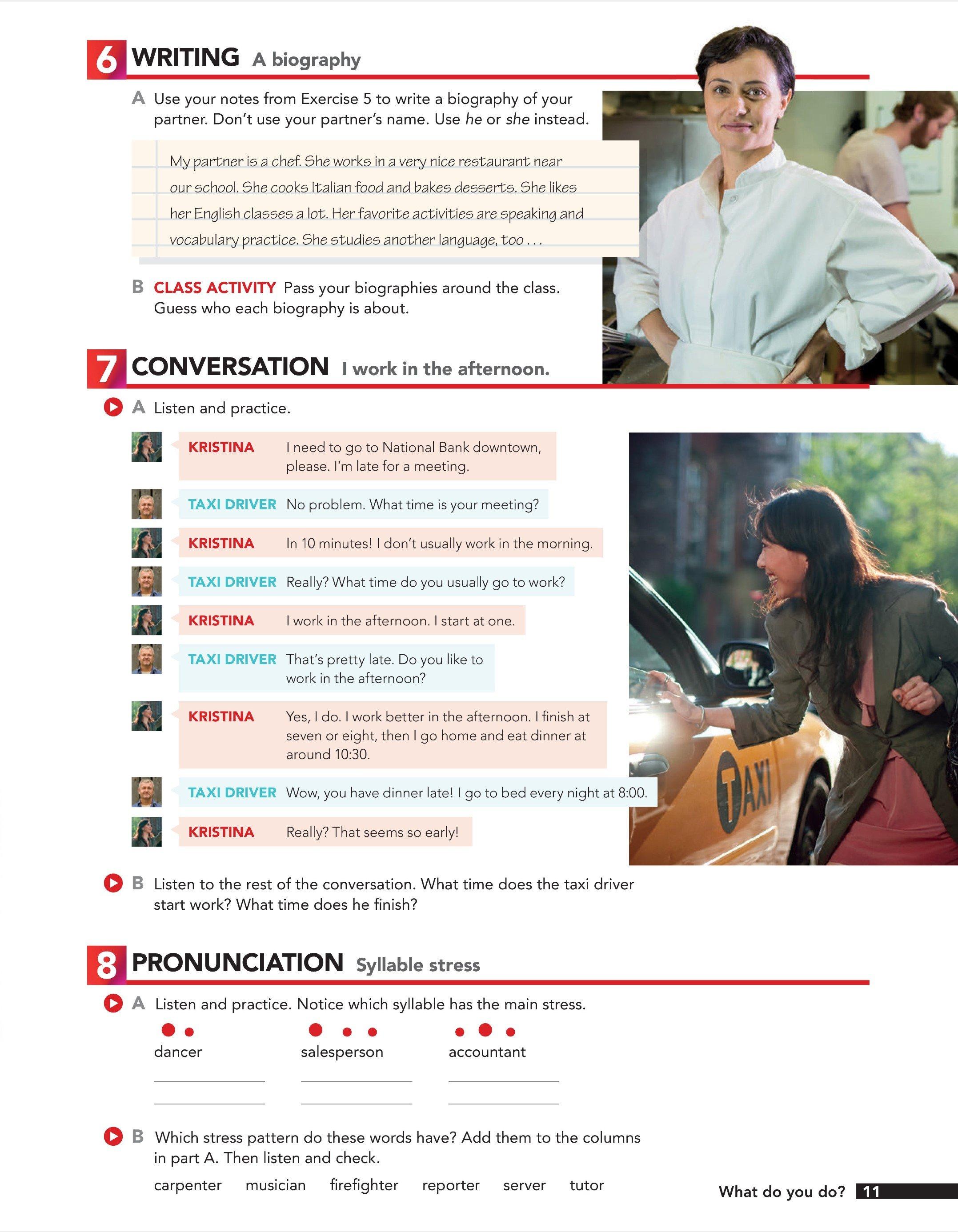
mM WRITING A
A Use your notes from Exercise 5 to write a biography of your y graphy ory partner. Don t use your partner s name. Use he or she instead.
My partner is a chef. She works in a very nice restaurant near our school. She cooks Italian food and bakes desserts. She likes her English classes a lot. Her favorite activities are speaking and vocabulary practice. She studies another language, too...
B CLASS ACTIVITY Pass your biographies around the class. Guess who each biography is about.
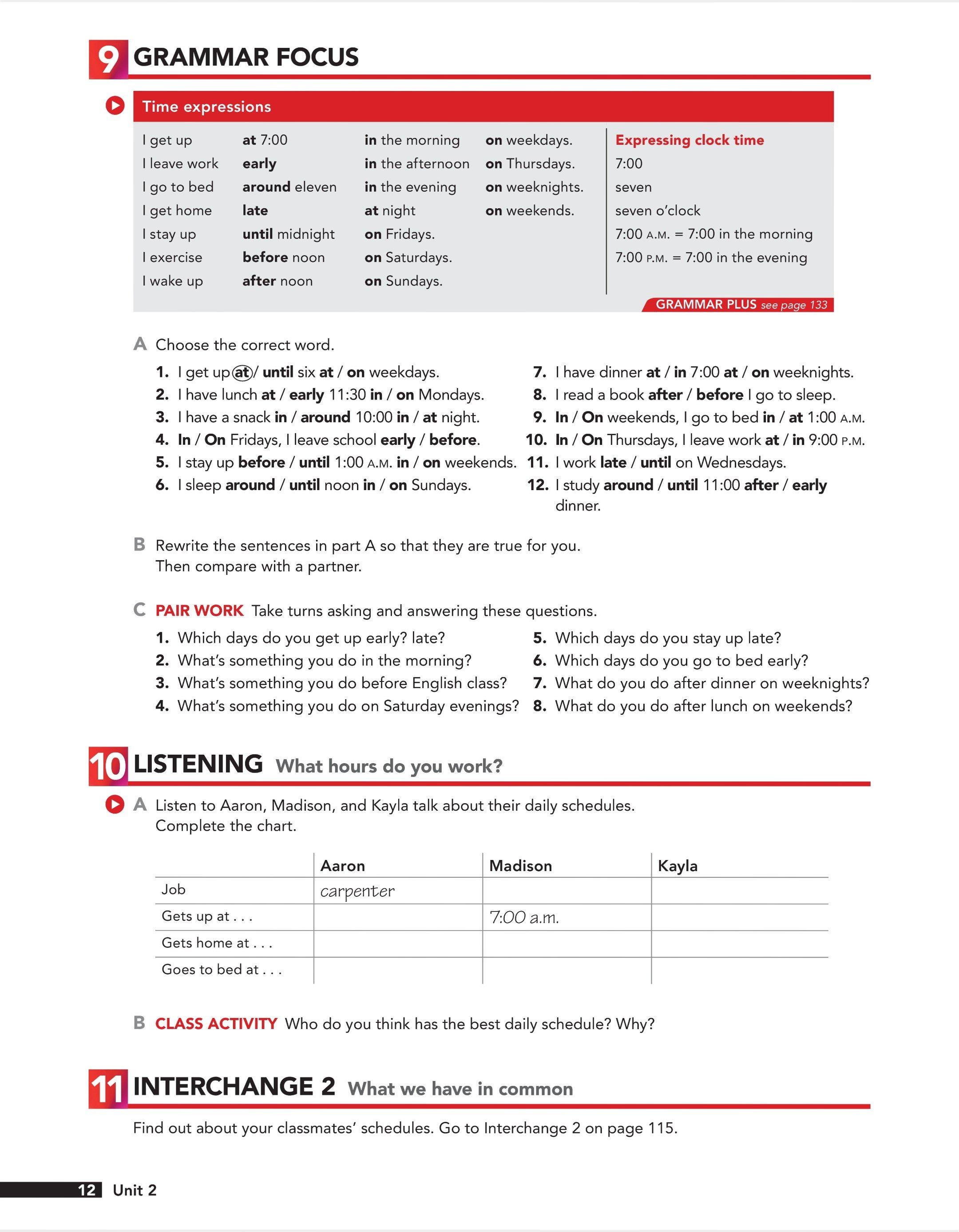
inthe morning on weekdays. Expressing clock time |leave work early in the afternoon on Thursdays. 7:00 go to bed around eleven in the evening on weeknights. seven get home late at night on weekends. seven o'clock stay up until midnight on Fridays. 7:00 a.m. = 7:00 in the morning exercise before noon on Saturdays. 7:00 p.m. = 7:00 in the evening wake up after noon on Sundays.
A Choose the correct word.
1. get up @b/ until six at / on weekdays. 7. have dinner at / in 7:00 at / on weeknights.
2. have lunch at / early 11:30 in / on Mondays. 8. read a book after/ before go to sleep.
3. have a snack in / around 10:00 in / at night. 9. In/ On weekends, go to bed in / at 1:00 a.m.
4. In/ On Fridays, leave school early/ before. 10. In / On Thursdays, leave work at / in 9:00 p.m.
5. stay up before / until 1:00 a.m. in / on weekends. 11. work late / until on Wednesdays.
6. sleep around / until noon in / on Sundays. 12. study around / until 11:00 after / early dinner.
B Rewrite the sentences in part A so that they are true for you. Then compare with a partner.
C PAIR WORK Take turns asking and answering these questions.
1. Which days do you get up early? late? 5. Which days do you stay up late?
2. What's something you do in the morning? 6. Which days do you go to bed early?
3. What's something you do before English class? 7. What do you do after dinner on weeknights?
4. What's something you do on Saturday evenings? 8. What do you do after lunch on weekends?
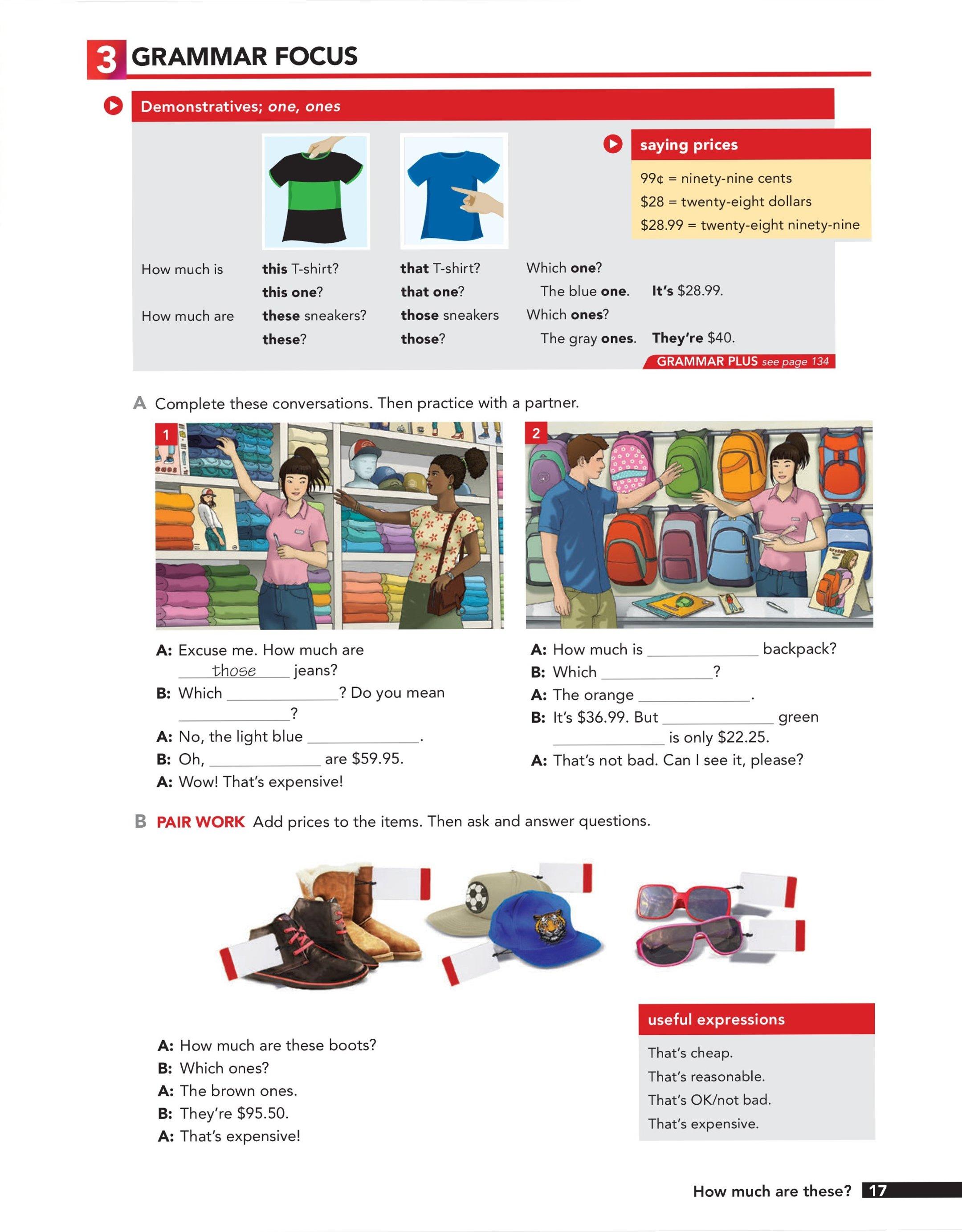
How much is this T-shirt? that T-shirt? this one? that one?
How much are these sneakers? those sneakers these? those?
o99¢ = ninety-nine cents
$28 = twenty-eight dollars
$28.99 = twenty-eight ninety-nine
Which one?
The blue one. It s $28.99.
Which ones?
The gray ones. They re $40.
A Complete these conversations. Then practice with a partner.
A: Excuse me. How much are those jeans?
B: Which ? Do you mean ?
A: No, the light blue
B: Oh, are $59.95.
A: Wow! That's expensive!
A: How much is backpack?
B: Which ?
A: The orange
B: It's $36.99. But green is only $22.25.
A: That's not bad. Can see it, please?
B PAIR WORK Add prices to the items. Then ask and answer questions.
A: How much are these boots?
B: Which ones?
A: The brown ones.
B: They're $95.50.
A: That's expensive!
useful expressions
That's cheap. That's reasonable. That s OK/not bad. That's expensive.
How much are these?
GRAMMAR PLUS see page 134
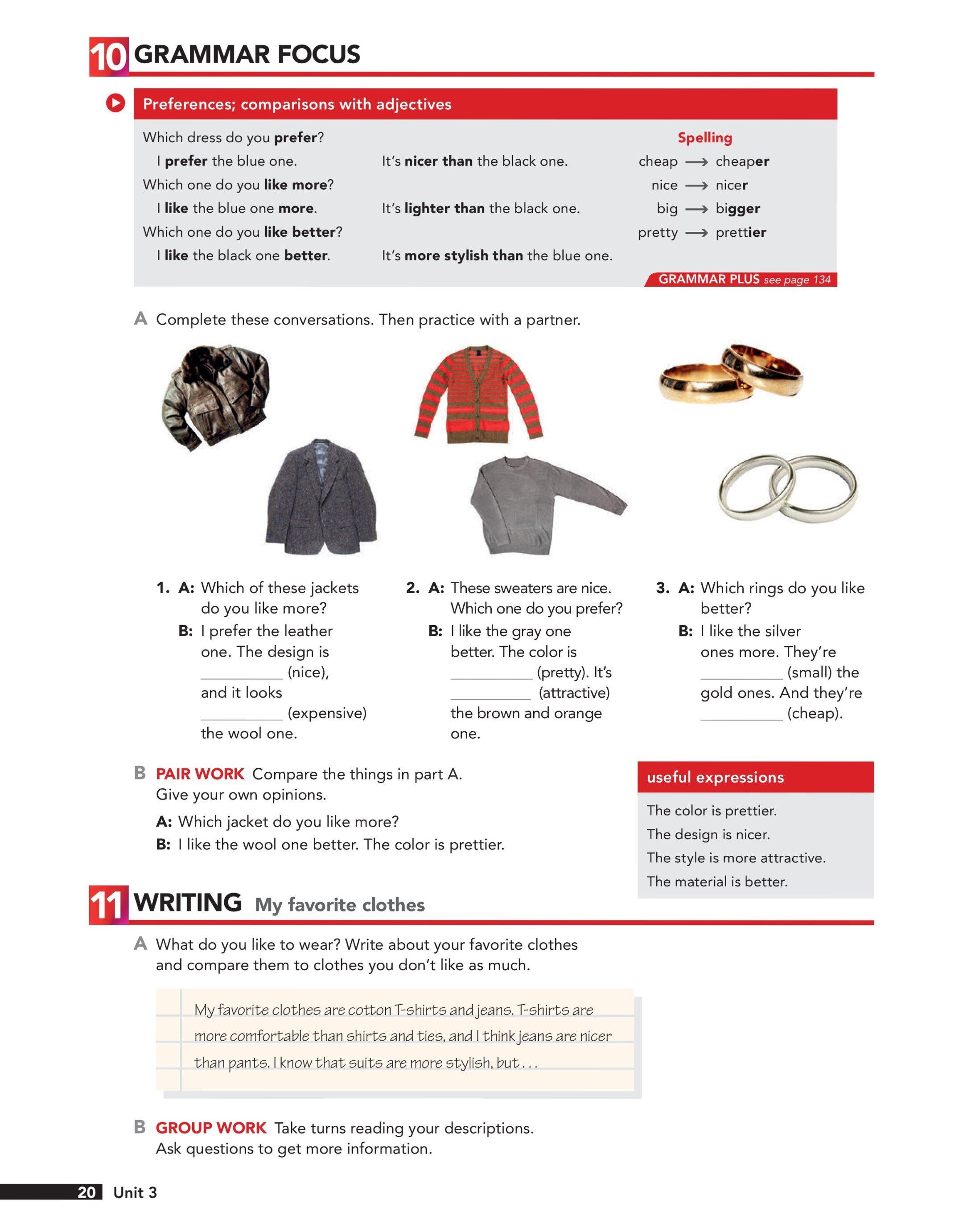
10) GRAMMAR FOCUS
eo Preferences; comparisons with adjectives
Which dress do you prefer? Spelling prefer the blue one. Its nicer than the black one. cheap > cheaper
Which one do you like more? nice > nicer like the blue one more. It's lighter than the black one. big > bigger
Which one do you like better? pretty > prettier like the black one better. It's more stylish than the blue one.
A Complete these conversations. Then practice with a partner.
1. A: Which of these jackets 2. A: These sweaters are nice. 3. A: Which rings do you like do you like more? Which one do you prefer? better?
B: prefer the leather
B: | like the gray one
B:| like the silver one. The design is better. The color is ones more. They re (nice), (pretty). Its (small) the and it looks (attractive) gold ones. And they re (expensive) the brown and orange (cheap). the wool one. one.
B PAIR WORK Compare the things in part A. Give your own opinions.
The color is prettier.
A: Which jacket do you like more? i The design is nicer. B: like the wool one better. The color is prettier. 2 The style is more attractive. The material is better.
11 WRITING My favorite clothes
A What do you like to wear? Write about your favorite clothes and compare them to clothes you don't like as much.
My favorite clothes are cotton T-shirts and jeans. T-shirts are more comfortable than shirts and ties, and think jeans are nicer than pants. know that suits are more stylish, but...
B GROUP WORK Take turns reading your descriptions. Ask questions to get more information.
GRAMMAR PLUS see page 134
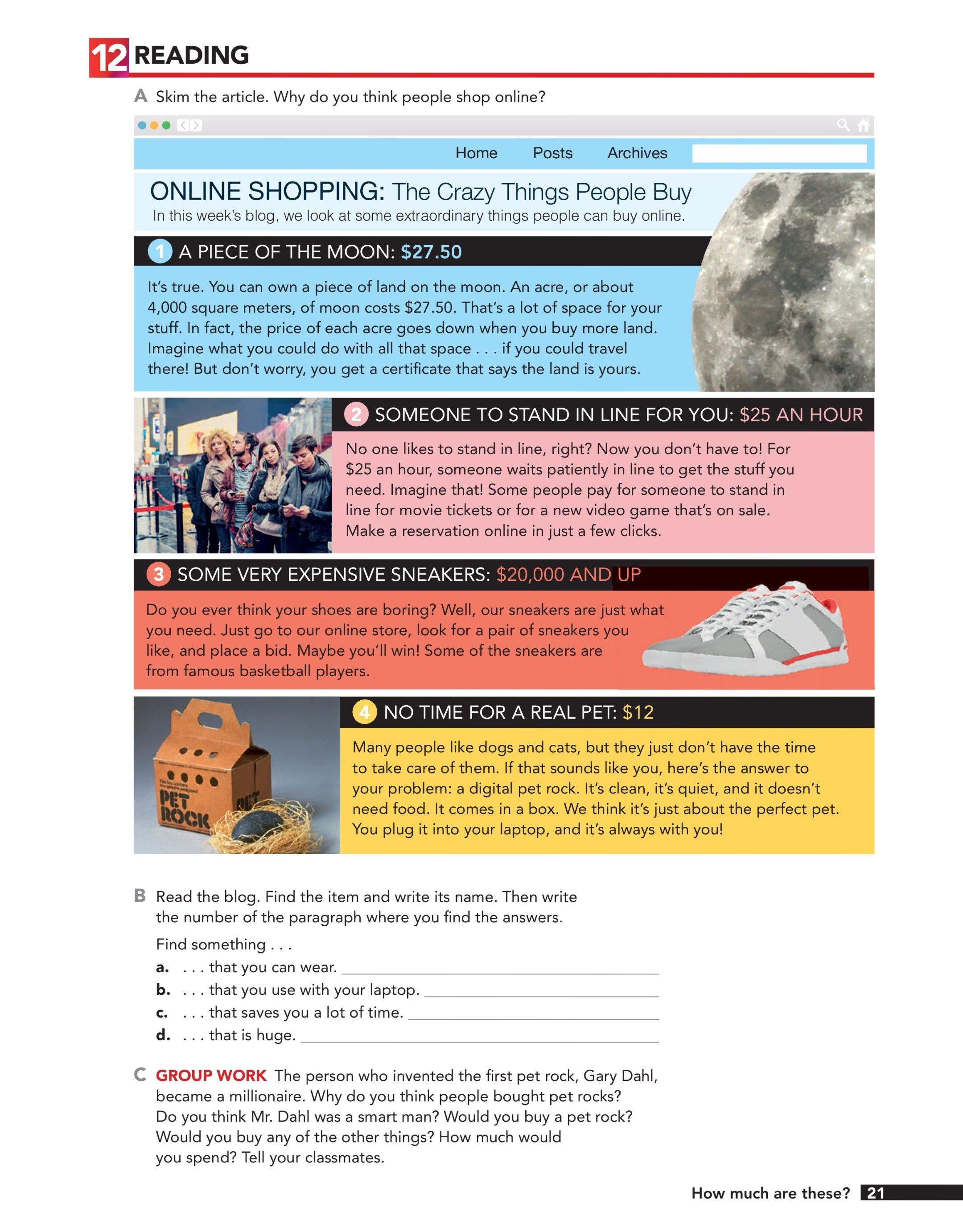
y READING
A Skim the article. Why do you think people shop online?
Home Posts Archives
ONLINE SHOPPING: The Crazy Things People Buy
In this week s blog, we look at some extraordinary things people can buy online.
@ A PIECE OF THE MOON: $27.50
It's true. You can own a piece of land on the moon. An acre, or about 4,000 square meters, of moon costs $27.50. That's a lot of space for your stuff. In fact, the price of each acre goes down when you buy more land. Imagine what you could do with all that space if you could travel there! But don t worry, you get a certificate that says the land is yours.
No one likes to stand in line, right? Now you don t have to! For $25 an hour, someone waits patiently in line to get the stuff you need. Imagine that! Some people pay for someone to stand in line for movie tickets or for a new video game that's on sale. Make a reservation online in just a few clicks.
3) SOME VERY EXPENSIVE SNEAKERS:
cy NO TIME FOR A REAL PET: $12
Many people like dogs and cats, but they just don t have the time to take care of them. If that sounds like you, here s the answer to your problem: a digital pet rock. Its clean, it's quiet, and it doesn t need food. It comes in a box. We think its just about the perfect pet. You plug it into your laptop, and its always with you!
B Read the blog. Find the item and write its name. Then write the number of the paragraph where you find the answers. Find something...
a. ... that you can wear.
b. ... that you use with your laptop.
c. ... that saves you a lot of time.
d. ... that is huge.
C GROUP WORK The person who invented the first pet rock, Gary Dahl, became a millionaire. Why do you think people bought pet rocks? Do you think Mr. Dahl was a smart man? Would you buy a pet rock? Would you buy any of the other things? How much would you spend? Tell your classmates.
How much are these?
> Discuss a TL eet9 aoe dislikes
» Make, accept, and decline invitations
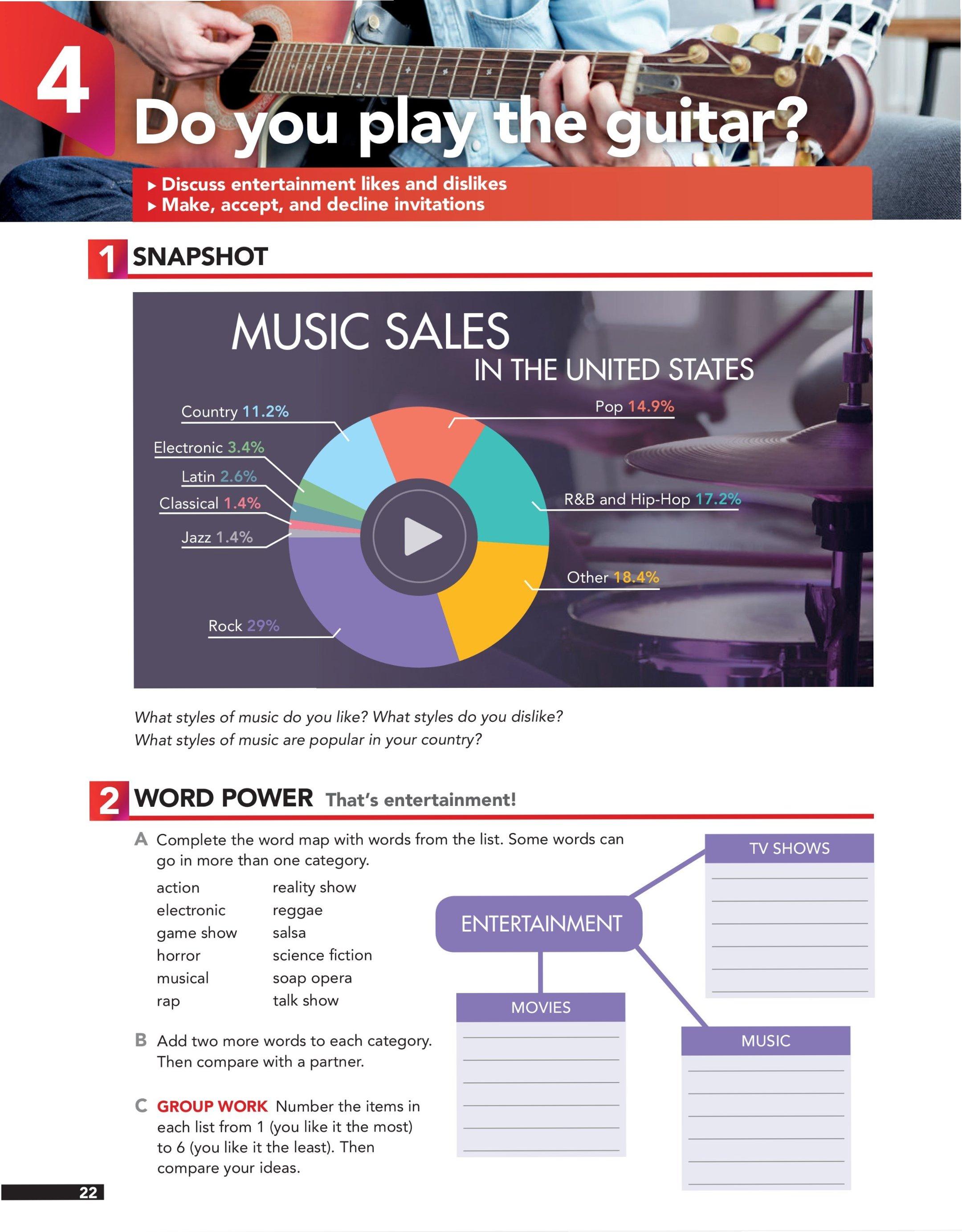
Ey sNapsHot
MUSIC SALES IN
THE UNITED STATES
Country 11.2% PopES all
Electronic 3.4Y lala
Classical NY R&B and Hip-Hop ee A Se a
What styles of music do you like? What styles do you dislike?
What styles of music are popular in your country?
2 | WORD POWER
That's entertainment!
A Complete the word map with words from the list. Some words can go in more than one category.
action reality show electronic reggae mame edie ENTERTAINMENT
horror science fiction
musical soap opera rap talk show
B Add two more words to each category. Then compare with a partner.
C GROUP WORK Number the items in each list from 1 (you like it the most) to 6 (you like it the least). Then compare your ideas.