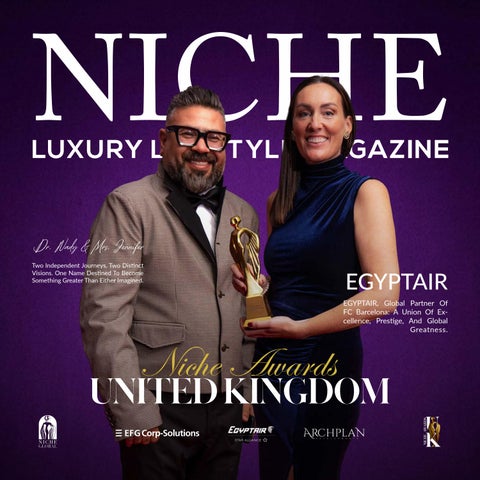
Dr. Nady & Mrs. Jennifer Two Independent Journeys. Two Distinct Visions. One Name Destined To Become Something Greater Than Either Imagined.
EGYPTAIR EGYPTAIR, Global Partner Of FC Barcelona: A Union Of Excellence, Prestige, And Global Greatness.
Code Of The
A crown has never been merely something worn. It is a symbol of everything that comes with it: the weight of expectation, the discipline of conduct, the responsibility of representation, and the understanding that those who carry it are part of something greater than themselves. For centuries, Britain’s royal tradition has preserved these principles through an unwritten code one expressed not only in ceremony, but in dignity, restraint, integrity, excellence, and duty. For this edition of Niche Awards, we asked what happens when that code is taken beyond the walls of the palace and placed in the hands of those who have earned their place. What if the enduring values of the crown could find new expression through achievement?
L
ondon was always the natural stage for such a question. Few cities carry the language of royalty so instinctively. Its streets, institutions, architecture, ceremonies, and traditions hold centuries of history, yet the city has never stood still. It continues to welcome new ideas, new ambitions, and new names into its story. Here, heritage does not exist in opposition to progress; it gives it context. And so the crown, too, is allowed to evolve. Some inherit a crown. Others carry forward the values that give it meaning: a code. The Niche Awards places that code in the hands of architects who shape skylines, entrepreneurs who build industries, artists who challenge perception, innovators who redefine possibility, and leaders who understand that influence is measured not simply by how far it reaches, but by what it leaves behind. Their distinction is built through years of discipline, vision, precision, and an unwavering refusal to settle for ordinary. This is where The Niche Code takes shape. It is not a set of rules written on paper, nor a title granted for a single achievement. It is a way of carrying oneself through achievement, knowing that excellence is a standard to be upheld, influence a responsibility to be carried, and legacy something to be built deliberately. The crown becomes the symbol; the code becomes the substance. The creative world of this edition draws from the quiet authority of royal ceremony. Nothing needs to announce its grandeur when grandeur is already understood. The language is measured. The imagery is deliberate. The atmosphere is opulent without excess, refined without explanation. Every detail is designed to suggest that what is being celebrated is not simply success, but the character, discipline, and standard behind it. The code endures because each generation gives it new meaning. And with every name worthy of recognition, its legacy moves forward.
Great businesses are not built on growth alone; they are built on the vision and strategy that make growth sustainable. Jennifer Boorman has spent more than a decade understanding what separates ambition from lasting business success. As a marketing strategist, business advisor and entrepreneur she has built, scaled, and successfully exited brands while developing a sharp instinct for recognising meaningful achievement. Launched in Leicester more than 13 years ago, the Niche Business Awards grew under Jennifer’s leadership into a respected platform celebrating innovation, leadership, resilience, and measurable impact. Today, as the awards expand across the UK and onto the international stage, she continues to shape their integrity as a jury member, bringing a commercial perspective grounded in entrepreneurial experience. Her career includes more than 13 years leading multi award-winning marketing agency Cross Productions, followed by co-founding Vantage Marketing Group, where she advises businesses on strategy, positioning, and sustainable growth. As Pro Chancellor at De Montfort University, she continues to champion emerging talent, extending her influence from business into the future of leadership.
Architecture, for Ahmed Ashour, extends far beyond walls, façades, and masterplans. It is an experience, a psychological landscape, and a reflection of how people aspire to live. Through Archplan Developments, he is turning this philosophy into a new language of contemporary development in Egypt and the wider MENA region. His approach is rooted in the belief that thoughtful design can influence both the character of the place and the quality of life within it. Under his leadership, Archplan Developments is bringing this philosophy to life through its Il Cuore series, a collection of landmark developments created in collaboration with internationally renowned architect Professor Stefano Boeri. Introducing the Vertical Forest concept to Egypt, the projects place greenery, architecture, and human experience at the heart of contemporary development. His contribution to the real estate and architectural landscape has earned recognition through the Niche Award for his contribution to the industry and the Landscape Middle East Award, affirming a vision that treats development not simply as construction, but as the creation of meaningful environments for the future.
With more than two decades spent at the intersection of technology, business and leadership, Peter Ishak brings a rare breadth of experience to the modern business landscape. As the Founder and CEO of Protip UK, he has built a recruitment and consulting company that connects ambitious businesses with expertise across technology, finance, and operations, working with startups, growing companies, and Fortune 500 organisations across the UK, Europe, North America, and the Middle East. Ishak’s professional journey spans more than 21 years, encompassing software engineering, operations, programme delivery, and product leadership. His experience includes senior positions at global financial institutions HSBC and BlackRock, giving him first-hand insight into the complexity of operating and scaling businesses across international markets. Having worked across more than 36 markets, Ishak brings a distinctly global perspective to his work, combining technical understanding with commercial and operational insight. Through Protip UK, he continues to apply that experience to helping organisations identify talent, navigate growth, and build the capabilities needed to move confidently into their next chapter.
A nuanced transformation of wood, air, and physical space unfolds with deliberate intention. The Cairo-born, Sydney-raised, and London-based composer Joseph Tawadros approaches the oud not as a fragile relic preserved in glass, but as an expansive vessel for contemporary thought. Across a career shaped by eight ARIA awards and a membership of the Order of Australia, his work avoids overt spectacle in favor of understated, architectural rigor. In unhurried musical dialogues with jazz icons like Jack DeJohnette and Béla Fleck, through the narrative geometry of his cinematic score for Ali’s Wedding, or within the historic acoustic halls of London’s Academy of Ancient Music, Tawadros articulates a deeply nuanced microtonal vocabulary. Performing alongside his brother James on traditional Egyptian percussion, bound by shared artistic instinct, the resulting rhythm forms a tactile, grounded spine rather than a theatrical backdrop. After earning an Honorary Doctorate from UNSW and releasing his twenty-second album, The Forgotten Path to Humanity, Tawadros carries five millennia of Middle Eastern heritage with unpretentious, effortless authority. What remains is neither pastiche nor forced genre fusion, but an intimate, atmospheric study in texture, memory, and presence, a moving sonic landscape that does not clamor for highlights, but quietly absorbs them.
For the Director Anwar Kawadri, cinema has always been a bridge between cultures. Born in Damascus in 1953, the Syrian filmmaker grew up surrounded by cinema, and has built a career spanning across British and Arab cinema, bringing together different worlds through the language of film. The son of filmmaker Tahseen Kawadri, Anwar was introduced to cinema from an early age. After receiving his degree from the Central Academy of Motion Picture and Drama Sciences in 1976, he received a scholarship to London, where he studied editing and directing. His early British films include Paulina (1978), Waiting Room (1980) and The Nutcracker (1983) are all marked by the beginning of an international filmmaking journey. His career later brought him back to the Arab world, where he directed Gamal Abdelnasser (1998), a biographical film portraying the life and legacy of one of Egypt’s most prominent leaders. From cinema to television, Kawadri’s body of work reflects a filmmaker who has consistently surpassed geographical and cultural boundaries in his work. His enduring contribution lies in his distinctive ability to tell stories that connect East and West, making his career a remarkable chapter in the history of Arab cinema.
Over the past twenty years, Eman El-Asi has dedicated her life to art and her passion for acting. She carved her way into stardom with steps that showed her raw talent and her precision. Eman ElAsi’s filmography and taste in choosing roles clearly shows her wide range of abilities in making characters that existed only in the folds of scripts come to life. Her spectacular performance always makes a mark and stays in the mind for a very long time, and her performance reached a whole new level in “Qasmet Al-Adl” and “Beraghm El-Qanon”. Aside from her ability to deceive the audience every time into almost thinking that this is her real character, her filmography shows clearly that she wants to shine a light on the injustice that faces so many Egyptian women in the middle and working classes and how we as a society need to stop the cycle of injustice and be better, all of this did not stop her from being a caring and loving mother and a woman who is really proud of her children. It is evident that we cannot stereotype Eman Al-Asi into one particular category for acting, but rather cherish her and her top-notch performance.
Inhabiting, not performing, is where Eyad Nassar’s approach to acting lies, bringing simmering intensity to characters shaped by complexity, contradiction, and human vulnerability. In Sohab Al Ard (Indigenous), that instinct finds a profound ground. His portrayal of a Palestinian man in Gaza is rooted in an emotional authenticity that extends beyond the boundaries of the screen. Nassar has spoken of how his Palestinian heritage and personal connection to the culture helped him draw from an inner reservoir while approaching a story born from an intensely painful reality. Rather than merely portraying the circumstances surrounding his character, he allows their emotional weight to deliberately transcend every moment to the audience. For Nassar, the role carried a responsibility beyond the profession itself: to contribute to a work that reflects the human reality of Gaza and preserves something of its story through art. His performance is consequently marked not by excess, but by presence. A measured, deeply felt interpretation that gives dignity to the experience it represents. From his early work in Jordan to the distinguished career he has built across Egyptian television and cinema, Nassar has consistently demonstrated a rare ability to disappear into the lives of others. With Sohab Al Ard, that ability takes on a deeper resonance, making his performance a compelling testament to the enduring power of acting to hold memory, identity, and humanity.
Cover Story They did not begin together. They did not build together. And for years, they did not even know the other existed. Yet today, Dr. Nady Ghaly and Mrs Jennifer Boorman share the cover of Niche Awards UK 2026 Magazine. Two individuals, two countries, two independent ventures, and a single name, with each one carrying its own meaning until the time, circumstance, and ambition brought them into the same story. For Dr. Nady Ghaly, the journey started out in London in 2011. Drawn to the United Kingdom’s influence on publishing, culture, and international communication, he set out to establish a foreign magazine in the Middle East. That vision became Niche Magazine, whose inaugural issue marked the beginning of an enterprise that would steadily evolve beyond print into a platform for recognition, connection, and cultural exchange. Two years later, another “Niche” was taking shape in Britain. In 2013, Mrs Jennifer Boorman founded Niche Magazine in the UK, independently of Dr. Nady and the publication developing in the Middle East. There was no connection between the two ventures; simply two separate publications that carried the same name and developed along two entirely separate paths. For more than a decade, each one continued to build its own identity. Dr. Nady expanded Niche across the Middle East through publishing, events, partnerships, and recognition, while Mrs Jennifer on the other hand, established Niche within the UK, building a publication and legacy of her own. Neither one of these journeys were shaped by knowledge of what was happening on the other side. That changed in 2025, when Dr. Nady returned to London for the Niche Business Awards. The possibility of acquiring Niche UK emerged, bringing the publication Mrs Jennifer had founded twelve years earlier into the wider Niche organisation. By then, neither was arriving at the beginning of a journey. Both had already built something of their own. The acquisition brought two established histories into a shared future, extending Niche’s presence across the UK, Egypt, Saudi Arabia, Milan, and beyond. That is what makes their story so compelling. It was never planned as one story. It became one with time.
AMBASSADOR
of Niche
Nour Khatab
Awad Rashad
Owner of Fithub
Owner of Spaan Fire & AROART Wood
AMBASSADOR
of Niche
Eslam Sherif
Khaled Hashem
Mohamed El Gamasy
Chief Executive Officer of Art Heritage
Founder & CEO of KH Elite
Founder & CEO of G Auto
EXCELLENCE
of Niche
Dr. Sherif Wakil
Alaa El Kahky
Europe’s Leading Cosmetic & Sexual Regenerative Doctor, Medical Director, Dr SW Clinics
Founder & Chairman of Al Nahar TV Network
EXCELLENCE
of Niche
Eng. Ahmed Youssef
Dr. Andreas Kasouhas
CEO & Founder of DIA
Founder & Clinical Director, Aesthetic Dentist, Oral Surgeon & Implantologist
EXCELLENCE
of Niche
Nawaf Jamal
Dr. Nida Kamal
Founder & CEO of WIN
Endodontist & Practice Principal Shiraz Endodontic Practice
EXCELLENCE
of Niche
Karina Bond
Elisa Fanella
Creative Director
Founder & Director of Elisa Interiors Ltd
THE ROYAL
GARAGE For centuries the British monarchy moved at the pace of a horse. Royal journeys were slow, ceremonial and impossible to miss, with elaborate carriages announcing the arrival of the Crown long before the monarch stepped into view. The carriage was never simply a means of transport; it was part of the spectacle, designed to make the presence of royalty visible. Then Britain entered the age of the automobile, and the Crown had to learn how to move with it. The arrival of the motor car changed more than the speed of a royal journey. It introduced a new way for the monarchy to exist beyond the palace, carrying it through cities, towns and countryside rather than keeping its presence within ceremonial spaces. What began as an embrace of modern technology gradually became something more significant: the Royal Garage became a reflection of how the monarchy itself was adapting to a changing Britain. The transition began in the early twentieth century, when King Edward VII became one of the first British monarchs to embrace motoring. Daimler became the preferred supplier of royal cars, beginning a relationship that would last for decades. These were not ordinary automobiles. They were commissioned and finished with the same attention to detail expected of anything associated with the Crown, transforming a relatively new invention into an unmistakably royal object. Yet the automobile did not replace the ceremony of the carriage so much as reinvent it. Royal cars were still designed to be recognised, whether through their imposing proportions, distinctive finishes, royal insignia or the procession surrounding them. The difference was that the ceremony could now move at the pace of the modern world. As the decades passed, the Royal Garage expanded alongside the monarchy’s changing public image. Rolls-Royce became closely associated with the most formal occasions, while other vehicles served very different purposes. The distinction between them reflected the many faces of royal life: state occasions demanded grandeur, public engagements required practicality, while private estates called for something altogether more functional. Queen Elizabeth II embodied this contrast particularly well. She was accustomed to being transported in some of the most recognisable royal cars in the world, yet she was also known for driving herself around Balmoral.
WHEN THE CROWN
Took to the Road
The image of the Queen behind the wheel of a Land Rover could not have been further removed from the grandeur of a state limousine, yet both belonged to the same royal identity. For centuries the British monarchy moved at the pace of a horse. Royal journeys were slow, ceremonial and impossible to miss, with elaborate carriages announcing the arrival of the Crown long before the monarch stepped into view. The carriage was never simply a means of transport; it was part of the spectacle, designed to make the presence of royalty visible. Then Britain entered the age of the automobile, and the Crown had to learn how to move with it. The arrival of the motor car changed more than the speed of a royal journey. It introduced a new way for the monarchy to exist beyond the palace, carrying it through cities, towns and countryside rather than keeping its presence within ceremonial spaces. What began as an embrace of modern technology gradually became something more significant: the Royal Garage became a reflection of how the monarchy itself was adapting to a changing Britain. The transition began in the early twentieth century, when King Edward VII became one of the first British monarchs to embrace motoring. Daimler became the preferred supplier of royal cars, beginning a relationship that would last for decades. These were not ordinary automobiles. They were commissioned and finished with the same attention to detail expected of anything associated with the Crown, transforming a relatively new invention into an unmistakably royal object. Yet the automobile did not replace the ceremony of the carriage so much as reinvent it. Royal cars were still designed to be recognised, whether through their imposing proportions, distinctive finishes, royal insignia or the procession surrounding them. The difference was that the ceremony could now move at the pace of the modern world. As the decades passed, the Royal Garage expanded alongside the monarchy’s changing public image. Rolls-Royce became closely associated with the most formal occasions, while other vehicles served very different purposes. The distinction between them reflected the many faces of royal life: state occasions demanded grandeur, public engagements required practicality, while private estates called for something altogether more functional. Queen Elizabeth II embodied this contrast particularly well. She was accustomed to being transported in some of the most recognisable royal cars in the world, yet she was also known for driving herself around Balmoral. The image of the Queen behind the wheel of a Land Rover could not have been further removed from the grandeur of a state limousine, yet both belonged to the same royal identity.
EFG CORP- SOLUTIONS AN EMPIRE IN MOTION
There is a particular kind of success that does not need to announce itself. Over the past decade, EFG Corp-Solutions has grown into precisely that kind of institution: one whose ascent has been measured not by spectacle, but by the quiet accumulation of trust, influence and remarkable momentum. Since 2015, what began as EFG Leasing has grown into something considerably more expansive, bringing together leasing and factoring under one sophisticated roof and, in doing so, creating a financial partner attuned to the changing rhythms of enterprise. At the heart of its offering is a leasing platform shaped around the varied needs of modern business, extending across real estate, commercial and fleet vehicles, machinery, equipment, production lines and renewable-energy assets. In this way, EFG Corp-Solutions becomes part of the physical story of enterprise itself: the properties from which businesses build their presence, the vehicles that carry their operations forward, and the equipment and infrastructure that turn ambition into something tangible. Its true measure lies beyond the assets themselves; in the confidence of some of Egypt’s most established financial institutions, in a reputation sustained among the country’s leading leasing companies, and in the succession of distinctions that have accompanied its rise. By the close of 2025, that momentum had taken tangible form, with net profits rising 43% year on year. Behind that figure lies a decade of conviction, an exceptional team, and an enterprise that has steadily transformed growth into an art of its own. At the heart of that ascent are two figures steering its course: Talal Elayat, CEO of EFG Corp-Solutions, and Aladdin ElAfifi, CEO of EFG Finance. Elayat looks beyond the present toward a corporate financial institution of regional stature, while ElAfifi continues to broaden the horizons of nonbank finance, bringing together an evolving range of capabilities for businesses and institutions of every scale. Together, they stand at the helm of an enterprise defined less by what it offers than by the possibilities it creates. Their ambitions extend beyond the immediate transaction, toward a more enduring role in the lives of the businesses they serve—one measured not simply in capital deployed, but in ideas given room to grow and enterprises given the confidence to move forward. Under their stewardship, expertise becomes confidence, ambition becomes direction, and financial sophistication becomes a means to something greater: lasting growth. It is this blend of vision and experience that gives EFG Corp-Solutions its distinctive character—and makes its journey feel less like a chapter completed than the first distant horizon of something considerably larger. EMAIL: info@efgcorpsolutions.com MOBILE: +2035357222 WEBSITE: www.efgcorpsolutions.com
ADDRESS: 56 El-Imam Ali, Almaza, Heliopolis, Cairo Governorate-, Egypt.
EMAIL: info@archplandevelopments.com HOTLINE: 15450 WEBSITE: www.archplandevelopments.com
Designing Spaces That
SHAPE TOMORROW In an industry where architecture is often measured by scale, appearance, and ambition, Eng. Ahmed Ashour approaches it through a different lens: the relationship between people and the spaces they inhabit. As Founder and CEO of Archplan Developments, Ashour has built a practice around the belief that architecture should do more than provide structure; it should shape experiences, support wellbeing, and respond intelligently to the world around it. Founded in 2021, Archplan Developments reflects Ashour’s research-driven approach to design. Educated in the United Kingdom in Architecture and Master Planning, his academic work explored the intersection between architectural environments and human psychology, examining how spaces can influence mood, behaviour, and quality of life. This perspective has become central to his philosophy, where function and aesthetics are considered alongside the emotional experience of the people who use a space. Under his leadership, Archplan has developed a distinctive portfolio built around sustainability, innovation, and international collaboration. Its signature trilogy: Il Cuore Verde, Il Cuore Giallo, and Il Cuore Azzurro, represents an architectural vision that seeks to bring nature and contemporary design into closer dialogue. The projects were developed in collaboration with renowned Italian architect Professor Stefano Boeri, whose work in vertical forests and green urbanism has helped establish a new relationship between architecture and nature. Il Cuore Verde offers perhaps the clearest expression of this philosophy.
Located in the Financial District of Egypt’s New Administrative Capital and overlooking Central Bank Square, the project introduces a smart, green approach to commercial architecture. Its concept incorporates vertical forests, private terraces, intelligent building-management systems, smart access and elevators, responsive lighting, and smart sensors. Sustainability is considered across the building’s lifecycle, from energy and water efficiency to material optimisation, waste reduction, and indoor environmental quality. The project also reflects a wider understanding of commercial environments, where productivity and wellbeing are increasingly considered together. Landscaped areas, natural light, intelligent systems, and adaptable spaces are designed to create a setting that feels connected rather than purely functional. In this sense, Il Cuore Verde becomes not only a workplace, but a model for how sustainability can shape everyday urban experience. For Ashour, however, innovation is not simply about adding technology or creating visually striking landmarks. It is about reconsidering what a building can contribute to the lives of those within it. His approach places human experience alongside environmental responsibility, creating architecture intended to be both intelligent and enduring. As Archplan expands its presence across Egypt and beyond, Ashour continues to position the practice at the intersection of design, sustainability, and human-centred thinking. His work suggests a broader vision for the built environment, one where buildings are not merely constructed, but conceived as living parts of the communities and futures they serve.
INFRAONE UK
A PROJECT DEVELOPMENT MACHINE
InfraOne is going fast, in a distinctive track and delivering projects on time, just like the monorail. Conquering a lot of tracks from green transportation, Industrial development, and mega sustainable developments, establishing their power, success and the image of an expert project development company with a wide range of mega construction projects under the supervision of Dr. Mahmoud Gamaleldin the CEO, founder and mastermind of InfraOne. Dr. Mahmoud Gamaleldin has over thirty years of experience in the world of Infrastructure by leading InfraOne to be a widely trusted company. In 2019 InfraOne started first step towards being an active player in the Global project development market, Eng. Ahmed Elkhabiry joined Dr. Mahmoud Gamaleledin to establish the headquarter of InfraOne in United Kingdom and won the first contract in Cairo Monorail Development. InfraOne main focus is on developing their own projects and advising clients on the development of mega projects in the Middle East and Africa, InfraOne is paying attention to every step in the cycle from project planning; full project cycle development management, project structuring, fundraising, and investments. Everything listed was and is translated through their capability in delivering projects with a huge industry weight behind them and earning the trust of governments, private clients, and partners internationally, starting with Egypt. A clear example of the value of their work, when they managed to start and participate in the development of Cairo Monorail project - a project with a wide scope extending to 96 km of alignment through two main lines East and west greater Cairo. Add over that the total development cost of 3 billion dollars, and their worth shines through the details. They took responsibility for such a high value project from the development phase, to contracting, project financial closure, project management, all the way to the project development phase. InfraOne is working now on Industrial Development Projects in the Middle East using their experience in developing required and needed industries in the area, joining forces with international technology partners, investors and financial institutions. Hard work, dedication and exceptional talent are the drivers of InfraOne. Through a combination of strategic vision, technical expertise, and disciplined execution, InfraOne continues to strengthen its position across complex markets. Its growing portfolio reflects an ability to transform ambitious infrastructure opportunities into tangible developments, while creating long-term value for partners, investors, governments, and communities across the region and beyond today.
WEBSITE: www.infraone.org
MASTERMIND BEHIND SUCCESS In a world defined by rapid technological advancement, shifting professional expectations, and an increasingly competitive job market, the pursuit of knowledge has become essential for professionals who want to remain relevant and advance with confidence; yet, many people struggle to find accredited education that combines academic credibility with the flexibility required to accommodate demanding careers. This changing landscape has created a clear gap in the educational market, one that the International Business Academy in London has worked to address through carefully tailored postgraduate programs designed around both professional ambition and market demand, creating accessible opportunities for individuals seeking meaningful academic and professional growth with confidence. Under the leadership of Rabab Zaineldin, Director of IBA London, the institution has strengthened its position in business education through a strategy centred on quality, accessibility, and international relevance. Her vision is reflected in the academy’s focus on developing programs that respond to the realities of modern professional life while maintaining recognised academic standards. By aligning its educational offering with the evolving needs of working professionals, IBA London has created an environment where learning is not treated as an interruption to career progression, but as an essential part of it. This approach has enabled the academy to attract ambitious students seeking knowledge, credibility, and practical tools that can support meaningful professional growth. Rabab Zaineldin’s leadership is also evident in the strategic partnerships developed under her direction. IBA London is in partnership with Qualifi UK, which provides regulated qualifications across a range of professional and academic disciplines, giving students access to structured programs built around recognised frameworks. The academy has also established a partnership with Horizons University in France, supporting postgraduate business education while extending IBA London’s international academic network. Together, these relationships reflect a commitment to academic standards, global engagement, and professional relevance, strengthening the institution’s ability to support students pursuing opportunities across an increasingly international business environment. They also reinforce the academy’s broader vision of internationally connected postgraduate education.
ADDRESS: Viglen House Business Centre Alperton Lane, Wembley, London, England, HA0 1HD
MOBILE: +447539049036
Behind this strategy is a career shaped by international exposure and professional versatility. Before becoming Director of IBA London, Rabab Zaineldin built experience across interpreting, management, and international development, working with diplomats, governmental institutions, and NGOs. This diverse background helped develop the leadership, communication, and decision-making skills that now define her approach to directing the academy. Her progression into educational leadership represents a natural extension of a career built on responsibility, strategic thinking, and engagement across different professional environments. It is this breadth of experience that has enabled her to approach IBA London not simply as an academic institution, but as a platform designed to connect education with real professional opportunity. It brings valuable perspective to the academy’s relationships with students, partners, and professional communities.
IBA London’s philosophy is reflected in the experience it offers its students. With more than 30 programs and a combination of virtual and on-site learning, the academy has adapted its model to the realities of digital transformation and modern working life. Flexible schedules allow professionals to pursue academic advancement alongside existing commitments, making postgraduate education a source of growth rather than an additional burden. The academy has also celebrated its graduates through distinguished ceremonies, most recently in Dubai in February 2025, where 70 MBA and DBA graduates received their certificates. The event marked an important institutional milestone and reflected the academy’s commitment to recognising achievement. For IBA London, the success of its graduates remains the clearest expression of its enduring purpose, ambition, and educational vision.
ARCHITECTURE MEETS IDENTITY Architecture can do more than shape the spaces we inhabit. For the Architect Khaled Hashem it can also preserve identity, shape experiences and also create a contemporary expression of place. As a Saudi entrepreneur and architect, Hashem has built his practice around that belief, combining together design, business and cultural understanding through his work across the Kingdom. As the founder and CEO of KH Elite Architecture and Elite Contracting Co., Hashem combines a Bachelor’s degree in Architecture with an MBA, allowing him to approach projects from both a creative and strategic perspective. The architect has successfully developed a design language that balances between modern-day aesthetics and the character of Saudi Arabia, with nearly a decade of professional experience that is reflected in residential, commercial, hospitality and workplace projects. The base of his approach is the reinterpretation of traditional Saudi architectural elements through a contemporary lens. Rather than treating heritage as something fixed in the past, Hashem sees it as a foundation for creating spaces that feel relevant to modern life. His work combines authenticity, innovation and human centred design, while taking into consideration sustainability and long term value, principles that align together with the ambitions of the Saudi Vision of 2030. At KH Elite Architecture, this philosophy is reflected in the way that architecture, interior design, branding and strategic design come together to create cohesive spaces and experiences. The studio doesn’t just create spaces that are simply visually appealing but also functional and responsive to the people who experience them. Every project is approached with an individual expression of the client’s vision while also staying connected to the studio’s broader design language Among its selected projects is Sabi House Cafe, an interior design project that reflects the studios’ ability to translate a concept into an environment, alongside private residential projects spanning architecture, interiors and landscape design. These projects reflect the practice’s desires to create spaces where architecture and interior design are woven together rather than existing as separate elements. Behind every project are challenges that require more than a strong visual concept.
Balancing client’s desire with functional requirements, integrating local identity into contemporary solutions and ensuring efficient execution can all shape the designing process. Hashem approaches these challenges through collaboration, detailed planning, material selection and close coordination between multidisciplinary teams, thus allowing the creative ambition of every client to remain grounded in practical execution. For the architect, however, architecture does not end with a completed project. He seeks to contribute to the wider design community through industry initiatives, collaborations and professional dialogue. By building partnerships with local and international brands, he encourages knowledge exchange and aims to contribute to higher design standards within Saudi Arabia. His support for emerging architects and designers further reflects his belief in developing the industry alongside his own practice. Through both KH Elite Architecture and Elite Contracting Co., Hashem continues to position architecture as a practice that goes beyond mere construction. His work reflects a growing design landscape in Saudi Arabia, where cultural identity, contemporary thinking and ambitious development are all woven together. For Hashem, the future of Saudi architecture lies in creating spaces that honour where the Kingdom comes from while embracing where it is going.
MOBILE: +966 56 119 5777 WEBSITE: www.khaledhashem.net INSTAGRAM: kh.elite.arch - kh.elite.con - kh.arch
ART HERITAGE
There is a quiet reverence in the continuity of craft, where an unbroken lineage transforms raw timber into imperishable, living heritage. Established in 1920, Art Heritage carries the refined devotion of four generations dedicated to the classical decorative arts. Functioning as both a custodian of historical legacy and a forward-thinking design atelier, the house seamlessly translates the majestic vocabularies of the fourteenth through nineteenth centuries into the refined fabric of contemporary living spaces. Stepping inside Art Heritage’s world is to enter a living archive of European joinery, where museum-grade replicas of historic masterpieces sit alongside internationally recognized original creations. Spanning grand private commissions and full-scale interior compositions across Egypt, the broader MENA region, and prestige markets across Europe, the atelier’s expansive reach is defined by an enduring global trust. Rather than yielding to the rapid, impersonal rhythms of modern mass manufacturing, Art Heritage privileges the slow, deliberate ingenuity of master woodcarving and traditional leafing techniques. Bridging the historic design sensibilities of London and Milan with the spatial grandeur of Cairo and the Gulf, the studio crafts understated architectural anchors. Each bespoke endeavor reflects an uncompromising mastery, transforming private residences into timeless sanctuaries of artisanal craft that effortlessly transcend ephemeral trends.
Eslam Sherif Monumental Grace Nowhere is this synthesis of historical rigor and artistic emotion more vividly expressed than in the Majestic Sofa. Inspired by the iconic eighteenth-century state sofas designed by architect Robert Adam for the Drawing Room at Kedleston Hall in the United Kingdom, the piece stands as a masterwork of classical storytelling sculpted directly into solid wood. It does not merely occupy a room, it commands an atmosphere of understated British stateliness, quietly shaping the surrounding architectural space. Every contour reveals a narrative of mythological grace and uncompromising technique. Flanking the frame, hand-carved gilded mermaids cascade seamlessly into the armrests, their fluid forms descending toward entwined marine feet that support the piece with sculptural lightness. At the crown rests a delicate classical cameo crest, enveloped by the soft, nuanced brilliance of hand-applied dual gold and silver leafing. This metallic finish catches ambient light in subtle shifts throughout the day, accentuating the depth and shadow of the intricate woodwork. Upholstered in rich damask silk and punctuated by classic cylindrical bolster cushions, the seating experience of the Majestic Sofa becomes both visually monumental and deeply inviting. To encounter the Majestic Sofa is to experience the boundary where neoclassical architecture meets intimate domestic comfort. It stands as an emblem of Art Heritage’s core philosophy: that true luxury lies not in brief, sensational flourish, but in the noble preservation of classical decorative handcraft, meticulously sculpted to gracefully endure across future generations and timeless interior spaces.
THE EVOLUTION OF TIMBER Some industries evolve through disruption, others evolve through experience, gradually absorbing new ideas without losing sight of what came before. For the Engineer Awad Rashad, nearly three decades in the timber industry have been defined by that balance between understanding how wood was used in crafting since 1996 and a growing interest in the possibilities of artificial intelligence. Rashad’s journey started out in the commercial world of wood, developing expertise in importing, trading and evaluating raw material before expanding into the management of several ventures within the timber sector. Throughout those years, the majority of his knowledge came from experience, understanding how the market operates, selecting suppliers, recognising quality and most importantly, learning how to read the material itself. Wood is rarely as simple as it appears. Its quality can be shaped by multiple factors, from knots and cracks to variations in colour, internal structures and imperfections, while its value ultimately lies in how it is intended to be used. For years, identifying these details relied on the trained eye of the experienced merchant. Nowadays Rashad is exploring how that eye can be complemented by artificial intelligence. Artificial intelligence introduces the possibility of leveraging those visual expertise into data. Through computer vision and image analysis, technology can examine the raw material, identify potential defects, classify them and determine their locations. From there, this information can support decisions about how each piece should be used, cut and manufactured. This shift is subtle but significant. The process is no longer simply about deciding whether a piece of wood is good or defective. Instead, it becomes about determining its potential: what is the best use for this particular piece, where it should be used and how much of the material can be preserved? That philosophy becomes particularly vital in the cutting process. Traditionally, the worker examines each piece, identifies its imperfections and decides the most doable cutting pattern, alongside the usage of AI-supported systems, cameras and sensing technologies that can capture the finer details of each piece, allowing algorithms to analyse its characteristics and identify the most efficient way to approach the cutting process. These insights can then be translated into precise instructions for machinery, bringing greater consistency and accuracy to manufacturing. The goal, however, is not technology for its own sake. It is about creating greater value from the same resources while reducing unnecessary waste. Across thousands of panels, even small improvements in material utilisation can become significant both environmentally and commercially.
EMAIL: Awad.rashad@aroart.com MOBILE: +9715244991550 - +201222166144 INSTAGRAM: awadrashad FACEBOOK: Awad Rashad
For Rashad, this progression is not straying away from his experience that shaped his career, but rather an extension of it. His knowledge of suppliers, customers, raw materials and market demands provides the foundation where AI adds another layer of analysis. Thus allowing that knowledge to be applied with greater precision. This approach also extends to his work in importing wood from Holland. From selecting the supplier and assessing specifications to transportation, storage, cutting and final manufacturing. Every step represents a decision that can influence the value of the finished product. Technology offers a way to connect these decisions through data, turning information into more informed production. In this sense, Rashad’s journey reflects something larger than the introduction of AI into the timber industry. It represents a movement from traditional commerce towards a smarter and sustainable production where efficiency is measured not only by how quickly something is made but also by how much value can be created from what already exists After almost three decades, Rashad’s tools may have evolved, but his belief that quality begins with understanding the material remains. Today, that understanding is supported by technology, bringing together experience, intelligence and precision to create greater value from every piece of wood.
SUBSTANCE OVER SURFACE Across contemporary health culture, physical fitness is frequently reduced to superficial aesthetic metrics and short-lived visual transformations, yet, trainer Nour Khattab has established a grounded wellness framework by challenging that narrative from the foundation up. What began as Khattab’s personal pursuit of self-betterment evolved into a dedicated professional philosophy: viewing physical conditioning not as a stressful search for quick fixes or superficial shortcuts, but as a sustainable lifestyle deeply rooted in long-term physical vitality, mental clarity, and internal resilience. This transformative approach took physical shape at FitHub, a health and lifestyle space originally established in Alexandria’s Smouha district to refine how people approach body and mind care. Designed to replace confusion and guesswork with total transparency, FitHub operates on structured follow-ups, rigorous safety protocols, and client trust, supporting each member’s personal development long before expecting full commitment. Beyond housing exclusive, high-performance equipment, the environment seamlessly marries athletic conditioning with sophisticated lifestyle care. Members move fluidly between high-performance athletic zones and restorative spaces, supported by smart access-control wristbands, private floors reserved for women, a refined Healthy Station, an inviting swimming pool, a relaxation spa, and an in-house professional nutrition clinic. Guidance comes from certified personal trainers who serve as passionate mentors, shaping calibrated movement programs that balance high-intensity conditioning with restorative practices. Studio programming reflects this expansive scope, integrating mind-body disciplines with dynamic, energy-driven formats, and specialized fitness sessions for kids. By moving beyond shortcut-driven trends, Khattab’s core methodology demonstrates that genuine physical capability develops when health, education, and sustainability take precedence over temporary visual results. He addresses the psychological frustration of chasing immediate physical changes by instilling a consistent mindset, ensuring members build a foundation to carry their healthy habits forward for years to come. Results take time, but the emphasis remains on cultivating daily rituals rather than chasing fleeting aesthetics. Expanding this holistic movement into Cairo’s evolving wellness landscape, FitHub is broadening its footprint with the opening of its newest location: FitHub Castle – Katameya Road. This new location combines structured, science-backed exercise with refined community amenities, establishing a health space for wellness enthusiasts across the capital. Physical conditioning is not a destination marked by a number on a scale or a brief visual shift, but a lifelong commitment to walking forward with clarity, resilience, and lasting strength.
EMAIL: Nourkhatab@fithubeg.com Drayatabdelhady@gmail.com
INSTAGRAM: fithubegypt FACEBOOK: FitHub Gym
ADDRESS:
Cairo: 311 Hyde Park, Business Plaza, New Cairo London: 124 City Road, London, EC1V 2NX EMAIL: Hello@design-itude.com
TELEPHONE:
Egypt: +20 (0) 222222753 UK: +44 (0) 2074594964
NICHE AWARDS
Where Ident i t y Shapes Every Space Architecture can shape more than the buildings we inhabit. It can influence how people operate and experience a place. For Design-Itude Associates (DiA), this understanding has revamped a London born architectural and interior consultancy into a full service design studio with offices in London, Cairo and Kent. Today, DiA brings architecture, interior design, landscape, 3D visualisation and project management together, creating an integrated experience for each client. With more than 500 projects completed across over 12 countries, the studio has developed a design philosophy that moves beyond traditionally Western-centric conventions, informed by its presence across Europe and the Middle East. At Umami Telford, the challenge extended beyond creating an upscale interior, with guest experience and service efficiency considered alongside the restaurant’s visual identity. The result reflects DiA’s belief that aesthetics and functionality are not competing priorities, but complementary ones. DiA’s relationship with cultural identity is equally evident in its award-winning transformation of Tobis African Restaurant in Maidstone. African visual references were brought together with contemporary materials and sculptural lighting, creating an environment rooted in heritage without becoming a recreation of the past. Ultimately, DiA’s work suggests that the most impactful spaces are those that understand their users, respond to their surroundings and allow identity, functionality and experience to exist in considered harmony.
UNITED KINGDOM
NICHE AWARDS UK
A STAR IN THE AUTOMOTIVE INDUSTRY The Automotive industry in Egypt is so delicate and competitive, due to the importance of such purchase decision to the consumers, they don’t preview this decision as something short term but rather an investment that comes with high expectations and demands, and in such high demand market comes a tons of challenges that you need to overcome to have an established presence and to gain and maintain the customers trust, this is exactly what Mohammed El–Gamasy have overachieved not by only have a presence but upgrading an upstanding legacy that goes back to 1978 and establishing a business model that made his competitors go in the same direction as him, which made him more sure that his vision is taking him to the right places. Being the CEO of El Gamasy Auto Group and MBD of the Chamber of Commerce and Head of the Automotive Division at the age of just 32 in a such a tough market was a Challenge but Mohammed El-Gamasy was more than ready to face any obstacle with his expertise and knowledge which started with a Bachelor of Commerce degree and later an MBA, that gave him the needed knowledge to lead one of the biggest groups in the automotive sector in Egypt. Mohammed El–Gamasy had no limits to his ambitions, he restructured how things go and merged several businesses that his family owns under one umbrella to ensure that the whole group goes in with a united vision that led to growth and exceptional success for a conglomerate that cover every aspect in the automotive industry,starting with G.Auto for the luxury and exotic vehicles, G.Motors that gives the audience a wide selection of new vehicles, G.Trucks which specializes in commercial sectors with specialized transportation solutions, beside that there is G.Finance that provides flexible financial services including loans, insurance, and installment plans and last but not least there is G.Service that manages the delivering of after-sales services and spare parts, with such a wide–ranged portfolio comes a lot of responsibilities that to their broad audience with their different needs and expectations, ensuring a long-lasting relationship of client satisfaction with them all. El-Gamasy Auto Group surpassed every expectation and continues to deliver exceptional success in all these sectors. The most important thing for Mohammed El-Gamasy is not to have business growth, but to continue the family legacy the goes back to almost five decades of trust, credibility, and maintaining the exceptional service providing for their clients that made them an outstanding member in the market for such a long period, this is his true success and what he truly wished from the moment he joined the family business since 2013. El-Gamasy Auto Group under the leadership of Mohammed El-Gamasy is miles ahead from anybody in the market but his ambitions are far away from being fulfilled. ADDRESS: waslet dahshur rd, elshikh zaid, 6th city
HOTLINE: 15453 INSTAGRAM: gauto.eg FACEBOOK: G.Auto
Ceo Letter
“Some journeys begin with a destination in mind, others begin with a vision that evolves. For me, Niche has always been the latter – shaped by people, stories, and the belief that there is always more to discover and create.” Niche was born from the simple belief that behind every name, profession, and achievement is a story worth telling. What started as a dream has evolved into a remarkable space where ideas, people, and perspectives meet. With every edition, we continue to build on that vision, bringing stories to the forefront that reflect ambition, creativity, excellence, and purpose. That vision has now brought us to London, a city where worlds intersect. Heritage meets innovation, tradition meets new thinking, and cultures from across the globe find a place within the same conversation. Within that landscape, Niche finds another space to grow, connect, and tell stories that deserve to travel. Within these pages, you will meet individuals whose work spans business, fashion, design, medicine, culture, and the arts. Their journeys may differ, but each reflects a willingness to create, to challenge convention, and to pursue something greater than the expected. At Niche, we believe recognition should go deeper than a title or an accomplishment. We are interested in the person behind the achievement, what drives them, what they have built, what they have learned, and what they hope to leave behind. As Niche continues to grow across borders, our ambition grows with it. We are not simply expanding into new markets; we are creating a wider platform for stories to travel, for perspectives to meet, and for meaningful connections to be made. London is part of that evolution, allowing us to bring the Niche perspective into a new cultural landscape while continuing to build upon everything that has brought us here. It is this belief in people, their stories, and the possibilities that emerge when those stories are given a platform that continues to shape Niche. To our contributors, partners, team, and readers who have shared in this journey, your trust and continued support remain an essential part of what we are building. As we look ahead, our focus remains on creating a platform that travels further, reaches wider, and continues to give exceptional stories the space they deserve.
When Art Became
For centuries, women were everywhere in art, yet almost nowhere behind it. They were painted as muses and madonnas, wives and daughters, goddesses and beauties. Their faces were framed, their bodies admired, their stories interpreted through someone else’s eyes. They can occupy the centre of a canvas and still remain at the margins of it. The woman was allowed to be the picture and rarely the person deciding what the picture would become. The distinction was simple, but its consequences were not. To be represented was one thing but to represent was another. At first the difference seemed almost inconsequential. Painting can be taught to women but only as an accomplishment, something refined to be practised alongside music, conversation and other marks of cultivated life. Yet within that seemingly harmless practice lay a possibility that reached far beyond decoration.
A skill can become a commission, one that can become an income and eventually that income would end up offering something far less decorative: independence. By the seventeenth century, women such as Mary Beale were beginning to make a living from painting, establishing professional identities at a time when financial and artistic independence remained difficult for women to achieve. The canvas was no longer simply somewhere a woman might demonstrate her refinement. It could become her work, her reputation and increasingly, her name. But a name on a painting can only take a woman so far in a world with its own rooms, institutions and rules about who was entitled to take part in it. When the Royal Academy was founded in 1768, women were not entirely absent from its story. Angelica Kauffmann and Mary Moser were among its founding members, an extraordinary position for women at a time when formal artistic education remained largely closed to them. Both had been trained by their fathers, yet even their place within the Academy came with limitations: they were excluded from the Life Room, where artists studied the nude, a fundamental part of artistic training. Kauffmann could be celebrated as a leading history painter while still being kept from the rooms where the discipline itself was taught. That contradiction revealed the limits of the invitation. A woman could be admired for what she made, even celebrated for it, while the authority to shape the world of art still remained beyond her. So women began testing the boundaries of a world that had never intended to make room for them. In 1860, Laura Herford submitted her work to the Royal Academy Schools using only her initials. It was accepted before the professors realised she was a woman. For once, the work entered before the woman behind it. And perhaps that was where the deeper change began. Women were no longer simply appearing in art. They were beginning to shape it, to decide what belonged within the frame and, eventually, to make their own perspective impossible to overlook. For centuries, women had been accustomed to being looked at, their appearances and stories shaped through the eyes of others. Now, as they began to take up the brush themselves, they could become the ones doing the looking, deciding what deserved attention and how the world around them would be represented. That shift was more significant than simply adding women’s names to the history of painting. To make art was to exercise a kind of authority: to choose where the eye should rest, which stories were worth remembering and which could remain outside the frame. The woman who had once existed within someone else’s vision could now create a vision of her own, using the same medium that had so often reduced her to an image. The canvas therefore offered something the woman inside it had rarely been given: the ability to shape the way she, and the world around her, could be seen. By the twentieth century, that possibility had moved far beyond portraiture and the subjects traditionally considered appropriate for women. Barbara Hepworth helped reshape British modernism through abstract sculpture, creating work that challenged the conventions surrounding both art and the role of the artist. Later, Tracey Emin pushed those boundaries further, placing memory, intimacy and personal experience at the centre of her work. Their practices reflected a wider change in what women could claim as worthy of artistic expression, as the subjects they had once been expected to embody became subjects they could interpret for themselves. The transformation, then, was not simply about women gaining recognition as artists. It was about changing their position within the world of art itself: from the figures being represented to the people doing the representing, from the subjects within the frame to those shaping what the frame contained. What began as an accomplishment could become a profession; the profession could offer independence; and independence could create the space to speak with a voice that was no longer filtered through someone else’s interpretation. In that sense, the history of women in British art is not only a history of who was finally allowed to hold the brush, but of what changed once they did. For centuries, women had been placed inside the picture, admired, interpreted and looked at. Slowly, they began to occupy the other side of the canvas, where they could determine what was seen, how it was seen and, ultimately, what it meant to be seen at all.
COUTURE REIMAGINED London based designer Karina Bond sought to explore a future where fashion is no longer mass-produced, conventionally sized or limited by the constraints of traditional manufacturing. Bond has managed to merge between couture technology and sculpture, she created 3D printed garments by hand using a 3D pen to craft each piece directly into form. Bond graduated from Central Saints with a distinction in Fashion Design in 2021, receiving both the L’Oreal Prize for her graduate collection and the Sarabande Foundation Alexander McQueen Scholarship. The designer managed to launch her brand in 2022, with a mission to investigate how fashion can evolve as technology continues to reshape the industry. Her approach to 3D printed couture is particularly distinctive because it remains intensely a hands on process. Instead of simply designing garments digitally and sending them to a machine, Bond physically draws every garment with a 3D pen. This process transforms clothing into a more wearable sculpture, blurring the lines between fashion, craft and technology. This innovation behind the designer’s work reflects a bigger concern with how clothes are produced and consumed. Bond envisions a system where garments can eventually be created with a simple individual body scan and printed on demand. Rather than producing large quantities in standard sizes, Bond wants to make fashion more personalized while simultaneously reducing excess production waste. Therefore, technology is not simply a visual novelty for the artist but rather a tool for reconstructing the traditional fashion model.
This vision has captured the world’s attention especially online. Bond’s 2026 Met Gala inspired 3D pen dress reels have generated over 28 million views, leading to over 122 thousand followers on Instagram. With her audience including Kesha, Kate Beckinsale, Vogue Editor Munroe Bergdorf, Swarovski Global Creative Director Giovanna Engelbert and fashion critic Sarah Mower. Moreover, behind the viral content, the artist has established a fashion career. Bond has presented 13 collections and has shown at London Fashion Week since 2021. In 2024 and 2025, she created looks for the two winning collections by Efi Davies in the Avant-Garde category at the British Hairdressing Awards. Bond also showcased her recent collection at London’s O2 Arena alongside longtime collaborators Toni&Guy, marking 70 years of the L’Oréal Colour Trophy. The artist’s work expands beyond fashion week, with the custom pieces being created for film, music performances and even some red carpet appearances. Some of her clients include Miley Cyrus, Rita Ora, Eurovision winner Loreen and Jisoo of Blackpink. Bond was also designated to create costumes for the upcoming 2026 fashion film “The Queen of Fashion” about legendary fashion editor Isabella Blow. Bond’s work has also appeared in British Vogue, Elle and Harper’s Bazaar. In addition to being interviewed by the BBC, the Met Museum, Business Insider Hypebae and Forbes. For Bond, technology plays a vital part in expanding fashion’s possibilities.
Her work suggests that the next evolution of couture may not be a simple process of creating more clothes, but rather a process of creating fewer more personalized pieces whilst changing the way people imagine a garment, starting from the moment it is made. This way of thinking places individuality at the centre of each design the artist creates, while also challenging the industry to reconsider the relationship between production, consumption and waste. As this practice continues to develop, Bond also raises questions about authorship, craftsmanship and the role of the designer within an increasingly automated industry. Each garment carries visible evidence of the hand that created it, making the process itself part of the final aesthetic. The irregularities, contours and intricate structures produced through the 3D pen are not imperfections to be hidden, but characteristics that give every piece a distinct identity. In this sense, Bond’s garments retain something deeply human despite being rooted in advanced technology. Her work also demonstrates how emerging tools can create new forms of creative independence. By developing garments directly through a handheld device, Bond can move between idea, material and finished object without relying entirely on established production systems. This allows experimentation to happen at a remarkably intimate scale. The result is a practice that feels closer to sculpting than conventional garment construction, yet remains connected to the movement, body and expressive qualities of fashion. As technology becomes increasingly accessible to designers, Bond’s approach offers a glimpse into how couture could become more responsive, experimental and individual. Rather than treating innovation as a replacement for craftsmanship, she demonstrates how the two can exist together. Her practice ultimately proposes a future in which technology does not make fashion less personal, but gives designers new ways to make individuality, imagination and human touch more visible, and meaningful.
EMAIL: studio@karinabond.com INSTAGRAM: karinabondlondon TIKTOK: karinabondlondon WEBSITE: www.karinabond.com
WIN SOLUTIONS WRITING A NEW CHAPTER OF SUCCESS
Success is a road filled with obstacles, but to be successful in more than one field is truly a challenge that very few could overcome, and that is exactly what Win solutions has done so far and continues to do in an astonishing way. Since the establishment of Win Solutions in KSA in 2023, it was clear without a question that it will be the rise of a prominent name in the fields of music production, marketing, strategic partnerships and event management, and the one of most trusted entities in the creative field throughout KSA. Founded by the well-known songwriter and poet Nawaf Jamal Al-jabri, who has been in the cultural scene for years and has many significant songs and poems, exploring the music production field and making a huge breakthrough came without merely having any struggles, due to his expertise and his determination to have a huge impact in the Saudi scene. This success made Win Solution more hungry for more achievements to come and more daring to go further in the event and concert management field, alongside strategic partnerships and marketing endeavors, going hand in hand with the KSA 2030 vision, which made them a very fast growing entity in their respective field. This rise and consecutive achievements in more than one field made Win Solutions a true success story and an example of how visionary leadership and knowledge of the field of your business could make you go miles ahead from every competitor - proving that success is always by the side of those who have clear vision and a strong strategy, not by those who are simply more established in the market. This strategy made Win Solution so attractive for a lot of stars in KSA to collaborate with; for example, the mega star Mohammed Abdo. Not only stars however were attracted to Win Solutions, but also the governmental sector put their trust in Win Solutions such as the Ministry of Sport and The General Entertainment Authority, which is further evidence of how Win Solutions dominates the Saudi music and entertainment scene without a doubt. Win Solutions is not simply here to do production work, Win Solutions is here to leave a legacy and write a new narrative in the Saudi entertainment scene, and to put out a statement of superiority amongst its peers, as the company that combines creativity and strategy collaborating with stars, crafting their own way into a new natural order. MOBILE: +966594381935 WEBSITE: www.win-solutions.org INSTAGRAM: nawaf_jamall
DR. NIDA KAMAL
From dreading root canals to leading Shiraz Endodontic Practice.
Some careers begin with certainty. Others reveal themselves slowly, often through the things we least expect to enjoy. For the practice principal of Shiraz Endodontic Practice, the path into endodontics was certainly not the obvious choice. As a newly qualified dentist, root canal treatment was something genuinely dreaded. Today, it forms the centre of a career shaped by curiosity, perseverance and a belief that there is always more to learn. After qualifying from Rīga Stradiņš University in 2012, her career took her through NHS, private and hospital dentistry, including a year in maxillofacial surgery. It was through this varied experience that she eventually found her way towards endodontics. Rather than continuing to avoid the procedures she found intimidating, she chose to understand them better, practising on extracted teeth during lunch breaks and attending courses before progressing through postgraduate training with Simply Endo. She completed her MSc in Endodontics in 2022. That willingness to turn uncertainty into knowledge has remained central to her work. Her clinical practice focuses on saving natural teeth through complex root canal treatment, retreatment and vital pulp therapy, with each case bringing its own anatomical challenges and questions. Microscopes, enhanced illumination and CBCT imaging support her work where clinically justified, but she remains clear that technology cannot replace clinical judgement, attention to detail or communication. In 2022, another unexpected chapter began when she took on Shiraz Endodontic Practice from her mentor, Arta Vahdaty, who spent more than two decades building its reputation. What she and her husband and co-director, Chris, inherited was not simply a practice, but a legacy already held in the trust of patients and referring dentists. Since then, Shiraz has grown from a single-surgery endodontic practice into a five-surgery multidisciplinary referral practice, expanding its services to include periodontics, restorative dentistry and oral surgery, alongside on-site imaging. Yet growth has never meant losing sight of the person sitting in the dental chair. Many of her patients arrive frightened, in pain or worried about losing a tooth. At Shiraz, care is shaped around helping patients feel listened to and in control. This can include using a simple hand signal to pause treatment, as well as providing stress balls and noise-cancelling headphones.
TELEPHONE: 0121 709 1660 EMAIL: info@shirazendo.com WEBSITE: www.shirazendodontics.com INSTAGRAM: shirazendo - nidz_endo
For particularly anxious patients, treatment can be approached more gradually, allowing time for trust and confidence to develop before any treatment begins. This approach was recognised when Shiraz won Treatment of Nervous Patients – Midlands at the Private Dentistry Awards 2025. She was also named Young Dentist of the Year – Midlands at the same awards, alongside receiving Best Endodontic Treatment and Best Endodontic Retreatment at the Clinical Case Awards 2024. Her commitment to sharing knowledge now extends into teaching. As a Clinical Dental Tutor at Birmingham Dental Hospital, she spends one day a week guiding undergraduates, especially those facing clinical procedures they find daunting. This teaching role has also encouraged her to reflect more deeply on her own practice, reinforcing her belief that experience should always be accompanied by curiosity and a willingness to keep learning. It has also given her the opportunity to pass on not only clinical knowledge, but the reassurance that once helped shape her own journey. Her approach to dentistry is also grounded in the importance of collaboration.
Working alongside colleagues across different disciplines has allowed her to consider cases from multiple perspectives, particularly when treatment involves more complex restorative or periodontal needs. This multidisciplinary environment reflects the wider direction of her career: an openness to seeking advice, sharing knowledge and recognising when another perspective can improve patient care. For her, expertise is not about working in isolation, but about knowing when collaboration can lead to a better outcome. That same sense of responsibility has followed her outside the clinic, from providing dental care in Peshawar, Pakistan, and Pokhara, Nepal, including work with rural communities, to raising £2,406 for The Little Princess Trust after donating 14 inches of her hair. Her story rests on a simple idea: careers rarely unfold as planned. From dreading root canals to building a practice around them, she found that growth begins where certainty ends. At Shiraz, everything we do is underpinned by caring deeply for our patients and helping them keep their natural teeth for as long as possible.
REDEFINING INTIMATE HEALTH Despite remarkable advances in modern medicine, sexual health remains one of society’s most persistent taboos. Men and women can live for years with intimate concerns yet remain reluctant to seek medical advice because of embarrassment or stigma. For Dr Sherif Wakil, internationally known as “The Godfather of Sexual Rejuvenation,” changing this conversation has become one of the defining missions of his career. A Cosmetic, Sexual Regenerative & Functional Medicine Doctor, Dr Wakil is Founder and Medical Director of SW Clinics on Harley Street, London, creator of the O Concept™, and Founder & President of the International Association of Aesthetic Gynaecology & Sexual Wellbeing (IAAGSW). While studying medicine in Cairo, Dr Wakil was simultaneously pursuing another passion - acting and modelling. His work in the entertainment industry took him from Cairo to the UK and Hollywood, bringing opportunities to work alongside internationally recognised film stars and placing him between two very different worlds: medicine and cinema. As his acting career developed, Dr Wakil reached a defining crossroads,choosing to pursue medicine. After moving to Britain and working within the NHS, his interest in aesthetic and regenerative medicine evolved into a fascination with restoring not simply appearance, but function, confidence, wellbeing and quality of life. More than 15 years ago, Dr Wakil became the pioneer responsible for introducing the P-Shot® and O-Shot® intimate rejuvenation treatments using PRP as well as the Vampire Facelift® and Vampire Breast Lift® to Europe and the UK, later expanding these regenerative innovations into the Middle East and Africa. As his experience grew, Dr Wakil became convinced that sexual dysfunction could rarely be understood through a single symptom or a one-size-fits-all treatment. Bringing together regenerative and functional medicine approaches through O Concept™ for HIM and O Concept™ for HER. Today, it encompasses more than 100 treatment approaches for men and more than 100 for women, with programmes individually tailored according to symptoms, age, medical history, associated health conditions and individual needs. Dr Wakil believes male and female intimate health should not exist as separate conversations. His work spans different stages of life for both men and women, including intimate and sexual dysfunction and changes associated with childbirth, menopause, andropause and ageing. Throughout his career, Dr Wakil has performed more than 40,000 regenerative procedures, with patients travelling from over 90 countries worldwide. In 2016, he founded IAAGSW, and through his international educational work, more than 3,000 medical professionals have been trained internationally in aesthetic gynaecology, aesthetic andrology, regenerative medicine and sexual wellbeing.
As part of his work to challenge overlooked areas of intimate health, Dr Wakil also created International Andropause Awareness Day, marked annually on 1 June, helping bring greater attention to an aspect of male ageing that remains far less openly discussed than menopause. For Dr Wakil, sexual health should not be considered in isolation. Hormones, cardiovascular and metabolic health, neurological function, psychological wellbeing, lifestyle and ageing can all influence intimate function and quality of life. This increasingly connects his work with functional medicine, health optimisation, longevity and wellbeing for both men and women. Dr Wakil’s work has received numerous accolades, with SW Clinics named Best Sexual Rejuvenation Clinic in the UK in 2024, followed by Best Sexual Rejuvenation Clinic in Europe in 2025 and again in 2026. The O Concept™ Protocol has also received multiple international awards and global recognition for its contribution to sexual regenerative and functional medicine. From pioneering regenerative treatments and treating patients from around the world to educating thousands of medical professionals, Dr Wakil’s work now sits at the intersection of sexual health, regenerative medicine, functional medicine, longevity and wellbeing for both men and women. At the heart of it remains one simple message: “Sexual health is health.”
INSTAGRAM: drswclinics YOUTUBE: Dr Sherif Wakil
THE ART
of Natural Smiles
There is a point at which dentistry becomes difficult to distinguish from craftsmanship. A shade is adjusted, a contour refined, a layer of ceramic placed with almost microscopic precision. At Dr. Andreas Kasouhas’ Athens clinic, these details are not simply technical decisions, they are a part of a larger pursuit of something more, individuality. Based in Athens Dr. Kasouhas is the founder and Clinical Director of Dr. Kasouhas Dental Clinic, where his work brings together aesthetic dentistry, oral surgery and implantology. His practice focuses on advanced aesthetic dentistry, porcelain veneers, smile design and complex smile rehabilitation, with every treatment revolving around the individual rather than a pre existing idea of perfection. The distinction is important. For him, a successful smile is not necessarily the whitest, straightest or most symmetrical, but one that feels naturally connected to the person. This philosophy is apparent in his approach to bespoke smile design and porcelain veneers. Working with a specialised dental laboratory in Dubai, porcelain restorations are handcrafted using an advanced microlayering ceramic technique under the microscope. This allows for careful control of translucency, texture, internal depth, light reflection and individual characterisation, reproducing the subtle qualities that give natural enamel its complexity. The results depend on mere technical skills alone. Every smile exists within a face, and its proportions, expressions and features influence how it is perceived. Dr. Kasouhas therefore approaches aesthetic treatment through a facially driven perspective, considering the relationship between teeth and the wider appearance of each patient the aim is not to impose a standardised version of beauty, but to create something that belongs to them. Technology remains an essential part of achieving this balance, supporting rather than defining the treatment itself. Through detailed digital planning, minimally invasive techniques and carefully considered clinical protocols, each stage can be precisely planned before treatment begins. The close relationship between the Athens clinic and the Dubai laboratory also allows the technical and artistic elements of every restoration to work seamlessly together. There is, however, a particular challenge in modern aesthetic dentistry: creating a noticeable transformation without allowing the treatment itself to become apparent. Often, the most convincing results are those that reveal little of the work behind them. In this balance, restraint becomes just as important as transformation, while preserving the natural structure of the teeth remains at the heart of the process. It is an approach that has brought Dr. Kasouhas’ work international attention, with features across publications including Vogue Türkiye, ELLE Ukraine, OK! Magazine, Harper’s Bazaar Australia, LA Weekly, The Village Voice, Forbes Greece and Entrepreneur Middle East. Yet the recognition reflects a philosophy that remains relatively simple: aesthetic dentistry should be personal, considered and, above all, believable. At the centre of his work is the idea that the best dentistry is invisible. When clinical precision, digital technology and artistry meet with restraint, the result does not compete with the face around it. Instead, it becomes part of it. And perhaps that is the real craft, creating a smile that looks less like something made, and more like something that was always there. WEBSITE: www.drkasouhas.gr INSTAGRAM: dr.kasouhas
The Art of Home
Between the architecture of Rome and the quiet character of Yorkshire, Elisa Fanella found her own way of looking at a home, shaped by the lives lived within its walls.Born in a small village outside of Rome, Elisa’s first education in design came long before she formally studied it. Rome offered an early appreciation for architecture, proportion, light and colour, while her mother taught her something more intimate, that a home is not just defined by furniture, but rather it is defined by the memories created within it. After moving to the UK in 1997, the designer found herself moving houses repeatedly, transforming each property before selling it. A decade and six homes later, she began to realise that people were not simply buying a house; they were buying into the lifestyle and feeling it promised, an insight that would later become an important part of her practice. She eventually returned to education, studying interior design at Leeds Metropolitan University before beginning her professional career at Laura Ashley. In 2010, Elisa Interiors was born. Having given herself just six months to make the business work, Elisa was driven by a personal promise to honour her grandfather, who had passed away in January 2009, by launching the company exactly a year later. Today, the Yorkshire-based studio brings together Italian and English influences to create interiors that feel personal rather than prescribed. At the heart of the practice is the belief in “slow design”, spaces shaped by intention, longevity and wellbeing rather than just trends. That philosophy became evident in her project “Beam Ends”, a countryside cottage that belongs to Rebecca Pullan. However, Beam Ends became more than a design project. During its development, Rebecca shared that she was undergoing treatment following a cancer diagnosis. Elisa continued to design around the qualities that had always defined her client: warmth, humour and irrepressible spirit. It is the understanding of the people behind each project that gives the designer’s work its character. Rather than imposing a particular aesthetic, she allows each interior to unfold around the stories, memories and personalities of those who live there. Every colour, pattern and detail becomes a part of something personal. Alongside her residential and commercial work, Elisa is now expanding into wellbeing, with plans for Italian retreats combining interiors, food, movement and mindfulness.
FACEBOOK: Elisa Interiors INSTAGRAM: elisainteriors WEBSITE: www.elisainteriors.com
A Witness of Those
WHO NEED NONE
Set within the historic precinct of Westminster Abbey, Niche marked a monumental milestone as it made its grand London debut, expanding its footprint with an evening steeped in atmospheric splendor. The venue was transformed into an immersive sanctuary of color, where deep amethyst filled the space in a warm, regal glow, harmonizing with subtle accents of deep crimson and sapphire blue, an evocative homage to the legendary gemstones of St. Edward’s Crown. Framed by sublime heritage architecture and historic portraiture, an extraordinary congregation of visionary leaders, icons, and role models gathered under one roof. Representing the pinnacle of modern achievement, attendees brought to life the signature Niche atmosphere, an artful blend of quiet luxury, expressive style, and elevated living. Every corner of the hall reflected a shared commitment to excellence and artistic expression, every corner of the hall embodied a witness of those who need none. As golden statuettes caught the light with each award, the gravitas of formal reverence softened effortlessly into moments of profound, shared intimacy. Beyond the official honors, the soul of the night thrived in unscripted moments around the tables: rich dialogue, shared stories, and spontaneous laughter that forged lasting bonds among luminaries. The celebration reached its crescendo as soulful live vocals filled the wood-paneled hall, casting a captivating spell over the room. Drawn by the music, guests moved onto the floor to dance, sing, and celebrate late into the night. Historic prestige, artistic warmth, and resonant camaraderie, the evening captured the true essence of the Niche lifestyle, weaving another distinct thread into the enduring tapestry of Niche.
OUR PARTNERS IN
Success
FOUNDER AND CEO NADY GHALY OPERATIONS MANAGER TIA KOMY ACCOUNT MANAGERS MARTINA ROMANY MARIAM GABALLAH NANCY AHMED ART DIRECTORS ABANOUB GIRGES MALAK SOLIMAN GRAPHIC DESIGNERS SONDOS AHMED ALIA ADEL FATMA MOATAZ HEAD OF CREATIVE & WRITING MOHAMED SOLIMAN COPYWRITERS MOSTAFA HOSSAM ESSAM ELSAYED SAMA ZAKI EDITORIAL EXECUTIVE MARIAM NABIL
WEBSITE
www.nichemagazine.me www.nichemagazine.co.uk
PR MANAGER NARIMAN YOUSRY PR SPECIALISTS JUMANA MOHAMED MARIAM KHATTAB MAYAR ASHARAF HEAD OF MEDIA MOHANAD MAGED VIDEO EDITORS AISHA MAMDOUH ABDULLAH AHMED JOMANA AHMED PHOTO & VIDEO GRAPHER SAMA HOZYEN RUNNERS AYMAN BEKHIET EMAD YOUSEF SAMAH SAMIR SOMIA MOHAMED
HEAD OF PEOPLE & CULTURE YUSSEF MANSOUR HR SPECIALISTS DOAA MOHAMED CHRISTEEN ATEF ADMIN COORDINATOR NERMEEN GHALY HEAD OF FINANCE MARCO HANY ACCOUNTANTS ISEAK YOUSSEF AMGAD ELPRINCE HEAD OF R&D ESSAM MORTADA WEB DEVELOPER MERNA ATEF MEDIA BUYER AHMED ALY IT & SUPPORT DAVID MAGDY
ASSOCIATE BUSINESS DEVELOPMENT DIRECTORS LISA HALIM SAHAR WAEL BUSSINESS DEVELOPMENT TEAM LEADERS GEHAN MAGDY NAWAL MOHAMED NOUREEN AMIN OMAR EL FAWI BUSSINESS DEVELOPMENT SPECIALISTS MARWA MUSA TERVANA MAGDY MAYAR TAREK NADA MAHROUS NADA SHAMS EL-DIN MONIA HAZEM SARAH NASHAT MALAK MOHAMED AMIRA ABDELMONEM ROAA MOHAMED MARIAM ASHRAF EDITOR-IN-CHIEF AHMED L. DARAWY
BUSINESS DEVELOPER’S NUMBERS
PRINTED BY
info@nichemagazine.me info@nichemagazine.co.uk
+966505971578 01202702700 from 2700 to 2709 01101112472 - 01227972010
International Printing House ( IPH )
Echoes of a Fallen Empire: Purcell’s Ground Bass and an Aria of Grief
Homer’s Odyssey may stand as the most famous voyage born from the ashes of Troy, however, it was Virgil’s Aenid that gave Western literature its most fatalistic imperial tragedy. From that Roman epic springs Henry Purcell’s only true opera, his only all-sung dramatic work, and one of the earliest known English operas, “Dido and Aeneas,” that engraves its memory in the collective consciousness of those who listened to it through, maybe, Dido’s final, haunting command, “Remember me” reverberating through the grains of time, love, and eternity. An apocalyptic romance story culminating in a funeral pyre, a seminal piece of music that synthesizes the influences of its time and condenses the essential ingredients of the lyric genre into an extremely short opera of a prologue, three acts, and a ground bass that anchors the entire work. But what love story? And what preceded Purcell’s Baroque landmark and its most famous aria, “When I am Laid in Earth” known as “Dido’s Lament”? Composed around 1688 for a Chelsea girls’ boarding school, Purcell’s Dido and Aeneas turned modest resources into a chamber masterpiece. Unfolding after Troy’s fall, Aeneas arrives in Carthage, kindling passion with Queen Dido. Dido is locked in agonizing conflict, torn between fidelity to her late husband, fear for her authority, and her burgeoning love. Reassured by her sister Belinda, she yields. Yet a malicious sorceress dispatches an elf disguised as Mercury to trick Aeneas: “Stay, Prince, and hear great Jove’s command.” Tricked into leaving, Aeneas sees Dido’s sorrow and offers to defy the heavens, declaring he will “Offend the Gods, and Love obey.” But Dido rejects his repentance, declaring:
“For ‘tis enough, whate’er you now decree, that you had once a thought of leaving me.” Left isolated, she faces her climax in “Dido’s Lament.” With Aeneas banished, Dido faces her fate, declaring that “Death must come when he is gone.” The opera reaches its tragic threshold not with an immediate surge of orchestra, but with a stark recitative: “Thy hand, Belinda, darkness shades me, On thy bosom let me rest, More I would, but Death invades me; Death is now a welcome guest.” This solitary plea for human comfort clears the stage for the opera’s crowning achievement, “When I am laid in earth,” immortalized as “Dido’s Lament.” Underpinning her vocal collapse is Purcell’s musical masterstroke: a dark, chromatic ground bass in G minor that steps continuously downward across five measures. Loop after loop, repeated eleven times without pause,the bassline represents an inescapable gravitational force, signaling that Dido’s demise is absolute and unchangeable. “When I am laid, laid in earth, May my wrongs create No trouble, no trouble in thy breast; Remember me, remember me, but ah! for get my fate. Remember me, but ah! forget my fate.” Purcell translates Dido’s psychological collapse directly into the vocal line. On the word “laid,” the melody drags downward into the gloom of the grave. Her final plea, “Remember me,” begins with speech-like restraint before suddenly surging in volume and leaping into her highest register: a desperate, soaring cry for her honor and memory to out live her woeful physical death. This cathartic moment transforms Dido and Aeneas’s tragedy from a tale of abandoned love into an apocalyptic romance, a devotion so monumental that its failure leaves a crying plea for immortality—on e that shall be remembered, unstained by the passage of time, unto eternity.
Beyond
Beauty
For Dr Ali Atef Awaleh, beauty was never simply about appearance. As the founder of Odontologia Diferenciada e Face Design and the professional behind “Dr. das Estrelas”, his career has been shaped by a deeper belief which is transforming the way people view themselves can also transform the way they live their lives. Working across Brazil, Paraguay and Argentina, Dr Ali has cultivated an international relationship in aesthetic dentistry, facial harmonisation and facial surgery. His methodology merges between scientific knowledge, technical precision and an artistic understanding of the face thus creating personalized transformations that embrace individuality. Dr Ali’s philosophy stems from his personal journey that started in childhood. He often credits his mother as one of the most important influential figures in his life. Despite being unable to provide the childhood she wished for him, she worked relentlessly to provide him access to education and knowledge. Her determination became a foundation for the discipline and perseverance that would later on define his career. Years of study, research and continuous development has transformed that early ambition into a profession that’s built on innovation. Dr Ali has developed and refined techniques that include 9D Harmonisation, Style Lips and CervicoMax, while simultaneously exploring new developments in aesthetic dentistry, facial harmonisation and facial surgery. facial harmonisation and facial surgery.
Beyond
Care
For him innovation is intertwined with education. As an international lecturer and educator, he believes that sharing this knowledge is an integral part of professional growth. Teaching allows him to contribute to the development of other specialists while also continuing his broader mission of intertwining beauty, knowledge and excellence. One of his biggest challenges was achieving recognition in a competitive industry. Instead of relying solely on marketing, Dr Ali was engrossed in continuous study, research, professional development and patient care. Over time the experiences and recommendations of his patients helped cultivate his reputation, helping establish his name throughout the Tri-border region of southern Brazil and eventually on an international level. His achievements reflect a dedication to continuous learning, earning two awards representing Brazil, recognition for facial harmonisation, and acknowledgement for his professional expertise and scientific contributions. His desire for knowledge has taken him across China, Lebanon Italy, Argentina and even Paraguay for research, advanced training and professional development. Yet recognition remains secondary to his objective. Dr Ali believes that every face carries its own identity, proportions and story. Through his work, he strives to enhance individuality and confidence. Thus creating transformations where external beauty reflects the strength and identity already present within. INSTAGRAM: drdasestrelas
NICHE AWARDS
CORNERSTONE’S SANCTUARY Within the leafy enclave of Heliopolis, Cairo, dentistry transcends routine clinical practice where precision meets a profound understanding of aesthetics. Founded over a decade ago by Dr. Gamal Fahmi, Cornerstone Dental Clinic was conceived as a sanctuary where structural alignment and cosmetic beauty exist in perfect poise. Dr. Fahmi’s perspective has been shaped by international training, including Fellowships in Aesthetics from the University of Genoa in Italy and Orthodontics from the Royal College of Surgeons of Edinburgh in the UK. By seamlessly integrating advanced clear aligner therapies with high-end restorative workflows, he approaches the human smile not simply as a clinical task, but as a bespoke creation requiring both technical rigor and artistic intuition. Inside the clinic, where minimalist warmth replaces clinical austerity, the traditional anxieties of dental treatment give way to an atmosphere of understated luxury and thoughtful hospitality. Every care path is elevated by digital diagnostic precision, ensuring that complex full-mouth rehabilitations honor the natural contours of the face while preserving long-term oral vitality. Rather than relying on fragmented, high-volume care, Dr. Fahmi has cultivated a multidisciplinary retreat where incoming patients experience dental art in its most serene and deliberate form, upholding structural longevity alongside refined beauty a quiet testament to uncompromising global standards reimagined on historic Egyptian soil.
INSTAGRAM: cornerstone.dental.eg INSTAGRAM: drgamalfahmi1 TIKTOK: Gamal Fahmi WEBSITE: www.cornerstondentalclinic.com
Niche
AWARDS
The approach extends seamlessly to an international clientele, bridging refined healthcare with the quiet majesty of Egyptian travel. For hundreds of global visitors seeking tailored smile transformations, Cornerstone turns complex multi-stage care into a calm, week-long retreat. The friction of tight travel schedules is erased long before departure; diagnostic planning takes shape in the digital space weeks prior. Through virtual consultations, remote radiograph reviews, and pre-coordinated master lab schedules, every clinical step is carefully choreographed down to the minute before a patient ever boards a flight. Beyond the accessible economics compared to Western care, the true nuance lies in the experience. Guests undergo high-caliber restorative artistry while immersed in Cairo’s historic depth and cultural wonder. Ultimately, the journey transcends a standard medical procedure into a quiet personal renewal, where the confidence of a restored smile aligns naturally with the timeless rhythm of the city.
SPECIALIST PERIODONTIST From a practice in considerable difficulty emerged a story of precision, resilience and leadership, one that would come to define Dr Sulaman Anwar’s journey. Within just twelve months, the practice had evolved from a struggling single-practitioner model into Serio Dental, a multidisciplinary organisation with a team of 17. His credentials, from dentistry at King’s College London and a Master of Clinical Dentistry in Periodontology to an MBA from Imperial College Business School, provided a formidable foundation as he reshaped Chronos Dental into an exceptional practice.
“If you were designing a specialist healthcare experience today, without inheriting the conventions of a traditional dental practice, what would it look and feel like?” was the question that shaped his vision for Serio Dental: a place where patients feel genuinely looked after, with empathy and attention woven into every aspect of their experience. The journey, however, was anything but straightforward. In April 2023, he acquired Chronos Dental, a struggling NHS practice in North-West London that had experienced serious regulatory difficulties, closure by the Care Quality Commission and significant negative publicity. The Chronos-to-Serio transformation required not simply growth, but reputation repair. Dr Sulaman took that leap of faith, envisioning what the practice could become; a future that would ultimately take shape as Serio Dental. He introduced new clinical governance systems, strengthened compliance processes and established an online governance infrastructure designed to make the organisation more transparent and accountable. The practice subsequently regained CQC compliance and, with it, credibility. As Serio evolved, Sulaman became interested in a broader question: why do some healthcare organisations thrive while others struggle? That curiosity led him to undertake the Executive MBA at Imperial College Business School. The experience fundamentally reshaped his approach to healthcare. Rather than viewing dentistry simply as a collection of clinical services, he increasingly sees healthcare through the wider lenses of systems, strategy, consumer behaviour, culture and technology. Today, Serio Dental is conceived as something far removed from the conventional dental practice: an anxiety-reducing spa, a luxury hospitality experience. The experience is underpinned by advanced technology, from EMS Airflow systems and intraoral scanning to advanced microscopy. Yet the most distinctive elements are often the most human. Patients receive personalised information, thoughtful welcome materials and carefully considered touchpoints throughout their journey. The end goal is ensuring the patient feels valued from the moment they walk through the door. The clinical offering subsequently expanded to encompass periodontics, prosthodontics, endodontics, orthodontics, oral surgery, sedation and cosmetic dentistry, allowing complex patients to be managed collaboratively rather than through isolated referrals. Sulaman became personally involved in the evolution of every element of Serio’s identity. He helped develop the logo and visual language and extended that identity through environmental details, even commissioning a bespoke Serio Dental fragrance as a signature scent for the practice. The transformation reinforced a conviction that has since become central to his philosophy: that exceptional healthcare extends far beyond clinical skill. It is built on culture, systems, leadership, experience and, above all, trust.
WEBSITE: www.seriodental.com INSTAGRAM: dentistsulaman TIKTOK: dentistsulaman
The Art of Sovereignty Long before a crown becomes a symbol of monarchy, it begins as something far more tangible: gold, stone, velvet and the hands of a craftsman. A diamond begins beneath the earth. Gold begins as metal. Velvet begins as thread. On their own, they are simply materials, beautiful in their own right but carrying no inherent language of authority. It is through human hands, imagination and ceremony that they become something else entirely, transformed from precious things into objects that can make power visible. Because power itself is invisible. Sovereignty cannot be held, touched or seen. It exists as an idea, built from authority, legitimacy, inheritance and responsibility. Yet throughout history, monarchies have surrounded these intangible ideas with things that could be seen: crowns placed upon heads, sceptres held in the hand, orbs carried through ceremony, and gemstones arranged to catch the light. The Crown Jewels are the most spectacular expression of this instinct, turning the abstract into something tangible and giving sovereignty a visual identity. This is what makes them more than a mere collection of exquisite jewellery. At the Tower of London, more than 100 objects and over 23,000 gemstones form a collection of regalia that has accompanied coronations and state occasions for centuries. Their significance, however, lies in more than their rarity. Their meaning has been built around them, through ceremony, craftsmanship, symbolism and time. A crown does not create sovereignty. It gives sovereignty a form we can recognise. Few objects reveal this transformation more beautifully than St Edward’s Crown. Created for Charles II’s coronation in 1661 after the medieval crown had been melted down, its solid gold frame was designed with crosses-pattée and fleurs-de-lis, then covered in precious stones, velvet and ermine. Yet for all its magnificence, the crown is not worn as an everyday emblem of royalty. It exists for a particular moment, placed upon the monarch during the act of crowning. That distinction gives it meaning, one that does not rely solely on its gold or gemstones, but rather on how it comes alive through the ceremony around it. For a brief moment, craftsmanship, ritual and history intertwine and become a sign of something far bigger than itself. The stones catch the light, the gold carries the weight, and the crown becomes the visible expression of an authority that otherwise has no physical form.
That same transformation can be traced through the Crown Jewels’ most remarkable stones. When the Cullinan Diamond was discovered near Pretoria in 1905, it was a vast, rough stone weighing 3,106 metric carats. It was extraordinary, but it was still simply material from the earth. To turn it into something capable of carrying meaning required human intervention on an almost astonishing scale. Three men spent eight months studying, cutting and polishing it, working for 14 hours a day to produce nine major stones and numerous smaller diamonds. Two of those stones would eventually find their place within the Crown Jewels. Cullinan I was mounted into the Sovereign’s Sceptre with Cross in 1911, while Cullinan II became part of the Imperial State Crown. The first was no longer merely a magnificent diamond. Set within a sceptre representing the monarch’s temporal power, it had entered an entirely different vocabulary. Its beauty remained, but now it was speaking.If St Edward’s Crown gives sovereignty its moment, and the Cullinan gives it a jewel-like brilliance, the Imperial State Crown gives it spectacle. Created for George VI in 1937, the crown contains 2,868 diamonds alongside historic stones including Cullinan II and St Edward’s Sapphire.
It is worn for major state occasions, including the State Opening of Parliament, where its extraordinary scale and concentration of precious materials turn authority into something immediately visible. There is something almost theatrical about this abundance. Power has always relied, in part, on what can be seen. Rarity commands attention. Scale creates presence. Colour catches the eye. Craftsmanship signals the extraordinary. The Crown Jewels blend all of these elements together, not simply to decorate a monarch, but to communicate the magnitude of the institution they represent. And perhaps that is what makes them so enduring. Their beauty attracts us first, but it is the meaning that makes us remember them. A gemstone does not arrive in the world knowing that it will represent majesty. Gold does not inherently signify permanence. A crown does not possess sovereignty simply because it is a crown. These meanings are constructed, repeated and carried forward until the object and the idea become almost inseparable. That may be the greatest craft of all. A gemstone begins beneath the earth. Gold begins as metal. Velvet begins as thread. None of them are born with the power we eventually see in them. That power is made by human hands, given meaning through ceremony, and carried through time. Perhaps that is the true art of sovereignty: not simply making beautiful things, but giving beauty the ability to speak for power.
NICHE AWARDS
WHERE EMOTION TAKES SHAPE
Jewellery can be worn, but it can hold a world. For Japanese born, London based designer Maiko Nagayama, each piece occupies the space between sculpture and the body, where materials become a language for emotion, movement and memory. A graduate of Central Saint Martins, where she studied Jewellery Design, Nagayama later qualified as a Graduate Gemmologist at the Gemological Institute of America in London. In 2009, she established her eponymous fine jewellery house, bringing together her Japanese sensibility with the experimentation and cultural diversity of her life in London. The result is a language built on contrasts architectural tension alongside organic form, stillness beside boldness and intricate engineering softened by the individuality of gemstones. Rather than treating a gemstone as a decorative centrepiece, Nagayama allows it to become part of the architecture of a piece. Carved, framed, suspended or incorporated into movement, each stone informs the structure around it. Her fascination lies in gems with their own character: unusual colours, inclusions and internal formations that appear to contain landscapes beneath the surface.
INSTAGRAM: maikonagayama WEBSITE: www.maikonagayama.com
This philosophy unfolds through three interconnected creative worlds: Inner Landscape, Transformation and Connection. Inner Landscape looks inward, drawing on memory, intuition, uncertainty and emotion. In ENIGMA, dendritic agates carry branching natural inclusions reminiscent of trees or distant landscapes, with the surrounding structure developed in response to what the stone already contains. Its guiding idea, “Follow what responds,” reflects Nagayama’s belief in intuitive discovery rather than fixed answers. Transformation turns that inward language into movement. Hinges, clasps, articulated structures and changing perspectives are not concealed technical necessities; they become part of the expression. This approach reaches its next chapter in HOPE, her solo exhibition in Tokyo, which explores hope as an active internal force capable of gathering strength and transforming what surrounds it. Across Hidden Fire, Light in the Dark, Air to Rise and New Green, darkness becomes not an absence of possibility but the place from which something new can emerge. Connection brings the work back to the wearer. Jewellery is intimate precisely because it is touched, carried and lived with, making weight, balance and movement as important as appearance. This connection runs through both her collections and bespoke practice. In bespoke commissions, conversations, gemstones and personal stories become part of a collaborative process. Her Japanese upbringing and the life she has built in Britain both inform her creative perspective. From 2014 to 2019, she regularly presented her jewellery at pop-up events in major Japanese department stores, including Isetan Shinjuku, Wako and Ginza Mitsukoshi. She held solo exhibitions at the ART Is. Tokyo Gallery in 2023 and 2024, and will return for an exhibition exploring the theme of ‘HOPE’ from 28 October to 22 November 2026. In London, her work was presented through a dedicated showcase at The Ritz London from 2024 to 2026. Her work has earned multiple honours from the Goldsmiths’ Craft & Design Council, including two Gold Awards, a Silver Award and two Bronze Awards. She was named Designer of the Year at the NAJ Awards 2025. In July 2026, she was shortlisted for Creative Jewellery Designer of the Year at the UK Jewellery Awards. In early September 2026, she won the Excellence in Jewellery Design category at the Professional Jeweller Awards. Across her work, the defining signature of MAIKO NAGAYAMA is not a single motif or shape, but her ability to give emotion a physical form, creating jewellery whose structure, materials and craftsmanship resonate deeply with the wearer.
JEWELLERY, FASHION
And Creative Freedom
For Vicki Sarge, jewellery has never been simply an accessory. Across four decades, she shaped a career defined by jewellery that was playful, theatrical and unapologetically unconventional. From the counter-cultural energy of 1970s Detroit to New York to the runways of European haute couture, Sarge has helped redefine what fashion jewellery could become. Raised in Detroit, Sarge developed an early fascination with fashion, thrift store finds and hands on craftsmanship. Music was an integral part of her environment, from Motown to rock, before she moved to New York City in 1975. There, the energy of Manhattan’s nightlife, including Studio 54 and the downtown club scene, became a lasting influence on her creative outlook. In the early 1980s, Sarge co-founded Erickson Beamon, beginning with an experimental approach to jewellery that involved stringing crystals onto suede. The idea soon attracted the attention of Bergdorf Goodman, leading to the brand’s first major order. What followed after that was a career that was intertwined with fashion, with jewellery becoming a vital part of the runway rather than an afterthought. Following her relocation to London in 1985, Sarge established the European arm of Erickson Beamon and became part of the city’s unconventional creative community. Her work would go on to feature in runway collaborations with some of fashion’s most influential houses and designers, including John Galliano, Alexander McQueen, Dries Van Noten, Givenchy, Erdem and Raf Simons for Jil Sander. Her creative reach goes beyond the fashion world. Sarge designed the iconic tassel necklace featured on Madonna’s Like a Prayer album cover and created pieces for films including The Favourite and Elizabeth. Her work has also appeared in Metropolitan Opera productions and museum collections and exhibitions, including The Wallace Collection and Buckingham Palace. Her work was also recognised through major industry awards and exhibitions. In 2004, she received the De Beers Nature’s Miracle Award, followed by the Swarovski Best Catwalk Jewellery award at the UK Jewellery Awards in 2008. Her designs have also been featured in Jewels of Fantasy and Costume Jewellery in Vogue, as well as exhibitions at Les Arts Décoratifs in Paris and MoMu in Antwerp. In 2013, Sarge launched her eponymous brand, VICKISARGE, creating handcrafted statement pieces in London. Her style combined crystals, semi precious stones, suede and unexpected materials with painstaking craftsmanship, always retaining a sense of humor and irreverence. Alongside design, Sarge has supported craft communities and education, including work with Turquoise Mountain in Afghanistan, a women only workshop in Saudi Arabia and the MADE project in Nairobi. She has also lectured at Central Saint Martins and the Geneva University of Art and Design. After retiring in 2024, Sarge entrusted the next chapter of VICKISARGE to her mentee, Louis Circé. Her legacy remains rooted in the belief that jewellery should not take itself too seriously, but rather it should give its wearer something far more valuable, a star moment. ADDRESS: 12 Kensington Church Street, W8 4EP
INSTAGRAM: vickisarge MOBILE: 07903 099746 WEBSITE: www.vickisarge.com
Who Gets To Smell Expensive?
For much of history, the answer was relatively simple; those who could afford to. Perfume belonged to courts, aristocratic households and a bourgeoisie eager to adopt rituals of refinement. Scent was not merely personal; it could become a quiet way of announcing where one stood. In Britain, fragrance became intertwined with this changing social landscape. Houses such as Floris, established on London’s Jermyn Street in 1730, developed within a world where grooming, fragrance and presentation were connected to social distinction. Penhaligon’s, founded later in Victorian London, similarly became associated with the Royal Household. Then society began to change. As the bourgeoisie expanded, so did its access to the objects and rituals that had once marked aristocratic life. Advances in production and commerce gradually allowed fragrance to reach a much wider public. What had once been a luxury of social position was becoming a consumer product. But that created a problem for luxury. If more people could buy the perfume, how could the perfume continue to feel exclusive? Perfume became democratised, but the language of exclusivity stayed. And that is where the bottle becomes fascinating. Perfume has a peculiar disadvantage as a luxury. Its defining quality cannot be seen.
It disappears into the air almost immediately, leaving only an impression behind. The bottle, however, remains. It can be held, displayed and recognised, giving an invisible product a physical identity. This transformed the bottle from a practical container into something that could communicate before the fragrance ever reached the skin. Glass could become heavier and more elaborate; stoppers could become sculptural; decorative details could turn the bottle into an object worthy of display. Penhaligon’s offers a recognisable example. Its distinctive bottle, with its rounded stopper and bow, developed into a signature associated with the house for generations. The bottle became part of the fragrance’s identity rather than simply the thing holding it. A fragrance could now communicate rarity, craftsmanship and refinement without having to explain any of them. As fragrance moved further into the mass market, its visual identity became increasingly important. The scent itself might now be accessible across different social classes, but the bottle could still create distinction. This is where the history of perfume begins to resemble the history of luxury itself. When access expands, exclusivity rarely disappears completely; it changes form. The signs of distinction became increasingly important: the weight of the glass, the quality of the materials, the heritage behind the name and the carefully constructed visual identity. None of this means that the bottle is merely pretending. Craftsmanship and design matter. A beautifully made object can possess genuine value beyond the social message attached to it. Yet the bottle still tells us how the fragrance wants to be perceived, and sometimes, quietly, how it wants its wearer to be perceived too. That may be the enduring contradiction of perfume. The scent became democratic. The bottle remained a little more selective. Today, fragrance can be found everywhere, with something available for almost every budget and taste. Yet luxury perfume continues to surround itself with a familiar visual vocabulary: weight, rarity, craftsmanship, heritage and restraint. Perhaps that is why the bottle has become inseparable from the fragrance. It does more than contain the scent. It establishes the world around it. The perfume disappears the moment it is released.The bottle stays behind to tell you what it was worth and perhaps, who it was meant to make you feel like.
NICHE AWARDS “Mood and Space”, Designed for Belonging
For Hanna, the value of real estate has always extended beyond the architecture itself, into the communities, opportunities and sense of belonging that give a place its lasting character. Raised on a council estate in Haggerston, she experienced first-hand the disconnect that can emerge when development is perceived as something done ‘to’ communities rather than shaped with them. That early perspective has quietly informed the philosophy underpinning her career, shaping an approach to development that balances commercial ambition with social and environmental value. Through Hanna’s development practice Mood and Space (MAS), Hanna brings together expertise in planning, development and community engagement to shape considered buildings and distinctive urban neighbourhoods. This delivers long-term value while keeping people at the centre of the process. At MAS’s heart is a simple ambition: to bring clarity to the complexity of development while creating places of enduring value. Her experience includes the landmark East Wick, and Sweetwater regeneration project at Queen Elizabeth Olympic Park, where, as Development Director within the Balfour Beatty Investments and Places for People joint venture, she led planning, development and delivery across an £860 million mixed-use scheme. The project encompasses approximately 1,800 homes, commercial space and community infrastructure, contributing to the evolution of the Olympic Park into a vibrant, sustainable and connected neighbourhood. Hanna’s influence extends beyond individual developments. In 2019, she founded Black Women in Real Estate (BWRE), creating a platform that connects Black women across the property sector, nurtures emerging talent, and translates conversations around representation into meaningful opportunity. That commitment extends into the wider industry, through her role as Vice Chair of the University of Greenwich’s Construction, Property and Surveying Practices Industry Advisory Board and as a member of Estates Gazette’s Diversity & Inclusion Content Advisory Panel. Recognised as a Rising Star by We Are The City in 2021, Hanna’s trajectory reflects a measured determination to create meaningful change within an industry where representation remains an evolving conversation. What distinguishes Hanna’s work is her ability to bring together commercial ambition, community value and representation, demonstrating that success and social impact can exist in harmony. Her vision points towards a more considered future for real estate: one in which places are not simply delivered, but thoughtfully shaped around the people who will live, work and build their futures within them.
UNITED KINGDOM
LINKEDIN: Black Women in Real Estate LINKEDIN: Hanna Afolabi (née Osundina) WEBSITE: www.MOODANDSPACE.CO.UK/
The Intelligence
Behind Aesthetics
For Dr Rozina Ali, aesthetic medicine is not about creating a new version of someone. It is about understanding what is already there, recognising what has changed and knowing how to restore balance with precision. With over three decades of surgical experience, her career has moved across reconstructive microsurgery, breast surgery, aesthetic medicine and regenerative treatments, intertwining disciplines that are traditionally practised separately. After Graduating from St Thomas’ Hospital Medical School, Dr Rozina trained extensively in plastic and reconstructive surgery before completing specialist qualifications and a doctorate in cutaneous research. With her academic career beginning early on with research extending from the ocular effects of leprosy in Venezuela to human beta defensins, while her clinical work developed a particular expertise in microvascular breast reconstruction and perforator-flap surgery. International fellowships further shaped her practice, including specialist training in Belgium, Great Ormond Street Hospital, Taiwan and Brazil. Her work in reconstructive surgery placed her at the forefront of perforator flap techniques, while extensive publication and teaching established her as a respected voice within the international surgical community. Fat transfer became an important point of connection between these two worlds. Instead of viewing fat solely as a means of replacing lost volume, Dr Rozina explored regenerative potential, applying it across breast, facial and scalp treatment, scar correction and tissue regeneration. This philosophy has developed into what she describes as Regenerative Aesthetics, which is an approach that’s based on anatomy, biology and the capacity of tissues to repair and renew. This philosophy now sits at the heart of her R&A Clinic in Central London. Standing for Regenerative Aesthetics, the clinic brings together aesthetic surgery, advanced non surgical treatments, regenerative medicine, wellbeing and longevity. Assessment comes first, with treatment being curated around each individual rather than a predetermined aesthetic ideal. Her approach to ageing reflects the same measured thinking. Rather than pursuing “anti ageing”, Dr Rozina describes three clocks, holding the clock through prevention and healthy tissue maintenance; slowing it through regenerative treatments that support collagen, hydration and elasticity; and, when structural ageing has occurred, turning it back through fat transfer, fillers or surgery.Across every stage of her career, the principles remain consistent. Intervention should respect that identity of every patient rather than erasing it. For Dr Rozina, the most convincing aesthetic result is rarely the most obvious. It is the one that appears considered, proportionate and quietly natural, where surgical expertise, regenerative science and clinical judgement work together to help each individual look and feel like themselves. ADDRESS: R&A CLINIC, 31 ONSLOW SQUARE, LONDON SW7 3HU
EMAIL: practice@rozinaali.com
Designed to Be Seen
Made to Move
Some cars announce themselves with the sound of an engine, Jaguar learned to do it with a silhouette. Long before the key turns or the engine comes to life, there is the shape. The long bonnet, low stance and sweeping lines all seem to suggest movement, even when the car is standing still. It was a quality that Jaguar cultivated from its earliest sports cars, turning performance into something that could be seen just as much as it was felt. This resulted in a car that was not only designed to move quickly, but also to possess a sense of occasion before it moved at all. That idea began to take shape with the XK120, introduced in 1948. It was fast enough to establish Jaguar as a serious performance marque, but its appeal was never confined to what lay beneath the bonnet. Its proportions gave speed a visual language, creating a car that looked almost as though it had been drawn in motion. When the E-Type arrived in 1961, that relationship between performance and appearance became even more pronounced. The long bonnet, curved body and low profile made it instantly recognisable, while its engineering gave the beauty something substantial underneath it.
When Performance Became Prestige: Jaguar had found a way to make a car appear to be moving before its wheels ever turned. Yet a distinctive shape alone could only go so far. If Jaguar aspired to become more than a collection of beautiful cars, it needed to create something people could recognise even before they knew what they were looking at. The silhouette had made the first impression; everything else would teach the world how to read it. The leaping Jaguar emblem became an almost perfect expression of that philosophy. The car did not simply carry a name, it carried a gesture. The symbol suggests movement, tension and instinct, reinforcing what the silhouette had already promised. Even the engine became a part of that language, its sound providing another form of recognition. Jaguar was no longer communicating through one feature, but through an entire collection of details that arrived together. This was what made its design feel less like decoration and more like identity. The proportions suggested speed, the emblem suggested movement and the engine gave that movement a voice. Inside, the same philosophy continued through the refinement of the cabin and the craftsmanship of its materials, allowing performance and luxury to exist within the same experience. Jaguar did not ask the driver to choose between the thrill of speed and the pleasure of elegance; it made the two feel inseparable. And as that identity became more established, it began to travel beyond the world of motoring. Jaguar was no longer simply being judged by what its cars could do on the road. It had begun to occupy a particular place within British culture, one where performance could carry the same sense of prestige usually associated with more formal symbols of status. That presence eventually carried Jaguar into the world of British royalty, not as the singular car of the Crown, but as something perhaps more revealing: a performance marque that could sit comfortably within the same cultural landscape as British prestige. Jaguar had held a Royal Warrant since 1951, while Queen Elizabeth II travelled in a Jaguar during her 2002 Golden Jubilee tour. The marque also became part of the royal family’s personal motoring history, with Diana, Princess of Wales, famously owning an XJ-S. The distinction matters. Jaguar was never simply defined by ceremony, nor did its association with royalty require it to become formal or restrained. Its appeal remained rooted in performance, individuality and movement, allowing it to occupy a different kind of prestigious space: one where elegance did not mean standing still. The car could belong in royal life while retaining the character of something made to be driven. That balance became one of Jaguar’s defining qualities. Its luxury was never entirely separate from its performance; the refinement of the cabin, the craftsmanship of its materials and the proportions of its body all contributed to the same impression of controlled power. A Jaguar did not have to choose between looking beautiful and being fast. The two were presented as parts of the same experience, each making the other more desirable. Perhaps that is why the marque has remained so recognisable even as its cars have changed. Models may evolve, technology may advance and tastes may shift, but the underlying idea remains remarkably consistent: a Jaguar should make an impression before it explains itself. Its silhouette catches the eye, its emblem reinforces the movement, its engine gives that movement a voice and its performance confirms that the promise was never merely aesthetic. In that sense, Jaguar’s greatest achievement was not creating a particular shape, badge or sound. It was teaching all of them to speak the same language. Performance became visible. Luxury became dynamic. British elegance acquired a sense of motion.The car, ultimately, became more than a machine for getting somewhere. It became a way of arriving with presence, character and just enough drama to make the moment memor able.Some cars are designed to get you there, Jaguar made the journey begin with the arrival.
London from Greenwich Park
Joseph Mallord William Turner