SEPTEMBER—OCTOBER 2026 / ISSUE 77 / £3
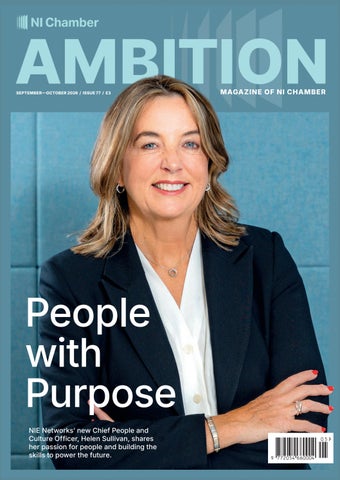
People with Purpose NIE Networks’ new Chief People and Culture Officer, Helen Sullivan, shares her passion for people and building the skills to power the future.
MAGAZINE OF NI CHAMBER
Upcoming Public Courses (Oct 26 – Jan 27) Motivating & retaining staff
Personal & professional development
October 26 01 Oct LinkedIn 01 Oct Accountability 01 Oct Giving & Receiving Feedback (half-day) 01 Oct High Engagement Remote Meetings (half-day) 06 Oct MS Project 06 Oct Minute Taking 06 Oct Proposal Writing 07 Oct MS Excel Introduction 07 Oct Career Management 07 Oct Business Support Skills (Notetaking & Report Writing) 08 Oct Introduction to AI 08 Oct GDPR Staff Awareness (half-day) 08 Oct PA Development 08 Oct Sage Cloud Payroll 13 Oct Xero Cloud Accounting 13 Oct MS Word Intermediate 13 Oct Continuous Improvement & Problem Solving 14 Oct Conducting Investigations 14 Oct Graphic Design for Non-Designers using Canva 14 Oct Business Support Skills (Inbox Comms & Small Projects) 19 Oct MS Powerpoint 20 Oct Mailchimp Email Marketing 20 Oct Event Management 20 Oct Tender Selection & Assessment 21 Oct HR Fundamentals 21 Oct MS Excel Intermediate 22 Oct Emotional Intelligence
November 26 10 Nov Introduction to Project Management 10 Nov Assertiveness Skills 10 Nov Preparing Management Accounts 10 Nov Data Visualisation with Power BI
Advance through knowledge & understanding
Enhancing productivity & effectiveness
11 Nov Mentoring Skills 11 Nov Effective Hybrid Working (half-day) 11 Nov Adobe Indesign (2 days) 12 Nov High Performing Teams 12 Nov Influencing & Negotiation Skills 17 Nov Challenging Unconscious Bias 17 Nov Difficult Conversations 18 Nov Business/Report Writing 18 Nov Finance for Non-Financial Managers 18 Nov Professional Selling Skills 19 Nov MS Word Advanced 19 Nov Delegation Skills 19 Nov Dignity at Work 23 Nov PRINCE2® Foundation 24 Nov Practical Risk Management 24 Nov Managing Conflict 25 Nov Developing Confidence 25 Nov Storytelling in Business 26 Nov PRINCE2® Practitioner 26 Nov Presentation Skills 26 Nov Teamwork & Motivation
In-house & public delivery
January 27 2 Jan Difficult Conversations 12 Jan Finance for Non-Financial Managers 13 Jan Communication with Impact 13 Jan Customer Service 14 Jan Managing Change 14 Jan People Management 19 Jan MS Excel Advanced 19 Jan Proofreading 20 Jan High Engagement Remote Meetings (half-day) 20 Jan Data Cleansing & Visualizing with Excel 21 Jan MS Word Accessibility 21 Jan Presentation Skills 26 Jan Resilience and Wellbeing 26 Jan Preparing to go to Tender 27 Jan Leadership Development 27 Jan Manager as a Coach 28 Jan Facilitation Skills 28 Jan PA Development Advanced
December 26 01 Dec Supervisory & Management Skills 01 Dec Time Management 02 Dec MS Excel Advanced 02 Dec Sage Accounting 02 Dec Whistleblowing 03 Dec Fraud and Cyber Awareness (half-day) 03 Dec Communication with Impact 08 Dec Data Transformation & Modelling with PowerBI 08 Dec Customer Service 08 Dec People Management 09 Dec Competency Based Interview Skills 09 Dec Proofreading 10 Dec MS Word Accessibility 15 Dec Introduction to AI
‘All courses are available for inhouse delivery’
Scan QR code for full range of courses and bookings:
t: +44 (0)28 9016 0587 | e: learn@aku.training | w: aku.training
*Course dates subject to change
Keep your people informed. Trusted journalism and insight for your team.
Stay across the news, politics, business and topics that matter with a digital subscription.
Corporate Digital Subscriptions Digital access for your team. Simple setup. Central billing. Scan to find out more.
AUTUMN 2026 ISSUE 77
Contents
52
SAM NI SAM NI discuss the opportunities for Northern Ireland created by the growing aerospace engineering industry.
Communications Partner
Managing Editor: Olivia Stewart Interviews: Emma Deighan Publisher: Chris Sherry Advertising Managers: Lorraine Gill Editorial Assistant: Abbie Vauls Email addresses: olivia.stewart@northernirelandchamber.com / l.gill@ulstertatler.com Websites: www. northernirelandchamber.com / www.ulstertatler.com Publisher: Ulster Tatler Group, Unit 26 Ormeau Businss Park, Belfast, BT7 2JA Tel: 028 9066 3311 Printed by: W&G Baird, Antrim. Front Cover Photo by: A
02
At a Glance... 4 6 8 10 12
13 46 51 55 63 75 80 83 87
NEWS: Member News Member News Member News Member News Member News
COLUMNISTS: Michael Hall Patrick Roberts John French Conor Mallon: My Ambition is to... Michelle Sherrard Barry Quinn Professor Joann Rhodes Ruth McDonald Terry Robb
NI CHAMBER: 32 CEO Update 34 Chamber News 36 Chamber Events Gallery
14 16 18 22 24 50 52 58 60 66
FEATURES: Lewis Silken Celebrate Fifth Anniversary AIB Back NI Business Ambition Voco's Year of Award Wins Brian O'Toole 60 Years of Boots Care Preserving Family Wealth with Legacy Wealth SAM NI On Aerospace Growth DAVY S&W On Investing In The Future Saleforce on NI's AI Opportunity
70 SERC's Tommy Martin In His Own Words 72 Further Education with Belfast Met 76 LauraLu On Building Ireland's Next Chapter 79 Neighbourgood Make It Matter 84 Centre For Democracy and Peace Fellowship
18
APPOINTMENTS: 56 New Appointments in the Business Community
LIFESTYLE: 88 Business Class Motoring – James Stinson 93 Dine & Wine – Juliette Morin 94 Fashion – Abbie Vauls
24
36
28
COVER STORY
79
SEPTEMBER—OCTOBER 2026 / ISSUE 77 / £3
People with Purpose
86
NIE Networks’ new Chief People and Culture Officer, Helen Sullivan, shares her passion for people and building the skills to power the future.
03
MAGAZINE OF NI CHAMBER
News
Titanic Quarter and Basketball NI partnership takes to the court at South Yard Square Titanic Quarter Limited has teamed up with Basketball Northern Ireland to celebrate the opening of the new 3x3 basketball court at South Yard Square. The new outdoor court forms part of South Yard Square, recently opened as part of the Loftlines development, alongside a children’s play park and landscaped spaces. The collaboration builds on Titanic Quarter’s existing partnership with Basketball NI, increasing participation in the sport and supporting the local basketball community. South Yard Square provides an opportunity to bring urban sport into the heart of Titanic Quarter, with an accessible outdoor facility for everyone to enjoy. James Eyre, chief executive of Titanic Quarter Limited, said: “We are delighted to continue our partnership with Basketball Northern Ireland and to see basketball become part of South Yard Square. “The new 3x3 court is about encouraging people to get active, have fun and enjoy the space together. We hope it will introduce more people to the sport, while providing a first-class outdoor facility for everyone to get out and shoot some hoops in the heart of Titanic Quarter.”
Powerscreen marks 60 years of manufacturing excellence Powerscreen has celebrated its 60th anniversary, marking six decades of growth from its manufacturing roots in Dungannon, Co. Tyrone. Founded in 1966 as Ulster Plant Ltd, Powerscreen pioneered the concept of mobile screening, an innovation that transformed how aggregates are processed around the world and established Northern Ireland as a centre of engineering excellence in the global materials processing industry. Today, machines designed and manufactured in Mid Ulster operate across Europe, the Americas, Africa, Asia and Australia, while the Powerscreen name remains one of the most recognised brands in the crushing and screening sector worldwide.
The anniversary was marked through PowerFest, a community-focused weekend of events that brought together employees, retirees, families, local residents, schools and community groups to celebrate the people whose skills, ingenuity and commitment helped build the business over six decades. Sean Loughran, business line director of Powerscreen, said, "While Powerscreen is recognised globally for the machines we build, our success has always been driven by people. As we celebrate our 60th anniversary, it is important to recognise the generations of employees, families and communities whose contribution helped create a world-leading manufacturing business from right here in Co. Tyrone."
NOW Group strengthens JAM Card team NOW Group has strengthened its JAM Card™ Corporate Partnerships team with the appointment of Emma Butler, Rebecca Dowson and Angela McCauley. As demand for JAM Card continues to grow across Ireland, the UK and beyond, the new team members will support the delivery of the organisation’s inclusion, accessibility and social value solutions, helping to further position JAM Card as a workplace inclusion partner of choice.
4
sing a n Lea
ement ag
EV Salary Sacrifice made simple.
eet man dfl
Ma
With our EV Salary Sacrifice Scheme, you can swap part of your salary for a brand-new electric or plug-in hybrid vehicle. No upfront costs, tax-efficient savings, and zero hassle - just smarter driving. It’s more than a car. It’s a smarter, cleaner, more affordable way to drive. Driving Savings. Driving Sustainability. Scan the QR code to find out more or call us today:
028 9084 9777
d e in N
I
News
Fibrus invests £10,000 in new environmental education partnership Fibrus has announced a £10,000 investment in a new partnership with The Conservation Volunteers (TCV) that will help primary school pupils develop practical environmental skills while growing hundreds of native trees for their schools and local communities. Delivered in partnership with TCV, the programme will work with five primary schools from across the region over an 18 to 24-month period, delivering 25 interactive workshops designed to inspire the next generation of environmental champions.
SuperValu and Centra celebrate 30 years Over the past 30 years, the Musgrave NI-owned brands have become a familiar part of communities across Northern Ireland, supporting local retailers, suppliers and producers, serving generations of customers, creating employment opportunities and contributing to the growth of the local economy. David Higgins, retail sales director for SuperValu and Centra, said, “Reaching this milestone is a testament to the strong partnerships we have built with independent retailers across the region, the dedication of our colleagues and the loyalty of our customers. “As we look to the future, we remain committed to investing in local communities, supporting our retailer partners and meeting the evolving needs of customers across Northern Ireland for many years to come.”
Galen set to accelerate growth in rare metabolic disease business Craigavon-headquartered pharmaceutical company Galen has launched Galsana, a new global brand that will support the continued growth and development of its specialist rare metabolic disease business and future innovation across the portfolio. The launch of Galsana forms part of Galen’s long-term strategy to expand its international presence, strengthen its innovation pipeline and build on a pharmaceutical heritage that began in Craigavon in 1968. It will create opportunities for international partnerships and long-term investment in Northern Ireland’s life sciences sector. The announcement was made at the SSIEM Annual Symposium in Helsinki, one of the world’s leading scientific conferences focused on inherited metabolic disorders, where the Galsana brand was unveiled to the global metabolic disease community. Dr Dennise Broderick, managing director and president at Galen Ltd, said: “For nearly six decades, Galen has built its reputation on a simple principle – understanding the needs of patients and healthcare professionals, and delivering solutions that make a meaningful difference to their lives. “The launch of Galsana marks the next extraordinary chapter for our medical nutrition business and its mission to support people living with rare metabolic diseases. While we are ambitious for growth, we remain grounded in the values that have guided us from the beginning – a commitment to innovation, quality and putting patients at the heart of everything we do. “Over recent years, we have expanded into new markets, strengthened our expertise and invested in the areas where we believe we can make the greatest impact. Galsana brings that experience, ambition and patient focus together under a single global identity – creating a platform for future innovation that will serve the rare metabolic disease community for decades to come.”
6
This CGI reflects our initial Master Plan vision. We look forward to sharing the detailed design at our public consultation events.
BELFAST CITY AIRPORT MASTER PLAN 2040 Have your say
Investing in Northern Ireland’s connectivity and prosperity
Belfast City Airport has unveiled draft proposals that could unlock up to £200 million of private investment and help it grow responsibly to meet future demand, strengthen connectivity and support economic growth across Northern Ireland.
The draft proposals include: Enhancements and extensions to the terminal, delivering world-class passenger facilities
New aircraft stands to accommodate more cleaner, quieter, new-generation aircraft
New multimodal passenger forecourt with upgraded public transport facilities
Improved vehicle access and parking facilities
Other complementary development, including a hotel
New aprons and taxiways to improve airfield operations
Safeguards to accommodate a future pedestrian link to a potential rail halt
Proposed operational changes to help meet future passenger demand
We want your views
A public consultation will run from 29th September 27th October 2026. This will provide an opportunity to learn more about the full package of draft proposals that could form part of future planning applications and represent the first stage in delivering Belfast City Airport’s Master Plan 2040.
Visit our dedicated consultation website at belfastcityairport.com/vision
Scan the QR code to find out more about how you can provide feedback, including upcoming public consultation events
News
Cool Trio blasts fundraising target after completing 800-mile cycle Breakfast show trio Pete, Paulo and Rebecca blasted all targets, and their own expectations, after completing a gruelling 800-mile, six-day cycle from Paris to Banbridge. The fundraising total of £201,478 was revealed to the Cool FM team as they crossed the finish line at The Boulevard in Banbridge. In addition to doubling their initial target, Pete, Paulo and Rebecca were overwhelmed by the response from hundreds of local supporters who gathered to greet them as they completed their epic journey. Pete Snodden said: “This has simply been the most unbelievable experience and confirms what can be achieved when we work as a team and believe in each other. We’ve experienced the highs and lows, we’ve battled winds and rain, we’ve laughed and cried together…and it’s all to the benefit of local children who really do need these vital funds. Thanks to all who have been with us both in person and in spirit, and particularly to those who have helped us achieve our fundraising goal.”
McCue fit out completes major refurbishment of Titanic Belfast
McCue has completed the fit out of the Titanic Suite at Titanic Belfast, the first phase of a phased investment programme in the attraction’s level five and six event and hospitality spaces. Acting as principal fit-out contractor, McCue delivered the joinery, wall panelling and interior finishes behind the refurbishment of one of Northern Ireland’s bestknown event venues, the suite that houses the building’s replica Grand Staircase. The scheme was designed by Belfast interior designer Garuda Design, led by Suzanne Garuda, and delivered alongside a supply chain of Northern Ireland businesses including Rainey & Best, Ulster Carpets and W. Stevenson & Son.
Microsoft Dream Space reaches 70,000 students in Northern Ireland More than 70,000 students across Northern Ireland have developed STEM, digital and AI skills through Microsoft’s flagship Dream Space skilling programme since its launch in Northern Ireland in 2019. Microsoft is currently inviting primary and post-primary schools to register to participate in Dream Space learning experiences delivered through its hub at W5 LIFE in Belfast. All Dream Space programmes are provided free of charge, ensuring students and educators can access hands-on STEM, digital skills and AI learning opportunities regardless of school budget or resources. In addition, applications are also open for students to apply for the Microsoft Dream Space Ambassador Programme for the 2026/27 academic year. The initiative empowers young people to become STEM and AI champions in their schools and local communities, helping peers and teachers build confidence through demonstrations, workshops and peer-to-peer learning. Catherine Doyle, general manager, Microsoft Ireland, said: “Northern Ireland has a tremendous opportunity to establish itself as a global leader in the AI era, but realising that potential starts with investing in the next generation of talent. Reaching more than 70,000 students through Microsoft Dream Space is a significant milestone and reflects the enthusiasm we continue to see from schools, teachers and students right across the region. “Through our collaboration with W5 LIFE and with the support of engaging educators, industry and government, we are helping young people develop the STEM, digital and AI skills that are essential for the digital economy. As schools return for the new academic year, we look forward to welcoming the next generation of Dream Space learners and Ambassadors, empowering them with the skills, confidence and curiosity to shape Northern Ireland’s future as an AI innovation hub.”
Duality Healthcare invests in new HQ Duality Healthcare has opened a new 2,500 sq ft headquarters building in Belfast. The company, which now has over 100 personnel, recently secured Great Place to Work accreditation, and says the new base is part of its strategy to provide a very high calibre working environment. The recently refurbished office building at Weavers Court represents a doubling in size from its previous headquarters accommodation, and is in addition to its new Belfast clinic which opened on Bedford Street earlier this year. John McEvoy, CEO of Duality Healthcare, said: "Duality Healthcare has grown significantly this year, both in terms of increasing the services we provide and the size of our team and clinical network, so moving into a new, larger space for our headquarters is another important milestone."
8
Where Christmas comes together.
News
Landmark Deloitte study points to solid ‘GenAI’ adoption in NI – but training gaps and concerns about oversight hold back business impact A major new report from professional services firm Deloitte has found that a majority of workers in Northern Ireland have used generative AI (GenAI) at work, but a significant proportion of this group have done so without their employer’s explicit permission. The data indicates that six in ten (61%) working adults aged 18-75 in NI have used GenAI for work, with 38% of workers doing so at least once weekly, and 21% of workers utilising it at least once every day. While adoption and usage in Northern Ireland is broadly in line with the rest of the UK, London continues to lead the way. Over half (55%) of respondents from London use the technology weekly, with 37% doing so at least every day. Of GenAI users surveyed in NI, 65% use tools their employer has given permission to use. But 22% said they use tools without their firm’s knowledge and 10% said they use tools their employer wouldn’t sign off on. Only 5% said they used tools that had been banned in their workplace. The findings come from Deloitte UK’s inaugural GenAI Workforce Survey, which surveyed 25,000 workers across the UK, including more than 600 respondents working in Northern Ireland, between 7 May and 10 June 2026, to understand how they are using GenAI in their jobs and how organisations are responding. The survey will be repeated every six months to monitor how usage evolves as the technology becomes more widely adopted. Time saved, but training is key to unlocking real business impact While over four in ten (42%) GenAI users said the technology has saved them time, a further 35% said they expect it to in future. Only 16% said that using GenAI at work does not save them time, and they don't expect that to change. However, the research also indicates that GenAI users in NI are largely using the technology to support everyday activities rather than innovation, with the top three use cases being searching for information
Deloitte launches AI Workforce Survey.
(42%), drafting emails (37%) and fact checking (32%). Almost a third (30%) of NI employees say their employer encourages the use of AI in the workplace and a third (34%) of NI employees have already received formal training from their employer on how to use GenAI at work. When asked what could be done to increase GenAI usage, almost a quarter (23%) of NI workers indicated that they would like clearer guidance on the acceptable use of GenAI at work. On training specifically, 27% said they would like to know how to how to evaluate/fact-check GenAI outputs. A fifth would like advanced GenAI training, with 24% requesting cybersecurity training related to GenAI. Policy and leadership Northern Ireland has kept pace in terms of governance, with a third of NI employees claiming their employers have an AI policy, in line with the UK average, and among those, 88% know what that policy is. However, only 35% of employees who use GenAI at work think their leaders have a good understanding of GenAI, while 30% went as far as to say their leaders talk about GenAI but have a poor understanding of how to use it. Approaching with caution Workers in NI appear to be concerned with succession planning, with 59% worried about how the next generation of people in roles like theirs will develop skills if GenAI does many tasks for them, compared to the 55% UK average. When asked to think about using GenAI for work across a number of listed areas, concerns around the misuse of personal
10
data/privacy were cited by almost half of those surveyed (49%), as well as overreliance on the use of GenAI reducing human control (48%) and inaccuracy of results (43%). A quarter (25%) of NI workers think there is a stigma attached to using GenAI in their workplace, and 48% think objectives aimed at increasing user’s proficiency of GenAI should not feature in annual appraisals (above the 42% national average). Marie Doyle, office senior partner at Deloitte in Belfast, said: “The story we’re seeing from our GenAI Workforce Survey is that Northern Ireland employees are relatively well informed about generative AI tools, with a third receiving training from their employers, which should be seen as a positive. “Northern Ireland has also kept pace with the rest of the UK on governance but as in many regions outside London, the use of GenAI tools has been a slow burn here and is being used principally for perfunctory tasks, such as searching for information and writing emails rather than transforming how work gets done. “There is a real opportunity here for NI companies to encourage the use of GenAI. With nearly a third of respondents claiming they are using AI tools without their employers’ knowledge, it is clear some employees are moving faster than their employers in terms of recognising which tools are most useful. “The organisations that will gain the greatest advantage from AI will be those that move beyond simply providing access to tools and focus on helping people use them to their full potential with the appropriate guardrails and purpose.”
AUTUMN R E T R E AT IN THE HEART OF THE CITY
FOR BEST RATES BOOK DIRECT AT WWW.TENSQUARE.CO.UK
10 Donegall Square South, Belfast, Northern Ireland, BT1 5JD | 028 9024 1001 | www.tensquare.co.uk
tensquarehotel
@tensquarehotel
@tensquarehotel
News
Go Succeed and Young Enterprise NI scheme returns for second year Northern Ireland’s enterprise support service Go Succeed and Young Enterprise NI are teaming up for a second year to inspire young people across the region to explore entrepreneurship through their ‘Future Founders’ programme. Delivered in partnership with all 11 councils across Northern Ireland and the region’s six further education colleges, the Future Founders programme launched in September 2025 and reached more than 2,500 young people during its first year.
M&S Stores in Northern Ireland partner with Too Good To Go M&S Food has launched on Too Good to Go, bringing surplus bakery products to customers through the app for the first time. Thirteen M&S Food stores in Northern Ireland will offer Too Good To Go Surprise Bags made up of surplus bakery products, giving customers the chance to collect quality food at a reduced price at the end of the day directly from in-store bakeries. Ryan Lemon, regional manager, said: “By finding new ways to re-purpose surplus products, we’re helping ensure more food is enjoyed rather than wasted. This partnership is another positive step towards reaching our goal of halving food waste by 2030.”
Barista Bar marks ‘biggest brand investment to date’ Barista Bar, the retail coffee-to-go brand owned by Henderson Foodservice, has invested £12 million into its next generation of self-serve coffee machines through an exclusive partnership with Melitta Professional, representing its biggest investment to date. The new machines have been customised specifically for Barista Bar’s third operational model since it launched over 10 years ago, and have been developed collaboratively with an investment into system technology, a refreshed brand design and an expanded drinks platform. In total, the business will invest £21 million over the next five years to support growth of the brand, which continues to expand outside of Northern Ireland, throughout GB and Europe.
12
Meet the
Trailblazer Michael Hall MBE MBE, Founder and CEO of Forest Feast
have continually invested in our own capabilities, from roasting our own nuts to developing chocolate-coated fruit and nut combinations and expanding our specialist production facilities. Today, that approach spans premium snacking, protein-led products, breakfast and indulgent chocolate.
What inspired you to take on the role that you have now? My interest in food started long before I founded Forest Feast. I grew up around food entrepreneurship and spent school holidays working in a food factory in Belfast. I loved the machinery, production lines and the pace of it all, but I was also fascinated by my father’s stories of travelling the world to source ingredients. After studying Business and Finance, I set out on my own at 23, initially running a co-packing business. As the market changed in the mid-1990s, I began buying and packing nuts and dried fruit, which ultimately led to the launch of Forest Feast in 1996 with my late wife Lorraine. From the beginning, our ambition was simple: to make something better – better ingredients, better tasting products and a better experience for consumers. How is your business innovating or doing things differently? We have always believed in taking ordinary ingredients and making them extraordinary. When we started, most people saw dried fruit and nuts primarily as ingredients for baking. We saw an opportunity to turn them into distinctive, premium snacks. Innovation for us is not about following every trend; it is about understanding what consumers want and finding new ways to deliver it. We
What has been the most exciting milestone so far? Seeing Forest Feast evolve from a small family-run operation into an international brand has been incredibly rewarding. We have grown from £23.2 million in FY23 to £43.8 million in FY26, and Forest Feast is now sold across more than 22 international markets. Winning more than 20 Great Taste Awards has also been an important validation of the quality behind what we make. But perhaps the most exciting part is what comes next. This month, we celebrate our 30th anniversary and have an ambition to double the size of the business by 2030. What has been the biggest challenge, and how did you overcome it? Growing a business is never straightforward. There have been supply chain pressures, rising costs and the challenge of scaling manufacturing while protecting the quality that built the brand. There have also been deeply personal challenges. Lorraine and I built the business together, and she passed away from breast cancer in 2017, leaving our children aged 19 and 15. I had to keep the business moving forward while dealing with an enormous personal loss. Her legacy remains part of Forest Feast today, with our daughter working in the marketing team and our son supporting us with digital transformation projects. What keeps you pushing boundaries? I still genuinely enjoy coming to work. No two days are the same, and there is always another product to develop,
13
market to explore or challenge to solve. More than anything, I am motivated by people – seeing talented individuals develop and watching a team build something together. Is there a person who has influenced the way you lead? My father has had a huge influence on me. Growing up around his food business taught me the value of hard work, relationships and knowing your ingredients. It also showed me that building a business is about much more than the numbers; it is about the people and the reputation you build along the way. Where do you see your industry heading? Consumers are becoming more adventurous and increasingly interested in quality, provenance, texture and new flavour combinations. The traditional boundaries between healthy snacking and indulgence are becoming less defined, and I think there is a huge opportunity for brands that can deliver both. We are preparing by continuing to invest in innovation, manufacturing, international expansion and our people. Our ambition is to build Forest Feast into one of the world’s leading premium snacking brands. What would you tell someone starting out today? Worry slightly less and trust the process more. When you are building something from the ground up, you can carry everything personally. Over time, you learn to trust your team, delegate and focus on what really moves the business forward. Most importantly, stay curious and keep believing in what you are building.
Feature
Lewis Silkin NI Celebrates Its Fifth Anniversary
Ciara Fulton.
The firm has grown to a powerhouse of over 80, fuelled by NI’s booming tech sector and a culture built on growing its own talent. The Belfast office of law firm Lewis Silkin this year marks its fifth anniversary, and in just half a decade has grown from a team of eight to a team of over 80. Lewis Silkin first joined forces with Belfast-based employment law specialists Jones Cassidy Brett in 2021 before merging with techfocused NI law firm Forde Campbell the following year.
The Belfast office has grown more than tenfold since it first opened its doors in 2021 and today consists of eight partners, and a team of 74 lawyers, paralegals and support staff across a range of specialisms including employment, immigration, intellectual property, corporate, tech, media and data. Driving Lewis Silkin’s growth is the rapidly advancing tech sector in NI, one of the fastest- growing regions in the UK due to the increase in the number of highgrowth and innovative businesses setting up base in NI. With the tech start-up and investment ecosystem booming, the demand for specialist legal support has surged. Lewis Silkin has positioned itself at the centre of that demand. The continued acceleration of AI, in particular, has created urgent need for businesses to understand both the opportunities and the legal risks. The firm’s Delphius AI-powered guide for in-house legal and HR teams and AI literacy programme have played a vital role in keeping clients in pace with the evolving policies and legislation in this space.
14
Ciara Fulton, partner and head of the Belfast office, says that the exponential growth is a testament to the team’s dedication to Lewis Silkin’s core values and specialisms. “Since day one we have focused on protecting the most important assets of any business, its ideas and people, while doing so in a way that stays true to Lewis Silkin’s core values of bravery and kindness. That’s what has been driving us forward over the years and has not only helped us build our reputation as experts at what we do, but also as a great employer. “Central to our success is our commitment to growing our own talent. We have built a genuine culture of progression where people are supported to develop their careers.” Since 2021, the office has seen 16 internal promotions, qualified five solicitors through its trainee scheme and currently has eight more in the scheme set to qualify on completion, with plans to welcome additional trainees throughout the rest of 2026 and into 2027. Last year, Olivia O’Kane joined the Lewis Silkin team as partner to lead
Feature
The partners of the Lewis Silkin Belfast office.
specialist media law in both Belfast and Dublin, whilst Kevin Gallagher, who has been with Lewis Silkin since 2022, was promoted to partner in the employment, immigration and reward team in early 2026. In 2025 Lewis Silkin had made three senior appointments with James Stewart, Caroline McNally and Mark Ward joining as legal directors in data, tech and corporate respectively. The corporate team was further strengthened this year by the addition of a transactional services lawyer, and the commercial/tech team has also grown, welcoming an associate and two new paralegals. The employment team remains the largest team in the Belfast office, now accounting for 41% of the office’s headcount, and with NI’s employment law landscape evolving, with proposed legislation such as the “Good Jobs” bill, Lewis Silkin’s employment team will continue to grow. Alongside this, the trademark team has welcomed three new hires, with further growth expected as demand for brand protection advice continues to rise.
In May of this year, the UK Supreme Court handed down its decision in “Dillon and Others”. Lewis Silkin NI acted for the Independent Commission for Reconciliation and Information Recovery (ICRIR) as intervener respondent in one of the most high-profile and complex constitutional and human rights law cases concerning Northern Ireland’s legacy framework. Belfast Partner Olivia O’Kane represented ICRIR and she instructed Frank O’Donohue KC and Andrew McGuinness BL and the team worked alongside the General Counsel Steven Bramley CBE and Tanya Doherty, head of litigation, supported by the wider GC team. But it’s not just what the team does in the office that is making a difference. The Belfast team lives Lewis Silkin’s values in practice, with employment Partner Paul Gillen chairing the firm’s global DE&I strategy and initiatives. The Belfast office also actively supports causes such as Pride and improving social mobility, and is involved in local partnerships including Business in the Community, The Welcome
15
Organisation and the Trussell Trust. Ciara continues: “We want the momentum of the last five years to continue. We plan to build on the strength and depth of expertise we have established, and to keep innovation central to our operations by continuously trialling and adopting new tools to deliver smarter, more cost-effective services for clients, including through our growing e-billing team, based here in Belfast. “Belfast has become increasingly strategically important to Lewis Silkin, and we work as one team with our colleagues in our Dublin, London, Oxford, Manchester, Leeds, Cardiff, Glasgow and Hong Kong offices. Many of the Belfast team are dual or tri-qualified so we can offer multi-jurisdictional support to clients, particularly those operating across, or expanding between, NI, ROI and GB. Between our expertise in Belfast, and support across the Lewis Silkin offices, this allows us to offer a tailored and unique service with international reach and expertise, while providing value to our clients.”
Feature
Backing Northern Ireland Business Ambition By Brian Gillan, Head of AIB NI
“From my conversations with businesses throughout the year, one message has come through clearly: while the environment remains challenging, the ambition to invest, adapt and grow has strengthened.”
Brian Gillan, Head of AIB (NI).
Businesses continue to navigate cost pressures, labour challenges, uneven demand and geopolitical uncertainty. These pressures can feel particularly difficult for SMEs who may have less room to absorb them. Yet Northern Ireland’s business community continues to show the resilience and practical determination that have long set it apart. There are good reasons to look ahead with confidence. Northern Ireland’s dual access to the UK and EU markets remains a distinctive advantage, while our strengths in business services, advanced manufacturing, technology, construction and energy create a solid platform for future growth. Our key services output in Northern Ireland now sits 11.3% above its prepandemic level.
Northern Ireland has remained one of the UK’s stronger-performing regional economies, with the latest forecast from the Ulster University Economic Policy Centre (EPC) reporting that our economy will outperform the UK average over the next five years. The UK’s new Prime Minister, Andy Burnham, is set on empowering the devolved nations even further to take advantage of these strengths with the leaders of Wales, Scotland and Northern Ireland set to meet at the National Economic Council this autumn. Against this background, many local businesses are making deliberate decisions with a view to benefiting from anticipated improvements in economic conditions; from strengthening business models and improving efficiencies to developing people and exploring digital transformation. As a bank we’re focused on helping customers make those decisions with confidence. GOING FOR GROWTH At AIB NI, this support is more than providing finance. Our expert business banking and corporate
16
teams understand the pressures and opportunities within a customer’s sector and we pride ourselves on connecting with businesses to maintain relationships for the long term. As a full-service bank with a footprint across Northern Ireland, Great Britain and the Republic of Ireland, we can bring customers local, cross-border and all-island expertise, drawing on our wider Group capability. For businesses operating across markets, that joinedup perspective can be particularly valuable. Whether the need is day-today banking, funding for investment, treasury support or access to broader advisory and capital markets, we support customers at different stages of their journey. Once Goodbody’s acquisition of Legacy Wealth Management completes, AIB Group will offer Northern Ireland customers a broader range of wealth management services alongside corporate finance, private equity and ESG advisory services. EASY TO ACCESS EXPERTISE We are also focused on making useful information as easy to access as possible. For example our ‘Let’s Talk Business’ webinar series launched earlier this year gives businesses the
Feature
The AIB NI team at the launch of the most recent ‘Let’s Talk Business’ webinar series.
opportunity to hear from specialists on topics that can affect their dayto-day operations and future plans. Cyber security is a huge threat to businesses. Sessions delivered so far this year include learnings on cyber security and treasury, with the next series examining fraud awareness, helping businesses be alert to fraud trends and how to avoid them. For me, that matters. Business owners need clear, relevant information in a format that works around the demands of running a business. By sharing specialist insight through accessible sessions, while continuing to provide support through our local relationships, we can help customers make more informed decisions. MAKING SUSTAINABILITY PRACTICAL Sustainability is another good example of where practical support can also make a real difference and inform decision making. Most businesses understand that change is needed, but for many SMEs the first question is simply where to begin. Our online ‘Steps to Sustainability’ resource breaks the journey into manageable actions, from understanding a business’s current position and carbon footprint to developing a plan and finding relevant support. We have also introduced a Business Sustainability Loan for eligible SME and agriculture customers investing in areas such as renewable energy, building
improvements, lower-emission transport and waste reduction. The commercial case is increasingly clear. More efficient use of energy and resources can reduce operating costs; stronger sustainability credentials can support reputation, competitiveness and recruitment; and early action can help businesses prepare for changing customer, supply-chain and regulatory expectations. AIB is targeting that at least 70% of new lending be green or transitional by 2030 and we continue to invest in initiatives that support the transition to a low-carbon economy. Our task is to help customers approach that transition in a way that is realistic for their business. A CUSTOMER-LED DIGITAL FUTURE Customers’ expectations of their bank are changing too. They want services that are straightforward, accessible and secure, with the reassurance that help is available when they need it. At AIB, we too have been on a digital transformational journey to ensure we have our customers at the heart of our processes. A significant part of this is AIB’s new Personal Mobile App banking experience for Northern Ireland, built on a modern cloud-based platform and informed by customer feedback. It will offer a simpler, more consistent experience, with stronger security and the flexibility to introduce further improvements over time. Already successfully rolled out in the Republic of Ireland market, we plan to launch in
17
Northern Ireland early next year. We also continue to invest in digital services for business customers through our iBusiness Banking (iBB) platform and our Business Mobile App. Customers increasingly expect banking to fit around how and where they work, and iBB enables them to manage accounts, make and approve payments, and access key information securely and conveniently. It is another example of how we are combining digital innovation with relationship banking to help businesses operate more efficiently and with greater confidence. CONFIDENCE THROUGH CHANGE Together these examples bring to life the three key principles of AIB’s customer support: Easy, Engage and Protect and our focus on supporting businesses’ ambition. There will be further change ahead as businesses prepare for 2027 and the Northern Ireland Assembly Elections in spring next year. Whatever the wider backdrop, long-term progress will depend on confidence, collaboration and a shared focus on the conditions that allow businesses to invest: skills, infrastructure, innovation, access to markets and a stable environment for decision-making. AIB NI’s focus remains clear. We will continue to listen to our customers, invest in better services and bring together the finance, expertise and practical support they need to grow. We are proud to stand alongside them as they build what comes next.
Feature
What a Year of Award Wins Actually Buys You By Judy Hutton, Director of Sales, voco Belfast
Somewhere around the fourth trophy of 2025, a colleague asked, half joking, whether we were entering awards or collecting them. Between the Institute of Hospitality NI, IHG Impact Awards, the INUA Awards, Belfast Chamber, Belfast Telegraph and the Northern Ireland Hotels Federation, voco Belfast picked up Management Team of the Year, Hotelier of the Year, Development of
Management and Leadership Award, Tourism & Hospitality Company of the Year, INUA People & Culture Leader of the Year, INUA Health & Safety Award, IHG HR impact Award, Hospitality & Tourism Business of the Year, a Rising Star award, Housekeeper of the Year and Apprentice of the Year, on top of achieving Great Place to Work accreditation in October 2025. It’s a genuinely strange amount of
voco Belfast collects Tourism & Hospitality Company of the Year Award, sponsored by Belfast International Airport, from Deborah Harris, Communications and Corporate Affairs Director, at the 2026 Belfast Telegraph Business Awards at the Crowne Plaza.
18
silverware for one 120-bedroom hotel two years out of a rebrand. Hot of the press is us earning a spot-on Great Place to Work UK’s 2026 list of best workplaces in retail, hospitality and Leisure so the accolades and celebrations continue. It would be easy to write this off as a good year for the trophy cabinet. I’d argue that’s the wrong read, it’s worth being precise about what an awards run does for a business, because it isn’t what most people assume. The first thing it does is force discipline you might not otherwise apply. Every submission asks the same uncomfortable questions: what did you do, what changed because of it, and how can you prove it. Writing ours meant going back through a full year of data rather than relying on how things felt. That’s how we know occupancy is up 20% year on year, corporate revenue through GDS channels is up 218.6%, room nights have more than quadrupled, and our commission costs have fallen from 9% to 6.3% of revenue as direct and corporate business has grown. None of that was written for the judges first -it was written for us, and the judging process was simply the deadline that made us do it properly.
Feature
The second effect is on recruitment and retention, and this is the one I’d flag hardest to anyone running a people centric business in a challenging labour market. Great Place to Work accreditation isn’t a plaque for reception, our people aren’t part of the strategy, looking after them is our strategy. Our Trust Index rose 14% year on year to earn it, and roughly six in ten of our aboveentry-level roles were filled internally in 2025 due to our commitment to learning and development. Individual wins matter here too. Our Front Office Manager, Rebecca Sterrett, was named Apprentice of the Year and Front of House Manager of the Year at IOHNI 2025 after completing her Level 3 in Supervision and Leadership; our People & Culture Leader, Hayley Norton, won an IHG HR Impact Award and People and Culture Leader of the Year with INUA. Those aren’t abstractions to the people who work here. They’re evidence, put in front of a room full of industry peers, that staying and progressing with us is worth doing. In a sector where the “war for talent” is not a cliché but a daily operational reality, that’s worth more to me than any headline occupancy figure. Third, and least talked about: external validation changes how corporate clients and event planners treat you. A trophy doesn’t book a conference on its own, but it does something quieter and more useful — it removes doubt at exactly the moment a planner is choosing
between us and a competitor they don’t know as well. Being named Hospitality & Tourism Business of the Year by Belfast Chamber carries
“It would be easy to write this off as a good year for the trophy cabinet. I’d argue that’s the wrong read, it’s worth being precise about what an awards run does for a business, because it isn’t what most people assume.” 19
different weight with a corporate account than our own marketing ever could, precisely because we didn’t write it. None of this works, though, if the underlying performance isn’t real. Awards amplify a story; they don’t invent one. Ours only holds up because we achieved Great Place to Work accreditation, total revenue is up 45% year on year, GOP by 16.1%, EBITDA by 14.2%, and our TripAdvisor ranking has moved from 45th in Belfast to 5th in fifteen months. Enter awards on the back of that and you get credibility. Enter them without it and you get, at best, an awkward gap between the citation and the guest review underneath it. My advice to any Chamber member sitting on genuinely good numbers and wondering if awards are worth the admin: they’re not a decoration, and they’re not really about the blacktie night either. They’re a forcing function for measuring what you do, and a distribution channel for a story you’ve earned but haven’t told yet. We didn’t collect trophies by accident. We collected them because we finally acknowledged what we’d already built and continue to build.
SPONSORED FEATURE
MICROSOFT BUSINESS CENTRAL: MORE THAN JUST AN ACCOUNTING SYSTEM By Blaithin Surgeoner
Blaithin Surgeoner, a Chartered Accountant with over 30 years experience and Partner at Endeavour Information Solutions, a Microsoft Solutions Partner based in Belfast, that specialises in bringing optimising customers systems with Microsoft Cloud solutions using a Cloud First approach.
Feature-Rich Capabilities for Modern Businesses: Business Central comes loaded with intelligent features that extend far beyond the capabilities of traditional accounting software: •
Too often, accounting systems are viewed narrowly as tools to manage ledgers, process But in today’s fast-moving landscape, growing businesses need more than just bookkeeping. They need agility in order to react to change, integration with an organisation’s other systems and processes, and intelligent management reporting. That’s where Microsoft Dynamics 365 Business Central shines: a modern, cloud-based ERP solution that empowers businesses to go beyond accounting — and take control of their entire operation. A Fully Integrated Business Platform:
in one place. •
Customer Relationship Management: Track customer interactions, automate sales processes, manage pricing and discounts, and convert quotes to orders seamlessly.
•
Inventory & Supply Chain: Gain full visibility into inventory levels, suppliers, warehouses, and product movements. Automate reordering and optimise stock to reduce costs and improve delivery times.
•
Designed for small and medium-sized management with operations, sales, service, inventory, and projects. This seamless integration eliminates data silos and manual entry, providing one source of truth across the business. From the moment a sales lead enters the system to when an invoice is paid and stock is replenished; Business Central keeps teams connected and processes streamlined. Built-in dashboards and real-time reporting departments, allowing for proactive, not reactive decision-making.
Financial Management: Robust nominal ledger, multi-currency support, dimen sional reporting, bank reconciliation,
Project Management: Monitor resources, track costs, manage time project.
•
•
Warehouse Management: Use bin and zone management, barcode scanning, and real-time stock updates to increase Manufacturing & Assembly: Plan production, manage BOMs (bills of ma terials), handle capacity, and track costs assemblers.
•
Service Management: Schedule service calls, manage contracts, and provide customers with prompt, high-quality support.
Microsoft Integration: What truly sets Business Central apart is its native integration with the Microsoft 365 ecosystem. Users can generate quotes directly from Outlook, ex port data to Excel, and collaborate in Teams, all without switching context. It also con nects seamlessly with Power BI for advanced analytics and Power Automate for process automation. Secure, Scalable, and Always Up to Date: Running in the cloud, Business Central pro vides enterprise-grade security, data backups, and automatic updates — all managed by Microsoft. Whether your team is on-site or remote, Business Central lets your team work anytime, from any location or device, and can grow and adapt to meet any changes your business needs without expensive upgrades. Partnering for Your Success: Microsoft Solution Partner, we don’t just implement software, we work alongside businesses to tailor Business Central to their ing from legacy systems or scaling for new markets, we bring deep product knowledge, industry expertise, and a commitment to delivering value at every stage. A Strategic Investment: Microsoft Business Central provides agility and intelligence to your business that not only manages the numbers, but also helps drive growth, im prove service, and future-proof operations. Summary: why not contact us to arrange a free, no commitment consultation, by visiting: www.endeavour-is.com/business-central or calling us on 028 9031 1010 and let’s talk.
Let’s Talk
Microsoft Cloud Expertise That Drives Results At Endeavour we help our customers transform the way they work through expert implementation of Microsoft Cloud team, optimise processes, and drive measurable results. So, whether you’re migrating, modernising, or managing your cloud environment our experience across the Microsoft Cloud stack, means we’re with you every step of the way.
across any device, with secure access to emails,
Helping customers to drive smarter interactions through connected CRM, case management, and marketing tools; enabling teams to manage leads, automate workflows, and deliver exceptional service.
Feature
Owning Your IT Is Costing You More Than You Think 22
Feature
The quiet revolution that’s reshaping how businesses use technology By Brian O’Toole, Consumption & Software Sales Leader - Northern Europe, Dell Technologies There’s a question more business leaders are quietly asking themselves: why do we still buy technology the same way we did 20 years ago? It’s a fair challenge. In almost every other area of business, the shift from ownership to access has been transformative. We stream music, use software subscriptions and spin up cloud compute on demand. And yet, for many organisations, the underlying model for IT infrastructure of forecast, procure, deploy, maintain, refresh has remained stubbornly unchanged. That’s starting to shift. And the reasons go well beyond cost. The planning problem The traditional capital expenditure model for IT was built on a reasonable assumption: that you could predict what your business would need over a three-to-five year horizon and invest accordingly. For a long time, that worked well enough. The problem is that the pace of change has made long-range planning increasingly difficult. Businesses that locked in infrastructure decisions in 2019 couldn’t have anticipated the overnight shift to hybrid working in 2020. Organisations investing in data platforms today are trying to anticipate AI workloads that are still evolving. The gap between when you commit and when you understand what you need has never been wider. This isn’t a failure of planning; it’s a structural mismatch between how technology is procured and how businesses actually operate. The hidden cost of ownership It’s also worth considering where IT time goes. In many organisations, a significant proportion of the team’s capacity is consumed by the mechanics of ownership: managing hardware lifecycles, forecasting capacity, planning refresh cycles. While these are necessary tasks, they’re not where IT professionals add the most value. Every hour spent on asset management is an hour not spent on the digital initiatives and security improvements that actually move the business forward. Data sovereignty: the cloud dilemma For many organisations, the appeal of public cloud is obvious, instant scalability, no capital outlay and someone else managing the infrastructure. But the conversation has matured. Regulatory requirements, GDPR obligations and growing awareness of geopolitical risk have put data sovereignty firmly on the boardroom agenda.
23
Knowing where your data lives, who can access it and under which legal jurisdiction it sits is no longer just an IT concern; it’s a governance one. This is where the binary choice between “own everything” and “move everything to the cloud” breaks down. Many organisations need the flexibility and consumption-based economics of a cloud model, but with the control and assurance of on-premises infrastructure. Consumption offerings such as Dell APEX address this tension by delivering infrastructure as a service. The infrastructure is on your own premises, so organisations retain full sovereignty over their data without sacrificing the operational flexibility they need. Flexibility as a strategic capability The shift towards consumption-based IT is, at its core, about recovering flexibility. Rather than making large upfront capital commitments based on predicted demand, organisations can scale infrastructure up or down as requirements change, paying for what they actually use. This matters particularly as businesses begin to explore AI seriously. AI adoption doesn’t follow a neat procurement cycle; it requires experimentation, iteration and the ability to scale quickly when something works. A consumption model is better suited to that kind of exploratory investment than a traditional capex approach. The same logic applies to the end-user estate: lifecycle services that wrap device procurement, deployment and support into a managed model can free up meaningful IT capacity across a distributed workforce. The bigger picture The conversation about consumption-based IT is really a conversation about what we want technology to do for our organisations, not just to run reliably but to adapt quickly, support growth and enable innovation. That’s a higher bar than it used to be. Meeting it requires not just better technology, but a more honest look at whether the way we acquire and manage that technology is still fit for purpose. For many organisations, the honest answer is that it isn’t. The businesses that recognise that first and act on it will be the ones best placed to compete in what comes next. For more information about Dell Apex contact: ireland.dell@exertis.com
Feature
60 Years of Care: Why Boots Remains at the Heart of Northern Ireland This year marks a significant milestone for Boots as we celebrate 60 years of serving the people and communities of Northern Ireland. From our first store opening in Cornmarket, Belfast, in 1966, to today’s network of more than 65 stores and pharmacies employing over 1,200 colleagues, Boots has been part of everyday life for generations of families across our towns, cities and villages. While anniversaries provide an opportunity to reflect on the past, they are equally a moment to look forward. The Northern Ireland of 2026 is very different from that of 1966. Our communities have evolved, our healthcare needs have changed, and the high street continues to adapt to new consumer behaviours and technologies. Yet throughout those changes, one thing has remained constant: Boots’ commitment to helping people look after their health, wellbeing and confidence. For many people, Boots is far more than a retailer. It is often the place they visit first when they need healthcare advice, support for a loved one, help managing a long-term condition or simply reassurance from someone they trust. Every day, our pharmacists, beauty advisors, optometrists, hearing care specialists and store colleagues support thousands of customers across Northern Ireland. Their expertise, professionalism and care are the
Aileen McGroggan, Director of Stores, Northern Ireland, Boots.
24
Feature
foundation of our success and the reason why generations of customers continue to put their trust in us. The scale of that contribution is significant. Last year alone, Boots pharmacies across Northern Ireland dispensed more than 5.3 million prescription items and delivered over 47,000 Pharmacy First consultations. These services are helping patients access treatment quickly and conveniently within their local communities while easing pressure on GP surgeries and hospitals. Community pharmacy has never been more important. Across Northern Ireland, healthcare services are facing significant pressures, and patients rightly expect timely access to care. We believe community pharmacies have a crucial role to play in meeting that challenge. They are highly accessible, trusted and embedded within the communities they serve. Every day, our pharmacists are helping people receive the right advice, the right treatment and the right support, often without the need for an appointment. That not only improves patient outcomes but also contributes to a more sustainable healthcare system for everyone. Our commitment to Northern Ireland extends beyond healthcare. Boots is also a major employer and investor in the region. Many of our colleagues have spent decades with the business, building careers while supporting customers and communities throughout their lives. That depth of experience is
“We are also proud of our partnership with The Hygiene Bank, which helps tackle hygiene poverty across local communities.”
25
something we are incredibly proud of. In fact, a significant proportion of our team have been with Boots for more than ten years, reflecting the strength of our culture and our commitment to creating rewarding workplaces where people can thrive. As customer expectations evolve, so too does Boots. We continue to invest in our stores, services and digital capabilities to ensure we remain relevant and responsive to changing needs. Recent investments have included the refurbishment of our flagship Belfast store and the opening of new airport locations, demonstrating our confidence in Northern Ireland and our belief in the continued importance of a strong retail presence on the high street. These investments are about much more than bricks and mortar. They are about ensuring customers can access the products, services and expertise they need in modern, welcoming environments. They are also about supporting town and city centre regeneration, sustaining local employment and maintaining vibrant high streets that continue to attract people into our communities. At Boots, we have always understood that being a successful business means being a responsible
Feature
community partner. That is why charitable partnerships and community initiatives are such an important part of our work. Our longstanding partnership with Macmillan Cancer Support is one example. Across Northern Ireland, Boots Macmillan-trained pharmacists, beauty advisors and optometry professionals provide specialist information, advice and practical support to people affected by cancer. Whether helping someone understand their medication, manage side effects or simply navigate an overwhelming diagnosis, these colleagues provide trusted support when people need it most. We are also proud of our partnership with The Hygiene Bank, which helps tackle hygiene poverty across local communities.
Through donation points in Boots stores, customers have contributed thousands of products that are distributed to families and individuals who might otherwise struggle to access basic hygiene essentials. Customers donated over 2 tonnes of products in Northern Ireland in 2025. What makes me most proud, however, is not the statistics or milestones. It is the people behind them. Across Northern Ireland, our colleagues are deeply connected to the communities they serve. They know their customers by name. They support local charities, schools and community groups. They provide reassurance during difficult times and celebrate important moments with the families they see every week. Their commitment is what transforms Boots from a business into a trusted part of
26
community life. As we celebrate six decades in Northern Ireland, we are not simply looking back on what has been achieved. We are focused on what comes next. We see enormous opportunities for community pharmacy to play a greater role in supporting healthcare delivery. We see continued opportunities to invest in our stores, support local jobs and strengthen the communities we serve. Most importantly, we remain committed to evolving alongside our customers and responding to their needs. For 60 years, Boots has been part of everyday life in Northern Ireland. We have served communities through periods of change, challenge and transformation. Today, we remain as committed as ever to improving access to healthcare, supporting local communities and helping people live healthier, happier lives.
Proudly Serving Communities Since 1996, SuperValu and Centra have been at the heart of communities across Northern Ireland.
Over 150 stores across Northern Ireland
Supporting 1000s of local jobs in our communities
Invested in local communities every day
£4.25m raised for local charity Action Cancer
Strong partnerships with over 250 local suppliers
THREE DECADES OF LOCAL RETAIL SUCCESS 1996 – 2026
Backed by Musgrave expertise, distribution and innovation
Feature
Together in Electric Dreams Chief People and Culture Officer of NIE Networks Helen Sullivan talks about her passion for people and why the future of the company looks set to be super-charged. 28
Feature
“We won’t achieve all of what we want to do without people right at the heart of it”
“What I sensed with NIE Networks was a real sense of purpose,” says Helen Sullivan, when asked what attracted her to joining the company. Helen took up the role of chief people and culture officer there in February of this year, following more than 25 years at PwC. She says: “I wouldn’t have left PwC for just any organisation, I spent 25 years supporting organisations on the people and capability dimensions, so it’s a natural segue to move to NIE where people will be at the heart of the energy transition and our strategic ambition,”. Helen goes on to explain that the values of NIE Networks, its importance in communities and its role in economic growth here, “created a perfect opportunity for me to make a difference.” It’s clear that people really are her passion and with NIE Networks an Investors in People triple platinum accredited company and recognised employer of choice, she says building on this strong reputation and growing the workforce while maintaining this reputation is a key focus. “Strategic workforce planning, skills, learning and development, none of that will happen without people. The foundations we’ve laid have set us up for success, so this is really about evolving what we do and elevating it to the next level.” On a personal level Helen says her current role is one with a huge amount of job satisfaction. “It does give you a great sense of purpose to get out of bed every morning and go to work knowing that you’re making a real difference across the economic development of Northern Ireland and also supporting our people to do what they’re doing day in, day out.” Embracing Technology Helen joined NIE Networks at an exciting time for the industry, with technological advances and the energy transition posing both challenges and opportunities. Helen believes that workforce will be vital in driving the company forward, saying; “We won’t achieve all of what we want to do without people right at the heart of that.” At a time when technological advances, such as AI, have
29
caused disruption in workplaces globally, Helen says she sees such changes as a positive.“I think it’s important that we embrace technology but we do that in a human-centred way because those core skills of problem-solving, relationship building, critical reasoning, they will still be at the heart of what will make tech, AI and digital work. So it’s not a bolt-on, it’s an augmentation.” She says: “I use the analogy of we’re driving the racing car whilst building the new wheels…” . And that is an incredibly exciting way to work because you’re focusing on the doing but you’re also envisioning the art of the possible, where could we get to.” Thinking Green “Competition for expertise across green skills is going to be intense… it is a rapidly expanding sector across Europe,” says Helen. “For Northern Ireland, we’re predicting 58,000 jobs in green skills in the next decade,” she adds. Focusing on building green skills, recruiting and retaining expertise in that area is another key goal for her. “It’s so important that we support our teams to deliver, not just with our existing workforce on those green skills, but also when we look at our early talent. [It’s about] making sure we’ve got the curriculum, the learning pathways and the development to ensure that all of our people are equipped with those necessary skills going forward.” Nurturing Future Talent “I genuinely believe that we are best in class in looking after our young people, putting that wrapper around them and providing them with career opportunities,” says Helen. Creating entry-level positions is something she says can be a key tool in ensuring that NIE Networks has the talent it needs heading into an ever-changing tech landscape for energy. Its apprentice programme at time of writing employs 79 across the business. Helen says: “We fully anticipate, given the support and guidance that our fantastic apprenticeship and learning and development teams provide, that we’ll hold on to 100% of those apprentices.” She continues: “Traditionally, 30% of our senior managers come
Feature
“Traditionally, 30% of our senior managers teams come from those early talent pools.”
from those early talent pools. So, there’s something about us creating really clear and transparent pathways, ongoing learning and development and… making sure that people understand they have a future filled with opportunities and can see the road through the organisation.” One area that Helen is particularly proud of and which she hopes to grow is the number of women employed by NIE Networks. “We’re continually working to widen our own reach to attract more females and to what, in fairness, was a traditionally male environment,” she says. “I do believe that NIE Networks can act as a sector leader in inspiring more females into STEM careers”” A Collective Approach “There really is a fabulous sense of collective responsibility,” says
Helen, describing the culture at NIE Networks, adding that that the workplace is, “incredibly inclusive and supportive”. This sense of camaraderie is something she says comes from the executive level down and she has praise for MD Ciarán McManus, who came on board in April 2026. “He has taken the warm culture that existed and cemented that with our future direction, which is really all about being best in class, but also with that real human element… bringing people with us. And that’s exciting to me, that we continue to make NIE Networks a brilliant place to work while playing our role in the evolution of the industry and providing world-class learning experiences and careers for our people here in Northern Ireland.” She says that viewing every aspect of the business as equally important
30
breeds a feeling of excellence throughout. “We won’t be able to deliver the energy transition and create the organisation of the future based solely on our engineering skills, even though they are world-class and at the heart of everything we do,” she says. “We also need the interpersonal, commercial, digital and cyber skills, the sustainability knowledge, and strong leadership, to meet all our strategic objectives.” Of playing her part in this, she says: “You can see that the people strategy is directly aligned to where we need to go as a business. It’s a vitally important part of that progression for the business coming into the future.”
Ireland's leading wealth manager At Davy, our strength is in our relationships. We have been helping individuals, families and businesses safeguard and grow their wealth for 100 years. Today, our Belfast and broader UK team oversee £2.4bn in client assets, combining local expertise with global knowledge, and a commitment to consistently delivering long-term, client-focused outcomes. To find out more, visit www.davyuk.co.uk BELFAST | LONDON | DUBLIN | CORK | GALWAY J & E Davy (UK) Limited, trading as Davy UK, is authorised and regulated by the Financial Conduct Authority. J & E Davy (UK) Limited is a Davy Group company and also a member of the Bank of Ireland Group.
Update
NI Chamber Chief’s
A
s we move into autumn, I’ve been reflecting on what has been an exceptionally busy and energising summer for NI Chamber.
Welcome
New Members Arbour Housing ARCEN ArtsEkta Bank of America Begbies Traynor Blackthorn Horizon Business Simulations Cara Network Solutions Centre for Negotiation and Leadership CEON Children in Crossfire Circet Concern Worldwide Conveyortek CyberSec NI Edge Innovate Excelerator Luxury Golf Tours Foyle Port Glandore Global Ocean Logistics Global Payments GM Energy Management Hills Financial Planning Hypership ICG Industrial Products Integrity360
Suzanne Wylie, Chief Executive, NI Chamber
Julius Baer Kilnbridge Kitroom Larne Port Leaf IT Mantle Services Marks & Spencer McBurney Transport McNulty Business Advisory MCS Branding Micro Learning Labs Mutual Energy Mzuri Group Northern Amateur Football League Palo Alto Networks Queensberry Quilter Financial Planning RNN Communications Rory’s Travel Club Safefood Scouts NI Sector Matters Taurus Productions Two Clouds Viatel Cyber WH Stephens
* To become a member of NI Chamber join online at www.northernirelandchamber.com or phone the membership team on 028 9024 4113
32
One of the best parts of the past few months has been spending time with our members. From social events and major flagship programmes, to visiting factories and service businesses, community. A particular highlight was our first ever Stormont Run Around 5K race. Bringing together businesses, colleagues, friends and families for a fantastic cause, the event surpassed all expectations and raised more than £10,000 for Cancer Fund for Children. My sincere thanks to everyone who ran, sponsored, volunteered or donated to make it such a success. We were also delighted to welcome a significant trade delegation from North Carolina, further strengthening an important international partnership and creating new opportunities for business-led collaboration. There are already numerous B2B follow-ups which are very encouraging. This summer also marked the launch of NI Chamber’s bright and bold new brand. Built around energy and ambition and anchored by our new strapline, ‘Driving Prosperity’, it reflects our commitment to championing business and supporting economic growth in every part of Northern Ireland. And finally, I am delighted that more than 50 new member businesses have recently joined NI Chamber. Momentum like that gives us tremendous confidence as we continue to grow our impact and work together to build a more prosperous Northern Ireland.
Communications Partner
Supporting Sponsors
Drinks Reception Sponsor
The President’s
Banquet
Thursday 26 November 2026. ICC Belfast. Members £200 + VAT pp, Non Members £225 + VAT pp
Book online at northernirelandchamber.com
“A night to remember.”
Media Partner
Events
Celebrating Success The winners of the 2026 NI Chamber Awards were presented with their trophies at a celebration breakfast, hosted in partnership with Deloitte. In total, ten companies were recognised including five category winners and five highly commended entrants. Representatives from the winning organisations were presented with their awards by NI Chamber’s president and chief executive, alongside Grace Cartin, audit & assurance partner at Deloitte. Future of Work Business of the Year Winner: Danske Bank Highly Commended: Clandeboye Lodge
01
Global Business of the Year Winner: Seating Matters Highly Commended: Haemoband Surgical Connecting Places Business of the Year Winner: Belfast Harbour Highly Commended: Connect Through Service Digital Revolution Business of the Year Winner: Express Merchants Highly Commended: Terex Green Innovation Business of the Year Winner: Artemis Technologies Highly Commended: Ionic Technologies
03
05
02
04
06
34
Events
07
08
09
10
11
1. 2. 3. 4. 5. 6. 7. 8.
Winner of Digital Revolution Business of the Year - Express Merchants. HC Digital Revolution Business of the Year - Terex. Grace Cartin, audit & assurance partner, Deloitte. Winner of Green Innovation Business of the Year - Artemis. HC in Global Business of the Year - Haemoband Surgical. HC in Green Innovation Business of the Year - Ionic Technologies. Winners of the 2026 NI Chamber Awards. Winner of Connecting Places Business of the Year - Belfast Harbour.
12
9. Winner of Global Business of the Year - Seating Matters. 10. NI Chamber President Neasa Quigley. 11. HC in Connecting Places Business of the Year - Connect Through Service. 12. HC in Future of Work Business of the Year - Clandeboye Lodge. 13. A celebration breakfast in Waterman House. 14. Winner of Future of Work Business of the Year - Danske Bank.
13
14
35
Events
Summer Networking with NI Chamber and Hill Vellacott Hosted in partnership with specialist chartered accountancy firm, Hill Vellacott and media partner, Bauer Media, NI Chamber’s 2026 Summer Social was held in The Dark Horse, Belfast. The August event brought NI Chamber members together for an enjoyable evening of networking and conversation in a relaxed and social setting.
36
Events
Charity 5K: A Resounding Success NI Chamber’s inaugural 5K race raised more than £10,000 for Cancer Fund for Children. More than 400 people took part in the Stormont Run Around on Friday 21 August, a social event which combined workplace wellbeing and fundraising in support of children and young people affected by cancer. That success was made possible through the support of headline sponsor Kingsbridge Healthcare, supporting sponsors Phoenix Energy and Stryker, media partners The Irish News and Q Radio and content partner, DHD.
Photography courtesy of Press Eye.
37
Events
NI Chamber Events
02
01
03
04
05
06
38
Events
07
08
09
1. The latest GROW with Danske Bank was hosted in McConnell’s Distillery. 2. The event was hosted in Killeavy Castle. 3. A Business Breakfast for finance professionals. 4. An agri-food sector roundtable in partnership with Queen’s University Belfast was held in Catalyst, Derry. 5. Jayne Brady, head of the Northern Ireland Civil Service, addressed the CEO Circle. 6. Members of the CEO Circle heard from Permanent Secretary at the Department of Finance, Neil Gibson. 7. Regional Networking in partnership with the Utility Regulator focused on relationship building for business growth. 8. Nick Coburn shared the growth story of Ulster Carpets. 9. A roundtable with Sinn Fein included Economy Minister Caoimhe Archibald, Cathal Mallaghan MP and Chris Hazzard MP. 10. The Successful Sustainability series heard from Terex and AICC.
10
39
Events
Golf Day in Full Swing NI Chamber’s annual golf day returned to Galgorm Castle on Friday 11 September. Sponsored by WRB Group, the popular event combines friendly competition with valuable networking opportunities. On the day, the winning four-ball team was led by Cushon, including George Baylis, Tim Colhoun, Emma Leslie and Johnny Tremlett. Representing Hub NI, Paul Adamson, Wilson Lamont, Peter Murray and Owen Fearon were runners up. The third placed team was Henderson Foodservice, represented by Ross Hunter, Paul Walker, Connor McCleneghan and Chris Halliday.
40
Events
41
Events
North Carolina Partnership Gathers Pace
A significant delegation of more than 20 senior executives from North Carolina visited Northern Ireland in August as part of NI Chamber’s strategic partnership with NC Chamber. The group, which included leaders from organisations such as John Deere, SunTX Capital Partners, PNC Bank and Azurity Pharmaceuticals, was welcomed by Secretary of State Sir Chris Bryant MP, deputy First Minister Emma Little-Pengelly MLA and Parliamentary Under-Secretary of State Sarah Owens MP at a launch event in Hillsborough Castle. The visit was a reciprocal one, following NI Chamber’s trade mission to North Carolina, which was led by the First Minister and deputy First Minister in March 2025. Over four days, the delegation met business leaders from across Northern Ireland, visiting key drivers of innovation
including Belfast Harbour, Studio Ulster and Queen’s University. They experienced the region’s renowned hospitality and tourism offering, culminating in a golf tournament at Galgorm Castle. The tailored programme was designed to provide both high-level business engagement and opportunities to build the personal connections that underpin
42
successful international partnerships. Suzanne Wylie, Chief Executive, NI Chamber, said it was an opportunity to showcase Northern Ireland and North Carolina as regions of joint opportunity. “Over the last two years, NI Chamber has been working intensively with businesses, universities and potential investors in North Carolina, a state which we identified as having many synergies
Events
with our own economy. We are now seeing that translate into meaningful connections, commercial opportunities and long-term partnerships. “This hugely successful visit was about building on that momentum. Our guests experienced first-hand the innovation, ambition and talent that exists across Northern Ireland, while exploring opportunities to deepen collaboration between our two business communities.” First Minister Michelle O’Neill said: “During my visit to North Carolina last year, I saw first-hand the scale of opportunity and the strength of the relationship. This visit is an important opportunity to build on that work as we explore new opportunities for businesses on both sides of the Atlantic. “We share many of the strengths that drive economic success with North Carolina and have a great deal to offer international investors, including a talented and highly skilled workforce, strong research and innovation capabilities, world-class businesses and universities, and the unique economic advantage of access to both the British and European markets. “Our ambition is to grow our economy, create good jobs and ensure that businesses here can compete and succeed on the world stage. I look forward to seeing new partnerships formed, new investment secured and new opportunities emerge for businesses and communities here and in North Carolina.”
Deputy First Minister Emma Little Pengelly added: “When we led the business delegation to North Carolina, we saw the same high level of talent, innovation and ambition that defines Northern Ireland. We recognised the benefits of coming together to share our expertise and forge meaningful collaborations across so many areas including technology, advanced manufacturing and life sciences. “And it is great to now welcome the North Carolina business delegation here to Northern Ireland as we further cement that partnership. The visit is
43
a demonstration of the strength of the relationship and our continued commitment to work together. “By combining our talent and ambition, by connecting more businesses and establishing more research partnerships, we can secure more investment and create those vital opportunities that will help build a prosperous future for us all.” The four-day programme was delivered by NI Chamber in partnership with Historic Royal Palaces, Lisburn and Castlereagh City Council, BLOC, EOS IT, ICC Belfast, NI Golf Tours, OS Doors, FAST, Kindred Collection and Henderson Foodservice.
Feature
Smallest NI Firms Feel the Strain While most firms in Northern Ireland remained profitable in Q2 26, a significant minority were under pressure. Survey findings published by NI Chamber and Queen’s University show that the strain falls most heavily on the smallest firms. Just 62% of micro firms (fewer than 10 staff) report trading well or reasonably, against 88% of small firms and 89% of those with 50 or more staff. Micro firms are also more than three times as likely to be just covering costs or struggling.
Overall, 83% of firms who responded to this survey report trading well (37%) or reasonably (46%). 13% are just covering costs and a further 4% are struggling, meaning around one in six firms (17%) is at best breaking even.
Northern Ireland is among the leading UK regions on both plant and machinery and training investment in both sectors. These balances are positive in Northern Ireland while running negative nationally, although there is no clear sign of acceleration.
Prices and costs Price pressures remained elevated across both sectors in Q2 26 and, in manufacturing, have re-intensified. Manufacturing price expectations jumped to +68, their highest in over a year, while services held steady at +49. The persistence of price increases reflects continued cost pass-through. These pressures are being driven primarily by internal cost factors, with labour costs remaining the dominant pressure in both sectors.
Recruitment holds up Hiring intentions held up but again, diverged by sector in Q2 2026, with services balances firming to +29 while manufacturing eased to +20. Both remain only modestly above their pre-pandemic norms and well below the 2021–22 peaks, pointing to steady rather than strong employment growth. At the same time, a high proportion of firms are actively trying to recruit. Recruitment activity in manufacturing is at or near the highest level recorded in the series at 90%, while services eased slightly to 75%. However, this is not translating into stronger employment growth. The gap between high recruitment activity and more modest employment expectations reflects hiring for replacement rather than expansion.
Confidence diverges Confidence diverged in Q2 26. In services it held broadly steady, while in manufacturing it weakened materially, with profitability expectations declining for a sixth consecutive quarter to at or below zero. Investment intentions remain positive and ahead of most UK regions, but cautious and volatile.
Strong UK position Northern Ireland ranked strongly across UK regions in Q2 2026 and its
44
relative position has strengthened. In services, performance is particularly strong, with Northern Ireland recording the highest balance of the 12 UK regions on seven indicators including export sales, export orders, employment, recruitment activity and cashflow. In manufacturing, strength is more concentrated, but Northern Ireland still ranks among the leaders on investment and recruitment activity and among the top regions on jobs and exports. The relative weaknesses are domestic demand and confidence, where Northern Ireland sits closer to the middle or lower end of the regional distribution, and labour availability, where the region reports among the tightest conditions in the UK. Impact of the Iran Conflict The conflict involving Iran, and the resulting energy and market volatility, has had a clear negative effect on Northern Ireland businesses. Two-thirds of firms (68%) report a negative short-term impact on their outlook, split between 57% somewhat negative and 11% very negative, while a quarter report no significant impact. The impact is broad but its
Feature
severity falls most heavily on the smallest firms. While larger firms are marginally more likely to report being affected at all, micro firms are far more likely to be hit hard – 22% report a very negative impact, which is around three times the rate of larger firms. Higher energy, fuel and operating costs are by far the most cited effect, reported by 69% of firms. Increased uncertainty (39%) and supply chain disruption (37%) follow, with reduced demand, margins and investment each cited by around a third. Just 5% report no impact on any aspect of their business. Commenting on the survey findings Suzanne Wylie, Chief Executive, NI Chamber, said: “Northern Ireland businesses continue to demonstrate resilience in a challenging economic environment. Firms here are outperforming many other UK regions on investment, recruitment and exports, highlighting the determination of our business community to continue investing and growing despite ongoing uncertainty. “However, the findings also underline that growth remains fragile. Domestic demand is weak, cost pressures remain intense and confidence in the manufacturing sector has deteriorated. While many businesses are continuing to perform well, that resilience is not being experienced equally across the economy. “One of the clearest messages from this survey is the impact that instability in the Middle East is having on firms here at home. The impact is particularly acute for manufacturers and for our smallest businesses, which often have the least capacity to absorb external shocks. “Overall, the survey points to a growing challenge for micro businesses. Almost four in ten micro firms are either just covering their costs or struggling, while more than one in five report that the conflict in the Middle East has had a very negative impact on their business. These firms are the backbone of our local economy and employers in communities right across Northern Ireland. “Businesses have shown remarkable resilience, but resilience alone is not a strategy for growth. Northern Ireland needs
urgent progress on the long-standing barriers to competitiveness, including skills shortages, planning delays, wastewater capacity constraints and energy costs. By addressing these challenges and providing greater certainty for business investment, we can ensure that firms of all sizes are equipped to grow, create jobs and strengthen Northern Ireland’s economic performance in an increasingly uncertain world.” Professor Richard Ramsey, Professor of Practice at Queen’s Business School, added: “The latest survey is something of a mixed bag. Whilst Northern Ireland continues to outperform most of its peers in Great Britain, all 12 UK regions continue to struggle in one form or another. The local economy continues to be buoyed up by the relatively strong economic performance of the Republic of Ireland economy. The latter is helping to offset weak domestic demand conditions particularly within the services sector. External markets continue to support strong service sector activity and confidence looking ahead. Conversely, the manufacturing sector is less optimistic about the challenges ahead. “In the climate of ‘tariffs on, tariffs off’ and ‘ceasefires on, ceasefires off’, uncertainty remains a given.
Meanwhile for both services and manufacturing, skills shortages and cost pressures appear to be switched on permanently. “On the cost front, ‘Warflation’ is impacting on input costs, notably within commodities and energy. However, much of the newly embedded cost pressures are ‘selfinflicted’, stemming from UK policy as opposed to global factors. Peace in the Middle East and a re-opening of the Strait of Hormuz will not bring labour costs down. Similarly, UK and NI businesses will continue to face some of the highest electricity costs within Europe. It is the relative cost, rather than the absolute cost, that affects competitiveness. “In light of the above, the profitability squeeze is set to continue. The latest survey notes that profitability expectations have declined for the sixth successive quarter. Businesses are waiting to see what the new incoming Burnham government will mean for the UK and Northern Ireland. More tax, more devolution? Arguably one of the biggest challenges facing Northern Ireland is delivering on the existing devolutionary arrangements. No agreed multi-year budget, ongoing talks with the Secretary of State and an election looming next year. Unfortunately, we have all seen this movie before.”
“Northern Ireland businesses continue to demonstrate resilience in a challenging economic environment. Firms here are outperforming many other UK regions on investment, recruitment and exports, highlighting the determination of our business community to continue investing and growing despite ongoing uncertainty.” 45
I N PA R T N E R S H I P W I T H
Quarterly Business Insights Q2 2026 N I C H A M B E R I N PA R T N E R S H I P W I T H Q U E E N’S U N I V E R S I T Y
Northern Ireland is still outperforming most UK regions but growth is narrow - resting on jobs, investment and exports as domestic demand and confidence soften.
Overall Conditions
1 in 6
Trading well or reasonably: (37% well, 46% reasonably)
1 in 6 firms (17%) at best breaking even
62% of micro firms trading well vs 88–89% of larger firms
Services
Turnover confidence
+7
+28
Profit confidence
-5
+10
Capital investment
+7
+23
+68
+49
79%
70%
90%
75%
91%
78%
Hiring intentions
+20
+29
Labour costs remain dominant
84%
81%
Confidence & Investment
83%
Smallest firms carry the strain:
Manufacturing
Costs & Prices
3x Micro firms 3x as likely to be just covering costs or struggling
Price expectations
(up from +43) Inflation concern Recruitment & Labour Market Actively recruiting Facing recruitment difficulties
Domestic Demand & Orders Domestic demand splitting:
Exports the bright spot:
services still positive (+7 sales) / manufacturing negative (−9 sales)
sales +10 manufacturing / +11 services; orders +13 services
(eased from 100% in Q1)
Among the tightest labour markets in the UK Values shown with a + or − (e.g. +68, −9) are net balances — the share of firms reporting an increase minus the share reporting a decrease. A positive balance means more firms reported growth than decline on that measure; a negative balance
Impact of the Iran Conflict
67%
22%
82%
reported a negative short-term impact (around two-thirds of firms)
of micro firms were very negatively affected (the hardest hit)
of manufacturers affected (the most exposed sector)
means more reported a fall. Figures shown as percentages (e.g. inflation concern, firms affected by the conflict) are the proportion of firms citing that item. ‘Micro firms’ are those with fewer than 10 employees.
Regional Position Top UK region (of 12) on 7 services indicators including a wide lead on plant & machinery investment, export orders and export sales
quarterlybusinessinsightsni.com A total of 171 businesses responded NI Chamber’s Quarterly Business Insight Survey for Q2 2026, representing more than 52,000 employees in Northern Ireland. Fieldwork was conducted between 15 May and 8 June 2026.
The
Business Baton John French Chief Executive at the Utility Regulator
keeping the public interest as a core focus.
This month, the business baton passes to John French, Chief Executive at the Utility Regulator. Can you share a defining moment in your career that shaped your leadership style? I was fortunate enough to work on the G8 Summit at Gleneagles in Scotland. It was an incredible opportunity to see world leaders discuss global challenges. What stayed with me was their focus on impact; how decisions made at the highest level could improve lives. As chief executive of the Utility Regulator, I know leadership is not abstract. Our decisions affect households, businesses and the economy. That has reinforced the importance of listening, weighing evidence and making decisions that serve the public interest. If you had to sum up your leadership philosophy in a sentence, what would it be? A phrase I often come back to is “trust, but verify”. It captures the balance I try to strike: giving people confidence and autonomy to do their best work, while staying close enough to the evidence to make sound decisions. For me, leadership is about setting clear direction, empowering others and
What makes Northern Ireland a unique place to grow a business? Northern Ireland has a distinctive business environment because of its scale and relationships. People know each other, networks are close, and that makes collaboration more direct and practical. This helps us better understand the realities facing consumers while supporting investment needed for growth, stability and the transition to net zero. What has been the toughest challenge you’ve faced in business, and what did it teach you? Covid was undoubtedly the toughest challenge I have faced in business. It changed the workplace almost overnight. Like many organisations, we had to quickly pivot to new ways of working while maintaining services and supporting staff. The experience reinforced the importance of trust and good communication. In a hybrid environment, leadership must be intentional, providing support and feedback while empowering people to deliver. It taught me that people respond with commitment and professionalism when they understand the organisation’s purpose. How do you keep your organisation innovative and ahead of change? At the Utility Regulator, the phrase “ever better” shapes how we work. We are constantly looking to improve and respond to changing needs of consumers, industry and government. A current focus is the responsible use of AI. Used well, it can help us monitor
47
markets more quickly, identify issues earlier and strengthen our compliance and enforcement work. The aim is to give our teams better tools and information to support their work. Innovation also means keeping regulation dynamic and enabling investment needed for growth and net zero. When building a team, what qualities do you look for above all else? I look for honesty, integrity and curiosity. Technical skills can be developed. What matters most is whether people are willing to learn, challenge and do their best for Northern Ireland consumers. I work with a team that demonstrates those qualities every day. My role is to provide clarity and support so that people can keep improving. How do you balance the pressures of leadership with life beyond the office? Outside work, family comes first. We have three teenagers, so life is rarely quiet, but that is part of the joy. Travel is something we all enjoy. In recent years we have taken up groundhopping; visiting football grounds around the world. Spending time with family and travelling helps me reset. Who would you like to see answer these questions next, and why? I would like to pass the baton to another leader helping shape Northern Ireland’s future, particularly someone working across infrastructure, sustainability and economic growth. Collaboration across these sectors is essential, and it would be valuable to hear how others are approaching challenges and opportunities.
Columnist Patrick Roberts President, Performance Solutions Navico Group
How Northern Ireland Competes Globally Through Innovation and Expertise Northern Ireland has a proud history of innovation, engineering excellence and entrepreneurial spirit. Its businesses continue to compete successfully on the global stage, exporting products, services and expertise to customers around the world.
As international competition grows and customer expectations evolve, maintaining that success requires more than simply relying on past achievements. Businesses must continually adapt, innovate and invest in their future if they are to remain competitive in an increasingly connected marketplace. Through my role with Navico Group, I have the privilege of working with teams in Northern Ireland whose products and technologies serve customers across international markets. That experience has reinforced an important lesson: global success is not determined by geography. It is determined by the ability to combine expertise, innovation and a deep understanding of customer needs. Innovation is often associated with major technological breakthroughs, but in practice it is much broader than that. Some of the most valuable innovations come from identifying everyday challenges and finding more effective ways to solve them. Whether improving a product, streamlining a process or enhancing the customer experience, innovation is ultimately about creating value. For businesses across Northern Ireland, this presents a significant opportunity. Many of the qualities
required to innovate successfully are already embedded within the region’s business community. We have a strong tradition of engineering, manufacturing and technical expertise, supported by people who are resilient, resourceful and willing to embrace challenges. However, expertise alone is not enough. Organisations must foster cultures that encourage curiosity, collaboration and continuous improvement. The most successful businesses are those that constantly challenge themselves to improve, respond to changing customer needs and stay ahead of market trends. One of the defining characteristics of successful organisations today is their
commitment to investing in people. Technology may continue to transform industries, but talented and engaged employees remain every organisation’s greatest asset. Developing skills, creating opportunities for growth and empowering teams to contribute ideas are all essential ingredients for long-term success. Northern Ireland benefits from outstanding universities, colleges and training organisations that produce highly capable graduates and professionals. The opportunity for businesses is to create environments where talented people can develop their skills, contribute ideas and build rewarding careers.
“The organisations that gain the greatest advantage are those that focus first on the customer challenge and then identify how technology can help solve it.”
48
Northern Ireland’s collaborative spirit is one of its greatest strengths. Partnerships between industry, academia and government help create an environment where innovation can flourish. At Navico Group, our Knowledge Transfer Partnership with Queen’s University Belfast has provided valuable opportunities to combine academic insight with industry expertise, helping us explore new ideas, develop capabilities and address strategic business challenges. Alongside this, Invest Northern Ireland has supported initiatives through R&D grant funding that have enabled us to invest in innovation, develop new capabilities and strengthen our long-term competitiveness. These types of partnerships and support mechanisms demonstrate how collaboration can unlock growth, accelerate learning and drive sustainable economic success across the wider business community. This collaborative approach is particularly important as businesses navigate rapid technological change. Advances in artificial intelligence, automation, data analytics and digital connectivity are creating opportunities across every sector. Yet technology alone is rarely the answer. The organisations that gain the greatest
advantage are those that focus first on the customer challenge and then identify how technology can help solve it. In my role, I regularly speak with customers across Europe and North America, and one consistent theme is that customer expectations are continually evolving globally. Today’s customers compare experiences not only within an industry, but across industries. They expect products and services that are intuitive, reliable and capable of delivering meaningful value. This expectation extends far beyond any one sector and applies to businesses of every size. Another priority increasingly shaping business strategy is sustainability. Customers, employees, investors and communities are placing greater emphasis on responsible business practices and long-term environmental stewardship. Organisations that embrace sustainability as a driver of innovation rather than a compliance requirement are likely to be better positioned for future success. Northern Ireland is well placed to capitalise on these opportunities. The region possesses many of the assets required to compete globally: a highly skilled workforce, a strong innovation culture, respected educational
institutions and businesses with a proven track record of success in international markets. The challenge now is to build on these strengths and ensure we continue investing in the areas that drive longterm competitiveness. Businesses that invest in talent, embrace innovation, strengthen partnerships and remain focused on delivering value to customers will be best positioned to grow and succeed. Looking ahead, I remain optimistic about Northern Ireland’s future and the role our businesses can play on the global stage. The future belongs to organisations that combine expertise with agility and innovation with purpose. Northern Ireland has repeatedly demonstrated its ability to compete with the very best. By nurturing talent, fostering innovation and maintaining a global mindset, Northern Ireland can continue to attract investment, create high-value employment and strengthen its position as a centre of excellence on the world stage.
News
Northern Ireland’s AI economy doubles in a year as £200m milestone reached two years early Northern Ireland’s artificial intelligence ecosystem has doubled in size in just 12 months, according to the new Artificial Intelligence Capability Census 2026. Commissioned by the Artificial Intelligence Collaboration Centre (AICC) and independently prepared by Perspective Economics, the Census identifies 400 firms actively engaged in AI development or deployment across Northern Ireland, compared with 198 in the inaugural 2025 study. Estimated AI-related employment has increased by 79% to 2,402 full-time equivalent roles, while estimated AIrelated Gross Value Added (GVA) has risen from £82 million to £214 million. The findings mean Northern Ireland has already surpassed the moderate
growth scenario set out in last year’s Census, which projected more than 2,000 AI professionals and £200 million in AI-related GVA by 2028, reaching that milestone two years ahead of schedule. However, the research also highlights the next challenge of converting rapid growth in AI capability into wider adoption across the economy. Around 45% of Northern Ireland businesses still report that they are not currently using AI, while access to investment and the ability of smaller firms to scale remain areas requiring continued focus. David Crozier CBE, director of the Artificial Intelligence Collaboration Centre, said: “Northern Ireland is no longer an emerging AI economy. It is one where
49
AI adoption, diffusion and economic impact are accelerating at pace across every postcode. “The significance of these findings is not simply that Northern Ireland has more AI companies or more AI-related jobs. It is that AI is becoming a more meaningful part of our economy, with businesses increasingly building capability, creating value and applying the technology in real-world settings. “Our focus now has to be on turning that momentum into long-term advantage, helping more businesses adopt AI effectively, supporting promising companies to grow and ensuring Northern Ireland has the skills and capability to compete in a rapidly changing global economy.”
Feature
Preserving Family Wealth: Your Goals, Your Responsibilities and Planning for the Unexpected 50
Feature
Assets, business interests, pensions, investments, property, tax and family circumstances are often closely connected and complex. These rarely can be considered in isolation. Equally, a good financial plan should not depend on one Government, one Budget or one set of economic conditions. Keith Liggett, managing director of Legacy Wealth Management, explains why good financial planning begins with understanding what matters to you and your family. When a client comes to Legacy, we need to understand their goals and aspirations. What income do they need to enjoy the life they aspire to? Do they want to pass a business to the next generation or prepare it for sale? How would they like to support children or grandchildren? What to do if their health or family circumstances change? These are very different questions, but they have one thing in common. They begin with an individual or a family, not with a product, a market forecast or the latest political announcement. How do you build a financial plan around each client? At Legacy Wealth Management, we start by listening. We want to understand what matters most to our clients, what they want to achieve and what may stand in their way. We pride ourselves on being experts in a range of complex family situations, and the feedback from our clients reflects this. Our role is to help place them in an informed position to enable effective decision making. From there, we develop a plan that brings together their personal and business objectives and keep it under regular review. The important point is that the advice is tailored for the client’s respective goals and their current situation. A decision made in one area may have consequences elsewhere. Effective planning requires a complete understanding of our client’s position. This allows us to help busy people make informed decisions. This approach is particularly important for families and family businesses. Preserving wealth is not simply about protecting numbers on a page. It can mean safeguarding the future of a business, providing for family members, planning for succession and ensuring that wealth
continues to serve its intended purpose. What happens when circumstances change? No financial plan is ever complete; it’s ongoing. Businesses grow or are sold. Family dynamics change. Children and grandchildren may need support. Health concerns can alter priorities, while new opportunities can lead our clients in a direction they had not previously considered. That is why review is central to Legacy’s approach. We consistently analyse our clients’ objectives, look at what has changed and consider whether the plan still does what our client needs it to do. How do you avoid reacting to every headline? Legacy cannot remove political, economic or market uncertainty. What we can do is help clients understand their position and prepare for different possibilities. Client reviews might consider whether the client’s objectives have changed, whether existing arrangements remain appropriate and whether changes to tax or legislation require action. In some cases, the right decision will be to make an adjustment. In others, it will be to stick with the existing plan. The important point is that any decision made is an informed and educated one, rather than driven by speculation or short-term noise. There is an important difference between responding to change and reacting to every headline. What about external factors? Political, economic and legislative change is unavoidable. Tax and financial planning has become increasingly complex. Changes to pensions, inheritance tax, capital gains tax and business relief can have significant implications for individuals, families and business owners. The latest figures from the Office for National Statistics show that CPI inflation rose to 3.1% in the 12 months
51
to August 2026. In September, The Bank of England held interest rates at 3.75%, despite rising inflation, as it continues to identify uncertainty around energy prices and the wider inflation outlook. Conditions can change quickly, particularly when they are influenced by events outside the UK. This does not mean that financial plans should be changed every time new data is published. It means they should be reviewed regularly and tested against different circumstances. What does the future hold for Legacy and its clients? We are always looking for opportunities to strengthen what we offer our clients. With that in mind, Legacy has recently agreed to be acquired by Goodbody, part of AIB Group plc, subject to regulatory approval. This agreement represents an exciting next step for Legacy. It will provide the business with greater financial strength and excellent opportunities for the development and expansion of our client offering. Legacy will retain its name and I will continue to lead the business in Northern Ireland. Our clients will continue to receive the same personal service from the team they know and trust, supported by the greater scale and broader capabilities of Goodbody. Our focus remains unchanged. We will continue to build trusted, longterm relationships, understand the complexities of each client’s position and help clients make informed financial decisions. In a world where change has become a constant, a clear and considered financial plan that protects you and your family matters more than ever. Would a second opinion help? Legacy Wealth Management offers a no-obligation, second opinion review of your financial affairs. To find out more, contact the team on 028 9045 4300 or email info@legacywm.co.uk.
Feature
Joel Best, Operations Director, SAM NI with Emma Little-Pengelly.
52
Feature
Aerospace Growth is Creating Opportunities – But Capacity Will Determine Who Captures Them There is a tendency to look at growth in aerospace through the headline numbers such as how many aircraft are being ordered, how many are being delivered and how big the manufacturers’ order books have become. Those numbers matter, but for the companies making the components and assemblies that go into those aircraft, the more important question is what happens when that demand reaches the supply chain. A strong order book is one thing; having the manufacturing capacity, technology, people and processes to turn it into aircraft is quite another. That is where the global aerospace market is right now, and the opportunities this creates for Northern Ireland could be exponential. Airbus ended 2025 with a record commercial aircraft backlog of 8,754 aircraft and is targeting around 870 deliveries in 2026. Boeing’s latest market outlook, published in July, forecasts demand for almost 44,000 new commercial aircraft over the next 20 years, with the global fleet expected to grow by almost 80% to more than 50,000 aircraft by 2045.
53
These are global figures, but for local specialist engineering businesses, they translate into strong sales prospects alongside the challenge of increasing output without compromising quality, traceability or delivery performance. Supply chain pressure ADS estimates that the UK aerospace industry generated £41.5 billion in turnover and £30.6 billion in exports in 2025, supporting 113,000 jobs. Across aerospace, defence, security and space, the wider sectors generated almost £110 billion in turnover and contributed £46.8 billion to the UK economy. Northern Ireland has a role within that picture that is considerably bigger than its size might suggest. Latest ADS figures put annual turnover across our aerospace, defence, security and space sectors at £2.2 billion, with around 9,000 people employed directly and more
Feature
than 500 apprentices. Our strengths in aircraft interiors, advanced manufacturing and precision engineering have already connected us into some of the world’s largest aerospace programmes. The next phase of growth is going to test those capabilities. Creating capacity At SAM NI, we have spent the last few years preparing for this. Since 2021, our workforce has grown to 100 people and we have continued to invest in advanced manufacturing technology. Our latest £10 million investment in Portadown, announced in June, is the largest single investment we have made. The new 25,000 sq ft facility takes our total manufacturing footprint to 68,000 sq ft and, importantly, increases our machining, inspection and subassembly capability. This is not simply about having more floor space. The expansion gives us greater manufacturing capacity allowing us to develop the processes around it – inspections, engineering support, production planning and people who understand how all those elements fit together. Our customer base includes Airbus, Boeing, Collins Aerospace and Safran Nacelles, each requiring components produced as part of highly controlled aerospace programmes, where quality and consistency are fundamental. With demand due to increase significantly, our responsibility as a supplier is not simply to produce more, but to do so consistently and to the highest standards. The skills challenge For an SME, particularly in advanced manufacturing, people can be as significant a constraint as equipment. We can invest in a new machine relatively quickly but developing someone who can programme machinery, operate, inspect or engineer complex aerospace components takes much longer.
“A strong order book is one thing; having the manufacturing capacity, technology, people and processes to turn it into aircraft is quite another. That is where the global aerospace market is right now, and the opportunities this creates for Northern Ireland could be exponential.”
That is why skills development has to sit alongside capital investment. In recent years we have received financial support from Invest NI through the ‘Skills for Growth’ fund, which allows us to further invest in our people through training courses focused on both technical and leadership skills. We have also added five higher-level apprentices to the business this year, and we expect to keep adding more, year on year. We are currently recruiting across CNC machining and programming, fabrication and assembly, quality assurance and inspection, engineering and production management, apprenticeships and trainee roles, and office support – jobs that reflect the breadth of capability required to operate a modern aerospace manufacturing business and the wider economic value of the sector. Aerospace employment is about creating and retaining technical capability in Northern Ireland. An apprentice developing expertise in CNC machining or inspection is building a skillset that can remain valuable throughout a career, while engineers working on complex aerospace programmes strengthen the wider manufacturing base. This is what matters if Northern Ireland is to compete for the next generation of advanced manufacturing investment or future substantial contracts.
54
Think beyond the next contract There is a temptation for some manufacturers to hold off on investing, waiting for the next big piece of business. But how do you make sure you have the capabilities to deliver before the contract is in place? New equipment has lead times. Recruitment and training take time. Processes need to be tested and approved, production layouts changed and working capital increased as businesses grow. In aerospace, where qualification and quality requirements are rigorous, none of these things can be accelerated on an ad hoc basis. That is why our approach at SAM NI has been to invest ahead of demand where we can see a credible longterm opportunity. The latest £10 million expansion is ultimately about giving us the capacity to support increasing customer requirements, develop our manufacturing capability and continue investing in people and technology. And to the outside world, it demonstrates foresight and a strong commitment to equipping ourselves to grow alongside an increasing global client base.
Feature
My AMBITION is to... Conor Mallon Chief Operating Officer, CloudGuard
Ambition, to me, is the ability to keep driving innovation at a pace that lets us protect more organisations than would ever be possible without it. Most businesses don’t fully understand the risk a cyber threat poses to their organisation until it’s already happened to them. Closing that gap is what’s shaped my whole career in this industry, and it’s what drives me at CloudGuard today. CloudGuard is a UK cybersecurity business built for organisations underserved by the traditional market – CREST accredited and trusted with 100% client retention. Our ambition has always been enterprise-grade protection at an SMB budget, delivered through affordable automation, our expert team and our AI Guardian, ANSEL, which responds to threats up to 90% faster than a human alone. We’re headquartered in Manchester, with a growing base here in Northern Ireland. We have grown headcount by over 90% in the last 18 months, but headcount was never the goal in itself – every person that joins our team is here to drive value for our clients and the community, and it’s about fuelling growth that clients can keep feeling throughout their whole journey with us, not just at the start. I joined CloudGuard as its second fulltime employee, alongside our CEO Matt Lovell, which has meant years of being hands-on in the Security Operations Centre, in front of clients and in the detail. As the business has grown, my job has shifted from doing that work to building the systems and the teams who now do it better than anyone could alone. That shift taught me more about leadership than I expected. For years my instinct was to be the one with the answer, because that felt like what leading looked like. What I’ve learned
since is that speed doesn’t always mean you’re right, and people trust a leader who asks a good question more than one who never seems to need to. Real alignment, bringing people with you rather than just telling them what to do, takes longer than deciding alone. For me, that means driving and growing the people who make this business what it is, because they are what our clients feel. I see that ambition in what we’ve built. I’ve watched ANSEL grow from an idea into something that lets a smaller team protect more clients properly, not fewer, and it’s still one of the things I’m proudest of at CloudGuard. Our partnership with CSIT’s Cyber-AI Hub matters to me because none of this can stand still. Staying close to where this industry is heading, not just where it’s been, is something that is so important. I want cybersecurity to stop being something only the well-resourced can properly afford, and that’s the gap CloudGuard exists to close. Over the next few years, our ambition is to take
55
what we’ve built and extend it from the UK into Europe and further, without losing the foundations that make up who we are today. I also want Northern Ireland to keep proving something to the next generation of talent here: that you don’t have to leave to be a part of worldclass work. A lot of businesses only find out how good their security really was on the day something goes wrong, and by then it’s too late. I would rather get to them before that day comes. That’s the business we are building, and Northern Ireland is where I’m proudest to be building it from.
“As the business has grown, my job has shifted from doing that work to building the systems and the teams who now do it better than anyone could alone.”
Appointments
New Appointments IN THE BUSINESS COMMUNITY
Mervyn McCall MBE
Glenn Watterson
Jonny Weir
Professor Matthew Moran
Jacob Vallelly
Gerard Byrne
Chairman of the Board, CASC
Director of Queen’s Institute for Peace, Security and Justice at Queen’s University
Head of Corporate, Mills Selig
Graduate Systems Engineer, Epitome Living
56
Senior Account Manager, B4B
Director of Finance and Planning, Southern Regional College
Appointments
A&L Goodbody welcomes new generation of legal talent to Belfast office
ALG NI New Trainees.
A&L Goodbody (ALG) has welcomed nine new trainee solicitors and one law degree apprentice to its Belfast office, as the firm continues to invest in the development of the next generation of legal talent in Northern Ireland. The new recruits will undertake structured development programmes combining practical experience, formal learning and mentoring, giving them the opportunity to build their legal, commercial and technical skills while working alongside experienced lawyers across a range of practice areas. Their arrival comes at a time of continued growth for ALG in Belfast, where the firm advises leading local and international organisations on some of the most significant and complex matters in the Northern Ireland market. The new intake also reflects ALG’s commitment to creating a range of routes into the legal profession. Alongside its established trainee solicitor programme, the firm’s Law Degree Apprenticeship offers an alternative pathway for talented young people seeking to build a career in law while combining academic study with practical workplace experience.
Farrans opens applications for 60 graduate, placement and apprenticeship roles Civil engineering and building contractor, Farrans, has opened applications for its 2027 graduate, placement and apprenticeship positions, offering 60 aspiring construction professionals the opportunity to take the next step in their careers. Successful candidates in this application round will join the business in June and September 2027. The business employs more than 600 people and has offices in London, Edinburgh, Leeds, Monaghan and Belfast. Created to support graduates at the start of their careers, Farrans Foundation is the company’s award-winning two-year graduate programme which combines
practical site experience with structured learning, mentoring and professional development. Graduates gain exposure to major projects while working towards professional accreditation with recognised industry bodies. Opportunities are available across a wide range of disciplines, including civil engineering and quantity surveying. Dominic Lavery, managing director of Farrans, said:
57
“Our industry needs skills and talent today to deliver the infrastructure of tomorrow and we have invested year-onyear in growing our graduate, placement and apprenticeship intake. We are looking for ambitious people who are ready to learn, to challenge themselves and to play their part in delivering projects that make a real difference across the UK, Ireland and Europe.”
Feature
Pensions and Inheritance Tax: Why Planning Matters By now, most financially engaged individuals will know the headline: from April 2027, unused pension funds will be brought into scope for inheritance tax. There is no single planning solution, but when the goalposts move this significantly, it should act as a catalyst for assessing whether a previous estate plan, or no plan at all, is likely to lead to worse outcomes. Those who take a proactive approach now are likely to be better positioned in the future. James Turley, Assistant Wealth Manager, Davy.
Why this change matters For years, many have viewed their pension wealth differently from the rest of their estate. This has led to a perfectly rational retirement strategy: preserve the pension for as long as possible and use other assets first. From April 2027, that approach will become much less efficient, with HMRC being a larger beneficiary of many estates. A particular concern is the risk of double taxation on unspent pension pots where the member dies after age 75, as those funds could first be brought into account for inheritance tax and then, when drawn by beneficiaries, also be subject to income tax at their marginal rate. In some cases, the combined effect could mean as much as 67% of the pension fund is lost to tax.
In that context, for those reviewing their retirement income strategy, it may now be appropriate to draw more heavily from pension assets during their lifetime. The right answer will depend on wider income needs, other available assets and the overall estate position, but the key point is that a strategy built for the previous regime may warrant review in light of these proposed changes.
One estate planning area likely to become more relevant is gifting from surplus income. Pension withdrawals can be treated as income for the purposes of the ‘normal expenditure out of income’ exemption, under which regular gifts may fall immediately outside the estate for inheritance tax purposes if certain rules are met. This may be a relevant estate planning consideration for
“From April 2027, that approach will become much less efficient, with HMRC being a larger beneficiary of many estates.” 58
Feature
some individuals, depending on their circumstances: pension withdrawals, combined with a well-considered and properly documented gifting strategy, may over time leave more of your wealth with your beneficiaries and less with HMRC. Why executors could feel the impact most sharply One strong practical argument for proper estate planning is the additional burden these changes could place on personal representatives at what will already be a difficult time. With pensions becoming part of the inheritance tax regime, personal representatives may find themselves dealing with a more complex estate. This could involve identifying and coordinating multiple pension arrangements across different providers, understanding historic nomination records and working through decisions at a time when speed, clarity and accurate records matter. The upcoming change in pensions also highlights the increasing importance of pension Expression of Wish forms. Their purpose is to guide scheme administrators as to who the member would like to receive the death benefits, and they should sit coherently alongside the wider estate plan. Where these forms are outdated, incomplete or inconsistent with the will, the result can be confusion, delay and, in some cases, outcomes that do not properly reflect the deceased’s wishes. This all strengthens the case for considering whether pension arrangements should be simplified and consolidated. Many individuals will have built up several pensions over the course of their working lives, often with different providers. Multiple pots could now add significantly to the administrative burden on death, particularly where information is incomplete or providers hold differing records. There is also the added complexity of applying available allowances across the estate and pension death benefits and determining how the resulting inheritance tax liability is to be apportioned before benefits can be distributed. Where several pension arrangements exist, executors will need to establish how allowances interact with each arrangement and, in turn, how much tax each pot may need to fund. Consolidation will not be right
“The upcoming change in pensions also highlights the increasing importance of pension Expression of Wish forms.” in every case, particularly where valuable scheme features would be lost. But where it is appropriate, it may help simplify the overall position, reduce the risk of error and make life materially easier for beneficiaries and executors later on. More broadly, it reinforces the wider point: for those who want the best outcome for their beneficiaries, proper estate planning is no longer just about tax efficiency, but about making sure affairs are organised clearly for when they are no longer here. Why involving the wider family may now matter more Good planning is also about ensuring that executors and beneficiaries understand the structure, the options and the intentions behind it. There are several risks that non-advised beneficiaries, without the knowledge, could cause irreversible damage. For example, a beneficiary who inherits pension death benefits may choose to withdraw the full amount immediately without understanding the tax consequences or the alternative options. That could mean the withdrawal is taxed at the beneficiary’s marginal rate and potentially pushes them into higher rate tax bands in a single tax year. Alternative options, such as beneficiary drawdown, may in some circumstances provide greater flexibility and different tax outcomes. Involving the wider family may feel uncomfortable for some, but in many cases it can reduce confusion, ease the burden on executors and materially improve outcomes for beneficiaries.
59
Planning matters Ultimately, this is just one example of why planning should be ongoing. Life evolves, economic conditions shift and regulation changes. Regular review of financial arrangements may help ensure they remain aligned with changing legislation and personal circumstances, ensuring your plan remains fit for purpose and enabling you to make timely adjustments where needed. The real value lies not just in putting a plan in place, but in keeping it aligned with changing circumstances and long-term objectives. This article reflects the views of J&E Davy (UK) Limited at the date of publication and is provided for general information purposes only. It does not constitute financial, investment, tax or legal advice and should not be relied upon as a recommendation to take any particular course of action. Individuals should seek professional advice based on their own circumstances.
Regular review of financial arrangements may help ensure they remain aligned with changing legislation and personal circumstances, ensuring your plan remains fit for purpose and enabling you to make timely adjustments where needed.
Feature
Investing in the Future: Building on Strong Foundations at S&W Wholesale
60
Anthony McVeigh, CEO of S&W Wholesale, talks to Ambition magazine about one of the most important milestones in the company’s history and its plans for future growth. Established in 1916, S&W Wholesale has evolved into one of Ireland’s leading wholesale businesses. Through generations of change, economic challenges and evolving consumer demands, one principle has remained constant and that’s placing our customer first. This has enabled us to build a trusted network of over 175 retailers, more than 2,500 customers, local and globally renowned supply partners alongside community partners who rely on us to support their own ambitions and growth plans. As customer expectations continue to evolve, it is crucial that we continue to invest in the latest infrastructure, technology and capabilities that allow
Feature
us to deliver even greater levels of service, efficiency and flexibility. Since the beginning of 2026 we have committed over £7m towards investment in fit-out and equipment of a new warehouse. This investment will allow us to provide our customers with the confidence we are providing them with the most efficient and seamless service. At S&W Wholesale, we have always believed that sustainable growth comes from making long-term decisions that benefit our customers, our employees, our suppliers and the communities we serve. As we embark on one of the most significant investments in our company’s history, that belief remains stronger than ever. The investment of our new 180,000 sq ft warehouse just outside Newry, Co. Down represents far more than an expansion of our physical footprint. It is a statement of confidence in our future, an investment in our people and supply partners who have contributed to our success, and a commitment to ensuring that we continue to deliver exceptional service to our customers for the future. With completion of the new warehouse on track for year end, the facility will significantly increase our capacity and provide the platform required to support future growth across all areas of the business. It will strengthen our distribution capabilities, improve operational efficiencies, improve our range and overall enhance our ability to serve customers across Ireland and beyond. Importantly, this investment is taking place at a time when S&W continues to experience strong momentum across the business. Despite operating in an increasingly competitive marketplace, we remain focused on identifying opportunities for innovation, improving service and creating value for customers. Our range will be a key focus for our trading teams as we look to grow our range by over 1,300 lines; providing our customers with even more choice than ever before.
The new site will help us unlock new opportunities and ensure we are well positioned to respond to the changing needs of the wholesale and retail sectors. It is about building resilience, creating scalability and laying foundations that will support future generations of the business and the customers we support. Bricks and mortar tell only part of the story of us here at S&W. Another important milestone in S&W’s recent history was our transition to an Employee Ownership Trust (EOT) in 2023. Becoming employee-owned represented a defining moment for the company and reflected our desire to secure a long-term future that benefits the people who contribute to our success every single day. The move to employee ownership was about recognising that our colleagues are at the heart of everything we achieve. It provides a structure that aligns the success of the business with the success of our people, creating a shared sense of purpose, responsibility and opportunity. As we invest in this new warehouse, we do so as an employee-owned business. That means the benefits of growth are felt widely across our organisation. It encourages long-term thinking, strengthens engagement and fosters a culture where everyone has an invested interest in the future success of S&W. The new facility is therefore not simply an investment in infrastructure. It is an investment in our people, creating opportunities for development, innovation and continued career progression within the business. Equally important are the relationships we have built over many years with our supplier partners. Wholesale is fundamentally a relationship-driven industry, and our success has always been built upon strong partnerships with suppliers who share our commitment to quality, service and customer satisfaction. On the lead up to entering the new warehouse we are delighted with some of the recent appointments who will strengthen our team and our partnerships immensely. As we grow, these partnerships will become even more important. The additional capacity and enhanced capabilities provided by the new warehouse will enable us to work even more closely with suppliers, creating opportunities for greater
61
“As we invest in this new warehouse, we do so as an employeeowned business. That means the benefits of growth are felt widely across our organisation.” collaboration, improved efficiencies and mutual growth; all under one roof. The same can be said of our connection to the local community. S&W has deep connections to Newry and the wider region and we fully understand the importance of supporting the communities that support us. Our success has always been intertwined with the success of local people, local businesses, local community groups and organisations. This major investment reinforces our commitment to Northern Ireland and demonstrates our confidence in the region’s economic future. It will create opportunities, generate economic activity and help strengthen the local supply chain. Importantly, it will also support closer ties to the local community by ensuring that S&W remains a significant employer and contributor to the regional economy for many years to come. While the scale of the warehouse project is undoubtedly exciting, what excites me most is what it represents. It represents confidence in our people, our suppliers and partners and in our customers. Most importantly, we remain committed to the foundations that have guided S&W for more than 100 years. By placing our customer first, fostering strong partnerships with suppliers, investing in our people and building closer ties to the local community, we are creating an S&W that is fit for the future. Our new 180,000 sq ft warehouse is not simply a new building. It is a symbol of ambition, resilience and belief in what comes next.
Feature
Tommy Martin in his own words... 62
Feature
Ambition talks to Tommy Martin, principal and chief executive of South Eastern Regional College (SERC), about his role in leading education to help meet ambitious targets for economic development in Northern Ireland. A member of SERC’s management team since 2009, Tommy played a key role in the strategic and financial development of the college before his appointment as principal and chief executive in August 2024. With a professional background in accountancy, he is well placed to deliver on social inclusion and education opportunity – the ethos of Further Education (FE) – with a new strategy aligned to the Department for the Economy’s priorities for Northern Ireland. 11,000 students study with SERC on courses from entry level through to level 7 (master’s) across four main campuses in Bangor, Downpatrick, Lisburn and Newtownards and smaller sites in Holywood, Ballynahinch and Newcastle. The college employs 900 expert and professional staff, partners with 22
local schools and supports over 7,000 business clients. Initially interested in becoming an English teacher, Tommy’s career took a different direction when he decided to do a business degree and, after graduating with first class honours from Ulster University, he briefly moved into human resources before deciding to specialise in accountancy. He holds a Postgraduate Certificate in Collaborative Transformation and is a fellow of Chartered Accountants Ireland. “I’m an accountant by trade and spent the early part of my career working in broadcasting and telecommunications. When I was in my 30s, I deliberately moved between industries because I was keen to learn about different sectors and valued the breadth of
63
experience I was gaining in a variety of businesses.” He added, “FE is the amalgamation of everything I have been interested in my whole life – education, professional development, social mobility and inclusion. It is the very ethos of FE that piqued my interest and is the reason I have been with SERC for the last 17 years. “I was the first in my family to enjoy the benefits of higher education and I see every day the opportunities that education and training bring to our learners – whether they chose a specific vocational pathway, never reached their full potential and decided to return to get the education they missed out on, or are in the workplace and want to reskill or upskill for employment.” Speaking about his leadership style in SERC he said, “I believe it’s
Feature
vital to get buy-in throughout the organisation, so at the very start I revisited the entire college strategy. It was built from the bottom up and all members of staff had the opportunity to get involved. It took just over a year and what we have in place now can be traced directly back to staff input. “I have sought to promote an inclusive leadership style, bringing a wide range of operational managers into the decision-making process that would have traditionally been the reserve of senior management. This focus is where the real success lies, because you get the benefit of everybody’s expertise and experience. You get an organisation that can be very innovative, and you get buy-in and support at different levels. That is where you help an organisation perform well. “The big risk that comes with this kind of devolved approach is that everything gets diluted or there is inconsistent decision making. My goal is to make sure we are quite tight when it comes to the overall strategy and for me it is about going back to my business finance background – good governance and
a good framework that everyone buys into means implementation decisions can be left to individual leaders and managers with whom you have built up a level of trust and understanding.” Speaking about challenges facing FE, Tommy warns, “The whole Northern Ireland public sector is facing financial uncertainty. The current inability to implement long-term budgeting places tremendous stress and uncertainty on public sector organisations. Short-termism stifles our strategy, our innovation and our overall development. The real core of FE is the quality of our staff, and the lack of funding means uncertainty, stress and pressure which has a knock-on impact on our ability to recruit, retain and develop highquality staff.” What is the solution? “It’s fundamental that a fair funding model is agreed for Northern Ireland and that it is used as the basis for longer-term public sector transformation which, in turn, can provide a strong foundation for economic and social development. Northern Ireland’s potential is huge, and longer-term stability is the key to unlocking it.”
64
“I’m an accountant by trade and spent the early part of my career working in broadcasting and telecommunications. When I was in my 30s, I deliberately moved between industries because I was keen to learn about different sectors and valued the breadth of experience I was gaining in a variety of businesses.”
Feature
Investing in Leadership: NI Chamber and IoD NI Announce New Partnership NI Chamber has launched a new partnership with the Institute of Directors (IoD). The collaboration, which has been designed to support senior leaders across the region, will see NI Chamber members benefit from unique access to industry-leading professional development opportunities provided by the IoD. Focused on governance, finance and strategic decision-making, the training programmes are designed to help professionals move beyond dayto-day operational pressures and play an influential role in shaping longterm organisational success. Speaking about the collaboration, Suzanne Wylie, Chief Executive, NI Chamber, said: “In a time of rapid economic and technological change, it is crucial that business leaders and company directors in all sectors are prepared to lead with impact. In that context, investing in leadership capability is critical. This collaboration has been created to help NI Chamber members develop the strategic confidence, commercial understanding and boardlevel expertise needed to guide their organisations through increasingly complex challenges and shape their future direction. “Having completed the IoD Certificate and Diploma in Company Direction, I can honestly say it was an investment worth making. Finding the time to commit to professional development is never easy when you are leading an organisation, but this programme is practical, relevant and directly applicable to the challenges that directors face every day. Whether
you are a CEO, executive director or non-executive director, it provides valuable insights across every aspect of good governance and business leadership.” John Hansen, chair of IoD NI, added: “We’re excited to collaborate in this initiative with NI Chamber with a view to improving leadership skills for boardroom members across a wide range of businesses in Northern Ireland. Our renowned professional development courses offer senior leaders opportunities to learn how to face modern business challenges head-on. With the advanced knowledge and skills gained on our
65
courses, directors in Northern Ireland can be equipped to lead effectively in a fast-moving, challenging business environment.” As part of the initiative, NI Chamber members can access IoD professional development programmes at IoD member rates. The available programmes include: • Certificate in Company Direction • Global Certificate in Company Direction • Role of the Director and the Board • Finance for Non-Finance Directors To enquire contact: nicc2026@10d.com
Feature
Rhys Thomas, Territory Account Executive, Salesforce Northern Ireland
66
Feature
Doing More With What We Have: Northern Ireland’s AI Opportunity Northern Ireland has never been short of ambition. Spend any time around our business community and you see it. We have manufacturers selling around the world, professional services firms competing beyond our shores, a growing technology sector and family businesses that have developed from small local operations into major employers.
Having spent much of my career working with businesses here, previously with NI Chamber and now with Salesforce, I’ve been fortunate enough to see that ambition first-hand. But I also have a much more personal interest in where our economy goes next. I’m a father of two young children, and like most parents, I think about the opportunities that will be here for them when they grow up. I’d like them to have the choice to stay in Northern Ireland. To build good careers here, work for ambitious local companies or perhaps start businesses of their own. I don’t want success to automatically mean having to leave. For that to happen, we need to keep building a stronger, more productive economy. I think
67
technology, particularly AI, can play an important part in that. The challenge is making sure we use it properly. Less hype, more productivity There is no shortage of conversation about AI at the minute. If anything, there’s probably too much. For most businesses I speak to in Northern Ireland, the questions are much more straightforward: What can this actually do for our business? Where would we start? And is it going to make a meaningful difference? Businesses here are dealing with rising costs, skills shortages and pressure to grow. For many, simply adding more people every
Feature
“A salesperson shouldn’t need to spend the first hour of their day working out which customers need attention. A customer service team shouldn’t have to jump between three systems to answer a straightforward question. A field engineer shouldn’t arrive on site without knowing what has happened with that customer before.” time the workload increases isn’t realistic. Northern Ireland also has a longstanding productivity challenge. Both the Department for the Economy and The Productivity Institute have highlighted the potential for AI to improve productivity, support innovation and create higher-value jobs. But the key for me is practical adoption. AI shouldn’t be a strategy looking for a problem. Start with what already frustrates your people. Where are employees wasting time? Where is work being duplicated? Where are customers waiting unnecessarily? What information does the business have but struggle to access? Those are better starting points than simply asking, “How do we implement AI?” We probably already have more than we realise Something I see regularly is that businesses aren’t necessarily short of technology or information. Often they have plenty of both. The problem is that it sits in different places. Customer information might be in one system, finance somewhere else, operational information in another, while spreadsheets, inboxes and experienced employees hold another layer of knowledge. Individually, those systems might work perfectly well. The problem comes when someone needs the full picture. A salesperson shouldn’t need to spend the first hour of their day working out which customers need attention. A customer service team shouldn’t have to jump between three
systems to answer a straightforward question. A field engineer shouldn’t arrive on site without knowing what has happened with that customer before. Likewise, a business leader shouldn’t have to wait days for someone to pull together a spreadsheet before understanding what is happening across the business. AI can help with these things, but only if the underlying information is connected and trusted. Ultimately, this isn’t really about AI. It’s about helping people do their jobs better. Start with one problem I don’t think every Northern Ireland business needs a grand AI strategy tomorrow morning. In fact, I’d probably recommend the opposite. Pick one problem. Maybe your salespeople spend too much time on administration. Perhaps your service team is answering the same questions repeatedly. Maybe management reporting takes days because information has to be pulled together manually. Work out what that problem is costing you. If five hours are being wasted every week, what does that become over a year? If a salesperson loses a day each week to administration, what could they be doing with that time instead? If experienced employees are constantly answering the same internal questions, could technology make that knowledge easier for everyone else to access? Suddenly, the conversation isn’t about buying AI. It’s about solving a business problem
68
and understanding whether there is a return on doing it. I think that practical approach suits Northern Ireland. We’re a relatively small and well-connected business community. People know each other, businesses learn from each other and, when something works, word travels quickly. We don’t need to invent every new piece of technology ourselves to benefit from it. There is a real opportunity in becoming very good at adopting technology that has proven its value and applying it to the problems our own businesses face. What does growth actually look like? For me, productivity isn’t about asking people to work harder or trying to replace them. It’s about giving good people better tools. If technology helps a local manufacturer compete for more international business, or allows an SME to grow without creating layers of unnecessary administration, that’s meaningful. And if an employee spends less time copying information between systems and more time speaking to customers, solving problems or developing new ideas, we’re starting to see the real value. Because when Northern Ireland businesses grow, the impact goes much further than their balance sheets. They employ people, develop apprentices and graduates, support local suppliers, invest in communities and give talented people reasons to build their careers here. AI isn’t going to build that economy for us. People will. But used properly, technology can help our people and businesses achieve more with what we already have. The businesses that get the most from AI won’t necessarily be those spending the most money or implementing the most tools. They’ll be the ones that understand where their people create value, know which information matters and are clear about the problems they’re trying to solve. Northern Ireland already has the ambition. If we can combine that ambition with smarter use of technology, we have a real opportunity to grow stronger businesses here and create more reasons for the next generation to build their future in Northern Ireland.
Columnist Michelle Sherrard Director, Consulting Services - Northern Ireland
CGI’s Growing Commitment to Northern Ireland When CGI established its Belfast operation in 2022, its ambition was to build a longterm presence connecting Northern Ireland’s talent and innovation ecosystem with the expertise of one of the world’s largest independent technology and business consulting firms. Combining global capability with local knowledge, CGI set out to support digital transformation and contribute to the region’s economic and social development. Four years on, CGI has grown its Belfast team to more than 50 professionals, moved into larger offices and invested in graduate and apprenticeship programmes that are building a sustainable talent pipeline. Its social value commitments, STEM outreach and community partnerships also support skills development and create opportunities beyond the workplace. CGI’s Belfast ambitions are structured around three pillars: ‘Deliver from’, establishing a Centre of Excellence to serve its wider customer base; ‘Deliver to’, building client relationships across Northern Ireland; and ‘Develop with’, collaborating with academia, SMEs and innovation partners to strengthen capability and create opportunities. According to Michelle Sherrard, director of Consulting Services at CGI: “Success for us has always been about more than growth in numbers. It’s about creating long-term value, developing local capability and helping organisations harness technology in practical and meaningful ways.” WHY NORTHERN IRELAND? Northern Ireland offers international businesses a compelling combination of talent, connectivity and ambition. For CGI, Belfast provides proximity to clients, skilled professionals and strong links with universities and innovation networks. These advantages have supported expertise in digital
transformation, cyber security, artificial intelligence and complex public-sector programmes. CGI’s metro model builds local teams within the communities they serve, combining local insight and lasting relationships with extensive UK and global expertise. The region’s collaborative business environment has also played an important role in the company’s growth. Michelle explains: “One of the strengths of Northern Ireland is its willingness to work together. Whether that’s industry, academia, government or the wider business community, there’s a genuine appetite to collaborate and solve problems collectively. CGI is genuinely proud to be part of this.” CREATING OPPORTUNITIES THROUGH INNOVATION Artificial intelligence is one area where CGI sees significant opportunities for both organisations and individuals. Through innovation programmes and partnerships, CGI is bringing global expertise into the local market and helping organisations explore how emerging technologies can be adopted responsibly. Its work with innovation partners and business and publicsector leaders focuses on applying AI to practical challenges and delivering measurable value. At the same time, demand for skills in areas such as software engineering,
69
data, AI, cyber security and digital transformation continues to grow, creating new career opportunities for people across Northern Ireland. Investment in CGI’s graduate and apprenticeship pathways, educational partnerships and community initiatives is helping to develop the next generation of digital professionals and strengthen Northern Ireland’s ability to compete globally. LOOKING AHEAD Looking ahead, CGI aims to deepen its impact by bringing more global expertise in AI, cyber security and digital transformation to Northern Ireland and applying it responsibly to real publicservice challenges. Michelle says: “We want Northern Ireland’s public-sector organisations to benefit from global innovation and experience, delivered by people who understand the communities they serve. Combining that capability with local talent can help create better public services, support economic growth and widen the benefits of digital transformation.” CGI’s focus is to become a long-term transformation partner to Northern Ireland’s public sector, improving citizencentred services and delivering lasting social and economic value.
Events
Festival of Business Draws Record Crowd to St George’s Market More than 1,200 businesspeople packed St George’s Market for NI Chamber’s Festival of Business on Wednesday 16 September. Attendees enjoyed a lively and interactive programme across two stages, alongside a marketplace with more than 100 local companies showcasing their products and services. With a focus on sales and marketing, the main stage line-up included Sinead Quinn, director of Inflight at Ryanair and Sam Shephard, founder of Juice Jar, as well as explorer, James McManus. A second studio stage hosted well-known brands including IKEA and Thompson’s Tea. The 2026 Festival of Business was supported by headline sponsors Budget Energy and Flogas, as well as supporting sponsors Second Nature, Mattioli Woods, NI Cyber Security Centre and Fortinet. It was also backed by venue partner, Belfast City Council, AV partner, AXL and media partner, U105.
70
Events
71
Feature
Further Education A Quiet Success Story and Future Economic Imperative
72
Feature
As employers navigate rapid technological change, the transition to a greener economy, shifting demographics and growing global competition, the demand for skilled people has never been greater. Damian Duffy, principal and chief executive at Belfast Met, discusses why further education (FE) colleges have become one of Northern Ireland’s most important strategic assets in a changing landscape. For decades, our six FE colleges have quietly delivered on a dual mandate: driving economic growth through skills development while promoting social mobility and inclusion. Today, that role is more important than ever, despite the significant financial pressures which the sector is facing. The Post-16 Education and Skills White Paper published by Government in October 2025 helps to reinforce the commitment to position FE colleges as central to the education and skills landscape. Belfast Met welcomes this approach, but is equally clear in our strategic plan that we need to work in partnership with other organisations to scale our reach and have the most impact. The ambition which is set out to have a more joined up system to support young people and adults to get into and progress in good jobs needs to considered in Northern Ireland, not least if we are to mitigate the risks for a generation of NEETs. Given the growing public finance pressures there is now more need than ever for a range of stakeholders to work together to deliver progressive pathways. What is equally clear from the national dialogue is that education and skills providers cannot improve the prospects for our learners, trainees and apprentices if we do not make it easier and more affordable for employers to take on new staff. The Prime Minister’s recent engagements also set out a new opportunity to develop more connected skills and employability ecosystems where vocational education is given parity of esteem and where placed-based solutions are considered where employers, FE colleges, universities, schools, councils and communities work more closely together to ensure young people have clearer pathways to work and adults have more options to upskill and reskill in the labour market. Belfast Met has been working to develop and deliver on innovative partnerships for almost 120 years. Being a “Partner of Choice” is a core strand in our strategic plan and in recent years we have been trying to build new relationships and delivery models to deliver on our ambition. Our partnership with Bank of America to deliver on the Belfast Digital Skills and Employability Programme has helped to ensure that some of the most disadvantaged groups across the city are able to access inclusive digital skills programmes.
73
Feature
“Belfast Met has been working to develop and deliver on innovative partnerships for almost 120 years.” Working in partnership with Northern Ireland Prisons we have led the transformation of learning and skills to improve prospects for rehabilitation. Our relationship with Northern Ireland Civil Service has helped to develop award-winning solutions for public sector apprenticeships which are key to public sector transformation. One thing that is clear for the College moving forward is that we need to be proactive about building mutually beneficial partnerships that help deliver better outcomes and maximise value for money. What makes FE colleges unique is their ability to act as the bridge between education and employment. Unlike many other parts of the education system, colleges operate at the intersection of learners and employers through skills and economic policy. They translate labour market demand into practical training solutions and create pathways that enable individuals to move confidently into employment, higher education or further career progression. Colleges can support
learners at every stage of life, from school leavers taking their first steps into a career, through apprenticeships and higher level apprenticeships and for adults seeking to upskill, reskill or return to education. The Department for the Economy has recognised that colleges are central to delivering economic growth, regional balance, productivity and decarbonisation objectives through its recently launched “Further Education: Fit for the Future Programme”. This programme will help the Department, colleges and other key stakeholders develop a vision which ensures the colleges build on existing opportunities and are responsive to emerging challenges. This responsiveness will be increasingly valuable given the pace of technological disruption, particularly through artificial intelligence, automation and digital transformation. Employers also need FE colleges that are capable of adapting quickly, introducing new qualifications, modernising curricula and supporting workforce
74
development at pace. FE colleges have repeatedly demonstrated that agility in recent years and will continue to do so. Another critical contribution will be supporting innovation and business growth. Traditionally, colleges have been viewed primarily as education and skills providers. Increasingly, however, they are becoming strategic business partners for employers. Support for city and growth deals, workforce development, management capability, innovation, digital adoption and sustainability is now firmly part of the FE offer. Many businesses, particularly SMEs, require practical support to adapt to economic and technological change and our local FE colleges can help fill that gap by combining technical expertise with an understanding of local economic needs. In October 2027 Belfast Met will celebrate 120 years since the formation of the College and this coming year will involve some reflection on the history of the contribution the College has made to the economic and social fabric of Belfast, whilst continuing to look to the future to ensure that our curriculum is responsive and relevant to the needs of employers.
Columnist Barry Quinn Professor of Finance and Financial Technology and Director of the Centre for Finance and Responsible Technology, Ulster University Business School
Finance’s Two Currencies: Information and Trust Ask what a bank or an exchange does, and two problems stand out. Each must extract useful information and make promises credible between strangers who couldn’t otherwise rely on one another. Financial technology’s history runs on both; losing either half leaves the story incomplete. Most fintech commentary tells only a thin version of the first: faster is better. For much of that history, innovation chased speed, and faster information could create an advantage. The promises still had to be credible, or the other side would not honour the trade. In 1866, the first durable transatlantic cable cut the information lag across the Atlantic from ten days to minutes, and finance changed shape. Ticker tape, electronic exchanges and microwave links continued the chase, light through air still beating light through glass. Speed still pays, but the edge is expensive and can turn hazardous. On 6 May 2010, in a market unsettled by Greek sovereign debt, a large sell order went through an algorithm that watched volume but ignored price, and met high-frequency traders dealing among themselves. US equity indices fell a further 5% and recovered within minutes; some stocks briefly traded for a cent, others for six figures. The scale and speed of that swing could not be explained by any corresponding change in the economy. Exchanges later broke trades that had moved more than 60% from the pre-crash price: even in a market that fast, a rule still decided which promises stood. The more durable edge lies in quality, not speed: distinguishing information that persists from correlations that vanish when the market changes. Today’s statistical learning systems can be pointed either way. Used to chase patterns at speed, they repeat naive correlations. Used to test whether a pattern will survive, they can still fail. A measure meant to flag a crash
in advance was later found to have peaked afterwards, and the dispute is unresolved. The trust story is quieter, no less consequential. Checking a stranger’s promise is expensive; if every saver did it alone, lending would rarely happen. Institutions do not make people trustworthy; they reduce how much you need to trust them. Finance’s answer was to delegate the checking, then regulate the checkers: reputation networks, credit bureaus, banks monitoring borrowers for depositors, and eventually deposit insurance and supervision. Regulation, read this way, isn’t a tax on finance but infrastructure that makes trust cheap enough to scale. Bitcoin, proposed in autumn 2008, sharpens this thread. Its founding document proposes replacing a trusted intermediary with cryptographic proof. But removing an institution doesn’t remove the need for trust; it relocates onto code, a consensus mechanism, and the exchanges holding coins. Mt Gox in 2014 and FTX in 2022 were the same custodial failure wearing new technology, outside the imperfect machinery that guards against it. Relocated trust isn’t automatically better, only harder to see. That’s why FinTech and TechFin still matter, even though marketing lumps them together as “fintech”. A financial firm adopting new technology stands behind its promises. A technology firm entering finance relocates part of that promise, whether by extending a data platform or by selling coded
75
products. Neither is automatically safer; incumbents fail too. The sharper question is where the regulatory perimeter lies, who falls under supervision and compensation, and who bears the loss. Northern Ireland sits inside this question. Invest NI’s 2025 fDi Markets analysis ranks Belfast among the top Western European locations for fintech investment. Attracting the sector is no longer the challenge; judging which promises deserve trust is. That judgement is why we built the Centre for Finance and Responsible Technology. We treat information and trustworthiness as claims to be proven, not assumed. Our research tests how algorithmic systems behave, not how they’re marketed. The Centre’s doctoral programme on information and trust in finance commences in September 2026. On information, a studentship asks whether global patent records carry a usable innovation signal. On trust, two studentships ask how firms use algorithmic systems in financial crime and compliance. A further Invest NI-funded studentship will test whether the promise of public innovation support causes activity that would not otherwise have occurred. The question is where trust has moved, who is responsible when it fails, and whether the claimed information advantage is robust. If those are your questions, we would like to hear the problem as you see it. We’d rather test that claim than assert it. Get in touch at b.quinn1@ulster.ac.uk
Feature
Building Ireland’s Next Chapter: Chris Jarvis on Lauralu’s Growth Ambition
76
Feature
For Chris Jarvis, becoming Lauralu’s head of Ireland in May 2026 marks the beginning of a new chapter, not only in his own career, but in the company’s ambitions across the island of Ireland.
Having previously focused on developing Lauralu’s presence in Northern Ireland, Chris is now responsible for taking that experience into the wider Irish market. The role comes at a time of significant momentum for the business, following several years of strong growth and increasing demand for Lauralu’s flexible building solutions. The next stage is about building on that success, increasing Lauralu’s
presence across Ireland and continuing to develop its position as a leading provider of temporary, semipermanent and permanent modular building solutions. It is an ambition backed by strong momentum. Lauralu’s rental market has grown by 170% compared with the previous year, highlighting a growing appetite from businesses for greater flexibility in how they create and manage operational space. “A 170% increase in rental compared with last year is a clear indication that the market is moving towards more flexible ways of creating space,” says Chris. “Businesses want the ability to respond quickly to growth and changing operational requirements, and that is exactly where our model adds value.” For Chris, that flexibility is about giving businesses greater control over how they plan for the future. “Businesses don’t always know what their requirements are going to look like in three, five or ten years’ time,” he explains. “Our role is to give them the ability to create space when they need it, without committing to a long-term cost for space that may no longer be required as their business evolves.” Lauralu’s approach is already being demonstrated through its growing pipeline across Ireland. The company has worked with well-known Irish transport and manufacturing businesses and is now developing opportunities in new sectors, including the data centre space. Three major projects are currently progressing, supporting customers with significant expansion plans. One of these will provide approximately 7,000 square metres of manufacturing facility space, reflecting both the scale of the opportunity in Ireland and the growing confidence businesses have in Lauralu’s ability to deliver. For customers experiencing growth, the ability to increase capacity quickly can be critical. Rather than waiting
77
for a lengthy traditional construction programme to complete, Lauralu’s solutions can provide businesses with the additional space they need to support new contracts, increased production or expansion plans. Lauralu’s proposition is built around giving customers greater choice in how they create space. Depending on the requirement, a project can be delivered as a rental, semi-permanent or permanent solution, allowing businesses to match their investment and commitment to their operational needs. That is also where rental has become an increasingly important part of Lauralu’s offering. The significant growth in the rental market reflects businesses looking for ways to access additional space while retaining the ability to adapt their footprint as their operations develop. “Ireland represents a significant growth opportunity for Lauralu, and my role is to make sure we capitalise on that opportunity,” says Chris. “We have the products, the capability and the experience within the group. The opportunity now is to take that proposition further across Ireland, build the right relationships and continue delivering for our customers.” Lauralu is aiming to deliver 11,000 square metres of rental projects during 2026, with an ambition to reach 15,000 square metres of rental projects across Ireland over the following 12 months. For Chris, those targets form part of a much wider strategy. “I want Lauralu to continue building on the position we have already established and become the clear market leader in modular building solutions across Ireland,” he says. “We have demonstrated that there is a strong market for what we offer, and we now have the opportunity to significantly increase our presence and the scale of projects we deliver.” For Chris, the move into the head of Ireland role is therefore about taking a
Feature
Chris Jarvis, Lauralu’s Head of Ireland.
successful foundation and developing it into something much larger. “I have a very clear ambition for Lauralu in Ireland,” he says. “We have already demonstrated what we are capable of, and the growth we have achieved gives us a strong platform to build from. My focus now is on taking that momentum and turning it into sustained growth across the Irish market.” The move into the head of Ireland role represents a natural progression from Chris’s work developing Lauralu’s Northern Ireland market, but the opportunity now extends across a
significantly larger territory. With rental demand accelerating, major projects progressing and new sectors opening up, the focus now is firmly on delivering the next stage of that growth. “Taking on the role of head of Ireland is a significant responsibility, but it is one I am confident about,” says Chris. “I know the market, I understand our proposition and, importantly, I know what we are capable of delivering. We have the foundations in place, we have the pipeline and we have a clear strategy. Now it is about executing
78
“We have built a strong platform in Ireland. Now the opportunity is to take it to the next level.” that strategy and continuing to build Lauralu’s position across Ireland.” Lauralu’s next chapter in Ireland is about building on the growth already achieved, increasing the scale of its operations and giving more businesses across the island the flexibility to create the space they need, when they need it. For Chris, the direction is clear.
Feature
Make It Matter Why your business should care about purpose-driven community engagement Some of the most impactful community engagement programmes in the world are created and managed right here in Northern Ireland, by consulting firm Neighbourgood. From guiding clients on rapid community responses to natural disasters to opening up creative industry careers to people from underserved communities, Neighbourgood’s work centres on purpose-driven community engagement. The consultancy’s managing director, Alexandra Symington, has recently completed a management buyout of the business and explains what community engagement is and why it matters. While the business world is largely in tune with Corporate Social Responsibility (CSR), I still spend a lot of time explaining what community engagement is, and what it isn’t. First of all, community engagement isn’t charity, and it’s not sponsorship. Community engagement often gets muddled with both, and this muddle can cost businesses money. Charity is a transfer of funds – you give an organisation money, and they spend it. Sponsorship is a transaction – you pay a fee and the name of the business goes on a football shirt, an advertising board, a website and so on. Community engagement is a relationship, and relationships form over longer periods of time. They require more resource, more thinking and more time – but they can have a much bigger impact. In practice, community engagement means finding where your business and the community it serves overlap, and then building something in that space that neither party could build alone. This works both ways. A logistics company has vans, drivers and storage, which is exactly what a community needs in the aftermath of a flood or fire. But what does the charity bring to the business? Credibility on the ground. Local knowledge that no market research budget can replicate. They’re built when a business says
“here’s what we’ve got” and a community partner says, “here’s what we know”. Why community engagement should be in your business plan, and not in your marketing budget. Community engagement campaigns can bolster hiring and staff retention, in an era where employees ask what a company stands for before they ask what it pays. Community engagement can also positively impact tender processes, and help build resilience for businesses. However, none of this works if a community engagement programme was invented purely for commercial purposes. People in the community can spot a programme that only exists to be photographed for the news or social media. Measurement is key A community engagement campaign can’t prove its impact if it’s not measured properly. The one-off giant cheque presentation, the logo on the front of a football shirt, will not deliver. Think about what you’re delivering for your community and measure it. Volunteering hours donated and pounds raised are inputs. They tell you what your business spent, not what changed. If a community engagement programme can’t say what’s different for local people a year later, then it’s marketing and should be paid for by the marketing team. Size doesn’t matter Businesses don’t need an inhouse CSR team to do community engagement well. They just need to be deliberate about what they’re doing. Here are some pointers to help get business owners on the right path.
79
• Start with your assets and not your chequebook. Staff, skills, premises, fleet, networks, time. • Ask before you build. The community knows what it needs, and the classic mistake we see is when businesses arrive with a community campaign that’s already written. • Pick one thing and stick with it. The best campaigns we’ve seen revolved around one partnership done properly over a sustained period of time. One partnership over five years beats five partnerships done for a year each. • Vet a charity partner as carefully as you would a new supplier, and expect the charity partner to vet you too. • Measure outcomes, publish them and report on the part of the campaign that didn’t work, along with how you’ll make improvements next time. Every business already shapes the community it operates in through who it hires, what it pays and what it leaves behind. Purpose-driven community engagement is simply the decision to do all of this on purpose, rather than by accident.
Columnist Professor Joann Rhodes Chief Executive, HIRANI
The Rules Need to Bend Why flexible policies and real partnership are the keys to unlocking Northern Ireland’s life sciences potential
Innovation doesn’t wait for the rules to catch up. The question is whether we can build a system agile and flexible enough to keep pace. When referring to regulatory compliance there is a common assumption: that regulations whilst creating a common standard to ensure safety and quality, also stand for uniformity across a whole system. However, regulations evolve and the UK system is anything but uniform. The United Kingdom is not one place. It is four nations with different health systems, different research infrastructures, different industry clusters, different international relationships – and, in Northern Ireland’s case, a genuinely different regulatory jurisdiction. For medical devices that complexity is routinely framed as a headache. But what if we make the case that, if we’re brave enough to lean in, it is one of the most underexploited strategic assets in the UK life sciences ecosystem. To unlock it, we need three things that don’t always sit alongside each other: regulation with real flexibility built in, creative and diverse regulatory science practioners and place-based strategic partnerships that explore opportunities and go deeper than a visit and a handshake. Regulation isn’t static. It should be a living system. The frameworks that were built for medicines and devices were designed for a world of static products. A small molecule drug that takes 12 years to develop gets approved, and then sits on a shelf behaving predictably. You could write a rulebook for that world. Advances in personalised or complex
medicines and software as a medical device blow that model apart. These don’t remain static after approval and we are seeing regulations that are beginning to acknowledge this: clinical point-of-care manufacture accreditation for personalised genetic products and predetermined change control for software that must adapt, and change, to ensure safety, quality and scalability. It is clear that a regulatory framework asking “is this safe at the point of market entry?” is asking the wrong question of a technology with no fixed point of market entry because it is personalised or perpetually evolving. This flexible regulation doesn’t mean weak regulation. It means frameworks are beginning to be designed from the outset to accommodate variation. There is huge potential for this thinking to go further: in geography, in product type, in rate of change, rather than treating variation as a problem to manage. The four nations aren’t a complication. They’re a feature. What if the UK’s devolved structure is actually one of its greatest potential strengths in the global competition for life sciences investment? Scotland offers a concentration of internationally notable life science advanced therapy manufacturing centres; Wales brings the Secure Anonymised Information Linkage Databank of public health data (SAIL); England provides the scale and reimbursement pathway that determines whether innovations can reach patients at population level. And then there is Northern Ireland – which is in a category of its own.
80
Under the Windsor Framework, Northern Ireland is the only place in the world that sits simultaneously within the UK regulatory framework and the EU’s medical device framework. This enables dual market access and significant competitive advantage for the local life sciences industry and supply chain. It has structured relationships with the Republic of Ireland and, through the Health Products Regulatory Authority, with the European Medicines Agency. The Health and Social Care system completed the ENCOMPASS Epic-based health data infrastructure roll-out in 2025 which covers primary, secondary and community care across a whole population. This means the public health data record in Northern Ireland has the potential to be utilised in ways most of the UK cannot match, to allow analysis of the impacts of shifting care from hospitals into the neighbourhood, or scaling up prevention efforts. This includes working closely with the MHRA to expand the yellow card scheme which will enable near real-time surveillance and earlier detection of safety issues integrated across that entire system. That is not a complication. That is an alternative regulatory sandbox within a dynamic life sciences sector. One that no other jurisdiction in the world can quite replicate, but that is connected to the UK’s world-class advanced life science research and development engine. A company building a diagnostic that needs regulatory acceptability in both the UK and EU faces a real problem: two conversations, two timelines, two compliance pathways. Northern Ireland, properly supported, can resolve that. A
single programme of clinical research generating evidence acceptable to both regulatory worlds simultaneously is a genuinely unique offer. There is nowhere else where that could be structurally possible.
18TH
TITLE SPONSOR
None of this happens without real partnership The MHRA’s recent establishment of a new Northern Ireland hub brings regulatory expertise closer to strengthen collaboration and support innovation from research through to patient access. The recent pace of engagement is inspiring. Commitments that explore policy levers and avenues to frameworks which allow greater regulatory flexibility matter. They give meaningful routes for patient communities to feed into regulatory decision-making because their data and participation is part of what makes the offer distinctive; they create the conditions for a dialogue between MHRA-HPRA-EMA that builds on Northern Ireland’s unique all-island relationships and they allow regulatory intelligence to be embedded in investment conversations from day one. This will unlock our region’s potential for health systems working as an asset to the wider UK life sciences sector. We can support preparation for approvals before they happen and partner to help innovators exploit their location and accelerate development timelines to derisk investment and enable growth. The EU and US regulatory environments are navigating their own turbulence. The UK has a genuine window to occupy an attractive middle ground: more proportionate than the EU, more stable than the current US trajectory. But it cannot capitalise on that window by presenting itself as a single, homogeneous regulatory jurisdiction. The richness of what the UK actually offers: four nations with different capabilities, relationships and regulatory configurations is precisely what makes it interesting to sophisticated global developers. Innovation is a team sport. It is time to build a team that plays to all its players’ strengths.
TITLE SPONSOR
CATEGORY SPONSORS
THE COURTYARD, CARRICKFERGUS
This blog reflects personal perspectives drawn from recent engagements across the UK life and health sciences community. It is intended as a contribution to ongoing public dialogue on regulatory policy, devolved health systems and life sciences partnership.
EVENT PARTNERS
DUFFY RAFFERTY Communications
81
Columnist Ruth McDonald Founder of Narratology
Leadership Between the Lines: The Power of Stories Why do we love stories? Because everybody has one. But also because as human beings it’s how our brains work. Extensive research shows that data-based information activates mainly the language processing regions of our brains. Stories, however, engage multiple brain regions simultaneously, resulting not just in engagement, but an entirely different level of clear cognition and emotional processing. In other words, when you hear a statistic, your brain processes language. When you hear a story, your brain simulates the experience. You don’t just understand it; you feel it. In fact, research by Stanford University found that stories are 22 times more memorable than facts presented alone. Stories are powerful! The Human Connection This impacts all areas of business. For senior leaders, communication that includes the human narrative of purpose (or why it matters) ensures trust, emotional commitment and behavioural change. Stories are critical to the employer-employee connection required in talent attraction, engagement, performance and retention. They influence organisations beyond the workplace and echo throughout my own world of executive search and leadership advisory. I recently re-read James Kerr’s Legacy, his study of the world’s most successful sports team, the All Blacks. In it he documents the people, decisions and defining moments that shaped them, relating it to business leadership. Being half Kiwi and therefore lucky (and fickle) enough to almost always support a winning team, now, as a business owner, I read it with different eyes. Kerr talks about stories; he refers to Richie McCaw’s notebook of affirmations
and writes that “the language we use embeds itself and becomes action.” He references former Harvard Business School professor John Kotter: “We learn best – and change – from hearing stories that strike a chord with us… Those in leadership positions who fail to grasp or use the power of stories risk failure for their companies or for themselves.” Narratology is a research-led executive search firm. But we aren’t a data business; we’re a people business. We live in an age where AI, MI and BI help us do our jobs so much quicker and slicker than our predecessors. We have search tools, databases and assessments at our disposal, but nothing can compete with a human conversation. “Be yourself; everyone else is already taken.” To paraphrase Oscar Wilde, the uniqueness individual experiences bring creates authenticity. In executive recruitment, an impressive CV isn’t enough – organisations look for real leaders. It’s said that leadership is a journey and not a destination. At interview, I look for the career-defining moments that have shaped that journey, leadership challenges, lessons learned, transformational experiences, values, behaviours and motivations – the story behind the CV, the experiences that have made them the person to move our client’s company forward. Where Leadership meets Legacy We have the privilege of working on the inside of an organisation at an important point in its story. It may be growing, navigating change, planning for succession or moving in a new direction. A deep understanding of the company past, present and future is fundamental to appropriately advising our client
83
and to ascertaining the leader who will continue the legacy. Board-level candidates don’t apply for jobs – they buy into visions. They’re already successful and they’re highly selective about the conversations they entertain. Career moves are rational decisions, but what captures their attention is a story, not a job description. Do they believe in the organisation’s purpose, can they bring solutions to its challenges, do its opportunities align with their career aspirations and will their own story be richer for the experience? For me, success isn’t about completing a search – that’s a given, and it’s only the start. It’s about understanding an organisation well enough to identify exceptional individuals who are ready to contribute to its enduring success. Recruitment seeks a culture fit; with board-level appointments, we’re looking for leaders who’ll set the tone and drive the narrative at the top. Narratology Next month Narratology will be eight years old and I’m encouraged when people say of my company’s name “Narratology – I get it!” Executive search has never been about vacuous recruitment marketing; it’s about understanding the story that connects human beings with corporate purpose and ensuring organisations hire impactful leaders – for the long term.
Ruth McDonald is founder of Narratology, an AESC-accredited executive search firm supporting organisations across the island of Ireland with senior leadership appointments, succession planning and leadership advice.
Feature
Centre for Democracy and Peace Fellowship Officially Launches at Pivotal Moment for Northern Ireland An influential group of leaders from across Northern Ireland came together at Stormont on Tuesday 8th September to launch the sixth cohort of the Centre for Democracy and Peace Fellowship Programme.
(L-R) Christina Bates, Centre for Democracy and Peace, Melanie McMordie, Fujitsu NI, Zachary Hutchinson, Centre for Democracy and Peace, Eva Grosman, Centre for Democracy and Peace, Darragh McCarthy, FinTrU, Helen Sullivan FCIPD, NIE Networks, Peter Cunningham, Camlin Group, Beverley Copeland, Ulster Carpets.
84
The Class of 2027, comprising 28 Fellows from across five political parties, business, the public sector and civic society, will embark on a seven-month programme designed to strengthen leadership, build relationships across sectors and create a powerful network for collaboration. The new cohort begins the programme at an important time for Northern Ireland. With the next Assembly election on the horizon, alongside continuing pressures on public services, the economy and communities, the Fellowship aims to create space for leaders with different experiences and perspectives to build relationships, challenge thinking and identify areas of common ground. At a time when confidence and trust in democratic institutions must
Feature
continue to be strengthened, the programme will also explore the role that strong leadership, constructive debate and collaboration can play in shaping Northern Ireland’s future. Rather than viewing Northern Ireland solely through the challenges it faces, the Fellowship is focused on equipping leaders to recognise opportunities, develop new ideas and contribute to a more ambitious and collaborative future for the region. The Fellows were officially welcomed at a special ceremony at Parliament Buildings, Stormont, on Tuesday 8 September, attended by First Minister Michelle O’Neill MLA and deputy First Minister Emma Little-Pengelly MLA. The event opened with keynote remarks from Dr Darragh McCarthy, Chair of the Centre for Democracy and Peace Fellowship Advisory Board, who welcomed the new cohort before Fellows took part in an engaging session led by Andrew Toogood, and a panel session with board members and alumni. This year’s cohort follows another significant number of applications during the programme’s robust selection process, reflecting growing demand for opportunities to build meaningful relationships across traditional political, professional and sectoral boundaries. The successful Fellows represent a broad cross-section of Northern Ireland society, including political representatives and leaders from business, health, education, charities, community organisations and the public sector. Central to the Fellowship is the creation of relationships that extend well beyond the seven-month programme. Through its growing alumni network, the programme is developing a community of leaders who can continue to share expertise, challenge one another and collaborate long after their Fellowship year concludes. The Fellowship programme is supported by the Department for Foreign Affairs and Trade, the Irish American Partnership, and its corporate partners and sponsors Allstate NI, Camlin Group, FinTrU, Fujitsu NI, NIE Networks and Ulster Carpets. First Minister Michelle O’Neill said: “I am delighted to welcome this year’s 28 Fellows, who bring a wealth of
The Centre for Democracy and Peace Fellowship Class of 2027 Cohort.
experience from politics, business, public service and civic society. “As First Minister, I am ambitious for this place and our people, but government cannot deliver that ambition alone. We need leaders across society who are willing to work together, build trust and find common ground. This Fellowship creates those connections, and I hope the relationships formed will help make a positive difference across our communities.” Deputy First Minister Emma LittlePengelly said: “This Fellowship is invaluable as it gives leaders from different backgrounds with different perspectives and experiences the opportunity to test ideas, challenge assumptions, learn from one another and build lasting relationships. “Over the years, we have seen how this programme is about so much more than personal development; it is about strengthening leadership across our society in a way that will benefit the communities we serve. I wish everyone success and look forward to seeing what the group achieves together.”
85
Eva Grosman, CEO of the Centre for Democracy and Peace Building and Fellowship programme director, said: “Northern Ireland is approaching a pivotal period. With elections on the horizon and significant challenges across our economy, public services and communities, investing in leadership, relationships and collaboration is more important than ever. “The Fellowship is built on the belief that our most complex challenges cannot be addressed by any one sector or perspective alone. We bring together leaders from across politics, business, the public sector and civic society to challenge perspectives, find common ground and build relationships based on trust. “We also encourage Fellows to look beyond the challenges and recognise Northern Ireland’s enormous opportunities. Each cohort strengthens a growing network of leaders with the confidence, connections and ambition to work together and help shape our shared future.”
IT AWARDS RECOGNISE THE BEST OF NI’S TECH TALENT The Belfast Telegraph IT Awards in partnership with Telefónica Tech have returned for 2026, with the winners announced at the MAC Belfast on Friday 13 November. The event has become an important fixture in the Northern Ireland IT industry since launching in 2019. 2026 marks Telefónica Tech’s sixth year as principal sponsor of the event, something VP of Enterprise Health Services, Ellen Dickson, says is a testament to the strength of the partnership between the Belfast Telegraph and Telefónica Tech. Ellen Dickson “As the title sponsor of the Belfast Telegraph IT Awards, of Telefónica Telefónica Tech is delighted that the awards are taking place Tech with again this year. Once again it is a celebration of the innovation, Margaret talent and world-class digital leadership thriving right here in Canning, Northern Ireland. This is especially important now whenever business editor at exceptional companies are having to rise to the challenges the Belfast created by global constraints, geopolitical turbulence and Telegraph. economic disruption. “As our tech sector continues to grow and evolve, these awards provide a platform to recognise the individuals and organisations shaping the industry here – something everyone at Telefónica Tech is keen to foster and encourage.” Previous winners at the Belfast Telegraph IT Awards in partnership with Telefónica Tech include Allstate NI, Encompass, Rapid 7 and Tom Gray who helped build Kainos, who was honoured with a lifetime achievement award at the 2025 event. The high-calibre, independent judging panel is chaired by Peter Russell, managing director of PR Business Growth Services. The panel also includes Scott Armstrong, head of Expleo NI; Claire Nixon, founder of Adepta Partners; Ellen Dickson, Telefónica Tech; Neil Hutcheson, CEO, Software NI; Professor Chris Nugent, Ulster University; John Ferris, accelerator leader of Ulster Bank; and Claire McBride, social value manager at Fujitsu. For more information on the awards, including information on the shortlist and winners, visit www.belfasttelegraph.co.uk
TWELVE NORTHERN IRELAND BUSINESSES RECOGNISED AS ARTS CHAMPIONS Businesses from across Northern Ireland are being recognised for their long-standing support for arts and culture, with 12 organisations awarded Arts Champion status by Arts & Business NI. The Arts Champion Award celebrates businesses that have demonstrated a sustained commitment to the arts and the difference that meaningful partnerships between business and culture can make, from supporting the wellbeing of young people to creating opportunities for communities to experience live music, theatre and the arts. The 12 businesses recognised are A&L Goodbody, Alchemy Technology Services, Bank of Ireland, Belfast Harbour, Cathedral Quarter BID, Dale Farm, HM Chartered Accountants, KPMG, Millar McCall Wylie, Translink, Ulster Carpets and Ulster University. The awards come as Arts & Business NI looks ahead to its 40th anniversary in 2027. Over four decades, the organisation has worked with hundreds of businesses, from micro-businesses to multinational companies, helping them to develop meaningful and strategic partnerships with the arts and cultural sector. Speaking about the award, William Thompson, head of consumer banking NI at Bank of Ireland, said: “We are delighted to be recognised as part of the A&BNI Arts Champion cohort. It is a privilege to play our part in supporting arts and culture across the island of Ireland. The arts have a unique ability to uplift, connect and bring people together, and through our partnerships, we are proud to support initiatives that make a meaningful and lasting difference to our communities.” Commenting on the Arts Champion awards, Brona Whittaker, CEO of Arts & Business NI, said: “We have an amazing business community here in Northern Ireland and, over the years, we’ve been fortunate to work with hundreds of businesses who proudly support arts and culture. People increasingly want to know what a business stands for, what it values and how it contributes to the communities around it.” “Our 12 Arts Champion businesses each bring something different to the table, from legal firms volunteering their time and expertise to support the boards of local arts organisations, to transport providers embedding community-led art into public infrastructure. The breadth of these partnerships is inspiring, but what they all share is a belief that investing in arts and culture creates opportunities and helps to shape a better Northern Ireland for us all.”
86
Columnist Terry Robb Head of Branch and Local Banking, Ulster Bank
Why Strong Communities Need Strong Local Banking There is no doubt that the way people bank in Northern Ireland and elsewhere has changed dramatically. That’s true over the 190 years that Ulster Bank has been in existence and especially in the past decade or so.
Ulster Bank serves more than half a million retail customers, representing around one in three families and individuals across Northern Ireland. And the majority now choose to manage their day-to-day banking digitally. Mobile apps, online banking and telephone services provide convenient ways for them to access their finances whenever and wherever they need. And all of this means that customers are visiting branches much less than in the past. At Ulster Bank, we embraced the change with investment in our digital services. And we continue to invest in them to make banking simpler, faster, more secure and more accessible for our customers. However, while technology has transformed banking, one thing that hasn’t changed is the importance of local communities and the value of face-to-face support when people need it most. That’s why we were pleased to confirm recently to customers and the communities we serve that Ulster Bank will not announce any further branch closures until at least 2029. This reflects our recognition of the continuing role that branches play within modern banking and local economies, even with all the change that we have seen. The reality is that while 95% of customers now choose to bank digitally for their day-to-day banking needs,
in-person support remains an important part of how customers manage their finances, especially in important life moments. A branch is where customers may seek support when doing things like getting married, buying a home or starting a business. It is often where important conversations around financing these big events take place. Our branch network is the largest in Northern Ireland and we operate a dedicated mobile branch network too, the only bank here to do so. Through this, and our commitment to banking hubs, Ulster Bank shows up with faceto-face services in 48 local locations. Our commitment to rule out any further branch closures until at least 2029 reflects our belief that branches continue to have an important role to play alongside digital banking. We believe that our current network is sustainable and gets the balance right. But we are also clear in making this pledge that we are not standing still. We will continue to invest in our branch network, to ensure that our premises are modern, accessible and deliver the best possible service for our customers. And we will continue to explore opportunities to refurbish, relocate and potentially open branches where there is clear customer demand for us to do so. Banking today is not necessarily about choosing between digital and physical services. It is about providing customers
87
with a seamless mix of ways to bank with us, including over the phone, digitally, or via our free-to-use ATM network, while continuing to support those who prefer face-to-face banking in branches and community banking hubs. We also have our Financial Foundations programme to support local communities. It is a free, financial education programme that delivers impartial, in-person money guidance workshops. Designed to boost financial confidence, it helps adults manage budgets, tackle debt, save, protect against scams and understand the basics of investing. It is free and open to all businesses, charities, housing associations and community groups, whether or not they bank with us. We believe strong communities need strong local banking. While banking will of course continue to evolve, our strong commitment to Northern Ireland’s people, businesses and communities remains, and will remain, unchanged. We are determined to remain at the heart of the communities we serve for many years to come.
Lifestyle - James Stinson
The People’s Electric Kia Smaller, cheaper electric cars are exactly what the market needs and the new Kia EV2 arrives at just the right moment, writes James Stinson. 30 minutes. Home charging on an 11kW wallbox takes around four-and-a-half hours for the smaller battery and a little longer for the larger pack.
Electric cars have improved enormously over the past few years but there are still two obstacles preventing many buyers from taking the plunge: price and practicality. Large family EVs boasting 300-plus miles of range are all very impressive but they’re also expensive. For many households, spending £40,000 or more on a car simply isn’t realistic. That’s why vehicles like the new Kia EV2 are so important. This compact electric crossover sits beneath the EV3 in Kia’s line-up and targets rivals such as the Renault 5 E-Tech, Hyundai Inster, Citroen e-C3 and forthcoming Volkswagen ID.2. In essence, it’s designed to bring electric motoring to a much broader audience.
Easy to live with The EV2’s greatest strength is how easy it is to drive. Visibility is good, the controls are straightforward and its compact footprint makes town driving remarkably stress-free. Parking spaces that feel tight in modern SUVs are dispatched without fuss. Ride comfort is generally impressive too. Kia has wisely tuned the suspension towards comfort rather than sportiness and the result is a car that copes well with potholes and poor road surfaces. There are compromises. Rear passenger space is good for the class but taller adults may prefer something larger for regular long-distance travel. Likewise, while the boot is perfectly usable, families carrying lots of luggage may still find the EV3 or Sportage a better fit.
Sharp styling Kia deserves credit for not making the EV2 look cheap. Despite its compact dimensions, it has real road presence. The styling borrows heavily from Kia’s larger EV models, with angular bodywork, distinctive lighting signatures and a chunky SUV-inspired stance. It looks modern without trying too hard and should appeal to younger buyers who see their car as something of a lifestyle accessory. Inside, the EV2 continues the theme. The dashboard is clean and contemporary, while the cabin feels airy thanks to clever packaging and a flat floor. Materials don’t trouble premium brands but neither do they feel bargain-basement. There’s enough quality here to satisfy most buyers in this segment.
Standard equipment The entry-level Air trim is generously equipped. Buyers get heated front seats, a heated steering wheel, dual digital displays, smartphone connectivity, climate control, adaptive cruise control, rear parking aids and a comprehensive suite of safety systems as standard. That strong equipment list helps the EV2 feel good value, especially compared with rivals that require you to climb the trim ladder before getting many of those features.
Battery choices The Kia EV2 is offered with two battery options. The entry-level version uses a 42.2kWh battery and offers around 197 miles of official range. Step up to the larger 61kWh battery and that figure rises to approximately 281 miles. In real-world conditions, expect something closer to 170-180 miles from the smaller battery and somewhere between 220 and 250 miles from the larger version, depending on weather and driving style. Performance is perfectly adequate rather than exciting. The standard version develops around 145bhp, enough to reach 62mph in about 8.5 seconds. It feels brisk around town thanks to the instant response electric cars naturally provide. Charging is competitive rather than class-leading. Using a rapid DC charger, both battery versions can replenish from 10 to 80% in roughly
The verdict The EV2 doesn’t rewrite the rulebook and it won’t be the last word in electric car performance or luxury. However, Kia has focused on the things that matter most: affordability, usability and sensible range. For many buyers, that will be enough. Pricing starts at £24,245 for the entry-level Air model, with longer-range and higher-spec versions expected to climb into the high £20,000s and low £30,000s. At those prices, the EV2 looks well placed to become one of the most significant small electric cars on sale.
LOOK BEYOND THE RENTAL
WHOLE LIFE COST takes the pain out of EV fleet management
88
028 9568 0235 agnewleasing.com
Leasing for Everyone
LOOK BEYOND THE RENTAL
Understand the true cost of your fleet. 028 9038 6600 agnewleasing.com
Lifestyle - James Stinson
Another Chinese SUV Arrives The flood of new Chinese-built SUVs into the UK market shows no sign of slowing, and the new Lepas L8 is the latest contender hoping to tempt buyers away from established names. The family-sized plug-in hybrid SUV is the first model from the new Lepas brand and arrives at a time when Chinese manufacturers are making significant inroads into Britain. Chinese-badged cars accounted for around 15% of UK new car registrations during the first half of 2026, roughly double the figure recorded a year earlier. Backed by Chinese giant Chery, which also owns Omoda and Jaecoo, Lepas is aiming slightly further upmarket with the L8. The newcomer combines generous equipment levels, plenty of interior space and competitive pricing in a bid to stand out in an increasingly crowded sector. Plug-in hybrid power Under the bonnet is a plug-in hybrid powertrain pairing a 1.5-litre turbocharged petrol engine with an electric motor and 18.4kWh battery. Combined output stands at around 275bhp, giving the L8
enough punch to reach 62mph from rest in around 7.9 seconds. Lepas claims an electric-only driving range of up to 56 miles, putting it ahead of some rivals such as the Kia Sportage PHEV, although it falls short of the latest Volkswagen Tiguan eHybrid. Official CO2 emissions are low, making it an attractive proposition for company car drivers. Generous standard kit The L8 is available in several trim levels, with even entry-grade models equipped with full LED lighting, dual digital displays, wireless phone charging, adaptive cruise control, climate control, keyless entry and a comprehensive suite of driver assistance systems. Higher-spec versions add larger alloy wheels, upgraded upholstery, enhanced connectivity features and additional comfort equipment. A spacious cabin and 2,800mm wheelbase should also make it
NO HIDDEN CHARGES 90
an appealing choice for families needing plenty of rear seat room. Tough competition ahead The L8 enters one of the most fiercely contested sectors of the market. Key rivals include the Kia Sportage PHEV, Hyundai Tucson Plug-in Hybrid, Volkswagen Tiguan eHybrid, MG HS PHEV and Ford Kuga PHEV. With a starting price of £34,000, the Lepas undercuts many of those competitors while offering a strong equipment tally. However, brand recognition remains limited and long-term resale values are still unknown. Another challenge in Northern Ireland is the lack of a local dealership. Currently, the nearest Lepas retailer is in Ayr. Given the rapid expansion of Chinese brands across the UK, though, it feels like only a matter of time before that changes.
WHOLE LIFE COST takes the pain out of EV fleet management
028 9568 0235 agnewleasing.com
Leasing for Everyone
NO HIDDEN CHARGES. See the true cost of your EV fleet with WHOLE LIFE COST analysis. 028 9038 6600 agnewleasing.com
Lifestyle - James Stinson
Audi’s Biggest SUV Yet Audi has unveiled the Q9, its largest production model to date and a new flagship for the brand’s SUV line-up. Priced from £103,900, the seven-seat newcomer enters the full-size luxury SUV market, taking on rivals including the Range Rover, BMW X7, Mercedes-Benz GLS and Lexus LX. Biggest Audi Yet Measuring 5.31 metres long and more than 2.2 metres wide, the Q9 is designed to deliver generous space across all three rows of seats. Seven electrically adjustable, heated seats are fitted as standard, making it suitable for family use, executive transport and longdistance touring. Buyers seeking additional luxury can opt for the Lounge Pack on Vorsprung models, which replaces the standard seven-seat layout with six seats and adds ventilated and massage functions for second-row passengers. Audi’s largest panoramic roof to date, featuring switchable transparency technology, further enhances the cabin’s sense of space.
Diesel-Only Launch UK customers initially have just one powertrain choice: a 3.0-litre V6 diesel producing 295bhp and 630Nm of torque. It is paired with an eight-speed Tiptronic automatic gearbox and Audi’s quattro all-wheeldrive system. Mild-hybrid technology provides additional efficiency and smoother operation, while an electric-powered compressor helps sharpen throttle response. Standard adaptive air suspension and all-wheel steering are also included to improve comfort and manoeuvrability. High-End Specification Audi has equipped even the entry-level Edition 1 model generously. Standard features include 22-inch alloy wheels, Matrix LED headlights, adaptive air suspension, all-wheel steering and an opening panoramic roof. Inside, buyers get Fine Nappa leather seats, front-seat ventilation and massage functions, heated seating in all three rows
and a Bang & Olufsen 3D audio system. The range-topping Vorsprung adds 23-inch alloy wheels, Digital Matrix LED headlights, OLED rear lights, an upgraded Bang & Olufsen 4D sound system, 3D surround-view cameras and automatic doors. Taking On Rivals Audi is relying on technology, comfort and cabin innovation to help the Q9 stand out in a competitive segment. While its diesel-only launch may disappoint buyers looking for hybrid or electric alternatives, the Q9 offers a compelling blend of luxury, space and long-distance capability. First UK deliveries are expected in November.
CHOOSING THE RIGHT VEHICLES Company car tax in the UK is charged through BenefitinKind (BIK), calculated as a percentage of a vehicle’s list price (P11D value). That percentage is driven largely by CO₂ emissions, with employees paying income tax on the resulting figure at their marginal tax rate. This approach continues to strongly favour low- and zero-emission vehicles, although the rules and associated ownership costs are evolving. Battery Electric Vehicles (BEVs) continue to offer the lowest company car tax of any option. As at September 2026, the BIK rate is 4%, with further increases already confirmed: • 4% in 2026/27 • 5% in 2027/28 • 7% in 2028/29, rising to 9% in 2029/30 Even at 9%, BEVs will retain a significant company car tax advantage over many petrol and diesel cars, whose BIK percentages can be much higher. From 1 April 2028, electric cars will also be subject to Electric Vehicle Excise Duty (eVED), a mileage-based charge
set initially at 3p per mile. Plug-in hybrid cars will be charged 1.5p per mile. The rates will be uprated from 2029/30 in line with CPI. The new charge will sit alongside existing Vehicle Excise Duty and will be reconciled using vehicle mileage readings. (These proposals are still to be fully clarified by HMRC.) Plug-in Hybrid Electric Vehicles (PHEVs) with CO₂ emissions of 1–50g/ km currently attract BIK rates between 4% and 16% in 2026/27, depending on electric-only range. However, this advantage is being phased out: • Current rates increase by a further 1 percentage point in 2027/28, subject to the applicable maximum
vehicle registration date, emissions standard and timing of the company car arrangement important when assessing future tax exposure. What this means For most company car drivers, fully electric vehicles remain the most future-proof and tax-efficient choice. However, employers should now assess BIK, Vehicle Excise Duty, the future eVED mileage charge, charging patterns and the intended replacement cycle together. PHEVs may still suit particular duty cycles, but lease length and the sharp BIK increase from April 2028 require careful consideration.
• From 6 April 2028, cars emitting 1–50g/km move to an 18% rate, rising to 19% in 2029/30 Updated emissions standards can produce higher official CO₂ figures for some PHEVs. A temporary BIK easement applies to eligible vehicles from 1 January 2025 to 5 April 2028, with transitional protection for certain arrangements potentially continuing until 5 April 2031. This makes the
92
For tailored advice on how these changes may affect your business or drivers, contact: David McEwen, Head of Business Development at Agnew Leasing, email david.mewen@agnews.co.uk Tel: 07989354911
Juliette Morin Assistant Executive Chef, Galgorm
Pear Macaron Method Macaron Shells (Italian Meringue Method) Ingredients Macaron Shells:
1.
Sift the icing sugar and ground almonds together into a large bowl.
2.
Add the first portion of egg whites (A) and mix to form a smooth paste.
• 60g Egg Whites (A)
3.
Place the caster sugar and water into a saucepan and cook to 118°C.
• 60g Egg Whites (B) • 166g Caster Sugar • 40g Water • 166g Icing Sugar • 166g Ground Almonds • A few drops Green Gel or Powdered Food Colouring
4.
While the syrup is cooking, whisk the second portion of egg whites (B) to soft peaks.
5.
Slowly pour the hot sugar syrup into the whisking egg whites to form an Italian meringue.
6.
Continue whisking until the meringue is glossy, firm, and cooled to 35-40°C.
7.
Fold one-third of the meringue into the almond paste to loosen it.
8.
Gently fold in the remaining meringue until the batter flows smoothly and falls in a ribbon.
9.
Pipe evenly sized rounds onto lined baking trays.
(adjust for desired shade)
Ingredients Pear Ganache: • 70g Cream • 40g Pear Puree • 140g White Chocolate (28%) • 60g Cold Cream
10. Tap the trays to release air bubbles and leave to rest until a skin forms. 11. Bake at 135–140°C for 15-18 minutes, allowing for variations between ovens. 12. Allow shells to cool completely before filling.
Method Pear Ganache 1.
Heat the cream and puree until simmering.
2.
Pour the hot cream over the white chocolate and leave to sit for 1–2 minutes.
3.
Gently whisk until smooth.
4.
Add cold cream.
5.
Hand blend until fully emulsified.
6.
Cover and rest in the fridge until set and ready to pipe.
Book a table for Afternoon Tea | galgorm.com
Lifestyle: Abbie Vauls
3-pack Chunky Resin Bangles Accessorize
Fall Back Into Routine
£22
Lily Chocolate Brown Faux Suede Tote Bag Oliver Bonas
£65
Ulster Tatler’s Abbie Vauls looks at a workwear wardrobe to suit the autumn season, when summer holidays end and routine returns.
Burgundy Crew Neck Knitted Cardigan Oliver Bonas
£65
Flask Homesense
£12.99
Women’s Aleena Shawl Scarf Khaki Green Regatta Wide-Leg Stretch Cord Trousers in Midnight Cotton Traders
£39
£40
Ambar Pinstripe Wide Leg Trousers Grey Monsoon
£75
Blue & Brown Striped Knitted Triangle Scarf Oliver Bonas £28
Dark Brown Faux Suede Pull On Boots, New Look
£59.99
Khaki Wool-Blend
94
Double-Faced Coat Tu
£85
Did you know?
612,000
the BelfastLive audience makes up 41% of the total online audience for NI.
Whether your budget is small or large, see who you could reach today! Contact us by emailing create@reachplc.com we’d love to hear from you!
reachsolutions.co.uk (IPSOS IRIS June 26 data), for UK (England, Scotland, Wales) and NI.
BENGAL, LISBURN ROAD Great Food. Good Company. Business Done Well. Bengal Brasserie is Belfast’s premier destination for business meetings, offering a refined setting, exceptional Indian cuisine in a warm, professional atmosphere. • IDEAL FOR BUSINESS MEETINGS • EXQUISITE, AUTHENTIC INDIAN FLAVOURS • COMPLIMENTARY WIFI • CENTRAL BELFAST LOCATION CLOSE TO BUSINESS HUBS AND TRANSPORT LINKS
Over 30 years of Indian Dining and Hospitality BOOK NOW
SCAN THE CODE