News in Conservation INTERNATIONAL INSTITUTE FOR CONSERVATION OF HISTORIC AND ARTISTIC WORKS
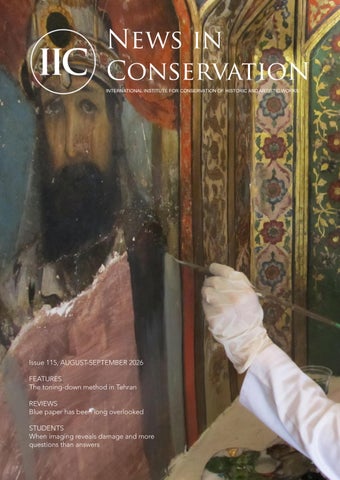
Issue 115, AUGUST-SEPTEMBER 2026 FEATURES The toning-down method in Tehran REVIEWS Blue paper has been long overlooked STUDENTS When imaging reveals damage and more questions than answers
News in Brief
Uğur and Hassan have reminded me that our profession is not a monolith; conservation training and professional expectations differ around the world. Like the cultures we aim to preserve, conservation practices in various nations, regions, and even between specialties may have a variety of techniques and procedures that, compared to our own area of the world, may feel unfamiliar or even uncomfortable. And what sounds revolutionary to one conservator may be the everyday habit of another. I am grateful for conservators like Uğur and Hassan who offer their perspectives and practices through NiC—a space where we can openly share our differences and learn from them rather than police or limit each other just because something is unfamiliar.
Sharra Grow Editor-in-Chief, News in Conservation
UNESCO is helping Cambodia strengthen the preservation of its documentary heritage through a nationwide effort to assess the condition and management of the country's archives. The initiative recognizes that archival collections—including government records, historical documents, photographs, maps, and audiovisual materials—are essential for preserving Cambodia's history, supporting research, and strengthening national identity. The project brings together archivists, cultural heritage professionals, and government institutions to evaluate collections across the country, identifying both their significance and the risks they face. Many archives are threatened by poor storage conditions, environmental damage, aging materials, and limited resources for preservation. The assessments will help establish priorities for conservation, improve archival management, and guide future investments in safeguarding these irreplaceable records. Beyond protecting historical documents, the initiative aims to build local expertise through training and capacity development, ensuring Cambodian professionals have the skills needed to care for documentary heritage over the long term. The findings will also contribute to national strategies aligned with UNESCO's Memory of the World Programme, which promotes the preservation and accessibility of documentary heritage worldwide. By systematically evaluating the nation's archives, Cambodia is taking an important step toward preserving its collective memory for future generations. The project highlights the vital role archives play not only in documenting the past but also in supporting education, cultural identity, transparency, and historical understanding. Original article: https://www.unesco.org/en/articles/ assessing-archives-safeguard-cambodias-memory
Book cover courtesy of E.C.C.O. and ENCoRE
A
s editor of News in Conservation, I am privileged to have a front-row seat in observing the diversity in our global field. In this issue, Dr. Uğur Genç describes the current protocol for conservation practice in Türkiye and calls for changes needed to improve it. Dr. Hassan Khalili Zonouz, in our conversations about his article describing the restoration of a palace room in Tehran, introduced to me an inpainting technique I had not previously known, and I am delighted to add this skill to my own treatment tool kit.
ASSESSING CAMBODIA'S ARCHIVES FOR LONG-TERM PRESERVATION
Tuol Sleng Genocide Museum. (2016) By Chiara Abbate/Flickr. Licensed under CC BY-NC-ND 2.0
Editor's Sounding Board
ALIGNING SKILLS WITH SECTOR NEEDS: NEW ENCORE AND E.C.C.O. PUBLICATION SETS EUROPEAN BENCHMARK FOR SPECIALISATIONS IN CONSERVATION-RESTORATION EDUCATION ENCoRE, the European Network for Conservation-Restoration Education, and E.C.C.O., the European Confederation of ConservatorRestorers’ Organisations, announce the release of Specialisations: Trends and Challenges in Conservation-Restoration Education. Available now as an open-access resource, this landmark publication develops further the common strategic framework connecting academic pathways with the evolving demands of cultural heritage preservation across Europe. Gathering proceedings from the joint symposium held in Prague, Czech Republic, on 5 April 2025, the publication addresses one of the central questions determining the trajectory of conservation-restoration: how
specialised knowledge, skills, and responsibilities must be defined, taught, and recognised to meet the realities of today’s complex heritage environments. As the profession confronts shifting cultural, institutional, technological, and labour-market conditions, the document serves as a timely intervention. It moves beyond viewing specialisation purely as a curricular matter, firmly linking it to social responsibility, professional regulation, institutional capacity, heritage legislation, and procurement systems. Through diverse European contributions, the text examines how specialist profiles can be structured, revised, and validated, from traditional material-based models to advanced competence frameworks addressing polymaterial heritage, contemporary art, digital media, and disaster response.
skill and reskill the cultural workforce, E.C.C.O. and ENCoRE provide a crucial blueprint. By mapping out how specialised expertise is developed and validated, the proceedings offer policymakers and heritage institutions the actionable insights required to support sustainable, high-quality employment in the conservationrestoration sector. The proceedings further emphasise the critical role of transversal competencies, such as communication, decision-making, interdisciplinary mediation, and research literacy, as foundational elements of expert professional practice. By bridging pedagogical models with critical reflections from the field, the publication promotes a dynamic understanding of specialisation as a continuous process spanning formal education, professional experience, and lifelong learning.
“Specialisation is no longer just a question of what we teach, but how we prepare professionals for an increasingly complex reality,”
“Specialisation is no longer just a question of what we teach, but how we prepare professionals for an increasingly complex reality,” said Laura Fuster-López, President of ENCoRE. “This publication represents a vital milestone. By bringing again E.C.C.O. and ENCoRE together, we are ensuring that academic pathways respond directly to the rigorous ethical and methodological demands of modern heritage preservation.” The release of the publication also aligns directly with the objectives of the European Skills Agenda and the EU Pact for Skills for the Cultural and Creative Industries. As European institutions increasingly call for resilient strategies to up-
“The safeguarding of cultural heritage relies entirely on the competence of the professionals entrusted with it,” added Elis Marçal, President of E.C.C.O. “This joint reflection proves that robust education and clear professional recognition must go hand in hand. It provides the sector with the evidence base needed to advocate for well-defined, highly skilled specialist profiles across Europe.” Specialisations: Trends and Challenges in Conservation-Restoration Education is freely accessible on Zenodo (DOI: 10.5281/zenodo.20082082). Access the publication HERE.
PEANUT BUTTER, PRESERVATION, AND A STICKY CONSERVATION CHALLENGE At first glance, a floor covered in peanut butter might sound more like the aftermath of a kitchen mishap than a museum masterpiece. But for Dutch conceptual artist Wim T. Schippers, it became one of his most recognizable works of conceptual art. First created in 1969, Peanut Butter Floor (Pindakaasvloer) transforms an everyday pantry staple into an artwork that asks viewers to rethink what art can be—and what it means to preserve it.
Background: Smooth and creamy peanut butter. (2021) kaboompics.com/pexels.com Top: Skylines and curves Depot of the Boymans van Beuningen Museum. (2020) By Rob Oo/Flickr. Licensed under CC BY 4.0
In July, Museum Boijmans Van Beuningen in Rotterdam recreated the iconic installation at its Depot as a tribute to Schippers, following his death in June. Rather than displaying an original object, the Museum must create an entirely new version of the work, carefully spreading approximately 390 kilograms (860 pounds) of smooth peanut butter (Calvé peanut butter, to be exact, as this was the artist’s preferred brand, stating ‘Because it spreads so nicely’) across a 25-square-metre hexagonal platform. Two specially trained "peanut butter plasterers" completed the task using detailed instructions developed by Schippers in collaboration with the Museum. Those instructions are surprisingly precise, specifying everything from the exact amount of peanut butter required per square metre to how the surface should appear. They also include one delightfully Schippers-esque rule: the artwork should not be presented with an educational purpose. Despite its playful appearance, Peanut Butter Floor poses some serious conservation questions. Peanut butter is not exactly museum-friendly. It dries out, separates, changes color, attracts dust, and can develop an increasingly distinctive aroma over time. Earlier installations also highlighted practical concerns, including the possibility of allergic reactions among visitors. For conservators, trying to preserve the peanut butter itself would be a losing battle, as well as misguided. Instead, the museum preserves something far more important: the idea. Like many conceptual artworks, Peanut Butter Floor exists not as a single physical object but as a set of instructions, photographs, installation records, and documentation that define how the work should be recreated. The peanut butter is temporary; the concept is permanent. Each installation is both new and authentic because it faithfully follows the artist's intent rather than attempting to preserve aging material. The work also raises fascinating philosophical questions that extend well beyond peanut butter. When the original materials are expected to disappear, what exactly is the artwork? Is it the sticky surface visitors see before them, the carefully written instructions, or the experience of encountering something so wonderfully absurd inside a museum? For conservators, Schippers' creation offers a reminder that preserving cultural heritage is not always about saving every original molecule. Sometimes, the greatest challenge is ensuring that an artist's vision can continue to delight, puzzle, and perhaps even make visitors a little hungry, for generations to come. Visit the exhibition and read more HERE.
BORDER WALL EXPANSION RAISES ALARM FOR CULTURAL HERITAGE AND PROTECTED LANDSCAPES Plans to expand border infrastructure along the U.S.–Mexico border are drawing growing opposition from conservation groups, archaeologists, Indigenous communities, and local residents, who warn that the project could irreversibly damage nationally significant landscapes and thousands of years of cultural heritage. Recent proposals focus on the Big Bend region of Texas, an area celebrated for its exceptional biodiversity, dramatic desert scenery, and rich archaeological record. According to the National Parks Conservation Association (NPCA), revised federal planning maps indicate that new border barriers and related infrastructure could affect areas surrounding Big Bend National Park, the Rio Grande Wild and Scenic River, and nearby protected lands. Conservationists argue that construction could fragment wildlife habitat, increase flooding risks, disrupt tourism, and alter one of
North America's most ecologically important desert ecosystems. Local communities have responded by organizing public meetings, advocacy campaigns, and legal challenges in an effort to protect the region. Archaeologists are particularly concerned about the impact on hundreds of cultural sites that span thousands of years of human history. Among the most significant are ancient cave paintings and rock art estimated to be around 6,000 years old, along with prehistoric campsites, burial grounds, and other Indigenous cultural landscapes. These sites provide invaluable evidence of early human occupation in the Chihuahuan Desert and continue to hold cultural and spiritual importance for Native American communities. To accelerate construction, the U.S. Department of Homeland Security has invoked authority under the REAL ID Act to waive numerous federal laws that would normally protect archaeological resources, historic sites, Native American graves, and environmental resources. Among the laws reportedly waived are the Native
American Graves Protection and Repatriation Act, the Archaeological Resources Protection Act, and the Historic Sites, Buildings, and Antiquities Act. Critics argue that bypassing these safeguards limits opportunities for environmental review, tribal consultation, and archaeological documentation before construction begins. The controversy highlights the continuing tension between border security objectives and the preservation of irreplaceable cultural and natural heritage. While federal officials maintain that the projects are intended to strengthen border security, opponents contend that alternatives such as surveillance technology could achieve similar goals with far less impact on fragile ecosystems and archaeological resources. As planning and legal challenges continue, many preservation advocates warn that once these ancient sites are disturbed or destroyed, the cultural knowledge they contain can never be recovered. Read the cited articles at: Hyperallergic IFLScience NPCA.org
“The Triad”, a large Pecos-River-style pictograph panel in Seminole Canyon State Park & Historic Site. (2010) by 12Foot Hedgehog Production/Flickr. Licensed under CC BY-NC SA 2.0
FRA ANGELICO'S REVOLUTIONARY RESTORATION
CONSERVING POLITICAL ARTIST PETER KENNARD
NEW NGL ZURBARAN CONSERVATION VIDEO
The Fiesole Altarpiece, considered Fra Angelico’s first truly significant altarpiece, has had centuries of restorations and repairs that have left it destabilized. Friends of Florence has funded a springfitted chestnut frame that may revolutionize how such works are treated in the future.
Peter Zetye, a conservator for the Royal Air Force Museum, gives an insider’s look at the history behind Greenham Common (1981) by Peter Kennard as well as the stepby-step process of examination, research and treatment of the powerful yet delicate piece.
In tandem with the National Gallery London’s current exhibition on Francisco de Zurbarán, the Gallery has released several behind-the-scenes videos including one on the conservation of two portraits featured in the exhibition. Explore Zurbarán online or at the Gallery, on display until 23 August.
(image: Royal Air Force logo. By Steve Johnson/Flickr. Licensed under CC BY-SA 2.0)
(image: Cup of Water and a Rose by Zurbarán. National Gallery London/Wikimedia Commons (Public Domain)
(image: Fiesole Altarpiece. Wikimedia Commons/Public Domain)
More News Click the images for more on these stories
Toning
in the
Painting
Room Of the
Golestan
Palace
A Contextual and Ethical Approach to Invisible Compensation By Dr. Hassan Khalili Zonouz and Dr. Gholamreza Rahmani
The west side of the Painting Room (Image courtesy of the Dr. Hassan Khalili Zonouz)
Any conservation intervention of these murals must consider not only their material condition, but also their spatial role and perceptual impact.
Q
ajar-period murals occupy a unique position within the visual and architectural identity of 19th-century Iran. Their extensive use of oil-based pigments, flat and uniform color fields, monumental symmetry, and the placement of figures within architectural niches reflect a deliberate attempt to integrate painting within the spatial logic of the building. These murals were conceived not as isolated artworks but as components of a unified architectural experience, shaping the rhythm, hierarchy, and ceremonial atmosphere of the spaces they inhabit. The Painting Room of the Golestan Palace is one of the most distinguished examples of this integration. With its 27 niches, 24 slender decorative columns, and a continuous frieze encircling the room, the space presents a highly structured visual environment in which painting and architecture are inseparably intertwined. The figures placed at the center of the niches are visually anchored by horizontal background lines and floral borders, creating a dynamic relationship between subject and setting. Any conservation intervention must therefore consider not only the material condition of the murals but also their spatial role and perceptual impact. Over time, the murals of the Painting Room have suffered from a combination of natural aging, environmental fluctuations, structural movement, and non-professional past restorations. Paint losses, flaking, abrasion, fading, and delamination have disrupted the visual coherence of the surfaces. In Qajar murals—where color fields are flat and textureless—such disruptions become immediately
noticeable, drawing the viewer’s attention away from the composition as a whole. The challenge of loss compensation in this context is therefore not merely technical; it is fundamentally perceptual and ethical. Before any intervention, a comprehensive documentation campaign was undertaken, including high-resolution photography, mapping of damages, examination of paint layers, and assessment of previous restorations. This documentation revealed that many losses occurred in visually sensitive areas, precisely where the original composition relied on tonal continuity to maintain balance. In several sections, earlier overpaints had introduced incompatible colors and textures, obscuring original details and creating visual noise. The removal of these additions was essential to reestablishing the integrity of the surface. The historical and artistic context of Qajar mural painting played a central role in determining the appropriate conservation approach. The introduction of oilbased pigments in this period allowed artists to create smoother surfaces and richer colors compared to earlier fresco traditions. Thematically, Qajar murals continued the long-standing tradition of royal representation and monumental symmetry, yet they also incorporated new influences from European painting and photography. Their visual language depends heavily on flatness, clarity, and the absence of visible brushwork. This characteristic makes them particularly sensitive to any intervention that introduces new textures or disrupts tonal unity.
Above: Shams-ol-Emareh, a significant part of the Golestan Palace complex and the first high-rise structure in Tehran. Below: The Marble Throne Veranda (Takht-e-Marmar), located adjacent to the Painting Room. (Images courtesy of the Dr. Hassan Khalili Zonouz)
Detail from the Painting Room during treatment (Image courtesy of the Dr. Hassan Khalili Zonouz)
Left: Painting Room of Golestan Palace by youngrobv/flickr (2008). Licensed under CC BY-NC 2.0. Right: The northern side and parts of the western and eastern sides if the Painting Room after treatment. (Image courtesy of the Dr. Hassan Khalili Zonouz)
International conservation theory emphasizes minimal intervention, reversibility, respect for original material, and the preservation of perceptual legibility. In the context of the Painting Room, these principles required a method that would reduce visual disturbance without introducing new textures or speculative reconstructions. Three common approaches—hatching, pointillism, and full reconstruction— were evaluated in light of these criteria. Hatching, although widely used in fresco conservation, introduces a linear texture that competes with the flat surfaces characteristic of Qajar painting. Pointillism can create smoother transitions but still
produces a granular effect that remains perceptible in large monochromatic areas. Full reconstruction, while seemingly capable of achieving visual unity, is ethically problematic when visual information is incomplete. In Qajar murals, even slight mismatches in tone or saturation become more noticeable than the original damage, and any attempt to recreate missing details risks introducing conjecture. For these reasons, the toning-down method emerged as the most appropriate solution. This approach does not attempt to recreate lost imagery; instead, it reduces the contrast between damaged and intact areas through subtle, semi-transparent layers of
color. The goal is not to make the intervention invisible in a physical sense but to achieve perceptual invisibility—a state in which the viewer’s attention is no longer drawn to the losses during normal viewing. From a closer distance, however, the intervention remains distinguishable, preserving the ethical requirement that restorations must not be mistaken for original work. The effectiveness of the toning-down method in this project stemmed from several factors. It preserved the flatness and textureless quality of Qajar painting, avoiding the introduction of any new visual patterns. It restored the perceptual unity of the murals without reconstructing
Detail from the Painting Room with old restoration, before current treatment. An example of imbalance caused by flaking in the mural, which disrupts the viewer’s perception. (Image courtesy of the Dr. Hassan Khalili Zonouz)
This invisible compensation does not aim to erase the history of the object or conceal the fact of damage; instead, it seeks to restore the viewer’s ability to perceive the artwork as a coherent whole. Detail from the Painting Room after treatment (Image courtesy of the Dr. Hassan Khalili Zonouz)
missing details, thereby respecting the authenticity of the original surface. The materials used were fully reversible and stable, ensuring that future conservators can remove or adjust the intervention without risk to the original paint. Most importantly, the method maintained the delicate balance between figure and background that defines the visual identity of the Painting Room. The implementation of the toningdown method followed a carefully structured workflow. After stabilizing flaking paint and removing intrusive overpaints, reversible toning layers were applied to areas of loss. These layers were adjusted gradually to achieve harmony with surrounding areas without imitating original brushwork. The final evaluation took place within the architectural context of the room, ensuring that the intervention supported the overall rhythm and balance of the space. The concept of invisible compensation, as applied in this project, aligns with contemporary conservation theory, which emphasizes managing visual dis-
turbance rather than reconstructing lost material. This invisible compensation does not aim to erase the history of the object or conceal the fact of damage; instead, it seeks to restore the viewer’s ability to perceive the artwork as a coherent whole. In the Painting Room, this meant allowing the murals to regain their visual presence within the architectural ensemble without compromising their authenticity. The conservation of the Painting Room murals demonstrates how a nuanced understanding of historical context, material behavior, and perceptual dynamics can guide ethical decision-making in loss compensation. The toningdown method, applied as a controlled form of invisible compensation, proved to be the most appropriate approach for preserving both the visual unity and the historical integrity of the murals. By grounding the intervention in both theoretical principles and practical experience, the project highlights the importance of balancing aesthetic legibility with respect for original material—an essential consideration in the conservation of Qajar mural painting.
.......................................................
Hassan Khalili Zonouz is a conservation architect, theorist, and university lecturer. He served as the director of studies and implementation of the Golestan Palace conservation project and works as an assessor of damage to historic buildings and urban fabrics, alongside his role as a certified court expert. His research focuses on innovative conservation technologies, architectural theory, and urban restoration planning. Gholamreza Rahmani holds a PhD in the conservation and restoration of historical and cultural properties and is a faculty member at the Research Institute of Cultural Heritage and Tourism. His expertise focuses on the conservation of murals, architectural decorations, and easel paintings. His theoretical research is primarily devoted to the foundations of Persian painting, particularly the Qajar period. He also teaches theoretical and practical courses in painting conservation and cultural heritage management.
Conservators Without Frontiers By Patricia Engel
onservators Without Frontiers (Restauratoren Ohne Grenzen) is C a non-profit organisation registered in Austria. As described in the bylaws, “the association… aims exclusively and directly at the salvation of the written and graphic heritage, with particular reference to technological advances in the field of restoration.” The non-profit was founded in 2015 by Patricia Engel in reaction to Thomas Aigner’s request for help in Iraq. Thomas Aigner was the head of the archives of the Diocese of St. Pölten and of ICARUS (International Centre for Archival Research), an association founded to support archives in the digital age. He had also been contacted by Fr. Michael Najeeb, a Dominican working as the Chaldean archbishop of Mosul who had asked for help in his effort to digitize and preserve manuscripts he had saved from ISIS.
WHERE WE WORK AND WHAT WE DO It has now been a decade since we first assisted in Iraq, when Father Najeeb had brought the manuscripts from Syria. In those years we also offered help in Armenia when the war between Azerbaijan and Armenia broke out, as well as assisting with projects related to the Russian-Ukraine war. We have also worked in Türkiye, offering help after the 2024 earthquake which instigated interesting discussions on how to stabilize historic library buildings against earthquake damage. We work on projects closer to home as well, assisting Austrian collections in finding funding for conservation work.
Scattered damaged books in the destroyed church in Syria. Image by N. Sarris. Courtesy of “Conservators Without Frontiers”.
In collaboration with Conservators Without Frontiers, the Bev/Art team held an art auction to raise funds as well as to celebrate creativity and the spirit of entrepreneurship. This event proved that even small teams can achieve big things when they come together with a shared vision. Read more about this collaboration on the RoG website
In our annual meetings, we finetune our goals, identifying new areas of activity (geographical and contentwise). Our international colleagues in these locations do not always need physical help from us but may want to discuss preventive measures or find ways to improve their first response plans. For these needs, we have created an area on our webpage with useful links providing such information. In general, the assistance and resources that we can offer are diverse and are demand-oriented. Sometimes we are asked to perform conservation treatment, however, this falls outside of our organisation’s framework of action.
SECURING AID AND FUNDING Helping hands, communication, and transport channels are offered by people from all sorts of professions. We are also supported by the Austrian ministries in our work. However, for the safety of all involved during any ongoing activity, we do not dis-
close the locations where we work nor do we make public the names of our team members. During the planning process, once we have narrowed down the needs for a particular project, we often must secure funds, either for equipment or for travel expenses. We often apply for special aid grants— there are specific Ukraine support funds and cultural heritage rescue funds—but we also organise public events. For example, during Tag des offenen Denkmals (Day of Open Monuments), we co-operated with St. Florian Monastery (in Upper Austria) where we set up a booth to which people could bring their beloved paper-based treasures (old cookbooks, diaries, etc.) and we offered them information on proper storage and handling, to help owners preserve their precious objects. For that service we asked for a monetary donation amount of their choice. Sometimes we are invited to events and conferences as presenters where we speak about our organisation, and if the inviting body offers a speaker salary, we ask that it be donated directly to Conservators Without Frontiers. Another example of a specific need and search for funding occurred when we needed to secure insurance for someone voluntarily traveling to a war zone. In this endeavour, we received help from Médecins sans Frontières (Doctors Without Borders) who recommended an insurance company that provides this service.
Left: Mould on manuscripts in an Austrian archive. Image courtesy of “Conservators Without Frontiers”. Right: The Bev/Art team (including IIC Council Member and Fellow Boris Pretzel) gathered at their headquarters in Bygdøy, Norway. Photo courtesy of Bev/Art
Besides the cases described above, we recently helped small museums in Ukraine. The bigger collections in Ukraine more often received aid from institutions soon after the outbreak of the war. However, small museums, archives and libraries did not receive as much help. Due to direct personal contact and cooperation with local people onsite, we learned about the sort of help needed for these smaller collections.
Father Najeeb in the burnt down church. Image by N. Sarris.
Work being done on an Aquarell by Affandi in the Affandi Museum, Yogyakarta, Indonesia. Image taken by the photographer of the Museum.
Manuscript rescued from fire.
Use the QR code if you wish to support Conservators Without Frontiers. We are happy to send you a confirmation.
A transparency policy concerning finances is maintained: all the team is unpaid except for some work by freelance conservators who cannot afford travelling expenses or have no means of generating consistent income at home.
CHALLENGES An on-going challenge is the fact that many volunteers have romanticized ideas about the sort of work we do, but when they experience the reality of our work, they soon leave us. Most of the tasks are collecting money, writing let-
ters to thank donors, composing emails requesting funds, detailing what we need to purchase and why. For cases in which we send someone onsite, these volunteers must be highly experienced conservators, which greatly limits who is eligible to travel. Much of the work is, therefore, very unglamorous, and onsite work is both physically and emotionally demanding and is, at times, very dangerous. While we can publish the names of the board members, the names of the conservators working on the ground are not made public for safety and security reasons. However, it can be said that, to be able to provide effective help, conservators involved must be experienced professionals. For similar reasons within our safety policy, our webpage can show little of the work we do, which can also hinder our visibility and our ability to demonstrate our services.
raise funds, but Conservators Without Frontiers does not collect and distribute payment for conservators merely requesting to complete a particular conservation treatment. We do welcome volunteers who: - would like to help us collect money for our activities - can help us maintain the webpage and perform updates - are willing to help in administrative work A volunteer’s preferred communication language is generally not an issue, and online co-operation is also possible.
RECENT PUBLICATION
INTEREST IN VOLUNTEERING
We recently participated in publishing a book which holds information on how to prepare for possible disasters, including war—the latter being a newer reality for Europe.
Generally, our volunteers do not perform conservation treatments. However, in cases where such work is needed, we may offer an (online) meeting to discuss the situation and exchange recommendations for strategies on how to rescue the items, how to convince responsible bodies and how to possibly
The book is Written Heritage New Challenges and Perspectives, edited by Penelope Banou, Georgios Boudalis, Patricia Engel, István Kecskeméti, Flavia Pinzari, Marianne Odlyha, Joseph Schirò and Jedert Vodopivec Tomažič, Berger Verlag (2025), ISBN: 978-399137-084-0.
All images courtesy of “Conservators Without Frontiers”.
.......................................................
Patricia Engel is senior researcher at the European Research Centre for Book and Paper Conservation-Restoration affiliated with University for Continuing Education Krems, Austria. She holds a magister, doctorate and a habilitation in conservation-restoration of cultural heritage. Patricia is vice president of International Paper Historians and a directory board member of ICCOM-CC. She is a recipient of the Liese Prokop award and Bernd Rode award. View her publications here.
Every other year, IIC holds its Keck Awards, which celebrate the best in public outreach, sharing and widening understanding of the work of conservators. For 2026 the judges have selected ten impressive projects for our shortlist with a noticeable recurring theme of involving the public and community in the work of conservation - whether that's a child led museum conserving the everyday or transforming a specialist site into an open learning environment. Once again we are asking the conservation community and the wider public to cast their votes. As we continue our journey through a vastly changed world, which of these projects speaks to you? The winner of our £2,500 prize will be chosen 50% by public vote and 50% by our judging team. Two honourable mentions will also be selected by our judges The winner will be announced on the final day of the Congress, Friday 11 September.
CLICK HERE for more nominee links and to cast your vote
© Conservation Office and the Hong Kong Museum of Art
IIC Keck Award Nominees 2026 PRESERVING CULTURAL HERITAGE THROUGH INCLUSIVITY: EXHIBITION AND OUTREACH PROGRAMME ON MOUNTING AND CONSERVATION OF CHINESE PAINTING AND CALLIGRAPHY In 2024, the Conservation Office and the Hong Kong Museum of Art presented “Seeing Art Anew: Mounting and Conservation of Chinese Painting and Calligraphy,” an exhibition exploring Chinese mounting as a 2,000-year-old craft and Intangible Cultural Heritage. Attracting over 576,000 visitors and broad media attention, the exhibition introduced audiences to the materials, formats, techniques, and preservation principles behind Chinese painting and calligraphy. Displays combined artworks, case studies, scientific findings and hanging scrolls that deliberately showcased past restoration, revealing the realities of ageing to offer visitors a raw and contemplative experience. Interactive augmented reality zone, educational mini-games, and monthly live demonstrations enhanced public engagement and deepened the understanding of conservation and family heritage care. From 2025 to 2026, the Conservation Office expanded the project through a roving exhibition and hands-on workshops in schools, minority communities, and for children recovering from severe illnesses at Ronald McDonald House Charities Hong Kong, reaching an additional 1,000 participants. Student Ambassadors helped share conservation knowledge with peers, while outreach workshops reduced barriers for under-served groups. Looking ahead, the Conservation Office plans to develop sensory materials for audiences with disabilities. Overall, the initiative showed conservation as a bridge between art, history, science, culture, inclusion, and community engagement.
Image courtesy of Sociedade de Promoção Sociocultural da Fiocruz. @casadeoswaldocruz @socultfio
Image courtesy of Guillermo Rosalio Pérez Muñoz, Paulina Anabel Pérez Muñoz and Karla Alicia Jáuregui Arreola
OPENING CONSERVATION TO THE PUBLIC: THE POMBAL RESTORATION HERITAGE EDUCATION PROGRAM MOTHERLAND: THE RESTORATION The Roundabout of the Disappeared, formally the Children’s Heroes Roundabout, is a monumental stone sculpture in Guadalajara, Jalisco, Mexico, created by Juan Fernando Olaguíbel Rosenzweig in 1950. In 2024, Motherland: The Restoration, a conservation project focused on the damaged head of La Patria, the figure crowning the 48-metre-high monument. A lightning strike had severely fragmented the sculpture’s crown, compromising its stability and formal integrity. The intervention reconstructed the affected stone elements using compatible materials, carefully carved and integrated to restore structural safety and visual legibility. Working at considerable height required specialized safety and technical strategies. Beyond its material challenges, the project responded to the monument’s contemporary role as a site of remembrance for families of disappeared persons, marked by photographs, banners, mosaics, and memorial installations. These social traces were documented, preserved, and understood as integral layers of recent memory rather than removed. A 22-minute documentary, involving members of affected collectives, became a mediation tool between communities and authorities. The project’s significance lies in its ethical, participatory approach, demonstrating how conservation can address material preservation while respecting social meaning, contested memory, and the evolving role of heritage in public space.
From 2023 to 2025, the restoration of the historic Pombal building at Fiocruz in Rio de Janeiro became an outstanding example of conservation as public engagement. Led by Casa de Oswaldo Cruz, the project transformed a specialist restoration site into an open learning environment, connecting heritage preservation with education, accessibility, professional training and social inclusion. Through hybrid public lectures, guided visits and inclusive activities, audiences were invited to understand traditional building techniques, conservation management and the significance of the Pombal within Fiocruz’s wider health heritage. Approximately 400 people attended outreach activities, while 249 visitors joined open-site tours, including an accessible visit for visually impaired participants and lectures supported by Brazilian Sign Language interpreters. The project also valued the people behind conservation, using audiovisual productions to highlight master craftspeople, restoration workers and the transmission of traditional knowledge. Training delivered through the Manguinhos School Workshop reached maintenance staff, construction teams and external participants from a socially vulnerable area, with 93 people completing conservation related courses. By reopening the restored Pombal as an exhibition space with accessible interpretation, the initiative created a replicable model showing how conservation can support learning, inclusion, community connection and long-term public appreciation of cultural heritage.
Image courtesy of Ding Wen © METRO LÍNEA 1 S.A.S.
Image courtesy of Floortje Clerix © KIK-IRPA
METRO LÍNEA 1 SAS: CONSERVING BOGOTÁ’S CULTURAL HERITAGE THROUGH PUBLIC ENGAGEMENT, DIGITAL INNOVATION AND URBAN STORYTELLING
THE GHENT ALTARPIECE: CONSERVATION, RESEARCH AND PUBLIC ENGAGEMENT The conservation of the Ghent Altarpiece has unfolded over 17 years, from the Getty supported study of 2010–12 through three major treatment phases led by the Royal Institute for Cultural Heritage (KIK-IRPA), Brussels. Meticulous examination and scientific analysis revealed that large areas of the work had been overpainted in the 16th century, fundamentally reshaping understanding of Hubert and Jan van Eyck’s original achievement. The project has been exceptional not only for its conservation discoveries, but for its sustained commitment to public communication. Through open studios, guided tours, public talks, press engagement, scholarly publications and the Closer to Van Eyck website, the team made complex research and treatment decisions accessible to local, national and international audiences. Visitors could watch conservation in real time at the Museum of Fine Arts Ghent, while online users could study high-resolution visible, infrared and x-radiographic images and compare the altarpiece before, during and after treatment. When the revealed face of the Mystic Lamb prompted public debate, the team responded calmly and transparently with evidence-based explanations. The project transformed a specialist conservation campaign into a shared cultural experience, deepening public understanding of conservation, material history and cultural heritage, and making its recognition in Ghent especially fitting.
Metro Línea 1 SAS (ML1), responsible for constructing Bogotá’s first metro line, has developed a cultural heritage conservation and public engagement programme within one of Latin America’s largest urban infrastructure projects. The initiative protects and interprets archaeological, urban, built and movable heritage uncovered along the 24-kilometre elevated rail route, which crosses seven significant heritage areas and contains evidence from preHispanic, colonial, republican and modern periods. Since 2021, an interdisciplinary team has recovered, documented and conserved more than 20,000 archaeological objects under management plans approved by ICANH, supported by laboratory analysis and professional conservation expertise. ML1 has made conservation visible through public storytelling, training and community dialogue. Its travelling exhibition Bogotá en Capas has reached varied audiences in public and educational venues, supported by talks, brochures, illustrations, videos and social media content. Construction personnel, students, local communities and heritage authorities have engaged through awareness sessions, Zonal Participation Committees, and guided field and laboratory visits. Digital access is central to the programme: photogrammetry and 3D modelling have created a freely available virtual archaeological collection on the Bogotá Metro platform and Sketchfab. By combining scientific rigour, outreach and digital innovation, ML1 shows how major infrastructure can protect heritage while fostering public understanding and shared stewardship.
Image courtesy of Anne Bancroft © The R.O.A.D. Initiative Inc.
Image of UV light on sculpture in youth workshop, Crucero. Image courtesy of Amigos del Arte Andino (AMARA) and La Capilla
R.O.A.D PROGRAMME: PUBLIC OUTREACH AND ENGAGEMENT
LA RESTAURACIÓN EN RUEDAS (“CONSERVATION ON THE ROAD”) Amigos del Arte Andino (AMARA) protects and promotes Andean artistic heritage in the Peruvian Altiplano. Its workshop "La Capilla" is the region's only scientific conservation studio, serving Quechua and Aymara communities whose churches hold fragile colonial paintings and sculptures beyond the reach of museums, ministries and tourist routes. Since 2023, AMARA's travelling public-engagement programme, "Conservation on the Road", has carried conservation knowledge to remote communities along roads that climb past 4,000 metres before falling away toward the edge of the Amazon. Loading a heritage-rescue 4x4 vehicle with a tactile demonstration kit, our locally trained Altiplano team hits the road to teach people to recognise risks: damp, candle flame and wellmeant repairs, introducing conservation principles through microscopes, ultraviolet light, gold leaf and traditional materials. Visits have built lasting guardian relationships, registered more than 50 works, treated dozens, and engaged over 250 participants in workshops and emergency-preparedness exercises. In Crucero, at 4,150 metres, more than 20 teenagers catalogued patrimony forgotten in a damp adobe storeroom, seven devotees stabilised a damaged Christ sculpture, and indigenous leaders and institutions began planning fire response. AMARA invites you to take the long road into the high Andes with us, sharing conservation knowledge where it is needed most.
The Reclaiming Our Atlantic Destiny (R.O.A.D.) Programme brings the work of conservation into public view in Barbados—making a specialist discipline visible, practical and meaningful to the communities it serves. A national conservation initiative preserving, digitising and widening access to archival records unseen for more than 30 years, its work spans four centuries of Barbadian and Atlantic history, stabilising fragile 17th–19th-century paper documents and ledgers so they can be safely handled and digitised. R.O.A.D. builds a Barbadian conservation workforce through structured, hands-on training. Its 16-member team brings experience from photography, chemistry, ecology, make-up artistry and fine arts, and together they operate the first conservation studio of its kind in the Anglophone Caribbean. Public engagement is central to the Programme. Through Heritage Month events, public lectures, webinars, demonstrations, roundtables, documentary coverage and international presentations, R.O.A.D. translates specialist conservation methods into accessible public language. Its emergency response to the 2024 Barbados Archives fire showed local expertise in action, with lessons later shared through UNESCO training and conferences. By reconnecting communities and diaspora audiences with digitised records, supporting professional development and empowering heritage custodians, R.O.A.D. presents conservation as both scientific discipline and cultural stewardship. It embodies the IIC Keck Award principles by making conservation rigorous, inclusive, visible and meaningful while safeguarding Caribbean heritage for future generations.
Alberto Sánchez Sánchez
Image courtesy of Nabukalu Solomy Nansubuga
GYENVUDDE (THE JOURNEY): A CHILDREN LED FAMILY MUSEUM Gyenvudde ("The Journey") is a child-led family museum that transforms everyday objects into living heritage. Born from one father's refusal to let memory be discarded, the project asks a simple but profound question: if we throw away ordinary things, what stories disappear with them? At an ancestral home in rural Uganda, children under 15 became conservators, researchers, and curators of their own family history. Guided by their paternal aunt, they documented oral histories, conserved more than 50 treasured objects using minimal intervention techniques, and created bilingual displays that honour both cultural knowledge and professional conservation principles. A stitched kanzu, worn photographs, schoolbooks, and a camera ordered from Britain are not merely possessions; they are witnesses to lives lived, resilience earned, and identities carried across generations. Gyenvudde celebrates the conservation of the everyday and makes it extraordinary, revealing that heritage is not reserved for palaces or monuments but lives within homes, hands, and memory. Free and open to visitors, the museum has inspired families to value their own heirlooms and has become a community heritage destination. By placing children at the heart of conservation, the project ensures that care for the past becomes an act of hope for the future, where every object preserved is another story carried forward.
MAKING CONSERVATION VISIBLE: PUBLIC ENGAGEMENT THROUGH HERITAGE, STORYTELLING, AND COMMUNITY ACTION Alberto Sánchez Sánchez has spent the past nine years making heritage conservation accessible to audiences beyond the profession. Trained as an architect in Madrid, later a Fulbright scholar at Columbia University and PhD graduate from UC Berkeley, he has focused on how conservation can support rural communities facing depopulation, economic decline, and the loss of traditional knowledge. His public-facing project, @casadepueblo, documents the conservation of a 17th-century house in Used, Spain, sharing research, materials, techniques, ethical decisions, mistakes, and discoveries in Spanish and English. The project presents conservation as a cultural and community practice, not only a technical field. In 2021, Alberto co-founded Asociación Fuset por el Patrimonio Rural, which promotes rural heritage through practical training in traditional building skills. In five years, Fuset has delivered 18 workshops for over 250 participants and generated over €120,000 in direct economic impact in a village of 260 residents, from just over €16,000 in public funding. Alberto has also shared his work through lectures, juries, media coverage, and international forums. His awards and recognition reflect a distinctive contribution: showing that conservation can educate, revitalise communities, and help build a more sustainable future.
© Alhena Caicedo – Supported by ALIPH © Luis Fernando Suescun – Supported by ALIPH
FIRST CONSERVATION PHASE IN THE CHIRIBIQUETE WORLD HERITAGE SITE BUFFER ZONE, SERRANÍA DE LA LINDOSA The project “First Phase of Conservation in the Buffer Zone of the Chiribiquete World Heritage Site, Serranía de La Lindosa” was developed through a collaboration between ICANH, Fundación Erigaie, and ALIPH. La Lindosa hosts one of the largest concentrations of pre Hispanic rock art in the Americas, reflecting over 11,000 years of human–Amazonian ecosystem interaction. The initiative addressed key deterioration factors, including biological colonization, termite activity, salt crystallization, and increasing anthropogenic pressure. Conservation was approached as a holistic process, integrating scientific research, technical intervention, and community engagement. Local communities played a central role through participatory workshops, knowledge exchange, and codevelopment of interpretive and protective strategies. The project produced accessible communication tools, including illustrated materials and a video series documenting fieldwork, interdisciplinary analysis, and conservation treatments, with bilingual dissemination to broaden outreach. An interdisciplinary team combined expertise in conservation, geology, biology, forestry, and communication, ensuring context-sensitive and sustainable solutions. The project also gained national visibility through major media coverage, strengthening public awareness. Beyond technical achievements, the initiative contributed to reinforcing conservation as a socially embedded practice, highlighting the interdependence between heritage, landscape, and community, while bringing international attention to a historically underrepresented region. We would also like to acknowledge the scientific leadership of the project. The principal researchers are María Paula Álvarez and Clemencia Vernaza, who served as Scientific Coordinator throughout the project. Finally, we would like to emphasize that this is a joint nomination representing a collaborative project developed through the partnership of the Colombian Institute of Anthropology and History (ICANH), the ERIGAIE Foundation, and ALIPH – International Alliance for the Protection of Heritage.
Click on the titles of each nominee to see the full description including a list of collaborators and partners for each highlighted project. Don't forget to vote HERE Feeling a bit of FOMO? Register to attend Congress HERE!
LO STATO DELL'ARTE 24: Sardinia MARIO SIRONI ACADEMY OF FINE ARTS, SASSARI 22-24 October 2026 Sardinia will be the next region to host State of the Art 24, at the Academy of Fine Arts in Sassari from October 22 to 24, 2026! The call for abstract is focus on the following topics: archeological conservation of waterlogged materials and sites, issues related to project planning and intervention; diagnostics, research and applied studies; preventive conservation; and ethics and sustainability in the conservation of cultural heritage.
.......... CONTEMPORARY PHOTOGRAPHY: METHODS, MATERIALS AND CONSERVATION | Academy of fine arts, Bologna February 2027 (day to be confirmed) On the occasion of the 200th year since the birth of photography, the conference will study the contemporary techniques of photography, the alteration of the materials, effects of the public exposition and the conservation strategy. CALL FOR ABSTRACT OPEN UNTIL 16TH NOVEMBER
.......... Cleaning Ceramic Materials: Methodologies, Innovation, and Ethics of Intervention. 5th edition of the biennial study days | MIC, FAENZA 10 June 2027 This new event is open to proposals that address the cleaning of ceramic materials based on the following thematic areas: cleaning of archaeological and collection-related artifacts,methodologies and products for cleaning contemporary works of art, the boundaries of cleaning: when to stop? Innovation, tools, and new technologies. CALL FOR ABSTRACT OPEN UNTIL 31 OCTOBER
Climate Action in the Art World: Towards a Greener Future Last month, the 2026 Book Club began reading Climate Action in the Art World: Towards a Greener Future, by Annabel Keenan, beginning with the Introduction. Here are some particularly impactful quotes with some reflections by Book Club leader, Alex Taylor. “These weather events are bringing issues of the climate crisis to the fore: the vulnerability of underserved communities; the disproportionate access to clean water and clean air; the increasing intensity, frequency and devastating impact of weather events; the irrefutable urgency of the need to change our behaviours and mitigate the damage we’ve done; and the reality of how unprepared we truly are.” (p. 11) Keenan acknowledges that the geographical scope of the book is limited, but the topics she addresses are deliberately ambitious. She considers both the commercial and non-profit sectors of the art world, writing: “In taking this ambitious approach, I hope to illustrate that climate action relates to everyone at every level and in every environment.” (p. 12) One of the things I appreciated about the Introduction is the time Keenan takes to establish what she means by ‘climate action’ and ‘sustainability’. She points to an inherent tension within the word sustainability: one definition implies maintaining an existing state, while another refers to environmental stability and the ability of natural systems to endure. Environmental stability, she argues, "cannot be achieved through sustaining existing practices unless every level of those practices ensures an equitable, green future." (p. 12) Fortnightly emails keep the Club members engaged with key chapter insights and additional reading materials. Learn more and apply to join HERE.
Spotlight on
Studies in Conservation Latest Articles By Lucy Wrapson Deputy Editor, Studies in Conservation his year will see a super El Niño impact weather in unequal bargaining power discourage borrowing inT the Pacific and beyond. In a world increasingly feeling stitutions from questioning climate demands imposed the effects of climate change, some conservation and museum practices will have to adapt. Yet in their article ‘The Costs of Changing: Factors Affecting Museum Loan Specifications and Their Revision’ (Studies in Conservation, 71, 4, 2026), Joel Taylor and Caitlin Spangler-Bickell find that museum loan specifications and, in particular, environmental requirements—such as relative humidity controls—have proven tough to revise despite the growing evidence that supports more flexible and sustainable approaches. Discussions of loans are often oversimplified as a clash between either ‘tight’ or ‘relaxed’ climate specifications. In practice, the factors that shape loan agreements are based on a wider range of priorities—institutional, professional and interpersonal. The paper is based on interviews with a broad range of museum professionals including registrars, conservators, curators, heritage scientists and insurers from international institutions. Through analysis of the interviews, the authors demonstrate that loan specifications are influenced not only by conservation science but by power relationships between borrowers and lenders, legal concerns, organisational culture and traditional and long-established professional conventions. This remains the status quo despite the evidence suggesting that alternative approaches may benefit the environment whilst also being safe. The authors highlight how uncertainty about responsibility and accountability can encourage professionals to maintain existing requirements rather than risk being blamed if damage occurs. Similarly, institutional hierarchies and
by larger or more prestigious lenders. These findings reveal how professional practice is often shaped by human and organisational behaviour as much as by scientific evidence. The paper is particularly resonant in the context of sustainability debates in museums. Environmental conditions required by loan agreements can drive significant energy consumption, sometimes stopping museums from adopting more sustainable climatecontrol strategies. By investigating the barriers to change, the authors move beyond technical discussions and provide insight into the social mechanisms that maintain current practices. Their analysis suggests that meaningful reform will require not only new scientific data but also cultural change within the museum sector. This interdisciplinary angle is a strength of the article. Instead of focusing solely on conservators, the study incorporates viewpoints from professionals who manage financial, legal, logistical, and curatorial aspects of loans. This in turn provides a nuanced understanding of decision-making processes and reflects the complexity of real-world museum operations. This is a timely contribution to conservation literature which challenges assumptions about museum loan practices and demonstrates that technical recommendations alone are insufficient to drive change. Its findings will be valuable to anyone interested in balancing collection care with environmental responsibility. This open access paper is published in Studies in Conservation, Issue 4, volume 71 and is available HERE.
Top: The Bayeux Tapestry Arrival © Trustees of the British Museum. Centre: John Singleton Copley's painting The Death of Major Peirson arrived in Jersey for exhibition for the first time in 2012 on loan from the Tate. It was hoisted into the Jersey Museum on 3 April 2012. A window and part of a wall had to be removed to enable access to the gallery for the crated painting. (2012). Image by Man vyi/Wikimedia Commons. Public Domain. Bottom: Transportkisten met schilderijen worden in treinwagons gezet. Transport ten behoeve van tentoonstelling in Galleria Borghese te Rome (1928) Public Domain/Rijksmuseum/Wikimedia Commons.
Ingang tot de Sagalassos tentoonstelling met lege kratten van de archeologische (2012) by Ben Pirard/Wikimedia Commons. Licensed under CC BY-SA 3.0
Specular light image of panel 2 of 3rd Movement by Scot Heywood. All images in this article courtesy of Rebecca Heyman.
The Promise of Visible-Induced Infrared Luminescence in Revealing Unseen Damages in Acrylic Paintings By Rebecca Heyman
I
recently encountered an interesting phenomenon during the treatment of a set of acrylic emulsion colorfield paintings. I noticed that the visible-induced infrared luminescent (IRLUM) imaging technique has the potential to reveal “invisible” damages in these acrylic-based paintings. I was excited about this discovery and wanted to share my findings in hopes of inspiring conservators to investigate these ideas further and consider adding IRLUM imaging to their multi-modal imaging suites when investigating acrylic painted works. Part of my motivation for sharing this project is also to ask the conservation community if anyone has any further ideas or has observed similar cases that may aid me in solving this mystery! Last year I began treatment of two companion color field paintings titled 3rd Movement, painted by Scot Heywood in 2006. The color fields were painted with acrylic emulsion paints over an acrylic gesso ground on canvas. For both works, the can-
vas was mounted on custom-made plywood panels using staples. These paintings, damaged by a water-related event, exhibited disfiguring drip marks and speckling across the satiny blue-purple-colored surface. As acrylic emulsion paint films dry, a process termed coalescence, surfactants in the formulation are pushed to the surface. This fact led me to suspect that the accumulated surface material seen in the drip marks on the 3rd Movement panels was likely caused by migrated surfactant that had interacted with water and condensation at the time of the water-damage event. Multiband imaging was completed before the treatment began: this included visible light or “normal” illumination, specular illumination, ultraviolet-induced visible luminescence (UV-VL), reflected ultraviolet (RUVA), reflected infrared (RIR), and visibleinduced infrared luminescence (IRLUM). This before-treatment imaging helped me to see the extent of the speckled, disfiguring marks from the water damage much more easily.
*Heyman, Rebecca, Fiona T. Beckett, Rebecca Ploeger, Glennis E. Rayermann, Lorna J. Brundrett, and Becca Goodman. Impasto Syndrome: Expanding the Analysis of Acrylic Paint Mediums used in Three-Dimensional Practice, 2026.
Removing accumulated surface material that resulted from the water damage was accomplished using deionized water and the gentle mechanical action with a cotton swab. Overall, the treatment felt simple, straightforward, and successful until I conducted another set of multiband images during the cleaning. For the during treatment images, the entire surface had been cleaned with the exception of the top right corner (Figure 2). Most of these images turned out as expected, showing a pristine, clean surface (with exception of the uncleaned area). However, in the IRLUM image, I could still see every speckle and drip mark across the whole surface, even in areas that had been cleaned. Even after all cleaning had been completed, IRLUM images still showed evidence of the previous damages. I felt compelled to understand why this was the case. In our department, IRLUM is an imaging technique that uses a 6500K LED lighting source filtered through two layers of BG38 (an infrared blocking filter). Imaging is performed with a UV-Vis-IR modified camera with visibleblocking lens filtration (such as the X-Nite 780 filter). In cultural heritage imaging, IRLUM is typically used to identify certain pigments, such as cadmium colors or Egyptian blue, but it has also been used to reveal previous treatment. This led me to wonder, what is it about this documentation technique that allows me to see the past damages even though they have been cleaned and are no longer visible in images captured using normal, reflected UVA, or reflected IR imaging techniques? I decided to investigate whether these results for the 3rd Movement paintings were a one-off occurrence or if IRLUM could be used to reveal treated damages in other acrylic emulsion paintings that are no longer visible in normal lighting conditions. A student-made test painting from the study collection of the Garman Art Conservation Department at SUNY Buffalo State revealed that IRLUM did, in fact, show evidence of past damages (Figure 3). In addition, this acrylic emulsion-on-canvas painting, known as Expendable, also revealed the limitations of this imaging technique; the ability to see the presence of damages relies upon whether or not the subject material luminesces. I also confirmed, through different experimentation completed for my master’s project (Heyman et.al. 2026)*, that pure methyl-methacrylate (MMA) and n-butyl acrylate (n-BA) co-polymer binding media (meaning, acrylic binder without pigment) does not luminesce when imaged using the IRLUM technique (Figure 4).
Figure 2: Panel 2 of 3rd Movement, during treatment: normal light (left) and IRLUM (right)
Figure 3: Expendable (a student-made test painting) in normal illumination conditions (left) and IRLUM conditions (right).
My current hypothesis is heavily influenced by modern paint formulation. The industrialization of the paint-making process has led to more finely, machine-ground pigment particles to be used in modern paints. This fact, accompanied by the expected surfactant migration that occurs during acrylic film coalescence, could reveal the potential culprit; some of the tiny pigment particles in acrylic paints are likely migrating to the surface alongside surfactant during coalescence. This could lead to brighter luminescence in damaged areas with a higher concentration of luminescent pigment particles. However, this does not explain why these areas still luminesce brightly after cleaning, assuming that any migrated pigments would be removed alongside the migrated surfactant during aqueous cleaning. When an acrylic painting experiences a water
damaging event, the water can be absorbed into the porous acrylic network. As the water evaporates at the paint film/air interface, it is possible that various components in the formulation could likewise be leached out toward the film surface. These components (not necessarily surfactant or pigment related) could have then been deposited on the surface of the paint layer, luminescing more brightly than the unaffected areas of the paint film. In truth, this phenomenon may not be attributable to the paint layer at all; perhaps it is a tideline or deposit located on the support or ground of the painting.
please reach out to me with any ideas you may have or similar observations you have made!
Rebecca Heyman cleaning 3rd Movement by Scot Heywood.
I hope to continue investigating the promise of IRLUM in revealing evidence of unseen damages in acrylic-based paintings in the future. This work could include taking cross-sections of the
Figure 4: 8 samples of pure acrylic binding material in normal illumination (left) and IRLUM (right).
painting in both damaged and undamaged areas and imaging the cross sections using IRLUM under magnification. X-ray fluorescent spectroscopy (XRF) could be a valuable tool to see if the water event left any salt or mineral deposits on the painting that could be altering or causing the luminescence. Other avenues of investigation could include mock-up experiments testing whether or not the support, substrate, ground, or paint layer are contributing to what I have been observing in these IRLUM images. I am excited and eager to hear if anyone else has seen or experienced anything like this, so please reach out to me at heymanrm01@buffalostate.edu with any ideas you may have or similar observations you have made! I want to express my sincere gratitude to my professor of conservation imaging, technical examination, and documentation, Lorna J. Brundrett and conservation imaging specialist, Adam Neese, for encouraging me to ask questions and follow this line of inquiry. Adam was especially helpful with brainstorming different ways to test my various hypotheses. I am also very grateful for the help of Fiona T. Beckett, my professor of paintings conservation, who guided me through this treatment.
.......................................................
Rebecca Heyman is a graduate fellow in paintings conservation at the Patricia H. and Richard E. Garman Art Conservation Department at SUNY Buffalo State University. Her master’s research focused on acrylic-based rheological modifiers. A recipient of the Fulbright American Friends of the Mauritshuis Award, Rebecca will complete her third-year internship at the Royal Picture Gallery Mauritshuis.
Blue Paper A Review Blue Paper: The Overlooked History of a Drawing, Printing and Writing Material 1400 -1600 By Thea Burns Archetype Publications (2025) Pages 168 / £45.00 ISBN 9781916642072
A
homogeneity of thought and enquiry across geographical boundaries is something that I have often observed as being both prevalent, insightful and comforting in conservation. For example, when I became interested in wellbeing and sensory exploration as useful tools for conservation engagement around 2012, I quickly found that many others across the world were having exactly the same ideas. So it was with the emergence of an interest in blue paper. Despite the Moulin de Verger papermill in the Charente region of France producing and teaching the making of blue paper since the early 2000s, it was at the time of the Getty’s Drawing on Blue exhibition, publication and online symposium in 2024 that the study and appreciation of blue paper seemed to truly take flight. The Getty exhibition and related activities were swiftly followed by the jewel box exhibi-
tion Drawn to Blue: Artists’ Use of Blue Paper at The Courtauld Institute of Art in London from October 2024 to January 2025, and I, amongst many other conservators fascinated by the blue paper content of the archives and works on paper under our care, hastened to book a ticket and immerse myself in the cool, variously toned waters of this most enigmatic of paper materials, overlooked no more. Prior to the publication of Thea Burns’s incredibly detailed study of the whole spectrum of blue paper and its many applications during the time of the Renaissance across Europe, the focus had primarily been on the use of blue paper as an artists’ material. Although the predominant exemplars in this book are artists’ paper supports, Burns usefully and comprehensively pushes the investigation much further, cataloguing
Book cover of Blue Paper, courtesy of Archetype Publications.
Review by Victoria Stevens MA ACR FIIC
*For example, the earliest extant manual of bookbinding technique was Dirck de Bray’s A Short Instruction in the Binding of Books, published as late as 1658. Created as an apprentice’s manual of technique, it provides a practical guide using beautifully coloured drawings.
the hidden use of blue paper for archival and ephemeral purposes in her final chapter. Combined with sections on material composition, the impact of trade, and the nature of the pigments used in its manufacture, this study is groundbreaking in scope and an essential companion for anyone working with this material, whether curatorially or in conservation. The book has a thesis-like quality in its layout. The introductory chapter sets out the areas of study very effectively, allowing easy navigation to relevant sections of investigation, should that be preferred. In what can only be described as a literature review, Burns acknowledges a paucity of archival or primary references, possibly due to the visual and
oral basis of late medieval and early modern apprenticeships* but compensates for this by casting her research net widely into areas such as economic histories, botanical treatises and textile production records. There is a pleasingly modern reference to the haptic and visual nature of the transmission of knowledge and information that will resonate with many readers: ‘YouTube has proven to many that it is easier to learn hand knowledge and techniques by watching an experienced practitioner’ (p. 5). The emphasis on studying original materials using simple analytical techniques—such as adjustments in lighting angle and intensity alongside microscopy—and the importance of the essential skill of close looking are also highlighted here. This develops into an assessment of fibre identification, colour analysis and surface characteristics, all of which are extremely helpful when the subsequent chapters move into more forensic detail according to period and material use. Chapter two explores the nature and formation of blue as a pigment for paper. Again reiterating the lack of primary sources, Burns encourages us to use original materials of known date and provenance as a means of creating a catalogue of papermaking techniques, all grounded in curiosity and investigation as primary approaches. The identification of Italy as the principal source of blue paper is introduced here and remains the predominant geographical focus throughout the following chapters. The chapter is divided into two areas of focus: first, a study of the fibre composition of the blue colourants in paper, demonstrating that coloured textiles were an early source of pigmentation; and secondly, an overview of the plant sources from which blue pigments were derived, namely woad and indigo. Although woad was grown in France, Burns demonstrates how it lost favour during the 16th century owing to imports from India into Europe by, amongst others, Italian merchants. The distinction between
Detail from book cover of Blue Paper, courtesy of Archetype Publications.
woad and indigo is important, as it contributed to the rise of blue paper production in the trading cities of northern Italy, particularly Venice. Chapter three has particular relevance for conservation, detailing the distinguishing characteristics of blue paper through its production methods and its response to environmental conditions. The chapter is packed with fascinating historical, social, industrial and economic details and is meticulously researched, making for deeply satisfying reading. The production and subsequent designation of white versus coloured paper are shown to have depended upon many contributing factors, including water purity, the nature of the raw materials to make the pulp, and the means by which colour was introduced. In conservation terms, Burns shows that the intrinsic presence of colour may have implied a cheaper, less carefully crafted paper, with the colour compensating for imperfections in pulp tone. The chapter concludes with a study of the nature of the blue colourants in paper, both as coloured
pulp and through the dyeing of paper after sheet formation. Here the focus falls upon the use of microscopy to highlight and identify individual paper fibres. The chapter concludes on a salutary tone: ‘tangible things are transformed by time’ (p. 57). The fading of blue paper is fully acknowledged and beautifully illustrated in figures 3.6 and 3.7, in which the faded recto and pristine verso of the substrate of a mid-15th-century watercolour are shown in stark contrast. Burns goes on to warn, however, that not all lightening or muddying of blue paper can be attributed to fading but may instead relate to the intensity—or lack thereof—of woad-pigmented papers in particular. Two further chapters on 15th- and 16thcentury drawings on blue paper form a gazetteer of Italian art and artists using blue paper supports throughout the period. Gorgeously illustrated, these chapters nevertheless reveal a continuing frustration with the lack of primary written sources to support the docu-
mented use of blue paper during these centuries. Again, there is a wealth of geographical, historical and economic detail. Burns catalogues the changing landscape of artistic creativity, which progressively leaned towards drawing throughout the period. She highlights the parallel use of media, such as ink and wash in the 15th century and chalk in the 16th, partially attributing the increased use and visibility of blue paper within the collection record to these developments. The contrast provided by white, red and black chalk highlights lent itself particularly well to the darker base tones available in 16th-century Italian blue paper. In a welcome step away from the main focus on art, chapter five also discusses the use of blue supports for singlesheet artistic print media, and here the study moves beyond Italy into central and northern Europe.
publicity strategy, driven by a need to… compete for buyers… it was a suitable paper to print on… available, functional and the right price’ (p. 116). That Manutius may have used these blue copies as gifts for cultivated patrons demonstrates the value of blue paper as a substrate. This is reinforced by figure 6.4, which shows a portrait of a cultured Italian noblewoman, Quintilia Fischieri, painted by Federico Barocci around 1600. On the table to her right sits a book with a blue paper text block. From the rarefied to the commonplace, the chapter—and indeed the book—concludes with the use of blue paper as a functional material for a wide variety of purposes, including ream wrappers, sugarcone wrapping and needle packets. Its use in Renaissance archival material is also evidenced, providing a precursor to the explosion in the use of blue paper for notarial and legal archives in the 19th century. Perhaps this forms the next stage in explaining the historical manufacture and use of blue paper.
That blue paper is no longer overlooked is due in no small part to Burns’s immaculate telling of its story.
The final chapter is, for me as a library and archive conservator, an absolute delight. Here Burns shows the versatility of blue paper through exceptional curiosities drawn from textual and archival sources. The printing of books on blue paper by the great humanist printers Aldus Manutius in Venice and Christopher Plantin in Antwerp was revelatory and leaves the reader eager to encounter one of these examples in person. The use of blue paper for Plantin’s first printed book, La institutione di una fanciulla nata nobilmente, published in 1555, and the insertion of blue sheets within white paper text blocks by the Aldine Press lend weight to Burns’s assertion that ‘there was no need for their production to be a marketing and
That blue paper is no longer overlooked is due in no small part to Burns’s immaculate telling of its story. This is a beautifully illustrated volume that functions equally well as a manual for identification and categorisation and as a fascinating scholarly study. If blue paper has not previously been on your radar, this book will certainly encourage you to look again at your collections, with hopeful eyes trained for that glimpse of cerulean amongst the neutral shades.
.......................................................
Victoria Stevens MA ACR FIIC has worked in heritage collections for over 30 years, mainly as a written heritage conservator and collections care adviser but latterly as a learning and engagement lead. She is Head of the School of Arts, Crafts and Conservation at West Dean College, UK, and holds a number of trustee and committee positions in national heritage organisations.
Future Stories in the Global Heritage Industry Edited By Alia Yunis, Robert Parthesius, NiccolòAcram Cappelletto Routledge: 2026 194 Pages / 34 B&W Illustrations ISBN 9781032804415
Review by Jacob Haddo uture Stories in the Global Heritage Industry is an eclectic and intellectually farranging study of what UNESCO World Heritage Site designation can mean for various places in the modern world, with a focus on traditionally under-represented places and cultures. It challenges traditional designation frameworks and, at times, proposes new schemes or modes of thought for assessing what it means to be a heritage site today. Owing to its interdisciplinary breadth and the presentation of different perspectives, it is accessible to non-specialist readers while maintaining sufficient technical detail to remain relevant to heritage professionals. Future Stories takes the form of seven case studies of sites or traditions connected to UNESCO herit-
age designation, either because they have already been designated or because the possibility of designation is explored. Each case study is written by a professional with personal ties to the subject, ensuring it is examined by someone with intimate knowledge of it. The studies span three continents, cover periods ranging from Roman mines to contemporary street food culture, and encompass not only physical sites but also living traditions including cooking and traditional crafts. These case studies are bookended by an introduction and a set of appendices that explore the theory and context of official UNESCO heritage designation. The introduction provides a history of UNESCO and the philosophy behind heritage listing, explaining
how the framework for choosing World Heritage Sites (the UNESCO Criteria for Selection, helpfully reproduced in Appendix 2) developed. Appendix 1, in contrast, attempts to synthesise the lessons of the case studies into a “Heritage Futures Manifesto” that advocates for the modernisation and decentralisation of the concept of heritage. The key question with which this book grapples is whether current understandings of cultural heritage are fit for purpose in an increasingly globalised and rapidly changing world. The case studies focus on places and traditions occupying liminal positions in relation to heritage designation, allowing the contributors to examine where the existing criteria may fall short. One advantage of this
Book cover courtesy of Routledge
broad approach is that each chapter offers a distinct perspective on the issue, giving the book a multidisciplinary feel that ranges from Eritrean filmmaking and tourism to Zanzibari tour guiding and Romanian politics.
concept of Relation. However, it integrates these ideas effectively with its analysis of hawker culture and the book’s broader argument about how heritage designation might evolve in the future.
For this reason, Future Stories is most valuable for those working with UNESCO or for organisations considering applying for UNESCO heritage status. The diversity of the case studies highlights both the benefits and limitations of heritage designation across a variety of contexts, offering insights that may encourage decision-makers to consider perspectives they had not previously explored. Despite its explicit global focus, this book also holds value for heritage professionals working at local or national levels, since the questions it raises about the nature of heritage and future development of the sector have broad relevance.
The book is not always so well organised, and it has a tendency to stumble when addressing the theoretical dimensions of heritage. At points discussions of heritage philosophy seem too distinct from the studies, and this contrast sometimes disrupts the coherence of the volume. Certain issues are introduced but not developed elsewhere, most notably the suggestion in the introduction that the concept of “heritage” is fundamentally a European construct—an intriguing idea that received little further attention. This lack of development also affects the impact of the “Heritage Futures Manifesto”, as several of its proposals feel insufficiently established by the preceding chapters.
The greatest strength of Future Stories lies in the storytelling portions of its case studies, which generally balance being informative and genuinely engaging to read. For me, the standout chapter was Yihao Li’s examination of the Imperial Kiln Archaeological Park in Jingdezhen, which vividly illustrates the interaction between a living tradition and designated heritage while successfully exploring the limitations of the current heritage framework through this cultural lens. By contrast, the third chapter, in which Matthew Tan discusses hawker street food culture, takes a more philosophical approach, devoting considerable attention to Édouard Glissant’s
Overall, Future Stories in the Global Heritage Industry offers much to interest both professionals working within the global heritage sector and general readers. Its case studies are consistently engaging and wellexplained, providing valuable insights into cultures and places that many readers will find unfamiliar. While the organisation of its theoretical argument slightly hampers its ability to offer a clear blueprint for the future of global heritage, it does not undermine the book’s key strength: its ability to pose the right questions about the role of heritage designation in the 21st century.
"The key question with which this book grapples is whether current understandings of cultural heritage are fit for purpose in an increasingly globalised and rapidly changing world."
.......................................................
Jacob Haddo is a researcher at Orion Heritage, specialising in architectural history and historic land use in England and Wales. He holds a BA in classics from the University of Cambridge and also works as a translator and editor of ancient texts.
Reclaiming the Object Why Conservation Needs a Forensic Turn By Dr. Uğur Genç
O
bjects do not arrive at the conservation lab as neutral materials—they arrive as evidence. Before we clean, stabilize, or restore, we make decisions—often irreversible—about what an object is and, therefore, how to treat it. Conservation in Türkiye—where I received my formal training and continued my practice for many years—has been understood as a quiet, careful practice. We clean, stabilize, and protect. Our work behind the scenes is often described as the “invisible hand”, ensuring the survival of cultural heritage without drawing attention to itself. A compelling case for forensic deliberation occurred during the assessment of a Hattian Sun Disc from the Museum of Anatolian Civilizations. The artifact initially arrived for rehabilitation; however, a deep biographical interrogation revealed a complex restoration history involving zinc replicas and copper wire stitching. While this intervention is considered technically incorrect by modern standards, it remains a unique testament to the restoration philosophy of its era. Since the museum already possesses numerous accurate representations of this object in its original form, this specific artifact has acquired a distinct identity in its current composite state. Consequently, the intervention was limited strictly to cleaning and chemical stabilization, intentionally preserving these historical layers as part of the object’s authentic biography (Image courtesy of Uğur Genç).
This understanding is logical. It reflects an essential ethical position: to intervene as little as possible and to respect the integrity of the object. But in practice, objects are rarely neutral. They arrive in the conservation studio carrying traces—of use, repair, damage, and sometimes events that are not immediately visible. When we approach them only as materials to be treated, as I have witnessed in Türkiye, we risk overlooking something more fundamental: their capacity to bear evidence.
g
THE BENCH AS A SITE OF DISCOVERY I recall a case that made this pull for further investigation impossible to ignore. What began as a routine conservation treatment of a textile glove shifted dramatically after computed tomography (CT) imaging. Beneath what appeared to be a stable object, the scan revealed human bone fragments still encased within the fabric. The glove was no longer just a military accessory; it became a material witness to a violent moment—a tangible fragment of the wearer’s story preserved in situ. This experience raised a question that has since become central to my work: Are we only conserving objects, or are we also responsible for understanding and preserving what they reveal? In another instance, a routine examination of an 18th-century sword revealed inconsistencies that stylistic analysis alone could not explain. Long catalogued as a “commander’s sword” based on decorative qualities, a forensic line of inquiry at the conservation bench allowed me to reclassify it as a functional cavalry weapon. This corrected a long-standing historical misidentification—not through an external research request (which is the usual protocol in Turkish institutions), but through the unorthodox and proactive decision I made at the bench to question first rather than simply proceed with treatment.
RESISTING “VISUAL PERSUASION” A similar moment occurred with two metallic fragments that appeared almost identical. Their stylistic compatibility suggested they could be permanently integrated. However, repeated elemental analysis using portable X-ray fluorescence (pXRF) revealed a clear metallurgical mismatch. The analysis conducted here, prompted by the conservator's momentary questioning, was not a corporate requirement. What might have become a seamless reconstruction would have, in fact, been an unintentional forgery—an error produced not by intentional deception, but by miss-led visual persuasion. This notion of visual persuasion is highly influential. Objects that “look right” can easily pass through standard institutional filters or protocols without sufficient verification.
Left and below: Computed Tomography (CT) imaging of a textile glove. The presence of human bone fragments—completely invisible from the surface—transforms the object from a military accessory into a material witness of a violent or tragic event.
Above: Two stylistically similar Urartian bronze fragments. The results demonstrated a clear metallurgical mismatch, proving that the fragments belonged to different objects and preventing a “well-intentioned forgery.”
Visual persuasion does not only apply to deceptive modern replicas; it can also leave important information that is not apparent to the naked eye undetected and therefore unexplored. A compelling, real-time example of this dynamic is illustrated by my recent fieldwork on ninth-century Abbasid stucco fragments from the Jumeirah archaeological site in Dubai. While designing the conservation strategy, the excavating archaeologists proactively shared their academic hypothesis that these pieces might have originally held color. Inspired by this interdisciplinary dialogue, I initiated a targeted forensic inquiry at the bench, looking beyond the current monochrome white appearance of the gypsum. Utilizing ultraviolet (UV) light fluorescence testing, I successfully detected anomalous, localized luminescent zones within the microscopic recesses of the plaster. Subsequent analysis with high-precision digital microscopy confirmed these zones as authentic pigment residues, proving that the architectural elements were painted red over a carefully prepared yellowish ochre ground layer. This discovery shifts the conservator’s traditional role from a passive, backend technician who merely stabilizes finds, into an exploratory scientist who actively co-produces new historical knowledge.
DEFINING FORENSIC CONSERVATION These cases point to a structural gap in the conservation tradition I was trained in—the absence of a stage where the object is treated not as a candidate for treatment, but as a subject of verification or identification. This is where I believe a shift is needed. What I propose is a reframing of our profes-
ted from the risks of systemic silence and loss. Forensic analysis is not integrated into the initial protocols of most laboratories in my country. Instead of conducting research only if deemed necessary, we should constantly remember the forensic conservation approach as the most critical stage of the conservation process. Forensic conservation, as a field similar to preventive conservation and interventional conservation, can be positioned as a terminology encompassing archaeometry and technical art history. In those silent moments when the conservator and the object stand side-by-side, we must provide a space to listen to what the object has to say and to hear it speak. By this, I mean a mode of practice in which the conservator engages with the object as an evidential system.
sional starting point as forensic conservation. A conservator, as the name implies, is a guardian of continuity. Therefore, we must ask, should these forensic investigations be viewed as a professional luxury, or are they, in fact, the non-negotiable core of our vocation? In my own professional journey, embracing this investigative path has often meant standing apart from the traditional norm. However, this rigorous inquiry should not be perceived by institutions as an extra effort or merely satisfying an individual's curiosity; rather, it is a fundamental responsibility. When a conservator pauses to interrogate an object, they are not stepping away from their duty—they are fulfilling its most critical requirement. It is time for administrations to recognize that these investigative moments are where the true biography of our heritage is protec-
This forensic engagement begins with a profound encounter; we first familiarize ourselves with the object, investigating its known narrative and identifying any underlying research questions. Before any intervention, we embrace its physical presence through non-destructive analysis, learning its material language until we successfully decipher its baseline material integrity, technological biography, and inherent historical testimony. Only then can we determine the specific care needed to preserve authenticity that will guide its treatment. In this process, the conservator’s role does not start and end at the bench; we must also have a defining voice in how this uncovered or verified authenticity is recorded and presented to the public, ensuring that the object’s true story is translated honestly from the laboratory to the gallery. The aim is not only to preserve its material condition, but also to interpret the various traces it carries before any irreversible action is taken.
ARE WE ONLY CONSERVING OBJECTS, OR ARE WE ALSO RESPONSIBLE FOR UNDERSTANDING AND PRESERVING WHAT THEY REVEAL?
"
Abbasid stucco fragments from the Jumeirah site in Dubai. Opposite page: (top) UV fluorescence testing and (bottom) microscopy analysis showing pigment residues. Images courtesy of the author.
THE 1+1=3 METHODOLOGY
object will be better able to decide on the most appropriate context for its current presentation.
Within this framework, I apply a 1+1=3 methodology. When material analysis and disciplinary knowledge are brought together through interpretive reasoning, they often generate insights that are more significant than either could have produce independently. The conservator, positioned at this intersection, connects scientific data with cultural and historical narratives. In this process, the conservator collaborates with a curatorial expert to determine the object's authenticity and conducts research with scientists to gather technical data.
A REQUIRED MINDSHIFT Adopting this approach will require a shift in mindset for my colleagues. It asks institutions to recognize that conservation laboratories are not only places where objects are treated but are also places where knowledge is discovered and gathered.
Forensic conservation is not a path chosen instead of preserving the past, but one chosen in order to understand it more honestly.
This methodology underscores that the forensic turn fundamentally relies on a synthesis of evidence, requiring the conservator to actively collect and reconstruct contextual data from (and with) other disciplines—such as field archaeologists and art historians—to fully comprehend the multi-layered biography of an artifact before planning an intervention.
Within the context of where I was trained and practiced in Türkiye, when a practitioner actively oversteps these systemic boundaries to synthesize cross-disciplinary data at the bench—bridging laboratory data with active archaeological and archival inquiry—it triggers institutional astonishment. Because these exploratory efforts currently rely entirely on individual defiance and overstepping institutional boundaries, our profession—and inevitably the collections—suffer.
The distinctive elemental and structural profiles obtained for the material can be used in the future to verify the object or can be utilized in analogy studies to identify another object. This key role of the conservator elevates them to an epistemological agent, preserving not only the material of an object but also the knowledge it holds. A conservator who understands the historical narrative and the original value of the
I cannot imagine that my professional context is unique in the world. Transitioning from treatmentcentered conservation traditions to formalized, process-oriented forensic conservation is therefore an urgent global necessity for rescuing historical truth from permanent systemic oblivion. In an era increasingly dominated by performance metrics, we often find ourselves pressured to prioritize the quantity of
The Multi-Layered Forensic Interrogation of the Golden Horn Chains, establishing a high-energy radiographic protocol. While traditionally attributed to the 15th-century Siege of Constantinople, the forensic inquiry has evolved as new historical records and typological comparisons became available, now strongly suggesting a 13th-century origin. Image courtesy of the author.
Above: The “Forensic Ecosystem of Authenticity” diagram, illustrating the conservator’s central position among five key domains: forgery and verification, sameness and identity, application methodology, museological strategy, and control of change.
treated artifacts as the primary indicator of professional success. However, defining success through statistical output alone risks turning conservation into a production line where speed replaces depth. Forensic conservation challenges this trend by asserting that pausing and interrogating is not a delay in progress but an essential investment in truth.
prevent from being lost to time. If conservation is to remain relevant in a world where authenticity is increasingly contested, we must move toward this evidential way of seeing—forensic conservation is not a path chosen instead of preserving the past, but one chosen in order to understand it more honestly.
True success in our field should not be measured by the number of objects that pass through our hands, but by how much of their authentic story we
Further methodological notes, practical tools, and extended discussion of this framework are available at: ugurgenc. com.tr
....................................................... Dr. Uğur Genç is a conservator and researcher specializing in material evidence, authenticity, and the interpretation of cultural heritage. His work focuses on evidential approaches to conservation and the evolving role of the conservator in knowledge production. He is currently developing the concept of forensic conservation as a framework integrating scientific analysis with interpretive practice.
News in Conservation INTERNATIONAL INSTITUTE FOR CONSERVATION OF HISTORIC AND ARTISTIC WORKS
News in Conservation is published by The International Institute for Conservation of Historic and Artistic Works, 3 Birdcage Walk, London SW1H 3JJ Website: iiconservation.org Email: iic@iiconservation.org ISSN 1995-2635
The International Institute for Conservation of Historic and Artistic Works (IIC) is a learned society, a registered charity and a company limited by guarantee with no share capital. Charity No 209677. Company No 481522.