

*RNI for males 19–50 years used as a comparator (excluding sodium, potassium, chloride and magnesium).
†10 µg vitamin D per 200 ml bottle.
‡Ensure TwoCal (3.4 µg) and Fresubin 2kcal (5 µg) (correct at time of preparation).
Date of preparation: 03/16








*RNI for males 19–50 years used as a comparator (excluding sodium, potassium, chloride and magnesium).
†10 µg vitamin D per 200 ml bottle.
‡Ensure TwoCal (3.4 µg) and Fresubin 2kcal (5 µg) (correct at time of preparation).
Date of preparation: 03/16



New Fortisip 2kcal provides 400 kcal and 20 g of protein per 200 ml bottle. Each bottle provides 50% of the RNI for micronutrients.*
It also has at least double the level of vitamin D† vs other 2 kcal/ml products.‡ This makes Fortisip 2kcal an ideal 2 kcal/ml product for your patients.







Emma Coates Editor
Emma has been a registered dietitian for nine years, with experience of adult and paediatric dietetics. She specialised in clinical paediatrics for six years, working in the NHS. She has recently moved into industry and currently works as Metabolic Dietitian for Dr Schar UK.
This double issue of NHD for August and September is filled with glorious dietetic treats for us all to enjoy whilst hopefully lounging in the sun with a long cool drink. OK, I’m really stretching my imagination here with the British summer having been a bit of a damp squib, but the fantastic articles we have for you this time are definitely real.
Dietetics always promotes healthy lifestyle choices and achieving a healthy weight. We have two great articles this issue, with quite contrasting approaches to these goals. An alternative approach comes from Dr Lucy Aphramor who shares her insights into the ‘Well Now’ way, where health gain and body respect become the focus of therapy in healthy weight services. Our second article on weight management is by Maria Dow, Freelance Dietitian, who discusses the clinical nutritional management of the bariatric patient; explaining surgical options and post-operative care required for this patient group.
Adult metabolic dietitians, Suzanne Ford (North Bristol NHS Trust) and Louise Robertson (University Hospitals Birmingham NHS Foundation Trust), bring this issue’s IMD Watch to us, focusing on Maple Syrup Urine Disease management in the adult patient. Specialist Dietitian, Maeve Hanan explores a multi-disciplinary approach to malnutrition and we welcome back Rychelle Winstone, Clinical Lead Paediatric Dietitian, with her thorough overview of specialist infant formulas and their use in practice. The handy Reference Table on pages 36-37 is a very useful resource.
Don’t miss too, Dr Carrie Ruxton’s look at fatty acid supplements and school performance, with evidence supporting the role these can play in children’s learning and behaviour. We also feature an article from the BSNA on the prescribing of oral nutritional supplements (ONS) in medical management.
The world of freelance dietetics is a growing area where practice should be safe and evidence based. Freelance Dietitian, Anne Wright provides an ethical discussion about the management of cancer care in freelance practice, where boundaries for safe practice are vital in maintaining safety for both practitioner and patient.
Be sure to visit our Subscriber zone on our website to access more great articles via our digital supplement NHD Extra: www.nhdmag.com.
You’ll find an interesting sports nutrition case study from Helen Phadnis on the dietary management of an experienced climber and some stimulating and curious Food and Drink articles. Ursula Arens delves into the world of energy drinks and Michelle Sadler gets a taste for crickets, locusts and mealworms, as she discusses the use of insect protein in the diet. Also, ever wondered what a meals on wheels nutritionist gets up to throughout the day? Annabelle de la Bertauche, Registered Nutritionist takes us through a Day in the Life of a Meals on Wheels Nutritionist.
On top of all that, don’t forget our online Student zone. This month we have a great article from Joe Alvarez, University of Chester student, where men in dietetics are discussed. A must read for Guyatitians!
If you are lucky enough to have some time off over the next few weeks, enjoy your summer break and we’ll see you in October for more excellent NHD articles and nuggets of dietetic information. Emma







Subscriber zone
• NHD Extra - our supplement with additional articles for subscribers
• NHD at-a-glance library of published articles back issues
Introducing our new resources specifically designed for students of Nutrition and Dietetics

Login with your username and password to view the Subscriber zone.
If you don’t have login details, you can check whether you are eligible for a FREE subscription to Network Health Digest at wwwNHDmag.com
Make the most of your NHD Community!

Dr Emma Derbyshire PhD RNutr (Public Health)
Nutritional Insight Ltd
Emma is a freelance nutritionist and former senior academic. Her interests include pregnancy and public health.
www.nutritionalinsight.co.uk
hello@nutritionalinsight.co.uk

Two new papers have been published questioning whether we need more randomised controlled trials (RCTs) within the field of nutrition. At present the number of epidemiological studies heavily outweighs the number of RCTs.

One pool of thought is that RCTs often recruit subjects with a history of disease (or an increased disease risk) and have relatively short periods of follow-up. Cohort studies, on the other hand, typically recruit healthy subjects at baseline and have longer periods of follow-up, usually 10 to 15 years. These differences may account for some of the discrepancies we see between the different types of study.
The other pool of thought is that RCTs play a valuable role in helping to identifying ‘non-significant’ findings. Whilst some may think that the outlook of this is rather grim, it is in fact a good thing. Lack of findings can actually help in refuting epidemiological associations that may have been hampered by confounders.
So, which way to go? Personally, I’d say that we need more RCTs that are adequately designed and fall in line with CONSORT (Consolidated Standards of Reporting Trials) guidelines. That way, outcomes can be compared fairly between studies and firmer conclusions drawn.
Also, given the recent Brexit choice, the question is whether collaborative cohorts with European colleagues will still go ahead. Funding sources were challenging enough and certainly won’t become any easier. So, from that viewpoint, perhaps specific well-designed RCTs may be the way to go for now.
If you have important news or research updates to share with NHD, or would like to send a letter to the Editor, please email us at info@network healthgroup.co.uk. We would love to hear from you. It is often thought that cranberry juice is great for urinary tract infections (UTIs). That said, the evidence for this has never really been substantiated. Now, a new randomised controlled trial has tested to see if the science really exists.
For more information, see: Loannidis JPA et al (2016); American Journal of Clinical Nutrition Vol 103, no 6; pg 1385-86 and Temple NJ (2016); British Journal of Nutrition Vol 116, no3; pg 381-89.

Women with a history of UTIs (mean age 41 years) were randomly allocated to drink 240ml cranberry juice (n=185), or a placebo
(n=188) over a period of 24-weeks. The number of UTI episodes was reported throughout. Study compliance was good and the number of UTI episodes was significantly reduced from 67 to 39 (by nearly half) in the cranberry juice compared with the placebo group. Overall, these results show that long-term daily consumption (about one glass per day) of cranberry juice may help to reduce the risk of UTIs in women with a history of this condition. For more information, see: Maki KC et al (2016); American Journal of Clinical Nutrition Vol 103, no 6; pg 1434-42.

Water has long been merged in with ‘fluids’ when looking at data from dietary surveys. That said, given the health benefits of drinking water, this ideally needs to be analysed and categorised separately. New work has looked into how water intakes are currently assessed in Europe.
A survey of 10 European countries looking at methods used to assess water intakes found great variability in methods. These ranged from 24-hour recalls, to estimated food diaries and food frequency questionnaires. None of these methods had been validated to specifically assess water and fluid intakes.
These findings highlight the need to devise uniform and validated methods used to assess water and fluid intakes. This would help to aid comparisons made between countries and support future recommendations.
For more information, see: Gandy J et al (2016); British Journal of Nutrition [Epub ahead of print].
We are an aging population, but past nutrition research hasn’t tended to go beyond the 60 to 65 year age mark. The good news is that researchers from the University of Newcastle have now done this, providing nutrition intake data for the ‘very old’.
Nutrient intakes of 75-year-olds living in the North-East of England taking part in the Newcastle 85+ Study were measured using 24hour recalls. Median vitamin D intakes were 2.0µg, calcium 731mg, magnesium 215mg, iron 8.7mg and selenium 39µg per day indicating shortfalls. Of most concern was that 95% of the population had vitamin D intakes below the UKs Reference Nutrient Intake of 10µg per day. These are important and much needed findings, emphasising the need for more research in this age group. Further research of this nature is also needed to support the formulation of agespecific dietary recommendations required for this growing age group.
For more information, see: Mendonca N et al (2016); British Journal of Nutrition [Epub ahead of print].
These breads are light, soft and can be eaten straight from the pack. The coeliac’s choice since 1983. Free from wheat, gluten, milk, eggs, soya, maize and nuts. They also contain vitamins and minerals including calcium and folic acid. Suitable for vegetarians, vegans and kosher diets. www.generaldietary.com
To book your Company’s product news for the next issue of NHD Magazine call 0845 450 2125

While most parents begin weaning their infants at six months, there has been a trend towards early weaning, with the introduction of solids at four months. New research has now looked at how this could affect children’s later eating habits.
Research using data from the Southampton Women’s Survey, looked at what age food was introduced compared with feeding difficulties when the children were three years of age, in 2,389 mother-child pairs. Factors such as breastfeeding, the mother’s BMI, age, education and employment were all accounted for.
Sixty-one percent of mothers/carers had some form of feeding difficulties when their child was aged three years, with children being choosy most common (74%). Children who were given solid foods at six months of age or later were significantly less likely to have feeding problems compared with those given solids at four to six months.
While other studies are needed to reconfirm these results, it seems that holding off from the temptation of early feeding may help children to eat better later on. Next we need to find out why this may be.
For more information: www.mrc.soton.ac.uk/sws/
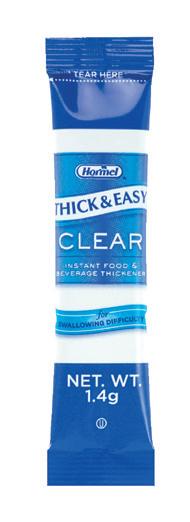
The benefits of using the NEW Thick & Easy™ Clear 1.4g sachet:
Easy to prepare drinks to the desired consistency
No pre-measuring required, thus reducing preparation time
Reduce the risk of product contamination by using a single dose sachet
Gum based thickener
Does not alter the appearance, taste or texture of drinks
Facilitates confidence to drink and reduces the fear of swallowing



To receive FREE samples of Thick & Easy™ Clear 1.4g Sachet
please contact Fresenius Kabi today on fresubin.uk@fresenius-kabi.com or call 01928 533515.

www.fresenius-kabi.co.uk

Lucy Aphramor Dietitian, Consultant and trainer, Visiting research fellow University of Chester
Lucy Aphramor PhD is committed to bringing compassion and social justice into dietetics’ lifestyle conversation. She is a founder member of Critical Dietetics and nominated to the BDA roll of honour.
An increasing number of dietitians are adopting an approach to nutritional wellbeing that promotes health gain and body respect for all, as an alternative to weight management. This shift in focus characterises an approach known as the ‘Well Now’ way. This article explores the rationale behind Well Now’s innovation and illustrates some of its hallmark features in practise.
Imagine that Jay comes to clinic with newly diagnosed hypertension. We see her again six weeks later, during which time she has made significant changes to her eating and activity behaviours, taken up mindfulness practise and changed jobs. She told us that her BMI when we first met was in the range 3035. She still has no wish to be weighed and we don’t know if her weight has changed or not.
independently of weight loss across a range of non-communicable diseases (NCDs), such as heart disease and Type 2 diabetes.
Jay told us that the reason she changed jobs was that she was being bullied and discriminated against. She feels valued in her new job and team morale is high. But how is this relevant to hypertension? Can respect impact NCDs?
For article references please email info@ networkhealth group.co.uk
Using the column headings in Figure 1, we can consider how change in behaviours may impact health and whether or not Jay’s weight is reduced. For instance, we know that diet can influence hypertension regardless of weight loss.1 In fact, improved health behaviours impact wellbeing
There is a vast amount of research showing that how we are treated by society has metabolic consequences.2-5 That is, stress has embodied impact even if health behaviours are unaltered. In acute stress, cortisol is released and when the stress passes, levels of cortisol and adrenaline return to base line. But,
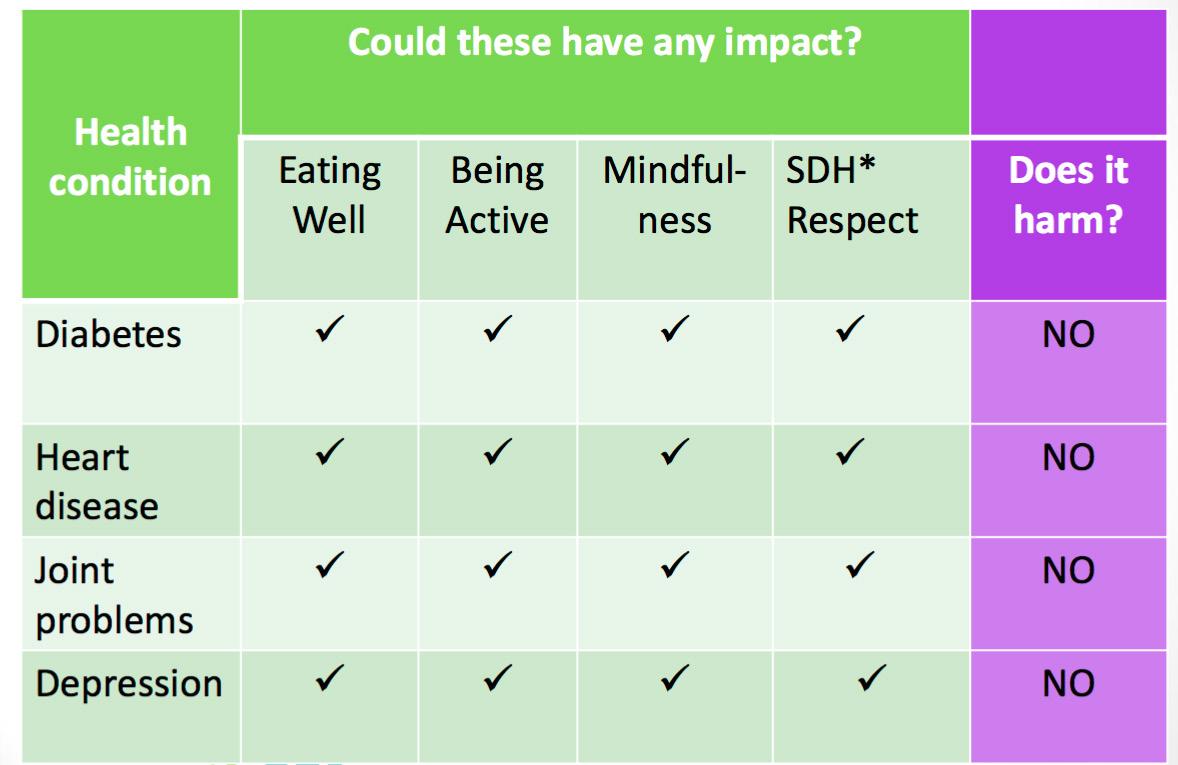
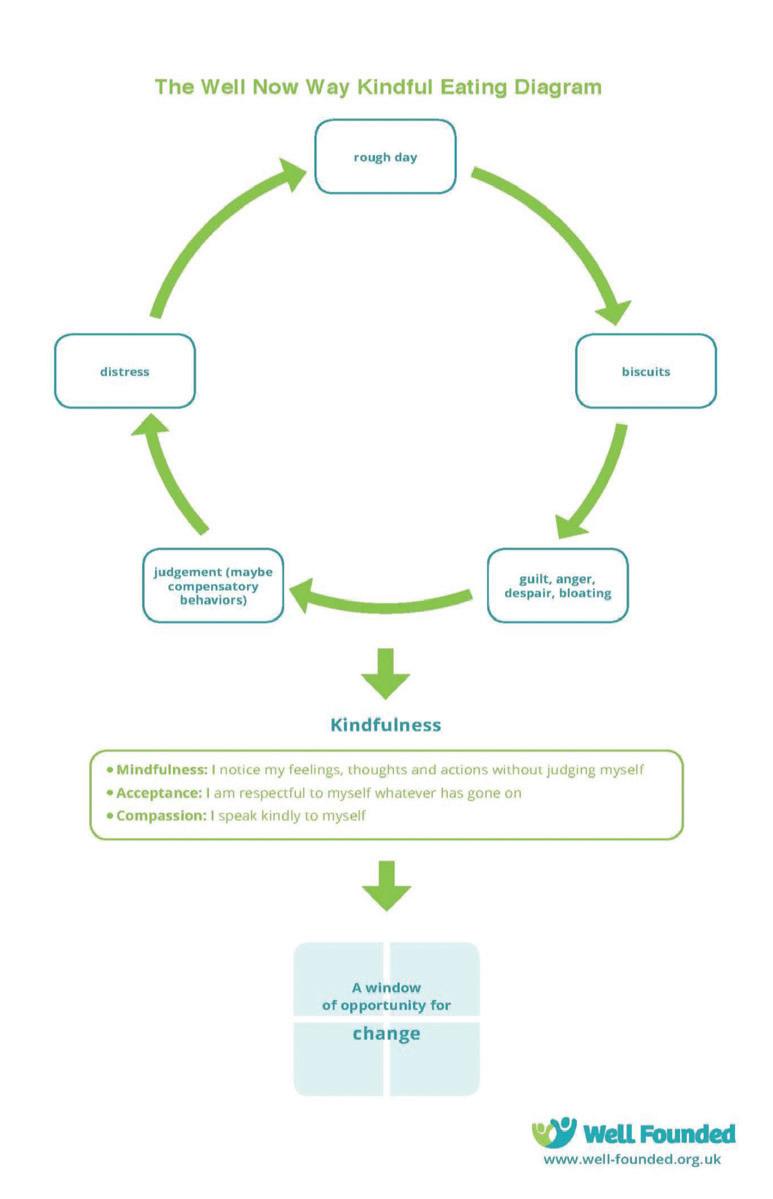
Figure 2: The Well Now Cycle
The Well Now way: respecting every body now
when someone lives with chronic stress this homeostatic mechanism gets overwhelmed. Instead, a new state of dysregulation is reached6 that predisposes someone to inflammation, insulin resistance and arterial damage, all of which are linked to NCDs. Thus, the stress of living with stigma has embodied consequences. In other words, stigma is a social determinant of health. This is one reason we need to tackle size and other stigma.
February 2016, by Lucy Aphramor, UK.
health and a healthy society is a fair society. Erasing science on the health impact of stigma (including size-ism, racism, etc) means that explanations for and interventions to alter population distributions of health will be incomplete, misleading and ultimately harmful.
Rejecting the pursuit of weight loss is not the same as being against patients losing weight. Instead, it means seeing weight loss as a secondary outcome rather than a primary goal, or reliable indicator of health. Personal health parameters of dietary quality, HbA1C, blood pressure, fitness, mental wellbeing, eating-disorder symptomology and so on, can measure change.
What of the final column? In six randomised controlled trials (RCTs), a health-gain approach teaching size acceptance is associated with health enhancement and is not linked with harm.1 A weight-focused approach, however, is robustly associated with all-cause mortality via yo-yo dieting, likely through its inflammatory potential.7 The British Nutrition Foundation notes: ‘‘…a positive association has consistently been observed between body weight fluctuation and all-cause mortality and usually…with coronary mortality in particular. This finding is very robust (p 37).’’8
Using an approach that promotes body respect for people of all sizes helps reduce size stigma and address body shame. Untangling weight, behaviours and wellbeing, and talking about wider determinants of health, supports this shift. (Figure 2). A narrow emphasis on weight control can miss the fact that oppression is a health hazard; respect is a social determinant of
A minority of patients will lose weight and keep it off when dieting. (Note that the same people would be expected to lose weight as a secondary outcome of a health-gain approach). But overall: “one third to two thirds of dieters regain more weight than they lost on their diets. In addition, the studies do not provide consistent evidence that dieting results in significant health improvements, regardless of weight change... The benefits of dieting are simply too small and the potential harms of dieting are too large for it to be recommended as a safe and effective treatment.”9 This citation is from a systematic review of RCTs of weight management studies
of two year’s duration, which is the best available evidence in the field. Clearly, it turns on its head the conventional belief that we have a safe, reliable, weight loss intervention. As such, it has urgent ethical significance.
It is only possible to write guidelines that find in favour of weight loss by ignoring this data. NICE (2014),10 for instance, has a scope that does not capture this study. Dietetic research is not immune to misrepresenting weight science.11
It may sound unbelievable given the tenacity of the ‘eat less, move more’ mantra, but long-term weight loss is not seen even when people adhere to sustained calorie deficit. In the largest study tracking calorie deficit, the Women’s Health Initiative,12 almost 20,000 women reduced calories for over seven years. The experimental group averaged a daily deficit of 360kcals from baseline and increased activity levels. At the end of the study, neither the control arm nor the experimental arm showed significant weight change: setpoint overrides calorie deficit in determining adult weight.
In short, perpetuating out-dated messages about weight loss is unethical and harmful. Dietitians are well placed to advocate for responsible science and advance the message of health-gain and body respect for all.
For someone who cannot recall a time when their eating choices weren’t guided by calories, switching focus to health-gain can feel like a leap into the unknown. If they have alternated periods of cognitive restraint with periods of chaotic eating, they may fear that letting go of a weight focus is tantamount to giving up
on themselves. Packing away the scales is not saying, “Eat with abandonment”. Instead, it is offering someone the chance to learn to eat with attunement, to listen to their appetite and use body signals to guide eating choices. The focus on body respect also contains the second message: you are worthy of respect as you are right now. Reminding patients that health gain can arise from behaviour change with or without weight loss and that people of all sizes deserve respect, supports sustained self-care.1
We can identify several steps in helping someone relate differently to food after a lifetime of diet-mentality thinking. First, if someone is distressed because of their eating, we can explore