THE CASE FOR HEALTH GAIN AND BODY RESPECT IN HEALTHY WEIGHT SERVICES
An increasing number of dietitians are adopting an approach to nutritional wellbeing that promotes health gain and body respect for all, as an alternative to weight management. This shift in focus characterises an approach known as the ‘Well Now’ way. This article explores the rationale behind Well Now’s innovation and illustrates some of its hallmark features in practise.
Imagine that Jay comes to clinic with newly diagnosed hypertension. We see her again six weeks later, during which time she has made significant changes to her eating and activity behaviours, taken up mindfulness practise and changed jobs. She told us that her BMI when we first met was in the range 3035. She still has no wish to be weighed and we don’t know if her weight has changed or not.
independently of weight loss across a range of non-communicable diseases (NCDs), such as heart disease and Type 2 diabetes.
Jay told us that the reason she changed jobs was that she was being bullied and discriminated against. She feels valued in her new job and team morale is high. But how is this relevant to hypertension? Can respect impact NCDs?
For article references please email info@ networkhealth group.co.uk
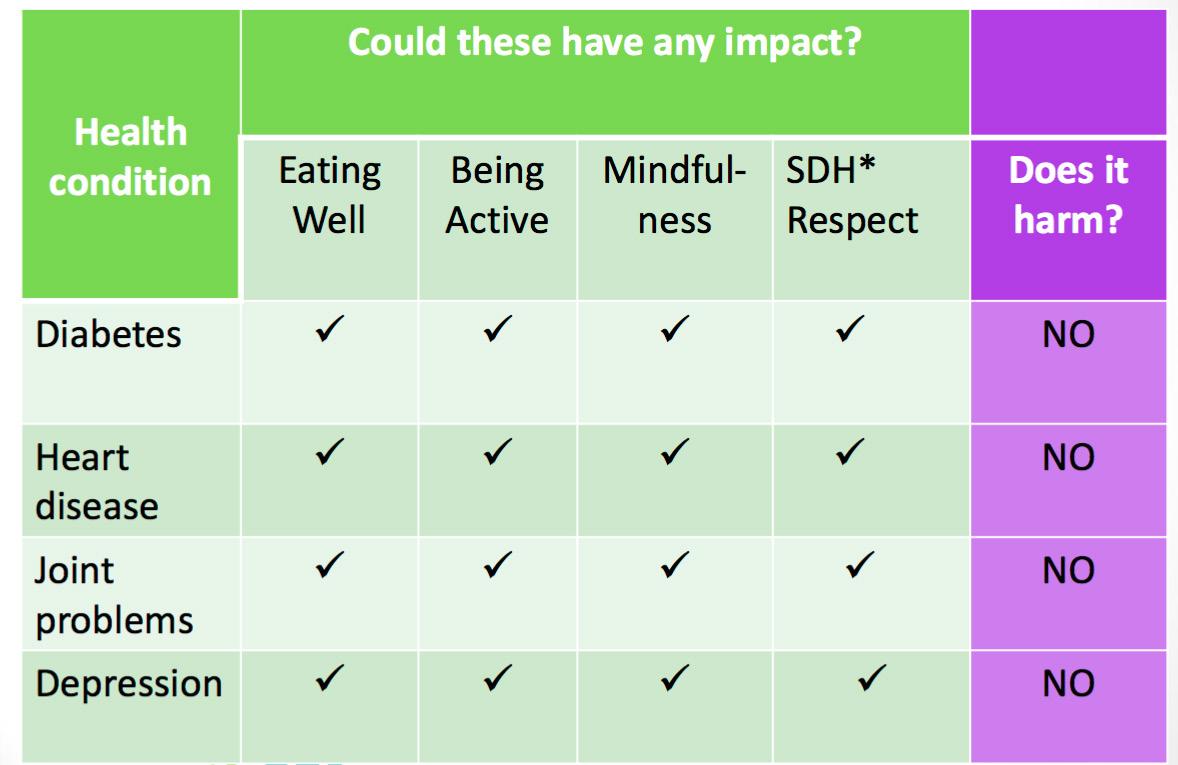
Using the column headings in Figure 1, we can consider how change in behaviours may impact health and whether or not Jay’s weight is reduced. For instance, we know that diet can influence hypertension regardless of weight loss.1 In fact, improved health behaviours impact wellbeing
There is a vast amount of research showing that how we are treated by society has metabolic consequences.2-5 That is, stress has embodied impact even if health behaviours are unaltered. In acute stress, cortisol is released and when the stress passes, levels of cortisol and adrenaline return to base line. But,
Figure 1: The Well Now Table for untangling health behaviours, respect, weight and wellbeing
Figure 2: The Well Now Cycle
Take away 5
The Well Now way: respecting every body now
when someone lives with chronic stress this homeostatic mechanism gets overwhelmed. Instead, a new state of dysregulation is reached6 that predisposes someone to inflammation, insulin resistance and arterial damage, all of which are linked to NCDs. Thus, the stress of living with stigma has embodied consequences. In other words, stigma is a social determinant of health. This is one reason we need to tackle size and other stigma.
THE ETHICAL DIETITIAN
February 2016, by Lucy Aphramor, UK.
health and a healthy society is a fair society. Erasing science on the health impact of stigma (including size-ism, racism, etc) means that explanations for and interventions to alter population distributions of health will be incomplete, misleading and ultimately harmful.
Rejecting the pursuit of weight loss is not the same as being against patients losing weight. Instead, it means seeing weight loss as a secondary outcome rather than a primary goal, or reliable indicator of health. Personal health parameters of dietary quality, HbA1C, blood pressure, fitness, mental wellbeing, eating-disorder symptomology and so on, can measure change.
WEIGHT SCIENCE: ADVERSE EFFECT
What of the final column? In six randomised controlled trials (RCTs), a health-gain approach teaching size acceptance is associated with health enhancement and is not linked with harm.1 A weight-focused approach, however, is robustly associated with all-cause mortality via yo-yo dieting, likely through its inflammatory potential.7 The British Nutrition Foundation notes: ‘‘…a positive association has consistently been observed between body weight fluctuation and all-cause mortality and usually…with coronary mortality in particular. This finding is very robust (p 37).’’8
Using an approach that promotes body respect for people of all sizes helps reduce size stigma and address body shame. Untangling weight, behaviours and wellbeing, and talking about wider determinants of health, supports this shift. (Figure 2). A narrow emphasis on weight control can miss the fact that oppression is a health hazard; respect is a social determinant of
A minority of patients will lose weight and keep it off when dieting. (Note that the same people would be expected to lose weight as a secondary outcome of a health-gain approach). But overall: “one third to two thirds of dieters regain more weight than they lost on their diets. In addition, the studies do not provide consistent evidence that dieting results in significant health improvements, regardless of weight change... The benefits of dieting are simply too small and the potential harms of dieting are too large for it to be recommended as a safe and effective treatment.”9 This citation is from a systematic review of RCTs of weight management studies
of two year’s duration, which is the best available evidence in the field. Clearly, it turns on its head the conventional belief that we have a safe, reliable, weight loss intervention. As such, it has urgent ethical significance.
It is only possible to write guidelines that find in favour of weight loss by ignoring this data. NICE (2014),10 for instance, has a scope that does not capture this study. Dietetic research is not immune to misrepresenting weight science.11
WEIGHT SCIENCE: INEFFECTIVENESS
It may sound unbelievable given the tenacity of the ‘eat less, move more’ mantra, but long-term weight loss is not seen even when people adhere to sustained calorie deficit. In the largest study tracking calorie deficit, the Women’s Health Initiative,12 almost 20,000 women reduced calories for over seven years. The experimental group averaged a daily deficit of 360kcals from baseline and increased activity levels. At the end of the study, neither the control arm nor the experimental arm showed significant weight change: setpoint overrides calorie deficit in determining adult weight.
In short, perpetuating out-dated messages about weight loss is unethical and harmful. Dietitians are well placed to advocate for responsible science and advance the message of health-gain and body respect for all.
KINDFUL EATING
For someone who cannot recall a time when their eating choices weren’t guided by calories, switching focus to health-gain can feel like a leap into the unknown. If they have alternated periods of cognitive restraint with periods of chaotic eating, they may fear that letting go of a weight focus is tantamount to giving up
on themselves. Packing away the scales is not saying, “Eat with abandonment”. Instead, it is offering someone the chance to learn to eat with attunement, to listen to their appetite and use body signals to guide eating choices. The focus on body respect also contains the second message: you are worthy of respect as you are right now. Reminding patients that health gain can arise from behaviour change with or without weight loss and that people of all sizes deserve respect, supports sustained self-care.1
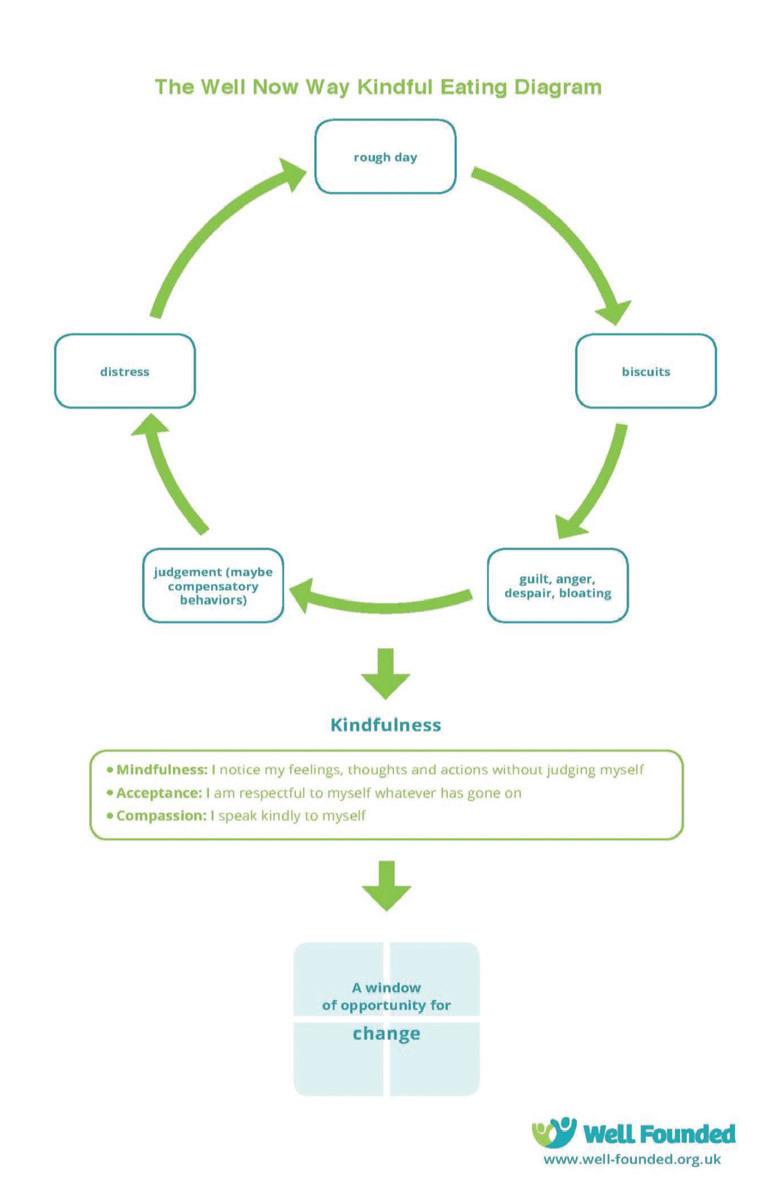
We can identify several steps in helping someone relate differently to food after a lifetime of diet-mentality thinking. First, if someone is distressed because of their eating, we can explore
ways to break the cycle. An effective way to do this is to teach compassion.13,14 Adding compassion to the eat-judge-distress-judge cycle offers a way out. When the harsh inner critic starts playing the archived tapes of failure and guilt, we can explore an option to prevent getting caught up in these feelings. This involves noticing emotions without judging them. No one is denying that this is a hard place to be, but accepting this without judgement enables us to take a step back. It can also help to remind ourselves of our common humanity and remember that other people feel this way. Now, someone has accepted the difficult emotion, stepped back and can ask themselves, “What would I feel better for right now?” How would they treat their closest friend? By being warm and understanding, or compassionate, they have created a window of opportunity for change.15 The cycle outlined above is the Kindful Eating cycle (Figure 3).
Seeing all foods as morally equal, also known as legitimising foods, is pivotal to breaking the eat-judge-distress cycle. Removing judgement removes barriers to satisfying hunger and so meeting needs.
of rules about what they should and shouldn’t eat. For sure, it makes sense for someone with an allergy to avoid an allergen. But judging food as good/bad, healthy/unhealthy and assigning moral values, is part of the problem of troubled eating, not the solution.
www.well-founded.org.uk
Seeing all foods as morally equal, also known as legitimising foods, is pivotal to breaking the eat-judge-distress cycle. Removing judgement removes barriers to satisfying hunger and so meeting needs. The compulsion to eat particular foods dissipates when restrictions are removeddieters are more likely to stimulus eat than those using a health-gain approach.16
CONNECTED EATING
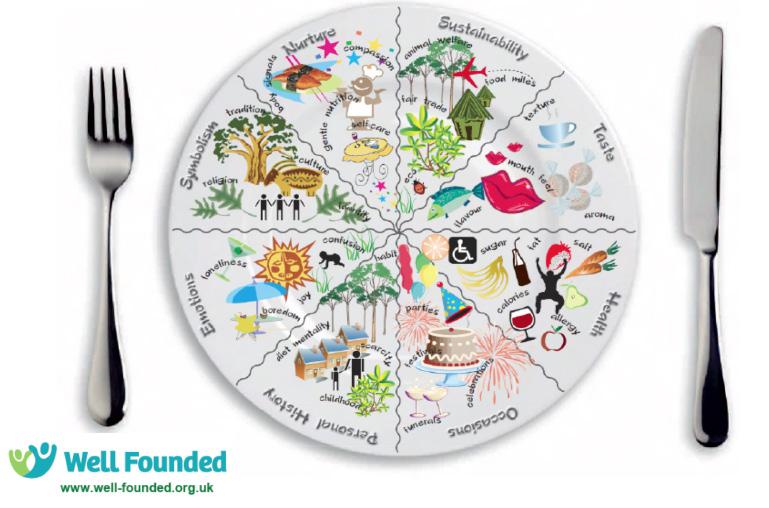
Once someone has new ways of responding to troubled eating, we can help them look in more detail at how to choose foods that support wellbeing (Figure 4).
The Kindful Eating cycle is supported theoretically by compassion science.15 It is also strengthened when we can help someone let go
When someone has primarily chosen foods on the basis of their nutrient and calorie content, the idea of allowing foods to meet a range of social, cultural and psychological roles alongside any nutritional need can be an eye-opener. This more holistic view of nutrition and health can reduce self-blame, food preoccupation and chaotic
eating and help restore a healthy relationship with food17 (Figure 5).
Teaching nutrition in ways that help people make links between what they eat and how they feel will further support eating for wellbeing. Here, paying attention to energy levels, appetite, hunger, mood, gut comfort and so on, is the starting point, and these body signals are then explained in relation to nutrition science. This helps someone make sense of their eating behaviours, reclaim pleasure in eating and make food choices that support their overall wellbeing.1,14,16
CONCLUSION
5: The Well Now Food for Thought Dinner Plate
So, have the scales had their day? Knowing and monitoring weight is important in clinical conditions, such as for burns patients and in heart failure. But encouraging a weight focus as a route to health in the general population is
harmful and unscientific. Morally and ethically, it behoves us to revisit the evidence and take action. The Well Now way offers an ethical alternative that focuses on health gain and body respect. Evaluation from NHS Highland, where ‘Well Now’ underpins the healthy weight strategy, illustrates its effectiveness.17
Figure