THE BARIATRIC PATIENT
The aim of this article is to discuss the most common types of bariatric procedures being performed in this country as a treatment option and discuss the long-term nutritional management of patients post-operatively.
The rise in the number of obese persons in the UK with a BMI >30kg/m2 and <40 kg/m2, appears to have slowed down since 2001. There is, however, a continuing rise in the prevalence of persons with a BMI ≥40kg/m2 1
Bariatric surgery is a generic term of weight loss surgery and a treatment option for those persons with severe obesity or obesity with other related comorbidities (see Table 1). It is more effective than any other non-surgical option for weight management, both for weight loss and also weight loss maintenance.2
For article references please email info@ networkhealth group.co.uk
The number of NHS commissioned bariatric surgery procedures in the UK has increased over the past 10 years, with 470 procedures being carried out in England in 2003/4 and up to 6,500 in 2010.3 The picture also appears to be replicated across the whole of the UK. This figure, however, still represents only about 1% of the number of UK patients who would benefit from bariatric surgery.3
RESTRICTIVE PROCEDURES
Adjustable Gastric Band
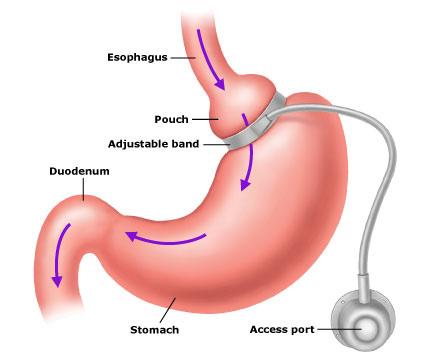
An adjustable silicone band is placed around the upper part of the stomach creating a small pouch. This has the effect of reducing the amount of food that can be eaten at any one time. It also reduces the feeling of hunger by pressing on the surface of the stomach. The diameter of the band and hence the restriction on the stomach, can be altered by either injecting or removing saline through a portal that is under the skin connected to the band. A benefit of the gastric band is that the procedure is relatively non- invasive. If the procedure proves ineffective or complications develop then it is easily reversed.
As the prevalence of severe and complex obesity increases, more patients are looking into surgical weight loss solutions. The most common procedures in the UK are Adjustable Gastric Banding, Gastric Bypass and a relative newcomer, the Gastric Sleeve. It is important that patients are reviewed as part of a multi-disciplinary team, including an experienced surgeon, anaesthetist, clinical psychologist and dietitian. Patients need to be thoroughly assessed as to their suitability for surgery and informed of each procedure, as well as of the risks and benefits. Bariatric surgery is not a guarantee of successful weight loss maintenance and consideration needs to be placed on long-term diet, exercise and behavioural therapy to minimise weight regain.
TYPES OF PROCEDURE
Procedures can be done either via open surgery or laparoscopically and can be categorised as either Restrictive or Malabsorptive.
Adustable Gastric Band
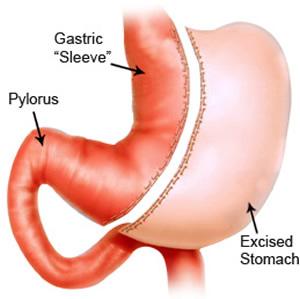
Sleeve Gastrectomy
MALABSORPTIVE PROCEDURES
Roux en Y Gastric Bypass
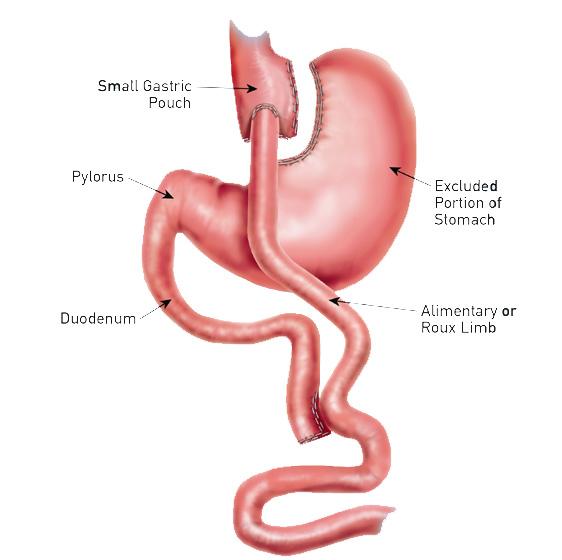
The Roux en Y Gastric Bypass is thought to be the preferred surgical procedure worldwide.4 A small pouch is created from the original stomach which remains attached to the oesophagus at one end. The other end is connected to a section of the small intestine. This results in a bypass of the remaining stomach and initial loop of small intestine. It is a malabsorptive procedure in that the anatomical change has an effect on intestinal absorption.
Patients with very high BMIs may have most to gain from this type of procedure; however, they are at increased risk of postoperative complications which makes them poorer surgical candidates.5
Sleeve Gastrectomy
The stomach is divided vertically, which reduces it in size by 75%, thus leaving a narrow gastric tube or ‘sleeve’. This permits only small amounts of food and creates a feeling of satiety earlier during a meal. The pyloric valve at the bottom is left and the stomach function and absorption are unaltered. This procedure is irreversible. It is the relative newcomer to bariatric surgery and is growing in popularity.
This surgery is a shorter duration than the gastric bypass, which is beneficial for patients with severe heart or lung disease. It can also be used as a staged approach for persons with very high BMIs to reduce their BMI with a view to having a gastric bypass in the future. The Gastric Sleeve is a relative newcomer on the scene, so there is a lack of long-term data.
Intragastric Balloon
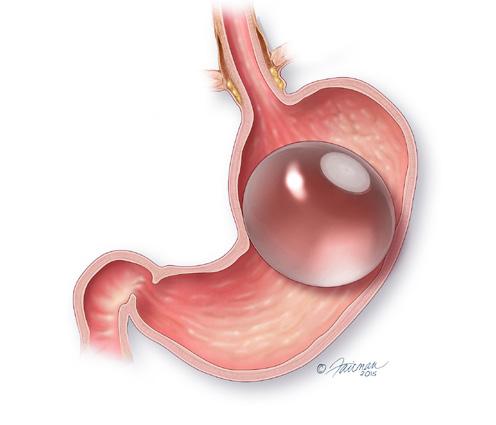
A silicone Intragastric Balloon is an interim measure for achieving weight loss in patients with very high BMIs and whom surgery is deemed high risk.
The Intragastric Balloon is placed endoscopically, inflated and designed to float freely in the stomach. It reduces the volume of the stomach and leads to premature satiety which aids weight loss.
It is following this weight loss that the patient may be offered further bariatric surgery.
Small Gastric Pouch
Pylorus
Duodenum
Excluded Portion of Stomach
Alimentary or Roux Limb
Roux en Y Gastric Bypass
Intragastric Balloon
BMI ≥40kg/m2
BMI ≥35kg/m2 with other significant obesity related diseases, e.g. Type 2 diabetes, high blood pressure
Person has been receiving or will receive intensive management in a Tier 3 service
Person fit for anaesthesia and surgery
Person commits to need for long-term follow-up
First line option for patients with BMI ≥50kg/m2
HEALTH OUTCOMES FOLLOWING BARIATRIC SURGERY
There is a shortage of direct comparative studies comparing bariatric surgical procedures. Systematic reviews published in 2009 looked into the effectiveness of bariatric surgery and concluded the following:6
• Bariatric surgery is more effective at achieving weight loss than non-surgical weight management in patients with BMI >30kg/m2.
• At one year, mean weight loss after gastric bypass was 38% compared to gastric band mean of 21% loss.7
• At 10 years, mean weight loss after gastric bypass was 25% compared to gastric band mean of 13% loss.7
• There were significant improvements to comorbidities such as diabetes and hypertension. Some of these effects are due to the neuroendocrine effects of gastric bypass surgery. Plasma glucose levels return to normal almost immediately post operatively, independent of weight loss.8 By contrast, gastric restriction operations have a positive effect on persons with Type 2 diabetes that are as a result of the weight loss itself and are not immediate.9
ADVERSE EVENTS
Bariatric surgery is not without its risks which are greatest for those with very high BMIs. Steps are taken to reduce these risks, such as weight loss before surgery using the Intragastric Balloon.
In the Swedish Obesity Study (SOS),7 there was a 0.25% of death following bariatric surgery. 13% of the SOS cohort had postoperative complications including embolism, thrombosis and wound complications or infections.7
POST-OPERATIVE NUTRITIONAL MANAGEMENT
Patient education on nutritional management following bariatric surgery is key to long-term weight loss and weight loss maintenance. It also reduces the risk of long-term nutritional deficiencies. There are certain nutrients that need to be regarded with interest:
Protein
It is recommended that the diet include 60-120g protein daily to maintain lean body mass during weight loss. This is especially true for patients who have had malabsorptive procedures, such as the Gastric Bypass, to prevent protein malnutrition.10
Table 1: Bariatric surgery criteria2
Table 2: 10g Protein exchanges11
Table 3: Diagnosis and treatment of nutritional deficiencies10
Deficiency Symptoms Diagnosis Treatment
Protein malnutrition
Calcium/vitamin D
Vitamin B12
Folic acid
Weakness
Decreased muscle mass
Brittle hair
Hypocalcaemia
Tetany
Tingling
Cramping
Metabolic bone disease
Pernicious anaemia
Tingling in fingers and toes
Depression
Dementia
Macrocytic anaemia
Palpitations
Fatigue
Neural tube defects
Iron Decreased work ability
Palpitations
Fatigue
Pica
Brittle hair
Anaemia
Vitamin A
Loss of nocturnal vision
Xeropthalmia
Table 4: Characteristics of weight loss maintainers17,18
Increased physical activity: 60-90 minutes daily
Emphasis on low energy dense foods
Regular meals including breakfast
Reduced portion sizes
Monitoring weight and food intake
Continued cognitive dietary restraint
Good social support
Patients are encouraged to consume protein rich foods that are well tolerated, such as meat, poultry, fish, eggs and dairy. Protein is an important part of good nutrition and an aim is set of around 30g of protein in at least two meals in the day. A summary of 10g protein exchanges can be found in Table 2.11 Dietary protein should be established first, then carbohydrates and then fats.
Vitamins and minerals
Long-term vitamin and mineral supplementation should be considered in all patients undergoing
Serum Albumin
Serum Creatinine
Total and ionized calcium levels
Intact PTH
25-D
Bone densitometry
Blood cell count
Vitamin B12 levels
Blood cell count
Folic acid levels
Homocysteine
Blood cell count
Serum
Iron
Ferritin
Blood vitamin A levels
Protein supplements
Calcium supplements
Oral vitamin D
Oral crystalline B12
Oral folate supplements (included in multivitamin)
Ferrous sulphate taken with vitamin C
Oral vitamin A
bariatric surgery. Changes imposed anatomically by the gastric bypass procedure do increase the risk of various deficiencies, but there is a longterm risk with each procedure. Supplementation with multivitamins, iron, vitamin B12 and calcium with vitamin D are recommended.12 Vitamin B12 deficiencies can occur, particularly after gastric bypass procedures. Studies have shown that over a third of patients had vitamin B12 deficiency at one year, which reduced slightly two to four years post operatively.13 The risk of vitamin B12 deficiency
The number of people with BMI ≥ 40kg/m 2 continues to rise and it is expected that the number of people choosing bariatric surgery as a weight management option will also continue to rise.
in restrictive procedures such as the Gastric Band and Gastric Sleeve are much less.14 The initiation of vitamin B12 supplementation within six months post operatively is recommended by surgical groups.10
Iron deficiency is common after gastric bypass procedures. Prophylactic iron supplementation is required to reduce the risk of iron deficiency anaemia.15 Vitamin C increases iron absorption and should be used with iron supplements.16 Calcium may inhibit iron absorption and is best not taken at the same time.
It is important that patients undergo both clinical and biochemical monitoring for micro and macro nutritional deficiencies after bariatric surgery. This includes glucose, electrolytes, iron/ferritin, vitamin B12, folate, calcium, 25D. This helps to reduce the risk of malnutrition and diagnosis of a nutritional deficiency (see Table 3).
PREVENTION AND TREATMENT OF WEIGHT REGAIN
Weight regain is not uncommon and it can be expected that 20-25% of the lost weight will be regained over a period of 10 years.10 Food intake charts show that calorie intakes increase one to two years after surgery which coincides with weight regain data.10 This weight regain could be managed by ensuring that patients adhere to dietary recommendations, increase their physical activity and adhere to behaviour modifications and pharmacological therapy.
Characteristics akin to successful weight loss maintenance include conscious control of dietary intake, self-monitoring, social support and physical activity (see Table 4).17,18 In severe post-operative weight regain, there
may need to be investigations into whether the gastrointestinal tract remains anatomically intact, or the integrity of the Gastric Band needs to be investigated.
FUTURE RESEARCH
There are few comparative studies that examine the weight loss of different surgical procedures. Indications are that weight loss is greater after Gastric Bypass procedures compared to a Gastric Band, but similar to a Sleeve Gastrectomy. Recruitment continues of the SurgiCal Obesity Treatment Study (SCOTS) trial, which is a longitudinal cohort study of bariatric surgery in Scotland following up all patients undergoing bariatric surgery for 10 years. Outcomes to be investigated include mortality, diabetes incidence, diabetes complications, weight change, surgical complications and quality of life.19 It is an area of weight management that continues to grow and, as dietitians, we welcome new evidence to improve our practice.
SUMMARY
The number of people with BMI ≥ 40kg/m 2 continues to rise and it is expected that the number of people choosing bariatric surgery as a weight management option will also continue to rise. This type of surgery is a viable treatment option for patients with severe and complex obesity. It has more successful weight change outcomes long term compared to non-surgical interventions. This translates to favourable outcomes in relation to diabetes and cardiovascular disease management. It also provides an opportunity for patients with high BMIs to experience an improved quality of life.