



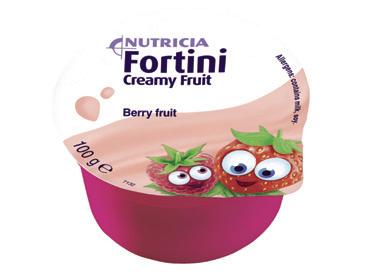
Oral Nutritional Supplements (ONS), specifically designed for children
Nutritionally balanced to help meet the needs of children. Available with or without fibre and as a nutritional drink, smoothie or spoonable ONS.
The trusted Fortini range combines flexibility with variety





Chris rudd nhd editor
Chris rudd’s career in continuous dietetic service has spanned 35 years. She is now working part time with the Sheffield PCt medicines management team, as a dietetic Advisor.
it only seems like yesterday that i was writing about 100 and now here is issue 110 for you! time certainly seems to be ‘flying by’ and recently i have been reading about ‘Why time flies as you age.’ it was an interesting account and looked at the key to time perception.
We all have routines in our lives, yet routine, although comforting, makes time go faster, whereas unique and memorable events slow down time. Maybe, if we want to ‘slow down’ time, we should focus on changing routine and creating unique experiences for each one. We can also engage in greater mindfulness - focusing on and savouring each passing moment.
The old adage of ‘live for the moment’ is the key to slowing down those quickly passing years. You may be thinking, how does this link in with this month’s NHD? Mindfulness for dietitians by Jackie Doyle describes mindfulness interventions and their potential application in healthcare. Two mindfulness interventions that have been developed for people with eating difficulties are also summarised.
Early years nutrition is the topic for two articles. Kate Harrod-Wild tells us that the toddler years can be difficult and food can become a big issue with many young children. Kate covers fussy feeders, healthy snacks, ensuring adequate fluid intake and also some common nutrition related problems.
Judy More and Melanie Pilcher look at the the role for early years’ providers in encouraging healthy eating habits for life. Food provision within early years’ settings has a significant role to play and the article covers the importance of investing in clear guidance, specific nutritional standards and training on healthy food provision in the early years of life as paramount.

For those of you working in the NHS you will know that innovative ways of working are being encouraged. Telemedicine is becoming more common. Noelle Cooper and Carolyn Jones share their experience of introducing and evaluating Skype clinics in Telemedicine and weight management. It seems that the patients had positive experiences and both the staff and Trust could see the benefits.
Moving on to novel procedures, Karen Jackson tells us about Fistuloclysis or Distal Enteral Tube Feeding (DETF). If you are not familiar with this form of nutritional support then please read on. Karen also includes a case study with a lady who experienced problems with tolerance and compliance.
Did you know that 27.6% of the cystic fibrosis population (1,924 people) has cystic fibrosis related diabetes? Cystic fibrosis related diabetes by Sarah Collins tells us more about pathophysiology, drug and nutritional management and their challenges and the importance of a MDT approach which can help reduce complications of the disease.
Neil Donnelly has a nostalgic look at the dietetic past and present in The Final Helping to complete NHD for 2015.
Finally, I hope that you all enjoy the festive celebrations and may I wish you all a very Merry Christmas and a Happy New Year. I wonder if 2016 will fly by as quickly as 2015 has.

editorial panel
Chris rudd, Dietetic advisor
neil donnelly, Fellow of the bDa
ursula arens, writer, Nutrition & Dietetics
dr emma derbyshire, Nutritionist, Health writer
emma Coates, Senior Paediatric Dietitian
noelle Cooper, Specialist Community Dietitian
Carolyn Jones, Specialist Community Dietitian
Sarah Collins, CF Specialist Dietitian
Karen Jackson, registered Dietitian
Kate harrod-wild, Specialist Paediatric Dietitian
Judy more, Dietitian and registered Nutritionist
melanie pilcher, Policy and Standards Manager, PLa
dr Jackie doyle, University College London Hospitals
dr fiona Carter, eraS UK
editor Chris rudd rD
Publishing director Julieanne Murray
Publishing editor Lisa Jackson
Publishing assistant Katie Dawson design Heather Dewhurst advertisement sales richard Mair Tel 01342 824073 richard@networkhealthgroup.co.uk address Suite 1 Freshfield Hall, The Square, Lewes road, Forest row, east Sussex rH18 5eS
Phone 0845 450 2125 (local call rate) fax 0844 774 7514 email info@networkhealthgroup.co.uk www.NHdmag.com www.dieteticJobs.co.uk all rights reserved. errors and omissions

@NHdmagazine





























From birth to discharge and beyond, the ESPGHAN-compliant1 Nutriprem range is designed to aid the development of preterm babies. For products that support feeding with breastmilk and contain ingredients to help babies thrive, choose Nutriprem.










dr emma derbyshire
phd rnutr (public health)
nutritional insight ltd
Fluids, but especially water, are essential to life. Unfortunately, fluid intakes are often overlooked from studies in favour of food and nutrient intakes. Now, new research has focused solely on evaluating fluid intakes.
A systematic review of studies was undertaken, focusing on healthy children, teens and adults living in cities. It was found that total beverage intakes ranged between 0.6 and 3.5 litres per day.
Plain water contributed to 58%, 75% and 80% of total beverage intakes in children, teen and adults, respectively. Milk was consumed more often in childhood, soft drinks during the teenage years and tea, coffee and alcohol in adulthood.
Overall, water contributed most to total fluid intakes, while the consumption of other drinks tended to vary according to life stage.
For more information, see: Ozen AE et al (2015). Journal of Human Nutrition & Dietetics Vol 28, Issue 5 pg 417-22.

dr emma derbyshire is a freelance nutritionist and former senior academic. her interests include pregnancy and public health.
www.nutritionalinsight.co.uk
hello@nutritionalinsight.co.uk
Fish is an important natural source of vitamin D. However, it’s still out on the jury whether habitual intakes alone are enough to maintain adequate status. A new paper has looked at this in detail.
A meta-analysis published in the American Journal of Clinical Nutrition analysed data from seven RCTs and two unpublished studies (640 subjects in total), all measuring fish intakes in relation to vitamin D status (as 25(OH)D).
When compared with controls, it was found that eating fish increased vitamin D levels by an average of 4.4nmol/L. Eating fatty fish led to a mean difference of 6.8nmol/L when compared with controls.
These findings show that while fish (particularly oily fish) is an importance source of vitamin D, current intakes and, indeed, recommendations are unlikely to lead to the attainment of optimal 25(OH)D status.
For more information, see: Lehmann U et al (2015). American Journal of Clinical Nutrition Vol 102, no 4, pg 837-47.
atest studies oN sugar
Sugar has been a hot topic in the news recently. This has largely been driven by the SACN report on Carbohydrates and Health which has led to a number of new publications in this area.
Two new papers published in Nutrition Reviews have focused on the roles of ‘added sugars’ (those added to foods and drinks during processing and preparation) in relation to dietary quality and health.
The first paper reviewed evidence from 22 studies, with all but one suggesting that higher intakes of added sugars were associated with reduced diet quality. A further 21 out of 30 studies found higher intakes of added sugars to be associated with lower micronutrient intakes.
A second paper looked at the effect of added sugar intakes in relation to ectopic fat (fat that builds up in places other than beneath the skin). Findings from 14 RCTs suggested that excess sugar intakes were linked to larger fat depots, especially in the liver and muscle fat. That said, report bias was likely in some of these studies. Subjects were also tested under hypercaloric conditions, i.e. when they ate more calories than needed.
Taken together, these are interesting findings suggesting that ‘added’ rather than total or intrinsic sugars pose most risks to health. Now further well designed RCTs with adequate power and duration are needed.
For more information, see: Louie JC and Tapsell LC (2015). Nutrition Reviews [Epub ahead of print] and Ma J et al (2015.) Nutrition Reviews. [Epub ahead of print].
Choline is a B vitamin and an important nutrient. Nevertheless, it is often omitted from dietary surveys. Now, new work has estimated habitual choline intakes across a European population.
Choline intakes were calculated using the European Food Safety Authority European Comprehensive Food Consumption Database and food values derived using the US Department of Agriculture Nutrient Database.
Interestingly, average choline intake ranges were: 151-210mg/d for toddlers (1 to ≤3 years old), 177-304mg/d for other children (3 to ≤10 years old), 244-373mg/d for teens (10 to ≤18 years old), 291-468mg/d for adults (18 to ≤65 years old), 284450mg/d among elderly people (65 to ≤75 years old) and 269-444mg/d among very elderly people (≥75 years old). In most population groups, average choline intakes were lower than adequate intakes set by the Institute of Medicine, with meat, milk, grains and eggs providing most choline.
While these findings are a useful guide to how much choline people are eating, more work is needed to improve choline food composition databases. That way, the accuracy of future work in this area can be optimised.
For more information, see: Vennemann FB et al (2015). British Journal of Nutrition [Epub ahead of print].

Berries are a great source of polyphenols, which are thought to support brain neurogenesis (the growth and development of nerves), which in turn, is involved in learning and memory. Now, new animal research has studied this further.
Aged Fischer rats (n=344) were fed a control 2.0% strawberry or 2.0% blueberry-supplemented diet for eight weeks. Behavioural changes and brain function were monitored.
It was found that rats eating the berry diets had improved cognition (brain function), with working memory found to improve the most. Improvements in brain neureogenesis were also seen.
While human trials are clearly needed, these are interesting findings suggesting that polyphenols found in berry fruits may help to support cognition and memory with advancing age.
For more information, see: Shukitt-Hale B et al (2015). British Journal of Nutrition Vol 114, Issue 10, pg 1542-49.






noelle Cooper Specialist
Community dietitian, berkshire
healthcare nhS foundation trust

Carolyn Jones Specialist
Community dietitian, berkshire healthcare nhS foundation trust
from mobile working to skype consultations, berkshire Healthcare NHs foundation trust community dietitians have embraced the use of technology to offer more patient choice in their weight management consultation venues. this article looks at how they did this, how the processes they introduced are working one year on and asks you to consider whether you might apply this to your setting.
The NHS is challenged to move with the times to offer innovative solutions to meet the demand of the expanding population and healthcare costs. The use of and confidence with technology is increasing, with a rising number of homes having access to the internet. In Great Britain, 84% had internet access in 2014 compared to 27% in 2006.1 Skype and other forms of video conferencing also continue to grow.
To address this, our service was interested to find out whether our patients wanted to access the dietetic service via interactive technologies. A three-month survey showed that 33% of new patients were interested in having a dietetic Skype appointment. Following on from this, from August 2014, Berkshire Healthcare dietitians introduced Skype consultations to our patients in addition to face-to-face outpatient appointments. The rationale behind offering these e-clinics was to make our dietetic service more accessible to patients. Benefits include reducing time off work, transport problems, clinic car park pressures and stress/anxiety, particularly in time of acute illness.
• remote patient monitoring using technological devices which can be transmitted back to a monitoring centre for evaluation and stored in patients’ medical records, e.g. undernutrition monitoring using ‘Health Call’ from Focus on Undernutrition Team (County Durham and Darlington NHS Foundation Trust); 2
• mobile technology such as smartphone applications and text messages to manage and track health conditions or promote healthy behaviours;
• real-time interactive technologies such as a two-way video, e.g. Skype.
approval proCeSS
noelle and Carolyn have both worked in dietetics for over 20 years, with experience of working in acute and community settings. they currently work for Berkshire healthcare foundation trust.
telemediCine
Telemedicine is defined as the use of technology to deliver care at a distance. It is rapidly growing and can potentially access more patients, enhance patient/ healthcare professional collaboration, improve health outcomes and reduce medical costs. Examples include:
As part of a staff engagement programme (Listening into Action), our application was chosen by the Trust’s Executive Committee. We became a pioneer team with ongoing support from senior managers over a period of six months. Our team included an IT specialist who guided us through gaining clinical governance approval and creating a Standard Operating Procedure (SOP).
We obtained Caldicott Guardian approval from our Clinical Director. Patient information leaflets were created to support Skype consultations, including guidance on how to download Skype. Patients were instructed that the dietitian would initiate the Skype call at their appointment time.














All the existing benefits of Nutramigen LIPIL with the addition of a probiotic branded LGG®, for no extra cost.
First stop — symptom resolution
Proven to have an average efficacy of 99%1†
Faster resolution of CMA symptoms vs previous formulation2,3
Final destination — oral tolerance to leave CMA behind
The only eHF clinically proven to accelerate time to tolerance4‡



8 out of 10 infants are tolerant to cow’s milk after 12 months of use4‡ The world's leading CMA formula5
NUTRAMIGEN1 NUTRAMIGEN2 NUTRAMIGEN PURAMINO PREGESTIMILLIPIL with LGG® with LGG®


AsolutionforallyourCMAneeds
Nutramigen with LGG® is not recommended for premature and immunocompromised infants unless directed and supervised by a healthcare professional. www.nutramigen.co.uk
†Studied before the addition of LGG®. Calculated using data on allergic reactions after oral food challenge with an eHF from table 3 of Dupont C et al. 2012, as judged by the Committee on Nutrition of the French Society of Paediatrics. ‡vs an eHF based on casein, rice hydrolysate, soy and amino acid formulas. CMA, cow’s milk allergy; eHF, extensively hydrolysed formula; LGG®, Lactobacillus rhamnosus GG. References: 1. Dupont C et al. Br J Nutr 2012;107:325–338. 2. Nermes M et al. Clin Exp Allergy 2010;41:370–377. 3. Baldassarre ME et al. J Pediatr 2010;156:397–401. 4. Canani RB et al. J Pediatr 2013;163:771–777. 5. Data on file, 2014.
IMPORTANT NOTICE: Breastfeeding provides the best nutrition for babies. *Trademark of Mead Johnson & Company, LLC. © 2015 Mead Johnson & Company, LLC. All rights reserved. LGG® is a registered trademark of Valio Ltd, Finland. This material is for healthcare professionals only. EU15.572/09–15.
Dietitians E-Clinic: Clinical Governance 29/07/14
teChniCal requirementS
IT uploaded Skype software onto department computers and sourced both headphones and web cameras. The aim was to ensure that the quality of our virtual consultations were on a par with face-to-face consultations.
Staff were offered in-house Skype training to ensure competency and confidence in delivering a good virtual consultation. Team members already using Skype on a personal basis were good advocates. As expected, there were some initial staff reservations for those unfamiliar with this form of communication, particularly around dealing with technical problems. These were overcome by the development of an SOP, enabling a consistent approach, along with troubleshooting tips.
Administrative staff play a key role in recruiting and booking Skype appointments into our community outpatient clinics. These appointments are well promoted and once agreed, further details are collected including a patient’s Skype
username and contact phone number in case of failed technology.
There are clear benefits to virtual consultations including a greater choice of where they are seen. Patients who are not able to attend an outpatient appointment and do not meet domiciliary criteria are now being offered a Skype appointment instead of a phone call. Clinic utilisation has also improved, as patients are being offered a Skype appointment when they phone to cancel their appointment.
Skype appointments were first introduced in August 2014 and have now been running a year. Recruitment was initially slower than anticipated, partly due to the waiting times. For new patients, there is still a preference to be seen faceto-face whenever possible. The numbers are now increasing with approximately seven patients receiving dietetic advice via Skype per month.
Following a Skype appointment, patients were asked to complete an online survey. To date, 24 patients have reported their experience to be as follows:
Saves on time off work and travel.
good patient clinic attendance.
efficiency and cost savings, e.g. less car park congestion.
Saves on fuel and parking costs.
Safe alternative in adverse weather conditions.
more choice where to be seen with increased access for some patients.
Superior to email or telephone as can see body language and cooking environment. better understanding of portion sizes through seeing plate sizes, etc.
Saves on clinical time due reduction in clinic travel.
better able to meet patient needs in timely manner.
• 100% requested a future appointment and would recommend a friend
• 100% said the appointment was convenient
• 95% rated the experience as ‘good’ or ‘excellent’
• 67% reported time off work was not needed
• 63% would have been unable to attend a faceto-face appointment
• 78% did not experience any technical issues
Overall, the experience has been positive with increasing staff confidence and competence. Technical issues were overcome by training as well as following the SOP and clinical governance pathway.
In our favour, technology is an important part of our working day with all staff having access to mobile working and using an electronic patient record system (RiO) to document dietetic intervention.
A disadvantage of Skype appointments is the reliance on patient self-reporting, e.g. body weight. However, there is recent evidence that self-reporting has become more accurate amongst overweight and obese patients.3 For those unable to self-weigh, other measures could include clothes or waist size.
A wide variety of clinical conditions are being seen including nutritional support, weight management, gastroenterology, diabetes and paediatrics. Over the last year (Sept 2014 to August 2015), we have seen 66 patients (28 new patients and 38 follow ups) from all age groups (early 20s to late 70ss).
positive patient experience.
working together increasing patient choice.
optimal clinical outcomes, seeing patients at right time and place.
The following table shows the benefits of offering Skype appointments to patients, staff and the Trust:
Over the last year we have shown that Skype appointments can be successfully applied to our dietetic practice without impacting on service delivery. Although Skype consultations are not suitable for everyone, they are an addition to and not a replacement for the traditional face-to-face appointments, hence giving wider patient choice.
We have been fortunate to have Trust support in introducing Skype appointments early on and we envisage that, as patient demand increases, we will have the expertise and confidence to be able to meet this demand. As technology has become the norm in most people’s lives, the public is becoming more open to telemedicine as a form of healthcare delivery for preventive care, acute care and chronic disease management.
Through the use of Skype appointments, we have raised the profile of the dietetics service across Berkshire Healthcare. The opportunity to run Skype clinics is now being opened up to other services within the organisation. We would encourage other dietetic services to consider patient benefits and introduce virtual consultations.
For the future, dietetic e-clinic consultations could one day complement evidence-based online programmes and approved smart phone apps.
for article references please email: info@networkhealthgroup.co.uk
An apple a day keeps the doctor away. Think what a square meal can do.

Wiltshire Farm Foods: The nutrition your patients need. The variety they want.

As a healthcare professional, you know the importance of good nutrition for patients. We understand it too. The UK’s leading provider of tasty, nutritionally-balanced frozen ready meals, we’ve prepared a range of over 300 satisfying dishes – ensuring your patients enjoy the variety, flavour and nutrition that help to maintain good health. All with free delivery to the door and ready in minutes. You look after the treatment. Let us look after the mealtimes.
Try our tasty ranges for FREE or request our brochures by calling