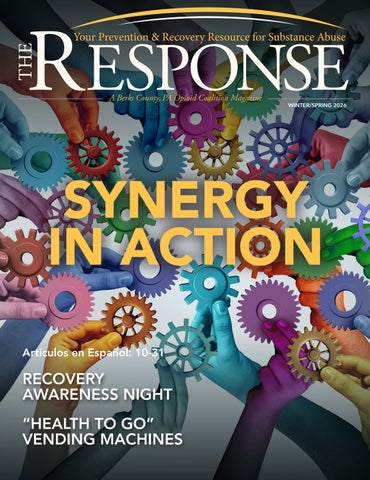
WINTER/SPRING 2026
SYNERGY IN ACTION Artículos en Español: 10-31
RECOVERY AWARENESS NIGHT “HEALTH TO GO” VENDING MACHINES
Serving Berks County since 1897
• We stock medications used to manage addiction. • We work with the prescriber and insurance plan if a prior authorization is required. • Specialize in providing pharmacy services to drug and alcohol treatment facilities.
BE PREPARED. GET NALOXONE. SAVE A LIFE.
538 Penn Ave., West Reading
westreadingdrug.com
FREE DELIVERY: 610.375.4366
Opioid overdose antidote naloxone available without a prescription.
We are committed to providing access to this life saving medication for you or your loved one.
Mon-Fri: 8 a.m. - 7 p.m. Sat: 9 a.m. - 2 p.m. Sun: 9 a.m. - 1 p.m.
The Response is published through funding from county and state dollars in concert with the Berks County Opioid Coalition under the guidance of the Council on Chemical Abuse. cocaberks.org • 610-376-8669
EDITORIAL BOARD
Marcia Goodman-Hinnershitz Director of Planning & Resource Development, Council on Chemical Abuse Kevin Bezler Hoffmann Publishing Group Josephine Torres-Boykins Executive Director Berks County Latino Chamber of Commerce
CONTENTS FEATURES 4 5
Synergy in Action—Keep the Wheels Turning From the Co-Chairs: SOS Berks: Synergy in Action
6
Recovery Awareness Night at the Reading Fightin’ Phils
8
The Oley Fair: Connecting with the Community
10 Socialization Is the Playground for Addiction Recovery
Kathleen Noll Executive Director, Council on Chemical Abuse
12 “Health To Go” Vending Machines: An Innovative
Michael Rivera Commissioner, County of Berks
15 No Wrong Door: Removing Barriers to Substance
BERKS COUNTY’S OPIOID COALITION, SOS BERKS
16 Turning Shared Struggles into Collective Strength
SOS BERKS BERKS OPIOID COALITION LEADERSHIP
19 Sinergia en acción—que las ruedas sigan girando
www.sosberks.com
Michael Rivera and Kathleen Noll Coalition Co-chairs
COMMUNITY SAFETY COMMITTEE
Use Disorder Treatment
18 My Story of Recovery
20 De los copresidentes: SOS Berks: sinergia en acción 21 No hay puertas equivocadas para eliminar barreras al tratamiento del trastorno por consumo de sustancias
OUTREACH EDUCATION COMMITTEE
22 Noche de Concienciación sobre la recuperación
DATA COMMITTEE
Justin Loose and Kathleen Noll Co-chairs
TREATMENT COMMITTEE
Amanda Miller and Bernice Hines-Corbit, Co-chairs
BERKS COUNTY OPIOID COALITION
Approach to Public Health
John Adams and Yvonne Stroman Co-chairs Laura Catalano, Jaclyn Steed, and Cory Trevena Co-Chairs
WINTER/SPRING 2026
con los Reading Fightin’ Phils
24 La socialización es el ambiente ideal para la recuperación de la adicción
26 Máquina expendedora—“Health To Go” un enfoque innovador para la salud pública
29 Mi historia de recuperación
30 Convirtiendo luchas compartidas en fuerza colectiva OPIOID COALITION VISION Identify opportunities to remediate the opioid crisis through the provision of evidence based/best practice strategies and resources.
This project is made possible, in whole or in part, by funds received through the Berks County Opioid Settlement Agreement.
The opinions expressed in this publication are for general information only and are not intended to provide specific legal, medical or other advice or recommendations for any individuals. All rights reserved. No portion of this publication may be reproduced electronically or in print without the expressed written consent of the publisher or editor.
OPIOID COALITION MISSION The mission of the coalition is to determine the extent to which Berks County is being affected by the non-prescriptive use of opioids and the use of heroin through the examination of its devastating effects, both personal and societal, and to set recommendations that address the prevention, intervention, treatment and recovery supports of local residents that suffer from opioid addiction.
Hoffmann Publishing Group is the official publisher of SOS Berks—Opioid Coalition’s The Response magazine. 2669 Shillington Road, Box #438 Sinking Spring, PA 19608 | HoffPubs.com | (610) 685.0914
FOR ADVERTISING OPPORTUNIITIES CONTACT: Sales@hoffpubs.com, 610.685.0914, ext. 715
LETTER FROM THE EDITOR
SYNERGY IN ACTION—KEEP THE WHEELS TURNING “If you are going to act, you have to do it now—once the wheels start turning, there is no going back.”
Marcia Goodman-Hinnershitz Director of Planning and Resource Development
When you hear the phrase “The Wheels are Turning,” it captures the sense of dynamic progress being made and change is starting to happen. This common inspirational expression is most often used to denote progress and movement towards the achievement of a goal. While the expression might invoke images of the gears of a machine in motion, it is also a vibrant way of describing the forward momentum of ideas and actions that are catalysts for positive change. “The Wheels are Turning” describes when plans or ideas are being put into action, leading to tangible results. The goal of reducing overdose deaths has guided the work of the SOS Berks Opioid Coalition since its inception in 2018. Once SOS Berks committed to this goal, there was no turning back. But putting this goal into action, keeping the wheels turning has been the strength of SOS Berks. The powerful force of synergy is the secret ingredient. Synergy took over as collaborative forces worked towards the common goal of saving lives. By starting small, but thinking big, the Coalition built on its early successes. Programs such as the Warm Hand-off Program at Reading Hospital and the Naloxone
4
THE RESPONSE // WINTER/SPRING 2026
Distribution Project became the sparks for the Coalition to pursue other innovative and lifesaving programs. The work of SOS Berks has always been data driven, directing resources to communities and populations at greatest risk for overdoses. Through this data driven approach, initiatives such as community outreach and education were in the areas of greatest need. The decision to place the “Health to Go” vending machine in the Reading branch of the YMCA was based on emergency medical response data that revealed that this section of the county has a higher prevalence of drug overdoses. As the membership of SOS Berks has expanded to over 50 partner organizations, synergy has served as the fuel to expand, implement, and sustain these vital initiatives. SOS Berks continues to turn outward, to mobilize the forces that will make a difference. The Response magazine serves as our messenger to the community. By highlighting the programs, the people and progress of SOS Berks, we demonstrate the power of collaboration and working together towards a common goal. We acknowledge the challenges ahead, but there is no turning back. We need to continue to keep our wheels turning, building synergy and resilience. We hope, as readers of The Response, one of the many stories we share resonates with your own life experiences and serves as a catalyst so you also can become a partner in positive change.
FROM THE COALITION
FROM THE CO-CHAIRS:
SOS BERKS: SYNERGY IN ACTION
By Co-Chairs: Michael Rivera, Berks County Commissioner, and Kathleen Noll, Executive Director of the Council on Chemical Abuse
Michael Rivera Berks County Commissioner
W
hen we, as the co-chairs of SOS Berks, talk about this Coalition, we describe the group members as working collaboratively to produce synergistic effects. Synergy describes a circumstance where “the whole is greater than the sum of its parts”; in other words, synergy is about two or more people or groups working in tandem to produce better results than if they acted alone. Within organizations, synergy might mean combining teams, resources or processes in a way that improves efficiency, effectiveness or value. On the surface, synergy is a meaningful and important concept signaling collaboration, integration and amplified outcomes. Unfortunately, “synergy” has become a buzzword. It has been so widely and casually used, particularly in organizations, that it has lost much of its integral meaning. Many times, it is a vague construct rather than a precise description of what is happening. As the co-chairs of SOS Berks, we remain cognizant of the importance of genuine synergy in our work and take every opportunity to foster collaboration among Coalition members and the entire community. At its best, a synergistic group includes all members being aligned by a shared goal, using open respectful communication in a judgementfree environment where constructive feedback is welcome. As co-chairs, we have witnessed SOS Berks grow into a group of people with unique talents and viewpoints, working in a cohesive and trusting environment leading to extraordinary outcomes.
Kathleen Noll Executive Director of the Council on Chemical Abuse
While SOS Berks has completed numerous projects that reflect the synergistic nature of the Coalition, the initiatives highlighted below clearly demonstrate the phenomenon of positive synergy at work: Creating community murals that depict the hope of recovery from substance use disorders— Two beautiful murals now grace our community
as encouragement and reminders that recovery is possible. SOS Berks members worked on the murals under the direction of Michael Miller, Berks Community Murals coordinator. The membership also invited family, friends, treatment and recovery organizations and the entire Berks County community to offer their time and talents to the creation of these murals. Engaging African American Community Leaders in the mission of SOS Berks—We know that opioid overdoses disproportionally impact the African American community in Berks County. To raise awareness and to garner support for initiatives designed to decrease opioid overdoses in the African American community, the Healthcare and Treatment subcommittee of SOS Berks enlisted the Prevention Education subcommittee and the Community Safety subcommittee to reach out to Berks County African American leaders. These subcommittees held an informational luncheon that resulted in African American leaders embracing the mission of SOS Berks with an emphasis on educating and equipping the African American community to impact opioid overdose deaths. Recovery Night at the Reading Fightin’ Phils—For the past several years, SOS Berks has sponsored Recovery Night at the Reading Fightin’ Phils. Like the creation of the community murals, SOS membership organizations came together along with family and friends to educate the community about SOS Berks, opioid overdose deaths and ways individuals can help further SOS Berks’ mission. We are immensely proud of our SOS Berks members and their commitment to actively and persistently assessing their individual strengths and weaknesses to understand how each member can best contribute to the group, decrease limitations and build something bigger than themselves. 5
FEATURE
RECOVERY AWARENESS NIGHT at the Reading Fightin’ Phils
By Laura Catalano, SOS Berks Education and Community Awareness Committee
W
hat do tickets, tables and t-shirts have to do with recovery from substance use disorder? And how does a first pitch or a firework display help people connect with recovery organizations? You might say none of that is relevant. But you might think differently if you’d attended the 4th Annual Recovery Awareness Night at the Reading Fightin’ Phils in July 2025. The SOS Berks Opioid Coalition cosponsored that event along with Berks Counseling Center. While those two organizations split the cost of the main sponsorship, 14 other recovery organizations and treatment providers helped co-sponsor Recovery Awareness Night. Together, the 16 organizations engaged in a months-long planning process, pitched 6
THE RESPONSE // WINTER/SPRING 2026
in funds to pay for over 600 Recovery Awareness Night T-shirts, and worked to promote the event and distribute the 5,000 tickets that come free with sponsorship. On the night of the event, all participating organizations set up tables throughout the plaza of FirstEnergy Stadium in Reading. As the crowd of over 6,000 flowed in before the baseball game, many people took time to stop at tables, talk to providers and pick up information on substance use prevention, treatment and recovery. The first 600 people to enter the stadium were handed free Recovery Awareness Night T-shirts bearing logos of all the organizations. As the main sponsors, SOS Berks and Berks Counseling Center provided a 30-second commercial about Recovery Awareness Night that was shown twice during the game, and their logos were featured on neon signs during first pitches before the
game and during fireworks after the game. Signs and banners at the front of the stadium announced Recovery Awareness Night. And, Berks County Commissioner Michael Rivera, who co-chairs SOS Berks, gave a mid-game interview to discuss the work of the coalition. Why sponsor a baseball game? Our goals are simple: to reach a large, diverse audience with the message that recovery is possible, and that treatment and recovery support are available right here in Berks County. “Sponsoring the Recovery Awareness Night game enables us and our partners to spread a message of hope and provide treatment and recovery information to a large audience,” said SOS Berks Co-chair Kathleen F. Noll, who is also the executive director of the Council on Chemical Abuse. What’s more, having 16 recovery organizations together in one place
provides a unique opportunity to amplify messages around things like NARCAN, support meetings, recovery housing, medication safety, treatment options and more. Because it happens amid a fun, casual atmosphere, it enables people to easily find resources, ask questions and share stories. A perhaps unintended benefit occurs in the collaboration itself, with people from a variety of organizations working together, and in the process building relationships that spread far beyond Recovery Awareness Night. The fact that most organizations have participated in Recovery Awareness Night for the past four years speaks to the fact that they find strong value in this event and that many are hoping to participate in the 5th Annual Recovery Awareness Night in 2026. Recovery Awareness Night Sponsoring Organizations Berks Counseling Center | SOS Berks | YMCA of Reading | Community Prevention Partnership | Peace & Harmony House | Easy Does It, Inc. | Shatterproof, Inc. | Caron Treatment Centers | Celebrate Recovery | Common Ground Recovery Community | Council on Chemical Abuse | Haven Behavioral Hospital of Eastern Pennsylvania | MINDSET Living | PA Adult & Teen Challenge | Project Transition | Recovery Coaching Services | Tower Behavioral Health | Jersey Ink
EDI
Easy Does It, Inc. Recovery Lies Within Making a Difference Since 1989
Supporting & Empowering Individuals in Recovery •• Permanent Supportive Housing Licensed Recovery Housing for Berks County • Self-Pay ResidentsOptions Available Berks County • for Recovery Support Residents Services • Recovery Services Provided Support by Certified Recovery Specialists by Certiied Recovery Specialists • Provided Individualized Recovery Planning • Individualized Recovery Planning Structure & Accountability •• Structure Accountability Life Skills& Workshops • Life Skills Workshops
610-373-2463 For610-373-2463 more information, please visit ediinc.org www.easydoesitinc.org
7
FEATURE
The Oley Fair:
Connecting with the Community By Beth Derr, Education and Outreach Committee
What do giant pumpkins, funnel cake and SOS Berks have in common? Why the Oley Community Fair, of course! For 78 years, this vibrant community fair is deeply rooted in agriculture and the community, and it is the centerpiece for farm exhibits, home-cooking and
8
THE RESPONSE // WINTER/SPRING 2026
music as well as business, faith-based and community organization displays. Over three days the fair attracts tens of thousands of visitors. Beginning in 2017, Hope in Action, a ministry of Friedens Lutheran Church in Oley, invited staff from the Council on
Chemical Abuse (COCA) and the Berks Treatment Access and Services Center (TASC) to partner by working a table at the Oley Community Fair. The first year we distributed educational and referral resources to the community. That was the beginning of a collaboration that evolved to encompass SOS Berks Coalition and that has become one of the Coalition’s most successful community collaborations. Hope in Action ministry formed in 2016, its members called to action in response to the illicit and prescription drug addiction crisis. We sought out public events and resources to become more informed of the many facets of drug addiction. We learned early on that Berks County has well regarded organizations dedicated to substance use awareness, treatment, recovery and support with whom we wanted to partner in the months and years ahead. Speakers from Caron Foundation, COCA and Common Ground Recovery Community have been invited to speak during Friedens’ worship service to educate the congregation. Hope in Action’s primary objective, then and today, is to promote awareness and to provide prevention education within the congregation and local community and to help direct families to the resources available in Berks County.
Integrated Outpatient Counseling and Physical Health and Wellness Services serving Adults, Youth and Families. Here are a few of the services we offer: • Adolescent and Adult Substance Use Disorder Counseling • Mental Health Counseling • Individual and/or group therapy
Dr. Netaji,
• Medication Assisted Treatment (MAT) • Certified recovery/peer specialists • Physical health and wellness services • Genoa Pharmacy on site (for both you and your family)
is board certified in Addiction Medicine and specializes in Medication Assisted Treatment (MAT). Dr. Netaji is a caring and compassionate physician who can help you on your road to recovery – always in a judgement-free zone.
Certified Community Behavioral Health Clinic | Integrated Community Wellness Center
Learn how we can help you or someone you love by calling
610.373.4281
645 Penn Street, 2nd Floor, Reading, PA 19601 • berkscounselingcenter.org
For this year’s tabling event at the Oley Fair, Hope in Action and SOS Berks promoted National Recovery Month to affirm that people can and do recover from substance use challenges. Fairgoers were invited to write on a paper butterfly a message of hope, honoring a loved one’s recovery date or in memory of a loved one. We then displayed the butterflies in front of the National Recovery Month banner. In addition, an interactive “what’s in a vape” display allowed visitors to test their knowledge. Through the interactive displays and giveaways, the fair provides an approachable means to seek out prevention and treatment information and, in this way, diminish the stigma around substance use disorder. Free medicine disposal bags often hold appeal to many visitors. Once at the table, some people seek out the free NARCAN, educational resources and of course, the candy and giveaways. Every year there are compelling and personal accounts shared with our volunteers. It’s become a safe place to reveal what’s on their mind such as the loss of a loved one to an overdose or the satisfaction of one’s recovery anniversary. It’s also a safe place for youth to learn about the dangers of illicit drugs, misuse of prescription meds, vaping and more. Volunteers are there to listen, not to judge. We are there to inform, not to lecture. We are there to enjoy the music, the food, the exhibits and most especially, the people.
Everyone is recovering from something.
SPIRITUAL RECOVERY PROGRAMS, MEALS & WORSHIP SERVICES SERVICE & MEAL.: Every Sunday at 2pm ABOUT ADDICTION Trinity Lutheran & RECOVERY Church Auditorium ◆ Small Groups
◆ Fellowship Supper every week at 6pm
527 Washington St., Reading, PA 19601
◆ Spiritual Recovery Worship Service: Every Wednesday at 7pm in-person or on Facebook and YouTube ◆ Coffeehouse & Open Mic: 3rd Friday at 7pm ATONEMENT LUTHERAN CHURCH LUDIN HALL 5 Wyomissing Blvd Wyomissing, PA 19610 www.cgrcommunity.org Contact Pastor Tom for more info at (610) 375-3512 or PastorTom@cgrcommunity.org
continued on next page 9
SOCIALIZATION FEATURE
Is the Playground for Addiction Recovery
By Yvonne Stroman, Community Program Specialist, Council on Chemical Abuse
A
ddiction recovery is not a solitary journey—it is a deeply social process. Healing from addiction requires more than abstaining from substances; it calls for reconnecting with oneself, others, and the world. In this sense, socialization becomes the “playground” for recovery—a dynamic space where individuals relearn trust, rediscover purpose and rebuild the relationships that addiction once eroded. Through social engagement, people in recovery find belonging, practice healthy communication and create new meaning in their lives. At its core, addiction isolates. It fractures relationships, separates individuals from their communities, and fosters shame and secrecy. Recovery, by contrast, thrives on connection. Socialization fulfills one of our most basic human needs: to belong. Research in psychology consistently shows that belonging is a key predictor of wellbeing, resilience and even longevity. In recovery, this sense of belonging becomes both protective and transformative. Being part of a group— whether it’s a recovery meeting, a faith community, a sports team or a volunteer project—offers an environment of mutual understanding and accountability. It helps individuals see that they are not alone in their struggles and that their experiences have value. Social bonds can counter the loneliness and despair that can contribute to return to use. 10
THE RESPONSE // WINTER/SPRING 2026
Calling socialization a “playground” highlights its experimental nature. In a playground, we learn by doing—testing limits, trying new skills and making mistakes in a safe space. Similarly, social interaction allows people in recovery to practice new ways of thinking and behaving. Addiction often impairs interpersonal skills such as honesty, empathy and boundary-setting. Through recovery-based socialization, individuals can rebuild these capacities. Support groups, peer mentoring and group therapy provide structured opportunities to communicate openly and receive feedback. Everyday interactions—chatting with coworkers, reconnecting with family, or joining a community club—extend this learning into real-world settings. The Substance Abuse and Mental Health Services Administration (SAMHSA) defines addiction recovery as a process of change through which individuals improve their health and wellness, live a self-directed life, and strive to reach their full potential. SAMHSA highlights “Connectedness” as a core recovery principle, meaning recovery is sustained through relationships and community involvement.
recovery outcomes. Safe, inclusive and substance-free social spaces are essential. Recovery community centers, sober living homes and wellness cafés provide places where individuals can connect without the pressure of drug or alcohol use. These environments normalize sobriety as a lifestyle rather than a restriction. They host recreational activities—music nights, fitness groups, art workshops—that make recovery social, enjoyable and sustainable. The more accessible and diverse these spaces are, the more people can find a niche that aligns with their interests and identities. Socialization also helps individuals rediscover their identity beyond addiction. Through interacting with others, people explore who they are, what they value, and where they fit in the world. Culture, spirituality and community traditions can all play a role in this process. When recovery spaces are inclusive and culturally responsive, they validate the diversity of lived experiences. They recognize that healing is not one-size-fits-all, and that everyone deserves to find community on their own terms.
Community connectedness Ultimately, recovery is about and socialization are widely Ultimately, recovery is about recognized as an evidence-based moving from survival to moving from survival to thriving— strategy in recovery addiction. thriving—and socialization is They strengthen protective the bridge. When individuals and socialization is the bridge. factors while reducing risks re-engage socially, they begin of relapse. The Berks County to see themselves as capable, RISE Center (Recovery — worthy and connected. Information—Support—Education), a community recovery Friendships, shared laughter, teamwork and mutual support all resource, offers a welcoming space where individuals in recovery remind them that life in recovery is not merely about avoiding and their families can access peer-support services, attend pain but embracing joy. mutual aid or self-help meetings, and recovery related events and activities that provide education, social supports and recoveryThe playground of socialization is where healing meets humanity. oriented community resources. It is where lessons are learned, hope is renewed, and new stories are written. In these shared spaces, recovery ceases to be a The RISE Center hosts four mutual aid support groups including lonely battle and becomes a collective celebration of resilience, Alcoholics Anonymous, Gamblers Anonymous and SMART compassion and possibility. Recovery as well as social events such as the annual recovery walk, recovery football, Taco Tuesdays, recovery bingo, Saturday “Socialization is the playground for addiction recovery” captures movie matinees, lunch and learns, Sundaes on Friday and holiday a truth at the heart of human healing: recovery happens in luncheons. More than 500 people participated in these social relationship. Through connection, we learn, grow and find purpose events last year. again. Whether through peer support, family reconnection or community involvement, social engagement transforms recovery Socialization isn’t just “being around people”—it’s the intentional from an individual task into a shared journey. use of positive, recovery-oriented social networks to build belonging, accountability, coping skills and resilience. Evidence In the end, it is not isolation but inclusion that sustains recovery. shows that through socialization and connectedness quality of life The more we invest in building supportive, substance-free social increase, making socialization a cornerstone of recovery strategies. environments, the more playgrounds of hope and healing we The environment in which socialization occurs greatly influences create—for individuals, families, and communities alike.
11
FEATURE
“HEALTH TO GO” VENDING MACHINES
An Innovative Approach to Public Health By Alice Zhang, Assistant Professor of Family and Community Medicine, Penn State University, and Jennifer Murphy, Professor of Criminal Justice, Penn State University
T
In the lobby of the YMCA in Reading, Pennsylvania, stands a row of vending machines—but one machine is different from the rest. 12
THE RESPONSE // WINTER/SPRING 2026
he Health To Go vending machine inside the Reading YMCA lobby is more than just an innovative public health intervention. It is the result of collaborative action and a shared commitment to Reading’s well-being among diverse community partners: from the YMCA who has provided the space and oversight for the machine to community members who lend their time and effort to package the kits that go into the machine. Thanks to this synergistic partnership with SOS Berks, the machine has dispensed over 6,800 items including more than 700 naloxone doses, 900 drug checking strips, 1,000 wound care kits, and 2,400 hygiene kits. The Health To Go machine’s success is a testament to the power of joining forces and teamwork around a common purpose–-to ensure that the community can access essential health supplies 24/7, free of charge and judgment, to stay healthy and to improve their quality of life.
The Health To Go vending machine initiative in Pennsylvania is an innovative response to the opioid epidemic where over 3,300 people died of drug overdose in 2024, down from over 5,300 in 2021. These machines are funded by grants from Penn State College of Medicine, the National Institute on Drug Abuse, UPMC Pinnacle Foundation and opioid settlement funds from Dauphin and Berks counties. The two Pennsylvania locations are the Reading YMCA and outside of the UPMC Harrisburg Emergency Department. Instead of stocking chips or soda, the vending machines dispense drug testing strips, hygiene kits, socks, soap, wound care supplies and naloxone, a medication also known by its brand name Narcan that is used to reverse opioid overdoses–-all completely free. The machines, using an interactive touchscreen, list the names of resources such as mental health care, food banks, housing assistance and substance use disorder treatment and provide contact information and a QR code to scan for more information.
OVER 6,800 ITEMS DISPENSED! March 26, 2024 - October 17, 2025 190+ drug checking kits (900+ drug testing strips) 9%
1,100+ 54% wound care kits
700+ 33% naloxone doses
2,200+ harm reduction kits
4% 90+ medical disposal bags
Naloxone, wound care kits and more Harm-reduction vending machines became popular in cities across the U.S. during the COVID-19 pandemic, when people could not easily access in-person services and when drug overdose deaths also rose dramatically. Most machines dispense naloxone nasal spray to reverse overdoses and other items such as syringes and fentanyl test strips. Some, like the Health To Go machines, also offer general health and hygiene items such as soap, toothpaste and toothbrushes, and pregnancy tests. If a person is seen at the machine, they could be getting a toothbrush and socks or they could be getting naloxone–-no one watching would necessarily know. Also, the nature of the vending machine means the people using them don’t need to interact with a person to obtain Narcan or drug checking strips, as many people with substance use disorder feel stigma or embarrassment about their addiction.
33%
1,100+ menstrual kits
53%
14% 200+ pregnancy test kits
The Health To Go vending machines are interactive, with a large touch screen on the front. The vending machine is connected to Wi-Fi and cellular data and can capture anonymous information on how people are using the machine. The machine can also ask users survey questions to get their feedback, such as whether there are other items they would like to see in the machine or whether they think the machine is having an impact on reducing stigma on substance use. This data helps the team know how to improve the machine to better serve people with opioid addiction, as well as people experiencing homelessness and having trouble affording basic needs. The touch screen is also able to play videos, such as a quick explainer on how to use fentanyl testing strips and testimonials from people in recovery, and display local community resources and services where people can get help. continued on next page
1,900+ sexual health kits
600+ safer sex kits
100+ HIV self tests 5%
400+ cold 14% & flu kits
3,000+ health & wellness kits 2,400+ hygiene kits
81%
Data sourced from SMRT1 IDS RPT 296- Health Machine Usage Report
13
Over the past year, the two Health To Go vending machines in Reading and Harrisburg combined have dispensed more than 11,000 items. The most popular items are hygiene kits, with over 3,300 dispensed. The kits contain toothbrushes, toothpaste, socks, combs, nail clippers, ChapStick, mouthwash, soap and towels. The machines also have dispensed nearly 1,900 doses of naloxone, 1,700 wound care kits, and over 1,500 safer sex kits.
as cost, hours of operation and potential stigma, the Health To Go vending machines can reach people who may otherwise fall through the cracks of traditional health care.
More than 2,300 distinct usernames were registered to the two machines in the past year. The usernames are the person’s birth year, a color and a nature or animal icon. This allows us to track individuals anonymously over time as they use the machine and get info as they answer survey questions. Nearly 40% of users reported being unemployed, and almost a quarter said they are experiencing homelessness or housing insecurity. Out of those surveyed, four in five users said they had trouble paying for basic needs, and over a third had not seen a health care provider in the past year.
The Authors Dr. Zhang and Dr. Murphy are a physician and an assistant professor of family and community medicine as well as a criminal justice professor at Penn State University respectively, and both have been part of a collective effort to put these two Health To Go vending machines in place. The vending machines are part of a growing movement in the United States to provide easy access to harm-reduction resources.
A judgment-free alternative In addition to data collected directly from the vending machine, the authors conducted interviews of ten vending machine users in Reading in the winter and spring of 2025. Health To Go vending machine users reported that they used the machines because the supplies were free, available 24/7, and they could get what they needed easily and without facing judgment. For people who feel uncomfortable in traditional health care settings or talking to someone in person, these vending machines offer a judgment-free alternative. “I was homeless and I didn’t have any money,” one woman shared with us. “It sounded too good to be true, and then I got here and got all that stuff for free. Just having a clean pair of socks, that’s awesome.”
As one machine user explained, “They are saving people from STDs and stuff like that. They’re saving people from overdosing. They’re saving people from dying.”
Disclosure statement Alice Zhang receives funding from National Institute on Drug Abuse, UPMC Pinnacle Foundation, Dauphin County, Berks County, York County, and Penn State College of Medicine. Jennifer Murphy does not work for, consult, own shares in or receive funding from any company or organization that would benefit from this article, and has disclosed no relevant affiliations beyond their academic appointment.
DRUG & ALCOHOL EVALUATIONS
“You don’t have anyone looking over your shoulder; you have no one condemning you for, you know, getting an HIV kit or getting a pregnancy test kit or getting a wound kit,” a vending machine user we surveyed told us. “There’s no one there behind you, just like, ‘Oh my God, you have HIV.’” “Nobody wants to walk up to somebody and say, ‘Hey, excuse me, can I get a Narcan kit, or can I get a fentanyl test strip?’” another vending machine user said. “It just makes you feel … like not whole. I don’t want other people to know that I’m in an addiction.” The authors point out that putting naloxone and drug checking strips alongside other health and hygiene items helps to normalize them. They also believe calling it Health To Go puts the focus on health, not just on substance use. The team plans to install at least two more machines in central Pennsylvania within the next year. By removing barriers such 14
THE RESPONSE // WINTER/SPRING 2026
• Free
(for Berks County residents with no private health insurance)
FOR ADULTS AND TEENAGERS
CALL 610-375-4426 640 Walnut Street, Suite 101, Reading, PA 19601
BerksTasc.org
FEATURE
NO WRONG DOOR Removing Barriers to Substance Use Disorder Treatment By the SOS Berks Healthcare and Treatment Committee
T
he road to recovery begins with the individual acknowledging that life with substance use has become unmanageable. This first step is oftentimes the hardest. Standing at a life-defining crossroad, the individual may delay getting help for fear of the unknown. But change and recovery are possible when the individual can confront his/her fears and is ready to take the important first step. However, the road to recovery is not always simple, oftentimes fraught with many barriers that may impede the individual on his/her journey. The SOS Berks Healthcare and Treatment Committee recognizes the importance of expanding and improving access to treatment and recovery services. Committee members continue to identify specific barriers including the fear of the unknown consequences of initiating substance use disorder treatment, the stigma and mistrust too often associated with treatment and the lack of an individual’s knowledge on how to access services. Through collaboration with substance use disorder treatment providers and community agencies serving Berks County residents, the Healthcare and Treatment Committee has promoted the “No Wrong Door” philosophy to treatment access. This philosophy,
endorsed by the Center for Substance Use Treatment, ensures that an individual needing treatment will be identified and assessed and will receive the appropriate treatment, directly or through appropriate referral, no matter where he or she enters the realm of treatment. In its practical application, the individual needing treatment may enter the system through a variety of doors including a hospital emergency room, a homeless shelter, a social service agency, the criminal justice system or a self-referral. Following the “No Wrong Door” approach, each treatment agency commits to providing the individual with a seamless continuity of care that ensures the individual receives the appropriate treatment at the facility best able to provide the needed treatment. Therefore, an agency may refer the individual to another facility if that facility is better able to address the treatment needs. By establishing this interagency cooperation, the “No Wrong Door” philosophy places a priority on the individual’s needs and ensures flexibility as the individual progresses through the stages of treatment. 15
FEATURE
TURNING SHARED STRUGGLES INTO COLLECTIVE STRENGTH By Kathy Strain, Partnership to End Addiction
K
athy spent years believing she was supposed to handle it alone. As a parent watching more than one child struggle with addiction, she carried the weight of questions that kept her up at night: What did I do wrong? Why can’t I fix this? Am I the only one going through this? “I kept thinking, ‘I’m a good parent. How did this happen?’” she recalls. The pivotal moment came when she learned that addiction is a disease—not a moral failing, not a choice, not something willpower alone could overcome. That single piece of knowledge shifted everything, but it also left her looking for more answers she didn’t know how to find. During one of those sleepless nights, Kathy found herself desperately searching online. That’s when she discovered Partnership to End Addiction. “Finding the Partnership changed the trajectory for my family,” she says simply. The resources and support she found didn’t just provide information—they connected her to other parents who understood. Today, as Manager of Advocacy and Peer Services at Partnership to End Addiction, Kathy has transformed her family’s crisis into helping others navigate what she’d been through. Her journey from isolation
16
THE RESPONSE // WINTER/SPRING 2026
to community leadership has helped countless families find hope. This ripple effect—from one parent’s desperate late-night search to community-wide change—captures what Partnership to End Addiction has quietly built over three decades: a network where isolation transforms into collective action. The Power of Connection “Families think they’re supposed to handle substance use privately, like it’s something shameful,” says Rachel Chernick, SVP of Family Services and Evaluation Research at Partnership to End Addiction. “But addiction thrives in isolation. Recovery happens in community.” The numbers are stark. One in seven young people will develop a substance use disorder, yet most families wait years before seeking help. Schools implement prevention programs in silos. Communities receive millions in opioid settlement funds without coordinated strategies. The Partnership recognized that fragmentation was part of the problem. Their solution? Stop being just another service provider and instead become the connective tissue between existing resources. When Families Find Community The Partnership created something special through their family support services. Parents who reach out in crisis often become peer
coaches later. Some parents trained by the Partnership end up sharing their story publicly to help others feel less alone and inspire change. The transformation happens through small moments of connection. “We don’t just give families information,” explains Karla CastroSoto, Associate Vice President of Helpline Services at Partnership to End Addiction. “Often when families find us, they tell us they’ve been going through this alone. We help families build community and this is the space where they find connection and the support they need.” The results speak volumes. Spanish-speaking families who once faced language barriers now have dedicated support groups. Rural families connect virtually with others who understand the unique challenges of seeking help in small communities where everyone knows everyone. The Professional Network Effect The Partnership doesn’t just provide resources. It facilitates conversations that help organizations work together and solve problems through the Community Partners Network, an affiliation of nonprofits from across the country who come together for monthly programming. During a monthly webinar this spring, a community partner in North Carolina mentioned that she was struggling to engage with faith-based organizations in her area. Another member from Idaho had a similar experience and shared the successful tactics she leveraged to build bridges with faith-based organizations local to them. In another effort to overcome the stigma related to addiction, the Partnership is working with employers to offer a curated set of digital tools and services as a workplace benefit. When an employer becomes a member of the Partnership’s Family Resilience Network, they support the working parents in their organization, connecting them with evidence-based parenting and prevention support, confidential, bilingual guidance, and coaching for those seeking extra support. Working Together to Create Lasting Change In addition to its direct work with families, professionals, and communities, the Partnership is championing policies—on a local, state, and federal level—that increase access to quality treatment, remove barriers to care, engage impacted families, and direct resources toward proven prevention approaches. An important part of that work is listening to the experiences of families and professionals and collaborating to enact change. When these diverse voices align, decision makers listen.
Consider their prevention approach. Rather than pushing a single curriculum, they help parents, schools, and community organizations work together. Parents learn to spot warning signs. Schools implement evidence-based programs. Healthcare providers screen early. Each plays their part, but the magic happens in coordination. The Partnership’s research translation follows the same philosophy. For more than 30 years, they’ve bridged the gap between academic studies and real-world application—not by being the sole expert voice, but by connecting researchers with families and practitioners who ground findings in lived experience. Kathy, who found them during that desperate 2 a.m. search, now facilitates support groups for families. She said, “Once I realized I was not alone, I wanted to ensure that no other parent felt as alone or afraid as I did. Connection is important.” At drugfree.org, the Partnership offers free, confidential support— including a helpline, online support groups and peer coaching. Professional training and partnership opportunities are available through their Community Partners Network. But their real work happens in the connections formed, the isolation broken, and the collective wisdom shared when people facing similar challenges finally find each other. Together, it turns out, we really do make a difference. Not through grand gestures or perfect programs, but through the simple act of showing up for each other in the storm. For free support and educational resources, visit drugfree.org. Professional resources, information about the Community Partners Network, and the Family Resilience Network are available at experts. drugfree.org.
The Partnership has built thousands of connections that collectively reshape how communities address substance use.
17
MY STORY OF RECOVERY By Josie Torres-Boykins
I was born in the City of Reading, the last daughter to a prominent city leader and a hard-working mother. My parents did not drink or smoke. I was not around any addicts, just the ones I would see in the streets. I thought my life was perfect. I had a mother, father, brother and sister. Little did I know there were family secrets. Growing up, I always felt like I did not belong. I was the darker one in my family and when my dad’s friends would approach him and ask who I was, he would say he got me from Africa. My dad was a white Puerto Rican. My father was very strict, and my mother was just a follower, she did whatever he thought. We were not allowed to have friends, and my father was prejudiced towards black people. At a very young age, I could not understand this. When I was 13 years old, I learned what my family secret was. The people I thought were my aunts and uncles, were really my sisters and brothers. It was very hard to accept that the ones I thought were my cousins, were my nieces and nephews. You see, my father had been married to another woman and took my mother when she was 18 and he was 36. My father instilled in me the importance of education. We were 18
THE RESPONSE // WINTER/SPRING 2026
expected to graduate from high school and go to college. I was determined to go to a college away from home because of the way my parents were overprotective.
and this affected me, my kids, my parents and my entire family. To this day, I cannot believe the things I did 35 years ago. Drugs had taken control of my brain and controlled my life. I have been sober for the past 35 years and have my master’s degree in youth counseling. I love what I do, and I have a passion for helping people overcome their addictions. I know what they are going through because I have been there. I am now the Executive Director of the Berks County Latino Chamber of Commerce. I overcame addiction and I am grateful to be alive to share my story.
I chose to attend Bloomsburg University where I was introduced to marijuana and cocaine. I graduated in 1979 and taught at a school in Allentown. I was still smoking marijuana and doing cocaine. I did not see it as a problem then, because I was able to do my everyday chores and work with no problems.
This is only part of my story, but I learned a lot about myself through this. I always thought I was better than other people because my dad was a prominent leader. I always talked about addicts and would say I would never be like them; I needed to help them. I learned that life goes around in circles, and you never know what the future has for you. I am the person I am today because of what I had to go through.
Upon graduation, I did not want to return home because of my parents, so I chose to get married. I moved to Allentown for a year before returning to Reading. My husband and I purchased a home and had our first daughter. I taught at Pace Institute for a year and got a good paying job as a supervisor. I met a guy who became my best friend. He was gay but I did not know.
Josephine Torres-Boykins was born and raised in Reading. She attended school in the Reading School District, graduating from Reading Senior High School in 1975. She received her bachelor’s in business education from Bloomsburg University and her masters in youth counseling from the International Institute for Restorative Practices. Josie is a proud mother, grandmother and Titi to many.
When I lost my best friend to AIDS in 1983, my life shattered. I turned back to drugs to heal the pain, but the pain was still there. I started smoking crack and that was the end. I lost everything—my kids, my house, my car. I ended up in jail because I was stealing from stores to support my horrible habit. I became homeless
Josie has over 45 years in administrative and executive experience. She is the Executive Director of the Berks County Latino Chamber of Commerce and serves as President of the COCA Board; Berks County CRIZ Authority; SOS Berks Coalition; and Finanta Credit Union Steering Committee.
ARTÍCULOS EN ESPAÑOL
SINERGIA EN ACCIÓN—QUE LAS RUEDAS SIGAN GIRANDO “Si vas a actuar, tienes que hacerlo ahora: cuando las ruedas empiezan a girar, no hay vuelta atrás”
Marcia Goodman-Hinnershitz
Cuando se escucha la frase “Las Ruedas están Girando”, capta la sensación de progreso dinámico y de que el cambio está empezando a ocurrir. Esta expresión inspiradora común se utiliza más a menudo para denotar el progreso y el avance hacia la consecución de un objetivo. Aunque la expresión pueda evocar imágenes de los engranajes de una máquina en movimiento, también es una forma vibrante de describir el impulso hacia adelante de ideas y acciones que son catalizadores de cambios positivos. “Las Ruedas están Girando” describe cuándo se ponen en marcha planes o ideas, conduciendo a resultados tangibles. El objetivo de reducir las muertes por sobredosis ha guiado el trabajo de la Coalición SOS Berks de Opioides desde su creación en 2018. Una vez que SOS Berks se comprometió con este objetivo, no hubo vuelta atrás. Pero poner en práctica este objetivo, mantener las ruedas en marcha ha sido la fortaleza de SOS Berks. La poderosa fuerza de la sinergia es el ingrediente secreto. Synergy tomó el relevo mientras fuerzas colaborativas trabajaban hacia el objetivo común de salvar vidas. Al empezar en pequeño, pero pensando en grande, la Coalición construyó sobre sus primeros éxitos. Programas como el Programa de Transferencia Asistida en el Hospital de Reading y el Proyecto de Distribución de Naloxona fueron las chispas
para que la Coalición impulsara otros programas innovadores y que salvan vidas. El trabajo de SOS Berks siempre ha sido basado en datos, dirigiendo recursos a comunidades y poblaciones con mayor riesgo de sobredosis. A través de este enfoque basado en datos, iniciativas como la divulgación comunitaria y la educación estaban en las áreas de mayor necesidad. La decisión de colocar la máquina expendedora “Health to Go” en la sucursal de Reading de la YMCA se basó en datos de respuesta médica de emergencia que revelaron que esta zona del condado tiene una mayor prevalencia de sobredosis de drogas. A medida que la membresía de SOS Berks se ha ampliado a más de 50 organizaciones asociadas, la sinergia ha servido como combustible para expandir, implementar y sostener estas iniciativas vitales. SOS Berks sigue dirigiéndose hacia afuera, movilizando las fuerzas que marcarán la diferencia. La revista Response actúa como nuestra mensajera para la comunidad. Al destacar los programas, las personas y el progreso de SOS Berks, demostramos el poder de la colaboración y el trabajo conjunto hacia un objetivo común. Reconocemos los desafíos que tenemos por delante, pero no hay vuelta atrás. Debemos seguir con nuestras ruedas girando, construyendo sinergia y resiliencia. Esperamos que, como lectores de Response, alguna de las muchas historias que compartimos resuene con sus propias experiencias de vida y sirva como catalizador para que también puedan ser compañeros para lograr un cambio positivo.
19
ARTÍCULOS EN ESPAÑOL
D E LO S C O P R E S I D E N T E S :
SOS BERKS: SINERGIA EN ACCIÓN Por los copresidentes: Michael Rivera, Junta de Comisionados del Condado de Berks y Kathleen Noll, Directora Ejecutiva del Concilio en Abusos de Sustancias Químicas
Michael Rivera Junta de Comisionados del Condado de Berks
Kathleen Noll Directora Ejecutiva del Concilio en Abusos de Sustancias Quimicas
20
C
uando nosotros, como copresidentes de SOS Berks, hablamos de esta Coalición, describimos a los miembros del grupo como quienes trabajan colaborativamente para producir efectos sinérgicos. La sinergia describe una circunstancia en la que “el todo es mayor que la suma de sus partes”; en otras palabras, la sinergia consiste en dos o más personas o grupos trabajando en conjunto para obtener mejores resultados que si actuaran solos. Dentro de las organizaciones, la sinergia puede significar combinar equipos, recursos o procesos de una manera que mejore la eficiencia, la eficacia o el valor. A simple vista, la sinergia es un concepto significativo e importante que señala colaboración, integración y resultados amplificados. Desgraciadamente, “sinergia” se ha convertido en una palabra de moda. Esta se ha utilizado de forma tan amplia y casual, especialmente en organizaciones, que ha perdido gran parte de su significado integral. Muchas veces, es una construcción vaga más que una descripción precisa de lo que realmente está ocurriendo. Como copresidentes de SOS Berks, somos conscientes de la importancia de una sinergia genuina en nuestro trabajo y aprovechamos cada oportunidad para fomentar la colaboración entre los miembros de la Coalición y la comunidad en su conjunto. En su mejor momento, un grupo sinérgico incluye; que todos los miembros estén alineados por un objetivo común, utilizando una comunicación abierta y respetuosa en un entorno libre de juicios donde se acepta la retroalimentación constructiva. Como copresidentes, hemos visto cómo SOS Berks ha crecido hasta convertirse en un grupo de personas con talentos y puntos de vista únicos, trabajando en un entorno cohesionado y de confianza que conduce a resultados extraordinarios. Aunque SOS Berks ha completado numerosos proyectos que reflejan la naturaleza sinérgica de la Coalición, las iniciativas destacadas a continuación demuestran claramente el fenómeno de sinergia positiva en acción: La creación de murales comunitarios que representan la esperanza de recuperación de los trastornos por
THE RESPONSE // WINTER/SPRING 2026
consumo de sustancias—Dos hermosos murales ahora adornan nuestra comunidad como estímulo y recordatorio de que la recuperación es posible. Los miembros de SOS Berks trabajaron en los murales bajo la dirección de Michael Miller, coordinador de los Murales Comunitarios de Berks. La membresía también invitó a familiares, amigos, organizaciones de tratamiento y recuperación, así como a toda la comunidad del condado de Berks, a ofrecer su tiempo y talento a la creación de estos murales. Involucrar a líderes comunitarios afroamericanos en la misión de SOS Berks—Sabemos que las sobredosis de opioides afectan de forma desproporcionada a la comunidad afroamericana en el condado de Berks. Para concienciar y obtener apoyo para iniciativas diseñadas para reducir las sobredosis de opioides en la comunidad afroamericana, el subcomité de Cuidado de Salud y Tratamiento de SOS Berks reclutó al subcomité de Educación en Prevención y al subcomité de Seguridad Comunitaria para contactar con líderes afroamericanos del condado de Berks. Estos subcomités organizaron un almuerzo informativo que llevó a líderes afroamericanos a adoptar la misión de SOS Berks, con énfasis en educar y capacitar a la comunidad afroamericana para impactar las muertes por sobredosis de opioides. Noche de recuperación en los Reading Fightin’ Phils—Durante los últimos años, SOS Berks ha patrocinado la Noche de Recuperación en los Reading Fightin’ Phils. Al igual que la creación de los murales comunitarios, las organizaciones de miembros de SOS se unieron junto con familiares y amigos para educar a la comunidad sobre SOS Berks, las muertes por sobredosis de opioides y las formas en que las personas pueden ayudar a avanzar en la misión de SOS Berks. Estamos inmensamente orgullosos de nuestros miembros de SOS Berks y de su compromiso de evaluar activa y persistentemente sus fortalezas y debilidades individuales para entender cómo cada miembro puede contribuir mejor al grupo, reducir sus limitaciones y construir algo más grande que sí mismos.
ARTÍCULOS EN ESPAÑOL
NO HAY PUERTAS EQUIVOCADAS para eliminar barreras al tratamiento del trastorno por consumo de sustancias Por el Comité de Atención y Tratamiento de SOS Berks
E
l camino hacia la recuperación comienza con que la persona reconozca que la vida con consumo de sustancias se ha vuelto inmanejable. Este primer paso suele ser el más difícil. Al encontrarse en una encrucijada que define la vida, la persona puede retrasar la búsqueda de ayuda por miedo a lo desconocido. Pero el cambio y la recuperación son posibles cuando la persona puede enfrentarse a sus miedos y está lista para dar el primer paso importante. Sin embargo, el camino hacia la recuperación no siempre es sencillo, a menudo está plagado de muchas barreras que pueden obstaculizar a la persona en su camino. El Comité de Atención y Tratamiento de SOS Berks reconoce la importancia de ampliar y mejorar el acceso a los servicios de tratamiento y recuperación. Los miembros del comité continúan identificando barreras específicas, incluyendo el miedo a las consecuencias desconocidas de iniciar un tratamiento para el trastorno por consumo de sustancias, el estigma y la desconfianza que con demasiada frecuencia se asocian con el tratamiento y la falta de conocimiento individual sobre cómo acceder a los servicios. A través de la colaboración con proveedores de tratamiento de trastornos por consumo de sustancias y agencias comunitarias
que atienden a los residentes del condado de Berks, el Comité de Atención y Tratamiento ha promovido la filosofía “No Wrong Door” en cuanto al acceso al tratamiento. Esta filosofía, respaldada por el Centro para el Tratamiento del Uso de Sustancias, garantiza que una persona que necesita tratamiento será identificada y evaluada y recibirá el tratamiento adecuado, directamente o mediante derivación adecuada, sin importar en qué ámbito se entre. En su aplicación práctica, la persona que necesita tratamiento puede entrar en el sistema a través de diversas puertas, incluyendo una sala de urgencias hospitalaria, un refugio para personas sin hogar, una agencia de servicios sociales, el sistema de justicia penal o una autoderivación. Siguiendo el enfoque “No Wrong Door”, cada agencia de tratamiento se compromete a proporcionar a la persona una continuidad de atención fluida que garantice que reciba el tratamiento adecuado en la instalación mejor capacitada para proporcionar el tratamiento necesario. Por lo tanto, una agencia puede referir a la persona a otro centro si este está mejor preparado para atender las necesidades de tratamiento. Al establecer esta cooperación interinstitucional, la filosofía “No Wrong Door” da prioridad a las necesidades del individuo y garantiza flexibilidad a medida que avanza en las etapas del tratamiento. 21
ARTÍCULOS EN ESPAÑOL
NOCHE DE CONCIENCIACIÓN SOBRE LA RECUPERACIÓN
con los Reading Fightin’ Phils Por Laura Catalano, Comité de Educación y Concienciación Comunitaria de SOS Berks ¿Qué tienen que ver las entradas, mesas y camisetas con la recuperación del trastorno por consumo de sustancias? ¿Y cómo ayuda un primer lanzamiento o un espectáculo de fuegos artificiales a la gente a conectar con organizaciones de recuperación? Podrías decir que nada de eso es relevante.
Juntas, las 16 organizaciones participaron en un proceso de planificación que duró meses, aportaron fondos para pagar más de 600 camisetas de la Noche de Concienciación de la Recuperación y trabajaron para promocionar el evento y distribuir las 5,000 entradas que vienen gratis con patrocinio.
Pero quizá pensarías de otra manera si hubieras asistido a la 4ª Noche Anual de Concienciación sobre la Recuperación en los Reading Fightin’ Phils en julio de 2025.
La noche del evento, todas las organizaciones participantes montaron mesas por toda la plaza del FirstEnergy Stadium en Reading. Cuando la multitud de más de 6,000 personas llegó antes del partido de béisbol, muchas personas se tomaron el tiempo de pararse en mesas, hablar con los profesionales y obtener información sobre prevención, tratamiento y recuperación del consumo de sustancias. A las primeras 600 personas que entraron en el estadio se les entregaron gratuitamente camisetas con los logotipos de todas las organizaciones.
La Coalición de Opioides SOS Berks copatrocinó ese evento junto con el Berks Counseling Center. Aunque esas dos organizaciones compartieron el coste del patrocinio principal, otras 14 organizaciones de recuperación y proveedores de tratamiento ayudaron a co-patrocinar la Noche de Concienciación sobre la Recuperación. 22
THE RESPONSE // WINTER/SPRING 2026
Como patrocinadores principales, SOS Berks y Berks Counseling Center ofrecieron un anuncio de 30 segundos sobre la Noche de Concienciación sobre la Recuperación que se emitió dos veces durante el partido, y sus logotipos aparecieron en carteles de neón durante los primeros lanzamientos antes del partido y durante los fuegos artificiales después del encuentro. Carteles y pancartas en la parte delantera del estadio anunciaban la Noche de Concienciación sobre la Recuperación. Y, el comisionado del condado de Berks, Michael Rivera, que copreside SOS Berks, concedió una entrevista a mitad de partido para hablar sobre el trabajo de la coalición. ¿Por qué patrocinar un partido de béisbol? Nuestros objetivos son sencillos: llegar a una audiencia amplia y diversa con el mensaje de que la recuperación es posible y que hay apoyo y tratamiento para la recuperación disponibles aquí mismo en el condado de Berks. continúa en la página siguiente
“Patrocinar el partido ‘Noche Anual de Concienciación sobre la Recuperación’ nos permite a nosotros y a nuestros asociados difundir un mensaje de esperanza y proporcionar información sobre tratamientos y recuperación a una amplia audiencia”, dijo Kathleen F. Noll, copresidenta de SOS Berks y también directora ejecutiva del Concilio en Abusos de Sustancias Químicas. Además, contar con 16 organizaciones de recuperación reunidas en un solo lugar ofrece una oportunidad única para amplificar mensajes sobre temas como NARCAN, reuniones de apoyo, alojamiento para la recuperación, seguridad de la medicación, opciones de tratamiento y más. Como ocurre en un ambiente divertido y informal, permite a la gente encontrar recursos fácilmente, hacer preguntas y compartir historias. Un beneficio quizás no deseado ocurre en la propia colaboración, con personas de diversas organizaciones trabajando juntas y, en el proceso, construyendo relaciones que se extienden mucho más allá de la Noche de Concienciación sobre la Recuperación. El hecho de que la mayoría de las organizaciones hayan participado en la Noche de Concienciación sobre la Recuperación durante los últimos cuatro años demuestra que encuentran un gran valor en este evento. Una encuesta enviada a los participantes tras la reunión determinó que la mayoría esperaba participar en la 5ª Noche Anual de Concienciación sobre la Recuperación en 2026.
Noche de Concienciación sobre la Recuperación Organizaciones patrocinadoras Berks Counseling Center | SOS Berks | YMCA of Reading | Community Prevention Partnership | Peace & Harmony House | Easy Does It, Inc. | Shatterproof, Inc. | Caron Treatment Centers | Celebrate Recovery | Common Ground Recovery Community | Council on Chemical Abuse | Haven Behavioral Hospital of Eastern Pennsylvania | MINDSET Living | PA Adult & Teen Challenge | Project Transition | Recovery Coaching Services | Tower Behavioral Health | Jersey Ink
• Data analytics • Reporting solutions • Program evaluation • Consultation
Deerfield Data Management, LLC supports the Berks SOS Community Coalition
Deerfield Data Management, LLC
transforming data into knowledge
610-212-6793
www.deerfielddata.com 23
ARTÍCULOS EN ESPAÑOL
LA SOCIALIZACIÓN es el ambiente ideal para la recuperación de la adicción Por Yvonne Stroman
L
a recuperación de la adicción no es un viaje solitario: es un proceso profundamente social. Sanar de la adicción requiere más que abstenerse de sustancias; Exige reconectar contigo mismo, con los demás y con el mundo. En este sentido, la socialización se convierte en un “parque” para la recuperación: un espacio dinámico donde las personas reaprenden la confianza, redescubren el propósito y reconstruyen las relaciones que la adicción erosionó. A través del compromiso social, las personas en recuperación encuentran pertenencia, practican una comunicación saludable y crean un nuevo sentido en sus vidas. En esencia, la adicción aísla. Fractura relaciones, separa a las personas de sus comunidades y fomenta la vergüenza y el secretismo. La recuperación, en cambio, prospera gracias a la conexión. La socialización satisface una de nuestras necesidades humanas más básicas: pertenecer. La investigación en psicología muestra de forma constante que pertenecer es un predictor clave del bienestar, la resiliencia e incluso la longevidad. En la recuperación, este sentido de pertenencia se vuelve tanto protector como transformador. Formar parte de un grupo —ya sea una reunión de recuperación, una comunidad de fe, un equipo deportivo o un proyecto de voluntariado—ofrece un entorno de comprensión mutua y rendición de cuentas. Ayuda a las personas a ver que no están solas en sus dificultades y que sus experiencias
24
THE RESPONSE // WINTER/SPRING 2026
tienen valor. Los lazos sociales pueden contrarrestar la soledad y la desesperación que pueden contribuir a la recuperación del uso. Llamando socialización un “parque” destaca su naturaleza experimental. En un parque, aprendemos haciendo: poniendo a prueba límites, probando nuevas habilidades y cometiendo errores en un espacio seguro. De manera similar, la interacción social permite que las personas en recuperación practiquen nuevas formas de pensar y comportarse. La adicción a menudo afecta habilidades interpersonales como la honestidad, la empatía y el establecimiento de límites. A través de la socialización basada en la recuperación, las personas pueden reconstruir estas capacidades. Los grupos de apoyo, la mentoría entre iguales y la terapia grupal ofrecen oportunidades estructuradas para comunicarse abiertamente y recibir retroalimentación. Las interacciones cotidianas—charlar con compañeros de trabajo, reconectar con la familia o unirse a un club comunitario—extienden este aprendizaje a entornos reales. La Administración de Servicios de Abuso de Sustancias y Salud Mental (SAMHSA) define la recuperación de la adicción como un proceso de cambio a través del cual las personas mejoran su salud y bienestar, llevan una vida autodirigida y se esfuerzan por alcanzar su máximo potencial. SAMHSA destaca la “Conexión” como un principio fundamental de recuperación, lo que significa que la recuperación se sostiene a través de las relaciones y la implicación comunitaria. La conexión comunitaria y la socialización son ampliamente reconocidas como una estrategia basada en la evidencia en la recuperación de la adicción. Refuerzan los factores protectores mientras reducen el riesgo de recaída. El Centro RISE del Condado de Berks (Recuperación— Información—Apoyo—Educación)—un recurso comunitario de recuperación ofrece un espacio acogedor donde las personas en recuperación y sus familias pueden acceder a servicios de apoyo entre iguales, asistir a reuniones de ayuda mutua o autoayuda, eventos y actividades relacionadas con la recuperación que ofrecen educación, apoyos sociales y recursos comunitarios orientados a la recuperación.
El entorno en el que ocurre la socialización influye enormemente en los resultados de la recuperación. Los espacios sociales seguros, inclusivos y libres de sustancias son esenciales. Los centros comunitarios de recuperación, las casas de vida sobria y los cafés de bienestar ofrecen espacios donde las personas pueden conectar sin la presión del consumo de drogas o alcohol. Estos entornos normalizan la sobriedad como un estilo de vida en lugar de una restricción. Organizan actividades recreativas—noches de música, grupos de fitness, talleres de arte—que hacen que la recuperación sea social, agradable y sostenible. Cuanto más accesibles y diversos sean estos espacios, más personas podrán encontrar un nicho que se ajuste a sus intereses e identidades. La socialización también ayuda a las personas a redescubrir su identidad más allá de la adicción. A través de la interacción con los demás, las personas exploran quiénes son, qué valoran y dónde encajan en el mundo. La cultura, la espiritualidad y las tradiciones comunitarias pueden desempeñar un papel en este proceso. Cuando los espacios de recuperación son inclusivos y culturalmente sensibles, validan la diversidad de experiencias vividas. Reconocen que la sanación no es igual para todos, y que cada uno merece encontrar una comunidad en sus propios términos. En última instancia, la recuperación consiste en pasar de la supervivencia a prosperar—y la socialización es el puente. Cuando las personas vuelven a relacionarse socialmente, empiezan a verse a sí mismas como capaces, dignas y conectadas. Las amistades, las risas compartidas, el trabajo en equipo y el apoyo mutuo les recuerdan que la vida en recuperación no consiste solo en evitar el dolor, sino en abrazar la alegría. El parque de la socialización es donde la sanación se encuentra con la humanidad. Es donde se aprenden lecciones, se renueva la esperanza y se escriben nuevas historias. En estos espacios compartidos, la recuperación deja de ser una batalla solitaria y se convierte en una celebración colectiva de la resiliencia, la compasión y la posibilidad.
El Centro Rise acoge cuatro grupos de apoyo mutuo, entre ellos Alcohólicos Anónimos, Jugadores Anónimos y SMART Recovery. Eventos sociales como la caminata anual de recuperación, fútbol americano de recuperación, martes de tacos, bingo de recuperación, matinés de cine los sábados, almuerzos y aprendizajes, sundaes los viernes y almuerzos festivos. Más de 500 personas participaron en estos eventos sociales el año pasado.
“La socialización es el ambiente ideal para la recuperación de la adicción” capta una verdad en el corazón de la sanación humana: la recuperación ocurre en la relación. A través de la conexión, aprendemos, crecemos y encontramos un propósito de nuevo. Ya sea a través del apoyo entre iguales, la reconexión familiar o la implicación comunitaria, la participación social transforma la recuperación de una tarea individual en un viaje compartido.
La socialización no es solo “estar rodeado de personas”, sino el uso intencionado de redes sociales positivas orientadas a la recuperación para construir pertenencia, responsabilidad, habilidades de afrontamiento y resiliencia. La evidencia muestra que, a través de la socialización y la conexión, la calidad de vida aumenta, convirtiendo la socialización en una piedra angular de las estrategias de recuperación.
Al final, no es el aislamiento sino la inclusión lo que sostiene la recuperación. Cuanto más invertimos en construir entornos sociales de apoyo y libres de sustancias, más espacios de esperanza y sanación creamos—tanto para individuos, familias como comunidades.
25
ARTÍCULOS EN ESPAÑOL
MÁQUINA EXPENDEDORA— “HEALTH TO GO”
un enfoque innovador para la salud pública
Por Alice Zhang, Profesora Adjunta de Medicina Familiar y Comunitaria, Penn State University, y Jennifer Murphy, Profesora de Justicia Penal, Penn State University
L
En el vestíbulo de la YMCA en Reading, Pensilvania, hay una fila de máquinas expendedoras, pero una máquina es diferente de las demás. 26
THE RESPONSE // WINTER/SPRING 2026
a máquina expendedora Health To Go dentro del vestíbulo de la YMCA de Reading es mucho más que una intervención innovadora de salud pública. Es el resultado de la acción colaborativa y un compromiso compartido con el bienestar de Reading entre diversos socios comunitarios: desde la YMCA, que ha proporcionado el espacio y la supervisión de la máquina, hasta miembros de la comunidad que prestan su tiempo y esfuerzo para empacar los kits que se insertan a la máquina. Gracias a esta colaboración sinérgica con SOS Berks, la máquina ha dispensado más de 6,800 artículos, incluyendo más de 700 dosis de naloxona, 900 tiras de control de medicamentos, 1,000 kits de atención de heridas y 2,400 kits de higiene. El éxito de la máquina Health To Go sirve como testimonio del poder de unir fuerzas y trabajar en equipo en torno a un propósito común: garantizar que la comunidad pueda acceder a suministros sanitarios esenciales las 24 horas del día, sin ningún costo ni juicio, para mantenerse saludable y mejorar su calidad de vida.
La iniciativa de máquinas expendedoras Health To Go en Pensilvania es una respuesta innovadora a la epidemia de opioides, en la que más de 3,300 personas murieron por sobredosis de drogas en 2024, frente a más de 5,300 en 2021. Estas máquinas se financian con subvenciones del Penn State College of Medicine, el National Institute on Drug Abuse, la Fundación UPMC Pinnacle y fondos de liquidación de opioides de los condados de Dauphin y Berks. Las dos ubicaciones de Pensilvania son la YMCA de Reading y la exterior del Departamento de Emergencias de UPMC Harrisburg. En lugar de almacenar patatas fritas o refrescos, las máquinas expendedoras dispensan tiras de prueba de drogas, kits de higiene, calcetines, jabón, suministros para el cuidado de heridas y naloxona, un medicamento también conocido por su marca Narcan que se utiliza para revertir sobredosis de opioides, todo completamente gratuito. Las máquinas, en una pantalla táctil interactiva, despliegan los nombres de recursos como atención de salud mental, bancos de alimentos, asistencia para vivienda y tratamiento de trastornos por consumo de sustancias, y proporcionan información de contacto y un código QR para escanear en busca de más información.
¡MÁS DE 6800 ARTÍCULOS DISTRIBUIDOS! 26 de marzo de 2024 - 17 de octubre de 2025 190+ kits de reacción de drogas (900+ tirillas de pruebas de drogas) 9%
1,100+ 54% kits de attención a heridas
2,200+ kits de reducción de daños
700+ 33% dosis de naloxone
4% 90+ bolsas para desechar medicamentos
Naloxona, kits de atención de heridas y más Las máquinas expendedoras para reducción de daños se hicieron populares en ciudades de todo Estados Unidos durante la pandemia de COVID-19, cuando la gente no podía acceder fácilmente a los servicios presenciales y cuando las muertes por sobredosis de drogas también aumentaron drásticamente. La mayoría de las máquinas dispensan spray nasal de naloxona para revertir sobredosis y otros artículos como jeringuillas y tiras reactivas de fentanilo. Algunas, como las máquinas Health To Go, también ofrecen artículos generales de salud e higiene como jabón, pasta de dientes y cepillos de dientes, y pruebas de embarazo. Si se ve a una persona en la máquina, podría estar recibiendo un cepillo de dientes y calcetines o naloxona; nadie que lo vea necesariamente lo sabría. Además, la naturaleza de la máquina expendedora significa que quienes las usan no necesitan interactuar con otra persona para obtener Narcan o tiras antidrogas, ya que muchas personas con trastorno por consumo de sustancias sienten estigma o vergüenza por su adicción. Las máquinas expendedoras de Health To Go son interactivas, con una gran pantalla táctil en la parte frontal. La máquina expendedora está conectada a datos Wi-Fi y celulares y puede capturar información anónima sobre cómo la utilizan las personas. La máquina también puede hacer preguntas de encuestas a los usuarios para obtener su opinión, como si hay otros elementos que les gustaría ver en la máquina o si creen que la máquina está teniendo un impacto en la reducción del estigma sobre el consumo de sustancias. Estos datos ayudan al equipo a saber cómo mejorar la máquina para atender mejor a las personas con adicción a los opioides, así como a continúa en la página siguiente
33%
1,100+ kits menstruales
53%
1,900+ kits de salud sexual
600+ kits de sexo mas seguro
14% 200+ kits de pruebas de embarazo
100+ auto-pruebas de VIH 5%
400+ kits 14% de gripa y resfriado
3,000+ kits de salud y bienstar 2,400+ kits de higiene
81%
Datos obtenidos de SMRT1 IDS RPT 296 - Informe de uso de equipos de salud
27
personas sin hogar que tienen dificultades para cubrir necesidades básicas. La pantalla táctil también permite reproducir vídeos, como una explicación rápida sobre cómo usar tiras de fentanilo y testimonios de personas en recuperación, además de mostrar recursos y servicios comunitarios locales donde la gente puede recibir ayuda. Las grandes pantallas táctiles piden a los usuarios que inicien sesión para recibir artículos gratuitos y aprender sobre otros servicios comunitarios. En este último año, las dos máquinas expendedoras Health To Go en Reading y Harrisburg han dispensado más de 11,000 artículos. Los artículos más populares son los kits de higiene, con más de 3,300 dispensados. Los kits incluyen cepillos de dientes, pasta de dientes, calcetines, peines, cortaúñas, bálsamo labial, enjuague bucal, jabón y toallas. Las máquinas también han dispensado casi 1,900 dosis de naloxona, 1,700 kits de atención para heridas y más de 1,500 kits de sexo seguro.
“Nadie quiere acercarse a alguien y decirle: ‘Oye, disculpa, ¿me puedes dar un kit de Narcan o una tira reactiva de fentanilo?’”, dijo otro usuario de máquina expendedora. “Eso hace que uno se sienta... como vacío. No quiero que los demás sepan que tengo una adicción.” Las autoras señalan que poner naloxona y tiras antifármacos junto con otros productos de salud e higiene ayuda a normalizarlas. También creen que llamarlo Health To Go (Salud para Llevar) pone el foco en la salud, no solo en el consumo de sustancias. El equipo planea instalar al menos dos máquinas más en el centro de Pensilvania en el próximo año. Eliminando barreras como el costo, horas de operación, y el posible estigma, las máquinas expendedoras Health To Go pueden llegar a personas que, de otro modo, podrían quedar fuera de los esquemas de la atención de salud tradicional.
Es el año pasado se registraron más de 2,300 nombres de usuario distintos en ambas máquinas. Los nombres de usuario son el año de nacimiento de la persona, un color y un icono de naturaleza o animal. Esto nos permite rastrear a las personas de forma anónima a lo largo del tiempo mientras usan la máquina y obtener información al responder preguntas de encuestas. Casi el 40% de los usuarios declaró estar desempleado, y casi una cuarta parte afirmó estar experimentando falta de vivienda o inseguridad de mantener dicha vivienda. De los encuestados, 4 de cada 5 dijeron que tenían dificultades para pagar necesidades básicas, y más de un tercio no había visto a un profesional de salud en el último año.
Como explicó un usuario de máquina, “Están salvando a la gente de enfermedades venéreas y cosas así. Están salvando a la gente de una sobredosis. Están salvando a gente de morir.”
Una alternativa libre de juicios Además de los datos recogidos directamente de la máquina expendedora, los autores entrevistaron a diez usuarios de máquinas expendedoras en Reading durante el invierno y la primavera de 2025. Los usuarios de las máquinas expendedoras de Health To Go informaron que usaban las máquinas porque los suministros eran gratuitos, disponibles las 24 horas del día, los 7 días de la semana, y podían conseguir lo que necesitaban fácilmente y sin ser juzgados. Para quienes se sienten incómodos en entornos de salud tradicionales o hablando con alguien en persona, estas máquinas expendedoras ofrecen una alternativa sin juicios.
Declaración de Divulgación Alice Zhang recibe financiación del National Institute on Drug Abuse, la Fundación UPMC Pinnacle, el condado de Dauphin, el condado de Berks, el condado de York y la Facultad de Medicina de Penn State.
“Estaba sin hogar y no tenía dinero”, compartió una mujer con nosotras. “Sonaba demasiado bueno para ser verdad, y luego llegué aquí y conseguí todo eso gratis. … Solo tener un par de calcetines limpios, eso es genial.” “No tienes a nadie mirándote por encima del hombro; no tienes a nadie condenándote por, ya sabes, hacerte una prueba de VIH o una prueba de embarazo o un kit para heridas”, nos dijo un usuario de máquina expendedora que encuestamos. “No hay nadie detrás de ti, diciendo como, ‘Dios mío, tienes VIH.’” 28
THE RESPONSE // WINTER/SPRING 2026
Las Autoras La Dra. Zhang y la Dra. Murphy son una doctora y profesora de medicina familiar y comunitaria, y una profesora de justicia penal en Penn State University, y han sido parte de un esfuerzo colectivo para poner en marcha estas dos máquinas expendedoras Health To Go. Las máquinas expendedoras forman parte de un movimiento creciente en Estados Unidos para facilitar el acceso a recursos de reducción de daños.
Jennifer Murphy no trabaja para, no es consultora de, no posee acciones ni recibe financiación de ninguna empresa u organización que se beneficie de este artículo, y no ha revelado ninguna afiliación relevante más allá de su nombramiento académico.
MI HISTORIA DE RECUPERACIÓN Por Josie Torres-Boykins
Nací en la ciudad de Reading, siendo la última hija de un destacado líder municipal y una madre trabajadora. Mis padres no tomaban ni fumaban. Por lo tanto, no estaba cerca de adictos, solo de los que veía en la calle. Pensaba que mi vida era perfecta. Tuve madre, padre, hermano y hermana. Poco sabía yo que había secretos familiares. Al crecer, siempre sentí que no encajaba. Yo era la más morena de mi familia y cuando los amigos de mi padre se le acercaban y le preguntaban quién era, él decía que me había traído de África. Mi padre era puertorriqueño blanco. Cuando tenía 13 años, descubrí cuál era el secreto de mi familia. Las personas que pensaba que eran mis tías y tíos eran en realidad mis hermanas y hermanos. Me costaba mucho aceptar que los que yo creía que eran mis primos en realidad eran mis sobrinos y sobrinas. Verás, mi padre estaba casado con otra mujer y se llevó a mi madre cuando ella tenía 18 y él 36. Mi padre era muy estricto, y mi madre solo era una seguidora, hacía lo que él pensaba. No nos dejaban tener amigos, y mi padre era prejuicioso hacia las personas de raza negra. A una edad muy temprana, no podía entender esto y hasta hoy no lo entiendo. Mi padre me inculcó la importancia de la educación. No nos permitían
simplemente graduarnos de la secundaria; también tuvimos que ir a la universidad. Estaba decidida a ir a una universidad lejos de casa por la sobreprotección de mis padres. Elegí asistir a la Universidad de Bloomsburg y fue allí donde me presentaron la marihuana y la cocaína. Me gradué en 1979 y enseñé en una escuela de Allentown. Seguía fumando marihuana y consumiendo cocaína. Entonces no lo veía como un problema porque podía hacer mis tareas diarias y trabajar sin problemas. Al graduarme no quise volver a casa por mis padres, así que decidí casarme. Me mudé a Allentown y viví allí durante un año antes de volver a Reading. Mi esposo y yo compramos una casa y tuvimos a nuestra primera hija. Enseñé en el Pace Institute durante un año y conseguí un trabajo bien remunerado como supervisora. Conocí a un chico y me hice amiga suya. Él era gay, pero yo no lo sabía. Era mi mejor amigo, y hacíamos todo juntos. Cuando perdí a mi mejor amigo por el SIDA en 1983, mi vida se vino abajo. Volví a las drogas para curar el dolor, pero el dolor seguía ahí. Empecé a fumar crack y ese fue el fin. Lo perdí todo, mis hijos, mi casa, mi coche. Acabé en la cárcel porque robaba en tiendas para sostener mi hábito horrible. Me quedé sin hogar y esto me
afectó a mí, a mis hijos, a mis padres y a toda mi familia. Hasta el dia de hoy, no puedo creer que hice las cosas que hice hace 35 años. Las drogas habían tomado el control de mi cerebro y controlaban mi vida. He estado sobria durante los últimos 35 años y tengo un máster en Consejería Juvenil. Me encanta lo que hago y me apasiona ayudar a la gente a superar sus adicciones. Sé por lo que están pasando porque yo he pasado por eso. Ahora soy la Directora Ejecutiva de la Camara de Comercio Latina del Condado de Berks. Superé la adicción y estoy agradecida de estar con vida para compartir mi historia. Esto es solo una parte de mi historia, pero aprendí mucho sobre mí misma gracias a esto. Siempre pensé que era mejor que los demás porque mi padre era un líder destacado. Siempre hablaba de adictos y decía que nunca sería como ellos; que necesitaba ayudarles. Aprendí que la vida da muchas vueltas y nunca sabes lo que el futuro te depara. Soy la persona que soy hoy por lo que he tenido que pasar. Josephine Torres-Boykins nació y creció en Reading. Asistió a la escuela en el Distrito Escolar de Reading y se graduó de la Preparatoria Reading en 1975. Obtuvo su licenciatura en administración de empresas en la Universidad de Bloomsburg y su maestría en consejería juvenil en el Instituto Internacional de Prácticas Restaurativas. Josie es una orgullosa madre, abuela y Titi para muchos. Josie cuenta con más de 45 años de experiencia administrativa y ejecutiva. Es Directora Ejecutiva de la Cámara de Comercio Latina del Condado de Berks y preside la Junta de COCA; la Autoridad CRIZ del Condado de Berks; la Coalición SOS Berks; y el Comité Directivo de la Cooperativa de Crédito Finanta.
29
ARTÍCULOS EN ESPAÑOL
CONVIRTIENDO LUCHAS COMPARTIDAS EN FUERZA COLECTIVA Por Kathy Strain, Asociación para Acabar con la Adicción
K
athy pasó años creyendo que debía manejarlo sola. Como madre que veía a más de un hijo luchar contra la adicción, cargaba con el peso de las preguntas que la mantenían despierta por la noche: ¿Qué hice mal? ¿Por qué no puedo arreglar esto? ¿Soy la única que está pasando por esto? “No paraba de pensar: ‘Soy buena madre. ¿Cómo pasó esto?’” recuerda. El momento decisivo llegó cuando aprendió que la adicción es una enfermedad—no un fallo moral, ni una elección, ni algo que la fuerza de voluntad por sí sola pueda superar. Ese único dato lo cambió todo, pero también la dejó buscando más respuestas que no sabía cómo encontrar. Durante una de esas noches sin dormir, Kathy se encontró buscando desesperadamente en internet. Fue entonces cuando descubrió Partnership to End Addiction (Asociación para Acabar con la Adicción). “Encontrar la Asociación cambió el rumbo de mi familia”, dice simplemente. Los recursos y el apoyo que encontró no solo proporcionaban información, sino que la conectaban con otros padres que la entendían. Hoy, como Responsable de Defensa y Servicios entre Iguales en Partnership to End Addiction, Kathy ha transformado la crisis de su familia en ayudar a otros a afrontar lo que ella ha vivido. Su camino desde el aislamiento hasta el liderazgo comunitario ha ayudado a innumerables familias a encontrar esperanza. Este efecto dominó —desde la búsqueda desesperada de una madre hasta altas horas de la noche hasta llegar a cambiar la comunidad— captura 30
THE RESPONSE // WINTER/SPRING 2026
lo que Partnership to End Addiction ha construido silenciosamente durante tres décadas: una red donde el aislamiento se transforma en acción colectiva. El Poder de la Conexión “Las familias piensan que deben manejar el consumo de sustancias de forma privada, como si fuera algo vergonzoso”, dice Rachel Chernick, vicepresidenta senior de Servicios Familiares e Investigación de Evaluación en Partnership to End Addiction. “Pero la adicción prospera en el aislamiento. La recuperación ocurre en la comunidad.” Las cifras son contundentes. Uno de cada siete jóvenes desarrollará un trastorno por consumo de sustancias, pero la mayoría de las familias esperan años antes de buscar ayuda. Las escuelas implementan programas de prevención de manera aislada. Las comunidades reciben millones en fondos para la liquidación de opioides sin estrategias coordinadas. La Asociación reconoció que la fragmentación era parte del problema. ¿Su solución? Deja de ser solo otro proveedor de servicios y conviértete en el tejido conectivo entre los recursos existentes. Cuando las Familias Encuentran Comunidad La Asociación creó algo especial a través de sus servicios de apoyo familiar. Los padres que buscan en crisis suelen convertirse en coaches entre iguales más adelante. Algunos padres formados por la Asociación acaban compartiendo su historia públicamente para ayudar a otros a
sentirse menos solos e inspirar el cambio. La transformación ocurre a través de pequeños momentos de conexión. “No solo damos información a las familias”, explica Karla Castro-Soto, vicepresidenta asociada de servicios de línea de ayuda en Partnership to End Addiction. “A menudo, cuando las familias nos encuentran, nos dicen que han estado pasando por esto solos. Ayudamos a las familias a construir comunidad y este es el espacio donde encuentran conexión y el apoyo que necesitan.” Los resultados lo dicen todo. Las familias hispanohablantes que antes enfrentaban barreras lingüísticas ahora cuentan con grupos de apoyo dedicados. Las familias rurales se conectan virtualmente con otras personas que comprenden los retos únicos de buscar ayuda en comunidades pequeñas donde todos se conocen. El Efecto Red Profesional La Asociación no solo proporciona recursos. Facilita conversaciones que ayudan a las organizaciones a trabajar juntas y resolver problemas a través de la Community Partners Network, una afiliación de organizaciones sin ánimo de lucro de todo el país que se reúnen para programas mensuales. Durante un seminario web mensual esta primavera, una socia comunitaria en Carolina del Norte mencionó que le costaba conectar con organizaciones religiosas de su zona. Otra miembro de Idaho tuvo una experiencia similar y compartió las tácticas exitosas que utilizó para tender puentes con organizaciones religiosas locales. En otro esfuerzo por superar el estigma relacionado con la adicción, la Asociación está trabajando con empleadores para ofrecer un conjunto seleccionado de herramientas y servicios digitales como beneficio en el lugar de trabajo. Cuando un empleador se convierte en miembro de la Red de Resiliencia Familiar de la Asociación, apoya a los padres trabajadores de su organización, conectándolos con apoyo basado en la evidencia en la crianza y la prevención, orientación confidencial y bilingüe, y asesoramiento para quienes buscan apoyo adicional. Trabajando Juntos para Crear un Cambio Duradero Además de su trabajo directo con familias, profesionales y comunidades, la Asociación impulsa políticas—a nivel local, estatal y federal—que aumenten el acceso a tratamientos de calidad, eliminen barreras para la atención, involucren a las familias afectadas y dirijan recursos hacia enfoques de prevención probados. Una parte importante de ese trabajo es escuchar las experiencias de las familias y los profesionales y colaborar para impulsar cambios. Cuando estas voces diversas se alinean, los responsables de la toma de decisiones escuchan.
trabajar juntos. Los padres aprenden a detectar señales de advertencia. Las escuelas implementan programas basados en la evidencia. Los proveedores sanitarios hacen detección temprana. Cada uno cumple su papel, pero la magia ocurre en coordinación. La traducción de investigación de la Asociación sigue la misma filosofía. Durante más de 30 años, han cerrado la brecha entre los estudios académicos y la aplicación en el mundo real—no siendo la única voz experta, sino conectando investigadores con familias y profesionales que fundamentan sus hallazgos en la experiencia vivida. Kathy, que los encontró durante esa búsqueda desesperada a las 2 de la madrugada, ahora facilita grupos de apoyo para familias. Dijo: “Una vez que me di cuenta de que no estaba sola, quise asegurarme de que ningún otro padre se sintiera tan solo o asustado como yo. La conexión es importante.” En drugfree.org, la Asociación ofrece apoyo gratuito y confidencial, incluyendo una línea de ayuda, grupos de apoyo online y coaching entre iguales. A través de su Community Partners Network, hay oportunidades de formación profesional y colaboraciones. Pero su verdadero trabajo ocurre en las conexiones que se forman, el aislamiento roto y la sabiduría colectiva compartida cuando personas que enfrentan desafíos similares finalmente se encuentran. Juntos, resulta que realmente marcamos la diferencia. No con grandes gestos o programas perfectos, sino con el simple acto de estar presentes los unos para los otros en medio de la tormenta. Para apoyo gratuito y recursos educativos, visite drugfree.org. Hay recursos profesionales, información sobre la Red de Socios Comunitarios y la Red de Resiliencia Familiar disponibles en experts.drugfree.org.
La Asociación ha construido miles de conexiones que, en conjunto, transforman la forma en que las comunidades abordan el consumo de sustancias. Considerando su enfoque de prevención. En lugar de impulsar un único currículo, ayudan a padres, escuelas y organizaciones comunitarias a 31
Center of Excellence
Psychiatric Outpatient Clinic Medication Management Individual, Family & Group Therapy Referral Services Opioid Treatment Program (OTP) Offering Counseling, Methadone, Buprenorphine and Naloxone
FULL-TIME PROFESSIONAL AND SUPPORT STAFF FLUENT IN SPANISH AND ENGLISH.
For more information and to schedule an appointment
610-750-6130
832 North Park Road, 1 Park Plaza Wyomissing, PA 19610
610-758-8011 2442 Brodhead Road Bethlehem, PA 18020
Monday – Friday 8 a.m. to 4 p.m. Contact us at
www.ndts.org
NDTS is a private 501(c)(3) non-profit company that has been providing service since 1980.