FALL 2026
A Recognized World Center for Advancing Health Care through Science, Education & Technology
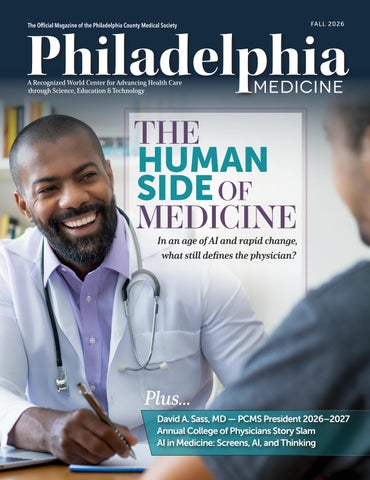
THE
HUMAN SIDE OF
MEDICINE
In an age of AI and rapid change, what still defines the physician?
Plus... David A. Sass, MD — PCMS President 2026–2027 Annual College of Physicians Story Slam AI in Medicine: Screens, AI, and Thinking
FALL 2026
Contents Philadelphia County Medical Society 2100 Spring Garden Street, Philadelphia, PA 19130 (215) 563-5343 www.philamedsoc.org
3
A New Chapter of Service: Introducing Mallorie Jones, MA, Assistant Executive Director Philadelphia County Medical Society
5
David A. Sass, MD, FACP, FACG, AGAF, FAASLD, FCPP, PCMS President 2026-2027
Walter Tsou, MD, MPH Pa st Pr e s i d e n t
7
President’s Installation
William King, MD Se c r e t a r y
8
Meet David A. Sass, MD, FACP, FACG, AGAF, FAASLD, FCPP, PCMS President 2026-2027
9
Walter Tsou, MD, MPH, Outgoing PCMS President
EXECUTIVE COMMITTEE David A. Sass, MD, FACP Pr e si d e n t Brian A. Hannah, MD, MSc Pr e si d e n t El e c t
Sharon Griswold, MD Tr e a su r e r BOARD OF DIRECTORS Victoria Cimino, MD, MPH Cadence A. Kim, MD, FACS Pratistha Koirala, MD Alekhya Madiraju Dale Mandel, MD Dana Martin, MD Elana McDonald, MD Max E. Mercado, MD, FACS Gillian Naro, MD Natalia Ortiz-Torrent, MD, DFAPA, FACLP Dhruvan Patel, MD Heta Patel, MD FIRST DISTRICT TRUSTEE Michael A. DellaVecchia, MD, PhD
10 2026 Philadelphia County Medical Society Spring Awards: Wisdom from our Winners: A Conversation with Enrique Hernandez and Michael DellaVecchia, Past Presidents, Current Guides
13 The Doctors Lounge— AI in Medicine, Part 2: Screens, AI, and Thinking
14 Annual College of Physicians Story Slam
EXECUTIVE DIRECTOR
17 Laurel House: A Refuge in the Storm
T.J. Huckleberry www.philamedsoc.org
20 PCMS at the Phillies
EDITORIAL BOARD MEMBERS William King, MD Susan Robbins, MD TJ Huckleberry Dan Dempsey, MD Kirsten Haas The opinions expressed in this publication are for general information only and are not intended to provide specific legal, medical or other advice or recommendations for any individuals. The placement of editorial opinions and paid advertising does not imply endorsement by the Philadelphia County Medical Society. ©2026 All rights reserved. No portion of this publication may be reproduced electronically or in print without the expressed written consent of the publisher or editor.
21 PCMS Revelry Club... Revived! 22 PCMS New + Reinstated Members 24 Ways YOU Can Get Involved in PCMS Hoffmann Publishing Group is the official publisher of the Philadelphia County Medical Society’s Philadelphia Medicine magazine. HoffmannPublishing.com | (610) 685.0914 FOR ADVERTISING INFO CONTACT:
Ad Sales • Sales@Hoffpubs.com • 610-685-0914 x715
philamedsoc.org
FEATURE
A New Chapter of Service: Introducing Mallorie Jones, MA, Assistant Executive Director Philadelphia County Medical Society
I
t is a privilege to introduce myself to the members, partners, and friends of the Philadelphia County Medical Society (PCMS) as your new Assistant Executive Director.
Throughout my career, I have been drawn to work that brings people together around a shared purpose—whether that means connecting patients with lifesaving preventive health services, building partnerships between healthcare institutions and community organizations, supporting physicians and researchers, or creating programs that help people feel informed, engaged, and valued. Joining PCMS has given me the opportunity to bring those experiences together in service of Philadelphia’s medical community, and I am incredibly excited about what lies ahead.
Before joining PCMS, much of my professional career was spent in academic medicine, clinical research, health equity, and community engagement. Most recently, at the University of Pennsylvania, I managed health equity and community outreach initiatives designed to expand access to cancer education, screening, and early detection services. One of the projects of which I am most proud was helping develop and lead a mobile, community-based prostate cancer education and screening initiative that reached more than 1,000 participants in a single year. That work reinforced something I have come to believe deeply: meaningful healthcare extends far beyond the walls of a hospital or medical office. It depends upon trust, relationships, communication, collaboration, and a willingness to meet people where they are. My previous work also allowed me to develop partnerships with healthcare systems, government agencies, nonprofit organizations, community groups, corporate partners, and volunteers. Earlier in my career, I worked in research
administration at the University of Pennsylvania and project management at Stanford University. These experiences strengthened my skills in strategic planning, operations, regulatory oversight, team leadership, and managing complex initiatives from an idea through implementation and evaluation. Although the settings have changed throughout my career, one theme has remained consistent: I enjoy building things that bring people together and make an organization, program, or community stronger. That is one of the reasons I am so enthusiastic about my role at PCMS. As Assistant Executive Director, I work closely with our Executive Director, Office Manager, Board of Directors, staff, members, and community partners to advance the Society’s mission and strengthen the value we provide to Philadelphia’s physicians. My responsibilities touch many different areas of the organization, including member engagement, special events, sponsorships and partnerships, communications, organizational initiatives, and programming. I am particularly excited to support our early-career physicians and physicians-in-training—including fellows, residents, and medical students. These members represent not only the future of medicine in Philadelphia, but an important part of the Society today. I look forward to finding new ways for them to build relationships with established physicians, develop professionally, become involved in organized medicine, and see PCMS as a professional home throughout every stage of their careers. I also have the opportunity to help lead many of the programs that bring our membership together outside of traditional meetings. Through special events and initiatives such as the continued on next page FALL 2026 : Philadelphia Medicine
3
philamedsoc.org
FEATURE continued A New Chapter of Service: Introducing Mallorie Jones, MA, Assistant Executive Director, Philadelphia County Medical Society continued from page 3
It’s Time to Put You First! A quick yearly mammogram can give you the power of peace of mind. If you’re 40 or older, talk to your healthcare provider about scheduling a breast cancer screening. Your health matters—take this important step today! Scan the QR Codes to Learn More
PCMS Revelry Club, we can create opportunities for physicians to connect as people as well as professionals. In a profession that can be extraordinarily demanding, I believe there is real value in creating spaces for collegiality, friendship, mentorship, and a sense of community. Communications will be another important focus of my work. Whether through the PCMS Pulse, social media, member communications, or the PCMS podcast, I want to help us share not only information, but stories—the accomplishments of our physicians, the issues affecting medicine in Philadelphia, the work happening within our communities, and the people behind it all. There is tremendous expertise within this Society, and I want to help make sure those voices are heard. My academic background has also shaped how I approach this work. I hold a Master of Arts in Clinical Psychology from Columbia University, and throughout my career I have remained interested in the human side of healthcare: how people communicate, what builds trust, what motivates engagement, and how organizations can create a greater sense of connection and belonging. As I begin this chapter with PCMS, one of my greatest priorities is simply to listen. 4
Philadelphia Medicine : FALL 2026
I want to learn what our members value most about the Society, what they would like to see us do differently, what challenges they are experiencing, and what would make PCMS an even more meaningful resource throughout their careers. I hope members will feel comfortable reaching out to me with an idea for an event, a potential partnership, a story we should highlight, an opportunity for collaboration, or simply to introduce themselves. Philadelphia has an extraordinary medical community, and PCMS has the unique opportunity to bring that community together across institutions, specialties, career stages, and generations. I am honored to have a role in that work. There is much that I hope we can build together—stronger connections, new partnerships, engaging programs, opportunities for our next generation of physicians, and an even greater sense of community among our members. Most of all, I am grateful to be here, excited to get to know you, and looking forward to serving the physicians and medical community of Philadelphia.
Mallorie Jones, MA Assistant Executive Director Philadelphia County Medical Society
philamedsoc.org
FEATURE
David A. Sass, MD, FACP, FACG, AGAF, FAASLD, FCPP PCMS President 2026-2027
PCMS Presidency Installation Speech:
G
ood evening, ladies, gentlemen, colleagues, families, friends, and honored guests.
It is my true privilege and profound honor to stand before you this evening to be installed as the 165th President of the Philadelphia County Medical Society. I am deeply grateful for the PCMS Board and Executive Committee’s trust and confidence in me and their shared commitment to the medical profession we hold so dear. To be entrusted with this role is an extraordinary honor for any physician. For me, as someone who began my journey in South Africa and now has the privilege to serve in the United States, it is especially meaningful. It is a testament not only to this society’s commitment to excellence, but also its belief in inclusion, opportunity, and the shared values that unite us as physicians—no matter where we began. My journey to this podium is not mine alone, but it reflects the journeys of countless international medical graduates who bring diverse perspectives to the practice of medicine and is a reminder that excellence in medicine is strengthened, not diminished, by diversity.
It is not lost on me how this year carries such special meaning as our great nation commemorates the 250th anniversary of its founding. We are reminded that the Declaration of Independence was signed in our own City of Philadelphia, not far from where we gather tonight. The ideals of liberty, equality, and the pursuit of a better future continue to shape not only our nation, but also the practice of medicine. At its core, Medicine expresses those same ideals, whether it’s advocating for the dignity of every patient, expanding access to healthcare, delivery of compassionate care, or pursuing scientific discovery through cutting-edge research in our service of humanity.
I am deeply indebted to so many of my career mentors who have guided me and colleagues who have supported me over the past 3 decades. I would be remiss if I didn’t acknowledge my dear father-in-law, Dr. Harvey Lefton, who was well known to so many people assembled here this evening. I so wish he could have been spared to celebrate with us tonight, but I know he’s looking down from heaven with a smile on his face. I first became actively involved in organized medicine with the encouragement and mentorship of Dr. Lefton. Harvey himself was the former President of both the Pennsylvania Society of Gastroenterology as well as the Philadelphia County Medical Society; he was the longstanding chair of the Philadelphia delegation to the PAMED HOD; a former Cristol Award recipient; and the course director of the Annual GI Course that he organized for 13 years, and in whose memory the course is now named. Harvey introduced me to the PSG in 2005, where I was eventually installed as the 17th PSG President from 2013-2015. For Philadelphia County, I have been a frequent delegate to the PAMED House of Delegates since 2012 and have served as an active county medical society board member since 2019. As President, I begin my term with a vision rooted in three commitments: Firstly, community, where I will strive to foster a society where every member feels valued, heard, and supported. Secondly, advocacy, to stand firmly for our patients for equitable access to care and for the integrity of our profession in an ever-changing healthcare landscape. Thirdly, mentorship and growth, where we can support physician well-being and ensure that the next generation of physicians, including those who come from afar, as continued on next page FALL 2026 : Philadelphia Medicine
5
philamedsoc.org
FEATURE continued David A. Sass, MD, FACP, FACG, AGAF, FAASLD, FCPP, PCMS President 2026-2027 continued from page 5 Now Welcoming, Paul C. Frake, MD, Board-Certified Otolaryngologist Dr. Frake joins ENT & Allergy Associates of Pennsylvania, expanding our comprehensive ENT services for adult and pediatric patients.
Comprehensive ENT, Allergy & Immunology Care Stephanie Eng, MD Adult and Pediatric Allergy, Asthma and Immunology
John Kuryan, MD Adult and Pediatric Allergy, Asthma and Immunology
Paul C. Frake, MD Adult and Pediatric Ear, Nose, and Throat
Min J, Ku, MD
Sheryl Mathew, MD
Sheenal Patel, MD
Adult and Pediatric Allergy, Asthma and Immunology
Adult and Pediatric Allergy, Asthma and Immunology
Adult and Pediatric Allergy, Asthma and Immunology
Three Convenient Locations
Horsham | Northeast Philadelphia | Richboro Now Accepting New Patients
1-855-ENTA-DOC | entandallergy.com/pa
I once did, find guidance, opportunity, and a sense of belonging. Given my ties to academic medicine, being associated with the SKMC, and having frequent interactions with medical students on a day-to-day basis, I would like to engage potential new members, particularly the young trainees, at a grassroots level by visiting the Philadelphia-based medical school campuses and extolling the virtues of being a PCMS member. I want to thank the leaders who came before me, including Walter Tsou, our immediate past president, and the numerous past presidents of the society who, through their dedication, have brought the society to where it is today. A big thank you also to our former Executive Director, Mark Austerberry, who always provided such a steady voice of reason, was a source of wisdom, and was someone we could always rely on. We at the PCMS are truly indebted to him for all he did behind the scenes to make the society thrive. Thank you, too, to our current Philadelphia County Medical Society staff, T.J. Huckleberry, Mallorie Jones, Robert Miyamoto, and also a big thank you to Eileen Ryan for all their efforts in making this evening’s event such a success. I look forward to working with all of you this year as we enter into the 178th year of the society. 6
Philadelphia Medicine : FALL 2026
I would, in addition, like to acknowledge my Jefferson transplant hepatology colleagues who are here to support me this evening, Drs. Herrine, Fenkel, Civan, and Loh, as well as my longtime friend and colleague, Dr. Manish Thapar, who is currently serving as the President of the Pennsylvania Society of Gastroenterology. And now to my family, many of whom are here with me tonight. None of this would be possible without your love, patience, and unwavering support. For my wife of 20 years, Allison; my children, Lauren and Aaron; mother-in-law, Paulette Lefton; and brother-in-law, Daniel Lefton, your encouragement and sacrifices have made this moment possible, and for that I am truly grateful. Unfortunately, my mother, Ethne Sass, in Toronto, Canada, was not able to be with us this evening, and my dearly departed father, Solly Sass, was also not spared to be with us tonight. Philadelphia has always been a city of firsts—a place where bold ideas take root. Let us carry that spirit forward at a moment when our nation reflects on its founding. Thank you once again for this honor and for the opportunity to serve alongside each of you.
President’s Installation
philamedsoc.org
FEATURE
Dr. David Sass (third from left) with his family
Dr. Cadence Kim (right) conversing with Dr. William King (left) Attendees of the President’s Installation and Awards Night
Medical students from the Sidney Kimmel Medical College Dr. Hester Sonder, Fifty Years of Medical Service Award recipient
Dr. Allan Crimm (center), recipient of the Practitioner of the Year Award, with family and friends (From left to right) Dr. Gillian Naro, Dr. Shailendra Vaidya, and Dr. Nathaniel Srikureja, recipient of the Dr. Vanitha Appadorai Vaidya Award for Humaneness in Medicine FALL 2026 : Philadelphia Medicine
7
philamedsoc.org
FEATURE
Meet David A. Sass, MD, FACP, FACG, AGAF, FAASLD, FCPP
PCMS President 2026-2027
D
avid A. Sass, MD, has been installed as the 165th President of the Philadelphia County Medical Society (PCMS). Dr. Sass has had several institutional, local, and statewide leadership roles during his professional career that spans 22 years since graduating from fellowship.
Dr. Sass is a gastroenterologist and hepatologist who has served as the Medical Director of Liver Transplantation since joining Thomas Jefferson University in 2013. He is also the Rorer Professor of Medicine at the Sidney Kimmel Medical College. Dr. Sass was born in Cape Town, South Africa, where he completed all his schooling and graduated from the University of Cape Town Medical School with Honors in 1992. He was the first in his family to embark on a career in medicine. Following a year of internship in Cape Town, Dr. Sass then immigrated to the United States, where he completed a research fellowship in Dr. Sol Epstein’s endocrinology lab, followed by internship, residency, and chief residency at Albert Einstein Medical Center in Philadelphia. He then completed additional fellowship training in gastroenterology and transplant hepatology at the University of Pittsburgh Medical Center (UPMC). After starting his academic career at UPMC, he was recruited back to Philadelphia to be the Medical Director of the Drexel/Hahnemann Liver Transplant Program in 2007. Dr. Sass, whose academic career spanned two decades, is a clinician, educator, and researcher in the field of liver disease and transplantation. He has mentored numerous medical students, residents, and fellows, and has published over 175 original research papers, abstracts, case reports, reviews, and book chapters. His clinical research interests in hepatology are chiefly in autoimmune and cholestatic liver diseases as well as complications of cirrhosis and portal hypertension. He has been nominated for three Golden Apple Awards for excellence in teaching in his former institution (Drexel University); has been a Top 25 Teacher as rated by the Thomas Jefferson medical residents; and has also been named numerous times as a Philadelphia Magazine and Castle Connolly Top Doctor over the past decade. Dr. Sass holds Fellowships in the ACP, ACG, AGA, AASLD, and the College of Physicians of Philadelphia. In addition, he has been a member of several standing committees of his national society, the American Association for the Study of Liver Diseases. Dr. Sass first became actively involved in organized medicine with the encouragement and mentorship of his late father-in8
Philadelphia Medicine : FALL 2026
law, Dr. Harvey Lefton. Dr. Lefton himself was the former President of both the Pennsylvania Society of Gastroenterology (PSG) as well as the Philadelphia County Medical Society (PCMS). Dr. Sass started as the Region 2 Councilor for the PSG in 2005 and rose up the ranks to eventually be installed as the 17th PSG President from 2013-2015, and he continues to contribute to the society by being an active PSG board member. His role in the PCMS has been as Delegate to the Pennsylvania Medical Society (PAMED) House of Delegates since 2012, and he has been an active PCMS board member since 2019, recently serving as Secretary and President Elect. Since Dr. Lefton’s passing, he has also taken over the mantle of organizing the annual PCMS Clinical Update in Gastroenterology course, now in its 15th year and named in memory of Dr. Lefton. During his year as President, Dr. Sass wishes to have a renewed focus on ways in which to attract, engage, and retain new PCMS members. Over the past several years, PCMS membership numbers have decreased, and we must find ways to attract and keep new members, from medical students to senior active physicians. Given his ties to academic medicine, being associated with a medical school, and having frequent interactions with medical students on a day-to-day basis, Dr. Sass would like to engage potential new members, particularly younger trainees, at a grassroots level by visiting the Philadelphia-based medical school campuses and extolling the virtues of being a PCMS member. Dr. Sass also plans to be involved in continuing the work of his predecessors in fostering a spirit of camaraderie amongst the PCMS physicians by actively participating in various Doctors Lounges and other community-based events, as well as several social offerings, including the newly created Revelry club events. Dr. Sass and his wife, Allison, live in Rydal, PA, with their two children, Lauren and Aaron. Lauren is an incoming freshman at Penn State University, pursuing a BFA in Acting, while Aaron will be entering his junior year of high school at Germantown Academy. Dr. Sass is truly indebted to his family as well as his mother, Ethne Sass, who lives in Toronto, Canada; his mother-inlaw, Paulette Lefton of Huntingdon Valley, PA; and his extended family, for their continued love and support over the years. He is also deeply appreciative of his deceased father, Solly Sass, and father-in-law, Dr. Harvey Lefton, for their endless guidance and life mentorship, to help shaping him into the man he is today! Congratulations and good luck to Dr. Sass! We look forward to a successful year under your leadership as the 165th PCMS President.
philamedsoc.org
FEATURE
Walter Tsou Outgoing President, 2026 Philadelphia County Medical Society
M
ay you live in interesting times,” as the saying goes.
It is an understatement to say that the landscape upon which we practice medicine is shifting rapidly. The One Big Beautiful Bill has timed its worst cuts after the midterms, but on October 1, lawfully present immigrants under five years lose their Medicaid. Many hundreds of thousands of immigrants may also lose their right to live and work in America. On January 1, “able-bodied” US citizens on Medicaid will need to document that they worked or volunteered 80 hours a month, and reapply every six months in order to keep their Medicaid. The paperwork onus will fall on our patients, many who will miss deadlines and lose their health insurance. Philadelphia, which has the largest Medicaid population, will be most impacted in Pennsylvania, but none of our hospitals or physicians will be immune to the devastating impact of these cuts. Meanwhile, we know that our close neighbor in Lancaster has a measles outbreak with at least two deaths. This is a disease that has no effective treatment. That so many choose not to get vaccinated is alarming since it is totally preventable. My final thought is that we need to get back to basics. Public health and prevention should be the foundation upon which we build our health care system. At a fundamental level, public health, including immunizations, is for everyone regardless of social or immigration status. Access to healthcare is not just a privilege but a necessity in a functioning society. After all, all illnesses, including communicable diseases, cross all social classes. We, as physicians, need to defend and promote health care as a public good. My gratitude to the members of the Philadelphia County Medical Society, to our wonderful board of directors, and to T.J. Huckleberry in his inaugural year as our Executive Director. It has been a privilege to serve as president this past year.
Walter Have a pleasant day!
FALL 2026 : Philadelphia Medicine
9
philamedsoc.org
FEATURE
2026 Philadelphia County Medical Society Spring Awards Wisdom from our Winners: A Conversation with Enrique Hernandez and Michael DellaVecchia, Past Presidents, Current Guides By Daniel Dempsey, MD, PCMS Past President, Philadelphia Medicine Editorial Board, and William King, MD, PCMS Board Secretary, Philadelphia Medicine Editorial Board
T
he Philadelphia County Medical Society Gala was a moment in June for our members to thank our last president, Dr. Walter Tsou, and welcome our next president, Dr. David Sass, as well as honor our colleagues for their service to our medical profession. Dan Dempsey and Bill King set out to have a conversation with two of our awardees who have close to a century of service with our medical society between them. Dr. Enrique Hernandez is this year’s recipient of the Strittmatter Award, our highest honor, presented to a physician who has made the most valuable contribution to the healing arts. Dr Hernandez has been Chairman of the Obstetrics and Gynecology at Lewis Katz School of Medicine at Temple, and has been a member of PCMS since 1988, serving in many capacities including as our 143rd president in 2004. He’s been involved with the Pennsylvania Medical Society (PAMED), serving on the Board of Trustees, and is our chair of the Philadelphia Caucus to the PAMED House of Delegates.
Dr. Michael DellaVecchia, the recipient of this PCMS Cristol Award, which is presented for significant contributions to the Society, as well as furthering and enhancing the purposes and functions of organized medicine. Dr. DellaVecchia, an ophthalmologist, served for years as Director of Emergency
Room at Wills Eye Hospital and in private practice. Dr. DellaVecchia is the Cristol Award winner for his countless service on PCMS committees on the Board of Directors, including the Philadelphia Medicine Editorial Board, and was our 154th President in 2015. Michael’s service to organized medicine has been myriad, as a member of more than 20 professional societies, including as President of the Pennsylvania Medical Society in 2020, and as a delegate to both the PAMED and the AMA House of Delegates. With our college’s endless font of knowledge of service to our medical profession, we were ready to discuss the challenges to physicians and the importance of coming together as a professional society. Dr. Daniel Dempsey, the PCMS 155th president, recently completed a term of service to our sister society in Philadelphia, the College of Physicians of Philadelphia, as interim Co-CEO, started our conversation. Dr. William King: How do doctors get involved in the many complexities of leadership in our county, state, and national medical societies? What are the challenges in this journey? Dr. Dan Dempsey: As far as the journey, the challenges, and the rewards of organized medicine, the most important thing about the journey is you’ve got to hop on the bus. You have to join. I think the challenge today is that a lot of docs feel they don’t
Dr. Daniel Dempsey (left) alongside Dr. Enrique Hernandez and his wife (right) with the Strittmatter Award 10 Philadelphia Medicine : FALL 2026
philamedsoc.org
need to do that. We all have our specialty societies; we’re busy with those. King: And busy with our employers, the medical centers and hospital systems. Dempsey: I think our general medical societies are one of the best ways for us as physicians to get outside of our bubbles, to meet and get to know people outside of our health systems. To get to know people who are in practice models different from us, in private practice, and also people who work in different systems in Philadelphia and at the state level. King: Dr. Hernandez, you also quickly became involved in the medical societies when you began practice as well. Dr. Enrique Hernandez: When I moved to Philadelphia in 1987, I figured that one way of networking and learning about the community of my colleagues and the community at large was to join the county medical society. So, I immediately did. As it has been said, 80-90% of success is just showing up. So, you show up; they usually volunteer you to do stuff on committees. Eventually they got me to be on the board of the county society, then I became the secretary, and then the treasurer, then the president, and then because I kept showing up they decided to send me to be on the board of trustees of the Pennsylvania Medical Society. And then during that term, I also served as the chair of the caucus to the House of Delegates, which I still chair. King: So, Enrique, it’s just been decades of simply showing up and saying yes. Hernandez: Yep. King: So, tell us a little bit more about the House of Delegates. Med students often participate in this annual process, which is our state medical society, PAMED. They come together, usually in Hershey, Pennsylvania. This is like a Congress almost, is it not? Hernandez: Yes, the House of Delegates is like the House of Representatives. They set the policy of the state society for the upcoming year. It’s an opportunity for physicians to participate, for medical students to participate, for residents to participate. More than half of our delegation to the House of Delegates is comprised of students and residents. We’re very proud of it. King: And our delegation is by far the largest in the state? Hernandez: That’s because we have so many med schools. Because we have so many training programs. So, you get these young people that are very energetic, have a lot of ideas to bring forward resolutions that will impact not only them in the future, but also all of the practicing physicians in Philadelphia and the state. The Philadelphia delegation is always very active, very active.
King: So for our young doctors, you join your local medical society; you just look up Philamedsoc.org and find our local county medical society. You join at the start of your academic year in the fall, that winter, that next spring. You can be asked to sign up or sign yourself up as a delegate. And so, by the next fall, you may be part of the delegation? Hernandez: Yes, for medical students, once they join the Philadelphia County Medical Society (PCMS), they also are going to automatically become members of the Pennsylvania Medical Society, and they can join the delegation or attend the convention in Hershey. King: Dan, you’ve been part of this process too. Dempsey: It’s a very broadening experience and a very educational experience, too. As I said before, it’s easier than ever these days to work inside your bubble because the bubble is pretty big. And the health systems have gotten big; the specialty societies have gotten big. You can stay isolated in your big bubble. I’m so glad that I’ve been involved in organized medicine my whole career. Along with Dr. Hernandez and Dr. DellaVecchia, I’ve been a delegate to the Pennsylvania House of Delegates many times. I have really enjoyed that and learned alot. King: So, Dr. DellaVecchia, you have been involved in organized medicine at all levels, local, state, and national; at each level, they have delegations? Dr. Michael DellaVecchia: I think one of the things we have to stress is that at the state and at the national level, as members, we bring resolutions to the floor. That’s what determines the future policy of the organization, which, as a delegate, is one of our most vital functions. So, when we see something that should be altered or addressed, whether it be reimbursement, patient care, politics, or whatever, we submit a resolution, and the Philadelphia Medical Society has been very active submitting resolutions at the state level, especially among our medical students. King: And these resolutions, the function of this process, for the societies as a Congress. Obviously, we’re not the government, so we’re not making laws, but we’re making policy as we interact with lawmakers and regulators. DellaVecchia: Well, as part of our lobby, how do all these societies advocate for the profession and the patients? We sometimes advocate for both. By addressing legislative measures. So, when the AMA or the House of Delegates at the Pennsylvania Medical Society, when we go to present to the state legislators, we can say, we’ve got 40,000 doctors behind us who represent millions of patients. We think you should listen. We usually are able to bring them to the table; a large part of the time, we are successful at that. continued on next page
FALL 2026 : Philadelphia Medicine 11
philamedsoc.org
FEATURE continued 2026 Philadelphia County Medical Society Spring Awards: Wisdom from our Winners: A Conversation with Enrique Hernandez and Michael DellaVecchia, Past Presidents, Current Guides continued from page 11
Dr. Michael DellaVecchia, recipient of the Cristol Award and Fifty Years of Medical Service Award recipient
King: Oh, I see. So, we’re commenting as a group, as a collective voice of doctors on what is our collective opinion on societal questions: health, environment, violence, insurance, economics, ethics. But many young doctors think they can go individually online and talk to the internet as a whole and influence society that way, as influencers. DellaVecchia: Totally wrong, because in numbers there is strength. And when we suggest something from the House of Delegates, it’s been widely discussed and vetted. We have our own experts who testify. And that’s what the importance is, as Dan and Enrique have said: being part of a group is to strengthen numbers. What worries me is the disorganization of medicine. And that’s what worries me. When the four of us got into practice, most people were in private practice and independent. Now, in the state of Pennsylvania, you have over 70% of doctors are employees. You have corporate medicine coming in and making corporate decisions and not medical decisions, as we’ve seen locally with Hahnemann and with Chester Crozier. It’s kind of important to stress to the younger physicians that you can determine your future by organizing. And that is done with your county medical society; we work only for each other and our patients. King: Physicians today are employed by large organizations, be it a medical school or a health system. Hernandez: And so they feel that that organization is going to provide all the things that they need and all the protection that they need. And they’re absolutely wrong. Those organizations don’t have the interest of physicians first. They don’t even have the interest of the patients first. And so, if physicians want to advocate for themselves and their patients, they can do it individually, but individually, they will not have an impact. We all have to come together, and as a larger group, we will have an impact. An impact not just on our lives, but also on the lives of our patients and the lives of the public in general in terms of public health. So, that’s what organized medicine is all about.
12 Philadelphia Medicine : FALL 2026
Dempsey: Very often, the first person that the senator or the representatives call at the state or national level, when the legislator wants to find out “what do the docs think,” is the state or national medical society. King: Do the next generation of doctors understand this strength in numbers? If doctors think of themselves as employees, then you need a union to fight the boss. You know, your boss is the medical center, your boss is the hospital, your boss is Amazon. So, if it’s about employers and customer service, then you don’t need medical societies; you also may not need doctors. Hernandez: But if we’re going to be doctors, we have to stand together as practitioners of our trade; that’s the only way to be successful in making things better not just for ourselves but for everybody else, our patients and citizens. Obviously, that’s what we believe at the Medical Society: that to be successful we have to have strength in numbers and also diversity of opinions. Dempsey: What’s going to impact early career doctors’ lives, and their patients’ lives, is strong organized medicine. I think what has weakened the profession over the last 30 years is the misconception that we as professionals are going to be taken care of by our health systems, the insurance companies, and our specialty societies. I think our specialty societies serve an important purpose, but we need organized medicine where we have a variety of specialists and a variety of practice venues. Group practice, private practice, employed practice, community hospital, academic hospital. We need this spectrum where people, they’re not always going to agree. As Mike and Enrique said, controversy can build strength, but we need strong organized medicine. King: Thank you, guys. This is a real honor, I think, for all of us who are part of the medical society to listen to three past presidents who have been recipients of our highest honors. Thanks, Dr. Dempsey, Dr. Hernandez, and Dr. DellaVecchia, and for many more years of service.
philamedsoc.org
FEATURE
The Lounge TheDoctors Doctors Lounge
in Medicine, 2: FeaturingAI Drs.Zeke Emanuel and Part Paul Offit Do No Harm: Defending a Physician’s Oath in Skeptical Times
Screens, AI, and Thinking
T
By Dan Dempsey, MD
he recent annual Julian Johnson lecture argues quite cogently that hours of daily digital write papers, memos, and emails makes the in the Department of Surgery at Penn screen reading and scrolling are turning us brain weaker. The second article is an essay was given by Dr. Patrick McCarthy, a into impatient skimmers, less willing to read by a French clinician-researcher (Bastien well-known cardiac surgeon who currently complicated or complex articles or books Le Guellec: “Writing the Hard Way,” Science, serves as the executive director of the Bluhm completely and thoughtfully. I think she makes August 13) who outsourced all his writing to Cardiovascular Institute at Northwestern in a good point. I can feel it, and I don’t even do AI for a year but stopped doing it because it Chicago. He spoke about implementing AI TikTok or Instagram. After finishing this book, made him a “less critical scientist.” He also felt into clinical practice. Among other things, I vowed to cut my screen time (newspapers, a loss of pride in his work. In an unpublished he told us that: cardiac auscultation with magazines, journals, emails, texts, and study from the MIT Media Lab comparing an AI-enhanced stethoscope will identify searches—many on Claude or Open Evidence). three groups of essay writers (ChatGPT, Google abnormal heart sounds as accurately as an I don’t read books on digital screens, but about Search, neither), those who used AI to write the expert cardiologist using her personal high a third of the books I do “read” are audiobooks. essays had the lowest EEG activity, while those quality regular stethoscope; an AI-enhanced I usually listen at 1.25-1.5 speed while walking who used neither had the highest and most computer program can train an ICU nurse or driving, and almost never go back and complex EEG activity during the writing task. to competently perform cardiac echo after re-listen. I fear I have become an impatient Those in the AI group had trouble recalling and 10 patients (most didactic programs for skimming listener (Wolf’s next book??) as explaining what they wrote about. I am glad cardiac echo techs are one to two years); The AI well as anof impatient skimmingof reader, eager that I retired from surgical practice before the College Physicians Philadelphia can “look” at a 12-lead ECG that shows NSR to scroll ahead to the next chapter or article arrival of ambient AI note generation. 19 S 22nd Street, Philadelphia, PA 19103 and (unlike the expert clinician) accurately without really digesting what I think I have Will AI lead to physician brain rot? Again, I predict whether the patient will develop atrial read. I am sure that my comprehension and suppose “it depends” on how AI is used. Based The Doctors Lounge series is designed to bring physician and trainee members of the Philadelphia fibrillation in the future; on echocardiograms, retention are best when I am holding and on my personal experience Medical Society and College Physicians of Philadelphia together over food and drink to daily querying AI can “see” subtleCounty abnormalities in ventricular reading aofreal book or journal or magazine or Claude and Open Evidence, I certainly socialize and learn how to use to advance their goals in diastolic relaxation imperceptible to from the expert panelists paper. Andon I am pretty sureone's that itmedical would bedegreeunderstand that AI can enhance, refine, and interpreting cardiologist—abnormalities better for my brain ifand I decreased screen areorganize business, public health, leadership/administration, politics.the Attendees welcome bringabout a guest. ourtoideas research and clinical which predict significantly higher morbidity time and increased the old-fashioned reading care. But AI should be the tool; we shouldn’t be and mortality after cardiac surgery. In the time. Or maybe I could just discipline myself to the tool. In the July 8 issue of The Atlantic, Rose latter two examples, we don’t know what AI is apply the old-fashioned reading techniques to Horowitch wrote an article entitled “The End of “looking” at. It was an excellent talk, but it left the screen, but I doubt it…. Reading is Here.” About the same time, one of me wondering whether these tools will make It seems axiomatic that reading and my surgeon friends declared “writing is dead.” clinicians better or lazy. I am sure “it depends.” listening and writing and thinking are For the sake of our patients, I hope they are
Monday, September 15 6:00 PM - 8:30 PM
Free to attend, but registration is required. Register at https://philamedsoc.org/events Over the last some things I read Ormonth, scan the QR code.inextricably linked. If we can’t read, listen, and
got me ruminating about the impact of digital write well, how can we clearly think in a deep screens and AIPhiladelphia on our ability to think deeply, and organized fashion (again, something that County Medical Society | stat@philamedsoc.org a necessary characteristic of good physicians. good patient care requires)? 215-563-5343 | http://philamedsoc.org How much you care about this may relate in So far, I have never used AI to help me part to your reaction to Elon Musk’s claim that write anything (did someone say, “yes, it humanoid robots will “surpass good human shows?”). Two recent essays encourage me to surgeons within a few years and the best keep it that way. The first is by op-ed columnist human surgeons within approximately five Bret Stephens (“I’m Begging You: Never Write years.”1 With AI,” NYT, August 4), who argues that Anyway, in the book Reader Come Home: The Reading Brain in a Digital World, author MaryAnne Wolf (a cognitive neuroscientist)
writing with AI is “mentally enfeebling”; it makes us intellectually lazy. Like skimming instead of deep reading, relying on AI to
both wrong. Let’s not delete our AI apps and turn off our phones (except occasionally). If our most respected and distinguished faculty from medical school and residency were practicing today, almost all would read stuff on smartphones and query AI. But they wouldn’t do it in a way or to an extent that would make them lazy thinkers, and we shouldn’t either. 1. https://www.foxbusiness.com/healthcare/ elon-musk-predicts-robots-outshine-even-bestsurgeons-within-5-years
FALL 2026 : Philadelphia Medicine 13
philamedsoc.org
FEATURE
A
N
N
U
A
L
College of Physicians
STORY SLAM
The College of Physicians of Philadelphia held its 8th Annual Story Slam on April 30, 2026. The event was hosted by the Section on Medicine and the Arts led by Dr. Douglas Reifler. Area medical schools were invited to send two participants to this event—one a medical student, and the second a healthcare professional at any level of training or
practice. Those chosen were given five minutes each to share personal stories that explore the humanistic side of medicine. During the event, the presentations were found to be inspiring, poignant, and/or humorous as well. The evening was truly enjoyable, one of connection through storytelling.
The Red Phone By Mark Testa, MS2, Cooper Medical School of Rowan University
I
was told I am sick. Sick, ill, damaged.
My parents are worried. My friends keep their distance. The blue skies of my mornings are now littered with strings of cotton. Butterflies don’t land near me anymore.
I don’t feel sick. My doctor didn’t prescribe me with medication. Instead, he advised me about risks and precautions. “Your life might get harder as you get older,” he suggested. The world told me that my illness is inside of me because of me. In other words, I’m the reason I am sick. I made the choices to thrust this plague into my veins. I am to blame for the lost relationships. It will be my fault when an employer hires the next candidate. It will be up to me to conceal my illness to live a normal life. *** It’s a January afternoon, and I enter a café with my computer and a book. I don’t wear a mask. I sit in a corner within the shadows of the book-shelved walls. I want to feel, I think to myself. So, I watch. And I listen. A mother sits with her daughter in a highchair. She smiles while her daughter drinks juice from a straw and droplets streak down her chin onto her bib. A crossing guard waits for his coffee order near the front windows. His STOP sign leans against the wall by his feet. His white beard is neatly trimmed, and I watch him giggle into his phone. A student sits in the middle of the space with his textbooks sprawled across the table. His tutor erases a mistake from his math homework and instructs him to try again. There is life in this café. Experiences that I now fear I might not have the chance to have. To live. Family. Children. Happiness in old age. 14 Philadelphia Medicine : FALL 2026
I leave without ordering anything. Across the street, I walk through the park and see a beautiful woman with persimmon hair sitting in front of a sign that says, “Talk to Me.” She sees me and points toward a bright red 1950’s telephone mounted on a wooden post about ten feet down the path. I walk towards it and lift the receiver to my ear. I hear her voice. “I am here to listen,” she said softly. “No judgment, just an ear. “If you have any confessions or grief or happiness that you want to share, this is your time to just be.” My back was to her, but I could imagine her sweet grin of sincerity. I looked around the park. It’s nearly empty. The January wind has kept most people indoors. I feel safe. I have no cough. No sneeze. No aches. So, I speak. “I’m not sick, but everyone says that I am. I don’t know if this is denial or desperation. I’m stuck in a hole of doubt and can’t find the ladder.” My eyes start to tear up, but I can’t tell if that’s emotion or the cold. “I don’t want my life to be over. I want it to be just getting started—like I hoped it would be when I admitted my truth. My truth being an illness to the world. But I am not sick. I am just gay.” As she promised, the nameless redhead didn’t respond. She sat there and listened with patience. I put the phone down. It clicked. I turned around to see her directing another passerby towards the phone. My declaration was ordinary to her. My thoughts were heard. My “illness” was not responded to or treated. I felt normal. She didn’t try to cure me. She just listened. And somehow, that was enough.
philamedsoc.org
FEATURE
HPV: The Story We Didn’t Know We Needed to Tell By Mary Volpe, MSN, RN, CCDS, CRC, Clinical Documentation Specialist III, Cooper University Hospital
I
n April of last year (2025), my husband Jon was diagnosed with HPV+ squamous cell carcinoma of the left tonsil—a truly “unexpected diagnosis” in an otherwise healthy 35-year-old male. We are sharing his story to raise awareness of this epidemic and advocate for early detection and vaccination.
It all started with a left-sided neck lump that appeared in November 2024—that’s it. No unintentional weight loss. No mouth or throat pain. No trouble swallowing. His PCP wasn’t alarmed and thought it was a swollen lymph node, likely viral in nature, that should resolve on its own. The initial ultrasound (ordered for good measure) was negative for lymphadenopathy. Blood work was also unremarkable. We took comfort in knowing that we did our part and leaned into the information we had received so far. The anxiety and the what-ifs were quieted. Yet, five months later, we would receive a cancer diagnosis that would change him (us) forever. Spoiler: The lump never went away. In January of 2025, Jon started to experience debilitating headaches, one of which landed him in the ER looking for relief and answers. Imaging confirmed what we previously suspected—he had an enlarged lymph node. Over the next several weeks, we advocated for additional imaging and chose to have the lymph node biopsied. The day he received the call with the pathology result is still such a vivid memory. The lymph node tested positive for squamous cell carcinoma. The primary site would later be identified as his left tonsil. Once diagnosed, things moved FAST. Prognosis was promising, but the treatment regimen would be HARD. They prepared us. The month or so leading up to treatment, we jokingly referred to as “bulking season.” Jon put on weight and enjoyed food, knowing that he soon wouldn’t be able to do either. He took a leave of absence from work as a special education elementary school teacher to face this battle head-on. Jon underwent a total of 35 fractions of radiation, which he received daily, and seven chemotherapy infusions that were administered weekly. For about the first month of treatment, he did incredible. He was able to drive himself to and from his appointments. He continued working as a baseball umpire on nights and weekends. He was present and able to care for our two young children. But they were right—things did get hairy. For the first time, my husband looked sick. His pain skyrocketed, and he spent most of the day resting. He lost taste and the desire
to eat, resulting in significant weight loss. He lost strength and energy and eventually was no longer able to drive. I remember questioning whether I would ever get him back. He was so vulnerable, and I was scared. But despite this, he never faltered— he persevered with such grit and determination even through those toughest weeks. And I followed suit. After ringing both bells in early July, Jon spent the rest of the summer recovering and healing. Timing was ideal for such an unfortunate situation. He slowly began to gain back taste and reintroduce foods into his diet. He worked closely with Palliative Care (Dr. Hardy) to manage his pain. There were glimmers of progress and hope. Jon returned to work in September—it was such a special day. It wasn’t easy, though, as he continued to struggle with fatigue, cold intolerance, and ongoing hearing loss. Jon achieved remission in October of 2025! Since then, he has remained under close surveillance by his care team (Dr. Shapiro, Dr. Mann, and Dr. Squillante) and will continue to do so for some time. We are so incredibly grateful for their compassion, their expertise, and their guidance. Who knew that a virus he likely contracted 20 years ago could lie dormant in his system and later transform into cancer? We sure didn’t. We didn’t know anything about HPV and the associated risk of head and neck cancers, particularly in men. Jon and I were dating at the time the HPV vaccine was first introduced in 2006. But neither of us was ever vaccinated. We feel strongly about sharing his story to inform, educate, and change the narrative. There are two things that we want to highlight: HPV is the most common sexually transmitted infection, and anyone who is sexually active is at risk, even in a monogamous relationship. And secondly, it’s not too late to get vaccinated as an adult—the vaccine is FDA-approved through age 45. While Jon is no longer receiving active treatment, we both feel a strong connection to the community that supported us through a very challenging time. To date, Jon and I have organized two efforts to support patients with increased nutritional needs during cancer treatment, resulting in the donation of nearly 30 cases of Ensure and Boost to the MD Anderson at Cooper nutrition department. These efforts are a small way for us to express our gratitude and honor the compassion, generosity, and care that carried us through our own experience.
FALL 2026 : Philadelphia Medicine 15
philamedsoc.org
FEATURE continued Annual College of Physicians Story Slam continued from page 15
Difficulties with Patience By Setareh Gooshvar, MS4, Perelman School of Medicine, University of Pennsylvania
T
he smell of fried red snapper permeates the air, nestled in a giant bed of rice—the meal she requests be reheated over and over again. The nurses oblige, knowing that the next time she asks, no more of it will have been eaten. The smell billowing out of her room with every opening of the door. Brown sugar crystals cling to her hospital gown. Greek yogurt sweetened with it, slipping off her spoon onto her as she slips away between each bite, too drowsy to finish. A minefield of stickiness for me to wash off my hands and stethoscope each morning after I go to examine her. Pained smiles shared with nursing staff I have come to befriend as we care for her each day. Starting each morning with a knock, a “good morning, A!” and the apprehension of being the subject of today’s mood.
A month-long firestorm, navigating her increasingly strident and indignant requests to decline treatment. Her continual insistence that she’s a fighter who refuses to consider the withdrawal of any care. Her actions and decisions running directly contrary. Each morning I’d have a new life-threatening lab value to present to her: hyperkalemia, hyperammonemia, hypoglycemia. Hyperkalemia. Only treatable with the dialysis she so often declined—a lifesaving treatment for her failed kidneys, an exhausting and uncomfortable experience for the rest of her body. We watched EKGs like hawks, delaying as long as we could. Two, three, four days would pass without dialysis, and then I would kneel by the side of her bed and tell her, “Today’s the day, you need to go to dialysis.” Her mood would instantly change, from laughing and joking to mouth drawn in a tight, tight line. I’d have the dialysis nurse practitioner on standby, ready to accommodate her requests, her attempts to control her situation—by demanding a certain bed, a certain nurse, or to have her headphones—all to get her the treatment she needed. A treatment that, when I went to visit her on the dialysis unit at her request, was jarring to watch.
with the quick flaps of asterixis, and most terrifying of all, the drowsy, sleepy way in which she looked at me when I greeted her. When I told her she looked bad today, worse than when I’d seen her yesterday afternoon, she was incredulous. She insisted she was fine and that we were creating problems for her so she’d never leave the hospital. She did not remember this conversation the next day, after emergent transport to dialysis as she became too drowsy to continue responding to us. Hypoglycemia. She had finished her antibiotics for the empyema that had overtaken her right lung. We had reached a tenuous truce for her dialysis schedule. The possibility of home was close. It happened on morning rounds. Get the nurse in here. Get my senior. Where is my attending? Call her wife! She’s not responsive! A D20 drip hung, steadily feeding her body glucose. Drop by drop by drop. Her finger sticks don’t look good, how will we ever wean this off? She’s tired, taking steps backward. “I want to go HOME!” She noticed the second I walked into her hospital room the morning of my third week on rotation. Her mouth dropped open, a grin spanning her face, smoothing the worn lines of anger and frustration. My haircut, an innocuous event to anyone else, was significant. She’d asked the day before to ask a personal question. I said yes because it felt like balancing the scales. We talked about our queerness and the ways we expressed it, the ways we nurtured it in our appearance and our lives. She asked to touch the buzzed hair at the back of my head, she ran fingertips worn to stubs by calciphylaxis through the longer strands on top. I knew her long enough for those fingertips to heal over. She told me I was her reassurance. I still don’t know what she meant by that.
Life, vibrant and crimson, flowing from two catheters in her neck while she slept. Two large tubes precariously perched on the side of her bed, feeding a white machine with giant clamps and clear tubing emerging from every opening.
Was I in over my head? Did I care too much? All she did was eat Greek yogurt with brown sugar. I knew her wife’s name. I knew her favorite color. I knew the smell of her body rotting. I knew every lab, imaging finding, and order. How little it took to compose a person when in medicine’s cradle.
Hyperammonemia. We are reminded daily that patients do not read our textbooks. It’s an effort to keep medical trainees constantly vigilant and creative, discouraged to anchor on one diagnosis. Her presentation was classic: facial twitches, wrists
She was the difficult patient when I first came on service. Such a fraught set of words. “Difficult patient.” Difficulty being patient. What is a hospitalization but the difficulties of being a patient.
16 Philadelphia Medicine : FALL 2026
philamedsoc.org
FEATURE
Laurel House:
A Refuge in the Storm
An Interview with State Senator Maria Collett & Cortney Marengo, Laurel House Director of Community Affairs By William King, MD, PCMS Board Secretary, Philadelphia Medicine Editorial Review Board, and Gillian Naro, MD, PCMS Board
D
r. Gillian Naro, internist and hospitalist at University of Pennsylvania Health System, and recent energetic member of our Philadelphia County Medical Society (PCMS) Board, agreed to join in leading our discussion with two great supporters of Laurel House. Dr. Naro relayed a clinical moment that we all learn, train, and teach about, but rarely feel fully prepared to address. The intuitive moment when we recognize that the patient we are attending is afraid to explain the pain and suffering they face. Gillian relayed this unfortunately familiar clinical visit: “I was attending at Penn Presbyterian, and a woman came in with the trauma of a very significant eye injury. And she was a young woman in her early 30s. And on the initial interview, I go in with a bunch of students and residents, and it’s a little performative in the way that we round at the academic hospitals. She tells us that she slipped while she was changing, and she hit her eye on the corner of her dresser.
That didn’t quite sit right with me, but it wasn’t the right time to talk to her. I remember circling back and talking to her, and she maintained that story. It took a little bit of time, getting to build a good rapport and relationship, and trust with her. She did reveal that this was not an accident; this was an injury from a partner, and that she’s felt unsafe for some time. But at that point, she wasn’t ready to do anything. So, when I hear these kinds of stories, I often wonder, how can I ensure that she has the information that she needs for when she’s ready?” continued on next page FALL 2026 : Philadelphia Medicine 17
philamedsoc.org
FEATURE continued Laurel House: A Refuge in the Storm continued from page 17
This is the dilemma we face in the office and on the wards more often than we wish. Fortunately, PCMS was approached by the staff at one of our great community providers, Laurel House, who was collaborating with one of our region’s and our profession’s great champions, State Senator Maria Collett, from the 12th District, in Montgomery and Bucks County. Laurel House has an annual event for healthcare providers on September 24, 2026, Breaking the Silence: When Healthcare Listens: Medical Advocacy in Action. When our executive board was presented with the program information, we wanted to do more than pass on the invitation. We brought in Cortney Marengo, Laurel House Director of Community Affairs, and Senator Collett to talk to us about the work of Laurel House and a preview of how they and their sister agencies— providers like Women Against Abuse in Philadelphia and DAPDC.org in Delco—can help physicians help our patients. Ms. Marengo explained, “Laurel House is Montgomery County’s comprehensive domestic violence agency. Our goal really is twofold. We work to respond to anyone experiencing domestic violence, either in their relationship, within their family or their home, or from anyone. And we also work to prevent domestic violence from happening.” She added, “We do a lot of work with community education. 18 Philadelphia Medicine : FALL 2026
We go into all the local schools, and we train young people, 6th through 12th grade students and college students, on healthy relationships, boundaries, and bystander intervention. “In addition, we do some medical advocacy, training health care providers on screening and educating patients on domestic violence. Then we do a lot of community awareness and events, understanding domestic violence as a public health epidemic. On the other side, we work on the response side, immediately responding to anyone in crisis. So, we do correspond with police departments, emergency rooms, and medical providers. We have 24 hours-a-day, seven days-aweek hotlines where we’ll go out and meet with people in person or talk to them on the phone. We connect with them, whatever’s most appropriate, for the person or their family. We also have an emergency shelter program, a transitional housing program, and rental assistance programs. You know, we operate to help people become safe and independent. We do lots of safety planning. All of our counseling is free and confidential.” Dr. Naro and Dr. King have both used these county domestic violence agencies in the clinical moment of crisis but agreed that most clinicians are not aware of the comprehensive
philamedsoc.org
services that Laurel House and its sister agencies provide. We had to bring our legislator into the conversation to help us all better understand the system that supports domestic violence victims in the Commonwealth. Fortunately, we had one of our most capable and fierce advocates for our healing professionals, Senator Maria Collett. Senator Collett began her career as a lawyer, with much of her practice advocating for victims of child abuse, serving as Deputy Attorney General of Camden. The senator then made a choice, leaving law practice to pursue her passion for healthcare, becoming a Level 1 pediatric trauma nurse, and working in pediatric home care and long-term care for aging adults. This experience has made Senator Collett a strong advocate for health care providers during her two terms serving the 12th PA Senatorial District in Montgomery and Bucks Counties.
“I work a lot in the aging space. I’m the chair of the Aging and Youth Committee, and that’s a big one. Once we figure out that an aging person in our community might be suffering abuse from a loved one or a caregiver, then what? And how do we ensure that people don’t fall through the cracks and that if it takes seven or eight times for them to finally get relief from that abusive relationship, what are we doing to make sure we don’t lose them during the duration of those seven to eight interactions? “That, in my opinion, is how I see the job of the government. So, you know, I know there’s that old joke, I think it was Ronald Reagan, that said the scariest words are, ‘I’m from the government, and I’m here to help you.’ But I really do want to say that that’s why I went into public service. I don’t consider myself a politician. I consider myself a public servant. That’s my job. I’ve always tried to serve as a lawyer, as a nurse, and now as a legislator. And so, I think there are more folks that believe that than don’t in our government. And I rely on those partnerships and those relationships to really build a network that’s going to make resources available to people.”
We asked Senator Collett how she has been connected with Laurel House. “I am thrilled to be a partner with Laurel House. And all of the work that they do, really across the southeast here. We are blessed here in this region with incredible resources Our conversation with the senator helped us overcome our and providers that really understand that this is a critical issue and there is work to be done, but there are also good things that trepidation about engaging in these interactions with patients, and we asked Ms. Marengo to explain the event in September. are being done already. And if we can plug into those systems “We’re there to support not just patients, but staff as well. As and we can get clients and patients plugged into those systems, we know, domestic violence does not discriminate. And then a lot of people can see themselves on the other side of the we’ve definitely gotten referrals from people for themselves abuse or neglect. But I was really struck when Cortney told us or for family members and staff as well. The Pennsylvania it takes seven to eight times for someone to leave an abusive Coalition Against Domestic Violence is really beefing up our relationship. I think that must be so difficult for people. And documentation and education, and looking at each hospital’s I’m so grateful that Laurel House is there as a provider of really record system and seeing how that can work for them. great resources for those folks. That’s incredible.” Senator Collett continued, “It was one of the things that I was reminded of when I was a nurse in an outpatient health center at Saint Luke’s Hospital. We had this universal screening. And I remember when we were going through, asking if people felt safe in their home. In the meeting, I piped up and said, and then what if they say yes? Then what? “So, I’m so grateful to PCMS for having this conversation, for elevating this information. Because without our resources, we providers really are just sort of documenting something and then moving on. So, we do need to know what those resources are, and I do want to assure you that is the government’s role. Our role really is to ensure that people have access to those resources. And as you know, there is no discrimination when it comes to abuse, right? If we’re requiring you to ask the question, it doesn’t do us any good to ask the question and then not know what’s next. So, I really do appreciate you highlighting that because it’s something I’ve been working on.
“So, we are finding ways to do that safely and confidentially in this Breaking the Silence event on September 24th. It’s a breakfast event. Medical providers are usually either getting off shift or they’re starving and ready for a meal and some great resources. We do this event every year. So, this is the first year that we’re highlighting medical advocacy. And we usually have a great turnout.” We appreciated the chance to learn about the opportunity to connect with our service providers at Laurel House, with Cortney Marengo and Senator Maria Collett. If you weren’t able to make it to the Breaking the Silence event, reach out to them at: https://laurel-house.org/. Our 12th District Senator Maria Collett can be reached at https://www.senatorcollett.com/. If you, your patients or a loved one are struggling with domestic violence, in Philadelphia call: (866) 723-3014 and reach out to: https://womenagainstabuse.org/. The Pennsylvania & National Domestic Violence Hotline is 1-800-799-SAFE (7233). FALL 2026 : Philadelphia Medicine 19
philamedsoc.org
Section FEATURE
William King, Jr., MD, Philadelphia Medicine Editorial Board “Take me out to the ballgame” is a lyric quoted, but rarely claimed as a reward, by busy physicians. Fortunately for the Philadelphia County Medical Society (PCMS), we have the diligent efforts of our board member Dale Mandel and his wonderful partner, Bianca. Once again, they organized and hosted a wonderful tailgate party with Philly delights, including tomato pies from Sarcone’s and plenty of craft brews—one a piece, since we are doctors. We were happy to see our executive director, T.J. Huckleberry, his delightful wife, Sara, and their family, as well as our new deputy director, Mallorie, and her partner, Xavier. The board showed up in force to cheer on the Fightin’ Phillies, but the real stars of the outing were our early career physicians, including medical students from Penn, Jefferson, Drexel, and PCOM in attendance, as well as our early career board members. We had a chance to talk to our board member Gillian Naro, MD, MEd, who is planning the first PCMS medical student social. It is being hosted at the College of Physicians, with an expected attendance of 100 students, and already has a registration list of more than 200 medical students planning to attend. Dr. Naro invited Spencer and Emily Ferraro, an MS4 and his very supportive wife, who let PCMS know, “Outings like this are great for us, and help keep Spencer the caring physician he’s trying to be for his patients.” Drexel medical students Nathan Sudeep, Nikki Holmes, and Annie Hancock cheered the Phillies on—between multiple trips to try out the ballpark snacks and treats—their young, healthy metabolisms tolerated a notable amount of Chickie’s and Pete’s, along with the support of PCOM MS2 Sarah Williams, who really enjoyed socializing with medical students and physicians from the other medical centers. Osteopathy in the house! First-year Penn Medical students Alisa Richardson and Kirsten Branch were very excited to come to Philadelphia and see a medical community with social interactions outside of the 20 Philadelphia Medicine : FALL 2026
medical school and were happy to hear about collaborations between PCMS and the College of Physicians, and other local societies like the Medical Society of Eastern Pennsylvania (MSEP), our local NMA affiliate. The medical students from Jefferson— Brendan, Jay Pendyala, and Nick Wahba—appeared to have fun at the tailgate before the game, but when the game started, they apparently were there to watch baseball. I continually relied on their baseball banter to keep me up to speed on the game’s progress. I sat next to our intrepid leader, incoming PCMS president David Sass, and with our mutual family connections to British Commonwealth countries—he to South Africa, and me to Trinidad—I engaged him in a conversation about cricket, which I find as relaxing to watch as baseball, with their test matches lasting three days, but Dr. Sass was no casual observer of baseball. When I chimed in to the knowledgeable Jefferson medical students, “Wow, I got to see home runs from Kyle Schwarber and Bryce Harper!” Dr. Sass quietly interjected, “That was Trea Turner and Harper.” Dr. Sass thoroughly enjoyed the game and was quietly helping his fellow doctor with the Phillies roster. The Phillies ended up falling to Toronto—I think it was Toronto—but our Philadelphia County doctors would agree that we were there for the fandom, friendship, fun, hot dogs, and tomato pies. We went home happy. I’m looking forward to Dale and Bianca helping us get to next year’s Phillies game, and I’ll make sure I sit next to David Sass, so he can catch me up when I’ve been snacking too long. Look out for other social activities from the PCMS Revelry Club, our social activity program, and maybe a Philly Union soccer match. See where you can find our next activity at: https://philamedsoc.org/ events-and-news/.
philamedsoc.org
FEATURE
By T.J. Huckleberry, Executive Director, PCMS This article originally appeared in Philadelphia Medicine, Fall 2025. To host a 2027 event, contact PCMS Executive Director T.J. Huckleberry at tjhuckleberry@philamedsoc.org!
I
n the process of reviewing our archives as your new Executive Director, I stumbled upon the minutes of our Fall 1895 Board of Directors Meeting. I was amazed to find a fascinating club that was established during that time. I am happy to announce that we will be reviving this collegiality initiative in 2026. Below, please find the transcript detailing the creation of this event and the words of its founding physician, the esteemed Dr. I. Noah Party. Ladies and Gentlemen of the Philadelphia Medical County Society, I rise today to propose a new social club for our member-physicians. In the wake of Dr. Eli Brary’s well-attended book club, and Dr. Harry Sideburns fascinating lecture series on handlebar moustaches and modern grooming techniques…I propose we start a club that is based solely on having fun and hanging around fellow physicians whom we deem awesome. This club will meet monthly, with a new member hosting each month. It will be a small affair of perhaps 10 to 15 physicians who, at the invitation of the host, will join in celebrating the hobby, sport, or venue chosen for the event! Of course, we could incorporate Dr. I.C. Robbin’s wildly popular birding club and the hiking group Dr. Roman Tufar has started.
This will be a good way for all of us to blow off some steam and network or perhaps reconnect with our fellow physicians. Let us not forget all the great theatres, stadiums, and other locations this city has to offer, all just a mere carriage ride away! I must reiterate, dear colleagues, that there are zero clinical or medical advancements made during these events but just good old-fashioned revelry. …In fact, that’s it! We will call it the Revelry Club! All in favor, say Huzzah!
Secretary’s note: Dr. I. Noah Party’s motion was carried out unanimously. Dr. Stu F. Fedmoose’s taxidermy club was not invited or recognized to join the Revelry Club. How the Revelry Club works: Who: Any member who would like to host an event with fellow physicians. What: A monthly collegiality initiative aimed at retaining and recruiting physicians and promoting the passions of our members Where: Philly and the surrounding community Why: …why not??? How: A member is selected monthly to host; the host invites 10-15 colleagues (preferably three to four non-members or new physicians). The host receives a stipend to support the gathering. Event happens; event will be highlighted in Philadelphia Medicine. Next month, a new host is selected. Respectfully submitted Dr. Yul B. Reading, Secretary. Approved by, Dr. Ira M. Overworked, President As you all can see, this is a great idea for our members to get involved and celebrate what they love to do outside of medicine. Whether it is tailgating at an alumni event, cookie baking during the holidays, biking your favorite trail, or teaching your friends your favorite hobby—this club is for you. So, if you are interested in following in the footsteps of the genius Dr. I Noah Party, please contact me at tjhuckleberry@philamedsoc.org!
FALL 2026 : Philadelphia Medicine 21
philamedsoc.org
FEATURE
PCMS New + Reinstated Members Jan-March 2026 Claire Abramoff, MD Amanda Acevedo, MD Rachael Acker, MD Daniel Acosta, DO Bahar Adeli, MD Christianah Ademuwagun, MD Muskaan Aggarwal Evangelia Alexopoulos, MD Noor Ali, MD Zuhdi Alkhatib, MD Ankith Alluri, MD Antonio Almeda-Lopez, DO Jared Alswang, MD Jesus Alvarado Salinas, DO David Andrews, MD, FACS John Anhalt, MD Sthefano Araya, MD Rohan Arora, MD Neha Arora, MD Arjun Arya, MD Adnan Aslam, MD Muhammad Athar, MD Daniel Ayodele Namrah Aziz, MD Pargol Balali, MD, MS Irena Balzekas, MD Sharika Bamezai, MD Lev Barinov, MD Ashley Barlev, MD Jonathan Baron, MD Louis-Xavier Barrette, MD Shriya Baweja Joseph Behnke, MD Sarah Berg, MD Mitchell Berger, MD Martina Bernstein Nidhi Bhal, MD Abagayle Bierowski, MD Yacob Bizuneh, MD Kevin Bom, MD Lara Boyle, MD, PhD Samuel Braza, MD Elise Breed, MD Joanne Brice, MD Lindsey Brier, MD Domenick Bucci, MD Patrick Cahill, MD 22 Philadelphia Medicine : FALL 2026
Jessica Campanile, MD Mariana Canizales Guerra, DO Elizabeth Card, MD Daniel Casey, DO Fnu Chaithanya Avanthika, MD Lyan Chang Sedano, MD Harrison Charwat, MD Karen Chiango Vivian Chioma, MD Eunbit Cho, MD Victoria Cimino, MD, MPH Anthony Ciro, MD Lindsey Claus, MD Jeremy Close, MD Samantha Cody Gary Cohen, MD Lamarque Coke, MD Elizabeth Cordell, MD Anthony Cordisco, MD Alfredo Cordova, MD Emily Correia, MD Allan Crimm, MD McKinley Curran John Curran, MD Mert Marcel Dagli, MD Debra Daquilante, MD Kathleen Davin, MD Alexis Davis, MD James Davis, MD Sandra Dayaratna, MD Paola Daza Nunez, MD Jilyan Decker, MD Giuliana Defrancesch, MD Daniel Del Castillo Rix, MD Lydia Denison, MD Peter Deraska, MD Priya Desai, MD Ali Dhanaliwala, MD Jonathan Dickens, MD, PhD Michael Dong, MD Nathan Doremus, MD Avi Dravid, MD Jennifer Drechsler, MD Wei Du, MD, PhD Katie Duquette Elizabeth Duthinh, MD Martin Edelman, MD
Colin Ellis, MD Meghan Ellwood, MD Rasih Ener, MD Norberto Escobales Jr. MD Samuel Fallon, MD Christopher Farrell, MD Nicholas Felter Alexa Finkelstein, DO Benjamin Fisher, MD Yombe Fonkeu, MD Lara Fougnies Pamela French, MD Guy Fried, MD Kathryn Fulton Rachel Galvao, MD Avani Gandhi, MD Sakthi Gautham, MD Jon George, MD Farinaz Ghodrati, MD Mohamed Ginina, MD Jon Glass, MD Noah Glauberman, DO Seth Glickman, MD Colin Godwin, MD Drew Goldberg, MD, MBA, MS Matthew Goldshore, MD, PhD Dhruv Goyal, MD Carina Guerra, MD Alexey Gurevich, MD Michael Gutman, MD Karam Habchi, MD Yi Wei Hang, MD Melina Harmelin, MD Jordan Harris, MD, PhD Daisuke Hasegawa, MD Sohaib Hashmi, MD Miranda Haslam, MD Kelsey Hassig, DO Quincy Hathaway, MD, PhD Janae Hatwood, MD Adam Hawkins, DO Christopher Hayden, MD Jordan Heiman Joshua Heller, MD Gabriel Herbst, MD Christopher Herrera, MD Lauren Herzog, MD
Zackary Hintze, MD Kevin Holsey Kristen HoSang, MD Carrie Huang, MD Jonathan Hunt, MD George Ibrahim, MD Larisa Ibric, MD Emily Ishak, MD Osahon Iyamu, MD Amit Iyengar, MD Rachel Jaber Chehayeb, MD Emilia Jakubek, MD Jack Jallo, MD, FACS, PhD Robert James, MD Minyoung Jang, MD Saurabh Jha, MD William Johnston, MD Mallorie Jones Danick Joseph, MD Huiet Joseph IV MD Daniel Joyce Julia Judd, DO Kevin Judy, MD, FACS Hae-Min Jung, MD Joy Justice, MD Bhavana Kadiyala, DO John Karp, MD Siobhan Kehoe, MD Tarlan Kehtari John Kelly DO, FACEP Joseph Kern, MD Caroline Kernell, MD Sabir Khan, MD Navpreet Kaur Khurana, MD Nicole Kim, MD Zachary Kiss, DO Abigail Knowles, MD Shunsuke Koga, MD, PhD Zakary Kolkey, MD Emily Kopp Mark Kotapka, MD Mariana Kuperman, MD Daniel Lai, MD Alan Lam, DO John Lasko Jr., DO Peter Lauro, MD Ian Lee, MD
philamedsoc.org
Haley Leopold, MD Gabriella Leri Olivia Leung, MD Melanie Levine, MD Emma Lewis, MD, PhD Xingchen Li, MD Andrew Lin, MD Ryan Linzer, MD Sarah Liskowicz Michael Litt, MD Joyce Liu, MD Carissa Livingston, MD Maureen Lloyd, MD Ana Maria Lopez, MD, FRCP, MACP, MPH Julie Low, MD Maryssa Lyons, MD Srivarshini Maddukuri, MD Peter Maduka Jr., DO Linda Magana, MD Margaret Maguire, MD Alexandra Makhoul, MD Peter Makhoul, MD Bhavsimran Singh Malhi, MD Laya Manoj, MD Naoum Fares Marayati, MD Eliana Marostica, MD Elena Martin Mckayla Mawn, MD Emma Mazzio, MD Breanne Mccarthy, MD Nikkisha McCrea, MD Elana McDonald, MD Siddhanth Kumar Mekala, MD Ian Messing, MD Jacob Michalski, MD Erich Miller, MD Luke Miller Hannah Mitlak, MD Curtis Miyamoto, MD Anurag Modak, MD Victoria Moffitt, MD Simon Mogendi, MD Robert Monsour, MD Samuel Morano, MD Matheus Moreira Sanches Peraci, DO Philip Moresco, MD, PhD Kenneth Morris, DO Natalie Morris, MD Michelle Munyikwa, MD Sanjana Murali, MD Caroline Myers, MD
Caitlyn Myrdal, MD Katherine Nabel Smith, MD Suraj Nagaraj, MD Abheya Nair Danya Nees, DO Pasquale Nestico, MD Uyen Nguyen, MD Cailin O’Connell, MD Erin O’Keefe, MD Brian O’Murchu, MD Randy Ogbenna, DO Aubrey Okpaku, MD Fiyinfoluwa Olasoko, MD Stefan Olsen, MD Alireza Oraii, MD Alvaro Ordonez Suarez, MD Matthew Outlaw, MD Lily Owei, MD Emmanuella Oyogoa, DO Christine Palazzolo, DO James Palmer, MD Sarjukumar Panchal, MD Dimitrios Papanagnou, MD Christine Park, MD Kinal Maharshi Patel, MD Nicki Patel, MD Kishan Patel Krishna Patel, MD Ricardo Perez Yepez, MD Stephen Petropoulos, MD Rhea Powell, MD Victoria Powers, MD Srinivas Prasad, MD Ranjitha Pratap Nair, MD Juliana Qin, MD Mindy Rabinowitz, MD Aparna Raghu, MD Peter Rakita, MD Sunidhi Ramesh, MD Christopher Ramirez, MD Ruchira Rao Simone Reaves, MD Ilan Remba, MD Leah Rethy, MD Matthew Riina, MD Nikki Rimlinger Cole Rinehart, MD Farsha Rizwan, MD William Roberts, MD Olaf Rodriguez, MD Peter Ronner, MD David Rosen, MD Ethel Rosenberg
Benjamin Rosenthal, MD Kyrollos Saad, MD Dana Saba, MD Molly Sabol Jackson Saddemi, MD McKayla Saine, MD Nicholas Sarcia, DO Rohan Savoor, MD Michael Schneider, MD James Schurr, MD Sara Schwenk, MD Jonathan Scott, MD, PhD Elisabeth Seyferth, MD Priyanka Shah, MD Tayyab Shah, MD Ali Raza Shaikh, MD Ashwini Sharan, MD, FACS Matthew Shelly, MD Naomie Shembo, MD Julia Shepherd, DO Michael Shost, MD Noah Silverstein, MD, PhD Jason Sims, MD Frances Sirico-Kelly, DO Anna Slebonick Evan Smith, DO Nathan Smith, DO Benjamin Smood, MD Nicholas Spornick, MD Nathaniel Srikureja, MD Maahika Srinivasan, MD, MS Alexandra Stendahl Kristen Stephens, MD Collin Stirpe, MD Sabina Strashun, MD Corey Sullivan Derek Sung, MD, PhD Palwasha Syar, MD Nawal Syed Alan Tang, MD, PhD Lisa Tartaglino, MD Alexandra Tatarian, MD Abigail Taye, MD Allyssa Thomas, MD Jenin Thomas, MD Sharon Ann Thomas, MD Justin Thomas, MD Marcus Thorne II William Tompkins IV, MD Karen Trabulsi, MD Kathryn Trayes, MD Stacey Trooskin, MD Ifeoluwa Tugbobo, MD
Alaina Turchi, MD Kai Turner, DO Stephanie Tzarnas, MD Domingo Uceda, MD Esteban Urias, MD Jacqueline Urtecho, MD Katia Valdez, MD, MPH Ella van Deventer, MD Prasanthi Vanga, MD Amy Varghese Oluwarotimi VaughanOgunlusi, MD Arun Venkataraman, MD William Vervilles, MD Matthew Vibbert, MD Rishi Voruganti, MD, PhD Dillon Voss, MD Andrew Voyack, DO Nicholas Wahba Selemon Walle, MD John Walsh, MD Anita Wamakima, MD Lucy Wang, MD Neha Waqas, MD Kenneth Wasserman, MD Connor Wathen, MD Caroline Westwood, MD Ammie White, MD Lillian Wieland, MD Thomas Willcox Jr. MD, FACS Charles Williams, MD Dale Winand Thomas Witkowski, MD Matthew Wong, MD Christina Wright, MD Sonia Wright, MD Denise Xu, MD Alan Yang, MD Meenakshi Yathindra, MD Daniel Yow, MD Qing Yu, MD Justin Yu, MD Uzma Zafar, MD Mohammad Zahwi, MD Nadim Zaidan, MD Angela Zaladonis, MD Shivam Zaver, MD Helen Zhang, MD Yuantee Zhu, MD Robert Ziechmann, MD
FALL 2026 : Philadelphia Medicine 23
philamedsoc.org
E
ach year, PCMS members are given the opportunity to participate in a rich diversity of committees that impact the practice of medicine in Philadelphia County, Pennsylvania and beyond. Because active participation in PCMS strengthens the voice of organized medicine, we encourage all members (including medical students, residents, and fellows) to help make an impact on the role PCMS plays in the medical community. •
Editorial Review Board – Works on the Philadelphia Medicine magazine and newsletter.
•
Delegate Caucus to Pennsylvania Medical Society’s Annual Meeting – Participates in PAMED’s House of Delegates as a representative of PCMS.
•
Public Health Committee – Tackles issues related to public health and manages the Block Captain Healthcare Council.
•
Membership Committee – Works on membership recruitment and retainment.
•
Early Career Section – Represents the needs of early career physician membership.
•
International Medical Graduates Section – Represents the needs of International Medical Graduate (IMG) membership.
•
Senior Physician Section – Provides a platform for physicians aged 65 and above to remain active and involved in the medical community.
•
Women Physician Section – A forum to encourage women physicians to participate in leadership, policymaking, advocacy, and other activities of PCMS.
•
Residents/Fellows Section – Represents the needs of resident and fellow membership.
•
Medical Student Section – Works to improve medical education and advocates for the future of medicine. To find out more about specific committees, go to https://philamedsoc.org/pcms-committee-form/ or call us at 215-563-5343 or email us at stat@philamedsoc.org.