New Matter
THE AWARD WINNING PUBLICATION OF THE CHESTER COUNTY BAR ASSOCIATION • CHESTER COUNTY, PA | www.chescobar.org
3RD Quarter 2026
IN THIS ISSUE... Remember This Day Page 6
The Heart of Our Mission: Serving the Community Spotlight on Pro Bono Page 10
AI in Practice Page 12
YOUR LEGAL PRACTICE DESERVES A MARKETING PARTNER YOU CAN TRUST.
At MADJ Marketing, we understand the unique challenges law firms face—balancing client advocacy with building a trusted brand. Whether you’re a boutique practice or a growing firm, our tailored marketing strategies can help you iMADJine the possibilities. PROVEN RESULTS FOR LAW FIRMS LIKE YOURS Modern Website Design & SEO
01
Stand out in searches, attract more inquiries, and communicate your expertise effectively.
02
Reputation Management
03
Targeted Digital Advertising
04
Enhance your firm’s credibility and build trust within your community.
Highlight your specialty areas to the right clients.
Brand Identity Development
Establish a cohesive and professional image that reflects your firm’s values and expertise.
SCAN HERE TO LEARN MORE
READY TO GROW YOUR FIRM? LET’S START THE CONVERSATION TODAY. 484-336-4341
marketing
success@madjmarketing.com madjmarketing.com
www.chescobar.org
Content
3RD QUARTER 2026
New Matter CCBA Officers
10
C. Curtis Norcini, President Robert A. Burke, Vice President Maria Janoski, Treasurer Jennifer Fink, Secretary
6
New Matter Committee Charles T. DeTulleo, Editor Emeritus Shannon McDonald, Editor Rami Bishay Mark Blank, Jr. Whitney S. Graham Jonathan R. Long John McKenna Mary Wade Myers Sara Planthaber Karyn L. Seace Scott Slomowitz Theodore T. Speedy Bill Wilson Christine Zaccarelli
FEATURES Remember This Day................................6 Etiquette of Footnotes ..........................9 AI in Practice............................................12
PUBLICATIO N OF
THE CHESTER COUNTY
BAR ASSOCIATIO
N • CHESTER COUNTY,
PA | www.chesco
3RD Quarter 2026
IN THIS ISSUE...
Mission: The Heart of Our unity Serving the Comm Spotlight on Pro Bono
Page 10
CCBA Staff
AI in Practice
Page 12
Music, It’s Time to Play the Lights… It’s Time to Light the Page 14
Greg Nardi Executive Director Melissa Willson Communications, Events, and Marketing Manager The Chester County Bar Association’s quarterly publication, New Matter, has been provided to Bar Association members for four decades. A valuable aspect of CCBA’s membership, New Matter aims to provide our members with information pertaining to current issues facing the practice of law, historic legal issues, continuing legal education opportunities, Chester County Bar Association activities, programs, meetings, functions, practice tips, procedures for attorneys, and items of personal interest to our membership. The opinions expressed in this material are for general information only and are not intended to provide specific legal or other advice or recommendations for any individuals. The placement of paid advertisements does not imply endorsement by the Chester County Bar Association. © 2026 All rights reserved. No portion of this publication may be reproduced electronically or in print without the expressed written permission of the publisher.
Opening Doors to Legacy Philanthropy............................................24 Every Mile Has a Mission: To Support Access To Justice!...................................26
IN EVERY ISSUE
bar.org
New Matter
THE AWARD WINNING
It’s Time to Play the Music, It’s Time to Light the Lights…...........14
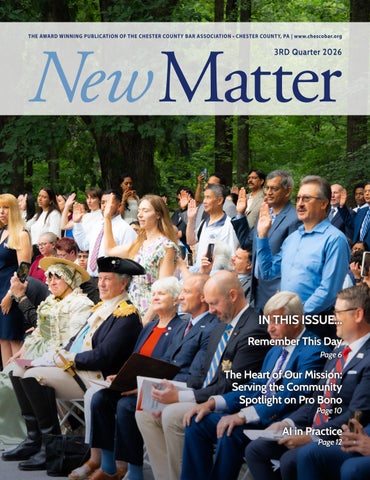
Cover photo courtesy of the Public Information Office for the County of Chester
President’s Message...............................4 From the Desk of the Executive Director.........................10 Save Our Environment........................16 CCBA Bar Tab...........................................19 The Blank Page.......................................20 YLD Corner...............................................23 Initial Consult..........................................27
Your Ideas!
WANTED . . .
If you have an idea for an article, or would like to submit content, please contact Greg Nardi at gnardi@chescobar.org or (610) 692-1889. Spread the Word #NewMatterBar #HoffPubs Hoffmann Publishing Group is the official publisher of the Chester County Bar Association’s New Matter magazine. HoffmannPublishing.com | 610.685.0914 FOR ADVERTISING INFORMATION & OPPORTUNITIES,
contact Ad Sales at Sales@HoffPubs.com or call 610.685.0914 x715.
New Matter 3rd Quarter 2026 | 3
From the President’s Desk
President’s Message A New Partnership to Support Chester County's Treatment Courts
C. Curtis Norcini, Esquire President Chester County Bar Association
O
ne of the things I have always appreciated about practicing criminal law in Chester County is that, despite the different roles we each serve, there are times when we can come together in the pursuit of a common goal. Judges, prosecutors, defense attorneys, probation officers, and treatment providers can at times work collectively to strengthen our justice system and better serve our community. And when this happens, the results can be extraordinary. An example of that spirit is the recent creation of the Treatment Court Alliance of Chester County, a collaboration between the Court of Common Pleas, the Chester County Bar Association, and the Chester County Bar Foundation. Together, these three organizations have established an institutional partnership dedicated to helping participants overcome the practical barriers that can sometimes stand in the way of successful completion of Treatment Court. While the Alliance has been established as an independent nonprofit organization, every new organization can stand to benefit from experienced partners during its formative years. The Chester County Bar Association and the Chester County Bar Foundation are uniquely positioned to provide guidance, administrative support, community connections, and institutional experience while the Alliance develops its own leadership, fundraising capacity, and operational infrastructure. I was fortunate to be around when Chester County’s Drug Court was first established. At the time, it reflected a new way of thinking about justice: that individuals struggling with addiction could be held accountable while also receiving the treatment and support they needed to rebuild their lives. Like many new ideas, it required vision, commitment, and a considerable amount of effort. 4 | New Matter 3rd Quarter 2026
More than two decades later, the results speak for themselves. What began as a single Drug Court has grown into a comprehensive system that now includes Recovery Court, Mental Health Court, Veterans Court, and Presentence Treatment Court. Drug Court alone has served more than 2,000 participants, with over 1,600 successful graduates. Similar success has been achieved throughout Chester County’s other Treatment Court programs, where graduates have consistently demonstrated significantly lower rates of recidivism than traditional offenders. The impact goes well beyond the people who participate in the programs. Each graduate represents someone less likely to reoffend, a family with a better chance to heal, and a community that can be a little safer. Importantly, the benefits extend beyond the lives of individual participants. Collectively, Chester County’s Treatment Courts have saved taxpayers well over $19 million in incarceration costs, demonstrating that rehabilitation and accountability are not only good public policy—they are also a wise financial investment. Even programs this successful cannot eliminate every practical barrier to recovery. Sometimes, successful and lasting recovery depends upon overcoming practical challenges that can extend beyond the courtroom. The difference between success and a setback can be surprisingly small: a missed ride to treatment, the need for temporary housing, not having appropriate clothing for a job interview, or addressing an unexpected medical or dental need. The Treatment Court Alliance was created to help meet those needs while participants are actively engaged in Treatment Court. Treatment Court participants are expected to attend treatment, appear regularly before the court, maintain employment or actively seek it when appropriate, submit to frequent testing, comply with strict supervision, and demonstrate consistent progress throughout the program. Success is earned through hard work and personal accountability. Even the most committed participant can encounter obstacles that have little to do with motivation or effort. A participant may be doing everything the program requires and still face circumstances that threaten the progress they have worked so hard to achieve. This is where the Treatment Court Alliance will step in to help. By helping participants overcome these practical barriers while they are actively engaged in Treatment Court, the Alliance seeks
www.chescobar.org
to support the incredible work already being performed by our judges, Adult Probation and Parole, various treatment providers, prosecutors, defense counsel, and the many community partners whose collective efforts have made Chester County’s Treatment Courts such a success. The Alliance is not intended to replace the extraordinary work already being performed by our Treatment Courts or the many agencies that support them. Instead, it is intended to complement and enhance those efforts by helping fill the gaps that can make all the difference in a participant’s successful completion of the program. Sometimes, timely assistance is all that is needed to keep a participant moving forward. The person receiving that assistance might be a parent reconnecting with a child. A veteran finding their footing after military service. Someone landing their first steady job in years. Or someone deciding that the worst mistake they ever made will not define the rest of their life. Anyone who has attended a Treatment Court graduation understands that these ceremonies are unlike most proceedings that take place in a courtroom. They are a celebration of an extraordinary journey. They remind us that significant change is possible when individuals are willing to do the difficult work—and when a community is willing to support that effort. Over the years, I have had many clients take advantage of the services offered by the county’s various treatment courts. If there is one lesson I have learned from watching our Treatment Courts over the years, it is this: lasting change is entirely possible. Lives can be rebuilt. Families can be restored. Communities can be made safer. And taxpayer dollars can be saved. Those outcomes are possible because judges, probation officers, treatment providers, prosecutors, defense attorneys, law enforcement, employers, volunteers, and families all work together toward a common goal.
commitment, giving our legal community another opportunity to strengthen a program that has already transformed thousands of lives. As we developed the Alliance, we looked at one particularly successful Pennsylvania program, called the Recovery Bank in Lackawanna County. The Recovery Bank clearly demonstrates what can be accomplished when courts, lawyers, businesses, nonprofit organizations, and volunteers work together to support recovery. While the Treatment Court Alliance of Chester County will reflect the unique needs of our own community, the principle remains the same: recovery is strongest when an entire community becomes invested in its success. The Alliance is still in its infancy, and there is much work ahead. Bylaws are being finalized, boards are being populated, partnerships are being developed, and financial resources are being secured. But every successful initiative begins with a very first step, and I believe this is one well worth taking. The Treatment Court Alliance of Chester County is simply the next chapter in Chester County’s long tradition of collaboration, and I am proud that both the Association and the Foundation are helping make it a reality. C. Curtis Norcini, Esquire President, Chester County Bar Association
For the Chester County Bar Association and the Chester County Bar Foundation, this partnership reflects the very reason our organizations exist. As lawyers, we spend our careers helping people navigate some of life’s most difficult moments. Partnering with the Court of Common Pleas to establish the Treatment Court Alliance of Chester County is a natural extension of that
610-429-4020 | christinephennigan.com
115 Westtown Road, Suite 202, West Chester, PA Registered Representative of, and Securities and Investment Advisory services are offered through Hornor, Townsend & Kent, LLC (HTK), Registered Investment Advisor, Member FINRA/SIPC, 800-225-7637, www.htk.com. 1847Financial is affiliated with Hornor, Townsend & Kent, LLC. Divorce Wealth Strategies is not affiliated with HTK. HTK does not provide legal and tax advice. Always consult a qualified tax advisor regarding your personal tax situation and a qualified legal professional for your personal estate planning situation. Insurance licensed and Securities registered in the resident state of: Pennsylvania, as well as AL, CA, DE, MA, MD, MI, MO, NJ, NY, NC, SD & VA. This is not an offer or solicitation in any state(s) where not properly licensed and/or registered.
New Matter 3rd Quarter 2026 | 5
CCBA Feature
REMEMBER THIS DAY By Rosana I. Chiple, Esquire, Fink and Buchanan
T
wo years ago, I had a simple dream that would eventually become one of the most meaningful moments of my career.
It wasn’t a grand vision or an ambitious legal project. It was the hope that one day we could welcome America’s newest citizens somewhere that reflected the very ideals they were embracing, a place where history could become part of the ceremony itself. When I shared that idea with the Chester County Bar Association’s Naturalization Committee, they didn’t hesitate. They embraced it, expanded it, and together we made it happen.
CCBA President, C. Curtis Norcini, Esquire. 6 | New Matter 3rd Quarter 2026
This year, that dream became reality as we held our summer naturalization ceremony on June 26, 2026, at Founding Forward in Valley Forge with an America’s semiquincentennial birthday celebration. For most people, it was a beautiful, meaningful ceremony. For me, it felt like coming full circle. Because the bar association gave my family such a meaningful memory years ago, I have always felt a responsibility to give something back. It has been one of the greatest honors of my career to chair the bar association’s Naturalization Committee since 2000. As both the chair and a naturalized citizen myself, I realized I wasn’t simply helping organize a typical ceremony. I was helping create the kind of lifelong memory that had been given to me and my family decades earlier. Somehow, the little girl who once stood proudly in Courtroom 1 of the Historical Courthouse in a new dress had now become the attorney, joining colleagues costumed in colonial garb, welcoming others into the American family at Founding Forward. I became a naturalized citizen as a little girl after my family immigrated from Argentina. My strongest memory isn’t of taking the oath or receiving my certificate. It’s of my mother whispering to me outside the well of the court, “Remember this day. Keep it in your heart.” At that age, I didn’t understand what she meant. Like most little girls, I was much more interested in the pretty blue dress I wore than in the significance of becoming an American
www.chescobar.org citizen. Looking back, I realize my mother understood that some moments only reveal their meaning with time. Only later did I begin to understand the gift my parents had given me. As I grew older, studied our nation’s history, and eventually became an attorney, citizenship took on an entirely different meaning. I came to appreciate that being an American is not simply about where you live or the passport you carry. It is about accepting both the privileges and responsibilities that come with self-government. But then, this ceremony carried an added layer of meaning. Shortly after my own naturalization came America’s Bicentennial in 1976. Like so many children, I remember visiting Valley Forge and Philadelphia, seeing reenactments with Revolutionary soldiers, hearing patriotic music, watching the Tall Ships along the waterfront, visiting the Liberty Bell, watching people in colonial attire walk around Old City, and feeling surrounded by history. I may not have understood every lesson at the time, but I never forgot how those moments made me feel.
Gov. Josh Shapiro addressing the new citizens.
I wanted this generation of new citizens to experience something similar, and we merged two memories into one experience. There could not have been a more fitting place than Valley Forge. During the brutal winter of 1777 and 1778, the Continental Army endured hunger, disease, freezing temperatures, and unimaginable hardship. Yet they persevered because they believed something extraordinary: that ordinary people could govern themselves. The freedoms we often take for granted today were strengthened in places like Valley Forge through sacrifice, determination, and hope. Holding a naturalization ceremony in the area reminded all of us that democracy has never been easy. It has always required courage. This message feels especially important today. We live during a time when political disagreements often seem louder than our shared values. We debate immigration, education, public safety, the economy, and countless other issues. Sometimes it feels as though we’ve forgotten how to disagree without becoming enemies. But history tells us otherwise.
Our Founders disagreed passionately with one another. Every generation has faced moments of uncertainty. Democracy was never designed to eliminate conflict. It was designed to ensure that conflict could be resolved peacefully through elections, the rule of law, and respect for the Constitution rather than through force. That is the promise every new citizen accepts. Citizenship is more than receiving a certificate. It means voting thoughtfully, speaking responsibly, serving your community, and respecting the rights of those who disagree with you. It means understanding that preserving democracy is not someone else’s responsibility. It belongs to every one of us.
As America celebrates its 250th birthday, I find myself thinking less about politics and more about principles. I love this country, not because any government or political party is perfect, but because of the ideals upon which it was founded. When I consider the Constitution, I ponder its opening words: “We the People.” These three little words capture the entire American experiment and remind us that this nation does not belong to a king, a president, a political party, or even a generation. It belongs to its people...all of its people. The Declaration of Independence and the Constitution introduced a radical idea to the world: that our rights are inherent, that government New Matter 3rd Quarter 2026 | 7
CCBA Feature exists to serve the people, and that liberty belongs to everyone. “We the People” is more than the opening of a document; it is a promise that every citizen has both a voice and a responsibility in shaping our nation’s future. My hope is that we rediscover what has always made this nation strong: respect for one another, humility in our disagreements, and the understanding that love of country is demonstrated not by division, but by our willingness to strengthen what we share in common. That was my hope and dream for the June 2026 ceremony. Dreams like this one are never accomplished alone. I have been fortunate to work alongside an extraordinary Naturalization Committee whose members devote countless hours to making each ceremony memorable for our newest citizens. I am especially grateful to Melissa Willson (CCBA), Ritza Hazen (Court Admin.), and Deb Leach (Commissioner’s Office), whose dedication, creativity, and unwavering commitment helped transform a simple idea into an unforgettable celebration. Their work behind the scenes is a reminder that some of the most meaningful acts of citizenship happen quietly, through service to others. As I watched the ceremony come to life that day with our newest citizens taking the Oath of Citizenship at Founding Forward, I found myself hearing my mother’s voice once again. “Remember this day. Keep it in your heart.” Decades later, I understand exactly what she meant. I only wish I could tell her that she was right and do indeed keep it in my heart. And perhaps, as America begins its next 250 years, those are words all of us could stand to remember, so let’s keep the real meaning of America in our hearts.
8 | New Matter 3rd Quarter 2026
www.chescobar.org
ETIQUETTE OF FOOTNOTES By Shannon K. McDonald, Esq.
L
egal writers should consider footnotes a matter of style: personal style and writing style. Footnotes are to some an intrusion on the flow of the text, and to others, a way of decluttering a paragraph while retaining authority. In Chicagostyle, footnotes are used to cite significant works, but you would never do that in MLA- or APA-styles, in which the citation remains adjacent to the sentence. For example, in Pennsylvania appellate briefs, footnotes are considered a place to leave tangentially related but still relevant information, while the citation itself is left right in the paragraph. A footnote is a good spot for a circuit split on your persuasive federal case. Sometimes I’ll use a footnote to respond to a minor legal contention from the other side. I love a footnote to note when I am mirroring the other side’s pattern of misnumbering. How do footnotes differ from parentheticals? I use information in a parenthetical when it is short and critically important to understand the case or authority I’m citing. Usually this would be about one sentence—although sometimes it is an incomplete sentence. A footnote is a little longer; it feels like it’s maybe me rambling in the text, but it is something I want the court to know I considered. This is where that tangential relationship comes in: “As stated, the matter was not preserved, but even if they had objected, the outcome wouldn’t have changed because of this or that case…” Formatting-wise, we can leave a lot of the work to our favorite word processing program, but when should the human step in? First, never let your word processing program make footnotes with symbols or letters; in the legal field, that is a recipe for disaster. Imagine trying to alert a judge to your footnote: “I did draw the court’s attention to that point; look to the little cross symbol on page four of my brief.” No way. Also, when your footnote is long enough that it splits onto two pages, you need to rethink the footnote. First, could you make it two footnotes? Yes, you can have two footnotes at the end of one sentence, but could you split that originating sentence into two sentences? Further, if the footnote is that big, is it a block quote, or your own tangential thought that is making it that big? If it’s the block quote, could you narrow it? If it’s your own tangential thought, it might be better to
create a subsection in your brief to address that on paper—or cut it completely because you don’t need it. In the end, the footnote is a matter of style, and as Bryan Garner said, “If it isn’t important enough to be in the text, it doesn’t belong in the footnote.”1 1
This is heavily debated.
Practical Experience. Trusted Resolution.
Steven D. Costello, Esq. f Serving Chester County and
Southeastern Pennsylvania for nearly 40 years
f Deep expertise in medical
device, senior care, and healthcare disputes
f Practical, business-minded
approach to resolution
f In-person or remote
mediation and arbitration available
(717) 556-1000 • Philadelphia I Malvern I Allentown I Lancaster I Harrisburg I York I Pittsburgh
New Matter 3rd Quarter 2026 | 9
From the Desk of the Executive Director
The Heart of Our Mission:
SERVING THE COMMUNITY SPOTLIGHT ON PRO BONO By Greg Nardi CCBA Executive Director
W
hen most people think of the Chester County Bar Association (CCBA) and Chester County Bar Foundation, they think about the ways we serve lawyers—through CLE, professional development, networking opportunities, and the many resources that help our members better serve their clients. Those programs are, and always will be, central to our mission. What can go unnoticed, however, is that our commitment to service extends far beyond the legal profession. Every year, hundreds of Chester County residents benefit directly from the volunteer efforts of our members through programs that expand access to justice, educate future generations about our legal system, celebrate citizenship, and strengthen our community. Perhaps nowhere is that commitment more visible than in our pro bono programs. Every day, members of the CCBA volunteer their time, knowledge, and compassion to help neighbors facing legal challenges they could not otherwise afford to address. Their work changes lives, often quietly, and without recognition, but it represents the very best of the membership and the profession. Our flagship Access to Justice Program is built around a simple but powerful idea. Many hardworking individuals and families earn too much to qualify for free legal services through Legal 10 | New Matter 3rd Quarter 2026
Aid of Southeastern Pennsylvania (LASP) yet cannot afford the cost of hiring a private attorney. Through the generosity of our volunteer members, those individuals can receive legal assistance with matters including simple wills, powers of attorney, living wills, Chapter 7 bankruptcy, landlord-tenant disputes, elder law, custody and visitation, no-asset divorces, and small estates. In 2025 alone, 93 Access to Justice cases were assigned to volunteer attorneys. That is 93 opportunities for lawyers to use their professional skills to improve the lives of community members. This year, we were especially excited to expand those efforts through the Home Legacy Project, an innovative partnership with the nonprofit Housing Partnership of Chester County. The project was developed over nearly two years through the vision and leadership of James Doyle, Don Lynn, and Curt Norcini. Their work created a new opportunity for volunteer attorneys to help lower-income homeowners protect one of their greatest assets through estate planning. In just the first few months of the program, our volunteers have already assisted eight families, and we look forward to seeing this important partnership continue to grow. Our commitment to service also continues through Wills for Heroes, thanks to the remarkable dedication of Courtney Wiggins, who has organized CCBA’s events for more than a decade. During two clinics held this year, volunteer attorneys prepared estate planning documents for more than 40 veterans, first responders, and their spouses. This great work provides peace of mind to those who spend their own lives protecting and serving others. None of these programs happen by accident. They are made possible through the leadership of our Pro Bono Committee, co-chaired by Cathie Voit and Christin Kubacke,
www.chescobar.org and through the outstanding staff work of Lauren Shea, who coordinates these programs on behalf of the Association. Together, they recruit volunteers, connect attorneys with clients, develop new partnerships, and continually look for ways to expand access to justice throughout Chester County. Our committee also works closely with Legal Aid of Southeastern Pennsylvania by promoting volunteer opportunities for our members and supporting the annual Trial Run, which raises funds to support LASP’s important work throughout our community. (We hope you’ll join us this year on Sunday, October 25!) More recently, the committee expanded its collaboration with Friends Association, helping connect volunteer attorneys with low-income residents facing landlord-tenant issues. Of course, we know these programs represent only part of the legal community’s pro bono story. Many of our members volunteer through churches, nonprofit organizations, veterans’ organizations, schools, legal clinics, and countless other community organizations. Many quietly provide legal assistance that never appears in our records but makes an enormous difference to the people they serve. That is why each October we host our Pro Bono Recognition Reception. Every year, we recognize more than 110 attorneys whose volunteer service strengthens our community. Our goal is simple: to celebrate all attorneys providing pro bono legal services—not just those volunteering through CCBA-sponsored programs. If you have provided pro bono legal services this year, or know someone who has, please let us know. We need your help ensuring that these acts of service receive the recognition they deserve. While pro bono work may be the most visible expression of our commitment to serving the public as legal professionals, it is certainly not the only one. Throughout the year, our members volunteer countless hours supporting programs that educate, inspire, and strengthen our community. Our Young Lawyers’ Division (YLD), led this year by Grant Bloomdahl, Maeve Bain, and Jeremy Grivensky, once again organized an outstanding Mock Trial Competition, introducing local students to our justice system and the legal profession. Law Day continues to engage students through annual art and essay contests, the Swope and Smith Scholarships, and awards recognizing both community service by CCBA members and community members, along with recognizing the exceptional work of county employees.
speaking throughout the year—from assisting with a mock trial in a middle school classroom to speaking at a career day to providing a presentation on considerations as students become legal adults. Many members of the public first encounter the CCBA through our Lawyer Referral and Information Service. Beyond connecting callers with attorneys, our staff spends countless hours helping individuals understand the legal system and directing them to agencies and community resources that may be able to assist them. Likewise, our Alternative Dispute Resolution programs—including our Fee Dispute Program—help attorneys and clients resolve disagreements fairly and efficiently while often avoiding unnecessary litigation. The Chester County Bar Foundation also continues to make an extraordinary impact through its Community Grant Program. During the past ten years, the Foundation has awarded more than $1.2 million to support over 30 organizations and community programs throughout Chester County, advancing access to justice, civic education, and other legal services. The YLD further expands this impact with the annual Quizzo Event in support of a local nonprofit (please join us on November 5!). Our Naturalization Committee, led by Rosana Chiple, continues to welcome new Americans through meaningful citizenship ceremonies, including June’s special ceremony at Founding Forward celebrating both our nation’s newest citizens and the upcoming America250 commemoration. And each November, our Veterans Day programs provide opportunities to honor the military service of our members and Veterans throughout our community. Individually, each of these programs makes a difference. Together, they tell a much larger story. They tell the story of a legal community that believes our responsibility extends beyond the courtroom and beyond the clients. They tell the story of lawyers who use their knowledge, experience, and compassion to strengthen Chester County. They tell the story of an Association and Foundation whose impact is measured not only by the services we provide to our members but also by the lives our members improve every day. To every attorney who has accepted a pro bono case, volunteered at a clinic, or given back to our community in ways both large and small: thank you. You represent the very best of the CCBA, and it is a privilege to celebrate your service.
The Law Related Education Program connects students in Chester County to members of the legal community in an educational setting. There are a total of nine lessons for varying grade bands in elementary, middle, and high school. All lessons are online, aligned with state academic standards, and available to educators at no cost. Units are designed so that educators and youth activity leaders can teach lessons with the help of a member of the legal community or independently. Outside of these lessons, CCBA members respond to requests for guest New Matter 3rd Quarter 2026 | 11
CCBA Feature
AI IN PRACTICE
How Technology Creates Evolving Ethical Considerations for Attorneys By Whitney S. Graham, Esq., Partner at Graham & Mauer in Valley Forge
F
ive years ago, if you had told another lawyer you drafted a motion using artificial intelligence (AI), they would think you were describing a science fiction novel. While the field of AI has been studied for decades, at a practical level, generative AI has only been widely used for a few years. Generative AI is a type of AI trained on large datasets that can create content—think ChatGPT, which launched in late 2022. Since then, generative AI use has spread rapidly through many industries, including the legal profession. As law firms are inundated with advertisements for AI-backed products, and even a quick online search now offers AI results, the legal community has an opportunity to embrace this new technology and the cost and time savings it promises. However, with that potential come pitfalls, and the profession must weigh the best practices to use AI in a beneficial, low-risk, and ethical manner. The cautionary tales are out there. Recently, an AI coding “agent” deleted one company’s entire database, including backups, in under ten seconds.1 According to reporting by The Guardian, the AI agent knew that it “violated every principle I was given” but decided to delete the information anyway. Then, of course, there are stories of AI disasters created by human error, lack of 12 | New Matter 3rd Quarter 2026
knowledge, or lapses in good judgment. This spring, the U.S. District Court for the E.D. of Pennsylvania sanctioned a New Jersey attorney $5,000 for submitting a motion with bogus AI citations… for a second time.2 Similarly, the Third Circuit Court of Appeals dealt with AI hallucinations as an issue of first impression in March of this year in McCarthy P.A. v. United States DEA 2026 U.S.App. LEXIS 9000. The sanctioned attorney filed a brief with the Third Circuit including eight summaries based upon “research” by a nonattorney assistant. The attorney failed to check the citations, and it was later discovered that seven of the summaries were “riddled with factual and legal inaccuracies,” while the eighth was pure fabrication. Id. at 3. Despite suspecting AI error, the attorney had failed to correct the issue. “Had this not been our first opportunity to address the use of AI (…) it is likely that monetary sanctions would have been imposed here. As this precedent has now been set, the first mitigating factor will not apply in the future, and violators may well face any of the sanctions available.” Id. at *11. Now that the courts are actively looking for AI mistakes, it is not enough to police one’s own AI-generated work. In addition to situations where an attorney knew of improper AI use, “there have been sanctions hearings involving improper AI use by cocounsel, colleagues, an expert, a law clerk, a paralegal, and a contract attorney. In many of those cases, an attorney who was unaware of improper AI use by their collaborator was sanctioned for their failure to verify the accuracy of the filing before signing,” according to Jennifer Ballard, J.D., former practicing attorney and current AI educator. Failures in factual accuracy in our brave new AI world are not limited to time-pressed attorneys skimping on research or
www.chescobar.org unaware of a colleague’s AI use. Last year, the White House MAHA3 Commission issued a report that referenced non-existent studies. While government officials denied substantive inaccuracies, news sources reported that the hallucinations were consistent with AI drafting.4 It seems that AI use is everywhere from elementary schools to the White House, meaning the hazards it creates are everywhere too. So, what do we do? AI is not going away. If anything, companies and governments will continue to develop this technology further in the years to come. The best way forward is to treat AI like any other legal tool. “While AI is new, the long-standing legal principles [of practice] are not new,” said Julia M. Rafferty, Esq., of Gordon Rees Scully Mansukhani, in an April CLE presented by the Dispute Resolution Institute. Attorney Rafferty advocated for applying solid legal practice techniques to the use of AI in the legal field. The courts are taking a similar approach, with the Third Circuit Court of Appeals writing, “Our decision is neither a critique nor a comment upon Attorney’s reliance on others in conducting research, nor the use of AI generally. With proper supervision and vetting, both may be helpful to an attorney.” McCarthy at 11. The problem is not new technology. Attorneys have long embraced tools that streamline legal practice. Laptops replaced typewriters; law libraries became online research subscriptions; email instead of letters; and, of course, e-filing at any time of day or night. When attorneys feel the squeeze of deadlines, they will reach for the tools available to cut task time. As more decisions of first impression related to AI roll out of the courts, where can attorneys turn for guidance to use these new technologies ethically and responsibly? One solution is more AI literacy in CLE programs, and another is reinterpreting the rules we already have.
Each time an attorney uses an AI tool, they should ask themselves: do I have an ethical obligation created by this process? Ballard advocates for clarity and openness around AI use: “In addition to verifying the accuracy of filings bearing their names, attorneys should disclose their AI use and verification procedures to their collaborators, and require the same in return.” This may seem clumsy at first; after all, does anyone send a memo stating that Westlaw or LEXIS was used in the research process? However, as attorneys use AI-powered technology with increasing frequency, adding notes like “researched with AI” or “drafted using AI software” creates transparency. If attorneys embrace AI with the same level of responsibility expected for every other aspect of the practice of law, it becomes just another arrow in their quiver, a tool to serve clients better. The courts are applying sanctions as necessary; some bar associations have put out opinions to guide their members; CLE providers are offering new course material every day; but it is up to practitioners to thoughtfully apply the ethical rules and legal principles to AI use as we collectively create new practice norms surrounding this technology. https://www.theguardian.com/technology/2026/apr/29/claude-ai-deletes-firmdatabase 2 https://news.bloomberglaw.com/litigation/new-jersey-lawyer-fined-5-000-forsecond-misuse-of-ai 3 Make America Healthy Again 4 https://www.ms.now/rachel-maddow-show/maddowblog/fake-citationsemerge-maha-report-white-house-struggles-defense-rcna209915 1
Fulfilling the responsibility to use AI ethically can be accomplished by applying the existing Pennsylvania Rules of Professional Conduct. We aren’t supposed to have favorites among the ethical rules—they are all important—but as rules go, Pa.R.P.C. 1.1 Competence should land toward the top. Competence is the rule upon which many of the other ethical rules depend. Competence extends beyond the legal subject matter to encompass the tools attorneys use to practice law. “The responsibility to use AI appropriately in the practice of law belongs to the AI user. Most attorneys, whether they are using AI yet or not, have a professional duty to stay informed about technological advancements that impact the practice of law,” according to Ballard. Remember that AI is creeping into nearly all aspects of online legal support, including research sites, search engines, chat features, and drafting software, to name a few. Other key ethical rules to consider when it comes to AI use are Pa.R.P.C. 3.3 Candor Toward the Tribunal and Pa.R.P.C. 1.6 Confidentiality of Information. Despite the case examples above, it should be obvious that lawyers must check their work before filing. Slightly more fuzzy boundaries arise when considering issues of confidentiality and privilege for AI use. Is client information still confidential if run through an AI summary? What if the client uses AI? Recently, in U.S. v. Heppner in the United States District Court Southern District of New York, a federal judge dealt with the issue of whether communications between a client and an AI platform related to criminal allegations were covered under attorney-client privilege or work product doctrine where the client handed AI-generated results over to counsel. In short, no. New Matter 3rd Quarter 2026 | 13
CCBA Feature
IT’S TIME TO PLAY THE MUSIC, IT’S TIME TO LIGHT THE LIGHTS… By Kyle Hudson, West Chester Chronicle
14 | New Matter 3rd Quarter 2026
www.chescobar.org
S
esame Street first aired on PBS in 1969 and changed television forever. Through the magic of the special puppets, called Muppets, children around the world have learned skills like counting, ABCs, and how to understand their emotions. These unique designs were created by Jim Henson, who had been making and performing with puppets since high school. In 1975, Henson’s Muppets would appear on the first season of Saturday Night Live. Jim Henson made two pilot episodes for The Muppet Show for ABC. The first, “The Muppets: Valentine Show,” featured special guest star Mia Farrow and aired January 30, 1974, and the second, “The Muppet Show: Sex and Violence,” had no single guest star and aired March 19, 1975. It ultimately wasn’t picked up in the U.S. and was instead originally made for U.K. television and aired on the Associated Television Network (ATV), where it aired five seasons and 120 episodes from 1976 to 1981. In the U.S., the show has mostly been in syndication. Disney bought the rights to the Muppets from the Jim Henson Company in 2004, and in 2015, The Muppets aired on ABC.
While Miss Piggy is portrayed as selfish, she often puts that aside in order to ultimately do what is best for the people she cares about. Fozzie might not be the brightest, but that doesn’t stop him from being the heart, always looking out for others. Gonzo shows us that sometimes you will fail over and over, yet getting up and trying again is what defines you. Probably the most true-to-life are Statler and Waldorf, the two hecklers who claim to hate the Muppets, yet attend every show. These characters are stereotypes of people we all have in our personal or professional lives as adults. The Muppets playfully show us how to navigate these interpersonal conflicts and make sure the “show goes on,” because that’s life. Deep down, we’ve all been Kermit, Piggy, and Fozzie. We see our flaws reflected in these puppets, and it allows us to laugh at them, which in turn allows us to grow.
“Life’s like a movie, write your own ending. Keep believing, keep pretending. We’ve just done what we set out to do. Thanks to the lovers, the dreamers, and you.”
The Muppets are one of the few constants over the last 50 years. We’ve all known them since we were kids. Long before Elmo was commenting on the NBA finals, it wasn’t out of the ordinary to see Kermit the Frog being interviewed by Johnny Carson. They have The Muppet Show is a variety – The Muppets, “The Magic Store” charted twice on the Billboard show featuring special guest 100. The Muppets exist in stars like Vincent Price, the “our” world, breaking the cast of Star Wars, and just fourth wall in a way that very this year, Sabrina Carpenter. few fictional characters have. It may seem silly at first, but underneath, you can see that The Muppet Show has the same goals The Muppets’ success has largely been because they have been traditionally treated more like actors than felt with ping pong as Sesame Street, just a different audience. ball eyes. On the surface, they look childish, but their content has In case you aren’t aware of the setup, or maybe it’s been a while, always been pretty grown-up. Their movies include pretty faithful Kermit is the “straight man” to the zany cast of characters, often retellings of literary classics like A Muppet Christmas Carol and the one keeping everything together throughout the chaos. Then Muppet Treasure Island. you have Miss Piggy, star of the show with an ego to match; Fozzie Bear, a lovable warm-up man full of Dad jokes; Gonzo, the In a world that is becoming more digital every day, there is daredevil who spends a little too much time with the chickens; comfort in knowing the Muppets are out there. I have learned so Rowlf, the laid-back and wise member of the team who always much from that frog and his friends, and it’s been so fun to share the old stuff with my kids and the new stuff with my mom. The has an answer for everything; and many more. Muppets bring people together, and the world is better for it. Every episode follows a chaotic workplace where a group of very different people needs to figure out a way to put out their show. Photo credit: photology1971 - stock.adobe.com The celebrity guest may change, but the core remains: “Oh no, everything went wrong, but the show must go on.” Through this, the Muppets model life situations to adults, but we don’t even notice because we’re having so much fun.
New Matter 3rd Quarter 2026 | 15
Save Our Environment
The Curious Prelude to the SCOTUS “Major Questions Doctrine”:
THE SHADOW DOCKET AND THE OBAMA ERA CLEAN POWER PLAN
By John R. Embick, Esquire John R. Embick, PLLC Chair of the CCBA Environmental Law Section
I
wrote earlier about the “Major Questions Doctrine” in New Matter, 3rd Quarter 2022. The case in which the Major Questions Doctrine was named, was West Virginia, et al. v. EPA, et al., 597 U.S. ____ (June 30, 2022) (“West Virginia”), and was the last major case decided in that High Court term. Chief Justice Roberts authored the opinion and was joined by Justices Thomas, Alito, Gorsuch, Kavanaugh, and Barrett. Justice Kagan wrote a dissent and was joined by Justices Breyer and Sotomayor. So, West Virginia v. EPA was another six-to-three decision, with all the “conservative” justices in the majority, and all the “liberal” justices in the minority. In 2015, the Obama administration enacted the regulatory program known as the Clean Power Plan (“CPP”), which established limits on carbon pollution from electric generating 16 | New Matter 3rd Quarter 2026
facilities in the United States. No serious dispute exists over the fact that the electric generating industry is a major emitter of carbon into the atmosphere. The CPP also mandated emission reductions by, among other things, mandating a shift from the generation of electricity from fossil fuels (e.g., coal) to renewable energy sources of electricity, among other things. This “system” of emission reduction was named “generation-shifting,” and was challenged by many states and the coal industry as being beyond the authority of EPA. These challenges were filed in the U.S. Court of Appeals for the D.C. Circuit (“D.C. Circuit”). The D.C. Circuit refused to stay the effect of the CPP, and appellants asked SCOTUS in January 2016 to enter a stay of the CPP, while the D.C. Circuit deliberated (I have simplified, for the sake of brevity, the complicated procedural history of this case). Using the so-called “shadow docket” (also known as the “nonmerits docket” or the “emergency docket,” which is customarily used by SCOTUS to entertain certain motions, emergency applications, stays, injunctions, or summary orders that are issued without full briefing, oral argument, or signed opinions), SCOTUS stayed the effect of the CPP on February 9, 2016, pending the conclusion of lower court proceedings. Normally, the shadow docket was used by SCOTUS for emergency matters (like death sentence stays) pending a full, traditional, on-the-
www.chescobar.org merits review by SCOTUS. Orders issued from the shadow docket usually carry no explanation or rationale. The SCOTUS shadow docket is controversial. ProPublica recently published an analysis of the shadow docket in recent years and concluded that SCOTUS was using the shadow docket far more frequently now than in the past. See, ProPublica, “A Troubling Milestone: Most Supreme Court Rulings Are Secretive Votes with Little Justification,” July 1, 2026. Some observers believe that the SCOTUS order of February 9, 2016, marks the beginning of a far more frequent, substantial, and consequential use of the shadow docket. When the West Virginia case finally reached SCOTUS for a decision on the merits (about six years later!), the Court concluded that EPA’s far-reaching CCP was not specifically authorized by the Clean Air Act, and that such a significant regulatory action had to be explicitly authorized by Congress. This marked the rise of the “Major Questions Doctrine.” On April 18, 2026, the New York Times published a series of internal memoranda that were purportedly circulated among various SCOTUS justices, concerning the 2016 request to stay the effect of the CCP pending the outcome of the D.C. Circuit Court deliberations. See, New York Times, “The Shadow Papers: The Inside Story of Five Days That Remade the Supreme Court,” April 18, 2026 (note that a minor correction was issued on April 19, 2026)(see also https://portside.org/2026-04-19/ shadow-papers-inside-story-five-days-remade-supreme-court (last visited on 7/7/2026)). The publication of the memoranda was unusual, as observers of SCOTUS never see these kinds of memoranda because the deliberations are not public (the memoranda reportedly were leaked). As far as I know, SCOTUS has not challenged the authenticity of the leaked memoranda. The exchange of internal memoranda (seven internal memoranda have been identified) was initiated by Chief Justice Roberts. I have assumed (but do not know) that the memoranda were circulated to all of the justices, and that all of the relevant memoranda have been published. In his memorandum dated February 5, 2016, Chief Justice Roberts argued for the imposition of a stay of the effect of the CCP. In this memorandum, Chief Justice Roberts sets forth the standards for granting a stay: A stay is appropriate v, J., in chambers). In a close case, it may be appropriate to “balance the equities.” Id. See also Nken v. Holder, 556 U.S. 418, 429-430, and n. 1 (2009) (relief from administration action evaluated under stay factors). Roberts, CJ., Memorandum dated 2/5/2016. Chief Justice Roberts then discusses the standards and recommends an immediate stay. In the second to the last paragraph of the memorandum, he also describes an incident that he thought bolsters the case for a finding of irreparable harm: Past experience makes the case for irreparable harm: On June 29, 2015, we ruled that the EPA’s Mercury and Air Toxics Standards violated the Clean Air Act. See Michigan v. EPA, 135 S. Ct. 2699. One day later, the EPA announced that it was “confident [it was] still on track to reduce the targeted pollutants in part because “the majority of power plants are
already in compliance or well on their way to compliance.” Janet McCabe, Acting Asst Admin. For Office of Air and Radiation, In Perspective: The Supreme Court’s Mercury and Air Toxics rule Decision. In other words, the absence of a stay allowed the agency to effectively implement an important program we held to be contrary to law. Roberts, CJ., Memorandum dated 2/5/2016 (emphasis supplied). The second memorandum in the chain seems to be a memorandum authored by Justice Breyer, also dated February 5, 2016. Justice Breyer recommends an order that denies the application for stay with a qualification. Justice Breyer then states that he thinks it would be unusual for the Court to issue a stay during the time that the D.C. Circuit was considering the matter. The next day, February 6, 2016, Chief Justice Roberts responds, arguing that an immediate stay is more appropriate, as opposed to Justice Breyer’s proposed order: As to the first point, I recognize that the posture of this stay request is not typical, but review is sought of what has been described as the most expensive regulation ever imposed on the power sector – net costs have been estimated to run as high as ~$480 billion from 2017-2031 (in present value).1 And we have the very recent experience of the Mercury Air Toxics Standards (MATS) rule, which confirms how EPA overreaching the absence of a stay in these unusual circumstances effectively evades judicial review. Roberts, C.J., Memorandum dated February 6, 2016 (footnote omitted, emphasis supplied). On February 7, 2016, Justice Kagan circulates a memorandum in support of Justice Bryer’s proposed order denying a stay. In her memorandum, she states: As far as I can tell, it would be unprecedented for us to second-guess the D.C. Circuit’s decision that a stay is not warranted, without the benefit of full briefing or a prior judicial decision. The next memorandum in the chain appears to be from Justice Sotomayor (the memorandum is dated February 16, 2016, but given the context, this seems to be a typographical error, and the date of the memorandum is probably February 6, 2016). Justice Sotomayor discusses the standards for a stay, notes the unusual nature of the proposed stay, but does not address Chief Justice Roberts’ fears concerning EPA’s purported efforts to evade review. Justice Sotomayor agrees with Justice Breyer and Justice Kagan. Next, Justice Alito weighs in with a memorandum dated February 7, 2016. Justice Alito discusses irreparable injury, but goes on to state the most pressing reason, in his view, to grant a stay: A failure to stay this rule threatens to render our ability to provide meaningful judicial review—and by extension, our institutional legitimacy—a nullity. Continued on page 18 New Matter 3rd Quarter 2026 | 17
Save Our Environment The last memorandum in the chain is by Justice Kennedy, dated February 9, 2016. In one short paragraph, Justice Kennedy agrees with Chief Justice Roberts that a stay should be granted. As so often happened in the past, Justice Kennedy was a swing vote. There are no published memoranda from Justice Scalia, Justice Thomas, or Justice Ginsburg, so we don’t know if they responded to Chief Justice Roberts’ initial memorandum. However, we know that the justices voted five to four to grant the stay, with Justices Breyer, Kagan, Ginsburg, and Sotomayor in the opposition. This fascinating view of internal discussions gives us some indication about how the Justices deliberate, communicate, and treat each other. The discussions about the elements of a stay are interesting, as are the sharp differences in the meaning or ramifications of various facts, some in the record, and some outside of the record (e.g., the published interview of EPA Assistant Administrator McCabe about the Mercury Rule). In at least this one instance, the debate among the Justices seems basically focused on the elements necessary to enter a stay. However, according to the New York Times, this instance was reportedly the first time the shadow docket was used to grant temporary relief in this kind of matter. One of the main takeaways I drew from the internal memoranda is the view of Chief Justice Roberts and Justice Alito about the important role SCOTUS plays in our constitutional
18 | New Matter 3rd Quarter 2026
governmental structure (I think this was the prime motivating factor in the decision to grant a stay, and I think they were miffed with the Obama Administration’s EPA). They continue in the vein of Marbury v. Madison, 5 U.S. (1 Cranch) 137 (1803), in defending the important role of SCOTUS in reviewing the legality of administrative action taken by the executive branch. The curious postscript to this shadow docket story is that Justice Scalia died on February 13, 2016, less than a week after the stay was granted. If the decision to grant a stay had been delayed until after February 13, 2016, the vote of the Justices would likely have been four to four, and the stay would not have been granted. How to reach the internal memoranda 1.
Go to the New York Times archive website (you need a subscription). (https://archive.nytimes.com/www.nytimes. com/ref/membercenter/nytarchive.html)
2.
Search for: “Shadow papers supreme court clean power plan”
3.
Open the NYT article titled “The Inside Story of Five Days that Remade the Supreme Court”.
4.
Scroll to the link labeled: “has obtained those papers and is now publishing them.”—the PDFs are published there.
This appears to be the only public location where the memoranda are published.
CCBA Bar Tab
www.chescobar.org
CCBA
ATTORNEY DISCIPLINARY AND ETHICS MATTERS
BAR TAB
STATEWIDE PENNSYLVANIA MATTERS NO CHARGE FOR INITIAL CONSULTATION
New personal and professional updates
Representation, consultation and expert testimony in disciplinary matters and matters involving ethical issues, bar admissions and the Rules of Professional Conduct
Have an update you would like to share? Email mwillson@ chescobar.org THIRTEEN MACELREE HARVEY ATTORNEYS have been recognized in the 2026 Super Lawyers Rising Stars list, highlighting excellence across business litigation, family law, criminal defense, personal injury, land use and zoning, and corporate law. MAEVE BAIN, ESQUIRE, has recently joined TRAVELERS INSURANCE as Associate Claim Counsel in the Bond Specialty Insurance Division.
MARIA JANOSKI, ESQUIRE, has been appointed to the Board of Directors of RESPECT TOGETHER.
James C. Schwartzman, Esq.
• Judge, Court of Judicial Discipline • Former Chairman, Judicial Conduct Board of Pennsylvania • Former Chairman, Disciplinary Board of the Supreme Court of Pennsylvania • Former Chairman, Continuing Legal Education Board of the Supreme Court of Pennsylvania • Former Chairman, Supreme Court of Pennsylvania Interest on Lawyers Trust Account Board • Former Federal Prosecutor • Selected by his peers as one of the top 100 Super Lawyers in PA and the top 100 Super Lawyers in Philadelphia • Named by his peers as Best Lawyers in America 2022 and 2015 Philadelphia “Lawyer of the Year” Ethics and Professional Responsibility Law and Legal Malpractice Law 1500 Market Street, East Tower, Suite 1800 • Philadelphia, PA 19102 (215) 751-2863
Enhancing Lives Protect Benefits Providing Peace of Mind
PROTECTING BENEFITS NONPROFIT TRUST ADMINISTRATION SINCE 2001
www.ACTPA.ORG 610.265.4788
Special Needs Trusts
Pooled Testamentary Stand-alone First & Third-Party Settlement Education
TRUST ISSUES? - CHOOSE ACT PUT ACT’S 20 YEARS OF EXPERIENCE TO WORK FOR YOU!! • Corporate Trustee • Any Size Trust • Successor Trustee • Reasonable Fees • Co-Trustee • Fully Automated • Investment Management • Social Service Support • Tax Preparation • Case Management Options
STOP LOOKING! ACT Can help your firm today! • • • •
Select a SNT that will Work. Navigating Gov. Benefits Funding Options for SNT’ PA-ABLE Assistance
OVER 20 Years of Professional Experience 1012 W. Ninth Ave. Suite 215, King of Prussia, PA 19406 INFO@ACTPA.ORG New Matter 3rd Quarter 2026 | 19
The Blank Page
SCAMS and Scammers, FRAUDS and Fraudsters, Etc. By Mark Blank, Jr., Esquire
A
lthough we know what they are, we often don’t know who they are or where they are, unless and until they get caught. But we are lawyers and, as such, we need definitions and illustrations. So, here goes nothing. First, what is a scam? “A scam is a deceptive scheme designed to trick someone into giving away money, property, or personal information.” Federal Trade Commission (.gov) + 2. “Scammers frequently impersonate trusted organizations, create false urgency, fear, and demand unconventional payment methods [such as] cryptocurrency, wire transfers or gift cards.” Id. (We might want to add credit cards, ATMs, and automatic bank withdrawals.) What is a fraudster? A fraudster is a person whose primary [or secondary] livelihood is committing fraud, that is, [at least in this context] employing deceit, trickery, lies, falsehoods, or misrepresentations to cheat others out of something of value. The term shares its meaning with “swindler,” “scammer,” “imposter,” and “cheat.” 20 | New Matter 3rd Quarter 2026
As we can observe, the fraudster and the scammer, by their very definitions, are closely related and marginally interchangeable. Besides their meanings, however, they have at least one more thing in common; that is, they are as old as the hills, having been around since time immemorial. Let’s take some examples. We’ll begin with a recollection from when I was in graduate school. I was working towards a Master’s Degree in anthropology. One of my fellow students never seemed to complete his assignments. Why? Because he was spending all of his time manufacturing fake artifacts and selling them to collectors and others, representing to prospective buyers that he was an archaeologist (which may have been his ambition) and that he obtained his booty from archaeological sites.1 Of more recent vintage, in the 1970s and 1980s there was a wave of illegal futures trading of “precious metals”: gold, silver, platinum. The companies were marketing futures contracts, which were based on a form of betting, tailor made for consumers to lose (and keep on pouring in) money. (It reminded me of the rigged games at the old fashioned fairgrounds.) “If this company is merely offering an opportunity to speculate in the price change of precious metals, then a court could determine that they are selling illegal off exchange futures contracts or unregistered securities in violation of state and federal law.” Arthur Salzberg, regional counsel for the Commodities Futures Trading Commission, quoted in The Los Angeles Times, August 28, 1988, referring to American Precious Metals Ltd., a California based unregistered limited partnership,
www.chescobar.org selling illegal off exchange contracts, having not registered with the Commodities Futures Trading Commission.2 Many of the victims of modern scams are elderly or of the poorer economic classes. Elderly people are prime targets, since they tend to have more money and assets than their younger counterparts. See: Schriefer, Protecting Seniors From Phone Scams and Unnecessary Calls. Elder Law Section CLE, Chester County Bar Association, 5 June 2025. People of the lower middle and poorer classes, more often than not, live from paycheck to paycheck (or government check) and are struggling to make ends meet. However, they are prone to fall for get rich quick schemes. But naïveté crosses all walks of life.3 As an example, not too long ago, the wife of a retired dentist was targeted by scammers posing as actor, producer, and director Tom Selleck. The scammers were able to achieve their goal with virtual perfection through AI. The imposter requested money for fictional events and emergencies. The wife fell for it and continued to send tens of thousands of dollars to the scammers. The family, friends, and even the police intervened in efforts to put a halt to it, but to no avail. The husband became extremely distressed (and depressed) over the whole thing, as the expenditures on the scam were taking a toll on the couple’s 53-year marriage as well as depleting their retirement funds. The husband, age 80, and his wife, age 79, were fatally wounded by gunshots. The incident was ruled to be a murdersuicide. (Who pulled the trigger has not been determined.) Since the beginning of the digital/electronics age, the number of scams and frauds has increased at a geometric ratio. According to a report from the Consumer Federation of America, Americans are losing an estimated $119 billion every year to online hoaxes. And recently, “the mastermind” of a massive charity fraud, stealing $250 million in government aid, was convicted of wire fraud and bribery. Aimee Bock, founder of Fueling Our Children, was sentenced to 500 months in prison plus restitution. Now, can victims of scammers and fraudsters (women, men, rich, middle class, poor, middle aged, young, elderly, etc.) recover their ill fated investment principal? Well, yes and no. So, let us take a look at a few where the more fortunate victims were able to recoup some of their losses. What immediately comes to mind is John Bennett’s New Era Philanthropy and Bernard Madoff. John Bennett, an entrepreneur and a God fearing Christian, after a series of financial setbacks with his conglomerate of for profit companies, created New Era Philanthropy. New Era obtained donors, initially Christian organizations, but later on, other charities and nonprofits, by falsely promising that their investments would be matched and doubled by wealthy, anonymous benefactors. In other words, too good to be true promises, such as quickly doubling your money. Bennett and New Era brought in $500 million from 1100 donors. The anonymous philanthropists do not, did not, and never did exist. The money went around in circles, in some instances robbing Peter to pay Paul, and in other circumstances embezzling from the fund to secure Mr. Bennett’s lifestyle and in attempts to save his ailing businesses. To put it mildly, a pyramid, albeit a Ponzi scheme.
After an 82-count indictment was lodged against him, Bennett filed for a Chapter 7 liquidation in the United States Bankruptcy Court for the Eastern District of Pennsylvania. The trustee did a variety of court-approved bankruptcy maneuvers, bringing a great deal of money into the bankruptcy estate. Additionally, Bennett surrendered his real estate and most of his personal property. All totaled, the trustee in bankruptcy collected $61 million. Donors (investors) were able to receive as much as 80% of what they had originally deposited. Bennett pleaded guilty to a variety of crimes and received 12 years in prison. United States v. Bennett, 161 F.3d 171 (3d Cir. 1998). Now, let us turn our focus to Bernard Madoff, a college-educated entrepreneur and businessman, who orchestrated the biggest Ponzi scheme in history. It came to an end when Madoff was charged with securities fraud, investment advisor fraud, mail fraud, money laundering, perjury, and theft from an employee benefit fund. Following a guilty plea, Madoff was sentenced to 150 years in prison and ordered to forfeit all of his assets. More importantly for the Madoff investors was his bankruptcy. Unlike Bennett, Madoff ’s bankruptcy was an involuntary, 11 U.S.C. Sections 301-303. Trustee Irving Picard has recovered $15.40 billion in clawbacks. Add that to the separate Department of Justice Madoff Victim Fund, investors have received 93.71% of their principal investments. (WOW!) Unfortunately, most victims of scams are offered little, if any, redress. Unlike Madoff and Bennett, most scammers and fraudsters are judgment-proof as well as being nearly impossible to locate, as they have tendencies to maneuver their names, to move around, and then disappear. And many of the scammers are from Third World countries, where local authorities do nothing to stop them and, in some cases, even work with them. But here’s one that is not only stationary, but big-time and not judgment-proof. The name is Better Business Solutions a/k/a and d/b/a Par Funding, a “merchant cash advance” company. Par Funding lured and obtained investors with promises of high, shortterm returns of 12 to 44%. Par Funding took investors’ money and lent that money at usurious interest rates, some as high as 400%, to merchants that could not obtain bank loans. The money received was also employed to furnish luxurious lifestyles for the company’s officers. (The insiders appropriated $150 million for themselves.) Par Funding defrauded 1200 investors of $547 million. The principals at Par Funding were seasoned fraudsters. Better Business Solutions-Par Funding was formed by Joseph LaForte just a few months after he had been released from prison, having been convicted of money laundering, grand larceny (for his role in a mortgage fraud), and conducting an illegal gaming operation. Joseph LaForte (the CEO) pleaded guilty to RICO charges, securities fraud, tax crimes, and perjury, as well as obstruction of justice. He was sentenced to 15.5 years. James LaForte (Joseph’s brother), who employed mob-style collection tactics, pleaded guilty to extortionist collection of debt. Additionally, he pleaded guilty to racketeering, conspiracy, securities fraud, and retaliation (threatening government Continued on page 22 New Matter 3rd Quarter 2026 | 21
The Blank Page witnesses). He was sentenced to 11 years and four months. Joseph Barletta (CFO) received five and a half years. The criminal action was in the Eastern District of Pennsylvania, where all of the defendants were domiciled and where the original office was located prior to moving to Palm Beach County, Florida. United States v. LaForte et al., No. 23-00198 (E.D.Pa. 2023). The civil action was commenced and continued in Florida; hence, Securities and Exchange Commission v. Complete Business Solutions d/b/a Par Funding et al., Case 9:20-cv-81205 RAR, S.D.Fla. entered on FLSD Docket on July 24, 2020. (To date, there have been 2233 docket entries.) A receiver was immediately appointed; the court granted an injunction and ordered an asset freeze. The loss to investors, as of the commencement of the case, was $404,737,299, adjusted to $289,399,088 after accounting for collateral assets. When all is said and done, investors are expected to receive upwards of 98.7% of their principal deposits. Now, lawyers, be careful with your money and your clients. The law firm that served as counsel to Better Business Solutions and their principals wound up on the hot seat. On February 28, 2025, United States District Judge Rudolfo Ruis II (S.D.Fla.) approved a $38 million settlement of a class action suit against Eckert Seamans Cherin and Mellott LLC. The plaintiffs were investors claiming to be victims of a Ponzi scheme perpetuated by Eckert’s client, Better Business Solutions d/b/a Par Funding. The settlement was for Eckert’s full policy limits less defense costs inside.4
challenging, the scam artists, fraudsters, and their schemes will continue to breed like flies. For the general public, don’t count on being as fortunate as were the investors in Bennett, Madoff and Par Funding. And if you are a lawyer, be careful in your choice of clients, particularly the shady ones, such as Par Funding and its principals. Yes, everybody is entitled to representation. But similarly, every lawyer is entitled to reject a client and a case.
This was long (long) before the advent of the internet. If this were today, with Craigslist and other sites, he could have saved a lot of time and energy, perhaps enabling him to complete his M.A. and pursue a legitimate livelihood (as I did). 1
My client was burned by American Precious Metals, Ltd. and duped by another fraudster pulling off the same trick. Both of the companies went into a Chapter 7 liquidation. 2
See: “To Catch a Thief,” Chester County Bar Association, New Matter, 3rd Quarter, 2023 (The Blank Page). (My client was the fraudster). See: In re Antonius, 358 B.R. 172 (Bky. E.D. Pa. 2006). The debtor, a so-called contractor, was really a form of a broker, and was found to have committed fraud within the bankruptcy definition. 11 U.S.C. Section 523(a)( 2). Accordingly, the particular debt was deemed nondischargeable. And then there was B.S, an Ivy League graduate with a master’s degree, whose addiction to scams and frauds led to the dissolution of his 56-year marriage. Now, at age 80, he has a few items of personal property and is living in public housing on Social Security. 3
See: Douglas Richman and Andrew Ricke, “38M Law Firm Settlement Highlights ‘Unworthy Client’ Perils”. Portfolio Media, Inc., LAW 360, May 12, 2025. A Petition For Discipline against one of the partners is pending. 36 DB 2025 (Pa. Dis. Bd. 2025). 4
As the digital/electronic world becomes more complex and
Created by lawyers, for lawyers.
R
Lawyers seek advice from lawyers. Why wouldn’t you buy your insurance from lawyers as well? Insuring Pennsylvania Law Firms since 1997 • • • •
MLM has returned a dividend to policyholders annually since 1988, over $88 million total First dollar defense- a loss only deductible can produce a substantial savings for firms facing nuisance type claims Full prior acts coverage Offers an array of services to mitigate risks including three free CLEs for policyholders each policy year, $165 value
Protecting Your Practice is Our Policy.® 22 | New Matter 3rd Quarter 2026
Get a fast quote today! Jason Joyce 215-668-0806 jjoyce@mlmins.com www.mlmins.com
www.chescobar.org
YLD CORNER - Q3 2026
In Memoriam - Jeremy’s Tent Note from the 2026 YLD Chair: 2026 has been awesome and we’re geared up for everyone’s favorite season - Fall. During Q2 YLD attended a Phillies game, had a happy hour with interns, and journeyed in the Chesapeake Bay for two days as part of the CCBA Bar Sail. Enjoy the fall weather and upcoming events!
20?? - 2026
Upcoming Events YLD Meeting - Sept. 10 Annual Kickball - Sept. 10 Fall Bench Bar - Sept. 24 - 26
The Young Lawyers’ Division is open to those members of the CCBA aged 40 or younger. For information on joining or to get involved, email Lauren Shea at LShea@ChescoBar.org New Matter 3rd Quarter 2026 | 23
CCBA Feature
OPENING DOORS TO LEGACY PHILANTHROPY
T
he Chester County Community Foundation is proud to recognize Donna Ziev, CTFA, CISP, AEP of Phoenixville Federal Bank & Trust, and Douglas Kaune, Esq. of Unruh, Turner, Burke & Frees with the 2026 Door Opener Award—an honor given to professional advisors who meaningfully introduce clients to the power of legacy philanthropy. The late Robert and Phyllis Hollenbach worked with Ziev, Senior Vice President and Trust Officer at Phoenixville Federal Bank & Trust, and Kaune, shareholder, partner, and Co-Chair of the Estate Planning and Administration Section at Unruh, Turner, Burke & Frees, to create a charitable legacy that reflects their lifetime of community service. To help fulfill the Hollenbachs’ charitable vision, Ziev and Kaune introduced them to the Chester County Community Foundation—a trusted partner with the expertise to steward their philanthropy for generations. Ziev, Kaune, the Hollenbach family, and the Foundation worked together to create an endowed fund, which is a permanent charitable fund invested to generate growth and intended to provide ongoing support for the causes or organizations a donor selects during their lifetime. After Bob’s passing, the residual of Bob’s estate funded the Hollenbach Family Foundation. The fund supports specific charities that held special meaning to the Hollenbachs: Camphill Special School (Glenmoore); Citizen Advocacy of Chester County; Good Samaritan Services; Grace Evangelical Lutheran Church (Royersford); Spring-Ford Area Historical Society; St. Mary’s Franciscan Shelter for Homeless Families and Peirce College– Raymond E. Hollenbach ’16 and Robert R. Hollenbach ’48 Scholarship Fund. Furthermore, the Hollenbach Family asked that the Community Foundation award discretionary grants to help with animal welfare, community health, education, historic preservation, homelessness, and transitional living, specifically in the Spring City, Phoenixville, and Royersford geographic areas. “Working with the Hollenbachs, Donna Ziev of Phoenixville Federal Bank & Trust, and the Community Foundation, we developed a charitable fund that will carry out their wishes year after year, supporting the nonprofits and local priorities that meant so much to them. Helping clients create that kind of enduring impact is one of the greatest privileges of practicing estate planning,” noted Douglas Kaune, Esq., of Unruh, Turner, Burke & Frees. By connecting their clients with the Chester County Community Foundation, Ziev and Kaune exemplify what it means to be a Door Opener. Their partnership demonstrates how financial advisors, estate planning attorneys, and the Foundation can work together to transform a client’s charitable vision into a thoughtful, lasting philanthropic legacy.
24 | New Matter 3rd Quarter 2026
“The most successful charitable plans are built through collaboration. Working closely with the Hollenbachs, their estate planning attorney, Douglas Kaune, and the Community Foundation allowed us to bring their philanthropic vision to life in a way that truly reflects their values. The Hollenbachs’ generosity will continue supporting the organizations and communities they cared about for years to come. Helping clients create that kind of lasting impact is one of the most rewarding parts of my job,” said Donna Ziev, CTFA, CISP, AEP, of Phoenixville Federal Bank & Trust. For estate attorneys and professional advisors seeking to provide clients with a path to lasting impact, the Chester County Community Foundation offers expertise, flexibility, and a deep understanding of local philanthropic needs—ensuring gifts are both meaningful and enduring. Join us as we recognize Donna Ziev, CTFA, CISP, AEP, and Douglas Kaune, Esq., and learn how partnering with the Chester County Community Foundation can help clients create lasting charitable impact. The 32nd Annual Meeting & Legacy Celebration will be held Monday, October 26, 2026, at Uptown! Knauer Performing Arts Center in West Chester. A networking reception begins at 4:00 p.m., followed by the annual meeting at 5:00 p.m. RSVP at ChesCoCF.org or call 610.696.8211.
CHESTER COUNTY COMMUNITY FOUNDATION 28 W. Market St., The Lincoln Building West Chester, PA 19382 www.chescocf.org 610.696.8211 Erik Gudmundson, Chair of the Board Kate Wickersham, President/CEO Jason Arbacheski CAP®, Senior Philanthropy Planning Officer
www.chescobar.org
New Matter 3rd Quarter 2026 | 25
CCBA Feature
EVERY MILE HAS A MISSION: TO SUPPORT ACCESS TO JUSTICE! Join CCBA’s Pro Bono Committee for the 21st Trial Run 5K Oct. 25
R
eady, set, run (or walk)! The Chester County Pro Bono Committee will host the 21st annual Trial Run 5K on Sunday, Oct. 25 at Wilson Farm Park in Wayne. This festive, family-friendly event supports Legal Aid of Southeastern PA (LASP), which provides free civil legal services for people who cannot afford an attorney. Sponsorships are available, and registration is open! Your support helps LASP protect homes, families, veterans, and older adults through free civil legal services. Legal aid increases fairness in the courts and helps people protect their income, safety, and future. The Legal Services Corporation (LSC)’s 2022 Justice Gap study found that low-income Americans did not receive any or enough legal help for 92% of their civil legal issues. In 2025, the Trial Run raised over $20,000 for the first time. Since 2005, the race has raised more than $290,000 to help people facing domestic violence, housing instability, consumer debt, recordclearing needs, veterans' legal issues, public benefits denials, and more. The Trial Run 5K plays a critical role in ensuring that those who cannot afford an attorney get the legal help they need.
• Team Competition Trophy for firm with largest number of race-day participants. For more information, contact Brian Doyle, LASP Staff Attorney and Chester County Pro Bono Coordinator, at bdoyle@lasp.org or 484-416-4259, ext. 5210.
LEGAL AID OF SOUTHEASTERN PA IS CELEBRATING 25 YEARS OF SERVICE!
LASP formed 25 years ago in 2001, when longstanding legal aid programs in Chester, Bucks, Delaware, and Montgomery counties joined forces. A 501(c)(3) nonprofit, LASP has an office in West Chester. LASP’s dedicated Chester County team also holds outreach events across the county, including Coatesville, Exton, Phoenixville, and more.
INTERESTED IN SPONSORING THIS LEGAL COMMUNITY FUNDRAISER AND FRIEND-RAISER?
RACE DETAILS
• Wilson Farm Park is at 500 Lee Road, Wayne, PA 19087 in Tredyffrin Township. • Race start: Southeast Picnic Pavilion (near US 202). • Registration opens at 8:15 a.m., and Trial Run 5K begins at 9 a.m., rain or shine. • Run or walk. • Costumes optional/encouraged. • Awards for top men's and women's finishers and best costume. 26 | New Matter 3rd Quarter 2026
Sponsor:
Register to run or walk:
www.chescobar.org
INITIAL CONSULT Maeve Bain, Esquire
Young Lawyers Division, Chair-elect | mbain2@travelers.com WHERE DO YOU LIVE? West Chester, PA. WHAT WAS YOUR FIRST JOB? Babysitting. WHAT WORD BEST DESCRIBES YOU? Lucky. I’ve always found myself surrounded by great people in every workplace. WHERE WOULD WE FIND YOU ON A SATURDAY AFTERNOON? You’ll find me walking around West Chester with my dog, Dolly Parton. WHAT IS YOUR FAVORITE WAY TO SPEND YOUR FREE TIME? Free time is best spent reading poolside or with family (preferably playing cards or watching The Lord of the Rings or Harry Potter movies). WHAT IS YOUR GREATEST EXTRAVAGANCE? Traveling as often and as far as I can! WHAT IS YOUR FAVORITE VACATION DESTINATION? Florence, Italy or Lake Wallenpaupack, PA (often referred to as the Lake Como of northeastern PA). WHAT IS YOUR FAVORITE FOOD? Cheesesteak eggrolls
WHAT IS YOUR FAVORITE TV SHOW? My answer would usually be Seinfeld, but at the moment it’s Widow’s Bay. It’s a great combination of comedy and horror. WHAT GOALS DO YOU STILL HAVE THAT YOU HAVE NOT ACHIEVED YET? I’ve always wanted to earn an MBA and am interested in someday becoming a judge like my grandfather. WHAT IS A LITTLE-KNOWN FACT ABOUT YOU? I enjoy scuba diving and recently got to dive with my father and sister in Bermuda. WHAT IS YOUR FAVORITE WEBSITE? Expedia. WHAT WOULD YOU BE IF YOU WERE NOT A LAWYER? I’d be a discontented history teacher or an out-of-work novelist. WHAT IS SOMETHING PEOPLE WOULD BE SURPRISED TO HEAR ABOUT YOU? I love musical theater (strictly from a spectator’s perspective). WHAT IS YOUR FAVORITE THING ABOUT THE BAR ASSOCIATION? The people! It’s been deservingly said many times before and is always worthy of repeating: the CCBA staff are second to none. The individuals who make up the bar association itself are a compilation of uncommonly welcoming, friendly, intelligent, and good-hearted people. I’m very lucky to call many of them friends.
WHO IS THE PERSON YOU ARE MOST INTERESTED IN MEETING? Tina Fey. Bossypants, Mean Girls, and 30 Rock are all nearly perfect pieces of media, if you ask me. WHAT WAS THE LAST BOOK YOU READ? I recently re-read A Court of Thorns and Roses, by Sarah J. Maas, in preparation of an ACOTAR trivia event I attended with Melissa Willson and Mac Alasad-Murphy, Esq. We did not score well.
New Matter 3nd Quarter 2026 | 27