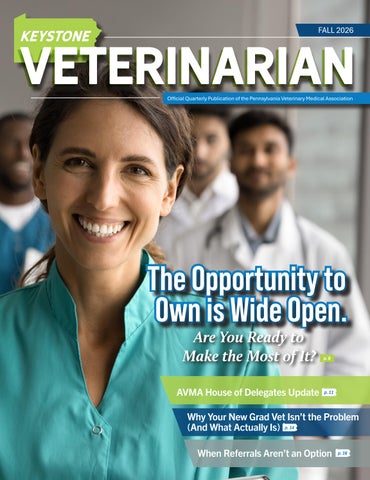
FALL 2026
Official Quarterly Publication of the Pennsylvania Veterinary Medical Association
Are You Ready to Make the Most of It?
p. 6
AVMA House of Delegates Update p. 11 Why Your New Grad Vet Isn’t the Problem (And What Actually Is) p. 14 When Referrals Aren’t an Option p. 16
BEYOND ANESTHESIA Advancing Patient Safety and Comfort through Specialized Veterinary Anesthesia and Analgesia
For Dr. Brandon Wahler, veterinary anesthesia is about more than safely guiding pets through medical procedures. It’s about providing peace of mind to pet owners, supporting fellow veterinary specialists, and ensuring every patient receives individualized care throughout their treatment. “Undergoing anesthesia, whether it is you or a furry family member, represents an incredibly stressful time in life,” says Dr. Wahler. “My goal, as a veterinary anesthesiologist, is to make this experience as stress-free as possible, to make sure it is a safe experience for the patient, and to leave every animal under my care better than how they arrived.” Board-certified in veterinary anesthesia and analgesia, Dr. Wahler works closely with the specialty team at Veterinary Dentistry Specialists (VDS) to develop comprehensive anesthetic plans tailored to each patient’s unique medical needs. His approach emphasizes patient safety, effective pain management, and clear communication with pet owners and referring veterinarians. At VDS, Dr. Wahler is proud to provide modern, exceptional anesthetic care in an environment dedicated to individualized treatment. By combining specialized expertise with compassionate, collaborative care, he helps make every patient’s experience as safe, comfortable, and stress-free as possible.
VDS® is the only referral practice in the nation dedicated to advanced dentistry and oral surgery for pets where a full-time board-certified veterinary dentist and a board-certified veterinary anesthesiologist are on staff to ensure the safest and most comfortable experience… and the best possible outcome.
455 Old Baltimore Pike, Chadds Ford, PA 19317 484.775.0557 | chaddsford@vdsvets.com | vdsvets.com
FALL 2026
Official Quarterly Publication of the Pennsylvania Veterinary Medical Association
Subscriptions:
5
Message from the President
The Keystone Veterinarian is mailed to PVMA
6
The Opportunity to Own is Wide Open. Are You Ready to Make the Most of It?
Members at no charge as a member benefit. Subscriptions are available to non-members for $30/year or $10 for a single issue. Please contact Membership@PaVMA.org if you’re interested in receiving the Keystone Veterinarian magazine.
Notice to Readers: Neither this publication, Hoffmann Publishing, nor PVMA assumes responsibility for material contained in articles and advertisements published, nor does publication necessarily constitute endorsement or approval of the
11
AVMA House of Delegates Update
14
Why Your New Grad Vet Isn’t the Problem (And What Actually Is)
16
When Referrals Aren’t an Option
20
Selling Your Practice: Private Equity vs. Succession Planning
22
A Grain of Truth: Problems with a Sugar Daddy
24
Vendor Contracts: What Veterinarians Should Watch Out For
26
Different Practice Structure, Same Questions
28
A Veterinary Radiologist’s Journey
30
Your Client Asked the App First. Now What?
32
The 2026 Keystone Veterinary Conference
35
In Memoriam: Earl C. Pebley, VMD E. Mark Fox, VMD
36
Classified Ads
advertiser, product, service or author viewpoint by the Keystone Veterinarian, its editors and publishers or the Pennsylvania Veterinary Medical Association. In addition, neither this
BOARD OF TRUSTEES
publication nor PVMA guarantees the accuracy,
Western Region Trustee: Erin Johnson, DVM
reliability or completeness of any facts, views, opinions, recommendations, information or statements contained within this publication. Reproduction in whole or in part is prohibited without the permission of the Pennsylvania Veterinary Medical Association.
The Pennsylvania Veterinary Medical Association is dedicated to ensuring the vitality of the veterinary profession by promoting excellence in veterinary medicine, advancing animal health and welfare, and protecting and enhancing human health.
PO Box 468, Elizabethtown, PA 17022 717.220.1437 | Info@PaVMA.org | PaVMA.org EXECUTIVE COMMITTEE President: Jeffrey Dill, DVM
w w w. H o f f p u b s.c o m Hoffmann Publishing Group 2669 Shillington Road, #438 Sinking Spring, PA 19608 Hoffmann Publishing Group is the official publisher of the PVMA’s Keystone Veterinarian magazine. For advertising opportunities, contact: Ad Sales at Sales@HoffPubs.com or call 610.685.0914 x 715.
President-elect: Andrea Carr, DVM Vice President: James Holt, VMD Past-President: Andrea Honigmann, DVM Secretary/Treasurer: Thomas Munkittrick, DVM
Metro Philadelphia Region Trustee: Jill Stetz, VMD North Central Region Trustee: Rhett Proctor, DVM South Central Region Trustee: Stephen Foulke, DVM Equine Veterinarian At-Large: Jim Zeliff, DVM, MBA Production Animal Veterinarian At-Large: William Croushore, DVM Academic Veterinarian At-Large: Dana Bubka, VMD Certified Veterinary Technician At-Large: Alyssa Killian, CVT AVMA Delegate: Tina Dougherty, VMD AVMA Alternate Delegate: Kate Boatright, VMD Student At-Large: Johannah Stahl
PVMA KEYSTONE VETERINARIAN Editor: Kate Boatright, VMD Editorial Assistant: Nina Mantione, DVM Editorial correspondence should be sent to Membership@PaVMA.org.
Message from the President
My name is Jeff Dill, and it is an honor to introduce myself to the great veterinarians and veterinary technicians across the state of Pennsylvania. I have the privilege of serving you as President of the PVMA for the next year, and I am excited about what Jeff Dill, DVM 2026-2027 PVMA President
this year has in store for us. I am a small animal practitioner and own a general practice that employs five doctors along with an amazing team of certified veterinary technicians and support staff. I have been in practice for 18 years. After graduating from the University of Missouri, I moved to Pennsylvania, where I spent two years working in a predominantly dairy practice before transitioning to a companion-animal-exclusive practice. I intend to draw on my experiences in both small and large animal practice as I continue to work on behalf of and advocate for veterinarians and veterinary support staff throughout Pennsylvania. I am excited to work alongside the exceptional veterinarians, technicians, and legal support staff who generously give their time to the PVMA and who continue to advocate for our profession in Harrisburg. I had the great opportunity to meet and speak with many PVMA members at the Keystone Conference, and I look forward to seeing you all in Pittsburgh in November! I am honored to serve as your president and look forward to working with all of you in the year ahead.
Pennsylvania Veterinary Medical Association | 5
The Opportunity to Own is Wide Open. Are You Ready to Make the Most of It? By Kelly Cooper, DVM, ACC When I bought my practice, I was a brand-new veterinarian with $100,000 in student debt, no savings, and no business training of any kind. What I did have was a clear vision for the kind of practice I wanted to create, a deep love for veterinary medicine, and enough ambition to outrun the fear.
The gap between jumping in with excitement and jumping in with preparation is exactly why I do this work. The woman I coach today is the woman I was 27 years ago. She is a great doctor. She is wonderful with clients. She probably has a team that genuinely likes her.
That ambition carried me a long way. What it did not do was teach me how to run a business. For years, I had QuickBooks, a tax accountant, and almost no real understanding of how my practice was doing financially. I was guessing more than I was managing, and the stress of not knowing was a steady hum in the background of everything.
And she is about to discover that none of that prepares you for the day you become the boss, the bookkeeper, the HR department, and the person who has to figure out why the autoclave is making that sound.
On the people side, I was learning to lead a team in real time, which is a polite way of saying I made a lot of mistakes with people who deserved better. I was directive, I was a perfectionist, and I was not exactly a joy to work for. And through all of it, I was doing it alone. I did not find mentors or reach out to colleagues to ask for help. I did not have a coach or a consultant in my corner. I thought asking for help meant I didn’t have what it took, so I kept my head down and kept pushing through. It took a lot of hard lessons, self-training, and a short gig in a practice management program that finally helped me understand the business I was running before things started to turn around.
The Window to Own Is Open. Here’s Why. For several years, corporate consolidators were acquiring independent practices at a pace that made purchasing a practice feel out of reach for many associates. Valuations soared, competition was fierce, and the math often didn’t work in an individual veterinarian’s favor. That landscape has changed. Rising interest rates slowed corporate acquisition activity significantly, and as a result, more practices are now selling at valuations that are more realistic for an individual buyer. Vet-to-vet independent deals have flipped from roughly 25% of all transactions to about 75%, according to recent data from Tony Mahan at Mahan Law, which closed over 75 continued on page 8 >
6 | Keystone Veterinarian
What Is Your Veterinary Practice Really Worth? A practice valuation is more than a number—it’s a strategic tool that reveals your practice’s strengths, uncovers opportunities, and prepares you for a confident future.
BUILD VALUE BEFORE YOU SELL
THE VALUATION PROCESS EXPLAINED
Buyers pay for proven performance and reduced risk. Focus on the fundamentals that drive a higher valuation multiple and a smoother transaction.
A professional valuation is a beneficial management tool. Here's how the process typically works.
Profitability Tells a Story
Normalized Earnings
Consistent profitability is the foundation of value. Understand your key drivers- service mix, pricing and cost- and managing them intentionally.
We start with your historical financials and adjust for one-time events, excess owner salary, and non-recurring items to determine sustainable earnings.
Dependable Operations
Comparable Transactions
Documented systems for scheduling, inventory, protocols and compliance show buyers the practice can run without constant owner oversight.
We analyze recent sales of similar veterinary practices to provide a more accurate and service mix to establish a realistic market range.
Clean, Transparent Financials
Growth Prospects
Accurate books, clear reporting and legitimate adjustments demonstrate credibility and make your earnings easier to trust.
Growing Opportunities for expanding services, improving marketing, or optimizing capacity can support a higher valuation.
Diversified Revenue
Data That Drive Confidence
A balanced mix of services, products and an organized team creates stability. Specialty or advanced services can strengthen both profit and appeal.
Three to five years of accurate financial and operational data are essential. Strong records lead to stronger buyer trust whether from a corporation or a doctor.
OWNER READINESS CHECKLIST ORGANIZE FINANCIALS Ensure tax returns, P&Ls, balance sheets, and aging reports are complete, accurate, and consistent.
DOCUMENT KEY PROCEDURES Create standard operating procedures for clinical, operational, and administrative processes.
STRENGTHEN THE MANAGEMENT TEAM Enpower leaders, define roles, and build a bench that can carry the practice forward.
REVIEW LEASE AND FACILITY TERMS Create standard operating procedures for the market, and property condition to reduce uncertainty.
PLAN A REALISTIC TRANSITION Define your ideal timeline, role after the sale, and key handover priorities to ensure continuity.
Simmons - The Nations oldest and most experienced veterinary practice brokers and appraisers Simmons Mid-Atlantic|814.466.7084 | SimmonsInc.com practice sales | practice appraisals | buyer agency | sale facilitaiton | exit strategy KNOW YOUR VALUE. PREPARE WITH PURPOSE. PLAN FOR WHAT'S NEXT.
A clear valuation today creates choices for tomorrow.
The Opportunity to Own is Wide Open. Are You Ready to Make the Most of It? continued from page 6
practice transactions in 2025 alone, representing more than $300 million in transferred practice value.1 Startup activity has roughly doubled in the same period.1 Banks also view veterinary practices as low-risk investments. Financing is more accessible than most associates assume. If you have been waiting for the right moment, the conditions right now are among the most favorable for independent ownership in recent memory.
Practice ownership is the clearest path to building wealth in this profession. The more women who own, the better positioned they are, in every way.
What It Takes to Do It Well Getting into ownership is genuinely within reach for most veterinarians who want it. The financing exists. The practices are available. The profession is ready for more independent owners. But accessible does not mean you’re prepared, and preparation is what separates the owners who thrive early from the ones who spend years recovering from the start they didn’t plan for. Here are the three foundations that make the difference. 1. Get clear on your why. Before you sign anything, sit down and write out why you’re doing this and what you want to build. Not a mission statement for the wall, but the real answer. • What is your long-term vision for your life and career? • What matters most, and how do you want to achieve it?
Women Are Leading This Moment Women now make up more than 60% of the veterinary profession, and more than 80% of graduating classes. We have been the majority in this profession since 2009.2 When I jumped into ownership right out of school, it was unusual for a woman, especially one at my level of experience, to make that move. The expectation, spoken or not, was that ownership was something you worked toward slowly, and that women in particular needed more time, more seasoning, more certainty before they were ready. That is changing. Women’s share of practice ownership has grown from 29% in 2007 to 41% in 2019, with projections pointing to women becoming the majority of practice owners by 2028.3 More women are taking the risk, making the leap, and building practices that reflect their values and their vision for veterinary medicine. That is good for their careers, good for their teams, and good for the profession. There is also a financial reality worth understanding. The gap between who is practicing and who is owning has a real cost over a career. Recent data shows that for women who went directly into practice ownership, the earnings differential compared to male counterparts grew to 80% by midcareer.4
• What kind of practice do you want to run? • What does it feel like to walk through the door every morning? • What makes you different from the clinic down the street? • What does success look like for your life, not just your business? Your why is not a nice-to-have. It is the foundation that every other decision gets built on: your business model, your hiring, your client experience, your culture. Owners who are clear on their why make faster, better decisions. 2. Build your community and your expert team. You can have your uncle look at the plumbing, but the business needs people who know what they are doing. That means two things. First, your personal community: the peers, mentors, and colleagues who have been through this and want to see you succeed. These relationships provide the perspective and encouragement that are hard to find anywhere else, especially when ownership gets hard. Second, your professional team: a coach and consultant who understands veterinary practice, a bookkeeper, an continued on page 10 >
8 | Keystone Veterinarian
Pennsylvania Veterinary Medical Association | 9
The Opportunity to Own Is Wide Open. Are You Ready to Make the Most of It? continued from page 8
accountant, a real estate advisor, a lawyer, and HR support. Yes, this feels like a significant investment at the start. But these are the people who help you avoid costly mistakes, make faster and better decisions, and grow revenue more quickly than you would stumbling through it alone. Practices that build this team early grow faster and struggle less. The investment pays for itself.
And I went from barely keeping it together to genuinely loving what I had built. The extraordinary practice you are envisioning, the one with a culture people want to be part of and a business that actually supports your life, becomes something you build on purpose. The opportunity is real. The timing is good. You made it through veterinary school, which, let’s be honest, is one of the hardest things a person can do. You have the grit. Build the foundation, bring the right people around you, and go create something extraordinary.
3. Become an intentional leader. You do not have to wait until you have a team to start learning how to lead one. The fundamentals of leadership are learnable, and the earlier you start, the better. Learn how to give feedback clearly and directly, without damaging the relationship. Understand what accountability actually looks like day to day. Know what goes into a job description that sets someone up to succeed rather than setting you both up for frustration. Understand why an employee handbook matters from the first hire and what performance management looks like before you are in the middle of a difficult situation with someone you depend on. The owners whose teams stay, grow, and build something worth being part of are the ones who invested in this before they needed it.
What Becomes Possible When you build on this foundation, the difference shows up in specific ways. You’re clear on your long-term vision and purpose. You have the knowledge and people around you to encourage and support you and to make sound decisions that align with these goals and your values. Because you have these things, everything else—team culture, operations, client service, financial management— will flow from the foundation you’ve created. You’ll feel grounded instead of overwhelmed. You’ll know where you’re headed instead of living on the hamster wheel that never ends. You’ll be confident. I know this because I lived it. Once I built the foundation I was missing, my practice grew by double digits. Turnover dropped. Clients drove over 100 miles with their pets because they trusted us.
10 | Keystone Veterinarian
References Mahan, A. The revival of independent veterinary practice. Published April 1, 2026. Today’s Veterinary Business. Available at https:// todaysveterinarybusiness.com/therevival-of-independent-veterinary-practice/. 1.
Hopkins C. The state of women in vet med—according to the data. Published March 22, 2024. AAHA NEWStat. Available at https://www.aaha.org/newstat/publications/ charts-the-state-of-women-in-vet-med/. 2.
American Veterinary Medical Association. Women practice owners projected to overtake men within a decade. Published December 3, 2020. JAVMA News. Available at https://www.avma.org/javma-news/2020-12-15/womenpractice-owners-projected-overtake-men-within-decade. 3.
Greenhill L. Gender pay gap and practice ownership earnings differential data]. Today’s Veterinary Business. Published October 2020. (Subscription required; underlying data from AAVMC research.) 4.
About the Author
Dr. Kelly Cooper is a veterinarian, executive leadership coach, and practice consultant who helps dedicated women practice owners go from exhausted and overwhelmed to confident and in control. Through Reality Vet Coaching & Consulting, she draws on 30 years in veterinary medicine to help owners face the realities of leadership and build extraordinary practices. She can be reached through https://www.linkedin.com/in/drkellycooper or https://www.realityvet.com.
AVMA House of Delegates UPDATE
By Tina Dougherty, VMD, Delegate Kate Boatright, VMD, Alternate Delegate
The AVMA House of Delegates (HOD) met in Anaheim, California, in conjunction with the 2026 AVMA Convention for its regular annual meeting. During the meeting, the HOD received updates from the AVMA; explored two topics of interest during the Veterinary Information Forum (VIF); and reviewed several bylaws, amendments, and resolutions.
AVMA Resource Updates The AVMA staff continually work to enhance existing resources for members and nonmembers, including: •
Technical tutorial videos as part of JAVMA. These are peer-reviewed and span a wide range of topics.
•
The Veterinary Vertex podcast, which provides interviews with authors published in JAVMA and AJVR. This podcast won a gold EPIC award earlier this year, selected from 70 nominees.
•
Journey For Teams continues to evolve and now includes three levels. JFT 1.0 works to increase understanding and awareness of diversity, equity, and inclusion. JFT 2.0 focuses on applying the lessons to strengthen skills and drive real-world impact. The newest level, JFT 3.0, focuses on sustaining change and driving cultural impacts. The program has continually grown engagement from veterinary practices.
•
New resource centers on environmental sustainability for veterinary practices and animal transportation through the AVMA website.
Advocacy Update The AVMA Government Relations Division (GRD) continues to advocate at the federal level for legislation that protects and supports the veterinary profession, including the Combating Illicit Xylazine Act, which has bipartisan support, and components of the Farm Bill, including the Healthy Dog Importation Act. Additionally, the GRD monitors state-level legislation and works with state VMAs in their advocacy efforts. Hot topics across the United States at this time include telemedicine and the establishment of the VCPR; non-economic damages; mid-level practitioners; and veterinary technician credentialing and scope of practice. To enhance advocacy efforts, funds collected by the AVMA Political Action Committee (PAC) are used to provide support to campaigns of Senators and Representatives who are supportive of legislation of importance to the veterinary profession. Contributions are nonpartisan. Funds for the PAC are collected through individual donations, and members are encouraged to donate to support ongoing advocacy efforts. Small donations from every member can go a long way toward building the PAC funds. No money from membership dues is given to the PAC.
AVMA Foundation The American Veterinary Medical Foundation (AVMF) is the charitable arm of the organization and is also in need of support, through both monetary donations as well as volunteers for scholarship review. The AVMF has a three-year continued on next page >
Pennsylvania Veterinary Medical Association | 11
AVMA House of Delegates Update continued from page 11 goal to raise 20 million dollars to fund its programs.
Veterinary Information Forum
The organization provides support through three main programs:
During the annual Veterinary Information Forum (VIF), HOD members received updates on two important topics affecting AVMA members.
•
Disaster Relief Grants, which support practices and all team members in the event of a disaster,
•
Reaching Every Animal through Charitable Healthcare (REACH) Program, which provides funds to AVMA members to help cover costs of care for clients unable to afford it,
•
Scholarships for Veterinary Students and Veterinary Technician Students.
AVMA Insurance Services AVMA Life and AVMA PLIT are now a unified resource under the name AVMA Insurance Services. The services themselves are unchanged. One new offering is license defense for credentialed veterinary technicians.
Artificial Intelligence The AVMA task force on emerging technologies and innovation provided an update on the use of Artificial Intelligence (AI) in veterinary medicine. Common uses include medical documentation, transcription, administrative workflow, and radiology. Common concerns include reliability and diagnostic accuracy; data security and client/patient privacy; lack of transparency as to how tools generate outputs; overreliance on AI by clinicians or staff; medico-legal responsibility if AI contributes to an error; insufficient training for responsible implementation; and the need for professional or regulatory oversight. The taskforce is working to identify and create resources to support veterinary teams who are using or considering the use of AI tools.
Having trouble sourcing certain compounded meds? Epicur Pharma has you covered!
expiration dates on drugs of up to 365 days Longer/proven compared to 503A compounded products
Ready to ship same day with 1-2 days in transit Stay stocked and get your medications quickly and easily. For office orders, call 888.508.5032. For patient orders, call 800.754.5222. View pricing, expiration dates, and order online at iFill.com
12 | Keystone Veterinarian
w our p ro ist ct l du
100% manufactured following FDA-enforced regulations for office use in Pennsylvania and by individual Available patient prescription through Stokes Pharmacy
Vie
One-Stop Shop for Legal Services for Veterinarians, Veterinary Clinics, and Animal Hospitals New World Screwworm Veterinary practice involves a wide variety of legal issues. Tucker Arensberg attorneys have experience working with veterinarians in all of the legal aspects of their practice.
A review of the life cycle of New World Screwworm was provided to the HOD, followed by updates on the current cases and the eradication plan. Resources are continually updated on the AVMA website (www.avma.org/nws).
Voting on Bylaws Amendments and Resolutions The full text of all bylaws amendments and resolutions can be found at https://www.avma.org/about/housedelegates/hod-resolutions-and-proposed-bylawamendments.
We offer full-service legal representation and consulting services throughout the entire lifecycle of your business from startup to transfer of ownership, including: • Employment matters • Business entity formation and governance • Contract drafting and negotiation • Real estate
Two bylaw amendments were reviewed and passed: •
Amendment 8: Revisions for Clarity
•
Amendment 9: Extension of Grace Period for Constituent Allied Veterinary Organizations.
• Purchase or sale of a business • Succession planning • Financing transactions, debt, or equity
To learn more visit www.tuckerlaw.com, follow us on LinkedIn , or call 412-566-1212.
Four resolutions were reviewed, and the following actions were taken: •
Resolution 3: Animal Abuse and Neglect–passed with amendments
•
Resolution 4: Free-Roaming Cats–passed
•
Resolution 5: Calf Management–passed with amendments
•
Resolution 6: Encouraging State Proclamations Recognizing November 3 as One Health Day– passed with amendments.
Now Serving
State College, PA and Washington, DC
Leadership Updates Elections were held for the position of president-elect and vice president. Dr. Robert Knapp is the new presidentelect, and Dr. Elizabeth Boggier was elected vice president. Dr. Jennifer Quammen moved into the position of president, and Dr. Michael Bailey moved into the pastpresident position for the 2026-2027 association year. Two individuals announced their candidacy for presidentelect for 2027-2028: Dr. Isaac Bott and Dr. Sandy Willis. It continues to be our honor to serve the veterinary professionals of Pennsylvania as representatives to the AVMA House of Delegates. Our next meeting will be held in January 2027 in conjunction with the 2027 Veterinary Leadership Conference in Chicago, Illinois.
Pennsylvania Veterinary Medical Association | 13
Why Your New Grad Vet Isn’t the Problem
(And What Actually Is)
By Dani Rabwin, DVM
There’s a narrative that keeps circulating in practice owner circles: New grads are too sensitive. They can’t handle pressure. They want their hands held. They’re not like we were. I hear it constantly. And every time I do, I want to ask one question: Do you remember what it actually takes to get into and through veterinary school?
Veterinary School Acceptance Rates Tell You Everything You Need to Know. Veterinary school acceptance rates hover around 10 to 15 percent. The ones who make it have typically spent years building a case for themselves. Hours of clinical experience, research, leadership, academic excellence—often while working jobs—managing debt, and navigating everything life throws at a person in their early 20s. Then they survived four years of one of the most demanding graduate programs in existence. The volume of material, the clinical rotations, the sleepless nights. All of it, before they ever walked through your door. These are not people who want their hands held. These are people who have already proven, repeatedly, that they can do hard things. That’s the baseline. That’s who you’re starting with. And I think it’s worth pausing on that before we go any further.
Why New Grad Vets and Practice Owners Keep Clashing So, if new grads aren’t fragile, what’s going on when the mismatch shows up?
14 | Keystone Veterinarian
In a lot of cases, it’s not a competence problem. It’s a values gap. And the data on this is striking. Suzy Welch, Professor of Management Practice at NYU Stern, recently published research that cross-referenced the values of Gen Z workers with what hiring managers are actually looking for.1 Her findings? Only 2% of Gen Z employees share the values their managers most want to see.1 That’s not a rounding error. That’s a near-total mismatch. What do Gen Z workers value most? Personal flourishing and self-care. Authentic self-expression. Giving back and helping others. What do most hiring managers prioritize? Achievement—the desire to win. Work centrism—the desire to work. Scope— learning, growth, and advancement. Neither list is wrong. But they are speaking almost entirely different languages. The generation entering veterinary medicine right now came of age in a world that was asking different questions than the ones previous generations were asked. Questions about sustainability. Mental health. Authenticity. Work that feels meaningful, not just productive. Work-life balance isn’t a luxury they’re hoping for. It’s a condition they need to do their best work. Psychological safety is essential to them. They want to know that asking a question won’t be held against them. That showing uncertainty isn’t the same as showing weakness. Those aren’t signs of fragility. Those are signs of selfawareness.
And here’s the thing. The research backs them up. We know that psychological safety improves clinical performance. We know that burnout is one of the most serious threats facing our profession. We know that the culture of “just push through it” hasn’t served us particularly well. The values aren’t wrong. They’re just different from what a lot of us grew up with. It’s also worth noting that this isn’t what previous generational clashes looked like. Every generation has had its friction entering the workforce. But a 98% values mismatch is a different magnitude entirely. Dismissing it as “kids these days” misses what’s actually happening.
How Dismissing Gen Z Values Is Hurting Your Veterinary Practice When we frame those values as entitlement or immaturity, a few things happen. We lose the chance to actually connect with someone who is trying to show up well. We create environments where new grads go quiet. Not because they have nothing to contribute, but because they’ve learned that certain questions aren’t welcome. And eventually, we lose them entirely. To relief work, to other fields, sometimes to leaving the profession completely. The turnover costs are real. The wellbeing costs are real. The patients pay a price too, when the culture burns through good veterinarians before they’ve had a chance to really hit their stride. None of that is what practice owners want. But it’s what happens when values misalignment goes unaddressed.
Awareness doesn’t mean abandoning your standards or running your practice around someone else’s preferences. It means coming to the conversation with enough context to tell the difference between a values gap and a performance problem.
They Earned Their Spot—Now Here’s How to Help Them Stay I want to come back to where we started. The person standing in your clinic on their first day—nervous, maybe a little stiff, maybe asking what feels like too many questions—got there by doing something genuinely hard. They didn’t get handed a spot in veterinary school. They earned it. They didn’t coast through four years of training. They showed up for every hard day of it. And now they’re in your practice, trying to figure out how to be a veterinarian in the real world, which is messier and a lot less scripted than anything they trained for. They need mentorship. They need structure. They need honest feedback delivered with respect. What they don’t need is to be dismissed before they’ve had a real chance. A values gap is bridgeable. Awareness is the first step. And when practice owners and new grads can have that conversation—not as adversaries, but as people trying to build something together—a lot of the friction disappears. Because the goal is the same on both sides. Good medicine. Sustainable careers. A profession worth staying in. We’re not as far apart as the narrative suggests. References
Closing the Gap Between Practice Culture and New Grad Expectations This doesn’t require a total reinvention of how you run your practice. It starts with awareness. When a new grad seems hesitant to take a case independently, before assuming it’s a confidence problem, ask yourself: do they feel safe asking for help here? Have I made it clear that uncertainty is a normal part of early practice, not a reflection of their worth? When they set a boundary around their schedule or ask for more structured feedback, before labeling it as high maintenance, consider: is this actually unreasonable, or does it just feel unfamiliar? When they seem emotionally affected by a hard case or a difficult conversation, before reading it as weakness, remember that’s the same care that’s going to make them an extraordinary vet. That’s not something to manage away. That’s something to support.
Welch S. They love self-care, hate hustle, and need a job—A CEO’s advice for an ‘unemployable’ Gen Zer. Published October 14, 2025. Available at https://www.stern.nyu.edu/ experience-stern/faculty-research/they-love-self-care-hatehustle-and-need-job-ceos-advice-unemployable-gen-zer. 1.
About the Author In her copy of Dr. Seuss’s My Book About Me, four-year-old Dani Rabwin wrote that she wanted to be a trapeze artist or an animal doctor. She decided against the circus, and today Dr. Dani Rabwin is a veterinarian, author, speaker, and mentor. She is the founder of Ready, Vet, Go, a growing platform that supports new and early-career veterinarians through remote mentorship, practical education, and a vibrant community of peers and mentors. Her work complements the in-clinic guidance offered by veterinary practices, helping earlycareer vets build confidence, competence, and connection. Dani graduated from the UC Davis School of Veterinary Medicine in 2004 and completed an internship at Michigan Veterinary Specialists. She continues to practice in the Bay Area, California, and feels deeply privileged to help veterinarians thrive in the profession she loves. Dani can be reached at dani@readyvetgo.co.
Pennsylvania Veterinary Medical Association | 15
When Referrals Aren’t an Option By James F. Wilson, DVM, JD
As I see it, veterinary medicine faces a difficult dilemma. As rising costs for gas, groceries, housing, interest rates, recreation, and nearly everything else dominate the news, the phrase “affordability crisis” now appears throughout the consumer world. Wages have not kept pace. In its February 13, 2026, News Bulletin, the AVMA reported that veterinarians are seeing a trend reflecting greater price sensitivity among clients and fewer visits.1 Over 50% of pet owners have skipped or delayed necessary veterinary care because of climbing expenses, often declining treatments costing under $1,000. Anecdotal reports from clinical staff confirm this.
Veterinary Inflation Nearly Doubles the CPI According to the U.S. Bureau of Labor Statistics, veterinary service prices rose by an average of 4.99% annually from 1997 to 2026.2 As a result, services that cost $20 in 1997 would cost $82.14 in 2026 for the same level of care.2 This is compared with an annual overall inflation rate of 2.53% during that period. Moneywise reports that veterinary bills have increased 44% since 2019 alone,3 leaving many retirees with sick pets caught between caring for the animals they love and risking financial hardship. The housing crisis is hitting pet owners especially hard because of high procedure deposits and, in some cases, monthly fees as well. This price surge means the average cost of treatment can now reach $3,000 per year for a single animal. Over a lifetime, a standard two-pet household might spend between $30,000 and $60,000. To manage these expenses, families are making difficult trade-offs: •
Approximately 33 percent of owners report reducing their grocery budgets to afford medical bills.
•
Another 28 percent have delayed paying rent or utility bills.
•
67 percent cannot cover a $5,000 emergency bill without taking on debt.4
16 | Keystone Veterinarian
The table below shows annual veterinary inflation since the end of the pandemic:2 2019 $53.44 4.14% 2020 $55.42 3.70% 2021 $57.75 4.21% 2022 $62.85 8.83% 2023 $68.79 9.44% 2024 $73.88 7.40% 2025 $78.65 6.46% 2026 $82.14 4.44%* *Partial year Humane World for Animals is reporting that animal shelters are in a crisis. At a time when dog veterinary visits are decreasing, pets are being returned to shelters at record paces because their “parents” can’t afford them.5 The AVMA attributes the large cost increases to the rising cost of materials, supplies, pharmaceuticals, and utilities; investments in new technology; and longer lifespans for pets. Tariffs have played a big role in increasing material prices. Sophistication coming from MRI and CT scans, dental radiographs, expensive chemo, and radiation options all add major costs for the growing volume of elderly pets seen by the profession. Although I lack the statistics to confirm it, some of this inflationary pressure seems to stem from the growing number of “almost instant” referrals primary care practitioners make to busy, high-cost emergency and specialty care centers. Might it be possible that this is a direct result of the rapid increases in class sizes and remote education which, in turn, made it harder for them to develop the clinical skills and confidence of their predecessors? Might it also be because they are taught in
veterinary school that all complex cases should be referred?
When Selling or Buying a Veterinary Practice
The following list probably enhances their fears: state board complaints, professional liability claims, social media criticism, the pressure of seeing 18 to 30 cases a day, their quest for a work-life balance, and avoiding burnout. Perhaps the last one is the fear of failure, without the resilience to learn from it and “get back on the horse and ride again.” The urge to refer is especially strong with cases requiring anesthesia and surgery. In my view, these factors are leaving billions of dollars’ worth of excellent care undelivered— unrealized care that primary care veterinarians could and need to provide. Examples include these procedures that historically have been performed in general practice: splenectomies, cystotomies, exploratory, cryptorchid and pyometra surgeries, gastropexies, removal of eyelid masses, intestinal anastomoses, cruciate repairs in small-breed dogs, lateral ear resections, lumpectomies, mastectomies, large-tooth dental extractions, ultrasound-guided kidney biopsies, and many others. Basic oncology for some cancers may also fall into this category. It is true that many GP-focused practices perform these. However, many others, as well as urgent care centers, do not. This leads to a growing sense that economic euthanasia is becoming all too common. The “all they care about is money” sadness we hear from clients regarding expensive specialty care centers and some GPs keeps growing. Stories keep emerging from pet owners indicating they hear “If you can’t afford what we offer here, your only option is euthanasia.” This, in spite of the fact that, if given the chance back in the day, we “older–full service” clinicians would have been willing to “give it our best shot” at a lower cost. This option has been driven by the expectation that there is only one standard of care. That is changing because of what is now known as a Spectrum of Care (SOC).6 It entails a range of options that vary in intensity, invasiveness, outcome, and cost.
You Can’t Learn Anything Without Trying I have always been of the belief that you can’t learn anything without trying. This requires work—above and beyond today’s desired 32-hour work week. It requires that nervous, inexperienced associates “come in on their days off” and work beside their senior practitioners who have been performing difficult surgeries since graduation. It requires risk-taking—risks that, when skills are added, allow associates to increase the revenue they need to grow their compensation. It takes a willingness to serve a clientele ready and able to take some risks of their own—risks that allow GPs to learn something new, because that is better than not offering anything at all. (I will talk about my “Educational Memorial” consent form as a way of generating learning opportunities in the next issue.) To help veterinary schools train students in offering flexible, context-driven treatment options for patients, the American Association of Veterinary Medical Colleges (AAVMC)
Practice Sales Appraisals Associate Buy-Ins Seller/Buyer Representation Experienced Corporate Negotiators
WESTERN PENNSYLVANIA
EASTERN PENNSYLVANIA
TPSG GREAT LAKES OFFICE: 440.933.4522
TPSG EAST COAST NORTH & MIDWEST
Bret Halishak Cell: 216.217.7822 Bret@tpsgsales.com
John Bryk, DVM Cell: 330.591.7669 John@tpsgsales.com
www.TotalPracticeSolutionsGroup.com launched the Spectrum of Care Initiative (SOCI) in 2021. The American Animal Hospital Association Trends journal addressed its evolution in 2024.6 The December 2025 supplemental issue of JAVMA, titled “Weighing the Evidence and the Options: Spectrum of Care,” provides actionable insights for applying a continuum of acceptable medical treatments tailored to client resources and values.7 The American Association of Veterinary State Board’s Elizabeth Venit, VMD, MPH, DACVPM, has published the only journal article I have seen related to informed consents, or owner consents, to be used with the SOC.8 I’m now offering what I believe is an important risk reduction tool. It’s called the “Consent to Proceed with Procedures When Finances, Time, and/or Distances Preclude Referral to More Qualified Experts.” The full text is available in Box 1.
Caution Because I believe this is essential to the SOC effort, I’m proposing that clinicians who are willing to offer various levels of care engage in the use of this form. It has not been tested with any state board or civil court complaint process. Moreover, it is unlikely that the attorneys general who work with state boards will provide anticipatory opinions on its continued on next page >
Pennsylvania Veterinary Medical Association | 17
When Referrals Aren't an Option continued from page 17
effectiveness until this or similar versions are implemented by licensees as defenses to client complaints.
of this or similar forms will encourage more generalists to tackle the complicated tasks their predecessors have been performing for generations. We need to prove once again With this background, establishing informed consent starts during these difficult financial times that offering the best with a critically important oral discussion of the risks and care we can at prices our clients can afford will illustrate that benefits. This must precede the signature on the form. It ends “money is not all our profession cares about.” with written medical record notes that corroborate the oral conversation. Ideally, this discussion should be presented to the client by the attending clinician, just as (in my experience) Summary it is done by doctors in the human health care arena. My hope is that as we do this, it will allow us to help restore Only time will tell how the use of this form plays out. the appreciation and trust the public once had for our Nonetheless, it seems clear that our profession needs to profession. Lastly, lots of generalists will prove they are offer some solutions to the high costs of veterinary care. My more competent than they think, and the pets they treat will hope is that by addressing the informed consent risk, the use experience the benefits of them trying. BOX 1: Consent to Proceed With Procedures When Finances, Time, and/or Distances Preclude Referral to More Qualified Experts Client’s Name __________________________
Patient’s Name ____________________
I certify that I am or am not over eighteen years of age, as indicated to the staff, and that I am the owner of the above-named pet or an authorized agent of the owner. I have been informed that my pet and its medical condition would likely benefit from referral to a more qualified and experienced general practitioner, technically capable veterinary practice, or board-certified specialist with more training and instrumentation than the primary care doctors and staff at this practice. However, I have indicated that a referral is not feasible or wanted because: a) I cannot afford it, b) the referral location is too far or difficult for me to reach, c) the time required to travel to the referral location and complete post-procedure care could put my personal, financial, family’s or pet’s well-being at risk and/or d) I trust and am choosing my regular veterinarian and their staff to provide the care to the best of their ability. I understand that because of one or more of these obstacles or options, I am consenting to the performance of any or all of the diagnostic, treatment, and/or surgical procedure(s) listed below: ________________________________________________________________________________________________________ ________________________________________________________________________________________________________ _________ ______________________________________________________________________________________________ I understand that I will receive a medical care plan that includes a written fee estimate for diagnostic tests, treatments, anesthesia, and/or surgery, anticipated visits and costs for follow-up care commensurate applying a general practice standard of care. I understand that with the lower spectrum of care my pet receives the fees charged will likely be below those charged by specialty care centers, and that this is a factor in my acceptance of the professional services to be provided by this practice and its staff. I agree to pay a deposit of _____% of the estimated fees, assume financial responsibility for the balance of services rendered, and agree to provide payment on a cash, credit card, check or approved in advance credit application at the time my pet is discharged. Commonly known and/or serious risks have been discussed with me including the possibility of blood loss, anesthetic complications, a procedure outcome disability, and/or death. I have been encouraged to ask questions and agree not to proceed with the procedure(s) outlined above until my questions have been answered to my satisfaction. While I accept that all procedures will be performed to the best of the abilities of the staff at this hospital, I understand that veterinary medicine is not an exact science and that no guarantee or warranty has been made regarding the results that may be achieved. By signing below, I decline the offer for a referral to a specialty care center and accept the risks of complications for my pet that might occur from applying a general practice standard of care as opposed to the standards at a specialty care center. This includes the possibility of an imperfect outcome. I accept the potential need for, costs of, and responsibility for adverse effects or corrective care including referral to an emergency or specialty care center. Having been fully informed of the risks and benefits of proceeding, I hereby consent to the services described herein. ________________________________________ Signature of Owner or Authorized Agent
18 | Keystone Veterinarian
______________________ Date
References Nolen RS. Veterinarians report increasing price sensitivity, decreasing visits. Published Feb 13, 2026. Available at avma. org/news/veterinarians-report-increasing-price-sensitivitydecreasing-visits.
1.
Prices for veterinarian services, 1997-2026 ($20). Accessed September 6, 2026. Available at www.in2013dollars.com/ Veterinarian-services/price-inflation. 2.
Bieber C. Vet bills have jumped 44% since 2019, and retirees with sick pets are caught between love and going broke. Published June 21, 2026. Available at https:finance. yahoo.com/healthcare/articles/vet-bills-jumped-44since-173000222.html. 3.
Famuyiro K. The 2026 pet care crisis: Why veterinary care costs are forcing families to choose. Published April 9, 2026. Available at https://www.latimes.com/veterinarians/health/ diagnostics/story/pet-care-gap-report-vets-pet-owners.
issue of JAVMA, titled “Weighing the Evidence and the Options: Spectrum of Care,” provides actionable insights for applying a continuum of acceptable medical treatments tailored to client resources and values. AVMA. Put spectrum of care to work with JAVMA supplement. Published December 5, 2025. Available at www:avma.org/blog/put-spectrum-care-work-javmasupplement.
7.
Venit E, Informed consent plays an important role when practicing veterinary medicine along the spectrum of care. JAVMA 2025;263(S3):S10–S16. https://doi.org/10.2460/ javma.25.05.0340 8.
4.
Grant B. Animal shelters are in crisis. Published December 10, 2025. Available at humaneworld.org/en/all-animals/ animal-shelter-crisis-2025. 5.
Green Seymour K. Spectrum-of-care: Busing common myths. Published October 25, 2024. Available at aaha.org/ newstat/publications/spectrum-of-care-busting-commonmyths/. NOTE: The December 2025 special supplemental 6.
About the Author Dr. Wilson graduated with a DVM from Iowa State University in 1967 and a JD from UCLA in 1973. His experiences range from farm boy and deer hunter (70 years) to practice owner and medical director (Penn). He has served as an expert witness; is an itinerant professor at 22 schools; and is a proud member of the PVMA Legislative and Regulatory Affairs Committee for 22 years. He enjoys educating his profession about veterinary and animal law.
Pennsylvania Veterinary Medical Association | 19
Selling Your Practice: Private Equity vs. Succession Planning By Ashley S. Wagner, Esq.
For many veterinary practice owners, the biggest business decision is not how to grow the practice, but how to eventually transfer ownership. While private equity-backed veterinary consolidators have created a growing market for practice sales, traditional succession planning remains an important alternative.
may be required to remain with the practice for several years following the transaction, with compensation, production requirements, and termination provisions governed by the new employment agreement.
The right strategy depends on more than valuation. Owners should evaluate the transaction structure, tax consequences, control, legal obligations, employee considerations, and their desired role after closing.
In addition, owners should understand precisely what they are selling. The transaction may involve the operating entity, real estate, equipment, goodwill, intellectual property, or some combination of these assets. Real estate ownership deserves particular attention because selling the practice does not necessarily require selling the underlying property.
Private Equity Sale Considerations
Hurdles in Succession Planning
A sale to a private equity-backed veterinary organization or other corporate buyer can provide a relatively clear path to liquidity. These buyers typically have access to capital and transaction infrastructure that an individual veterinarian may not have.
A succession transaction, typically involving an associate or another veterinarian, can provide greater continuity and potentially more control over who assumes ownership.
For the seller, the attraction is often straightforward: monetize the value created over years of practice ownership while potentially continuing to practice post-sale under an employment agreement. But the purchase price is only one component of the transaction. Owners should carefully distinguish between cash paid at closing and other forms of consideration, including seller financing, earn-outs, rollover equity, or contingent payments. An offer with a higher headline valuation may ultimately be less attractive if a significant portion of the consideration depends on the future performance of the practice. The employment agreement is equally important. A seller 20 | Keystone Veterinarian
The principal challenge is financing. An individual buyer may not have the capital to match a corporate offer. Educational debt, limited personal liquidity, and lending requirements can constrain the transaction size. The seller may therefore need to consider seller financing, a phased buy-in, or a minority-interest transaction before completing a full transfer. Those structures can create additional legal and financial complexity, but they also allow the parties to spread the transition over time. For example, an owner might initially sell a 20% interest to an associate, establish defined management responsibilities and purchase terms, and provide a mechanism for the associate to acquire additional interests over several years. This approach can create a gradual transition while allowing the successor to
develop the financial and managerial skills necessary to run the practice. However, a succession plan should not rely on an informal understanding that an associate will “eventually take over.” The parties should address valuation methodology, ownership percentages, buy-sell provisions, decision-making authority, compensation, disability, death, termination, and dispute resolution in legally binding agreements.
Valuation Is Only the Beginning Whether the prospective buyer is a consolidator or an individual veterinarian, an independent valuation is an important starting point.
A practice that is professionally managed and legally organized is generally easier to sell—and may command better terms and a better price.
Plan for the Exit Before You Need One Perhaps the most important distinction between private equity and succession planning is timing. A corporate sale can sometimes move relatively quickly once an owner decides to sell. On the other hand, a succession may require years to identify, develop, and finance the right successor.
Owners should understand the difference between enterprise value and the amount they will actually receive. Debt, workingcapital adjustments, transaction expenses, and taxes can materially affect net proceeds.
Practice owners should build an exit strategy into their broader business plan. Maintaining accurate and complete financial records and documents, developing a management team, reducing excessive dependence on the owner, understanding the practice’s market value, and identifying potential successors all help to preserve optionality.
Tax planning should also begin well before a transaction takes place. The tax consequences can differ substantially depending on whether the transaction is structured as an asset sale, equity sale, or another arrangement. The structure can affect both the seller’s tax liability and the buyer’s willingness to pay.
If a compelling corporate offer arrives, the owner is prepared to evaluate it. If an associate emerges as a viable successor, the practice is positioned for a transition. And if neither option is attractive, the owner can continue operating the practice while preparing for a future transaction.
For that reason, a CPA and transaction attorney should be involved before the owner signs a letter of intent—not simply brought in to review the final purchase agreement.
Ultimately, the choice between private equity and succession planning is not simply a matter of choosing the highest price. It is a decision about value, control, risk, timing, and legacy. The strongest position for a practice owner is to understand those variables well before a buyer appears at the door.
Legal Due Diligence Matters A practice sale is also a legal transfer of risk. Buyers will typically conduct due diligence involving financial statements, tax returns, employment records, leases, real estate, contracts, regulatory compliance, equipment, insurance, and potential liabilities. Owners should conduct their own preparation. Outstanding employee issues, undocumented compensation arrangements, veterinarian or associate contracts, lease provisions, partnership agreements, intellectual property, and compliance concerns can all become transaction issues.
About the Author Ashley S. Wagner, Esq., is a seasoned corporate attorney with a strong focus on mergers and acquisitions (M&A), succession planning, and corporate transactions. As a member of the firm’s Business and Finance Group and co-chair of the Mergers & Acquisitions Practice Group, she represents corporations and business owners in M&A transactions, asset purchases, corporate governance, and business succession planning. Contact Ashley at awagner@tuckerlaw.com or at (412) 594-5550. Pennsylvania Veterinary Medical Association | 21
Problems with a Sugar Daddy By Todd A. Jackson, DVM, DACLAM This series of articles depicts funny, tragic, terrifying, or otherwise memorable anecdotes from veterinary careers. Some of them might be mine, and some might belong to other people. I’m not telling. In all cases, the names have been changed to protect the innocent and the comically guilty. Some are completely true, but at minimum, every story has a grain of truth. For those who haven’t been in veterinary medicine long enough to remember when the best available drug to treat arthritis in dogs was aspirin (available in 5-grain tablets), a grain is an obsolete unit based on the mass of an ideal seed. In the Apothecaries’ system, it is equal to 64.79891 milligrams… so, maybe not much, but there is some truth in there. My first job out of veterinary school was at the Wintertown Animal Clinic in Tyler, IN, more or less the opposite of today’s corporate practices. The clinic owner, Phil Wintertown, had built up the practice from scratch, having been born and raised in Tyler, a tiny map dot of a town with a whopping population of a little over 3,000. Senior clients knew Phil way back from when he was a child, and middle-aged clients knew him from their school days together. That led to a high level of familiarity between clients and clinic staff, and nobody took more advantage of that than Mr. and Mrs. Luther. The Luthers treated the clinic like their second home. While other clients would politely keep to the waiting room and exam rooms, the Luthers roamed about at will, walking in the back door and wandering around the hospital ward, boarding kennels, laboratory, and operating room. They would hover over me curiously while placing catheters, suturing wounds, 22 | Keystone Veterinarian
or giving injections to hospitalized patients. My requests for personal space, especially for safety when working with fractious animals, were ignored. The only time I remember ever getting the Luthers to stand back was when working on a Rottweiler’s impacted anal sacs. Despite being warned, they huddled in close to watch me squeeze fragrant goo out of the left side. Gagging and retching, they skittered to the far side of the room before I could express the right. When I asked Phil why everyone ignored the Luthers’ intrusive behavior, he told me that they contributed more money to the practice than almost any other clients. They travelled a lot, and their dog, Roy, spent as much time boarding with us as he did living at home. The Luthers had come to see the clinic as Roy’s second home, so they treated it like their home too. I was also perplexed that Phil had me work with the Luthers almost exclusively. For most long-term clients racking up large veterinary bills, Phil arranged our schedules so that he could handle their appointments. The Luthers, on the other hand, always ended up on my side of the appointment book. I didn’t mind because Roy was a hyper-friendly dog, truly a joy to work with. Roy was a 60-pound, happy-go-lucky mutt stuffed into what should have been a 40-pound body. Perhaps he was always on my side of the appointment book, so I would always be the one lifting his massive bulk onto an exam table. When boarding for a few weeks, I could get Roy to drop several pounds with measured food portions and frequent walks. Despite having prescribed a weight loss diet with directions on how much to feed, Roy always gained weight back before his next visit.
[For her own safety, I hope my primary care physician never reads this article. If she heard me grousing about a patient being overweight despite my best medical efforts, she could seriously strain her superior rectus muscles from an ironic, involuntary eye roll reflex.] When dropping Roy off for boarding one day, the Luthers told me that he had developed a ravenous appetite, always begging them to refill his feeder. They also said he was drinking more water than usual and asking to go outside all the time. Testing showed a blood glucose level of >350 mg/ dL, and I had my first-ever diabetic patient. In those primitive times before continuous glucose monitors had been invented, it was standard to hospitalize diabetic patients, measuring glucose levels several times a day to titrate their insulin doses. Roy boarded so often that it was easy and convenient to get his glucose curves. He would show good control of his diabetes with insulin treatment and a controlled diet while boarding but would be back out of control after having been home a few weeks. Despite training the Luthers on how to refrigerate, roll to mix, draw up, and inject insulin, and despite strict dietary instructions, Roy remained an uncontrolled diabetic.
I placed my order at the speaker while watching as the drivethru attendant handed Mr. Luther an extra-large cone. The soft serve was piled up over eight inches high and several inches across. Mr. Luther handed the frozen monstrosity to Mrs. Luther as the drive-thru attendant held out a second giant cone. Mr. Luther took that one and started rapidly licking vanilla drops to keep them from spilling into his lap. Mrs. Luther was already going after hers, balancing brain freeze from eating too fast against spillage from eating too slow. Roy kept grinning and wagging his tail from the back seat. To my complete and somewhat naïve surprise, the drive-thru attendant then handed out a third extra-large cone. I sat there confused because there were only two people in the car. Why buy a third cone? Mr. Luther handed the ice cream tower to his wife, and then she held it out for Roy. Roy chomped down and devoured the top half as they pulled away from the drive-thru. I went absolutely ballistic, shouting “What the flying #@!%^&” while jumping up and hitting my head on the roof of the car. The top of my head is still a little flatter from the impact. Fortunately, Phil never noticed the oval dent in the clinic car’s roof.
This cycle repeated over and over—great glucose control while staying at the clinic, and blood sugar levels to rival a The drive-thru attendant stuck her head out of the window to root beer float on return. Every time I questioned the Luthers, find out why I wasn’t pulling forward. Upon seeing a raging, they confirmed that they gave Roy his insulin and followed my cursing lunatic in the car, she called her manager over to dietary instructions to the letter. I watched them administer hand me my burger and fries. Of course, he was a client. He insulin injections to verify that they did it correctly and said the classic line “What’s up, Doc?” and followed with confirmed that they kept the insulin refrigerated. They swore “You OK?” I sheepishly apologized for my outburst. repeatedly that Roy only ate his prescription diet and never At Roy’s next visit, I asked the Luthers again whether Roy got any treats. got any food or treats besides his prescription diet. When Starting to feel like an inept internist, I reviewed my notes they swore he did not, I confronted them about the Dairy from veterinary school and reread Ettinger’s Veterinary Queen incident and Roy’s ice cream habit. They hung their Internal Medicine chapter on diabetes. I asked Phil for help, heads in shame and said, “But he loves it so much!” and “We and after reviewing Roy’s records, he concluded that I was want him to be happy.” I could see Phil grinning from across doing everything by the book. Unfortunately, Roy wasn’t the room while I re-explained for the umpteenth time the reading the same book. For lack of other ideas, I was about importance of proper diet in controlling Roy’s diabetes. This to call up my internal medicine instructors back at Purdue time I explained it from the standpoint of how Roy would for consultation when I had an unexpected diagnostic be happier living longer and not having to urinate so many breakthrough. times every night. The Luthers finally understood, and Roy’s After finishing morning appointments during my Saturday diabetes stayed under control. on-call, I was on my way out to suture a small laceration on a stallion. On the way to the farm, I stopped by the only fastAbout the Author food restaurant in Tyler for lunch in a paper sack. In the driveDr. Jackson is a board-certified specialist in laboratory thru lane at Dairy Queen, I saw the Luthers and Roy in their Jeep ahead of me. My first thought was how nice it was to see animal medicine and serves as the Director of the Animal Resource Program and a Research Professor in the Office of Roy smiling and looking so happy in the backseat, enjoying the Senior Vice President for Research and the Department of an afternoon drive with his eccentric owners. My second Veterinary and Biomedical Sciences at Penn State’s University thought brought on frustration and a little shame about being Park campus. He can be reached via e-mail at taj5330@psu. unable to control Roy’s diabetes, knowing he was in danger of edu. https://vbs.psu.edu/directory/taj5330. progressively more severe health issues unless I could find a way to help him.
Pennsylvania Veterinary Medical Association | 23
Vendor Contracts: What Veterinarians Should Watch Out For By Adam J. Appleberry, Esq.
Vendor agreements are a routine part of running a veterinary practice, and their seemingly routine nature can make them easy to sign without much scrutiny. Unfortunately, the contracts that can quietly do the most damage to a practice’s bottom line are often the ones that aren’t read carefully: equipment leases, practice management software, laboratory service agreements, waste disposal contracts, and other practice management systems. These agreements rarely feel as personal as other contracts, so they get signed quickly, sometimes on a tablet in the middle of a sales visit, with little more than a glance. The provisions buried in those agreements can have significant consequences years later, particularly when a practice wants to change vendors, experiences a service problem, or prepares for a sale. Most of these consequences are avoidable if a practice knows what to look for before signing.
Auto-Renewal and Termination Terms A very common issue I see is the auto-renewal clause. Many vendor contracts renew automatically for another one-, three-, or even five-year term unless the practice provides written notice within a narrow window, sometimes as short as 60 or 90 days before the renewal date, and sometimes even earlier. If you miss it, the practice is locked in again for an additional year or possibly even longer. In a commercial agreement between businesses, practices should generally assume that the renewal language in the contract will matter. Before you sign, mark the renewal notice date on your calendar, not just the contract end date. Also, be sure 24 | Keystone Veterinarian
to read the termination section closely. Ask whether the practice can terminate for convenience, or only for cause, and what “cause” actually requires. Look for early termination penalties, which are sometimes dressed up as “liquidated damages” equal to the remaining balance of the contract.
Assignment and Change of Control With practice sales and consolidation more common than ever, assignment clauses deserve real attention. Many vendor agreements prohibit assignment without the vendor’s consent or automatically terminate on a change of ownership. That can complicate, delay, or add cost to an otherwise straightforward practice sale. If a sale or partnership change is even a possibility down the road, this clause is worth negotiating up front, when the practice has more leverage than it will during a pending transaction.
Indemnification and Liability Caps Vendor-drafted indemnification clauses are frequently onesided, requiring the practice to indemnify the vendor against a broad range of third-party claims while providing little or no corresponding protection to the practice. At the same time, the vendor’s own liability is often capped at the fees paid in the prior month or year, which can be a fraction of the actual harm if a piece of equipment malfunctions or a software failure affects patient records. These provisions are negotiable more often than practice owners assume, particularly with vendors competing for the practice’s business.
Data, Records, and Software Contracts For medical records, practice management, and other software platforms, the contract should address who owns the data entered into the system, how the practice can export its records if it switches vendors, and what happens to that data on termination. I have worked with practices that discovered, only after trying to leave a platform, that meaningful export of medical records was slow, costly, or limited by the very contract they signed years earlier. This is worth resolving before go-live, not after a dispute arises.
PVMA’s New CVT Committee: Get Involved!
Pricing, Escalators, and Hidden Costs Watch for annual price escalation clauses tied to an index or, worse, left to the vendor’s discretion with no cap at all. Equipment contracts structured as “service agreements” sometimes obscure the fact that the practice is financing equipment it will never own outright. Restocking, early termination, and “processing” fees can add up quickly if they are not identified before signing.
Prevention Is the Best Strategy None of this requires treating every vendor as an adversary. Most vendor relationships are cooperative and long-lasting, and most vendors expect some negotiation on the front end. The mistake is not negotiating too little; it is not reading the contract closely enough to know what to negotiate at all. The best time to address a vendor contract problem is before the practice signs, not after a dispute, difficult renewal, or practice sale forces the issue. At a minimum, practices should understand how long they are committing, how they can get out, what the relationship will actually cost, and what happens if something goes wrong. A brief review before signing can be considerably easier (and less expensive) than trying to unwind unfavorable terms years later. About the Author Adam Appleberry helps veterinarians and other healthcare professionals with the legal challenges of running a practice, including compliance, contracts, compensation arrangements, ownership transitions, and sales or acquisitions. He provides clear, practical guidance so his clients can focus on patient care while he manages the complex legal details.
The Pennsylvania Veterinary Medical Association is beginning to develop a new Certified Veterinary Technician Committee focused on strengthening CVT engagement and connection within PVMA. The committee’s early work will include reviewing feedback gathered through PVMA’s technician engagement survey; discussing the needs of credentialed veterinary technicians across Pennsylvania; and identifying potential priorities for future networking, education, outreach, and professional involvement. PVMA is currently looking to connect with CVTs who may be interested in contributing their perspectives or becoming involved as this initiative develops. We hope to hear from technicians representing a variety of professional settings, including general practice, emergency and specialty medicine, academia, veterinary technology education, industry, and other areas of the profession. Whether you have previous volunteer experience or are considering becoming involved in organized veterinary medicine for the first time, we would love to hear from you. This is an opportunity to share your ideas, connect with other credentialed technicians, and help PVMA better understand and represent the needs of CVTs throughout Pennsylvania. To express interest or learn more, please contact Alyssa Killian, CVT, VTS (Clinical Practice–Canine/Feline), at alyssakillianvts@gmail.com.
continued on next page >
Pennsylvania Veterinary Medical Association | 25
Different Practice Structure, Same Questions The veterinary profession has changed significantly in recent years. For many veterinarians, the traditional path of joining or eventually purchasing a privately owned practice is now just one option among several. Corporate veterinary groups are an important part of the industry, offering another avenue for professionals to build their careers. The corporate-versus-private conversation often centers on clinical autonomy, but there is more that deserves attention: how your practice structure affects financial protection and benefit opportunities available to you and your team. Whether you are a veterinarian working for a corporate group, an associate in a privately owned practice, or an owner building your own practice—the questions surrounding employee benefits, insurance, and long-term financial planning are remarkably similar.
Benefits: One Size Does Not Fit All Employee benefits are an important part of attracting and retaining veterinary professionals, particularly in a competitive labor market. Health insurance, disability coverage, life insurance, paid time off, and retirement benefits can all influence an employee’s decision to join and stay with a practice. In a larger corporate organization, many of these benefits are typically designed and administered at the corporate level. That can provide employees with access to established programs and resources, but it may also mean less flexibility for an individual practice or employee. Private practices, on the other hand, may have greater flexibility in designing a benefits package that will reflect the
26 | Keystone Veterinarian
needs of their team. The challenge is that practice owners must balance those decisions with everything else involved in running a veterinary business. For both, the key question is not simply, “Do we offer benefits?” but rather, “Are our benefits helping us compete for the people we need?” The practice structure may lead to different answers, and benefits strategy should be thought of as an important business tool, not simply an employee expense.
Keeping Retention in Mind The American Animal Hospital Association’s 2023 Retention in Veterinary Medicine Survey provides a look at what veterinary professionals actually value. Among those planning to stay with their employer, the six strongest factors included teamwork, the ability to practice modern and sound medicine, meaningful work, fair compensation, flexibility, and feeling appreciated.1 Fair compensation was the leading factor identified by those considering leaving.1 In a competitive labor market, the question isn’t whether corporate or private practices have the advantage. It is whether the individual practice understands what employees value and builds a benefits strategy around those priorities. That might mean reviewing health insurance options, improving retirement benefits, offering disability or life insurance, or simply making sure the total compensation package is competitive with what employees can find elsewhere.
Insurance: Protecting More Than the Building Veterinary practices face a unique combination of business risks. Property, equipment, professional liability, general liability, workers’ compensation, and other forms of coverage can all play a role in protecting the practice. Corporate veterinary groups may have centralized insurance programs and risk-management resources. But understanding what is covered by the organization—and what remains the individual’s responsibility—is equally important. For an individual practice owner, insurance decisions can fall squarely on the owner’s shoulders. That makes it particularly important to periodically review coverage as the practice grows and changes. Has the practice added new equipment? Expanded its facility? Added another veterinarian? Started offering a new service? Increased payroll? Taken on additional debt? Each of these changes can affect the practice’s risk profile. Insurance should not be viewed as a “set it and forget it” purchase. It is a business-planning tool that should evolve alongside the practice and align with the company structure and size.
Don’t Let the Business Become the Retirement Plan Perhaps the biggest financial distinction between corporate and private practice emerges when we talk about retirement and ownership. For an employee of a corporate veterinary organization, retirement planning may include an employer-sponsored retirement plan, employer contributions, or other corporate benefits. The individual veterinarian still needs a personal retirement strategy, but some of the infrastructure may already be in place. For a private practice owner, retirement planning can be considerably more complicated. The practice may represent a significant portion of the owner’s personal net worth. Eventually, that practice may be sold, transferred to another veterinarian, or transitioned to the next generation. The timing and value of that transition can have a major impact on the owner’s financial future. And while ownership comes with significant responsibility, research suggests it can also bring meaningful professional benefits. A peer-reviewed study of more than 2,600 veterinarians who participated in the 2021 AVMA Census found that private-practice owners reported higher professional satisfaction and lower burnout scores than associate veterinarians, although both groups experienced comparable levels of secondary traumatic stress.2 Ownership is not simply a financial calculation. For many veterinarians, it is part of how they want to practice medicine and build their careers. For corporate and private ownership,
it’s important to ask what happens when our employees and ourselves stop practicing. How much of our wealth is tied to the practice, and how much has been built separate from it? Building retirement assets outside the practice can help create greater financial flexibility. It also gives owners more options when the time comes to sell or transition the business, rather than forcing the sale of the practice to carry the entire weight of their retirement plan.
The Common Ground Despite the differences between corporate and private veterinary medicine, there is a common thread: you need a plan. In fact, the more complex the veterinary industry becomes, the more important it is to have professionals who understand how the pieces fit together. Regardless of the path chosen, veterinarians should regularly ask themselves and their advisors some basic questions: •
Are my benefits working for me?
•
Is my practice adequately protected?
•
Am I building wealth outside of my practice or paycheck?
•
Do I have a plan for the next stage of my career?
The answers may change throughout a veterinarian’s career, and they may change based on the structure of the business they’re practicing within. At Alera Group, we work with veterinary professionals and practices across Pennsylvania to help develop benefit packages, assist with retirement planning, and review business insurance that all fit the structure and size of each individual practice. Our goal is not to determine whether corporate or private practice is the better choice. It is to help veterinarians make informed decisions and build strategies that support whichever path is chosen. Ultimately, the most important distinction isn’t corporate versus private. It’s planned versus unplanned. To learn more or get started, visit cloud-aia.aleragroup.com/ pvma.
References 1. Green Seymour K. Stay, Please. Published January 1, 2024. Available at https://www.aaha.org/trends-magazine/ january-2024/staff-retention-survey/ 2. Ouedraogo FB, Lefebvre SL. Benefits of practice ownership among US private practice veterinarians extend to professional quality of life. JAVMA 2022;260(15):1971-1978. doi: 10.2460/javma.22.05.0218. PMID: 35921399.
Pennsylvania Veterinary Medical Association | 27
A Veterinary Radiologist’s Journey By Van W. Knox IV (Rafe), VMD, DACVR
Twelve Thousand Years in the Making Most historians consider animal domestication—beginning with the dog—in places in Western Asia like Mesopotamia around 12,000 years ago to be the beginning of animal care and, ultimately, veterinary medicine. Structured veterinary education began in 1762 in Lyon, France, at the world’s first veterinary school, the École Nationale Vétérinaire de Lyon. The École began a transition from a field centered around superstition and passed-down knowledge to a true scientific discipline grounded in anatomy, pathology, and evidence-based care. This milestone not only elevated animal welfare but also laid the foundation for today’s advanced diagnostics and diagnosticians. As veterinary science advanced through the 19th century, discoveries in bacteriology, immunology, and pharmacology expanded the scope of care, creating the need for more specialized knowledge and laying the groundwork for referral practices and specialists. The increasing consideration of pets as members of the family has also played a role. Currently, 22 specialty organizations and 48 types of board-certified veterinary specialists are recognized by the American Veterinary Medical Association (AVMA) through the American Board of Veterinary Specialties (ABVS), and 16 veterinary technology specialties are recognized by the National Association of Veterinary Technicians in America (NAVTA).
What’s in a Name: Board-certified Veterinary Specialist? According to the AVMA, as of December 31, 2025, slightly more than 20,600 veterinarians have been awarded diplomate status in one or more of these specialty organizations after completing rigorous postgraduate training, education, and examination requirements.1 This has increased nearly 70% since December 31, 2015.1 28 | Keystone Veterinarian
Board-certified veterinary specialists serve animals and the public through collaboration and teamwork with primary care veterinarians, human medical professionals, research scientists, and public health officials. The terms “specialist” and “board-certified” are used interchangeably to designate the same thing. There are other entities offering certificates or “certifications” of variable rigor, and there are many other designations that might imply the veterinarian is a specialist. To determine whether the AVMA recognizes a field as a veterinary specialty and/or an organization issuing a credential as a specialty organization, see the complete list of AVMArecognized specialties and organizations on the ABVS webpage.
My Experience as a Veterinary Specialist in Pennsylvania Across the many types of specialty practitioners and hospitals, the requirements for veterinary patient referrals vary from one-time consultations to long-term case oversight and management. Internists, for example, typically have long-term involvement. Dermatologists may have long-term involvement but on a more focal level. As a board-certified veterinary radiologist, my patients include a combination of outside referrals from general practitioners and specialists—primarily from Lancaster County but also from different locations within the state of PA and occasionally from outside the state—and inhouse cases from our internal medicine specialists, our oncologist, our surgeons, our ophthalmologist, and our emergency clinicians. I do not take over cases but instead work with the referring veterinarians to use imaging (usually ultrasonography, radiographs, and CT studies) and procedures (mostly aspirates, biopsies, contrast studies, and ethanol ablations) to obtain additional information to help the referring veterinarian diagnose and treat their patients.
Your PVMA membership just became even. more. valuable. Your membership will soon provide access to an online webinar library. The first webinars will debut later this year. Watch your inbox for more details. Many referral cases involve liver value elevations, masses, biopsies and aspirates, ethanol ablations, and monitoring response to chemotherapy. I believe that performing these studies myself—rather than interpreting them remotely— gives me the most reliable information and allows me to best help patients, educate owners, and assist the referring clinicians. My duties as a veterinary radiologist do not permit me the time to delve deeply into all aspects of a patient’s history, so I definitely rely on concise, specific referral history. Over the years, I have had to narrow my focus—no more external radiology consultations, for example, and less time to interpret CT scans—than when I began. It has taken me to unexpected places, such as sexing Gila Monsters and working with capuchin monkeys.
Wrapping It Up My career as a board-certified veterinary radiologist has been very satisfying on many levels. Satisfaction and success have always relied on strong relationships—with animals, with owners, with other specialists, and especially the referring veterinarians who are entrusting me with their patients. I’m honored to work with them all.
And thank you for being a member of PVMA!
committees-task-forces-and-trusts/american-boardveterinary-specialties. 3. AVMA. What do board-certified veterinary specialists do? Available at https://www.avma.org/ resources-tools/pet-owners/yourvet/what-boardcertified-veterinary-specialists-do. 4. Asher L. The birth of modern veterinary medicine: from folklore to high-tech diagnostics. Published June 4, 2025. Available at https://www.linkedin.com/pulse/ birth-modern-veterinary-medicine-from-folklore-hightech-lee-asher-apauf/. 5. NAVTA. The NAVTA committee on veterinary technician specialties. Available at https://navta.net/ veterinary-technician-specialties/.
Reference 1. AVMA. Veterinary specialists in the US. Last updated December 31, 2025. Accessed September 1, 2026. Available at https://www.avma.org/resources-tools/reportsstatistics/veterinary-specialists. Additional Resources 1. Summit Animal Hospital. The evolution of veterinary care: from past to present. Available at https://www. summitanimalhospitalil.com/the-evolution-of-veterinarycare-from-past-to-present.html. 2. AVMA. American Board of Veterinary Specialists. Available at https://www.avma.org/about/councils-
About the Author Van William Knox IV, VMD, DACVR (nicknamed Rafe) graduated from The University of Pennsylvania School of Veterinary Medicine; interned at The Animal Medical Center in NYC; practiced in small animal private practice for five years; and then returned to Penn for his radiology residency. He became board-certified in 2004 and currently works in Lancaster, PA, at PETS (Pet Emergency Treatment and Specialties). He loves radiology and may be reached at Home | Pet Emergency Treatment and Specialties and www.svimaging.com. Pennsylvania Veterinary Medical Association | 29
By Jonathan Lustgarten, MS, PhD, VMD, CSPO By the time a client reaches the exam room, a digital service may have shaped the visit. A chatbot may have suggested diet as the cause of vomiting; an athome report may list several “allergies”; or a video consultation may have recommended overnight monitoring. The owner may arrive with a diagnosis, plan, and price in mind. Usually, the owner is trying to solve a practical problem: cost, access, reassurance, or convenience. The practice must decide what the service contributed and what requires an examination or diagnostic workup.
What counts as a client app? “Client app” is used here as shorthand for a direct-to-consumer digital service that an owner can access without going through the primary veterinary practice. Some are mobile apps; others are webbased platforms that deliver or interpret a health service. This article focuses on three categories:
• Generative AI. General chatbots, pet-specific assistants, and structured symptom checkers answer health questions directly. They can explain terms and suggest possibilities, but they do not examine the patient or necessarily have the complete record. Other direct-to-consumer categories include online pharmacy apps and product or shopping apps. They also affect veterinary care, but they raise different questions about prescribing, fulfillment, pricing, and product selection and are outside this article’s scope.
Why clients use them Despite their differences, all these apps offer quick access, plain-language answers, convenience, and often a clear price.
• Virtual care. These apps connect owners with veterinary professionals by video, phone, text, or chat. They may provide triage, general advice, follow-up, or, where legally permitted, diagnosis and treatment.
In a 2025 PetSmart Charities-Gallup study, 37% of pet owners had declined at least one recommendation, while 15% had not brought a pet to the veterinarian because of barriers.1 Among owners who skipped or declined care, 71% cited cost, and 73% of those who declined care because of cost said they had not been offered a more affordable option.1
• At-home testing. These platforms sell or distribute kits for genetic screening, microbiome analysis, and allergy or sensitivity panels. Owners collect a sample and receive a report that may look definitive, even when clinical interpretation or confirmation is needed.
That gap is an opportunity. An owner using an app may want an affordable next step, not a replacement for a veterinarian. Veterinary practices can respond to this concern by offering clear estimates, payment options, bundled services, and tiered plans when medically appropriate, which can keep the practice involved.
30 | Keystone Veterinarian
Telemedicine: What Pennsylvania law currently allows Pennsylvania’s Veterinary Medicine Practice Act requires the veterinarian to know the animal’s keeping and care through an examination or medically appropriate and timely visits to the premises where it is kept.2 The statute currently provides no video-only route to establish a veterinary-client-patient relationship (VCPR). Two 2026 co-sponsorship memos in the Pennsylvania House and Senate proposed allowing a VCPR to begin through real-time audio and video. As of August 28, 2026, the full text has not been released, and neither has been introduced as a bill.3,4 A different bill, HB 2620, introduced in June, would instead require “at least one on-site physical examination” or medically appropriate and timely on-site visits; it does not contain a video-only VCPR provision.5 As a note, the PVMA opposes the establishment of a VCPR through virtual means. Telehealth can still have a role in Pennsylvania practices after a VCPR is established. For practices looking to provide telehealth services, Guidelines from the American Association of Animal Hospitals (AAHA) and the American Veterinary Medical Association (AVMA) recommend defining services, assigning a staff lead, building a workflow, choosing secure technology, and reviewing results.6 It is important that all services you provide conform to state and federal rules.
Match the response to the category Begin with one intake question: “Have you used an online veterinarian, chatbot, home test, or other direct-toconsumer service for this concern?” Ask for the report or transcript, the service name, and why the owner used it. The answer may reveal an after-hours issue, a cost issue, or a communication gap. Look for patterns across multiple clients that may reveal gaps in your own services, then plan a response. Virtual care. Make your options easy to find and your availability clear, including online scheduling, callback expectations, after-hours instructions, and appropriate telehealth services. When choosing an outside teletriage or telehealth partner, ask how emergencies are escalated, when records return, how data are protected, and whether the service directs clients back to the primary veterinarian. This area carries potential medical, ethical, and legal liability, so review all contracts and consult a lawyer if you decide to use external services. At-home tests. Adopt a written policy. Hair-and-saliva “allergy” panels deserve particular caution. In one controlled study, samples from an allergic dog, a healthy dog, synthetic fur, and water produced results no better than chance and with poor repeatability.7 Genetic tests require a different discussion. In a 2025 survey, 81.2% of veterinary care providers had encountered clients using or considering direct-to-consumer genetic tests.8 A risk variant is not a diagnosis. Before a result changes treatment, ask whether the test reliably detects the variant, predicts disease, and fits the patient. Confirm important results through a validated laboratory or conventional diagnostic workup. A credentialed veterinary technician can collect the test name, method, full report, clinical question, and family history before the veterinarian reviews it. A designated reviewer gives clients a consistent response and saves examroom time. Generative AI. Owners may value it as much for communication as for content. In a 2026 study, 68% of 201 participants preferred ChatGPT-generated answers
to those written by a veterinarian in two online pet-health scenarios and rated the AI responses higher for structure, quality, and empathy. The study did not assess medical accuracy and included one veterinarian and two scenarios.9 Even so, it should prompt us to examine our own communication. Discharge instructions and callbacks should make clear what to monitor, when to worry, and whom to call. A one-page “Using AI for Pet Health” handout can advise owners not to delay emergency care, change medications, or start treatment based only on an AI response. Encourage them to bring the full exchange and explain that signalment, examination findings, medication history, and diagnostic results can change the answer.
The Future Clients will keep using these services before and after contacting us; we need to make sure our role remains to guide, partner, and help pet parents provide for their animals. One way to do this is to train your team to discuss these services with an open mind and curiosity. Understanding why clients use these apps to fill gaps will help us direct them to reliable sources, improve our communication, and support the veterinarian-client relationship. References 1. Hrynowski Z, Lall J. 52% of U.S. pet owners skipped or declined veterinary care. Gallup. Published April 15, 2025. Accessed August 28, 2026. https://news.gallup.com/ poll/659057/pet-owners-skipped-declinedveterinary-care.aspx 2. Pennsylvania Veterinary Medicine Practice Act, Act of December 27, 1974, P.L. 995, No. 326, section 3(15), 63 P.S. section 485.3(15). Accessed August 28, 2026. https://www.pa.gov/content/dam/ copapwp-pagov/en/dos/department-andoffices/bpoa/veterinary/Vet%20-%20 Practice%20Act.pdf 3. Pennsylvania House of Representatives. Veterinary Telehealth Modernization Act. Co-Sponsorship Memorandum 48731. Circulated May 15, 2026. Accessed August 28, 2026. https://www.palegis.us/house/cosponsorship/memo?memoID=48731 4. Pennsylvania State Senate. Veterinary Telehealth Modernization Act. CoSponsorship Memorandum 48470. Circulated April 7, 2026. Accessed August 28, 2026. https://www.palegis.us/senate/ co-sponsorship/memo?memoID=48470 5. Pennsylvania General Assembly. House Bill 2620, Printer’s No. 3576, 2025-2026 Regular Session. Introduced June 9, 2026;
referred to the House Committee on Professional Licensure June 10, 2026. Accessed August 28, 2026. https://www. palegis.us/legislation/bills/2025/hb2620 6. American Animal Hospital Association; American Veterinary Medical Association. 2021 AAHA/AVMA Telehealth Guidelines for Small-Animal Practice. Published January 18, 2021. Accessed August 28, 2026. https:// www.aaha.org/resources/2021-aaha-avmatelehealth-guidelines-for-small-animalpractice/ 7. Coyner K, Schick A. Hair and saliva test fails to identify allergies in dogs. J Small Anim Pract. 2019;60(2):121-125. doi:10.1111/ jsap.12952. https://pubmed.ncbi.nlm.nih. gov/30371955/ 8. Bennett NE, Johnson EA, Gray PB. Veterinary care providers recognize clinical utility of genetic testing but report limited confidence in interpreting direct-toconsumer results. Am J Vet Res. 2025;86(2). doi:10.2460/ajvr.24.09.0265. https:// avmajournals.avma.org/view/journals/ ajvr/86/2/ajvr.24.09.0265.xml 9. Griot IA, Ward R. Comparing veterinarians and ChatGPT responses to pet owners’ medical questions relating to their pets posted on an online forum. Front Vet Sci. 2026;13:1939644. doi:10.3389/ fvets.2026.1939644. https://www. frontiersin.org/journals/veterinary-science/ articles/10.3389/fvets.2026.1939644/full
About the Author Dr. Jonathan L. Lustgarten, MS, PhD, VMD, CSPO, is employed in Applied AI at Vetcove. Previously, he was the Director of AI and Machine Learning and Product Manager at Mars Veterinary Health. He holds a Master of Science (MS) and a Doctor of Philosophy (PhD) in Biomedical Informatics from the University of Pittsburgh School of Medicine, as well as a Doctor of Veterinary Medicine (VMD) from the University of Pennsylvania School of Veterinary Medicine. In his prior roles, he led the development and evaluation of predictive and generative AI systems and created and curated structured enterprise medical data to support clinical practice workflow and analytics. He also built a comprehensive knowledge base of veterinary medicine by developing a conceptual model that cross-links terminology, products, services, problems, and diagnoses for use in operational workflows. He is passionate about advancing veterinary medicine by providing clinicians with the right information and tools for their work. He believes that optimizing workflows, integrating AI tools and assistive technologies, and promoting the ethical and transparent use of AI to enhance the quality of veterinary care and improve patient outcomes are key to achieving this goal. A frequent speaker at veterinary conferences, he actively contributes to academic research in informatics and artificial intelligence.
Pennsylvania Veterinary Medical Association | 31
SAVE THE DATE FOR THESE UPCOMING EVENTS
SAVE THE DATE FOR THESE UPCOMING EVE
August 14 – 17 | Harrisburg, PA The 2026 Keystone Veterinary Conference Registration Now Open! The 2026 Keystone Veterinary Conference brought together veterinary professionals from across Pennsylvania and beyond for four days of education, networking, collaboration, and community at Kalahari Resorts & Conventions in Pocono Manor on August 13 – 16. This year’s conference welcomed more than 500 attendees, including veterinarians, technicians, veterinary assistants, practice managers, students, and other veterinary team members. Throughout the four-day event, attendees had countless opportunities to learn, connect, and recharge while earning valuable continuing education credits through a diverse program of educational offerings.
August 14 – 17 | Harrisburg, PA Registration Now Open!
November 8 – 9 | Mars, PA Members of the PVMA Board of Trustees. From left to right: Dr. Jim Zeliff, Dr. Tina Dougherty, Education forDetails Every Member of the Veterinary Available online Alyssa Killian, CVT, Dr. Stephen Foulke, Dr. Andrea Carr, Team One of the greatest strengths of the Keystone Veterinary Conference (KVC) continues to be its exceptional lineup of speakers who generously share their expertise and experience with our attendees. Their willingness to educate and engage with the veterinary community is at the heart of what makes PVMA’s educational events successful.
Scan this code to access the PVMA calendar of events and online registration.
From clinical topics and specialty medicine to practice management and emerging issues affecting the profession, this year’s program offered something for every member of the team. Sessions were designed to provide practical, relevant information that attendees could immediately put into action. We are incredibly grateful to each of our speakers for helping make the 2026 educational program such a success.
Connecting with Colleagues and Industry While education remains the focus of the Keystone Veterinary Conference, the connections made outside the educational sessions are just as important. The KVC Marketplace provided attendees with the opportunity to meet representatives from more than 50 companies offering products and services designed to support veterinary practices and improve patient care. The exhibit hall was a hub of activity throughout the conference, giving attendees the chance to discover new products, ask
32 | Keystone Veterinarian
Dr. Tom Munkittrick, Dr. Kate Boatright, Dr. Jeffrey Dill, Dr. Dana Bubka, Dr. James Jolt, Dr. Andrea Honigmann, and Dr. Rhett Proctor.
November 8 – 9 | Mars, PA Details Available online
Scan this code to access the PVMA calendar of events and attendees spend online registration.KVC time with old friends while making new friends as well.
Special recognition goes to our 2026 sponsors!
questions, reconnect with industry partners, and build new relationships.
More Than Continuing Education Keystone Veterinary Conference is about more than earning CE hours. It is about bringing the veterinary community together. The conference provided an opportunity for PVMA members to stay connected with their professional association, learn more about the work being done on behalf of veterinary professionals across the Commonwealth, and included specific initiatives to support the CVT community. In addition, events such as the Penn Vet alumni luncheon gave attendees an opportunity to reconnect with their veterinary school community and colleagues.
Attendees line up for Dr. Shelby Reinstein’s ophthalmology sessions.
PVMA also partnered again with Purina for its Purple Leash Project, where attendees packaged items donated by both organizations into bags for survivors of domestic abuse.
Thank You for Making KVC 2026 a Success Most importantly, thank you to everyone who attended KVC 2026. Your participation, enthusiasm, and commitment to continuing education are what make the Keystone Veterinary Conference such a special event. The energy throughout the conference was a fantastic reminder of the strength of Pennsylvania’s veterinary community and the importance of coming together to learn from one another. We are also incredibly grateful to the companies whose support helped make this year’s conference possible (see above). continued on next page >
Passing of the gavel from Dr. Andrea Honigmann (right) to Dr. Jeffrey Dill (left).
KVC offers attendees the opportunity to network with veterinary professionals from around Pennsylvania. Pennsylvania Veterinary Medical Association | 33
The 2026 Keystone Veterinary Conference continued from page 33
As we close the chapter on Keystone 2026, we are already looking ahead to the future. We hope you will join us again in 2027 for the Keystone Veterinary Conference and Three Rivers Veterinary Symposium as PVMA continues its commitment to providing meaningful education, valuable connections, and opportunities that support the entire veterinary profession.
PVMA welcomed Adam Christman, DVM, MBA, to present the keynote address, “Be Our Guest! Implementing the Magic of Customer Service.”
PVMA leadership (from left to right): Dr. Andrea Honigmann, 2025-2026 PVMA President, Denise Ott, Executive Director, and Dr. Rhett Proctor, 2025-2026 PVMA past president.
The Keystone Veterinary Conference offers attendees the opportunity to engage one-on-one with speakers like Dr. Han Chia, who spoke on dentistry topics.
KVC attendees were able to give back to the local community through Purina’s Purple Leash Project.
34 | Keystone Veterinarian
Members of the Pennsylvania Board of Veterinary Medicine provided updates on State Board operations as well as resources to support veterinary professionals struggling with mental health and addiction.
Dr. Chris Pachel spoke to a packed room on companion animal behavior.
Dr. Christman’s keynote presentation required audience participation.
Attendees had multiple opportunities to learn about new products and services while networking with over 50 vendors in the KVC Marketplace.
In Memoriam Earl C. Pebley, VMD Obituary link: https://www.hendersonbohnfuneralhome.com/obituaries/Earl-C-Pebley-VMD?obId=48118236 Lancaster Online Link: Tom R. McElhaney, DVM | Obituaries | lancasteronline.com Earl C. Pebley, VMD, 95, of Belleville, died Sunday, April 12, 2026, at his home. Born March 23, 1931, in Johnstown, PA, he was the son of the late Clyde E. and Dorothy (Wagner) Pebley. In addition to his parents, he was preceded in death by his daughter, Karen K. Riden; his sister, Marion Hollern; and his son-in-law, Michael Slygh. He is survived by his loving wife of 73 years, Linda L. (Huntington) Pebley; children Sara Slygh of Emmaus, Stephen Pebley and wife Tina of Harrisburg, Linda Kay Chambers and husband Charles of Lewistown, and Pamela Fultz and husband Lance of State College; son-in-law Jeffrey Riden and wife Sonya; grandchildren Justin Riden, Nathan Slygh, Jessica Riden, Melinda Barnett, Matthew Fultz, Andrew Chambers, Emma Kaveney, Katie Pebley, and Jon Chambers;
great-grandchildren Silas Riden, Sydney Riden, Liam Barnett, Paul Kaveney, and Nell Kaveney; three bonus grandchildren and eight bonus great-grandchildren. Earl graduated from Ferndale High School, Johnstown, PA, and did undergraduate study at the University of Pittsburgh. He graduated from the Veterinary School of the University of Pennsylvania with a VMD in 1955. He served in Kansas and Japan for the U.S. Air Force Veterinary Corps for five years before moving to Belleville in 1962 to practice with William Kline, VMD. After retiring from the veterinary practice, he became an authorized lay worship leader through the ELCA and served the Upper Susquehanna Synod for 20 years. He was an active member of St. Paul’s Lutheran Church in Allensville.
E. Mark Fox, VMD Obituary Link: https://www.legacy.com/us/obituaries/name/e-fox-obituary?id=61930414 E. Mark Fox, age 73, of Warminster, PA, died peacefully on July 2, 2026. He is preceded in death by his beloved wife, Susan Greenstein Fox. He was the proud father of Matthew, Peter, and Jillian (Michael); the dear son of the late Stuart A. Fox and Claire Gilbride Fox; and the loving brother of Richard S., Jeffrey K., and Susan A. Fox.
member of the Abington YMCA and served in other local civic organizations.
Born in West Philadelphia, Mark was an alumnus of Germantown Academy (‘71), Hamilton College (‘77), and the University of Pennsylvania School of Veterinary Medicine (‘81). He joined his father as a veterinarian at Rau Animal Hospital in Glenside, PA, eventually acquiring the practice and expanding it. He was a longtime board
In lieu of flowers, donations can be made in Mark’s name to the ALS Association at https://alsassociation.donorsupport.co/ page/FUNERTJXXTE?tributeHonoree=E.%20 Fox.
Mark had a lifelong love for animals and made a lasting impact on his friends, colleagues, and clients. He enjoyed crossword puzzles, reading, and spending time with his family. His kindness and humor will live on in all the lives he touched.
Details for a memorial service will be announced at a later date.
Pennsylvania Veterinary Medical Association | 35
Classified Ads Veterinarians Dublin, PA | Full-Time Urgent Care Veterinarian–32 Hour/threeDay Work Week Salary + Production Incentive Join the Ohio State University Veterinary Medical Center team! •
Off-campus, satellite location– Dublin, Ohio
•
Open positions are staff (nonfaculty) positions.
•
Comprehensive benefits package
Be a part of the provision of outstanding patient and customer care in our Dublin veterinary hospital. See full position description and link to application @ https://osu.wd1.myworkdayjobs.com/ en-US/OSUCareers/details/UrgentCare-Staff-Veterinarian---Dublin_ R142015-1?q=veterinary. Please call J o Fleming at 614-889-8070 and/or email fleming.145@osu.edu
Chambersburg, PA | Full-Time Managing Veterinarian or Associate Veterinarian | Chambersburg, PA. Join an award-winning team where compassionate care and great teamwork come first. Chambersburg Animal Hospital is welcoming a Managing Veterinarian or Associate Veterinarian to our wellestablished, six-doctor practice. From wellness visits and surgery to dentistry, urgent care, and even select exotics, every day brings something new. You’ll enjoy a recently updated hospital, experienced teammates, mentorship, and the freedom to practice medicine your way. Recognized as Franklin County’s 2024 Community’s Choice Award Winner, we’re proud of the relationships we’ve built with our clients, pets, and community—and we’d love for you to be. Please call Kelli Dowhaniuk at 818-309-3709 and/or email Kelli.dowhaniuk@nva.com.
36 | Keystone Veterinarian
Murrysville, PA | Full-Time A Different Kind of Veterinary Practice | Associate Veterinarian | Murrysville, PA. What if your workplace was designed around reducing stress—for pets, clients, and the team caring for them? At Murrysville Veterinary Associates, every detail of our AAHA-accredited hospital was thoughtfully created to support compassionate, high-quality medicine. Join a collaborative team where your interests are encouraged, your voice is valued, and your growth is supported. From urgent care and exotics to acupuncture and Fear Free handling, you’ll enjoy variety and meaningful medicine with a more balanced schedule. With a flexible four-day schedule, mentorship, and a team that truly cares. Please call Kelli Dowhaniuk at 818-309-3709 and/or email Kelli.dowhaniuk@nva.com.
Chambersburg, PA | Full-Time Associate Veterinarian | Best Friends Animal Hospital. If you’re looking for a place where you can build meaningful relationships with pets, clients, and teammates, Best Friends Animal Hospital could be the perfect fit. Our team is passionate about providing thoughtful, personalized care in a welcoming environment where collaboration and camaraderie matter. As an Associate Veterinarian, you’ll enjoy a diverse caseload, modern equipment, and the opportunity to care for dogs, cats, and pocket pets while continuing to grow your skills. With mentorship, continuing education, generous bonuses, and a supportive team behind you, you’ll have everything you need to thrive. Please call Kelli Dowhaniuk at 818-309-3709 and/or email Kelli.dowhaniuk@nva.com.
Williamsport, PA | Full-Time Managing Veterinarian or Associate Veterinarian | Williamsport, PA. Your next chapter in veterinary medicine could start here. Animal Hospital on the Golden Strip is looking for a Managing Veterinarian or Associate Veterinarian who wants to be part of a team that values collaboration, kindness, and quality
medicine. Our newly built hospital offers modern technology, experienced support staff, flexible scheduling, and no on-call responsibilities, so you can focus on your patients without sacrificing your personal life. Whether you’re ready to lead or looking for a supportive place to grow, you’ll find genuine teamwork, generous bonuses, relocation assistance, and a practice. Please call Kelli Dowhaniuk at 818-309-3709 and/or email Kelli.dowhaniuk@nva.com.
Pittsburgh, PA | Full-Time Managing Veterinarian or Associate Veterinarian | Pittsburgh, PA. Ready for a fresh start in a beautiful, newly renovated hospital? Pittsburgh Premier Veterinary Care is looking for a Managing Veterinarian or Associate Veterinarian to join our growing team! Whether you’re excited to lead and mentor or simply want to focus on practicing great medicine, you’ll find a supportive team, loyal clients, and the freedom to make the role your own. Enjoy a flexible schedule with no weekends or oncall, modern equipment, generous signon and long-term commitment bonuses, relocation assistance, and outstanding benefits. Please call Kelli Dowhaniuk at 818-309-3709 and/or email Kelli.dowhaniuk@nva.com.
Edinboro, PA | Full-Time Associate Veterinarian | Edinboro, PA. Looking for more than just your next job? At Camboro Veterinary Hospital, you’ll find a team that enjoys practicing great medicine, supporting one another, and having fun along the way. Whether you’re an experienced veterinarian or a new graduate, you’ll receive mentorship, collaboration, and the freedom to grow your interests. Enjoy a four-day workweek, loyal clients, modern equipment, and a healthy work-life balance. We offer a $25,000 sign-on bonus, a $45,000 longterm commitment bonus, relocation assistance, excellent benefits, and a welcoming community just minutes from beautiful Lake Erie. We’d love to meet you! Please call Kelli Dowhaniuk at 818-3093709 and/or email Kelli.dowhaniuk@nva. com.
Interested in placing a classified ad? Visit PaVMA.org/Classified-Ads for information on all classified ad placement opportunities. Huntington, PA | Full-Time Two Associate Veterinarians: Looking for two associate veterinarians to join our established, client-focused practice near Raystown Lake and State College. Choose a mixed animal role with large animal oncall (no small animal emergencies) or a small animal only position with no on-call. Large animal service focuses on dairy, but includes small ruminant, equine, and beef clients. We offer competitive salary, flexible scheduling, strong mentorship, PTO, CE allowance, licensing coverage, health stipend, and retirement contributions. Enjoy a supportive team, loyal clients, and an affordable, outdoorfriendly community. Please call Dr. John Brockett at 814-644-5118 and/or email huntingdonvetservice@gmail.com.
Oley, PA | Full-Time Oley Valley Animal Clinic seeks a compassionate Associate Veterinarian to join our modern, fully renovated practice in scenic Oley, PA. Serving the community since 1970, we offer comprehensive care including wellness, surgery, dentistry, nutrition, and ultrasound. Work alongside a supportive, collaborative team dedicated to personalized, high-quality medicine. We offer a $120k–$150k base salary, production bonuses, a generous signing bonus, flexible scheduling, full benefits, CE allowance, and paid licensure. Enjoy a strong work-life balance in a beautiful region near major cities. If you’re a dedicated veterinarian looking to make a meaningful impact, we’d love to hear from you. Please call Kelli Dowhaniuk at 818-309-3709 and/or email Kelli.Dowhaniuk@nva.com.
Valencia, PA | Part-Time Relief Surgical Veterinarian Twinbrook Animal Clinic in Valencia, PA, is seeking an experienced Relief Surgical Veterinarian to assist with our surgical caseload. We’re looking for a veterinarian skilled in routine soft tissue surgery, including spays/neuters, gastropexies, cystotomies, exploratory surgeries, and routine dentistry. Our ideal schedule is one to two days per week, but we’re
flexible and open to other arrangements. Join an experienced, supportive team in a low-stress environment focused on quality patient care. Compensation is negotiable based on experience and availability. If surgery is your passion and you value flexibility, we’d love to hear from you. Please email your cover letter and resume to Nicky at twinbrookclinic@ zoominternet.net.
Butler, PA | Full-Time GP/ER Veterinarian | Butler, PA (Just North of Pittsburgh). Looking for a place where you can practice great medicine and still have a life outside of work? Join the friendly, collaborative team at Butler Veterinary Associates & Emergency Center! Whether you enjoy General Practice, Emergency Medicine, or a mix of both, you’ll find flexibility, mentorship, and no overnight or on-call shifts. Our modern, well-equipped hospital supports high-quality medicine, while generous sign-on and retention bonuses, relocation assistance, student loan support, and excellent benefits help you thrive. Enjoy small-town charm with Pittsburgh less than an hour away. Please call Kelli Dowhaniuk at 818-309-3709 and/or email Kelli.Dowhaniuk@nva.com.
York, PA | Full-Time Associate Veterinarian | York, PA. Leader Heights Animal Hospital is seeking a compassionate Associate Veterinarian to join our supportive, growing team. If you enjoy building relationships through appointment-based care—including preventative wellness, urgent care, and sick visits—this could be the perfect fit. Enjoy no weekends, flexible full- or part-time scheduling, individualized mentorship for new graduates, and a newly renovated hospital designed for exceptional patient care. Dentistry and surgery opportunities are available for those interested but are not required. Join a collaborative team that values highquality medicine, work-life balance, and providing exceptional care to pets and the families who love them. Please call Kelli Dowhaniuk at 818-309-3709 and/or email Kelli.Dowhaniuk@nva.com.
Chester Springs, PA | Full-Time Ludwigs Corner Veterinary Hospital is seeking an Associate Veterinarian to join our growing, AAHA-accredited practice in Chester Springs, PA. Established in 1973, we provide high-quality, compassionate care in a welcoming environment. Our nine-doctor, high-volume hospital features two surgical suites, a dental suite, an in-house lab and pharmacy, and advanced services including ultrasound, laser therapy, and orthopedic surgery. We welcome candidates with surgical experience, though new graduates are encouraged to apply with mentorship provided. This role begins part-time with potential for full-time. Enjoy a vibrant community near parks, outdoor recreation, and convenient access to Philadelphia, Lancaster County, and nearby coastal destinations. Please call Kelli Dowhaniuk at 818-309-3709 and/or email Kelli.Dowhaniuk@nva.com.
Manheim, PA | Full-Time White Oaks Veterinary Hospital is seeking an Associate Veterinarian to join our supportive, collaborative team! Our well-equipped hospital features four exam rooms, separate cat and dog housing, a comfort room, digital and dental radiography, Mindray Vetus 7 ultrasound, in-house laboratory and diagnostics, and electronic medical records. Enjoy a diverse general practice caseload with opportunities for internal medicine workups and soft-tissue surgery, supported by an experienced team. We offer an excellent 30–35 hour workweek, Monday–Friday schedule with no weekends or after-hours emergency duty, providing the work-life balance you deserve. Compensation & Benefits: Competitive salary based on experience and schedule Performance bonuses. Please call Meaghan Mostriansky at 941-254-9583 and/or email mostriansky@vetevolve.com.
continued on next page >
Pennsylvania Veterinary Medical Association | 37
cl assified ads
continued from page 37
State College, PA | Full-Time
About Us:
Join Keystone Veterinary Care in State College, PA, where quality medicine, continuous learning, and work-life balance come together. For over 40 years, our compassionate team has provided exceptional care to the Happy Valley community. We are seeking a part-time to full-time Associate Veterinarian who is collaborative, curious, and passionate about veterinary medicine. New graduates and experienced veterinarians are welcome; interest in exotic medicine is a plus. Enjoy a supportive culture, opportunities for growth, competitive compensation, signing and retention bonuses, relocation assistance, comprehensive benefits, 401(k) match, CE support, vacation, sick time, and coverage of professional dues and licensure. Please call Kelli Dowhaniuk at 818-309-3709 and/ or email Kelli.Dowhaniuk@nva.com.
BCAS is an open-admission, no-kill municipal shelter (Asilomar Accords) serving 49 towns in Bergen and Hudson Counties, caring for approximately 5,000 animals annually. Candidates should apply to: EKligler@bergencountynj.gov.
Technicians Hackensack, NJ Bergen County Animal Shelter and Adoption Center. Animal Health Technician - Per Diem ($25/hr) •
Accredited vet tech program + one year experience; NJ license preferred
•
19.5 - 29.5 hours/week, must be flexible
•
Render treatment and administer medication as directed by Veterinarian
•
Perform preliminary examinations and report findings
•
Assist veterinarian in preparing animals for surgical procedures
•
Perform laboratory tests and operate X-ray equipment
•
Full posting: https:// bergencountynj.gov/ employment/animal-healthtechnician-division-of-animalservices-only-hiring-per-diem/
38 | Keystone Veterinarian
Practices/ Equipment for Sale Southwestern York County, PA Well-established one-doctor small animal practice grossing over $1M located in York County, Pennsylvania. This advanced facility features 1,500 square feet and two exam rooms and can easily support another FTE associate. With the current demand, the practice is positioned for continued growth by increasing office hours and expanding its range of services. For more information, contact Lori Smith, Executive Director of Business Development, at 973-307-8338 or info@monarchpracticetransitions.com. Reference PA117. Contact: lsmith@ monarchpracticetransitions.com
Pipersville, PA Turnkey veterinary hospital available in Pipersville, PA. Avoid the cost and delays of building a new clinic. This fully built-out veterinary facility is ready for occupancy and offers an excellent opportunity for an independent veterinarian, expanding practice, or specialty provider. Current tenant is seeking a qualified party to assume the existing lease. Equipment and furnishings may be available. Contact us for additional details and to schedule a tour. Please call Chris Stine at 513-2550478 and/or email cstine@vip-vet.com.
Centre County, PA Thriving small animal hospital in an excellent location along a major east-west highway with over 13,000 vehicles passing daily! 2,600-square-foot leasehold facility
with two exam rooms and potential for a third. Full X-ray suite, an isolated surgery suite, and advanced diagnostic, ultrasound, and dental capabilities. Steady year-over-year growth. Current gross revenue over $744K with a solo DVM and appointments offered only on weekdays. Room for multiple doctors. Negotiable post-sale employment available. With proximity to Penn State University, the surrounding region offers a stable, educated population, top-rated schools, abundant outdoor recreation, and a high quality of life. (Listing PA12). Contact PS Broker at: 800636-4740 | info@psbroker.com | https:// go.psbroker.com/PA12.
Reading, PA Animal Clinic is for sale at 813 Elm St. in Reading, Pennsylvania 19601. It is in the city of Reading and serves the community. It is a small Animal Veterinary clinic. For more information, contact Dr. Dwight Rude at 610-376-0065. You can email at rdl0814@comcast.net.
Milan, PA The Milan Veterinary Clinic is a thriving full-service small animal hospital serving Bradford County, PA, and Tioga County, NY, for nearly 35 years. The owner is seeking retirement and is the solo practitioner currently. Therefore, there is a huge potential for exponential growth with expanded hours or multiple practitioners, as was done in previous years. Located just 45 minutes from Cornell, there is easy reference to and referral of complicated cases. Beautiful NE PA offers abundant opportunities to outdoor enthusiasts for hiking, fishing, hunting, camping, and skiing. Please contact Dr. Renee Fisher at 607-857-4324 or rdfisher46@hotmail. com.
SAVE THE DATE FOR THESE UPCOMING EVENTS
August 19 – 22, 2027 Wind Creek Bethlehem Bethlehem, PA
November 6 – 7, 2027 | Pittsburgh, PA DoubleTree by Hilton Pittsburgh-Cranberry
The Doctor Makes the Diagnosis. The Team Makes the Difference. A Remarkable Journey Diagnosed with lymphoma at just 3½ years old, Hazel began a remarkable journey with the team at Lancaster Veterinary Specialties. For more than three years, Dr. Binstock, Bethany, and the LVS team provided individualized treatment, monitoring, and—just as importantly—care and connection. Hazel didn’t just tolerate going to the vet. She loved it. Her family recalls that every time they turned into the LVS parking lot, Hazel would start barking and jumping with excitement to see her “LVS fan club.” Despite undergoing treatment, Hazel continued to enjoy life—happy, energetic, and surrounded by the people who cared for her. When it was finally time to say goodbye, her family chose LVS so Hazel and her family could be surrounded by love and peace.
“Lots of places can provide cutting-edge medicine to your pet. The difference with LVS is the people.”
Because Exceptional Medicine is Only Part of Exceptional Care.
“They aren’t just trusted, knowledgeable providers. They are caregivers for both your pet and you.” Alex Hvizda, LVS Client
Stacy Santoro Binstock, DVM, DACVIM
Specialized expertise. Collaborative care. Compassionate medicine. Call 717-347-0838 to consult or refer today.
1861 Charter Lane, Suite 113, Lancaster, PA 17601 | 717-347-0838 | www.lancastervs.com/services/oncology