Your Community Resource For What’s Happening In Healthcare
Summer 2026
Official Publication of the Dauphin County Medical Society
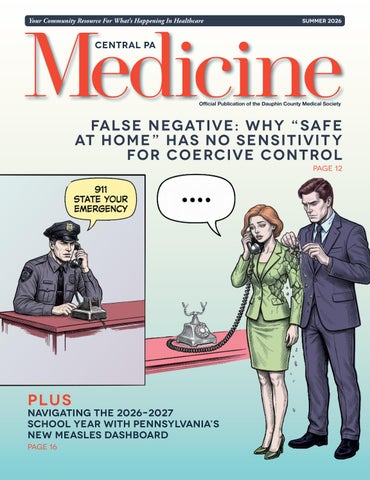
Fal s e Neg at ive: Why “ Safe at Hom e ” Has No S ens i t ivit y for Coercive Cont rol PAGE 12
PLUS
Navigating the 2026–2027 School Year with Pennsylvania’s new measles dashboard PAGE 16
Put joint pain behind you. As one of the largest orthopaedics and sports medicine programs in the nation, we know what it takes to get you back on your feet, faster. Our team of experts will work together to develop a treatment plan that’s tailored to you. We’ll provide care today so you can look forward to a pain-free tomorrow. Learn more at UPMC.com/OrthoCPA.
daup h i n c m s .o rg
Executive director’s Message
A MESSAGE FROM THE DCMS EXECUTIVE DIRECTOR, GERARD EGAN: STRENGTHENING OUR MEDICAL COMMUNITY THIS SUMMER
W
elcome to the Summer issue of Central PA Medicine! As we move through the warmest months of the year, our medical community across central Pennsylvania remains as vibrant and dedicated as ever. Whether navigating shifting public health landscapes, cultivating local educational funding, or engaging in community outreach, our members consistently demonstrate why physician leadership matters. In this issue, we spotlight three distinct yet interconnected areas that reflect the heart of our mission: community advocacy, public health vigilance, and investment in the next generation of physicians.
The Dauphin County Medical Society Alliance: Advocacy in Action Physicians rarely work in a vacuum; our ability to care for patients effectively relies heavily on the strength of our supporting network. For decades, the Dauphin County Medical Society Alliance has been an indispensable partner in advancing health education, community service, and physician family well-being throughout Central Pennsylvania. Led by a dedicated executive board, the Alliance exemplifies how grassroots advocacy translates into tangible public benefit. From organizing health literacy campaigns to supporting regional philanthropic endeavors, the Alliance continuously reminds us that healthcare extends far beyond the clinic walls. I encourage every member to explore the featured article on the Alliance’s summer initiatives and consider how your practice or household can partner with their outstanding work. Public Health Vigilance: Tracking Immunity and Prevention Public health tracking mechanisms remain critical tools for clinical decision-making. In this issue, we dive into the Pennsylvania Measles Dashboard—a timely resource developed by the Department of
Health to provide real-time epidemiological data, vaccination coverage trends, and regional monitoring for measles cases across the Commonwealth. While measles was declared eliminated in the United States decades ago, fluctuating vaccination rates and international travel continue to introduce localized outbreaks. For primary care providers, pediatricians, and emergency clinicians across Dauphin County, quick access to accurate surveillance data is essential. The PA Measles Dashboard serves as both a warning system and an educational asset, helping practice managers and physicians identify pockets of under-immunization, counsel vaccine-hesitant families, and safeguard our regional herd immunity. Investing in Our Future: Foundation of PAMED Scholarships Finally, we look toward the pipeline of medical talent that will sustain our regional healthcare infrastructure for years to come. The financial burden of medical school continues to weigh heavily on students, making scholarship support vital to keeping exceptional clinical talent right here in Pennsylvania. I urge all physicians who mentor students to spread the word about these valuable resources. Looking Ahead Whether you are catching up on reading during a well-deserved summer break or reviewing articles between patient consultations, I hope this issue of Central PA Medicine informs, inspires, and connects you to the broader mission of the Dauphin County Medical Society. Thank you for your tireless service to our patients, our practices, and our community!
Central PA Medicine Summer 2026 3
MEDICAL PROFESSIONALS PROGRAM Fulton Mortgage Company has designed a mortgage program dedicated to making homeownership easy and affordable for medical professionals1 including Physicians, Pharmacists, Dentists, Veterinarians, and Podiatrists. If you have a medical doctorate degree, this program may work for you. • 100% financing2 available for loan amounts up to $1.5 Million • 95% financing2 available for loan amounts up to $2 Million • 90% financing2 available for loan amounts up to $3 Million • Mortgage Insurance not required • Up to 6% seller paid closing cost 3 and prepaids allowed • Gift funds are allowed from immediate family members • Student loan payments that are deferred for 12 months or longer are not included in the credit approval process • Find and close on new home up to 90 days prior to start of new employment • 30 & 15 Year Fixed Rate 4 as well as Adjustable Rate5 Options (5/6, 7/6, 10/6, & 15/6)
Contact us today! ROLAND HILGERS
EVIE COLDSMITH
RYAN BRENNAN
Mortgage Sales Manager
Senior Mortgage Loan Officer
NMLS# 615627
NMLS# 1026538
NMLS# 1912835
717.418.0982
717.658.7103
443.622.5484
rhilgers@fultonmortgagecompany.com
ecoldsmith@fultonmortgagecompany.com
rbrennan@fultonmortgagecompany.com
DAN LORD
Senior Mortgage Loan Officer
Mortgage Loan Officer
NIKKI SHENK
Mortgage Loan Officer
NMLS# 490247
NMLS# 1617043
717.265.5955
717.580.5097
dlord@fultonmortgagecompany.com
nshenk@fultonmortgagecompany.com
fultonbank.com/mortgage Fulton Bank, N.A. Member FDIC. Subject to credit approval. 1Medical Doctorate degree required. Restrictions apply. 2Financing is based on the lesser of the appraised value (fair market value) or the contract sales price. Interest on any portion of the loan that exceeds the appraised value of the dwelling is not tax deductible. Please consult your tax advisor. 3Closing costs may include items such as an origination fee, title fee, credit report, flood determination, and other applicable fees. These costs typically range from 2% to 6% of the total loan amount. 4Monthly payment for a $250,000 mortgage with a 15-year term at a 6.469% Annual Percentage Rate (APR) would be $2,144. Monthly payment for a $250,000 mortgage with a 30-year term at 6.469% Annual Percentage Rate (APR) would be $1,539. Monthly payments exclude taxes and insurance, which will increase the total payment amount. 5Adjustable rates are subject to increase after the initial fixed-rate period. APR may increase after consummation. Monthly payment for a $250,000 mortgage with a 5/6 adjustable-rate mortgage (ARM) at 6.722% APR, and an initial interest rate of 6.5% would be $1,580 for the first 60 months, followed by a variable rate of 8.08% would be $1,848 for the remaining 300 months. Monthly payments exclude taxes and insurance, which will increase the total payment amount.
Central PA
Dauphin County Medical Society P.O. Box 53 • Robesonia, PA 19551
717-798-9420 • dauphincms.org
2025-2026 DCMS BOARD OF DIRECTORS Andrew Lutzkanin III, MD President Everett C. Hills, MD Secretary/Treasurer Joseph F. Answine, MD Past President
MEMBERS-AT-LARGE Michael D. Bosak, MD Robert A. Ettlinger, MD John Forney, MD John D. Goldman, MD Virginia E. Hall, MD, FACOG, FACP Saketram Komanduri, MD John C. Mantione, MD Mukul Parikh, MD Gwendolyn Poles, DO Andrew J. Richards, MD, FACS, FASCRS Jaan Sidorov, MD Andrew R. Walker, MD William Wenner, Jr., MD
EDITORIAL BOARD Gerard Egan, DCMS Executive Director Joseph F. Answine, MD, Editor in Chief Robert A. Ettlinger, MD Gloria Hwang, MD Puneet Jairath, MD Mukul L. Parikh, MD Meghan Robbins
MEDICAL STUDENTS/ RESIDENTS/PENN STATE AMA REPRESENTATIVES Denise Ocampo, President Mariya Starostina
Summer 2026
Contents Features 7
Dauphin County Medical Society Alliance Update
8
Celebrating the Future: DCMS Members Honored as 2026 PAMED Top Physicians Under 40
10
I Cannot Fix Chronic Disease
12
False Negative: Why “Safe at Home” Has No Sensitivity for Coercive Control
16
Navigating the 2026– 2027 School Year with Pennsylvania’s New Measles Dashboard
20 Investing in the Future
of Medicine: PAMED Foundation Scholarships for Dauphin County
21
Pennsylvania Passes 202627 Budget
In Every Issue Executive Director's Message . . . . . . . 3
Restaurant Review. . . . . . . . . . . . . . . . . 22
President’s Message. . . . . . . . . . . . . . . . 6 Hoffmann Publishing Group is the official publisher of the Dauphin County Medical Society’s Central PA Medicine magazine. Reading, PA | HoffmannPublishing.com | 610.685.0914
SPREAD THE WORD #PACentralMedMag FOR ADVERTISING OPPORTUNITIES CONTACT: Ad Sales | 610-685-0914 x715 | Sales@HoffPubs.com The opinions expressed in this publication are for general information only and are not intended to provide specific legal, medical or other advice or recommendations for any individuals. The placement of editorial opinions and paid advertising does not imply endorsement by the Dauphin County Medical Society. © 2026 All rights reserved. No portion of this publication may be reproduced electronically or in print without the expressed written consent of the publisher.
daup h i n cm s .org
president‘s message
BURNOUT, RESILIENCE, AND INSPIRATION
G
reetings! As some of you may know, I wear several leadership hats. This past April I was sworn in as President of the Pennsylvania Academy of Family Physicians. At that meeting, I spoke to the audience about finding inspiration in our work as physicians. In a world of ever-increasing administrative burden and decreasing trust in science, it’s easy to see why many of our colleagues are burning out and leaving medicine. Resilience, we are told, is what we all need to combat this, and thus we are all subject to online modules and grand round presentations while the root causes go unaddressed. I believe, however, that a better solution to burnout is inspiration. And so, I wanted to share today some parts of that speech: Inspiration, in our field, rarely comes as a sudden flash. More often, it’s quiet and steady. It’s in the patient who returns after a long struggle and tells you they finally quit smoking. It’s in the parent who trusts you with their child’s care year after year. It’s in the small, almost invisible moments—when listening a little longer or asking one more question makes all the difference. We also find inspiration in each other. Recently, I have been inspired by two of the medical students in our three-year accelerated program at Penn State. Chad, who grew up and went to college in rural western Pennsylvania, participated in our Rural Health Scholars program and wants to return home to practice full-spectrum family medicine with OB. After recently completing a rural OB elective, his preceptors were so impressed that they have already offered him a job. Our Family Medicine OB team is now actively brainstorming
with the residency leadership how we can continue to give Chad OB experiences as he starts his residency with us this July. Priya grew up outside of State College and originally came to medical school with plans to go into emergency medicine given her background running EMS. Lucky for us in Family Medicine, she decided to switch to the 3+ FM program as she realized what she truly loved about EMS wasn’t the medicine; it was the relationships with the patients in the small community she served. Priya is interested in how to support the transition of kids with special medical needs from pediatric to adult care and would like to join me on my next set of group home rounds. Of course, there are days when the weight of the work feels heavier than the meaning it carries. Burnout, frustration, and system pressures are real. But even then, inspiration is not gone—it’s just quieter. Sometimes it asks us to pause, to reflect, and to remember that our presence alone can be powerful. And so perhaps finding inspiration isn’t about searching for something new, but about noticing what’s already here. It’s about recognizing that in medicine, we don’t just treat illness—we witness resilience, growth, and humanity every single day. So, pay attention. Stay curious. And when you find something that sparks even the smallest sense of purpose—follow it. Because inspiration doesn’t just find us… we have to be willing to meet it halfway. There is hope. Burnout rates amongst physicians this past year have finally started showing some signs of improvement. More and more of our younger colleagues are calling out the system-level issues that have driven so many away. I find this inspiring. Stay healthy and stay inspired. Andrew Lutzkanin, MD, FAAFP President, Dauphin County Medical Society
6
Summer 2026 Central PA Medicine
daup h i n c m s .o rg
DAUPHIN COUNTY MEDICAL SOCIETY ALLIANCE UPDATE T he Dauphin County Medical Society Alliance (DCMSA) is an organization that was founded in 1826. An auxiliary to the Dauphin County Medical Society (DCMS) and comprised of physicians’ families, the DCMSA is dedicated to improving community health, supporting medical education, and engaging and contributing to charitable organizations on behalf of the medical profession.
The group raises funds and engages sponsors to support organizations whose work improves community health. A notable example is our support of the annual Children’s Mental Health Wellness Day held in Northern Dauphin County. Our volunteers attend this conference and provide information such as “Hands Are Not for Hitting” and bullying prevention. Other examples are volunteer and monetary support of the Beacon Clinic for Health and Hope and the Community Check Up Center, both in Harrisburg. We also recently supported the Kidney Foundation of Central Pennsylvania, assisting with the purchase of pulse oximeters and DASH Diet Cookbooks. Mission Central in Mechanicsburg was granted funds to clean and repair medical equipment. The Alliance has long supported the Capital Area Science and Engineering Fair (CASEF) in the medical division to honor Doctor’s Day. Our representative is present to congratulate the awardees and present certificates as well as a monetary prize.
SATURDAY
OCT. 3 9:00 AM
ROSSMOYNE BUSINESS CENTER MECHANICSBURG
For many years, the DCMSA has awarded scholarships to medical students from Dauphin and Cumberland counties who are enrolled full-time in an accredited medical school located within the Commonwealth of Pennsylvania. Recipients of this scholarship are grateful, given the high tuition of medical school. This support ensures that these students are successful in pursuing their career in medicine. The Dauphin County Medical Society Alliance is proud of its long and distinguished heritage, and its mission to support the health of our community and to encourage pre-medical and medical education in Central Pennsylvania.
Registration and sponsorhip: HomelandEvents.org/5K-MemoryWalk
Mary Simmonds, DCMSA President-elect For more information about the Dauphin County Medical Society Alliance, go to https://dauphin-county-medical-societyalliance.square.site/.
A Commitment to Excellence since 1867 Central PA Medicine Summer 2026 7
daup h i n cm s .org
FEATURES
CELEBRATING THE FUTURE: DCMS MEMBERS HONORED AS 2026 PAMED TOP PHYSICIANS UNDER 40
8
Summer 2026 Central PA Medicine
daup h i n c m s .o rg
A
cross Pennsylvania, medicine is being shaped by a new wave of physicians who possess both clinical skill and a deeply human approach to care. Healthcare continues to face real pressures, from workforce shortages and physician burnout to the rapid arrival of new technologies. In that environment, early-career leaders bring fresh perspective, adaptability, and a clear sense of purpose to both clinical practice and the broader future of medicine. Each year, the Pennsylvania Medical Society (PAMED) spotlights some of those rising leaders through its Top Physicians Under 40 awards. In 2026, two Dauphin County Medical Society (DCMS) doctors—Jennifer Cooper, MD, and Kevin Wile, MD—earned a place among the 28 honorees, recognized for work that reflects the promise and purpose of modern internal and family medicine.
it comes to prevention. He practices at Penn State Health Medical Group – Middletown. From wellness visits and acute illnesses to coordinating specialized care, family medicine physicians help keep healthcare personal, accessible, and connected to the everyday realities of patients’ lives. MEETING CENTRAL PENNSYLVANIA WHERE IT LIVES
Dr. Cooper and Dr. Wile both serve patients in Dauphin County, a region where urban neighborhoods, suburban communities, and rural areas often intersect in the same healthcare systems. As primary care and internal medicine physicians, they are often the first point of contact for patients—helping manage chronic conditions, encourage preventive care, and make complicated health decisions feel a little more navigable. The PAMED Top Physicians Under 40 award is DR. JENNIFER COOPER: PRECISION, PARTNERSHIP, AND more than a career milestone. It reflects the respect of INTERNAL MEDICINE peers, a record of strong clinical judgment, leadership In internal medicine, the details matter. As an within the profession, and a steady commitment internist and hospitalist, Dr. Jennifer Cooper’s work to advocating for patients. Chosen from nominees centers on diagnosing, treating, and helping prevent across the Commonwealth, the honorees represent complex adult illnesses—an area of medicine that the kind of dedication that matters at a moment when calls for both careful analysis and a broad view of healthcare is evolving quickly. the whole patient. Affiliated with Penn State Health The 2026 PAMED Top Physicians Under 40 list is a Milton S. Hershey Medical Center—where she reminder that Pennsylvania’s medical future is already also serves on the faculty as an assistant professor taking shape in exam rooms, clinics, and communities in the Division of General Internal Medicine—her across the Commonwealth. By honoring physicians areas of expertise include care for people managing under 40, PAMED draws attention to the energy overlapping conditions such as diabetes, hypertension, and commitment moving local healthcare forward. and cardiovascular disease, where each decision can In Dauphin County, doctors such as Cooper and shape long-term health.1 Wile are helping shape a model of care that values Her recognition by PAMED points to a practice prevention, collaboration, and the relationships rooted in comprehensive, evidence-based care. patients build with the clinicians they trust. But internal medicine today is not only about Through their work in internal and family medicine, diagnosis; it is also about partnership. Through clear Dr. Jennifer Cooper and Dr. Kevin Wile reflect communication and empathetic guidance, physicians the best of patient-centered care—and the kind of like Dr. Cooper help patients understand their options, leadership that leaves a lasting mark close to home. take an active role in their care, and build healthier lives over time. DR. KEVIN WILE: FAMILY MEDICINE WITH A PERSONAL TOUCH Nominations for the 2027 PAMED Top Physicians For Dr. Kevin Wile, family medicine is built on Under 40 are open! Go to https://www.pamedsoc.org/ continuity—the kind of care that follows patients membership/awards to learn more about how you can through different ages, stages, and seasons of life. recognize the next generation of medical talent! A faculty member at Penn State Health Milton S. Hershey Medical Center—where he also completed his residency—Dr. Wile is the director of the Lifestyle REFERENCES: Medicine Area of concentration. A dedicated educator, 1. https://health.usnews.com/doctors/jennifercooper-1159984 he is involved with all levels of medical learning.2 Dr. Wile’s place on PAMED’s 2026 list underscores 2. https://med.psu.edu/departments-faculty/ the critical value of primary care, especially when directory/kevin-wile Central PA Medicine Summer 2026 9
daup h i n cm s .org
FEATURES
I CANNOT
fix CHRONIC DISEASE By JOSEPH F. ANSWINE, MD, FASA
A
s an anesthesiologist, I see many patients with chronic diseases such as hypertension, diabetes, and coronary artery disease. When they come to the operating room, it is neither appropriate nor safe to make a chronically hypertensive patient with an average blood pressure of 160/90 mmHg acutely 110/60 mmHg. Nor a diabetic with an A1C of 11% and a fasting glucose of 225 mg/dl acutely 90 mg/dl. Sudden changes such as these would create a dangerous reduction in organ perfusion and glucose delivery to the cells. Our bodies try to adapt to chronic disease. I commonly tell residents and students that we should leave such treatment to the primary care physicians. However, I can and must treat acute changes that may affect surgical outcomes. Furthermore, some chronic abnormalities may be appropriate to treat. One example is chronic hypokalemia, or low potassium. 10 Summer 2026 Central PA Medicine
Why? I will explain later in the article. So, what should be fixed in an individual with one or many comorbidities? Anemia is a good example, especially if significant blood loss is expected. But what would be our endpoint before surgery? Well, it depends. Don’t you love that answer? But it is true. Let’s say the person is otherwise totally healthy. A normal hemoglobin (Hgb) may be 14 g/dl. If the Hgb is now 7 g/dL, the individual would have to double their cardiac output, or the delivery rate of blood to the organs, to maintain the same oxygen delivery. A healthy person can do that. But a sick older person cannot; therefore, a safe pre-surgical level would be 10 g/dl, so that should be our goal. Hypokalemia (below 3.5 mEq/l) is a common preoperative finding. Yes, patients
are walking around frequently with levels below that and do just fine. But anesthesia and surgery are different than our usual life. They are a total disruption of our normal homeostasis. Our acid/base balance is altered, stress hormones are released, blood pressure quickly goes up and down, and medications that affect the heart are administered throughout. Adding a low potassium dramatically increases the risk of a cardiac arrhythmia during the perioperative period. So, raising the potassium levels to at least 3.0 mEq/l if not 3.5 mEq/l is a must. Abnormal glucose levels are a common problem before surgery. At least 12% of the US population is diabetic. Many are undiagnosed before surgery. I said at the beginning that we shouldn’t try to achieve normal fasting levels, but current recommendations state that glucose levels should be maintained between 140 mg/ dl and 180 mg/dl to avoid symptomatic hypoglycemia and hyperglycemia leading to
daup h i n c m s .o rg
poor wound healing and infection, as well as short- and longterm increased mortality. So, treatment likely with a continuous infusion of insulin is essential before and throughout surgery, We talked about the importance of not normalizing the blood pressure of a chronically hypertensive patient during surgery, but that doesn’t mean that we do not treat dangerously high levels. Most studies show that a level above 180/110 mmHg could lead to acute organ damage. Therefore, if the risk of canceling surgery is too high, then preoperative and intraoperative reduction to safer levels may be warranted. Now, I didn’t say to reduce it to what one would consider normal levels. Just reduce it to where end-organ damage is unlikely. The level to achieve is very patient dependent. Many patients that come to the operating room have atrial fibrillation. Putting a patient back into sinus rhythm before surgery would likely be unsuccessful and potentially quite dangerous if they have a hidden blood clot in their heart. But that doesn’t mean that the patient should come to the operating room tachycardic (a heart rate above 100 beats per minute for an adult). A rapid ventricular response (RVR) leading to significant tachycardia is common in a patient with chronic atrial fibrillation when acutely stressed by injury or illness. That tachycardia should be reduced and controlled preoperatively to minimize intraoperative blood pressure instability, coronary ischemia, heart attack, acute congestive heart failure, and death. Starting treatment during surgery is likely too late to avoid the cascade of events leading to major cardiac morbidity. Many of our surgical patients suffer from cognitive decline, but acute changes in mentation or delirium should be evaluated and treated accordingly before surgery. Surgery is typically delayed until the underlying cause of the delirium, such as infection, dehydration, or electrolyte imbalance, is identified and treated; otherwise, it will likely negatively affect surgical outcome. Furthermore, anesthesia undoubtedly will worsen the delirium, leading to a significant delay in postoperative recovery and likely causing further long-term cognitive changes.
hemodynamic instability intraoperatively. The massive fluid shifts that can occur during a major surgical procedure will only worsen an already existing fluid imbalance. Preoperative treatment may include intravenous crystalloid solutions or blood products depending on patient needs.
A close relationship with our medicine friends is much more common than years ago when the void between medicine and surgery seemed insurmountable. Their input and preoperative intervention are invaluable. A patient with stable coronary artery disease probably would not benefit from cardiac intervention before surgery except for those procedures expected to create major hemodynamic instability. However, patients with resting angina or angina equivalents such as shortness of breath at rest would benefit from cardiac evaluation and preoperative optimization. Many other patient-specific abnormalities should be treated before undergoing the stresses of anesthesia and surgery. A close relationship with our medicine friends is much more common than years ago when the void between medicine and surgery seemed insurmountable. Their input and preoperative intervention are invaluable. Again, as an anesthesiologist, I cannot treat all of the patient’s chronic diseases, nor would it be healthy for the patient during surgery. However, there are many abnormalities, as stated above, that should be corrected before being wheeled into an operating room.
Chronic congestive heart failure will likely not lend itself to improvement before surgery, but an acute exacerbation of congestive heart failure should be treated. Anesthetics, surgical stress, and major fluid shifts will increase cardiac demand, which will lead to further cardiac failure in the acutely stressed and failing heart. Whether treatment is diuresis or optimizing medical management, this should be done, and the patient should be stabilized before going to the operating room. We discussed potassium abnormalities; however, many other electrolyte abnormalities such as hyponatremia, abnormal calcium levels, and abnormal magnesium levels should be treated safely and appropriately before undergoing the stress of surgery. Dehydration should be assessed and treated accordingly prior to going to the operating room to avoid significant Central PA Medicine Summer 2026 11
daup h i n cm s .org
FEATURES
FALSE NEGATIVE:
WHY “SAFE AT HOME” HAS NO SENSITIVITY FOR COERCIVE CONTROL The Screening Question That’s Been Failing for Years—and What to Ask Instead
Disclaimer: Based on my three years as a full-time domestic violence advocate working exclusively with female survivors and male perpetrators, I use “he” to refer to the perpetrator and “she” for the survivor throughout this piece. This reflects my direct experience—it is not a claim that abuse follows this pattern universally. Intimate partner violence affects people of all gender identities, and abusers and survivors exist across every kind of relationship.
ARTICLE AND ILLUSTRATIONS BY MARIYA STAROSTINA 4TH-YEAR MEDICAL STUDENT, PENN STATE UNIVERSITY COLLEGE OF MEDICINE
B
efore I worked as a domestic violence advocate, ask me to sketch an abuser, and you’d have gotten a stock photo: angry man, stained “wife-beater,” beer in one hand, his other hand balled into a fist.
Yet, after working for three years at the nation’s only domestic violence (DV) organization that primarily supports women from middle- to upper-income communities, I learned that sketch belonged back at the drawing board, or better yet, referred out and never followed up on.
Take Yeardley Love. She and her boyfriend, George Huguely, were both standout Division I lacrosse players at the University of Virginia, weeks from graduation, when he killed her.
More recent, and louder, is Gabby Petito, strangled to death by her fiancé, Brian Laundrie, who framed it as a “mercy killing” to end her suffering after a bad fall in the wilderness. 12 Summer 2026 Central PA Medicine
Then there’s the story that shook Silicon Valley. Neha Rastogi is a well-educated, financially independent mother and a successful engineer who spent years at Apple working on tools like Siri and FaceTime. She was abused for more than a decade by her husband, Abhishek Gattani, then-CEO of the startup Cuberon. Rastogi secretly recorded some of the abuse herself, footage that would later show her husband hitting her with their two-year-old daughter in the room. He was sentenced to 30 days. He served about half of that. There’s also Gurbaksh Chahal. He sold one of his companies to Yahoo for $300 million, donated PPE and ventilators to hospitals during the pandemic, and opened a foundation to support hate crime victims. Single, successful, generous, he was crowned America’s Most Eligible Bachelor. He was also caught on camera kicking his girlfriend 117 times in 30 minutes. The charges were dropped, though not for lack of evidence. The video had been seized without a warrant, on the fear that a man who’d built his fortune on tech savvy could wipe it clean in seconds. He walked. The pattern did not. The following year, he was accused of assaulting another girlfriend.
daup h i n c m s .o rg
An athlete, a CEO, a tech mogul: pedigree enough to disarm anyone paying attention. Which was exactly the point. None of them looked like the men you should warn your daughter about. And if the abuser is this hard to spot, what about the victim? (I use victim and survivor interchangeably throughout, on purpose. My experience has shown me that not all of them survive.) Can we even predict who becomes a victim? Not reliably, the research says. Decades of studies have tried to trace it back to something, whether that’s family background, education, or personality. Lundy Bancroft, who has spent a lifetime counseling and writing about men who abuse their partners, sums it up in one line: the only risk factor that holds up is being a woman. In fact, most of the survivors I worked with came from secure, loving, two-parent homes. They were educated and successful, working as: • Nurses • Doctors • Engineers • Lawyers • Teachers • Psychologists • Stay-at-home moms Their partners were: • Doctors • Engineers • Lawyers • CEOs • Business owners • Account executives • Even religious leaders
That list alone should put to rest the notion that abuse is a product of poverty or a lack of education. “I don’t get it,” people would say. “She has everything. She’s not exactly helpless. What’s stopping her from leaving?” I hear some version of that question constantly. Susan Weitzman writes about this in her book Not to People Like Us. She calls out the assumption that women with money and status have the power to simply leave. That assumption is why these women are doubted, or even mocked, instead of helped. The real reason they stay isn’t money. It’s coercive control. Coercive control—a pattern of intimidation, isolation, manipulation, and surveillance used to dominate a partner. That definition is accurate. But it doesn’t tell you that “isolation” might mean moving somewhere new for “a fresh start,” two states away from everyone who knows you, or that “intimidation” can be a voice that gets quieter, not louder, right before it gets worse. To understand coercive control, let’s start with what everyone already recognizes. Hitting. Choking. Beating. Patient in the ER, with bruises on the stomach from “tripping and falling.” Most people see that and think, yes, that’s abuse, maybe even 30 days in jail. In contrast, coercive control doesn’t show up as an ER admission. It isn’t a stroke, sudden enough to call 911 over. It’s the plaque that builds for years before it ever causes one. It is sophisticated enough to pass for concern. Calculated enough to be mistaken for love. CONTINUED ON NEXT PAGE Central PA Medicine Summer 2026 13
daup h i n cm s .org
FEATURES
Take privacy. A partner saying, “Let me see your phone, I want to check who you are texting” presents like a clear boundary violation—most people would flag it immediately. Now reframe it as “Couples who have nothing to hide don’t need privacy from each other. Why does transparency scare you?” Somehow, the same demand sounds like living proof of commitment instead of control. Refusing to hand over the phone starts to read as withholding now. So, the phone changes hands. Self-reflection is a strength—which is exactly why coercive control targets it. In response to his wife asking for more
quality time, an overtly dismissive partner says, “Get a life, you’re being needy.” A calculating one reaches for therapy language instead: “You might want to ask your therapist about this. Always wanting more time together sounds like your attachment style acting up again.” This line succeeds because it’s aimed at someone reflective, someone who takes criticism seriously instead of pushing back. It works because it doesn’t provoke anger— it provokes doubt. Instead of asking “why won’t he give me what I need,” she starts asking “what’s wrong with me that I need this?” He comes across as the rational one. She starts to seem like the problem.
In our work with survivors, we didn’t retire the standard screening tools—we recalibrated them, translating the language into something a coercive control survivor would recognize. Ask “Has your partner ever harmed you physically?” and coercive control returns a false negative nearly every time. Ask instead whether he has a certain look—one that cuts straight through you when he’s angry—and the test finally has sensitivity. Every survivor knew exactly the look. Many had their own names for it: the demonic look. Like his soul left his body. Darkness in the eyes.
Then the question this entire piece is named after: do you feel safe at home? Most of our survivors said yes. And meant it. That’s the diagnostic problem with coercive control: it’s subtle enough that many women live inside it for years without recognizing the condition, not until it decompensates. Ask it differently—do you think your partner is capable of hurting or killing you?—and the response, almost universally, was some version of absolutely. Think of coercive control less as a symptom of physical violence and more as its own disease process—with a lethality risk all its own. That distinction matters, because coercive control almost never announces itself the way a black eye does. It stays invisible right up until it isn’t—which is why you always hear the same thing afterward: they seemed like such a perfect family. I can’t believe he killed her. 14 Summer 2026 Central PA Medicine
It also, quietly, becomes a medical issue long before it becomes a headline. Roughly 40% of the survivors I worked with had been strangled by a partner to the point of losing consciousness—usually during sex—and were left with chronic headaches, and in some cases, strokes. Many of the women I worked with, women in their 30s, 40s, and 50s, were also managing heart failure, cancer, or debilitating autoimmune disease. The ACE studies, now nearly 30 years old, established the link between a child’s environment and their lifelong health. I’d argue the mind doesn’t care whether the damage came from childhood or marriage. Trauma doesn’t read a birth certificate. The scar tissue doesn’t ask who caused it.
daup h i n c m s .o rg
Credentials, it turns out, can double as weapons. One of the survivors I worked with was in the process of leaving her husband, a physician, when—over dinner one night, apropos of nothing—he said, “Do you know there are 40 ways to kill a woman and make it look like she died of natural causes?” He never said he’d hurt her. He never said he’d drive over her with a truck one afternoon. But to her, the message was loud and clear. “If I call the police,” she asked me, “what am I supposed to say? Officer, he’s chipping away at my soul?”
Fair question. There is no statute for soul erosion. You cannot subpoena a feeling. That was exactly why our mission was to train police officers, physicians, and lawyers to recognize coercive control before it needed a body as proof.
Ask if a partner has ever used a “weapon,” and most people picture a knife or a gun—so the real answer gets away clean.
Ask instead whether he’s ever sped up or swerved dangerously when asked to slow down, with her or the kids in the car.
95% said yes.
Nobody thinks of putting the family car on the list of things that can hurt you.
Dozens of women I worked with were relieved to realize that whatever they’d been calling “crazymaking” had a name. To them, abuse was, quite literally, what the screening measured—getting physically hurt or being afraid to go home. At their physician’s office, they tested negative for both. By that measure, they didn’t qualify—so whatever they were feeling never got a name either. Statistically, whether you’re a dentist, a PCP, or the surgeon who saw her once for an appendix, you’ve already treated someone living through this. Some of these women, you already know by name. They keep showing up for rounds, charting next to you, matching your pace down the hallway, laughing at the right moments. More than that isn’t mine to tell. I hope we start treating these quieter signs—the isolation, the surveillance, the offhand comment about “40 ways”—with the same seriousness we give a woman hit 117 times in 30 minutes. These are not two different stories. Just two different chapters of the same book.
Central PA Medicine Summer 2026 15
daup h i n cm s .org
FEATURES
NAVIGATING THE 2026–2027 SCHOOL YEAR WITH PENNSYLVANIA’S NEW MEASLES DASHBOARD 16 Summer 2026 Central PA Medicine
daup h i n c m s .o rg
A
s Pennsylvania pediatricians, family physicians, and school health personnel prepare for the upcoming 2026–2027 school year, they will be able to take advantage of a new community health trends tool. With over 114 confirmed cases of measles recorded across the Commonwealth so far in 2026, the threat of widespread transmission in school settings is a pressing clinical concern. In response to this potential community health threat, on July 14, Governor Josh Shapiro and the Pennsylvania Department of Health (DOH), led by Secretary of Health Dr. Debra Bogen, launched a new online dashboard focused on tracking measles cases. “This new measles dashboard is part of the Shapiro Administration’s commitment to boost public access to information and provide transparency in our work to protect public health,” noted Dr. Debra Bogen. “We continue working tirelessly to contain the spread of this highly contagious virus among people who are not vaccinated.”1
WHAT THE NEW DASHBOARD DELIVERS Updated every Monday, Wednesday, and Friday afternoons, the new platform provides real-time, transparent data designed to inform clinicians, school leaders, and families alike. The dashboard offers granular detail, such as case details on county, age, and hospitalizations for measles throughout Pennsylvania. Key data points integrated into the public interface include: • County-Level Mapping: Tracking active and historical confirmed cases geographically, highlighting local hot spots. • Demographic Breakdown & Age Profiles: Highlighting vulnerable cohorts, particularly infants and school-aged children. • Vaccination Status & Hospitalization Rates: Outlining the clinical severity and immunization history of confirmed cases. (Over 90% of cases nationwide and in Pennsylvania continue to occur among unvaccinated or under-vaccinated individuals). • Public Health Interventions: Documenting state-led outreach efforts, including local Measles, Mumps, and Rubella (MMR) vaccination totals administered by state health centers and pop-up clinics. Continued on next page
Central PA Medicine Summer 2026 17
daup h i n cm s .org
FEATURES
TRANSLATING PUBLIC DATA INTO CLINICAL PRACTICE Measles (rubeola) remains a highly infectious human pathogen, carrying a basic reproduction number (R0) between 12 and 18.2 In Pennsylvania, MMR vaccination rates for kindergarten students are around 94% for the state. Per the DOH School Immunization Summary for the 2023-2024 school year, Dauphin County’s MMR kindergarten vaccination rate was around 88%; there are some counties with rates as low as 84%.3 In a classroom where herd immunity drops below the requisite 95% threshold, a single imported case can rapidly ignite secondary transmission chains. The state dashboard serves three immediate clinical functions: 1. Targeted Recall and Catch-Up Immunization By cross-referencing county dashboard trends and upcoming school-level coverage data with internal Electronic Health Record (EHR) registries, practices can proactively identify pediatric patients missing their first (12–15 months) or second (four–six years) dose of the MMR vaccine.
2. Early Infant Protection Guidance In areas experiencing active community transmission, standard immunization schedules may be adapted under DOH guidance. Providers are encouraged to evaluate infants aged six through 11 months for an early, off-schedule MMR dose if traveling internationally or residing in high-risk local environments. (Note: Infants receiving an early dose before 12 months of age will still require two standard doses starting at age one.) 3. Triage and Environmental Infection Control With respiratory viral season approaching alongside back-to-school checkups, triage protocols are critical. Front-desk staff and clinical teams should utilize dashboard data to assess local prevalence when screening patients presenting with classic symptoms: high fever, cough, coryza, conjunctivitis, and the pathognomonic Koplik spots preceding an erythematous maculopapular rash. Suspected cases should be isolated immediately in negative-pressure rooms—or evaluated outside the facility—to prevent waiting room exposures. BUILDING VACCINE CONFIDENCE IN THE EXAM ROOM While transparent data is essential, public health data alone does not administer vaccines—strong physician-patient relationships do. Physicians remain the most trusted messengers for vaccine-hesitant parents navigating complex health decisions. The surge in regional cases—such as the localized outbreak in Lancaster County, where public health staff administered three times as many MMR vaccinations than in all of 2025 in response—demonstrates that accessible information combined with local clinical availability can reverse declining coverage trends.
daup h i n c m s .o rg
When counseling families concerned about school vaccine Department of Health Measles Dashboard. For healthcare providers requirements, clinicians can leverage dashboard findings to ground across central Pennsylvania, this initiative represents more than discussions in local realities: just another public health tool; it is an actionable asset for clinical • Frame vaccination as community protection: Emphasize that decision-making, patient advocacy, and outbreak containment as high school-level MMR coverage protects immunocompromised children return to the classroom.
classmates, infants too young to be vaccinated, and pregnant By integrating local epidemiological data into open, compassionate teachers. dialogue with patient families and through vigilant clinical screening • Highlight safety and efficacy data: Reassure parents that and dedicated immunization efforts, the regional medical community two doses of MMR are 97% effective at preventing measles can ensure schools remain safe, healthy environments for every child. infection and most people receiving the vaccinations will be The PA DOH Measles Dashboard is available at https://www.pa.gov/ protected for life. agencies/health/diseases-conditions/infectious-disease/measles.
• Normalize routine catchups: Address missed well-child visits during early childhood years by framing immunization as a REFERENCES: routine, empowering step toward back-to-school readiness. 1. https://www.pa.gov/agencies/health/newsroom/shapiroadministration-launches-measles-dashboard, July 14, 2026. LOOKING AHEAD: A UNITED FRONT FOR CENTRAL PA COMMUNITY HEALTH 2. Guerra FM, Bolotin S, Lim G, Heffernan J, Deeks SL, Li Y, The launch of the DOH measles dashboard comes at a pivotal Crowcroft NS. The basic reproduction number (R0) of measles: a junction for Pennsylvania’s healthcare infrastructure. Although systematic review. Lancet Infect Dis. 2017 Dec;17(12):e420-e428. the DOH currently provides school vaccination data—available doi: 10.1016/S1473-3099(17)30307-9. Epub 2017 Jul 27. online—at the state and county levels, allowing families access PMID: 28757186. to necessary information to make personal health and education decisions, physicians are encouraged to bookmark the Pennsylvania 3. School Immunization Survey Summary by County 2023-2024, PA DOH, October 3, 2024.
REFER YOUR PATIENTS TO THE EYE CARE SPECIALISTS
YouTrust! EXPERT CARE. TRUSTED RESULTS.
CENTRAL PENNSYLVANIA’S EYE CARE EXPERTS
MULTIPLE PHYSICIANS NAMED CASTLE CONNOLLY TOP DOCTORS
Board-certified ophthalmologists specializing in cataracts, cornea, retina, glaucoma, oculoplastics, pediatric ophthalmology, and more. Experienced optometrists and optical shops at every location. Refer your patients today!
TOP 5 EYE CARE PRACTICE IN PA - CASTLE CONNOLLY
(717) 272-2161 • eyeconsultantsofpa.com
Central PA Medicine Summer 2026 19
daup h i n cm s .org
FEATURES
INVESTING IN THE FUTURE OF MEDICINE:
PAMED FOUNDATION SCHOLARSHIPS FOR DAUPHIN COUNTY
T
he rising cost of medical education remains one of the most formidable hurdles for aspiring physicians across the Commonwealth. With medical school debt often reaching six figures, financial assistance is a vital tool for keeping talent local.
The Foundation of the Pennsylvania Medical Society (PAMED) offers medical students in Pennsylvania access to scholarship opportunities designed to relieve financial stress and foster future leaders in medicine. For students in Dauphin County—particularly those training at Penn State College of Medicine in Hershey—the Scott A. Gunder, MD, DCMS Presidential Scholarship provides a dedicated local opportunity, while several statewide and Penn State-specific programs offer additional support. THE FLAGSHIP LOCAL AWARD: THE SCOTT A. GUNDER, MD, DCMS PRESIDENTIAL SCHOLARSHIP The cornerstone award for Dauphin County’s next generation of physicians is the Scott A. Gunder, MD, DCMS Presidential Scholarship. Established in October 2000 by the Dauphin County Medical Society (DCMS), this scholarship honors the memory of Dr. Scott A. Gunder, a respected Harrisburg gastroenterologist and clinical assistant professor of medicine who served as president of DCMS before passing away from cancer at age 39.
ADDITIONAL SCHOLARSHIP OPPORTUNITIES In addition to the Gunder Scholarship, medical students training in Dauphin County may qualify for broader programs administered by The Foundation of PAMED, depending on each award’s eligibility requirements:
Dr. Gunder envisioned a fund that would give back to the medical community while recognizing the leadership of DCMS presidents. His legacy lives on through an annual award to one second-year medical student at Penn State College of Medicine at the Milton S. Hershey Medical Center, where Dr. Gunder taught.
• Alliance Medical Education Scholarship (AMES): Awarded to second- or third-year medical students who are PA residents enrolled full-time at an accredited Pennsylvania medical school, AMES awards assist students across the state with tuition and educational expenses.
Key Eligibility Criteria • Target Audience: One second-year medical student enrolled full-time at Penn State College of Medicine. • Residency Requirement: Applicants must be U.S. citizens and bona fide Pennsylvania residents for at least 12 months before registering as medical students, excluding time spent attending an undergraduate or graduate school in Pennsylvania. • Membership: Must hold membership in the Pennsylvania Medical Society and county medical society. • Selection Factors: Evaluated on academic achievement, integrity, interpersonal skills, and potential as a future leader in clinical practice.
20 Summer 2026 Central PA Medicine
• Dr. Satish and Rupal Shah Family Scholarship: Designed specifically for medical students attending Penn State College of Medicine, this fund assists students who demonstrate strong academic standing and dedication to the medical profession.
• Foundation Education Award and the Saryu and Jitu Desai Foundation Scholarship: The Foundation Education Award supports a medical student who demonstrates economic hardship and a strong commitment to medically underserved communities. The Saryu and Jitu Desai Foundation Scholarship supports second-, third-, or fourth-year medical students who demonstrate sustained community service, particularly through healthcare-related volunteerism, advocacy, or leadership in underserved populations.
For a complete listing of scholarships, including eligibility information and application requirements and deadlines, go to https://www.foundationpamedsoc.org/scholarships.
daup h i n c m s .o rg
PENNSYLVANIA PASSES
2026-27 BUDGET F
ollowing a 12-day impasse, Governor Josh Shapiro signed a bipartisan compromise $50.85 billion state budget for FY 2026-27. The spending plan, passed by the Pennsylvania General Assembly and signed into law on Sunday, July 12, increases overall spending by about 3.7% without taking any of the state’s $8 billion Rainy Day Fund and avoiding any new or increased broad-based taxes. To balance the budget without new sources of revenue or transferring Rainy Day Funds, lawmakers shifted $500 million from off-budget special funds and deferred $1.3 billion in recurring Medicaid managed care costs into the next fiscal year.
You may recall that in 2017, the General Assembly passed legislation requiring the Joint Underwriting Authority (JUA) to transfer $200 million in surplus funds to the General Fund. The JUA is Pennsylvania’s legislatively established malpractice insurer of last resort and provides a way for physicians to buy malpractice insurance who are unable to do so through regular insurance providers. The JUA filed litigation opposing this legislation, with PAMED and the AMA submitting briefs in support. After years of litigation, the U.S. Third Circuit Court of Appeals ruled that the JUA is a public entity and the Commonwealth has broad authority One element of significance to PAMED is the Primary Health to oversee the JUA and transfer funds as it deems appropriate. Care Practitioner line-item administered by the Department of After the U.S. Supreme Court denied review, in August 2025 the Health. This line-item provides the funding for the physician Commonwealth of Pennsylvania transferred the $200 million loan repayment program and the state-funded residency program, from JUA to the General Fund. and this budget continues the increased level of funding achieved With that legal question settled, in November 2025, as part over the past several budget cycles. Some additional significant of the 2025-26 PA Budget’s Fiscal Code legislation, the General elements include: Assembly transferred another $100 million from the JUA to the General Fund to help close the funding gap for medical assistance Health and Human Services —Mental health services see an payments. As part of that legislation, the JUA was also restructured, increase of $41 million, including $10 million for the 988 network and now each June the Commissioner of the Department of and $5 million for walk-in crisis stabilization clinics. Rape crisis Insurance is required to report to the General Assembly on the centers receive a $12 million increase over last year. amount of funds in excess of the minimum operational reserves Education —Education receives $678 million in new funding, needed for that year. That amount is then available to be transferred including $565 million for underfunded schools, $58 million for to the General Fund. basic education, and $55 million for special education. In June, the Commissioner reported that the JUA had $14.3 Infrastructure —A new Rapid Bridge and Road Deployment million available to transfer to the General Fund. As part of the Program receives $775 million to fast-track shovel-ready transit 2026-27 PA Budget enacted on July 12th, the Fiscal Code bill, projects. SB 146, included a transfer of $14.3 million from the JUA to the General Fund. PAMED has in the past and continues to oppose Taxpayer Relief —Provides $216.7 million for low- and middleany transfers of funds from the JUA. However, it is important to income workers via The Working Pennsylvanians Tax Credit. note that the only funds the JUA has come from premiums paid Corporate Tax Reductions —Maintains the scheduled phase- by physicians using the JUA and from earnings on investments down of the Corporate Net Income Tax leading to a target 4.99% made by the JUA. No MCARE Fund monies are involved. by 2031. Biotechnology and Innovation —Establishes the “Innovate in This article is from PAMED, July 15, 2026, https://www.pamedsoc. PA 2.0” initiative, providing $125 million in capital to support org/news-resources/news-and-resources/article/pennsylvania-passesbiotechnology startups and fund clinical trials for the life sciences. 2026-27-budget. Childcare Support —Provides $30 million for childcare worker retention and recruitment bonuses. Central PA Medicine Summer 2026 21
daup h i n cm s .org
RESTAURANT REVIEW By ROBERT A. ETTLINGER, MD
T
his year-old eatery on N. Mountain Road, about a mile north of exit 72 on Rte. 81, recently received more than one comment on social media sites about its great food and “authenticity.” Based on a Yelp survey (I know...not very scientific) in which it won the most votes for being the best Chinese restaurant in the area, it at least justified a visit to see what all the fuss was about. Categorizing a place as being authentic vs. Americanized does not fully imply that the food many of us know as being Chinese is not delicious, because it certainly is. Like authentic Italian food morphed into strip mall pizzerias in America, and real Mexican went Tex-Mex and Taco Bell, Chinese food also carries a story about how it changed into the little take-out places with white boxes containing rice and beef lo mein. The Chinese immigration wave to the West Coast in the mid19th century was partly prompted by a need for cheap labor for the evolving railroad and mining industries in the Western frontier. Due to fears of job competition with European Americans from immigrants with a vastly different culture, President Chester A. Arthur signed into law the Chinese Exclusion Act in 1882. This law prohibited additional Chinese immigration, denied citizenship to those already here, and mandated strict documentation requirements. Until the law and its extensions were repealed in 1943, Chinese in America were shunned by society and were often the victims of isolation and violence. Because of the inability to assimilate and to obtain much in the way of housing and jobs, they were largely concentrated into the Chinatown districts of many cities, where they could set up their own businesses and survive in a segregated community. As they spread eastward from the coast, their food offerings became more dependent 22 Summer 2026 Central PA Medicine
YI PIN HONG
on what was available and affordable, and restaurants were destined to cater to American tastes. This caused their cuisine to transform into something other than the food habits and ingredients from their homeland. The culinary features of Szechuan, Mandarin, Cantonese, and Hunan cooking lost access to many Chinese spices, herbs, and other ingredients. To stay in business, they offered “Western” elements like beef, wheat, sweet sauces with corn starch, and the ever-present fried foods like egg rolls. Interestingly, a sharp rise in the number of Chinese restaurants in the USA followed Nixon’s historic visit to China. Looking at the menu, you’ll see that Yi Pin Hong serves the real deal. Their prime serving style is Szechuan, originating in southwestern China and typified by relative spiciness and an emphasis on color and freshness. Our table shared generous portions of walnut shrimp, toothpick lamb, orange chicken, beef with cumin, a beautiful crispy whole fish with a sweet and sour sauce, and dim sum platters of pork buns and shrimp dumplings. The extensive menu has unique choices that include dry pots, multiple soups, and dim sum appetizers, plus a full page of whole fish dishes. For the very adventurous, a few items feature kidney, lamb, pig’s feet, rabbit, and even frog legs. Personally, I’ll pass on most of those, but I look forward to trying some of the distinctive and manifold others. If the only Chinese food you’ve ever tasted is the stuff in the white paper boxes and the cans of La Choy Chow Mein, this is the place to broaden your horizons.
YI PIN HONG 1031 N. Mountain Road Harrisburg, PA 717-651-1098 Open daily 11 a.m. - 9:30 p.m. Closed Wednesdays
WE’RE THE REASON YOUR COMPETITOR LOOKS SO GOOD. They didn’t get lucky. They called MADJ. Want in? Level the playing field at madjmarketing.com
SCAN HERE TO LEARN MORE
marketing
Creating a group lifestyle medicine program for spine pain Virtual group visits are making lifestyle medicine more accessible and effective for patients with neck and back pain. The visits meet individual needs while offering in-depth education and a support group setting.
Get an inside look at our program.