Your Community Resource For What’s Happening In Healthcare
Fall 2026
Official Publication of the Dauphin County Medical Society
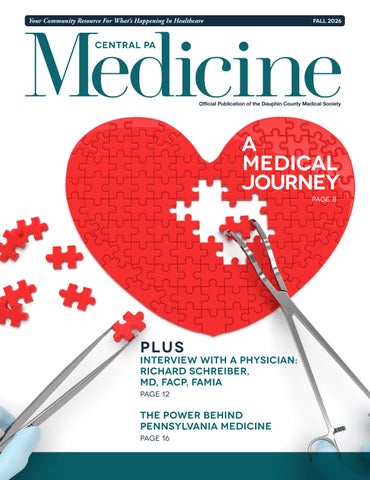
A Medical Journey PAGE 8
PLUS
Interview with a Physician: Richard Schreiber, MD, FACP, FAMIA PAGE 12
The Power Behind Pennsylvania Medicine PAGE 16
Get back to the swing of it.
Make primary care your primary call. Your primary care provider understands your active lifestyle and can help you come up with a plan to make sure you enjoy your time with those you care about. See how convenient staying healthy can be with online scheduling and virtual appointments. For chronic, minor, and complex conditions, find care that’s close to home and schedule now at UPMC.com/PrimaryCare.
daup h i n c m s .o rg
Executive director’s Message
A MESSAGE FROM THE DCMS EXECUTIVE DIRECTOR, GERARD EGAN: UNIFYING OUR VOICE AND BUILDING OUR FUTURE
A
s 2026 comes to a close, I find myself reflecting on the remarkable progress we have made together across the Dauphin County Medical Society (DCMS) and Central Pennsylvania’s healthcare community. Throughout the year, our members have demonstrated extraordinary resilience, dedication, and leadership for the cause of advancing patient care and strengthening our collective regional voice in organized medicine.
physicians, residents, and medical students—to step forward for 2027 DCMS Board of Directors positions. Serving on the board offers a rewarding opportunity to shape county-level health policy, guide educational programming, and foster meaningful connections across our regional medical community. Whether you wish to lead advocacy campaigns or help expand our member resources, your perspective is vital to our society’s future.
A cornerstone of our annual advocacy efforts was the recent 2026 Pennsylvania Medical Society (PAMED) House of Delegates (HOD). Our DCMS delegation brought vital local insights to the stage, debating crucial policies, addressing administrative burdens, and championing physician wellness. The collaborative spirit and determination displayed in Hershey underscored the power of organized medicine: when physicians unite, real change happens.
I want to extend my gratitude to our board officers, committee chairs, and dedicated members who give their time and expertise so generously. I also encourage you to utilize Central PA Medicine as your platform to share clinical research, celebrate achievements, or voice perspectives on issues impacting practice in Central Pennsylvania.
To maintain this momentum, we need your continued energy and leadership. We are currently inviting interested members—including practicing
On behalf of the DCMS leadership and staff, I wish you, your families, and your practice teams a peaceful holiday season and a healthy, prosperous new year. I look forward to working alongside you in 2027 to advance healthcare excellence across Dauphin County. Central PA Medicine Fall 2026 3
MEDICAL PROFESSIONALS PROGRAM Fulton Mortgage Company has designed a mortgage program dedicated to making homeownership easy and affordable for medical professionals1 including Physicians, Pharmacists, Dentists, Veterinarians, and Podiatrists. If you have a medical doctorate degree, this program may work for you. • 100% financing2 available for loan amounts up to $1.5 Million • 95% financing2 available for loan amounts up to $2 Million • 90% financing2 available for loan amounts up to $3 Million • Mortgage Insurance not required • Up to 6% seller paid closing cost 3 and prepaids allowed • Gift funds are allowed from immediate family members • Student loan payments that are deferred for 12 months or longer are not included in the credit approval process • Find and close on new home up to 90 days prior to start of new employment • 30 & 15 Year Fixed Rate 4 as well as Adjustable Rate5 Options (5/6, 7/6, 10/6, & 15/6)
Contact us today! ROLAND HILGERS
EVIE COLDSMITH
RYAN BRENNAN
Mortgage Sales Manager
Senior Mortgage Loan Officer
NMLS# 615627
NMLS# 1026538
NMLS# 1912835
717.418.0982
717.658.7103
443.622.5484
rhilgers@fultonmortgagecompany.com
ecoldsmith@fultonmortgagecompany.com
rbrennan@fultonmortgagecompany.com
DAN LORD
Senior Mortgage Loan Officer
Mortgage Loan Officer
NIKKI SHENK
Mortgage Loan Officer
NMLS# 490247
NMLS# 1617043
717.265.5955
717.580.5097
dlord@fultonmortgagecompany.com
nshenk@fultonmortgagecompany.com
fultonbank.com/mortgage Fulton Bank, N.A. Member FDIC. Subject to credit approval. 1Medical Doctorate degree required. Restrictions apply. 2Financing is based on the lesser of the appraised value (fair market value) or the contract sales price. Interest on any portion of the loan that exceeds the appraised value of the dwelling is not tax deductible. Please consult your tax advisor. 3Closing costs may include items such as an origination fee, title fee, credit report, flood determination, and other applicable fees. These costs typically range from 2% to 6% of the total loan amount. 4Monthly payment for a $250,000 mortgage with a 15-year term at a 6.469% Annual Percentage Rate (APR) would be $2,144. Monthly payment for a $250,000 mortgage with a 30-year term at 6.469% Annual Percentage Rate (APR) would be $1,539. Monthly payments exclude taxes and insurance, which will increase the total payment amount. 5Adjustable rates are subject to increase after the initial fixed-rate period. APR may increase after consummation. Monthly payment for a $250,000 mortgage with a 5/6 adjustable-rate mortgage (ARM) at 6.722% APR, and an initial interest rate of 6.5% would be $1,580 for the first 60 months, followed by a variable rate of 8.08% would be $1,848 for the remaining 300 months. Monthly payments exclude taxes and insurance, which will increase the total payment amount.
Central PA
Dauphin County Medical Society P.O. Box 53 • Robesonia, PA 19551
717-798-9420 • dauphincms.org
2025-2026 DCMS BOARD OF DIRECTORS Andrew Lutzkanin III, MD President Everett C. Hills, MD Secretary/Treasurer Joseph F. Answine, MD Past President
Fall 2026
Contents
MEMBERS-AT-LARGE Michael D. Bosak, MD Robert A. Ettlinger, MD John Forney, MD John D. Goldman, MD Virginia E. Hall, MD, FACOG, FACP Saketram Komanduri, MD John C. Mantione, MD Mukul Parikh, MD Gwendolyn Poles, DO Andrew J. Richards, MD, FACS, FASCRS Jaan Sidorov, MD Andrew R. Walker, MD William Wenner, Jr., MD
EDITORIAL BOARD Gerard Egan, DCMS Executive Director Joseph F. Answine, MD, Editor in Chief Robert A. Ettlinger, MD Gloria Hwang, MD Puneet Jairath, MD Mukul L. Parikh, MD Meghan Robbins
MEDICAL STUDENTS/ RESIDENTS/PENN STATE AMA REPRESENTATIVES Denise Ocampo, President Mariya Starostina
Features 12
Interview with a Physician: Richard Schreiber, MD, FACP, FAMIA
18
16
The PAMED House of Delegates: The Power Behind Pennsylvania Medicine
20 New+Reinstated Members
PAMED 2026 House of Delegates Summary
2026-2027
In Every Issue Executive Director’s Message. . . . . . . . 3
From the Editor . . . . . . . . . . . . . . . . . . . . 8
President’s Message . . . . . . . . . . . . . . . . 6
Restaurant Review. . . . . . . . . . . . . . . . . 15
Hoffmann Publishing Group is the official publisher of the Dauphin County Medical Society’s Central PA Medicine magazine. Reading, PA | HoffmannPublishing.com | 610.685.0914
SPREAD THE WORD #PACentralMedMag FOR ADVERTISING OPPORTUNITIES CONTACT: Ad Sales | 610-685-0914 x715 | Sales@HoffPubs.com
The opinions expressed in this publication are for general information only and are not intended to provide specific legal, medical or other advice or recommendations for any individuals. The placement of editorial opinions and paid advertising does not imply endorsement by the Dauphin County Medical Society. © 2026 All rights reserved. No portion of this publication may be reproduced electronically or in print without the expressed written consent of the publisher.
daup h i n cm s .org
FEATURES
PRESIDENT’S MESSAGE
A
s 2026 comes to a close and my tenure nears its end, I find myself reflecting on my time as your president these past two years. Together, we have navigated an evolving healthcare landscape, advocated for our patients, and supported one another across every discipline and practice setting. I want to start by thanking each of you for your membership in the Dauphin County Medical Society (DCMS) and for your unwavering dedication to the patients we all serve.
A high point of our collective efforts came during the recent 2026 Pennsylvania Medical Society (PAMED) House of Delegates. Once again, organized medicine demonstrated the immense power of our unified physician voice. Our DCMS delegation brought vital local insights to the state level, actively debating policy, tackling administrative burdens, and championing issues critical to physician wellness and patient care. The discussions and resolutions shaped in Hershey reinforce a fundamental truth: real change in medicine begins when frontline physicians step forward to share their experiences and solutions. As we look ahead to 2027, DCMS will need fresh perspectives, new ideas, and energized leadership to continue to support physicians and patients in Dauphin County. We are actively seeking dedicated physicians, residents, and medical students to join the DCMS Board of Directors for the upcoming year. Whether you are interested in local policy and advocacy, organizing educational programming, or fostering community connections among regional colleagues, there is a place for you at the leadership table. Serving on the board is a rewarding opportunity to shape the future of our medical society and advocate directly for our local medical community.
6
Fall 2026 Central PA Medicine
So, as I conclude my final message as president, I want to extend my deepest gratitude to our current board members, committee leaders, and executive staff, whose behind-the-scenes commitment keeps DCMS thriving. I wish you, your families, and your practice teams a joyful, peaceful holiday season and a prosperous new year. I look forward to working alongside you in 2027 as we continue advancing healthcare across Dauphin County. Andrew Lutzkanin, MD, FAAFP President, Dauphin County Medical Society
daup h i n c m s .o rg
Central PA Medicine Fall 2026 7
daup h i n cm s .org
FEATURES
Joseph F. Answine, MD, FASA
FROM THE EDITOR
A MEDICAL JOURNEY
WHEN PHYSICIANS ARE FIXATED ON ONLY WHAT THEY KNOW 8
Fall 2026 Central PA Medicine
daup h i n c m s .o rg
T
his is a story about how easy it is in an unresolved pleural effusion. Conservative medicine to miss the “big picture.” therapy was recommended using diuretics. More common without a team leader, However, without resolution with medications the physician leading a patient’s care. and time, the pleural effusion was drained on two occasions. Working Dx: residual pleural It’s personal. Let’s say it’s about my uncle. effusion after cardiac surgery. Well, because it is about my uncle. My dad’s 80-year-old brother.
Time zero: At the beginning of his medical journey, my uncle was a very robust, active man—an avid golfer, looking years younger than his advanced age. He began noticing some exertional dyspnea.
Time + 10 months: Pulmonary medicine was consulted. Pulmonary function studies led to the diagnosis of reactive airway disease; therefore, bronchodilator therapy was started. Complete resolution of the symptoms did not occur, but there was a period of stability. Working Dx: reactive airway disease.
Time + one month: My uncle, without a Time + one year: Now, about a year has designated primary care physician, sought care gone by since the journey started. While on a from a cardiologist. Reasonable choice due to “slow” walk, my uncle had a syncopal episode. symptoms and age. Working Dx: cardiac origin. This led to a cardiac electrophysiology study. Time + two months: The cardiologist, after The study demonstrated episodes of atrial the primary appointment, scheduled a treadmill fibrillation. Working Dx: arrhythmia-induced stress test with imaging. Although only mildly syncope and dyspnea. symptomatic during the study, a reversible Time + 13 months: My uncle underwent a defect was noted inferiorly. Therefore, a cardiac cardiac ablation procedure that was deemed catheterization was scheduled. Working Dx: successful. However, the symptoms continued. cardiac ischemia due to coronary artery disease. Working Dx: arrhythmia resolved and reactive Time + three months: The cardiac airway disease. catheterization demonstrated only a 50% left Time + 15 months: The pulmonologist was anterior descending (LAD) lesion; however, an re-consulted, and the reactive airway disease anomalous takeoff of the right coronary artery was again noted by repeat studies. Working (RCA) was noted. The vessel was in a position Dx: reactive airway disease induced exertional to be “squeezed” between the pulmonary artery dyspnea. and aorta, leading to reduced flow during exercise. This was felt to be the source of the Time + 17 months: My uncle was then exertional symptoms. Working Dx: cardiac referred back to the original cardiologist. ischemia due to a congenital anomaly. After a quick review of his medical journey, After a discussion with the cardiologist, a my uncle was scheduled to again undergo a referral for coronary artery bypass grafting was cardiac catheterization. The study demonstrated made since the shortness of breath continued. a patent arterial graft to the LAD but an occluded vein graft to the RCA. With the Time + six months: A few months later, my continued symptoms of shortness of breath and uncle underwent two-vessel coronary artery now poor appetite and weight loss, my uncle bypass grafting with a left internal mammary was placed on a beta blocker and long-acting graft to the LAD and a vein graft to the RCA. nitroglycerin. Working Dx: cardiac ischemia Working Dx: cardiac ischemia, repaired. due to failed graft to the RCA. I took my father the 3.5 hours away from The medications did little to resolve the our home in Hershey to visit his younger symptoms; however, it was felt that he would brother as he recovered in SW Pennsylvania. slowly adjust to the hemodynamic changes My uncle looked tired but overall unchanged and reach stability. from all my previous visits. Time + 19 months: Stability didn’t happen. Early recovery went well; however, the My uncle now became near homebound. shortness of breath continued. I encouraged my father to make another trip Time + eight months: Follow-up studies with me to visit his struggling younger brother. ordered by the cardiac surgeon demonstrated Time + 20 months: Upon arrival, we were Central PA Medicine Fall 2026 9
daup h i n cm s .org
FEATURES greeted by my aunt. After a short time, my uncle slowly ventured from his bedroom to sit with us. As he walked into the room, I became terribly disappointed in myself as a physician and nephew.
vetoed within a day by an oncology visit, and my uncle was scheduled for an infusion line placement for chemotherapy. My uncle, with this new diagnosis, agreed to proceed.
What I observed, I have seen countless times before. A level of wasting that points to a devastatingly common diagnosis.
Time + 21 months, one week: The central line took eight hours to complete, with complications including a small pneumothorax. Working Dx: metastatic cancer and complications from line placement.
My cousin, my uncle’s granddaughter, was a newly graduated physician assistant. I asked her to pull up my uncle’s medical records on her computer. So many tests, but all above the diaphragm. We agreed that a scan of his abdomen was indicated. Working Dx: possible abdominal malignancy. Time + 21 months: Before the scheduled date of an abdominal CT scan, my uncle again had a syncopal episode leading to an emergency department visit. While there, his cardiologist was called to the ER to evaluate my uncle. Working Dx: worsening cardiac ischemia. The cardiologist reluctantly ordered an abdominal CT scan at the urging of my family. Time + 21 months: The ER physician and the cardiologist then sat with my uncle and aunt to let them know that there was a large tumor in the tail of the pancreas as well as signs of spread throughout the abdomen. Working Dx: metastatic pancreatic cancer. Pushing near two years from the start of his medical journey, my uncle had a diagnosis for his exertional shortness of breath. He had a metastatic malignancy. We talked as a family, and comfort care was decided upon. That was
Time + 22 months: After a short hospital stay, my uncle went home. Before a milliliter of chemotherapy could be administered, my uncle rapidly deteriorated and died under home hospice care. So many good doctors, so many diagnoses, so many procedures, and so much missed. Everyone had good intentions, but there was no coordination of care. What was missing? A physician, whether PCP or geriatrician, to see what was done, what was possibly missed, and what should be done moving forward. Could my uncle have been saved? Maybe not, but so much human invasion may have been avoided. And so much time could have been refocused on family. We are becoming a world of specialists. However, what is missing is that individual looking at the big picture, the PCP, or even a geriatrician with our aging population. Becoming physicians that again think about the whole patient, develop a differential, and consult specialists as needed. The data collected and a new differential developed until a diagnosis is made and the disease treated.
REFER YOUR PATIENTS TO THE EYE CARE SPECIALISTS
YouTrust! EXPERT CARE. TRUSTED RESULTS.
CENTRAL PENNSYLVANIA’S EYE CARE EXPERTS
MULTIPLE PHYSICIANS NAMED CASTLE CONNOLLY TOP DOCTORS
Board-certified ophthalmologists specializing in cataracts, cornea, retina, glaucoma, oculoplastics, pediatric ophthalmology, and more. Experienced optometrists and optical shops at every location. Refer your patients today!
10 Fall 2026 Central PA Medicine
TOP 5 EYE CARE PRACTICE IN PA - CASTLE CONNOLLY
(717) 272-2161 • eyeconsultantsofpa.com
GET BACK TO WHAT MATTERS MOST
STEPHEN LONGENECKER, MD • CHRISTOPHER SCHUMACHER, MD • KENNETH MCALPINE JR., MD • GARY CANNER, MD MATTHEW J. SAUER, DPT • CASEY CORREA, PTA • MICHAEL J. LEHR, DPT
ONE TEAM FOR YOUR COMPLETE RECOVERY Working as one collaborative team, Berks Ortho and Freedom Therapies provide patients with comprehensive orthopedics, sports medicine, and physical therapy care. Together, we guide you from diagnosis through recovery with a shared goal: helping you move better, feel stronger, and return to the activities that make life yours.
berksortho.com/care Visit berksortho.com/care to discover how our orthopedic and sports medicine specialists work alongside our physical therapists to ensure a seamless continuum of care focused on getting you back to what matters most.
daup h i n cm s .org
FEATURES
INTERVIEW WITH A PHYSICIAN:
RICHARD SCHREIBER, MD, FACP, FAMIA
By EVERETT C. HILLS, MD, MS
12 Fall 2026 Central PA Medicine
daup h i n c m s .o rg
That one resolution has remained stuck in my mind. Artificial Intelligence (AI) increasingly grabs more of the public’s attention daily. No surprise. Who could I turn to for a primer on this subject? Was that person local and available? It turns out there is an incredible resource here in central Pennsylvania—Richard Schreiber, MD, FACP, FAMIA. Following the conclusion of the reference committee meetings and almost impulsively, I sent him an email of introduction telling him of the resolution that was discussed and my interest in learning more about artificial/ augmented intelligence. Dr. Schreiber replied almost immediately.
“Clinicians need to think first before relying on AI,” Dr. Schreiber said before adding another question his past September, I attended two that the physician needs to address: “Should I reference committee meetings in do this test or another test?”
Richard Schreiber, MD, FACP, FAMIA
T
Mechanicsburg, PA, in preparation for the upcoming annual meeting of the Pennsylvania Medical Society’s House of Delegates (PAMED HOD). Basically, the reference committees are tasked with reviewing resolutions submitted by physicians throughout the commonwealth to determine which ones will be presented to the full HOD to be voted on and to become the business of the medical society in the year ahead.
Wow! The first thing I have to say about Dick is that he’s incredibly modest about his achievements. He “retired” in 2022 from his clinical and administrative duties to allow more time to focus on continuing informatics research. He’s been teaching a course titled “Leading Change in Clinical Informatics” at Johns Hopkins University, where he has been an adjunct faculty member for the past five years. Additionally, he has been teaching clinical informatics at the University of Maryland for the past two years.
In Reference Committee B, on which I served as a member, we focused on medical education. One particular resolution stood out—advancing artificial intelligence (AI) literacy in medical education and practice. The Well, I had to know more about his discussion around this resolution was quite background. lively, as one might imagine, and amendments Dick Schreiber was born and raised in were proffered to produce a version intended to Manhattan, New York City. He attended represent the author’s intentions. The resolution Cornell University and initially thought of resolved that the Pennsylvania Medical Society (PAMED) “encourage Pennsylvania medical becoming a veterinarian during his freshman schools and graduate medical education year, learned the real world of veterinary programs to incorporate instruction in the medicine, and changed to pre-medicine. He appropriate use, limitations, and bias of clinical attended Albany Medical School, graduating augmented intelligence into their curricula.” with honors in 1979. Dick pursued his Further, the resolution stated, “PAMED residency training at the University of Rochester, supports continuing medical education that including one year as chief resident. Following prepares practicing physicians to use clinical residency training, he served in the Indian augmented intelligence safely and to engage Health Service branch of the US Public Health in shared-decision making with patients in the Service Corps, holding the rank of lieutenant commander. In 1984, Dick entered the private use of artificial intelligence tools.” Central PA Medicine Fall 2026 13
daup h i n cm s .org
FEATURES
One of the hardest, and most important, things about querying AI is to compose the prompt (what are you asking AI to do?). That’s thinking ahead. The analogy would be creating a hypothesis. You can’t very well design a research study if you don’t know what question you are trying to answer. Similarly, you can’t diagnose a patient unless you ask yourself the right question(s).
practice of the Internists of Central Pennsylvania. In 2006, Dick commenced formal training in clinical informatics, and in 2009, he left private practice to concentrate on clinical informatics as the Chief Medical Informatics Officer (CMIO) at Holy Spirit Hospital, where he remained for the next 13 years. Dr. Schreiber is a Fellow of the American College of Physicians and achieved additional qualifications in geriatric medicine. He is a Fellow of the American Medical Informatics Association and qualified as a diplomate in clinical informatics from the American Board of Preventive Medicine. Dr. Schreiber has amassed over 40 years of tremendous clinical experience, including collaboration with numerous MD and PhD researchers representing prestigious institutions such as Massachusetts General Hospital and Vanderbilt University, along with institutions closer to home—Geisinger and Penn State University College of Medicine. In turn, he has authored or coauthored more than 80 papers. I outlined the basic elements of the resolution in our telephone conversation for his thoughts. Dr. Schreiber was very supportive of medical students getting AI training, adding that it is important for them to receive an introduction to informatics. As he put it, “How do we get the information that we need?” He views AI training as a skill set development and breaks it into two key concepts: 1) how does AI impact our decision-making, and 2) how does AI impact the patient. Dr. Schreiber spoke of the work of George Engel, a psychiatrist who proposed the biopsychosocial model in the 1970s as an alternative to the traditional biomedical model prominent at the time. This biopsychosocial model presents a holistic view of the patient as opposed to a view of health and disease seen more narrowly through biology alone. Dr. Schreiber tied the above two concepts into a real-world example: ordering a test. First of all, Dr. Schreiber said, ask yourself, “What do you think this test will show?” Next, ask yourself, “Why do you want to do this test? Is there a better test, or don’t do the test at all?” And ultimately, “How, if at all, will the result change what you do?” “Clinicians need to think first before relying on AI,” Dr. Schreiber said before adding another question that the physician needs to address: “Should I do this test or another test?” Dr. Schreiber recommended a recently published commentary article by Adam Wright, PhD, that summed up his thoughts about
14 Fall 2026 Central PA Medicine
two highly worrisome possible consequences of AI: automation bias and deskilling. Automation bias is the overreliance on AI for making medical decisions. Deskilling is described as the “erosion of manual and cognitive skills over time.”1 Dr. Schreiber spoke about some other risks of AI that should be part of the curriculum for medical students and residents, besides automation bias and deskilling. An allied risk is diminished thinking. Besides lab testing skills, he pointed out that if medical students think one can look up everything, then they might not learn how to think. One of the hardest, and most important, things about querying AI is to compose the prompt (what are you asking AI to do?). That’s thinking ahead. The analogy would be creating a hypothesis. You can’t very well design a research study if you don’t know what question you are trying to answer. Similarly, you can’t diagnose a patient unless you ask yourself the right question(s). Dr. Scheiber bolstered his point with a quote from William Osler who said, “He who studies medicine without books sails an uncharted sea, but he who studies medicine without patients does not go to sea at all.” Experience counts as much as, or more than, “what you can look up.” AI has no “experience,” unless it’s already written about. And then one patient’s history is just the history of that patient; all others are unique. Dr. Schreiber suggested Epic’s “Cosmos” database (“deidentified” records of every patient its systems have seen, shared with Epic) as a fantastic resource for “I’m seeing a patient with this and that, but I don’t have a dx and/or treatment plan; has an Epic client ever seen this?” He described it as “chock full of biases, limitations, and critics, but it is a valuable resource. It’s not exactly AI, but there is an analogy here somewhere.” Dr. Schreiber agreed that there should be greater involvement at the federal level (FDA, NIH) for the role of AI as Software-as-a-Service (SaaS). He pointed out there is no effort currently ongoing, that he is aware of, that is addressing AI as a device. “(We) need AI regulations in general,” Dr. Schreiber said, “especially in medicine.” Reference: Beyond alert fatigue: Automation bias, deskilling, and clinical decisionmaking in the age of AI, Scott D. Nelson, PharmD, MS, FAMIA, ACHIP, FASHP, Adam Wright, PhD, FACMI, FAMIA, FIAHSI, American Journal of Health-System Pharmacy, 30 July 2026. 1
daup h i n cm s .org
daup h i n c m s .o rg
RESTAURANT REVIEW
L
una opened in late summer at the new Susquehanna Union Green development on the corner of Linglestown and Progress. Like the first Luna in Mechanicsburg and Visaggio’s on Wertzville Road (bought by Luna with fused menus), gourmet Italian dishes abound. The Calamari Fritto app was done perfectly without being greasy, arriving in a little boat with both marinara and sweet chili dipping sauces. Entrees included Luna Crab and Shrimp in an Old Bay blush sauce over linguini, and Zuppa di Pesce with octopus. Osso Buco, porcini risotto, and three different type gnocchis will have to be tried at a later visit.
LUNA 2650 Gravel Road, Harrisburg 223-225-1070
D
ownhill from beautiful, scenic Sterretts Gap in Shermans Dale, Lumadues is celebrating its first anniversary this season, and was deservedly packed on a Thursday evening (pasta special night). Start with Formaggio in Carrozza—four batter-fried cheeses with marinara. My Giovanni had thin slices of veal and peppers/onions/mushrooms in a Madeira wine sauce, with pillowy gnocchi. Popular entree Arturo contained shrimp, scallops, and salmon with a Creole sauce over linguine. For both newcomers...buon appetito!
LUMADUES 4900 Spring Road, Shermans Dale 717-961-1421
LUNA & LUMADUES Fabulous food can be found in all corners of the world, but many will agree that Italian fare is on another plane. We’re fortunate to have two new eateries nearby that raise the bar for cuisine from The Boot. — Robert Ettlinger, MD
Central PA Medicine Fall 2026 15
daup h i n cm s .org
FEATURES
THE PAMED HOUSE OF DELEGATES:
THE POWER BEHIND PENNSYLVANIA MEDICINE
E
very fall, physicians, residents, and medical students from across the Commonwealth gather for the annual business meeting of the Pennsylvania Medical Society (PAMED) House of Delegates (HOD). The annual event is a whirlwind of formal parliamentary debate, reunion, and high-stakes advocacy, but it also serves as something far more vital: it is the legislative engine of organized medicine across the Commonwealth. Whether addressing administrative burdens like prior authorization, tackling scope-of-practice expansions, defending public health measures, or championing physician wellness, many of PAMED’s major legislative positions are shaped by policy set within the HOD. Understanding how the HOD functions—and how individual physicians or delegations can influence and transform state law—shows why every clinical voice matters. WHAT IS THE HOUSE OF DELEGATES? The HOD serves as PAMED’s main legislative and policymaking body. Rather than functioning as a top-down hierarchy, its 16 Fall 2026 Central PA Medicine
governance is built from the ground up through proportional representation. Delegations are composed of three primary populations: • County Medical Societies: Local societies—including those across Central Pennsylvania, such as Dauphin County Medical Society (DCMS)—elect delegates. These delegates give voice to the distinct regional perspectives of urban health systems, suburban practices, and rural clinical outposts. • Specialty Societies: Pennsylvania specialty societies may send delegates, helping ensure that clinical and subspecialty concerns inform broad medical policy. • Special Sections: PAMED maintains dedicated sections representing specific career stages and groups of physicians, including Medical Students, Residents and Fellows, Early Career Physicians, International Medical Graduates, Women Physicians, Independent Practice Physicians, and Senior Physicians.
daup h i n c m s .o rg
Led by the Speaker and Vice Speaker of the House, this diverse assembly of delegates convenes at the HOD to vote on policy, elect PAMED officers, and establish the strategic priorities that guide PAMED throughout the year. THE FUEL OF THE HOUSE: DEMYSTIFYING THE RESOLUTION At the core of the HOD’s deliberative process is the resolution—a formal document that outlines a specific concern or issue within the healthcare realm and proposes a specific corrective action for PAMED to adopt.
Any PAMED member can author a resolution: a medical student concerned about student debt; a rural practitioner struggling with rural broadband access for telehealth; or a specialist navigating burdensome payer audits. Although the official delegate or delegation must formally introduce the resolution onto the floor, the idea itself originates at the grassroots member level. A standard resolution follows a precise structure divided into two key components: • The “WHEREAS” Clauses: These preamble statements frame the problem. They outline the background context, clinical evidence, epidemiological data, or practice metrics detailing why the status quo is unacceptable. • The “RESOLVED” Clauses: This is the actionable engine of the resolution. If adopted by the House, the “RESOLVED” text becomes official PAMED policy, while the “WHEREAS” statements are discarded. For that reason, the “RESOLVED” portion should stand alone as a complete and understandable statement. THE JOURNEY FROM RESOLUTION TO POLICY 1. Identification & Formal Submission
A physician identifies a clinical or administrative barrier. Working with local county medical society leadership or PAMED staff, the author compares the idea to existing PAMED policy in the Policy Compendium to avoid duplication. Resolutions must be accompanied by a fiscal note when there is a financial impact to PAMED, and staff can help authors determine the appropriate fiscal note. 2. Referral to Reference Committees Before resolutions reach the full HOD floor for a final vote, they are assigned to a Reference Committee (or to the Bylaws Committee, in the case of bylaws changes). These committees review the resolutions and the testimony received and produce a report for the House. The committees and their topic areas vary from year to year. 3. Testimony & Reference Committee Reports Reference Committees gather testimony on each resolution. PAMED members can submit written comments online, which serve as official testimony, and can also offer oral
testimony in favor of, in opposition to, or suggesting amendments to a resolution. Following testimony, the Reference Committee meets to evaluate the arguments and draft a recommendation report for the full House. Recommendations typically take forms such as the following (the exact categories and wording are set out in the HOD Manual): • Adopt: Accept the resolution as written. • Adopt as Amended: Modify the wording based on member testimony. • Reaffirm: Maintain existing PAMED policy if the issue is already addressed. • Refer: Send the resolution for further study before any policy is set. • Not Adopt: Reject the proposed policy. 4. Floor Debate and Voting At the in-person meeting, the full House takes up the Reference Committee reports. Delegates debate recommendations, offer floor amendments under standard parliamentary procedure, and cast final votes. 5. Implementation by PAMED Adoption of a resolution is the catalyst for action. After the House adjourns, PAMED publishes HOD Actions reports that summarize the House’s decisions and identify the staff assigned to implement them. Adopted policy is added to the Policy Compendium and becomes the focus of PAMED’s initiatives and legislative efforts at the Capitol. WHY DCMS PHYSICIANS MUST STAY ENGAGED It is easy for practicing physicians—mired in the daily grind of clinical documentation and patient care demands—to view organized governance as an abstract political process. But the policy set by the HOD guides PAMED’s advocacy on issues that affect daily medical practice in Pennsylvania.
PAMED’s advocacy at the Capitol—on issues such as telemedicine insurance coverage and restrictive covenants in physician contracts—is guided by policy that physicians debate and adopt on the House floor. DCMS physicians have a meaningful opportunity to shape healthcare legislation. By participating in the DCMS, bringing practice challenges to the attention of delegates, or authoring a resolution, physicians help ensure that the realities of front-line medicine inform statewide healthcare policy. The HOD shows that when physicians speak with a unified voice, their message carries weight across the Commonwealth. To learn more about the PAMED House of Delegates, go to https://www.pamedsoc.org/house-of-delegates/hod-home. Reference PAMED, House of Delegates “Resolutions 101” Fact Sheet Central PA Medicine Fall 2026 17
daup h i n cm s .org
FEATURES
PAMED 2026
HOUSE OF DELEGATES SUMMARY T
he Pennsylvania Medical Society (PAMED) held its 2026 House of Delegates (HOD) and All Member Annual Meeting from October 23 to 25 at the Hershey Lodge in Hershey, Pennsylvania. Bringing together physicians, residents, and medical students from across the commonwealth, the annual gathering served as PAMED’s primary policy-making forum, providing a platform to deliberate key healthcare issues, fulfill continuing medical education (CME) requirements, and elect leadership. The Dauphin County Medical Society (DCMS) was well represented: • DCMS Delegation: Joe Answine, MD; Eva Eleftheriadis, student; Manpreet Kaur,
18 Fall 2026 Central PA Medicine
daup h i n c m s .o rg
MD; Denise Ocampo, student; Navitha Ramesh, MD; Jaan Sidorov, MD; Mariya Starostina, student; John Forney, MD, alternate; Everett Hills, MD, delegation secretary • DCMS Section delegates: Jacqueline Bissonette, MD, OB/GYN Section; Esther Bowie, MD, Ophthalmology Section; Maria Dhinojwala, student, Medical Student Section; Jacob Gildea, MD, Pathology Section; Shannon Grap, MD, Anesthesiology Section; Pallavi Kulkarni, resident/ fellow, Women Physicians Section; Christine Nash, student, Medical Student Section; Bhjavna Bali, MD, alternate, Preventative Medicine Section; Neerav Goyal, MD, alternate, Otolaryngology Section; Paul Juliano, MD, alternate, Orthopaedic Section; Harrison Zoltowski, student, alternate, Medical Student Section • DCMS President Andrew Lutzkanin, MD, served as Vice-Speaker of the HOD. • Other DCMS attendees included: Anton Aluquin, student; Sara Hammel, student; Bogdan Ivanov, student; Wilson Jackson, MD; John Mantione, MD; Matthew Moyer, MD; Tyler Myers, student; YB Nie, MD; Mackenzie Pargeon, resident/ fellow; Mukul Parikh, MD; Arjun Sharma, resident/fellow; Rebecca Thomas, student; William Wenner, MD; and DCMS Executive Director Gerry Egan. KEY POLICY DISCUSSIONS AND RESOLUTIONS Delegates evaluated actionable reports and resolutions submitted by county medical societies, specialty sections, and individual members. Central topics addressed during the policy sessions included:
• Administrative Burden: Strategies for alleviating prior authorization hurdles and exploring the use of AI tools to appeal insurer denials. • Workplace Safety & Workforce: Measures targeting healthcare worker safety, strategies for mitigating
workplace violence, and findings from the Physician Unionization Task Force. • Public Health Policies: Resolutions focused on public health initiatives, medical cannabis policies, and organ and tissue donation recovery processes. CME SESSIONS & LEADERSHIP Alongside policy debates, PAMED offered dynamic educational programming and keynote presentations. CME sessions covered public health updates—such as HIV cluster detection—lifestyle medicine for chronic disease management, and practical strategies for preventing workplace violence.
The meeting concluded with elections for PAMED leadership positions, delegations to the American Medical Association (AMA), and board trustees, reaffirming PAMED’s commitment to physician advocacy and patient care across Pennsylvania. Congratulations to DCMS members elected to the HOD leadership! • Andrew Lutzkanin, III, MD, FAAFP, Speaker of the House and AMA Alternate Delegate
far beyond the podium. He is the kind of person who makes you wonder, “How on earth does he remember everyone?” and seems to take it upon himself to make sure everyone feels welcome, has a memorable weekend, and enjoys a little magic along the way (quite literally!). And it is reflecting on my own four years of being part of the Dauphin County family. I’m not sure what I expected when I first joined a group of physicians with decades of experience, but I certainly didn’t expect them to be so open to hearing from someone who still had so much to learn. They’ve always been so generous with their time, so willing to listen to my ideas, and so encouraging whenever I found the courage to speak up. And beyond all that, their humor, humility, and kindness make seeing them each year feel like reuniting with old friends. — Mariya Starostina, student HOD was wonderful! It was amazing to see everyone come together and pass resolutions and make it another successful HOD. It was so inspiring to see everyone’s passion and commitment. — Eva Elefthriadis, student
The Pennsylvania Medical Society’s 2026 House of Delegates and Annual Meeting, held • Sara Hammel, AMA Alternate this past October 23–25 at the Hershey Lodge in Student Delegate Hershey, PA, never fails to reinvigorate positive • John D. Goldman, MD, Judicial feelings about being a physician. I have enjoyed Council the camaraderie of participating on a reference Here are some DCMS member impressions committee—it’s a powerful demonstration of how one physician can speak up and be proactive of this year’s event: for changes in medicine. Over the many years For me, the House of Delegates means much that I have attended this annual meeting and more than policy. witnessed technical shifts in medicine, none It is the work of dozens of people I may never perhaps was as remarkable as the discussions meet, who work behind the scenes to make this regarding Artificial (or Augmented) Intelligence weekend possible and turn it into something so (AI). One particular resolution presented at many of us look forward to each year. Reference Committee B (Medical Education) It is the meeting of generations, where the to address AI was a revelation to me of the enthusiasm of those just beginning their careers rapidity with which it will change both medical meets the wisdom of those who have seen education and practice in the very near future. The keynote speaker provided one of the best medicine change over a lifetime. forward-thinking addresses on integrating AI It is the Speaker’s and Vice Speaker’s witty into physician-led care. On a personal note, I exchanges that remind us that serious business enjoy interacting with physicians from around doesn’t always require serious faces. the commonwealth, and this meeting is superb It is the bittersweet feeling of seeing Dr. for making new acquaintances and catching Hertzberg step down as Speaker after four years, up with old friends. knowing that what makes him so special goes — Everett Hills, MD Central PA Medicine Fall 2026 19
daup h i n cm s .org
FEATURES
NEW+REINSTATED MEMBERS 2026-2027 Effective September 1, 2026
Your voice matters. Your connections matter. Put both to work with the Dauphin County Medical Society (DCMS). Connect with local physician colleagues, build leadership skills through board and committee service, and engage with legislators on issues affecting physicians and patients. Ready to add your voice? Join or reinstate your membership today—and help strengthen our medical community. Visit dauphincms.org or call 717-798-9420 to learn more and to take the next step. We welcome all 2026-2027 new and reinstated members, effective September 1, 2026! Morgan Abdo, DO Boluwaduro Abasiekem Adeyemi, MD Shiv Shankar Aggarwal, MD Nabeel Ahmad, MD, MSEd Feras Al Moussally, MD Yasmin Alamdeen Shahzada, MD Joseph Scott Aliaga, MD Thomas William Allen, MD Lawrence Lewis Altaker, MD, DLFAPA Anton Aluquin Domingo T Alvear, MD, FACS Chidi Amah, MD Margretta J Ameigh, MD Elizabeth Joan Anderson, MD Leslie Anderson, MD Sunjay Anekal, MD Joseph Frederick Answine, MD MohammadHossein Asgardoon, MD, MPH Lian Atlas-Grayton, DO Javairia Ayyub, MD Nathan Badillo, DO Mujhtuba Baksh, MD Aparna Balakrishnan, MD Bhavna Bali, MD Balint Balog, MD Dennis Ray Banducci, MD, FACS 20 Fall 2026 Central PA Medicine
Andrea N Bao, MD Jade Basem, MD Supriya Baskaran, DO Frank J Battista, MD Luke A Beardslee, MD Lena Becker Rachel Marie Beckworth, DO Joshua Beiler, MD Joseph B Bellissimo, MD Michael Anthony Belmonte, MD Jeffrey Berg, DO Alexandra Berger, MD Jonathan Bernstein, MD Atul Bhardwaj, MD Autumn Dawn Bieber, MD Rachael Bieler Tyler Matthew Bielinski, MD Jacqueline Leigh Bissonette, MD Rachel Evelyn Blansfield Ralph Daniel Bledsoe, MD, FACEP Andrew Bloschichak, MD Richard John Boal, MD Henry Aidoo Boateng, MD Pamela Bohn Travis Boman, MD Kathryn Anne Bonnett, MD Randall Scott Bossler Jr., MD Alexandre Bourcier, MD
Jessica Ann Bourgeois, DO Finnley Bourne, MD James H Bower, MD Esther Michelle Bowie, MD Rushin Dilip Brahmbhatt, MD Smit Sanjaykumar Brahmbhatt Mary Brand, DO Makenna Brezitski, MD Roger George Bucs, MD Justine Faye Busby, MD Christian H Caicedo, MD Matthew David Capodarco, DO Donnie Lee Carter Jr., MD Marena Casey, MD Jennifer A Chambers, MD Amina Mukhtar Chaudhary, MD Andrew Guang Chen, DO Dongjiang Chen, MD Jihua Cheng, MD Bennett Chotiner, MD, FACS Regina Chow, DO Kyle Cicalese Roderick Keir Clark, MD Jennifer Elizabeth Coles, MD Darya Connor, DO Jane Kirker Conroy, DO Richard Charles Contrata III, DO James Conway
Cameron Cooper, MD James Cooper, MD, PhD Jennifer Lynn Cooper, MD Matthew Thomas Cory, MD Adrianna Costello, MD John William Cottingham, DO Ross Cottrill, MD Najeeb Crossley, MD Brianna Cummings, DO Joseph Eapen Daniel, DO Harshith Dasara, MD Jana Davis, MD Carol Ann Deaton, MD William Todd DeKryger, MD Cynthia T Demuth, MD, FAAP William W Demuth, MD, FACS Christopher Michael DeOliveira, MD Angela Derobertis, MD Jacqueline DeRusso Nitya Devireddy, MD, MPH Ravendra Dhanraj, MD Maria Dhinojwala, MD Stephanie Diegue, MD Hannah Alicia Dieterle Prashanth Krishna Donepudi, MD Qianze Dong, MD Joseph John Drabick, MD Devin Patrick Dromgoole, DO
daup h i n c m s .o rg
Ryan Thomas Egbert, MD Greg R Ehgartner, DO Issam El Bizri, MD Ahmed Eldaboush, MD Rebecca Emeigh Stephanie J Estes, MD Nayanka Etienne, MD Robert A Ettlinger, MD Brian Fang, MD Michael Taylor Faschan, MD Julia Elizabeth Faust Todd Matthew Felix, MD Meagan Delbaggio Fernandez, DO Jessi Arlett Fernandez Reyes, MD John M Field, MD, FACC, FACEP Kimberly Finke John P Forney, MD Carla Lucia Fotopoulos, MD Sharon R Frankel, MD Kayla Fresco, MD John R Freshman, MD A David Froehlich, MD Matthew Frownfelter, MD Dayna Gager, MD Bobga Sigala Gang, MD Lexi Garber, DO Monica Garced del Valle, MD Michael T Gette, MD Megan Elizabeth Gilroy, MD Robert Cummings Gilroy Sr., MD Dennis L Gingrich, MD Gwendolyn Glatz, MD Rajat Goel, MD John Douglas Goldman, MD Jayanthraj Gone, DO Shannon Marie Grap, MD James Eric Greensmith, MD Simran Singh Grewal, DO Evan L Grim Matthew William Griswold, DO John Grossi, DO Chad Richard Grundy, MD Mindy Gruzin, MD Manish Gupta, MD Roger B Gustavson, MD Kristin Haag, MD William Jonathan Haff, DO Patrick Joseph Halloran, MD Madeline Hamby, MD Rasikh Nayyer Hamid, MD Sara Grace Hammel Madie Denise Hartman, DO James R Harty, MD
Joseph Hassey Jr., DO Kallie Elizabeth Hays, DO George F Henning III, MD William Lawrence Hennrikus, MD Cathy Renee Henry, MD Deborah J Herchelroath, DO Christina Hermann, MD Jeffrey W Hermann, MD Tiffany Dai-Hwa Ho, MD William Frederick Hoffman, MD Stephanie Anne Schultz Horst, MD James M Hughes, MD Jack Ibinson Caroline Alexis Interrante, MD Anupama Iyer, DO Tovia Nissim Jacobs Jenna James, DO Rebecca Janelli, DO Kaitlyn Rose Janos, DO Elhaam N Jawadi Elizabeth Rose Jennings, DO Heather Johnson Kathryn Johnston, DO Jennifer Jornod, MD Olivia Julian, MD Paul J Juliano, MD Scott Kamen, MD Anne C Kantner, MD Amanda Ann Karasinski, MD Kinnari Mihir Karia, MD Sneha Jaychand Karmani, MD Manpreet Kaur, MD Rikesh KC, MD Katherine Keck, MD Emily Ann Kelly, DO Robert John Kerris III, MD Mohamed Abdelhamid Mohamed Khalil, MD Ali Muhammad Al Mutawakal Khan, MD Simone Khouzam, MD, MPH Ryan Kidd, DO Jaehee Kim, MD Peter Chan Kim, MD YeonSoo Kim, MD Jonathan Thomas Kinley, DO Harrison Kline, DO Emerson Leroy Knight Jr., MD, FACS Pauline H Kostelac, DO Raymond Francis Kostin, MD, FACS Jadd Wadi Koury, MD Kevin Earl Kramer, MD Karen Krok, MD
Pallavi Kulkarni, MD Vitalii Kupriienko, MD Eustina Gyehyun Kwon, MD, MPH Danielle Elizabeth Ladie, MD Anna Laemmle, MD Amar Lal, MD Taylor Lan, MD Annie Le, DO Charles Lee, MD Morgan Elizabeth Lehman, MD Dean J Leis, MD Jessica Gabrielle Lelonek, MD Rachel L Levine, MD Dafnia Leyva Villarreal, MD Heng-Feng Lim, MD Evan Bennett Lloyd Alexis Lauren Lo, MD Dev Lochan Patricia Ann Logan Farley, DO Calista Long, MD Yan Luan, MD Andrew Lutzkanin III, MD, FAAFP Kristen Marie Lutzkanin, MD Frank Craig Lynch, MD Chaitanya Maddukuri, DO Porter Wolfgang Maerz, MD John Richard Mantione Jr., MD Maisha Manzoor, MD Julian Gerald Mapp, MD Jessica Marconi, DO Evelyn Soledad Marin Ann M Markiewicz, MD Wayne K Marshall, MD Abraham Mathew, MD Robert Joseph Maurer, MD Stewart Craig McCarver, MD Karen D McCauley Lisa Macnabb McGregor, MD Davis McGuirt, MD Sanshalee Zenobia McKay Mathews, MD Ghraer Christina McKinney, MD Lauren Ashley Mcnickle, MD Peyton McNulty Patrick Feargal McSharry, MD, CHCQM, MBA Elizabeth Ann Meck, MD William J Meisler, MD Andrew Meister, MD Zahra Anis Memon, DO Vijay Gopal Menon, MD Priya Merai, DO Glenn Benjamin Mieszkalski, MD
Jason Mikhail, MD Natasha Eva Miner, MD Kayla Miranda, MD Bernadine B Moglia, MD Vahin Mohanakrishnan, MD Malik N Momin, MD Ahila S Moorthy, MS Brady James Morgan, MD Steven E Morganstein, DO Troy A Moritz, DO Eileen Marie Moser, MD, MACP, MHPE Timothy John Mosher, MD Keeley A Motter Hana Mousa, MD Eric Moyer, MD Matthew T Moyer, MD Waqar Ahmad Mughal, DO Karen Muthike Muindi, MD Austin Joel Mullaly, DO Michael John Mullen, DO Ryan Patrick Murphy, MD William M Murray, MD Kirtanaa Muthukrishnan Sunil Muthusami, MD Amulya Sai Mutnuri, MD Franklin J Myers III, MD Tyler Glenn Myers, Christine Nash Catherine Nashed, MD Munima Nasir, MD Rafay Nasir, MD Meghna Nepal, MD Janet A Neutze, MD Jordan Matthew Newman, MD Roland W Newman, DO Baotram Nguyen, MD James Huy Nguyen, MD Kimberly Nguyen, DO Sarah Elizabeth Nickolich, MD Isabella Niedermair, MD Christopher Noty, DO Denise Ocampo Maria Olender, DO Katrina Emily Olenwine, MD Hector Oliveras Cordero, MD Eric Olsen, MD Luis Tulio Ortiz-Figueroa, MD Ian O’Shea, MD Lauren Otto, MD Dhwani S Oza, MD Leslie A Packer, MD Millie Pal, DO Central PA Medicine Fall 2026 21
daup h i n cm s .org
FEATURES
22 Fall 2026 Central PA Medicine
Isabella Rose Sciacca-Coppola, MD Leslie B Scorza, MD Avery Quinn Scripture, DO Melissa A Seachrist Jed S Seitzinger, DO Jaime Sexton, MD Kartik Jatin Shah, MD Arjun Kumar Sharma, MD Emily Eileen Fuyue Short Najina Shrestha, MD Eman Shreteh, DO Zachary Thomas Shuckrow Jaan Erik Sidorov, MD Sara Sierra Tobon, MD Mary A Simmonds, MD Joshua Singer, DO, MPH Chanpreet Singh, DO Manpreet Singh, MD Thomas M Skeehan, MD Travis John Smith, MD Zachary Logan Smith, DO Cynthia Snyder Olubunmi Solano, MD Zev M Sonneborn-Turetsky, MD Joel Irwin Sorosky, MD, FACS Allison Rebekah Sowers, DO Charles Sherman Specht, MD Sambasiva Rao Srungavarapu, MD Mariya Starostina John K Stene, MD Mason Stoltzfus, MD Devan Andrew Straub, DO Saurav Suman, MD Bharath Nair Suresh Kumar Bindu, MD Brendan M Sweeney, DO Alison Swigart, MD Faizan Ali Syed, MD Ryan Szykowny, MD Brian Takimoto, MD Marisa Tandy, DO Clinton Shih Tang, MD Cem Tanriover, MD Sarah Tedesco, MD Krishnamoorthy Thamburaj, MD Matthew Pothen Thomas, DO Rebecca Anne Thomas Amanda Thornton, MD Joseph Anthony Torchia, MD Lisa Kim Torp, MD Nam Tran, MD Marcellus Tseng, MD Emily Tufford, MD
Kyle Tuohy, MD Alexander Urena, MD Samantha Valaitis, DO Ma del Carmen Valdes Bracamontes, MD Maia Van Buskirk, MD Timothy Van Dover, MD Jesus Vargas Jr., MD Avani Sree Vasireddy, MD Natasha Venugopal, MD Thomas Andries Verbeek, MD John Vincent Voigt, DO Kristina Mae Wagner, MD Junaid Ahmad Wali, MD Catherine Waller, MD Timothy P Walsh, MD Yun Hwa Walter Wang, MD Carleigh Ward, DO Caitlin Johanna Warf, DO Hannah Weber, DO Lucy Wang Wei, MD Eric Weiler, MD William Joseph Wenner Jr., MD
Kevin Andrew Wile, MD Lisa Witmer, MD Brynn S Wolff, MD Christian Woo, DO Karl Douglas Woodard, DO Steven Yacovelli, MD Sandra Yang, MD Charles S Yanofsky, MD, FAAN Min Yao, MD Belal Jamil Yasin, MD Habib Yazgi, MD Isaac Yoon, MD Thomas A Young, MD Mehwish Zeb, MD Ashley Zhan, DO Kebo Zhang, MD Roderick Paul Zickler, MD Harrison David Zoltowski Bohdan Zoshchuk, MD Robert Mark Zuckerman, MD
2027 Celebrating 160 years!
Homeland Lottery Calendar A CHANCE TO WIN 365 DAYS A YEAR! In honor of our 160th Anniversary, we celebrate the Iron Ladies who founded Homeland and continue to inspire us today. With a $25 purchase, you will have the chance to win prizes each day of the year, while at the same time helping Homeland’s benevolent care programs.
Get yours today!
717-221-7885 or scan the QR code >
HomelandCenter.org/2027-lottery-calendar
Artist: Anni Matsick
Mackenzie Elise Pargeon, DO Mukul Lalit Parikh, MD Joseph Hoon Park, MD Seth Parker, DO Herbert M Parnes, MD Venkata Kalyan Paruchuri, MD Aayushi Patel Khyati Chinmay Patel, MD Megha Dilipkumar Patel, MD Shreya Patel, DO Lewis T Patterson, MD, FACS Zane Patterson Jeffrey David Perluke, MD McLeod Phillips, MD Patrick Allen Philpot, DO Stuart Bruce Pink, MD Lauren Christina Portas, MD John D Potochny, MD, FACS John David Powell Jr., MD Susan Bernadette Promes, MD, FACEP, MBA Kay Denise Gaitan Que, MD Elise Rose Quinn, DO James Anthony Raczek, MD Navitha Ramesh, MD Gabi Ramos Nigel Antonio Ravida, MD Mohammed Ibrahim Raza, DO Vishal Reddy, MD Elizabeth A Reiner, DO Hector Francisco, Reyes Santiago, MD Ryan Young Rhie, MD Ana Isabel Rincon Galvez, MD Chantelle Roberts, MD Shayne Roberts, DO Brandon Rodgers, MD Christina Rogers, MD Max E Rohrbaugh, MD Parthay H Rokad Elies Roldan Berengue, MD Kara Romanowski, MD Jennifer Caroline Rosenberg, MD William A Rowe, MD Marc Buch Royo, MD Ernest Robert Rubbo, MD Morton L Rubin, MD Edward Russek, MD Grace Ryu, MD Shawn David Safford, MD Robert G Sanford, MD Joseph W Sassani, MD, MHA Spencer Sawyer, DO Andrea Marie Schneider, MD, PhD
WE MARKET BRANDS, NOT BANANAS. BUT THIS AD HAS ONE.
You won’t forget this ad, and that’s the point. We help businesses stand out in crowded markets with bold branding and smart strategy. Let’s make something a little… bananas. SCAN HERE TO LEARN MORE
marketing 484-336-4341
success@madjmarketing.com
madjmarketing.com
DISCOVER
Your new digital gateway to the latest WellSpan advances. With articles, research updates and exclusive insights tailored for physicians, MacroScope is our new content platform to inform and inspire. We look forward to sharing medical innovations, clinical research and new technologies that will empower and inform your professional journey. • Stay up to date: Keep abreast of the latest developments across various specialties. • Gain insights: Benefit from expert analyses and studies that can directly impact your practice. • Expand your network: Connect with other experts shaping the future of healthcare.
Magazine
For another healthy dose of valuable medical content, subscribe to our companion publication. Complete the subscription form on MacroScope online for delivery to your home or office three times a year.
MacroScope.WellSpan.org