FALL 2026
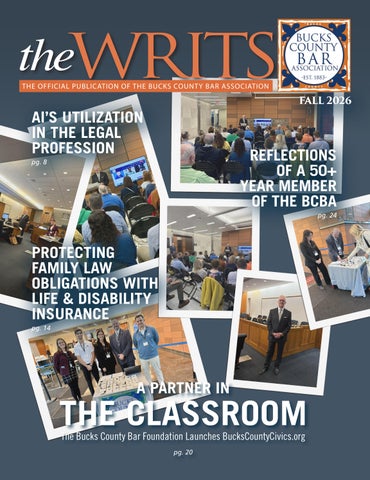
AI’S UTILIZATION IN THE LEGAL PROFESSION
REFLECTIONS OF A 50+ YEAR MEMBER OF THE BCBA
pg. 8
pg. 24
PROTECTING FAMILY LAW OBLIGATIONS WITH LIFE & DISABILITY INSURANCE pg. 14
A PARTNER IN
THE CLASSROOM The Bucks County Bar Foundation Launches BucksCountyCivics.org pg. 20
Results. Speed. Service. Here’s why Bucks County attorneys refer their serious injury cases to Cordisco & Saile.
Exceptional client experience for personal injury cases having received over 800 five-star reviews.
A history of multi-million dollar recoveries in the region and throughout Pennsylvania.
With ten offices in key areas across southeastern PA,we’re easily accessible for your clients. Locations include: Bensalem | Doylestown | Newtown | Bristol | Quakertown Norristown | Bethlehem | Allentown | Philadelphia | Reading
info@cordiscosaile.com | 215-543-6780 www.cordiscosaile.com
Extensive understanding of traumatic injuries and how to present them to maximize recoveries.
Scan To Learn More:
contents
CONTACT INFO President Melanie J. Wender Vice President/President Elect Stephanie M. Shortall Secretary Elaine T. Yandrisevits Treasurer Brendan M. Callahan Immediate Past President Jeremy D. Puglia Past Presidents’ Representative Sean M. Gresh Board of Directors Hon. Robert O. Baldi Abigail C.S. Bukowski Joseph A. Cullen Timothy J. Duffy Steven M. Jones Jeffrey A. Liebmann Brian M. Marriott Gabriel T. Montemuro Travis P. Nelson Thomas E. Panzer Mindy J. Snyder Kathleen M. Thomas theWRITS Editor Travis P. Nelson theWRITS Photographer Emily McGee Bar Association Office Heather Cevasco, Executive Director 135 East State Street Doylestown, PA 18901 215.348.9413 • www.bucksbar.org email submissions to BucksWritsEditor@gmail.com Hoffmann Publishing Group is the official publisher of the Bucks County Bar Association’s theWRITS magazine. FOR ADVERTISING OPPORTUNITIES CONTACT: Ad Sales, Sales@HoffPubs.com, 610.685.0914 x715
FALL 2026
feature
AI’s Utilization in the Legal Profession
AI’S UTILIZATION IN THE LEGAL PROFESSION
As an undergraduate student, I am often asked what...
.................................................................................................
By Madeline Cutting
A
S AN UNDERGRADUATE STUDENT, I AM OFTEN ASKED WHAT PROFESSION I SEE MYSELF ENTERING
in increased justice served. Some AI tools have been built specifically to support underserved communities as well as legal professionals, such as the Vanderbilt AI Law Lab (VAILL). At VAILL, “students have built projects ranging from an end-of-life planning tool that expands access to legal help to a state-bystate tracker of AI legislation.”2 VAILL, among others, shows how AI can be used specifically in legal philanthropic ways.
POST-GRADUATION. When I tell people that I want to be an attorney, on more than one occasion have I been told stories of businesses and individuals scaling back their use of physical attorneys in replace of AI to warn or dissuade me of my future path. Obviously, AI cannot replace all areas of law thanks to the physicality of the courtroom, but I have been told of contracts being written by a robot in lieu of an attorney and Pro Se litigants using ChatGPT for their legal advice. Like most, if not all, professions, the law has changed in response to this evolving technical landscape and will continue to do so.
But what AI tools do firms actually use? They don’t just use ChatGPT. There are AI models that have been built specifically for the legal profession. For example, Syllo, a website advertising ‘Litigation AI’, is a “fully integrated, collaborative, and AI-enabled workspace for written discovery, depositions, and pretrial.”3 Case documents and facts are inputted into this AI platform, and it produces insights and strategy that can be utilized by attorneys. It advertises speed, efficiency, and the ability to simplify large and complex cases. A major application of AI in the law is for these predictive analytics, designed to analyze vast amounts of historical legal data, including records, opinions, rulings, etc., to identify patterns, generate case statistics, and produce the probability of the case’s outcome.4 This use of AI is seen as providing a significant strategic advantage. Differently, Centerbase is a site that uses AI to improve the internal efficiency of a firm, including “billing, collections, accounting, matters, and trust.”5
feature
CENTRAL PARK SMOOCHING SHINES LIGHT ON LAW FIRM WORKPLACE ROMANCES
Law firms are using AI in significant and varied ways. This depends on the size of the firm, the type of law, tasks the firm handles, and, most importantly, the degree to which the attorneys are willing to use it. Briefly, it has been massively utilized for document review and e-discovery; legal research; contract analysis and automated clause extraction; predictive analytics; drafting assistance,1 as well as basic editing and information retrieval. The attractiveness of AI for these tasks points to overall efficiency in time and cost, human error reduction, and aid in data-heavy cases.
This speed and efficiency greatly benefits the law as a whole. Less time spent on a case results in lower legal fees for clients; more cases able to be taken on by attorneys; shorter wait times for pro bono clients; and faster decisions—all resulting
So, to the people who have told me their (mostly well-meaning) stories: AI will not render attorneys obsolete.
8
By Travis P. Nelson, Esq.
Page 8
Central Park Smooching Shines Light on Law Firm Workplace Romances Amid the BBQs, trips to the local pool, or drives down...
................................................................................................. Page 10 feature
A PROTECTING FAMILY LAW OBLIGATIONS WITH LIFE & DISABILITY INSURANCE MID THE BBQS, TRIPS TO THE LOCAL POOL, OR DRIVES DOWN THE SHORE DURING THE SUMMER OF
60 percent. Some might view such relationships as unavoidable. In the case of romantic relationships between associates, this might even be expected, or even understandable. After all, if you do not find your romantic partner in college, or law school, or at an internship, your last best chance at finding an age-appropriate partner with similar interests, or at least a similar occupation, is your job as a junior associate at a law firm. Fair enough. However, it becomes less understandable, and even bad for the firm, when the relationship blossoms between a partner and an associate, as appears to have been the case on the Central Park bench this past summer.
2026, THERE WAS ROMANCE BREWING. The romance was on display between two adults, kissing on a park bench in New York’s Central Park. Nothing unusual, right? That would be correct, but for the fact that the two objects of Cupid’s arrow were a partner and an associate at a very prominent New York law firm. What made the encounter even more sensational was that it was caught on camera. Oops! That law firm had average profits per equity partner of $12.1 million in 2025. Not that it is necessarily germane to this story, but reflective of the extent to which the partner involved had to lose over the romance.
Workplace romances, particularly among more senior attorneys and more junior attorneys, create several substantial legal risks to the firm. Such relationships risk sexual harassment claims, whether the relationship arises from a supervisor-subordinate
Romantic relationships among coworkers are certainly not new, nor are they infrequent. In a 2023 study, the Society for Human Resource Management found that 24 percent of U.S. workers have dated a coworker. A Forbes study places that number at By Joseph Gentile, Esq.
Protecting Family Law Obligations With Life & Disability Insurance Family lawyers advising clients on prenups or divorce...
10
................................................................................................ Page 14 feature
A LEGACY OF JUSTICE: LASP MARKS 25 YEARS WITH STUMBLING STONES: THE JOHN ROSENBERG STORY ON NOV. 20 By Vanessa Starr
Legal Aid of Southeastern Pennsylvania (LASP) invites the Bucks County legal community and the broader community to celebrate its 25th anniversary on Friday, Nov. 20. The evening connects one attorney’s lifelong 14 pursuit of justice with the role that each person can play in advancing access to justice.
Legal Aid of Southeastern Pennsylvania (LASP) invites...
................................................................................................. Page 18
LASP is proud to present the regional premiere of Stumbling Stones: The John Rosenberg Story, written and performed by Jeff Sherr. The acclaimed one-man performance tells the story of a Holocaust survivor, a litigator in the U.S. Dept. of Justice in the 1960s, and the founder of rural legal aid serving the Appalachian coal fields of Eastern Kentucky. Following the performance, John Rosenberg, now age 95, and his wife, Jean, plan to participate in a live discussion and audience Q&A, offering attendees the opportunity to hear directly from two people whose lives have been intertwined with decades of human rights, legal aid, and community advocacy.
feature
back much further, across generations and some of the defining struggles for justice in American history. John Rosenberg fled Nazi Germany as a child and later became a civil rights attorney, legal aid pioneer, community advocate, and champion for justice. His path took him to Mississippi during the Civil Rights Movement, where he helped defend voting rights, and later to the Appalachian coal fields, where he worked alongside families seeking to protect their homes, land, and dignity.
A PARTNER IN THE CLASSROOM The program celebrates LASP’s quartercentury of advocacy and service in Bucks, Chester, Delaware, and Montgomery counties. LASP formed in 2001 and was built upon the foundation of longstanding legal aid programs in each county. The story at the center of the evening reaches
A Legacy of Justice: LASP Marks 25 Years with Stumbling Stones: The John Rosenberg Story on Nov. 20
Stumbling Stones brings that history to the stage through an 80-minute play tracing Rosenberg’s life from the rise of antisemitism in Europe through the Civil Rights era and the struggle for economic justice in Appalachia.
The Bucks County Bar Foundation Launches BucksCountyCivics.org
For attorneys, the story offers a relevant look at what public interest law can mean beyond a single case or courtroom. Rosenberg’s career demonstrates how lawyers can use their training not only to represent individual clients but also to help build institutions, strengthen communities, and expand meaningful access to the legal system. Jean Rosenberg’s role is also central to the story. Her work with families, education, health care, and community building broadens the evening’s examination of justice, underscoring that lasting change takes place in neighborhoods, schools, and homes, as well as in courtrooms. For 25 years, LASP has worked to expand access to justice for those who cannot afford an attorney. Civil
A Partner in the Classroom Civics has always asked a lot of our teachers...
18
By Jeffrey A. Liebmann, Esq.
“The practice of democracy is not passed down through the gene pool. It must be taught and learned by each new generation of citizens.”
................................................................................................. Page 20
— SANDRA DAY O’CONNOR
C
IVICS HAS ALWAYS ASKED A LOT OF OUR
Planning, Chad Evans, Ed.D.; Julie Goldstein; Sarah Ryan; Gina Kiley; Liz Fritsch; and the Bucks County Bar Association & Foundation Director of Development & Marketing, Emily McGee.
TEACHERS. In a single school year, an elementary teacher juggling reading, math, and science standards is also expected to lay the groundwork for how a student understands community and government. A high school social studies instructor has to make the structure of the Constitution feel as real and immediate as anything happening in a student’s own life. Bucks County is fortunate to have educators who take that work seriously, and the Bucks County Bar Foundation wanted to find a meaningful way to stand alongside them in a lasting way.
feature
A
T LEGAL AID OF SOUTHEASTERN PENNSYL-
WHY CIVICS EDUCATION MATTERS VANIA (LASP), THE CONSUMER LAW PRACTICE In its broadest sense, civics is the lifelong process that IS FOCUSED ON HELPING FINANCIALLY VULNERABLE makes people into informed and engaged members of their CONSUMERS RESPOND TO DEBT AND COLLECTION communities. It is the study of all aspects of citizenship. ACTIONS, CREDIT-CARD AND DEBT-BUYER LAWSUITS, A civics education helps students understand their rights JUDGMENTS AND POST-JUDGMENT COLLECTION, AND and responsibilities as citizens and fosters informed and PROVIDING ASSISTANCE WITH BANKRUPTCY. These are engaged participation in our democracy. Civics teaches issues of increasing concern for low-income and vulnerable critical thinking and decision-making skills by analyzing laws, people in Bucks County and across the country. government structures, and current events. A well-rounded civics education promotes virtues that are keyWhen to positive LASP completed an assessment of the legal needs community involvement such as civility, respect, and of potential clients in Bucks, Chester, Delaware, and tolerance. A functioning democracy dependsMontgomery on citizens counties in 2024, “Money or debt” was cited who understand how their government works just as as and, the most severe legal problem. Nationally, trends show importantly, how they can participate in it. Students who significant increases in consumer debt burdens and debt understand how laws are made, how courts collection operate, and lawsuits. In March 2026, the Consumer Financial what rights and responsibilities come with citizenship Protectionare Bureau found significant increases in consumerbetter equipped to engage with their communities as debt-collection adults, reported problems. Notably, complaints
That is the spirit behind www.BucksCountyCivics.org, the new home of the Bucks County Bar Foundation’s Civics Program. BucksCountyCivics.Org went live on May 26, 2026, and represents over two years of hard work by the Bucks County Bar Foundation’s Civics Committee; Judge Jeffrey G. Trauger; Judge Denise M. Bowman; Bucks County Bar Association & Foundation Executive Director, Heather Cevasco; Bucks County Intermediate Unit Supervisor of Educational
about debts that the consumers did not recognize increased 240% compared with the prior two-year monthly average. The vast majority of people sued for debt collection attempt to navigate the complex legal system without an attorney. Studies from the Pew Research Center indicate that a mere 4% of debtors have legal representation in lawsuits that can have life-altering consequences.
20
Legal Aid Expands Services for Clients in Need with New Pro Bono Consumer Debt Relief Program At Legal Aid of Southeastern Pennsylvania (LASP)...
................................................................................................. Page 22
feature
REFLECTIONS OF ALEGAL AID EXPANDS 50+ YEAR MEMBER SERVICES FOR OF THE BCBACLIENTS IN NEED WITH NEW PRO I BONO CONSUMER DEBT RELIEF PROGRAM
LASP advocates work diligently to provide advice or representation for an overwhelming number of requests for assistance. Advocates prioritize representation for clients facing emergencies where housing or other significant assets are at risk. For cases that are not emergencies, advocates provide advice, pro se assistance, or referrals. To expand the help available to clients whose financial problems may not present as urgent but still carry serious long-term consequences, LASP has created the Consumer Debt Relief Program.
HOW THE PROGRAM WORKS The Consumer Debt Relief Program creates two distinct opportunities for pro bono attorneys to help clients navigate the web of legal issues that arise when living with locations, the hotel in Bushkill Falls could have been a stand-in debt. Experienced bankruptcy attorneys overwhelming for the hotel in The Shining, sans Jack Nicholsoncan (although some provide full representation in Chapter 7 bankruptcy of the then older members could have easily filled thatwith role).extensive administrative and paralegal support cases Prior to this first Bench Bar conference, all annual membership from LASP. Attorneys without a consumer law background meetings and Bench Bar conferences were held can in locations learn toother provide brief advice consultations to help than the Bar Association building, generally in a clients restaurant in theagainst credit card lawsuits. In 2025, LASP defend Doylestown area. Attendance was not spectacular. groups a Project Grant from the Legal Services wasBut awarded of lawyers did try to meet, ad hoc, typically for lunch at a local Pro Bono Innovation Fund to provide financial Corporation’s By Erika Esq. the support restaurant. I recall John CollinsBecker, encouraging Lower Bucks for this important work. lawyers to regularly meet at the “Puss N Boots” Tavern in Fairless Hills (Yes, that is its actual name: No, it is not a Gentlemen’s Club). In reality, most Bucks County lawyers became acquainted with each other through interaction in Court 22 proceedings, the Lawyers Lounge, political functions, or involvement in bar-sponsored community events, like Law Day.
By Francis J. Sullivan, Esq.
AGREED TO WRITE THIS ARTICLE ON A WHIM, NOT REALIZING IT WOULD TAKE ME ON A JOURNEY BACK TO A TIME FEW OF US ARE AROUND TO REMEMBER. So here
it goes! Back in December 1972, when I was admitted to the Bar of Bucks County and the Bar Association, the makeup of the legal profession was dramatically different from what it is today: it was predominantly male and overwhelmingly white. In the hallway outside Heather Cervasco’s office is a 1973 photo board with headshots of 284 members of the Bar Association. I am on this photo board, as is the only African American member (retired Judge Clyde Waite), and three female members. The Bar Association then was a relatively small and parochial organization. There were only a few standing committees (Finance, Membership, Fee Disputes, and the Unauthorized Practice of Law); no Sections or Divisions existed. To be a member of the Bar Association, you had to first be admitted to the Bar of Bucks County. By definition, this meant you had to be employed by a Bucks County law firm, or if you were a solo, you had to have an office and be practicing principally (if not exclusively) in Bucks County. The solo then had to be recommended for membership by an existing member of the Bucks County Bar, almost all of whose members were very protective of who could be admitted. Admission to the Bar of Bucks County and the Bucks County Bar Association was neither easy nor automatic.
I remember well how, in the former courthouse, all the courtrooms, Judges’ Chambers, and Court Administration offices existed in one separate, smaller round structure, on one side. All county government offices existed in a larger, separate structure on the other side. Connecting them was a walkway bridge. At the end of the bridge from the government side to the courtroom side was a closed door on which hung an ominous sign that read “Court Personnel Only.” Beyond that door lay the infamous “Lawyers Lounge,” where all members of the Bar Association who were “in Doylestown” that day, either to file papers at the Prothy’s office or to attend a Court hearing or trial, could meet to talk about cases, issues, and interact with other members. Here, at a large round table, senior members of the Bar would sit and hold “court.” Younger, junior members sat in the outer periphery of the table to listen and learn from these older, wiser members, as they drank their coffee and ate lunch. It was actually a classroom where the “how-to” of being a lawyer was taught. Ethics were discussed, court procedure and propriety were explained, all of which were communicated via war stories, accompanied by uproarious laughter or disapproving shakes of the head. The Lawyers Lounge was truly a training ground where wisdom and advice on all topics relating to the practice of law and dealing with clients were freely dispensed. It was truly a raconteur’s stage. The I miss the intimacy of the Lawyers Lounge.
Reflections of a 50+ Year Member of the BCBA I agreed to write this article on a whim, not realizing...
................................................................................................. Page 24
At that time, there were only four judges, and all the law firms in Bucks County were single-office law firms, except Power, Bowen and Valimont, which had offices in Doylestown and Perkasie. Most law firms had four or fewer lawyers and most “firms” were solos. The Bar Association was essentially a loosely organized, social club, whose main revenue-generating activity was ensuring that the Bucks County Law Reporter and the statutorily mandated legal notices were published. As I recall, the lawyers then also self-identified themselves geographically as being a “Lower Bucks,” “Central Bucks,” or “Upper Bucks” lawyer. I doubt many of you have any recollection of the original, humble structure that housed our Bar Association. Few also would remember the first Bench Bar conference held outside Bucks County in Bushkill Falls in the Poconos in the mid-1980s. Unlike our present-day Bench Bar conferences now held in luxurious 24
Also in This Issue: • President’s Message . . . . . . . . . . . . . . . . 5 • From the Editor . . . . . . . . . . . . . . . . . . . 6 • I Know What You Did Last Summer . . . . 7 • And Now for Something Completely Different . . . . . . . . . . . . . . 19 • New Member Profile . . . . . . . . . . . . . . 26 • Law Clerk Profile . . . . . . . . . . . . . . . . . 28 • Managing Partner’s Corner . . . . . . . . . 29
• Federal Courts Reception . . . . . . . . . . . 30 • BCBA Annual Hon. John J. Rufe Softball Classic . . . . . . . . . . . . . . . . . . . 31 • 2026 BCBF Annual Charity Golf Outing . . . . . . . . . . . . . . . . . . . . . 32 • Young Lawyers Division Happy Hour . . 33 • Women Lawyers Division Happy Hour . . 34 • Pro Bono Honor Roll . . . . . . . . . . . . . . . 35
SEE PAST ISSUES AT bucksbar.org/attorney-resources/the-writs SPREAD THE WORD #BucksWrits & #BucksBar
©2026 All rights reserved. No portion of this publication may be reproduced electronically or in print without the expressed written consent of the publisher and/or the Bucks County Bar Association. The opinions expressed in this publication are for general information only and are not intended to provide specific legal or other advice or recommendations for any individuals. Additionally, the placement of editorial content, opinions and paid advertising does not imply endorsement by the Bucks County Bar Association.
10% Post Consumer Waste Please Recycle
President’s Message interesting CLEs, and Kristen is the one who kept the pressure on for materials. Then there is Kelly Mott. Kelly’s event planning experience is in high demand when it’s Bench Bar time. She came up with great ideas, wonderful ways to utilize space, and knows how to keep a party going. Then Joanne and Lynne kept our lawyer referral service going while still joining in with ideas for the conference. I cannot thank this team enough for their endless support and hard work. I also have to thank my Bench Bar chair, Mindy Snyder, for her creativity and enthusiasm with planning this year’s conference. Mindy consistently came to the table with new and different ideas. I also want to thank all of the committee members for their assistance and for their work on putting the CLEs together. A special thank you goes out to Judge Robert Baldi for his assistance in securing this year’s plenary speaker. The idea started as a pipe dream, and then Judge Baldi made it happen. The infamous actor David Constabile was a complete hit, and all thanks go to Judge Baldi. Now, with all that said, there is still more to come in my year as President. As you may know, I am sometimes known as energetic. In October, the Women’s Law Division, chaired by the amazing Lisa Bothwell, is hosting its distinguished speaker series with Kathy Boockvar, the former Secretary of State for the Commonwealth of Pennsylvania. Ms. Boockvar provided a great deal of guidance to our state during the incredibly difficult time of the pandemic, and that included addressing the issues of voting while in quarantine. I am incredibly excited to hear from her and hope to see you all there. Then the Young Lawyers Division is hosting their annual Trunk or Treat event. That event is always so much fun, and it is open to the entire community. Come with your kids and get some food!
Melanie J. Wender, Esquire Bucks County Bar Association President
After that, the fun does not stop as the Foundation will be hosting its annual trivia night at the beginning of November. Another fantastic event to support an excellent cause.
Well, summer has officially come to an end, and whatever rest we had is now over. But do not fret! There is always something going on at the Bar Association! While I’m writing this message, the Bar Association is in full swing for our annual Bench Bar Conference. By the time you read this message, Bench Bar will be over, but the stories of how wonderful it was will continue to be told. I guarantee that it will be a blast, and you will hear all about the amazing location. This year, we decided to try a new location, and our conference was at the Resorts World Hotel & Casino in the Catskills of New York. It was a new and different venue, with new and different ways to have fun and learn.
This list is not exhaustive, but I’m now exhausted writing about everything coming up for the Bar Association. It’s non-stop! I will end, though, by saying that being President of the Bucks County Bar Association is a great pleasure. I am incredibly honored to be trusted with this responsibility and am extremely flattered to be a leader in this legal community. In my opinion, it’s the best legal community in the Commonwealth. – Melanie J. Wender, Esquire Bucks County Bar Association President
Because I know that Bench Bar will be a wild success, I want to take a minute to thank the people who make it possible. First, I have to start with our executive director, Heather Cevasco. She led the team to another victory, continuing to keep us organized, remind us of meetings, and maintain a positive attitude. There’s also the amazing Emily McGee, who did an absolutely amazing job obtaining sponsorships. This year was record-setting, and that is due in large part to Emily’s hard work. Barb Sauers kept us on track from a financial perspective. Sometimes we have great ideas, but Barb is there to discuss cost and keep us realistic. Kristen Norcross managed the CLEs, which is arguably the hardest part of our Bench Bar Conference. We did our best to provide new and
Melanie J. Wender is a partner in the Family Law Practice Group at Antheil, Maslow & MacMinn, LLP.
We Welcome Your Feedback! Thanks for your interest in theWRITS. Please send all comments, questions, submissions to: BucksWritsEditor@gmail.com. 5
FALL 2026
From the Editor… After an eventful summer, we are back to the fall grind. Leaves are turning colors, the weather is turning cooler, and our firms’ collections departments are starting to step up their year-end targets. Yes, the fourth quarter of 2026 is underway.
During the Bench Bar golf outing, I had the pleasure of being partnered with two attorneys from a firm with a substantial Bucks County presence, where, outside of the Bar Association, our professional paths may never cross. I was particularly impressed by one of the attorney’s ability to field client calls while driving a golf cart. Multitasking at its best! One of the attorneys I partnered with turned out to be a former student whom I taught four years ago at Villanova Law. He ended up not pursuing a career in banking law—probably a better choice on his part!
We have a broad assortment of interesting and informative articles in this edition of theWRITS, and some from new authors. Our President, Travis P. Nelson, Esquire Melanie Wender, writes in her Editor, theWRITS President’s Message about the greatly successful 2026 Bench Bar Conference at Resorts World Catskills. For my part, I found the CLEs to be extremely informative, especially the family law program where a packed room listened to the experiences and expectations of the new family court bench. I also found the war stories from the Steve Jones’ panel on criminal law to be very exciting—it was like sitting in on the writing staff from Law & Order. Bench Bar was also a unique opportunity for practitioners to get to know the humanity behind the robes when it comes to our County’s judges. Sometimes in court, with the focus on rules and procedures, and of course the search for justice, we forget that the person on the bench in the black robe is a fellow member of our community. At the Friday morning breakfast, before the plenary session, I was joined at my table by a panel of several sitting common pleas court judges, as well as one of Doylestown’s preeminent family law attorneys. As I was sitting among several of our judges, I thought to myself of the irony that I am lucky enough to sit with the finest legal minds in our County, with incredible insights into courtroom practice, procedure, and expectations, even though I do not professionally appear in Bucks County courts (though maybe I will someday be arraigned on charges of being the coolest bank regulatory lawyer in Bucks—it is admittedly a very small talent pool). One of the judges noted that the key to smoothing over golf mishaps is to find something else about which to compliment your fellow player, for example, “Well, your hair looks great!” After hearing that advice, it occurred to me that I have never received that compliment, so I must be an amazing player! It was an experience that I appreciated on a very personal level. Another judge I spoke with at the conference was gracious enough to help me connect with someone so I could provide pro bono services in court, an area where we need more volunteers in Bucks County.
In this edition of theWRITS, we hear from some great first-time authors. We read about the intersection of family law and insurance planning from guest writer Joseph Gentile, who was referred to theWRITS by Melanie Wender. In his article, Joseph writes about how insurance planning can be an important consideration in settling matrimonial actions. We also read an article by local college student and prospective attorney Madeline Cutting, who writes about how AI is changing the industry. Frank Sullivan offers an article describing his experiences from having been a member of the Bucks County Bar Association for more than 50 years. Frank discusses how both the Bar Association and the legal industry in Bucks County have changed substantially during his membership. Frank shows once again what a valuable resource he is to our Bar Association. We also have several articles that highlight service opportunities. Jeff Leibmann provides an informative article on the Bucks County Bar Foundation’s Civics Program. This program is an effort to facilitate partnerships between the bench, bar, and teachers in Bucks County’s classrooms. Legal Aid of Southeastern Pennsylvania (LASP) also provided several articles on the great work that LASP is doing in our community. The above-referenced articles and others, as well as the wonderfully successful 2026 Bench Bar Conference, illustrate what a diverse and valuable resource the Bucks County Bar Association is. From social, professional, and service opportunities, the Bucks County Bar Association offers something for everyone. – Travis P. Nelson, Esquire Travis P. Nelson is a partner in the Philadelphia, PA, office of Polsinelli, P.C., where he practices financial institutions regulation and enforcement law. Mr. Nelson is also the Editor of theWRITS, and is a Doylestown, PA, resident.
6
I Know What You Did Last Summer
Stephanie Shortall & Family at Currituck Beach Lighthouse
Abby & Andrew Bukowski
Dianne Magee at 50th HS Reunion in Honolulu
Abby Bukowski & Children
Dianne Magee at 50th HS Reunion in Honolulu
Gabe Montemuro & Son in Longport, NJ
Gabe Montemuro & Wife at Hotel Stephanie Shortall & Family at Tina Mazaheri and Susan Levy Du Village Wedding in New Hope Jockey’s Ridge State Park Eisenberg in Long Port, NJ
Stephanie Shortall & Family at Citizen’s Bank Park
Dianne Magee at 50th HS Reunion in Honolulu
Andrew Bukowski at Citizen’s Bank Park
Travis Nelson & children in Ocean City, MD 7
FALL 2026
feature
AI’S UTILIZATION IN THE LEGAL PROFESSION By Madeline Cutting
A
S AN UNDERGRADUATE STUDENT, I AM OFTEN ASKED WHAT PROFESSION I SEE MYSELF ENTERING POST-GRADUATION. When I tell people that I want to
in increased justice served. Some AI tools have been built specifically to support underserved communities as well as legal professionals, such as the Vanderbilt AI Law Lab (VAILL). At VAILL, “students have built projects ranging from an end-of-life planning tool that expands access to legal help to a state-bystate tracker of AI legislation.”2 VAILL, among others, shows how AI can be used specifically in legal philanthropic ways.
be an attorney, on more than one occasion have I been told stories of businesses and individuals scaling back their use of physical attorneys in replace of AI to warn or dissuade me of my future path. Obviously, AI cannot replace all areas of law thanks to the physicality of the courtroom, but I have been told of contracts being written by a robot in lieu of an attorney and pro se litigants using ChatGPT for their legal research. Like most, if not all, professions, the law has changed in response to this evolving technical landscape and will continue to do so.
But what AI tools do firms actually use? They don’t just use ChatGPT. There are AI models that have been built specifically for the legal profession. For example, Syllo, a website advertising “Litigation AI,” is a “fully integrated, collaborative, and AI-enabled workspace for written discovery, depositions, and pretrial.”3 Case documents and facts are inputted into this AI platform, and it produces insights and strategy that can be utilized by attorneys. It advertises speed, efficiency, and the ability to simplify large and complex cases. A major application of AI in the law is for these predictive analytics, designed to analyze vast amounts of historical legal data, including records, opinions, rulings, etc., to identify patterns, generate case statistics, and produce the probability of the case’s outcome.4 This use of AI is seen as providing a significant strategic advantage. Differently, Centerbase is a site that uses AI to improve the internal efficiency of a firm, including “billing, collections, accounting, matters, and trust.”5
Law firms are using AI in significant and varied ways. This depends on the size of the firm, the type of law, tasks the firm handles, and, most importantly, the degree to which the attorneys are willing to use it. Briefly, it has been massively utilized for document review and e-discovery; legal research; contract analysis and automated clause extraction; predictive analytics; and drafting assistance,1 as well as basic editing and information retrieval. The attractiveness of AI for these tasks points to overall efficiency in time and cost, human error reduction, and aid in data-heavy cases. This speed and efficiency greatly benefits the law as a whole. Less time spent on a case results in lower legal fees for clients; more cases able to be taken on by attorneys; shorter wait times for pro bono clients; and faster decisions—all resulting
So, to the people who have told me their (mostly well-meaning) stories: AI will not render attorneys obsolete. 8
Madeline Cutting is a Doylestown resident; a graduate of Central Bucks West High School; and a current junior at American University in Washington, DC, where she is the recipient of an ACLU Emerging Advocate Scholarship. Ms. Cutting was an intern at Legal Aid of Southeastern PA during the summer of 2026.
While they have turned to AI for many of their foundational tasks like legal research and data analysis, the practice of law is human-centered.6 It also occurs in unique, emotionally charged, or morally ambiguous situations and relies on ever-changing societal norms and situational events, requiring real-world understanding. AI excels in aiding in the law that is clear-cut and follows precedent; however, nuanced judgments, especially in regulatory landscapes, require human evaluation.
References 1. Medha Deb, Ai and the Legal Profession: Revolutionizing Law or Replacing Lawyers?, WayToLegal, (Dec. 10 2025), www.waytolegal.com/legal-help-guides/ai-impact-on-legalprofession-future-of-lawyers.
So, the next time I am told about the concerns others have about the profession and AI’s impact on it, I can rebut that these tools are being used to aid attorneys in their pursuit of the most powerful argument and the most useful information, therefore providing better service to their clients. And human attorneys have, most importantly, complex judgment, moral compasses, and ethical responsibility, which are the key pillars of the legal profession and qualities that AI bots distinctly lack. In my opinion, my future career is not shrinking because of AI but is empowered by it to serve more people and provide a higher degree of representation.
2. Desislava Dureva, How Is AI Impacting the Legal Profession?, Vanderbilt Master of Legal Studies, (Apr. 30 2026), law.vanderbilt.edu/master-legal-studies/articles/how-is-aiimpacting-the-legal-profession/ 3. Litigation AI for Complex Commercial Litigation Portfolios, Syllo, (Aug. 3 2026), https://syllo.ai/. 4. Annabel V. Teiling, Will Ai Render Lawyers Obsolete?, New York State Bar Association, (Oct. 7, 2025), nysba.org/will-airender-lawyers-obsolete/. 5. See Why the Best Midsize Firms Run on Centerbase, Centerbase, www.centerbase.com/demo. Accessed 31 Aug. 2026.
While I have sung my praises about AI in this piece, I must remind readers of its many and significant dangers and shortcomings. For guidance on AI use in the legal profession, Lisa Bothwell, Esq., wrote a very informative piece in the Winter 2026 issue of theWRITS.7
6. Id. at 4. 7. Lisa A. Bothwell, “Additional Guidance on AI Use in the Legal Profession,” theWRITS, a publication of the Bucks County Bar Association, Winter/Spring 2026.
Created by lawyers, for lawyers.
R
Lawyers seek advice from lawyers. Why wouldn’t you buy your insurance from lawyers as well? Insuring Pennsylvania Law Firms since 1997 • • • •
MLM has returned a dividend to policyholders annually since 1988, over $88 million total First dollar defense- a loss only deductible can produce a substantial savings for firms facing nuisance type claims Full prior acts coverage Offers an array of services to mitigate risks including three free CLEs for policyholders each policy year, $165 value
Get a fast quote today! Jason Joyce 215-668-0806 jjoyce@mlmins.com www.mlmins.com
Protecting Your Practice is Our Policy.® 9
FALL 2026
feature
CENTRAL PARK SMOOCHING SHINES LIGHT ON LAW FIRM WORKPLACE ROMANCES By Travis P. Nelson, Esq.
A
MID THE BBQS, TRIPS TO THE LOCAL POOL, OR DRIVES DOWN THE SHORE DURING THE SUMMER OF 2026, THERE WAS ROMANCE BREWING. The romance
60 percent. Some might view such relationships as unavoidable. In the case of romantic relationships between associates, this might even be expected, or even understandable. After all, if you do not find your romantic partner in college, or law school, or at an internship, your last best chance at finding an age-appropriate partner with similar interests, or at least a similar occupation, is your job as a junior associate at a law firm. Fair enough. However, it becomes less understandable, and even bad for the firm, when the relationship blossoms between a partner and an associate, as appears to have been the case on the Central Park bench this past summer.
was on display between two adults, kissing on a park bench in New York’s Central Park. Nothing unusual, right? That would be correct, but for the fact that the two objects of Cupid’s arrow were a partner and an associate at a very prominent New York law firm. What made the encounter even more sensational was that it was caught on camera. Oops! That law firm had average profits per equity partner of $12.1 million in 2025. Not that it is necessarily germane to this story, but reflective of the extent to which the partner involved had to lose over the romance.
Workplace romances, particularly among more senior attorneys and more junior attorneys, create several substantial legal risks to the firm. Such relationships risk sexual harassment claims, whether the relationship arises from a supervisor-subordinate
Romantic relationships among coworkers are certainly not new, nor are they infrequent. In a 2023 study, the Society for Human Resource Management found that 24 percent of U.S. workers have dated a coworker. A Forbes study places that number at
10
relationship, or between colleagues when an employee’s affection is not reciprocated and the relationship sours. An employee could claim that they were retaliated against after the once consensual relationship ended, or after unwanted advances were rebuked.
genuine fact disputes precluded summary judgment on the issue of whether the city’s interest outweighed the plaintiff’s interest in exercising his intimate association rights). The lesson learned from that line of cases may be: If you want to date your coworker without your boss’ interference, join the Miami-Dade County Law Department. Moreover, some authors suggest that some employees would rather give up their job than end their relationship, which may result in loss of valuable employees that could have been prevented with a more moderate policy. See “Does #MeToo Movement Mean #TheEnd for Workplace Romance?” Pennsylvania Employment Law Letter, 28 No. 5 Pa. Emp. L. Letter 4 (Feb. 2018).
Workplace relationships also risk allegations of sexual favoritism, which courts have generally defined as favoritism shown by supervisors to employees who are the supervisors’ sexual partners. Equal Employment Opportunity Commission (“EEOC”) policy guidance notes that sexual favoritism can be the basis for a valid hostile work environment claim under Title VII: “If favoritism based upon the granting of sexual favors is widespread in a workplace, both male and female colleagues who do not welcome this conduct can establish a hostile work environment in violation of Title VII regardless of whether any objectionable conduct is directed at them.” Sapko v. Ringgold Area School Dist., 2008 WL 2367321 (W.D.Pa. June 10, 2008), citing EEOC Policy Guidance on Employer Liability Under Title VII for Sexual Favoritism, EEOC Notice No. 915-048 (Jan. 12, 1990), available at: https://www.eeoc.gov/laws/guidance/policyguidance-employer-liability-under-title-vii-sexual-favoritism. Third party employees who are not involved in the relationship may nonetheless be motivated to bring claims of sexual favoritism if they see a coworker receive job benefits as a result of being intimately involved with a supervisor. See, e.g., Miller v. Department of Corrections, 115 P.3d 77 (Cal. 2005). In other words, an employee can establish a sexual harassment claim by demonstrating that sufficient sexual favoritism existed to alter the nature of the working environment even if the plaintiff was not himself/herself the object of the sexual relationship. In fact, several years ago there was a complaint filed against a law firm in Pennsylvania where the plaintiff alleged that she was passed over for work because she refused to engage in sexual relations with the partners. The parties settled before the courtroom quotes could fill the legal blogs.
Rather than a blanket prohibition, most law firms are restricting relationships between partners and associates, or between a supervising attorney and the supervised attorney. Firm policies place an affirmative duty on the romantically involved parties to self-disclose the relationship. Valerie Brown, a partner at Polsinelli, P.C., in Philadelphia, advises: “We generally recommend that the policy places the onus on the more senior employee to disclose the relationship to human resources so that human resources can determine if any appropriate steps need to be taken.” Some law firms are adopting so-called “love contracts.” A love contract is an agreement between two employees where they represent that their relationship is consensual and not sexual harassment. These love contracts will generally contain releases absolving the employer from liability should the romantic embers fizzle out. Patricia Collins, of Antheil, Maslow & MacMinn, LLP, in Doylestown, notes that “while ‘love contracts’ may provide some peace of mind as to workplace behavior, the releases they generally include are of questionable enforceability.” Moreover, according to Ms. Collins: “The employer will really never know whether or not the initial contact is the result of undue pressure, a feeling that the employee could not decline, or an actual or perceived ‘quid pro quo’ relationship.”
Law firms have many options for addressing the risks posed by workplace romances. Some firms have attempted to impose a blanket ban on any romantic relationships among employees. However, such a radical approach could backfire, leading to employee resentment and allegations that the employer is overstepping its role and encroaching into the private lives of employees. Where the employer is a public sector entity, such a policy could lead to more than just resentment; it could lead to civil rights suits. In a 2010 Eleventh Circuit case, the court acknowledged that the plaintiff firefighter arguably had a First Amendment right to “intimate, extramarital association.” Starling v. Board of Commissioners, 602 F.3d 1257 (11th Cir. 2010); see also, Robinson v. City of Darien, 363 F.Supp.3d 1345 (S.D.Ga. 2019) (the district judge assumed without deciding that the relationship was protected, and she concluded that
Sometimes requiring disclosure or love contracts is insufficient to address the potential risk to the workplace environment, and to the law firm generally. In such situations, it becomes necessary to separate the two parties so that the workplace does not become hostile (or at least uncomfortable) for the parties involved, or the third parties who must endure the relationship. Valerie Brown advises as to the approach to be taken in such separations: “[I]n disclosing the relationship, HR can determine if the relationship requires the more senior employee to be moved from their current position or exited if there is not another option. Typically, policies will not allow the more subordinate employee to be impacted by the relationship because it could give rise to a claim. The keys are discouraging the relationships from taking place, making clear 11
FALL 2026
feature that if they do take place they need to be disclosed to HR, and that it is the more senior employee who will be responsible for any employment implications for the relationship—not the junior employee.” Patricia Collins takes a similar view: “The most effective way to manage this is to completely separate the two employees, such that the more senior employee has absolutely no say or influence over any of the conditions of the subordinate employee’s employment.”
and a third firm’s managing partner said humorously that he/ she has “no policy, no experience, no romance.” From the above, we can see that law firms should adopt some policy on workplace romances. It also seems that the larger the firm, the more formal and detailed the policy should be. Perhaps this is because at smaller firms (firms with less than 30 attorneys), you are less likely to have multitudes of single attorneys working in close proximity, and it might be more difficult to conceal when romances do happen. It also seems that given the clarity of message that formal written policies send, the value to be realized by prescribing what relationships are prohibited, the duty of one of both parties to self-report the relationship, and the possible consequences of having the relationship (separation of the employees from each other, or even from the firm), is well worth the investment in drafting the policy. And finally, if you are going to smooch with your co-worker paramour, then please don’t do it in broad daylight in a widely used public park!
Law firms around our area have taken differing approaches to implementing the sort of advice that Ms. Brown and Ms. Collins offer. One large firm we consulted has a policy that prohibits romantic relationships between senior and junior attorneys where the senior attorney has written or is likely to write a performance evaluation for the junior attorney. The same firm has designated certain very senior management officials who, by virtue of their title, are prohibited from romantic relationships with any attorney, e.g., a member of the firm’s senior management team. A brief survey of managing partners at Bucks County firms has yielded mixed results. One managing partner said that their firm has an unwritten understanding that partners are not to date non-partners, but that they have had associates date each other. Another firm declined to comment,
Travis P. Nelson is a partner in the Philadelphia, PA, office of Polsinelli, P.C., where he practices financial institutions regulation and enforcement law. Mr. Nelson is also the Editor of theWrits, and is a Doylestown, PA, resident.
Your Journey to Strength Begins Here! Discover your path to recovery at Roxborough Acute Inpatient Rehabilitation! Our dedicated team of experts provides personalized therapy plans that empower you to regain strength, independence, and return to the activities you love.
Acute Rehabilitation Inpatient Rehabilitation | (267) 294-8866 | roxborough/inpatient-rehabilitation Roxborough Memorial Hospital | 5800 Ridge Ave., 4th floor, Philadelphia, PA
12
steps. The real risk in a busy practice isn't incompetence, it's bandwidth. Things get missed because someone had forty other things happening at once. A tool that flags "this case hasn't moved in 60 days" is less about replacing judgment and more about protecting it.
By Michael L. Saile, Jr. Partner, Cordisco & Saile
There's a conversation happening in every firm right now, whether you're having it out loud or not. Half the room worries AI will replace lawyers. The other half worries they're falling behind because they haven't figured out how to use it. Both fears are understandable, and both are a little misplaced.
3. Sharper marketing, intake, and client response. This one gets underestimated. We use AI throughout sales, marketing, and intake: comparing results and reviews, creating content, clipping video, speeding response times, scoring leads, and training intake staff. In personal injury, the difference between a client choosing your firm or the one down the street often comes down to response time and the quality of that first conversation. AI hasn't replaced our intake team, it's made them faster and better prepared. The bottom line.
At Cordisco & Saile, we've spent the last couple of years treating AI not as a threat but as a working partner in our personal injury practice, one that handles specific, well-defined jobs so our people can focus on the parts of this work that actually require a human being. Here are three real ways we're using it. Once you see AI applied to the boring mechanics of running a firm, it stops feeling like science fiction and starts feeling like a better spreadsheet.
None of this works if you treat AI as a replacement for judgment, or hand it the keys without oversight. Every output still needs a lawyer's eyes on it.
1. Making sense of our own data.
But don't assume you're too far behind to start, either. These tools can teach you how to use them. Ask Claude to help build a better prompt, or explain a feature you don't understand. It's both an operator and a teacher, often in the same conversation.
Every firm sits on a mountain of historical data, case outcomes, intake numbers and settlement timelines, that mostly go unexamined because nobody has time to dig through it. We use Claude to analyze years of our own firm data and build long-term models and projections. It can scan thousands of data points in minutes and hand us benchmarks we'd otherwise have to guess at or pay a statistician to produce. It's turned "I think we're on track" into "here's what the numbers actually say."
The fear of AI in this profession is usually a fear of the unknown. The fix isn't caution, it's curiosity. Pick one task that eats too much time, and go find out what a tool like this can actually do with it. You'll learn more from twenty minutes of hands-on use than from any amount of worrying. 13
FALL 2026
SPONSORED CONTENT
2. A second set of eyes across every case. AI ISN’T COMING use Eve Legal to help generate document FOR YOUR PRACTICE. We drafts and, more importantly, to scan our full for gaps and issues that might IT’S YOUR COLLEAGUE. caseload otherwise slip through, then advise on next
feature
PROTECTING FAMILY LAW OBLIGATIONS WITH LIFE & DISABILITY INSURANCE By Joseph Gentile, Esq.
F
AMILY LAWYERS ADVISING CLIENTS ON PRENUPS OR DIVORCE SPEND A LOT OF TIME CONSIDERING, NEGOTIATING, AND MEMORIALIZING FUTURE (ACTUAL AND/OR POTENTIAL) FINANCIAL OBLIGATIONS. The relevant
care for another or is judicially required to make continuing child or spousal support payments, it is common to require life insurance so that a premature death does not abruptly eliminate the income stream on which a former spouse or surviving children depend. The types of life insurance appropriate for such circumstances can vary widely, from term life (i.e., temporary coverage for a specified period, such as 10 or 20 years) to permanent coverage, including whole life and universal life.
issues are well known and include, for example, the length and amount of support, what happens when children reach adulthood or spouses remarry, and who covers certain expenses like college, among many others. A far less considered issue is this: what happens if the person responsible for making all those payments is deceased or alive but can no longer earn the income needed to make those payments?
In the divorce context, life insurance can be used to secure financial obligations that otherwise depend entirely upon the continued life of the paying spouse. Assume, for example, that a parent is required to pay child support for another 12 years and spousal support for another eight. If that parent dies during the support period, the obligation may disappear or become a claim against an estate that may have insufficient liquid assets to satisfy it. A properly structured life insurance policy can instead provide an immediate source of funds to replace some or all of the remaining support. The required death benefit can be established by reference to the anticipated remaining payments and, where appropriate, can decline over time as the underlying support obligation itself declines. The former spouse may be named as the beneficiary, or where the principal purpose is to protect children, the proceeds may be directed to an appropriate trust for their benefit.
This article addresses how insurance can help family lawyers and their clients manage some of the typical financial contingencies that arise in prenup negotiations and divorce, in addition to those situations in which the payor of financial obligations becomes unable, due to a disability, to make those payments. Life and disability insurance can significantly reduce catastrophic financial risk, and family law attorneys should understand when to consider these tools to help protect their clients. HOW LIFE INSURANCE CAN ADDRESS THE RISK OF DEATH IN PRENUPS AND DIVORCE Life insurance has long been a familiar part of family planning, especially during prenuptial discussions and divorce proceedings. Indeed, where one spouse promises to financially
Because many divorce-related obligations have a defined ending date, term insurance is often particularly well suited 14
to this purpose. A 10-,15-, or 20-year obligation can frequently be matched with a policy intended to remain in force for substantially the same period. In that sense, term insurance addresses an “if” problem: if the insured dies while the financial obligation remains outstanding, the policy supplies the capital needed to replace the lost payments. Permanent insurance may nevertheless be appropriate where the obligation is indefinite, where the parties already own a permanent policy, or where the policy serves objectives beyond merely securing temporary support such as dividing an eventual estate. Existing permanent policies also may have substantial cash value, meaning that the policy can be relevant both as an asset considered in the financial settlement and as a continuing source of death benefit protection. How those two functions should be coordinated depends upon the policy, its ownership and funding history, and the parties’ broader settlement objectives.
and fund coverage expected to be in force and available when it is ultimately needed. This use of life insurance thus provides a familiar and legally recognized means of protecting support and other financial obligations at the time of death. Of course, whatever form of insurance is selected, the policy’s terms and the obligations should be carefully coordinated with the agreement, as discussed below. But death is not the only event that can destroy the income necessary to satisfy financial obligations. Disability can do the same thing, which, during working years, is much more likely to occur. DEATH IS NOT THE ONLY THREAT TO SUPPORT Consider a relatively common arrangement. A 45-year-old professional agrees to pay $4,000 per month in combined child and spousal support for the next 10 years. The parties agree to require $1 million of term life insurance, with the former spouse or a trust for the children as beneficiary.
Life insurance can serve an equally important, but somewhat different, function in prenuptial planning. This is particularly true in a second marriage where one or both spouses have children from a prior relationship. A parent may want most of his or her existing assets ultimately to pass to those children, while the prospective spouse understandably wants assurance that he or she will be financially secure if the other spouse dies first. Those goals can conflict if the only assets available to provide for the surviving spouse are the same assets the parent intends to leave to the children. Life insurance can separate the two objectives. Pennsylvania law permits a surviving spouse’s elective share rights to be waived before or after marriage. In appropriate circumstances, a life insurance benefit can therefore become part of the economic bargain supporting that waiver: the surviving spouse receives a defined and liquid benefit in the form of a permanent policy, while the insured spouse remains free to leave the balance of the estate to children or other intended beneficiaries.
If the payor dies during the 10-year term of the life insurance, the plan provides financial protection. The life insurance company supplies capital that will replace the income that has disappeared. But suppose the payor suffers a serious neurological condition, debilitating back injury, cancer, cognitive impairment, or other illness that leaves him or her unable to continue working in the same occupation. The payor is still alive, so the life insurance is not implicated. But the economic engine supporting the agreement may have stopped just as completely. Worse still, the payor’s savings may now be needed to meet medical expenses and the payor’s own living expenses. Pennsylvania law generally addresses that problem after it happens. Child and spousal support orders may be modified upon a material and substantial change in circumstances, and court-ordered alimony can be modified where changed circumstances are substantial and continuing. Contractual alimony presents an additional complication: unless the agreement provides otherwise, an agreed alimony obligation is generally not subject to judicial modification.
For that type of prenuptial arrangement, permanent life insurance often deserves greater consideration than term insurance. The reason is straightforward: the division of an estate is ultimately a “when” question, not an “if” question. A marriage may last five or 50 years, but at some point one spouse will die, and his or her estate will pass. Term insurance is particularly well suited to an “if I die during the next 10 or 20 years” risk. But if the economic bargain in a prenuptial agreement is that the surviving spouse will receive a specified death benefit whenever the first spouse dies, a policy that expires before that death can fail prematurely.
Neither result is particularly attractive. If the obligation is modifiable, the disabled payor may return to court and seek a reduction, leaving the recipient with diminished support after the family’s finances have already suffered a major shock. Both sides may incur legal fees and litigate the extent of the disability and its effect on earning capacity. If the obligation is contractual and nonmodifiable, the opposite problem can arise: a genuinely disabled payor may remain bound to an obligation negotiated on the assumption that substantial income would continue.
Permanent insurance, including whole life and various forms of universal life, can address that longer duration need. But “permanent” is not synonymous with “guaranteed.” Traditional dividend-paying whole life generally provides a guaranteed death benefit and cash value if required premiums are paid, while universal life and other permanent products are typically less “guarantee” rich and will require greater attention to funding and policy performance. The objective is not simply to buy a policy labeled “permanent,” but to design 15
FALL 2026
feature In either event, the law is being asked to allocate a loss after the loss has occurred. Insurance offers a different approach: transfer at least part of that risk before it occurs.
level) and usually imposes a monthly maximum. For highly compensated professionals, the maximum may become more important than the percentage. A plan promising 60% income replacement can replace far less than 60% of actual earnings if bonuses, incentive compensation, or income above the plan cap are excluded.
The case of Crocker-Fasulo v. Fasulo offers a cautionary illustration. There, the husband (an orthopedic surgeon) developed Parkinson’s disease, stopped practicing, and sought modification of his permanent alimony obligation. His deteriorating health and reduced income led to multiple adjustments to the support obligation. At the same time, the courts continued to require him to maintain $1 million in life insurance for his former wife. The case demonstrates the asymmetry involved and the unfortunate typicality of most divorce agreements: the risk of death was addressed in advance and thoughtfully insured against while the risk of disability was left to generate litigation and adjustment.
The contractual definition of “disability” is equally important. Some group plans provide an “own occupation” or similar standard for an initial period and then move to a more restrictive “any occupation” standard. Under a true own occupation individual policy, by contrast, a “surgeon” who can no longer perform surgery, or a “trial lawyer” who can no longer perform the material duties of a litigator, may qualify for benefits even though that person retains the ability to perform some other type of work. Group coverage also generally belongs to the employment relationship, not the employee. Change jobs and the coverage may disappear. The employer may also change the plan. And depending on how premiums are paid, disability benefits received under an employer plan may be taxable, reducing the amount actually received.
DISABILITY MAY BE THE MORE LIKELY EVENT We tend to treat death as the principal catastrophic risk because it is final and easy to understand. Disability is less visible. But actuarially, it deserves at least equal attention. The Social Security Administration’s Office of the Chief Actuary recently estimated that an insured worker attaining age 20 in 2024 has a 23% probability of becoming disabled before normal retirement age, compared with a 13% probability of dying during the same period. The Social Security definition of disability used for that analysis is demanding, so this is not a statistic about relatively minor injuries or short absences from work.
For a significant support obligation, therefore, an individually owned disability income policy should at least be considered. Where available and economically appropriate, a well-designed private policy can offer stronger contractual protections, tax advantages, portability, a true own-occupation definition, residual or partial disability benefits, and coverage extending to age 65 or 67. Group coverage can then serve as the first layer, with the individual policy filling some of the gap.
The precise probability for any individual person will, of course, depend on age, health, occupation, and other factors. But the larger point is obvious: during a person’s working years, the possibility of losing the ability to earn a living is not an outlandish risk. It’s nearly the same odds as picking a spade from a deck of cards.
Disability insurance will not (and generally cannot) replace 100% of income. Insurers deliberately limit benefits so that an insured retains an economic incentive to return to work. The objective is not to make disability financially irrelevant. It is to preserve enough income so that a medical event does not automatically become a financial crisis for two households.
For many professionals and business owners, their most valuable financial asset is not their house, retirement account, or investment portfolio. It is their future earning capacity. A physician, lawyer, executive, or entrepreneur may reasonably expect to earn several million dollars over the remainder of a career. Support obligations often derive directly from that earning power.
DRAFT THE INSURANCE REQUIREMENT, NOT JUST THE IDEA A prenuptial or divorce agreement that says simply, “Husband shall maintain life insurance” is not much of an insurance plan.
“I HAVE DISABILITY INSURANCE THROUGH WORK” MAY NOT BE ENOUGH Many clients will respond that they already have disability coverage through their employer. That is an excellent starting point. But it may not be enough.
Some of the questions to ask are obvious. And some are not obvious. They include: What type of policy is it? Who owns it? Who is the beneficiary? How long does it last? In what amount is the death benefit? Can the insured borrow against it? Can the coverage be replaced? Can the death benefit be reduced as the support obligation declines? How does the other party verify that the policy remains in force or is not at risk of lapsing due to underpayment? How will the premium be paid?
Employer-sponsored long-term disability coverage commonly replaces only a percentage of salary (60% is a familiar benefit
That same care should apply when disability insurance is part of the arrangement, although disability insurance operates
If we insure the obligation against the destruction of that asset by death, why do we ignore the possibility that disability can destroy or severely impair the same asset?
16
FAMILY LAW IS ALSO RISK ALLOCATION At its core, family law is partially an exercise in dividing assets (future and present) and allocating risk.
differently. Unlike life insurance, disability income benefits ordinarily are paid to the disabled insured; the former spouse is not simply named as a beneficiary. The point of the coverage is to preserve the payor’s income so that support can continue.
A thoughtful resolution determines who keeps the house, who receives investment or business assets, who pays support and who bears particular future expenses. Insurance should be viewed the same way. It seeks to mitigate the financial consequences if an event occurs that otherwise makes the carefully negotiated plan impossible to perform.
An agreement might therefore address the minimum monthly disability benefit to be maintained, the acceptable definition of disability, the elimination period before benefits begin, the duration of benefits, whether employer coverage counts toward the requirement, proof that the coverage remains in force, who pays the premium, and notice of any material reduction or termination.
For support obligations, counsel routinely ask: What happens if/when a spouse dies? Thoughtfully designed life insurance can help answer that question.
There should also be some recognition of insurance reality. Neither life nor disability coverage should be promised on the assumption that it can later be purchased. Medical underwriting matters. Occupation matters. Existing health conditions matter. A proposed insured may discover only after the settlement has been negotiated that the required coverage is unavailable or prohibitively expensive.
The next question should be just as routine: What happens if the payor lives, but can no longer work? If the answer is simply, “We will figure it out or go to court,” a missed opportunity to build a better plan is about to pass. Don’t let it.
Where insurance is important to the bargain, the better practice is to determine its availability and approximate cost before the agreement is final.
Joseph Gentile is a member of the law firm Sarraf Gentile LLP, where he represents insurance policyholders in class action litigation. He is also the chief strategist at Left Tail Risk Advisors, a life and disability insurance advisory firm.
Boring turns long-term advice into longer-term wealth. Managing wealth is complicated. Whether you’re looking to grow yours over time, plan for a succession, define your family legacy, or give back to the community, PNC Private Bank® simplifies the complex. By meeting you where you are on your financial journey, we aim to gain a better understanding of your goals so that we can bring them to life brilliantly. Backed by nearly 160 years of experience, our team of specialized advisors takes a steady, calculated, some might even say, boring approach to deliver expert services that are in your best interest. Through our deep discovery process we’re able to create customized solutions that reflect your long-term ambitions, starting today and through the life of your wealth plan. Find out what our brilliantly boring philosophy can do for your wealth. Contact Robert Shiffler, SVP & Wealth Director | (215) 489-2194 | robert.shiffler@pnc.com | pnc.com/privatebank
The PNC Financial Services Group, Inc. (“PNC”) uses the marketing names PNC Private Bank® to provide investment consulting and wealth management, fiduciary services, FDIC-insured banking products and services, and lending of funds to individual clients through PNC Bank, National Association (“PNC Bank”), which is a Member FDIC, and to provide specific fiduciary and agency services through PNC Delaware Trust Company or PNC Ohio Trust Company. PNC does not provide legal, tax, or accounting advice unless, with respect to tax advice, PNC Bank has entered into a written tax services agreement. PNC Bank is not registered as a municipal advisor under the Dodd-Frank Wall Street Reform and Consumer Protection Act. “PNC Private Bank” is a registered mark, and “Brilliantly Boring Since 1865” is a service mark of The PNC Financial Services Group, Inc. Investments: Not FDIC Insured. No Bank Guarantee. May Lose Value. ©2026 The PNC Financial Services Group, Inc. All rights reserved.
17
FALL 2026
feature
A LEGACY OF JUSTICE: LASP MARKS 25 YEARS WITH STUMBLING STONES: THE JOHN ROSENBERG STORY ON NOV. 20 By Vanessa Starr
Legal Aid of Southeastern Pennsylvania (LASP) invites the Bucks County legal community and the broader community to celebrate its 25th anniversary on Friday, Nov. 20. The evening connects one attorney’s lifelong pursuit of justice with the role that each person can play in advancing access to justice. LASP is proud to present the regional premiere of Stumbling Stones: The John Rosenberg Story, written and performed by Jeff Sherr. The acclaimed one-man performance tells the story of a Holocaust survivor, a litigator in the U.S. Dept. of Justice in the 1960s, and the founder of rural legal aid serving the Appalachian coal fields of Eastern Kentucky. Following the performance, John Rosenberg, now age 95, and his wife, Jean, plan to participate in a live discussion and audience Q&A, offering attendees the opportunity to hear directly from two people whose lives have been intertwined with decades of human rights, legal aid, and community advocacy. The program celebrates LASP’s quartercentury of advocacy and service in Bucks, Chester, Delaware, and Montgomery counties. LASP formed in 2001 and was built upon the foundation of longstanding legal aid programs in each county. The story at the center of the evening reaches
back much further, across generations and some of the defining struggles for justice in American history. John Rosenberg fled Nazi Germany as a child and later became a civil rights attorney, legal aid pioneer, community advocate, and champion for justice. His path took him to Mississippi during the Civil Rights Movement, where he helped defend voting rights, and later to the Appalachian coal fields, where he worked alongside families seeking to protect their homes, land, and dignity. Stumbling Stones brings that history to the stage through an 80-minute play tracing Rosenberg’s life from the rise of antisemitism in Europe through the Civil Rights era and the struggle for economic justice in Appalachia.
18
For attorneys, the story offers a relevant look at what public interest law can mean beyond a single case or courtroom. Rosenberg’s career demonstrates how lawyers can use their training not only to represent individual clients but also to help build institutions, strengthen communities, and expand meaningful access to the legal system. Jean Rosenberg’s role is also central to the story. Her work with families, education, health care, and community building broadens the evening’s examination of justice, underscoring that lasting change takes place in neighborhoods, schools, and homes, as well as in courtrooms. For 25 years, LASP has worked to expand access to justice for those who cannot afford an attorney. Civil
And Now for Something Completely Different…
legal aid levels the playing field in courtrooms and increases fairness in the complex justice system. LASP’s celebration looks both backward and forward, recognizing the people who helped establish and strengthen the legal aid movement while asking a new generation of attorneys and advocates to join in continuing this work.
By Sarah A. Steers, Esquire I either grossly underestimated my young son’s competitive nature, or my brain cells are decaying at an absolutely rapid rate.
Proceeds will benefit LASP and AppalReD Legal Aid, the organization founded by John Rosenberg.
If, for some reason, this column ends up in the hands of one of my clients or one of my bosses, it’s most definitely the former, and I encourage you all to remember I am mining the tragicomic duality of man for a few sporadic chuckles from a rather specific audience. I assure Mr. Guarrieri that I remain worth my hourly rate.
LASP Executive Director Shawn Boehringer, in announcing the event to LASP managing attorneys, noted, “John and Jean will be coming from Lexington, Kentucky. John, at age 95, is a walking history of legal aid in the United States. In the last month, John received the ABA Medal from the American Bar Association, which is the highest award the ABA gives to a lawyer. I was incredibly fortunate to work with John, who gave me my first job as a lawyer in 1993.”
No, but really, this past summer, I got my butt whomped by a six-year-old at approximately 457 consecutive games of UNO while stuck in a remote Maine cabin on a drizzly afternoon. When I first pulled out the card deck, I was simply looking for something to pass the time until the sun peeked through the clouds again. I wasn’t entirely sure whether he would pick up the rules with ease. It’s not a particularly challenging game, but … the kid is six. Factoring in attention span and potty/snack breaks, I thought for sure he was going to throw down a red four, get bored, and run out into a mud puddle.
JOIN US ON NOV. 20: SHOW DETAILS Stumbling Stones will be presented at The Baldwin School’s Simpson Center for Performing Arts, 701 Montgomery Ave., Bryn Mawr. Doors open for the reception at 6:15 p.m. Welcome and remarks are at 7:15 p.m., and the show starts at 7:30 p.m.
But this child is blessed (cursed? refer back to the “tragicomic duality of man” referenced above) with a spirited soul bordering on calculated obsession. I swear, I have no idea where he picked up such behavior. So, I doled out a few cards. Round one: getting the hang of colors and numbers. Round two: learning the action cards (e.g., skip, reverse) and the wild cards. Rounds three through ten: figuring out basic strategy and getting the hang of it.
Learn more about sponsorship opportunities and purchase tickets at the event webpage, lasp. org/25years. Questions? Contact Vanessa Starr, LASP Development Officer, at vstarr@lasp.org.
And then rounds 11 through infinity: watching this child grin like a pig in mud while he mercilessly mopped the floor with me. Reds, greens, blues, yellows spinning past my eyes in a rainbow blur; feeling him slam yet another +4 card down on top of my wrist, stinging me both emotionally and physically; holding a hand of about 15 useless cards while he crows “UNO” directly into my face and throws the winning card down on the heap as I’m stunned into pathetic silence.
For members of the legal community, Stumbling Stones offers an opportunity to consider the profession’s role and the ways attorneys can continue carrying forward a legacy of justice. FURTHER READING • ABA Medal: https://www.americanbar.org/groups/ leadership/board_of_governors/aba-medal/
But there’s one small thing my incorrigible child does not yet know. My brother, the semi-silent monolith known as “Uncle Pete,” is a ringer. He played UNO every day for four years at lunch in high school, betting both snacks and money against a ragtag team of nerds, coming home with pockets jingling full of quarters and practically swimming in icy-cold cans of Mango Madness Snapple. (Yes, I’m that old. Snapple used to come out of vending machines in cans.)
• “Holocaust survivor John Rosenberg became a Kentucky legal aid pioneer” (April 14, 2026): https:// www.lsc.gov/press-release/holocaust-survivor-johnrosenberg-became-kentucky-legal-aid-pioneer
My kid might be able to beat me, but I have no qualms about siccing Uncle Pete on him at our next get-together. I love him to pieces, but making me doubt my sanity while the pine walls of the cottage closed in around me? Turnabout is fair play, kid.
Vanessa Starr is the Development Officer for Legal Aid of Southeastern Pennsylvania.
Sarah A. Steers is an attorney at Curtin & Heefner, LLP, where she practices public sector law. 19
FALL 2026
feature
A PARTNER IN THE CLASSROOM The Bucks County Bar Foundation Launches BucksCountyCivics.org By Jeffrey A. Liebmann, Esq.
“The practice of democracy is not passed down through the gene pool. It must be taught and learned by each new generation of citizens.” — SANDRA DAY O’CONNOR
C
IVICS HAS ALWAYS ASKED A LOT OF OUR TEACHERS. In a single school year, an elementary
Educational Planning, Chad Evans, Ed.D.; Julie Goldstein; Sarah Ryan; Gina Kiley; Liz Fritsch; and the Bucks County Bar Association & Foundation Director of Development & Marketing, Emily McGee.
teacher juggling reading, math, and science standards is also expected to lay the groundwork for how a student understands community and government. A high school social studies instructor has to make the structure of the Constitution feel as real and immediate as anything happening in a student’s own life. Bucks County is fortunate to have educators who take that work seriously, and the Bucks County Bar Foundation wanted to find a meaningful way to stand alongside them in a lasting way.
WHY CIVICS EDUCATION MATTERS In its broadest sense, civics is the lifelong process that makes people into informed and engaged members of their communities. It is the study of all aspects of citizenship. A civics education helps students understand their rights and responsibilities as citizens and fosters informed and engaged participation in our democracy. Civics teaches critical thinking and decision-making skills by analyzing laws, government structures, and current events. A well-rounded civics education promotes virtues that are key to positive community involvement such as civility, respect, and tolerance. A functioning democracy depends on citizens who understand how their government works and, just as importantly, how they can participate in it. Students who understand how laws are made, how courts operate, and what rights and responsibilities come with citizenship are better equipped to engage with their communities as adults,
That is the spirit behind www.BucksCountyCivics.org, the new home of the Bucks County Bar Foundation’s Civics Program. BucksCountyCivics.org went live on May 26, 2026, and represents over two years of hard work by the Bucks County Bar Foundation’s Civics Committee; Judge Jeffrey G. Trauger; Judge Denise M. Bowman; Bucks County Bar Association & Foundation Executive Director, Heather Cevasco; Bucks County Intermediate Unit Supervisor of 20
whether that means voting, serving on a jury, attending a township meeting, or simply knowing where to turn when something goes wrong.
These are not canned presentations, and they’re not meant to run the room. Our Speakers Bureau volunteers show up as a resource for the teacher to deploy however is most helpful: answering questions, sharing a case story, walking through how a piece of legislation becomes law, with the educator still very much in charge of the classroom and the learning goals for the day. The website features a roster of these volunteers, along with a simple “Book a Speaker” request form that any teacher, principal, or civic organization in the county can use to invite a lawyer, judge, or elected official in on their own terms. The Bucks County Bar Foundation has access to people—judges, lawyers, elected officials, community leaders—who can speak to civics not as an abstract subject, but as their lived professional experience.
Teachers are already doing the hard work of building that understanding. What the Bucks County Bar Foundation can add is texture: a real story from a courtroom, a plain-language explanation of how a case actually moves through the system, a volunteer who can answer the question a textbook cannot. The Bucks County Bar Foundation is the natural home for this work. Our members—judges and attorneys—interact with the machinery of government and the rule of law every single day. We understand, in a very direct way, why civics knowledge matters. Paired with the lesson a teacher has already designed, this kind of firsthand perspective can make a lesson come alive, which is exactly the partnership with educators we hope to offer.
For members of the Bar, the invitation is a simple one: this is a chance to support Bucks County educators in a way that plays directly to our professional strengths, as a partner.
A RESOURCE BUILT FOR BUCKS COUNTY CLASSROOMS BucksCountyCivics.org is not a generic, one-size-fits-all civics curriculum imported from somewhere else. It is built around our own Justice Center, our own local government, our own Bar Association members, and our own community leaders throughout Bucks County; every piece of which is meant to supplement the efforts of the educator. The mission statement of the civics program puts it plainly: the Project exists “to promote civics education and engagement in Bucks County through an increased understanding of civic rights and responsibilities and enhanced civic participation.” BucksCountyCivics.org is offered as a non-partisan resource for educators, students, and the community at large. Our goal is to help students understand how our system of government works, not to advocate for any particular position within it.
GET INVOLVED If you are an educator with a lesson plan to build out or an idea for how we could be more useful to you in your classroom, we encourage you to reach out to us and provide your input on how we can make your classroom come alive and how we can be a better partner to you through BucksCountyCivics.org. If you are a fellow member of the bar interested in joining the Speakers Bureau, I encourage you to visit www.BucksCountyCivics.org or scan the QR Code below and follow the prompts. We built this as a resource in service of the educators of Bucks County with the goal of providing a meaningful civics education to Bucks County students. We are very excited at the prospect that this effort will continue to serve as a resource to area educators for decades to come.
That local, classroom-ready approach shows up throughout the site’s programming, all of it grade-appropriate, designed to have BucksCountyCivics.org as a partner in a teacher’s curriculum—something that makes their job a little easier and their students’ learning a little richer.
Jeffrey A. Liebmann is a partner in the family law group at Curtin & Heefner, LLP. Mr. Liebmann is also the President of the Bucks County Bar Foundation.
THE CENTERPIECE OF BUCKSCOUNTYCIVICS.ORG: THE BCBF SPEAKERS BUREAU If the website is the civics resource library, the Speakers Bureau is what brings civics to life. At the heart of the Bucks County Bar Foundation’s Civics Project is our Speakers Bureau—a growing roster of volunteer judges, attorneys, and other community leaders who are available to join a classroom or assembly at the teacher’s invitation and in service of the lesson the teacher is already teaching.
21
FALL 2026
feature
A
T LEGAL AID OF SOUTHEASTERN PENNSYLVANIA (LASP), THE CONSUMER LAW PRACTICE IS FOCUSED ON HELPING FINANCIALLY VULNERABLE CONSUMERS RESPOND TO DEBT AND COLLECTION ACTIONS, CREDIT CARD AND DEBT-BUYER LAWSUITS, JUDGMENTS AND POST-JUDGMENT COLLECTION, AND PROVIDING ASSISTANCE WITH BANKRUPTCY. These are issues of increasing concern for low-income and vulnerable people in Bucks County and across the country. When LASP completed an assessment of the legal needs of potential clients in Bucks, Chester, Delaware, and Montgomery counties in 2024, “money or debt” was cited as the most severe legal problem. Nationally, trends show significant increases in consumer debt burdens and debt collection lawsuits. In March 2026, the Consumer Financial Protection Bureau found significant increases in consumerreported debt-collection problems. Notably, complaints about debts that the consumers did not recognize increased 240% compared with the prior two-year monthly average. The vast majority of people sued for debt collection attempt to navigate the complex legal system without an attorney. Studies from the Pew Research Center indicate that a mere 4% of debtors have legal representation in lawsuits that can have life-altering consequences. LASP advocates work diligently to provide advice or representation for an overwhelming number of requests for assistance. Advocates prioritize representation for clients facing emergencies where housing or other significant assets are at risk. For cases that are not emergencies, advocates provide advice, pro se assistance, or referrals. To expand the help available to clients whose financial problems may not present as urgent but still carry serious long-term consequences, LASP has created the Consumer Debt Relief Program.
LEGAL AID EXPANDS SERVICES FOR CLIENTS IN NEED WITH NEW PRO BONO CONSUMER DEBT RELIEF PROGRAM
HOW THE PROGRAM WORKS The Consumer Debt Relief Program creates two distinct opportunities for pro bono attorneys to help clients navigate the web of legal issues that arise when living with overwhelming debt. Experienced bankruptcy attorneys can provide full representation in Chapter 7 bankruptcy cases with extensive administrative and paralegal support from LASP. Attorneys without a consumer law background can learn to provide brief advice consultations to help clients defend against credit card lawsuits. In 2025, LASP was awarded a Project Grant from the Legal Services Corporation’s Pro Bono Innovation Fund to provide financial support for this important work.
By Erika Becker, Esq.
22
MEET THE TEAM The Consumer Debt Relief Program team is led by veteran bankruptcy practitioner Michael Kaliner, who is now Helpline Intake Staff Attorney at LASP. Kaliner previously served as a Chapter 7 Trustee for the Eastern District of Pennsylvania. He has been entrusted by courts to serve in fiduciary roles including Liquidating Trustee, Examiner, and Mediator. Kaliner brings tremendous experience and expertise to LASP. He is joined by Staff Attorney Andrew Schreder, a 2025 alumnus of the University of Michigan Law School where he focused on economic justice and the intersection of consumer and civil rights. The team receives support from Paralegal Abigail Garey, who helps clients navigate the complex document collection process in preparation for filing. The Consumer Debt Relief Program also incorporates local law student externs who help support clients throughout the process.
EXPANDING TO PROVIDE ADVICE ABOUT DEFENDING AGAINST CREDIT CARD LAWSUITS The Consumer Debt Relief Program is interested in other ways that volunteer attorneys can help guide clients faced with mounting consumer debt. This fall, the team is launching an opportunity for attorneys at any stage in their career, not just those with bankruptcy experience, to provide brief advice to low-income clients defending against credit card debt collection lawsuits. Through the Consumer Debt Relief Program, volunteers can meet with debtors in a focused 30-minute virtual consultation and help them understand the lawsuit, identify possible defenses, and take practical next steps. In September, LASP delivered a CLE training entitled “Nuts and Bolts of Defending a Collection Lawsuit” that is available to volunteers along with written materials and support from LASP staff. The hope is that this is a meaningful and manageable way to expand access to justice that leaves clients better positioned to defend the lawsuit.
ACCEPTING PRO BONO CHAPTER 7 BANKRUPTCY REFERRALS WITH SUPPORT FROM LASP During the first full year of the program, LASP has focused on developing tools to identify clients whose cases are relatively straightforward as good candidates for referral to a pro bono attorney. The LASP team collects core documents, helps clients complete a bankruptcy questionnaire, and provides paralegal or law student support throughout the case.
“For many clients, the first step is simply understanding what is happening,” Kaliner said. “A brief conversation can help explain the client’s options and give them the confidence to take the next step.” GET INVOLVED! The list of clients in need of consumer debt relief far outpaces the availability of volunteers. To learn how you can get involved in the Consumer Debt Relief Program, please contact Pro Bono Director Erika Becker at probono@lasp.org.
LASP has reinvigorated its pool of bankruptcy practitioner volunteers. This is due in large part to the deep connections and recruiting efforts of project attorney Michael Kaliner. Upon accepting a referral, attorney volunteers receive an up-to-date set of documents for each client. Volunteers are asked to prepare the petition and schedules, file the case, attend the §341 Meeting of Creditors, and guide the client through discharge. LASP’s Consumer Debt Relief Program team is available to answer questions throughout the process.
LASP is an accredited provider of CLE credit both for CLE classes and pro bono service. Attorneys can earn one CLE credit for every five hours of volunteer work, for up to three credits each reporting period. Training materials are available to volunteers on a password-protected website. In addition, all attorney volunteers are covered by LASP’s liability insurance policy.
In the first half of 2026, volunteer attorneys accepted 25 Chapter 7 bankruptcy referrals and expanded LASP’s capacity to serve clients in need exponentially. Kaliner explained, “Bankruptcy can provide more than financial relief. It can relieve the stress caused by things like collection calls, lawsuits, and attempts to garnish bank accounts. The fresh start can provide peace of mind and allow clients to focus on housing stability, health care, employment, and family.”
Erika Becker is the Pro Bono Director for Legal Aid of Southeastern Pennsylvania.
23
FALL 2026
feature
REFLECTIONS OF A 50+ YEAR MEMBER OF THE BCBA By Francis J. Sullivan, Esq.
I
AGREED TO WRITE THIS ARTICLE ON A WHIM, NOT REALIZING IT WOULD TAKE ME ON A JOURNEY BACK TO A TIME FEW OF US ARE AROUND TO REMEMBER. So here
locations, the hotel in Bushkill Falls could have been a stand-in for the hotel in The Shining, sans Jack Nicholson (although some of the then-older members could have easily filled that role). Prior to this first Bench Bar conference, all annual membership meetings and Bench Bar conferences were held in locations other than the Bar Association building, generally in a restaurant in the Doylestown area. Attendance was not spectacular. But groups of lawyers did try to meet, ad hoc, typically for lunch at a local restaurant. I recall John Collins encouraging the Lower Bucks lawyers to regularly meet at the Puss N Boots Tavern in Fairless Hills (Yes, that is its actual name: No, it is not a gentlemen’s club). In reality, most Bucks County lawyers became acquainted with each other through interaction in Court proceedings, the Lawyers Lounge, political functions, or involvement in Bar-sponsored community events, like Law Day.
it goes! Back in December 1972, when I was admitted to the Bar of Bucks County and the Bar Association, the makeup of the legal profession was dramatically different from what it is today: it was predominantly male and overwhelmingly white. In the hallway outside Heather Cervasco’s office is a 1973 photo board with headshots of 284 members of the Bar Association. I am on this photo board, as is the only African American member (retired Judge Clyde Waite), and three female members. The Bar Association then was a relatively small and parochial organization. There were only a few standing committees (Finance, Membership, Fee Disputes, and the Unauthorized Practice of Law); no Sections or Divisions existed. To be a member of the Bar Association, you had to first be admitted to the Bar of Bucks County. By definition, this meant you had to be employed by a Bucks County law firm, or if you were a solo, you had to have an office and be practicing principally (if not exclusively) in Bucks County. The solo then had to be recommended for membership by an existing member of the Bucks County Bar, almost all of whose members were very protective of who could be admitted. Admission to the Bar of Bucks County and the Bucks County Bar Association was neither easy nor automatic.
I remember well how, in the former courthouse, all the courtrooms, Judges’ Chambers, and Court Administration offices existed in one separate, smaller round structure, on one side. All county government offices existed in a larger, separate structure on the other side. Connecting them was a walkway bridge. At the end of the bridge from the government side to the courtroom side was a closed door on which hung an ominous sign that read “Court Personnel Only.” Beyond that door lay the infamous “Lawyers Lounge,” where all members of the Bar Association who were “in Doylestown” that day, either to file papers at the Prothy’s office or to attend a Court hearing or trial, could meet to talk about cases, issues, and interact with other members. Here, at a large round table, senior members of the Bar would sit and hold “court.” Younger, junior members sat in the outer periphery of the table to listen and learn from these older, wiser members, as they drank their coffee and ate lunch. It was actually a classroom where the “how-to” of being a lawyer was taught. Ethics were discussed, court procedure and propriety were explained, all of which were communicated via war stories, accompanied by uproarious laughter or disapproving shakes of the head. The Lawyers Lounge was truly a training ground where wisdom and advice on all topics relating to the practice of law and dealing with clients were freely dispensed. It was truly a raconteur’s stage. I miss the intimacy of the Lawyers Lounge.
At that time, there were only four judges, and all the law firms in Bucks County were single-office law firms, except Power, Bowen and Valimont, which had offices in Doylestown and Perkasie. Most law firms had four or fewer lawyers and most “firms” were solos. The Bar Association was essentially a loosely organized social club, whose main revenue-generating activity was ensuring that the Bucks County Law Reporter and the statutorily mandated legal notices were published. As I recall, the lawyers then also self-identified themselves geographically as being a “Lower Bucks,” “Central Bucks,” or “Upper Bucks” lawyer. I doubt many of you have any recollection of the original, humble structure that housed our Bar Association. Few also would remember the first Bench Bar conference held outside Bucks County in Bushkill Falls in the Poconos in the mid-1980s. Unlike our present-day Bench Bar conferences now held in luxurious 24
One particular event in the Lawyers Lounge is forever burned into my memory. On the walls surrounding the round table were racks of special coffee cups, each with the name of a specific member of the Bar Association. The cardinal sin was to take a cup which did not have your name on it. One morning, in walked Bob Valimont, of Power, Bowen and Valimont, and there I was sipping coffee from his cup. When he could not find his cup, he roared, and I had to confess that I had it. The look of scorn on his face was only matched by my red-faced humiliation. I jumped up, emptied and cleaned his cup, and handed it to him with a litany of apologies. I then removed myself from the Lawyers Lounge as quickly as my feet would carry me. Right after that, I got my own coffee cup.
not only were lawyers meeting more often to discuss substantive matters, but they also needed locations, other than Philadelphia, where the seminars could be held. In 1997, the Bar Association Building was extensively expanded to accommodate this need. With the new building came new meeting spaces, which in turn invigorated the Bar Association members to meet to discuss not only the substantive practice of law but the advancement and well-being of the membership. From these discussions sprang the formation of specific committees and sections to meet the needs of the membership, which led to the creation of both the Women’s Law Division and the Young Lawyers Division. The Bar Association building had become the “Lawyers Lounge,” but better.
1972 also saw the end of the Pennsylvania Supreme Court’s Preceptorship program. In order for a recent law school grad to be admitted to the Pennsylvania Supreme Court, not only did the graduate have to pass the Bar Exam, but the recent graduate also had to spend six months in the office of a Bucks County lawyer “learning the law.” In essence, existing members of the Bucks County Bar often got a free law clerk or a law clerk for nominal cost in exchange for being their sponsor to the Bucks Bar, followed by being admitted for membership to the Bar Association.
In 2004, Dermott Kennedy and I started the Bucks County Bar Association Foundation. He was the first President, and I was the second/third. The Foundation had a slow start but is now the principal fundraising arm of the Bar Association. Among its other fundraising events is the annual golf outing, which I chair with an energetic committee supported by the Bar Association staff. It has become the largest fundraising event for the Bar Association. The funds raised are used to primarily support the Military Veterans outreach program. After I finished my terms as President of the Bar Association and Bar Foundation, my involvement with the Bar Association has continued, primarily as a member of the Past Presidents club, which itself has become an integral part of the fabric of a vital, effective, and vigorous Bucks County Bar Association. As the cheerleaders for the Bar Association, the Past Presidents encourage members to be involved as leaders and foster the ongoing growth and development of the Bar Association.
Bucks County also had a well-deserved reputation for being a difficult county in which to practice law if you were an “out-ofcounty” lawyer. There was an unwritten rule that if you were a lawyer from “out-of-county,” you needed to get local counsel. This unwritten rule was supported in large measure by the Bench. If an out-of-county lawyer showed up in court, it was not unusual for the Judge to inquire of counsel whether he had local counsel and, if not, that he should get local counsel before he appeared again before that Judge. This practice eventually faded out when the Supreme Court instituted statewide rules applicable to all PA lawyers.
Today, the makeup of the legal profession, in general, and the Bucks County Bar Association, in particular, is dramatically different from what it was in 1972. It is a diverse organization, where it is common for members of color and women to hold key positions as the chairs of committees, sections, and divisions, and to become officers of the Bar Association. When I look back over the past 50+ years of my membership in the Bar Association, what stands out the most is the friendships I have made with lawyers throughout Bucks County. What saddens me is the realization that I have more yesterdays than tomorrows, but it is my intention to continue to fill my tomorrows by remaining an active member of the Bar Association and to contribute whatever I can to make sure the next 50+ years of the Bucks County Bar Association are as good as, if not better, than it was over the past 50+ years.
I cannot talk about the Bar Association without mentioning Pat Martin, who was a pivotal Executive Director in the growth of the Bar Association during her tenure. She strongly encouraged members to become more active and involved in the Bar Association, which they did. She identified and encouraged members to seek positions of leadership within the Bar Association, which they did. I served as President during her tenure for fiscal year 1998-1999. Shortly after she became Executive Director, the Pennsylvania Supreme Court instituted its Mandatory Continuing Legal Education (MCLE) requirements for all Pennsylvania lawyers. Effectively, the MCLE requirement and the creation of a new industry of seminar providers kick-started regional lawyer-tolawyer interactions, with a secondary consequence of lowering all individual county barriers to lawyers “out-of-county.” Eventually,
Francis J. Sullivan is a senior counsel at Hill Wallack, LLP in the Yardley, PA office, where he is the partner-in-charge of the firm’s Business & Commercial and Trusts & Estates practice groups. Mr. Sullivan is a past president of the Bucks County Bar Association. 25
FALL 2026
feature
NEW MEMBER PROFILE David E. O’Beirne, Deputy District Attorney, Bucks County District Attorney’s Office
theWRITS: Describe a typical day in the life of your practice. The practice as a Deputy District Attorney is very busy and active, as any prosecutor from anywhere will likely tell you the same. You’re constantly running from court to court on different cases going against very skilled defense attorneys. In my office, besides appearing in court on cases, you’re assigned many other duties, such as office duty, answering calls from Bucks County officers and citizens throughout the day to address any questions and concerns. One of the units I serve in as a prosecutor is the Special Victims Unit (SVU). I have been in the SVU since I started at the Bucks County District Attorney’s office. The unit prosecutes all sexual and physical abuse of adults and children. I take on many cases involving children because they are the most vulnerable in our society and need to be protected from abuse, exploitation, and severe neglect.
theWRITS: Tell us about yourself (e.g., hometown, family, school). I grew up in Richboro, Bucks County. I am the oldest of five children. I attended St. Joseph’s Prep High School, where I was captain of my football and lacrosse teams. I then attended Lehigh University, where I played football. I received my Emerging Leaders MBA from Mount St. Mary’s University. I then went to Charleston School of Law in South Carolina, where I received my Juris Doctor (JD).
theWRITS: If you are from Bucks County, what made you decide to live or work here? If you are not from Bucks County, what about the area made you interested in working in Bucks County?
theWRITS: What was the most interesting case or project that you have worked on in your career? All my cases are unique in their own way. Some cases obviously get more publicity than others depending on the facts of the case and charges. The small cases are also very special to me. Those cases receive no publicity; no one really knows about the case except the parties involved. However, the small cases are just as important to my victim. I treat every case the same and speak to my victim regularly to make sure they are comfortable and understand the process. This is their life, and to my victim, the case means the world to them, and so it means the world to me.
I grew up in Bucks County, and it holds a special place in my heart. I enjoyed youth sports, the stores, the restaurants, and of course the people. I always felt safe in the community. After I graduated from law school, I knew I wanted to come back home to serve and protect the community and its citizens. I want the children of Bucks County to experience the same feeling I did as a child growing up in Bucks County.
theWRITS: What made you want to become an attorney? Who were your role models or inspirations and why?
theWRITS: What is your favorite fictional character from the legal industry? What is your favorite movie that portrays the legal profession and why?
I actually applied to law school and wanted to become an attorney to work as a prosecutor. The motto of St. Joseph’s Prep High School was “men for others,” and that has always been a driving force in my life. I knew exactly what I wanted to do with my law degree, and it still feels very surreal that I am now working in the District Attorney’s office as a Deputy District Attorney. I feel so lucky, so honored, and it’s an absolute privilege to work in this office to serve and protect the great citizens of Bucks County.
It’s hard not to love Lt. Daniel Kaffee (Tom Cruise) in the movie A Few Good Men. Some classic moments and lines in the movie such as when Lt. Kaffee as a U.S. Navy Military Prosecutor cross examines Colonel Nathan R. Jessep (Jack Nicholson) on the stand where we get the infamous line, “You can’t handle the truth!” That is a dream scenario for a prosecutor where the Colonel confesses during cross-examination, which hardly ever happens in real life. Moreover, the movie appeals to me because instead of taking a plea deal, Lt. Kaffee goes forward with the prosecution to seek justice for his victims even though the odds might be against him. 26
theWRITS: What has been your favorite place to travel and why? One of my favorite places in the world is Rome, Italy. The history as you walk the streets, the architecture, the people, and of course the food!
The Bucks County Mediation and Arbitration Center (BCMAC) is owned and operated by Barbara N. Lyons, Esq. She is certified, skilled and experienced in neutral arbitration, mediation and case evaluation. Attorneys work closely with Barbara from initial contact to the conclusion of their case.
theWRITS: What advice would you give a law student to help prepare for a career in this area, and specifically in your area of practice? Join the mock trial team while in law school or try to obtain an internship in a district attorney’s office. The mock trial team and internship will both give you the opportunity to practice speaking in a courtroom. Being comfortable speaking, questioning witnesses, and making legal arguments in a courtroom are invaluable, and the sooner you start to develop them, the better.
theWRITS: What do you do when not practicing law? As a former athlete, I needed to find an outlet to keep the physical activity going, and so I am now a runner. I have run several marathons, including Philadelphia, Marine Corps in DC, and the Missoula marathon in Montana. Running helps me relieve stress and helps clear my mind. It’s really, though, just an excuse to sign up for new races in order to travel and explore new locations. I am currently training for a new marathon now, where I will be somewhere south in the winter. See, it’s all about the running and nothing else…
BCMAC is a full-service ADR provider addressing issues involving, but not limited to:
BCMAC is a full-service ADR provider addressing issues involving: • Medical malpractice • Personal injury premises and • Equity matters product liability • Employer/employee disputes • Commercial and insurance • Underinsured and uninsured motorist cases matters • Business mergers and dissolutions Real estate •• Personal injuryand equity disputes • Contract and real estate disputes
theWRITS: If you had not become an attorney, what job or career do you think you would have pursued? I would say a doctor. That’s another field where you get to serve the community, interact with its citizens, and have the chance to help others by healing any type of physical suffering.
• Municipal matters
BCMAC providescost-effective cost-effective BCMAC provides andand real-world real-world attorneys and their solutions to solutions attorneys, for consumers, business and industry professionals, employees, clients, business and industry professionals.
theWRITS: What is your favorite bar or restaurant in Bucks County?
employers and government agencies.
I can’t choose just one!
For more information call Bucks County Mediation and (215) 340-7655 Arbitration Center or visit www.bcmac.org. The Farm, 220 Farm Lane, Doylestown, PA 18901 Bucks County Mediation and For more information call (215) 340-7655 Arbitration Center or visit www.bcmac.org. The Farm, 220 Farm Lane, Doylestown, PA 18901 27
BUCKS COUNTY
FALL 2026 ISSUE: 1705 1711 1708 ORG/PUB: Bucks Writs
feature LAW CLERK PROFILE Terrence Kane The Bucks County Bar Association is extremely proud of its members who serve as judicial law clerks. Many of these clerks are newly minted from law school, and display incredible promise to serve as future leaders of the Bar Association. As a recurring column, theWRITS will feature profiles on a few members of the current clerkship class. In this edition, we are proud to present Terrence Kane, law clerk to the Hon. Judge DiDonato Burke.
Terrence Kane
Either way, in five years I’d like to be litigating or living in Europe, whichever happens first.
theWRITS: Tell us about yourself.
theWRITS: What is your favorite fictional character from the legal industry?
My name is Terrence Kane. I am a Law Clerk to Judge DiDonato Burke. I went to American University in Washington, DC, where I studied journalism, and I got my JD from Syracuse University College of Law.
Marisa Tomei as Expert Witness Mona Lisa Vito.
theWRITS: What has been your favorite place to travel to and why?
theWRITS: If you are from Bucks County, what made you decide to live or work here?
Ireland. Great people, great weather, and lots of history to explore. It’s my happy place.
I have been a Bucks County resident my whole life, so after law school it made sense to move back for a little while.
theWRITS: What advice would you give a law student to help prepare for a clerkship in Bucks County?
theWRITS: What made you want to become an attorney? Who were your role models or inspirations, and why?
Be ready to ask for help. Practically every day, I am running my ideas past other clerks, my Judge, or other Judges with different areas of expertise. You will not have answers to every question, but someone will. Find that someone and ask for help.
I have always loved politics and history, and I came to feel like the law was a combination of my two favorite things.
theWRITS: Describe a day in the life of a law clerk in your judge’s chambers.
theWRITS: What do you do when not working as a clerk? I like to say that my favorite hobby is collecting hobbies. I frequently knit, read, hike, and run (slowly). In addition to that, I dabble in gardening, baking, and whatever DIY or crafty project strikes my interest on the weekend. However, hobbies tend to take a backseat to spending time with family, friends, and my cat.
My day typically consists of being in conferences or in court. I usually spend most of my day on Westlaw researching or drafting orders or opinions.
theWRITS: What was the most interesting case that you have worked on for your judge? I enjoy statutes and rules of procedure, so I have enjoyed cases that involved looking at how courts have interpreted statutory language. As my judge is in family court, that generally means lots of deep diving into the Uniform Child Custody Jurisdiction and Enforcement Act.
theWRITS: What do you do when not working as a clerk? I like to run. I like to watch horror movies. I play Dungeons & Dragons and video games with my friends.
theWRITS: What is your favorite bar or restaurant in Bucks County?
theWRITS: What type of law do you want to go into after your clerkship, and where do you see yourself in five years?
Nikos in Yardley.
I would like to go into civil rights and constitutional litigation. Or, I would like to go into International Humanitarian Law.
28
MANAGING PARTNER’S CORNER
Begley, Carlin & Mandio, LLP By Sean M. Gresh, Esq.
William Begley arrived in Bristol in the early 1930s to open a law practice, originally renting space from the already established Hugh Eastburn. In 1951, Begley and Eastburn founded a firm with their friend and future EDPA Judge John Fullam called Eastburn, Begley, and Fullam. The firm added former WWII paratrooper Tony Mandio in 1960, followed shortly thereafter by Bristol’s Bill Carlin in 1961. The firm adopted the name of Begley, Carlin, and Mandio in 1985.
the client? It’s too early to determine the answers to these questions, but a prepared law firm that is willing to consider these changes to the “old-fashioned” practice of law as they occur while adapting to them with the proper degree of forethought and professionalism will certainly be better prepared to navigate this changing landscape and compete well into the future. Sean M. Gresh is a partner at Begley, Carlin & Mandio, LLP, where he practices civil litigation. Mr. Gresh is a former President of the Bucks County Bar Association.
BCM is a full-service law firm of over 25 hard-working attorneys with offices in Langhorne and New Hope. The firm helps clients with a wide range of matters, including real estate development and land use, civil and Orphans’ Court litigation, estate planning and administration, matrimonial law, criminal law, municipal law, and personal injury.
ATTORNEY DISCIPLINARY AND ETHICS MATTERS STATEWIDE PENNSYLVANIA MATTERS NO CHARGE FOR INITIAL CONSULTATION
Representation, consultation and expert testimony in disciplinary matters and matters involving ethical issues, bar admissions and the Rules of Professional Conduct
In the last several years, the firm has grown with the addition of several attorneys who come from differing personal and legal backgrounds. All bring substantial experience and a strong work ethic to our firm, helping us to thrive.
James C. Schwartzman, Esq.
• Judge, Court of Judicial Discipline • Former Chairman, Judicial Conduct Board of Pennsylvania • Former Chairman, Disciplinary Board of the Supreme Court of Pennsylvania • Former Chairman, Continuing Legal Education Board of the Supreme Court of Pennsylvania • Former Chairman, Supreme Court of Pennsylvania Interest on Lawyers Trust Account Board • Former Federal Prosecutor • Selected by his peers as one of the top 100 Super Lawyers in PA and the top 100 Super Lawyers in Philadelphia • Named by his peers as Best Lawyers in America 2022 and 2015 Philadelphia “Lawyer of the Year” Ethics and Professional Responsibility Law and Legal Malpractice Law
BCM utilizes a management committee model. Currently, Jeff Garton, Mike Meginniss, and I constitute that committee and maintain the day-to-day operations of the firm in consultation with our firm’s Chief Operating Officer, Tim Knowles. Larger issues of firm governance and administration are handled by a committee of all equity partners at regular meetings. The next ten years will be an interesting and exciting time for suburban law firms of our size. Many firms are worried about the use of artificial intelligence and its potential impact on the practice of law. Will the use of AI mean fewer jobs? Will reliance upon machine learning cause a reduction in competency, and therefore in dutiful service to
1500 Market Street, East Tower, Suite 1800 • Philadelphia, PA 19102 (215) 751-2863 29
FALL 2026
feature
Federal Courts Reception May 27
30
BCBA Annual Hon. John J. Rufe Softball Classic June 4
31
FALL 2026
feature
2026 BCBF Annual Charity Golf Outing June 8
32
Young Lawyers Division Happy Hour July 16
33
FALL 2026
feature
Women Lawyers Division Happy Hour August 27
34
BUCKS COUNTY PRO BONO HONOR ROLL APRIL 1 – JUNE 30, 2026 THANK YOU for volunteering your valuable time to provide high-quality legal representation to Bucks County residents. You provided pro bono representation for plaintiffs and defense in Protection from Abuse court every Wednesday. You assisted clients with wills, divorce, custody, and bankruptcy. You volunteered your time for the Mortgage Foreclosure Diversion Program and went to landlord-tenant court to prevent eviction. Thank you, too, to all those who provided financial assistance through donations and arbitration allowances. Legal Aid of Southeastern PA (LASP) could not assist as many individuals without this support. Your efforts help to ensure that there is justice for all. – Megan Reinprecht, LASP Staff Attorney & Bucks County Pro Bono Coordinatorr
Anonymous Jacqueline Alexander Lidia Alperovich Maureen Anderson Cynthia Bashore Chloe Boudazin Christopher J. Brill D. Keith Brown Charles Burrows Sheila Callahan Roger Cameron Melissa Cantwell Bill Casey Tracy Cassel-Brophy Patricia Collins Henry Dantzig, Jr. Kristen Davis Tim Duffy Susan Eisenberg Madeline Felix Elizabeth Fineman Rachel Fingles
Michael Frisbie Martin Ghen Susan Gibson Lynelle Gleason Timothy Grissilo Mary Ann Grossman Kevin Hand Robin S. Holmes Morris Kaplan Barbara Kirk Spencer Krawitz Larry Lefkowitz Marc Lynde Diane Magee Brooke Marsheski Joseph Marinaro Tina Mazaheri Pam McCormick Greg Mitsch Neil Mittelman William Moore Doug Mormello
Sandra Morris Robert B. Murray, Jr. Valerie Natsvina Brooke Newborn Brian Newman Lindsay Norton Gabrielle Outlaw Keith Peters Lee A. Profy Hayley Purcell Joseph Ramagli Lawrence Reinfeld Kate Roth Jason Rubinstein Jen Ryan Russel P. Sacco Michael Shelton Linda Shick David Silver Chris Simcox Mindy Snyder Hailey Song
SERVING SMALL BUSINESSES & INDIVIDUALS
A VALUED RESOURCE FOR ELDER LAW ATTORNEYS I collaborate with accountants, attorneys, trustees, and families to provide ongoing financial management solutions for your clients.
Amir Stark Kathleen Thomas Karen Ulmer Sonam Vachhani Heidi Van Steenburgh Sara Webster Melanie Wender Shari Williams
Don Williford Brighid Wilusz Ryan Wirsch Lily Yazno-Bartle Stephen Zaffuto Laura Zartman Kevin Zloc
Our Mission The Burgman Financial Group is a multi-generational Financial Planning and Wealth Management firm with a zeal to educate and serve our clients. We partner with them, explaining their options, building and implementing their financial plan to realize their unique dreams and goals. Perhaps that sounds a bit different? Candidly, we hope it does. We are trained as educators and planners, and our entire team is dedicated to helping you achieve financial security.
BALANCED BOOKKEEPING SOLUTIONS BY DEE, LLC
Our clients believe in the choices they’ve made with us and are confident their plan will succeed.
Bringing Balance to Your Books
Michael D. Burgman
DOLORES (DEE) BOLAND
CFP®, ChFC®, CLU®, CLTC®
Bookkeeper and Daily Money Manager AADMM Registered
Jay C. Burgman Contact Us:
CFP®, AEP®
267.337.7471
215-696-7092 dee@balancedbooksbydee.com www.balancedbooksbydee.com
Email : burgmanfinancial@nm.com Website : https://burgmanfinancial.nm.com/
Reliable. Responsive. A partner you can refer with confidence.
Call for a free consultation!
Jay C Burgman and Michael David Burgman use The Burgman Financial Group as a marketing name for doing business as representatives of Northwestern Mutual. The Burgman Financial Group is not a registered investment adviser, broker-dealer, insurance agency or federal savings bank. Northwestern Mutual is the marketing name for The Northwestern Mutual Life Insurance Company (NM) and its subsidiaries located in Milwaukee, WI. Investment Advisory services provided as Advisors of Northwestern Mutual Wealth Management Company® (NMWMC), Milwaukee, WI, a subsidiary of NM and federal savings bank. Investment brokerage services provided as Registered Representatives of Northwestern Mutual Investment Services, LLC (NMIS), a subsidiary of NM, registered investment adviser, broker-dealer and member FINRA (finra.org) and SIPC (sipc.org). Insurance Agents of NM. Jay C Burgman CA License: 0K26117; Michael David Burgman CA License 0M84566.
CFP Board owns the marks CFP® , CERTIFIED FINANCIAL PLANNER® , and CFP® (with plaque design) in the U.S..
35
FALL 2026