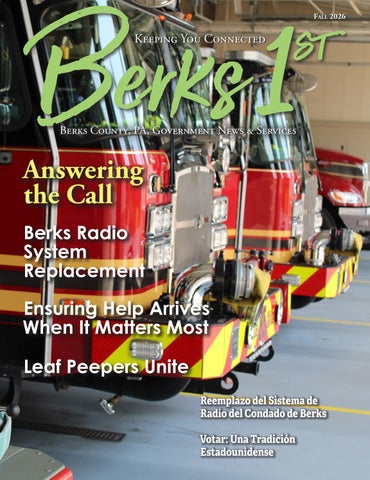
Fall 2026
Berks County, PA, Government News & Services
Answering the Call Berks Radio System Replacement Ensuring Help Arrives When It Matters Most Leaf Peepers Unite Reemplazo del Sistema de Radio del Condado de Berks Votar: Una Tradición Estadounidense
12 14
25
CONTENTS
02
21
2
Answering the Call: Why Volunteer Firefighters Are Needed More Than Ever
6
Berks Radio System Replacement
8
Ensuring Help Arrives When It Matters Most
12 Cheers to 40 Years! 14 Berks County Celebrates America250 17 Local Food Promotion has a New Home with Bountiful Berks
18
Official Publication of the County of Berks, PA 633 Court Street, Reading, PA 19601 Commissioners’ Office: 610-478-6136 commissioners@berkspa.gov
www.berkspa.gov
18 Leaf Peepers Unite: The Berks County Parks are Ready for Nature’s Greatest Show! 21 New VA Programs Aim at Veteran Employment and Optimal Wellbeing 22 Voting: An American Tradition 24 Municipal News 25 Career Opportunities 26 Reemplazo del Sistema de Radio del Condado de Berks 28 Votar: Una Tradición Estadounidense
For Advertising Information, contact Sales@HoffPubs.com 610-685-0914 x 715 www.berks-1st.com
The County of Berks has exercised great care to ensure that the content of this magazine is accurate as of the date of publication.
Editorial content and advertising appearing in this publication should in no way be considered an endorsement from the County Commissioners or the County of Berks. The county assumes no liability for the accuracy of claims made by the advertisers. This publication was created with the intent to deliver useful county government news to the residents of Berks County. The County of Berks disclaims any and all liability and responsibility to any person or party, be they a reader, advertiser or consumer of this publication, for any consequences, actions, results taken or outcomes of anything done or omitted on the basis of reading information or reliance whether partly or solely on the contents of this publication and related website and products. ©2026 All rights reserved. No portion of this publication may be reproduced electronically or in print without the expressed written consent of the publisher or editor.
2027 Commissioners Town Hall Meeting Schedule Wednesday, January 20, 2027 • 6:30p.m. Schuylkill Valley Community Library 1310 Washington Rd., Leesport, PA 19533 Tuesday, February 9, 2027 • 6:30p.m. Fleetwood Area Public Library 110 W. Arch Street, Fleetwood, PA 19522 Tuesday, March 2, 2027 • 6:30p.m. Brandywine Community Library 60 Tower Dr., Topton, PA 19562 Wednesday, April 21, 2027 • 6:30p.m. Womelsdorf Community Library 203 West High St., Womelsdorf, PA 19567
COMMISSIONERS’
Tuesday, May 4, 2027 • 6:30p.m. Hamburg Public Library 32 N. Third St., Hamburg, PA 19526
MESSAGE
Tuesday, September 14, 2027 • 6:30p.m. Sinking Spring Public Library 3940 Penn Ave., Sinking Spring, PA 19608 Wednesday, October 6, 2027 • 6:30p.m. West Lawn-Wyomissing Hills Library 101 Woodside Ave., West Lawn, PA 19609
(L to R) Berks County Commissioners Christian Leinbach, Dante Santoni, Jr. and Michael Rivera
Tuesday, November 9, 2027 • 6:30p.m. Village Library of Morgantown 207 N. Walnut St., Morgantown, PA 19543
Welcome to the Fall 2026 issue of Berks 1st magazine! In these pages, we continue to share the people, programs and stories that make Berks County a special place to live, work and explore. This issue takes a closer look at several important challenges facing our community, including the need for upgrades to the first responder radio system and the ongoing challenges of funding Emergency Medical Services. We also highlight the vital role of volunteers with our local fire departments. There is plenty more to discover throughout this issue. We celebrate 40 years of the Berks Library System; look back at the many America250 celebrations that brought our communities together this summer; and explore the beauty of fall foliage in Berks County parks. We also introduce readers to a unique Guitars for Veterans program that uses the power of music to connect and support those who have served our country.
Scan to Read Online!
Escaneé para leer! g 2026
Sprin
ws & ent Ne
unty,
Co Berks
From emergency services and community volunteers to libraries, parks, history and programs that enrich the lives of our residents, these stories reflect the many ways Berks County continues to grow and come together. We hope this issue informs, inspires and gives you a deeper appreciation for the people and places that make Berks County home. Thank you for reading Berks 1st and for being part of our Berks County community.
es Servic
vernm PA, Go
day, y Birth Happ ica and ! Amers County k er B Built
SPRING
2025
use A Ho pe y ount on Ho rks C es tiful Be Servic ws &d Boun Nean entil So s tinvergnm 1946 Estado PA, Go años, Berks! e oty,ec Co Prunt nc cumple o de Si Berks ¡Feliz y condad Water idos
stem ry Sy LibraDelivery Van ce OnServi s with
Berks 1st Monthly
(digital email blast)
es las ortant son imp edias Por qué s Interm one Elecci
Un
Lead alth Care s VA Berk ental He rks site M pus of Be ento de nos artam story orth Cam El Dep s de Vetera ro me The Hi y’s N Asuntoks es el pri ecer Count de Ber ado en ofr del est iento de tratam ntal en sus me salud ciones instala
Online, email newsletter covering the same great material you get in the print version of Berks 1st but in inboxes every month! Sign up online at www.berkspa.gov/BerksFirst.
FE ATURE – E m er genc y S er v i ces
ANSWERING THE CALL Why Volunteer Firefighters Are Needed More Than Ever
2
Berks 1st - Keeping You Connected Fall2026
departments to rethink how they provide emergency services while continuing to protect their communities. “Volunteerism in general has declined,” said Chris Jordan, Volunteer Fire Chief of the Exeter Township Volunteer Fire Department. “It’s a societal change, but it’s especially noticeable in the fire service.” As volunteer numbers have fallen, emergency calls have moved in the opposite direction.
By Jonathan Heintzman, Berks County Public Relations Officer
T
here was a time when the sound of a fire siren or bell meant storefront owners closed their shops, factory workers stepped away from their machines and neighbors rushed from their homes to answer the call. Volunteer firefighters were woven into the fabric of nearly every Berks County community, providing emergency protection while balancing full-time jobs and family responsibilities.
Today, that tradition continues but with far fewer volunteers. Fire chiefs across Berks County say volunteerism has steadily declined over the past several decades, forcing many
Exeter Township responded to fewer than 500 incidents annually about two decades ago. Today, the department answers approximately 1,500 calls each year as population growth, increased traffic and modern fire alarm systems generate more requests for service. The Township of Spring Fire Rescue Services has experienced similar growth. Fire Chief Colin Hackman recalls that the department handled roughly 800 calls annually when he joined the department in 2007. Last year, it responded to more than 2,500 emergencies, including fires, vehicle rescues, medical emergencies, hazardous materials incidents and other public safety calls. That increase has transformed what it means to be a firefighter. “Fire departments aren’t really just fire continued on next page >
www.berkspa.gov
3
FE ATURE – E m er genc y S er v i ces
“Fire departments aren’t really just fire departments anymore. We’re more of an all-hazards service. When nobody knows what to do, they call us.” — Colin Hackman, Fire Chief, Township of Spring Fire Rescue Services
departments anymore,” Hackman explained. “We’re more of an all-hazards service. When nobody knows what to do, they call us.” The changing nature of emergency response has also made volunteer service more demanding. Modern firefighters receive extensive training before they are ever allowed to enter a burning building. Both chiefs noted that earning Firefighter I certification requires roughly 200 hours of instruction combining classroom education and hands-on practical exercises. Beyond that, firefighters pursue specialized certifications for vehicle rescue, hazardous materials, emergency medical care and numerous other disciplines while completing recurring annual recertifications. Finding time for that level of commitment has become increasingly difficult. Many households now depend on two working adults; family schedules are packed with children’s activities and employers are less likely to allow workers to leave during the day to respond to emergencies. Jordan notes that the days when employees could simply leave a neighborhood business to answer a fire call have largely disappeared, prompting departments like Exeter to add paid daytime staffing to maintain rapid
response times. Hackman believes the training itself could become more accessible through expanded online learning for classroom portions, reducing the number of weekends volunteers must spend away from their families while still maintaining rigorous safety standards. To compensate for declining volunteer participation, many departments have evolved into “combination” organizations that blend career firefighters with volunteers. Exeter staffs firefighters during daytime hours while volunteers continue to provide critical overnight coverage. Spring Township has similarly expanded career staffing over the years as volunteer availability declined. Despite these challenges, both chiefs remain optimistic that people still want meaningful ways to serve. For many volunteers, firefighting provides much more than emergency response. It offers leadership opportunities, specialized training, scholarships, community service experience and lifelong friendships. Jordan says departments also help young people build confidence and develop skills that
4
Berks 1st - Keeping You Connected Fall2026
stand out to future employers. In his experience, interviewers o f t e n a s k m o re a b o u t his service as a volunteer firefighter than his education or previous jobs because it demonstrates commitment, character and a willingness to serve others. Departments are also finding new ways to introduce young people to the fire service. Junior firefighter programs allow teenagers to begin learning the profession in a supervised environment, while internship partnerships with local schools have already helped Spring Township recruit students who remained active volunteers after completing the program. Ultimately, both chiefs say the greatest reward cannot be measured in certifications or equipment. “It really is a calling,” Hackman said. “If you want to do something for your community, contact your local fire department. It’s one of the best things you can do to help protect your neighbors.” He describes the fire service as a family where members look out for one another while serving people on what is often the worst day of their lives. As Berks County continues to grow, so will the need for trained men and women willing to answer the call. While emergency services have evolved dramatically since the days when sirens emptied local businesses, the heart of volunteer firefighting remains unchanged: neighbors helping neighbors when they need it most.
BERKS COUNTY AGRICULTURAL CENTER BUILDING UPGRADES
MG-ARCHITECTS.COM ARCHITECTURE | DESIGN | PLANNING www.berkspa.gov
5
FE ATURE – E m er genc y S er v i ces
BERKS RADIO SYSTEM REPLACEMENT By Jonathan Heintzman, Berks County Public Relations Officer
B
erks County began a major effort in 2010 to ensure emergency responders in the county had access to reliable radio communications. This resulted in the county constructing its first engineered, secure and resilient public-safety radio communications system. This system has not been inexpensive to own and operate. However, according to county emergency responders, there is no argument about the fact that it has performed without downtime and has dramatically improved radio system coverage and reliability. Spring Township Fire Chief Colin Hackman puts the radios into perspective: “There was a time not too long ago that, the police in the county couldn’t talk to the firemen while we were in the field. They just didn’t have the technology to do it. The radios really make that difference.”
Bally Community Ambulance Service Chief of Operations Michael Groff doesn’t mince words: “Those radios are essential. They’re our lifeline. Our crews need to be able to communicate 6
Berks 1st - Keeping You Connected Fall2026
with the communication center, with the 911 center, with the dispatchers, to get updated notes. God forbid, if a crew gets in trouble, that radio is their lifeline.”
Find your dream home!
The components that make up this system have a life expectancy like any similar electronics. Some of the parts can be managed through a break/fix process (allowing the part to fail and then replacing it at cost). Other components cannot be managed responsibly in this way. They need to be replaced in anticipation of failure. The complex and ever-changing world economy means that manufacturers cannot guarantee availability of parts/subcomponents for as long as they used to.
Team up with the Tiger!
This means the county needs to begin considering next steps in the long-term management of this system. There are significant expenses expected over the next five years to “refresh” the technology.
Bill Moser
Topton Ambulance Chief Michael Richards says that some hard decisions will need to be made by everyone—ambulance services, municipalities, the county and taxpayers. “We are looking at getting rid of certain radios to keep the cost low, to lower the burden,” Richards says. “But that means we’re not going to have the same coverage, the same availability. So where is the line? I mean, that’s up to the taxpayer.” The radios used in the field by local and county personnel have similar needs. These radios are going into fires, being dropped/ dislodged during law enforcement activities, exposed to weather and experiencing just about any other undesirable situation you can imagine. Their manufacturers will no longer support the units, and many of them need replacement now or will need to be replaced in the next 12-24 months. State law assigns the responsibility for the delivery of most emergency services to local municipalities. So, the costs for these radios will generally be borne by local governments. As the county works to plan next steps in the ownership of the system itself (as well as the individual, hand-held radios used by County Sheriff deputies, detectives, corrections officers, etc.), local partners will be looking to set forth a plan to refresh some/all of the radios in their possession. To support the needs of the local governments, the County Commissioners are working to: 1. Establish the best possible contract terms and costs. 2. Offer a pass-through, seven-year financing program to local governments to help spread this cost over time, if desired. The Berks County Commissioners hope that this summary of the project planning underway will aid residents in understanding actions that local and county governments are taking now and will need to take over the next few years.
Lisa Tiger
REALTOR
REALTOR
610-207-6186 610-779-2500 LisaTigerHomes.com
WANT TO BE PART OF A TEAM? At SECV, Our People Make Us Special WHY OUR EMPLOYEES ENJOY SECV: ● Our family reputation
● Flexible Spending
for excellence
Accounts (FSAs)
● Comprehensive
● Tuition Assistance
Benefits ● 401(k) Retirement
Savings Plan ● Medical Plan ● Life Insurance ● Paid Holidays and
Vacation
● Competitive Pay ● Making a Difference ● Dynamic Company
Culture ● Local employees
serving local customers with care
● Sick Leave
READY TO JOIN OUR TEAM?
View the available positions with SECV or submit your resume at secv.com/careers
www.berkspa.gov
7
FE ATURE – Em er genc y Ser v i ces
ENSURING HELP ARRIVES WHEN IT MATTERS MOST 8
Berks 1st - Keeping You Connected Fall2026
Why Berks County Communities Are Working Together to Address EMS Funding Challenges By Jonathan Heintzman, Berks County Public Relations Officer
W
hen someone calls 911 because a loved one is having a heart attack, has been seriously injured in a crash or is struggling to breathe, they expect an ambulance to arrive quickly with trained emergency medical professionals ready to help.
For most people, that expectation seems simple. Behind the scenes, however, maintaining that level of emergency response has become increasingly difficult. Across Berks County, throughout PA and the nation, Emergency Medical Services (EMS) providers are facing unprecedented financial pressures that threaten the long-term sustainability of the system communities have relied upon for decades. A recent report prepared through the Center for Excellence in Local Government (CELG) highlights a growing concern shared by EMS providers, municipal leaders and public officials alike. The report stated that without changes to
how EMS is funded and supported, more ambulance services could reduce coverage areas, merge with neighboring agencies or, in some cases, cease operations altogether.
A Changing Financial Reality
Unlike police and fire departments, which are traditionally funded through municipal taxes, EMS operates under a much different financial model. Most ambulance services rely heavily on payments from Medicare, Medicaid, private insurance companies, subscriptions, donations and direct patient billing to fund daily operations. While these revenue sources cover a portion of operating expenses, they often fail to keep pace with the actual cost of providing emergency medical care. The result is a widening gap between what it costs to provide emergency response, and the revenue agencies receive. That challenge has only grown more significant in recent years as the cost of
ambulances, lifesaving equipment, fuel, medical supplies, insurance and employee wages continues to rise. “In our station, it costs over $900 to transport a patient to the hospital. On average, you bring in about $537. That’s one of the major issues, trying to improve reimbursement to cover the cost of business,” said Michael Groff, Chief of Operations for Bally Community Ambulance Association. “Reimbursement just does not cover the cost of business.” “Most people think their insurance covers EMS the same way it covers a doctor or hospital. The reality is it’s not,” said Berks County Director of Emergency Services Brian Gottschall. “The real truth is that much like police and fire, the cost of the service is as much about the cost of readiness as it is the cost of delivery. The ambulance still costs whatever it costs when it’s sitting in the garage. The crew is still getting paid. The lights still have to be kept on in the station. The drugs are expiring.”
Readiness Comes at a Cost
One of the unique aspects of EMS is that providers must be ready to respond at any moment, regardless of how many emergency calls occur during a shift. Ambulances, medical equipment, medications, communications systems and trained personnel must all be available 24 hours a day, seven days a week. Even during periods when crews are not actively transporting patients, those resources must remain fully staffed and ready for the next emergency. continued on next page >
www.berkspa.gov
9
FE ATURE “You pay for police coverage 24 hours a day, regardless of whether an officer responds to a call. EMS should be funded the same way,” said Anthony Tucci, CEO of Western Berks Ambulance Association.
they can make more money in a more stable environment,” Tucci said.
Municipalities Have an Important Role
Pennsylvania law recognizes municipalities as having responsibility for ensuring EMS services are available to their residents. Historically, however, the level of municipal financial support has varied significantly from one community to another.
This “cost of readiness” represents one of the greatest financial challenges facing EMS providers today. Unlike many businesses, ambulance services cannot simply reduce staffing during slower periods or schedule emergencies around business hours. Maintaining aroundthe-clock coverage requires significant investment regardless of call volume. “The mandates we’re required to meet do not coincide with the funding we’re able to receive... the local taxpayer ends up stepping in,” said Topton Ambulance Chief and Executive Director Michael Richards. “You can mandate us to bring a $500,000 ambulance for something as minor as a stubbed toe. There’s just no upside for EMS. EMS providers can’t say no to a call.”
Staffing Remains a Growing Challenge
Financial pressures also affect an EMS agency’s staff, one of their most valuable resources. Like many healthcare professions, EMS organizations across Pennsylvania continue to experience shortages of qualified emergency medical technicians (EMTs) and paramedics. Recruiting new employees while retaining experienced professionals has become increasingly competitive.
“We all know that something has to change. It’s just a matter of making sure the change is done the right way.” — Anthony Tucci, CEO of Western Berks Ambulance Association
The earlier CELG report on EMS funding recommends expanding educational opportunities, strengthening workforce development and conducting a comprehensive analysis of salaries and benefits to help establish EMS as a competitive long-term career. EMS leaders say workforce shortages are driven by financial realities. “I have people that can work at Amazon instead of being an EMT and make more money. People don’t want to go into EMS when 10
Berks 1st - Keeping You Connected Fall2026
Some municipalities provide direct financial contributions. Others offer inkind assistance such as buildings, utilities or maintenance services. Still others have limited financial participation despite receiving the same level of emergency medical coverage. The report concludes that creating greater consistency among municipalities served by the same EMS provider would promote fairness and help establish a more sustainable funding model. Rather than relying on annual funding requests that may differ widely from community to community, the report recommends developing standardized municipal subscription agreements that recognize both direct financial contributions and the value of in-kind support.
Working Together Instead of Working Alone
The CELG report emphasizes that no single solution will solve the challenges facing EMS. Instead, it calls for unprecedented cooperation among EMS agencies, municipalities, county government, educational institutions and state and federal policymakers. Recommendations include improving communication between neighboring ambulance services, enhancing mutual aid coordination, encouraging shared resources, standardizing financial reporting and expanding partnerships that improve operational efficiency.
The report also encourages greater collaboration among EMS agencies in areas such as purchasing equipment, scheduling personnel, billing services and sharing specialized resources where appropriate. These efforts are intended to strengthen local EMS systems while preserving the high level of emergency care residents expect.
Looking Beyond the Short Term
One of the CELG report’s central messages is that there is no quick fix. The funding challenges facing EMS developed over many years and will require thoughtful planning, honest conversations and sustained cooperation to address. “We need a finger in the dike right now. But a finger in the dike is not the solution to the flood. We need reform, and that means everybody—municipalities, EMS companies, insurers, community residents—must be willing to do things differently,” Gottschall said. The report makes clear that while immediate actions are necessary to stabilize ambulance services, lasting solutions will require long-term strategic planning involving providers, municipalities, county leadership and policymakers at every level of government. CELG plans to continue bringing together municipalities and EMS providers to review the report’s findings, discuss local needs and develop strategies that ensure reliable emergency medical services remain available throughout Berks County. Despite the challenges, EMS leaders remain optimistic that collaboration can produce lasting solutions. “We all know that something has to change. It’s just a matter of making sure the change is done the right way,” Tucci said. Bally Ambulance Chief Michael Groff added, “We can continue to work with our legislators to fix the direct-pay legislation and address the gaps in funding that exist from insurance carriers.” For residents, the conversation ultimately comes down to preserving something everyone hopes they never need, but everyone depends on. Whether responding to a serious accident, a medical emergency or a life-threatening illness, EMS professionals are there every hour of every day. Ensuring those dedicated men and women have the resources necessary to continue answering the next call is a shared responsibility that will require collaboration across the entire community. By working together today, the greater Berks County community has an opportunity to build a stronger, more sustainable emergency medical system that continues to provide lifesaving care for generations to come.
WE’RE THE REASON YOUR COMPETITOR LOOKS SO GOOD. They didn’t get lucky. They called MADJ. Want in? Level the playing field at madjmarketing.com
SCAN HERE TO LEARN MORE
marketing
www.berkspa.gov
11
FE ATURE – Lib ra r y S er v i ces
CHEERS TO 40 YEARS! Berks County Public Library System Turns 40
By Emily Montagna, Community Relations Coordinator, Berks County Public Libraries
The Foundation
In July 1985, a year-long study of Berks County libraries culminated in the release of a 97-page report titled Public Library Service for Berks County. The key recommendations of this grant-funded report were to form a “county-wide system of federated libraries...and to operate a center supportive of all the libraries in the system.”
One year later, in July 1986, the Berks County Board of Commissioners officially established the Berks County Public Library System (BCPL). The twelve charter libraries included: • Bethel-Tulpehocken Free Public Library • Birdsboro Community Library (now Boone Area Library) • Hamburg Public Library • Kutztown Public Library (now Kutztown Community Library) • Mifflin Community Library • Muhlenberg Community Library • Reading Public Library • Robesonia Community Library • Sinking Spring Public Library • Village Library of Morgantown • Wernersville Public Library • West Lawn Community Library (now West Lawn-Wyomissing Hills Library) During its founding year, these System libraries served 45,000 registered borrowers and circulated 470,900 items. As its membership grew, BCPL continued making its mark within the Berks County community. Below are a few notable events: 1991: The System assumed operation of the County Bookmobile from the Reading Public Library. This service was a unique 12
Berks 1st - Keeping You Connected Fall2026
library outlet that brought materials to people in rural areas of the county. It served as an alternative to stationary libraries and went to locations where library use may otherwise have been minimal or nonexistent. The Bookmobile continued to operate until 2009.
1996: Van delivery service was established as a way to transfer materials between county libraries, allowing patrons access to a more diverse selection of books, movies and more. The delivery service continues to this day, operating five days a week, by a team of nine part-time drivers. 2000: The first electronic books were added to the county’s District Library Center collection while ebook readers were provided for all System libraries. Consumption of electronic material continued to expand over the years, with the largest increase occurring during the height of the COVID-19 pandemic in 2020-2021.
2014: Libraries in the county began participating in the 1000 Books Before Kindergarten initiative in an effort aimed at developing early literacy in preschoolers. Caregivers are encouraged to read any book to their newborn, infant or toddler to work towards the goal of 1,000 books. Prizes are available as they read their way to 1,000 books, with a special program T-shirt available upon reaching the goal.
The call for entries resulted in 11 original designs, each reflecting the creativity and spirit of the library community. Members of the public were later invited to vote for their favorite design. The response was enthusiastic, with nearly 1,700 votes cast in a short timeframe. The winning artwork, designed by Amanda Kusant, was unveiled in September in conjunction with National Library Card Sign-up Month. First-time library users can request the commemorative card from their local library upon registering, while existing cardholders can upgrade to the new card. The limited-edition design will remain available while supplies last.
Discover the Unexpected
Berks County Public Libraries’ services and offerings have evolved over the years. While books remain a core resource adored by many, Berks libraries have much more to offer. Yet many of these services remain hidden in plain sight. 2021: Berks County Public Libraries became the first institution to offer EnChroma colorblind glasses free for public use. The addition of these specialty glasses was introduced at a live reveal event where colorblind guests were invited to experience the glasses for the first time. 2023: Following the successful reception of its StoryWalk at the Reading Public Museum in 2021, the Library System launched two additional StoryWalk exhibits—one at Berks Nature and the other at Berks Heim Nursing Home.
Limited Edition Library Card
Earlier this year, the Library System invited staff members and library affiliates from its member libraries to take part in a design contest celebrating the organization’s 40th anniversary. Participants were asked to create artwork for a commemorative limited-edition library card that would debut as part of the anniversary celebration.
To celebrate its 40th anniversary, the Library System is shining a light on these overlooked offerings with 40 Things You May Not Know About Berks Libraries—facts about its member libraries and public services that just may surprise you. Here is a small selection of interesting library tidbits: 1. The West Lawn-Wyomissing Hills library is housed in what used to be a fire company social hall. The former bar (circulation desk) and bowling alley bench (children’s area seating) are still there. 2. There are 10 System libraries that participate in the Seed Exchange Libraries program, a partnership that began with the assistance of the Penn State Master Gardeners. “Check out” seeds from a variety of native plants and vegetables and bring back seeds from your harvest to share with other library patrons. 3. Berks County is home to two Carnegie libraries: Reading and Hamburg. This notable distinction is granted to libraries built by businessman and philanthropist Andrew Carnegie. During its latest renovation to expand space and access points, the Hamburg Public Library used bricks knocked down from the demolished wall to build its new circulation desk. 4. All library locations offer Princh wireless printing service. Patrons can download the app, scan a QR code or visit the official Princh website to print documents from their phone or other mobile device. 5. 24 S. Reading Avenue (current location) was gifted to the Boyertown Community Library by BB&T Bank for $1. The bank donated this building to the library after the BB&T and National Penn Bank merger was completed in 2017. Discover more about Berks County Public Libraries by visiting its 40th Anniversary Celebration page on berkslibraries.org. www.berkspa.gov
13
FE ATURE
BERKS COUNTY CELEBRATES
AMERICA250
By Jonathan Heintzman, Berks County Public Relations Officer
14
Berks 1st - Keeping You Connected Fall2026
T
here was a unique sense of community during the 250th anniversary celebrations in July. From one corner of the country to the other, America was celebrating! Countless, utterly countless, families, blocks, neighborhoods, communities and regions recognized the moment in their own unique and wonderful ways.
On July 4 and over the broader weekend, millions of times a friend passed the mustard for a hot dog. Millions of lucky skywatchers watched rockets explode in coruscating, chromatic delight. Millions of small, reluctant swimmers held their noses, clutched their water wings and leapt into the water and supporting arms. Small, similar moments of family, camaraderie, joy and celebration were replicated and repeated, over and over, everywhere. How remarkable and wonderful!
parade. Sycamore Stage had raided their costume loft to fit out nearly 25 reenactors. The group and the parade float represented Berks County America250PA, one of a statewide collection of committees tasked with helping to arrange and support celebrations of the 250th birthday of our nation.
In every state, in every county, in every town, we were celebrating our country! We were celebrating ourselves. Singing “You’re a Grand Old Flag” and other patriotic tunes, the county personnel and reenactors handed Amid the many and out American flags (donated by the VA), candy and varied celebrations specific America250 signs. The bunting, flags and certainly the to Berks County, the period costumes impressed the parade officials, and County Commissioners, the Berks County America250 group was awarded a row officers, staff and first-place ribbon! volunteers from Sycamore Stage Theatre Company Later in the day, the Star-Spangled Spectacular concert spent the July 4th morning at the Berks County Fairgrounds entertained a crowd arranging straw bales, that grew steadily throughout the afternoon. Music hanging bunting and, most lovers on camp chairs and picnic blankets watched importantly, organizing bands including the Let’s Dance Orchestra, Flamin’ the coolers of water and Dick and the Hot Rods, and Brass Pocket Band. At its Gatorade before marching peak, approximately 1,000 people attended the festivities. in the annual Wyomissing Strong thunderstorms moving through the region cut Borough Fourth of July short a recitation of the Declaration of Independence from PA State Senator Judy Schwank and PA State Representative Mark Gillen. Sadly, the event was forced to end due to the storms, and the feature concert from continued on next page > www.berkspa.gov
15
the Reading Symphony Orchestra and the grand finale fireworks were cancelled. Mother Nature decided to hold her own fireworks display through the evening, and it was breathtaking! Finally, on July 8, the county’s celebrations culminated with the ringing of the Berks County Liberty Bell! The Berks County Liberty Bell is the same one that, 250 years ago, had called residents in Reading and the surrounding area to the center of the city to hear the first reading of the Declaration of Independence. It still rang out a clear message that our nation has endured this long. The celebration also included music from the New Ringgold Band, the history of the bell from Rick Polityka and more. The Declaration of Independence was recited by Dr. Dale Cake (fifth great-grandson) and Jennifer Loveland (sixth great-granddaughter) of Berks County Sheriff Henry Vanderslice, who read the Declaration on July 8, 1776, at the Berks County Courthouse. Many thanks to everyone at the county and the many, many volunteers who helped to make all of our celebrations possible! Happy 250th Birthday, America!
So Many Places. So Many Stories. One Incredible Fall. Visit experienceberks.com to discover local fall happenings & events.
UNLOCK YOUR INNER MUSICIAN!
Whether you dream of playing music with family & friends, performing, or playing for yourself, Meadowood Music is your Berks County destination. Find fine stringed instruments, expert instruction for all ages & skill levels, professional repair services & a community of musicians to welcome you.
Visit us at MeadowoodMusic.com Call Today: 610-916-1285 Meadowood Music | 8521 Allentown Pike, Blandon PA 19510
@goggleworks
Reading Liederkranz
Reading Pagoda
Folino Estate Colebrookdale
www.experienceberks.com
16
Berks 1st - Keeping You Connected Fall2026
FEATURE – Ag r i c u lt u re
LOCAL FOOD PROMOTION HAS A NEW HOME WITH BOUNTIFUL BERKS
Do More With
YOUR MONEY
VISIT YOUR LOCAL BERKS COUNTY BRANCH TODAY OR BECOME A MEMBER ONLINE.*
By Amanda Burkard-Sell, Deputy Director, Berks County Dept. of Agriculture
B
erks County is a hot spot for farm stands and farmers’ markets, with over 250 locations for residents and visitors to buy local food. To help connect consumers with this multitude of options, the Berks County Department of Agriculture has relaunched the Bountiful Berks brand. Featuring a refreshed logo and website, look for the updated local food directory on www.bountifulberks.org. New Facebook and Instagram pages will feature fun facts, stories and seasonal recipes.
Rather have a physical copy to page through or bring on a road trip? Pick up a printed market guide from a local farm stand or visit the Berks County Department of Agriculture office at the Agriculture Center in Leesport or at an event. Both are your source for all local food—from fresh corn and tomatoes in the summer, to seasonal pumpkins and Christmas trees, to year-round options like meat, cheese and wine. Bountiful Berks is the new destination to find your local products. If you have always wanted to buy local but didn’t know where to start, or if you are looking for a fun new way to explore what Berks County has to offer, Bountiful Berks is your resource.
FEDERALLY INSURED BY NCUA *PROSPECTIVE MEMBERS MUST MEET ELIGIBILITY REQUIREMENTS.
Support farm families! Buy local! www.berkspa.gov
17
FE ATURE – Pa r k s & Rec rea t i o n
LEAF PEEPERS UNITE The Berks County Parks are Ready for Nature’s Greatest Show! By Lisa Gauker, Recreation & Special Events Supervisor, Berks County Parks and Recreation
18
Berks 1st - Keeping You Connected Fall2026
Y
ou may have heard the phrase “leaf peepers” or even used it as a term of endearment for someone you know, but for those of us relishing in the colors of the season right now, it’s game time. The rowdy reds, yielding yellows and outstanding oranges are making their appearances soon on the many species of trees that call our county parks home.
The parks along the Tulpehocken Creek as well as Antietam Lake Park are abundant in fall foliage color. Have you ever wondered about the science behind these magnificent colors? Why do we have such a variety of hues in our Pennsylvania forests? Those colors have always been there, lying patiently behind a curtain of chlorophyll like a well-practiced understudy in a play. When the green stuff steps aside, it’s lights, action, anthocyanins! You might remember from elementary school science
class that chlorophyll is the green pigment in plant leaves that allows plants to turn sunlight into energy. In the fall, many of our plant friends take notice of the shortening days, making less chlorophyll because of dwindling sunlight. Colder nights also signal winter’s impending arrival and cue our trees to conserve and begin shutting down for their long winter’s nap. Eventually, chemical signals from the tree’s trunk and roots tell the leaves to stop making chlorophyll. What we see on display are green leaves fading to the beautiful colors that exist behind that green curtain. These reds, yellows and oranges are chemical pigments called carotenes (yes, as in the orange of carrots). If we were to further break those colors down by chemicals, reds are produced by anthocyanins, yellows by xanthophylls and oranges by carotenoids. Any combination of these chemical
compounds can result in leaves with multiple colors, and some species are known for having all three!
Best-kept secrets of Berks County Parks’ fall foliage
Our county parks have some of the best fall foliage around. Get the inside scoop on where to check out a variety of native trees ablaze in autumn color. 1. Antietam Lake Park: Gravity Trail from Angora Trailhead Lot: Nestled in the heart of Antietam Lake Park, starting off in any direction from here will lead you towards magic. From the parking lot, head up the Gravity Trail past the kiosk to immerse yourself in the deep greens of our white pine (Pinus strobus) forest where you’ll discover that some trees stay green all year long! Bright yellow tulip continued on next page >
www.berkspa.gov
19
F E AT URE – Agr i c u lt u re
trees (Liriodendron tulipifera) with their cat’s head shaped leaves tower towards the sky as you rise in elevation up the mountainside. 2. Antietam Lake Park: Mother’s Tree Plaza: If you’re drawn to the water, cross Angora Road carefully from the main lot to follow the “boardwalk” along the lake edge down to the Mother’s Tree. This white paper birch (Betula papyrifera) features small, delicate yellow leaves that tremble in the breeze and stand in stark contrast to the peeling white bark that gives this tree its name. History buff alert: Solan Parkes started his journey here, and his impact was felt nationwide. Great man, great tree, great story—look it up! 3. Berks County Heritage Center: Spectacular species of trees and shrubs call this historic park home. Its location along the Tulpehocken Creek often means that early morning visitors to the Union Canal Trail can enjoy steam rising from the tree-lined creek banks that gives photographers those perfect moody shots that are quintessentially fall. The puzzle piece bark of the massive American sycamore (Platanus occidentalis) is a great backdrop for the much smaller flowering dogwood (Cornus florida) trees’ burgundy ribbed leaves that are found near the creek banks. Red maples (Acer rubrum) with flame-red leaves guard the entrance to the Country Store and Snack Bar. 4. Gring’s Mill: Frequent flyers to our park programs know that February brings our maple sugaring season when staff taps several of the century-old sugar maples (Acer saccharum) tucked along the edge of the wood line at Gring’s Mill. These trees most likely saw all phases of the property, from farm and mill to public park. Other maples have just one color to offer each leaf peeper season, but sugar maples get to choose all three—gorgeous yellow, orange and red speckled leaves! 5. Union Canal Trail: There is no bad place to catch a glimpse of fall foliage along the trail. With more species of trees than you can shake a stick at (see what we did there?), each one offers variation and beauty that make our four-plus-mile trail one of the most iconic in the area—because of our tremendous trees. Happy leaf peepin’! 20
Berks 1st - Keeping You Connected Fall2026
Connecting Berks County to Addiction Resources Local Treatment and Recovery Resources Free NARCAN Free Medication Lock Boxes Community and School Education Free Tobacco Cessation Classes
(610) 376-8669 cocaberks.org
FE ATURE – Ve t era ns Af fa i rs
NEW VA PROGRAMS AIM AT VETERAN EMPLOYMENT AND OPTIMAL WELLBEING By Lt. Col. (Ret) Jay Ostrich, Director, Berks County Veterans Affairs
T
he tenuous balance between work and play wreaks havoc on us all, but with veterans who have retired from the military and returned to Berks County to live, the challenges of finding it in the civilian world can be even more daunting. Thanks to two new programs and partnerships from Berks County Veterans Affairs, veterans and their spouses can tackle issues like unemployment and underemployment and even find new and productive pathways to healing.
Eligibility documents are required, including a valid DD214; driver’s license or government ID; Social Security card if DD214 does not show a Social Security Number; proof of Berks County residence if address differs from address on your ID; and proof of income or public assistance. Appointments are highly encouraged, and interested parties can call to schedule their free consultation at 610-378-5601.
Guitars for Veterans
Starting in September, a partnership struck by the Berks County Workforce Development Board and PA CareerLink® Berks County—an initiative by the Pennsylvania Department of Labor and Industry that connects job seekers with employers—will launch by holding regularly scheduled office hours at the Berks County Etchberger Veterans Center at 20 Commerce Drive in Wyomissing, Tuesdays and Thursdays, 8 a.m. to 4 p.m.
On a different note—quite literally— veterans and spouses may also take advantage of an exciting new program called Guitars for Veterans, which offers free guitar lessons for beginners. The partnership with national nonprofit Guitars for Vets (G4V) serves at-risk United States veterans impacted by post-traumatic stress disorder (PTSD) and other servicerelated trauma.
The partnership will connect qualified veterans and spouses with a career counselor free of charge. The goals of this relationship are to find better career paths to suit their skills and goals, receive transportation assistance, help with childcare, housing assistance, help with uniforms and clothing, and other household expenses.
PTSD has been a major barrier to optimal well-being for our veterans and their families, as well as a leading cause of the unacceptable suicide rate among our heroes. According to statistics from the Department of Veterans Affairs, more than 150,000 U.S. veterans have ended their lives by suicide since 2001.
In Berks County last year, veterans accounted for 26 percent of all county suicides despite comprising only 4.5 percent of the population. Through this unique, 10-week, structured guitar instruction program headed by former Hamburg School District Superintendent and accomplished musician Richard Mextorf, our heroes can put the healing power of music right into their hands while reconnecting them to their veteran tribe and greater community. Moreover, thanks to the unbelievable generosity of Doug Ellis of No Strings Attached Guitars, 10 practice guitars await students who will begin their journey. Graduates of the program will not only get their instruction for free but will receive a brand-new quality guitar to continue their musical mission however they like. “This program offers an opportunity for our heroes to use music as a venue to start healing,” said Mextorf. “It’s a powerful connection and great fellowship.” Although the first iteration of classes in September is full, a waiting list for 2027 has already started. As seating is quite limited, interested veterans and spouses are highly encouraged to contact Veterans@ BerksPA.gov to reserve a spot. www.berkspa.gov
21
FE ATURE – E lec t i o ns FEATURE – E lec t i o ns The outbreak of the Revolutionary War did not prevent colonists from voting. Elections continued to be held at the state and local level through the end of the conflict in 1783. In 1789, the United States held its first federal Presidential election. Almost a century later, during the Civil War, states devised ways for their soldiers to vote even though they were away from home. During that time, absentee voting was reserved only for members of the military. Non-military voters would gain the ability to vote by absentee ballot until the early-to-mid 20th century, depending on the state.
Election Reform
VOTING: AN AMERICAN TRADITION
Election reform from the 18th through the early 20th centuries focused on the question of voter eligibility. The U.S. Constitution was amended several times between 1868 and 1924, granting voting rights to different groups of people, including former slaves, Native Americans and women. The latter part of the 20th century saw a new era for voting and election reform. The focus shifted to voter protection, voter inclusion and voting accessibility. This new reform era was kicked off in 1965, when the federal Voting Rights Act (VRA) was passed. The VRA’s primary objective was to eliminate unfair voting requirements, such as literacy tests and poll taxes. The 26th Amendment passed in 1971, lowering the voting age from 21 to 18, further expanding the voting population. Future VRA amendments would provide protections for voters with disabilities and the elderly, as well as expand language access to non-English speakers.
Although absentee ballots had been available to civilian voters in Pennsylvania since the mid-20th century, a shift towards no-excuse ballots occurred with the passing of Act 77 in 2019. Act 77 also eliminated straight-ticket voting, extended registration and ballot deadlines, streamlined election procedures and encouraged Pennsylvania counties to upgrade their By Silvia Gutierrez, Chief Registrar, Berks County Election Services voting machines. No-excuse mail-in ballots came to Pennsylvania just as the country was rocked by the COVID-19 pandemic and leading up to the 2020 Early Elections Presidential election. Pennsylvania election officials Before the colonies declared independence from Great Britain in 1776, scrambled to conduct the 2020 election in a way that colonists already participated in early forms of voting. In Pennsylvania, would keep voters safe at the polls, while still adhering the first recorded elections occurred in 1683 when eligible voters elected to election laws and requirements. In the wake of county representatives. Early voting was predominantly a public and 2020, election reform swung to election integrity and often festival-like affair. It was standard practice for voters to cast their election security. votes by voice (known as viva voce) or by public ballot. This concept may seem foreign to many modern voters who think it is commonplace Though elections will almost certainly continue to to cast their ballot secretly behind a curtain at a polling place. However, evolve, one thing has remained constant throughout modern-day voting, as we recognize it, would only begin taking shape American history. That is that citizens have consistently in the late 19th century. voted without missing a beat. From the country’s early
22
Berks 1st - Keeping You Connected Fall2026
beginnings, through modern times, elections have been held without pause. American citizens have found a way to cast their vote through revolution, civil conflicts, world wars and pandemics. Voting truly is an American tradition.. Important Dates for the 2026 General Election Last day to register to vote: October 19 Register to vote at www.vote.pa.gov/register. Last day to apply for a mail-in or absentee ballot: October 27 Apply for a mail-in or absentee ballot at www.vote.pa.gov/ apply-mail-in. All voted mail-in and absentee ballots must be received by the Berks County Office of Election Services by 8 p.m. on Election Day to be counted. Ballots can be sent via mail or dropped off in the office or one of the county’s drop boxes. Election Day: November 3 Polls open 7 a.m. to 8 p.m. Find your polling place at www.vote.pa.gov/polls.
On the Ballot This 2026 General Election ballot features federal and statewide offices, with the Governor race at the top of the ticket. Ballots in Berks County will include the following offices: • Governor & Lieutenant Governor • Representative in Congress º 4th District º 6th District º 9th District • Senator in the General Assembly º 24th District º 44th District º 48th District • Representative in the General Assembly º 5th District º 127th District º 99th District º 128th District º 124th District º 129th District º 126th District º 130th District Once finalized, sample ballots for each precinct will be available at www.berkspa.gov/elections.
e r e h w Every
INTERNET COVERAGE
FAST SPEEDS
RELIABLE CONNECTION
MORE DEVICES
800.344.0347
secv.com/internet
LOCAL SUPPORT
www.berkspa.gov
23
Mu n i ci p al N ew s
s w e N l a p i c i Mun Brecknock Township
www.brecknockberks.com Brecknock Township in Berks County encourages all to visit our Township’s website, www.brecknockberks.com. Here you can find our meeting agendas, permit applications, fee schedule, ordinances, current newsletter, upcoming events and contact information for the Township Office and Police Department. You can also follow us on Facebook.
Fleetwood Borough
www.fleetwoodboro.com Welcome to the Fleetwood Borough, “Everyone’s Hometown”! In December, the Fleetwood Rec Board hosts a Tree Lighting in Fleetwood Park complete with Santa and Mrs. Claus! Check our website for more information on everything that is happening in our little Borough. Council meetings are held the second Monday of every month at 6:30 p.m. in the Community Center.
Hamburg Borough
www.hamburgboro.com Looking for hiking, running or viewing trails? Hamburg has seven moderate and one easy trail in the area from 3.8 to 9.3 miles. Trails start at the Hamburg Reservoir parking lot at 400 Reservoir Rd., Hamburg. The trailhead is ½ mile from the lot. Parking is from sunrise to sunset.
Kutztown Borough
www.kutztownboro.org Kutztown has a thriving downtown with well-established mom & pop shops, restaurants and unique retailers. Visit this fall to “Trick-or-Treat on Main Street”; take a ride on the Allentown & Auburn Railroad’s Pumpkin Trains; or see a movie/event at The Strand Theatre, which is being upgraded to breathe new life into this historic building. Follow us on Facebook.
Longswamp Township
www.longswamptownship.org Upcoming Events at our Community Park: Sat. Dec. 5, 2026—Christmas Tree Lighting; Sat. Mar. 20, 2027—Egg hunt; and Sat. June 12, 2027—Swamp Fest. Park pavilion rental reservations for 2027 can be made starting April 5th. Follow Longswamp Township on Facebook and visit the township website to learn more.
24
Berks 1st - Keeping You Connected Fall2026
Upper Tulpehocken Township
www.UpperTulpehockenTownship.com Please visit www.UpperTulpehockenTownship.com for all Upper Tulpehocken Township and Strausstown Village information. Upcoming Strausstown Volunteer Fire Company Breakfasts: Nov 8 and Dec 13, 2026, and January 10, 2027! Supervisor meetings are held the second Tuesday of every month at 6:00 p.m. Residents are welcome and encouraged to attend.
Wernersville Borough
www.wernersvilleborough.org The Wernersville Borough is a small borough with a lot to offer! Our Rec Board has been busy hosting events throughout the year. Our next event will be the Holiday Event at the Borough Hall in December. Follow the Borough and Rec Board pages on Facebook for updates! (Wernersville Borough and Wernersville Borough Rec Board)
Calling All Municipalities! If you have news you would like to publish in our Spring 2027 issue, please contact Jonathan Heintzman, Berks County Public Relations Officer, at JHeintzman@berkspa.gov for more information.
www.berkspa.gov
25
R i n cón e n EEsp s p a ño l
REEMPLAZO DEL
SISTEMA DE RADIO DEL CONDADO DE BERKS Por Jonathan Heintzman, Berks County Public Relations Officer
E
n 2010, el Condado de Berks emprendió un esfuerzo importante para garantizar que los socorristas de emergencia del condado tuvieran acceso a comunicaciones de radio confiables. Como resultado, el condado construyó su primer sistema de comunicaciones de radio para la seguridad pública diseñado técnicamente, seguro y resiliente. Este sistema no ha sido económico de poseer ni de operar. Sin embargo, según los socorristas de emergencia del condado, no cabe duda de que ha funcionado sin interrupciones y ha mejorado notablemente la cobertura y la confiabilidad del sistema de radio.
El jefe de bomberos de Spring Township, Colin Hackman, pone los radios en perspectiva: “No hace mucho tiempo, la policía en el condado no podía comunicarse con los bomberos mientras estábamos en el campo. Simplemente no contaban con la tecnología para hacerlo. Los radios realmente marcan esa diferencia.”
26
Berks 1st - Keeping You Connected Fall2026
Michael Groff, jefe de operaciones del Servicio de Ambulancias Comunitario de Bally, no se anda con rodeos: “Esos radios son esenciales. Son nuestros salvavidas. Nuestro personal necesita poder comunicarse con el centro de comunicaciones, con el centro del 911, con los despachadores, para recibir información actualizada. Dios no lo quiera, pero si una unidad se encuentra en problemas, ese radio es su salvavidas.” Los componentes que conforman este sistema tienen una vida útil similar a la de cualquier equipo electrónico similar. Algunas piezas pueden manejarse mediante un proceso de reparación tras fallo (permitiendo que la pieza falle y luego reemplazándola, con el costo correspondiente). Otros componentes no pueden manejarse responsablemente de esta manera. Es necesario reemplazarlos de forma preventiva, en anticipación a una falla. La complejidad y los constantes cambios de la economía mundial hacen que los fabricantes ya no puedan garantizar la disponibilidad de piezas y subcomponentes durante tanto tiempo como antes. Esto significa que el condado debe comenzar a considerar los próximos pasos para la gestión a largo plazo de este sistema. Se prevén gastos considerables durante los próximos cinco años para “renovar” la tecnología. El jefe de la Ambulancia de Topton, Michael Richards, afirma que todos —los servicios de ambulancia, los municipios, el condado y los contribuyentes—tendrán que tomar decisiones difíciles. “Estamos considerando eliminar ciertos radios para mantener bajo el costo y aliviar la carga”, dice Richards. “Pero eso significa que no tendremos la misma cobertura ni la misma disponibilidad. Entonces, ¿dónde está el límite? Eso, en última instancia, le corresponde decidir al contribuyente.” Los radios utilizados en el campo por el personal local y del condado tienen necesidades similares. Estos radios se ven expuestos a incendios, se caen o se desprenden durante operativos policiales, quedan expuestos a la intemperie y enfrentan prácticamente cualquier otra situación adversa que se pueda imaginar. Sus fabricantes dejarán de darles soporte técnico, y muchas de ellos necesitan reemplazo ahora o deberán reemplazarse entre los próximos 12 a 24 meses. La ley estatal asigna a los municipios locales la responsabilidad de la prestación de la mayoría de los servicios de emergencia. Por lo tanto, los costos de estos radios generalmente recaerán sobre los gobiernos locales. Mientras el condado trabaja para planificar los próximos pasos en cuanto a la propiedad del sistema en sí (así como de los radios portátiles individuales que utilizan los diputados del alguacil del condado, los detectives, los oficiales correccionales, entre otros), las entidades locales buscarán establecer un plan para renovar algunos o todos los radios en su posesión.
WE MARKET BRANDS, NOT BANANAS. BUT THIS AD HAS ONE.
You won’t forget this ad — and that’s the point. We help businesses stand out in crowded markets with bold branding and smart strategy. Let’s make something a little… bananas. SCAN HERE TO LEARN MORE
marketing 484-336-4341 success@madjmarketing.com madjmarketing.com
Para apoyar las necesidades de los gobiernos locales, los comisionados del condado están trabajando para: 1. Establecer los mejores términos contractuales y costos posibles. 2. Ofrecer, a quienes lo deseen, un programa de financiamiento de intermediación a siete años para los gobiernos locales, con el fin de ayudar a distribuir este costo a lo largo del tiempo. Los comisionados del condado de Berks esperan que este resumen de la planificación del proyecto en curso ayude a los residentes a comprender las medidas que los gobiernos locales y del condado están tomando actualmente y que deberán tomar en los próximos años. www.berkspa.gov
27
R i n cón e n Esp a ño l
VOTAR: UNA TRADICIÓN ESTADOUNIDENSE Por Silvia Gutierrez, Registradora Principal, Servicios Electorales del Condado de Berks
Las Primeras Elecciones
Antes de que las colonias declararan su independencia de Gran Bretaña en 1776, los colonos ya participaban en formas tempranas de votación. En Pensilvania, las primeras elecciones registradas se llevaron a cabo en 1683, cuando los votantes elegibles eligieron a los representantes del condado. Las primeras votaciones eran, en su mayoría, un evento público y, con frecuencia, de carácter festivo. Era práctica habitual que los votantes emitieran su voto en voz alta (conocido como viva voce) o mediante papeleta pública. Este concepto puede parecer ajeno a muchos votantes modernos, quienes consideran habitual emitir su voto en secreto, detrás de una cortina, en un centro de votación. Sin embargo, la votación moderna, tal como la conocemos hoy, no comenzó a tomar forma sino hasta finales del siglo XIX. El estallido de la Guerra de Independencia no impidió que los colonos votaran. Las elecciones continuaron celebrándose a nivel estatal y local hasta el final del conflicto en 1783. En 1789, Estados Unidos celebró su primera elección presidencial federal. Casi un siglo después, durante la Guerra Civil, los estados idearon formas para que sus soldados pudieran votar aun estando lejos de casa. Durante ese tiempo, el voto 28
Berks 1st - Keeping You Connected Fall2026
en ausencia estaba reservado únicamente para los miembros de las fuerzas armadas. Los votantes no militares no obtendrían la posibilidad de votar mediante papeleta de voto en ausencia hasta principios o mediados del siglo XX, según el estado.
Reforma Electoral
La reforma electoral, desde el siglo XVIII hasta principios del siglo XX, se centró en la cuestión de la elegibilidad de los votantes. La Constitución de los Estados Unidos fue enmendada en varias ocasiones entre 1868 y 1924, otorgando el derecho al voto a distintos grupos de personas, entre ellos, los antiguos esclavos, los indígenas estadounidenses y las mujeres. La segunda mitad del siglo XX marcó una nueva era para la votación y la reforma electoral. El enfoque se desplazó hacia la protección del votante, la inclusión del votante y la accesibilidad al voto. Esta nueva era de reformas comenzó en 1965, con la aprobación de la Ley federal de Derecho al Voto (Voting Rights Act, o VRA, por sus siglas en inglés). El objetivo principal de la VRA era eliminar requisitos de votación injustos, como las pruebas de alfabetización y los impuestos electorales. La 26ª Enmienda, aprobada en 1971, redujo la edad mínima para votar de 21 a 18 años, ampliando aún más la población electoral. Futuras enmiendas
a la VRA brindarían protecciones a los votantes con discapacidades y a las personas mayores, además de ampliar el acceso lingüístico para las personas que no hablan inglés. Aunque las papeletas de voto en ausencia habían estado disponibles para los votantes civiles de Pensilvania desde mediados del siglo XX, con la aprobación de la Ley 77 (Act 77) en 2019 se produjo un cambio hacia el voto por correo sin necesidad de justificación. La Ley 77 también eliminó el voto por partido único, amplió los plazos de registro y de entrega de papeletas, simplificó los procedimientos electorales y alentó a los condados de Pensilvania a modernizar sus máquinas de votación. El voto por correo sin justificación llegó a Pensilvania justo cuando el país se vio sacudido por la pandemia de COVID-19 y en el período previo a la elección presidencial de 2020. Los funcionarios electorales de Pensilvania se apresuraron a llevar a cabo la elección de 2020 de manera que se mantuviera la seguridad de los votantes en los centros de votación, sin dejar de cumplir con las leyes y los requisitos electorales. Tras el 2020, la reforma electoral se orientó hacia la integridad y la seguridad electoral. Aunque es casi seguro que las elecciones seguirán evolucionando, una cosa se ha mantenido constante a lo largo de la historia estadounidense: los ciudadanos han votado de manera ininterrumpida. Desde los primeros años de la nación hasta la actualidad, las elecciones se han celebrado sin pausa. Los ciudadanos estadounidenses han encontrado la manera de emitir su voto a través de revoluciones, conflictos civiles, guerras mundiales y pandemias. Votar es, verdaderamente, una tradición estadounidense.
En la Papeleta La papeleta de esta Elección General de 2026 incluye cargos federales y estatales, con la contienda para ser el(la) Gobernador(a) a la cabeza. Las papeletas del Condado de Berks incluirán los siguientes cargos: • Gobernador(a) & Teniente Gobernador(a) • Representante en el Congreso º 4to Distrito º 6to Distrito º 9no Distrito • Senador en la Asamblea General º 24to Distrito º 44to Distrito º 48vo Distrito • Representante en la Asamblea General º 5to Distrito º 127mo Distrito º 99no Distrito º 128vo Distrito º 124to Distrito º 129no Distrito º 126to Distrito º 130mo Distrito Una vez finalizadas, las papeletas de muestra para cada precinto electoral estarán disponibles en www.berkspa. gov/elections.
Fechas Importantes para la Elección General de 2026 Último día para registrarse para votar: 19 de octubre Regístrese para votar en www.vote.pa.gov/register.
La Esperanza Empieza Aquí
Último día para solicitar una papeleta de voto por correo o en ausencia: 27 de octubre Regístrese para votar en www.vote.pa.gov/apply-mail-in.
Hope Starts Here
Todas las papeletas de voto por correo y en ausencia votadas deben ser recibidas por la Oficina de Servicios Electorales del Condado de Berks antes de las 8:00 p.m. del día de las elecciones para ser contadas. Las papeletas pueden enviarse por correo o entregarse en la oficina o en uno de los buzones de recolección del condado. Día de las Elecciones: 3 de noviembre Los centros de votación abren de 7 a.m. a 8 p.m. Encuentre su centro de votación en www.vote.pa.gov/polls.
VISIT US AT:
CentroHispano.org www.berkspa.gov
29
NOW OPEN!
The Region’s Only 24/7 Pharmacy. Care when you need it most—around the clock. Reading Hospital Ambulatory Pharmacy, located in the Reading Hospital 5th Avenue Lobby, is now Reading Hospital 5th Avenue Pharmacy—the region's only 24/7 pharmacy— with convenient curbside pickup.
EASY CURBSIDE PICKUP
Learn more at TowerHealth.org/Rx247