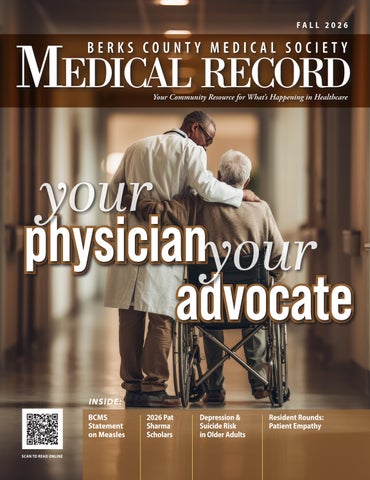
FALL 2026
Your Community Resource for What’s Happening in Healthcare
INSIDE: BCMS Statement on Measles SCAN TO READ ONLINE
2026 Pat Sharma Scholars
Depression & Suicide Risk in Older Adults
Resident Rounds: Patient Empathy
Mark Titi, MD Henry Scovern, MD
A Quarterly Publication To provide news and opinion to support professional growth and personal connections within the Berks County Medical Society community.
Features
Contents
Berks County Medical Society MEDICAL RECORD
FALL 2026
7
D. Michael Baxter, MD, Editor
Editorial Board
INTRODUCTION TO THE 2026 PAT SHARMA SCHOLARS
D. Michael Baxter, MD Lucy J. Cairns, MD William Santoro, MD Raymond Truex, MD Beth E. Gerber, IOM
Berks County Medical Society Officers Ankit Shah, MD President Olapeju Simoyan, MD President-elect Daniel Edwards, DO Treasurer William Santoro, MD Immediate Past President Secretary & Delegation Chair
Directors
Advocacy Chair: D. Michael Baxter, MD Collegiality Chair: Pauletter Dreher, DO Early Career Physician Chair: Caitlyn Moss, MD Education Chair: Lucy Cairns, MD Medical Record Editor: D. Michael Baxter, MD Medical Student Chair: Peter Aziz (one-year term) Residency Chair: Osadebamwen ‘Deb’ Osaghae, MD, resident (one-year term) Eve Kimball, MD Jacob Lucas, DO Amogh Nagol, student (one-year term) Fatima Khalid, MD (one-year term) Wei Shaw, DO Mansi S. Vasconcellos, MD*, BCMS Alliance President
18 Depression and Suicide Risk in Older Adults: Clinical and Public Health Implications 22 Berks County Medical Society Night at the Fightin’ Phils 24 Pediatric Perspectives
POSTMASTER: Please send address changes to the Berks County Medical Record, 2669 Shillington Rd, Sinking Spring, PA 19608, Ste 501.
Editor’s Notes
20 Community Anchors 25 Resident Rounds 26 Student Vital Signs
Berks County Medical Society – BECOME A MEMBER TODAY! Go to our website at www.berkscms.org and click on “Join BCMS/PAMED.”
Berks County Medical Society
The Berks County Medical Record (ISSN #0736-7333) is published four times a year by the Berks County Medical Society, 2669 Shillington Rd, Sinking Spring, PA 19608, Ste 501. Subscription $50.00 per year. Periodicals postage paid at Reading, PA, and at additional mailing offices.
6
30 BCMS News & Events
* designates non-voting member
Manuscripts offered for publication and other correspondence should be sent to 2669 Shillington Rd, Sinking Spring, PA 19608, Ste 501. The editorial board reserves the right to reject and/or alter submitted material before publication.
President’s Message
29 In Memoriam
Staff
The opinions expressed in these pages are those of the individual authors and not necessarily those of the Berks County Medical Society. The ad material is for the information and consideration of the reader. It does not necessarily represent an endorsement or recommendation by the Berks County Medical Society.
4
27 Advocacy
Beth E. Gerber, IOM Executive Director
2669 Shillington Rd., Suite 501, Sinking Spring, PA 19608 (610) 375-6555 • (610) 375-6535 (FAX) info@berkscms.org • www.berkscms.org
In Every Issue
Content Submission: Medical Record magazine welcomes recommendations for editorial content focusing on medical practice and management issues, and health and wellness topics that impact our community. However, we only accept articles from members of the Berks County Medical Society. Submissions can be photo(s), opinion piece or article. Typed manuscripts should be submitted as Word documents (8.5 x 11) and photos should be high resolution (300dpi at 100% size used in publication). Email your submission to info@ berkscms.org for review by the Editorial Board. Thank YOU!
w w w. H o f f p u b s . co m
Hoffmann Publishing is the official publisher of the Berks County Medical Society’s Medical Record magazine. For advertising opportunities contact: Ad Sales at Sales@HoffPubs.com or 610.685.0914 x715
©2026 All rights reserved. No portion of this publication may be reproduced electronically or in print without the expressed written permission of the publisher.
BERKS COUNTY MEDICAL SOCIETY STATEMENT ON MEASLES Ankit Shah, MD, FACEP, FAAEM, FAMIA President
The following statement by the Berks County Medical Society Board of Directors was recently released to local media for distribution, reflecting our commitment to provide factual, science-based information and recommendations to promote a healthy, wellinformed community.
The Berks County Medical Society (BCMS) is deeply concerned about the resurgence of measles in Pennsylvania, particularly in Southcentral Pennsylvania. Measles is one of the most contagious diseases known and can cause serious complications such as pneumonia, encephalitis, permanent disability, and death when it affects body organs or the brain. We extend our heartfelt sympathy to families and loved ones who have suffered the devastating loss of life from this disease. Measles was declared eliminated from the United States in 2000 because widespread vaccination and sanitation had dramatically reduced its spread. Unfortunately, it is returning. Pennsylvania has reported over 400 measles cases this year. We understand that parents have questions about vaccines. Asking questions is an important part of making informed decisions for our families. The evidence, however, is clear: MMR vaccination is highly effective and has a well-established, strong safety record. Two doses provide approximately 97% lifelong protection against measles, with lifelong protection for most people. No medical intervention is completely without risk. MMR vaccination can cause side effects, most commonly soreness, fever, or a mild rash; serious reactions are rare. Decades of research involving millions of people have found no evidence that MMR vaccination causes autism. The important question is the risk of vaccination compared with the risk of measles. While serious vaccine reactions are rare, measles can cause pneumonia, severe dehydration, brain inflammation, permanent disability, and, locally here, death. All persons who cannot safely be vaccinated are particularly vulnerable. Vaccination also protects our community. Because measles spreads so easily, vaccination rates of at least 95% are needed to help prevent continued transmission. Recent data from Berks County elementary schools show reported vaccination rates ranging from approximately 89% to 94.9% at some schools, with some rates unreported. These rates represent a significant decline from rates five years ago. BCMS encourages parents and adults to:
4
|
www.berkscms.org
•
Check vaccination records and confirm two documented MMR doses when recommended. A list of vaccines recommended by multiple professional organizations from birth to age 18 can be found at https://downloads.aap.org/AAP/PDF/AAP-Immunization-Schedule.pdf.
•
If records are uncertain, talk with a healthcare professional. An additional MMR dose is generally safe when the status of immunizations is uncertain.
REFER YOUR PATIENTS TO THE EYE CARE SPECIALISTS
YouTrust! EXPERT CARE. TRUSTED RESULTS.
BEST OF BERKS 8 YEARS IN A ROW
6 PHYSICIANS NAMED 2026 CASTLE CONNOLLY TOP DOCTOR
Board-certified ophthalmologists specializing in cataracts, cornea, retina, glaucoma, oculoplastics, pediatric ophthalmology, and more. Experienced optometrists and optical shops at every location. Refer your patients today!
TOP 5 EYE CARE PRACTICE IN PA - CASTLE CONNOLLY
(800) 762-7132 • eyeconsultantsofpa.com Keystone Spine & Pain Management Center Is pleased to announce that
• •
•
Keep children up to date with MMR and other recommended childhood vaccines.
Justin D. Stull, MD
Has joined their team of professionals and is now accepting new patients
If measles exposure is suspected, call ahead before visiting a healthcare facility so that precautions can be taken to protect others at the facility.
Dr. Stull is a fellowship trained orthopaedic spine surgeon. He specializes in degenerative conditions of the cervical, thoracic, and lumbar spine, as well as spinal trauma, revision surgery, and spine tumors. He completed his orthopaedic surgical residency at Rothman Orthopaedics at Thomas Jefferson University Hospital, where he was the recipient of the Everett J. Gordon Award, which recognizes the chief resident who demonstrates outstanding clinical achievement and leadership. Following his residency, he was awarded a fellowship in orthopaedic spine surgery at the University of Utah School of Medicine
Schools should continue monitoring the vaccine status of their students.
We recognize that some families have sincere questions and concerns about vaccination and may be uncertain about what information to trust. We encourage them to discuss those concerns with their physician, who can explain both the well-established safety record of the MMR vaccine and the very real risks of measles. Our responsibility is to provide clear, evidence-based guidance.
Justin D. Stull, MD Fellowship-Trained Spinal Surgeon
Originally from Lancaster County, Pennsylvania, Dr. Stull completed his undergraduate education at Princeton University and received his medical degree from Sidney Kimmel Medical College at Thomas Jefferson University.
Comprehensive care. Personalized wellness.
Measles is preventable. The MMR vaccine is highly effective and has a well-established safety record. The risks of measles are real. Our children, families, and neighbors deserve the protection that vaccination can provide.
www.kos-spine.com 2607 Keiser Blvd. Suite 200, Wyomissing 484-509-0840
Ankit Shah, MD President, Berks County Medical Society www.berkscms.org Edward M. DelSole, MD
Fellowship Trained Spinal Surgeon
Stephen P. Banco, MD
Fellowship Trained Spinal Surgeon
Steven M. Evans, DO
Director of Non-operative Spinal Care
FALL 2026 | 5
by D. Michael Baxter, MD, FAAFP, Editor, Medical Record
I
f ever there was a time for the physician as patient advocate, that time is now. Certainly, a physician has many roles, none of them particularly easy. One must be as an accomplished diagnostician and skilled in the use of a wide range of therapeutic options. To accomplish these essential tasks, the physician must be a highly competent communicator and a dedicated educator as well as a lifelong student readily seeking the latest science-based information to ensure the best care. However, a fundamental question must be: “What value is such care if the patient has no access to it?” There are several reasons that patients lack access to care. One may be geographic, as especially rural patients are finding it harder to obtain care as rural health care facilities close. And in particular, farm workers and farm families may find it difficult to obtain affordable health care. This is indeed a significant issue in Berks County where an initiative is underway between Co-County Wellness Services and the Berks County Community Foundation to provide information and access to social services through libraries in such rural communities. However, in the United States, the primary reason for lack of health care is AFFORDABILITY. Either the patient has health care but cannot afford their premiums or co-pays or more commonly, the person cannot afford even limited health care and does not qualify for a publicly funded program. Among the industrialized world, the U.S. ranks first in medical costs and last in the percentage of insured patients.(1) This issue has been made even worse in recent months due to federal government policies. The Commonwealth of PA records that 87,000 patients dropped their Affordable Care Act health plans through the PA Pennie Program this year(2) due to loss of subsidies 6 | www.berkscms.org
under the “One Big Beautiful Bill Act” of 2025 and it is anticipated that due to additional requirements of that legislation tens of thousands more will lose their access to Medicaid health plans in the next few months.(3) Recognizing this, the BCMS has undertaken a project with the Berks County Community Foundation to better address the needs of the Berks uninsured patient population. But does health care even matter? As physicians we would certainly say it does. Physicians of course provide both acute and chronic care disease management to alleviate suffering and worsening of medical conditions. To avoid potentially life threatening diseases, they provide preventive services, not the least of which are essential childhood and adult immunizations. Without access to even basic health services, our society–individuals, families, communities–would see our national health and all associated social and economic factors decline. As ACCESS to health care declines for many, there will be additional burdens placed on our social service agencies (many already struggling) and our health care institutions. Who has not heard a complaint about waiting times in our busy emergency departments, at least in part due to patients with few other alternatives seeking their care in that option of last resort. Thus this is an issue which impacts all of us. In this issue of the Medical Record, the role of the Berks County Medical Society as patient advocate is emphasized as well it should be. Of our four symbolic compass points (Advocacy, Professionalism, Education and Collegiality) none is more important than Advocacy, whether the physician advocating for their patients or the Medical Society advocating for physicians. Our times and circumstances demand no less.
With the unprecedented return of measles to our region (700 cases and four related deaths in Pennsylvania), the BCMS Board of Directors developed a public health statement to the community regarding these threats and the necessity of appropriate immunizations for everyone, especially children. This was disseminated to news media throughout our area. In addition, in our newest column “Pediatric Perspectives,” Mansi Vasconcellos, MD, discusses this most important role as a pediatrician. The article by Alexandra Santoro, PsyD, emphasizes the critical role of physicians in not only diagnosing mental health disorders in their older patients, but ensuring that these potentially life-threatening illnesses receive the appropriate interventions. Our focus on medical student research projects in this edition also emphasizes our strong role advocating for educational opportunities for the next generation of physicians. And of course, each issue of the MR includes a “Legislative Update” regarding the many important issues that the Pennsylvania Medical Society is monitoring and advocating for on our behalf in our state legislature. Yes, ADVOCACY, for the care of patients and for the preservation of the practice of medicine as a strong, scientific, fact-based profession, may never have been more important. As physicians do their part, they can be certain that the BCMS will do ours. References: Schneider, E. C., Shah, A., Doty, M. M., Tikkanen, R., Fields, K., & Williams, R. D., II. (2021, August 4). Mirror, mirror 2021: Reflecting poorly: Health care in the U.S. compared to other high-income countries. The Commonwealth Fund. (1)
Pennsylvania Health Insurance Exchange Authority. (2026). One in five Pennie enrollees drop health coverage due to expired federal tax credits. (2)
Commonwealth of Pennsylvania. (2025). Fact sheet: How many lose Medicaid and SNAP as a result of reconciliation bill. (3)
by Lucy J. Cairns, MD (retired)
Introduction to the 2026 Pat Sharma Scholars
T
he Berks County Medical Society (BCMS) is pleased to publish the research papers authored by Ashmeen Sindhar and Benjamin Zobian, this year’s successful applicants for the Pat Sharma President’s Scholarship program. In six short weeks, they produced the illuminating articles you will find in the following pages, while immersed in a learning experience facilitated by generous preceptors and enriched by clinical shadowing and the opportunity to make connections with peers who share their goal of entering the medical profession. Ashmeen is on track to graduate from the Schreyer Honors College at Penn State Berks in May of 2028. She is pursuing a B.S. degree in Genetics and Developmental Biology with the aim of advancing directly to medical school. Her efforts so far have garnered honors and awards that include a Cohen Hammel Fellowship, a Penn State Provost Award, an Academic Excellence Scholarship, an Investment for the Future Scholarship, and the Penn State University’s President’s Freshman Award. At Penn State Berks, she has served as Chair of Community Relations for the PSU Berks Pre-Health Society and Treasurer of the PSU Berks Honors Club. She has gained experience in basic science research while in college as a research assistant for studies of antibiotic resistance and susceptibility, and clinical experience as a Patient Support Volunteer at WellSpan Ephrata Cancer Center, followed by work as a Nursing Assistant at WellSpan Ephrata Community Hospital. Ashmeen and her family emigrated to the U.S. from the Punjab region of India, where her early experience was that healthcare was a luxury only the privileged could access. The contrast with what she
found in this country—in particular the Medicare and Medicaid programs—changed her perspective. She realized that a career in medicine could be more than a way of making a living; it could become a life of service. This view of the profession aligns with the core principle of Ashmeen’s Sikh faith, seva, or selfless service. Benjamin (Ben) Souders Zobian is entering his senior year at Williams College in Williamstown, MA. He has undertaken double majors in Chemistry and Theater, while satisfying medical school prerequisites. In the summer of 2025, he completed a research project at Williams to investigate greener solvent alternatives to carbon disulfide for passive air sampling of trichloroethylene (TCE). Before heading to college, Ben was active in the Boy Scouts of America (now Scouting America). He earned the rank of Eagle Scout with Three Palms and enjoyed mentoring younger scouts. In the spring of 2021, he provided Spanish interpretation and other support to COVID-19 vaccination clinics. Ben describes his interest in medicine as being rooted in the way it “joins careful science with care for people.” The communication skills honed in the theater, including awareness of one’s own and others’ body language, are ones that every physician would benefit from. Ben’s decision to pursue a career in medicine is doubtless also related to his being a member of a family that includes multiple doctors and nurses. The challenges and rewards such a life offers have been the stuff of daily conversations in his home all of his life. The BCMS Pat Sharma President’s Scholarship is all about the future: providing a little lift under the wings of college students from our community aspiring to a career in healthcare. The students chosen for the program spend six weeks researching and writing continued on next page > FALL 2026 | 7
Introduction to the 2026 Pat Sharma Scholars continued from page 7
a paper on a healthcare topic of special interest to them, with one-on-one mentoring by local experts recruited by the BCMS. An up-close preview of the challenges and rewards of a life in medicine is provided through shadowing opportunities. Most Pat Sharma Scholars finish the program with a deeper commitment to their career goals and a renewed store of motivation to complete the grueling path they have started down. Since the inception of this BCMS program in 2014, its value has been greatly enhanced by being folded into the Reading Hospital Student Summer Internship program, thanks to the generosity
of the Reading HospitalTower Health Academic Affairs team and hospital administrators. The programs run concurrently, and both pay students a stipend. The hospital program is focused on pre-medical students, but is also open to some current first- and second-year medical students. These students undertake guided research projects in a variety of clinical departments and spend time observing clinical practice. At the close of the internship, students in both programs present their research projects to a panel of faculty. At least as valuable to the student participants as the knowledge they gain are the personal connections forged with preceptors and with fellow students, which often last well beyond the weeks of the internship. Those serving as preceptors are lifted up as well, by witnessing the idealism and energy of a rising generation of physicians who are looking to the future. On behalf of Ashmeen, Benjamin, and the BCMS, I wish to express our gratitude to preceptors Tara Lawlor, DO, of Lawlor Dermatology; Helen Hawkey, Executive Director of the PA Coalition for Oral Health; and Eve Kimball, MD, for giving of their time and expertise. Sincere thanks are also due to all the physicians who make room for student observers; to Wei Du, MD, and his superb staff in Academic Affairs at Reading Hospital-Tower Health; and to Pat Sharma, MD, and Raymond Truex Jr., MD, for funding this BCMS program.
8 | www.berkscms.org
C H O O S E
At Tompkins, our business
B U S I N E S S
A C C E L E R AT E D
banking team helps you put
W I T H
TOMPKINS CASH MANAGEMENT SOLUTIONS MEDICAL BILLING MADE SIMPLE YOUR SOLUTION FOR: • Accounts Receivable • Claims Submission, Management Appeals, Denials • Credentialing Service • Patient Billing
RELIANCE MEDICAL BILLING SOLUTIONS https://reliancembs.com/ 717-740-2622 simple@reliancembs.com
together just the right suite of cash management solutions to turn “business as usual” into “business amazing”—and to help your business thrive.
Scan the code for more information
Pain?
We Can Help... Do you have patients with: • Chronic Headaches • Tinnitus • Jaw Pain • Insomnia • Ear Pain without signs of infection • Dizziness • Clicking, popping, or grating in the jaw joint • Limited jaw opening or locking • Swallowing difficulty • Snoring • Pain when chewing • Sleep issues • Facial pain • Neck pain or stiffness • Tired jaws • CPAP Intolerance
If so, they may be suffering from TMJ Dysfunction and/or Sleep Disordered Breathing, such as snoring and obstructive sleep apnea. We offer comprehensive diagnosis and treatment. Our many years of experience have resulted in a high rate of successful outcomes. Our philosophy involves a conservative, non-surgical, non-pharmaceutical approach to management with an emphasis on multidisciplinary care. Tammy Balatgek, DDS, MS Diplomate, American Board of Dental Sleep Medicine Fellow, American Academy of Craniofacial Pain
2433 Morgantown Road (Route 10) Suite 200, Reading, PA 19607 www.TMJSleepCenter.com • 610.796.2835 FALL 2026 | 9
The Evolving Management of Acne Vulgaris: Shifting Toward Antibiotic Stewardship and Targeted Therapies by Ashmeen Sindhar BCMS Pat Sharma President’s Scholarship Recipient Preceptors: Tara H. Lawlor, DO, FAOCD, and Lucy J. Cairns, MD, Berks County Medical Society INTRODUCTION Acne vulgaris is a chronic inflammatory skin disorder affecting up to 90% of adolescents and young adults. The severity of this condition varies, ranging from small pustules to deep cysts, with some patients left with permanent scarring and hyperpigmentation. Because of its visible nature, acne has a strong association with psychiatric disorders such as depression, social anxiety, and body dysmorphia (Santer et al., 2023). Over the past century, antibiotics have become one of the primary treatment options for acne vulgaris. Given their antimicrobial and direct anti-inflammatory properties, they serve as effective therapies. However, the increasing emergence of antibiotic resistance and antibiotic-induced dysbiosis (imbalance in the microbial community) have made the prolonged use of antibiotics a serious concern. This paper highlights the reshaping of acne vulgaris treatment through an emphasis on microbiome preservation and antibiotic stewardship. It examines the shift in dermatological practices toward approaches that reduce antibiotic usage while targeting the multifactorial etiology of acne.
PATHOPHYSIOLOGY OF ACNE VULGARIS Acne Vulgaris is complex in its origin and development. Triggered by androgens and inflammation, an abnormal accumulation of sebum and keratinocytes within the hair follicles initiates acne lesion formation. This sebum-rich, nutrient-dense environment promotes the proliferation of Cutibacterium acnes, a gram-positive, aerotolerant anaerobic bacterium that normally helps enhance the skin barrier. However, excessive proliferation allows C. acnes to break down sebum into free fatty acids, which activate immune factors. This activation leads to inflammation, seen as pustules and papules (Deng et al., 2024). C. acnes is also thought to directly promote inflammation by
10
|
www.berkscms.org
activating toll-like receptors on immune cells (Walsh et al., 2016). As inflammation progresses, follicular wall rupture can occur, allowing lipids and microorganisms to penetrate deeper into the skin and causing nodules and cysts (Deng et al., 2024). A recent study suggested that acne may not just be caused by C. acnes alone, but rather by the inflammatory response of the overall skin microbiome to microenvironmental changes in hair follicles (Cavallo et al., 2022).
ANTIBIOTIC TREATMENT Historically, many approaches to acne vulgaris have included antibiotics. As antibiotics kill or inhibit C. acnes, they regulate its triggered immune response. Antibiotics also possess antiinflammatory properties that are independent of bacterial reduction by reducing pro-inflammatory factors including cytokines, white blood cells, and certain enzymes. The inhibition of bacterial growth and the direct anti-inflammatory effects are what make antibiotics such an effective treatment against acne (Walsh et al., 2016). The most common antibiotics used are broad-spectrum, meaning they exert antibacterial effects on members of the microbial community aside from C. acnes alone. Microbial communities inhabit many sites of the human body, including the skin, gut, and respiratory tracts, and in a healthy microbiome these microbes work together to protect against infections by pathogenic ones. Experts recognize that antibiotic exposure of “bystander” bacteria is a major challenge (Del Rosso, 2020). Antibiotics can damage microbiome diversity, resulting in antibiotic resistance in non-target bacteria by disrupting the microbial barrier. Dysbiosis can permit the growth of opportunistic pathogens. This is evidenced by the fact that patients taking oral clindamycin are at a higher risk of a gut C. difficile infection, which can cause adverse gastrointestinal (GI) complications like diarrhea (Zhanel et al., 2018).
ANTIBIOTIC RESISTANCE Antibiotic resistance refers to the ability of microorganisms to overcome the mechanism of agents designed to inhibit or kill them. Resistance in C. acnes typically arises from chromosomal point mutations (Walsh et al., 2016). Most antibiotics used to treat acne are largely bacteriostatic and merely inhibit the bacterial growth and division (Walsh et al., 2016). Prolonged exposure to such antibiotics ultimately creates selective pressure. To elaborate, while non-resistant C. acnes remain stagnant, bacteria that are inherently resistant proliferate dramatically in the less-competitive environment (Frieri et al., 2017). A systematic review by Walsh et al. (2016) reveals that after just four weeks of treatment with erythromycin, the flora of the patients’ facial skin was dominated by resistant bacteria, and by week 12 it became the most dominant species. The spread of resistance is attributed to antibiotic-resistant genes (ARGs) that can be transferred from C. acnes to other bacteria through horizontal gene transfer. As resistance spreads and resistant organisms become more prevalent, infections from the organisms can become significantly harder to treat (Walsh et al., 2016). The review by Walsh et al. (2016) followed antibiotic usage in various countries and found a strong correlation between a rise in antibiotic prescribing and the emergence of resistant C. acnes strains. This resistance was observed in clinical outcomes as reduced or no response to treatment or a relapse after treatment. Antibiotic resistance significantly limits the effectiveness of conventional treatments for a wide range of bacterial infections. Beyond acne management, this has become a major concern for public global health (Frieri et al., 2017).
EVOLVING STRATEGIES FOR ACNE TREATMENT Collectively, these findings indicate that while antibiotics are incredibly valuable in the management of acne, extended dependency on broad-spectrum antibacterial agents has significant negative implications. The microbiome disruptions and antibiotic resistance resulting from the historical reliance on antibiotics have driven a shift in dermatology. Therapies that limit antibiotic usage while reducing the risk of resistance have led to the practice of antibiotic stewardship. Novel approaches include combination therapies and treatments that preserve the microbiome and target the multidimensional mechanisms of the disease. The 2024 American Academy of Dermatology (AAD) guidelines strictly advise against antibiotic monotherapies and strongly recommend that prescribers pair topical and oral antibiotics with benzoyl peroxide (BPO). BPO is the most potent bactericidal agent against C. acnes that has not been observed to result in resistance within the bacteria. The mechanism of action of BPO is broad and nonspecific, so it causes oxidative stress on all strains, whether antibiotic-resistant or non-resistant. This reduces the likelihood of selective pressure against non-resistant strains. One experimental study showed that repeated exposure of C. acnes to topical clindamycin resulted in resistance in all three acne-associated strains. In contrast, no resistance developed in C. acnes with treatment combining clindamycin and BPO. In addition to eliminating
development of antibiotic resistance, clindamycin/BPO also resulted in more effective outcomes than either clindamycin or BPO alone (Ghannoum et al., 2025). New therapies are directly targeting the multifactorial nature of acne vulgaris. One FDA-approved therapy is a fixed-dose triple-combination acne topical that combines an antibiotic (clindamycin), non-antibiotic antimicrobial (BPO), and a retinoid agent (adapalene). Adapalene is a retinoid that regulates cellular proliferation, differentiation, and keratinization (Kircik et al., 2024). Clinical trials by Kircik et al. (2024) show that patients on this topical experienced 73%–78% reductions in non-inflammatory and inflammatory acne lesions, while those on the control vehicle gel showed significantly lower reductions, ranging from 48%–57%. The superior clinical outcomes are attributed to its three active components working synergistically to address the various etiologies of acne. This triple therapy strategy strongly aligns with AAD guidelines and modern dermatological practice that prioritize combination treatment modalities over the use of antibiotics alone. As discussed previously, broad-spectrum antibiotics exert antibacterial effects on a large spectrum of bacteria, beyond the target species. This can disrupt the microbiome, potentially making individuals more prone to infections caused by antibiotic-resistant microbes. For instance, doxycycline and minocycline are widely used broad-spectrum oral acne antibiotics highly absorbed by the GI tract. Studies indicate that their use is directly linked to the overgrowth of tetracycline-resistant organisms and intestinal dysbiosis (Zhanel et al., 2018). Therefore, preserving the microbiome while effectively treating acne has become a major priority, giving rise to narrowspectrum treatments, including sarecycline. As explained by Del Rosso (2020), sarecycline is a targeted antibiotic that is highly active against C. acnes but has limited antibiotic activity against gramnegative and many gram-positive anaerobic bacteria. It reduces the selective pressure and emergence of antibiotic-resistant strains among non-target organisms. As a result, fewer adverse effects are observed in comparison to broad-spectrum oral tetracyclines (Del Rosso, 2020). Though these novel treatments are clinically beneficial and have the potential to minimize dysbiosis and antibiotic resistance, there are barriers to access. Being branded and patent-protected, many of these treatments are protected from generic competition during their exclusivity period, allowing manufacturers to set costs significantly higher than generic counterparts such as doxycycline (UpCounsel, 2025). Additionally, many insurance companies tend to favor lower-cost generic treatments and may require step therapy before covering more expensive medications. This limits patient access to newer and potentially more effective and safer treatments (Bunick, 2025). Fortunately, there are affordable alternatives available that still align with the principles of antibiotic stewardship. Many topical combination products like generic clindamycin/BPO are widely available, with one formulation, adapalene/BPO, also being available over the counter (Shields & Barbieri, 2023).
continued on next page >
FALL 2026 | 11
The Evolving Management of Acne Vulgaris: Shifting Toward Antibiotic Stewardship and Targeted Therapies continued from page 11
CONCLUSION The emergence of antibiotic resistance and increasing recognition of dysbiosis has prompted a fundamental shift in dermatological practice. Rather than relying on prolonged topical or oral antibiotic treatments alone, modern dermatological practices are now leveraging the effectiveness of BPO combination therapy, narrow-spectrum antibiotics, and mechanism-targeted approaches. These stewardshipbased approaches allow dermatologists to use antibiotics judiciously and protect patients. Though newer treatments remain difficult to access due to cost and insurance barriers, Bunick (2025) argues that innovative therapies could ultimately reduce healthcare costs by preventing further relapses and complications. Overall, the evolution of acne management options reflects great strides to mitigate antibiotic resistance across medicine.
References American Academy of Dermatology. (2024, January 31). American Academy of Dermatology issues updated guidelines for the management of acne. https://www.aad.org/news/updated-guidelinesacne-management Bunick, C. G. (2025, August 27). Navigating insurance barriers and treatment choices in acne care. NP/PA Connect. https:// nppaconnect.com/dermview/oral-antibiotics-in-acne-still-a-place-inthe-evolving-treatment-landscape Cavallo, I., Sivori, F., Truglio, M., De Maio, F., Lucantoni, F., Cardinali, G., Pontone, M., Bernardi, T., Sanguinetti, M., Capitanio, B., Cristaudo, A., Ascenzioni, F., Morrone, A., Pimpinelli, F., & Di Domenico, E. G. (2022). Skin dysbiosis and Cutibacterium acnes biofilm in inflammatory acne lesions of adolescents. Scientific Reports, 12(1), 21104. https://doi.org/10.1038/s41598-022-25436-3 Del Rosso, J. Q. (2020). Sarecycline and the narrow-spectrum tetracycline concept: Currently available data and potential clinical relevance in dermatology. The Journal of clinical and aesthetic dermatology, 13(10), 45–48. Deng, Y., Wang, F., & He, L. (2024). Skin barrier dysfunction in acne vulgaris: Pathogenesis and therapeutic approaches. Medical Science Monitor: international medical journal of experimental and clinical research, 30, e945336. https://doi.org/10.12659/ MSM.945336
12
|
www.berkscms.org
Frieri, M., Kumar, K., & Boutin, A. (2017). Antibiotic resistance. Journal of infection and public health, 10(4), 369–378. https://doi. org/10.1016/j.jiph.2016.08.007 Ghannoum, M., Gamal, A., Kadry, A., Del Rosso, J. Q., Stein Gold, L., Kircik, L. H., & Harper, J. C. (2025). Criticality of benzoyl peroxide and antibiotic fixed combinations in combating rising resistance in Cutibacterium acnes. Clinical, Cosmetic and Investigational Dermatology, 18, 755–766. https://doi.org/10.2147/CCID.S506254 Kircik, L. H., Stein Gold, L., Gold, M., Weiss, J. S., Harper, J. C., Del Rosso, J. Q., Bunick, C. G., Bhatia, N., Tanghetti, E. A., Eichenfield, L. F., Baldwin, H., Draelos, Z. D., Callender, V. D., Han, G., Gooderham, M. J., Sadick, N., Lupo, M. P., Lain, E. T., & Werschler, W. P. (2024). Triple combination clindamycin phosphate 1.2%/ adapalene 0.15%/benzoyl peroxide 3.1% for acne: Efficacy and safety from a pooled phase 3 analysis. Dermatology and Therapy, 14(5), 1211–1227. https://doi.org/10.1007/s13555-024-01155-7 Santer, M., Burden-Teh, E., & Ravenscroft, J. (2023). Managing acne vulgaris: an update. Drug and Therapeutics Bulletin, 62(1), 6–10. https://doi.org/10.1136/dtb.2023.000051 Shields, A., & Barbieri, J. S. (2023). From breakouts to bargains: strategies for patient-centered, cost-effective acne care. Cutis, 112(2), E24–E29. https://doi.org/10.12788/cutis.0844 UpCounsel. (2025, August 6). Patent monopoly explained: Innovation, strategy, and limits. https://www.upcounsel.com/ patent-monopoly Walsh, T. R., Efthimiou, J., & Dréno, B. (2016). Systematic review of antibiotic resistance in acne: an increasing topical and oral threat. The Lancet Infectious Diseases, 16(3), e23–e33. https://doi. org/10.1016/S1473-3099(15)00527-7 Zhanel, G., Critchley, I., Lin, L. Y., & Alvandi, N. (2018). Microbiological profile of sarecycline, a novel targeted spectrum tetracycline for the treatment of acne vulgaris. Antimicrobial Agents and Chemotherapy, 63(1), e01297-18. https://doi.org/10.1128/ AAC.01297-18
Maternal Oral Health and Newborn Hospital Stay in Pennsylvania Findings from PRAMS Phase 8, 2016–2022 by Benjamin Zobian BCMS Pat Sharma President’s Scholarship Recipient Preceptors: Helen Hawkey, RDH, PHDHP, and Eve Kimball, MD, FAAP WHY ORAL HEALTH MATTERS IN PREGNANCY Dental caries is the most common chronic infectious disease, particularly prevalent in children but also in pregnant mothers.1 Rising estrogen and progesterone amplify the gingival inflammatory response to dental plaque, leading to gum inflammation. This inflammation is reported in an estimated one-quarter to threequarters of pregnancies, typically appearing in the second month and peaking in the eighth.1 Frequent vomiting additionally exposes enamel to gastric acid, and shifts in diet and salivary composition raise caries risk. These changes are ordinary and often treatable. A poor oral environment affects pregnancy. Two mechanisms have been proposed to link maternal periodontal disease with adverse birth outcomes: chronic inflammation arising from the mother’s inflamed gingival tissue, and the movement of oral bacteria from the mouth into the bloodstream and, potentially, the placental compartment.2 Systematic reviews have reported associations between periodontal disease and preterm birth and low birth weight.3,4 These relationships remain hypotheses under active study, and periodontal inflammation rather than tooth decay is most strongly related to poor birth outcomes.5 The American College of Obstetricians and Gynecologists (ACOG) recommends oral health assessment at the first prenatal visit and affirms that dental care, including cleanings and needed treatment, is both safe and necessary during pregnancy.6 Nationally, only about half of pregnant women receive dental care, and the reasons cited most often are lack of coverage, cost, and uncertainty (among patients and clinicians alike) about whether treatment is safe.7,8 Prenatal providers are positioned to address all three reasons.9 The stakes of good oral health extend past a single pregnancy, as a mother’s own oral health habits and care are among the strongest predictors of the healthy habits her children go on to develop.10
DATA AND APPROACH The Pregnancy Risk Assessment Monitoring System (PRAMS) is a CDC surveillance program that surveys a stratified, population-based sample of postpartum women and applies state-specific weights so that results represent all live births in a given year.11 For this research, the Pennsylvania Department of Health provided survey-weighted tabulations of PRAMS Phase 8 for the years of 2016 through 2022. Two survey questions form the focus of this analysis: whether the
respondent had her teeth cleaned by a dentist or dental hygienist during her most recent pregnancy, and how long her newborn remained in the hospital after delivery. All percentages are weighted to represent Pennsylvania live births, and all comparisons are descriptive.
WHO RECEIVES DENTAL CARE DURING PREGNANCY Just under half of Pennsylvania mothers (49%) had their teeth cleaned during pregnancy across the seven years studied, and dental coverage was one of the sharpest dividers. Eighty-three percent (83%) of mothers reported having insurance that covered dental care, and 54.3% of those had a cleaning; where coverage did not extend to dental care, the figure was 24.1%. PRAMS separately asks what kind of health insurance paid for prenatal care, grouping the answers four ways: private plans held through a job, a parent, or the Health Insurance Marketplace; public plans, meaning Medicaid, or the Children’s Health Insurance Program (CHIP); other coverage, including TRICARE and other military health care; and no health insurance at all. Cleaning rates decreased over those groups: 58.2% among privately insured mothers, 37.4% among publicly insured mothers, 38.4% among mothers with other coverage, and 25.7% among mothers with no health insurance for their prenatal care. Income and education followed the same pattern: cleanings were less common among mothers with lower household incomes and less formal education. Mothers enrolled in the Special Supplemental Nutrition Program for Women, Infants, and Children (WIC) also had cleanings less often than those who were not. It is clear that not all mothers have the same access to dental care. Roughly one mother in six reported needing to see a dentist for a problem during her pregnancy. Of those, 28.2% did not receive that care. Access to care may be out of a physician’s control, however, health communication is not. Just over half of mothers (53.3%) reported that a health care worker had talked with them about caring for their teeth and gums during pregnancy. Among mothers who reported such a conversation about oral care, 76.8% had a cleaning; among mothers who did not, only 17.4%. Although these data cannot establish which came first (since a dental visit is itself an occasion for such a conversation), no other variable in the dataset separates the two groups so widely as provider-patient communication.
continued on next page > FALL 2026 | 13
Maternal Oral Health and Newborn Hospital Stay in Pennsylvania Findings from PRAMS phase 8, 2016–2022 continued from page 13 Table 1. Mothers who had their teeth cleaned during pregnancy, Pennsylvania, 2016–2022
DENTAL CARE AND NEWBORN HOSPITAL STAY Pooled across 2016–2022 (n = 7,444), newborns whose mothers had a dental cleaning during pregnancy were less likely to remain in the hospital beyond 48 hours: 37.7%, compared with 43.6% of newborns whose mothers did not (Figure 1). The difference of 5.9 percentage points corresponds to a risk ratio of 0.86 (95% CI 0.81–0.93; P < .001). Length of stay is a practical marker of delivery complexity rather than a clinical diagnosis; gestational age, birth weight, and NICU admission were not available in these data.
Figure 1. Newborns remaining in the hospital longer than 48 hours by whether the mother had her teeth cleaned during pregnancy. Pennsylvania, pooled 2016–2022 (n = 7,444). P < .001.
14 | www.berkscms.org
The difference was not constant across the study period (Figure 2). It was absent in 2016 and 2017, when the two groups were essentially indistinguishable, and present in every year from 2018 onward, reaching roughly 14 percentage points by 2022. Whether this reflects a change in who receives dental care, a change in how the items were reported, or a strengthening relationship cannot be determined from these data.
Figure 2. The same comparison by year. The groups were indistinguishable in 2016 and 2017; a difference is present in every year from 2018 onward.
COULD ANOTHER FACTOR EXPLAIN THIS DIFFERENCE? To test for confounding variables, the correlations between an extended hospital stay and 26 other factors PRAMS measured were modeled in addition to professional tooth cleaning. For 21 of the 26 variables, even the upper end of the 95% confidence interval for their risk ratio could not reach 1.00 (Figure 3), the point at which a variable would be strong enough to fully explain the difference. Five variables could reach that point: health insurance type, household income, timing of the first prenatal visit, neighborhood safety, and smoking in the last three months of pregnancy. A note on the reliability of the final variable is that only four mothers smoked in the last three months of their pregnancy, so the accuracy of its odds ratio is likely poor.
Figure 3. All 26 measured factors, each plotted at the largest risk ratio it could produce on its own in the worst case. A dot past 1.00
marks a factor whose maximum possible bias could account for the association—not an estimate of actual bias, and not a multivariable adjustment. Although there is no standout variable that PRAMS measured that could explain the six-point difference, it is possible that an unmeasured factor could still be at play. An unmeasured factor would have to be tied to both a cleaning and a longer stay by a risk ratio of at least 1.58 each—a quantity called an E-value—to account for the association entirely, or 1.37 each to bring the confidence interval to no association. Health insurance reaches 2.85 on the cleaning side of that pair, so associations of that size do exist in the data set but are not observed in likely related variables. This analysis tested 26 of the many factors PRAMS collects; an untested one could still explain what is seen here. The question is no longer whether confounding is possible, but whether a factor that strong is plausible.
WHAT THIS MEANS IN PRACTICE The prenatal visit is the point of contact that most pregnant women in Pennsylvania reliably make, and roughly half report leaving it without any discussion of oral health. For providers, three actions follow. 1. Discuss the importance of oral hygiene and dental care with expectant mothers and say plainly that treatment during pregnancy is safe. The American College of Obstetricians and Gynecologists recommends discussions of oral hygiene with pregnant patients. Patients are much more likely to receive care if they have discussed it with a provider, and patient uncertainty about safety remains among the most frequently cited barriers to professional help.6,7 2. Discuss both coverage and symptoms. Dental insurance and household income strongly correlate with a mother’s professional oral care. Asking whether a patient has dental coverage and helping her confirm what her insurance includes can help to create an oral care plan. 3. Build a referral path. Roughly a quarter of the mothers in this sample who needed dental care during pregnancy did not receive it. Knowing which local practices accept new patients with dental insurance (public or private) and will treat pregnant patients could help more mothers receive the care that they need.
LIMITATIONS AND NEXT STEPS The comparisons drawn in this paper are population-level and do not establish cause. Mothers who received dental care differed from those who did not in insurance, income, education, and other characteristics, and data of this kind cannot separate those differences from the dental care itself. The newborn’s length of stay stands in as a proxy for birth outcomes that PRAMS does not measure directly, and the association between oral care and hospital stay varied across the study period. With these limitations in mind, the disparity in who receives care and the difference in newborn hospital stay are best read as one finding seen from two directions: who gets dental care, and what happens to their newborns.
For future research, individual-level PRAMS records linked to birth certificates would permit direct examination of gestational age and birth weight and would allow the contribution of dental care to be weighed alongside insurance, income, and other factors rather than separately from them. Acknowledgments. This work was completed with funding from the Berks County Medical Society Pat Sharma President’s Scholarship. The author thanks Helen Hawkey, Executive Director of the Pennsylvania Coalition for Oral Health, and Eve Kimball, MD, for their mentorship, and the Pennsylvania Department of Health PRAMS program, and Angelo Santore in particular, for providing the data. Generative AI (Anthropic’s Claude) was used to assist with tabulation, statistical analysis, figure preparation, and drafting; the author verified all analyses and is responsible for the content. References Boggess KA; Society for Maternal-Fetal Medicine Publications Committee. Maternal oral health in pregnancy. Obstet Gynecol. 2008;111(4):976–986. doi:10.1097/AOG.0b013e31816a49d3 1.
Javaid MM, Khalid SN, Khan SA, et al. Exploring the influence of oral health on pregnancy outcomes: a narrative review. Glob Health Epidemiol Genom. 2025;2025:9304496. doi:10.1155/ghe3/9304496 2.
Chambrone L, Pannuti CM, Guglielmetti MR, Chambrone LA. Evidence grade associating periodontitis with preterm birth and/or low birth weight: II. A systematic review of randomized trials evaluating the effects of periodontal treatment. J Clin Periodontol. 2011;38(10):902–914. doi:10.1111/j.1600-051X.2011.01761.x 3.
Corbella S, Taschieri S, Del Fabbro M, Francetti L, Weinstein R, Ferrazzi E. Adverse pregnancy outcomes and periodontitis: a systematic review and meta-analysis exploring potential association. Quintessence Int. 2016;47(3):193–204. doi:10.3290/j.qi.a34980 4.
Wagle M, D’Antonio F, Reierth E, et al. Dental caries and preterm birth: a systematic review and meta-analysis. BMJ Open. 2018;8(3):e018556. doi:10.1136/bmjopen-2017-018556 5.
American College of Obstetricians and Gynecologists. Oral health care during pregnancy and through the lifespan. Committee Opinion No. 569. Obstet Gynecol. 2013;122(2 Pt 1):417–422. Reaffirmed 2025. doi:10.1097/01.AOG.0000433007.16843.10 6.
Lee H, Deshpande R, Benn EKT. Race, ethnicity, and other barriers to access dental care during pregnancy. J Racial Ethn Health Disparities. 2024;12(3):1715–1723. doi:10.1007/s40615-024-02001-4 7.
Robison V, Bauman B, D’Angelo DV, Espinoza L, Thornton-Evans G, Lin M. The impact of dental insurance and medical insurance on dental care utilization during pregnancy. Matern Child Health J. 2021;25(5):832–840. doi:10.1007/s10995-020-03094-z 8.
George A, Johnson M, Blinkhorn A, Ellis S, Bhole S, Ajwani S. Promoting oral health during pregnancy: current evidence and implications for Australian midwives. J Clin Nurs. 2010;19(23–24):3324–3333. doi:10.1111/ j.1365-2702.2010.03426.x 9.
Bozorgmehr E, Hajizamani A, Malek Mohammadi T. Oral health behavior of parents as a predictor of oral health status of their children. ISRN Dent. 2013;2013:741783. doi:10.1155/2013/741783 10.
Centers for Disease Control and Prevention. PRAMS data methodology. Updated May 15, 2024. Accessed August 13, 2026. https://www.cdc.gov/ prams/php/methodology/index.html 11.
FALL 2026 | 15
Residual Risk of High-Grade Cervical Neoplasia in HPV DNA-Positive Women with Negative E6/E7 mRNA Testing: A Systematic Review and Meta-Analysis by Annie Curran and Gabriela Godin Summer Internship Sponsored by Reading Hospital and Drexel University College of Medicine at Tower Health Preceptor: Xuezhi (Daniel) Jang, MD Department of Obstetrics and Gynecology, Reading Hospital-Tower Health
Identification of new studies via databases and registers
Identification
INTRODUCTION: Human Papillomavirus (HPV) is the most common cause of viral sexually transmitted infections (STIs), and infection can progress to genital dysplasia and cancer, including Cervical Intraepithelial Neoplasia (CIN). HPV DNA and mRNA testing are being increasingly used to screen for and assess the risk of CIN in women, but analysis on disease progression with discordant dual results (DNA+/mRNA-) is limited.
RESULTS: Seven studies, all conducted in Europe, were included in this meta-analysis. Pooled risk of CIN2+ in DNA+/mRNA+ and DNA+/mRNA- women was 29% and 15.8%, respectively, while pooled risk for CIN3+ in DNA+/mRNA+ and DNA+/ mRNA- women was 5.4% and 2.7%, respectively. Forest plots used a logarithmic scale and demonstrated a 4.67 (CI 95% 3.13-6.96) risk ratio for CIN2+ and 5.01 (CI 95% 2.18 - 11.53) risk ratio for CIN3+. Leave-one-out analysis demonstrated that no individual
16
|
www.berkscms.org
Records screened (n = 1,086)
Records excluded (n = 1,011)
Reports sought for retrieval (n = 75)
Reports not retrieved (n = 0)
Reports assessed for eligibility (n = 75)
Reports excluded: Wrong comparator (n = 36) No full data (abstract only) (n = 8) Wrong study design (n = 6) Wrong outcome (n = 3) Wrong patient population (n = 1) Non-English paper (n = 1)
New studies included in review (n = 20) Included
relative risk of developing CIN2+ or CIN3+ in HPV DNA+/ mRNA+ patients compared to HPV DNA+/mRNA- patients. A systematic search of PubMed, Embase, Web of Science, and Cochrane databases returned 1753 studies, 667 of which were duplicates and removed. Title and abstract screening of 1,068 studies was independently conducted by both authors. Studies were included if they reported high-risk HPV DNA testing and HPV E6/E7 mRNA testing, histological outcomes such as CIN2+ and/or CIN3+, allowed extraction of discordant subgroup (DNA+/mRNA) and subgroup CIN2+ events, reported follow-up data, and if the study was original research. Following, 75 studies underwent full-text review, and 20 studies made it into the overall meta-analysis. From these 20 studies, seven included follow-up and were advanced to data extraction for the analysis presented here. QUADAS-2 risk-of-bias analysis was used to assess study quality.
Records removed before screening: Duplicate records (n = 667) Records marked as ineligible by automation tools (n = 661) Records removed for other reasons (n = 6)
Screening
METHODS: We conducted a meta-analysis to investigate the
Records identified from: Databases (n = 4): PubMed (n = 1,106) Embase (n = 370) Web of Science (n = 260) Cochrane (n = 17)
Total studies included in meta-analysis (n = 7)
study materially altered the pooled effect estimates. Funnel plots did not demonstrate obvious asymmetry, and Egger’s regression was not statistically significant for either CIN2+ or CIN3+. However, these findings should be interpreted cautiously as there were fewer than ten studies. QUADAS-2 risk-of-bias analysis found three studies to have overall low risk, two studies to have unclear risk, and two studies to have high risk of bias.
Connecting Berks County to Addiction Resources Local Treatment and Recovery Resources Free NARCAN Kits Free Medication Lock Boxes Community and School Education Free Tobacco Cessation Classes
(610) 376-8669 cocaberks.org
CONCLUSION: There is a clear need for further stratification and clinical testing to accurately assess the CIN risk in patients with discordant HPV DNA/mRNA results. Patients who are mRNAnegative carry a five- to sixfold lower risk than their mRNA-positive counterparts. However, because their risk is not zero, clinicians should counsel them regarding these baseline risks. One limitation of this study is that it analyzed relative risk from patients receiving follow-up lasting anywhere from six to fifty-eight months. As such, this analysis cannot quantify the risk of patients with longer followup. Nonetheless, while patients with discordant results are at lower risk than those who are both HPV DNA and mRNA positive, they still require close follow-up and potential treatment. Annie Curran is a second-year medical student at Drexel University College of Medicine. She received her undergraduate degree in biology from the University of Virginia and plans to pursue a specialty in primary care. Gabriela Godin is a member of the Class of 2029 at Drexel University College of Medicine. Before entering medical school, Gabriela earned a B.S. in Neuroscience from Haverford College and a Master of Bioethics from the University of Pennsylvania.
FALL 2026 | 17
Depression and Suicide Risk in Older Adults: Clinical and Public Health Implications by Alexandra Santoro, PsyD
F
ew life events are more tragic than suicide, certainly to the individual, but also the impact on the family and the community. This article examines the factors that lead to the relatively high rates of suicide in our older population and the important prevention role of primary care physicians. In Pennsylvania, Overdose Fatality Review (OFR) Teams provide a structured framework for examining preventable deaths through a multidisciplinary public health lens. Supported by the Pennsylvania Commission on Crime and Delinquency, OFR teams conduct de-identified case reviews to identify systemic gaps and generate actionable prevention recommendations. Teams typically include representatives from public health, behavioral health, law enforcement, emergency services, coroners, and social services. Their purpose is not to assign blame but to examine cross-system engagement and identify missed opportunities. Although initially developed to address overdose mortality, the OFR framework is adaptable to suicide prevention. Structured reviews examine the presence of risk factors, barriers to assessment and treatment, whether aging or social services were engaged, and what stressors or contributing factors may have been present from the loved ones’ perspective. Applying this framework locally, the Berks County Mortality Review Team (MRT) is using the OFR model to review suicide deaths in our community by examining cross-system engagement, identifying recurring risk patterns among older adults, and translating findings into targeted prevention strategies. As part of this process, voluntary next-of-kin interviews are conducted in a trauma-informed manner to understand the individual’s life circumstances and the family’s experience of loss. It is through this invitation to participate that we hope to honor the individuals we have lost and offer a platform on which their loved ones may have a voice in advocating for change based on lived experience. These conversations provide meaningful insight into healthcare access, barriers to support, and missed opportunities for intervention that may not be reflected in formal records. Information gathered informs recommendations to strengthen service coordination, improve access to care, and enhance postvention efforts to better support families affected by suicide. In Berks County in 2025, there were 59 total suicide deaths. Of these, 26 individuals (44%) were adults over the age of 60. The majority of these older adults (22 individuals) were male.
18
|
www.berkscms.org
The most common method was self-inflicted gunshot. These findings mirror broader patterns of elevated suicide mortality among older men and the predominance of firearms in late-life suicide. The high lethality associated with firearm use underscores the importance of including inquiry into access to lethal means in risk assessments and prevention strategies alongside depression identification and treatment. Our discussions with next of kin have also highlighted the need for support in the proper removal and disposal of a firearm that has been associated with a traumatic event, often achieved through individualized followup with next of kin by law enforcement professionals who are able to provide gentle guidance and outline options for families to consider. Late-life depression often presents atypically, with somatic complaints, apathy, cognitive slowing, or irritability rather than overt sadness (Fernandez-Rodriguez et al., 2022). In our interviews, many next-of-kin noted that their loved ones would have been unlikely to seek out mental health services. For this population, opportunities for depression screenings and suicide risk assessments, psychiatric consultation, and coordination of mental health care are most likely to have occurred in primary care offices. The older adult population often encounters several age-related risk factors for suicide, including declining health, functional impairment, bereavement, and social disconnection. Chronic medical illness and physical disability may reduce autonomy and increase perceived burdensomeness. Persistent pain can intensify hopelessness (Ding & Kennedy, 2021). Social isolation and loneliness compound risk. Aging may be accompanied by the diminishment of social networks due to retirement, mobility limitations, or the loss of peers and partners. When depression intersects with isolation and declining function, suicide risk may escalate significantly.
Practical Steps for Physicians When Suicide Risk is Identified Primary care physicians are often the first point of contact for older adults experiencing depression or suicidal ideation. When safety concerns arise, brief structured screening tools can be used in time-limited clinical settings. The Columbia-Suicide Severity Rating Scale (C-SSRS) provides a rapid method to assess the presence and severity of suicidal ideation and behavior. The Beck Depression Inventory-II (BDI-II) also includes items that may signal
suicide risk; positive responses to Item 2 (pessimism) and Item 9 (suicidal thoughts or wishes) suggest the need for further suicide-specific assessment. If screening indicates concern, physicians should complete a focused evaluation of ideation, intent, plan, access to lethal means, protective factors, and available supports. Means safety counseling— particularly regarding firearm access—is an important component of immediate risk mitigation. When uncertainty exists about safety or level of care, collaborative safety planning with loved ones and consultation with local crisis services may be indicated. In Berks County, Holcomb Behavioral Health Systems operates a 24/7 crisis service that physicians can contact to consult on patient safety and determine whether a higher level of care may be indicated. Clinicians may call 610-379-2007 to discuss clinical concerns, coordinate crisis evaluation, or explore urgent intervention options. Physicians may also provide this resource to patients’ loved ones, who may observe warning signs outside of medical settings and benefit from professional guidance.
Conclusion Late-life suicide represents not only a clinical crisis but a population health imperative. Depression in older adulthood intersects with changes in health status, social isolation, and access to lethal means in ways that increase suicide risk and provide targets for implementation of prevention strategies to be achieved through collaborative, coordinated care efforts. What we have often encountered is that many valuable resources are already established in our community, but gaps exist in connecting individuals to these resources. Primary care offices can offer a valuable contribution to suicide prevention initiatives through depression detection, suicide risk assessment, and by providing a warm hand-off for older adult patients to connect with behavioral health and aging services, psychiatric care, and social support resources. Following up with families after the suicide of an older adult patient to offer mental health and grief support resources can provide both meaningful connection and a clear path to trauma-informed postvention efforts for those whose lives have been so deeply affected.
Center of Excellence
Psychiatric Outpatient Clinic Medication Management Individual, Family & Group Therapy Referral Services Opioid Treatment Program (OTP) Offering Counseling, Methadone, Buprenorphine, and Naloxone Serving Adolescents & Adults
FULL-TIME PROFESSIONAL AND SUPPORT STAFF FLUENT IN SPANISH AND ENGLISH.
References Ding, O. J., & Kennedy, G. J. (2021). Understanding vulnerability to late-life suicide. Current Psychiatry Reports, 23(9), 58. https://doi.org/10.1007f/s11920021-01274-3 Fernandez-Rodrigues, V., Sanchez-Carro, Y., Lagunas, L. N., Rico-Uribe, L. A., Pemau, A., Diaz-Carracedo, P., & de la Torre-Luque, A. (2022). Risk factors for suicidal behavior in late-life depression: A systematic review. World Journal of Psychiatry, 12(1), 187–203. https://doi.org/10.5498/wjp.v12.i1.187 Alexandra Santoro, PsyD, is a Psychologist at the Caron Foundation and is the daughter of William Santoro, MD, Immediate Past President of the Berks County Medical Society. Pam Seaman, Administrator, Berks County Mental Health and Developmental Disabilities Programs, contributed to this article.
For more information and to schedule an appointment
610-750-6130
832 North Park Road, 1 Park Plaza Wyomissing, PA 19610 Monday – Friday 8 a.m. to 4 p.m. Contact us at
www.ndts.org NDTS is a private 501(c)(3) non-profit company that has been providing service since 1980. FALL 2026 | 19
A
cross Berks County, thousands of residents aged 60 and older rely on the Berks County Area Agency on Aging (BCAAA) to stay healthy, independent, and connected. As the county’s designated Area Agency on Aging, BCAAA plans, coordinates, and delivers a comprehensive network of supports that meet people where they are—at home, in senior centers, and in the community so older adults can thrive with dignity.
Care Management OPTIONS Program
BCAAA’s mission centers on empowering self determination, advocating for older adults’ rights, and promoting the highest possible level of independence. In practice, that means pairing each person with the right mix of services—information and referral, assessments, and care management—so health needs, social needs, and practical supports are addressed together. This whole person approach helps prevent avoidable hospitalizations, supports recovery after illness or injury, and makes day to day life safer and easier.
Care management assists seniors through the OPTIONS program, which provides older adults with support for essential daily activities by tailoring services to each individual’s functional needs and financial eligibility. This program utilizes a sliding fee scale to extend support to seniors who may be over income for other programs. BCAAA enables more people to stay in their homes for as long as possible. These services may also include home-delivered meals and ongoing case management to ensure continued support and improved quality of life.
Person-centered Health and Wellness, Close to Home BCAAA acts as a central access point (“gateway”) for aging services in Berks County. It collaborates with community organizations, healthcare providers, and state programs to ensure older adults can remain in their homes as long as possible, access long-term care when needed, and stay informed, active, and connected. The agency offers a wide range of programs and supports. Information and referral serve as a key intake function for the department. Intake staff assist older adults, their families, and loved ones by guiding them through available supports and sharing extensive knowledge of community services. Getting started is simple. BCAAA assists by phone and in person to help residents determine eligibility, complete applications (e.g., PACE/PACENET, Property Tax/Rent Rebates, LIHEAP), and connect with the right programs. Staff coordinates services across providers, ensuring timely support and clear communication.
20 | www.berkscms.org
Empowering Caregivers Family caregivers are essential partners in health. BCAAA’s Caregiver Support Program provides respite, education, and limited financial assistance to help caregivers sustain their role and manage stress. By strengthening caregivers, the program improves outcomes for care recipients and reduces the risk of avoidable emergency care.
Safety, Advocacy, and Protection = PROTECTIVE SERVICES BCAAA’s Protective Services program operates around the clock, providing 24/7 support to investigate and respond to reports of abuse, neglect, exploitation, or abandonment for adults aged 60 and older. Anyone in Berks County can confidentially report or discuss concerns about suspected abuse, ensuring that vulnerable adults receive the help they need. Over the past five years, the Protective Services program has experienced substantial growth, more than tripling in size to meet increasing needs. Currently, investigations related to financial
exploitation—whether by family members or scammers—are the most frequent cases handled by the program. To ensure a thorough and effective response, Protective Services investigators regularly seek input from health care professionals involved in cases. This collaborative approach helps provide a comprehensive assessment of risks and needs. The goal is not only to evaluate safety concerns but also to assist older adults in resolving issues in the least restrictive manner possible, prioritizing their protection and well-being.
Staying Active, Socially Connected and Nutrition Social connection is foundational to well being. BCAAA supports a countywide network of senior wellness and activity centers—operated by Berks Encore—in Douglassville, Fleetwood, Mifflin (Shillington), Reading, Strausstown, and Wernersville. Also offered by Centro Hispano in Reading and Boyertown Area Multiservice in Boyertown. These centers offer excellent FREE meals, fitness and balance classes, health education, arts and lifelong learning, and volunteer opportunities. The result: more movement, more friendships, and a stronger sense of purpose—protective factors that improve physical and mental health. Lunches served fresh and hot daily at the senior wellness and activity centers further promote nutrition and social engagement for those who can attend in person. For older adults who are homebound, Meals on Wheels delivers nutritious meals alongside a friendly safety check, reducing hunger and isolation while supporting independence.
Access to Benefits: PA MEDI Navigating Medicare, supplemental plans, and prescription coverage can be confusing. BCAAA contracts with Berks Encore to coordinate a network of trained volunteer counselors to connect residents with PA MEDI (Pennsylvania’s State Health Insurance Assistance Program). The program provides free, unbiased counseling
on Original Medicare, Medigap, Medicare Advantage, Part D, and ways to lower out of pocket costs. Counselors offer one to one assistance and educational sessions year round, including during Open Enrollment. Older adults and caregivers can receive local help through BCAAA’s partners and senior centers.
Evidence-Based Health & Wellness Programs Preventing disease and injury is just as vital as treating them. Through the Pennsylvania Department of Aging’s Health & Wellness initiative, BCAAA offers evidence-based workshops at convenient community locations—senior centers and senior housing high-rises. These programs are managed and contracted with Berks Encore. The programs can build strength, manage chronic conditions, and reduce fall risks. Through workshops, participants have proven outcomes such as better symptom control, increased physical activity, and fewer falls. Healthy aging is achievable when older adults have access to practical supports, trusted information, and opportunities to stay active and engaged. From evidence-based wellness workshops and PA MEDI counseling to home supports, senior centers, caregiver assistance, and protective services, the Berks County Area Agency on Aging is the community’s front door to aging well safely, independently, and with dignity.
Contact: BERKS COUNTY AREA AGENCY ON AGING: Berks County South Campus 400 E. Wyomissing Avenue, Mohnton, PA Monday–Friday, 8:00 a.m.–5:00 p.m.; phone 610-478-6500. Aging@BerksPA.Gov
FALL 2026 | 21
BCMS members, Reading Hospital Residents, and Drexel University College of Medicine/Tower Campus students had a grand time at the annual “Night at the Fightin’ Phils” on August 13th. The evening started with Caitlyn Moss, MD, Reading Hospital/Tower Health Internal Medicine Residency Director, throwing out the “first pitch” and ended with a spectacular fireworks show. Thanks to Beth Gerber, BCMS, Executive Director, and to Anthony Pignetti of the Fightins, our host, for making it a great time for all!
22 | www.berkscms.org
FALL 2026 | 23
by Mansi Vasconcellos, MD
Pediatricians Have Never Wanted to be the Center of Attention We chose a field with one needy patient and one even needier parent because we genuinely love the quiet conversations that the parent was never comfortable having with anyone else. We chose a field that has the lowest pay in medicine because quietly changing an entire family’s life in the office is a worthy reward. And we most importantly chose a field built entirely on quiet prevention in an unglamorous way. So, imagine how uncomfortable it is to be a pediatrician today, especially in our communities. Our zip codes are nationally well known because of a measles epidemic perfectly corresponding with an already busy back-to-school season. It is not quiet. It is loud and chaotic. And worse, few outside of medicine see the scope of the problem. Vaccines are a victim of their own success because few people living today remember how brutal the diseases ever were. And pediatricians are a victim of our own humility because we want to gently educate rather than scream from the rooftops. With so much health information available to anyone with a smartphone, choosing what is real and what is not is a burden increasingly being placed on a public that is not ready or trained for that responsibility. So where does a pediatrician best communicate in the void? This is a new column dedicated to pediatrics issues in Berks County and beyond. Please join as we explore the changing and
24 | www.berkscms.org
innovative ways that pediatricians are choosing to communicate to parents in a world with too much information and too little trust. How are we changing our approaches in the office? How are we giving our voices to our communities beyond clinical medicine? And how are we joining the world of social media to battle against misinformation? It will take time for the slow-moving medical field to weigh scientific evidence every step of the way to counterbalance fast-moving advice from profit-minded lay people without our professional and ethical responsibilities. And by the time we get it right, new communication challenges we do not even yet understand will make us shift courses again. That’s ok—our commitments and patience span longer than our allotted 18 years. If you are a pediatrician or if you work with children and families, and would like to contribute to this column, please contact mansi.s.vasconcellos@gmail.com, and I would love to hear your thoughts.
by Fatima Khalid, PGY III, Internal Medicine Residency, Reading Hospital/Tower Health
P
atient empathy—we learn about it a lot. We try to perfect this trait in our personal and professional lives. But what does it even entail? I know growing up, we are taught the lesson of how empathy and sympathy are different. Sympathy means you feel bad for someone, but empathy entails something deeper—it means you feel what they feel. You feel how terrible it must be to go through what they are going through. Sympathy entails you being a spectator as someone drowns in a lake. Maybe you call 911. Maybe you give them a hug when they get out. Maybe you offer them blankets and a warm shelter. But empathy invokes you to step into the stream, become wet, experience the panic of not being able to breathe, the anxiety of wondering, what if I do not survive this? Empathy entails you holding their hand and making your way across the stream with them. Recently, I was on my palliative medicine rotation, where I had lots of “goals-of-care” discussions with patients and their families. It might be one of the specialties that demanded me to step into the stream the most. But it also made me realize that, despite the metaphors we use and our attempts to do so, even if we do step into the stream, we can never really know what it feels
like to be where they are. One of my attendings gave me an interesting perspective. He drew two parallel horizontal lines, one labelled as the patient and one labelled as himself. He said that the two parallel lines were a metaphor for our lives. This patient that we are going to see has had a life running parallel and unrelated to ours for many years. Life, circumstances, and the universe make those two lines intersect briefly as we interact with them beside a hospital bed. We can utilize all the empathy we have. We can hold their hand. We can extrapolate from a family or personal experience similar to that patient’s from our own lives to connect with them. But despite it all, our intersection with them is only for a few hours, maybe days, or perhaps a few hours every few months. Their experience of whatever they are going through started long before we intersected with their lives, and their experience will continue long after we leave their room. So, despite our best attempts at empathy, we truly cannot encompass all that our patients or their families feel. We see our patients at one of their lowest moments, but we don’t know—and we cannot know—how they were at their prime. We don’t know how they look when they laugh the hardest, what their
most precious memories are, what their biggest joys have been, or what their biggest losses are. We can ask these questions. We can hold their hand. We can stay at their bedside longer than we intended to. But we still will never fully know the look in their vulnerable eyes after we leave the room, the thoughts that encompass their mind when they lie alone at night, or the words they share with their family members in the early morning hours. And all that information—all that context of what we do not know—is so important to many of the “goals-of-care” conversations we have with our patients. Perhaps empathy, then, is not about believing that we can fully understand another person’s experience. Perhaps it is about recognizing how much of their experience we will never know. Even when we have empathy, we must always try to hold space for all that we don’t know and all that we won’t experience. Because even if we step into the stream, we must always leave room for the understanding that we may never know how it felt to fall—not step—into the stream. To fall into it not as a choice, but as an unfortunate stroke of luck.
FALL 2026 | 25
The Sub-Internship “Interview” by Peter Aziz, MS IV, Drexel University College of Medicine, Tower Health Campus
A
s residency applications loom just around the corner, many fourth-year medical students across the country ricochet between different specialty training programs as acting “sub-interns.” These acting internships offer residency programs an opportunity to work with interested medical students for anywhere from two weeks to a month, allowing them to observe students’ clinical skills, interpersonal qualities, and work ethic. At the same time, sub-internships give medical students the opportunity to experience different residency programs firsthand, including the people, hospital systems, and geographic locations. The hidden curriculum of these rotations lies in the inherent fact that they function as longitudinal interviews, allowing programs to assess a candidate’s aptitude for both the specialty and the residency program. It is an exciting time for fourth-year medical students, as they finally get to rotate through their specialty of choice after completing
26
|
www.berkscms.org
the pre-clerkship years and third-year core rotations. More importantly, we get to pursue our “why” for the specialty we have chosen. Nevertheless, it can also be overwhelming, as we are constantly required to adapt to new environments, new people, hospital systems, and, often, new cities. At the same time, we are working on our residency applications, which are meant to portray the best versions of ourselves to program directors and demonstrate our potential to become their next interns. In reflection, these sub-internships are milestones. We, as medical students, are gaining greater autonomy as developing clinicians. There is a sense of accomplishment in being directly involved in patient care, armed with the clinical knowledge we have accumulated over the past several years, while being entrusted by residents and attendings to care for their patients. As we inch closer to receiving our long white coats, we will look back on fourth year as the final chapter of our journey as student doctors.
Pennsylvania Medical Society Legislative Update As Pennsylvania moves into the new fiscal year, lawmakers have finalized a state budget that includes continued investments in physician workforce programs and several significant health care and education initiatives. At the same time, the General Assembly has approved another transfer of funds from the Pennsylvania Professional Liability Joint Underwriting Association ( JUA), a move PAMED continues to oppose. Meanwhile, a closely watched special election in Butler County has provided an early glimpse into the political landscape ahead of November’s general election.
State Budget Enacted Gov. Josh Shapiro signed the FY 2026-27 budget into law on July 12 after lawmakers reached a bipartisan compromise following a 12-day impasse. The $50.85 billion spending plan increases overall state spending by approximately 3.7% while avoiding any broadbased tax increases and preserving the state’s $8 billion Rainy Day Fund. To balance the budget, lawmakers utilized transfers from special funds and deferred certain Medicaid managed care costs into the next fiscal year. For PAMED, the budget maintains funding for the Department of Health’s Primary Health Care Practitioner line item, which supports Pennsylvania’s physician loan repayment and state-funded residency programs. The continued investment preserves increased funding levels secured during recent budget cycles.
Other notable provisions include: • Mental Health Services: $41 million increase, including funding for the 988 crisis response network and walk-in crisis stabilization clinics. • Education: $678 million in new funding for public education, including support for underfunded schools and special education programs. • Infrastructure: Creation of a $775 million Rapid Bridge and Road Deployment Program. • Taxpayer Relief : $216.7 million for the Working Pennsylvanians Tax Credit. • Biotechnology and Innovation: Launch of the Innovate in PA 2.0 initiative with $125 million to support biotechnology startups and life sciences clinical trials. • Childcare Support: $30 million for workforce recruitment and retention initiatives.
Additional Transfer from the Joint Underwriting Authority The budget’s accompanying Fiscal Code legislation also includes another transfer of funds from the Pennsylvania Professional Liability Joint Underwriting Association ( JUA) to the General Fund. The JUA serves as Pennsylvania’s legislatively established malpractice insurer of last resort, providing coverage options for physicians unable to obtain insurance through the traditional continued on next page >
FALL 2026 | 27
Pennsylvania Medical Society Legislative Update
WE’RE MORE THAN BONES & JOINTS
continued from page 27 marketplace. In 2017, legislation authorized the transfer of $200 million in JUA surplus funds to the General Fund. After years of litigation, federal courts ultimately upheld the Commonwealth’s authority to make the transfer, and the funds were transferred in August 2025. Subsequent legislation enacted in 2025 restructured the JUA and established an annual process requiring the Pennsylvania Insurance Commissioner to identify funds exceeding the organization’s minimum operational reserves. As part of that process, the commissioner reported that $14.3 million was available for transfer this year. Consequently, the FY 2026-27 budget includes a transfer of $14.3 million from the JUA to the General Fund. PAMED has consistently opposed transfers from JUA. It is important to note, however, that these funds originate from premium payments made by physicians insured through the JUA and investment earnings generated by the authority, and do not involve monies from the MCARE Fund.
Butler County Special Election Remains Unofficial
We’re Berks County’s Best Choice for Comprehensive Orthopedics and Sports Medicine!
A special election held Aug. 18 to fill a vacancy in Pennsylvania’s 12th House District produced one of the closest legislative contests of the year. The seat became vacant following the resignation of former Rep. Stephenie Scialabba (R-Butler) earlier this year. The district, located in Butler County, includes Cranberry, Adams, and Jackson townships, along with several surrounding communities. According to unofficial results, Democrat Brandon Dukes received 8,434 votes while Republican Scott Timko received 8,346 votes, a margin of just 88 votes. Results remain unofficial pending completion of the county’s election certification process.
Patients, community members, and physicians alike trust us for their comprehensive orthopedic and sports medicine needs. DISCOVER WHY
While the outcome will determine representation for the remainder of 2026, it will not affect Democratic control of the Pennsylvania House. The result nonetheless has attracted significant attention, as the district has been represented by Republicans for more than 30 years and was carried by President Donald Trump by approximately 18 percentage points in the 2024 election. The race may provide both parties with an early indicator of voter sentiment heading into the fall campaign season. Dukes and Timko will face each other again in the Nov. 3 general election, which will determine who represents the district for a full two-year term beginning in 2027. As lawmakers return their focus to legislative priorities for the remainder of 2026, PAMED will continue monitoring budget implementation, physician workforce investments, and policies affecting Pennsylvania physicians and patients.
Kenneth McAlpine Jr., MD • Stephen Longenecker, MD Christopher Schumacher, MD • Gary Canner, MD 28
|
www.berkscms.org
For more information about any of the items mentioned above, please visit the Advocacy Section of PAMED’s website at www.pamedsoc.org/advocacy
John Frederick Hiehle, Jr., MD March 21, 1934-June 19, 2026 by Eve Kimball, MD, and Daniel Kimball, MD
J
. Frederick Hiehle, Sr., MD, known to all as “Fred,” was a valued member of multiple Berks County “communities”: medicine, duplicate bridge games, Opportunity House, United Way, Atonement Lutheran Church, and sailing. Fred was beloved by all who knew him. His quiet competence permeated the Reading Hospital Radiology Department from 1970 to 1996, where he was Chief of the Radiology Department for his final three years of practice. He was frequently sought out and easily available for advice for staff and residents. He also served as President of the Medical Staff. Born in Fairmont, West Virginia, his family migrated to Mercersburg, PA, for completion of his high school years. He returned to West Virginia for a BA from West Virginia University and then back to Pennsylvania for an MD from Jefferson Medical College (now known as Sidney Kimmel Medical College) in Philadelphia, where he served on active duty with the Navy with the “Berry Plan” for his senior year at Jefferson Medical School. He and Dolores B. “Dee” began their 63-year marriage on June 4, 1960, after graduation ceremonies were completed. His subsequent US Navy career included a rotating internship at the Philadelphia Naval Hospital; flight surgery training in Pensacola, Florida; practice as a flight surgeon at Moffett Naval Air Station, Sunnyvale, California; and a radiology residency at Philadelphia Naval Hospital. He served for a year as station radiologist in Da Nang, Vietnam, in 1967-68, and a final two years at Portsmouth Naval Hospital from 1968-1970. Equally important parts of his life in Berks County were his service to the boards of Opportunity House, the Berks County United Way, and the Church Council at Atonement Lutheran Church, where he served all in his quiet and effective manner. Fred was an avid sailor and founding member of the Reading Hospital Sailing Association—first with day-sailors, then with
progressively larger sloops, and finally with many “gunkholing trips” (cruising in shallow or shoal water, meandering from place to place, spending the nights in coves). He and Dee purchased a bayfront retirement home in St Michaels, MD, to pursue their sailing passion in retirement. During retirement, international travel, summer weeks sailing, and relaxing in Linekin Bay, Maine, were enjoyed with his competitive duplicate bridge and sailing partners. They returned to reside at The Highlands at Wyomissing, where they pursued their passions for gardening (Dee) and competitive duplicate bridge (Fred) until shortly before his death, despite battling asbestosis/mesothelioma and lung cancer. Fred always had a smile and a pleasant greeting as he traversed the halls of The Highlands in his motorized scooter. During Eve’s tenure as pediatrician to the Hospital in 1989-91, Fred assisted her in the care of several infants with intussusception, facilitating their highly successful radiological treatment at Reading without the need for transfer to tertiary care far from their parents’ homes. He also supported the implementation of hip ultrasound for diagnosis of congenital hip dysplasia in infants at Reading Hospital with Dr. Gordon Perlmutter. He was an integral part of the Internal Medicine resident teaching service, reviewing films (yes, films!) with the residents to increase their knowledge base and facilitate their patient care (some of the “Preliminary Program” residents pursued a career in radiology inspired by him). All who knew him will miss Dr. Fred—friend, physician, sailor, and consummate duplicate bridge player. However, he is now “with Dee” (his words during the final weeks of his life). Memorial donations may be made to Opportunity House, Reading, PA, opphouse.org/donate.
FALL 2026 | 29
FRONTLINE GROUPS » FALL 2026 Frontline Practice Groups have made a 100% membership commitment to BCMS and PAMED. We thank them for their unified support of our efforts in advocating on your behalf and facilitating an environment for physicians to work collaboratively for the benefit of the profession and patients. Arthritis & Joint Replacement Center of Reading Arthritis & Osteoporosis Center, Inc Berks Eye Physicians & Surgeons Ltd Berks Genesis Family Medicine PC Berks Plastic Surgery Berks Radiation Oncology Associates CCC Health Center For Pain Control Center for Urologic Care of Berks County Children’s Clinic of Wyomissing Inc Emkey Arthritis & Osteoporosis Clinic ENT Head & Neck Specialists Eye Consultants of PA Family Medicine Associates of Wyomissing FocusedHealth PC LA Rotenberg MD Laboratory Medicine Association Nader Rahmanian MD LLC Reading Dermatology Associates PC
Reading Nephrology Ltd Reading Pediatrics Inc Robin A Altman MD Spring Ridge Plastic Surgery Tower Health Urgent Care-Douglassville Berks Ortho Family Allergy & Asthma-Wyomissing Integrated Medical Group PC-Oley Medical Associates Integrated Medical Group-Green Hills Patient First-Wyomissing Penn Medicine-Alvernia Medical & Counseling Center SJMG-Wound Care Center Tower Health Medical Group Addiction Medicine-Reading Tower Health Medical Group Family Medicine-Hamburg Tower Health Medical Group Gynecology-Exeter DeMoss Rd Tower Health Medical Group Maternal Fetal Medicine Tower Health Medical Group Wound Healing & Hyperbaric Medicine-Wyomissing
NEW AND REINSTATED MEMBERS NEW MEMBERS
REINSTATED MEMBERS
Bethany Correa, DO
Michael T. Brown, MD, FACS - Tower Health Medical Group Breast Health Center - Wyomissing
Jonathan George, DO, resident - St Joseph’s Hospital Stormie R. Gough, DO - SJMG-Hospitalists Jinsun Kim, student - Drexel University College of Medicine Courtney A. Odza, MD, student - Tower Health System Erin M. Pfeffer, DO, resident - Tower Health System/Reading Hospital Fnu N. Rimsha, MD, resident - St Joseph’s Hospital Wongelawit Zerihun, MD, resident - Tower Health System/ Reading Hospital
30 | www.berkscms.org
Sana M. Chaudhry, MD - Tower Health Medical Group Family Medicine-Kenhorst Amy Zisa, MD - Penn State Health Medical Group-All About Children
Berks County Medical Society:
PA Medical Society House of Delegates October 23rd - 25th Hershey Motor Lodge 325 University Drive, Hershey, PA 17033 Installation of Officers/Board Members March 2027 (Date and location to be announced)
L E A R N M O R E AT B E R K S C M S . O R G
To register contact: bgerber@berkscms.org FALL 2026 | 31
We are happy to make time for your patients
Eye Emergencies Cataracts Glaucoma Diabetic Eye Exams Macular Degeneration
Yes, we can see your patients same day for emergencies and often same week for consults. At BERKS EYE PHYSICIANS AND SURGEONS, we are happy to offer state-of-the-art and efficient care. Our doctors provide appropriate diagnosis and treatment, and fast feedback to you. Whether your patient has a sudden change in vision, cataracts, diabetes impacting vision, or even has a family history of glaucoma or macular degeneration, we would be honored to monitor and react to issues related to your patient’s eye health.
Left to Right: Benjamin Nicholas, MD, Francisco L. Tellez, MD, FACS, Michael C. Izzo, MD, Peter D. Calder, MD, Kasey L. Pierson, MD, Guri Bronner, MD
610-372-0712 | berkseye.com | 1802 Paper Mill Road, Wyomissing, PA 19610 |