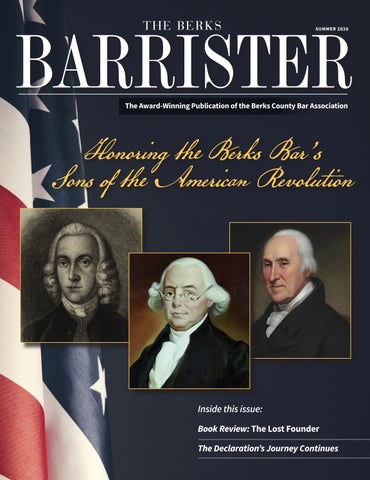
SUMMER 2026
The Award-Winning Publication of the Berks County Bar Association
Honoring the Berks Bar’s Sons of the American Revolution
Inside this issue: Book Review: The Lost Founder The Declaration’s Journey Continues
Content for Summer 2026
BOARD OF DIRECTORS Peter F. Schuchman, Jr., President Andrew F. Fick, President-Elect Lauren M. Marks, Vice President Daniel C. Nevins, Immediate Past President Amy J. Litvinov, Treasurer Jacquelin M. Hamer, Secretary
Features: 8
Pitchford v. Cain: Supreme Court Reinforces Importance of Fair and Diverse Juries
Alexa S. Antanavage, Director Daniel Cortes, Director Beth M. Kohl, Director Jesse C. Leisawitz, Director Joseph R. Speece, III, Director Pamela VanFossen, Director Jacob D. Kramer, Young Lawyers Section President
BAR ASSOCIATION STAFF Kori A. Walter, Executive Director Rose M. Johnson, Law Journal Secretary/Office Manager Lucy Brito, Community Services Manager Emily Bucolo, Publications/Marketing Coordinator Valerie Kramer, Law Journal Editor Jacob D. Kramer, Law Journal Assistant Editor Pamela VanFossen, Barrister Editor
Please submit materials or comments to: Berks County Bar Association 544 Court Street, P.O. Box 1058 Reading, PA 19603-1058 Phone: 610.375.4591 Fax: 610.373.0256 Email: info@berksbar.org www.berksbar.org
Thank You Our thanks are extended to the numerous people who have contributed to The Berks Barrister. Your time, energy and efforts are sincerely appreciated.
10 Law Day Reflects on the Rule of Law and the American Dream 14 Honoring the Berks Bar’s Sons of the American Revolution 22 The Declaration’s Journey Continues 26 Law Foundation Sponsor Appreciation Reception 28 Members Root, Root, Root for the Phillies 30 Berks Bar Night at the Reading Phillies 32 FIFA World Cup Brings Family Together, Creates Unforgettable Moments 34 Wellness Committee Union Canal Wellness Walk 35 Pets at the Park 38 Berks County Welcomes 30 New Citizens 39 Past Presidents Dinner
Departments: 4
Opening Statement
18 Book Review 36 Fine Food Review w w w. H o f f p u b s .co m Hoffmann Publishing Group 2669 Shillington Road, #438 Reading, PA 19608 ©2026 All rights reserved. No portion of this publication may be reproduced electronically or in print without the expressed written permission of the publisher.
On the cover: Among the Berks County lawyers who are immortalized on a courthouse plaque for their service “in the cause of liberty” are George Ross, James Wilson, and Edward Burd. Hoffmann Publishing Group is the official publisher of the Berks County Bar Association’s The Berks Barrister magazine. For Advertising Information & Opportunities Contact: Ad Sales 610-685-0914 x715 Sales@hoffmannpublishing.com
www.BERKSBAR.org
Opening Statement
Lawyers and Liberty Peter F. Schuchman, Jr., Esquire 2026 Berks County Bar Association President
M
y early education about the American Revolution was focused on our soldiers. I learned about the midnight ride of Paul Revere, the Minutemen at Lexington and Concord, the Continental Soldiers enduring winter at Valley Forge, Washington crossing the Delaware, Molly Pitcher firing artillery at the Battle of Monmouth, Fort Ticonderoga, and so many other events culminating in the British surrender at Yorktown. Our Generals and the troops fighting under them earned a victory against the greatest armed forces that existed at that time. All the praise showered on our heroic founders in this milestone anniversary year was well earned. As I aged and did more reading and research, I learned the Revolution was a rebellion led by lawyers long before shots were fired. The central complaint by the colonists was not merely that they were taxed, but that they were taxed and regulated without the legal process, representation, and constitutional safeguards that others living under English law enjoyed. It should come as no surprise, then, that lawyers were integral to every step towards the founding of our nation. They crafted the arguments. They convened and contributed to running the Continental Congress. Ultimately, they drafted the Declaration of Independence that we celebrate this year. Lawyers were instrumental in our break from the tyrannical regime of King George III.
Thomas Jefferson, a 33-year-old lawyer at the time, holds a draft of the Declaration of Independence in this 19th-century engraving depicting the Committee of Five meeting in June 1776.
4 | Berks Barrister
www.BERKSBAR.org
C H O O S E
At Tompkins, our business
B U S I N E S S
A C C E L E R AT E D
banking team helps you put
W I T H
TOMPKINS CASH MANAGEMENT SOLUTIONS Lawyers Led the Fight Against an Oppressive Government Long before 1776, colonial lawyers were building an intellectual case for resistance. For example, James Otis, a Boston attorney representing local merchants, argued against renewing “writs of assistance”—general warrants that let British customs officials search colonists’ homes and warehouses without specific cause.i Otis lost the case, but his argument that such writs violated fundamental rights under English common lawii made a lasting impression on John Adams, then a 25-year-old Boston attorney in the audience. Adams recalled the moment decades later in a letter: “Then and there was the first scene of the first Act of opposition to the arbitrary claims of Great Britain. Then and there, the Child Independence was born.”iii Patrick Henry built his early reputation defending local tax collectors in the 1763 “Parson’s Cause,” a dispute that turned on whether the Crown or Virginia’s own legislature held ultimate authority over colonial law.iv Not long after, Henry carried that same argument into the House of Burgesses, introducing the Virginia Stamp Act Resolves, which declared that only Virginia’s elected representatives— not Parliament—had the right to tax Virginians.v Thomas Jefferson later credited Henry’s resolves with having “set the impetus to the ball of revolution.”vi Lawyers were uniquely positioned to lead the resistance because they were trained to frame political grievances as legal ones. They argued not only
together just the right suite of cash management solutions to turn “business as usual” into “business amazing”—and to help your business thrive.
Scan the code for more information
that taxation without representation was unfair, but that it violated charters, common law rights, and the legal structure employed elsewhere in the British Empire. That legal framing gave the protest movement legitimacy it would not have had as merely a dispute over money. The legal training our colonial predecessors received was fundamental to their ability to organize and argue their grounds for separation from Great Britain. They served as leaders of committees of correspondence, colonial assemblies, and eventually the Continental Congress. These lawyers knew how to draft resolutions, marshal precedent, and build a documentary record justifying resistance. The record they built led ultimately to independence. The Declaration of Independence Resembles a Criminal Indictment By the time the Second Continental Congress convened, close to half of its delegates were lawyers.vii The “Committee of Five” that drafted the Declaration was made up of four lawyers: Thomas Jefferson, John Adams, Roger Sherman, and Robert Livingston, together with Pennsylvania’s own Benjamin Franklin. Franklin, perhaps the greatest intellectual of the age, was self-taught in law (as in so many other disciplines) rather than formally trained, but was a leading publisher and printer who lent his editing talents to the final text.viii
continued on next page SUMMER 2026 | 5
www.BERKSBAR.org
Lawyers and Liberty Continued from page 5
We hold these truths to be self-evident, that all men are created equal, that they are endowed by their Creator with certain unalienable Rights, that among these are Life, Liberty and the pursuit of Happiness.--That to secure these rights, Governments are instituted among Men, deriving their just powers from the consent of the governed, --That whenever any Form of Government becomes destructive of these ends, it is the Right of the People to alter or to abolish it, and to institute new Government, laying its foundation on such principles and organizing its powers in such form, as to them shall seem most likely to effect their Safety and Happiness.xi The Lessons for Today What example can we draw from the lawyers who helped found our nation? They did not just draft documents that others had already decided upon. They influenced how the colonists understood their own grievances. They gathered and translated the various frustrations with the Crown into specific claims about the limits of government power. That is precisely the role lawyers continue to play today when they challenge government overreach.
The structure of the Declaration itself reads like a legal complaint, because that is essentially what it is. After the famous preamble asserting natural rights and the principle that governments derive legitimacy from the consent of the governed, the document shifts into a long, itemized list of specific charges against King George III, phrased almost as counts in an indictment—“He has refused,” “He has forbidden,” “He has dissolved.” Jefferson and the committee were not merely venting; they were building a legal case for separation, one that could be defended before other nations and before their fellow colonists who might otherwise see revolution as unlawful treason rather than a justified remedy for a demonstrable pattern of abuse.ix Beyond Jefferson and Adams, another 23 lawyers signed the Declaration.x Many of those signers, and other lawyers of that era, proceeded to draft state constitutions, serve as judges, and eventually write the U.S. Constitution and the Bill of Rights. They went from rebelling against tyranny to creating a system of governance designed to protect the people from tyranny: 6 | Berks Barrister
Modern lawyers who litigate against executive overreach, administrative agency overstep, or unconstitutional statutes are doing the same work Otis and Henry did in their colonial courtrooms. They took political grievances and reframed them as legal questions with a defined remedy. When advocacy organizations or individual litigants sue over warrantless surveillance, challenge the scope of an agency’s rulemaking authority, or contest “emergency” (real or invented) executive actions as exceeding constitutional or statutory limits, they are following Otis’s example in contesting the writs of assistance: government action is illegitimate not just because it is unpopular, but because it exceeds the legal authority granted to it.xii There are, of course, important differences. Revolutionary-era lawyers were arguing largely outside any settled judicial system that was binding on the Crown. Today, we work within a constitutional order that the Revolution’s lawyers themselves helped create. Jefferson had to justify a complete rupture with the monarch. A modern lawyer challenging government overreach generally argues within the existing system, seeking to hold government accountable to laws it has already accepted, rather than to break from those laws entirely. The Revolution’s lawyers gave us courts, statutes, and a Constitution to appeal to instead of committees of correspondence and pamphlets distributed to the populace. I think the motivations that led many of us to the law are the same today as they were to our forebears 250 years ago. Then and now, our chief contribution to vindicating
www.BERKSBAR.org
Find your dream home! rights is not moral outrage—plenty of people feel that without legal training—but the discipline of converting outrage into specific causes of action. We identify which specific authority has been exceeded, which right has been violated, and what remedy the law allows. That discipline, first exercised against the King of England by men like Otis and Henry, remains the lawyer’s chief tool against overreaching government today, whether that government sits in London, Washington, or Harrisburg. To all lawyers who seek to protect people from an overreaching government, and vindicate the rights of those who have been harmed, thank you for all of your contributions. Our brave founders are entitled to the reverence and gratitude we celebrate in this milestone year. But you carry forward their legacy.
Team up with the Tiger! Bill Moser
Lisa Tiger
REALTOR
REALTOR
References James Otis Jr., Wikipedia, https://en.wikipedia.org/wiki/James_Otis_Jr.; “A ‘Flame of Fire’ for Every Age: James Otis and the Writs of Assistance,” The Daily Economy, https://thedailyeconomy.org/article/a-flame-of-fire-for-every-agejames-otis-and-the-writs-of-assistance/ i
https://teachingamericanhistory.org/document/speech-against-writs-ofassistance/ ii
“Then and There the Child Independence Was Born,” American Heritage, https://www.americanheritage.com/then-and-there-child-independencewas-born; “In Opposition to Writs of Assistance – 1761,” The National Center for Public Policy Research, https://nationalcenter.org/ncppr/2001/11/03/inopposition-to-writs-of-assistance-1761/ iii
610-207-6186 610-779-2500 LisaTigerHomes.com
“Parson’s Cause,” Wikipedia, https://en.wikipedia.org/wiki/Parson%27s_ Cause; “Patrick Henry (1736–1799),” Encyclopedia Virginia, https:// encyclopediavirginia.org/entries/henry-patrick-1736-1799/ iv
“The Stamp Act in Virginia,” Encyclopedia Virginia, https:// encyclopediavirginia.org/entries/the-stamp-act-in-virginia/; “Patrick Henry: Give Me Liberty or Give Me Death Speech,” History.com, https://www.history. com/articles/patrick-henry v
“Patrick Henry,” Colonial Williamsburg, https://www.colonialwilliamsburg. org/discover/18th-century-people/nation-builders/patrick-henry/ vi
https://www.americanbar.org/groups/senior_lawyers/resources/voice-ofexperience/2026-june/who-were-the-lawyers-that-signed-the-declaration-ofindependence/ vii
https://fi.edu/en/blog/benjamin-franklin-and-declaration-independence; https://www.archives.gov/founding-docs/declaration-history
David R. Beane, Esquire
viii
ix
https://www.archives.gov/founding-docs/declaration-history
https://www.americanbar.org/groups/senior_lawyers/resources/voice-ofexperience/2026-june/who-were-the-lawyers-that-signed-the-declaration-ofindependence/ x
xi
https://www.archives.gov/founding-docs/declaration-transcript
https://constitutioncenter.org/the-constitution/historic-document-library/ detail/james-otis-against-writs-of-assistance-february-24-1761 xii
Swanona At Historic Centre Park 606 North Fifth Street, Suite 7 P.O. Box 1339 Reading, Pennsylvania 19603 Tel: 610.378.5555 Fax: 610.378.5551 drb@beanellc.com www.beanellc.com Helping the Regulated Community Manage Environmental Risk and Solve Environmental Problems SUMMER 2026 | 7
www.BERKSBAR.org
Pitchford v. Cain:
Supreme Court Reinforces Importance of Fair and Diverse Juries By Gabriela Raful, Esquire
T
he United States Supreme Court’s recent decision in Pitchford v. Cain is an important reminder that racial discrimination in jury selection remains a serious concern nearly four decades after Batson v. Kentucky. Although the Court’s decision focused on the procedure courts must follow when evaluating claims of discrimination during jury selection, the case underscores a broader principle: our justice system functions best when juries reflect the diversity of the communities they serve. As lawyers and citizens, we often speak about the right to a jury trial as one of the cornerstones of our democracy. The jury system places ordinary members of the community in a position of tremendous responsibility. Jurors decide questions of credibility, determine facts, and render verdicts that can forever change the lives of litigants, victims, defendants, and families. For that reason, confidence in the jury system depends on ensuring that juries are selected fairly and that all segments of the community have a meaningful opportunity to participate. Pitchford arose from a 2004 robbery and homicide in Grenada County, Mississippi. Terry Pitchford, who was 18 years old at the time, participated in a robbery of a grocery store with a 16-year-old accomplice, Eric Bullins. During the robbery, Bullins shot and killed the store owner. Bullins later entered into a plea agreement and received a sentence of imprisonment. Pitchford, however, was charged with capital murder and faced the death penalty. A jury ultimately convicted him and sentenced him to death. What followed was years of litigation focused not only on the conviction itself, but also the manner in which the jury was selected. During voir dire, the prosecutor exercised peremptory strikes against four of the five eligible Black prospective jurors. As a result, the jury that ultimately decided Pitchford’s fate consisted of eleven white jurors and only one Black juror. This occurred in a county where a substantial percentage of the population was Black. Pitchford’s attorneys objected under Batson v. Kentucky, the landmark 1986 Supreme Court decision holding that the Equal Protection Clause prohibits prosecutors from excluding jurors because of their race. Before Batson, attorneys frequently used 8 | Berks Barrister
peremptory challenges to remove minority jurors with little judicial scrutiny. The Supreme Court recognized that such practices not only denied defendants equal protection but also excluded citizens from one of the most important forms of civic participation solely because of their race. The Batson framework established a three-step process for courts to evaluate claims of discriminatory jury selection. First, the party raising the objection must make a prima facie showing that discrimination may have occurred. Second, the party exercising the strike must provide a race-neutral explanation for the exclusion. Third, the court must determine whether the explanation is genuine or whether it is merely a pretext for discrimination. The third step is often the most important. A raceneutral explanation on its face does not necessarily mean that discrimination has not occurred. Courts must examine whether the explanation is credible, whether similarly situated jurors of a different race were treated differently, and whether the totality of the circumstances suggests purposeful discrimination. In Pitchford’s case, the prosecutor offered race-neutral explanations for the strikes. However, the defense argued that it was never given a meaningful opportunity to demonstrate that those explanations were pretextual. When defense counsel attempted to challenge the prosecutor’s reasons, the trial court effectively cut off further discussion and proceeded with jury selection. The Supreme Court concluded that this was inconsistent with the requirements of Batson. Writing for the majority, Justice Brett Kavanaugh explained that the third step of the Batson inquiry is a critical component of the process. A defendant must be afforded a meaningful opportunity to rebut the prosecutor’s stated reasons and to demonstrate that those reasons are merely a cover for discrimination. Because that opportunity was denied, the Court determined that further proceedings were necessary. While the legal issue before the Court involved procedural safeguards during jury selection, the broader implications of the decision are significant. The case highlights why diversity
www.BERKSBAR.org
in jury service matters and why courts must remain vigilant in preventing discriminatory practices. The importance of jury diversity extends beyond the interests of any single litigant. Diverse juries strengthen the quality of deliberations and improve the overall functioning of the justice system. Numerous studies have demonstrated that diverse juries deliberate longer, discuss a broader range of facts, consider more perspectives, and make fewer factual errors than homogeneous juries. The research consistently demonstrates that diverse juries engage in more thorough deliberations and are better equipped to identify assumptions, biases, and blind spots that may otherwise go unnoticed. Diversity does not guarantee a particular outcome. Rather, it improves the process by which jurors reach their decisions. This principle is particularly important in cases where credibility plays a central role. Jurors inevitably evaluate testimony through the lens of their own experiences. Cultural norms, communication styles, educational backgrounds, and life experiences can influence how a witness’s testimony is perceived. The harms caused by discriminatory jury selection extend beyond the defendant. The Supreme Court has repeatedly recognized that excluding jurors because of race also harms the excluded citizens themselves. Jury service is one of the most direct forms of participation in our democratic system. It allows citizens to contribute to the administration of justice and to help shape the application of the law within their communities. When qualified citizens are excluded from jury service because of race, they are denied an opportunity to participate fully in civic life. The community loses their perspective, and public confidence in the fairness of the judicial system is diminished. This concern is especially important at a time when many communities already struggle with trust in governmental institutions. People are more likely to accept court decisions, even unfavorable ones, when they believe that the process was fair. A jury that reflects the community strengthens that confidence. The decision in Pitchford v. Cain demonstrates that the work begun by Batson remains unfinished. Despite decades of legal precedent, concerns regarding the exclusion of minority jurors continue to arise in courtrooms throughout the country. Vigilant enforcement of Batson remains necessary to ensure that jury selection practices comply with constitutional guarantees. The case also serves as a reminder that increasing jury diversity requires more than judicial oversight. It requires community engagement, education, and efforts to encourage participation in jury service. Many communities continue to face barriers to participation, including economic hardship, lack of information about the jury process, and skepticism regarding the legal system. Addressing these challenges is essential if courts are to achieve juries that truly reflect the populations they serve.
A Trusted ADR Resource for Berks County
Ron Pollock, Esq. f 15+ years of ADR experience
specializing in construction, personal injury, business, and insurance law
f Over 250 cases
arbitrated and mediated
f Former Judge Pro Tempore
handling civil trials and conciliations
f In-person or remote mediation
and arbitration available
(717) 556-1000 • Philadelphia I Malvern I Allentown I Lancaster I Harrisburg I York I Pittsburgh
Ultimately, Pitchford v. Cain is about more than a procedural dispute over jury selection. It is about preserving the integrity of the jury system itself. The promise of equal justice under law cannot be fulfilled if citizens are excluded from jury service because of race or if courts fail to carefully examine claims of discrimination. Nearly 40 years after Batson, the Supreme Court’s decision reminds us that jury diversity is not merely an aspirational goal. It is a fundamental component of a fair and legitimate justice system. When all members of a community have an equal opportunity to participate in jury service, the quality of deliberations improves, confidence in the courts is strengthened, and the administration of justice is better served. As practitioners, we should view Pitchford not just as a legal decision but as a call to action. The case reinforces the principle that our jury boxes should reflect the communities they serve and that vigilance against discrimination remains essential. Diverse juries benefit litigants, strengthen public confidence, and improve the pursuit of justice for all. Ms. Raful is a senior partner with Galfand Berger in Reading and served as President of the Berks County Bar Association in 2023.
SUMMER 2026 | 9
www.BERKSBAR.org
Law Day Reflects on the Rule of Law and the American Dream Members, Berks County students, and local officials celebrated the 68th annual Law Day at the Berks Bar Law Day Luncheon on May 20 at Sts. Constantine & Helen Greek Orthodox Church. This year’s theme, in conjunction with the 250th anniversary of the United States, was “The Rule of Law and the American Dream.” Keynote Speaker Kara Bowser, First Deputy Attorney General of Pennsylvania, offered some great insight into her work in the Office of the Attorney General and how they are striving to serve Berks County in better and more efficient ways. In addition, the Bar Association recognized Exeter Senior High School’s Mock Trial team for winning the 2026 Berks County Mock Trial Championship. President Peter F. Schuchman, Jr., also congratulated six Berks County students who placed in the 2026 Law Day Multimedia Competition Awards: Edith Spencer, 5th grader from La Salle Academy; Julian Agudo, 5th grader from Lancaster Country Day School; Arianna Walker, 5th grader from La Salle Academy; Kylie Lewandowski, 8th grader from La Salle Academy; Eva Thompson, 7th grader from La Salle Academy; and Dean Petras, 7th grader from Immaculate Conception Academy.
Bar President Peter F. Schuchman, Jr., Esq., presents Arianna Walker, 5th grader from La Salle Academy, with her Multimedia Contest Award.
Bar President Peter F. Schuchman, Jr., Esq., presents Dean Petras, 7th grader from Immaculate Conception Academy, with his Multimedia Contest Award.
Allen S. Gehring, Jr., Esq., Co-Chair of Law Day Committee. 10 | Berks Barrister
Berks Bar Board Member Alexa S. Antanavage, Esquire, and her father, the Hon. A. Joseph Antanavage.
www.BERKSBAR.org
Food & Agribusiness Law.
Industry Insight. Practical Solutions. Our Food & Agribusiness team, comprised of attorneys across our footprint and multiple disciplines, help clients navigate the unique challenges facing the industry including:
Our Core Food & Ag Team Members
» Food safety and regulatory compliance » Product recalls and contamination events » Farm succession and ownership transitions » Agricultural labor and immigration matters » Food labeling and marketing compliance Catherine Begley
Timothy Dietrich
Hyo Jin “Jinnie” Lee
» Agricultural and commercial disputes
WWW.BARLEY.COM | 610-372-3500
2755 Century Blvd., Wyomissing, PA 19610 READING • LANCASTER • YORK • HARRISBURG LEBANON • HANOVER • GETTYSBURG • MALVERN SCHUYLKILL HAVEN • HUNT VALLEY, MD • COLUMBIA, MD
Exeter Senior High School captured the Berks County Mock Trial Championship this year. Faculty advisor Sean Reese, second from right, and attorney advisor Amber Moll, Esquire, of the Berks County Public Defender’s Office, guided the team to the title.
Bar President Peter F. Schuchman, Jr., Esq., presents Eva Thompson, 7th grader from La Salle Academy, with her 2nd place Multimedia Contest Award. continued on next page
SUMMER 2026 | 11
www.BERKSBAR.org
Law Day Reflects on the Rule of Law and the American Dream Continued from page 11
Bar President Peter F. Schuchman, Jr., Esq., presents Edith Spencer, 5th grader from La Salle Academy, with her 1st place Multimedia Contest Award.
Law Day Committee Co-Chairs Kelsey E. Frankowski, Esq., and Allen S. Gehring, Jr., Esq., participate in the fireside chat with guest speaker First Deputy Attorney General of Pennsylvania, Kara Bowser.
Young Lawyers Section President Jacob D. Kramer, Esq.
Brittney, Walt, and Kathleen Frankowski.
Bar President Peter F. Schuchman, Jr., Esq., presents Julian Agudo, 5th grader from Lancaster Country Day School, with his 2nd place Multimedia Contest Award.
Law Day Committee Co-Chairs Kelsey E. Frankowski, Esq., and Allen S. Gehring, Jr., Esq., with guest speaker First Deputy Attorney General of Pennsylvania, Kara Bowser.
12 | Berks Barrister
www.BERKSBAR.org
Jadelynn Smolarski entertains with the National Anthem and America the Beautiful.
Kelsey E. Frankowski, Esq., Co-Chair of Law Day Committee.
President Peter F. Schuchman, Jr., Esq., thanks guest speaker First Deputy Attorney General of Pennsylvania, Kara Bowser, for helping Berks County commemorate Law Day.
Bar President Peter F. Schuchman, Jr., Esq., presents Kylie Lewandowski, 8th grader from La Salle Academy, with her 1st place Multimedia Contest Award.
Law Day Attendees.
Mid Penn Legal Services team.
Reading City Council President Donna Reed presents a Certificate of Appreciation to Bar President Peter F. Schuchman, Jr., Esq., center, and Michael J. Gombar, Jr., Esq. Gombar is the City’s Solicitor. SUMMER 2026 | 13
www.BERKSBAR.org
Honoring the Berks Bar’s Sons of the American Revolution Bar Association Plaque Memorializes Lawyers who Contributed to our Nation’s Fight for Independence
By Brian C. Engelhardt, Esquire
I
n the lobby of the Berks County Courthouse by Central Court, next to the stairwell and behind a bench, is a bronze plaque titled: “THE BAR OF BERKS COUNTY TO ITS REVERED MEMBERS WHO SERVED IN THE CAUSE OF AMERICAN INDEPENDENCE.” The plaque lists the names of seven men who were members of the bar in 1776 and their respective birth and death dates. In addition, the plaque lists brief statements about the contributions each made to the “cause of independence.” Listed on the plaque, in order, are: Maj. Peter Scull; George Ross; James Wilson; James Read; Edward Biddle; Capt. Edward Burd; and Capt. Alexander Graydon. Although some of the names— notably Wilson and Biddle—may be familiar, I will introduce readers to all of these “old time patriots,” as they were referred to in The Reading Eagle’s account of the plaque dedication on Dec. 12, 1929. The plaque hung briefly in the former Berks County Courthouse, which was demolished in 1931. Fortunately, County leaders had the foresight to preserve the plaque and reinstall it in the current courthouse when it opened in 1932.
Plaque Unveiling at Berks County Historical Society The Bar Association organized a dinner to unveil the plaque on Dec. 12, 1929, and honor the contributions to the Association’s seven sons of the Revolution. The location of the dinner was the Berks County Historical Society on Centre Avenue, which had dedicated its new building a little more than two months earlier on Oct. 1, 1929. 14 | Berks Barrister
Most of the 100 attendees were Bar members and judges, including Judges H. Robert Mays, Paul N. Schaeffer, Forrest N. Shanaman, and retired Judge Edgar S. Richardson. Among the attorneys present were President of the Bar Association, C.H. Ruhl; the event’s Toastmaster (not a word you hear much these days), Frank S. Livingood; and J. Bennett Nolan, also an active member of the Historical Society, who was credited by The Reading Eagle as being responsible for the “success of the affair” through his “painstaking efforts…in digging out these interesting events of the great men of the past.” Also present were several “honored guests,” including Dr. Edward Biddle, a Philadelphia attorney who was the great-great-grand-nephew of Edward Biddle, whose name appears on the plaque (in addition to being the greatgreat-grandson of Charles Biddle, first burgess of the borough of Reading); Burton Alva Konkle, a historian and author who had written extensively on James Wilson; and Charles Montgomery, curator of the Historical Society’s museum, who invited all present to visit the museum and its library, and join the Society. With an American flag covering the plaque during the dedication ceremony, events got underway with opening remarks from toastmaster Frank S. Livingood in which he stated that the purpose of the event was “to throw aside a curtain of 150 years and to introduce to (the audience) seven who were members of the Berks County bar in Colonial Berks…and who had the distinction of serving in the Revolutionary War.” He added the goal of the evening was to project “the life, manners and accomplishments of these seven men, lawyers of a century and a half ago, as historical research relates them to us.”
www.BERKSBAR.org
This was followed by the presentations for each honoree, discussed below. At the conclusion of the presentations, the most dramatic moment of the evening occurred as Bar Association president C.H. Ruhl removed the flag from the plaque. The following profiles provide a glimpse of the “life, manners, and accomplishments” of the seven men memorialized on the courthouse plaque. The text in bold represents text that appears on the plaque for each of the men.
Title Searches for Legal Matters Major Peter Scull 1753 – 1779 Aide-de-camp to General George Washington; Secretary to the Board of War; Died at Sea in the Country’s Service December 4, 1779 Born in Philadelphia and educated to be an attorney-at-law, Peter Scull moved to Reading after the death of his father in 1773. While residing in Reading, Scull volunteered to serve in the 3rd Pennsylvania Regiment, where he was commissioned as a captain. After being promoted to serve as an aide-decamp to General George Washington, Scull demonstrated such bravery and gallantry in the Oct. 28, 1776, Battle of White Plains that Washington recommended him to Congress for the office of Secretary of the Board of War. He ultimately was appointed to that post on July 17, 1779. In the interim, in January 1777, Scull was promoted to the rank of Major, while serving under Col. John Patton in “Patton’s Additional Continental Regiment,” which saw action in the Philadelphia campaign in 1777. Ultimately, with his health failing, Scull departed for France on October 20, 1779, on the frigate “Confederacy.” According to Nolan, he was dispatched on a mission, but other historical sources stated he was ordered to go abroad by his physician. As a result of his health issues, he died at sea on Dec. 4, 1779, at the age of 26. George Ross 1730–1779 Delegate to the Continental Congress; Signer of the Declaration of Independence; Judge of the Court of Admiralty In his presentation on George Ross, Judge Paul Schaeffer stated that although he never resided in Berks County, he owned property here and was active at the Berks Bar, with court records showing his involvement in many cases. A native of Delaware, Ross was admitted to the Philadelphia Bar. And he practiced primarily in Lancaster, while also regularly coming to Reading for sessions of court as part of what was known as “riding the circuit.” Originally loyal to Britain and appointed a “King’s Counsel,” serving as a legal advisor and prosecutor for the Crown in local matters, Ross resigned from the post as he became disenchanted with Tory policies and supported the cause of independence. A signer of the Declaration of Independence,
Present owner searches for trust transfers and probate estates Lien and encumbrance analysis Accurate public-record research to enhance your estate planning and probate representation. Pennsylvania expertise to support your staff and firm. 100 Berkshire Blvd., Suite 100 • Wyomissing, PA 19610 610-372-8201 • www.stewartabstract.com Insuring your investment, securing your dream
ATTORNEY DISCIPLINARY AND ETHICS MATTERS STATEWIDE PENNSYLVANIA MATTERS NO CHARGE FOR INITIAL CONSULTATION
Representation, consultation and expert testimony in disciplinary matters and matters involving ethical issues, bar admissions and the Rules of Professional Conduct
James C. Schwartzman, Esq.
• Judge, Court of Judicial Discipline • Former Chairman, Judicial Conduct Board of Pennsylvania • Former Chairman, Disciplinary Board of the Supreme Court of Pennsylvania • Former Chairman, Continuing Legal Education Board of the Supreme Court of Pennsylvania • Former Chairman, Supreme Court of Pennsylvania Interest on Lawyers Trust Account Board • Former Federal Prosecutor • Selected by his peers as one of the top 100 Super Lawyers in PA and the top 100 Super Lawyers in Philadelphia • Named by his peers as Best Lawyers in America 2022 and 2015 Philadelphia “Lawyer of the Year” Ethics and Professional Responsibility Law and Legal Malpractice Law 1500 Market Street, East Tower, Suite 1800 • Philadelphia, PA 19102 (215) 751-2863
continued on next page SUMMER 2026 | 15
www.BERKSBAR.org
Honoring the Berks Bar’s Sons of the American Revolution Continued from page 15 he was elected to the Continental Congress three times. While holding several legislative positions during the Revolutionary War, he never accepted pay for any of them.
mentioned, included serving as a justice of the county court as well as a member of the Supreme Executive Council from 1778 to 1781.
Additionally, Ross’s humanity in his practice of law was demonstrated by his involvement in mediating disputes between settlers and Natives, as well as his willingness to represent those loyal to the Crown who were being prosecuted or imprisoned. Many supporting the cause of independence deemed such representation to be treasonous; however, Ross, as well as James Wilson and Edward Biddle, were among the few willing to plead on their behalf. After resigning from Congress in 1777 because of poor health, Ross was appointed to the Pennsylvania Court of Admiralty, on which he served briefly until his death in 1779 at age 49.
One of the first attorneys admitted to the bar in Reading, Read grew a private law practice while performing his duties in the various county offices. Read worked to grow his client base by studying German, the primary language spoken by more than 75% of Berks County residents. This often involved translating legal documents from German. Read’s son, Colinson, would also become a member of the Reading bar. Colinson was appointed by his father as register of wills in 1774, apparently keeping the position within the family.
James Wilson 1742-1798 Delegate to the Continental Congress; Framer of the Federal Constitution; Signer of the Declaration of Independence; Associate Justice of the Supreme Court of the United States James Wilson settled in Philadelphia shortly after immigrating from Scotland in 1765. He tutored Latin while studying law at the office of John Dickinson, among the most prominent attorneys in Philadelphia. After Wilson’s admission to the bar in November 1767, he moved to Reading where he set up a law practice, specializing in land law, achieving substantial success (or as one commentator put it, “made a fortune.”) In 1771, seeking to increase his practice, he moved to Carlisle, where there was substantial Scotts-Irish population in the area, which he believed would lead his practice to grow—which it did. Donald F. Smith, Jr. provides a comprehensive review of Wilson’s unique contributions to our nation in this issue of The Berks Barrister. Check out Mr. Smith’s review of the new book The Lost Founder on page 18. James Read 1718 -1793 Clerk of All the Courts of Berks County 1763-1777; Supreme Executive Counsellor; Register of the Admiralty Born in Philadelphia, James Read came to Reading in 1752—the same year the County of Berks was established. He was appointed by Gov. James Hamilton to fill the county offices of prothonotary, recorder, register of wills, clerk of orphans’ court, and clerk of quarter sessions. Read benefited from having friends in high places, including Berks’ Proprietor Thomas Penn, who advised Gov. Hamilton to make the appointments. Except for register of wills, Read would hold onto each office from 1752 to 1776. In his presentation relating to Read, Harvey F. Heinley related how he ultimately would hold 13 positions, which, in addition to the ones already 16 | Berks Barrister
Read had a wide range of interests. He studied botany, theology, and the classics. He enjoyed a lifestyle that often caused him to be short of funds, which is what caused him to move to Reading from Philadelphia, a city which he loved. In the words of historian Philip E. Pendleton, Read was “flat broke” at the time and needed the money. Read was able to have a large enough practice as well as find a sufficient number of appointed positions (including being named “Flower Inspector” in Philadelphia in 1785) that kept him and his family financially afloat until his death in 1793. Edward Biddle 1738-1779 Speaker of the Last Pennsylvania Provincial Assembly; Delegate to the Continental Congress In his presentation on Edward Biddle, John A. Moss talked of how Biddle came to Berks County in 1755 as a 17-year-old serving as an ensign in the militia during a period when raiding parties of Native Lenape were attacking homes of settlers in the northern part of the county, giving him a great deal of concern. Moss related that Biddle served in the provincial army during the French and Indian War, where he rose to the rank of Captain and was present at the taking of both Fort Duquesne and Fort Niagara. After his military service, Biddle studied law and was admitted to the bar in Berks County, becoming the most successful lawyer in the area during the 1760s through the early 1770s. He is not to be confused with his older brother, James, who also had an office in Reading in the early 1760s, but returned to Philadelphia, where he served as Prothonotary for 12 years before returning to Reading in 1775. A picture of James Biddle hangs in the Bar Association office, which contains a note stating he was the first known lawyer to reside in Berks County. No picture of Edward Biddle is known to exist. Aside from his active law practice, Edward Biddle was active politically, elected to the Pennsylvania Assembly initially in 1767, the first of nine times he would serve, in addition to being elected as Speaker of the Assembly in 1774. He became active in the movement for independence, serving as a delegate to the First and Second Continental Congress, among other activities, including serving on various
www.BERKSBAR.org
committees in support of that cause. All of these activities were affected by a debilitating illness he contracted on January 23, 1775, when he fell overboard into the Schuylkill River on a boat trip from Reading to Philadelphia, then slept in wet clothes. Biddle awoke the next day, afflicted with what was described as inflammatory rheumatism, causing an overall deterioration of his health and the loss of sight in one of his eyes. With his health impaired, Biddle was limited in his activities. It is presumed that this was the reason he was one of 22 members of Congress who did not sign the Declaration of Independence. Complications from the illness were the cause of Biddle’s death in September of 1779. Biddle’s final act of service occurred in 1779 when he was appointed to serve on a committee whose purpose it was “to bring in a bill for abolishing slavery in Pennsylvania,” which passed in 1780. Captain Edward Burd 1749-1833 Prothonotary of the Supreme Court of Pennsylvania Born in 1749 (the plaque incorrectly states 1750), Edward Burd studied law with his uncle, Pennsylvania Chief Justice Edward Shippen IV (whose daughter Burd would marry in 1778). After moving to Reading from his parents’ home in Lancaster, Burd was admitted to practice in the courts of Berks County in 1772. Like James Read, Burd studied the German language so he could converse more readily with clients. At the outbreak of the Revolution, Burd closed his law office, joined the company of Capt. George Nagel, and marched to Cambridge, Mass. in the summer of 1775. When that enlistment expired, Burd joined what was known as the “Flying Camp,” which was created for the defense of the central colonies. While serving as a Major in Col. Henry Haller’s Battalion, Burd was wounded and taken prisoner at the Battle of Long Island in August 1776. After his release several months later, ill health prevented him from re-entering military service, and he returned to his parents’ home in Lancaster to recuperate. A strident supporter of independence, Burd refused to take an oath of allegiance as required at the time under the Pennsylvania Constitution. He considered the oath too radical. Burd’s refusal to take the oath of allegiance delayed the start of his legal practice in Reading for several months. His future father-in-law, Chief Justice Shippen, appointed Burd to the post of Prothonotary of the Pennsylvania Supreme Court with the condition that Burd sign the obligatory oath. Burd reconsidered his opposition to the oath, signed it, and received his official appointment on Sept. 1, 1778. Burd then moved back to Philadelphia and married Elizabeth Shippen in December. He was all set. Burd served as the Prothonotary of the Supreme Court until resigning in 1805. In his presentation on Burd, Wellington M. Bertolet described him as “one of the most picturesque members of the Berks Bar.” To that effect, Burd was the subject of an 1820
portrait by the renowned Charles Willson Peale. In 1798, Burd constructed Ormiston Mansion, located in Fairmount Park in Philadelphia, which is on the Register of Historic Places. He died in 1833. Captain Alexander Graydon 1752-1818 Born in Bristol, Bucks County, in 1752, Alexander Graydon moved to Philadelphia with his mother and several siblings after the death of his father. His mother took in boarders to supplement the household’s meager income. After several years at the Academy of Philadelphia, the 14-year-old Graydon began to read law with his uncle, Joseph Marks, in Philadelphia and then with another attorney in York. In 1775, the 23-year-old Graydon volunteered to serve in the Continental Army and was commissioned as a Captain in January 1776. After leading his company in the Long Island campaign, he was taken prisoner by the British in September at the fall of Fort Washington. Released on a parole arrangement, he returned to Reading to the charge of his mother. He resumed his legal studies and was admitted to the bar in 1779. After engaging in the practice of law for a short time in Reading, Graydon and his family moved to Harrisburg, where he was elected Prothonotary of Dauphin County in 1785, a post he held until 1799. He would return to Philadelphia in 1816, where he died in 1818. George M. Jones, who made the presentation on Graydon, noted that he did not figure greatly in the legal matters in Berks County as contrasted to his activities in Dauphin County. However, Jones added that Graydon is well remembered for the memoirs he wrote in 1811, Memoirs of a Life, Chiefly Passed in Pennsylvania, Within the Last Sixty Years, an engaging account which included descriptions of Reading social life during the Revolution, and insights on a number of historical figures with whom he interacted daily, together with many other recollections from the past. (The memoir is available online at no cost at https://digital.libraries.psu.edu/digital/ collection/digitalbks1/id/25676.) In his remarks at the dedication, J. Bennett Nolan called the creation of the plaque a payment of a “debt of appreciation” containing “an element of apology for having neglected (the seven honorees) so long.” Nolan concluded by saying that although it would have been fitting to dedicate the memorial 50 years earlier, it would have been “more fittingly … dedicated 100 years ago when at least one of them was living.” Now, almost 100 years after Nolan’s remarks, the Bar Association again honors them with this article. EDITOR’S NOTE: A note of thanks to Prothonotary Jonathan K. Del Collo and Lisa Adams, Assistant Archivist at the Berks History Center, for their assistance in researching the plaque. Mr. Engelhardt retired from BB&T’s Legal Department and is a regular contributor to The Berks Barrister and the Berks County Historical Review. SUMMER 2026 | 17
www.BERKSBAR.org
B ook Review THE LOST FOUNDER: James Wilson and the Forgotten Fight for a People’s Constitution By Jesse Wegman Reviewed by Donald F. Smith, Jr., Esquire
H
is first law practice began in Reading, Berks County, in 1767. He would go on to play an important role in the adoption of the Declaration of Independence. Then, during the Constitutional Convention of 1787, his contributions to the resulting document were significant. He was one of the six initial justices nominated by President George Washington and confirmed to serve on the United States Supreme Court. His name was James Wilson, whose important work as one of the country’s founders seems to have been forgotten by many, including many lawyers. Interestingly, in a recent survey of historians, law professors, and journalists, James Wilson placed eighth, out of eight, of “The Most Influential Founding Fathers.”1 At the top was James Madison. In a separate polling of conservative contributors, he was not listed at all.2 That anonymity might change with this summer’s publication of the appropriately named biography The Lost Founder: James Wilson and the Forgotten Fight for a People’s Constitution, by Jesse Wegman, a senior fellow at the Brennan Center for Justice. Wegman writes in the book’s introduction: “As America marks its 250th anniversary, Wilson remains at best a bit player in a story about more important men. He is
18 | Berks Barrister
overshadowed in Pennsylvania by Benjamin Franklin; he is overshadowed at the 1787 convention by James Madison; he is overshadowed in his advocacy of radical democracy by Thomas Jefferson—and yet, in each case, the more well-known founder depended on Wilson.” He concludes the introduction with this line: “If we are to understand where we came from and where we might be headed, we need first to understand the man who saw it all so clearly 250 years ago.” That man was born on September 14, 1742, the fourth child and the first son of the Wilsons, who were tenant farmers in the Scottish lowlands. When the young Wilson came of school age, he and his cousin, Robert Annan, walked five miles to the grammar school, a daily trek of one and a half hours. The curriculum included programs in Latin, writing, geometry, and navigation. Before he was ten, Wilson was studying Latin poets and writers including Cicero, Cato, Horace, and Virgil. Wegman notes, “Wilson’s obvious intelligence compelled his parents to keep him in school, even though they could have used him at the farm.” After grammar school, he attended the University of St. Andrews, “one of the homes of the intellectual movement that would become known as the Scottish Enlightenment… innovative political thought and
www.BERKSBAR.org
moral philosophy…” Wilson was exposed “to concepts such as the consent of the governed, the separation of powers, and human equality—all of which would prove central to the American founding.” When he was 19, his father died, requiring Wilson to leave St. Andrews and return home to help his mother. After a year, however, he continued his education at the University of Glasgow, where he came under the influence of Thomas Reid, chair of the school’s moral philosophy department. Reid had written: “The learned and the unlearned, the philosopher and daylaborer, are upon a level, and will pass the same judgment, when they are not misled by some bias, or taught to renounce their understanding from some mistaken religious principle.” Wegman observes that it is not surprising “a poor farmer’s son” would find Reid’s “egalitarian approach to human problems” appealing. Looking ahead, Wegman writes that Wilson’s “future commitment to political equality and majoritarian democracy is remarkable not only for existing in the first place but for the single-minded tenacity with which he fought to turn those ideas into a political reality.” At the end of the school term in 1765, Wilson apprenticed briefly as a bookkeeper, finding it dull work. His cousin, Robert Annan, would recall much later, “His genius being too sublime for such low drudgery he formed the resolution to try his fortune in America.” Later that year he made his way across the Atlantic, disembarking in New York City, but quickly making his way to Philadelphia. Wilson found work as a tutor in Latin at the College of Philadelphia, predecessor to the University of Pennsylvania. He performed so well in his first term that he was granted a Master of Arts honorary degree. Next, considering his background and ambitions, Wilson sought formal training in the law. He chose John Dickinson, a very successful Philadelphia attorney, to be his mentor. He completed his studies in about a year and was admitted to the Pennsylvania bar, whereupon he moved to Reading. However, his stay in Berks County lasted approximately only one year. With a smallpox epidemic sweeping through Reading, Wilson moved to Carlisle before the end of 1768. Wegman writes: “In contrast to Reading, which was dominated by the ‘Pennsylvania Dutch’ or descendants of German immigrants, Carlisle was a place where a native Scot could feel at home.” Nevertheless, two years later he would make an important Berks connection. In 1770, Wilson was introduced to Rachel Bird, a sister of one of his clients and the daughter of William
Bird. Rachel and her brother had taken over their father’s ironworks after he had died several years before, leaving an estate worth more than $10 million in today’s dollars. She and her brother lived in the family homestead in Birdsboro. Wilson was immediately smitten and made repeated attempts to win her over. At one point, she instructed him that he “must visit her in the character of a friend and not in that of a lover; for that she did not purpose ever to marry.” He persisted, however, and she finally succumbed. They were married on November 5, 1771, at St. Gabriel’s Episcopal Church in Douglasville with the reception following in the Bird Mansion. They would have six children, but Rachel died at age 39 in 1786, never fully recovering from the last child’s birth. With his move to Carlisle, his legal practice really took off. As described by Wegman, in the first five years alone “his practice would grow to be the biggest in the region—of 819 cases heard by the courts at that time, Wilson handled 346, more than 40 percent.” While Carlisle, in the early 1770s, was situated on the edge of Pennsylvania’s western frontier, Wilson was not unaware that Americans “were on the cusp of violent revolution.” It was driven by the taxes being levied on them by Parliament, but to revolt would be an illegal act against King George III. However, a legal argument in support of such an illegal act appeared on October 20, 1774, as part of an unsigned essay in Rivington’s New York Gazetteer. It proposed that, only with consent by representation, can the American people be bound by the Parliament’s rule. The initial essay was followed by six consecutive editions and 11,000 words. This language appeared near the beginning of the first essay: All men are, by nature, equal and free: no one has a right to any authority over another without his consent: all lawful government is founded on the consent of those who are subject to it...The consequence is, that the happiness of the society is the first law of every government. Less than two years later, those words, slightly altered, would find their way into the Declaration of Independence. While unsigned, it came to be known that James Wilson was the essay’s author. Future drafters of the Declaration, John Adams and Thomas Jefferson, are known to have taken note of the essay, praising it. continued on next page
SUMMER 2026 | 19
www.BERKSBAR.org
Book Review: The Lost Founder: James Wilson and the Forgotten Fight for a People’s Constitution Continued from page 19 Wegman wonders whether Jefferson was knowingly paraphrasing Wilson when he drafted the Declaration’s most famous passage. His answer: “Numerous historians have come to that conclusion over the years. The case is strengthened by the fact that Jefferson had not used language like this in ‘any of his earlier writings’.” While practicing law in Carlisle, Wilson became a Pennsylvania delegate to the Continental Congress and participated in the debates leading up to the Declaration’s adoption on July 4, 1776. Wegman writes: “Without Pennsylvania’s support, the Declaration most likely would not have come together, or at least not have landed with the impact it did. And Wilson was a key factor in pushing Pennsylvania across the line…The world Wilson had dreamed of was coming into view, and he played a central role in bringing into being.” Today we hear the words of the Declaration’s Preamble and especially the “created equal” phrase invoked so often that one would think the founders must have made regular reference to it after its adoption. But Wegman makes an interesting observation: They almost never did. In a meticulous review of Jefferson’s letters, speeches, diaries, and essays from July 4, 1776, until his death precisely fifty years later, William Ewald, a professor of law and philosophy at the University of Pennsylvania Law School, found that he did not use the phrase “created equal” a single time. Neither did George Washington. Or John Adams. Or Benjamin Franklin, or James Madison, or Alexander Hamilton, John Jay. Nor did any of them use “self-evident,” “inalienable,” or “pursuit of happiness”—the other key phrases of the Declaration’s preamble. Professor Ewald also researched “The Documentary History of the Ratification of the Constitution, a 30-volume set cataloging the ratifying debates in every state. In all those volumes, Ewald located only two relevant references to the phrase ‘created equal.’ They were both spoken on the same day, December 4, 1787; in the same place, Philadelphia; and by the same person, James Wilson.” According to Ewald, it “was the pivotal speech in favor of the Constitution…” For Wilson, the Declaration’s concept of human equality provided the foundation upon which the Constitution was constructed. And he had much to do with that construction. As
20 | Berks Barrister
Wegman notes, “There is a good case to be made, as several scholars of the founding era have, that Wilson was as central to the architecture of the Constitution as James Madison.” In late May 1787, the Constitutional Convention began with James Wilson present as part of the Pennsylvania delegation. Fifty-five delegates were in attendance at one time or another; all were white, most wealthy, and more than a third were slaveholders. Thirty-four were trained as lawyers. Wilson did not miss one day of the proceedings. “He would speak, by Madison’s account, 168 different times, more than any delegate but Gouverneur Morris, who spoke 173 times.” As described by Wegman, “Wilson’s commitment to the power of regular people—popular sovereignty—would guide him through constant battles with other delegates.” Wilson would later argue: “Elections are equal, when a given number of citizens, in one part of the state, choose as many representatives, as are chosen by the same number of citizens, in any other part of the state. In this manner, the proportion of representatives and the constituents will remain invariably the same.” Almost two centuries later, his words would be cited in the U.S. Supreme Court decisions establishing the principle of “one person, one vote.”3 He was successful in having the new constitution provide for direct election of House members but not for senators. After much debate, the convention did accept Wilson’s argument for a single, powerful executive but not his proposal for direct election of the president. Instead, he made an “uneasy peace” in accepting the Electoral College election in its place; he saw it as “a valuable improvement” over allowing Congress to do the choosing. Surprisingly, it had been Wilson, a strong believer in human equality, who proposed the Three-Fifths Clause to appease the Southern states, who had threatened to walk out, ending all efforts for a new governing document. Adoption of the Clause did result in the Southern states having extra representatives in Congress, translating to gains in the Electoral College. For almost 40 years, every president but John Adams was a Virginia slaveholder. James Wilson accomplished even more during that summer of 1787. He drafted the Constitution’s Preamble, described as “the most famous of America’s civic poetry.” It begins with the phrase “We the People,” which are considered “the three most
www.BERKSBAR.org
resonant words in the history of democracy.” He also provided the final draft of the “Necessary and Proper Clause,” including not only for Congress to be able to execute “the foregoing powers” listed in Section 8 of Article I, but also “all other Powers vested by this Constitution in the Government of the United States.” Thus, with Wilson’s pen, the prior list of powers could not be considered exhaustive. In the end, Wilson had achieved his dream of establishing a powerful national government. Following the Constitution’s ratification and George Washington’s election as president, James Wilson was nominated and confirmed as one of the first Supreme Court justices. In the early years of the Court, there was not a lot of work for the justices as appeals were slow in reaching them. Instead, most of their work involved “riding the circuit,” and, in fact, Wilson’s most significant decision was while sitting as a circuit judge. The Invalid Pensions Act was passed by Congress in March 1792 to provide Revolutionary War veterans with financial assistance. Under the law, the veteran first filed his claim with the federal circuit court, whereupon the court was to make a decision as to his entitlement. If the court rendered a favorable decision, its recommendation for payment went to the Secretary of War, who could either accept or reverse the court’s decision. A veteran, William Hayburn, filed a claim for benefits with Justices Wilson and Blair sitting on circuit in Pennsylvania. They decided not to hear the petition, holding the law was unconstitutional. The opinion letter, considered to have been written by Wilson, reasoned: “It is a principle important to freedom that in government, the judicial should be distinct from and independent of the legislative department…[T]he people of the United States, in forming their Constitution, have…placed their judicial power not in Congress, but in ‘courts.’”4 As a result, Justice Wilson established the principle of judicial review ten years before Marbury v. Madison, “once again anticipating where the country was headed well before it was to go there.” His tenure on the Court ended with his death, at the age of 55, on August 21, 1798. For a person with a remarkable legal mind, his service as justice was rather unremarkable. Unfortunately, its most notable aspect was the fact that for the last 18 months of his life he was on the lam, trying to avoid debtor’s prison. Wegman details Wilson’s addiction to land speculation beginning when he settled in Carlisle. Despite his lucrative law practice and the wealth it generated, over his career he could not resist investing in speculative real estate over many states. His debt would come to total over millions of dollars. When he breathed his last, he was holed up, with his second wife, in a tawdry back room of a tavern in Edenton, North Carolina. It was an ignoble ending to what had been an outstanding legal career. Wegman’s biography of the forgotten founder is a scholarly work without reading like one. His thorough research is evidenced by the appendixes that include 56 pages of notes and another 10 pages of selected bibliography.
In the epilogue, Wegman states: “So why does James Wilson’s story matter to us today? Because he was right.” First, he was right by anticipating “the nation’s democratic, egalitarian arc more accurately than any other founder.” He was also right on the values he held dear. “Most Americans today agree that it is morally right to treat all people as equal, to recognize their ultimate political authority, and to give them a more direct role in shaping their government and choosing their leaders than many of Wilson’s peers desired.” Wegman also observes: “Today, 250 years after America’s birth, Wilson continues to challenge us to live up to his vision, and to use its light to chart our way forward. Were he alive now, he would look at a Senate increasingly skewed in favor of smaller states and an Electoral College that has turned popularvote losers into presidents twice already in this century and say, I told you so.” Given his insistence during the Convention of having a powerful chief executive, Wilson would no doubt have joined the conservatives in advocating acceptance of the unitary executive theory and applauded the Court’s recent decision in Trump v. Slaughter (the president can fire agency heads at will without regard to conditions imposed by Congress).5 The survey of conservative academics and journalists, by having left Wilson off the list of influential founders, really emphasizes his “lost status” in history. As the book concludes, Wegman notes, “President Trump has arrogated to himself near-monarchical powers,” a risk opposing founders voiced to Wilson’s expansive vision for Article II. Wegman believes Wilson “might respond that the other branches were designed to serve as reliable checks on executive overreach: through judicial review in the courts and the Necessary and Proper Clause in Congress.” Such “checks and balances” may not work, though, when the other two branches are controlled by adherents to the same policies as the executive. I submit then, under the Wilsonian approach, we turn to the popular sovereign and the power of the ballot box—in other words, “We the People.” Thank you, Jesse Wegman, for finding the lost founder. Warts and all, he is to be remembered and celebrated! Mr. Smith is the BCBA’s Executive Director Emeritus whose hobby in retirement is the study of constitutional law and Supreme Court history. The opinions expressed in this article are his alone and do not represent the opinions of the Berks County Bar Association. References 1
The New Republic, July/August 2026, pp. 34-35
2
Ibid. 36
Westberry v. Sanders, 376 U.S. 1, 17 (1964); Reynolds v. Sims, 377 U.S. 533, 564n41 (1964) 3
4
Hayburn’s Case, 2 U.S. (2 Dall.) 409, 414 (1792)
5
Docket No. 25-332 (6/29/2026)
SUMMER 2026 | 21
www.BERKSBAR.org
The Declaration’s Journey Continues Exhibit in Philadelphia Celebrates the 250th Anniversary of the Declaration of Independence, Challenges Visitors to Contemplate What the Future Holds for Principles that Inspired Revolution By John J. “Jack” Duffy, III, Esquire
Why do people go to history museums? Is it because they are interested in the contents of the various exhibits that the museum has to offer? Is it because they want to further their education or that of their children? Is it because they like to go to museums, generally speaking? Is it because we are celebrating the semiquincentennial of the Declaration of Independence? Or, more practically speaking, is it because there is a desire to get out of uncomfortable elements of the weather, such as heat, cold, or perhaps rain, which my area of the country has been experiencing recently in biblical amounts? (Full disclosure: the author of this review went to the exhibit “The Declaration’s Journey” at the Museum of the American Revolution on June 26, a rather warm and humid day. While I did not go to be sheltered from the elements, the rather hospitable climate inside the beautiful museum was neither unnoticed nor unfelt.) In this brief review of this exhibition, which I found to be most impressive and worthy of visitation, another reason for taking time to check it out will be suggested: to be challenged. It is probably not frequently the case that people go to a museum of history to be challenged to look forward, and not just backward at events that have already transpired and get a look at items associated with those historical events. While this exhibition certainly gives the benefit of an inspired historical review of past events and items associated with them, it does so much more, in that it uses those events and items as a springboard to provocative thought. The nature and purpose of “The Declaration’s Journey” may be found on the museum’s website. In part, that purpose is stated as follows: 22 | Berks Barrister
“To mark the 250th anniversary of our nation’s founding, the Museum presents a major special exhibition exploring the history and global impact of the Declaration of Independence from 1776 to today. “The Declaration’s Journey” …showcases how, with more than 100 nations having integrated its ideals into their own Independence movements, the American Declaration of Independence has become one of the most influential political documents in modern history.”
www.BERKSBAR.org
The exhibition itself justifies this description in various ways through a well-organized display of artifacts and of didactic text and labels, the latter including a wall display of independence movements in various countries informed and inspired by the Declaration of Independence, including: France (1789); Poland (1794); Venezuela (1811); the Mexican Empire (1821); Greece (1822); Lower Canada (1838); the Irish Republic (1919); India (1937); and Vietnam (1945), among others. While this review will focus primarily on three of the artifacts displayed, as will be discussed below, some of the others include a printing of Frederick Douglass’s July 5, 1852, Oration to the Rochester Ladies Anti-Slavery Society of “What to the American slave is your 4th of July?”; an 1817 copy of The Colombian Orator, instrumental to the education of Douglass, and which Douglass purchased in 1830; a handwritten scroll of “A Declaration of Liberty by the Representatives of the Slave Population of the United States of America” that was written by John Brown and Owen Brown in 1859; and the script document that Martin Luther King, Jr. read from at the March on Washington on August 28, 1963, which is housed in the Villanova University collection as a result of a donation from George Raveling, an alumnus and a member of the NBA Hall of Fame, to whom King gave the document upon conclusion of the speech. While space considerations do not allow for a more indepth description of the many other texts and artifacts on display, three additional artifacts proved to this reviewer to be integral to the experience, and to the challenge of this exhibition: a wooden chair owned by Thomas Jefferson; a small, metal bench on which Martin Luther King, Jr. sat in a Birmingham jail while writing his famous letter; and a tan, broad-brimmed toquilla hat that Frederick Douglass may have worn while serving as the United States ambassador to Haiti.
Refer your matters with confidence. When at their most vulnerable, your clients need a personal injury lawyer they can trust. With more than 40 years of experience, Dan will work to make sure your clients receive the help they need. 3 Auto Accidents Daniel E.P. Bausher, Esq. 3 Construction Accidents 3 Premise Accidents 3 Insurance Disputes 3 Product Liability 3 Wrongful Death
Free Initial Consultation • No Recovery, No Fee 610.478.2002 l www.personalinjurypros.com
Why these three? I have read and studied the words of Jefferson in the Declaration of Independence, including the following, that are woven into the American fabric: “We hold these truths to be self-evident, that all men are created equal, that they are endowed by their Creator with certain unalienable Rights, that among these are Life, Liberty, and the pursuit of Happiness…” I have read and studied the words of Martin Luther King, Jr. in “Letter from Birmingham Jail” that are woven into the American fabric, including some that reference the Declaration of Independence: “… One day, the South will know that when these disinherited children of God sat down at lunch counters, they were in reality standing up for what is best in the American dream, and for the most sacred values in our Judeo Christian
A printing of Frederick Douglass’s July 5, 1852, Oration to the Rochester Ladies Anti-Slavery Society of “What to the American slave is your 4th of July?” continued on next page
SUMMER 2026 | 23
www.BERKSBAR.org
The Declaration’s Journey Continues Continued from page 23 heritage, thereby bringing our nation back to those great wells of democracy, which were dug deep by the founding fathers in their formulation of the Constitution and the Declaration of Independence….” I have read and studied the words of Frederick Douglass that are woven into the American fabric, including those that he spoke in his Fourth of July speech, which words included the following: “… Allow me to say, in conclusion, notwithstanding the dark picture I have this day presented, of the state of the nation, I do not despair of this country. There are forces in operation, which must inevitably work the downfall of slavery. The arm of the Lord is not shortened, and the doom of slavery is certain. I, therefore, leave off where I began, with hope. While drawing encouragement from “the Declaration of Independence,” the great principles it contains, and the genius of American Institutions, my spirit is also cheered by the obvious tendencies of the age….” To this reviewer, one of the major advantages of this exhibition was the opportunity, while remembering their words and lives, to feel the joint presence of Jefferson, Douglass, and King through their displayed artifacts. The first artifacts exhibited were Jefferson’s chair and King’s stool; the hat of Douglass followed later.
This section of the exhibit examines how principles outlined in the Declaration sparked independence movements around the world.
Plan Your Visit “The Declaration’s Journey” is an exhibit at the Museum of the American Revolution, Third and Chestnut Streets, Philadelphia, PA 19106, that runs until January 3, 2027. Admission is $27 for adults at the museum or $25 if purchased online; $21 for seniors, students, teachers, and military; and $14 for youth aged 6 to 17 years. Museum members and children five and under receive free admission. If you need to grab a bite to eat during your visit, The Cross Keys Cafe is a small but nice café on the first floor of the museum. Generally, the museum is a beautiful building with interesting and commanding spaces. The various exhibitions, including the one reviewed in this issue, are quite good. One other exhibition that should not be missed is “George Washington’s War Tent.” More information about the Museum of the American Revolution is available at www.amrevmuseum.org.
24 | Berks Barrister
A wooden chair owned by Thomas Jefferson, who wrote “all men are created equal,” and a metal bench from a Birmingham jail where Martin Luther King, Jr. persisted in challenging our country to achieve equality for all.
www.BERKSBAR.org
The script document that Martin Luther King, Jr. read from at the March on Washington on August 28, 1963.
In a sense, Jefferson, Douglass, and King were present with this reviewer in that space and at that time. While the reading and study of primary sources are crucial to the role of any student of history, those primary-source artifacts associated with those great men added a dimension to the usual use of primary sources and immeasurably enhanced the significance and appreciation of the entire exhibition. The consideration of Jefferson, Douglass, and King, coupled with the textual commentary and the presentation of the other items in the exhibition, confronts the attentive attendee with a challenge: is the Declaration of Independence merely a matter of historical curiosity, or one of current and future moments? Is the Declaration of Independence primarily about antiquities behind glass, or those famous words uttered by Benjamin Franklin, “a republic, if you can keep it”? Is the Declaration of Independence a mere monument to former great deeds, or a challenge to continue the work? The final text displayed in “The Declaration’s Journey” is titled “The Ongoing Journey.” It states:
We can advocate for representative government. We can protect the rights of all Americans, and all humans. We can pursue happiness and celebrate our freedoms. We can seek truth to deepen our understanding of the world. We can speak out when we witness injustice. We can remember the Declaration’s journey and see that it continues.” Mr. Duffy has been a lawyer for more than 40 years. He is a contributor to The Berks Barrister and a full-time teacher.
Why do you go to museums? Do you want to be challenged?
“Today, thanks to generations of revolutionaries who have been part of the Declaration’s journey, we can decide what the Declaration means for ourselves and our future.
SUMMER 2026 | 25
www.BERKSBAR.org
Law Foundation Sponsor Appreciation Reception The Law Foundation of Berks County and Pennsylvania Institute of Certified Public Accountants welcomed more than 130 guests for a Mid-Year Sponsor Appreciation Reception on June 24 at The Berkshire Country Club. The event is an expression of gratitude for the generosity of the banks, financial services firms, accounting firms, law firms, and other local businesses that have helped the Annual Holiday Benefit Luncheon grow each year. Special thanks
Former Philadelphia Phillies outfielder Domonic Brown shares stories from his playing days and his thoughts about rules changes and other topics related to Major League Baseball.
to Connors Investor Services for sponsoring the reception, which featured special guest, former Philadelphia Phillies outfielder Domonic Brown. Brown played for the Phillies from 2010-2015. His best season was 2013 when he hit 12 homers in May and earned a spot on the National League All-Star team. The gregarious Brown answered questions from guests and graciously signed autographs and posed for countless photos at the event. The 18th Annual Holiday Benefit Luncheon will be held on Friday, December 4th at the DoubleTree Hotel in downtown Reading.
The Connors Investor Services team, from left: Peter J. Connors, President; Steven E. Pottieger, Vice President; special guest Domonic Brown; Steven C. Silverman, Senior Vice President; Benjamin Connors; and Ryan F. McCallum, Vice President. Connors Investor Services generously sponsored the reception for the third consecutive year.
Tompkins Bank & Trust will be the Hall of Fame sponsor for that event, with Bank of America serving as All-Star sponsor. Sponsorship packages for the event are available by contacting Executive Director Kori Walter at kwalter@berksbar.org. Tickets will be on sale this fall. Funds raised benefit programs for Berks County youth and access to legal services for individuals in need.
26 | Berks Barrister
The team from Fleetwood Bank with special guest Domonic Brown.
www.BERKSBAR.org
James M. Smith and Daniel B. Huyett of Stevens & Lee. Mike DeStefano of RKL with special guest Domonic Brown.
Benjamin Connors of Connors Investor Services welcomes everyone to the event.
Mark Caltagirone of Cherry Bekaert gets the crowd ready to meet former Phillies outfielder Domonic Brown. Caltagirone serves as a Law Foundation Trustee and Chair of the Holiday Benefit Luncheon Committee.
Phillip Wholaver of Cherry Bekaert talks baseball with Domonic Brown. Special guest Domonic Brown signs an autograph for Bar Association Secretary Jackie Hamer.
The lawyers from Smith Bukowski, from left, Jeffrey D. Bukowski, special guest Domonic Brown, James M. Smith, and Kourtney E. Bernecker.
Kelsey Frankowski, left, and Susan Frankowski catch up with Debora M. Covell, Vice President, Connors Investor Services.
Tompkins Bank & Trust will return for the second consecutive year as Hall of Fame Sponsor for the 18th Annual Holiday Benefit Luncheon on Dec. 4 at the DoubleTree Hotel in downtown Reading. SUMMER 2026 | 27
Members Root, Root, Root for the Phillies www.BERKSBAR.org
Members and their friends and family spent a sun-splashed afternoon at Citizens Bank Park watching the Philadelphia Phillies notch a 6-4 victory on June 4 over the San Diego Padres, completing a season sweep of National League West visitors. Phillies ace Zack Wheeler took a no-hitter into the sixth inning, ultimately allowing only two hits in seven innings pitched.
Members enjoyed the game from seats along the right field line.
Publications and Marketing Coordinator Emily Bucolo and her friend, Jack Garapola, cheer on the Phillies!
Mary Favinger and her husband, Rick, cool off with some refreshing Philadelphia Water Ice.
Members get ready to head from the bus to the ballpark.
2026 Philadelphia Phillies Bus Trip Attendees! 28 | Berks Barrister
www.BERKSBAR.org
Your Growth in Fast Forward A DV I S O RY | A S S U R A N C E | TA X At Cherry Bekaert, we provide solutions that drive growth, address challenges and deliver efficiency. We’re reimagining the future of middle-market businesses by activating innovation with digitally enabled, end-to-end transformation solutions. Our goal is to guide you forward no matter the direction you’re headed.
cbh.com
John Reigle and Jay Kurtz soak in the sun on a warm afternoon at the ballpark.
Courteney Hahn, right, and her friend, Molly O’Brien. SUMMER 2026 | 29
Berks Bar Night at the Reading Phillies
www.BERKSBAR.org
JUNE 12, 2026
The Bar Association ventured across town to enjoy a beautiful Friday night baseball game at First Energy Stadium, where the Reading Fightin’ Phils hosted the Portland Sea Dogs, the Red Sox Double-A affiliate, in the series opener. Bar members, family, and friends were able to enjoy a bite to eat from the buffet featuring pulled pork, burgers, hot dogs, barbecue chicken, pasta salad, potato salad, and other summer cookout favorites, and indulge in a splash in the pool afterwards. The Crazy Hot Dog Vendor and the Fightin’ Phils Mascot Band paid a visit to the pool deck and buffet area for photos with our members and to sign autographs for the kids. The game provided a thrill for all with 25 total runs, 31 total hits, and seven home runs. After trailing 12-9 in the bottom of the ninth, the Fightins tied it up with a three-run home run to send the game to extra innings but fell 13-12 after the Sea Dogs scored on a line drive, and the Fightins were unable to answer back in the 10th inning. A beautiful sunset to cap off a great evening.
Lauren Butterworth enjoys the view from right field with her husband and daughters.
Alisa and Chuck Hobart converse with their son and Andy Fick.
Douglas Wortman and his son, Jake, bond over barbecue.
Mike Wieder and his colleagues from Bitler Law catch up over dinner.
30 | Berks Barrister
www.BERKSBAR.org
Barbecue and baseball make for a great Berks Bar Night at the Reading Phillies!
James Smith and The Hon. Eric J. Taylor pose with The Crazy Hot Dog Vendor!
Bar members, staff, and their kids secure the best seat in the house—the pool!
Kathryn Wentzel poses with her daughter and fellow Phillies fan, Camryn.
Berks Bar President-Elect Andy Fick enjoying the buffet with Supervising Chief of Trials at the District Attorney’s Office, Alisa Hobart, and her husband, Chuck.
Abby Ridgon and her son cooling off while watching the game from the pool.
John Reigle, Mike Wolfe, and The Hon. Stephen Lieberman share a drink in the sunshine.
Lauren Butterworth and James Smith share a laugh at the picnic tables.
SUMMER 2026 | 31
www.BERKSBAR.org
FIFA World Cup
Brings Family Together, Creates Unforgettable Moments By Gabriela Raful, Esquire
T
here are certain sporting events that transcend the game itself. The FIFA World Cup is one of them. For our family, attending matches during the 2026 FIFA World Cup has been much more than watching soccer. It has been an opportunity to celebrate culture, family, and national pride while creating memories that will last a lifetime. Like many soccer fans, we purchased our tickets as soon as they became available. At the time, fans had two options. They could either purchase tickets tied to a specific country or purchase tickets tied to a specific location. Choosing a country carried some risk. You might end up with tickets anywhere in the United States, Mexico, or Canada, depending on where that country was scheduled to play. Since we wanted to ensure we could attend without extensive travel, our family chose tickets based on location: Philadelphia. We were fortunate enough to secure tickets for three different match days. What we did not know at the time was that fate would smile upon us in a very special way. My husband, Lenin, was born in Ecuador and remains a passionate supporter of the Ecuadorian national team. As luck would have it, one of the Philadelphia matches we purchased ended up featuring Ecuador. Suddenly, what had been a simple ticket purchase became the first chapter of an unforgettable experience. We only had two tickets for that match. Naturally, there was no question that Lenin would be attending. The debate then became whether I would accompany him or whether our oldest son, Julian, would get the opportunity. Julian won that battle, and on Sunday, June 14, father and son headed to Philadelphia together to watch Ecuador take on Côte d’Ivoire. What they encountered was unlike anything they had ever seen. More than 40,000 Ecuador supporters filled the parking lots surrounding the stadium. Everywhere they looked, yellow, blue, and red flags waved proudly. Music echoed through the crowds. Families gathered together. Friends who had never met before embraced as if they had known each other for years. 32 | Berks Barrister
The food was equally memorable. Traditional Ecuadorian dishes were being grilled throughout the parking areas. Among them was cuy, perhaps the most iconic food of Ecuador’s Andean region. For those unfamiliar with it, cuy is roasted guinea pig. My husband and son enthusiastically sampled it. For that part of the experience, I must admit I was perfectly happy to stay home! The match itself did not end the way Ecuadorian fans had hoped. Ecuador suffered a disappointing defeat to Côte d’Ivoire. Yet the result hardly diminished the experience. Julian later described the day as “invigorating.” As a half-Ecuadorian pre-teen, being surrounded by so many Ecuadorians celebrating their heritage was something he had never experienced before. It allowed him to connect with a side of his identity in a powerful and unforgettable way. Seeing generations of Ecuadorians singing, cheering, and proudly displaying their national colors created a feeling that went far beyond soccer. To this day, he says it was his favorite memory of this summer. Sometimes the outcome on the scoreboard matters far less than the memories made along the way.
www.BERKSBAR.org
Julian is ready to cheer on Ecuador, the country where his father, Lenin, was born, during their match in Philadelphia on June 14.
Our next set of tickets was originally for the Curaçao versus Côte d’Ivoire match on June 19. When we purchased those tickets months earlier, we had no idea which teams would be playing. As fate would have it, however, Ecuador was scheduled to face Germany on that very same day. Faced with a choice, there was really no decision at all. We sold our Philadelphia tickets the week before and turned our attention to Ecuador’s match via television. What followed was one of the most memorable victories in Ecuadorian soccer history. Defeating Germany on the World Cup stage was a monumental accomplishment. Germany has long been one of the sport’s traditional powers, with a rich history of World Cup success. For Ecuador to earn such a victory represented one of the greatest moments in the country’s soccer history. The final Philadelphia match we attended took place on June 27, featuring Croatia and Ghana. For this game, our whole family was able to attend, including our five-year-old son, Camilo. While neither country was our primary team, we were thrilled simply to be part of another World Cup atmosphere. As the day unfolded, we found ourselves cheering for Croatia. One of the highlights was watching Luka Modrić, one of the greatest midfielders of his generation, compete in what would likely be his final World Cup appearance. Even in the later stages of his remarkable career, Modrić displayed the vision, composure, and leadership that have made him a legend of the sport. Rain kept many fans away from the tailgating areas, but those who attended still enjoyed foods and traditions representing both countries. Then, almost on cue, the rain stopped just before kickoff. The stadium atmosphere came alive, and Croatia delivered a tremendous performance, earning a well-deserved victory. There is something special about attending a World Cup match in person. By the final whistle, you inevitably find
yourself emotionally invested in one side or the other. Croatia’s skill, discipline, and determination made them easy to cheer for, and watching Modrić lead his nation one last time made the experience even more meaningful. Looking back, the World Cup has been everything we hoped it would be and more. It has brought our family together, introduced us to new cultures, and allowed us to witness unforgettable moments in soccer history. From Ecuadorian tailgates in Philadelphia to dramatic World Cup victories and the opportunity to watch legends like Luka Modrić, every experience has been special. Although Ecuador’s tournament journey eventually came to an end, our family quickly found a new team to support: Spain. Known affectionately as La Roja, Spain has combined extraordinary technical skill, creativity, and youthful energy throughout the tournament. Their possession-based style is beautiful to watch, and they have emerged as one of the most entertaining teams in the competition. On July 19, we watched from home as La Roja defeated Argentina and won its second star. As we celebrated in our living room and cheered their victory, we found ourselves fully invested in their remarkable run. The memories our family created during this World Cup will stay with us forever. Long after the scores are forgotten and the trophies have been awarded, we will remember the sights, sounds, cultures, and shared experiences that made this summer so special. For our family, the World Cup was never just about soccer. It was about heritage, family, community, and creating memories that will last a lifetime. Ms. Raful is a senior partner with Galfand Berger in Reading and served as President of the Berks County Bar Association in 2023.
SUMMER 2026 | 33
www.BERKSBAR.org
Wellness Committee Union Canal Wellness Walk Members gathered May 14 at the Stonecliffe Recreation Area in Reading for a Wellness Committee walk led by Joe Speece. The first leg of the trek took members to the confluence of the Schuylkill River and Tulpehocken Creek before the group backtracked and headed west toward the Gring’s Mill Recreation Area. The vehicles buzzing along the West Shore and Warren Street Bypasses could be heard throughout the walk. The route took members past remnants of the area’s industrial past, including portions of the Union Canal locks that once were critical to transporting goods and people to Reading and beyond. The Tulpehocken Creek was an important resource for Native Americans in the area and an integral reason for the settlement and growth of Reading by the English colonists and German settlers. In addition to physical activity, members learned quite a bit of history thanks to the fascinating facts Mr. Speece presented throughout the event.
Daniel Nevins, Joe Speece, and The Hon. Eric J. Taylor.
The Hon. Eric J. Taylor, Steve Gorman, Joe Speece, Suzanne Palmer, Lisa Siciliano, and Frederick Hatt.
Frederick Hatt, Lisa Siciliano, Lisa Suzanne Palmer, Steve Gorman, Dan Nevins, Joe Speece, and The Hon. Eric J. Taylor.
Joe Speece, Lisa Siciliano, Suzanne Palmer, Dan Nevins, Frederick Hatt, and The Hon. Eric J. Taylor.
Steve Gorman, Suzanne Palmer, Joe Speece, Lisa Siciliano, Dan Nevins, Frederick Hatt, and The Hon. Eric J. Taylor.
34 | Berks Barrister
www.BERKSBAR.org
Pets at the Park The pets who took home prizes are, from left, Cosmo, Best Groomed; Chai Latte, Best Mannered; and Chester, Best in Show.
The Hon. Eric J. Taylor resting with his dogs Coco Marshmallow and Bambi.
Law Journal Editor Valerie Kramer’s dog, Chester, cools off in the shade.
Coco Marshmallow, The Hon. Eric J. Taylor’s dog, runs around the park to greet all Berks Bar guests!
The Bar Association kicked off summer on June 6 with the annual Pets at the Park event, hosted by the Wellness Committee. Members, their families, and their pets gathered at Muhlenberg Township’s Jim Dietrich Park on June 6 to enjoy a late morning meet-up with their four-legged companions. The Perk Up Truck provided delicious coffee and smoothies for all to enjoy. This year’s event featured some friendly competition for the dogs as members voted for their favorite four-legged contestants in the following categories: Best Manners to Valerie Kramer’s dog Chai Latte; Best Groomed to Rachel Louviaux’s dog Cosmo; and Best in Show to Valerie Kramer’s dog Chester.
Bella Donna, Law Journal Assistant Editor Jacob Kramer’s pug, checks out what her family got from The Perk Up Truck.
Chai Latte gets comfy on the shoulder of Rose Leisawitz.
Rachel Louviaux’s dog Cosmo struts around the park.
Members brought pet food, toys, and other items that were donated to Berks Animal Rescue League. Presenting the donated items are, from left, Rachel Louviaux; Immediate Past President Dan Nevins; Tristyn Koehler, friend of Berks ARL; Berks ARL Shelter Manager Savannah Baller; and Presidentelect Andy Fick.
Bella, Suzanne Palmer’s dog, keeps a distant eye on the action.
Berks Bar Members, family, and friends enjoy the Jim Dietrich Dog Park.
Law Journal Editor Valerie Kramer’s dog, Chai Latte, getting her puppy zoomies out!
SUMMER 2026 | 35
www.BERKSBAR.org
Enjoy a Taste of the White House Without Running for President By Susan N. Denaro, Esquire
The Greenfield Restaurant & Bar 595 Greenfield Road, Lancaster, PA www.thegreenfieldrestaurant.com
W
hen I was asked to find a topic for this article that would tie to the theme of our great nation’s 250th anniversary, my first thought flew right to the article I wrote a few years ago about a slave named Hercules who served as the first chef for President George Washington during the time the newly formed government of the United States was situated in Philadelphia. His culinary skills were well-known in that era. It was reported that people clamored to be invited to those first State dinners hosted by Washington. My second thought was to write about the old White Horse Inn located on Old Philadelphia Pike, Douglassville. A big part of its claim to fame is that Washington is alleged to have dined there sometime between December 8, 1777, and June 19, 1778, the time frame when troops in the Continental Army were stationed nearby at Valley Forge.
The cassis mousse cake earns high praise from the author, who placed it near the top of the best desserts she’s enjoyed in a while.
Spread the made-on-premise spicy ketchup on the short rib egg rolls, and the dish will sing on your palate.
A crab cake with no filler sits atop a beet salad dotted with diced bacon, pistachios, and fresh mozzarella, and dressed with a light vinaigrette. 36 | Berks Barrister
Back in the 1970s, my mother and a very tight group of her female friends volunteered their time and talents to the Historic Preservation Trust of Berks County (the “Trust”), which owns the Inn and two other neighboring buildings that are part of an area known as Morlatton Village. One of those buildings, the Mouns Jones House, is the first deeded property in Berks County. Mom and her fellow members of its Board of Directors spearheaded fundraising efforts by hosting an annual Fall Fair, regular Christmas Teas, and special dinners at the Inn. Dressed in period costumes, they served meals featuring fare that would have been on the menu during the period in which Washington would’ve dined there. I vividly recall being drafted to help serve in 1976 when their events were even more in demand due to the nation’s bicentennial anniversary. Those dinners in the Inn often featured a classical music string quartet dressed in period costumes. The only obvious difference between the dinner service in the 1700s and those in my mother’s era was that women were not allowed to eat in the dining room during colonial times. Reservations for the Trust’s meals would be snapped up as soon as the event schedule was released. Funds raised at the events enabled the Trust to afford the restoration and upkeep of that historic and special Swedish settlement nestled along the banks of the Schuylkill River. These period dinners, which featured food fit for a colonial president, were so popular that they wrote and published a spiral-bound cookbook of their most requested recipes; to say it is a family keepsake would be an understatement. In the centuries since our nation was founded, the public’s interest in how our Presidents are fed has only grown. Books have been written on the subject. State dinners have been meticulously covered by the media. If you want a small glimpse into that world, take a road trip to The Greenfields Restaurant & Bar, where former White House Chef John Moeller operates a white-tablecloth establishment that is, ironically, attached to a farmhouse built in 1780—just about the time Washington’s Continental Army was shifting the tide of the Revolution in America’s favor. My first dining experience there was on a very busy Wednesday night. Even though the restaurant was packed, the meal was flawless. I enjoyed a beet salad
www.BERKSBAR.org
A brandy-based mustard cream sauce elevates the pork schnitzel. The author pondered whether the sauce would have been used to cover the gaminess of meat around the time of the American Revolution.
The flourless chocolate cake is a decadent delight.
with a delicate crab cake made of sweet lump crab and no filler. The mix of red and golden beet slices was dotted with diced bacon, pistachios, and fresh mozzarella, and dressed with a light vinaigrette. The server shared that it was her favorite dish on the menu, and it was something I would not hesitate to order again. But it was a bite of my friend’s salmon dish that caught my attention and made it easy to understand how the chef, who trained at Johnson and Wales, managed a long run working in the White House kitchen during the three consecutive presidencies of George H.W. Bush, Bill Clinton, and George W. Bush. I despise undercooked and overcooked salmon in equal measure. That piece of salmon my friend shared was cooked to perfection in my opinion. We shared a couple of desserts, including a decadent flourless chocolate cake, a crème brûlée, and a cassis mousse cake that quickly shot to the top of my list as one of the best desserts I’ve enjoyed in a long time. The crème brûlée, which had an odd texture even though it had a lovely flavor, was the only misstep that first night. Because I do not like to review a local restaurant unless I have dined there on more than one occasion, I returned for dinner two weeks later with my husband and another couple. This time, our meal started with a couple of shared appetizers. The first was the short rib egg rolls. My first bite of it was nothing special, but when I added some of the spicy ketchup— made on the premises—it sang on my palate. Our server was kind enough to share that sriracha brought the spice to the sauce that I will be recreating at home. Our other appetizer was a classic shrimp cocktail, and the premise-made cocktail sauce also had the right level of heat from the horseradish that dotted it. This dish was easy to imagine being served at White House dinners on a regular basis. Our meal progressed to the salad course, and based upon the strength of those two sauces, we were all looking forward to the premise-made salad dressings. I opted for a creamy Caesar salad and was not disappointed as the level of garlic was properly balanced. Two of my fellow diners opted for the blue cheese dressing, which they both described as disappointing due to its blended thinness and lack of the expected chunks of blue cheese.
Perfectly cooked salmon with a surprising combination of beans in a light tomatobased sauce.
Curious about whether the perfection of that piece of Scottish salmon the first night could be replicated, when I returned for a second dinner with my husband, I again ordered the salmon entrée. This visit, the salmon was surprisingly served with beans in a light tomato-based sauce, a combination I’ve never seen before. The salmon was again perfectly cooked, and the white bean side was a lovely, playful addition. I would not hesitate to order the salmon again. My husband ordered the pork schnitzel. Despite describing the spaetzle as uninspired, he noted that the brandy-based mustard cream sauce elevated the dish and made up for the flatness of that starch element. After trying two bites, one without the sauce and one with it, I readily agreed. It also was not lost on me that the sauce seemed like something the White Horse Inn might have served back in Washington’s day to cover the gaminess of the meat. Overall, the dish had a lovely lemon undertone. I can understand why it is a popular item on the menu. The only other misstep during the second visit was that our friend described his New York Strip steak as a little tough. The restaurant was again full to the brim, and reservations are clearly needed. On Friday and Saturday nights, there is a pianist with an electric sound machine in one of the dining rooms. We were disappointed to be seated in that area, but the music did not interfere with our ability to hear each other. Instead, it felt like an unneeded feature and, all things considered, it made me wish the music had been provided by that string quartet at the Inn from years gone by. While the meal that second night was not as perfect as it was on my first visit, it was still enjoyable, and we left saying we would rate it a “B plus” and give it another try sometime before the next anniversary of our nation’s independence.
Ms. Denaro is with the Wyomissing firm Plank Frankowski.
SUMMER 2026 | 37
www.BERKSBAR.org
Berks County Welcomes 30 New Citizens The Honorable Justin D. Bodor presided over his first naturalization ceremony, which welcomed 30 new American citizens on April 29. Officer for the United States Bureau of Citizenship and Immigration Services Gillian Kosinski presented certificates of citizenship to the newly naturalized citizens. These newly naturalized citizens came from the countries of Colombia, Dominican Republic, El Salvador, Guatemala, Jamaica, Mexico, and Vietnam. Guest speaker Ommannan Gonzalez, retired Sergeant First Class who now serves as an instructor for the Wilson High School Army JROTC program, shared his story as one of 125,000 Cuban immigrants who came to the U.S. in 1980 as part of the operation known as the Mariel Boatlift. The celebration was joined by members of the community, including State Sen. Judy Schwank; Rabbi Ted Prosnitz, who gave the invocation; National Anthem singer and guitarist David Cullen; and the Wilson High School JROTC, who presented the colors.
Guest Speaker Ommannan Gonzalez delivers his remarks about his experience as an immigrant from Cuba.
Pennsylvania State Senator Judy Schwank congratulates new citizens.
New United States Citizen Ana Gomez and family pose to celebrate new citizenship.
Tegan Marks, Bar Association Vice President Lauren Marks’ daughter, presents new citizen Daniela Chavez Beltran with the American Flag.
Guadalupe Mendoza and the Hon. Justin D. Bodor.
Wilson High School JROTC presents the colors.
Fabian Charlton Treleven and the Hon. Justin D. Bodor.
Thi Myhong Kim with the Hon. Justin D. Bodor.
30 new U.S. citizens take the Oath of Allegiance.
30 of the United States’ newest citizens!
38 | Berks Barrister
www.BERKSBAR.org
Past Presidents Dinner The annual tradition of honoring the leadership and service of Past Presidents of the Berks County Bar Association continued June 4 as 21 men and women who held the office attended a dinner at Dans in Green Hills. Current Bar President Peter F. Schuchman, Jr., expressed gratitude for those who have stepped up to lead the Bar Association in the past and provided a strong foundation for the future.
Frederick K. Hatt (2012 President) and Frederick R. Mogel (2023 President).
David M. Kozloff (1992 President), center, with John J. Speicher (2002 President), and Daniel B. Huyett (2004 President).
President Peter F. Schuchman, Jr., and past presidents at his table trade tales about the characters they’ve encountered—in and out of a courtroom—through the years.
Charles J. Phillips (2010 President), Jesse Pleet (2015 President), and Joan E. London (2018 President).
Jeffrey A. Franklin (2019 President) and Karen H. Cook (2024 President).
Bar Association President Peter F. Schuchman, Jr., toasts all past presidents. This year’s dinner brought 21 Past Presidents together for an evening of conversation and collegiality.
SUMMER 2026 | 39
Some of your most important connections can be found close to home We’re proud to put Berks County first for 32 years, and we’re committed to helping you build on your success with a financial approach that’s designed for you. What would you like the power to do?®
Maggs & Associates Merrill Lynch Wealth Management 985 Berkshire Blvd. Suite 200 Wyomissing, PA 19610 610.320.5462 advisor.ml.com/sites/pa/reading-pa/maggs
Merrill Lynch, Pierce, Fenner & Smith Incorporated (MLPF&S) is a registered broker-dealer, registered investment adviser, and Member SIPC. MLPF&S is a wholly owned subsidiary of Bank of America Corporation. Connect with Merrill: © 2026 Bank of America Corporation. All rights reserved. 8736971 Vault-BA118RH | TEMP-01-26-2512 | MLWM-245-AD | 02/2026