The Award-Winning Publication of the Berks County Bar Association
BOARD OF DIRECTORS
PETER F. SCHUCHMAN, JR., President
ANDREW F. FICK, President-Elect
LAUREN M. MARKS, Vice President
DANIEL C. NEVINS, Immediate Past President
AMY J. LITVINOV, Treasurer
JACQUELIN M. HAMER, Secretary
ALEXA S. ANTANAVAGE, Director
DANIEL CORTES, Director
BETH M. KOHL, Director
JESSE C. LEISAWITZ, Director
JOSEPH R. SPEECE, III, Director
PAMELA VANFOSSEN, Director
JACOB D. KRAMER, Young Lawyers Section President
BAR ASSOCIATION STAFF
KORI A. WALTER, Executive Director
ROSE M. JOHNSON, Law Journal Secretary/Office Manager
LUCY BRITO, Community Services Manager
EMILY BUCOLO, Publications/Marketing Coordinator
VALERIE KRAMER, Law Journal Editor
JACOB D. KRAMER, Law Journal Assistant Editor
PAMELA VANFOSSEN, Barrister Editor
Please submit materials or comments to: Berks County Bar Association 544 Court Street, P.O. Box 1058 Reading, PA 19603-1058
Phone: 610.375.4591
Fax: 610.373.0256
Email: info@berksbar.org www.berksbar.org Thank
Content for Spring 2026
Opening Statement
Peter F. Schuchman, Jr., Esquire
2026 Berks County Bar Association President
In Defense of Judicial Independence
We will very soon be celebrating Independence Day. This nation of ours, with all its achievements and all its challenges, will celebrate the 250th anniversary of the signing of the Declaration of Independence.
This column addresses independence of a different sort: judicial independence. There are threats today to judicial independence that take many forms: calls to impeach judges for unpopular decisions; rhetoric designed to delegitimize courts; threats to defy lawfully issued orders; and political pressure (and even death threats) against judges at every level of our Courts. These threats are not particularly new. They have arisen in different forms throughout American history. What seems to be new is their intensity, their visibility, and the degree to which they have migrated from the fringes to mainstream political discourse.
We lawyers understand that ours is an adversarial system of justice. One side must win, and one side must lose. Our judges have each taken oaths to serve with impartiality and fidelity to the Constitution of the United States and, for our state court judges, the Pennsylvania Constitution as well.
The need for an independent judiciary is identified in the Declaration of Independence. After many years of abuse, our brave and brilliant Founders listed their grievances against a tyrannical monarch, including that, “He has made Judges dependent on his Will alone, for the tenure of their offices, and the amount and payment of their salaries.”
When our Founders later ratified the United States Constitution, in Article III they established the judicial branch with life tenure and salary protection for the judges. This was not for the benefit of the judges, but rather to protect the American people. Our ability to trust in an independent judiciary that will interpret and apply the law without being beholden to the political branches is one of our nation’s bedrock principles.
Article III further defines the scope of federal judicial power, extending it to all cases “arising under this Constitution, the Laws of the United States, and Treaties.” This grant of authority to strike down acts of Congress or executive orders that conflict with the Constitution has proven unpopular with those who seek unchecked power.
Comments made by Chief Justice John Roberts in March illustrate the concern about attacks on the judicial branch:
WASHINGTON (AP)—Supreme Court Chief Justice John Roberts warned Tuesday that personal criticism of federal judges is dangerous and “it’s got to stop,” two days
Your Growth in Fast Forward
ADVISORY | ASSURANCE | TAX
At Cherry Bekaert, we provide solutions that drive growth, address challenges and deliver efficiency. We’re reimagining the future of middle-market businesses by activating innovation with digitally enabled, end-to-end transformation solutions.
Our goal is to guide you forward no matter the direction you’re headed.
cbh.com
after President Donald Trump called a federal judge who ruled against the administration “wacky, nasty, crooked and totally out of control.”
As he has done before, Roberts was careful not to single out Trump or anyone else, insisting that the attacks on judges are not from “just any one political perspective.”
Criticism of judicial opinions “comes with the territory” and can be healthy, Roberts said in remarks at Rice University’s Baker Institute for Public Policy in Houston.
But it’s different when the criticism moves away from legal analysis.
“Personally directed hostility is dangerous and it’s got to stop,” Roberts said.
U.S. District Judge Lee Rosenthal, who shared the stage with the chief justice, thanked Roberts because “we always know that you have our backs and that means a great deal.”
The U.S. Marshals Service, responsible
for protecting judges, reported 564 threats in the government fiscal year that ended in September, up from the year before. Roberts acknowledged the “serious threats” by noting Congress has responded by increasing funding for judges’ security.1
This is only one report. People across the country and from both ends of the political spectrum can (and do) complain about judicial decisions.2 While the Chief Justice has acknowledged that criticism can be “healthy,” he has also been clear that “Impeachment is not an appropriate response to disagreement” with judicial decisions. This was not a partisan statement—it was a reaffirmation of precedent established by the acquittal of Justice Samuel Chase despite a political supermajority that wanted him removed. The lesson of that acquittal was that “a judge’s judicial acts may not serve as the basis of impeachment.”3
Speaking to judges and lawyers in Buffalo, New York, in May 2025, Chief Justice Roberts stated: “The judiciary is a
coequal branch of government, separate from the others with the authority to interpret the Constitution as law, and strike down, obviously, acts of Congress or acts of the president.” The courts’ role, he added, is to “decide cases but, in the course of that, check the excesses of Congress or the executive.” That work, Roberts noted, “does require a degree of independence.”4
Judicial independence is not only a federal concern. It is equally vital at the state level, where most legal disputes that touch ordinary Americans are resolved. When Chief Justice Debra Todd was sworn in on January 20, 2023, she spoke directly to the oath she was undertaking and what it demanded of her: “It means the world to me to take the oath like so many distinguished jurists before me, while forging new ground for women and reaffirming my commitment to support, obey and defend the Constitution of the United States and of this commonwealth.”5 Those words—“support, obey and defend”—are not merely
In Defense of Judicial Independence
Continued from page 5
ceremonial. They are a statement of professional obligation that stands independent of any political consideration.
In this time when the judicial system is under attack, we lawyers are uniquely positioned to stand up and speak up in defense of our judges and our judicial system. The comments of Chief Justice Roberts aside, most judges refrain from speaking out. That is changing to some extent, as the U.S. Judicial Conference, a governing body that oversees the federal judiciary, recently issued an advisory opinion making clear that judges may speak in public regarding matters of security.6 The oath that you and I took upon our admission to practice contains the same momentous words, “support, obey and defend,” as our judges recited. We lawyers are a vital part of the judicial system, and we ought to defend it. The very loud and very strident criticism being leveled from opposing sides against decisions rendered by our judges will surely undermine confidence in the judicial system. Political polarization has, no doubt, caused many to conclude that judges are biased and that they should have no faith that they will get a fair hearing on any matter of importance. We lawyers know better. I expect that all of us, from time to time, have been asked by family, friends, and neighbors to explain or give an opinion on an issue. If we are given a chance to discuss our court
system, we can and should be honest. The system is imperfect. That is because it is populated by human beings. But that does not make the system crooked. This is especially true when one is critical of the system, or when one disagrees with a judge’s decision. Our local judges have taken oaths to “support, obey and defend” the United States and Pennsylvania Constitutions. That means that they have accepted their roles to decide matters of vital importance to the parties coming before them, and have accepted their duty to do so fairly and impartially. We should remind the public of these facts.
When talking to a jury, good lawyers try to keep it simple. I think we can educate the public about the importance of judicial independence in the same way. The principles that govern the court system really aren’t so different from what we all learned as children on the ballfield, wrestling mat, or basketball and volleyball courts. Understand the rules of the game. Hone your skills. Play hard but play fair. The umpires and referees have jobs to do. The playing field is level. Win if you can and lose if you must. Be a good sport and be gracious in victory. Nobody likes a sore loser.
Have I agreed with every ruling ever made by a judge? Of course not! I console myself by believing that the lawyer who has never lost a case has never tried a case. I also know that no matter how hard you try (and always try hard), sometimes a decision doesn’t go your way. The proper response to an adverse ruling is not to claim that the system is rigged. It is not to call for impeachment. And most certainly it is not to call for violence. Our clients deserve to know that one side must win and one side must lose. In losing, there is usually disappointment, but there is no place for dishonor.
The Founders designed the judiciary to be the branch least susceptible to passion, faction, and temporary political majorities. Alexander Hamilton wrote many statements in support of independent judicial review in Federalist No. 78,7 including:
If, then, the courts of justice are to be considered as the bulwarks of a limited Constitution against legislative encroachments, this consideration will afford a strong argument for the permanent tenure of judicial offices, since nothing will contribute so much as this to that independent spirit in the judges which must be essential to the faithful performance of so arduous a duty.
He understood that without courage—protected by structural independence—the rule of law dissolves into the rule of whoever happens to be in office. The independence of the judiciary—its ability to rule without fear of political retaliation—stands as one of the last bulwarks upholding constitutional democracy.
At the conclusion of the Constitutional Convention, Benjamin Franklin was famously asked by Elizabeth Willing Powell, “Well, Doctor, what have we got, a republic or a monarchy?” He responded, “A republic, if you can keep it.”8
Keeping our republic involves recognizing that our institutions need care and maintenance. The judiciary is under attack simply for doing its job. Chief Justice Roberts instructs judges to continue deciding cases “according to our oath, doing equal right to the poor and to the rich, and performing all of our duties faithfully and impartially under the Constitution and laws of the United States.” This remains the standard, affirmed by Chief Justice Todd when she pledged to defend the Constitutions of the United States and of Pennsylvania. We lawyers can also fulfill our oaths to “support, obey and defend” by reminding people that three coequal branches of government exist. The independence of the judiciary is as important today as it was 250 years ago. It exists to protect us from tyranny: past, present, or future.
I wish all of you and your loved ones a safe and joyous Independence Day celebration.
Present owner searches for trust transfers and probate estates Lien and encumbrance analysis
Accurate public-record research to enhance your estate planning and probate representation.
Pennsylvania expertise to support your staff and firm.
100 Berkshire Blvd , Suite 100 • Wyomissing, PA 19610 610-372-8201 • www stewartabstract com
Insuring your investment, securing your dream
Are Taxes on Sale? Why Attorneys Should Think in Terms of a Lifetime Income Tax Bill
By Paul Marrella, J.D., CFP®, CLTC®, CEPA®
For many clients, tax planning is still measured by a single annual event: the filing of the income tax return. If the client receives a refund, the year feels successful. If the client writes a check, the year feels painful. That mindset is understandable, but it is shortsighted. A refund may say something about withholding and estimated payments; it says very little about whether the client is lowering their “Lifetime Income Tax Bill.”
For affluent families, the more meaningful question is whether current decisions are reducing the total taxes the entire family will ultimately pay. That inquiry requires a different lens. It requires looking at account structure, the timing of future distributions, the effect of widowhood on filing status, the interaction between ordinary income and Medicare premiums, and the tax character of charitable gifts. In other words, it requires strategic multi-year planning, rather than a single tax return.
Tax-Deferred is Far From Tax-Free
A useful starting point is to distinguish tax-deferred wealth from tax-free wealth. Many clients have accumulated substantial balances in traditional IRAs, 401(k)s, 403(b)s, and tax-deferred annuities. Those accounts often dominate retirement balance sheets, and for good reason: they were funded over decades with deductible contributions, employer matches, and taxdeferred growth. Here is the key: deferral is not forgiveness. Those assets carry an embedded tax liability that becomes
payable when distributions occur. As a result, the statement value of a retirement account can be materially different from its after-tax value.
This distinction is often underappreciated. A client may look at a $1 million IRA and mentally count it as $1 million of spendable wealth. The reality is that the account may be worth considerably less after federal and state taxes. The exact amount depends on future law, place of residence, and distribution timing, but the broader point remains the same: for planning purposes, the IRS is an economic partner in every pre-tax retirement account.
If You Knew Current Tax Rates Were the Lowest You’d See in Your Lifetime, What Would You Do?
Why does that matter now? Because the value of that government “partnership interest” changes as tax rates change. If rates rise in the future, the government’s share rises with them. If a client expects future marginal rates to be the same or lower, continued deferral may remain attractive. But if the client believes rates may rise, even modestly, then the case for using current brackets more intentionally becomes stronger.
No lawyer, accountant, or advisor can predict future tax law with certainty. Still, it is not speculative to observe that the federal government continues to operate with large deficits and that tax policy remains politically fluid. Current rates may
or may not prove to be the lowest rates a client will ever see, but income tax rates are at generational lows. We ask clients, “Are taxes on sale?” The cost of inaction is not always visible in the current year; it often appears later, when required distributions begin or when a surviving spouse inherits the same income streams in a less favorable filing status.
That “Someday Single” problem deserves particular attention. This is a conundrum every married couple will face. Most long-term plans fail to account for the point where one spouse survives the other. When that occurs, the surviving spouse usually moves from “Married Filing Joint” to single income tax brackets. Everything is cut in half: the income tax brackets, the standard deduction, and even income thresholds connected to Medicare premium surcharges. What people fail to remember is that the survivor’s income often does not drop by half. Social Security may decline, but required minimum distributions, dividends, interest, rental income, and capital gains are typically the same, if not worse. The result can be a sharp increase in the effective tax burden borne by the survivor.
This dynamic is often overlooked because it is not primarily a returnpreparation issue. It is a planning issue. A conscientious tax preparer may do an excellent job minimizing the current year’s liability, but that annual focus does not necessarily solve a 10-year or 20-year problem. Attorneys who work with estate plans, beneficiary designations, trusts, and family governance are well-positioned to recognize this blind spot. The tax burden
of widowhood can be severe, and in many households, the surviving spouse is also the spouse least comfortable managing financial complexity alone.
What Are Medicare Surcharges?
The same point applies to IRMAA, the “Income Related Monthly Adjustment Amount” that can increase Medicare Part B and Part D premiums. IRMAA introduces another layer of stealth taxation into retirement planning because income choices made in one year can affect Medicare premiums later. Large IRA distributions, Roth conversions, capital gains, and other income events can trigger or worsen surcharges. This does not mean those actions should be avoided. It means they should be tactically coordinated.
Roth Planning
Roth planning becomes important in this environment because it can convert future uncertainty into present certainty. Roth conversions move dollars from a tax-deferred environment into a tax-free one by accelerating income into a chosen year. That acceleration creates a current tax cost, but it can also reduce future required minimum distributions, shrink the tax burden on a surviving spouse, and improve the tax treatment of wealth transferred to children.
Roth assets have several structural advantages. Qualified distributions are income-tax-free. Roth IRAs do not impose lifetime required minimum distributions on the original owner. And for beneficiaries, although inherited Roth accounts are still subject to distribution timing rules under current law, the distributions generally do not generate income tax. By contrast, inherited traditional IRAs can force children or other beneficiaries to recognize taxable income during their highestearning years. For families concerned with multigenerational planning, that difference can be substantial.
Importantly, Roth planning is not limited to direct Roth IRA contributions. High-income clients are often told they “cannot do a Roth,” but that statement is at best incomplete. Depending on the
facts, options may include backdoor Roth IRA contributions, Roth 401(k) salary deferrals, mega backdoor Roth strategies in qualifying plans, and ordinary Roth conversions of existing retirement assets. Each path has technical requirements and potential traps, including the pro rata rule for taxpayers with existing IRA balances, but the larger point is that high income does not eliminate Roth opportunities.
The core planning insight is that families benefit from tax diversification. A retirement plan funded entirely with pre-tax money can leave the client with little control over future taxable income. A more resilient structure includes some tax-deferred assets, some taxable assets, and some tax-free assets. That mix gives the client flexibility to choose where withdrawals come from, which can help control bracket management, Medicare premium exposure, and the taxation of Social Security or other income-sensitive items.
What About Charitable Giving?
Charitable planning should also be integrated into this framework. Many clients are charitably inclined, but they often donate in tax-inefficient ways simply because no one has presented alternatives. Donating appreciated securities can allow the charity to receive the full value of the gift while the donor avoids capital gains tax on the appreciation. Qualified charitable distributions, for clients eligible to use them, can direct IRA assets to charity without including the distribution in taxable income. Donor-advised funds can bunch deductions into a high-income year while preserving flexibility over when ultimate grants are made.
These strategies become even more powerful when coordinated with the rest of the tax plan. For example, a significant charitable deduction in one year may create room for additional Roth conversion income at a lower net tax cost. Appreciated stock gifts can reduce concentrated-position risk while also advancing philanthropic goals. In short, generosity and tax efficiency are not competing values; when structured thoughtfully, they can reinforce one another.
For attorneys, the practical lesson is not that every client should convert aggressively or pursue sophisticated charitable vehicles. Rather, it is that clients should be encouraged to view taxes as part of a broader lifetime planning system. Estate documents, beneficiary designations, trust structures, retirement distributions, and charitable intent all interact. A family with substantial pretax retirement assets, aging spouses, and charitable goals may face risks that are invisible if each professional is looking only at a narrow slice of the picture.
The phrase “taxes are on sale” is, of course, rhetorical. But the planning question behind it is serious. If today’s tax environment is more favorable than the one your client may face later, what actions should be considered now? Should lower brackets be filled intentionally? Should the someday-single problem be modeled before it becomes real? Should charitable gifts be restructured to improve tax efficiency? Should account statements be reframed in after-tax rather than pretax terms?
Those are not merely accounting questions. They are legal, financial, and family-governance questions. They affect the surviving spouse, the next generation, and the client’s ability to control how and when taxes are paid. For that reason, attorneys who help clients connect annual tax compliance to long-term planning provide a service that is both practical and deeply consequential. The real objective is not winning on next April’s return. It is helping clients preserve more of what they have built to benefit generations to come.
Mr. Marrella is a Managing Director with Apella Wealth in Wyomissing, Pennsylvania. He oversees a Virtual Family Office serving high-net-worth families, focusing on investment strategy, tax planning, wealth transfer, asset protection, and charitable giving. Paul and his brother also host the YouTube channel Investing is the Easy Part, where they encourage viewers to think differently about managing wealth.
Single-use plastic (“SUP”) bans at the local level have been gaining ground statewide in recent years. And Berks County municipalities are starting to take notice. At a recent luncheon facilitated by Berks Nature, representatives from multiple Berks County municipalities gathered to network about adopting ordinances to manage SUPs.
The impetus behind efforts to regulate SUPs originates from a growing concern about the human and ecological impact of discarded plastics impacting groundwater quality, in addition to concerns of municipal officials with such waste clogging storm drains, waterways, and littering streets and public property, the removal costs of which are borne by taxpayers. Over 35 million tons of plastic waste are discarded annually in the U.S., including 100 billion SUP bags, with all but 6% of plastic waste being landfilled. 12 states have enacted SUP bans. Recognizing the divisiveness of this issue across the political spectrum, 12 states have passed preemption laws preventing local governments from banning
plastic bags. In the absence of a statewide ban in Pennsylvania, 40 cities, townships, and boroughs have passed ordinances regulating one or more types of SUPs. Ordinances regulating SUPs have been enacted predominantly in the southeastern part of the Commonwealth, covering 2.6 million Pennsylvanians, with the potential to eliminate 950 million plastic bags annually. Philadelphia, which adopted its ordinance in 2019, reports a 94% reduction
David R. Beane, Esquire
ATTORNEY DISCIPLINARY AND ETHICS MATTERS
STATEWIDE PENNSYLVANIA MATTERS NO CHARGE FOR INITIAL CONSULTATION
Representation, consultation and expert testimony in disciplinary matters and matters involving ethical issues, bar admissions and the Rules of Professional Conduct
James C. Schwartzman, Esq.
• Judge, Court of Judicial Discipline
• Former Chairman, Judicial Conduct Board of Pennsylvania
• Former Chairman, Disciplinary Board of the Supreme Court of Pennsylvania
• Former Chairman, Continuing Legal Education Board of the Supreme Court of Pennsylvania
• Former Chairman, Supreme Court of Pennsylvania Interest on Lawyers Trust Account Board
• Former Federal Prosecutor
• Selected by his peers as one of the top 100 Super Lawyers in PA and the top 100 Super Lawyers in Philadelphia
• Named by his peers as Best Lawyers in America 2022 and 2015 Philadelphia “Lawyer of the Year” Ethics and Professional Responsibility Law and Legal Malpractice Law
1500 Market Street, East Tower, Suite 1800 • Philadelphia, PA 19102 (215) 751-2863
Municipalities Mull Single-Use Plastic Ordinances
Continued from page 11
in plastic bag use since the adoption of a SUP ban. Ordinances adopted in Pennsylvania to date have regulated not just plastic bags, but also expanded to include foam polystyrene straws, plates, and utensils.
The effort by elected officials in Pennsylvania to regulate in this space dates to 2017, with a veto by Governor Wolf of House Bill 1071 that would have prohibited bans at the local level. Narberth Borough in Montgomery County followed with a local ban in 2018, and the City of Philadelphia and West Chester Borough in Chester County adopted bans of their own in 2019. A moratorium on plastic bag bans was included in Pennsylvania’s 2019 budget bill, which prohibited local governments from enacting or enforcing any law, rule, regulation, or ordinance imposing a tax on or in relation to the use, disposition, sale, prohibition, or restriction of SUPs, such as bags, utensils, and polystyrene food containers. In 2021, several municipalities filed suit in Commonwealth Court seeking to overturn the moratorium, which expired on December 8th, 2021, before the Court could dispose of the case. Measures are currently pending in both the General Assembly and the Pennsylvania Senate seeking to impose a statewide ban on SUPs in retail establishments.
Within Berks County, a local group calling itself What’SUP Berks has been advocating for the adoption of SUP bans, and although no local municipality has yet to impose restrictions on the use of SUPs, the City of Reading Environmental Advisory Council has drafted a SUP ban ordinance that has been forwarded to Reading City Council for consideration. The
Our Alternative Dispute Resolution (ADR) Service Team
proposed City of Reading ordinance would cover single-use carryout plastic bags, polystyrene containers, and SUP utensils and straws.
Penn Environment has developed a model ordinance for use by municipalities interested in adopting SUP ordinances. Most of the 40 municipalities in Pennsylvania that have adopted SUP ordinances have used the Penn Environment template. Key components of Penn Environment’s model ordinance include a plastic bag ban that prohibits thin-film plastic bags at checkout; a recommended minimum $0.15 fee on paper bags or reusable bags to encourage the use of reusables, all monies collected to be retained by the retail establishments; a polystyrene ban that prohibits foam cups, plates, and takeout containers; a restriction on plastic straws and utensils; and implementation that allows for a phased, orderly rollout for businesses. Penn Environment’s model ordinance makes allowance for reusable bags with handles designed for multiple, durable use (usually 4 mils thick) and provides exemptions for produce bags, garment bags, and bags used inside a retail establishment by a customer to deliver unwrapped perishable items to the point of sale of the establishment, including meats, fish, fruit, vegetables, and unwrapped prepared foods or bakery goods.
Retail establishments covered by Penn Environment’s model ordinance include locations where food or other products are
offered to the public for direct sale or delivery to a customer, including supermarkets, convenience stores, service stations, delicatessens, department stores, dollar stores, clothing stores, restaurants, pharmacies, food trucks, farmers’ markets, or delivery services, but not including dry cleaners. Recognizing that education of the marketing public will be required to successfully implement any ban, the Penn Environment model ordinance makes allowance for a phase-in period after the effective date of the ordinance, during which time signage is required to be posted informing customers of the ban and the transition to reusable/ compliant bags. As for enforcement, the model ordinance provides for the issuance of a warning first, followed by fines for subsequent violations.
Acknowledging that efforts to successfully regulate SUPs in Berks County will require a coordinated countywide effort, Berks Nature plans to stay engaged to facilitate further networking by municipalities as they begin deliberating the merits of SUP bans.
Hon. David L. Ashworth (Ret.)
Lindsey M. Cook
David J. Freedman
Jeffrey D. Lobach
Kevin A. Moore
Latisha Bernard Schuenemann
Joshua L. Schwartz Martin R. Siegel
Bench-Bar Conference
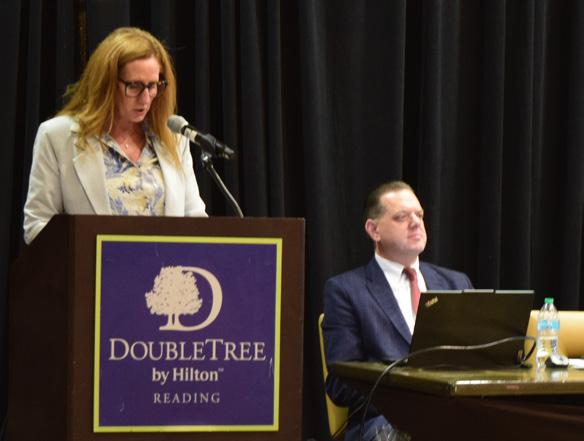
Over 250 members, presenters, and community sponsors attended the 2026 Bench-Bar Conference at the DoubleTree Hotel in downtown Reading on April 15. The conference featured 16 courses covering a variety of practice areas. Some stand-out seminars included Paul C. Troy’s “Avoiding Malpractice”; “The ABC’s of Education Law”; “Divorce and Advanced Age Parties”; “2026 DUI Update: New statute, New ARD Guidelines, and the Newly Certified DUI Treatment Court”; and, of course, Criminal and Civil Bench Roundtables. This year’s conference also included two plenary courses: “Artificial Intelligence in the Legal Profession” and “View from the Bench: Jury Diversity and Other Issues that Enhance Equal Justice for All.”
The Hon. Jeffrey L. Schmehl, the Hon. Patricia M. Mayer, the Hon. J. Benjamin Nevius, Attorney John J. Miravich, and the Hon. Madelyn S. Fudeman review key procedures and discuss hot topics for civil litigators during the Civil Bench Roundtable.
Berks County Bar Association President Peter F. Schuchman, Jr., presents a check to support the work of the PBA legislative affairs team to PBA President Kristen B. Hamilton.
In the “Bankruptcy Guide for Litigators” seminar, moderated by Pamela VanFossen, Esq., George Lutz, Esq., and Eden Bucher, Esq., lead a discussion of the nuances of the various bankruptcy chapters; exemptions under Section 522; claim priorities; automatic stay and related exemption procedures; seeking relief to pursue coverage for personal-injury cases only; proofs of claim; and the interaction between mechanics lien claims and general contractor bankruptcy.
Benjamin A. Leisawitz visits the RKL table, one of our three Breakfast Bar Sponsors.
Presenting Sponsor Tompkins Community Bank representatives ready to engage with members and raffle off a Unique Pretzel gift basket to one lucky winner.
Berks County Bar Association President Peter F. Schuchman, Jr., engages with representatives from vendor USI Affinity.
Joseph R. Speece, III, Kimm R. Montone, the Hon. Eleni Dimitriou Geishauser, the Hon. Justin D. Bodor, Alex Velazquez, Adam Bechdel, and Daniel C. Nevins partake in the “2026 DUI Update: New Statute, New ARD Guidelines, and Newly Certified DUI Treatment Court” in the Penske Amphitheater.
Reading School District Chief Legal Officer Jesse C. Leisawitz leads “The ABC’s of Education Law” seminar, providing a primer for attorneys whose clients interact with Pennsylvania’ s public K-12 education system as parents, employees, residents, and volunteers. Topics of discussion included FERPA, the impact of custody agreements, student rights/discipline, and emerging trends.
Moderated by Berks County District Attorney John T. Adams and Chief Public Defender Keith McConnell, the Hon. Justin D. Bodor, the Hon. Thomas Parisi, the Hon. Eleni Dimitriou Geishauser, Berks County Court of Common Pleas President Judge M. Theresa Johnson, and the Hon. Patrick Barrett participate in a lively discussion of hot topics for criminal law practitioners during the Criminal Bench Round Table Discussion.
Members visit sponsor tables and engage with different local vendors.
Paul Troy reviews the Rules of Professional Conduct and offers guidance on how lawyers can avoid malpractice during the first seminar of the morning.
In the “Divorce and Advanced Age Parties” seminar moderated by Sara H. Clipp, members learn how to identify and handle divorce issues with elderly clients, including assessing questionable capacity, the appointment of a guardian and/or guardian ad litem, important ethical considerations, and the intersection of divorce and Medicaid planning. Presenters include Victoria White, Esq., Lauren P. Butterworth, Esq., Ethics Counsel for the Pennsylvania Bar Association representative, and Nicole C. Manley, Esq.
Members fill out special raffle tickets by engaging with our sponsors for exciting gifts and prizes!
Attendees hear from President Judge Johnson on the State of the Bench and important updates to courthouse procedures.
Stephanie Rio of the Committee of Seventy discusses a campaign to increase the diversity of jurors as part of a panel featuring the U.S. District Court Judge Jeffrey L. Schmehl of the Eastern District of Pennsylvania and the Hon. J. Benjamin Nevius of the Berks County Court of Common Pleas.
President Peter F. Schuchman, Jr., addresses the State of the Bar.
A meaningful Q&A with practitioners on best practices in guardianship representation, zealous advocacy, amplifying vulnerable adults’ voices, and exploring alternatives to guardianship at our “Zealous Advocacy Representing Vulnerable Adults in Guardianship Proceedings” seminar. Leading the panel were, from left, Keith Hinkel, Assistant Director of the Office of Elder Justice in the Courts; Alexa S. Antanavage, Esq., and from the Reading Office of MidPenn Legal Services, Kathryn Wentzel, Esq., and Summer Swanson, Esq.
Julie J. Marburger, Esq., moderates a discussion about proposed changes to Berks County Family Court rules with, from left, Pamela A. DeMartino, IV-Counsel for Berks County Domestic Relations; Jill Gehman Koestel, Divorce Hearing Officer; and Catherine Nadirov, Berks County Family Court Administrator.
Franki Aitken, trustee for the Law Foundation of Berks County and Chief Operating Officer of the Berks County Community Foundation, converses with Attorney James Rothstein about charitable funds at the BCCF.
“Life is like riding a bicycle. To keep your balance, you must keep moving.”
—AlbertEinstein
A common goal of “trying to improve as well as we can” unites everyone who trains at CFS Academy, according to Fielding.
A Bridge Too Far? MyVentureInto CombatSports
By John A. Fielding, III, Esquire
Iwas 6'1'' and 128 lbs. when I graduated from Somerville High School in 1972. Gradually, food, lack of exercise, and lack of ambition took over. Eventually, my weight ballooned to 230 lbs. before settling to 210 lbs. in the summer of 2024. My wife was not impressed and had been after me for 40 years to lose weight. Finally, that summer, I decided to “bite the bullet.”
In 2021, David Harr decided to take the plunge and open his own gym; CFS (“Confidence, Fitness, Striking”) Academy was born. He was a retired kickboxer with some 16 fights under his belt. He began with a few students. Erroll “Junior” Washington, another man with martial arts experience, came and started to train some boxing students. Eventually, Harr advertised for and hired Washington as a boxing coach at the gym. Harr expanded the offerings at his Shillington gym to include Muay Thai, MMA, and jujitsu instruction. There is also a cardio kickboxing class for women exclusively, and a multitude of children’s classes.
Meanwhile, I was holding down a seat at my favorite “watering hole.” One night, a young man with too much to drink started to pick on a female customer, and she broke a couple of his ribs for him. I was suitably impressed. Her name is Sandy Sands. I began talking to her about physical fitness and her training. As it turned out, she was trained in the Kempo martial arts by Mr. Washington when she was 13-14 years old. I told her I needed to get in shape and, while I was at it, learn a useful skill. I’ve generally been bored by regular gyms, so I was no “gym rat” and needed a goal other than just losing weight and lifting weights to keep me motivated. She referred me to CFS Academy and Mr. Washington.
In turn, Mr. Washington referred me to the jujitsu class, taught by Keith Neff. Neff is a retired detective from Lancaster County with a black belt in jujitsu and teaches self-defense to law enforcement types, among other things. He’s also older, and, since I was getting into this at the young age of 72, it was thought to be a good match. There were several problems. One, I had a 128 lb. musculature trying to move 210 lbs. on the mat. Second, the classes are in the evening, and meetings conspire to take those away from me. Third, I just discovered that I enjoyed punching and kicking other people and not getting arrested for it much more.
Meanwhile, I set about losing weight. I set a goal of 170 lbs., which was 10 lbs. lighter than my married weight in 1981. I adopted a keto diet, took a multitude of supplements, and adopted an “intermittent fasting” ritual. Eventually, after about a year of effort, my weight dropped to a low of 159 lbs. My weight as of this writing is 171 lbs. People ask me how I did it, and I invariably answer, “Well, I’d like to say something profound here, but it’s diet, exercise, and discipline.”
I signed up for what Harr called “Fundamentals of Striking.” “Striking” is the comprehensive term for the combat sports that involve punching or kicking in some form. In fact, Muay Thai (Thai Boxing) is called “The Art of the Eight Limbs” because it includes knees and elbows. It is derived historically from Lethwei, the combat sport from Myanmar, which also includes head-butting. Kickboxing is further derived from Muay Thai and has many different rule sets and variants.
Dave Harr, founder and owner of CFS Academy in Shillington, with John A. Fielding, III.
Book Review
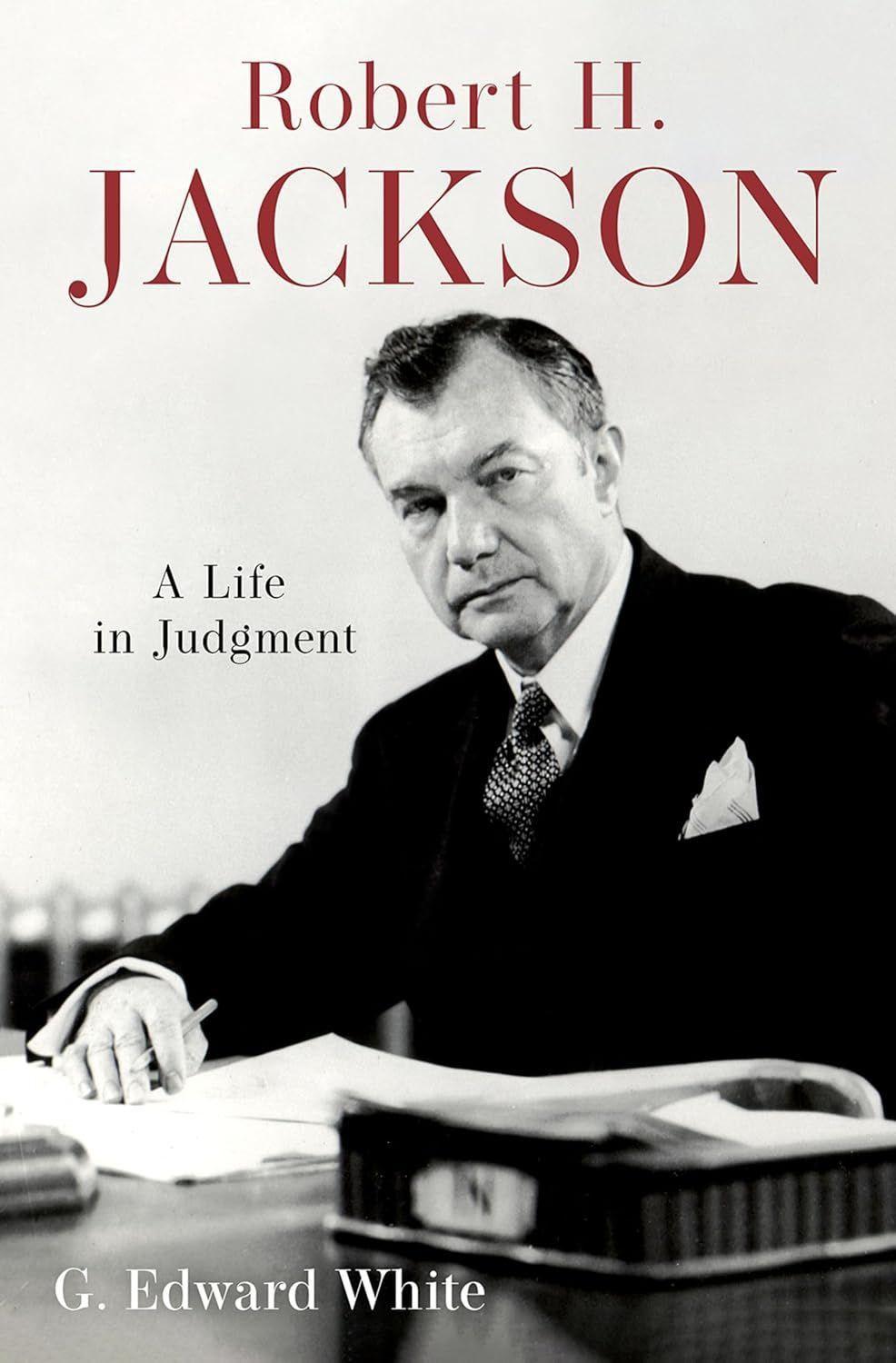
ROBERT H. JACKSON: A LIFE IN JUDGMENT
By G. Edward White
Reviewed by Donald F. Smith, Jr., Esquire
“We are not final because we are infallible, but we are infallible only because we are final.”
That is a quote from Justice Robert H. Jackson, who served on the United States Supreme Court from 1941 until his death on October 9, 1954.
After reading the quote some time ago in an article, it became my favorite aphorism about the Court. To me, it seemed that Justice Jackson was expressing humility. But now, having read the biography Robert H. Jackson: A Life in Judgment, I wonder.
While my initial thought is certainly true, what motivated the comment may have been something else. At times, in Justice Jackson’s view, as observed by the book’s author, University of Virginia Law Professor G. Edward White, the Court’s majority “had taken advantage of its position at the apex of the hierarchy of courts in America to issue an unreviewable fiat, unsupportable by reason.”
During his presidency, Franklin D. Roosevelt placed eight justices on the Court. Of those, the four who are considered FDR’s greatest are Hugo L. Black, Felix Frankfurter, William O. Douglas, and Jackson, all of whom are the subject of one of my favorite books on the Court, Scorpions: The Battles and Triumphs of FDR’s Great Supreme Court Justices, by Harvard Law Professor Noah Feldman, published in 2010.1
is how Feldman introduces the four:
A tiny, ebullient Jew who started as America’s leading liberal and ended as its most famous judicial conservative. A Ku Klux Klansman who became an absolutist advocate of free speech and civil rights. A backcountry lawyer who started off trying cases about cows and went on to conduct the most important international trial ever. A self-invented, tall-tale Westerner who narrowly missed the presidency but expanded individual freedom beyond what anyone before had dreamed…They began as close allies and friends of Franklin Delano Roosevelt, who appointed them to the Supreme Court in order to shape a new, liberal view of the Constitution…Within months, their alliance had fragmented. Friends became enemies.2
In his book, Professor White focuses on Justice Jackson’s life and work, while also analyzing selected opinions by him, his attributes, and shortcomings as a justice. The reader comes to appreciate that Jackson was no ideologue on the Court.
He was not a liberal in the mold of Douglas and Black, nor a conservative as Frankfurter would become. Jackson was an able advocate for almost three decades before joining the Bench. The “backcountry lawyer” had a very successful, lucrative practice in Jamestown, NY, developing an analytical style in solving legal problems. That style continued after FDR brought him to Washington, DC, appointing him to various federal positions— Assistant Attorney General, first for the Bureau of the Internal Revenue, followed by the Tax Division and then the Antitrust Division. Thereafter, before becoming the head of the Justice Department as Attorney General, he served almost two years as
Here
Solicitor General, a position Jackson considered “the highest prize that could come to a lawyer.”
And he was good at being a lawyer. He won 38 of the 44 cases he argued before the Court as solicitor general. According to Justice Frankfurter, Justice Brandeis had said, “Jackson should be Solicitor General for life.” White notes that, of all the official positions Jackson had held, the solicitor generalship “best suited his professional skills and temperament.”
Jackson was more comfortable as an advocate and, later acknowledged, he had trouble adjusting to the role of judge. White writes, “On the Supreme Court, he encountered a form of political intrigue that made him uncomfortable and…he would become something of a loner and gadfly on the Court.”
As related by White, Jackson believed Justices Black and Douglas each had “a political attitude toward their decision-making…in terms of their outcomes and immediate social consequences.”
Justice Jackson did not believe in analyzing legal issues “by the ideological preferences of the judge.” His approach was to analyze first the facts of the case and then look to the “relevant legal sources accompanying a particular case—provisions of the Constitution, judicial interpretations, and the like—and see how far those took him.” In other words, he favored a problem-solving style that started “first with the sources,” whereas “Black’s and Douglas’s approach, he thought, started with outcomes.” As a result, “his posture as a judge was not overly ideological” and “his stance marked him as a centrist with voting patterns that were somewhat unpredictable.”
Jackson wrote his own opinions, having his law clerks serve only as sounding boards. He saw himself as an individualist, “inclined to work out his views on cases without consulting his colleagues.” As a workaholic, “he wrote and rewrote his material, constantly trying to make it reach the high standards he held for himself.”
Professors White and Feldman both agree “that, with the possible exception of Oliver Wendell Holmes, Justice Jackson is the greatest writer ever to have sat on the Court.” Given his approach to constitutional problem-solving, his jurisprudence is described as having a pragmatic, centrist philosophy.
The White book details the approach taken by him in several cases. Probably, the most famous is Justice Jackson’s concurrence in Youngstown Sheet and Tube Company v. Sawyer.3 The Court’s majority had held therein that President Truman’s seizure and operation of America’s steel plants to prevent a strike during the
Korean War was a violation of law.
Jackson’s opinion is considered “the founding constitutional text for separation of powers between Congress and the president.”4 In a 1980 law review article, William H. Rehnquist, who was his law clerk at the time of the decision, described his Justice’s opinion as a ‘state paper’ of the same order as the best of The Federalist Papers, or of John Marshall’s opinions for the Court.”5 When Con Law 1 courses review the Youngstown decision, it is the concurring opinion, not the majority’s, that is analyzed.
Given my having written and lectured multiple times on the separation of church and state, White’s discussion of the case I found most interesting involved Jackson’s dissenting opinion in Everson v. Board of Education6. A New Jersey taxpayer had challenged a state statute reimbursing commercial bus fare incurred by parents of children attending Catholic parochial schools (other private schools were not included) as a violation of the First Amendment’s Establishment Clause.
By a narrow 5-4 decision, with Justice Black writing the majority opinion, the statute was held to be constitutional. In its decision, the Court applied, for the first time, the Establishment Clause to the states under the Fourteenth Amendment’s Due Process Clause. Black noted: “Neither a state nor the Federal Government can set up a church. Neither can pass laws which aid one religion, aid all religions, or prefer one religion over another.” His conclusion: “The First Amendment had erected a wall between church and state. That wall must be kept high and impregnable. We would not approve the slightest breach.” Nevertheless, the statute was sustained. Black analogized it to the state providing the Catholic schools general government services, such “as ordinary police and fire protection, connections for sewage disposal, public highways and sidewalks.” Furthermore, the state funding was provided to the parents and not to the schools.
Jackson dissented from the decision. First, he looked at the facts—New Jersey was reimbursing the parents of Catholic school children and not the parents of children going to any other private schools. Then he observed that the Canon Law of the Catholic Church mandated that their schools provide religious instruction.
To rebut Black’s analogy, Jackson wrote: “A policeman protects a Catholic, of course—but not because he is a Catholic; it is because he is a man and a member of our society. The fireman protects the Church school—but not because it is a Church school; it is because it is property, part of the assets of our society.” It was of no moment to Jackson that the aid was provided to the parents and not the school. “The state cannot maintain a Church, and it can no
Book Review: Robert H. Jackson: A Life in Judgment
Continued from page 19
more tax its citizens to furnish free carriage to those who attend a church. The prohibition against establishment of religion cannot be circumvented by a subsidy, bonus, or reimbursement of expense to individuals for religious instruction and indoctrination.” Demonstrating his literary flair, Jackson concluded:
“The state may pay out tax-raised funds to relieve pauperism, but it may not, under our Constitution, do so to induce or reward piety. It may spend funds to secure old age against want, but it may not spend funds to secure religion against skepticism. It may compensate individuals for loss of employment, but it cannot compensate them for adherence to a creed.”
Without a doubt, his pragmatic interpretation of the Establishment Clause in Everson convinces me that the holding was an “unreviewable fiat, unsupportable by reason.”
Over the years, the breach of the wall between church and state has only grown wider as the Court has allowed parochial schools to benefit in various ways from state aid. Such has especially been the trend with the current Roberts Court, as I outlined in the last issue of The Berks Barrister.7 In my mind, the approach taken by the Court’s solid conservative majority concerning the First Amendment’s religion clauses is not only ideological but also outcome-oriented. As interpreted by the Court, the Free Exercise Clause dominates, rendering the Establishment Clause practically impotent, an interpretation that is in stark contrast to the judgment of Justice Jackson. As expressed in his Everson dissent, the Establishment Clause’s “strength is in its rigidity”; no breaches to the “wall” should have ever been permitted, starting with Everson.
The members of the Roberts Court seem to utilize their “ideological preferences” in analyzing issues requiring constitutional interpretation. The current decisions generally break down according to an ideological divide—six conservative justices, three liberals. The six, appointed by Republican presidents, appear to be following the party’s agenda: overruling long-standing precedents on abortion and affirmative action; gutting the landmark Voting Rights Act; eliminating deference to actions taken by expert agencies when legislation is vague, thereby overruling a 40-year precedent; and ending restrictions on campaign contributions. This agenda-based approach, with its predictable voting pattern, champions a jurisprudence focused on outcomes, and not on the language of the Constitution, as was Jackson’s approach. In Scorpions, Professor Feldman writes that the “absence of ideology made Jackson a role model and the symbol of a particular approach to judging.”8 Jackson’s decision-making style, in my opinion, is sadly missing on the current Court.
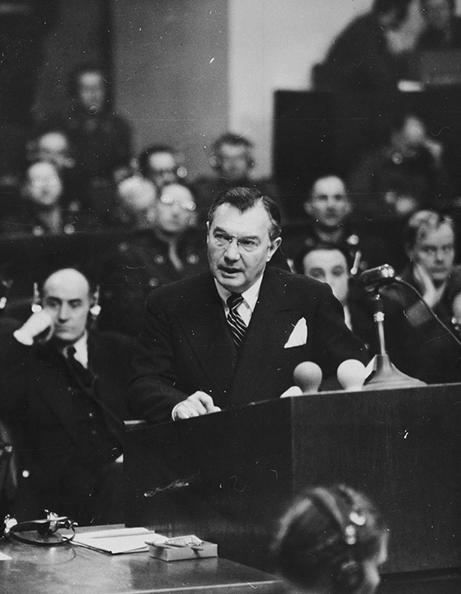
Jackson is unique in having taken a leave from the Court for an entire term to serve as the Allies’ chief prosecutor of Nazi officials and organizations as part of the Nuremberg trials following World War II. He had done so at the request of President Truman. Being
one who “always loved advocacy and trial work,” Jackson came to believe his role as Nuremberg prosecutor was the “high point of [his] experience.” The White book describes his efforts to impose American-style rules of law and procedure, insisting on due process in the litigation, despite the Nazi atrocities. In doing so, he established that the trials were not merely for show. In fact, several acquittals resulted.
The book also details Jackson’s struggle in deciding how to vote in Brown v. Board of Education9 and whether there was legal justification to overrule the concept of “separate but equal” in education. Jackson, it should be noted, was personally opposed to segregation. Once again, though, he approached the case with the outcome not pre-determined. To work his way through the struggle, and following his problem-solving style, he came to write six memorandums to himself over a period of four months. In the end, he concluded that education by the mid-20th century was “not a privilege but a right” and it could “not be encumbered with unconstitutionally discriminatory or oppressive conditions.” That thought found its way into Chief Justice Earl Warren’s eventual opinion for the unanimous Court, finding school segregation unconstitutional.
Professor White has done a fine job of encapsulating Justice Robert H. Jackson’s life and career, finding him to be “one well worth writing about and lingering in the company of, as I encourage others to do.”
Reading his book is one way to linger in the company of a great literary jurist whose work ended too soon but whose judicial philosophy should be respected and emulated, particularly if the Court is to be considered infallible.
Mr. Smith is the BCBA’s Executive Director Emeritus whose hobby in retirement is the study of constitutional law and Supreme Court history. The opinions expressed in this article are his alone and do not represent the opinions of the Berks County Bar Association.
References
1Reviewed in the Spring 2011 issue of The Berks Barrister
2Noah Feldman, Scorpions: The Battles and Triumphs of FDR’s Great Supreme Court Justices, (Twelve, 2010), p. xi (hereinafter “Scorpions”)
3343 US 579, 634-655 (1952)(Jackson, J., concurring)
4Gerard N. Magliocca, “The Untold Story of Robert H. Jackson’s Youngstown Concurrence,” Journal of Supreme Court History, 2025 Vol. 50, No. 1, p. 8.
5William H. Rehnquist, “Robert H. Jackson: A Perspective Twenty-five Years Later,” Albany Law Review, 44 (1980), p. 539 (as quoted in the Magliocca article, p. 8)
6330 US 1 (1947)
7Donald F. Smith, Jr., “Christian Nationalism and the Supreme Court: No Respect for the Word ‘Respecting,’” The Berks Barrister, Winter 2026, pp. 19-23
8Scorpions, p. 413
9Brown v. Board of Education, 347 US 483 (1954)
REGIME CHANGE Only Sensible Plan in Iran
By Douglas Wortman, Esquire
The American military is once again at war in the Middle East and has committed significant combat platforms, aircraft, troops, and munitions in a fight against the Islamist regime in Iran. Having destroyed Iran’s air defenses, decapitated its leadership, gained total air supremacy, targeted nuclear facilities, and depleted missile stockpiles and launchers in the first two weeks of the campaign, President Donald J. Trump has said he expects the war to last another “four to five weeks,” but has said he is willing to go longer if needed. Secretary of War Pete Hegseth said that the U.S. “is in this for as long as it takes.” The Iranian military continues to fight despite significant losses to its most senior ranks. Iran’s foreign minister called their strategy a “decentralized mosaic defense” that gives remaining commanders autonomy to fight independently of top-level control.
American/Israeli attention now turns to the apparatus of government oppression of the nation—the Iranian Revolutionary Guards Corp (IRDC). Make no mistake, at least to the Israelis, if not to President Trump as well, this is about regime change. There is no sensible alternative.
Islam vs. Islamism
Islam and Islamism are not synonymous. While Islam is the faith of 1.4 billion people, Islamism is not a form of the Muslim faith or an expression of Muslim piety. Rather, it is a political ideology that strives to derive legitimacy from Islam.
So, if Islam is a faith, what then is Islamism? Islamism can be best described as an “anti-ideology” in the sense that it defines itself only in opposition to things. That is, Islamism stands not for, but against. For starters, Islamism is anti-Semitic in promoting the view that Jews are evil. Because Jews live in Israel, it is also antiIsraeli. It is also anti-American due to its distorted view of Jews’ role in the United States and America’s support of Israel. “Jews are evil, they run America, therefore America is evil”—this is the
mantra of Islamist thinking. Islamism is also anti-Christian, and since Jews and Christians live in the West, it is also anti-Western. Islamism likewise opposes liberal democracy and secularism, as these institutions originated in the West.
Tehran is the Epicenter of the Islamist World
Since 1979, Iran has been governed by an Islamist theocracy. In Iran’s political system, an elected president and parliament are subservient to a clerically appointed ayatollah, the “Supreme Leader,” who wields ultimate authority and personally oversees the Revolutionary Guards and other powerful bodies of state. The Islamic Republic is not a unitary state with a single chain of command. It is a complex web of power centers—the IRGC, the regular military, the presidency, the judiciary, the clerical establishment, intelligence services, and the Basij militia—all with overlapping jurisdictions, rival interests, and independent capabilities. The Supreme Leader’s essential function is not just symbolic religious authority, but practical political arbitration— when these institutions disagree, he decides. Ayatollah Ali Khamenei, the Supreme Leader since 1989, along with dozens of other Iranian leaders, was killed in the opening minutes of the Joint U.S.-Israeli attack. He has been replaced by his son, who reportedly was severely wounded in the same airstrike and may not even be aware of his unenviable promotion.
Justification for the Attack
In the Islamist world (including the regime in Iran), there are no solutions to international disputes or religious rivalries. There is no concept of peaceful coexistence—there is only the total destruction of the enemy or defeat and annihilation. Successive ayatollahs and those who surrounded them have orchestrated
continued on next page
Regime Change Only Sensible Plan in Iran
Continued from page 21
terrorist activities and have been a national ATM for terrorist organizations in the Middle East and beyond for decades.
America has basically been at war with Iran since 1979, the year the Islamist regime seized power. From its inception, the regime has been hostile to the United States. Iranians chant “Death to America” in virtually every Friday sermon. It is the slogan of their nation. They spread American flags on the ground at schools and universities, where students can step on them. They think America is the primary force of evil in the world. They call us “The Great Satan.” They want to see America defeated in the Middle East and expelled from the region. They see America’s influence as nefarious, not just militarily, but also culturally and economically. They have killed Americans repeatedly in many different places, either directly or through proxies. There is simply no government on earth more hostile to the United States than the Islamic Republic of Iran.
U.S. Objectives and Strategy
The stated goals of Secretary Hegseth are: 1) Decapitate the regime, and sow confusion and fear among the leadership that remains; 2) Establish air superiority; 3) Sink the Iranian navy and destroy their air force; 4) Destroy Iranian offensive missiles, missile production facilities, and other security and defense infrastructure. The first three objectives have been completed. The fourth is well underway.
Iranian Strategy
Iran seeks a war of attrition. It is trying to establish deterrents to make it too costly for the world and for the U.S. to continue to wage war against them. The United Arab Emirates, Kuwait, Qatar, Bahrain, Turkey, Oman, and Saudi Arabia have all come under heavy drone and missile fire from Iran. The Strait of Hormuz is at a standstill, which means there is considerable uncertainty about the short-term oil supply. Iran’s coastal areas offer ideal locations for launching anti-ship missiles, which can be fired from close distances and provide little time for a defensive response. Only 22 miles wide at its narrowest point, the Strait of Hormuz is an Iranian kill box. Commercial vessels and any U.S. warships sent to escort them face an enormous risk of losses in ships, cargo, and lives. Iran intends to keep it that way and hopes international pressure forces an end to the conflict.
End Game
The end game scenarios that seem most likely are: 1) The regime survives and hardens; 2) The regime survives but new, moderate leadership arises that is more willing to coexist with Israel and the United States and give up its revolutionary ideology and nuclear ambitions; or 3) The regime falls. The latter—if it
were to happen—would be a best-case scenario for Iran, America, Israel, and the world. While best-case scenarios rarely manifest into reality in the Middle East, the conflict is at least giving Iranians a chance to replace the tyrants who rule over them with something better.
This is no snatch-and-grab mission, though. Iran is a much more resilient and hardened regime than the Venezuelan regime. It’s more institutionalized, much better organized, and significantly more advanced militarily. It’s a tougher, far more ideological regime. They’ll not go down without a fight. Things might get worse before they get better.
Conclusion
Iran is an incredibly beautiful and complex place with a rich, sophisticated society, history, and a talented and educated population. Iran is a nation desperate to reclaim itself. Approximately 70% of the Iranian population is under the age of 40 and born after the 1979 revolution. Tens of thousands of Iranians took to the streets in December and January, rejecting 47 years of imposed rule. They abandoned their fear of death and protested for change now, and for a life worth living. Unknown thousands of them were killed in those protests. They, and the American service members who have been killed, and those who almost certainly will be before this conflict ends, must not have died just for a better nuclear deal. This must not be a war of reform or containment. If this evil regime is allowed to remain in power, sooner or later, it will acquire nuclear weapons—by developing them or by purchasing them. It is inevitable. If the Iranian government is willing to kill tens of thousands in Tehran, it will have no problem killing 500,000 in Tel Aviv. A nuclear-armed Iran, with little to no regard for human life, acting with impunity, is simply too dangerous to allow.
To those who oppose this military action, I ask—if this were happening in your country, if you were not safe in your own home, if your children were being hunted in the streets, if your hospitals were raided and your doctors executed for doing their jobs, if your internet were cut, so the world could not see, if the women of your country were told for decades that they are less than human, if the single biggest threat to you was the very government that was meant to protect you, would you not demand action? The question is not whether Iranians want freedom—it is whether they will be given the chance to gain it. The answer to that question, now, lies in the hands of the United States of America.
Mr. Wortman, a principal of Justicia Law in Reading, is a former Soviet/Russian Analyst for U.S. Air Force Intelligence. He holds a B.A. in Russian and Eastern European Studies and an M.A. in European History.
By Kori A. Walter
Mahsa Mohkamkar was chatting on FaceTime with her sister when the roar of a jet engine interrupted their conversation. Mohkamkar and her sister remained silent until the lowflying military aircraft passed. When the conversation resumed, Mohkamkar knew her sister was jarred, unsure of whether the sound of a bomber buzzing overhead would be followed by devastating explosions near her home.
“She was joking around and trying to play it off, but I could see that she was terrified,” Mohkamkar. “But she would not talk until she was sure the jet was not dropping a bomb. I cannot imagine what the children in Iran feel like when they hear those sounds.”
The sounds of aircraft buzzing overhead and bombs crashing into targets have become frequent since March 1, when the United States and Israel began striking sites throughout Iran in an effort aimed at decimating the Iranian regime’s nuclear weapons program.
Mohkamkar’s family, including her sister, lives in Isfahan, Iran’s third-most populous city, about 210 miles south of Tehran.
Mohkamkar, an associate member of the Berks County Bar Association who handles immigration work at her Lehigh Valley firm, Abogada Vida, came to the United States in 2012 and earned her citizenship in 2015. She said communicating with family members in Iran has been challenging since the bombing began. Iran has blocked access to the internet, and she can’t always reach her sister, brother, or the rest of her family by phone.
Mohkamkar said bombs have been dropped near Isfahan, raising worries that her family may be in danger. The city is on the north bank of the Zayandeh Rood River and is potentially a prime bombing target because of its multiple bridges, the
continued on next page Isfahan is in central Iran and home to about 2.2 million people. It was the capital of Persia throughout history, including 1598-1722 during the Safavid Empire.
War Through Iranian Eyes
Continued from page 23
proximity of an aircraft manufacturing facility just north of the city, and a nuclear facility to its south.
In early March, one of her family members was worried that the appliance manufacturing facility he owns would be a target, wiping out a business he had been working for decades to build.
“He closed the factory the same day the bombing was happening nearby,” Mohkamkar said. “It was a scary moment. You don’t know who’s telling the truth about what is a target.”
Finding themselves in trouble as a consequence of the new year, her family was forced to cancel their return to the Lehigh Valley. They were meant to come back to continue residing with Mahsa and to celebrate the Persian New Year, which coincided with the spring equinox. Typically, Mohkamkar said Iranians take two weeks off work to celebrate. And it is a tradition that the youngest family members call the oldest family members to wish them a happy New Year.
“Because of everything happening, we were not able to call our elders,” Mohkamkar said. “This is the first time in history that the youngest family members were waiting for the oldest family members to call them to wish them a happy New Year.”
During her childhood in Isfahan, Mohkamkar excelled in school because of her love of reading and her memorization skills. She said Iranian children must choose a career path relatively early, and she was drawn to what was called a literacy track in high school. Admission to Iran’s public universities is extremely competitive because schools limit class sizes, Mohkamkar said. Students are required to take a national college entrance exam, and those with the top scores get the first shot at prestigious schools.
“Education is a big deal for our families and everybody,” Mohkamkar said. “I took the entrance exam and was able to go to Isfahan University to study law.”
Mohkamkar aspired to become a notary in Iran, preparing
contracts and registering those contracts with government agencies.
“Becoming an attorney is easier than becoming a notary in my country,” she said.
Leaving her home country was not a difficult decision, either. Mohkamkar was also inspired by the 13th-century Iranian poet Saadi Shirazi, who wrote that if a person wants to grow, they should travel.
“I knew since I was in high school that I wanted to explore the world,” Mohkamkar said. “Yes, it’s hard not to be with your parents and with your friends who you grew up with. But I know that you gain more by challenging yourself.”
Her fiancé, who was raised in Tehran, was an undergraduate at the University of Arizona. On one of his trips back to Iran, he proposed to Mohkamkar and asked her to move to the U.S. The original plan was for Mohkamkar to apply for a fiancée visa. However, her parents did not approve. So Mohkamkar briefly delayed her move to the U.S. until she was married.
Mohkamkar said she’s glad she waited. And now she counsels her clients to avoid fiancée visas when possible because they are overly complicated, and the benefits of entering the U.S. two months before tying the knot are minimal.
Even after she married her husband, Mohkamar’s parents were skeptical about her decision to leave Iran.
“They thought I was so crazy for leaving my country and coming here because they believed I had better opportunities in my country and that I could've had a bigger house, and that I could’ve had a better car,” Mohkamkar recalled. But Mohkamkar relished the challenge of relocating to Tucson, Arizona.
“I just came here thinking that I could improve my English and wanted to see what I could do next,” she said. “I really wanted to work. And one of my classmates from Isfahan came to the United
Built between 1598 and 1622, Naqsh-e-Jahan Square is in the center of Isfahan and home to several tiled mosques.
Lawyers seek advice from lawyers.
Why wouldn’t you buy your insurance from lawyers as well?
Insuring Pennsylvania Law Firms since 1997
• MLM has returned a dividend to policyholders annually since 1988, over $88 million total
• First dollar defense- a loss only deductible can produce a substantial savings for firms facing nuisance type claims
• Full prior acts coverage
• Offers an array of services to mitigate risks including three free CLEs for policyholders each policy year, $165 value
Protecting Your Practice is Our Policy.®
States. He told me how to apply for a master’s degree.”
Mohkamkar, who learned English at Isfahan University, enrolled in the University of Arizona, James E. Rogers College of Law. She earned a Master of Law in International Trade and Business Law. Her husband earned a doctorate in physics at the University of Arizona. He received a job offer to work as an engineer at a tech firm in the Lehigh Valley.
Moving east was exciting for Mohkamkar. She had always wanted to live in Virginia, but Pennsylvania was a close second on her list.
“I love to see the changes of the seasons,” she said. “Living in Arizona, I missed the change of seasons in my home country.”
Roughly 6,600 Iranian-born residents lived in Pennsylvania in 2024, according to World Population Review, which is an independent organization that analyzes population data. By comparison, World Population Review estimated 223,000 Iranians reside in California.
Mohkamkar said Iranian Americans are divided about whether U.S. bombing is an effective way to bring about change in the Iranian government. Some support U.S. military intervention because they believe it’s the only way to loosen the grip of a theocratic regime that has been in control since the 1979 Iranian revolution.
Get a fast quote today! Jason Joyce 215-668-0806 jjoyce@mlmins.com www.mlmins.com
But others expressed concern that Iranian leaders use the chaos the war is creating to crack down on individual freedoms, arguing that stamping out dissent was necessary to preserve Iran’s security.
“I don’t believe that war is the solution to change the regime,” Mohkamkar said. “It gives more power to those who misuse it.”
Mohkamkar said her neighbor and colleagues have been very kind and supportive in the wake of the bombings. Old friends from Arizona have texted and asked how Mohkamkar’s family is doing. One colleague made a meal for the family, including macaroni and cheese, her daughter’s favorite.
“I believe that even in the darkest moments, something positive can emerge,” she said. “One positive outcome is that more people are learning about Iran because of the war. Iran has a very rich culture, history, and people. And today, when I say I’m from Iran, people already know where it is and understand its depth and culture. No matter how dark the night may be, it still allows some light to be seen.”
Mr. Walter is the Berks County Bar Association Executive Director.
Reading Royals Night
On March 27, members and their families gathered in the Coca-Cola Ice Box of Santander Arena for the 3rd annual Berks Bar Night at the Reading Royals. The Royals shut out the Norfolk Admirals 3-0 in a crucial matchup to help determine playoff standings in the ECHL North Division. Members enjoyed an up-close view of all the action on the ice with a full spread of stadium goodies and even a visit from Slapshot and Tiara!
Berks Bar President Peter F. Schuchman, Jr., joined by his wife, Mary, and Royals mascot Tiara.
Alexa Antanavage and her children, Claire and Noah, enjoy dinner.
Lucy Brito and Kathryn Wentzel send birthday wishes to the Royals mascot, Slapshot.
Joseph R. Speece, III, and his son, Joey, bump fists with Slapshot.
The Hon. Eric J. Taylor embraces Slapshot during intermission.
Lauren Marks with her husband, Chad, Slapshot, and Past President Daniel C. Nevins.
Tegan and Wyatt Marks take in the ice-level view with Slapshot.
Members celebrate the Royals scoring an empty net goal to secure the 3-0 shutout.
Tiara waives the victory flag at center ice.
Public Museum
500 Museum Rd., Reading, PA 19611
A Night Dining at the Museum
By Susan N. Denaro, Esquire
A$200 raffle ticket purchased in December to benefit the Reading Education Foundation led to a memorable private dining experience with friends at the Reading Public Museum. The wine-and-dinner package was valued at $1,200, a pleasant surprise on my charitable investment in the Foundation’s signature fundraiser.
By Susan N. Denaro, Esquire
Our group of eight settled on April 2 as the night we would dine at the museum. Unlike the movie Night at the Museum, there were no terrifying moments of exhibits coming to life.
Instead, the delightful experience was more like The Wizard of Oz. Chef David Brennan, owner of Special Occasions by Panevino, was the man behind the curtain. He performed culinary feats of magic from behind a black curtain erected in a corner of the private gallery where we dined.
Some of you may remember Chef Brennan’s arrival in Berks County decades ago. He was the executive chef at DiLullo’s in Philadelphia. After that restaurant closed, Chef Brennan and a partner purchased and renovated the old Chat-A-While Inn. After a few years, he bought out his partner and transformed the restaurant into the even better Bistecca. Eventually, thanks to the unending encouragement of Al Boscov, who was trying to bring top-notch dining to Second Street in Reading, across from the IMAX Theater, Chef Brennan opened Panevino. Chef Brennan’s knowledge of Northern Italian dishes shone even brighter in the Entertainment Square eatery.
Toward the end of his run on Second Street, Chef Brennan used that space as a special events venue and hosted regular wine dinners. Currently, Chef Brennan operates his special occasion catering company out of his new location at 600 E. Penn Avenue, Wernersville, where his spouse, Trish Brennan, deftly serves as pastry chef.
Aside from picking the date and the theme for our early Spring evening (“April in Paris,” which featured gypsy jazz and French-influenced tunes inspired by yet another movie, Woody Allen’s Midnight in Paris), the rest of our evening was orchestrated entirely by Chef Brennan, who independently planned the menu and selected the wines.
Upon our arrival, our group visited the museum’s resident 2,300-year-old mummy, Nefrina, and toured some of the other exhibits. Then we settled in for our first course, a stunning crab cake plated on a bed of sweet corn risotto. Corn risotto and crab are a traditional pairing as their flavors complement each other well, but the glass of Chiaretto di Bardolino Classico Chef Brennan poured elevated the delightful start to our dining experience, as the rosé wine from Northern Italy helped bring an extra element of Spring sunshine to our palates. That first bite brought an instant reminder of how much we missed being at Chef Brennan’s table since his traditional restaurant closed.
I have been a fan of risotto since the first time I endlessly stirred a batch in my mother’s kitchen as a teenager. I often find most chefs either rush the preparation and undercook it, or serve it overcooked and too loose. As expected, Chef Brennan’s offering was sheer perfection. Although the sweetness of the corn and the chewiness of the arborio were excellent on their own, the addition of the crab cake—which was pillowy soft, perfectly crusted, and sublime—rocketed the dish to a whole new level and was a reminder of his classical training at the renowned Culinary Institute of America in Hyde Park, NY.
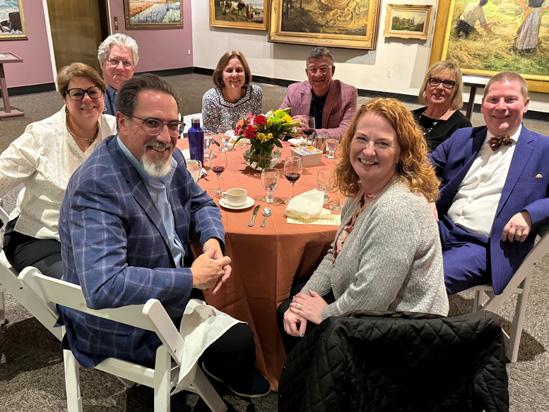
The dinner party of eight included, from left, your author; her spouse, John Cullen; Deborah and Carl Sottosanti; Franki Aitken; Benjamin Watts; Glynis Fitzgerald; and David Rifkind.
Corn risotto and crab cake.
Cavatelli with spinach in a Béchamel sauce.
When the proposed menu for our dinner landed in my inbox for approval, I was dubious about Chef Brennan’s decision to serve a second pasta course immediately after the risotto. Despite my concern about an excess of carbs, I said nothing and rolled with his vision. When the cavatelli with spinach was served, it was generously topped with large flakes of shaved Reggiano. The surprisingly light Béchamel sauce, which made one want to scrape the plate clean, left me very happy I did not challenge its inclusion in our meal. One of our guests, who was born in Italy, smiled all the way through this course. He said it reminded him of a comforting and similar dish his mother made often during his childhood. While I was expecting all the wines to be from Italy, Chef Brennan chose an Australian Vision Gruner Veltuner white wine. The subtle notes of green apple and pear, as well as citrus elements, worked well and added to the unexpected lightness of that second course.
A beautifully plated panzanella salad boasting a medium-sized ball of creamy burrata was a welcome third offering. According to food lore, panzanella salad was invented by frugal Italian cooks looking for a way to use leftover bread. Chef Brennan tossed his bread cubes with halved cherry tomatoes, sliced red onion, and fresh herbs. I suspect he salted the tomatoes prior to tossing them into the salad to draw out some of their liquid, to soften their acidity, and to heighten their sweetness. I also question whether he used A L’Olivier’s tomato basil vinegar, made in France, in place of a traditional Italian red wine vinegar because the dressing had an added burst of tomato flavor and was devoid of the rattling sharpness some red wine vinegars impart in dressings. The burrata was playfully dotted with white balsamic vinegar pearls that mellowed the sharp brightness of the onion slivers. A mediumbodied super Tuscan Sangiovese from Le Sughere di Frassinello Maremma was a logical selection for this course. If I recall correctly, this was the one dish that everyone finished in its entirety, but, to be fair, because all the servings were larger than anticipated, most of us were pacing ourselves to have room for at least part of all five courses.
The fourth course was grilled filet mignon topped with a classic Barolo red wine sauce and black truffle slices. I believe the slices were from preserved truffles because they lacked that deep, earthy flavor of a fresh truffle, but it was still an offering worthy of the Guido Berta, Barbera D’Asti served with it. This second Tuscan super red wine served that night had a dark, rich hue and a fabulous
bouquet; it was further proof that Chef Brennan’s palate never fails when he is pairing foods and wines. I suspect the beef was prepared sous vide style before being finished on either an electric grill or an induction plate that was tucked behind the black curtain. I am merely guessing because at no point during the night did we hear any sounds from behind the curtain nor smell any cooking aromas, yet all dishes were expertly finished and served at their optimal temperatures.
I am not sure anyone truly had any room left for the dessert course, but somehow, we all managed to enjoy Trish Brennan’s warm chocolate molten lava cake covered in powdered sugar and served with mixed berries. Again, I marveled at how it was heated so that the center properly flowed when split open, given its final preparation in that curtained, makeshift kitchen. Thankfully, the serving size was small enough to keep the guilt at bay for those who managed to clean their plates. The final wine of the night was a Cocchi Brachetto D’Acqui that drew the most raves from everyone. The strawberry, cherry, and cranberry notes of the Italian sparkling blush wine held their own against the richness of the chocolate in the dessert.
Needing to walk off a few calories, we enjoyed a brief stroll through a couple of the nearby galleries, guided by Matthew Citrone, Manager of Internal Events at the Reading Public Museum, making sure to visit the Museum’s very own Keith Haring painting and the colorful traveling Lego exhibit. I was hoping to get a glimpse behind Chef Brennan’s curtain to see how he created such a memorable meal, but by the time we returned to our table from our tour, as if by magic, the black curtain was gone, and there was no evidence that Chef Brennan or any of his staff had ever been there.
You don’t need to be the lucky winner of a charity raffle to enjoy your own “night at the museum” with Special Events by Panevino. Contact Matthew Citrone at Matthew.Citrone@ ReadingPublicMuseum.com to get all the details.
Citrone and Chef Brennan scripted a flawless evening and left us feeling like we experienced a touch of movie magic.
Ms. Denaro is with the Wyomissing firm Plank Frankowski.
Filet Mignon in a truffled Barolo sauce.
Panzanella salad with burrata and white balsamic pearls.
Strolling through a museum exhibit before dinner, the author photographed potential predators in case they came to life during the private dining experience, like in the movie Night at the Museum.
Chocolate molten lava cake with mixed berries.
LAW FOUNDATION OF BERKS COUNTY 2025 ANNUAL GIVING CAMPAIGN
Thank you to all the Law Foundation Trustees, Bar Association Board of Directors and members, and supporters from throughout our community for making the 2025 Annual Campaign an incredible success. Nearly 70 donors contributed over $18,500 this year. Please know your amazing generosity is making a significant and lasting difference right here in Berks County, as the Law Foundation has been able to make a positive difference for victims of domestic violence, help foster care children in need of advocates, and assist local youth participating in public service projects and developing their athletic, artistic, and academic talents. Because of our continued efforts, the Law Foundation has been able to offer support to various community organizations, including the Berks County Treatment Court, CASA Berks County, Community Justice Project, Children’s Alliance Center, Mary’s Shelter, and Safe Berks. Again, thank you to everyone who donated to the 2025 Annual Campaign.
Bridge Builder Society ($1000 or more)
William R. Blumer, Esquire
Barbara J. Kline
(In memory of Sidney D. Kline, Jr.)
Juris Society ($500 to $999)
Cathy & John Badal, Esquire
Paula Barrett & Hon. Patrick T. Barrett
Karen H. Cook, Esquire
Andrew F. Fick, Esquire
Edwin H. Kershner, Esquire
Lori and Hon. James M. Lillis
Heidi B. Masano, Esquire
(In memory of the Hon. Thomas M. Golden)
John J. Miravich, Esquire
Daniel C. Nevins, Esquire & Jennifer Nevins, Esquire
Virginia & Eugene Orlando, Esquire
Charles J. Phillips, Esquire
Gabriela G. Raful, Esquire
Donald F. Smith, Jr., Esquire
(In memory of Past President Alan S. Readinger)
Ann & Jim Snyder, Esquire
Hon. Jeffrey K. Sprecher
President Society ($250 to $499)
Franki A. Aitken
Merle & Wendy Dunkelberger
(In memory of Daniel Birnhak, Esquire)
Jacquelin M. Hamer, Esquire
Joanne Judge, Esquire
Robert & Jill Koestel, Esquire
David M. Kozloff, Esquire
JoAnn & Howard Lightman, Esquire
(In honor of Honorable Arthur Ed Saylor)
Thomas and Heidi B. Mason, Esquire/Masano
Architects Group
Raymond Melcher and Terri Lampe
Frederick R. Mogel, Esquire
Anne and Christopher C. Muvdi, Esquire
Frederick M. Nice, Esquire
Andrew C. Onwudinjo, Esquire
Jesse L. Pleet, Esquire
William F. Roberts, Esquire
Honorable Jill M. Scheidt
Mary and Peter F. Schuchman, Jr., Esquire
Carl and Debbie Sottosanti, Esquire
Terry D. Weiler, Esquire
Partner Society ($100 to $249)
Hon. A. Joseph Antanavage
Mary Ellen Batman
Dee and Daniel E.P. Bausher, Esquire
(In memory of Richard Bausher)
Jessica Bodor & Hon. Justin D. Bodor
Mahlon J. Boyer, Esquire
Eden R. Bucher, Esquire
Mark S. Caltagirone
Alfred W. Crump, Esquire
Sean Curran, Esquire
Curran Estate & Elder Law
Pam A. DeMartino, Esquire
Lori & Jeffrey Elliott, Esquire
Ann E. Endres, Esquire
Matthew Fessler, Esquire
Susan E.B. Frankowski, Esquire
Sara Haines Clipp, Esquire
Frederick K. Hatt Esquire
Charles & Alisa Hobart, Esquire
Beth Kohl, Esquire
Kathryn L. Lehman, Esquire
Jesse Craig Leisawitz, Esquire
Daryl F. Moyer, Esquire
Michael J. and MaryJean Noon
Suzanne Palmer, Esquire
James M. Polyak, Esquire
James J. Rothstein, Esquire
(In memory of the Hon. Elizabeth and Leon Ehrlich)
Hon. Jeffrey L. Schmehl
Edwin L. Stock, Esquire
Valerie West, Esquire
White Star Tours
Associate Society ($50 to $99)
Amy J. Litvinov, Esquire
Michael G. Wolfe, Esquire
The work of Berks County Bar Association leaders and members helped us earn a “County Bar Recognition Award” during the Conference of County Bar Leaders in State College on Feb. 27. Our summer associate/intern breakfast in June and “Judging Juries” program at the Boscov Theater at the GoggleWorks in September were the two programs that earned the award from the Pennsylvania Bar Association. These programs—and all events and programs we offer throughout the year—rely on leaders willing to roll up their sleeves and take on extra work and members who volunteer time and again. The summer associate/intern breakfast was launched by 2025 Bar President Dan Nevins and is sure to remain on the list of annual events for years to come. It’s just one strategy for attracting young lawyers to Berks County at a time when many firms/practices, the Court, and legal services providers face challenges filling jobs.
Kevin A. Moore, Esquire, received the 2026 Chris Kaag Community Motivator of the Year Award from the IM ABLE Foundation on March 14 during the BASH Fundraiser at Alvernia University. Moore was recognized for his decades of service to the Foundation’s mission to remove barriers for individuals with disabilities through inclusive fitness and athletic programming. His decades of service have included participation in the Got the Nerve? Triathlon and RU ABLE? Duathlon and mentoring adaptive athletes, and leading training sessions for participants of all experience levels.
Moore also led efforts to rehabilitate six push-rim wheelchairs, ensuring athletes have access to equipment allowing them to train and compete.
“I’m truly honored to receive this award from an organization that means so much to me,” Moore said. “The IM ABLE community is family to me, and it all starts with Chris Kaag, Founder and Chief Motivator, who inspires me every day with his ‘Don’t Quit’ attitude. It’s been a privilege to support athletes as they challenge themselves and achieve things they may not have thought possible. This recognition really belongs to the athletes and volunteers who make up the IM ABLE Family and live every day.”
County
Smith, Jr., Esquire, with the Civitas Award on March 16 during the seventh annual Picture Berks Healthy event at the DoubleTree Hotel in Reading. Smith was a founding member of BCHC and served on the organization’s Board of Directors. His outstanding community leadership includes serving various roles with the Central Berks Police Commission, Centro Hispano of Reading and Berks County, MidPenn Legal Services, and Barrio Alegria. Smith practiced personal injury law, concentrating in workers’ compensation cases, for more than 28 years with the Reading firm Liever, Hyman & Potter, P.C. He was Bar Association executive director for 10 years, retiring in December 2018.
A. Moore, right, with fellow award recipient and friend Rodger Krause, CPA, and adaptive athlete JoAnn Kenton. (Photo Courtesy of IM ABLE Foundation/Austin Mitchell)
Moore is a partner with Barley Snyder in the firm’s Spring Township office, where he is a member of the Employment, Litigation and Alternative Dispute Resolution groups and chairs the Labor Law Practice Team.
Have personal news or a professional accomplishment to share with your colleagues? E-mail items and photos to kwalter@berkbar.org to be considered for publication in an upcoming issue.
Berks Community Health Center presented Berks
Bar Association Executive Director Emeritus Donald F.