FALL 2025
The Award-Winning Publication of the Berks County Bar Association
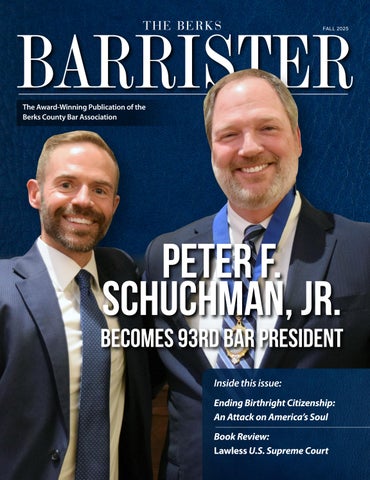
Peter F. Schuchman, Jr. becomes 93rd Bar President Inside this issue: Ending Birthright Citizenship: An Attack on America’s Soul Book Review: Lawless U.S. Supreme Court
YOUR LEGAL PRACTICE DESERVES A MARKETING PARTNER YOU CAN TRUST.
At MADJ Marketing, we understand the unique challenges law firms face—balancing client advocacy with building a trusted brand. Whether you’re a boutique practice or a growing firm, our tailored marketing strategies can help you iMADJine the possibilities. PROVEN RESULTS FOR LAW FIRMS LIKE YOURS Modern Website Design & SEO
01
Stand out in searches, attract more inquiries, and communicate your expertise effectively.
02
Reputation Management
03
Targeted Digital Advertising
04
Enhance your firm’s credibility and build trust within your community.
Highlight your specialty areas to the right clients.
Brand Identity Development
Establish a cohesive and professional image that reflects your firm’s values and expertise.
SCAN HERE TO LEARN MORE
READY TO GROW YOUR PRACTICE? LET’S START THE CONVERSATION TODAY. 484-336-4341
marketing
success@madjmarketing.com madjmarketing.com
BOARD OF DIRECTORS
Content for Fall 2025
DANIEL C. NEVINS, President PETER F. SCHUCHMAN, JR., President-Elect ANDREW F. FICK, Vice President JACQUELIN M. HAMER, Secretary AMY J. LITVINOV, Treasurer ALEXA A. ANTANAVAGE, Director
Features: 7
DANIEL CORTES, Director SARA R. HAINES CLIPP, Director JAY M. KURTZ, Director BETH M. KOHL, Director JESSE C. LEISAWITZ, Director KAREN H. COOK, Immediate Past-President MATTHEW FESSLER, President YLS
BAR ASSOCIATION STAFF KORI A. WALTER, Executive Director ROSE M. JOHNSON, Law Journal Secretary/Office Manager LUCY BRITO, Community Service Manager VALERIE KRAMER, Law Journal Editor JACOB KRAMER, Law Journal Assistant Editor PAMELA VANFOSSEN, Barrister Editor
Please submit materials or comments to: Berks County Bar Association 544 Court Street, P.O. Box 1058 Reading, PA 19603-1058 Phone: 610.375.4591 Fax: 610.373.0256 Email: info@berksbar.org www.berksbar.org
Thank You
Our thanks are extended to the numerous people who have contributed to The Berks Barrister. Your time, energy and efforts are sincerely appreciated.
Spotlight on Importance of Jury Service
10 Eastern District of PA Admissions Ceremony 12 An Attack on the Soul of America 16 From Outsider to Bar President: Peter F. Schuchman, Jr. Recounts His Path to becoming the 93rd President of the Berks County Bar Association 18 Meet Our 50-Year Members 20 2025 Annual Meeting 24 2025 Golf Competition and Picnic 28 Paddles and a Few Pointers at Pickleball Event 33 Exploring Blue Marsh Trail 34 Ortega v. Henríquez: Language Access, Judicial Responsibility, and the Right to Be Heard 36 Hispanic Heritage Month Celebration
On the cover:
37 Citizenship Day Pro Bono Clinic
Outgoing BCBA President Daniel C. Nevins & Incoming BCBA President Peter F. Schuchman, Jr.
38 Serving Our Community Through Naturalization
Departments: 4
Opening Statement
30 Book Review w w w. H o f f p u b s . co m Hoffmann Publishing Group 2669 Shillington Road, #438 Reading, PA 19608
For Advertising Information & Opportunities Contact: Ad Sales 610-685-0914 x715 Sales@hoffmannpublishing.com
w w w.BERKSBAR.org
Opening Statement
Passing the Baton: Daniel C. Nevins, Esquire 2025 Berks County Bar Association President
Reflections on a Year of Service I
would like to begin by offering my heartfelt thanks for the privilege of representing you this past year as the 92nd President of the Berks County Bar Association. It has been a tremendous honor to serve, and a highlight of my professional career.
When my wife Jen and I moved to Berks County in 2005 after graduating from the Dickinson School of Law, we knew few people and had minimal connections to the area. Jen began her career at Stevens & Lee, and I joined the Berks County Public Defender’s Office soon after. Two decades later, Berks County and our Bar Association have truly become home. The colleagues we once knew only as peers have become lifelong friends, and the sense of community within this organization has enriched both our professional and personal lives. I am deeply grateful to be part of such a collegial and dedicated association. Many of you know that I am also a runner—a passion that mirrors the practice of law in meaningful ways. Running in the quiet pre-dawn hours can be a solitary pursuit, not unlike poring through discovery or crafting a motion late at night. In both endeavors, progress comes through steady discipline and daily commitment. Yet while running often rewards the individual, Bar leadership is more like a relay race. When you receive the gavel, you are handed a baton—a symbol of trust and continuity—and your task is to carry it forward with purpose, ensuring that the team continues to thrive. I was fortunate to follow in the footsteps of dedicated leaders such as Gabby Raful and Karen Cook, who each ran their leg of the race with distinction. This year, we carried forward themes from their presidencies—jury diversity and civics education— while building upon one of my own priorities: attorney wellness. There is a direct connection between personal well-being and professional excellence. When we care for our physical and mental health, we serve our clients, 4 | Berks Barrister
w w w.BERKSBAR.org
C H O O S E
At Tompkins, our business
B U S I N E S S
A C C E L E R AT E D
banking team helps you put
W I T H
TOMPKINS CASH MANAGEMENT SOLUTIONS colleagues and communities more effectively. With that in mind, our Wellness Committee has continued to offer an impressive range of programs this year, including: •
Wellness Committee Book Club meetings.
•
Family-friendly sporting events at the Reading Royals and Reading Phillies.
•
Regular lunchtime Wellness Walks, along with a special walk through the Centre Park Historic District.
•
A Blue Marsh Lake hike organized by the Minority Bar Section.
•
A group pickleball outing in West Reading.
•
Our annual “Pets in the Park” event at Jim Dietrich Park.
Each of these gatherings promotes balance, camaraderie and connection—
together just the right suite of cash management solutions to turn “business as usual” into “business amazing”—and to help your business thrive.
reminding us that wellness and community go hand in hand. Our Bar also continued its steadfast commitment to pro bono service, a cornerstone of our profession. As lawyers, we are entrusted with a unique privilege—the power to use the law to make a tangible difference in people’s lives. Every time an attorney steps forward to help someone who cannot afford representation, we bring to life our profession’s highest ideals. Through service, we transform the promise of “equal justice under law” from aspiration into reality. This year, our members gave generously of their time and expertise through our Citizenship Clinic, LGBTQ+ Name Change Clinic and annual Wills for Heroes program. We also continued our participation in the Eviction Prevention Project before MDJ Tonya Butler, advocating for tenants facing housing insecurity.
Scan the code for more information
I am especially proud of a new initiative launched this year—the Driver’s License Restoration Clinic. In August, more than a dozen attorneys volunteered to assist approximately 25 individuals seeking to resolve licensing issues or suspensions. This program helped people return to work, support their families, and drive safely and legally. It is my hope that this clinic will become an annual tradition. Innovation has extended beyond service as well. To attract new legal talent to Berks County, we introduced a Law Student membership category, welcoming interns and summer associates from local firms, MidPenn Legal Services, and the District Attorney’s Office. Our July “Coffee & Conversations” event at the Bar Building connected these students with Bar leaders, past presidents and mentors. We hope that early engagement with our Association becomes a lasting relationship—and a compelling reason to build a career here in Berks County. Continued on next page FALL 2025 | 5
w w w.BERKSBAR.org
Passing the Baton: Reflections on a Year of Service Continued from page 5
Meanwhile, we have maintained the traditions that bring our members together: our annual Bench Bar Conference, Golf Tournament and Picnic, Annual Meeting, Holiday Party, three Naturalization Ceremonies and our annual Memorial Service. Each event reflects the vitality of our Bar and the dedication of those who make it possible. That dedication begins with our Officers and Board of Directors. To those who serve, thank you for the time, preparation and thoughtfulness you bring to every meeting. Your work behind the scenes ensures that our Association continues to function with purpose, integrity and care. I am also profoundly grateful for our extraordinary staff— Lucy, Rose, Claudia, and now Morgan—who keep the heartbeat of this organization steady day after day. Their professionalism, efficiency and warmth are the quiet forces behind every success we celebrate. And to our Executive Director, Kori Walter: thank you for your leadership. Kori embodies the essence of a servant leader— steady, adaptable, detail-oriented and always willing to let others shine. His guidance, financial stewardship and management have
been vital to the success of our programs and the health of our Association. As my term concludes, I am honored to pass the baton to our incoming President, Peter F. Schuchman, Jr. Pete brings wisdom, energy and heart to this role, and I have complete confidence in his leadership. At this year’s Annual Meeting on October 30, we learned that Pete will focus his Presidency on the theme of Mentorship. As a mid-career professional, I am looking forward to both giving and receiving mentorship from others and am excited by the specific initiatives Pete plans. I have no doubt Pete will shine as our 93rd Bar President and our Association will benefit from his service. Leadership in this Bar is indeed a relay—a long and meaningful one that stretches across generations. Each of us carries the baton for a moment in time, building on the work of those before us and preparing the way for those who will follow. My time holding that baton has been one of deep gratitude and pride. Together, we continue the race—advancing the rule of law, supporting one another, and serving our community.
Strategic appeals. Persuasive advocacy. Proven results.
Thad Gelsinger Partner
Paul Troisi Partner
Our appellate practitioners offer the following services: » Serving as lead counsel during appellate process » Evaluation of case for appeal » Drafting or consulting on dispositive motions at trial level » Emergency stays of judgments » Post-judgment proceedings » Interlocutory appeals » Oral argument presentation » Amicus curiae representation
WWW.BARLEY.COM
2755 Century Blvd., Wyomissing, PA 19610 READING • LANCASTER • YORK • HARRISBURG LEBANON • HANOVER • GETTYSBURG • MALVERN SCHUYLKILL HAVEN • HUNT VALLEY, MD • COLUMBIA, MD
6 | Berks Barrister
w w w.BERKSBAR.org
Spotlight on importance of
jury service
The Berks County Bar Association offered a special screening of the documentary “Judging Juries” on September 10 at the Boscov Theater at the Goggle Works in Reading. The documentary discusses the reality that juries often do not reflect the demographics of our community. This special event organized by Jury Diversity Committee Chair Gabby Raful aimed to raise public awareness about the importance of jury service and why having all members of our community serve on juries ensures the promise of equal justice for all. Following the 24-minute film, Ms. Raful moderated a panel discussion about strategies that could help yield more diverse juries in local and federal courts. That panel discussion featured Judges Juan Sanchez and Jeffrey Schmehl for the U.S. District Court for the Eastern Continued on next page
The distinguished panel discussing strategies for increasing diversity in jury pools included, from left: The Hon. Juan Sanchez, U.S. District Court, Eastern District of Pennsylvania; Jury Diversity Committee Chair Gabby Raful; the Hon. J. Benjamin Nevius, Berks County Court of Common Pleas; the Hon. Jeffrey L. Schmehl, U.S. District Court, Eastern District of Pennsylvania; Berks County District Attorney John T. Adams; and Berks County Chief Public Defender Keith McConnell.
The Hon. J. Benjamin Nevius of the Berks County Court of Common Pleas and the Hon. Jeffrey L. Schmehl, U.S. District Court, Eastern District of Pennsylvania.
FALL 2025 | 7
w w w.BERKSBAR.org
Spotlight on Importance of Jury Service Continued from page 7
District of Pennsylvania; Judge Ben Nevius from the Berks County Court of Common Pleas; District Attorney John T. Adams; and Chief Public Defender Keith McConnell. More than 70 people attended the event, including Berks County Commissioners Christian Leinbach, Michael Rivera and Dante Santoni, Jr., several row officers and court administrators, and other community leaders. The event was thought-provoking and continued to raise awareness about the importance of jury service and the need to engage the whole community. Ms. Raful has been a tireless advocate for juror diversity. Her work coordinating the “Judging Juries” event earned her a Presidential Award of Merit, which was presented to her at the Annual Meeting on October 30.
The Hon. Juan Sanchez, U.S District Court, Eastern District of Pennsylvania, details how the Eastern District is working with Pennsylvanians for Modern Courts, The Committee of Seventy and bar associations to ensure a cross-section of the community shows up for jury service.
Berks County District Attorney John T. Adams discuses how having all members from the community serve on a jury affects criminal cases. 8 | Berks Barrister
w w w.BERKSBAR.org
David R. Beane, Esquire
Berks Bar Jury Diversity Chair Gabby Raful explains how the bar association distributes flyers encouraging jury service at public events and with monthly ads in Paolo magazine, which is published in English and Spanish in Berks County.
Swanona At Historic Centre Park 606 North Fifth Street, Suite 7 P.O. Box 1339 Reading, Pennsylvania 19603 Tel: 610.378.5555 Fax: 610.378.5551 drb@beanellc.com www.beanellc.com Helping the Regulated Community Manage Environmental Risk and Solve Environmental Problems
Happy Holidays! ere’s no time like the PRESENT to ank my Customers, Family & Friends for the Support you gave me throughout the Year. Lisa Tiger is that rare combination of passion for her business, sales skill, marketing professional and unwavering care for her clients.
.e ultimate professional, Lisa is the #1 Top Producing Century 21 Agent in the State of PA, and is consistently ranked in the Top 100 in the US., but proudest of her ranking in Berks County. Lisa cares about the communities she serves, and it shows in her commitment to others. In these challenging times, Lisa never waivers in her objective to help her clients reach their objective. It is always about YOU.
Pamphlets and television advertising are part of the Eastern District’s campaign to motivate people to serve on a jury. The Hon. Jeffrey L. Schmehl added that more employers should encourage workers to serve on a jury when receiving a summons for jury service.
When you are ready to buy or sell, Team up with the Tiger!
FALL 2025 | 9
w w w.BERKSBAR.org
Eastern District of PA Admissions Ceremony Seven Berks County Bar Association members were admitted to the U.S. District Court for the Eastern District of Pennsylvania during a ceremony on August 26. The Hon. Jeffrey L. Schmehl presided over the swearing-in for these members in his courtroom in the Gateway Building in Reading. Taking the oath of admission were Courteney A. Hahn; Matthrew R. Fessler; Collin J. MacFarlane; Joseph R. Speece, III; Elisabeth R. Timura; Misty Toothman; and Thomas Youngman. Congratulations to the new admittees and their families, who enjoyed a small reception following the ceremony.
Julie Marburger, left, and new admittee Courteney Hahn of Berman Voss. George M. Lutz, left, and new admittee Matthew Fessler of Hartman, Valeriano, Magovern & Lutz.
Taking the oath of admission for the Eastern District of PA. 10 | Berks Barrister
w w w.BERKSBAR.org
The Hon. Jeffrey L. Schmehl congratulates attorney Thomas Youngman of SmithBuskowski.
Judge Schmehl gets a high five from Thomas Youngman’s son following the ceremony.
Heidi Masano of Masano Bradley with new admittee Joseph R. Speece, III. Masano moved for Speece’s admission during the ceremony.
James M. Smith of SmithBukowski introduces his associate attorney, Thomas R. Youngman.
Kourtney E. Bernecker of SmithBukowski, left, and new admittee Misty Toothman of Twin Valley Law. Bernecker was the sponsor for Toothman’s admission.
Joan E. London and new admittee Colin Macfarlane of Kozloff Stoudt with Judge Schmehl. FALL 2025 | 11
w w w.BERKSBAR.org
An Attack on the
Soul of America
12 | Berks Barrister
w w w.BERKSBAR.org
Why the Attempt to Strip Birthright Citizenship from the 14th Amendment by The Trump Administration is Illegal & Immoral By Raymond Edward Baker, Esquire
O
n January 20, 2025, President Donald J. Trump signed an executive order stating the executive’s intent to eliminate birthright citizenship as a right guaranteed under the 14th Amendment.1 He and his team cite this as an action to reduce illegal immigration to America, a key policy he campaigned on in his victory over Kamala Harris in 2024. Ending birthright citizenship has been one of the chief goals of the far right of the 21st century. But what is birthright citizenship? Is it something Trump can cancel? What does it say about our country if we allow it? Birthright citizenship, also known as “Juis Solis,” is the idea that anyone born within the borders of a country is instilled at birth with the rights & privileges of citizenship for that nation. This contrasts with bloodline citizenship, or “Juis Sanguinis,” which grants citizenship only to the children of citizens. America, since its germination, has followed a hybrid of both ideas, guaranteed nearly regardless of your parent’s status whether your family came over on the Mayflower or an undocumented immigrant who arrived yesterday, so long as you were born on American soil, you are an American citizen. While birthright citizenship was guaranteed in practice prior to the passage of the 14th Amendment to the Constitution, it was reaffirmed and solidified by it, as it states: All persons born or naturalized in the United States, and subject to the jurisdiction thereof, are citizens of the United States and of the State wherein they reside. No State shall make or enforce any law which shall abridge the privileges or immunities of citizens of the United States; nor shall any State deprive any person of life, liberty, or property, without due process of law; nor deny to any person within its jurisdiction the equal protection of the laws.2 Through Executive Order, the Trump administration seeks to claim that illegal immigrants are not “subject to the jurisdiction thereof ” and therefore their children are not entitled to citizenship on that basis, an expansion of the limited exception provided by
the jurisdiction clause of the 14th Amendment. This argument lacks merit. It’s long been interpreted that the people whom the government “lacks jurisdiction” over are diplomats (and therefore their children) and American Indians who are given a degree of self-governance as “semi-autonomous nations” but have since been granted citizenship. Not being “subject to the jurisdiction thereof ” was discussed by the Supreme Court prior to the passing of the 14th Amendment in Inglis v. Trustees of Sailor’s Snug Harbor: So the children of an ambassador are held to be subjects of the prince whom he represents, although born under the actual protection and in the dominions of a foreign prince. Birth within the dominions of a sovereign is not always sufficient to create citizenship, if the party at the time does not derive protection from its sovereign.3 Illegal immigrants in the United States are not permitted any of the protections of their homeland. We grant them no diplomatic immunity. They do not derive a wage from their origin nation’s coffers to be present here and we tax their wages the same as we do all residents of the United States. All of this was considered and solidified in Wong Kim Ark v. United States, where Wong Kim Ark, born on American soil to Chinese nationals, was fighting for return to the United States after departing to visit China and was denied re-entry under the Chinese Exclusion Acts.4 Mr. Justice Gray writing for the six Justice majority made it clear, “whether a child born in the United States, of parents of Chinese descent, who, at the time of his birth, are subjects of the emperor of China…and are not employed in any diplomatic or official capacity… becomes at the time of his birth a citizen of the United States…this court is of opinion that the question must be answered in the affirmative.”5 Continued on next page
FALL 2025 | 13
w w w.BERKSBAR.org
An Attack on the Soul of America
Stewart abStract of berkS county Insuring Your Investment, Securing Your DreamTM • Full Title Searches • Present Owner/Lien Searches • Title Insurance • Recording Services
• Settlement, Escrow & Disbursment Services • Point of Sale for all Real Estate Transactions
610-372-8201• www.stewartabstract.com info@stewartabstract.com 1100 Berkshire Blvd, Suite 100 Wyomissing, PA 19610 “Proudly serving Berks and its surrounding counties since 1988.”
Voted Best Real Estate Agent! Eric P. & Eric J. Miller
1
Our laws are clear: anyone born within the United States, outside of limited exceptions listed in the 14th Amendment, are citizens, as is their unalienable right. For over a century, Wong Kim Ark has stood as the stare decisis that confirms what was amended and ratified into the Constitution. Every time the Court has reviewed the issue since Ark, they have returned with the same accurate review; the Fourteenth Amendment of the Constitution guarantees that every person "born in the United States, and subject to the jurisdiction thereof, becomes at once a citizen of the United States, and needs no naturalization.”6 No Court has overturned Ark and furthermore the Trump administration failed to address it in their executive order, as they lack any legal standing or legal theory to overturn Ark, Inglis, or their progeny. Legality notwithstanding, it’s a moral imperative to push back on such a change I can only describe as un-American. America, has been, is now, and must always be a nation of immigrants new and old. America, since its germination in the 16th century, has been the refuge of the slave, the scoundrel and the unwanted; and that idea has spent nearly 500 years continuing to grow. The times we have failed to push back resulted in the Chinese Exclusion Acts and the turning away of the S.S. St. Louis. These are some of America’s greatest shames and scars that we must carry and remember forever. Nearly every person reading this has an immigrant story, whether you are a blue blood Boston Brahmin whose family arrived on the Mayflower, or a Dominican immigrant who arrived yesterday, our stories sing the same song at different tunes. They have built unique groups and cultures home only in America from African Americans, to the Melungeon, to The Pennsylvania Dutch. This action leads me to think of my family’s story: Irish ancestors fleeing the British yoke, Annie Knudsen running from Norway and a forced marriage, to The Graybills, who like so many, left warring German states for Pennsylvania, to help build the beautiful tapestry that would flourish into the Pennsylvania Dutch. But I think often of my ancestors most recent to our shores in the Koshebas.
#
O: 610-670-2770 • C: 484-269-2394 EMiller@GoBerksCounty.com BerksCountyUpscaleHomes.com
14 | Berks Barrister
Continued from page 13
The Koshebas came to America from occupied Poland. They were a people without a home for centuries, abused by Russians, Austrians and Germans for their mere existence. They came and landed in Pennsylvania in the early 1900s and settled in Pittsburgh. Like many immigrants, Poles were not wanted. The “Real” Americans were already here, and they thought the Poles
w w w.BERKSBAR.org
(like their Irish, Italian and other fellow immigrants) were dirty, criminals, loyal to the Pope and should go back to where they came from. Constantine Kosheba, and his American born sons, including my great-grandfather Chester ignored them, and walked into the steel mills of Pittsburgh, helping to build the America, that was so hellbent on trying to reject them, into greatness. Despite all of this, my great-grandfather Chester Kosheba, died at 97, a proud American, never knowing the land of Poland that racists, bigots and fools were so hellbent on him “going back” to. He didn’t need to “go back” anywhere. He knew his home; he had always lived in it. Trump and his allies will tell you we must do this for “safety” or “economic prosperity.” They are less American than any immigrant, legal or not, who comes here; they are soulless, heartless and cruel, but most importantly, they are wrong. We must not reject what made America great, what brought us all here. We must not kill the soul of America but rather continue to be the land of immigrants and their children forever and always. In New York Harbor sits The Statue of Liberty, a centuries old beacon for those immigrants to America, those poor, sick and wretched huddled masses yearning to breathe free. She, like the 14th Amendment and birthright citizenship, contains no expiration date, and for the sake of what it means to be an American, we cannot allow Donald Trump and his lackeys to install one. Mr. Baker is a Berks County Assistant District Attorney. The opinions expressed in this article are not the policy, practice or opinion of the Berks County District Attorney’s Office, they are the sole beliefs, opinions, and arguments of its author. References “Protecting The Meaning And Value Of American Citizenship.” The White House, 21 Jan. 2025 1
2
USCS Const. Amend. 14
3
Inglis v. Trustees of Sailor's Snug Harbor, 28 U.S. 99, 155 (1830)
4
United States v. Wong Kim Ark, 169 U.S. 649 (1898)
5
Wong Kim Ark at 705.
6
Miller v. Albright 523 U.S. 420 (1998); Plyler v. Doe 457 U.S. 202 (1982)
ATTORNEY DISCIPLINARY AND ETHICS MATTERS STATEWIDE PENNSYLVANIA MATTERS NO CHARGE FOR INITIAL CONSULTATION
Representation, consultation and expert testimony in disciplinary matters and matters involving ethical issues, bar admissions and the Rules of Professional Conduct
James C. Schwartzman, Esq.
• Judge, Court of Judicial Discipline • Former Chairman, Judicial Conduct Board of Pennsylvania • Former Chairman, Disciplinary Board of the Supreme Court of Pennsylvania • Former Chairman, Continuing Legal Education Board of the Supreme Court of Pennsylvania • Former Chairman, Supreme Court of Pennsylvania Interest on Lawyers Trust Account Board • Former Federal Prosecutor • Selected by his peers as one of the top 100 Super Lawyers in PA and the top 100 Super Lawyers in Philadelphia • Named by his peers as Best Lawyers in America 2022 and 2015 Philadelphia “Lawyer of the Year” Ethics and Professional Responsibility Law and Legal Malpractice Law 1500 Market Street, East Tower, Suite 1800 • Philadelphia, PA 19102 (215) 751-2863 FALL 2025 | 15
w w w.BERKSBAR.org
From Outsider to Bar President Peter F. Schuchman, Jr. Recounts His Path to Becoming the 93rd President of the Berks County Bar Association By Kori Walter (Editor’s Note: The following article was written based on Mr. Schuchman’s remarks at the Berks County Bar Association Annual Meeting on October 30 and includes excerpts from his speech).
P
eter F. Schuchman, Jr. arrived in Berks County with a new bride and a law degree from Dickinson School of Law.
Peter hailed from Binghamton, New York. He married Mary, a Connecticut native, prior to his third year of law school. A job offer from the firm Kozloff, Diener, Payne, and Fegley brought Peter and Mary to Berks in 1993. Schuchman was optimistic about beginning a legal career in a place where he had no friends or acquaintances.
Peter F. Schuchman, Jr. and the attorney he considers his “rabbi,” Fred Hatt. Schuchman credits Hatt with “seeing a spark in him” when Schuchman first arrived in Berks County in the early 1990s.
“I was a reasonably good student but the job prospects in our respective hometowns back in the early ‘90s were thin,” Schuchman recalled. “We figured we’d be willing to try anywhere for me to find work, and we’d figure the rest out later. As long as we were together, everything would be OK. I always wanted to live someplace where people pronounce Schuchman right on the first try. So, here we are in Berks County.” Though his last name seemed a perfect fit in a county with a rich Pennsylvania German heritage, Schuchman realized he was an outsider. “A lot of you know that this isn’t the easiest community to break in to,” Schuchman recalled. “I used to shop at the Redner’s in Kenhorst and say hello to complete strangers just to make them uncomfortable.” Colleagues and lawyers he met at the Berks County Bar Association were his social network at the start of his career. “This bar association became our first home here,” Schuchman said. “Our first friends were lawyers, and their spouses. This Association has been a place of welcome. Of sharing. Of learning. And sometimes, just plain old fun.”
David Kozloff is among the mentors who Peter F. Schuchman, Jr. says made him the lawyer he is today. 16 | Berks Barrister
Three decades later, Schuchman is the 93rd President of that bar association.
w w w.BERKSBAR.org
Schuchman is a shareholder and director in the Spring Township firm, Kozloff Stoudt. He is a plaintiff ’s lawyer, focusing on wrongful death and significant personal injury cases as well as subrogated insurers. In addition, he serves as solicitor for Reading Area Community College. Schuchman credited several mentors for helping him adjust to Berks and become a successful lawyer. Among those he thanked after receiving the presidential gavel at the bar association Annual Meeting on October 30 were Fred Mogel, Don Smith, Terry Weiler, Geoff Stoudt and the late Lee Sapira. “Candidly, I wouldn’t be at this stage in my career, in this role in the bar association, and where I stand in our community without the tremendous mentors I have learned from,” Schuchman said. Schuchman added that several attorneys at his firm always made time for mentoring him, including David Kozloff and Jestyn Payne. Schuchman praised Payne for being an example of determination, diligence and decency Schuchman said he was proud to carry Kozloff ’s “battle bag” into court earlier in his career and cherished the time spent debating points of law–even prevailing sometimes. He added that Kozloff ’s encouragement and trust helped shape him into the lawyer that he is today. Fred Hatt was another major influence. Hatt was an attorney at Kozloff, Diener, Payne & Fegley when the firm hired Schuchman. Schuchman explained that Hatt was his rabbi—a term that Schuchman learned from his father, who was a third-generation police officer in upstate New York.
Peter and Mary Schuchman married prior to Peter’s third year at Dickinson School of Law. Peter jokes that Mary “earned a piece of my law degree,” adding that she is the source of and reason for everything good in his life. “It’s an honorific,” Schuchman said of the term. “It identifies an older cop who sees a spark in you, takes an interest in you and helps advance your career.” He said Hatt extended himself in friendship and was always generous with wise and helpful advice. “I’m glad and grateful that our careers and our clients and our bar association activities continued to intersect and complement one another even after Fred crushed me all those years ago when he moved on from Kozloff, Diener Payne and Fegley,” Schuchman said. Mentorship will be a focus for Schuchman during the upcoming year. Networking events where young lawyers can make connections with older lawyers and revitalizing a program where young lawyers can seek advice confidentially from veteran attorneys are among the initiatives on Schuchman’s agenda. “I hope that we all will honor our mentors by living the lessons they have taught us, passing their wisdom on to those who follow us, and hopefully finding that by this effort, we strengthen our bar association, and our profession,” Schuchman said. “I can never give back to this Bar Association all that I have taken from it. But I promise to all of you, for the coming year and all the years that will follow, I will keep trying.”
Current President Dan Nevins passes the presidential gavel to Peter F. Schuchman, Jr. Schuchman will be the 93rd President of the Berks County Bar Association.
Mr. Walter is the Berks County Bar Association Executive Director.
FALL 2025 | 17
w w w.BERKSBAR.org
Meet Our 50-Year Members The Berks County Bar Association, during the Annual Meeting on October 30, honored two members who have been members of the bar for 50 years. Congratulations to Daniel B. Huyett and Kenneth C. Myers on reaching this memorable milestone.
lawyers with offices up and down the East Coast. He co-chaired its litigation group for many years and served in several leadership positions. In 2007, Dan was inducted as a Fellow of the American College of Trial Lawyers, an invitation-only organization composed of the best trial lawyers in the United States and Canada.
Daniel B. Huyett Dan is an attorney with Stevens & Lee, where he specializes in complex corporate and business litigation. After graduating from the Dickinson School of Law in 1975, Dan started his career with the Philadelphia firm Liebert, Short, Fitzpatrick & Lavin. In 1979, he joined the U.S. Attorney’s Office in Philadelphia as a federal prosecutor and was promoted to the Special Prosecution Division, specializing in complex criminal fraud and political corruption cases. In August 1982, Dan joined Stevens & Lee, then a firm of about 25 lawyers. Today, Stevens & Lee has grown to over 200 18 | Berks Barrister
In 2011, Dan served as president of the Berks County Bar Association and is a former board member of the Law Foundation of Berks County Bar. He served as a delegate to the Pennsylvania Bar Association’s House of Delegates and has served on a number of the PBA’s committees and task forces. Following in his parents’ footsteps, Dan is a devoted community volunteer, having served on many nonprofit boards. He and his wife, Ellen, co-chaired the United Way of Berks County’s annual campaign in 2014, and in 2021 they were awarded the Doran Award, United Way’s most prestigious award for commitment to the United Way and our community. For many years, Dan served on the board of the Caron Treatment Centers, and in 2003 he chaired the board. In 2012, Dan and Ellen were recipients of the Richard J. Caron Award of Excellence. Recently, Dan was elected Chair Emeritus. Presently, Dan serves on the Albright College Board of Trustees.
w w w.BERKSBAR.org
Bar Association President Daniel C. Nevins congratulates Kenneth C. Myers (left) and Daniel B. Huyett (right) for their five decades of service to the bar. After mustering out of military service Ken married his wife, Beverly, in April 1972 and began his studies at the Villanova University School of Law. He earned his J.D. in May 1975 and was admitted to the Bar of the Commonwealth of Pennsylvania in November 1975. Following his admission to the Bar he shared office space with his law school Mentor (D. Scott Kelley) in Bryn Mawr, Pennsylvania before moving to Lewistown, Pennsylvania (Mifflin County) in June 1976. During his time in Lewistown Ken served as an Assistant District Attorney for Juniata County, and served the Mifflin County School Board, several Townships and a Sewer Authority and was active in the formation of a church sponsored elementary school.
Kenneth C. Myers Ken is a sole practitioner who has maintained his current office at 534 Elm Street, since August 2004. Ken was born in Philadelphia and is a 1966 graduate of the John Bertrum High School. He then matriculated at The Pennsylvania State University, graduating with a BA in Political Science in June 1970. Ken then served in the United States Army from. September 21, 1970, to March 27, 1972. Following basic training, AEI, and paratroop training he was assigned to HHC 307th Engineer, BN, 82 Airborne Division at Ft. Bragg, North Carolina.
In October 1981 Ken relocated to Reading and worked in the Office of the Honorable Calvin Lieberman. After Cal was elected to the Bench he continued to work with the Honorable Stephen B. Lieberman before joining forces with the late Martin W. Binder and Frederick G. McGavin with whom he worked until opening his office. During his time in Berks County Ken has served as an Assistant Solicitor for the City of Reading Zoning Board and Parking Authority. He has also served as a Divorce Master in the period from 2004 to 2010. Ken maintains a general practice with a large concentration in all spheres of family law. Ken was involved in the creation of Mercy Ministry (a crisis pregnancy center) and he and Bev are active in many aspects of ministry in their church, Grace Bible Fellowship. Ken and Bev celebrated 53 years of marriage and have two married daughters (Laurel Beth Gibson and Amy Rebekah Bowser) and five grandchildren.
FALL 2025 | 19
w w w.BERKSBAR.org
2025 Annual Meeting Members gathered for the Annual Membership Meeting on October 30, 2025, to reflect on how the bar association has served the community and our members throughout the past year. Peter F. Schuchman, Jr. received the presidential gavel from a long line of Past Presidents. His term as the 93rd President of the Berks County Bar Association begins January 1, 2026. Current President Daniel C. Nevins presented Presidential Awards of Merit to the Hon. Justin D. Bodor, Angelica Matias, Gabby Raful and Joseph R. Speece, III for their exceptional work on projects that benefited the community and demonstrated exemplary dedication to our members. Members also approved the following nominations to the Board of Directors: Andrew F. Fick, President-Elect; Lauren M. Marks, Vice President; Joseph R. Speece, III, Director; and Pamela VanFossen, Director. Tessa Bewley, a first-year law student at Dickinson Penn State Law, was recognized as the recipient of the Seidel Scholarship. Our bar association also welcomed Pennsylvania Bar Association President Kristen B. Hamilton and PBA Deputy Executive Director and General Counsel William R. Christman, III.
Bar Association Treasurer Amy Litvinov, left, with incoming Vice President Lauren Marks.
Pennsylvania Bar Association President Kristen B. Hamilton with Berks Bar President Daniel C. Nevins and Board Member Jay Kurtz.
Brian J. Boland, Julie Pandich, Seidel Scholarship recipient Tessa Bewley, and Alicia Muir.
The Hon. Scott E. Lash with Joseph R. Speece, III and Lisa Sicilliano.
20 | Berks Barrister
w w w.BERKSBAR.org
Enjoying dinner are, from left, Ken Millman; Jesse Pleet; Bar Association Board Member Jesse Leisawitz; Board member Alexa Antanavage; Russell Farbiarz; and the Hon. A. Joseph Antanavage.
The Hon. Justin D. Bodor receives a Presidential Award of Merit for his outstanding work coordinating a pickleball event in West Reading in August.
Kevin A. Moore, left, and John Muir.
Angelica Matias receives a Presidential Award of Merit for coordinating the “Future Legal Leaders” program at Wilson High School. Berks Bar members spoke about various legal issues and practice areas during the seven-week program from September to early November.
Berks Bar President Dan Nevins (right) congratulates incoming Bar President Peter F. Schuchman, Jr. (left). continued on next page FALL 2025 | 21
w w w.BERKSBAR.org
2025 Annual Meeting Continued from page 21
Past President James M. Smith during the ceremonial passing of the presidential gavel. Smith was Bar Association President in 2022.
Receiving the Presidential Award of Merit for coordinating a jury service awareness event in September is Gabby Raful. The event at the Goggle Works featured a special screening of the documentary “Judging Juries” followed by a panel discussion about strategies for encouraging all members of our community to show up for jury service.
Earning a Presidential Award of Merit is Joseph R. Speece, III for leading a lunchtime walking tour of the Centre Park Historic District in Reading. The May event took members past the mansions built by Reading’s industrial barons and other landmarks in this unique neighborhood.
Joseph R. Speece, III with Immediate Past President Karen H. Cook.
Joseph R. Speece, III with Past President Jill Koestel and current President Daniel C. Nevins.
Joseph R. Speece, III with Alisa Hobart and Jesse Leisawitz.
22 | Berks Barrister
w w w.BERKSBAR.org
Refer your matters with confidence. When at their most vulnerable, your clients need a personal injury lawyer they can trust. With more than 40 years of experience, Dan will work to make sure your clients receive the help they need. Katie Wentzel, Doug Wortman, and the Hon. Jeffrey K. Sprecher.
3 Auto Accidents Daniel E.P. Bausher, Esq. 3 Construction Accidents 3 Premise Accidents 3 Insurance Disputes 3 Product Liability 3 Wrongful Death
Free Initial Consultation • No Recovery, No Fee 610.478.2002 l www.personalinjurypros.com
Law Foundation Trustee Valerie West with Jeffrey D. Bukowski.
Jacob Kramer, incoming Young Lawyers Section President, with current Young Lawyers Section President Matthew Fessler. FALL 2025 | 23
w w w.BERKSBAR.org
2025 Golf Competition and Picnic
The Berks County Bar Association held its annual Golf Competition and Picnic on September 17, at the Moselem Springs Golf Club. Members teed off at noon and showcased their golf skills on the challenging course. After the competition, members joined the golfers for an evening on the patio where they enjoyed a picnic buffet and relaxing evening of conversation.
Wayne Bridgham admires his tee shot.
Teammates Eric Fabrizio, Sean O’Brien, Ken Millman, and Michael Dautrich. Michael Dautrich tees off.
24 | Berks Barrister
w w w.BERKSBAR.org
Kozloff Stoudt foursome of Jeff Elliott, Bill Blumer, Colin Macfarlane, and Andy George.
Nate Greisbaum checks out his tee shot.
Barley Snyder golfers Allen Shoillenberger, Chuck Phillips, and Matt Mayer.
Sal Folino, Matt Lasewicz, and Kelsey Frankowski relax following their round of golf.
continued on next page
FALL 2025 | 25
w w w.BERKSBAR.org
2025 Golf Competition and Picnic Continued from page 25
Aaron Bell, Bar President Dan Nevins, Charles Dutko, and Corey Chwieko prove that prosecutors and the criminal defense bar can join forces on the golf course.
Teammates Matt Kopecki, Ken Kelecic, Wayne Bridgham, and Nate Griesbaum.
Phil Edwards follows through on his approach shot.
26 | Berks Barrister
w w w.BERKSBAR.org
Pamela VanFossen, Bar Association President Dan Nevins, and Sal Folino chat before the picnic buffet.
Bar Association President Dan Nevins catches up with Val Hykes before the golfers head out on the course.
Enjoying their round are Sue Fultz, Julie Marburger, Jordan Fegley, and Kelsey Frankowski.
Thomas Youngman plays his second shot from the thick cut.
FALL 2025 | 27
w w w.BERKSBAR.org
PADDLES AND A FEW POINTERS at Pickleball Event
Members had the chance to relax and learn a popular new sport on August 21, during our first pickleball event. The Hon. Justin D. Bodor, co-chair of the Wellness Committee, organized an evening of friendly competition at the West Reading Pickleball Courts for a dozen members. For many, it was their first time playing pickleball. To help the new players learn the rules and pick up a few tips on how to play, Judge Bodor arranged for now retired bar member and seasoned Pickleball player Brian Kulp to provide instruction throughout the evening. After all that serving and volleying, members socialized during a Happy Hour at Third & Spruce Drafthaus in West Reading. Bar President Daniel C. Nevins recognized Judge Bodor's work coordinating the event by awarding him a Presidential Award of Merit during the Annual Meeting on October 30.
The Hon. Patrick T. Barrett gets ready to begin another point with teammate Val Hykes.
The Hon. Jusin T. Bodor and teammate Val Hykes.
Participating in some friendly pickleball competition are front row (from left): Val Hykes, Jen Nevins, Bar Association President Dan Nevins, and Magisterial District Judge Eric Taylor. Back row (from left): The Hon. Justin D. Bodor; Brian Kulp; Keith Mooney; Jay Kurtz; The Hon. Patrick T. Barrett; Tim Bitting; Joan London; and Suzanne Palmer. 28 | Berks Barrister
w w w.BERKSBAR.org
Jay Kurtz lines up his serve.
West Reading MDJ Eric Taylor and teammate Joan London.
Keith Mooney scoops a low shot.
Teammates Suzanne Palmer and Tim Bitting.
Bar Association President Dan Nevins and Jen Nevins team up against Suzanne Palmer and Tim Bitting.
Brian Kulp smashes a volley across the net to Judge Bodor and Dan Nevins.
Brian Kulp offers a few helpful hints on pickleball play to Bar Association President Dan Nevins and Jen Nevins.
Suzanne Palmer follows through on her serve.
FALL 2025 | 29
w w w.BERKSBAR.org
Book Review LAWLESS By LEAH LITMAN Reviewed by Donald F. Smith, Jr., Esquire
L
eah Litman is singing my song about the six conservative justices on the current United States Supreme Court.
But where my lyrics emphasize their callousness, insensitivity, and insistence on looking to the 18th century to answer 21st century issues, her lyrics, instead, accuse them of lawlessness. They make for a powerful message, hitting the high notes! Accordingly, the University of Michigan constitutional law professor and co-host of the “Strict Scrutiny” podcast has titled her recent book, Lawless. The book’s subtitle accurately describes her examination: “How the Supreme Court Runs on Conservative Grievance, Fringe Theories, and Bad Vibes.” She focuses on the issues of abortion, gay rights, voting rights, campaign financing and the environment. The professor begins by tackling originalism, the method of interpretation employed by the six Republican justices (hereinafter “the Block”). It holds “that the Constitution means today what it meant to the drafters and ratifiers when the constitution was adopted.” By its application, as she rightfully claims, a group possesses rights today only if that group of people had those rights
30 | Berks Barrister
in the 1700s or 1800s. The Block in Dobbs v. Jackson Women’s Health Organization did away with the woman’s right to have an abortion “because women weren’t regarded as full and equal citizens who should have control over their lives and bodies in the 1700s and 1800s” and, as a result, “they weren’t entitled to have control over their lives and bodies 300 hundred years later.” Litman goes on to give examples of “the terror that Dobbs has unleashed just in the first few years since the decision.” For example, due to the ban, “an emergency room turned away a pregnant teenager with sepsis because her fetus had detectable cardiac activity—leaving her to die an excruciating death.” To be responsible for such an avoidable death because of a Court decision ignoring women’s rights is beyond callousness, it is the height of lawlessness. Where death may not be a consequence, the Court’s follow-up to the Obergefell decision ending discriminatory marriage bans and rendered when the six did not have the majority, demonstrates the Block’s current “persecution complex” about gay rights.
w w w.BERKSBAR.org
In 303 Creative v. Elenis the Block held that not giving a website designer the right to refuse to do a wedding website for a same-sex couple would violate the First Amendment by compelling her “to create speech she does not believe.” As Litman explains, the conservative justices believe prohibiting discrimination against LGBT persons actually results in discrimination against the religious and social conservatives who want to engage in such discrimination. Now, she asks can “’expressive’ goods and service providers” constitutionally refuse service to “racial minorities, religious minorities, people of certain genders or sexes or more.” The professor claims it is not clear. Lawless.
Reagan did not accept his recommendations. Now, as Chief Justice, those objections have been given new life. First, Section 4 was declared unconstitutional in the 5-4 decision of Shelby County. The Chief Justice wrote the majority opinion, finding that requiring the designated jurisdictions to seek preclearance represented unfair discrimination. The holding rendered Section 5 totally ineffective. The Block’s justification: “nearly 50 years later things have changed dramatically.” Really?
However, the imminent death of the Voting Rights Act of 1965 (VRA) is before the Court, having been argued on October 15. The case, Louisiana v. Callais, had previously been argued in March, but the Court was unable to reach a decision by the term’s end in June. The case was relisted for the current term. Although Litman’s book was published in May, right before the case was relisted, she provides the necessary background to the litigation.
Professor Litman writes: “Sure enough, within twenty-four hours of the decision, Alabama revived a voter identification bill that Section 5 had blocked and closed thirty-one DMVs that people could have used to obtain a voter ID. The closed offices were mostly located in counties with large minority populations— in eight of the ten counties with the highest percentage of Black voters. Texas also revived a voter identification requirement that preclearance had blocked. Within six years of Shelby County, Southern states closed more than one thousand polling places, resulting in significant burdens on voting, often to voters of color. In 2020, the evening wait time at Georgia polling locations with more nonwhite voters was close to an hour, whereas the wait time at locations with more white voters was about six minutes.” (Footnotes omitted.)
The VRA is considered the crowning achievement of the civil rights era. As enacted, it had three important provisions. Section 2 “prohibited all voting practices that ‘deny or abridge the right…to vote on account of race or color.’”
Then in the 2019 decision of Rucho v. Common Cause, the Republican justices “refused to allow federal courts to do anything about partisan gerrymandering, another species of antidemocratic redistricting.”
Section 5 “required certain jurisdictions (primarily those in the former Confederacy) to get permission from the federal government before changing their voting policies. This system became known as preclearance. It was included to stop voter discrimination before it ever happened—to ensure that discriminatory policies never went into effect, rather than relying on courts to strike them down after the fact, perhaps after they already skewed an election.”
As Litman points out, “The combination of Rucho and Shelby County produced asymmetric redistricting. Rucho meant that if Republicans controlled a state legislature and wanted to make it harder to elect anyone who was not Republican, that was okay. And Shelby County blocked the federal government from trying to preemptively ensure that Black people would be represented politically.”
Is the Obergefell holding at risk? Kim Davis, a former Kentucky clerk who refused to issue same-sex marriage licenses in 2015, filed a petition asking the Supreme Court to end the constitutional right to gay unions. Fortunately, the Court announced on November 10 that it would not hear her case.
Section 4 set forth the formula by which it was determined what jurisdictions were subject to the preclearance requirement— those with a history of voter discrimination. In the 1969 decision of Allen v. State Bd. of Elections, the Warren Court read the law broadly by applying it also to “districting maps that translate votes into election results.” The latter is what the Calais case is about. But first some history. When a young lawyer, John G. Roberts, Jr., worked in the Reagan Administration, he produced multiple memos outlining his objections to the VRA; however, President
The Republican justices then moved onto weakening Section 2. In Abbott v. Perez, they made it harder for plaintiffs to prove intentional racial discrimination. Three years later, with the Block solidified with the addition of Justice Barrett, two Arizona voting policies were upheld that disproportionately affected voters of color in Brnovich v. DNC. Surprisingly, in 2023 in Allen v. Milligan, the Court “changed course” with the Chief Justice and Justice Kavanaugh joining the liberal justices in concluding Alabama’s redistricting was a violation of Section 2, and that the state had to provide a second majority-Black congressional district. But wait! Continued on next page FALL 2025 | 31
w w w.BERKSBAR.org
Book Review Continued from page 31
In his concurring opinion, Justice Kavanaugh suggested that “Alabama had not pressed an argument resembling the one the Court had relied on in Shelby County—that conditions in the country had changed and enough time had passed such that a VRA provision (here, Section 2) was now invalid.” Since when does a sitting justice get to educate litigants how to argue the issue in their case?
doctrine striking down executive actions fighting climate change, protecting the environment, and ending the student loan waivers. In the Block’s view, before actions of “economic and political significance” can be enforced, it has to be clear “Congress meant to confer such action.” What executive actions are considered significant? Litman answers: “Whatever policies give the Republicans the biggest yuck.”
As the response to the Shelby County decision demonstrated, the VRA has certainly not outlived its usefulness—conditions in fact have not changed. Following Justice Kavanaugh’s suggestion, we now have the Callais case before the Court.
Interestingly, the decisions applying the doctrine have only gone against Democratic administrations. Thus, this writer is moved to ask: will the Republican justices consider President Trump’s actions bypassing Congress to impose his high tariffs to be a major question requiring Congressional authorization? Even the conservative Wall Street Journal’s editorial board believes Trump’s tariffs “run afoul of the Supreme Court’s major questions doctrine.” The case involving his tariffs was argued on November 5. I await the answer to my question.
Louisiana has six congressional districts, and about one-third of the state’s population is Black. Thus, a federal appeals court ordered the redistricting map providing for only one majorityBlack district had to be redrawn to provide a second. The resulting new map was challenged by a group of self-described “nonAfrican American” voters as an illegal racial gerrymander. It is their appeal that is now pending before the High Court. With the order relisting the case for argument, Justice Thomas took the unprecedented step of writing a dissenting opinion. As described by Linda Greenhouse in a New York Times op-ed article, the dissent was “a six-page opinion chastising his colleagues for avoiding what he insisted was the real issue in the case, the constitutionality of Section 2 itself. ‘For over three decades, I have called for “a systematic reassessment of our interpretations of Section 2,”’ he wrote.”
Her analysis of 234 pages is written with a touch of humor, and is well documented by extensive research. My only problem is her frequent references to pop culture, of which I have very little knowledge. Other than Elie Woods in Legally Blonde, I had no clue what she meant in making comparisons of the Block’s decisions and reasoning to American Psycho, Arrested Development, Barbie, Game of Thrones, The Handmaid’s Tale, and Mean Girls. Reading this book by those conversant with the cited movies and television shows will no doubt result in them gaining even greater insight into constitutional law.
So, on August 1, the Court ordered the parties in Callais to specifically address the issue of “whether the state’s intentional creation of a second majority-minority congressional district violates the 14th or 15th Amendments to the U.S. Constitution.”
I have to think her con law students at Michigan have more fun in class than I ever did!
While the Lawless book appeared well before the August 1st order, Litman, nevertheless, wrote about the case with insight and prescience by concluding the Court will now determine “whether the real racial discrimination is trying to enforce a law that seeks to remedy racial discrimination.” (Emphasis in original.)
I hesitate to call any lawyer, especially Supreme Court justices, “nuts.” While she does make a persuasive case, I would simply prefer to sing a song of lawlessness!
Will the Chief now achieve all that the young attorney wished for? Litman goes on in her book’s last two chapters to eviscerate the Block’s striking down every campaign financing regulation that has come before the Court as well as its made-up major questions
32 | Berks Barrister
At the end of her book’s examination, she reaches a diagnosis: “Does the country know that the Court is nuts?”
Mr. Smith is a frequent speaker and writer on constitutional law topics. The opinions expressed in this review are his and do not represent the opinions of the Berks County Bar Association.
Exploring
w w w.BERKSBAR.org
Blue Marsh Trail
To encourage wellness and collegiality, the Minority Bar Section organized a hike at Blue Marsh Lake on Sunday, September 7. The group of seven members, led by Kirby Simone Gordon, traversed the Skinners Loop Trail in about an hour. The weather and scenery were near perfect.
Preparing to hit the trail are, from left, Kirby Simone Gordon and her dog, Precious; Suzanne Palmer; Bar President Dan Nevins; Jay Kurtz; Stacey Lindsay; Joan London; Jen Nevins; and Miki Onwudinjo.
Miki Onwudinjo, left, with hike organizer Kirby Simone Gordon.
A picturesque backdrop for an afternoon of hiking on the Skinner’s Loop Trail.
Miki Onwudinjo, Kirby Simone Gordon, and Joan London emerging from a wooded section of the Skinner’s Loop Trail.
Stacey Lindsay, left, and Joan London chat while descending one of the hills along the trail.
Jen Nevins sets the pace for Dan Nevins and Stacey Lindsay.
Plenty of sunshine and stunning scenery made for near perfect conditions for the hike.
FALL 2025 | 33
w w w.BERKSBAR.org
Ortega v. Henríquez:
Language Access, Judicial Responsibility, and the Right to Be Heard Language Diversity and the Courts in Pennsylvania By Angélica Matías, Esquire
A
ccording to the 2020 U.S. Census, Pennsylvania had a population of 13 million, of which 1,049,615 identified as Hispanic or Latino. Thirteen percent of Pennsylvania residents speak a language other than English at home. Among these languages, Spanish ranks as the most spoken, followed by Indo-European, Asian and Pacific Islander languages.1 These numbers make clear that many individuals navigating the Pennsylvania Judicial System may require an interpreter to meaningfully participate in legal proceedings. Recognizing this need, the Pennsylvania General Assembly enacted Act 172 of 2006, authorizing the Administrative Office of Pennsylvania Courts (AOPC) to establish a program for the certification and appointment of interpreters in both administrative and judicial proceedings. The Unified Judicial System of Pennsylvania’s Language Access Plan outlines measures to guarantee meaningful access for individuals with limited English proficiency (LEP), as well as those who are deaf or hard of hearing. As the Plan emphasizes, full access is essential to ensure that people can participate in judicial proceedings, court programs and activities in which their rights and interests are at stake.2 In early May 2024, I was invited to join a MidPenn Legal Services team to work on an appeal in a troubling case: Ortega v. Henriquez3, involving a final hearing under the Protection from Abuse (PFA) Act. During the hearing, the trial judge instructed the court-appointed interpreter to stop interpreting while the plaintiff—who had limited English proficiency—was testifying. This case marked my first oral argument before the Pennsylvania Superior Court. The journey became deeply personal as I completed the first draft of the appellate brief on June 19, 2024, the day my father passed away. My father was my biggest supporter. He instilled in me a passion for the written language and taught me my first words in English. The Superior Court issued its opinion on December 31, 2024. The Court granted our application to publish the case, which was supported by the Pennsylvania Bar Association, ACLU, Justice at Work, Community Justice Project, The Pennsylvania Interbranch Commission for 34 | Berks Barrister
Gender, Racial, and Ethnic Fairness and Pennsylvania Legal Aid Network. In Ortega, the trial judge repeatedly asked the plaintiff how long he had lived in the United States and remarked that his English “was pretty good” before directing him to testify in English. But being conversationally functional is not the same as being legally fluent. The plaintiff ’s English proficiency was limited, and the court’s decision to cut off interpretation created an unfair burden. The decision was republished on January 22 of this year as a precedential decision. The Superior Court cited Pennsylvania’s Judicial Code, 42 Pa. C.S.A. §4401, declaring the policy of the Commonwealth to secure the constitutional and statutory rights of individuals who, because of their cultural or linguistic background, cannot communicate effectively in English during judicial proceedings. The opinion clarified that while trial courts have discretion in determining whether an interpreter is needed based on factual findings, they do not have discretion to deny the legal right to an interpreter once that need is established. It reversed the trial court’s decision and remanded the case, reaffirming Pennsylvania’s statutory commitment to language access.
Why Interpreter Access Matters The right to an interpreter is not a luxury; it is a legal necessity. In some states, like California, that right is enshrined in the state constitution. In others, like Pennsylvania and Illinois, it is grounded in statutory law. The appointment of interpreters is a mechanism to uphold due process and equal protection under the law. The interpreter’s role is essential to ensuring a fair trial. It allows LEP individuals to: • Understand what the judge, attorneys, and witnesses are saying. • Communicate their own story using the words that best express their truth, emotions and experiences. • Ensure their words are faithfully conveyed to the Englishspeaking court.
w w w.BERKSBAR.org
But the interpreter is only as effective as the courtroom allows them to be. When a judge instructs an interpreter not to interpret, it places that interpreter in a legally and ethically compromising position, and it undermines the very right they were appointed to protect.
The Risk of Mistranslation and the Silence of the Record The court record is created in English. If something is mistranslated—or not translated at all—during a hearing, that nuance or omission is lost to the appellate court unless someone else catches it. And who would? Unless someone else in the courtroom happens to be bilingual in both English and the speaker’s language, the mistake is invisible. That raises a troubling question: If a person says something vital in a language the court does not understand, and it is mistranslated or not translated at all, does it even “exist” in the record? This reminded me of the philosophical riddle: If a tree falls in a forest and no one is there to hear it, does it make a sound? In the legal context, this is not a thought experiment, it’s a due process violation.
A Simple, Powerful Solution: Record the Testimony In her article “If an Interpreter Mistranslates in a Courtroom and There is No Recording, Does Anyone Care?”4 author Lisa Santaniello suggests recording testimony in the speaker’s native language as a safeguard. This would allow for later verification if a translation were challenged. It’s a smart, cost-effective idea. In Puerto Rico, courts use an audio system that enables recording with one touch of a button, and attorneys may request the recording and obtain a transcript if needed. It’s simple. It’s practical. And it protects the record. I like Santaniello’s recommendation that courts should record the original testimony in the speaker’s language whenever interpretation is involved. This practice would preserve the integrity of the record and protect LEP individuals’ right to be heard—accurately and completely.
Credibility and the Interpreter’s Role Credibility determinations are critical in trials, especially in cases like Ortega involving protection orders. Judges often base findings on a witness’s demeanor, consistency, inflection and tone. But when a person is forced to speak in a second language, their ability to communicate may be significantly limited. Interpreters are trained to convey not just the words but also the inflection and emphasis of the speaker—without becoming theatrical. This helps the judge assess credibility more fairly. Without interpretation, or with poor interpretation, the witness’s voice is flattened, distorted, or lost.
Conclusion: A Call for Awareness The Superior Court’s decision in Ortega v. Henriquez is a reminder of how the judicial system must honor its commitment to language access. Interpreter services must be protected, improved and better understood—not just by judges and attorneys, but by the community at large. I am deeply grateful to have played a role in this case. I hope that Ortega will be used not only in legal education but in civics education, especially among communities that may one day need to ask for an interpreter, but don’t yet know that they have the right to do so. No one should have to gamble with their rights using a limited repertoire of English words and phrases. Justice must speak every language.
Ms. Matias is an attorney in the Reading office of MidPenn Legal Services. The views expressed in the article are her own and not representative of any official position of MidPenn Legal Services. References 1 https://data.census.gov/profile/Pennsylvania?g=040XX00US42 2 https://www.pacourts.us/Storage/media/pdfs/20210215/192602-theunifie djudicialsystemofpennsylvanialanguageaccessplan-005972.pdf 3 Ortega v. Henriquez, 2025 PA Super 14, 331 A.3d 12, 13 (2025) 4 Lisa Santaniello, If an Interpreter Mistranslates in a Courtroom and There is No Recording, Does Anyone Care?: The Case for Protecting LEP Defendants’ Constitutional Rights, 14 Nw. J. L. & Soc. Pol'y. 91 (2018). https://scholarlycommons.law.northwestern.edu/njlsp/vol14/iss1/3
FALL 2025 | 35
w w w.BERKSBAR.org
Hispanic Heritage Month Celebration
Berks Bar members and their family members enjoyed a flavorful celebration of Hispanic Heritage Month presented by the Minority Bar Section on October 2. Members sampled a variety of food and drink from the Dominican Republic, Puerto Rico, El Salvador and other nations in the Batdorf Room at the Bar Association before heading to Rosana’s Choice Café at Fifth and Washington streets.
LizMary Mejia Julio chats with Miki Onwudinjo, Ryan Poorman, and Mahsa Mohkamkar.
Bar Association Community Services Manager Lucy Brito serving up Coquito – a Puerto Rican coconut-based drink similar to eggnog.
Berks Bar member Jana Barnett and her husband, Ronald Hunsicker.
Gathering outside Rossana’s Choice Café are: Front row (from left) Rose Johnson, Berks County Bar Association; Carolina Hoyos; and LizMary Mejia Julio, Minority Bar Section Chair. Back row (from left): Lucy Brito, Berks County Bar Association; Ronald Hunsicker; Jana Barnett: Mahsa Mohkamkar; Jay Kurtz; Ryan Poorman; Miki Onwudinjo; Kori Walter, Berks County Bar Association; Daniel Cortes; Jaxx; Kirby Simone Gordon; and Angelica Matias.
The evening featured a variety of dishes from the Caribbean, Central America, and South America.
36 | Berks Barrister
Ryan Poorman, Miki Onwundinjo, and Angelica Matias.
Dinner is served at a table with Miki Onwudinjo, Val Hykes, Jonathan Hykes, and Ryan Poorman.
Great food and great conversation at the table with, from left, Mahsa Mohkamkar, LizMary Mejia Julio, Carolina V., Jay Kurtz, and Daniel Cortes.
w w w.BERKSBAR.org
Citizenship Day Pro Bono Clinic
Berks County Bar Association Board Member Daniel Cortes led a pro bono clinic in celebration of National Citizenship Day on September 20, at the Hispanic Center in downtown Reading. Teamwork made the day possible with the Bar Association, Community Justice Project and the Hispanic Center collaborating. Thank you to Daniel and members Mahsa Mohkamkar, LizMary Mejia Julio, Daniel Troy and Rolando Ramos as well as the Villanova Law students who spent their Saturday morning helping individuals complete their applications for naturalized citizenship. Hopefully we will see the applicants again at one of our upcoming naturalization ceremonies in Courtroom 5A.
Volunteers from the Berks County Bar Association, Hispanic Center, Community Justice Project and Villanova Law students spent their Saturday morning serving the community.
Daniel Troy meets with a man working to become a naturalized citizen.
LizMary Mejia Julio interviews an applicant for citizenship.
This is the second consecutive year that Berks County Bar Association Board Member Daniel Cortes coordinated a pro bono clinic to assist individuals applying for naturalized citizenship.
Rolando Ramos provides guidance on the citizenship application process.
Mahsa Mohkamkar reviews paperwork with a Villanova Law student. FALL 2025 | 37
w w w.BERKSBAR.org
Serving Our Community Through Naturalization One of the many ways Berks County Bar Association members give back to the community is through organizing three naturalization ceremonies each year. This year, these ceremonies helped 145 individuals become naturalized U.S. citizens. The ceremonies allow each new citizen to celebrate their accomplishment surrounded by family and friends. Citizenship Committee Co-Chairs Julia Adams, Elisabeth “Libby” Timura and Andrew Fick volunteer their time to coordinate the guest speakers, clergy, color guard and musical performers who make these ceremonies memorable for everyone. The cooperation of the Berks County judges who preside over the ceremonies, Berks County Prothonotary Jonathan Del Collo, who delivers the ceremonial opening of court at each ceremony, court administration, and the deputy Berks County sheriffs providing security are invaluable and sincerely appreciated. The final ceremony of the year on October 8, welcomed 26 new citizens. The Hon. Patrick T. Barrett presided and administered to the Oath of Citizenship to individuals who came to the United States from
The Hon. Patrick T. Barrett presents a certificate of citizenship to one of the participants in the ceremony.
Magisterial District Judge Priscilla Campos congratulates one of the 26 new citizens.
Preserving the special moment with a group photo with the 26 new citizens. 38 | Berks Barrister
w w w.BERKSBAR.org
One of many smiling faces at the October ceremony.
Muhlenberg High School Air Force JROTC cadets present the colors.
The naturalization ceremonies organized by the bar association allow new citizens to celebrate with family.
10 different countries. Reading Magisterial District Judge Priscilla Campos served as guest speaker, sharing her memories of coming to the United States from the Dominican Republic. Thank you to the Rev. John Culinan of the First Unitarian Universalist Church of Berks County for delivering the invocation, Muhlenberg High School Air Force JROTC cadet for presenting the colors and vocalist Juanita Ocasio-Price of the GT Worship Team for performing our National Anthem. Reading Magisterial District Judge Priscilla Campos offers encouragement to the new citizens during her keynote address.
Berks County Bar Association President Daniel C. Nevins welcomes the 26 new citizens.
The Berks County Bar Association is eager to welcome more new citizens in 2026 when our country celebrates the 250th anniversary of its founding.
Did you know that BCC...
Has been serving the Berks County community for more than 45 years. Delivers high-quality, coordinated care using evidence-based practices with sameday service access.
Outpatient counseling provides support for addiction, mental health, and youth therapy through regular sessions.
Se Habla Español
Has a Child and Family Center designed specifically for families and children experiencing behavioral issues It is an Integrated Community Wellness Center that follows the Certified Community Behavioral Health Clinic model of care
Walk-Ins Welcome! 610-373-4281 BerksCounselingCenter.org 645 Penn Street, 2nd Floor, Reading, PA 19601
FALL 2025 | 39
Now more than ever, personalized advice matters
Maggs & Associates Merrill Lynch Wealth Management 985 Berkshire Blvd. Suite 200 Wyomissing, PA 19610 610.320.5462 advisor.ml.com/sites/pa/reading-pa/maggs
Merrill Lynch, Pierce, Fenner & Smith Incorporated (MLPF&S) is a registered broker-dealer, registered investment adviser, and Member SIPC. MLPF&S is a wholly owned subsidiary of Bank of America Corporation. © 2025 Bank of America Corporation. All rights reserved. 7410498 Vault-BA113AT | MLWM-242-AD | 470944PM-0325 | 03/2025