“Never forget that writing is as close as we get to keeping a hold on the thousand and one things – childhood, certainties, cities, doubts, dreams, instants, phrases, parents, loves – that go on slipping, like sand, through our fingers.”
– Salman Rushdie
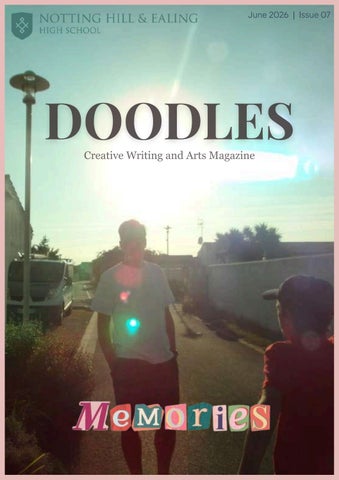
We are thrilled to present the seventh publication of Doodles creative writing and art magazine. This year ’ s theme, ‘Memories’, has prompted a diverse collection of works, from heartfelt recollections and imagined remembrances, to meditations on the significance of memory in our lives Many entrants have written using their personal experiences, through writing about people who are or have been in their lives, or experiences that have shaped them. It is through this sincerity that our collection of entries has such a feeling of warmth and intimacy.
Such a project would be impossible without the significant volume of entries and their exceptional quality. We have received contributions from people in all areas of school life, with students across many years, and even teachers submitting their work. The variety of responses to a single prompt makes curating this collection such a rewarding job. Engaging with so many voices and styles has truly been a pleasure.
We hope that you will enjoy reading this year ’ s entries, and that it will inspire students to pursue their own creative endeavours!
The Doodles Team
h I Could R, Y7
or a quick snack or drink, tually stop and think my old plastic slide, legs squashed on the inside.
believe in the hidden creatures under my bed em for the mess that lies ahead in my room. run like I did when I was four, y head on the handle of the door
hide in the cushions of the sofa, my brother to come and scare me with a loud “Boo.” sleep to the gentle rocking of the pram, my mum waking me up with a shout and a door-frame slam
go to the park and fly on the swings, man who trips and bumps into things.
I am just outgrowing all my favourite things, be many more treasured memories to come!
Before the Sky Changed
By Esha M, Y8
She remembered the classroom
Wooden desks in straight rows
Sunlight across the blackboard
The teacher writing slowly in chalk
A whisper behind her
A folded note passed under a desk
Quiet laughter they tried to hide
Then the siren began
Chairs scraped across the floor
Voices shouting
They ducked under their desks
Hands over their heads
Dust fell from the ceiling
Glass rattled in the windows
But she still remembered that morning
Sunlight on the blackboard
A quiet lesson
Before the war reached them.
Midnight Blooms by
Zoe K, Y7
Found by Milla C, Y12
20th of January, 2026
7:58pm
The day before my birthday I’ve been receiving text messages from friends, family members, but something feels wrong –different. My phone won’t stop buzzing, but I’ve never felt quieter. I can’t tell if it’s in a bad way or not I’m sitting in my living room, scrolling mindlessly through videos on my phone on the sofa with my brother sitting at the table. He’s rewatching Despicable Me for the hundredth time, while jumping around, stimming with his hands
We found out a few years ago that he has severe autism, and cannot speak. Autism isn't a textbook definition for me. When I see him stimming with his hands or rocking around when he gets overwhelmed – that’s how I see it. He looks as if he is in a trance watching that television. Small things make him happy. I don’t even realise the same scene has played twenty times My phone asks me to confirm I’m not a robot. He has to go to sleep in a few minutes, so I’ve just chosen to sit with him while I still can. Me
It’s Quiet Between Us
By Elle S, Y8
and my brother’s relationship can be seen as odd from others’ point of view. They think because he can’t talk, it’s impossible for him to have a proper relationship with somebody else I love my brother, and I think he loves me too. I just hope one day he’ll be able to say it to me.
21st of January, 2026 6:47pm
I’m upstairs in my room, blasting music in my ears, and attempting to do my science homework. I know I won’t be able to finish it because my mind is continually wondering about the events of my school day. I expected it to be better, as today was my birthday after all. Downstairs, my mum is making me my favourite cake – red velvet with cream cheese icing – and it’s one thing I’ve been looking forward to all day. I’ve been grumpy since the minute I got home, and I’ve been snappy with my family. I’ll apologise later; I just want to feel sorry for myself first.
I think to last year on my birthday. My brother had thrown a tantrum because it was all too loud for him. I had been so angry at that moment. I thought he was trying to take the
attention away from me, on my one special day of the year. I didn’t think he had been paying attention, but I realised how it’s just difficult for him sometimes I think we ’ ve grown even closer since then, and I believe I understand him more than ever now. Instead of dwelling on the bad memories, I let my mind drift to the good.
7:56pm
Once again, I’m sitting downstairs with my brother while he rewatches Despicable Me. While I was getting sung happy birthday, he sat in silence, staring at me. I knew he couldn’t help it, but I wanted him to just say something to me. I feel terrible for thinking like that, but nobody really talks about the struggle of having a special needs sibling that you love so much. I feel selfish for wanting more from him – more words, more signs, more proof. I’ve been sitting here drowning in my thoughts for so long that I haven’t even noticed my brother edging towards me
“Elle?” he whispers.
I whip my head up immediately, unable to process that my brother has just said my name. It was so quiet, I think for a second I imagined it. The TV is playing loudly in the background Maybe it was just a sound from the movie. On second thought, my heart is beating too loudly in my ears for me to hear the TV. My focus is all on him.
“Happy birthday.”
He remembered So maybe he always had
Mr Gregson
By Ms Hanbury
Mr Gregson arrived at my school the year I entered the sixth form. He shuffled into the classroom in our first English Literature Alevel class muttering under his breath and my heart sank. His mud-brown suit was crumpled, and his curry-brown tie had stains on it that looked so ancient they had become ingrained into the fabric. His shoes resembled Cornish pasties, and he gave off a stale smell of cigarettes and coffee. His flecked beard still had crumbs from his last meal sitting amongst the grey like small mouse droppings; his thinning hair was slicked over his moon head. An ominous red patch leeched from the corner of his top pocket.
We ate teachers like this for breakfast. Mr Brooks, the Computer Science teacher, had left in a flurry the term before, unable to get his class to do the simplest tasks. Miss Twaits, the Latin teacher, who had a long red mane that went down her back, soon learned to plait her hair and clutch it in front of her chest after we used to take it in turns to cut a little off the end every time she walked past. Mr Sentence, the other English teacher (whose wife, he had old us in one of many moments of oversharing, was called Ms Secret), had previously been a Hoover salesman and wore Next suits that were slightly shiny.
He must have been about twenty-five, and with an audience of drooling seventeen-yearold girls he barely stood a chance. Mr Palmer, the French teacher, who had left his previous job at a boys’ prep school in the middle of a school year under ‘mysterious circumstances’ and who had a flabby, moist face and a wide mouth like a frog, on one occasion had pins placed on his chair and on another a pool of water.
We were a pack of wolves that could smell fear a mile off, and Mr Gregson stank of it. We crouched, waiting.
We were studying The Tempest by Shakespeare, and I remember the first few lessons went ahead without much disturbance. We circled our prey. The room where we had our lessons was at the end of a colonnade, with one side of the room made entirely of glass The chapel was next door. It was a bright, sunny room. I remember Mr Gregson’s handwriting, tiny and scrawling, almost entirely illegible covering the board as if ants had traipsed all over it
Then one day we got to the part of the play where Caliban reminds Prospero (and the audience) of when Prospero and Miranda first arrived on the island, and how he took pains to be kind to them and show them the island: all the fertile places and where the best water is found It is written in the form of a sonnet Mr Gregson said that he would be reading this part himself.
He stood at the front of the class and paused. He waited for silence We were gearing up to snigger. He waited. The air felt like the moment before an orchestra starts, when the conductor’s hands are in mid-air holding all the instruments in tension. He slowly put the book down on the table at the front of the classroom. We did not breathe. What was he doing? We half expected him to start yelling at us. Then he started to recite. He was transformed. No longer the timid, mumbling intellectual ripe for our ridicule, his voice seemed to change.
“When thou camest first, Thou strok’st me and made much of me, wouldst give me Water with berries in’t…”
We were mesmerised. The gentleness of the words and the cadence of his voice held the room like the sea held in the pause between two waves. The speech reached a heartbreaking climax as Caliban reveals, “And then I loved thee.” Nothing stirred in the room We were transfixed And then suddenly his voice turned and boomed out across the classroom. I seem to recall that the windows may have even shaken a little as he cried out, with all the pain and vitriol that Caliban must have felt in that moment, “Cursed be I that did so!” We jumped in our seats. He was no longer Mr Gregson but a furious, abused, wounded creature who had made himself vulnerable only to be betrayed.
In that moment, he was Caliban, and it felt to us that he had suffered his whole life for being judged for his form and not his soul. He, like Caliban, knew what love was and could speak in achingly beautiful poetry
The speech ended. We waited for something to happen. The bell rang. Mr Gregson picked up his tatty copy of the play and shuffled out of the class room muttering under his breath
One Heart Two Homes
By Ms Newman
You can never truly express the feelings
Of leaving home to go home
And leaving friends to see friends
From sunshine and beaches
To grey skies and puddles
Bringing back dirty washing
Photos and videos on your phone
And memories to keep you going until the next time
Switching languages to still speak your own
Missing one place while arriving back at another
Your heart will always be in two places at the same time
Iceland by Ms Cagnino
I was standing in my hallway. The floorboards, which were usually soft, wooden panels, felt like wet cardboard underneath my feet The hallway was unusually quiet. All I could hear was the wind rattling against the window panes. Tonight, the silence had a physical weight.
A black silhouette was standing in front of me in the cold darkness. It had long limbs that dragged across the floor, and it was far too thin. It seemed to get bigger – no, it was moving closer towards me I wanted to run I wanted to scream. Then I heard a voice.
“I’m coming for you. ”
But I was paralyzed, desperate to get out, yet my muscles refused to cooperate. I could only watch the figure come closer . The hallway wasn’t silent now. All I could hear was the faint scrape-scrape-scrape noise of its fingers dragging across the floor Though I couldn’t see its eyes, I could feel them staring - staring at me intensely as it came closer and closer.
The air around me grew cold and bitter. It wasn't a natural chill; instead it sucked the breath right out of me. My heart hammered against my ribs like a bird trapped in a cage as I watched.
The Figure
By Daya N, Y7
Out of nowhere, I heard a voice calling my name from somewhere distant, like an echo in the back of my mind
“Run! Get out of there!”
Every inch of my body wanted to move. I desperately wanted to get my muscles to work Even trying to scream for help was useless. I was frozen in place and could only watch –helpless.
Now the figure was dangerously close It was much bigger than before. I could see dirt under its fingernails and noticed something I hadn’t seen before. Blood. Old, dried blood. Not just on its withered hands, but around its mouth, dripping from its jaws
Out of nowhere, I felt an icy hand grab me around my neck. It was so cold I couldn’t breathe
“No one is coming to save you now, ” it said with a croaky, husky voice.
The creature opened its jaws, revealing row after row of shark-like teeth, with a smell that washed over me like stagnant pond water. I felt myself falling backwards, my subconscious whispering in a rapid breathless, sequence:
“No one is coming ”
“This is your fate.”
“Save yourself.”
“Goodbye.”
Clawed fingers made contact with my neck. My eyes were enveloped in absolute darkness, and a crushing weight pressed on my chest as I fell to the floor. I had no breath to shout out. It was too late. I had been caught.
The Oldest Sibling
By Bryony M, Y12
Waves of Topsham’s estuary waltzed back and forth, three by three, its steady pace rhythmically striking the blankets of mud before withdrawing once again. To my right laid a vast body of water dotted with ducks, swans, and on occasion, a slender heron perched on a jagged rock. A rocky ramp descended into the water, its eroded cobbles washed over with a glaze of slippery seaweed and algae.
“Look! There’s a swan over there, B!” Dad pointed out to me Mum snatched the bread bag from Lewis, tenderly offering it to me instead. My brother Lewis – at only ten and a half – was ordered to accompany me, appointed as my chaperone: he looked miserable
Our muddy trainers persevered to keep a grip on the slimy decline into the estuary; I clung on to the bread bag fretfully as my discomfort heightened, spurred on by the blazing sun As Lewis and I approached the swan, I turned my head back to look at Mum and Dad. I was met by their smiling faces and encouraging gestures, but looking back, Lewis maintained a solemn gaze to the broad stretch of water ahead of us. Despite being inches away from him, Lewis felt miles away; isolation burnt through his body, even through the thick coat of sunscreen that clung to his face.
“Do you want to feed the swan?” I timidly offered him the bread bag, expecting an irritated response, but he did not utter a word, instead reserving his gaze for the water only. All I could do was look at him with large blue eyes, like the shallow cerulean tide, misted with naivety and childlike ignorance.
“...Lewis?” I gazed up at him, tilting my head like a puppy. Lewis lifted his foot up tentatively. He took a step into the water.
“What are you doing? Your trainers are getting all wet!” I exclaimed. Confusion and then concern burdened my mind. The once refreshing seaside breeze that blew cooling air on our skin mutated into jarring, heavy flurries of wind Turning my head to the estuary, I noticed how the wind guided the water into rougher, more ferocious waves, like a puppeteer controlling her marionette. At this distance, I could see the subtle mud peeking out from under the water, adding a pungent odour to the air. I pulled a disgusted face. Lewis took another step forward. And another. And another. Having already consumed his calves, the waves licked at his knees, ready for a mighty feast to satisfy its mud-ridden stomach.
“Lewis? What are you doing, get out the water! It's not safe!” Mum cried, her once comforting words laced with distress and hysteria. He ventured further into the greedy water.
“LEWIS!”
Without hesitation, Dad sprinted towards us furiously, blinded by anger and fear. But then suddenly, I heard a yelp and a splash behind me
Dad plunged into the estuary. Lewis’s body strained, struggling to move in the dense mud, waves clawing at his neck insatiably. As salty water rushed into his mouth, painful gasps for air silenced all except for the cruel sound of the water engulfing his body.
But like a statue, I stood helplessly. My limbs were like stone, my eyes wet with tears, my mind like an empty book where only panic and confusion held the pen allowing me to move. Determined, Dad cautiously kept his body raised above the deadly surface of mud. Mum and I watched in terror as he began to desperately swim towards Lewis. Urgently, Dad reached out to him. His enormous hands clasped onto Lewis’s arm, almost crushing it from sheer strength spurred by adrenaline.
Dad yanked at Lewis’s arm. Mud grasped at their legs like Hell’s sinners. Dad yanked again. Waves crashed down on them.
Dad yanked with all his might, but his expression was adorned with despair. At that moment, a life with Lewis gone infiltrated my mind. A life so dark that even Devon’s golden sun would have been engulfed in its anguish. A life so empty that I even began to cherish the times when he would ‘wind me up ’ (as Mum said) and I would end up in tears bawling for her. Sometimes I hated him, but I always loved my brother.
But then, at last, the mud’s grip loosened. Desperately, Dad hauled Lewis out the estuary, collapsing at my feet. In the distance, Mum sobbed with relief. And I remained, the remnants of terror still coursing through my trembling body. Soaked, Lewis and Dad lay on the slimy path, coughing and spluttering up salty water.
Dad was the first to get up Solemnly, he snatched Lewis’s shirt, pulling him up to his feet and dragging him back up the cobbled path, leaving a trail of mud and water. I followed behind them like a whisper. For the first time, all eyes were on Lewis
Dementia
Alexandra O, Y9
I sit in my chair staring blankly at the room before m
A young girl steps into my view.
She smiles and takes my hand, standing before me.
“Hello Grandma,” she says in a soft voice.
I know you, a voice in my head says. You’re family.
I can feel the memory of her dancing through my hea Every time I reach for it, it slips away again, just out of reach Another memory comes to the surface.
A lullaby sung whilst stroking her hand.
I hum the first few notes and her eyes light up.
“You remember me!”
I try to nod, to say yes but I cannot remember how and the memories of walking, talking, laughing and dancing all slip away into the depths of my mind.
I try to cry out to say, “Help me! I’m drowning!”
but I cannot utter a word.
My mind rages as I try and try to speak or move or do anything, but I cannot.
My memories slip away as I sit in my chair, staring blankly at the room before me
Aide Mémoire
By Daisy G, Y10
A small brass bell rings as I open the door. I step across the threshold and check my watch: 13:52. The room I am in is small but wellfurnished, with several comfortable-looking armchairs dotted around the space. Bookshelves line the walls and a small track runs along the top of them. A piano sits in the corner, complete with a leather stool. Dust dances in the air, settling on the surfaces of the chairs. I’m a little early for my appointment so I choose an armchair in the corner of the room. I sit down and the familiar ping of a message sounds from my phone. I pull it out of my rucksack, wincing at the state it is in A prominent crack spreads across the screen like lightning, forking and branching from one side to the other. My homescreen is altered: it’s a very old photo of me and my sister, in our early 20s, clutching our university certificates and grinning from ear to ear. A dark shape lingers on the left-hand side of the screen, a ghost of the LEDs that used to emit brightly coloured lights. Until I dropped my phone that is The shape obscures half of my sister’s face, a young woman with curly dark hair and a bracelet on her right wrist
I unlock my phone. Through the lightning fork I can make out the obscured message: Are you sure you want to be doing this? It’s from Zoe, my ever-worrying neighbour, and also my oldest friend. I can picture her face, twisted with agitation and concern for what I’m about to do And yet I don’t reply Instead I shove my messed-up phone back in my rucksack and place the bag by my feet
And I look around at the room Although it is technically a waiting room, it looks like the exact opposite. The lighting is warm, with the colours of red, orange and pink swirling around.
This light comes from oddly shaped bulbs that are suspended from the ceiling. As I reach towards the light, the bulb’s contents begin to pulsate, the light within growing and dimming
Suddenly, a battery-powered train clatters across some tracks above me, bringing me back to reality. Several bookshelves cover the walls, the books adorning them plagued by age and dust The track is placed on top of the highest shelf, and a small copper-coloured train rattles across it before disappearing into a tunnel set into the wall.
A memory surfaces, breathing and living once more In the memory I am seven years old My hands are small, my skin is smooth and I have more energy than I could ever wish for. It’s my birthday. Or Christmas. I can’t exactly remember now. But I do remember the train. It was a gift from my parents It was red – not quite copper – but it was enough to jog the memory. My train was a 1936 locomotive, complete with intricate passenger carriages, and a golden rim. For several years, it was my most prized possession I kept it central on my mantlepiece, and I would polish and dust it every Saturday afternoon. My sister used to think I was strange for caring so much about it. She would rather lie in the grass, looking up at the vastness of the sky, watching the clouds dance above her But I thought the train was brilliant.
On the other side of the room, a piano sits against the wall, abandoned by its player and left to a life of solitude I go over and open the lid, and the hinges creak in agony. I brush the dust off the worn, cracked keys and set my fingers down to play. I have no sheet music, and through my clouded memory, I can only remember one song: Für Elise by Beethoven I stumble over the first few notes before muscle memory kicks in and I lose myself completely in the music. My fingers glide over the keys, gentle but precise in their motions. Memories flood my brain as I get faster and faster, my heart rate increasing at the pure thrill of playing something so beautiful once again. And my sister. She sits before me. Her hair is fashioned with a hundred braids, each ending in a singular glass bead, the colours mimicking those present in the room with me today. She smiles at me, a tear forming in her eye. I stop playing.
“I’m so proud of you, Isaac,” she whispers “And I will never not be proud of you. ”
A door opens, and a woman steps out. She has curly, dark hair and a bracelet on her right wrist
“Mr Evans, my name is Beatrix and I will be conducting your memory removal today. I understand you wanted to forget your sister’s death. Is that right?”
I nod.
“Would you please come through?”
I don’t move. Recalling all of these memories has made me realise that I don’t want to forget. I want to remember her laugh, her smile, her disapproval of my trains I want to even remember playing Beethoven to her while she lay bedridden, eyes closed, a machine beating out her heart rate. I don’t want to forget that.
“Not today,” I say, as I turn from Beatrix and the shadow of my sister, walking back towards the threshold.
A small brass bell rings as I open the door I step back across the threshold and check my watch: 14:02.
I remember the car rides singing
To Dancing Queen and Mamma Mia, Always out of tune, but we had no idea.
Building sand castles
Bedtimes stories
Running from waves
And summer ’ s little glories.
I remember the tiny purple table, Sat at to eat dinner, You sat beside us, Only then was there no fuss.
Skipping hand-in-hand to the Wizard of Oz,
Down the yellow brick road, Always being silly, just because.
I remember the adventures in summer, Bouncy castles
Water slides
Bournemouth beaches, playing in the tides.
Off to the Isle of Wight and Black Gang Chine,
I will always be grateful
That these memories are mine
Down The Yellow Brick Road
By Isabel H, Y12
I don’t think you remember the car rides singing, The purple table, the bouncy castle too
Once the life and soul of every party, Sometimes names don’t come as easily to you.
You might not remember my favourite memories, The summers, The stories, The laughter we knew.
But even if those moments fade for you, Grandad, I will always remember you.
My Ninth Birthday by Isabel H, Y12
The Burial
By Mrs Myatt
My grandmother had never looked so beautiful as when she lay there dead Her face was serene. Lips pressed tightly together, eyes closed. Skin a creamy white that was smoothed all over. Her short black hair was precisely parted, brushed neatly, and tucked behind each ear The cream-coloured hemp on her body was starched to perfection, with not a wrinkle in sight.
But it was her sleeves that caught my breath. They were rainbows Each arm was held loosely by a linen puff of technicolour. I had never expected to see such life in a funeral home, my first experience of its kind in Korea, my motherland.
I was dressed all in black, trying to learn the etiquette of mourning Was I suitably sombre? I was a foreigner back in her hometown, trying to unlearn near two decades of westernisation. Her outfit reminded me of hanbok, or the traditional Korean clothing reserved for special occasions, like weddings and the New Year. But my grandmother had chosen the brightest colours for her final bowing out. She would go out in triumph.
She could not look more different from the last few years of her life. She had been a frail, hunched figure of ninety years when I returned home to Hong Kong in my twenties after several years studying and working in England It was not an easy homecoming My grandmother’s needs were ever growing, and my parents struggled to adapt. Caring for your elderly parent is arguably the highest moral value in Korea. But when the task is divided between five siblings spread across the world, the differences between definitions of love become stark.
My father, the fourth of five children, took on the mantle and flew my grandmother out to Hong Kong. Aging can involve a reversal of fortunes. For my grandmother, the change was severe. She had enjoyed living by herself in a three-bed apartment in the centre of Seoul. Every day, she scrubbed the laminate floors of her apartment till they sparkled. “Don’t go on the beds!” she would cry when we dared to sit on her fresh sheets. A white handkerchief was glued to her hand every time she went out, so she wouldn’t have to touch anything anyone else had touched.
I thought it was a bit ridiculous. But there were many things I didn’t understand about her Like when she would take so much pride in her face and daily apply costly creams. Perhaps she was living up to her name, ‘Hee Nyeo’, which meant ‘white woman ’ . Fairness in Korea was not just a Kpop beauty standard but a national ideal Or the way she criticised my parents while favouring her two oldest children who had immigrated to Chicago and Toronto and returned every few years with gifts of Burberry and golden jewellery.
I couldn’t argue with her cooking though. Home-cooked Korean delicacies would pour out of her kitchen and pantry, from doenjang, or fermented soybean paste, to botangguk, a rich brown broth filled with squid, prawns, mussels and small chunks of beef. Every meal she cooked would be a feast, including costly finds from the market, like myeongnanjeot, or fermented pollock roe, specially picked for her grandchildren “Eat more, ” she repeated If food be the music of love, you were to feed and eat on.
But now, in the twilight of her life, when cleaning and cooking became difficult, she found her life shrink beyond recognition She moved into my old room, which she seldom left. There was a window with an iron frame –a standard security measure in high-rise buildings in Hong Kong – that let in bars of sunlight Hoards of mysterious bags piled up in her room and a musty smell emanated each time I opened her door. Night and day, she lay on the old single bed. Sometimes she would call me, her youngest granddaughter, and ask for a cup of orange juice Sometimes she would try to slip me a five-hundred dollar bill that had been stashed away in one of her bags. In an age of helplessness, giving was a privilege and a power.
long day alone. My father was out at work while my mother, overwhelmed by the gaping demands of her mother-in-law, kept to herself Should I knock on my grandmother’s door and listen to her meandering words? Or could I quietly slink away to my room? I often chose the easier path.
I once heard her beating her chest. When I asked her what was wrong, she would say she was filled with hwa, or fury and bitterness. She never explained what she meant by that. But I wondered about her lying in bed all day with nothing to do but go over her memories and regrets. She had seen better days than these. There was little dignity now.
So then seeing her, at the funeral, in these resplendent burial clothes took all thoughts of pity and weakness away. For years, she had been planning this. The outfit had been tucked away in one of those amorphous bags in her room Waiting At the end of her days, she might not have been able to decide where she lived, who she lived with, and what she did each day. But she was going to choose how she looked on one of the most important days of her life – her death And so I will always remember my grandmother, not just in her dejection and defeat but in her defiance against her odds. In beauty and glory.
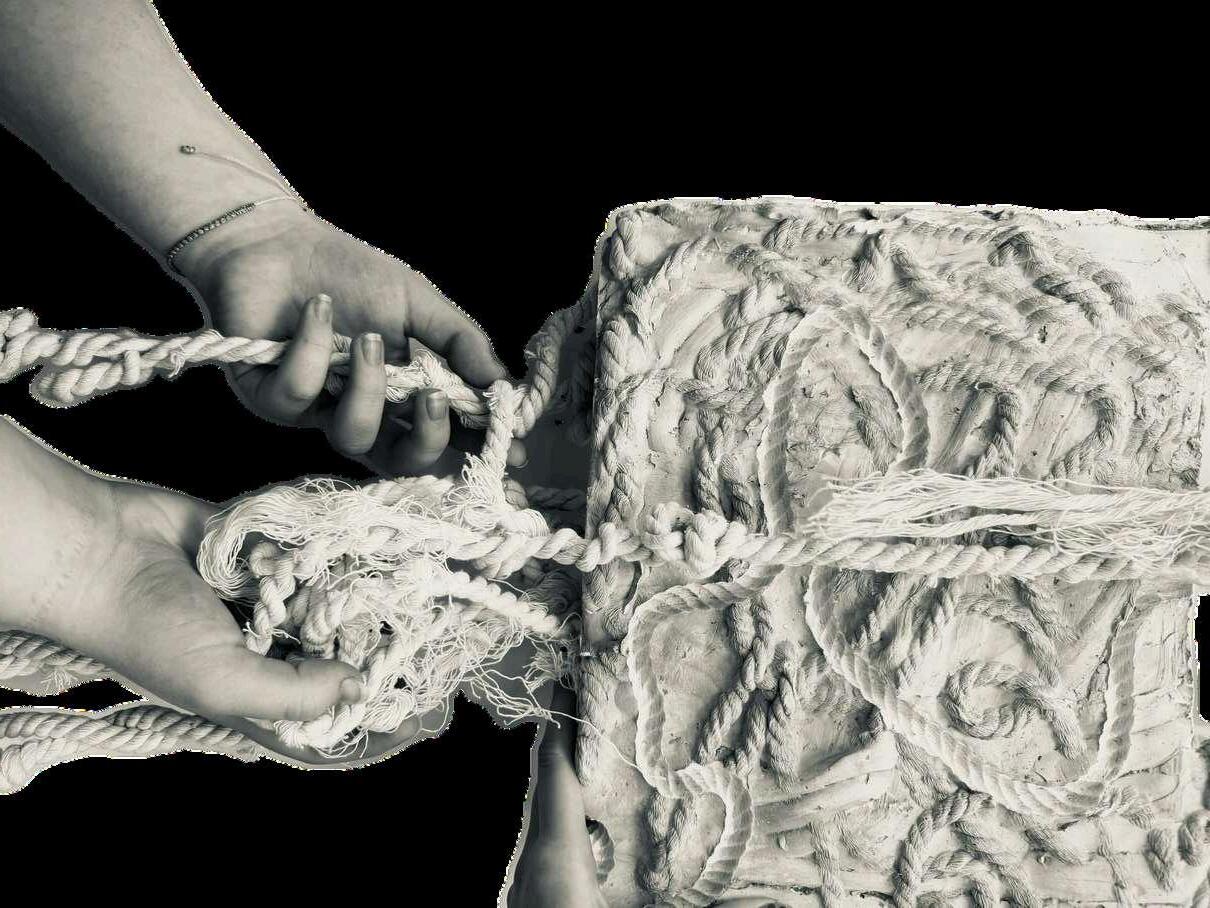
Threads of Memory
By Dheeksha M, Y7
Memories, memories, they come and go, In flashbacks or dreams from many years ago
Some may be imagined, things that aren’t real, Lost, forgotten, the thoughts concealed.
Some can be cherished, some should be ignored, The awful ones, well, can’t afford to be recalled
The lovely ones, on the other hand, Are loved, wanted and simply just grand!
I realise now,
That a memory is tied to a place or time, To a person, a scent, a drawing or design.
No one can just go back and recollect, You have to reach out, and connect