SAVING FRANCONIA NOTCH | WHERE THE FOREST MEETS THE ROAD
N E W H A M P S H I R E ’ S C O N S E R VAT I O N M A G A Z I N E
The Places We Protect The Legacy We Carry Forward
SUMMER/FALL 2026
forestsociety.org
Experience The Rocks: Beauty, History, Home Wake up to sweeping mountain views, quiet mornings, and the timeless charm of Forest Society North at The Rocks. The Gardener’s Cottage—once part of the historic Glessner family estate—has been thoughtfully restored to welcome today’s visitors while honoring more than a century of conservation and care. • Sleeps up to nine; perfect for families and groups. • Step outside to trails, history, and peaceful landscapes. • Your stay supports year-round education and land stewardship at The Rocks.
Plan your visit at brettonwoodsvacations.com/rocks
TABLE OF CONTENTS: SUMMER/FALL 2026, No. 325
8
12
20
FEATURES
DEPARTMENTS
12 Sawed or Saved: The Movement that Created Franconia Notch State Park
2 FROM THE PRESIDENT’S DESK 125 Years, and the Work Ahead
4 THE WOODPILE
16 Where the Forest Meets the Road
+ 5 Hikes Challenge is Underway! + Vista & Vibes Returns to The Rocks + Woods Day Show and Tell + Speaking Up for the Bartlett Experimental Forest
8 GET OUT Fuel Your Hike, Feed Your Spirit as Fall Approaches
10 PUBLIC POLICY What’s Next for the Farm Bill?
20 IN THE FIELD
SAVING FRANCONIA NOTCH | WHERE THE FOREST MEETS THE ROAD
N E W H A M P S H I R E ’ S C O N S E R VAT I O N M A G A Z I N E
The Places We Protect The Legacy We Carry Forward
SUMMER/FALL 2026
forestsociety.org
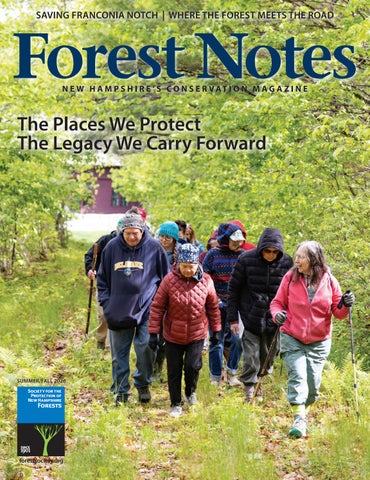
On our cover: Opportunities abound this fall to join a hike and celebrate the Forest Society’s 125th anniversary. Photo: Justin Smulski.
+ Restoring Red Spruce Through Assisted Migration + What’s New at the Merrimack River Forest
24 PROJECT IN PROGRESS Saving Springfield’s Pillsbury Ridge Forest
FROM THE PRESIDENT’S DESK
CHAIR Jason Hicks, Meredith
VICE CHAIR Susan Arnold, Strafford
SECRETARY Amy Meyers, Jaffrey
TREASURER Allyson Hicks, Concord
PRESIDENT Jack Savage, Middleton
BOARD OF TRUSTEES Emory Baldwin, Deering Philip Bryce, Deering Susan Ide, Littleton Kathy Eneguess, Errol George Epstein, Silver Lake Don Floyd, Concord Jameson French, Portsmouth
Patricia Losik, Rye Jim Merrill, Manchester Michael Morison, Peterborough Elizabeth Salas, Weare Tom Wagner, Campton David Worthen, Wilton
STAFF Josh Abbott, Regional Stewardship Manager Ben Aldrich, Field Forester Frank Allen, Building and Grounds Assistant Sarah AlSamaraee, Stewardship & Forestry Administrative Coordinator Dave Anderson, Senior Director of Education Kristine Arey, Program Director, The Rocks Emily Bartolini, Southeast Region Program Manager Brie Belisle, Regional Stewardship Manager Nik Berube, Maintenance Assistant Naomi Brattlof, Director of Easement Stewardship Adam Buxbaum, Christmas Tree Farmer, The Rocks Rita Carroll, Tree Farm Administrator Tony Cheek, Vice President for Finance Connie Colton, Administrative Assistant Linda Dammann, Development Assistant Carrie Deegan, Vice President for Recreation Management and Public Engagement Leah Hart, Land Conservation Project Manager Stacie Hernandez, Land Conservation Project Manager Brian Hotz, Senior Land Conservation Project Manager Steve Junkin, Field Forester Susanne Kibler-Hacker, Senior Philanthropy Advisor Allan Krygeris, Senior Technology Specialist Matt Leahy, Public Policy Director Margaret Liszka, Membership Director Jeremy Lougee, Vice President for Land Conservation Kaylin Lustig, Concord Community Engagement Coordinator Nigel Manley, Senior Outreach Manager, The Rocks Hannah McCarthy, Major Gifts Officer Ann McCoy, Development Manager Stephanie Milender, Human Resources Director Michelle Morse, Finance Specialist Carl Murphy, Facilities Manager Nora Noble-Christoff, Land Protection and Stewardship Coordinator Cara Pearson, Membership Specialist Meredith Reed O’Donnell, Foundation Relations Manager Tina Ripley, Administrative Coordinator Ilissa Sargent, Regional Stewardship Manager Jack Savage, President Matt Scaccia, Recreation and Community Relations Manager Ryan Smith, Communications Manager Justin Smulski, Digital Marketing & Content Manager Kaity Stanton, Regional Development Manager – Seacoast Maria Stewart, Senior Executive Assistant Dylan Summers, Stewardship Projects Manager Laurel Swope-Brush, Land Steward & Volunteer Programs Coordinator Lauren Thomas, Administrative Assistant, The Rocks Anne Truslow, Vice President for Development Wendy Weisiger, Managing Forester Brenna Woodman, Director of Communications Harriette Yazzie-Whitcomb, Assistant2026 2 | FOREST NOTESAdministrative Summer/Fall
125 Years, and the Work Ahead
C
elebrating our 125th anniversary this year has been a pleasure, in no small part because of the opportunities we’ve had to meet and visit with so many members and supporters at various events across the state. By the time you read this, we will have welcomed 250 people to our annual meeting at Forest Society North at The Rocks in Bethlehem. We’ll have a story in the next issue featuring our award winners and keynote speaker Anthony “Tony” D’Amato. At the meeting, we thanked five Trustees whose terms on the board have come to an end: Bill Tucker, Drew Kellner, Peter Fauver, Janet Zeller, and Deb Buxton. I know they find it a privilege to serve the organization and our mission, but we owe them a deep debt of gratitude for committing so much of their time, talent, and treasure to advancing conservation and forestry. Those who have served three full terms—nine years—have navigated a lot of transition, including a pandemic. We thank them for that. We also welcomed four new Trustees; Susan Ide Caswell of Littleton, Emory Baldwin of Deering, David Worthen of Wilton, and Kathy Eneguess of Errol. It will be their challenge to work with others to ensure that we continue to create history. All the successes of the last 125 years set the standard for what the Forest Society should achieve in the years to come. The past and present are reflected in this issue of Forest Notes. The story of Franconia Notch is a powerful reminder of what can happen when people (and allied organizations like the Appalachian
Mountain Club, celebrating their 150th this year) come together around a shared belief that a special place is worth protecting. Elsewhere in these pages, you’ll read about the work happening today— from forest research and stewardship to recreation, community engagement, and advocacy. The best news is what we have to celebrate: a state 82 percent forested, a strong community of land trusts, a credible goal of protecting 40 percent of New Hampshire by 2040, and the Forest Society itself having protected more than 200,000 acres, including owning and managing nearly 70,000 acres across more than 200 places. Less welcome is the realization that 125 years after our founding, we still must advocate earnestly for the fundamental idea that our forests are critical to our own livelihood and way of life and deserve protection. Our work is not done. Thank you for being part of the Forest Society.
Jack Savage is the president of the Forest Society. He can be reached by email at jsavage@forestsociety.org. P.S. You can read the FY26 Annual Report at forestsociety.org/annualreport or email ldammann@forestsociety.org to ask for a printed version to be sent to you.
(OPPOSITE PAGE) JUSTIN SMULSKI; (THIS PAGE, CLOCKWISE FROM TOP LEFT) ALEXANDER BADYAEV, COURTESY OF JACK BRONNENBERG, COURTESY OF BUILDING COMMUNITY IN NEW HAMPSHIRE
WEB EXCLUSIVES
Anniversary Events Join an outing or two near you forestsociety.org/events
Flying Squirrels! An elusive White Mountain wonder nhpr.org/somethingwild
Three Oaks Tree Farm Outstanding Tree Farmers of 2026 nhtreefarm.org/news-events
“There’s something special about exploring a new place with new friends.
CONNECT WITH US!
Over the summer, the Building Community in New Hampshire community had the opportunity to explore Lost River Gorge—many of us experiencing this beautiful part of New Hampshire for the very first time.
facebook.com/ForestSociety
A huge thank you to Dave and Kaylin from the Forest Society for welcoming us, sharing their knowledge, and creating such a wonderful experience for our group…For new Americans, building a new life means more than finding a home, a job, or a school. It also means getting to know the place you now call home — discovering its mountains, forests, communities, and hidden treasures, while meeting people along the way. Opportunities like this help turn a new place into a home.”
T ag #forestsociety on Instagram for a chance to be featured in a future issue of Forest Notes.
—Building Community in NH
@ForestSociety
Sign Up! Tree Mail E-Newsletter Stay on top of land protection projects, advocacy news, and upcoming events with our monthly e-newsletter, Tree Mail. Sign up at forestsociety.org/ enewsletter.
Society for the Protection of New Hampshire Forests A nonprofit membership organization founded in 1901 to protect the state’s most important landscapes and promote wise use of its renewable natural resources. Basic annual membership fee is $45 and includes a subscription to Forest Notes. Editor: Ryan Smith Design & Production: The Secret Agency Printing: R.C. Brayshaw & Company, Inc. Forest Notes is printed on elemental chlorine-free Sappi Flo paper with 10 percent post-consumer recycled content. Sappi Flo is made from pulp purchased from suppliers who document sound environmental practices and sustainable forest management. Permission is required for reproduction of any part of this magazine. Copyright 2026 SPNHF. US ISSN: 0015 7457 54 Portsmouth Street, Concord, N.H. 03301 | Phone: 603-224-9945 | Fax: 603-228-0423 info@forestsociety.org | forestsociety.org The Forest Society proudly supports the following organizations:
Cosponsor
Underwriter
Member
Summer/Fall 2026 FOREST NOTES | 3
THE WOODPILE—NEWS NOT SO NEATLY STACKED
5 Hikes Challenge is Underway! The Forest Society’s Five Hikes Challenge is back! Choose any five participating Forest Society properties, complete your hikes before October 31, and discover some of New Hampshire’s most beautiful, conserved landscapes along the way. And because we’re celebrating 125 years of conservation, there are a few extra surprises this year: participants receive a limited-edition reusable snack bag and anniversary sticker, plus the chance to hunt for hidden wooden “tree cookies” along select trails and win some trail-fueling goodies. Prefer some company? You can also join one of our staffled guided hikes throughout the season. The Challenge is free for Forest Society members— and if you’re not a member yet, now is a great time to join! Your membership includes free Five Hikes registration, along with a full year of member benefits, special events, and more ways to explore and connect with the lands you help protect. Thank you to this year’s challenge sponsor, Ben’s Maple Syrup!
Grab your free snack bag and hit the trails this fall!
Vista & Vibes Returns to The Rocks The second annual Vista & Vibes Festival brought hundreds of people to Forest Society North at The Rocks in August for an evening of live music, community, and sweeping White Mountain views. Guests spread across the lawn amphitheater with blankets, chairs, and picnics while enjoying a lively performance by the Wicked Smart Horn Band. The free festival offered another opportunity to welcome the community to the Forest Society’s North Country flagship and celebrate the landscape in a relaxed, festive setting. Donations collected during the event support the Forest Society’s work and future community programming at The Rocks.
4 | FOREST NOTES Summer/Fall 2026
Water-powered since 1856.
Celebrating the Past In June, Forest Society members boarded the Mount Washington Cog Railway for a special anniversary outing celebrating some of New Hampshire’s most iconic landscapes. The trip offered a memorable way to reflect on places the Forest Society has helped protect in perpetuity and to experience firsthand the remarkable scenery that generations of conservation work have helped preserve.
DISCOVER ADVENTURE OPEN MAY - OCTOBER. 1712 Lost River Road, Woodstock, NH 03262
BOOK ON
11 boulder caves, 1-mile boardwalk trail & more!
E TODAY LIN
NO KOOB
JUSTIN SMULSKI (X3)
Craft & creativity since 1986.
Enduring elegance.
garlandmilltimberframes.com Lancaster, New Hampshire 603.503.0217
LOSTRIVERGORGE.COM 603.745.8031 Summer/Fall 2026 FOREST NOTES | 5
THE WOODPILE—NEWS NOT SO NEATLY STACKED
Woods Day Show and Tell In August, landowners from across the state welcomed folks onto their properties as part of Open Woods Day to show off the landscapes that they love so much that they chose to permanently protect them. From hiking trails through thick forest to wildflower fields and working farms, there was plenty to explore. So much of the work the Forest Society does relies upon strong partnerships with conservation easement landowners. Open Woods Day was a great reminder of those relationships. For decades now, landowners have invited Forest Society staff who are monitoring their conservation easements onto their porches and into their kitchens for a cold drink on a hot summer day. And that, inevitably, leads to fascinating stories about the land, its history, and why it means so much to the people who protected it. Each of those interactions is its own miniature Open Woods Day—and we loved being able to finally share that with the public. Gillingham Farm in Newbury, the Schendler family in Goshen, the Hager family in New Hampton, and the Sterns in Canterbury in particular went above and beyond to help us plan the day. Shout out to our event sponsors, Gilsum Village Store and Monadnock Food Co-op, for their in-kind donations of tasty snacks and beverages that we were able to offer our guests.
Open Woods Day welcomed visitors onto privately owned conservation easements across New Hampshire, including Deepwood Forest in Canterbury and Northfield, offering a firsthand look at the places landowners have chosen to protect for generations to come.
6 | FOREST NOTES Summer/Fall 2026
Consulting Foresters The Forest Society encourages landowners to consult with a licensed forester before undertaking land management activities. The following are paid advertisers. Evergreen Forest Management, LLC Smokey the Bear poses with U.S. Forest Service Research Forester Bill Leak in 2007 during the Bartlett Experimental Forest’s 75th anniversary celebration.
Specializing in creative, ecological approaches to forest management that are designed to provide long-term economic benefits to landowners and their forests.
752 Rt. 103A Newbury, NH 03255 • 802-310-0292 efm-llc.com
Martin Forestry Consulting, LLC
(OPPOSITE PAGE) JUSTIN SMULSKI; (THIS PAGE) RYAN SMITH, K. DUDZIK (U.S. FOREST SERVICE)
Speaking Up for the Bartlett Experimental Forest The Forest Society, New Hampshire Timberland Owners Association, and retired U.S. Forest Service scientists Mariko Yamasaki and Steve Fay recently sent information to U.S. Secretary of Agriculture Brooke Rollins and members of New Hampshire’s congressional delegation detailing facility needs and current conditions at the Bartlett Experimental Forest. The U.S. Forest Service network of experimental forests has been accurately described as “living laboratories.” The agency runs 84 of these centers on national forests, where it has been conducting long-term ecological research—in some cases for more than 90 years— on matters related to sustainable forestry practices, climate change, wildlife habitat, and water quality. The White Mountain National Forest hosts two of these centers—Hubbard Brook Experimental Forest in Woodstock and Bartlett Experimental Forest in Bartlett. While they may not be widely known to the public, the work that has taken place there for decades has benefited one of New Hampshire’s most important natural resources—our forests—and the landowners and foresters who steward them. The materials sent to the secretary and congressional delegation members are intended to help the U.S. Department of Agriculture and U.S. Forest Service accurately assess the needs and costs associated with maintaining and operating Bartlett Experimental Forest. Currently, the department is evaluating options for continuing operations at Bartlett. While the timing of a final decision remains unclear, the Forest Society will continue advocating for this important research facility and will share updates as they become available.
Offering complete forest management services, including timber sales, cruises, appraisals, and wildlife habitat management. Ask us about recreation trail planning, construction, Brontosaurus mowing, and forestry excavation services.
P.O. Box 89, New Hampton, NH 03256 • 603-744-9484 Email: martinforestry@gmail.com
Meadowsend Consulting Company Quality Consulting Forestry with Integrity. Guaranteed.
Jeremy Turner, NHLPF #318 – Southern NH jturner@meadowsendco.com Matthias Nevins, NHLPF #518 – Central NH mnevins@meadowsendco.com Ryan Kilborn, NHLPF #442 – Northern NH rkilborn@meadowsendco.com Vast range of quality land management services. Connect with us for a free site consultation!
meadowsendco.com • 603-526-8686
Licensed foresters should address inquiries about advertising to Anne Truslow by calling 603-224-9945 or emailing atruslow@forestsociety.org. Summer/Fall 2026 FOREST NOTES | 7
GET OUT
n/Warn orest, Sutto F in ta n u o Black M
er
Fuel Your Hike, Feed Your Spirit as Fall Approaches By Carrie Deegan
V
ery few of us want to hear that summer is winding down, that the bright, hot days filled with morning birdsong and the mid-afternoon whine of cicadas are coming to an end— but there is a silver lining. We’re about to enter the best season for hiking, spanning the end of summer and well into autumn. The blackflies and deerflies are gone, mosquitoes are fading quickly, and the drier, cooler days mean a reduced threat of surprise thunderstorms and uncomfortably sticky, sweaty exertion. Plus—the views! New Hampshire is a hiker’s paradise, with everything from rugged multiday mountain-scaling adventures to gentle meanders along forested brooks. Once foliage season is in full swing, hikers will have to compete with the weekend leaf-peepers flying or driving in from afar to experience the state’s natural beauty. But for those who know where to
8 | FOREST NOTES Summer/Fall 2026
head, there are dozens—even hundreds, dare I say—of stunning hikes where you’re unlikely to encounter more than a handful of others. For a good way to get outside during the best hiking time of the year, consider participating in the 2026 5 Hikes Challenge, which takes advantage of the Forest Society’s statewide portfolio of more than 200 conservation forests to introduce people to new and varied hiking destinations in every corner of the state. This year’s Challenge theme, “Fuel Your Hike, Feed Your Spirit,” recognizes the positive benefit that time spent outdoors can provide from a mental health perspective. I can say with certainty that I have not regretted a single hike I’ve ever taken in the woods. Some days I have to drag myself out there—my dog usually assists, begging until we go—but I am always glad I made the effort and I invariably experience something magical on even the shortest
Ammonoo suc River Fo rest, Bethlehem
of woods walks: flushing an early-morning owl from its roost, watching mist rise off the surface of a pond, or discovering a perfect wildflower growing alongside the trail. Fueling hiking adventures in a more literal sense is important, too. For a safe and enjoyable experience on the trail, a little advance planning can go a long way. Here are some tips for optimum hydration and nutrition on day hikes, whether tackling a 4,000-footer or just the easy grades of a fall woods road.
Eat early, lightly and often It can be hard to remember to eat while hiking, since you’re busy moving and enjoying the scenery. Plus, it’s common not to feel very hungry while actively exercising. However, hikers are burning calories—typically 200 to 300 per hour— and failing to replace them regularly can lead to a “bonk,” or a point of extreme tiredness and sluggishness. Sports nutritionists often suggest eating small snacks every 60 to 90 minutes, whether hungry or not. Hikers can set a watch or phone alarm for this purpose— or bring your kids! In my experience, they never fail to remind you about the need for snack breaks.
y in, Troy/Jaffre ta n u o M p a G
(OPPOSITE PAGE, FROM LEFT) JERRY MONKMAN, JEREMY BARNABY; (THIS PAGE, FROM LEFT) JERRY MONKMAN, EMILY LORD
Think carbohydrates first, then fats, then protein So, snack frequently—but on what? Carbohydrates are the name of the game, since they provide fast, efficient fuel the body can easily convert to energy. Caloriedense fats like nuts are also good and digest slowly to provide longer-lasting energy. There’s a reason trail mix earned its name—the combination of fatty nuts and chocolate along with carbohydrate-rich dried fruits makes it one of the best, easyto-eat hiking foods. Don’t let the current fad of proteineverything tempt you too much. There’s nothing wrong with protein on a hike if carbohydrates are in the mix, too, but a diet of only hard-boiled eggs and meat sticks may leave hikers cranky and exhausted.
Pack snacks strategically Loading up a backpack with heavy items can make for a challenging hike, so think lightweight when packing trail snacks—pretzels, peanut butter crackers, and granola bars are great choices. A mix of sweet and savory snacks will guarantee taste buds won’t get bored. Most hiking destinations in the state are carry-in, carry-out, so bringing snacks in reusable, sealable containers is best to minimize food and wrapper waste.
Eagle Cliff Forest, Sandwich
Even biodegradable waste like apple cores and fruit peels should be packed out on busy hiking trails so they don’t attract animals and become an eyesore for other hikers. It just takes a little advance planning—like peeling a tangerine before packing it—to avoid having to carry out the rind.
Be a hydration hero Drinking water frequently while hiking is every bit as important as eating. Bring at least a liter of water on any hike lasting two hours, and a second liter if it’s hot or you plan to be out for more than two hours. Remembering to drink regularly is the real trick, since waiting until you’re very thirsty means you are already significantly dehydrated. Many hikers find a CamelBak or other bladder-and-straw hydration system helpful, since it eliminates the need to stop and fish a water bottle out of a pack. It’s also a good idea to add electrolytes to replace the salts and minerals lost through sweating. Electrolyte powders and tablets are available at grocery stores, or hikers can make their own drink by adding pinches of salt and sugar to water to taste—a little squeeze of lemon works well, too.
Registered Five Hikes Challenge participants receive a special reusable snack bag—perfect for fueling your next adventure while reducing waste on the trail.
Now that you’re ready to fuel your hike and your spirit of adventure, you can stop dreading the end of summer and look forward to the best season outdoors in New Hampshire’s woods and mountains. Need even more of an incentive? Registered 5 Hikes Challenge participants will receive a special 125th anniversary reusable snack bag—perfect for fueling your next adventure while reducing waste. Happy trails! Carrie Deegan is the vice president for recreation management and public engagement for the Forest Society.
Learn More More information about the Forest Society’s 5 Hikes Challenge, which runs through October 31, can be found at forestsociety.org/fivehikeschallenge2026. Summer/Fall 2026 FOREST NOTES | 9
PUBLIC POLICY
What’s Next for the Farm Bill? By Matt Leahy
T
he U.S. Farm Bill (titled the Agricultural Act of 2026) is the largest source of federal funding for private land conservation in the country. Each year, it provides more than $5 billion in incentives and assistance programs to forestland owners, farmers, and ranchers who play a critical role in protecting soil, restoring wetlands, and improving wildlife habitats. Because of these wide-ranging and deep benefits, the Forest Society always takes a priority interest whenever Congress focuses on the Farm Bill. That is the case in 2026. Beyond the funding it provides, the law authorizes several programs that support forests and open spaces and the recreational, economic, and environmental benefits these places provide, including the: • Urban and Community Forestry Program, which provides technical and financial assistance to deliver nature-based solutions to support the forests and trees in urban and suburban communities. • Good Neighbor Authority, which supports collaboration between the U.S. Forest Service and state, tribal, and local governments to keep our forests healthy and productive. • Environmental Quality Incentives Program, which helps the owners of working lands and their various conservation practices to address natural resource concerns on their property. • Agricultural Conservation Easement Program, which helps land trusts cover the cost of placing conservation easements on privately owned agricultural properties. • Regional Conservation Partnership Program, which enhances partnership initiatives to protect working agricultural lands as well as to restore wetlands and other sensitive natural resources. 10 | FOREST NOTES Summer/Fall 2026
In addition to these existing conservation-related programs, the proposed Farm Bill would also create two new options to help manage and steward our country’s natural resources: • The Forest Conservation Easement Program would allow willing private landowners to voluntarily sell the development rights on their forestland to land trusts in order to prevent conversion to non-forest uses. • The proposed State Conservation Assistance Program would provide $50 million each year (capped at a maximum of $5 million per state) to support initiatives that improve soil health, wildlife habitats or address other local resource concerns. Typically, Congress needs to reauthorize the Farm Bill every five years. Of course, Congressional schedules don’t always stay on course. In fact, the last time they officially reauthorized the act was in 2018. Instead of the full five-year reauthorization that was due in 2023, Congress has passed a series of one-year extensions to keep existing agricultural and food programs operating while they try to come to a consensus on the next long-term reauthorization. Predicting the likelihood that Congress will pass a five-year bill in 2026 is not easy. In fairness, the Farm Bill is one of the most difficult pieces of legislation to pass. In addition to the conservation programs, the bill also includes nutrition and food security programs, commodity support programs, U.S. agricultural exports and international food assistance programs, and crop insurance and rural development programs. Each of these separate sections has their own stakeholder groups who don’t always agree on the best policy outcome for these programs.
However, even while acknowledging the recent inability to get to a final agreement, the chances are better this year that Congress will reach a consensus on a new Farm Bill. The U.S. House of Representatives successfully passed its version of the five-year reauthorization bill (H.R. 7567) on April 30, 2026, by a vote of 224 to 200. The Senate’s Agriculture, Nutrition, and Forestry Committee debated a draft of the act through the summer. Unfortunately, the committee failed to advance the bill in a 10–11 vote on August 6 due to disagreements over the Supplemental Nutrition Assistance Program (SNAP). However, the Forest Society is hopeful the Senate will resume discussions on the bill later this year. Positive movement matters, as was highlighted in The Benefits of New Hampshire’s Open Space report that the Forest Society and our partners commissioned last year. The report illustrates how forest lands, farmlands, and other undeveloped open spaces provide immense economic, ecological, and other public benefits. Simply stated, they improve the quality of life for people and wildlife. Therefore, we have a fundamental responsibility to steward these lands for the long-term wellbeing of this country. The programs included in the Farm Bill are a recognition of this fact. The continued investment in healthy forests, water, and soils is a responsibility that the Forest Society will always take seriously, and it is one that Congress should, too, with the passage of this bill. Matt Leahy is the public policy director for the Forest Society.
Learn More Stay up to date on the status of this legislation by signing up for the Forest Society’s advocacy newsletter at forestsociety.org/forestadvocate.
Celebrate 125 Years in Style Commemorate 125 years of conserving New Hampshire’s forests with our new merchandise line! From classic t-shirts and hats to collectible note cards, these limited-edition items let you show your love for the Granite State’s forests while honoring a remarkable conservation legacy.
Scan the QR code or visit forestsociety.org/merch to get shopping.
Sawed or Saved :
The Movement that Created Franconia Notch State Park By Ham Mehlman
O
n August 3, 1923, an inferno, culminating with the explosion of 800 gallons of fuel, leveled Profile House, a grand hotel located under the gaze of the Old Man of the Mountain and set between Profile and Echo lakes. The fire burned for only four hours, but that fire set in motion a remarkable five-year campaign to preserve under public ownership one of the most sublime and featured landscapes in the Northeast: Franconia Notch. Profile House was a product of the Gilded Age. And the Notch was something akin to Newport, R.I., for the upper class of the era. In its final incarnation, Profile House could accommodate 600 guests, boasted a dining room for 400, and could board 350 horses. The owners built a 9.5-mile private rail line from Bethlehem Junction to bring guests from Boston and New York to the grounds. The Profile House also maintained a farm with its own dairy cows, a greenhouse, a power plant, a steam launch, and the most modern conveniences, including indoor plumbing and electricity. It was pretty much a self-contained playground of the grandest order. But the main asset of the resort was the land surrounding it. Over the years since opening in 1853, Profile House’s principal
12 | FOREST NOTES Summer/Fall 2026
Logging operations in the Pemigewasset River Valley spiked when James E. Henry bought thousands of acres of virgin timber in 1892 and began processing the trees at his mills in Lincoln, N.H.
(OPPOSITE PAGE, FROM TOP) ADOBE STOCK (ICEMAN J), FOREST SOCIETY ARCHIVES; (THIS PAGE) COURTESY OF THE NEW HAMPSHIRE HISTORICAL SOCIETY (X3)
Profile House workers (bottom left) had only hours to salvage what they could from the hotel as it burned to the ground in 1923.
Summer/Fall 2026 FOREST NOTES | 13
Did You Know? In 1938, a hurricane toppled an estimated 5 billion board feet of timber statewide, including the 180-foot-tall white pine that overlooked The Pool at The Flume called “The Sentinel Pine.” To salvage what was left of the tree, a Forest Society crew hoisted an 80-foot section of the massive trunk 100 feet above the upper Pemigewasset River to serve as the central support beam for the “Sentinel Pine Covered Bridge” at The Flume. The bridge is a photogenic icon, a rustic shelter covered bridge for pedestrian traffic walking the loop at The Flume.
owners, Richard Taft (until his death in 1881) and Charles Greenleaf (until selling to Frank H. Abbot and son, Karl, in 1922) accumulated 6,157 acres stretching seven miles along both sides of the Daniel Webster Highway from the town of Lincoln north to the far side of the current Mittersill Alpine Resort. The towering Eagle Cliffs of Mount Lafayette and the granite face of Cannon framed a sublime vista harboring popular natural curiosities, including Flume Gorge, The Pool, The Basin, three glacial lakes, huge glacial erratics, and miles of hiking trails, all under the “severe expression” of the Old Man of the Mountain. In preserving the Notch in its natural state, Taft and Greenleaf were early pioneers in profiting from their version of ecotourism in a period when most saw economic value only in exploiting nature for its resources, principally timber in this area of New Hampshire. Travel brochures dubbed the Notch “The Little Yosemite.” By the 1920s, as the Notch opened its access to the public, more than 100,000 people a year were paying admission just to explore The Flume. The 1923 Profile House fire was a financial disaster for the Abbot Family as they had just borrowed money to purchase it from Charles Greenleaf a year earlier. They shared in the vision of 14 | FOREST NOTES Summer/Fall 2026
preserving the Notch and were amenable to creating a state park with their land holdings, but for a price. And if a new owner wasn’t found, timber interests made ready buyers or lessors for the area’s mature stands of beech, yellow birch, sugar maple, and white pine. On September 11, 1924, the Forest Society’s Executive Committee took up the cause and met with Karl Abbot, eventually agreeing to purchase the property for $400,000. From there, the Forest Society went on to convince Governor Winant, after some haranguing, to support legislation for $200,000 on the condition that the Forest Society would raise the other $200,000. This was a significant commitment—the equivalent of approximately $3.5 million in today’s dollars. In 1925, the New Hampshire State Legislature unanimously approved “An act to preserve for the acquisition by the state of the Franconia Notch, so called, lying in the towns of Franconia and Lincoln, as a forest reservation and state park.” The act provided “the governor with the advice of council…to acquire on behalf of the state by purchase, if in their judgment they can be purchased at a fair valuation, such lands lying in Franconia and Lincoln, including all or part of the properties of the Profile and Flume Hotels Company and the wood and timber standing thereon and constituting a part of the Franconia Notch and Flume properties, so called, as the governor and council, aided by the advice of the Forestry Commission, may deem necessary for the preservation of the forests and scenery, and to accept deeds thereof in the name of the state.” The Legislature made good with their $200,000 commitment for the purchase, leaving the Forest Society $200,000 short of their fundraising goal, which was due on June 1, 1928. To kick off their fundraising initiative, Boston financier and a founding member of the Forest Society, James J. Storrow, pledged $100,000 in 1926. Edward Tuck, benefactor of Dartmouth, sent a check for $10,000, and the Appalachian Mountain Club contributed $7,000. But it would fall to the New Hampshire Federation of Women’s Clubs (NHFWC) to raise the bulk of the remaining funds. NHFWC had a particular long-standing interest in conservation. Ellen McRoberts Mason was a founding member of the Forest Society in 1901 and now chaired the Forestry Committee for NHFWC. The club set goals for its 12,000 members living in 151 New Hampshire towns. Through its remarkable organization and dedication, NHFWC would ultimately raise about $70,000. Support was broad-based, with the club ultimately receiving donations from more than 15,000 contributors living in and out of the state. At the Forest Society, Forester Philip Ayres launched a campaign to “sell” trees for a dollar in return for a “Certificate of Purchase.” In essence, “The Notch would be saved tree by tree,” Ayres said. On June 15, 1928, the Forest Society reported that “On June 7th, arrangements were concluded for the acquisition of the entire Franconia Notch property, including the Old Man of the Mountain,
Echo and Profile Lakes, The Flume, and about six thousand acres of land in Franconia and Lincoln. This was only possible through the prompt and generous response of the fifteen thousand contributors to our fund…. The appreciation and thanks of the Society are due to those public-spirited citizens whose contributions have made it possible to bring this marvelous property into public ownership and save it for all time from destructive lumbering and exploitation for profit. In particular, the State Federation of Women’s Clubs and other organizations, which have co-operated in this project with the Society, are entitled to the gratitude of the State and forest lovers everywhere for their effective leadership in the campaign which has been so successfully concluded.” In September 1928, the park and a war memorial honoring New Hampshire service members was officially dedicated. Per agreement, in 1947 the Forest Society turned over the 913 acres it managed, to be included in the park. Over time, the state
added terrain, particularly west of The Basin, at the southern end in Lincoln, and to the western portions of the Cannon and Mittersill ski areas. It also transferred several parcels on the east side to U.S. Forest Service jurisdiction. Today, 6,807 acres make up Franconia Notch State Park. The dramatic scenic peaks of Cannon Mountain and the Franconia Ridge frame the floor of Franconia Notch, attracting thousands of tourists every year. Hikers, rock climbers, anglers, and skiers access trailheads and parking areas from the two-lane parkway that winds through the notch. The parkway remains the nation’s only two-lane section of the Interstate Highway System because its construction became the focus of a 30-year legal battle. The conflict ultimately ended in 1977 with a compromise that incorporated conservation alternatives championed by organizations including the Forest Society and the Appalachian Mountain Club.
(OPPOSITE PAGE) FLICKR, AP0013; (THIS PAGE) JUSTIN SMULSKI (X3)
Celebrating in Style
From left: AMC and Forest Society staff build a bog bridge on the Old Bridle Path. Champions of AMC and the Forest Society’s work hold commemorative anniversary banners. Forest Society President Jack Savage celebrates these pivotal anniversaries.
While the Forest Society has been celebrating its 125th anniversary all year, our friends at the Appalachian Mountain Club (AMC) have been doing the same for their 150th, and doing so in a very AMC fashion at that: a 2,000-plus-mile relay carrying their banner from Virginia to Maine. In July, the relay came through Franconia Notch and AMC asked the Forest Society to celebrate alongside them. For this very special day—complete with remarks on the Notch’s history, some trail work, and an old-fashioned ice cream social—a Forest Society banner joined the relay, too.
Summer/Fall 2026 FOREST NOTES | 15
T
Words and photos by Dave Anderson 16 | FOREST NOTES Summer/Fall 2026
WHERE THE FOREST
odd St Cyr has been involved in the forest products industry for 38 years, first as a log skidder operator and then as a truck driver for logging companies. He is now the owner of OMT Inc. Timber Transport based in Sutton, N.H. In April 2026, I joined St Cyr for a ride during the traditionally slow mud season to pick up a load of sawlogs for delivery to a nearby pine sawmill. St Cyr’s truck is a Kenworth T-880. The powerplant is a modest 565 horsepower Cummins diesel engine that produces a whopping 2,050 foot-pounds of torque. The truck is immaculate. The cab floor sits six feet above the road, and the truck is 42 feet long with eight wheels at a thousand dollars a tire. It is no small task for St Cyr to back the rig up a tight access road to a landing where logs wait neatly stacked. Spring is when loggers and truckers perform seasonal maintenance and repairs. The sawmills are chock full of winter logs after the prolonged cold, snowy winter, which are ideal conditions for timber harvests. Logging companies and truck drivers are now on quotas limiting deliveries to a maximum of three log loads per week. During mud season, when rural roads are posted with weight limits and woods roads are squishy, woodlots with frontage on paved highways allow direct truck access that can net a premium when logs are scarce. That’s if mill inventories start to fall short of lumber output. St Cyr says in New Hampshire there are far fewer logging companies and sawmills, but the overall efficiency of the industry produces more lumber faster than ever before. Any glimmer of uptick in demand with higher prices is quickly met when the weather is favorable. Today’s mechanized logging crews can produce 250,000 board feet of logs per week compared to 30,000 board feet per week produced by a logger operating a chainsaw and a cable skidder 30 years ago. A smaller mechanized crew can produce 10 million board feet of logs annually and the work is safer inside the cabs of machines. “The workforce today are equipment operators,” St Cyr notes. “They don’t operate chainsaws to cut, skid, and yard logs outside in the weather.”
MEETS THE ROAD At his shop, St Cyr does his own welding, fabrication, and routine mechanical work, including maintaining and repairing wheels, tires, and the hydraulics for the log loader. The shop is clean and well organized. Reflecting on a constantly changing business, including recent diesel fuel price hikes, St Cyr says, “You’ve got to eat the price hike and hope it’s temporary.” The only way for mills to pay loggers, truckers, and landowners more for their wood is for lumber retail prices paid by consumers to increase. “We sell wood at wholesale prices to sawmills that produce lumber that is ultimately sold at retail prices,” he says. A $21 per ton load of pine pulp increases greatly in value as it climbs the manufacturing chain. Hardwood firewood at $15 per cord to the landowner becomes $350 per retail cord with value added by logging, trucking, and milling at firewood processing facilities.
The Statewide View
Top: Todd St Cyr of OMT Timber Transport; below: his truck’s 565
NH Timberland Owners Association (NHTOA) Executive Director Jasen Stock says that the forest products sector in New Hampshire provides $1.7 billion in direct annual economic output. With value added from ancillary businesses serving the forest industry, the figure rises to $2.6 billion annually. “Biomass wood energy is experiencing a renaissance lately because of volatility in electricity rates and increased demand as we have electrified everything, including cars for example. There is renewed interest in wood-fired powerplants,” Stock notes. Annually, New Hampshire produces 3 million tons of all grades, products, and species. At 30 tons per truck, that represents 100,000 truckloads annually. Despite all this activity on the roads, trucking is the most overlooked link in the supply chain. For forestland owners and logging companies, logs are worth zero if you can’t get them from the landing to the mill, and a potential shortage of drivers is an industry-wide concern. St Cyr says there is still plenty of work but logging companies are now competing for drivers who are working in the larger construction sector.
horsepower Cummins diesel engine.
On the Road Again Back in his rig, St Cyr easily swings the now fully loaded truck onto the ramp for Interstate 89 North. I ask him to explain what double clutch is and he says it’s a two-stage shifting between the eighteen gears. On a flat stretch, we gain speed and momentum. St Cyr pops the transmission out of gear without even depressing the clutch and smoothly engages the next gear. We hit 41 mph chugging up the long grade into New London in fourteenth gear. A steady stream of cars passes us on our left. We hit the plateau and reach 58 mph in sixteenth gear—two more to go for the downhill. Trucks today are quieter and equipped with sophisticated suspensions for a smoother ride. “If this was twenty years ago in the cab of any log truck, we’d be yelling right now just to be heard over the engine and road noise,” St Cyr remarks. Summer/Fall 2026 FOREST NOTES | 17
Above: Todd St Cyr loading logs at a timber landing in Sutton, N.H. Right: Massive log pile at Durgin and Crowell pine sawmill in Springfield, N.H.
Legal Loads – Board Feet vs Tons There is no flat rate trucking. St Cyr says it’s a proprietary business when it comes to setting trucking rates. “It’s always been kind of secretive,” he notes. It’s easier to calculate costs for hauling pulpwood, which is sold by weight. The rate is by the mile multiplied by the weight in tons. But rates for higher value sawlogs are paid by the mile multiplied by the total number of board feet on a truckload. Board feet of logs is a more subjective measurement determined by a log scaler at the mill. Some logging companies and sawmills own their own trucks and drivers are company employees, not independent contractors. A different business model with higher overhead. “Trucking is more expensive the farther you must drive from the mill to get your logs but it’s a necessary evil. The longer the haul, the less money left over,” St Cyr adds.
Highs and Lows When I ask St Cyr about the best part of his job, he cites the variety each day presents. “I leave early in the morning, get outside and climb on the truck to build the load, drive a little more to unload at the mill, and drive back for more.” About 70 percent of his time is spent driving and 30 percent is spent loading or unloading logs. I ask about traffic and he laughs. “Traffic is generally not a big issue around here. The best part is the work itself. I love it! You 18 | FOREST NOTES Summer/Fall 2026
have to love it or you wouldn’t do it.” St Cyr says it’s also about the relationships made in the tight-knit community that is the forest products industry. “From loggers and truckers to the mill workers, they are good, hard-working folks.” The worst part about his job: administration. Maintaining licenses, permits, insurance, and regulations that can vary by state can be a full-time job. With log inventories now high at sawmills, St Cyr speculates mills are going to be full for a while. “Ideally, you have a business model that allows you to expand or contract. If you have high overhead, you need to make careful decisions.” As we return the truck to the shop after a long day, St Cyr looks over and says, “I guess I’ve always loved trucks—ever since I was a little kid. At this point in my career, I’m smart enough to know better but still dumb enough to keep doing it.” Dave Anderson is senior director of education for the Forest Society.
Together Making New Hampshire a Great Place to Live, Work, and Explore We thank our business partners for their generous support during our 125th anniversary year.
Summit Circle ($5,000 and up)
Partner (continued)
Matching Gift Companies
Athletic Brewing Company Garnet Hill Inc. Granite State Independent Living Mainstay Technologies Merrimack County Savings Bank Nathan Wechsler & Company Seaboard International Forest Products, LLC Whalen Public & Media Relations, LLC
MegaFood Milestone Construction LLC The Music Mill NH Conservation Real Estate Pine Springs R.M. Piper, Inc. RSP Studio Leigh B. Starer, LLC
Trustees’ Circle ($2,500 to $4,999)
Colleague ($250 to $499)
Collette Travel Mallory Portraits Newburyport Bank Northeast Delta Dental The Secret Agency, LLC
Ancient Traditions Natural Medicine, LLC Bittner Property Management Blaktop, Inc. Dog Cove Corp. Dublin Road Tap Room & Eatery Evergreen Forest Management LLC Forest Land Improvement, Inc. Frost Pond Carpentry Garland Mill Timberframes Gideon Asen LLC Grappone Management Company Great Brook Veterinary Clinic H.L. Turner Group, Inc Innovative Natural Resource Solutions, LLC Kel-Log, Inc. Kozikowski Properties, LLC Law Office of Manning, Zimmerman & Oliveira, PLLC Law Office of Michael M. Ransmeier, PC Mulligan Forest, LLC Old Mill Properties, LLC Pelletier Realty Group Pembroke Automotive Services Proctor Hill Forestry and Logging, LLC REI Co-op Bedford Strauss Law Group LLC Tri-State Iron Works Twin State Sand and Gravel Co., Inc. Underhill Acres, Inc. Winnipesaukee Chocolates
ADP, LLC Advent International American Biltrite, Inc. Amgen, Inc. Bank of America Bank of New Hampshire Boston Scientific Bristol-Myers Squibb Company The Cigna Group Cleveland H. Dodge Foundation, Inc. Davis Polk & Wardwell, LLP Dell, Inc. Erie Insurance Gartner, Inc. Gilead Sciences, Inc. Google, LLC Gradient Hearst Communications, Inc. Intel Corporation Jacobs Solutions, Inc. Jefferies Financial Group, Inc. Johnson & Johnson Liberty Mutual Insurance Lincoln Financial Group Macy’s, Inc. Manulife Financial Corporation Microsoft Corporation Motorola Solutions, Inc. NetApp, Inc. Prudential Financial, Inc. Raytheon Technologies Corporation Shell Oil Company Takeda Pharmaceuticals, Inc. Thermo Fisher Scientific, Inc. The Travelers Companies, Inc. UnitedHealth Group Vertex Pharmaceuticals, Inc. VMware, Inc.
President’s Circle ($1,000 to $2,499) Aesthetic Dental Center Badger, Peabody & Smith Realty, Inc. BCM Environmental & Land Law, PLLC Bensonwood & Unity Homes Chinburg Properties EOS Research Ltd. Frog Hollow Forestry Lumbard & Kellner, LLC Maxfield Real Estate Meredith Village Savings Bank New England Private Wealth Advisors, LLC Northland Forest Products, Inc. Ransmeier & Spellman, P.C. Rockywold-Deephaven Camps, Inc. Upstream Tech W.S. Badger Company, Inc.
Steward ($750 to $999) Law Office of Leonard D. Harden
Partner ($500 to $749) Blue Loon Bakery R.C. Brayshaw & Company Blue Mountain Forest Association Capitol Craftsman, LLC Durgin and Crowell Lumber Co., Inc. Half Moon Enterprises The Lyme Timber Company LP Meadowsend Timberlands Limited
We are grateful to the many businesses that support the Forest Society with gifts of less than $250.
The Forest Society…Where Conservation and Business Meet For information about business memberships, sponsorships, or to initiate a gift membership program for your clients or employees, please contact Anne Truslow at (603) 224-9945 or atruslow@forestsociety.org.
IN THE FIELD
From left: University of Vermont graduate student Stephen Tyler uses a planting bar to dig a hole for a bare root seedling while graduate student Grace Lindstrom attaches a tree tag to a red spruce seedling. Inset: A bucket of red spruce cones are ready for planting.
On the Move: Restoring Red Spruce Through Assisted Migration By Ben Aldrich
O
ver the past 20 years, New Hampshire summer temperatures have trended about 1.5 degrees higher than the 125-year average. Temperatures are expected to rise more as the climate changes, making it hard for plants to respond. Without assistance, the southern range of the state’s native tree species will migrate north seeking cooler temperatures. It’s possible that plants, including red spruce (Picea rubens), might vanish from southern New Hampshire due to increased drought conditions and competition from better-adapted species. 20 | FOREST NOTES Summer/Fall 2026
So, what can we do to help these and other trees? Assisted population migration is a tool natural resource managers are looking to employ by moving the seeds of more southerly populations of species north. The concept of assisted migration is nothing new. Indigenous peoples of North America would plant culturally significant tree species outside of their existing range for sustenance and other uses. In modern times, disease-resistant and faster-growing trees are used to increase yields in intensively managed plantation forests.
To maintain the presence of vulnerable species on our landscape, researchers have begun to study the effectiveness of planting tree species that are expected to be better adapted to a warmer climate. Red spruce is a keystone species to the Northern Forest region and is critically important for wildlife and biodiversity, wood products, and ecosystem functions. This species is common across northern New England, but it also grows in isolated populations across higher elevations in the Appalachian Mountain Range as far south as North Carolina. In
NATURAL MIGRATION BOUNDARY
(OPPOSITE PAGE) DR. PETER CLARK (X3); (THIS PAGE) RE-CREATED FROM WILLIAMS & DUMROESE (2013)
Assisted Population Migration Introducing new populations into the species’ existing range.
Assisted Range Expansion Used to accelerate the migration of species.
summer 2025, the drought in New England caused widespread mortality of understory red spruce in drought-prone sites in New Hampshire’s southern White Mountains and Lakes Region, demonstrating the need for introducing climate-adapted populations to maintain critical ecosystem functions. “When you incorporate a conifer component in a stand that is predominantly hardwoods, it can have some important wildlife and climate benefits in terms of resilience and carbon mitigation potential,” says Dr. Peter Clark, applied forest ecologist at the Rubenstein School of Environment and Natural Resources at the University of Vermont (UVM) and an affiliate at the USDA Northern Institute for Applied Climate Science. In May 2026, Clark and Dr. Tony D’Amato, a professor and the director of the UVM Forestry Program and Research Forests, and UVM graduate students Grace Lindstrom and Grace Smith were assisted by Forest Society staff and volunteers in planting 800 seedlings at two Forest Society properties that were recently harvested in Troy and Lempster, N.H. These research sites are just two of dozens of locations scattered
Assisted Species Migration Used to further accelerate migration beyond a natural migration barrier.
across northern New England and New York where the restoration and climate adaptation potential of red spruce are being evaluated. The research is being conducted as part of a partnership between UVM, the Northern Institute of Applied Climate Science, and The Nature Conservancy. These plantings introduced spruce phenotypes from across their native range, stretching from the Black Mountains of North Carolina to Nova Scotia. The growth and suitability of these trees will be closely monitored to select the best genetic seed sources for wider introduction into our forests to enhance the native population, better ensuring long-term survival. These results will be incorporated into recommendations for practitioners, advising them on the best planting strategies. “Our work is largely experimental,” Clark says. “We monitor
mortality, but also other potential changes within the plantings...in an experimental context. It’s important to know where those thresholds are now.” The practice of planting trees is no longer commonly used in Northeast forests as foresters heavily rely on natural regeneration. Planting is an expensive endeavor with risks, but the practice is being reintroduced to make our forests more resilient to climate change while maintaining ecosystem functions and services. However, there is a large gap in knowledge in selecting the best genetics for the future climate. “The challenges foresters face are certainly the practicality and difficulty of actually planting trees in this region,” Forest Society Managing Forester Wendy Weisiger says. “The forest floor is littered with rocks and access can be difficult. Deer also love to munch on saplings, which is certainly an issue for many tree species.” Other challenges include changes in funding and access to seedlings and labor. Most of the assisted migration work in the Northeast is in the research phase and limited to a few species. And it has only been conducted on a handful of sites in New Hampshire. Many dedicated staff and volunteers contribute countless hours to projects like these and, as the research is scaled up, red spruce and other plants in our forests stand to benefit from this effort to make our forests more resilient over time. Ben Aldrich is a field forester for the Forest Society.
Learn More For more information on planting trees in forests and assisted migration, check out the newly published Reforestation Guide: Tree Planting to Enrich, Restore, and Adapt Northern Forests at masswoods.org/planting. Summer/Fall 2026 FOREST NOTES | 21
IN THE FIELD
What’s New at the Merrimack River Forest By Kaylin Lustig
O
ver the last year and a half, the Forest Society’s Education and Outreach team made great strides to engage with people living in Concord, N.H., who might not otherwise have the chance to visit the Forest Society’s Conservation Center and explore the surrounding trails. The partnerships staff built are all about creating stronger community connections with our neighbors, whether that be with local schools, nonprofits, or other organizations committed to health and healing. We all know that spending time in nature can have a profound beneficial impact on our mental health. Access to these inspiring places depends on having the time, means, and opportunity to explore them. Many New Americans living in Concord have never visited the Conservation Center’s trails or attended a Forest Society event because of these limitations, which is exactly what staff sought to address this year. On March 21 and 22, 2026, staff gathered with more than 100 people from the Sycamore Community Garden at the Conservation Center to introduce them to the opportunities that exist on the floodplain. While forging partnerships with organizations like Sycamore, who serve New American and low-income individuals in Concord, we’ve welcomed people with open arms and laughter, ensuring every participant knows they are welcome on the trails and at our programs. Staff also partnered with local school and afterschool programs, hitting the trails on a weekly basis to teach students about ecology. So many of these kids struggle to focus while indoors and the closest thing they have to experiencing nature is in a nearby park. By taking kids into the woods, staff observed students who at the beginning of the program were unwilling
22 | FOREST NOTES Summer/Fall 2026
Concord YMCA afterschool program participants explore the Merrimack Floodplain Forest. to listen; but by the end, were fully engaged in holding worms and leading the group’s hiking adventures. One girl, who was terrified of bees, announced proudly that she no longer was afraid. Another boy, who at first wandered off every chance he got, became one of the most active participants of a predator-prey tag game. The benefits of time spent in nature also extended into the classroom, where the Broken Ground School afterschool
program teachers reported marked improvements in student engagement, focus, and wellbeing. The school started a trend because now every elementary school afterschool program in Concord is joining the Forest Society for guided hikes as part of the YMCA’s afterschool care program in addition to its summer camps. In addition to the trail visits, education staff visited Broken Ground’s nature club crew in their classrooms to engage and enhance what they’ve learned on the trails through nature journaling and seed planting activities. The outreach didn’t stop there. In October 2025, we had run a program for 50 people from Manchester-based Building Community in New Hampshire and this year in August offered a free visit to Lost River in the White Mountains to their members. Another Concord nonprofit called Project S.T.O.R.Y., which empowers youth from culturally diverse communities in the city, signed up in March 2026 for programming on a weekly basis. We are looking into the future with health and wellness in mind, ranging from paddleboard adventures to meditation walks offered through our partnership with Rooted Rose. And we continue to work with elders in our community who live at Havenwood Heritage Heights. With the Forest Society’s All Persons Trail at the Merrimack Floodplain Forest now open, we mean it when we say, “All people are welcome here.” Kaylin Lustig is the Concord community engagement coordinator for the Forest Society.
Plan a Visit To learn more about the Conservation Center and the Merrimack River Forest, visit forestsociety.org/conservationcenter.
(OPPOSITE PAGE) AMANDA NEWTON; (THIS PAGE, CLOCKWISE FROM TOP) JUSTIN SMULSKI, AMANDA NEWTON, KAYLIN LUSTIG
Clockwise from top: Broken Ground School students investigate a bald-faced hornet nest with their teacher Ellen Kenny (pictured fourth from right) and Senior Director of Education Dave Anderson (left). Concord Community Engagement Coordinator Kaylin Lustig leads an activity for YMCA afterschool participants on the floodplain. Sycamore Community Garden members attend their annual garden registration held at the Conservation Center in March 2026.
Summer/Fall 2026 FOREST NOTES | 23
PROJECT IN PROGRESS
Important wildlife habitat, including rocky outcrops and upland streams, make up the nearly 1,000-acre Pillsbury Ridge Forest that the Forest Society is working to protect by March 2027.
Protecting a Key Wildlife Corridor in Springfield
S
ituated between the Mount Sunapee region and the White Mountain National Forest, the Pillsbury Ridge Forest property is located at the northern border of Springfield, along the Grafton town line. Encompassing nearly 1,000 acres, this property is shaped like a puzzle piece that connects 6,675-acre Gile State Forest with 820-acre Carter Brook Wildlife Management Area. Conserving this land would create a nearly contiguous protected landscape of more than 12,000 acres extending as far as Pleasant Lake in New London. The Pillsbury Ridge Forest sits at the northern end of the Quabbin-to-Cardigan Partnership area, a 2 million-acre northsouth corridor that traces the highlands from the Quabbin Reservoir in Massachusetts to Mount Cardigan and the southern edge of the White Mountains in New Hampshire. Protecting Pillsbury Ridge will significantly 24 | FOREST NOTES Summer/Fall 2026
improve the connectivity of protected land in this important region of the focus area, providing passage for wildlife and protecting headwater streams. The remote, rugged, high-elevation terrain offers varied high-quality wildlife habitat. Forest Society foresters have observed deer, moose, coyote, porcupine, fisher, and bobcat tracks—and black bear claw marks and nests were noted in beech trees. The property’s rocky outcrops also offer good habitat for both porcupine and bobcat, while younger areas of forest provide browse for moose and deer and ideal habitat for woodcock and ruffed grouse. Several streams on the property, which are suitable for native Eastern brook trout, flow north to Smith Brook and eventually into the Smith River about 5 miles away. A lowland spruce-fir forested wetland lies along the northern boundary. The Forest Society has an agreement to
purchase the Pillsbury Ridge Forest as an addition to its network of permanently conserved forestlands. To accomplish this effort, the Forest Society must raise a total of $1.9 million to provide the needed purchase price, costs, and long-term stewardship funds. Fortunately, about $700,000 in funding is identified, including a grant of $200,000 from the Land and Community Heritage Investment Program (LCHIP). Now, the Forest Society must secure the balance of funding in order to purchase the property by March 2027. This will be a challenging fundraising effort and every dollar will help. Please consider making a donation to the Pillsbury Ridge Forest project today. Our goal is to complete fundraising by March 1, 2027. For more information, please contact Anne Truslow at atruslow@forestsociety.org or 603-224-9945.
YES, I WOULD LIKE TO HELP PROTECT THE PILLSBURY RIDGE FOREST IN SPRINGFIELD Name: Address:
Town/City:
Telephone:
Email:
State
Zip:
Enclosed is my tax-deductible contribution of $ ________________ VISA
MasterCard Number:
Exp. date:
Security code:
BRIAN HOTZ
Please mail the completed form to: Society for the Protection of New Hampshire Forests 54 Portsmouth Street, Concord, NH 03301
Donate online at forestsociety.org/Pillsbury-Ridge For more information, call Anne Truslow at 603-224-9945 or email atruslow@forestsociety.org.
Thank you for your help!
4104T317/263 PRF2610FN
SOCIETY FOR THE PROTECTION OF NEW HAMPSHIRE FORESTS 54 Portsmouth Street Concord, NH 03301-5400
Nonprofit Organization US Postage Paid Manchester, NH Permit No. 0494
Address Service Requested
Cut Your Own Christmas Tree Visit The Rocks this holiday season for cut-your-own balsam and Fraser Christmas trees, handmade wreaths, and locally made presents from our gift shop.
OPEN DAILY NOVEMBER 27–DECEMBER 13 10 a.m.–3 p.m. (Gift shop open until 4 p.m.) The gift shop will remain open daily through December 23.
COLLEEN ELIASON FOR WHITE MOUNTAINS ATTRACTIONS ASSOCIATION
The Rocks, Bethlehem forestsociety.org/the-rocks/2026HolidaySeason