groundswell GREENLIFE INDUSTRY VICTORIA
Print Post Approved 100023223
Vol 37 Number 5 | SPRING 2026
Volume 37 Number 5 | Spring 2026
CONTENTS EXECUTIVE UPDATE . . . . . . . . . . . . . . . . . . . . . . . . 4 TAKING HORTICULTURE TO PARLIAMENT HOUSE . . . . . . . . . . . . . . . . . . . . . . . . . . . . . . . . . . . . . 6 PUBLISHER GREENLIFE INDUSTRY VICTORIA PRESIDENT Carl Soderlund CEO Craig Taberner CONTRIBUTORS Carl Soderlund, Craig Taberner, Meg San Miguel, Louise Soriano, Natalie Anstey, Liza DeBon Karavelas, Belinda Spence, James Callender, Penny Lee, Rayne Gibson, Nan Cleven ADVERTISING Greenlife Industry Victoria T (03) 9576 0599 ADDRESS Unit 3, 307 Wattletree Road, Malvern East VIC 3145.
2026 GARDEN CITY PLASTICS ROADSHOW: FROM KNOWLEDGE TO PRACTICE . . . . . . . . . . 10 DISCOVERING THE FRAGRANCE OF ENGLISH ROSES . . . . . . . . . . . . . . . . . . . . . . . . . . . 13
TRANSPLANT SYSTEMS RETURNS WITH RENEWED ENERGY TO AUSTRALIA . . . . . . . . 18 UK HORTICULTURE – OBSERVATIONS, INSIGHTS AND OPPORTUNITIES . . . . . . . . . . 20 BEHIND THE GATES OF QUEENSLAND’S LEADING PRODUCTION NURSERIES . . . . . . . 24 NEW MEMBER: TTA-ISO OCEANIA . . . . . . . . . . 26 MINIMUM TAX ON DISCRETIONARY TRUSTS – WHAT DOES THAT MEAN? . . . . . . . 27
MAILING ADDRESS P.O. Box 2280, Wattletree Road LPO, Malvern East VIC 3145.
SUPPORTING THE WELL-BEING OF VICTORIA’S GREENLIFE INDUSTRY . . . . . . . . . 29
T (03) 9576 0599 E comms@greenlifeindustryvictoria.org.au www.greenlifeindustryvictoria.org.au
PLANNING FOR THE FUTURE . . . . . . . . . . . . . 33
FINISHED ART Vale Graphics E info@valegraphics.com.au PRINTING Norwood Industries 6 Wedgewood Road, Hallam VIC 3803.
06
CELEBRATING EXCELLENCE ACROSS VICTORIA’S GREENLIFE INDUSTRY . . . . . . . . 16
A NEW CHAPTER FOR NATIONWIDE TREES . . 31
13
DATA POINTS GROWERS SHOULD BE USING . . . . . . . . . . . . . . . . . . . . . . . . . . . . . . . . . . . . . 35 ELEVATE YOUR BRAND THROUGH APPAREL AND MERCHANDISE . . . . . . . . . . . . 37 TRADE DAY REPORT . . . . . . . . . . . . . . . . . . . . . . 39
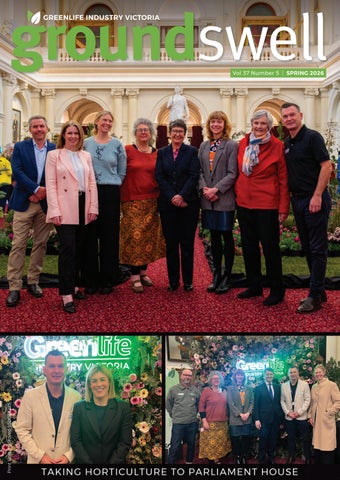
FRONT COVER Taking horticulture to Parliament House
GROUNDSWELL | SPRING 2026 // 03
E X E C U T I V E U P D AT E
Executive update As we enter into spring, I think many of us are looking forward to longer days, a little more sunshine and, hopefully, some drier weather.
Carl Soderlund President
It has been a wet winter for many across Victoria, while the broader economic environment remains challenging. Cost-of-living pressures continue to weigh on consumer confidence, inflation remains stubborn, and interest rate relief has been slower than many would have hoped. The constant commentary around household budgets and economic uncertainty does little to encourage discretionary spending either. Despite these headwinds, our industry continues to demonstrate its resilience. It hasn’t necessarily been easy, but there is a growing sense of momentum as we head towards spring.
Welcome to the new Groundswell Craig Taberner CEO
Welcome to the first seasonal edition of Groundswell. We hope you enjoy the new look and feel, which reflects our new name and identity, Greenlife Industry Victoria (GIV). While the magazine has evolved, its purpose remains very much the same. Groundswell will continue to bring you the industry news, insights, profiles, education and updates that help keep our members informed, connected and up-to-date. Our transition to Greenlife Industry Victoria formally commenced on 1 July 2026 and has been very positively received by members and external stakeholders. We were also pleased to officially introduce the new brand externally when we took horticulture to Victorian Parliament House in August, an appropriate setting to demonstrate both who we are today and where our industry is heading.
04 // GROUNDSWELL | SPRING 2026
A busy few months Reflecting on the past few months, there has been an enormous amount happening across our relatively small GIV team. Our Trade Days continue to perform strongly and remain an important meeting place for members, buyers, growers and suppliers. Our events program has also been particularly active. The Tree & Shrub Growers event hosted at AgriBio in Bundoora was an outstanding opportunity to bring people together, exchange knowledge and strengthen industry connections. We also enjoyed a terrific industry tour of the Royal Botanic Gardens Melbourne, with a number of participants staying on to experience Lightscape. Further north, our industry tour aligned with Green Expo in Queensland which provided another valuable opportunity to see businesses and innovation beyond Victoria. We were privileged to visit both Boomaroo Nurseries and Pohlmans Nursery, as well as attend the Expo. Another highlight was our Annual Awards evening at the Melbourne Arts Centre. Thank you to everyone who attended and helped make the evening such a success, and congratulations to all our award recipients. The Awards are an opportunity to recognise the people and businesses whose talent, commitment and innovation help our industry flourish. You’ll find more on this year’s winners later in this edition.
Taking our industry to Parliament Advocacy remains one of the most important roles we undertake on behalf of members.
E X E C U T I V E U P D AT E
In late August we held our seventh annual Horticulture Showcase at Queen’s Hall, Victorian Parliament House. It is a key event on our advocacy calendar, bringing our industry's story directly into the heart of Victorian decision-making. That engagement takes on even greater importance as Victoria approaches the November 2026 State Election. This year’s Showcase gave us the opportunity to present our five key actions to Grow Victoria and speak directly with Members of Parliament about the contribution our industry makes economically, environmentally and to the community. Our approach remains focused on building strong bipartisan relationships. Regardless of the outcome of the State Election, we want the next Victorian Government to understand the value of our industry and the practical actions that will help it grow. You can read more about the Showcase and our advocacy priorities later in this edition of Groundswell.
Looking ahead As part of our ongoing work to showcase innovation and excellence in greenlife, applications are now open for Plant of the Year 2027 and 2028. The program recognises outstanding plant varieties that combine visual appeal, performance and innovation. Whether it is an exciting new release or an exceptional performer deserving greater recognition, we encourage members to put forward plants that demonstrate the very best of our industry. And, before we get too far ahead of ourselves, we have Australian Horticultural Trials Week proudly presented by the Garden Gurus as seen on Channel 9 to look forward to in the first week of December. Trials Week has become an important fixture on the industry calendar and a fantastic opportunity to see new varieties, emerging trends and innovation firsthand while connecting with colleagues from across the country.
Thank you Finally, thank you to every member who has renewed their membership for another year, and to our industry partners who continue to support both GIV and the broader greenlife industry. Your support makes possible the advocacy, events, education, professional development, promotion and industry programs we deliver throughout the year. There is plenty ahead of us. Spring is approaching, the days are getting longer, and despite the economic challenges facing businesses and consumers, there are good reasons to remain positive about the opportunities ahead. Thank you for being part of Greenlife Industry Victoria, and I hope you enjoy this new edition of Groundswell.
Carl Soderlund
Craig Taberner
President, Greenlife Industry Victoria Botanix Plant Supply
CEO, Greenlife Industry Victoria
GROUNDSWELL | SPRING 2026 // 05
F E AT U R E : PA R L I A M E N T S H O W C A S E
Taking horticulture to Parliament House for the seventh year Greenlife Industry Victoria returned to Parliament House for its seventh annual Parliamentary Horticulture Showcase, bringing the people, plants and innovation of Victoria’s greenlife industry directly to the state’s decision-makers. In an election year, CEO Craig Taberner reflects on why this year’s Showcase carried particular significance for the industry. BY CRAIG TABERNER
Each year I wonder how we will improve on the last. Yet the Showcase continues to evolve, not simply as a celebration of Victoria’s horticulture industry, but as one of our most important opportunities to put our industry, its people and its priorities directly in front of Victoria’s decision-makers. This year, with a state election approaching, that opportunity carried even greater significance.
<
A garden with a story to tell FROM L–R: Carl Soderlund, Emma Kealy MP, Sarah Jones, Megan Blair, Michaela Settle MP, Jane Edmanson, and Craig Taberner.
At the centre of Queen’s Hall was The Showcase Garden, created by Megan Blair, Georgina Honner and Sarah Jones from The Gordon in Geelong, winners of the Award of Excellence in the Achievable Gardens category at the 2026 Melbourne International Flower and Garden Show.
06 // GROUNDSWELL | SPRING 2026
Mentored by 2026 MIFGS Best in Show winner Matt York, the designers created a colourful and welcoming garden that encouraged people to pause, notice and engage. This year we also extended the story beyond the central garden. Around Queen’s Hall, a curated perimeter display brought together plants, products and horticultural artefacts demonstrating how deeply our industry is woven into Victorian life. From the remarkable Australian-bred Jala avocado, to the evolution of soilless growing media, the iconic Seasol brand, climate-ready turf and the 2026 Plant of the Year, Corymbia ficifolia ‘Precious Pearl’, each display told its own story. Together, they demonstrated the contribution horticulture makes to Victoria’s economy, environment and communities.
F E AT U R E : PA R L I A M E N T S H O W C A S E
Three days of engagement Our official opening brought together the Minister for Agriculture, the Hon. Michaela Settle MP, and Shadow Minister for Agriculture, Emma Kealy MP, who formally opened the Showcase with our traditional vine-cutting ceremony, joined by Jane Edmanson OAM. Wednesday’s Appreciation Day provided the opportunity for a deeper conversation about our industry’s future, with horticulturalist and Garden Gurus host Trevor Cochrane and Melissa King, horticulturalist and presenter on Better Homes and Gardens. These conversations were particularly important this year because they allowed us to focus attention on GIV’s advocacy priorities ahead of the Victorian election.
Five actions to Grow Victoria Our message to Members of Parliament was deliberately clear: Victoria’s horticulture industry grows more than plants. It grows our environment, communities and economy. »
GROUNDSWELL | SPRING 2026 // 07
F E AT U R E : PA R L I A M E N T S H O W C A S E
More than 35 per cent of Australia’s greenlife is grown in Victoria. Our industry employs more than 25,000 people and contributes more than $3.1 billion annually to Victoria’s economy. This year we presented Five Actions to Grow Victoria. At the centre is our call for government to co-invest up to $21.2 million in a Victorian Horticulture Centre of Excellence, bringing together education, workforce development, innovation and technology. We need to make horticulture a career of choice, develop the capability required for a greener and more liveable Victoria, and ensure our state leads horticultural innovation.
< FROM L–R: Craig Taberner, Melissa King, Trevor Cochrane and Carl Soderlund
< FROM L–R: Rebecca Humphris, Emma Kealy MP, Claire-Elisa Blackie and Suzie Shearer
08 // GROUNDSWELL | SPRING 2026
I was particularly pleased to highlight the Opposition’s commitment to support direct investment in the Centre should it form government following the November election. Our remaining actions are equally important: elevating the Melbourne International Flower and Garden Show through strategic marketing; growing Victoria’s horticulture economy by supporting Victorian-grown greenlife, reducing regulatory pressures and investing in Branch Out; recognising green infrastructure as essential infrastructure; and securing a climate-resilient and water-secure horticulture sector.
F E AT U R E : PA R L I A M E N T S H O W C A S E
Together, these five actions provide a practical agenda for government and industry to strengthen Victoria’s horticultural capability and unlock its economic, environmental and community benefits.
More than a Showcase
Making the case in Parliament
Seven Showcases later, it has become an established and important part of GIV’s advocacy calendar.
The displays throughout Queen’s Hall helped bring these priorities to life. The 2026 Plant of the Year, Corymbia ficifolia ‘Precious Pearl’, demonstrated how Australian plant innovation can deliver beautiful, resilient trees suited to modern urban environments. Climate-ready turf demonstrated how parks, schools and public spaces can remain usable with less water in a hotter and drier climate. The Melbourne International Flower and Garden Show provided another compelling example. MIFGS attracts more than 100,000 visitors and generates more than $45.5 million in direct economic returns for Victoria each year, yet around 80 per cent of its visitors currently come from within the state. There is a significant opportunity to grow interstate and international visitation and further establish Victoria as Australia’s garden and major-events capital. These are exactly the conversations the Showcase is designed to generate. It allows decision-makers to experience our industry differently - to walk through a garden, see new plant varieties and innovations, and speak directly with the people behind them.
When we began this event in 2018, our ambition was to raise our profile and strengthen relationships with government.
With Victorians heading to the polls in November, this year was about ensuring that whoever forms the next government understands both the scale of our contribution and the opportunity that comes from investing in our sector. Our message is straightforward: back horticulture and you are backing a greener, healthier, more resilient and more prosperous Victoria. None of this happens without an enormous collective effort. My thanks go to our designers, growers, suppliers, horticultural personalities, partners and supporters, and to the GIV team who once again brought an ambitious Showcase together inside one of Victoria’s most important buildings. Most importantly, thank you to our members. The credibility we take into Parliament House comes from the businesses and people we represent every day. Another Showcase is complete, and how important it was in an election year!
GROUNDSWELL | SPRING 2026 // 09
F E AT U R E : G C P
From knowledge to practice: The 2026 Garden City Plastics Roadshow For the fourth consecutive year, Garden City Plastics (GCP) has taken its annual Roadshow across Australia, bringing growers, industry specialists and supply partners together to share practical knowledge and explore solutions to some of the challenges facing production nurseries.
<
BY ELLIOT AKINTOLLA
GCP's national Roadshow
On the 21st July, more than 85 growers and industry representatives from Victoria joined GCP’s national Roadshow. Held across five Australian states, the free industry event takes learning into real growing environments, giving attendees the opportunity to see trials, demonstrations and management techniques in practice. Around 500 registrations were received nationally, demonstrating the strong appetite for practical, accessible technical education. This year’s show focused on integrated pest, weed, disease and nutrition management. With technical experts from ICL Growing Solutions, Biological Services, Grow Help Australia and Greenlife Industry Australia (GIA), Victoria’s Roadshow took participants from GCP’s Dandenong South headquarters into commercial growing environments at Oasis Horticulture in Cranbourne and Ball Australia in Skye.
10 // GROUNDSWELL | SPRING 2026
Putting weed and nutrition management to the test At Oasis Horticulture, attendees learnt about two significant production challenges and opportunities: weed management and plant nutrition. Stuart Burns from GIA explored the importance of looking beyond a single control method for integrated weed management. Growing media, water sources, incoming plant material, nursery hygiene, hand weeding and herbicide use all play a key role and require an ongoing and integrated approach. Stuart also shared practical tips on effective hand-weeding techniques to help growers make better use of labour and time. Dr Sam Stacey from ICL followed with a live demonstration on the calibration and application
F E AT U R E : G C P
of a pre-emergent herbicide, showing how correct calibration can directly influence the effectiveness of a weed-management program. Practical nutrition management was covered by Kim Girdwood and John Walsh from ICL, with sideby-side trials that demonstrated the visible impact fertiliser selection, application rates and longevity can make on plant performance. Wetting-agent trials provided another highly visual demonstration, showing noticeable differences in root development where Hydraflo 2 had been incorporated into the growing media. The results highlighted the important role moisture management can play alongside nutrition in producing healthy, market-ready plants.
Seeing integrated pest management in action At Ball Australia, the conversation shifted to integrated pest and disease management.
look beyond the most obvious symptoms when diagnosing plant-health problems. Environmental or abiotic disorders can sometimes present symptoms that resemble disease. Dr Manners delivered a practical session on plant diagnostics from foliage through to crowns, vascular tissue and roots. Rather than simply removing a plant from its pot and inspecting the root ball, he showed how to investigate further by washing away growing media, examining root health and looking inside plant tissue when necessary. The session also reinforced the value of knowing when to call on specialist support. Grow Help Laboratories offers diagnostic services, while agronomists and other technical specialists can help growers investigate problems where the cause isn't immediately clear. Andrew demonstrated how to use the Agdia test and correctly package samples for postage to the laboratory. »
Greg Pruit from Biological Services explored the increasing range of beneficial insects used to manage common pests including aphids, thrips and whiteflies, alongside the monitoring and early detection needed to make an IPM program effective. Greg demonstrated practical scouting techniques for monitoring pests, and introduced the Entomatic dispenser, designed to assist commercial-scale releases of beneficial insects in a growing environment. These demonstrations are an important part of what the Roadshow aims to achieve. It is one thing to hear about new technology or management practices; it is another to see them operating, ask questions of the specialists and consider how they might work within your own production system.
Looking closer at plant health Disease management starts by getting the diagnosis right, and Dr Andrew Manners from Grow Help Laboratories challenged growers to
More information Garden City Plastics 10 E J Court, Dandenong South VIC 3175 t: 1300 695 098 e: vic@ gardencityplastics.com gardencityplastics.com
GROUNDSWELL | SPRING 2026 // 11
F E AT U R E : G C P
The Roadshow also demonstrates what can be achieved through industry collaboration. GCP sincerely thanks ICL Growing Solutions, Biological Services, Grow Help and GIA for sharing their knowledge, support and investment in the program, along with the nurseries and businesses that hosted and participated in events around Australia. A special thank you also goes to Greenlife Industry Victoria CEO Craig Taberner and the GIV team for attending and continuing to support GCP in promoting these opportunities throughout the Victorian industry.
More than a Roadshow For GCP, the Roadshow forms part of a much broader commitment to supporting growers with technical knowledge and access to expertise. Our role does not end with supplying products. Through our agronomy support, field managers, online Agronomy Solution Finder, technical partners and education initiatives such as the Roadshow and webinar series, we want growers to know that support is available when they encounter a challenge. Sometimes that means providing an answer; at other times, it means connecting a grower with the right specialist who can help find one.
12 // GROUNDSWELL | SPRING 2026
For those who attended, we hope you left with new ideas, practical knowledge and perhaps a different way of looking at some familiar production challenges. And for those who couldn’t make it this time, there is always next year. In the meantime, the learning continues through GCP’s technical webinar series, with recordings available to GCP customers through our website. If you’re facing a production challenge or would like to learn more about technical support available, speak with your local GCP representative. We look forward to continuing to bring growers, experts and industry together to share knowledge, solve problems and ultimately achieve better growing outcomes.
F E AT U R E : D AV I D A U S T I N R O S E S
Helping customers discover the fragrance of English Roses Fragrance is often the quality that transforms interest into affection. While colour and flower form may first attract attention, scent creates an emotional connection that lingers long after a garden centre visit. By understanding the fragrance families of English Roses, retailers can help customers choose varieties that bring lasting enjoyment to their gardens. For more than sixty years, David Austin® has championed one defining quality above all others: fragrance. From the earliest days of the breeding programme, David Austin set out to combine the timeless beauty and perfume of Old Roses with the repeat flowering, robust health and broad colour palette of modern roses. The result was the English Rose, a completely new class of rose admired around the world for its distinctive blooms, exceptional performance and unforgettable fragrance. While flower colour may catch the eye, fragrance creates a deeper connection. A single bloom can evoke childhood gardens, favourite seasons or treasured moments shared with family and friends. Unlike colour, which is appreciated instantly, fragrance encourages people to pause, lean closer and fully experience a rose. It is often the quality gardeners remember long after they have left the garden centre.
BY DAVID AUSTIN ROSES
To help gardeners explore this diversity, David Austin groups the fragrances of English Roses into five distinctive families. Each offers its own character and provides retailers with an engaging way to introduce customers to the remarkable world of rose fragrance.
Old Rose The Old Rose fragrance is the scent many people instinctively associate with roses. Rich, romantic and beautifully layered, it combines notes of citrus peel, dried fruits, black pepper and patchouli. It is luxurious without being overpowering and has become the benchmark against which many fragrant roses are judged. »
<
Rose fragrance is also remarkably complex. Scientists have identified up to 400 aromatic compounds within a single bloom, creating perfumes
that rival the finest fragrances. No two varieties smell exactly alike and, much like perfume, every gardener develops personal favourites. Some are drawn to rich, traditional scents, while others prefer lighter, fresher or fruitier fragrances. Helping customers discover these differences transforms choosing a rose from a practical decision into an enjoyable and memorable experience.
The Poet’s Wife (Auswhirl) PBR
GROUNDSWELL | SPRING 2026 // 13
F E AT U R E : D AV I D A U S T I N R O S E S
Gertrude Jekyll (Ausbord) is one of the finest expressions of this fragrance family. Introduced in 1986, it remains one of the world's most admired English Roses, producing glowing pink blooms with a rich, perfectly balanced Old Rose fragrance. Elegant in both flower and habit, it continues to demonstrate why classic rose perfume never goes out of style.
Fruity Fresh, lively and uplifting, Fruity fragrances range from crisp apple and pear to berries and bright citrus notes. They bring freshness and energy while remaining unmistakably rose-like.
<
The Poet’s Wife (Auswhirl) PBR beautifully represents this family. Its rich yellow blooms release a fragrance with fresh lemon notes that gradually develop into a sweeter, fuller perfume as the flowers mature, rewarding gardeners throughout the flowering season.
Gertrude Jekyll (Ausbord)
Musk Musk fragrances are warm, soft and subtly spiced, carrying hints of clove, cinnamon and honey. Unlike many roses, the perfume often comes from the stamens, creating a lighter fragrance that rewards anyone who pauses for a closer look.
< Tottering-by-Gently (Auscartoon)
%$ "" # ! "" $ %$ ! !# $$ !" & # %$ % !$%' ! "" " " % # $ %# $ %$ ! $ % % $ #% $$ !% % %# % $ %
((('&%$#"!# ' '!
14 // GROUNDSWELL | SPRING 2026
F E AT U R E : D AV I D A U S T I N R O S E S
Tea Tea fragrances are refined, fresh and comforting, with notes of violet and orris root that gradually develop into hints of lemon and blackcurrant. They are understated, sophisticated and beautifully balanced. Princess Alexandra of Kent (Ausmerchant) PBR combines this evolving fragrance with exceptionally large, deeply cupped pink blooms. The flowers make a striking impression in the garden while retaining an elegance that has become a hallmark of the English Rose.
Myrrh Perhaps the most distinctive of all the fragrance families, Myrrh often surprises gardeners encountering it for the first time. Named after Myrrhis odorata, or Sweet Cicely, it is fresh and aromatic, carrying notes of aniseed, fennel and herbs, often softened with hints of vanilla, meadowsweet and heliotrope. Claire Austin (Ausprior) PBR is one of the finest examples. Its creamy white flowers open gracefully from pale lemon buds, producing a distinctive fragrance that is both light and memorable. Vigorous and versatile, it performs beautifully as either a shrub or a climber.
Helping customers choose by fragrance For retailers, fragrance offers an opportunity to begin conversations that go beyond colour and flower form. Customers often arrive looking for a particular shade or growth habit, yet many leave having discovered a fragrance that resonates with them personally. Encouraging visitors to compare different scent families creates a more engaging shopping experience and helps customers choose with greater confidence.
<
Tottering-by-Gently (Auscartoon) captures this character perfectly. Its simple yellow flowers are borne in generous sprays, creating a relaxed, natural display while offering an elegant fragrance that gently draws visitors in.
FROM L–R: Princess Alexandra of Kent (Ausmerchant) PBR Claire Austin (Ausprior) PBR
Organising displays by fragrance family also gives staff another way to tell the story of English Roses. Rather than viewing roses simply by colour, customers can explore the remarkable diversity of scent and discover varieties they may never have considered otherwise. A David Austin Scent Gallery brings this idea to life by displaying representative varieties from each fragrance family together. Customers are encouraged to slow down, compare fragrances and enjoy one of gardening's most rewarding sensory experiences. For retailers, it creates a natural focal point within the garden centre, sparks conversations and showcases the diversity that makes English Roses so distinctive. In today’s retail environment, fragrance remains one of the few qualities that cannot be communicated through a label or photograph alone. It must be experienced. By inviting customers to pause, breathe deeply and discover the rich diversity of English Rose fragrances, retailers can create memorable moments that inspire lasting enjoyment and often the beginning of a lifelong appreciation of roses.
More information Contact: e: internationalpartner network @davidaustinroses.co.uk.
GROUNDSWELL | SPRING 2026 // 15
INDUSTRY NEWS
Celebrating excellence across Victoria’s greenlife industry The people, businesses and emerging leaders helping shape the future of Victoria’s greenlife industry were celebrated at the 2026 Greenlife Industry Victoria Annual Horticultural Industry Awards Night on Saturday 22 August. BY MEG SAN MIGUEL
Greenlife Industry Awards provide an opportunity to recognise the outstanding achievements across Victoria’s vibrant horticultural sector – from students taking their first steps into the industry, to established businesses setting benchmarks for excellence, innovation, and sustainability. Winning an Industry Award is an important career marker for the next generation of horticulturalists.
<
This year’s Horticulture Student of the Year was Molli Scott of Kangan Institute, who is also building her practical industry experience with Ball Australia.
FROM L–R: Ian Firth with Mario Diaco from Diaco’s Garden Nursery Heatherton. Greenlife Industry Victoria Horticultural Awards Evening Ben Scoble with Molli Scott of Kangan Institute
Molli impressed the judging panel through her ability to translate her studies into practical outcomes, alongside a strong commitment to sustainability, teamwork and supporting the people around her. Her willingness to mentor peers was particularly noted by the judges and highlighted the leadership potential she is already demonstrating early in her career. Mariia Brunt of Haars Nursery was named Young Horticulture Leader of the Year. Mariia was recognised for leadership that combines practical problem-solving with strong people skills. Judges highlighted her adaptability, inclusive communication and ability to guide people through
16 // GROUNDSWELL | SPRING 2026
change while retaining collaboration and trust – qualities that position her strongly among the next generation of horticulture production leaders. Three businesses were also recognised for excellence across different parts of the sector. Australian Growing Solutions was named Allied Business of the Year, with judges recognising the company’s product innovation, investment in research and development, customer service and commitment to sustainability. Its focus on quality assurance and compliance was also recognised as an important part of the confidence it provides to customers. Diaco’s Garden Nursery, Heatherton received Horticultural Retailer of the Year. The business demonstrated strengths across customer service, store presentation and signage, business strategy, point-of-sale technology, workplace culture and community involvement – together creating a strong and accessible retail experience. The Commitment to Environmental Stewardship Award went to Eco Guardians, whose technologydriven model diverts approximately 30 tonnes of food waste from landfill each day. Through its own engineering and process development, the business has also developed SoilFood, which is supplied to
INDUSTRY NEWS
farms across Australia to help increase soil carbon and support beneficial microbial communities. Judges recognised the broader potential of the circular model to connect food waste management, soil health and agriculture.
Show and 11 years of service on the FGSL Board from 2013 to 2024, including four years as Chair. During that period, he helped guide the organisation through major governance, partnership and strategic changes.
<
The evening also saw Michael Warner of Warner’s Nurseries presented Greenlife Industry Victoria Life Membership.
Fion Zhang of Box Hill Institute, Mani Swift of Ball Australia and Helix Australia were also recognised on the night as Highly Commended in their respective categories.
Greg Young with Matt Underwood and Sam Westhorpe from Australian Growing Solutions.
Michael was recognised for his distinguished service, leadership and a long-term contribution to both the association and the industry. His contribution included Warner’s Nurseries’ substantial support of the Melbourne International Flower and Garden
Together, this year’s recipients reflect the breadth of talent within horticulture – and the many different ways individuals and businesses continue to strengthen, innovate and invest in our industry.
FROM L–R: Sophie Thorne and Marcelle Swanson from Eco Guardians, with Hamish Mitchell.
Bruce Yelland with Mariia Brunt from Haars Nursery.
GROUNDSWELL | SPRING 2026 // 17
INDUSTRY NEWS
Transplant Systems returns with renewed energy for Australian growers Transplant Systems Australia recently became part of PrimeHort New Zealand, bringing fresh investment, innovation and long-term support for Australian growers. For more than 40 years, Transplant Systems has been helping forestry and vegetable growers improve productivity through quality seedling trays and nursery automation. And now we enter an exciting new chapter, combining the renowned Transplant Systems name with the expertise and long-term commitment of PrimeHort.
BY KIRSTY MILLAR
PrimeHort has been New Zealand’s leading horticultural supplier since 2002. Family-owned, its team supports commercial growers, landscapers and big-box retailers with practical solutions that improve productivity and crop performance.
While ownership has changed, our focus has not We remain committed to supplying the TS-nursery trays that growers rely on. We are also investing in tailored AI support tools and working with customers as long-term partners. Over the past few months we have enjoyed connecting face-to-face with growers, discussing future projects and sharing how automation can ease labour challenges and support business growth. We’ve also renewed our partnership with Greenlife Industry Victoria.
< Ernie Wearmouth (L) and Joel Wearmouth (R) at Greenscape and Green Expo
More information Transplant Systems 48 Tarnard Dr, Braeside VIC 3195 t: 03 9769 9733 e: sales@primehort.com.au transplantsystems.com.au
18 // GROUNDSWELL | SPRING 2026
The response from growers has been incredibly positive. Understandably, they’ve also been curious about what the changes mean for them. “Like we do in NZ, we take a genuine partnership approach with customers. The products growers know and trust aren’t changing. Transplant Systems nursery trays continue to be manufactured in Melbourne by the same experienced team with healthy stock levels across the range. Consistency matters when you’re producing quality plants, and we wouldn’t change products with such a strong reputation,” says Ernie Wearmouth. Joel Wearmouth adds, “For nursery automation we respect that every nursery is different. Every crop, workflow and production target presents its own challenges. Our focus is to understand an operation before recommending a solution. That philosophy has worked very well for our NZ customers and will continue as we build Transplant Systems in Australia.”
Investing heavily in the future With the change, Australian growers can also take advantage of our exclusive partnership with Italian nursery automation specialists Da Ros.
INDUSTRY NEWS
Since 1986, Da Ros has been a global leader in automation. From standalone tray fillers and seeders through to complete integrated production lines, everything is manufactured in-house. Whether you’re considering your first machine or planning a complete nursery upgrade, we’re here to help. Send us your floor plan and requirements and we’ll happily prepare a free layout design and quote. We continue to stock both machinery and spare parts in Australia. But demand has been strong so it’s important growers plan ahead, particularly as global shipping continues to present challenges for everyone.
Meet iFIX, your AI-powered nursery expert As part of our commitment to aftersales care, this year we have developed iFIX, an AI-powered nursery expert designed for customers using Da Ros automation. Believed to be a first for the horticultural machinery sector in Australasia, iFIX helps reduce downtime by giving growers instant access to trusted technical guidance and replacement parts info, from any device, 24/7. iFIX doesn’t replace a local technician. It complements our support by helping growers solve simple operational questions quickly while making it easier to know when specialised help is required.
Looking ahead Transplant Systems is back … yet we’ve only just begun! We’re enjoying supporting Australian growers to boost productivity and produce healthier plants. If we haven’t met yet, we’d love the opportunity to visit your nursery, learn more about your goals and explore how we can help. We look forward to growing alongside the Australian Greenlife industry.
GROUNDSWELL | SPRING 2026 // 19
INDUSTRY NEWS
UK Horticulture – observations, insights and opportunities A recent visit to the United Kingdom (UK) offered valuable insight into the country’s greenlife industry – from the prestigious RHS Chelsea Flower Show and leading commercial growers to evolving garden centre models, the research capabilities of RHS Wisley and the work of peak industry body the Horticultural Trades Association (HTA). Just as importantly, the visit reinforced that while the UK provides a strong international benchmark, Victoria’s industry is already leading in several important areas. BY CRAIG TABERNER
Chelsea Flower Show The RHS Chelsea Flower Show remains one of horticulture’s great international showcases. What immediately stands out is the consistently high standard of presentation. Whether a show garden, trade display or retail exhibit, everything feels permanent, polished and highly considered. Exhibitors invest significantly in presentation, creating a premium experience across the entire event.
<
Growers use Chelsea as much for promotion and lead generation as direct sales. Displays showcase individual product ranges and retail exhibitors create spaces more akin to premium shopfronts than temporary exhibition stands.
FROM L–R: Displays at the RHS Chelsea Flower Show
This commitment to quality is reinforced through Chelsea’s award system. Recognition delivers strong marketing value, while maintaining presentation standards is essential for future participation.
Fashion and presentation played a major role in the event atmosphere, comparable to the prominence of fashion during Melbourne's Spring Racing Carnival. Attendees embraced the occasion by dressing formally, contributing to the prestige and excitement of the event. Chelsea is also a major business and media event. Opening day includes corporate hospitality, functions and a gala dinner attracting business leaders and industry stakeholders. Media coverage is extensive, with television, radio, print and social media ensuring global visibility throughout the week. Show gardens operate under a unique model. Gardens are rehomed post the show, supporting sustainability outcomes and community benefit. Waste reduction and reuse are increasingly central to event delivery. In regard to MIFGS, there were some clear opportunities, and forming a stronger and deeper
Proud Partners of GIV Technology is what we do, innovation is what we live for Follow Us
/powerplantsaustralia
20 // GROUNDSWELL | SPRING 2026
@powerplantsaust
powerplants.com.au
/user/powerplantsaustralia
pb-tec.com
@powerplantsaustralia
INDUSTRY NEWS
relationship with the Chelsea Show management was a good starting point. However, we also do some things exceptionally well at MIFGS, and the Chelsea team is keen to explore these areas further and understand what they can learn from our approach over time.
Growers Visits to The Bransford Webbs Plant Company and British Garden Centres’ Temple Nursery provided two contrasting perspectives on UK growing facilities.
A key observation was that Victorian growers compare very strongly on an international scale. In the many areas I saw, we are more advanced than their UK counterparts, particularly in production efficiency and technology adoption.
<
Bransford Webbs is a highly specialised wholesale nursery focused on large-scale production, automation, crop consistency and servicing professional horticultural markets. Temple Nursery combines production with delivery to their own retail garden network, strengthening the link between growing, merchandising and the end consumer.
RHS Chelsea Show Gardens
The visit reinforced the sophistication and innovation already present within Victoria’s production nursery sector.
Horticultural Trades Association (HTA) Engagement with the Horticultural Trades Association (HTA) highlighted the importance of strong industry representation and advocacy. The HTA plays a similar role in the UK to GIV in Victoria.
< Visits to growers in the UK.
Its work includes policy advocacy on issues such as water management, import/export conditions, and workforce development. The HTA also delivers industry support programs, including voucher schemes and business development initiatives, while providing a strong collective voice for horticulture at government level. »
GROUNDSWELL | SPRING 2026 // 21
INDUSTRY NEWS
The HTA model demonstrates the value of a unified industry body that connects commercial interests with policy influence, research, and market development. Continued engagement between Australia and the HTA presents opportunities for collaboration, benchmarking and shared advocacy priorities, and supports ongoing knowledge exchange and strengthens international industry connections.
Retail Garden Centres One of the clearest differences between the UK and Australian markets is the evolution of the garden centre.
<
The UK garden centre sector is widely regarded as being 10–15 years ahead of Australia in retail development, customer experience and diversification. Many leading centres have transformed from plantfocused retail outlets into full lifestyle destinations.
UK garden centres.
In larger centres, plants may now account for only 20–40% of turnover. The remainder is generated through cafés and restaurants, food halls, delicatessens, homewares, clothing, gifts, seasonal retail (particularly Christmas), and pets. A range of operators was observed, including the Blue Diamond group, Hilliers, Notcutts, Bents, Webbs and B&Q.
EVERY GOOD GARDENER DESERVES A GLASS OF COPPERHEAD AFTER A BIG DAY IN THE GARDEN
SCAN TO ORDER
@copperheadwines
Copperhead Wines
Free shipping Vic customers min order 12+ bottles. Wine tasting by appointment only.
WWW.COPPERHEADWINES.COM.AU
22 // GROUNDSWELL | SPRING 2026
INDUSTRY NEWS
The strongest UK operators are no longer competing solely with other garden centres. They are competing with shopping centres, hospitality venues and tourism destinations for consumer time and discretionary spending. Customers often spend several hours on site, combining shopping, dining and leisure experiences. The key lesson for Australian retailers is that while plants and horticultural expertise remain central, long-term success increasingly depends on building a broader destination experience around them.
< UK garden centres.
The UK model demonstrates the potential of viewing garden retail not as a transaction, but as an experience-led destination.
Wisley
Hilltop integrates scientists, researchers, educators, industry professionals and the public within a single horticultural research and engagement facility. Funding is derived from a mix of membership revenue, donations, sponsorship, commercial activity, research partnerships and visitor income.
<
RHS Hilltop at Wisley represents a compelling benchmark for what a future horticultural centre of excellence could achieve in Australia.
RHS Hilltop, Wisley.
For Victoria, the opportunity is significant. The UK provided valuable ideas and benchmarks, while also reinforcing that Victoria’s horticulture industry has considerable capability, innovation and leadership to share on the global stage. It truly was a trip of a lifetime, filled with invaluable learnings and insights. I’m excited about the relationships forged and look forward to continuing to strengthen them, while bringing some of these ideas and learnings to life here in Victoria.
GROUNDSWELL | SPRING 2026 // 23
INDUSTRY NEWS
Behind the gates: Lessons from Queensland’s leading production nurseries Greenlife Industry Victoria’s Tree & Shrub Growers headed north ahead of Green Expo 2026, getting behind the gates at Pohlmans and Boomaroo Nurseries for a first-hand look at two major Queensland production businesses. There is something particularly valuable about stepping inside another nursery.
BY MEG SAN MIGUEL
Beyond the plants themselves, it is an opportunity to see how another business approaches its growing systems, technology, people, infrastructure and the everyday challenges of production - and to take some of those ideas back to your own operation.
<
In August, members of Greenlife Industry Victoria’s Tree & Shrub Growers (TSG) did exactly that, travelling to Queensland for a special industry tour held in conjunction with Green Expo 2026.
Production nursery operations in Queensland
The small group visited Pohlmans and Boomaroo Nurseries, gaining behind-the-scenes access to two significant Queensland production operations and the opportunity to exchange ideas with the people behind them.
Production at scale at Pohlmans The first stop was Pohlmans, one of Queensland’s major production nurseries.
For the TSG group, the scale of the operation was immediately impressive. But equally valuable was the opportunity to look beyond size and see the systems, infrastructure and planning required to keep a large and diverse production nursery moving.
< LEFT & BELOW: Tree & Shrub Growers Tour participants in Queensland.
Touring the site provided an insight into how plants progress through a large-scale growing operation, and how decisions around workflow, infrastructure and production systems can support efficiency and plant quality. It also gave members the chance to talk directly with the Pohlmans team, ask questions and compare approaches with their own nursery operations back in Victoria.
A different perspective at Boomaroo The tour continued at Boomaroo Nurseries, providing another perspective on production at scale and an opportunity to compare the approaches of two very different businesses.
24 // GROUNDSWELL | SPRING 2026
INDUSTRY NEWS
Seeing multiple nurseries is an important part of tours like these. Every operation has its own site, crops, systems and challenges, but seeing how another grower tackles familiar problems can prompt new thinking. Sometimes it is a major piece of infrastructure or technology that catches your attention. Other times, it can be something much simpler - the way plants are handled, how a growing area is organised or how people and materials move around a site. The opportunity to ask questions and exchange ideas with other growers is just as valuable as seeing the infrastructure itself. The Queensland tour extended one of the key strengths of the Tree & Shrub Growers program beyond Victoria. Throughout the year, TSG brings growers together at nurseries and industry sites to share knowledge, see different approaches in practice and build stronger connections across the production sector. Taking the group interstate opened that exchange even further. With Green Expo providing another opportunity to connect with the wider industry, the trip gave members time away from their own businesses
to see what others are doing, compare experiences and come home with fresh ideas. No two nurseries operate in exactly the same way – and that is precisely what makes opening the gates and sharing knowledge so valuable.
<
Taking TSG on the road
Tour participants got to see behind the scenes.
A big thank you to the teams at Pohlmans and Boomaroo Nurseries for generously welcoming our TSG group and sharing their time, knowledge and experience. And thank you to the members who joined us on the road. There was plenty to see, plenty to discuss and more than a few ideas making their way back to Victoria.
GROUNDSWELL | SPRING 2026 // 25
MEMBER PROFILE
New member profile: TTA-ISO Oceania BY THEO ARVANITAKIS
Bringing decades of global horticultural automation experience to growers across Australia and the wider Oceania region, TTA-ISO is helping nurseries improve efficiency and productivity through practical automation solutions. Founded in the Netherlands in 1996, TTA built its reputation pioneering high-speed transplanting technology before expanding into advanced vision systems, deep learning and autonomous solutions. The business established a local Australian presence in 2023, and its 2025 merger with ISO broadened its capabilities further into areas including grafting, bulb planting and harvesting.
What makes TTA-ISO different?
<
At its core, TTA-ISO is focused on helping growers solve production challenges through practical innovation and automation. By working closely with customers around the world, the team develops solutions designed to improve productivity, enhance yields and support more sustainable growing practices. The goal is simple: to help growers work more efficiently and achieve better outcomes.
Theo and Nico at Green Expo 2026.
improve efficiency and respond to the changing demands of modern production.
What’s next for TTA-ISO Oceania? TTA-ISO is continuing to strengthen its presence across the region, including expanding its service team with experienced technicians. The business is also introducing Finance by TTA-ISO, providing another option for businesses looking to invest in automation technology.
What does TTA-ISO offer growers? TTA-ISO specialises in complete nursery automation, with a strong focus on plant handling. Its solutions include transplanting plugs and cuttings, sorting, grafting, germination correction, harvesting, pot and tray handling, packing and other tailored automation applications.
Tell us a little about the local team.
What experience does the team have in the Victorian nursery industry?
Across the team, there is expertise in nursery design, automation flow, equipment installation, training and ongoing service - allowing TTA-ISO to support customers from initial planning through to implementation and after-sales support.
While TTA-ISO’s Australian presence is relatively new, its local team brings more than 20 years of experience working within the nursery industry. During that time, team members have supplied and supported a broad range of nursery automation – from pot fillers and seeders through to sophisticated AI vision-enabled transplanting equipment.
What is TTA-ISO’s approach to innovation? TTA-ISO’s vision is to help transform horticulture and food production through new technology and automation. The business is focused on developing practical solutions that help growers rethink their processes,
26 // GROUNDSWELL | SPRING 2026
TTA-ISO Oceania has experienced technical staff based in Brisbane, the company’s Oceania head office, and Melbourne.
More information Greenlife Industry Victoria members can learn more about TTA-ISO Oceania and its automation solutions through the TTA-ISO website, latest updates, YouTube channel and TTA-ISO Oceania Instagram page. TTA-ISO Oceania 2/24 Evans Dr Caboolture QLD 4510 t: +61 448 157 485 (sales) e: sales@tta-iso.com tta-iso.com
Why did TTA-ISO join Greenlife Industry Victoria? Joining Greenlife Industry Victoria is an opportunity for TTA-ISO to strengthen its connection with the industry and build relationships with growers and other businesses. Membership also provides opportunities to develop partnerships, share knowledge and identify new opportunities, while accessing workplace relations support, legal updates and other industry resources.
BUSINESS NEWS
30% minimum tax on discretionary trusts – what does it mean for you? The May 2026 Federal Budget proposed a range of tax reforms, creating uncertainty for many businesses, particularly those operating through discretionary trusts. This article explains the proposed 30% minimum tax on discretionary trusts, what it could mean for businesses, and restructuring options that may help reduce its impact. Many operators in the greenlife industry conduct their businesses through discretionary trust structures. These structures offer flexibility in distributing income while also providing a degree of asset protection for business owners and their families. Historically, trusts have often been preferred over companies because income generally flows through to beneficiaries and retains its tax character, providing flexibility in how profits are taxed. However, the Federal Government’s recent focus on trust structures as part of its tax reform agenda has left many small businesses unsure what the changes mean for them and whether alternative structures may better suit their needs. The proposed 30% minimum tax on discretionary trusts (the Proposed Tax) could substantially affect how greenlife businesses benefit from their structures once the changes take effect from 1 July 2028. The Proposed Tax has not yet been enacted, and the consultation process closed on 31 July. At the date of writing, the proposal remains as set out in the Budget and explained in this article. Draft legislation is expected in the coming months and should provide further guidance on its scope and application.
share of the trust distribution (e.g. a beneficiary receiving 50% of the distributed income is entitled to 50% of the offset for tax paid by the trustee).
BY BELINDA SPENCE
Importantly, where a trust distributes income to a corporate beneficiary (sometimes called a ‘bucket company’), the company will not receive the offset and must pay tax at its applicable corporate tax rate (25% or 30%). In effect, that income is taxed twice. Bucket companies are commonly used as potential beneficiaries of discretionary trusts, allowing surplus cash to be retained in a corporate entity and either reinvested in the business by way of loan or held for other purposes. If the Proposed Tax becomes law in its current form, bucket companies would no longer be financially viable for businesses. For example, if a discretionary trust has $100,000 of taxable income, the trustee would pay $30,000 in tax. If the $100,000 is distributed to an individual with no other income, their tax liability would be $20,252 (excluding Medicare levy), reduced by the trust offset. The remaining $9,748 offset would be lost. By comparison, if the $100,000 is distributed to a »
What are the changes? From 1 July 2028, the trustee of a discretionary trust will be subject to a minimum tax of 30% on its taxable income. It is a ‘minimum’ tax because a higher rate may apply in some circumstances, such as where no beneficiary has been made presently entitled to particular trust income by 30 June in an income year. If the trustee distributes trust income to an individual or non-corporate beneficiary (e.g. a charitable entity, trust or superannuation fund), the beneficiary will receive a non-refundable, non-carried-forward tax offset that can reduce their tax payable. If the offset exceeds the beneficiary’s income tax liability, however, the excess is lost and cannot be carried forward. The offset is based on the beneficiary’s
GROUNDSWELL | SPRING 2026 // 27
BUSINESS NEWS
company with no other income and a 30% tax rate, the company would receive no offset and pay a further $30,000 in tax. In total, $60,000 of tax would be paid on the $100,000 of income. Another unresolved issue is whether trustees of discretionary trusts will be brought into the payas-you-go withholding regime and required to remit income tax payments on distributions during the income year, as companies currently do. If so, this could create cash flow challenges for many businesses.
Exemptions There are circumstances in which the 30% minimum tax won’t apply.
Income exemptions Certain income generated by a trust is exempt from the Proposed Tax, including: » distributions to foreign beneficiaries which are subject to withholding tax, such as dividends, interest or royalties; and » primary production income generated by a farming or agricultural business. The exclusion only applies to qualifying primary production income. Any other income derived by the trust would be subject to the Proposed Tax.
of those entities as a partner. The recipient entity cannot be a superannuation fund or an income tax-exempt entity; » where the alternative entity is a company, there must only be a single class of ordinary shares on issue. There cannot be multiple classes of shares or any discretion as to the distribution of capital/income of the company to shareholders. There will be a ‘clawback’ period where membership changes in the entity may result in the exemption being lost unless the changes are only genuine third party transactions for sales of shares or capital raises etc; and » the shareholders of the new company must be members of the same ‘family unit’ as those that controlled the discretionary trust. This is a new term and is expected to be broader than the ‘family group’ concept for family trust elections. It has also been confirmed that restructures using the proposed rollover relief will not trigger family trust distribution tax because of a breach of a family trust election or interposed entity election. Importantly, the proposed rollover relief only applies for capital gains tax purposes. State and Territory duty may still apply when assets are transferred, which could significantly impact the overall cost of a restructure.
Entity exemptions
About the Author
Discretionary testamentary trusts are included in the class of testamentary trusts excluded from the Proposed Tax. To qualify, they must satisfy several conditions, including being established for genuine testamentary purposes and generating income from assets of the deceased estate. For discretionary testamentary trusts established on or after 1 July 2028, beneficiaries may only be individuals and income tax-exempt entities. Other entities excluded from the Proposed Tax include fixed trusts, widely held trusts, complying superannuation funds, special disability trusts, deceased estates and charitable trusts.
Restructuring relief Belinda Spence Special Counsel, Tax Advisory team t: +61 3 8665 5546 e: bspence@ piperalderman.com.au Piper Alderman Level 23, 459 Collins Street, Melbourne Vic 3000 piperalderman.com.au
To help taxpayers restructure from a discretionary trust to another structure, capital gains tax rollover relief has been proposed from 1 July 2027 for three years. The relief would allow discretionary trusts subject to the Proposed Tax to restructure into alternatives such as a company or fixed trust, provided key requirements are met: » all of the assets of the trust must be transferred. The trust may retain nominal assets to avoid triggering a requirement to formally wind up the trust; » the alternative entity must be either a company, fixed trust, individual or a partnership with one
28 // GROUNDSWELL | SPRING 2026
What does this mean for you? Uncertainties remain and further detail is expected once consultation feedback is finalised and draft legislation is released. The proposed changes could significantly affect how you structure your business and manage the flow of profits to yourself, business partners and family members. Business owners should start considering whether their existing trust structure remains appropriate and whether the proposed rollover relief could provide an opportunity to move to an alternative structure. For many greenlife businesses, this will require careful consideration given the complexity of the rules and the volume of commentary already published. Our recommendation: don’t wait until the rollover relief period begins on 1 July 2027 before considering your options. Start by identifying any discretionary trusts in your group, the assets they hold and why those structures were originally established. Discuss potential alternatives with a tax adviser experienced in complex restructures and trusts, such as Piper Alderman, to assess how the proposed rules may affect your long-term commercial objectives. While final restructuring decisions may be best deferred until the legislation is enacted, businesses that plan early will be better placed to respond once the final rules are known.
BUSINESS NEWS
Supporting the wellbeing of Victoria’s greenlife industry Employee Assistance Programs are important initiatives designed to strengthen the wellbeing of your people, both at work and at home. Having one in place can increase employee engagement, productivity and retention – thereby increasing the resilience of your business into the future. The horticulture industry faces unique challenges, and Gallagher’s Greenlife Industry Victoria Employee Assistance Program (EAP) is designed to help mitigate business risk by providing inclusive, holistic support that prioritises the mental health and overall wellbeing of its workforce. By addressing emotional, practical, and organisational aspects, it helps individuals and their families thrive.
they’re full-time, part-time or seasonal. Designed to address industry challenges such as fatigue, environmental stressors, and the demands of peak seasons, the program fosters safer and more productive workplaces. With 24-hour access and multilingual support in over 100 languages, the EAP ensures inclusivity and accessibility, meeting the unique needs of a culturally diverse workforce.
As a sector worth over $3.1 billion and employing more than 25,000 people, the Victorian horticulture industry plays a vital role in supporting Australia’s greenlife sector, and it’s critical to support those within it. But this comes with its unique challenges, including seasonal and environmental pressures, blurred work-life boundaries, and physical and mental strain, which can significantly impact the wellbeing of employees, particularly those working in demanding peak periods.
Gallagher is proud to partner with Greenlife Industry Victoria to deliver holistic support that strengthens the wellbeing of horticultural workers and their families. Contact us today to learn more about implementing an effective EAP and together, we can cultivate a resilient workforce that grows the industry forward.
This EAP offers tailored resources to support the health and resilience of horticultural workers, whether
BY JAMES CALLENDER
What is an Employee Assistance Program? An Employee Assistance Program (EAP) is a confidential, employer-funded service designed to support employees and their immediate family »
GROUNDSWELL | SPRING 2026 // 29
BUSINESS NEWS
members through life’s challenges. While traditional EAPs focus on counselling and crisis support, Gallagher’s approach goes further. We believe in proactive, holistic support that addresses every aspect of wellbeing – emotional, practical, and organisational. Whether it’s managing stress, dealing with personal or professional issues, or improving overall mental health, an EAP provides access to qualified professionals who can offer guidance and support.
Why is an EAP essential? Gallagher’s research, conducted with over 2,500 Australians, identifies mental health as the key driver of workplace wellbeing. With psychological injuries (and workplace violence) costing the Australian economy billions annually, Gallagher’s holistic EAP takes a proactive approach to addressing these challenges. By providing tailored support, the program empowers employees to thrive both personally and professionally.
Key features of Gallagher’s EAP
About the Author
» Counselling services: Confidential support for mental health, stress management, and personal challenges. » 24/7 multilingual support: Direct access to clinicians that employees and their families can access free, including confidential counselling in over 100 languages, ensuring inclusivity and accessibility.
James Callender National Manager – Corporate Benefits Gallagher e: gbs_enquiry@ajg.com.au ajg.com.au
» Wellbeing resources: Access to tools and information that promote physical, emotional, and financial wellbeing. » Quick access to clinicians: No long waits – help is available when it’s needed most. » Personalised wellbeing plans: Tailored coaching and resources to support health goals, life changes, and more. » Digital tools: Easy-to-use apps and web portals for seamless access to wellbeing resources.
» Manager support solutions: Resilience training, conflict resolution guidance, and team performance coaching for leaders. » Critical incident response: Onsite and virtual psychological first aid for crisis situations.
Invest in your people, invest in your business At the heart of every successful operation is its people. By investing in their wellbeing through an EAP, you’re not only supporting your employees but also strengthening your business for the long haul. For employers, Gallagher’s EAP can help reduce absenteeism, improve retention, and maintain sustainable workers’ compensation premiums. For employees, it’s about feeling supported at every stage of their wellbeing journey, whether through counselling, coaching, or practical assistance. » Improved employee retention: By demonstrating a commitment to employee wellbeing, businesses can reduce turnover and attract top talent in a competitive industry. » Enhanced safety: Proactively supporting mental health and reducing stress can lead to fewer workplace incidents and sustainable workers compensation premiums. » Increased productivity: A healthy, supported workforce is less absent and more efficient, helping businesses meet their operational goals. » Stronger workplace culture: An EAP fosters a culture of care and support, which can improve morale and teamwork.
Why choose Gallagher? At Gallagher, we don’t believe in one-size-fits-all solutions. We work closely with organisations and industry experts to understand their unique challenges and goals to create a customised EAP that delivers real results. With local expertise and global strength, we make it easy to implement a program that works for your business and your people.
ESTABLISHED 1998
WHOLESALE NURSERY | LANDSCAPING AND SEASONAL LINES BORDERING PLANT OPTIONS | POTTED PLANTS
JMK NURSERY 160 Wandin Creek Rd Wandin East VIC 3139 E jmknursery@bigpond.com | T 03 5964 2971 | jmknursery.com.au
30 // GROUNDSWELL | SPRING 2026
BUSINESS NEWS
A new chapter for Nationwide Trees as Glenn Fenton retires After 24 years at the helm of Nationwide Trees, Managing Director Glenn Fenton has retired from the role, marking a significant changing of the guard for the long-standing Victorian nursery business. The end of August marked the end of an era at Nationwide Trees, with Glenn Fenton stepping down as Managing Director after 24 years leading the business.
BY MEG SAN MIGUEL
His retirement follows a carefully planned three-year transition and sees the leadership of Nationwide Trees pass to Lachlan Fenton, who has been part of the business since 2016.
More information Nationwide Trees 3590 Yarra Junction Noojee Rd Piedmont 3833
Lachlan’s connection to the nursery stretches back much further, having spent school holidays helping around the family farm since the age of 14. He later began his horticultural career at Warners Nursery before moving to Semken Landscaping, building experience across both the nursery and landscape sectors.
t: +61 3 5628 9554 e: sales@ nationwidetrees.com.au nationwidetrees.com.au
outside the nursery - including golf, fishing and, most importantly, time with his grandchildren. For an industry where family businesses, long-term relationships and knowledge passed between generations play such an important role, the transition is a significant milestone – both for Nationwide Trees and for the many people across Victoria’s greenlife industry who have worked alongside Glenn throughout his 24 years as Managing Director. Greenlife Industry Victoria congratulates Glenn on 24 years leading Nationwide Trees and wishes him all the very best for retirement. We also congratulate Lachlan on his appointment as Managing Director and look forward to seeing the next chapter unfold.
Glenn’s retirement represents an important generational transition for Nationwide Trees. After more than two decades at the helm, he leaves the business and leadership team well positioned for the future and ready to build on the foundations established over many years. General Manager Brad Frost will continue to oversee the nursery’s day-today operations, providing continuity for the team and customers as Lachlan takes on the new role. While Glenn may be stepping away from day-today leadership, he won’t be disappearing entirely. He will remain involved with Nationwide Trees as a part-owner, while making a little more room for life
GROUNDSWELL | SPRING 2026 // 31
BUSINESS NEWS
Planning for the future As nursery owners consider what comes next, succession planning is becoming increasingly important across the greenlife industry. Planning early can help protect what has been built and create a stronger pathway for the future. Why succession is becoming one of horticulture’s biggest opportunities Australia’s greenlife industry is entering a period of significant change. While demand for horticultural products continues to grow, many nursery businesses are also approaching a generational transition. Across the country, longestablished family businesses are beginning to ask an important question: What comes next? Whether the answer is passing the business to family, bringing in new leadership or eventually selling to another operator, succession planning is becoming one of the industry's most current conversations.
A strong industry with growing interest Australian horticulture continues to perform strongly, reaching a record farmgate value of $18.4 billion in FY2025. Export markets are expanding, consumer demand remains resilient, and investment in production continues across many sectors of horticulture. This strong outlook is also attracting increasing interest from buyers looking to invest in established businesses with proven systems, experienced teams and long-term customer relationships. Well-run nursery businesses are highly sought after right now, with a growing pool of buyers and investors actively looking to enter the industry or expand their existing operations. For many nursery owners, that creates opportunities that simply didn’t exist a decade ago.
BY PENNY LEE
The succession challenge Many businesses across Australia’s nursery industry have been family owned for generations. Owners who have spent decades building successful businesses are now beginning to consider retirement or reducing their day-to-day involvement. At the same time, not every next generation wants – or is able – to take over the business. As a result, more owners are exploring a range of succession options, including management buyouts, partnerships, mergers or selling to another industry participant. While every business is different, one thing is becoming increasingly clear: the earlier succession planning begins, the more options owners have.
What makes a business attractive? Businesses that generate the strongest interest are rarely just those with the highest turnover, and value is rarely just about the land. Buyers are looking at the whole business - the systems, the people, the customer relationships and the numbers behind it – not simply the property it sits on. Today’s buyers are looking for businesses that are well organised, professionally managed and capable of continuing successfully beyond the current owner. Some of the qualities buyers consistently value include: » Strong and reliable financial reporting » Well-documented systems and operating procedures »
GROUNDSWELL | SPRING 2026 // 33
BUSINESS NEWS
About the Author
» Loyal customers and long-term supply relationships » Experienced staff and management » Modern infrastructure and efficient production systems » Clear opportunities for future growth Many of these improvements also strengthen the business itself, regardless of whether an owner decides to sell.
Thinking about succession planning for your nursery business? Talk to expert business broker Penny Lee, who has spent almost a decade working in and around the nursery industry and brings a true understanding of the market to every conversation. Penny Lee Morgan Business Sales m: 0488 601 421 e: penny@ morganbusinesssales.com morganbusinesssales.com.
Don’t take your foot off the accelerator One of the most common mistakes owners make in the lead-up to a sale is easing off just as they should be pushing hardest. Buyers want to see at least three years of consistent, ideally upward-trending financial performance. When figures start to decline, it sends the wrong signal to the market and can significantly reduce the value of the business – even if the underlying operation is sound. Preparation matters just as much as performance. Owners should ensure they have: » Up-to-date balance sheets » A complete and accurate asset list » Accurate, current stocktakes » Recent land valuations Getting these fundamentals in order well ahead of any sale process gives owners the best chance of
34 // GROUNDSWELL | SPRING 2026
achieving a strong outcome, and gives buyers the confidence they need to move forward.
Planning creates options Succession planning isn’t simply about preparing a business for sale. It’s about building a stronger, more resilient business that can continue to thrive - whether it’s passed to family members, key employees or new owners. Owners who begin planning early often have greater flexibility, more control over the process and the opportunity to maximise the value they’ve spent years creating. As Australia’s greenlife industry continues to evolve, succession planning is becoming less about stepping away and more about ensuring businesses remain successful for the next generation.
About Morgan Business Sales Morgan Business Sales specialises in the sale, valuation and succession planning of privately owned businesses across Australia’s horticulture, nursery and agribusiness sectors. Their team works with business owners to prepare for the future – whether that’s planning an eventual exit, facilitating a transition or identifying growth opportunities.
BUSINESS NEWS
The data points your growers should be using Connecting production data with sales, financial and customer insights can give growers a clearer picture of crop performance – and help inform smarter decisions about everything from trimming and inventory to future production. This article explores how better use of crop data can improve efficiency and profitability. Walk a block of finished plants with a grower and ask what they see.
Financial halfway point: when has the crop paid for itself?
Most will tell you what’s ready. What needs trimming. What’s starting to stretch, yellow or outgrow its container.
The financial halfway point is the percentage of a crop that needs to sell, at expected pricing, before the gross margin generated covers the costs assigned to producing and carrying it.
Almost none will tell you where that crop sits financially, how fast it’s moving compared to last year, or whether the block is 20% sold or 60% sold. A crop has four lives running at the same time: » Biological life: how it’s growing. » Production life: how long it takes to become ready. » Commercial life: how fast customers are buying it. » Financial life: when it pays for itself and what happens after that. Most operations have strong visibility into the first two. The opportunity is to connect all four.
The core data points Every crop’s commercial life can be built around a set of dates and numbers: 1. Planting Date 2. Planned Ready Date 3. Actual Ready Date 4. Financial Halfway Point (break-even) 5. Average Order Quantity 6. Majority Sell-Through Date 7. Expiration Date 8. Cutting Availability, where applicable Together, these tell a story about production timing, sales velocity, economics and customer behaviour. While planting and ready dates are commonly tracked, some of the other measures can provide valuable insights.
BY RAYNE GIBSON
In plain terms: at what point has this crop paid for itself? One crop might break even at 35% sold, another at 55%, while another may not clear its costs until 70%. That range is why the number matters. For example, a nursery starts with 5,000 plants. Historical cost and margin data shows roughly 2,800 need to sell at expected pricing before the crop clears what has been invested in it. That puts the financial halfway point at around 56% sell-through. Crossing that threshold doesn’t mean everything remaining is pure profit. Labour, water, space and handling are still tied up in the crop. But the economics have shifted – and that can change decisions around discounting, pruning, fertiliser, space allocation and future production quantities.
Financial halfway ≠ 50% sell-through Financial halfway and 50% sell-through answer two different questions. Financial halfway point is the percentage that must sell before the crop recovers its assigned costs: when have we recovered our investment? Historical 50% sell-through date is when half the crop typically sells based on past performance: how quickly is customer demand consuming this crop? A crop where 50% historically sells by 15 May but 62% must sell to recover the investment tells a very different story to one that breaks even at 38% and sells half its inventory within three weeks of becoming ready. Tracking the two separately gives production and sales teams a clearer picture of crop performance.
GROUNDSWELL | SPRING 2026 // 35
BUSINESS NEWS
About the Author
Average order quantity: how much moves at once?
» Financial break-even is around 58% sell-through.
Production usually knows unit counts. What it may not know is how customers actually consume that inventory.
» Average order quantity is 175 plants. » Sales are moving faster than last year.
Whether the average order is 25 plants or 250 can change how a crop should be managed.
Now the question isn’t simply does this crop need trimming? It’s: which portion should we trim, and when?
For example, a nursery has 4,000 units of a variety and an average order of around 200 plants. Rather than viewing all 4,000 as one production unit, think of them as roughly 20 likely sales units.
Maybe 1,000 plants get trimmed while 4,000 stay saleable. Maybe sales is told which section is available now. Maybe next year’s production quantity is adjusted based on how quickly the crop is moving.
Instead of trimming all 4,000 at once and temporarily taking the entire crop out of saleable condition, the nursery could trim in sections, keeping some stock immediately available while working on the rest.
If a number you’re tracking never changes a decision, it’s worth asking why you’re collecting it.
The point isn’t to divide every crop by its average order size. It’s to use customer purchasing behaviour to help inform how inventory is physically managed.
Putting it to work Rayne Gibson is a horticultural consultant specialising in using data to scale nursery operations. Rayne is planning to visit Australia in April 2027 – keep an eye out for more details.
» Current sell-through is already 42%.
Consider a grower walking a block of 5,000 plants. Without historical data, the read might simply be: this crop needs trimming. With better information, they know: » The crop became ready three weeks ago. » Historically, 50% sells within six weeks.
36 // GROUNDSWELL | SPRING 2026
The bigger point A crop has a biological, production, commercial and financial life, all running at once. This isn’t about turning production managers into salespeople or accountants. It’s about giving growers enough information about how their crops move through the business to make better horticultural decisions - not just better guesses. The next opportunity is giving growers better information about how plants move through the business.
BUSINESS NEWS
Elevating your brand through apparel and merchandise Today, branding is more than just displaying a logo. It’s about elevating your business through every touchpoint. When it comes to apparel and merchandise, that means choosing products that are useful, considered and tell the right story. Whether it’s a uniform worn every day, a water bottle given to customers or merchandise created for an event, products carrying your logo become a physical representation of your business. As expectations around quality, sustainability and brand experience evolve, The Branding Studio looks at three considerations that can help businesses get more from their branded merchandise.
Practical, everyday products One of the simplest questions to ask when choosing branded merchandise is: will people actually use it? Practical, high-quality products are one of the most effective ways to keep your business visible and build brand awareness. Businesses are replacing trivial, one off items with durable products that people can incorporate into their everyday lives. For example, durable UV-rated workwear may be ideal for horticultural and trade-based businesses, while premium drinkware or notebooks may be better suited to corporate clients. Choosing products that are genuinely useful means they’re more likely to be kept and used, naturally keeping your business front-of-mind for longer. This long-term exposure also makes branded products a cost-effective marketing investment, as your business continues to be represented over time.
There may also be opportunities to sell your branded products to the end-user/consumer, creating sustainable additional income.
BY CHLOE OLDHAM
Having the opportunity to evaluate the quality of a product is important. Seeing, touching and comparing samples in a physical showroom, such as The Branding Studio, before placing an order can help businesses assess everything from fabric and fit to finish and durability, ensuring the final product reflects the standard of the brand it represents.
Sustainability is now expected As consumer expectations for sustainable and eco-conscious products grow, businesses are increasingly seeking alternatives that minimise environmental impact – preferring biodegradable, plastic-free and reusable products. By choosing environmentally friendly products and apparel, businesses can strengthen their brand image and demonstrate a genuine commitment to sustainability. The sustainable merchandise market has expanded significantly, with options ranging from reusable and plastic-free products to items made from recycled plastics, reclaimed fabrics, recycled paper and natural fibres such as bamboo, cork and organic cotton. Beyond materials, suppliers are also considering their carbon footprint and supply chain impacts, as
GROUNDSWELL | SPRING 2026 // 37
BUSINESS NEWS
More information The Branding Studio is a Greenlife Industry Victoria member specialising in branded apparel, headwear and promotional products. Established in Melbourne in 2000, the team services businesses across Australia and has worked within the greenlife industry for more than 10 years. Greenlife Industry Victoria members can contact The Branding Studio to learn more about exclusive member benefits and tailored branding solutions. e: sales@ thebrandingstudio.com.au t: +61 3 9822 4009 thebrandingstudio.com.au
well as end-of-life reuse and recyclability. As this category continues to grow, The Branding Studio is committed to providing innovative products that are eco-friendly and sustainable.
Telling your story As branded products continue to evolve, businesses are moving beyond simply adding a logo to an item and instead choosing products that tell a compelling brand story. Reflecting your brand's values, personality and purpose transforms a promotional item into a meaningful brand experience.
Think about: who will receive the product? When will they use it? What would be genuinely useful to them? Starting with these questions can lead to more thoughtful – and creative – product choices. The Branding Studio has worked with businesses to select authentic, creative products, such as custom branded socks for tradespeople and portable chargers for teams who work out of office. It doesn’t have to be complicated – choose products that suit the people receiving it while also reflecting the brand behind it.
Save the date:
Aus ustrian Horticultur Tris Week returns thisis December This December, the horticulture industry will once again come together for Australian Horticultural Trials Week – a week of new plants, new ideas and connections across Victoria’s leading trial sites. Running from Monday 1 to Friday 4 December 2026, Australian Horticultural Trials Week gives growers, retailers, landscapers and other industry professionals the opportunity to get an early look at new and upcoming plant varieties from leading breeders and suppliers. Across the week, participating exhibitors will open their doors to showcase new genetics, trial results and future releases, giving visitors the chance to see plants performing in real growing conditions and speak directly with the people behind them. More than simply a chance to see what’s new, Trials Week is an opportunity to exchange knowledge,
catch up with industry colleagues and get a glimpse of what could be coming to nurseries and garden centres in the seasons ahead. Whether you’re looking for new varieties, keeping an eye on emerging trends or simply keen to connect with others across the industry, it’s a week worth having in the calendar.
Australian Horticultural Trials Week 1-4 December 2026 Participating exhibitors, locations and event details will be announced soon. Save the date and stay tuned.
www.horticulturaltrials.com
38 // GROUNDSWELL | SPRING 2026
T R A D E D AY R E P O R T
Winter Trade Days bring plenty of activity to KCC Park BY NAN CLEVEN
Winter may bring dark mornings and chilly starts, but there was no slowing down at Greenlife Industry Victoria Trade Day, with the July and August markets delivering plenty of activity at KCC Park as the industry moved steadily towards spring. July Trade Day began on a frosty, overcast morning, with coffee and breakfast bacon rolls proving popular as buyers and stand holders settled in for another busy market. Bare-root stock was a highlight, with strong seasonal availability across the market. The team from Gem Trees had orders stacked and ready for collection, with fruit and deciduous trees once again proving popular with customers. July Trade Day was proudly sponsored by Greenlife Industry Victoria Industry Partner Transplant Systems (6), who were welcomed back to market. Ernie Wearmouth brought plenty of enthusiasm to the important role of bell-ringer, sounding the bell at 7am and sending eager buyers through the entry points to begin trade. There was also a glimpse of the industry’s next generation in action, with seven-year-old Henry spending his school holidays helping his grandma, Jean Patten from Ecolife, Bass, throughout the morning. By August Trade Day, there were already signs that spring was on the way. Another cool, crisp morning gave way to a very busy market, with buyers stocking up in preparation for the season ahead.
Greenlife Industry Victoria Gold Industry Partner Grow Better was August’s Coffee Cart Sponsor of the Month, and with the chilly start, there was certainly no shortage of buyers and stand holders lining up for an essential hot brew. August also welcomed Plant Growers Australia (PGA) (2) as a new Trade Day stand holder. Claire-Elisa Blackie took on bell-ringing duties to officially start trade, before joining Trent Caulfield on the PGA stand, where the team attracted plenty of buyer interest. PGA will now become a regular stand holder at the market. Among those preparing for spring was Matt from Flowers Vasette, who filled multiple trolleys during the morning, including a spectacular selection of ferns from Plantopia. Seasonal colour was also in abundance as hellebore season arrived, with a great selection available throughout the market. Humphris Nursery presented an impressive display, with buyers quick to source plants from their colourful range. From bare-root trees and frosty mornings in July to ferns, hellebores and the anticipation of spring in August, our winter Trade Days once again demonstrated the strength, variety and energy of Victoria’s greenlife industry.
GROUNDSWELL | SPRING 2026 // 39
E X E C U T I V E U P D AT E
Employees and independent contractors – which is which, and why does it matter? When it comes to deciding how to engage workers for your business, actions speak louder than words, in the sense that whatever you may call the role, the substance of the role will determine what it really is. This article explores the fundamental distiness. Almost all operators in the greenlife industry engage other people to assist with different tasks. You might engage somebody for planting, pruning, fertilising, earthworks, accounts paween an employee and an independent contractor is important, because your responsibilities in relation to matters including: » tax, including PAYG withholding obligations; » employee entitlements; and » superannuation, each vary depending on whether the worker is an employee or an independent contractor and the services being providedremember that if it walks like a rooster, and sounds like a rooster, then you had better not call it a duck!
What this means for you As someone who engages workers, your responsibilities depend on whether those workers are employees or independent contractors. Legal problems (for example, underpayments or ‘sham contracting’ allegations, and unpaid leave entitlements) can arise from an incorrect classification.
Superannuation Ordinarily, employers must pay their employees’ superannuation. Independent contractors, however, are ordinarily not owed superannuation by the people who engage them, except in certain circumstances. These circumstances can include if they are working your business, and that worker. It is always prudent, and often essential, to obtain specific legal advice when engaging workers for your busines.
00 // GROUNDSWELL | SPRING 2026
BY MEG SAN MIGUEL