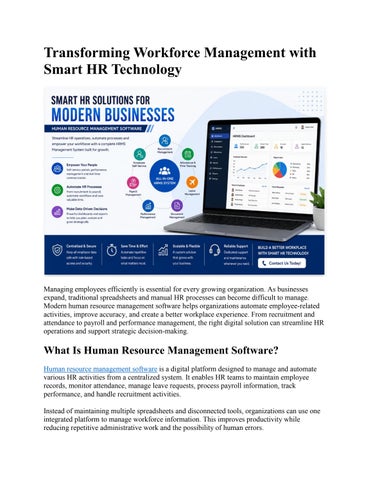
Transforming Workforce Management with Smart HR Technology
Managing employees efficiently is essential for every growing organization. As businesses expand, traditional spreadsheets and manual HR processes can become difficult to manage. Modern human resource management software helps organizations automate employee-related activities, improve accuracy, and create a better workplace experience. From recruitment and attendance to payroll and performance management, the right digital solution can streamline HR operations and support strategic decision-making.
What Is Human Resource Management Software? Human resource management software is a digital platform designed to manage and automate various HR activities from a centralized system. It enables HR teams to maintain employee records, monitor attendance, manage leave requests, process payroll information, track performance, and handle recruitment activities. Instead of maintaining multiple spreadsheets and disconnected tools, organizations can use one integrated platform to manage workforce information. This improves productivity while reducing repetitive administrative work and the possibility of human errors.
Why Businesses Need HR Management Software As companies grow, managing employee information manually becomes increasingly challenging. An effective hr management software solution provides HR professionals with a structured way to organize employee data and automate routine processes. A centralized system can help businesses manage employee profiles, attendance, leave, payroll, benefits, documents, and performance information. Employees can also access self-service features to update their information, apply for leave, download documents, and view important HR updates. By reducing paperwork and repetitive tasks, hr management software allows HR professionals to focus more on employee engagement, workforce planning, and organizational development.
Key Features of an HRMS Management System A modern hrms management system combines multiple HR functions into a single platform. Depending on organizational requirements, it can include features such as:
Employee information management Recruitment and applicant tracking Attendance and time tracking Leave management Payroll integration Performance management Employee self-service Training and development HR document management Reports and analytics Notifications and workflow automation
An integrated hrms management system gives HR teams better visibility into workforce activities. Automated workflows can also reduce delays by routing approvals and notifications to the appropriate employees or managers.
Benefits of Custom Human Resource Management Software Every organization has different HR policies, workflows, employee structures, and reporting requirements. Off-the-shelf solutions may provide general features, but they may not always match specific business processes. This is where custom human resource management software becomes valuable. A customized platform can be designed around the organization's exact requirements. Businesses can select the features, workflows, integrations, dashboards, and access controls they need.
With custom human resource management software, organizations can also integrate HR operations with existing payroll platforms, accounting systems, ERP solutions, communication tools, and other business applications. This creates a connected technology ecosystem and minimizes duplicate data entry.
Improving Employee Experience HR technology is not only beneficial for HR departments. A well-designed hr management software platform can improve the employee experience by providing convenient self-service capabilities. Employees can access their profiles, submit leave applications, check attendance, view company policies, access documents, and receive important notifications through a centralized portal. Managers can review requests, monitor team performance, and access workforce information without depending on manual HR processes. This accessibility creates greater transparency and allows employees to complete common HR tasks quickly.
Data-Driven HR Decision-Making One of the major advantages of an hrms management system is its ability to provide useful workforce insights. HR leaders can use dashboards and reports to analyze attendance patterns, employee turnover, recruitment performance, workforce distribution, and other important metrics. These insights can support better workforce planning and help management identify trends. For example, organizations can analyze employee performance data to identify training requirements or examine workforce trends to improve recruitment strategies. A modern hrms management system can therefore transform HR from an administrative function into a more strategic business department.
Security and Scalability Employee information is highly important and should be protected through appropriate security controls. A reliable human resource management software solution can include role-based access, authentication, data encryption, audit trails, and controlled permissions. Scalability is another important consideration. As an organization adds employees, departments, locations, and HR processes, the platform should be capable of supporting increased requirements. A scalable custom human resource management software solution can evolve alongside the organization and accommodate new features and integrations when required.
How to Choose the Right HR Solution Before selecting an HR platform, businesses should evaluate their current processes and identify areas that require automation. Organizations should consider features, usability, integrations, security, customization, scalability, reporting capabilities, and ongoing technical support. A suitable hr management software solution should be easy for HR teams and employees to use. It should also provide flexibility to adapt to changing organizational requirements. Businesses considering custom human resource management software should work with an experienced development team that can understand their HR workflows and create a solution aligned with their operational goals.
Conclusion Digital HR transformation can significantly improve the way organizations manage employees and HR operations. A comprehensive human resource management software platform can automate repetitive tasks, centralize workforce information, improve employee experiences, and support data-driven decisions. Whether an organization needs a standard hr management software platform or a tailored hrms management system, choosing the right technology can create a more efficient and connected workplace. For businesses with unique requirements, custom human resource management software provides the flexibility, scalability, and functionality needed to support long-term growth.
FAQs 1. What is human resource management software? Human resource management software is a digital solution that helps organizations manage employee records, attendance, leave, recruitment, performance, payroll-related processes, and other HR activities.
2. What is an HRMS management system? An HRMS management system is an integrated platform that brings multiple HR functions together, enabling organizations to automate processes and manage workforce information from one centralized system.
3. What are the benefits of HR management software? HR management software can reduce manual work, improve data accuracy, streamline employee processes, enhance reporting, and provide employees with convenient self-service capabilities.
4. Why choose custom human resource management software? Custom human resource management software can be developed according to an organization's specific workflows, policies, integrations, reporting requirements, security needs, and scalability goals.
5. Can HR software integrate with other business systems? Yes. Modern HR platforms can integrate with payroll, accounting, ERP, communication, attendance, recruitment, and other business applications to create a connected workflow.
6. Is an HRMS suitable for growing businesses? Yes. A scalable HRMS management system can support organizations as they add employees, departments, locations, and new HR processes.