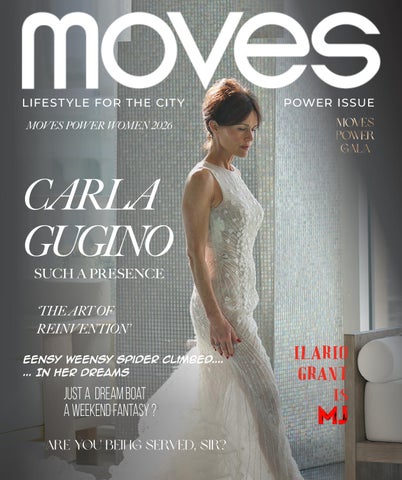
LIFEST YLE FOR THE CIT Y
POWER ISSUE
MOVES POWER WOMEN 2026
CARLA GUGINO SUCH A PRESENCE
‘
‘THE ART OF REINVENTION’ eensy weensy spider climbed.... ... In HER Dreams
Just a Dream Boat a Weekend Fantasy ? ARE YOU BEING SERVED, SIR?
ILARIO GRANT IS
cover
CARLA GUGINO THE ART OF BEING IMPOSSIBLE TO DEFINE After four decades in Hollywood, Carla Gugino has mastered the rarest trick in show business: remaining entirely herself while becoming almost anyone else. From teenage rebel to Hollywood leading lady, from David Fincher’s exacting world to the formidable Vivien Leigh, hers is a career built not on celebrity’s shifting fashions but on talent, instinct and an admirable refusal to be ordinary. By Moonah Ellison Photography: Patrick Fraser
“ ... in regards to the arts AI is an incredible mimic and resource ... but it can’t really create something new. Like the nature of inspiration is not innate in it ... ”
There is something wonderfully subversive about Carla Gugino. In an industry that has spent the better part of a century attempting to manufacture individuality by committee, she has committed the rather radical act of possessing some of her own. She is intelligent without making an exhibition of it, glamorous without appearing enslaved by the obligation, and sufficiently secure in her abilities to admit that she is still learning. Hollywood, which has never quite known what to do with women who refuse to fit conveniently into its filing cabinets, has nevertheless found itself employing her for more than forty years. One suspects the relationship has been considerably more rewarding for the audience than for the filing clerks. When we speak, Gugino has just finished a day’s filming in San Francisco. Beyond her window are Coit Tower and Alcatraz, an appropriately cinematic arrangement for an actress currently immersed in Fog City, a noir drama set in the 1930s. Filming began in Australia before moving to the city where the story unfolds. She plays a character based on a real woman, and her enthusiasm for the material is unmistakable. There is no weary recitation of publicity-approved adjectives, no suggestion that another production is merely another entry on an already distinguished résumé. Instead, she talks about the pleasure of storytelling with the curiosity of someone encountering its possibilities for the first time. It is an enthusiasm that began in circumstances rather less glamorous than a San Francisco hotel overlooking the bay. Born in Florida, the daughter of an orthodontist of Italian heritage, Gugino grew up moving between different worlds. Her father, Carl, gave her both her name and, apparently, a splendid set of teeth, having enthusiastically tested various orthodontic contraptions on his daughter. When she began acting professionally, advisers suggested that Gugino was too ethnic, too difficult to pronounce, too inconvenient for Hollywood’s delicate sensibilities. She considered alternatives, including Carla Burgess and Carla Neil, before deciding that the name she had inherited was rather more important than the prejudices of those recommending its disposal. Her father died last year at 96, having, she says, lived the life he wanted. Looking back, she is profoundly grateful that she kept his name. What might once have seemed a minor professional calculation has become something infinitely more meaningful: a declaration of identity, continuity and affection. Her route into acting was similarly governed by instinct rather than convention. Recruited by Elite Petite, she travelled to New York as a young teenager to pursue modelling, only to discover that the city’s formidable energy and the industry’s peculiar demands held considerably less appeal than anticipated. While her fellow models embraced Manhattan nightlife, Gugino was the California girl practising yoga and eating granola. An acting class in Los Angeles, suggested by her aunt Carol Merrill, changed everything. Under teacher Gene Bua, she discovered the exhilaration of surrendering control within the safety of a performance. For a serious, academically accomplished child accustomed to imposing order on an unpredictable life, the revelation was immediate. Acting offered freedom without chaos, discipline without confinement. She knew, with remarkable certainty, that she had found her vocation.
most
“The impressive thing about Carla Gugino is
not
how many characters she
has become, but how com-
pletely she has
remained
herself.”
Early appearances in Webster, ALF, Who’s the Boss?, The Wonder Years and Doogie Howser, M.D. provided the apprenticeship. Then came Troop Beverly Hills, the 1989 comedy with Shelley Long that remains a cult favourite. Gugino recalls claiming to be fourteen when she was actually sixteen to secure the role, a small act of youthful deception that demonstrated a larger professional truth: an actor’s capacity for transformation should matter rather more than the biographical information available to a casting director.
and accepting responsibility for decisions that an actor can ordinarily leave to somebody else. Gugino relishes the challenge. She has little interest in ornamental producing credits, preferring to contribute meaningfully to every stage of filmmaking. It is a philosophy shared with her longtime partner and creative collaborator, Sebastian Gutierrez, and reflects her belief that the best work emerges when talented people are encouraged to contribute rather than instructed merely to obey.
Her career is a persuasive argument that genuine talent has no interest in being confined by other people’s expectations.
“For Gugino, artistic power is not the privilege of controlling others, but the opportunity to make something extraordinary together.
The decades that followed proved the point. From Spin City, where she formed an enduring friendship with Connie Britton, to Sin City, Entourage and Karen Sisco, Gugino moved between comedy, crime, drama and psychological complexity with an ease that made classification increasingly absurd. Her work in The Haunting of Hill House and The Fall of the House of Usher further demonstrated her ability to give emotionally demanding material an intelligence and humanity that spectacle alone cannot supply. She is equally at home in the fantastical and the painfully recognisable, a versatility that owes less to reinvention than to an unusually disciplined understanding of character.
Her concerns about artificial intelligence reveal a similarly thoughtful approach to the future. She recognises its usefulness while questioning the wisdom of allowing commercial enthusiasm to outrun artistic protection. The possibility of performers losing control over their likenesses, or background actors being displaced by digital substitutes, troubles her. Yet her optimism about human creativity remains intact. Technology may imitate the products of imagination, she argues, but the human experience from which inspiration emerges is another matter entirely. It is an important distinction in an industry increasingly tempted to confuse efficiency with achievement.
That discipline has brought her into the orbit of David Fincher and The Adventures of Cliff Booth, the Brad Pitt-led follow-up to Quentin Tarantino’s Once Upon a Time in Hollywood. Set in 1977, the film revisits Cliff Booth in a different chapter of his life. Gugino describes a demanding audition process involving conversations, work sessions and a traditional screen test. After forty years of professional accomplishment, she was perfectly prepared to prove herself again. The result was an opportunity to work alongside Pitt, Elizabeth Debicki and Scott Caan under a director whose precision she finds liberating rather than restrictive. Fincher’s focused, almost phone-free set suits her temperament: serious about the work, generous in collaboration and refreshingly uninterested in unnecessary noise. Her ambitions, however, extend beyond the camera. In a forthcoming independent film exploring the final year of Vivien Leigh’s life, Gugino assumes the role of the legendary actress while also serving as producer. Matthew Modine and David Hyde Pierce join the cast. The project required the unromantic business of raising money, navigating production difficulties Photographer: Patrick Fraser Fashion Editor: Cannon @ Atelier Management Fashion Assistant: Winnie Paranoan Hair: Sebastian Scolarici @ Tracey Mattingly Makeup: Lisa Aharon @ The Wall Group Location: One Wall Street, NYC
And then there is the theatre, a medium that demands precisely the immediacy, courage and emotional honesty she has spent a lifetime cultivating. Gugino is preparing for another major New York stage undertaking, a reminder that even an enviable screen career need not exhaust an artist’s ambitions. Her return to New York Moves as a cover subject, and her participation in its Power Women celebration, provides an appropriate moment to consider the remarkable distance travelled since that young Californian first ventured onto Manhattan’s intimidating streets. There is a temptation, when examining a career of such longevity, to describe it as a triumph of survival. But survival is a rather modest ambition, and Gugino’s accomplishments deserve a more generous vocabulary. She has not simply endured Hollywood’s changing fashions; she has demonstrated that intelligence, independence, humour and genuine artistic enthusiasm can flourish within them. The girl who refused to surrender her father’s name has become a woman who refuses to surrender her individuality. In an industry perpetually searching for the next new thing, Carla Gugino offers something considerably more valuable: the enduring pleasure of an original.
“Four decades into her career, she still approaches a new role with the appetite of a newcomer and the assurance of a master
cheers
NEW YORK CITY: ONE DRINK AT A TIME
... AND when a wide-eyed newcomer asks you where they should go for a drink, you smile knowingly and say, “Well, that depends.”
From rooftop cocktails and fashionable speakeasies to neighbourhood dives and bartenders who know your name, the newcomer’s journey into the drinking habits, peculiar rituals, and irresistible social life of the city that never sleeps. Nobody arrives in New York as a New Yorker. You arrive as an enthusiastic amateur, armed with a suitcase, an optimistic bank balance and the entirely mistaken belief that Manhattan is best experienced from a rooftop with a $28 cocktail. You have watched Sex and the City, memorised the skyline and convinced yourself that a glamorous social life is simply a matter of choosing the correct shoes. Naturally, your education begins with a considerable financial misunderstanding.
Then comes the downtown phase. You discover Employees Only, Death & Co. and Attaboy, where the absence of a conventional cocktail menu initially seems alarming until you realise the bartender probably knows what you want better than you do. At Please Don’t Tell, aka PDT, you enter through a telephone booth and feel wonderfully conspiratorial, despite the fact that approximately half of Manhattan knows the secret. You begin recognising neighbourhoods by their bars rather than their subway stations. This is progress, although perhaps not the kind your parents imagined.
Your first weeks are spent chasing the view. You discover Overstory, perched high above the Financial District, and Le Bain, where the skyline is magnificent and everyone appears to have a considerably more interesting occupation than yours. You order champagne, photograph the Empire State Building and inform friends back home that you’re absolutely loving New York. You are, of course, still a tourist. You just happen to pay rent.
By month four, the borough of Brooklyn beckons. Maison Premiere introduces you to oysters and elegant cocktails. Clover Club demonstrates that serious drinking needn’t require a Manhattan postcode. At Sunny’s Bar, you discover the peculiar magic of an establishment whose atmosphere has been accumulated rather than designed. Williamsburg, Greenpoint and Fort Greene become familiar territory. You meet musicians, designers, aspiring filmmakers and people whose occupations remain impressively mysterious. Everyone has a project. Nobody appears particularly concerned about completing it before the stroke of midnight.
By the second month, your education becomes more sophisticated. Someone introduces you to Bemelmans Bar, inside The Carlyle, where the piano, murals and elegantly dressed clientele suggest that Manhattan has never entirely recovered from the 1940s. At the King Cole Bar, you discover the pleasures of a properly made Bloody Mary. At Dante, an afternoon Negroni begins to seem less an indulgence than a cultural obligation. You are learning that drinking in New York is not simply about alcohol. It is about atmosphere, conversation and the delicious possibility that the stranger beside you might become tomorrow’s closest friend.
And then comes the truly significant development: you discover happy hour. The financial implications are revolutionary. You learn that a good neighbourhood bar can offer more pleasure for the price of one fashionable cocktail than an entire evening spent attempting to impress strangers. At McSorley’s Old Ale House, history arrives with the beer. Rudy’s Bar & Grill offers an entirely different education in New York hospitality, while Jimmy’s Corner reminds you that authenticity rarely needs an advertising budget. You even venture into the Upper West Side, where The Dead Poet provides a pleasingly literary excuse for another round.
But something more interesting than your drinking habits is changing. You no longer arrange elaborate evenings involving three bars, two taxis and an expensive disappointment. You have developed preferences. You know where the music is good, where the bartender pours generously, where conversation comes easily and which places should be avoided when somebody announces they know the promoter. Your social circle begins expanding almost without effort. The woman you met at a West Village bar introduces you to her friends in Brooklyn. A neighbour invites you for a Friday drink. Someone from work suggests a Sunday afternoon at The Ear Inn, and suddenly you are discussing apartments, relationships and the mysterious behaviour of New York landlords with people who were complete strangers six weeks earlier. Most importantly, you stop trying to impress the city. You begin enjoying it. One evening, perhaps six months after arriving, you walk into your neighbourhood bar. The bartender recognises you. Someone moves over to make room. You order without consulting the menu, exchange a few words with the person beside you and settle comfortably into the reassuring noise of New York Citaaaay. There is no spectacular skyline, no velvet rope, no fashionable cocktail to photograph. Just familiar faces, good conversation and the satisfying feeling that you belong somewhere. You realise something extraordinary. You no longer need New York to entertain you. You have become part of its entertainment. w Congratulations. You’re a New Yorker. (And somebody knows your drink.)And
dish
But still ... always lead with your c By Brinlee Edger
There comes a point in your life when you start grieving the conversations you can’t take back. Not because you lied. Not because what you shared wasn’t true. But because you gave pieces of yourself to people who never intended to hold them carefully. When we’re younger, oversharing feels like a connection. You stay up until three in the morning telling someone everything: the family stories, the heartbreaks, the insecurities you swore you’d never say out loud. They do the same. It feels mutual. It feels intimate. So you leave thinking you’ve built something meaningful. Sometimes you have. A lot of the time, you’ve simply exchanged information. I’ve started to think oversharing isn’t really about talking too much. It’s about believing that honesty automatically creates trust. It doesn’t. Trust is earned long before it’s tested. When we’re young, we’re often so eager to be understood that we skip the part where we ask whether someone has actually earned the right to understand us. We hand people the map before they’ve proven they deserve the destination. Then life happens. Friendships change. Relationships end. People drift away. And suddenly you remember every story they know about you. It’s a strange kind of vulnerability. They know the things that shaped you. They know who broke your heart. They know what keeps you awake at night. They know the version of you that existed before you learned to protect yourself. You can’t unsay any of it.
chin
The older I get, the more I realize privacy isn’t the opposite of authenticity. It’s discernment. We’ve somehow created the idea that authenticity means complete transparency. That if you’re holding something back, you’re being fake. But authenticity isn’t measured by how much of yourself you reveal. It’s measured by whether what you do reveal is genuine. You don’t owe everyone the entire story. Some people only deserve the introduction. Others earn the middle chapters. Very few deserve the ending. I’ve also realized that oversharing is often rooted in hope. We tell people everything because we’re hoping they’ll stay. We think if they know the real us, they’ll understand us better. Maybe they’ll love us more. Maybe they’ll finally see us. But being known and being valued aren’t the same thing. Some people collect details about your life without ever taking responsibility for your heart. Looking back, I don’t regret being vulnerable. I regret confusing vulnerability with accessibility. Not everyone needed unlimited access to me simply because they asked. There is something freeing about realizing that you can be an open person without being an exposed one. You can be warm without being an open book. You can be honest without narrating every wound while it’s still healing. Some stories deserve time before they deserve an audience. Maybe that’s one of the quieter lessons of growing up. Not everyone who enters your life is meant to know everything about it. And maybe maturity isn’t learning how to say more. Maybe it’s learning that some of the most valuable parts of yourself become even more meaningful when they’re shared with fewer people.
feature
The Boat, the Blue Water, and that Beautiful Great Escape One day, you are going to buy a boat and disappear. You know this because it is 10:17 on a Monday morning, somebody has scheduled another meeting about the meeting, your inbox has developed its own weather system, and on your screen is a photograph of a small white sailing boat floating on an impossibly blue Mediterranean. Look at it. Nobody on that boat is answering emails. And suddenly the fantasy seems not merely attractive, but entirely sensible. We will sell the house, abandon the inbox, learn celestial navigation and spend the rest of our lives drifting between small Mediterranean islands where nobody knows our name or requires a password reset. Not a yacht. Yachts involve staff, polished brass and people called Sebastian. We mean a proper little sailing boat. White hull, blue water, enough teak to look romantic and just enough cabin space to convince ourselves we have finally escaped civilization. The fantasy is magnificent. Morning arrives somewhere off Greece. You wake to the gentle movement of the sea, dive naked into impossibly clear water and climb back aboard to make coffee. There is no traffic. No commute. No leaf blower. No breaking news. The phone lies forgotten in a drawer because suddenly we are the sort of people who don’t need phones.
Lunch is bread, tomatoes and something caught that morning by a fisherman called Nikos. Afternoons are spent reading novels we have been meaning to read since 2007. At sunset, we open wine and watch the sun disappear behind a tiny Greek island, congratulating ourselves on having finally understood what life is actually about. We have escaped! We are free! We have found paradise! And then the toilet stops flushing. This is the small detail generally omitted from photographs of sailing boats. Because a boat is essentially a beautiful collection of things waiting to break in extremely inconvenient places. They leak. Things corrode. Batteries die. Ropes tangle. Engines develop mysterious noises precisely when land disappears over the horizon. There are storms, seasickness, marina fees, insurance, fuel, laundry and the astonishing discovery that two people who adore each other on land can develop murderous thoughts after six days together in a floating cupboard. That carefree afternoon sail? You are checking the weather every twelve minutes. That deserted cove? Infested with midgies. That romantic night beneath the stars? Something metallic has been banging against the mast since 2:13 a.m. And Nikos, unfortunately, has gone home. Suddenly the Mediterranean looks rather less seductive when the wind is howling at three in the morning and you are outside in your underwear trying to stop something expensive from smashing against something even more expensive. And yet perhaps we shouldn’t abandon the dream entirely. Because maybe the boat was never really about the boat. Perhaps what we actually wanted was less noise, fewer possessions, more freedom and enough time to notice where we are. Maybe we don’t need to sell everything and sail into the sunset. Maybe we just need the occasional afternoon when nobody can reach us. A smaller life for a moment. Water nearby. Someone we love. A bottle of wine. And preferably a good hotel. With plumbing that works!
cover profile
IL
The Dange From an At the Musica thing. Esca
By Molly Watso
LARIO GRANT IS
erous Business of Becoming Michael Jackson! tlanta performing arts school to the international stage of MJ al, Ilario Grant is discovering that impersonating a legend is one aping his shadow may prove considerably more interesting.
on
cover profile You’ve described playing Odessa ‘Bird’ Clay in The Greatest as one of the most meaningful roles of your career. Can you take us back to when you first learned you would be playing Muhammad Ali’s mother, and tell us why this particular woman’s story resonated so deeply with you? If I’m being honest, it was a particularly tough time for our family. My husband and I were touring schools for our son, but we had no idea how we would afford it. In between our second and third tour that day, I got a call from my team with the news. I cried the moment I found out. It was a beautiful moment. We felt hope, real hope for the first time in a while. Odessa is my mother, my grandmother, my greatgrandmother, and so on. She carries with her the spirit of all our mothers. So often these women go unnoticed, so it was so important to me to give her a voice and to do her justice. Ali is one of the most recognizable figures in history, but this series also brings attention to the woman who helped shape him. What did you discover about Bird that you think audiences may not know? I think audiences would be surprised to learn that Odessa was a true boxing fan and she knew in-depth stats about fighters. She made it her business to know all the facets of this sport and any opponent her sons had to face. How did you approach portraying a woman whose influence was so significant, even though much of the world’s attention has historically focused on her famous son? I kept it simple: she’s a mother that loved her sons. I studied her as much as I could, and I studied how Muhammad Ali spoke about her. Also, the era gave incredible clues about what her emotional life might have been like; how she might have felt inside. What do you think Bird understood about her son that the rest of the world might never have fully appreciated? That he was sensitive and deeply afraid to fail.
Dana Gourrier Photography: Storm Santos
The greatest influence on Muhammad Ali’s early years
What do you hope audiences, particularly women and mothers, take away from Bird’s story? I hope that mothers and women truly understand how vital their lives are. And that their importance is not just about being in service to someone else, but being in service to their own calling. You were born and raised in New Orleans. What was your childhood like, and what are some of your earliest memories of the city? New Orleans is an incredible city. It is beautiful and rich with so much culture. I still sometimes can’t believe I grew up here. My earliest memory is being 2-3 years old and putting my little fingers through the gate of our backyard while our Doberman Pinscher named Spike licked them. Spike was always a very sweet dog. At 11, you accompanied your younger brother to an audition for the New Orleans Recreation Department’s Theatrical Group and decided to audition yourself. Do you remember what you were feeling at that moment? I felt extremely nervous, but it also felt like I was called to do it. Where are you getting this intel?? Wow! Hurricane Katrina was a defining moment in your hometown’s history. How did that period affect your personal outlook and your relationship with New Orleans? It taught me that things didn’t matter. The loss of childhood things was devastating, but when the focus turned to trying to locate my grandfather’s body, that changed my relationship to material items all together. I answered this question last, because it still hurts to talk about. That should tell you everything. You returned to New Orleans after earning your MFA with the goal of joining HBO’s Treme. What did it mean to return home and contribute to a story about your own community? It meant everything. I was determined to be on that show, and I was. I wanted to represent for my city during one of its most challenging times. What advice would you give a young actor who has the talent and ambition but is struggling to find a way into the industry? First, I would ask if they TRULY wanted to do this, because I would try to deter them if I could. Then I would just say, keep going. Don’t stop. Live a big life of experience and bring it to all your art and creativity.
Your screen career includes Django Unchained and The Hateful Eight, working with Quentin Tarantino. What did those experiences teach you about performance, storytelling, and working with a distinctive filmmaker? It taught me so much. Firstly, to bring my absolute A-Game to work every single day, to work as hard as I could, and keep pushing. Always. It also taught me to pay very close attention to detail. Who were your earliest artistic influences? Are there performances you return to when you need inspiration or a reminder of what great acting can accomplish? Oh wow! This is a great question. Diana Ross in Mahogany. Judy Garland in The Wizard of Oz. Emma Thompson in Sense and Sensibility. I can also watch the 2005 version of Pride and Prejudice on any day of the week. I would also say Whitney Houston’s videos from her first few albums influenced me, because music is very important to my life and journey as well. You also have a love for fashion and have spoken about embracing your curves. How has your relationship with your body and personal style evolved over the years? I love fashion, but I have never felt there is a space for me in fashion. It feels like a club that only a few belong to. However, I do respect the art of building clothing driven by all the mostly women behind the scenes. The people up late at night stitching and sewing and doing. And I do respect the artistic eye designers have. I see them as fellow creators like myself. What would you like the next chapter of your career to look like? A masterful film. I really want to work with the folks at A24. But more than anything, consistent quality work that helps me to support my family without me having to be separated from them for too long. Am asking for the world here, LOL? But ask, and you shall receive. Are there stories about women that you feel especially compelled to tell in the future? Yes. I want to tell Etta James’ story. Can’t you see me as her? She taught me how to sing after all. Her and a gospel choir I was a part of at 13. But I want to be a part of many stories. Anything of inspiration I can get my hands on. I want to give to the world as much as I can through my artistry. And I want to have fun doing it.
feature
DO SPIDE DREA
At three in the morning, somewhere behind your bedroom curtain, a spider may be dreaming. This is unsettling, not least because most of us assumed the spider was simply sitting there waiting to ruin breakfast. But imagine her instead: eight legs tucked in, tiny brain off duty, perhaps reliving the afternoon’s successful fly or wandering through some magnificent subconscious web where every thread is symmetrical and nobody owns a vacuum cleaner. Then suddenly—terror. A rolled-up copy of MOVES appears on the horizon. A shoe descends from the heavens. She wakes, checks all eight legs are attached and thinks: Thank God. Just a dream.
Scientists b spiders experie someth resemb REM sle
Ridiculous, obviously. Except for the dreaming part. Research into jumping spiders has found that while resting at night they display twitching limbs and rapid movements of their retinal tubes that resemble signs associated with REM sleep in humans. Scientists are careful: a REM-like state is not proof that a spider is dreaming about missing the 7:42 train. But the possibility challenges our assumption that interesting inner lives belong principally to us. “Somewhere tonight, a spider may be dreaming. Humanity would now quite like to know whether we’re in it.” Sleep itself is one of nature’s stranger decisions. A sleeping creature becomes temporarily useless when it might benefit from remaining alert. Evolution kept sleep anyway, suggesting it matters. Dogs twitch. Cats make tiny hunting movements. Birds experience REM sleep. Octopuses show complex sleep states. And now the spider, an animal we’ve spent considerably more time screaming at than contemplating, has joined the nocturnal mystery. What could a spider possibly dream about? Freud would have had a wonderful afternoon. Perhaps flies. Perhaps male spiders have anxiety dreams about courtship, understandable when getting the signals wrong can result in being eaten. Perhaps they experience the nightmare in which you’re trying to run but your legs won’t work—a more complicated emergency when you have eight of them. Or perhaps they dream about the hysterical giant who spots a creature the size of a fingernail and evacuates the bathroom. Arachnophobia is one of humanity’s more impressive failures of proportion. We happily drive two tons of metal at sixty five miles an hour while drinking coffee, but discover a spider in the bathtub and we require emergency services. A grown adult capable of international travel can be reduced to standing on a chair shouting instructions at another giant holding their dressing gown ever tighter. “For humans, the classic anxiety dream is arriving naked in public. For a spider, being naked is presumably just Tuesday.” From her point of view, she has entered a room containing a creature roughly a million times her size, which immediately starts screaming, throwing footwear and shouting, “GET IT!” If anybody should have developed a phobia here, it is probably the spider.
Which raises one of the more important questions facing modern science:
O ERS AM?
Beneath the joke lies something rather beautiful. Science keeps enlarging our understanding of animal experience. Crows solve problems. Bees learn and communicate. Octopuses demonstrate remarkable intelligence. Animals remember and adapt in ways that repeatedly force us to redraw the line separating “us” from “them.” “The history of animal intelligence is partly the history of humans discovering that we weren’t quite as special as we’d advertised.”
believe may ence hing bling eep.
Spiders are especially intriguing because they’re difficult to anthropomorphize. A Labrador has eye lashes designed to extract tasty morsels every time. A dolphin smiles and appears delighted to meet us. The spider has eight eyes, no visible expression and a public-relations problem dating back several thousand years. We don’t wonder what she’s feeling. We wonder where she went after we looked away—which, for the arachnophobe, is considerably worse than knowing where she is. Yet jumping spiders are extraordinary. Their sophisticated vision and tiny nervous systems achieve an enormous amount with remarkably little equipment. If they pass through sleep states analogous to ours, how much inner experience can fit inside something so small? “Perhaps consciousness doesn’t require a large brain so much as humans require a little more imagination.” Nobody should get carried away. We cannot interview a spider over breakfast and ask whether she dreamed of flies or an unresolved relationship with her mother. REM-like behavior does not automatically equal human-style dreaming, and scientists are rightly cautious about imposing our experience on minds we barely understand.
What exactly does a spider have nightmares about? Bigger shoes?
Tonight, while billions of humans disappear into their innercinemas—flying over cities, arguing with dead relatives and sitting an exam for a class they forgot to attend—the creatures sharing the planet with us will also become still. Dogs will twitch. Birds will sleep. Octopuses may change color. And in a quiet corner, safely away from the terrifying shoe department, a tiny jumping spider may move her eyes as some mysterious neurological performance unfolds. Perhaps there are no pictures at all. Perhaps there are sensations we don’t possess words for. Or perhaps, somewhere inside that minuscule head, an eight-legged heroine is standing triumphantly over a human trapped in an enormous web. Frankly, after everything we’ve done with the shoes, we probably deserve it. (Remember James Bond in Dr No.) “The universe becomes much more interesting the moment we stop assuming we’re the only creatures having an interesting time in it.”
_
profile rant
T h Action ma n ... with
From Boys Own characters in Seal Team and Fire to sensitive portr ayals of male vuln erabilities, Max Th embraces his craft with courage, pas sion and insight. It’s those eyes tha t seem to look de ep and understan you wish they did d thin n’t. At the same ti me as making yo you’ve found a lif u feel elong friend.
Max hieriot aPhD in
Country Thieriot
ngs
Life
_
profile
LILY SU SHE’S GOOD!
ULLIVAN
_
rant
One Wall Street proudly celebrates Anna Zarro and all the 2026 Moves Power Women
+1 212 403 3990 | Sales@OneWallStreet.com | OneWallStreet.com
MOVES POWER WOMEN 2026
DAME MAGGIE SMITH Few women have commanded the world’s attention with such effortless authority, intelligence and wit as Dame Maggie Smith. From the stages of Broadway to the grandeur of Downton Abbey, from her two Academy Awards to her beloved portrayal of Professor McGonagall in Harry Potter, she captivated generations of American audiences and reminded the world that talent knows neither borders nor age. Beyond the spotlight, her quiet generosity supported medical research, the welfare of fellow performers and the preservation of the arts. She understood that true distinction lies not simply in what one achieves, but in what one gives back. In an industry so often preoccupied with youth, Maggie Smith became more celebrated, more admired and more indispensable with every passing decade. She never needed to announce her power. It was evident in every performance, every perfectly delivered line and every life she touched.
Her legacy is a reminder to women everywhere: brilliance does not fade with age. It deepens. She was indefatigable, an icon and a real Power Woman.
MOVES POWER WOMEN
2026
Alexandra Wilkis Wilson | Co-Founder & Managing Partner, Clerisy; Co-Founder, Gilt; Co-Founder, GLAMSQUAD Angela Robinson | American Director, Screenwriter, Producer Daniela Bocresion | President, Regal Jewelry Dame Vivian Hunt | Global Business Executive; Philanthropist Sarah Feinberg | Founder, Feinberg Strategies; former President and CEO, New York City Transit Dr. Lisa Michelle Satlin | Professor and Chair of Pediatrics, Icahn School of Medicine at Mount Sinai (ISMMS); Pediatrician-in-Chief of the Mount Sinai Kravis Children’s Hospital Cristina Mommsen | Managing Director, The Consello Group Valeria Sandei | Global Director of AI, The Almaviva Group Alison Graham | Director, Barnes New York & The Hamptons SKIN | Singer, Musician, Songwriter Anna Zarro | President, One Wall Street Sales; Founder, Principal AZ&Co. Nedra Dickson | Interim President and Chief Executive Officer, WBENC Lisa Guerrero | Award-Winning Journalist, Author Meenakshi Lala | Chief Executive Officer, UrbanStems Sara Baxter Hutcherson | Chief Financial Officer, Gracenote Jennifer Guilfoyle | Chief Legal Officer, Maybourne Ashley Winton | SVP of Global Creative Services, Warner Chappell
ALEXANDRA WILKIS WILSON Co-Founder & Managing Partner, Clerisy; Co-Founder, Gilt; Co-Founder, GLAMSQUAD
“
In today’s culture of visibility and performance, I think society tends to overvalue visibility itself. We often confuse being seen with being impactful, and there is too much emphasis placed on certainty, perfection, and constant performance rather than substance, thoughtful leadership, and the hard work happening behind the scenes.
”
ANGELA ROBINSON American Director, Screenwriter, Producer
“
An executive once told me, ‘You didn’t fully understand how much power you had.’ That changed how I approached my career. It’s important to understand the influence you actually have in a situation—sometimes it’s more than you realize, and sometimes it’s less.
”
DANIELA BOCRESION President, Regal Jewelry
“
You always need to be respectful, even in dissent. That’s something that was repeated in my house as my children were growing up, and it’s an important lesson. As leaders, we have to make difficult decisions, and it’s really important to treat people with dignity. You can be direct, hold high standards, and make really tough calls, but you must remain respectful.
”
DAME VIVIAN HUNT Global Business Executive; Philanthropist
“
Real power is the ability to positively influence the environment around you. It isn’t about title, money, or status. Whether you’re a teacher changing one student’s life or leading a large institution, power comes from using whatever platform you have to create meaningful change.
”
SARAH FEINBERG Founder, Feinberg Strategies; former President and CEO, New York City Transit
“
The way you treat people—in business, on a board, in the office, or personally—is what people remember. In a digital world where so much can feel manufactured, authenticity matters more than ever.
”
DR. LISA MICHELLE SATLIN Professor and Chair of Pediatrics, Icahn School of Medicine at Mount Sinai (ISMMS); Pediatrician-in-Chief of the Mount Sinai Kravis Children’s Hospital
“
That’s what I try to do with the people I mentor: recognize their strengths, gifts, talents, and possibilities and help bring those qualities to life. I would love to become even better at recognizing that potential earlier.
”
CRISTINA MOMMSEN Managing Director, The Consello Group
CRISTINA MOMMSEN
“
Leaders have a responsibility to make sure people evolve alongside the technology through education, retraining, and mentorship. We can’t allow the human side of careers and organizations to disappear.
”
VALERIA SANDEI Global Director of AI, The Almaviva Group
“
My greatest strength has become resilience paired with longterm vision: the ability to hold a steady course through the constant turbulence around us, and to keep listening, always—even when I think I already have the answer.
”
ALISON GRAHAM Director, Barnes New York & The Hamptons
“
I know the value I bring into a room has grown exponentially because of my years of experience. Youth shouldn’t automatically be treated as the ultimate ideal.
”
SKIN Singer, Musician, Songwriter
“
Putting ourselves in someone else’s shoes is one of the most powerful things human beings can do. It makes us more willing to protect and help one another.
”
ANNA ZARRO President, One Wall Street Sales; Founder, Principal AZ&Co.
“
What I’ve learned is that there’s strength in softness. I don’t always need to attack something with maximum intensity. There’s power in intuition, grace, taking a breath, and moving with intention.
”
NEDRA DICKSON Interim President and Chief Executive Officer, WBENC
“
I grew up believing that if you worked hard, you would be recognized. I’ve since learned there’s a balance—you have to be willing to share your story and your ideas, but you don’t have to talk over everyone else to be heard.
”
LISA GUERRERO Award-Winning Journalist, Author
“
People are often afraid of cultures and experiences they don’t understand. But our differences make us stronger. Leaders need to recognize that what happens to people somewhere else ultimately affects all of us. We’re part of one collective community.
”
MEENAKSHI LALA Chief Executive Officer, UrbanStems
“
We often mistake kindness for weakness, particularly in women leaders. But treating people with dignity and empathy doesn’t prevent you from making difficult decisions, holding people accountable, or demanding high performance.
”
SARA BAXTER HUTCHERSON Chief Financial Officer, Gracenote
“
I hope the next generation of women grows up knowing that they deserve a seat at the table—and that they are allowed to take it. The meaningful change will be cultural as much as institutional: women owning their power, and the people around them making room for it without requiring them to become someone else first.
”
JENNIFER GUILFOYLE Chief Legal Officer, Maybourne
“
T he technology [AI] itself isn’t the challenge; it’s ensuring that human judgment, accountability, and fairness remain at the center of every decision. Leaders cannot allow efficiency to replace humanity.
”
ASHLEY WINTON Senior VP, Creative Services, Warner Chappell Music
“
“You can’t be afraid to pave your own paths. I was never trained into any of my jobs in the entertainment industry. I always created the jobs I’ve had from scratch. I didn’t wait for people to tell me what to do.
“
CREDITS MOVES POWER WOMEN 2026 Photographers: Patrick Fraser Ruben Caballero Aly Whitman Liz Strupat Frank Rocco Stylists: Alaye Alleyne Elizabeth Meredith Natalie Fajer BTS Camera/ Videographer: Kateryna Andre Hemmitt Jr. Luis Hernandez Hair & makeup: Martha Noronha Eloria Michelle Christine Tirado Rachael Thomas Michaela Wolf Locations: One Wall Street, New York City Park Modern, Penthouse, London Oval Village by Berkeley, London Hagop Studios, Los Angeles
_
Luxury Flowers for the Moments that Matter rant
Use code URBANFRIENDS25 for 25% off your order.
SCAN TO SHOP
One Wall Street Redefining Luxury Living in Downtown Manhattan
One Wall Street is more than a landmark residential conversion. It is a new vision for luxury living in downtown New York City.
Designed by celebrated architect Ralph Walker and completed in 1931, the Art Deco tower was first the headquarters of the Irving Trust Company and later the home of BNY Mellon. Today, after a meticulous restoration by Macklowe Properties, it stands as Manhattan’s most elegant office-to-residential conversion, and its way of life has raised the standard for downtown living. The building’s transformation mirrors the Financial District’s own evolution into one of Downtown Manhattan’s most dynamic residential neighborhoods, now home to young professionals, families, retirees, and downsizers alike. One Wall Street has been central to that shift. Under one roof, it brings together architectural heritage, contemporary design, whiteglove service, and world-class retail, and in doing so it has reshaped what it means to live downtown. The residential experience is anchored by 100,000 square feet of resort-caliber private amenities, designed to make daily life easier and to bring residents together. At its heart is The One Club, a residents-only private club inspired by the most exclusive lounges of London and New York. Designed by TenBerke, the club offers a seasonal restaurant and bar, espresso service, and craft cocktails. All of it is set within a light-filled dining room that opens onto a 4,500-square-foot landscaped terrace with sweeping skyline views. Residents also receive complimentary membership and priority access to Life Time, The One Club also includes:
The One Pool: a 75-foot glass-enclosed sky pool on the 38th floor, with a wraparound outdoor terrace.
The One Playroom and The One Canine Club.
The One Gym: a fully equipped fitness center.
One Works: a 6,500-square-foot co-working space with private podcast rooms and spaces designed for focus and collaboration.
This four-level, 75,000-square-foot athletic country club offers premier fitness, recovery, and lifestyle programming, all just an elevator ride away. Beyond its architecture and amenities, One Wall Street stands out for its exceptional service. Full-time door staff, a live-in resident manager, and a dedicated concierge are on hand for virtually any request. The concierge and lifestyle team come from some of the world’s most prestigious hospitality brands. They secure reservations at the city’s most sought-after restaurants, plan travel and private celebrations, and create memorable on-site events for residents. Technology extends that convenience. A custom resident app lets homeowners reach building staff directly, reserve co-working space and dining experiences, and order pickup from the residential restaurant on the 39th floor. The result is a home where every need is anticipated and met. Last year, Printemps, the storied Parisian luxury department store, opened its U.S. flagship at One Wall Street. Its arrival fulfilled the developer’s vision of a “city within a city,” with residences, wellness, dining, and luxury retail all in one address. Printemps brings an international view of fashion, culture, and cuisine to Downtown Manhattan. Beyond its curated retail, it offers five food-and-beverage venues and a wine shop, which add a new dimension to the building’s lifestyle. Together, these offerings have made One Wall Street a destination for residents and neighbors alike. The building remains deeply connected to its surroundings. From its position at the meeting point of the Financial District and greater Downtown, residents are moments from Lower Manhattan’s growing collection of restaurants, boutiques, cultural institutions, and waterfront attractions. Few addresses combine the ease of a private residential retreat so well with the energy and connectivity of New York City. Throughout its transformation, the building’s architectural legacy has stayed central to its identity. One Wall Street is widely regarded as one of New York City’s most significant Art Deco landmarks. The New York City Landmarks Preservation Commission designated its original 1931 tower a landmark in 2001. In 2007, the building was recognized as a contributing property within the Wall Street Historic District, which is listed on the National Register of Historic Places. In September 2023, commemorative plaques honoring its landmark status were unveiled at the front entrance. By honoring its Art Deco legacy while adding thoughtfully designed residences, hospitality-inspired service, wellness, and an exceptional mix of retail and dining, One Wall Street has set a new benchmark for residential living in Downtown Manhattan.
cover profile
LUKE
DIMYAN THE ART OF NOT LOSING YOUR MADNESS By Maddy White Photography:Dean Foreman
“ ... If you give someone a chance to be softer, to be kinder, you’d be surprised how many people will take you up on that offer ... ”
profile
DAN
THE SERIOUS BUSINES
INGS
In an era wh an interview committee-a talking point sourdough, D that he migh thinks. He la down conver technology m our conversa to defeat the
NIEL
SS OF HAVING FUN
S
hen actors can arrive at apparently armed with a approved anecdote, three ts and a charming story about Daniel Ings gives the impression ht actually tell you what he aughs easily, wanders happily rsational side streets and, when misbehaves at the beginning of ation, simply waits for humanity e machine. It feels appropriate!
feature
By Richard Peters
The Accident of Being !
Pride is one of the strangest emotions in the human repertoire. We are proud of our intelligence, beauty, careers, resilience, wealth, children, nationality, sometimes even our height. Yet beneath almost every declaration of pride lies an uncomfortable question: how much of any of it did we actually choose? None of us chose to be born. We did not select our parents, genes, brains, bodies, temperaments or natural abilities. We did not decide whether we would arrive with perfect pitch, extraordinary memory, physical strength, mathematical brilliance, crippling shyness or an effortless ability to charm a room. We did not choose our country, childhood wealth or poverty, education, or whether our earliest experiences taught us that the world was safe or dangerous. We simply arrived. Being proud of beautiful eyes makes roughly as much logical sense as being proud of having been born on a Tuesday. But intelligence, talent and achievement present a more complicated problem. A brilliant mathematician may work extraordinarily hard, but she did not choose the brain that allowed mathematics to make sense to her. A great athlete may train relentlessly, but he did not order the lungs, reflexes or coordination that made elite performance possible. We respond: But they worked for it. Certainly. But where did their ability to work for it come from? Consider the concert pianist who practices six hours a day for twenty years. We admire the sacrifice, discipline and determination, and rightly so. But she did not choose her musical sensitivity—and perhaps more importantly, she did not choose the mind capable of tolerating endless repetitive practice, delaying gratification, surviving criticism and wanting greatness badly enough to continue. Another child may possess equally capable fingers and ears but find practice unbearable. We call one “driven” and the other “lazy,” one successful and the other someone who “wasted their potential.” Yet neither chose what produced pleasure, boredom, determination or frustration inside their brain. The pianist’s achievement is real. The harder question is why she possessed the capacity to achieve it when someone else did not. This is where things become uncomfortable, because even character—the part of ourselves we like to believe we truly own—does not appear from nowhere. We admire discipline, courage, ambition and perseverance because they seem like choices rather than gifts. But why can one person study for eight hours while another struggles for twenty minutes? Why does adversity make one determined and another despairing? Why does one resist temptation while another repeatedly succumbs? Someone may say, “At thirty I decided to change my life.” Fine. Perhaps he stopped drinking, started exercising, studied at night and built a successful business. But doing so required him to recognize his situation, imagine an alternative, delay gratification and sustain effort.
... Of What Exactly, Are We Proud? “I worked hard.” Why were you capable of working hard? “I was determined.” Why were you determined? “I wanted something better.” Why did that desire propel you forward when the same desire leaves someone else unable to move? Follow the question backwards for long enough and every road eventually disappears into something we did not choose. This does not mean our choices are meaningless. If you decide tonight to apologize to a friend, leave a destructive relationship, start a business or write a book, your decision genuinely affects what happens next. You participate in your future. But you did not manufacture the brain that reached that decision. By adulthood, each of us is an unimaginably complicated mixture of inheritance, environment, accident, memory and previous choices. And this creates an uncomfortable problem with our understanding of success and failure.Imagine two children born on the same day. One arrives in a stable home filled with books, affection, good food and parents expecting university. The other arrives amid violence, hunger, instability and a failing school. At thirty, their lives may look radically different. Both made choices, certainly, but pretending those choices were made from identical starting positions—or by minds with identical capacities for making them—is absurd. That leap is far harder to justify. Perhaps, then, the mature alternative to pride is neither shame nor false modesty. It is gratitude accompanied by responsibility. Celebrate success, but remember the parents, teachers, genetics, strangers, opportunities, accidents and coincidences standing invisibly behind it. And be slower to judge the person whose collection of accidents was less fortunate than yours. We did not choose our cards. We play them as best we can—but we did not choose our ability to play cards either. We may be authors of our lives, but we did not choose the author. And once we truly understand that, pride begins to look less convincing, superiority almost impossible—and humility not merely admirable, but logical. Perhaps there are successful and unsuccessful outcomes. But there are no successful and unsuccessful human beings.
profile
L earning toT rust the U nknown By Monica Edison Photograhy: Jonny Marlow
There is a particular confidence that arrives when someone finally stops trying to become the person everybody else expected. Julia Jones seems to know something about that. When we speak, she is in Berlin, preparing for a project she is absolutely not allowed to discuss, which is both frustrating and somehow appropriate for an actress whose career has
increasingly been defined by refusing the obvious next move. “It’s all under wraps for now,” she says, laughing. “But it’s exciting. It’s fun. I’m sure you’ll hear about it soon.” Jones has spent much of her career moving between worlds: independent film and blockbuster franchises, Los Angeles and New York, acting, and now writing. There is a sense that the movement
Julia Jones
itself has become the point. She grew up in Boston, studied in New York and began modeling as a teenager before making her first independent film during college. Acting, however, had been sitting somewhere inside her since she was eight. Her parents, both professionals, wanted education and stability; Jones wanted the considerably less predictable life of an actor.
College became complicated not because she disliked learning—she describes herself now as deeply curious—but because she already knew what she wanted to do. Eventually the pull became impossible to ignore. With a semester remaining, she left for Los Angeles, later returning to finish her degree. “I just knew that I wanted to do this,” she says. “I was all in.”
feature
I t ’s O n l y H u m a n N a t u r e A f t e r A l l We can reconstruct the birth of stars and contemplate an infinite universe. Yet faced with greed, tribalism, domination and aggression—the ancient machinery inside ourselves—we still reach remarkably easily for the oldest defence available: That’s just the way we are. Perhaps human nature describes where we came from. But our willingness to accept its worst consequences may reveal something considerably more uncomfortable: we never travelled quite as far from the animal as we thought.!
By Sylvia Brown There is a phrase we reach for with extraordinary ease when human behavior becomes too depressing, too complicated or simply too familiar to contemplate for very long: “It’s just human nature.” We say it about greed and jealousy, war and tribalism, aggression and the apparently bottomless desire for more. We say it with the weary sophistication of people who believe they have understood something profound. Of course nations fight. Of course the rich want to become richer. Of course groups distrust outsiders. Of course people compete for status, territory, resources and power. That’s simply how humans are. And with those few words something extraordinary happens: an explanation quietly becomes an absolution. What might have been examined as a deficiency becomes accepted as an inevitability. We don’t merely acknowledge the darker parts of our inheritance; we accommodate them, build around them and, remarkably often, admire them. Aggression becomes strength. Ruthless competition becomes ambition. Acquisition becomes success. Tribalism becomes loyalty. Possessiveness becomes passion. Dominance becomes leadership. Status-seeking becomes aspiration. We have become extraordinarily accomplished at taking impulses with ancient biological origins and giving them excellent public relations. Then, when those same impulses scale upward—from individual to corporation, corporation to nation, nation to civilization—we behave as though their consequences were unavoidable. Wanting sufficient resources to survive is natural; accumulating quantities no individual could possibly use becomes achievement. Favoring one’s own group may once have helped small communities survive; divided into nations, races, religions and ideologies, the same instinct has supplied humanity with an almost inexhaustible reason for conflict. The problem isn’t that these impulses exist. Of course they do. We didn’t design the animal from which we emerged. The problem is our extraordinary reluctance to distinguish between having an instinct and granting it authority. “We have become extraordinarily good at giving our oldest instincts better job titles.” Humans are supposedly exceptional because we can make precisely that distinction. We can examine our behavior, trace its origins, anticipate its consequences and understand suffering far beyond our immediate experience. A wolf defending territory doesn’t know about evolutionary psychology. A lion doesn’t commission a report on the long-term consequences of killing a rival. Humans can model climate change decades into the future, calculate the effects of famine, understand generational poverty, photograph a dying ecosystem from space and predict with horrifying accuracy what a bomb will do when dropped upon a city—and then do it anyway. This is what makes our reverence for self-awareness so peculiar. We treat the capacity to look at ourselves as though the looking itself
were an achievement. But self-awareness without correction is merely observation. If an engineer discovers a fatal defect in an aircraft, nobody celebrates because the defect has now been beautifully understood. You redesign the aircraft. Yet when the defect is ours, we become curiously sentimental about it. People will always be greedy. There will always be wars. Humans need hierarchy. People naturally divide into tribes. Somebody will always want more. Perhaps. But notice what those sentences accomplish. They move us almost invisibly from this exists to this cannot meaningfully be changed. Knowledge becomes a rather hollow mark of superiority when it repeatedly loses the argument to appetite. Civilization itself demonstrates how questionable this surrender is. Violence is natural; we created laws against it. Disease is natural; we invented medicine. Dying from an infected tooth is magnificently natural; very few people propose returning dentistry to the wilderness. Sexual desire is natural; societies construct boundaries around its expression. Hunger is natural; taking somebody else’s dinner remains frowned upon. Much of civilization consists precisely of mechanisms designed to restrain, redirect or overcome what comes naturally when its consequences become unacceptable. Yet certain inherited behaviors receive a curious exemption. We construct economies that reward limitless accumulation and then cite acquisitiveness as proof that humans are naturally greedy. We build political systems around adversarial tribes and point to polarization as evidence that humans inevitably divide into hostile groups. We glorify extreme competitiveness and then regard relentless competition as an immutable feature of adulthood. We create the conditions that amplify an instinct and use the resulting behavior as evidence that the instinct cannot be moderated. There is an almost perfect circularity to it. Perhaps being the dominant species has allowed us to sustain this extraordinary arrangement. Humanity writes its own performance review. There is no external civilization sitting opposite us saying, The antibiotics were impressive, Beethoven was lovely, but we’d like to discuss the wars, the extinctions and what exactly you’ve been doing to the oceans. We establish the measurements of success, award ourselves the prizes and decide which collateral damage is acceptable. Humans determine which animals may be eaten, which forests may disappear, which rivers may be diverted, how much one individual may accumulate and which deaths constitute an acceptable price for prosperity. Then we construct economic, political, philosophical and sometimes religious arguments explaining why these arrangements are reasonable. The dominant species has one enormous advantage when defining progress: nobody else gets a vote. “The dominant species has one enormous advantage when defining progress: nobody else gets a vote.”
“ ... Perhaps the most dangerous thing about “human nature” isn’t what it makes us do. It’s what the phrase allows us to stop questioning ... ”.
But there may be a still more uncomfortable conclusion. Perhaps our casual acceptance of these traits is itself evidence of how little distance actually exists between the animal and the creature we congratulate ourselves for having become. We like to imagine that somewhere during the journey from animal to human an important line was crossed. Instinct remained on one side and reason emerged on the other. The animal wanted; the human considered. The animal reacted; the human understood. The animal competed for territory, resources, mates and position; the human produced moral philosophy, symphonies, democracy and particle accelerators. Perhaps the line was never nearly as clean as we pretend. Perhaps we remain animals with an extraordinary additional layer of intelligence—intelligence capable not only of examining our instincts but, rather inconveniently, of constructing magnificent arguments for continuing to obey them. That possibility changes the meaning of “it’s just human nature.” We usually deliver the phrase as evidence of sophistication: I understand people. I know how the world works. Humans are greedy, competitive and tribal. Don’t be naïve. But perhaps the speed with which we reach for that explanation reveals something less flattering. Perhaps the animal isn’t merely present in the behavior. It is present in our determination to defend the behavior. An organism has every evolutionary reason to protect the mechanisms that helped it survive. The desire for resources, position, belonging and territory did not persist because our ancestors philosophically approved of them. They persisted because those tendencies proved useful. Consciousness arrived, but the machinery didn’t disappear. It acquired a spokesman. Us. “Perhaps the animal in us isn’t only the impulse. It is also the voice insisting that the impulse is inevitable.” We don’t simply want more; we develop theories explaining why wanting more drives progress. We don’t simply compete; we construct cultures in which relentless competition demonstrates character. We don’t simply divide ourselves into groups; we produce flags, doctrines, histories and elaborate moral arguments explaining why our group is different. We don’t simply dominate other species; we create a hierarchy of value in which the dominant species naturally occupies the highest position. Reason may therefore be doing something quite different from what we imagine. Instead of standing above instinct like an impartial judge, it can become instinct’s exceptionally talented lawyer. And that might explain one of humanity’s strangest contradictions: we possess an almost obsessive curiosity about everything except the assumptions that most flatter us. We will spend billions
investigating distant galaxies, subatomic particles and the origins of life, yet remain remarkably comfortable with explanations of our own behavior amounting to little more than that’s simply the way people are. For a species that prides itself on asking why, we become surprisingly incurious when the answer might require us to change. None of this means that love, compassion, sacrifice, art, morality or kindness are fraudulent because they too emerged from an animal organism. Cooperation is as much part of our inheritance as competition. Attachment is as real as aggression. The mistake is assuming that consciousness automatically elevated us beyond the forces that produced us. Perhaps consciousness did something both more modest and more extraordinary: it allowed the animal to know that it was an animal. That should have changed everything. Instead, remarkably often, we use that knowledge to excuse ourselves. “Reason may not have replaced the animal. It may simply have become the animal’s most persuasive defence attorney.” Homo sapiens can survey thousands of years of violence, territorial conflict, hierarchy, exploitation and accumulation; watch the same impulses reappear wearing increasingly sophisticated clothes; understand enough biology and psychology to recognize something of where they came from—and conclude: Well, what can you do? It’s human nature. But perhaps those words contain evidence against our grandest conception of ourselves. If we had truly transcended the animal, discovering an inherited behavior capable of causing enormous suffering should provoke a determination to restrain it. Instead, our first response is frequently to explain why it cannot be restrained. We protect it. We normalize it. Sometimes we celebrate it. And when its consequences become sufficiently terrible, we rename it inevitability. Perhaps “human nature” should therefore be the beginning of an explanation, never the end of one. Yes, we are tribal—but what should we build knowing that? Yes, we seek status—but must our institutions endlessly reward it? Yes, we accumulate—but at what point does enough become enough? Yes, aggression is part of us—but why should something being ancient make it admirable? We have split the atom, sequenced the genome, walked on the Moon and built machines capable of discussing our own nature with us. We can reconstruct the birth of stars and contemplate an infinite universe. Yet faced with greed, tribalism, domination and aggression—the ancient machinery inside ourselves—we still reach remarkably easily for the oldest defence available: That’s just the way we are. Perhaps human nature describes where we came from. But our willingness to accept its worst consequences may reveal something considerably more uncomfortable: we never travelled quite as far from the animal as we thought. “Our willingness to excuse the animal may be one of the clearest signs that the animal never left.”
profile
In a television landscape increasingly addicted to moral certainty, Nona Parker Johnson finds herself inhabiting
its delicious opposite. In Dexter: Resurrection as Fiona Mixon, a young homicide officer negotiating the treach-
erous territory between justice, ambition, and inherited expectations, Johnson brings intelligence and psychological curiosity to a franchise built on humanity’s darker
appetites. With credits including The Handmaid’s Tale,
Sugar, and Mayor of Kingstown, she is an actor whose
growing versatility suggests a career as unpredictable as the characters she inhabits.
NONA PARKER JOHNSON Q & A by Sandy Brown Photography: Emily Soto
e m e gav
r e h t o m My : e t o n g n i t c a t s r fi ” . y e m b t ’ n o “D
t s u j , t c a
Photographer: Emily Soto Hair: Cassandra Normil Makeup: Shyanna Lundi
The original Dexter challenged conventional ideas about morality. Why does its appeal endure? The show brings us into the catharsis of satisfying “the urge” in a way that remains irresistible. We know who the monsters are, and we know Dexter is the monster slayer. We never tire of watching him win, even when he scares us. It’s a tale as old as time. What intrigued you about Fiona Mixon, your character in Season 2? I love how no-nonsense she is. She sets clear boundaries, knows what she wants, and lives in the moment. She’s determined and exacting, yet still young, with considerable responsibility and pride in her upbringing. Experience is her primary teacher. How did you approach portraying a homicide training officer? I wanted Fiona to weather the demands while remaining grounded. She’s familiar with pressure and eager to meet challenges. Characters like Fiona are fascinating because their tough exteriors are rarely airtight. How did you prepare for the role? Two advisers on set coached me through the physicality and technical aspects of police work. Learning where to hold tension helped heighten the stakes of action-oriented scenes. What did you discover about Fiona beneath her toughness? Some of that toughness is a cover, preventing anyone from getting too clear a read on her. The moments when she lets her guard down were among the sweetest discoveries. Is Fiona guided by instinct, logic, ambition, or emotion? She believes in doing things by the book because she sees procedure as a route to genuine justice. Yet she’s frustrated by its limitations and capable of acting rashly. She wants to follow reason but is ultimately heart-led.
How does her relationship with her father influence her work? Following in his footsteps brings pride but also pressure to prove herself. She works directly under him, initially to her delight, but struggles with the unexpected. Her impatience sometimes threatens her naturally efficient approach. What did working alongside Michael C. Hall teach you? There was something spirited about how he inhabited Dexter, particularly in quieter, more morose moments. He reminded me how important a dynamic internal life is. That focus can be felt regardless of the scene.
almost like those of his biggest fan. Using memory beneath the surface is something I’ll keep exploring. What did working on The Handmaid’s Tale mean to you? It was enriching professionally and personally. I find it impossible to separate work from the wider world. Thoughtful conversations with colleagues about both the material and contemporary society were especially meaningful. In this case, they were inseparable. How did your childhood shape your acting?
Inspiring. Almost immediately, I felt the weight of becoming part of an incredible legacy.
My mother gave me my first acting note: “Don’t act, just be.” I heard it again while pursuing my MFA at USC. Growing up, education happened equally at school and home. Appreciating different viewpoints gives me more experiences and knowledge to draw upon.
What distinguishes Dexter: Resurrection from other psychological thrillers?
Did your family encourage your ambitions?
The writing. Its wry humor and the Morgan family dynamics cleverly reveal generational differences, making it funny and unexpectedly touching. Add extraordinary actors playing twisted characters, and it becomes an all-youcan-eat buffet for genre lovers.
I announced at ten that I wanted to act. My mother warned me it would be a long, arduous pursuit. She was right. We were encouraged to develop talents for personal enrichment rather than necessarily as careers. Eventually, my family trusted that however things unfolded, I would be okay.
What was it like joining such an accomplished cast?
Your credits include Sugar, Mayor of Kingstown, Fear the Walking Dead, and Law & Order: Organized Crime. What has been most rewarding? Embodying different young women in extraordinary circumstances. I’ve also learned enormously from veteran actors, directors, and crew members. Their stewardship and encouragement have permanently changed my work. I love science fiction and fantasy and hope to explore more. Did previous roles help prepare you for Fiona? Playing Nova in Organized Crime helped me understand Fiona’s pride in following her father. I imagined treasured memories of his achievements,
What advice would you give aspiring actresses? Hone your craft. It sounds clichéd, but every one of us is singular. Acting is a lifelong pursuit, so begin wherever you can, with whatever pulls you toward it. What are you proudest of, and what comes next? My ability to pivot. Unpredictability comes with this profession, but it has taught me about myself and strengthened my foundations. I hope to keep evolving. Right now, I’m concentrating on getting into tremendous shape, mentally and physically, ready for those dream action and combat roles.
profile
ROSALIE CRAIG ... no more editing
After two decades on the British stage, Rosalie Craig is entering the most interesting act of her career—one in which women get older, louder, braver and considerably less interested in behaving as expected...
o f e b t ’ n o d ... So s u o i r e s a s i This . . . t i r i p s e e r f
! d e ool
sly
“ ... You’ve
“We have to
rem
just got to go for it. What have you got to lose?... ”
Photographer: Tim Jobling @ Lisa Pritchard Agency Stylist: Natalie Fajer Videographer: Kateryna @ Ostapenko Productions Hair & Makeup: Rebecca Hampson Location: Park Modern, Penthouse, London
There is something wonderfully unmanufactured about Rosalie Craig. She has spent much of her professional life in an industry devoted to illusion, yet she talks about success with an almost suspicious lack of mythology. There was no grand childhood master plan, no precocious certainty that she would become one of Britain’s most compelling performers. Growing up in Nottingham, she remembers being taken to the local pantomime with her brother and sister and becoming intoxicated by the theatre itself: the smell, the programs, the singing, the peculiar magic of people walking onto a stage and becoming somebody else. Music came first. She taught herself guitar, played piano and imagined she might become a songwriter. Her parents weren’t theatrical people and there was no family machinery quietly steering her towards drama school. Eventually they found Rose Bruford and its actor-musician course, where Craig could compose, play and act. Even then, acting wasn’t necessarily the obvious destination. She remembers performing an extract from Macbeth and a teacher telling her, perhaps for the first time, that she might actually be an actor. Until then, she says, people had tended to think of her voice as “the thing.” What followed was less a calculated ascent than an education in possibility. Craig became a major theatre actress, but she refused to stay obediently inside the category assigned to her. “I don’t want to choose really, because I love them all,” she says. That instinct—to resist the neat little boxes the entertainment business adores—has become increasingly important as she has moved through her forties. Curiosity, she believes, matters more than arriving. There is, after all, no final summit in a creative career, only another part, another room, another opportunity to discover something you didn’t know you could do. For all her success, Craig still possesses the actor’s astonishing ability to believe unemployment is approximately five minutes away. When the curtain comes down or filming wraps, she admits, some part of her immediately thinks: Well, I’ll never work again. Her agent periodically has to remind her that
move the editing away from
who we are as women.
things are, in fact, going rather well. The contradiction is charming but revealing: this is an actress with decades of work behind her who still understands how much luck sits beside talent. Then came Sally Wainwright. Craig had just been rejected for a major job she desperately wanted when her agent called with an unexpected consolation prize: Wainwright wanted to meet her for Riot Women. Craig’s first reaction was disbelief. Her second was terror. She was filming in Ireland, read the script and became convinced she was completely wrong for it. Her agent’s response was gloriously unsentimental: “You better go and fucking work it out.” So Craig did. She flew back, changed in an airport toilet, saw the other actresses auditioning and discovered they were famous. She considered herself the wild card. Then something extraordinary happened in the room. Instead of the familiar audition divide—performer here, powerful decision-makers there—Wainwright began working with her. Questions flew. Scenes expanded. The casting director followed the action with the camera. Craig missed her flight back to Ireland and sat in the airport thinking that even if she didn’t get the part, the meeting itself had been worth it. A month later, the offer arrived. Only afterwards did she learn that Wainwright had seen her in the West End production of Company, had written her name in a book where she keeps actors she admires, and later opened that book while creating Riot Women. Others wondered whether Craig was the obvious choice. Wainwright insisted. The experience left Craig with something more valuable than another credit: a demonstration of what belief can do to an artist. “If someone believes in you,” she says, “the walls around you sort of disappear.” That sense of permission runs through Riot Women, which is perhaps why Craig speaks about it with such affection. The series refuses to polish women into socially acceptable versions of themselves. Menopause, sexuality, friendship, identity, ageing, ambition, bodies—the things television has historically preferred women either to endure attractively or discuss discreetly—are allowed into the room. Craig recalls conversations around a scene involving a heavy menopausal bleed and whether the blood should really be shown. Her response was essential-
ly: yes, because this happens. She describes herself as perimenopausal and is refreshingly impatient with the expectation that women should keep certain realities neat, shiny and preferably invisible. What Wainwright’s writing does, Craig says, is “remove the editing” from women. That phrase lands because it reaches far beyond television. Women spend decades being edited: younger, prettier, calmer, nicer, thinner, more maternal, less sexual, more sexual, ambitious but not threatening, visible but never inconvenient. Then comes the great disappearing trick of middle age, when society begins quietly suggesting that a woman’s appetite—for adventure, friendship, sex, reinvention, fashion, creativity, even attention itself—should politely diminish. Craig is having none of it. Appearance, she suggests, surely has to be among the least interesting things about a woman. Riot Women instead gives us women finding their voices and discovering one another without the tired machinery of female rivalry. Craig particularly loves that the relationships aren’t constructed around who has whose man or who looks better. They are simply women talking about real things. And something of that spirit spilled beyond the script. Craig talks about increasingly meeting women who genuinely champion other women— not because there is something to gain, but because generosity itself can be powerful. Wainwright’s process was equally liberating. Craig says they spent roughly a month going through scenes and lines together, researching difficult material and consulting experts where the character’s history demanded care. It wasn’t a matter of learning dialogue and arriving on set. By the time filming began, Craig felt almost fully formed inside the character. That collaborative method suits an actress built in the theatre, where interrogation and rehearsal are part of the architecture. It also helps explain why Craig no longer seems interested in accepting artificial boundaries around her career. After Riot Women came Sherwood, and with it another marker of how quickly perceptions can change. Two years earlier, Craig had been trying to get a meeting for the series. Now she finds herself holding a central storyline. Her description of the moment is perfect: she feels “like a horse in a stable,” ready for the door to open.
Theatre remains a profound love—she spent some 20 years working onstage before network television arrived—but love does not require exclusivity. She wants film. She wants television. She wants theatre. She wants stories she hasn’t imagined yet. Fame itself holds little fascination except for the access it might provide. “Fame’s a byproduct,” she says. What she actually wants is the luxury of choice: more interesting writing, unexpected characters, directors who see something in her she hasn’t yet seen herself. The sky, as she puts it, is the limit. And then there is home, where grand conversations about women, culture and technology encounter a formidable nine-yearold critic. Craig and her husband have built what she describes as a creative household, one in which their daughter is encouraged to talk, question and form her own opinions. Her daughter is already suspicious of AI; when her parents use ChatGPT, she apparently demands to know why they aren’t using their brains. Craig laughs, but takes the larger question seriously. The internet can be brilliant when used well, she says, and the same may be true of AI, but we have to be particular about how we use it. The counterweight is real life: making something, going somewhere, seeing something inspiring, cultivating interests beyond a screen. Craig remembers childhood boredom as oddly productive because boredom forced her to discover what fascinated her. Most important is conversation. She hopes her daughter will always know she can talk to her parents and that they will give her their attention. “The best thing you can give a child is time,” she says. It is perhaps the perfect line with which to understand Craig herself. Her career has not been built around arriving first. It has been built around time: time learning, time onstage, time becoming curious about new forms, time waiting for somebody like Sally Wainwright to open an old notebook and see her differently. Now, after years of being known predominantly as one thing or another, Rosalie Craig appears to be entering the period when she can simply be all of them. Actress. Musician. Mother. Collaborator. Woman in her forties. Work in progress. And, if that stable door finally swings completely open, very ready to run.
_
rant