

FRUITIER




CREATING AN INCLUSIVE CULTURE
Running a modern operation with diversity, equity and mental well-being at its core
WOMEN LEADING IN WHOLESALE
ATTRACTING THE NEXT GENERATION MENTAL HEALTH & WELL-BEING
WELCOME
Three pathways to growth
After seven years in this industry, one of the most encouraging changes I have witnessed has been wholesale gradually shedding its outdated reputation in three key areas.
Conversations around mental health are becoming open, more women are stepping into leadership positions across the sector and businesses are working harder than ever to attract the next generation of talent. For an industry once seen as resistant to change, that progress deserves to be recognised, although there is still plenty of work to do.
In this edition, we take a closer look at mental health awareness and the importance of creating workplaces where staff feel supported, valued and able to speak openly. Wholesale is a fast-paced channel and a demanding environment, and while resilience has always been part of the culture, there is now a growing understanding that well-being must also be a priority. The businesses leading the way in this area are not only supporting their teams better, but also building stronger and more sustainable companies as a result.
We also explore the role of women in leadership, and the positive impact greater representation is having across the sector. While progress is undeniable, there is still a need for more visibility, more opportunities and more support for women looking to develop long-term careers in wholesale. When leadership teams reflect a broader range of experiences, perspectives and ideas, wholesale benefits.
Finally, we examine perhaps one of
Editor Paul Hill
Editor in chief Louise Banham
Contributors Tamara Birch, Elit Rowland, David Gilroy, Tom Gockelen-Kozlowski, Tim Murray
Production manager
Chris Gardner
Senior content and production editor Ryan Cooper

the biggest challenges facing the sector today, and that is attracting Gen Z and Millennials into the workforce. Younger professionals are looking for industries that offer progression, innovation and purpose. Wholesale has all of those opportunities, but its biggest issue has always been presenting that and making the industry look appealing to the wider job market. This issue also features two interviews with forward-thinking wholesalers that
“
For an industry once seen as resistant to change, progress deserves to be recognised
are helping drive that progress and both achieving phenomenal growth. Universal Product Solutions up in Preston and Mack Wholesale down in Southampton were both happy to discuss their innovation and the vision for the future of their operations.
REPORT
P4-5: Viewpoint
The importance of a younger workforce
P6-7: Interview
Mack Wholesale on its growth strategy
P8-9: Insight
Leading female wholesalers offer advice
P10: Column
Looking at adaptability in wholesale
P11: Viewpoint
Harnessing AI for future operational growth
P12-13: Next generation
Attracting young people into the channel
P14-15: Mental health
How to build a well-being plan
P16-17: Interview
UPS on its profitable USP
ADVICE
P18: Service providers
Herald Packaging discusses its 500+ products
P20: Buying groups
Caterforce speaks about its biggest developments
P22: Buying groups
NBC on what it is doing for its members

Paul Hill Editor
Copy editor Minhaj Zia
Senior designer Jody Cooke
Designer Lauren Jackson
Head of commercial
Natalie Reeve
Senior account manager
Tommy King

Printed by Acorn Web Offset Ltd
Distributor Seymour Distribution
Newtrade Media Limited, 11 Angel Gate, City Road, London EC1V 2SD Tel 020 7689 0600
Email: paul.hill@newtrade.co.uk
P24: Buying groups
Sterling on how it has achieved growth
P26: Buying groups
Sugro reveals all of its latest news
P28: Buying groups
Unitas explains its latest plans
P30: Buying groups
TWG gives an insight into its recent work
P32-35: Foodservice focus
All of the latest from catering and OOH
P36-39: Price-marked packs
How to make the most of this category
P40-42: Alcohol
Analysing the trends in this sector
P43-45: Tobacco and next-gen nicotine


@BW_mag
How to plan in depot to improve sales rb.gy/74j0oy
Cover image credit: Getty Images/Naeblys


Gilroy’s viewpoint
The importance of young people in wholesale Attracting and retaining young talent is critically important for sustained business success

In March this year, at the age of 15 years and 73 days, Max Dowman scored his first goal for Arsenal against Everton. He is the youngest ever player to score a goal at Premier League level. Indian cricketer Sachin Tendulkar is one of the most consequential young international debutants. From the age of 16 years and 205 days, the ‘Little Master’ went on to have a glittering 24-year career breaking many records, including the most ever international runs scored and the only player to score a century of centuries. When Max Dowman scored his goal at Arsenal, the crowd knew that they were witnessing something special. There is nothing more exciting than seeing young talent come through and succeed at senior level.
Supporters in all sports understand the importance of bringing youth through and the absolute need for an effective pipeline of future first-team players. In music, the youth principle is perhaps even more predominant where often the artist’s best and most endur-
ing work is written and performed before or in their early 20s. Ed Sheeran broke through in 2011 just shy of his 20th birthday.
The importance of young people Young talent is incredibly important for any enterprise. This is widely recognised by industry in schemes such as the RN 30 Under Thirty list, The Sunday Times Power List and the Federation of Wholesale Distributors Future Leaders Forum. Attracting and recruiting young people has become a strategic priority for modern organisations operating in fast-changing markets. As demographic shifts, technological advancement and evolving labour dynamics reshape the nature of work, businesses increasingly recognise the importance of young employees. Particularly those from Generation Z (Gen Z) and younger Millennials.
Not merely an entrylevel workforce, but a critical source of innovation, adaptability and long-term sustainability. Youth unemployment and underemployment remain persistent in the UK. By recruiting young people, firms not only secure talent, but also contribute to broader economic stability. From an organisational behaviour perspective, diversity of thought is a key driver of innovation. Younger employees, having grown up in different social, technological and cultural environments, often challenge established practices and introduce novel approaches. This aligns with innovation theory, which emphasises the importance of cognitive diversity in generating new ideas.

Young people are often described as ‘digital natives’, having grown up with advanced technologies and digital platforms. As a result, they bring valuable technological skills that are increasingly essential in modern workplaces.
One million UK youth classed as NEET (not in education, employment or training)
Research indicates that younger employees possess up-to-date knowledge and familiarity with contemporary tools and systems, which can improve organisational efficiency and innovation. In an era defined by digital transformation, businesses benefit from employees who can quickly adapt to new technologies, from artificial intelligence systems to social media marketing platforms. Recruiting young people is a long-term investment in human capital. Human capital theory suggests that organisations benefit from developing employees over time, increasing their productivity and organisational value. Young employees, often at the beginning of their careers, offer significant potential for development. Because they are still forming their professional identities, young recruits are more adaptable and easier to train in company-specific practices.
As noted in industry research, they represent a ‘blank slate’, allowing organisations
David Gilroy is the managing director of Store Excel
to shape their skills and align them with organisational culture and strategic objectives. This approach supports succession planning. By hiring and developing young talent early, businesses can cultivate future leaders and reduce reliance on external recruitment for senior roles. It also enhances employee retention, as individuals who grow within an organisation are more likely to remain loyal.
Young employees can have a positive impact on organisational culture. Their enthusiasm, energy and optimism can enhance team dynamics and workplace morale. Evidence suggests their infectious enthusiasm contributes to improved productivity and collaboration.
Moreover, younger generations often prioritise values such as diversity, inclusion and social responsibility. Their presence can encourage organisations to adopt more inclusive practices that align with broader societal expectations.
This, in turn, strengthens employer positioning and helps attract additional talent. From a financial perspective, recruiting young employees can offer cost advantages. Entry-level workers typically command lower salaries than experienced professionals, allowing organisations to allocate resources more efficiently. This can be particularly beneficial for small- and medium-sized enterprises (SMEs) with limited budgets. This would apply to many wholesalers today.
At the same time, investing in young employees can yield long-term returns. As they develop skills and experience, their productivity increases, generating value for the organisation. This aligns with human capital investment models, which emphasise the long-term benefits of training and development. Additionally, employing young people can help address skill shortages in specific sectors. By training young recruits internally, organisations can reduce
“
Gen Z prefer hybrid or flexible work arrangements, driven by autonomy
dependence on external labour markets and mitigate recruitment challenges.
What are young people looking for?
Career-orientated young people are not merely seeking jobs; they are pursuing meaningful, flexible and development-focused careers that align with their values and lifestyles. Traditional career models have emphasised hierarchical progression and long-term organisational loyalty. However, younger workers increasingly reject this
linear approach. Research shows that only a small proportion of Gen Z workers prioritise leadership positions as their main goal; instead, they value personal growth and balance.
They define success through continuous learning and skill acquisition – personal fulfilment and purpose, and financial security combined with lifestyle flexibility. Young workers are highly value driven. They seek employers that align with their ethical beliefs, particularly regarding sustainability, diversity and social impact. This is consistent with earlier academic work on Millennials as emerging ‘socially responsible business professionals’, highlighting the growing importance of corporate responsibility in career decision-making. Studies indicate that organisations that emphasise purpose and societal contribution are more attractive to younger candidates. Businesses must clearly communicate their mission and demonstrate authenticity. Tokenistic corporate social responsibility initiatives are insufficient; young workers are adept at identifying inconsistencies between stated values and actual practices.
Flexibility is a defining expectation of younger workers. Research shows that Gen Z strongly prefer hybrid or flexible work arrangements, driven by the desire for autonomy and balance. Flexibility is not limited to remote working. It includes flexible working hours, compressed work weeks and autonomy over task management. Young workers increasingly prioritise mental health and well-being alongside career progression. This reflects a broader rejection of continuous performance delivery and an emphasis on sustainable productivity. They expect employers to actively support their well-being. Well-being is not only a moral issue, but also a business imperative, as it directly impacts productivity and retention. They also place a high value on diversity, equity and inclusion where workplaces are inclusive, respectful and representative.
Attracting career-orientated young people into the workforce requires a fundamental shift in how businesses design work and engage employees. The key attraction components to attract young people include a purpose-driven employer identity, continuous learning opportunities, flexible and hybrid working arrangements, competitive and transparent compensation, technology, inclusive and participative workplace cultures and a serious approach to well-being and health. Much of this traces back to the culture of the organisation. l
Spotlight: Mack Wholesale
Paul Hill visited Southampton to find out how the fruit and veg wholesaler is aiming to achieve national coverage within five years

PH: What is the history of the business?
SW: Mack was formed in 1874, with Matthew Mack laying the foundations on his stand at Covent Garden Market. Fast forward 152 years, and his great grandson Christopher is now group chairman at our parent company, Fresca, which was set up as a group of companies that own land to grow fresh produce directly, as well as partner with specialist growers both in the UK and globally.
Mack forms a key part of Fresca, and we are based across three facilities – including here in Southampton – where we work from a modern, purpose-built depot. From here, we offer a broad range of services including ship stores, and a fresh fruit and veg warehouse which supplies market traders, retailers and foodservice wholesalers.
Our facility in Bristol has been at the wholesale market near Temple Meads station for many years. While it’s not reliant on footfall anymore, it is our base for deliveries across the south-west and into Wales. Mack Bristol supplies a wide range of fresh produce to foodservice companies, market traders and retailers. We also have an emerging foodservice business there and supply hotels and restaurants directly around the Bristol area.
Our third location in Birmingham is more
market reliant, and we now work from the relatively new Birmingham Wholesale Market near Villa Park, where customers browse and trade. We also deliver to the wider Midlands area from this location to both wholesale and foodservice customers.
Who and what do you supply?
Our main product portfolio is fresh, high-quality fruit and veg. The product range tends to stay the same, so the focus is always on improving the quality and freshness. Fresca has various product-specific companies, such as The Avocado Company, which gives us a great framework and supplier network to work from, and allows us to champion vertical integration opportunities. We also have significant ambient, frozen and chilled products specifically for our ship stores and foodservice businesses.
We then split our customer base into three key areas – ship stores, wholesale fruit and veg, and foodservice – which all marry up quite nicely together.

“ The ship stores component is a great USP for us as that channel tends to have its own micro economy
How does the ship stores business work?
The ship stores element accounts for almost half of our turnover and involves deliveries to UK ports, directly onto the cruise ships. We also pack containers here in Southampton to meet cruise ships at ports around the world, as well as ship products globally to other wholesalers for English
products like Pukka Pies and English teas. Southampton has always been a busy port hub for ocean liners, and Mack has been supplying the ships with fresh produce over a long period of time. To help with this, we also have our own import, customs and clearance teams.
Having the ship stores component is a great USP for us as that channel tends to have its own micro economy that doesn’t always necessarily reflect the wider UK economy. Furthermore, cruise ship contracts tend to be 12 months once a tender is secured, which allows us to plan and budget far in advance.
What are your long-term ambitions as a business?
At Mack, we have created a five-year strategy with a target to achieve national distribu-
Steve Whitwam, managing director

tion and be able to deliver to any part of the UK within that time.
I joined from Harvest Fine Foods last year and immediately formalised The Mack Group Management Board, which includes heads of all the critical, functional areas. This includes newly appointed roles for a finance director, head of HR and a transformation director, as well as a head of compliance. One of our first priorities will be to modernise our digital frameworks, which include a new ERP system.
The five-year plan includes evolving the ship stores business to a broader international base. For instance, we’ve been talking to wholesalers in the Falkland Islands, which are supplying British citizens who require more familiar UK products.
Fruit and veg wholesale will also form a key part of achieving national coverage,
which we aim to do through natural growth, but also through being opportunistic and obtaining new depots through M&A. The same goes for our foodservice business, which is comparatively small at the moment, but in five years’ time we’re looking to increase that considerably. In five years’ time, I’m not sure if there will be another business quite like ours in the UK.
How is Mack and the wider Fresca business performing financially?
The wider Fresca Group reported a 23% growth in group sales to £526m last year, with EBITDA up 17% to £15.7m. Mack’s turnover is expected to grow substantially over the next five years and forms a key part of the Fresca increase with the ship stores business benefitting from the continued popularity of global cruise travel. l
Number of sites 3 (Southampton, Bristol, Birmingham)
Women leading in wholesale
Paul Hill speaks
to
some of the most influential female leaders in wholesale to ask about their challenges, what they have learnt and find out what advice they would give from their years in the channel

Gail Bridgeman Director of e-commerce, Bidfood
My biggest advice would be to say yes to opportunities, even if you don’t feel fully ready. Wholesale offers far more career variety and opportunity than many people realise, so stay curious and open-minded about where your career could take you.

Nikki Watts Head of buying – grocery, Booker
Credibility comes from consistency, not volume. In wholesale, environments can be fast-paced and traditionally male-dominated. I’ve learnt that clarity, delivery and followthrough build more authority than being the loudest voice in the room.

Coral Rose Managing director – foodservice, The Wholesale Group
To be a female leader in wholesale, you need a thick skin, to have confidence and belief in your own ability. It’s important to tap into your emotional intelligence and it’s OK to lead in your own style. Softer skills can be a great asset as long as they are underpinned by commercial understanding.

Nikki Castley Commercial manager, The Cress Company
My advice to women progressing in wholesale is to believe in yourself and build a network that genuinely helps you to grow. Surround yourself with people who challenge you and champion you in equal measure,
ones who push you when you need it and back you when it matters.

Jess Douglas Managing director – operations, The Wholesale Group
My advice is to be confident in your abilities and do not wait until you feel ‘100% ready’. Some of the biggest career growth comes from stepping outside your comfort zone; it certainly has done for me at times I was not expecting or necessarily prepared for.

Jodie Mansfield
Warehouse operations manager, Brakes
In operational roles, it can be difficult to break through the stereotypes – even simple things like people expecting you to make the tea. This is symptomatic of the challenges in being accepted as equals. My advice is to speak up and ensure that everyone knows we are there on merit.

Siobhan
Afford
Regional operations director, Brakes
When I took on my first depot general manager role at 23, having a young woman in that position was pretty much unheard of. You learn quickly that you need to back yourself and be resilient. I am pleased to be a pioneer, and hopefully the industry sees the value that women can add.

Stacey Gooch Regional director, Booker
I’ve learnt that wholesale is an industry

where authenticity matters. Being your true self builds trust, and that trust is the foundation for great teams, strong leadership and lasting relationships with customers. I’d also encourage women to embrace networking opportunities wherever possible.

Yulia Petitt
Head of commercial and marketing, Sugro
Navigating a traditionally male-dominated industry requires a blend of resilience, strategic communication, emotional intelligence and authentic leadership style. Standing up for yourself without raising your voice allows females to be better received in high-pressure environments.

Cheryl Murray, Depot manager, LWC
The biggest thing I’ve learnt is to be yourself. We’ve all started somewhere, and

remembering what that’s like really matters. For me, that means having a voice, but also listening and understanding the day-to-day realities of the team. Running a depot at LWC can be a unique experience.

Cheryl Hope Trading director, Parfetts
People respond to authenticity. When you are open, approachable and true to your values, it helps build trust and long-term partnerships. When I first started in wholesale, there were very few women in senior positions, so it’s been encouraging to see attitudes and representation improve.

Debbie Harrison Joint managing director, Pricecheck Brand Partners
I strongly recommend finding a mentor to share experiences with, as having one was the single-biggest influence on my profes-

sional success. Beyond that, you must seize every opportunity that comes your way and accept that delegation is essential for growth.

Sarah Guest Managing director, Rowan International
Never be afraid of putting yourself out there and saying yes to opportunities. Don’t wait to be asked. The best way to make things happen is to tell people what you want. Whether that’s travel, trade shows, conferences or new roles – the more you speak up, the more comes your way.

Emma Senior Managing director, Sugro
I think there are many women who have preconceptions of the sector. But once you are working in wholesale, you see that the development and relationships you build are totally unique to any other area. It is an
For full interviews with all 16 female leaders featured here, please check out betterwholesaling.com and search the term ‘women leading in wholesale’
ever-growing and truly entrepreneurial area.

Louise Lyle Director of supply chain, Bidfood
Don’t wait for someone to map it out for you. Be specific about the role, scope or experience you’re aiming for. If you’re looking to build credibility quickly in wholesale, operational, pacey, front-line experience is the place to be. It’s where you learn fastest.

Katie Dempster Group marketing manager, Filshill
Coming from outside of wholesale has allowed me to bring a different perspective and ideas to the business. A huge positive of wholesale is how agile the industry can be –make decisions, implement changes and see real impact quite quickly. It is fast paced and constantly changing. l
Opinion: Adaptability is the new agility in wholesale
Elit Rowland questions what adaptability means in this ever-changing industry

How many times have you heard the term ‘agile’ when referring to business? How about ‘resilience’? Is it driving you slightly mad? I prefer the term ‘adaptability’ – which was recently referenced by Women in Convenience founder Louise Banham in her last column where she asked what ‘adapting’ means to different people. It got me thinking…
For someone like me working in foodservice wholesale, adaptability is about not being comfortable with standing still. It’s about being prepared to move fast, embrace new tools, new ideas and new ways of working. It’s about being okay with making mistakes and learning along the way.
Crucially, adaptability is a culture and a team mindset – not something you do alone.
The current situation
It’s been a tough time out there for hospitality businesses – the sector has been in decline since Covid-19, and people have been careful with their spending ever since. Add to that being slapped by increases in National Insurance, energy costs, food bills and business rates – plus the expected food inflation by year end – and the picture continues to look bleak for restaurants and caterers.
As a huge foodie and supporter of all my local eateries, I’ve found it hugely disappointing to witness how tough it’s been for restaurants and caterers over the past few years. The ones doing well are adapting to change. They are offering exceptional quality, service and something you simply cannot replicate at home.
When you go out now, it’s not just about eating. You expect a total sensory experience – tastebuds, eyes, ears and smell. And the best businesses are responding. Many of our customers are constantly innovating on their menus. We’re seeing traditional fish & chip shop customers – who previously swore never to have anything other than fish on their menus – are now embracing alternative proteins to add variety and better margins to menus.
Interestingly, the main customer segment attending our new Demo Days are in fact fish & chip shops looking for menu inspiration – from chicken wings to smash tacos and gourmet sausages.
One of our recent wins – Spud Bros – went viral on TikTok because they combined an ordinary food product with extremely effective short-form social media content – think overloaded spuds with chilli, beans, garlic butter and sauces.
Everyone is chasing innovation and new ways to add ‘wow’. The rise of AI has made this easier than ever – even a small business with the right idea and tools can move as fast as an established brand that’s slow to adapt.
The rise of social commerce
But it’s not just what you sell – it’s how you adapt to sell it. One stat that really stood out for me this year is the rise of social commerce. According to Retail Economics, social commerce in the UK reached £7.3bn in 2024, driven by 16.2 million users, and is projected to more than double to £15.7bn by 2028.
Shopping through social media is exploding, and it’s clear to see why. The other
day, I bought a swimming costume through Facebook. It all happened so quickly, I barely knew it was happening. I clicked on a Facebook ‘Shop’ advert, saw it again, and within two clicks I’d ordered, paid and had them on their way. The experience was faster than going directly to the retailer’s website.
If people can get what they need more easily through a social platform than through an official brand’s own site, why would a caterer or convenience retailer behave any differently? This is one space to keep an eye on – even in wholesale.
Adapting, to me, means being curious enough to learn from wherever growth is happening. And being lucky enough to be part of a team and culture that not only encourages adaptability, but is brave enough to lead it. l
FOUR THINGS I’VE LEARNT ABOUT ADAPTABILITY
l Stay curious – The best lessons often come from outside our own sector. Pay attention to where growth is happening and untapped opportunities.
l Don’t wait for perfect – The right moment may never come. Get your project or new idea started, learn and adapt along the way.
l Be comfortable with discomfort
– If you’re not feeling a little nervous about a new project or proposal, maybe you’re not being ambitious enough.
l Adaptability is a culture –Adaptability is nothing if you’re doing it alone. It’s a mindset that needs to be embraced by your business and leaders.
Elit Rowland, head of communications, JJ Foodservice
Opinion: The next stage of AI in wholesale is upon us
Companies now need to harness AI as the next generation enters the sector

Wholesalers don’t need another debate about whether AI matters; they need to know how to harness it to save time, reduce cost and improve service before that discussion can be had.
The tangible impact AI can have on every business is what needs to be explored, as the sector seeks to understand where – and not if – the biggest gains can be made.
I’m optimistic about AI because of what it can already do in wholesale, not because it’s the latest tech trend. Instead, what excites me most is how AI is changing the way wholesalers work across the whole commercial cycle. It’s already happening, and it’s only the start.
My team and I have been working on providing digital services for wholesalers and suppliers in the food and drink wholesale industry for more than 15 years – and no innovation that has emerged in that time has come close to having such a huge reach.
Ordering apps transformed the way customers buy products; push notifications and WhatsApp Business API changed the way we attract and keep customers – and Bluetooth Beacons changed the way we look at the in-depot experience.
But AI doesn’t touch only one part of a
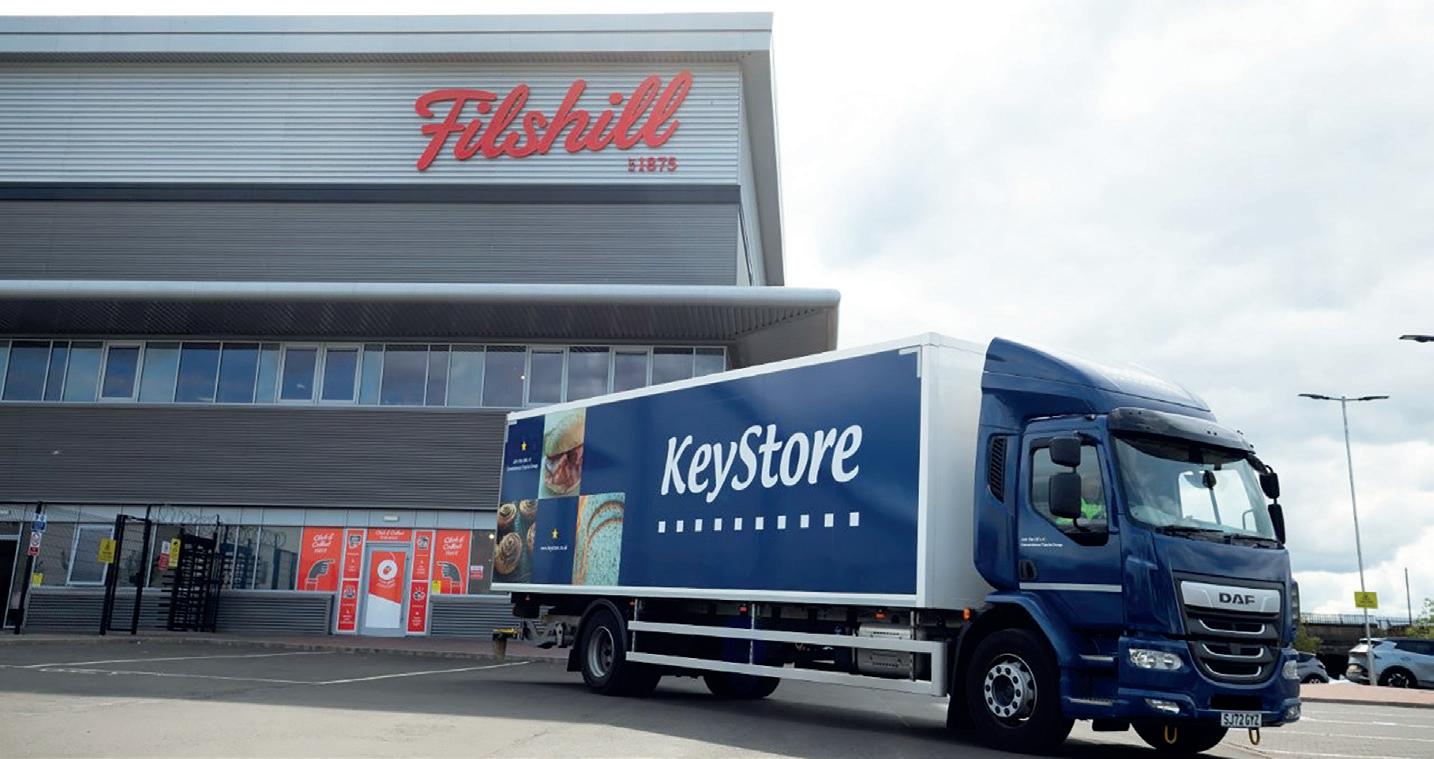
JW Filshill has been one of the leading adopters in AI in the wholesale channel
wholesaler’s business like everything on that list – it can cover all of them.
New AI tools can support with data and stock analysis, customer service support, marketing asset creation, compliance checks and general admin tasks. In addition to this, there are a number of ways wholesalers have already been using AI for several years, such
“
AI is changing the way wholesalers work across the whole commercial cycle
as route planning and product recommendations in online ordering.
However, the big challenge facing wholesalers is understanding where to invest in AI among the vast array of potential uses. Too much choice can overwhelm even the most single-minded managing director when there are strong commercial arguments for multiple solutions all at once.
As a result, AI adoption requires a different mindset to other tech. Deciding what and
which part of the business to prioritise can be staggered over a longer-term strategy that helps to inform and identify where the biggest gains can be made.
JW Filshill offers a good case study, asking department heads to keep bringing forward AI projects every 90 days to keep learning and land on positive uses across the business.
To help more wholesalers and suppliers achieve a similar position, we’re building a series of practical AI capabilities into our customer engagement platform, ProConnect, in a way that fits how this sector operates –focusing on transactions, communication, customer service and payments.
That gives wholesalers a more practical way to test and scale AI without stitching together multiple tools or forcing generic software into messy wholesale operations. It’s the way to effectively introduce new ways of working for all teams.
No wholesaler can afford for any of their departments to stand still because if AI can impact the entire commercial cycle, the gains – and potential losses by not acting – are so much greater. The risk isn’t what AI might replace, it’s that competitors will quietly use it to become faster, easier to buy from and cheaper to serve. l
Rob Mannion, founder, b2b.store
How wholesalers can attract the next generation of talent
What the channel needs to do to attract and retain the stars of the
future
Paul Hill
Although the Covid-19 pandemic helped bring wholesale into the public eye, the channel still struggles to attract younger workers despite it being a key cornerstone of the UK’s economy.
With Millennials and Gen X now dominating the workforce – and Gen Z now fully ingrained into workplaces – wholesale needs to evolve to appeal to a generation that values flexibility, purpose and innovation.
Here are some actionable ways wholesalers can make that happen.
Show the impact behind the industry
Younger professionals want to do meaningful work, so wholesalers need to demonstrate how the industry keeps the nation running. An example of this could be the likes of Dunsters Farm highlighting how it helps feed hospitals, or Savona Foodservice and its work with schools in the local area.
Modernise the company image
The outdated perception of the industry as old fashioned needs to go. Wholesalers can do this by revamping branding with refreshed visuals and using social media to create engaging content. Up in Hull, Turner Price is doing the latter very well and using online storytelling to show it is a tech-savvy and people-focused business through videos on TikTok and Instagram for its trade shows and customer events.
Invest in structured development programmes
Graduate schemes, apprenticeships and internships, like those pioneered by Bidfood and Pricecheck, offer a clear first step into the industry. By making continued education a cornerstone of a work culture, this will support employees to gain new skills and explore different roles across the sector.
Champion mentorship
As seen in FWD’s Future Leaders mentorship programme, as well as Women in Wholesale’s former Coaching Academy, pairing young professionals with senior leaders accelerates growth and creates new leaders who are then at less risk to leave to a new industry. This can also work the other way, with younger staff sharing insight on technology and social trends to more experienced members of the workforce.
Promote
a flexible, inclusive culture
Gen Z in particular values flexibility, inclusivity and belonging. Offering hybrid roles where possible, especially in admin or sales, can widen your candidate pool. Wholesalers need to foster environments where diverse voices are heard and everyone can see a path to progression.

enter the space with a digital-first mindset. By investing in cloud-based systems and AI-driven analytics like Filshill has done, it will encourage younger talent to invest in a career in wholesale. Service providers such as b2b.store offer wholesale-tailored software to implement this.
Build a strong sustainability ethos
Work-life balance is the top career goal for both Millennials and Gen Z in the UK*
Embrace technology and
innovation
Since Covid-19, the wholesale channel has massively improved its frameworks within the digital space. However, that needs to progress even further as the younger workforce
Whether it’s cutting food waste, supporting local sourcing or strengthening community partnerships, wholesalers need to show that sustainability is part of the company’s purpose and communicate this authentically.
Offer more than salary
Like David Gilroy says on page 4, traditional career models have emphasised hierarchical progression and long-term organisational loyalty, but younger workers are increasingly rejecting this linear approach. This is why wholesalers need to think beyond pay packets to meaningful benefits such wellness programmes, travel opportunities or education allowances. l


Paul Hill
Mental health & well-being
A deep dive into how wholesalers can build a mental health plan into their operations
Warehousing, logistics pressure, long shifts and physical strain make the wholesale channel vulnerable to burnout and stress-related issues. This is why building a mental health plan into an operation will not only improve morale across the employee base, but also positively affect safety, productivity, staff retention and even customer relationships.
The impact of poor mental health in the workplace has been well documented in recent years. As well as its effects on the individual, the impact on organisations, the economy and society are severe, and according to the Health and Safety Executive (HSE), 16.4 million working days were lost due to work-related stress, depression or anxiety in 2023/24.
What is your duty of care as an employer?
The British Red Cross training website states that the law requires employers to tackle work-related stress. It adds how it’s crucial to treat mental health in the workplace as you would first-aid requirements within your organisation, and plan the training you require accordingly.
The 2024 HSE guidance introduces the inclusion of mental health considerations within first-aid needs assessments to identify training requirements, and references the six ‘Core Standards’ for managing Mental Health at Work:
1. Produce, implement and communicate a Mental Health at Work plan
2. Develop mental health awareness among employees
3. Encourage open conversations about mental health and the support available when employees are struggling
4. Provide your employees with good working conditions
5. Promote effective people management
6. Routinely monitor employee mental health and well-being.
Using these six standards, here’s a starting point, some quick wins and a practical plan for wholesalers to implement.
Leadership commitment and culture
Train supervisors to recognise early signs of stress, burnout and fatigue; include mental health KPIs alongside productivity metrics; and encourage open conversations without stigma.
Risk assessment

standard health and safety risk assessments.
Work design improvements
Ensure realistic productivity targets; build buffer time into schedules during peak demand; and limit excessive overtime.
One in five UK adults report having a common mental health condition
Identify where mental strain is coming from in your workflow; run anonymous employee surveys quarterly; map stress ‘hotspots’ (e.g. delivery routes, busy periods, admin bottlenecks); and include mental health in
On-the-ground support systems
Appoint trained ‘mental health first-aiders’ on each shift; provide quiet/rest areas in warehouses or offices; and offer access to confidential counselling services (such as employee assistance programmes).
Training and awareness
Normalise mental health as part of operational training; offer mandatory training for all staff on stress management and resilience; and run manager-specific training on

handling sensitive conversations.
Crisis and absence support
Clear protocol for employees experiencing acute mental health issues; have supportive return-to-work plans after absence; and avoid punitive approaches to mental-health-related sick leave.
Measurement and continuous improvement
Track absenteeism and overtime levels; track employee satisfaction/stress survey results; and track incident and error rates (often linked to fatigue).
Integrate into existing operations
Embed mental health into health and safety policies; align with HR, operations and compliance teams; include well-being checks in standard operating procedures (SOPs); and provide managers with clear escalation pathways. l


Mentalhealth.org.uk has numerous pieces of content for companies to use on its website, especially around periods such as Mental Health Awareness Week
Spotlight: Universal Product Solutions
Paul Hill caught up with Universal Product Solutions to find out how a unique customer and product strategy has made it successful

PH: Could you talk to us about your product range and your unique relationship with customers and brands?
KW: Our customer base and products cover a huge range because we sell on Amazon, Temu, TikTok and eBay, as well as our own website. We sell to anyone, from the hotels in London to people at home, and our split is around 80% B2C and 20% B2B. That includes supplying other foodservice companies if they’re struggling to hit MOQs on certain brands.
With regards to our product portfolio, we recently had a change of strategy in which we have gone from doing as much volume as possible to focusing on profitable volume. To do this, we went through our catalogue to flush out lines that were too low margin, get damaged too easily in transportation or are too short dated.
Grocery staples such as tea, coffee, biscuits and sugar have always been our bread and butter, as these are the lines that will forever sell well and we want to do these in huge numbers.
Another area we’d like to expand further is our exclusive projects for products and gift packs we work in partnerships with our suppliers on.
What gives your business its USP?
We work very well with big brands and have a unique ability to adapt to what the brands need and want – whether it’s a gift pack we create from scratch or supporting them with brand reports each month. No matter what the customers’ or suppliers’ need, we make it happen. We change and adapt very easily, and that can sometimes mean working overnight to achieve this for them. We also go above and beyond with compliance, and make sure everything is by the book.
For example, we have BRCGS and Organic Certification, and even though some of the processes we have may seem like we go overboard, it gives us confidence to work with all the big brands. This means we are ready for any requirements thrown at us to be able to work on a project.
What are your growth plans for the years ahead?
We sit at just above £24m turnover now

“
We have a unique ability to adapt to what the brands need and want
and we want to get that up to £30m very quickly. This is something we know we can achieve within a few years by helping the brands with new gifting lines and supporting them with knowledge of what other lines can work.
With regards to our longer-term goals, we must keep them very open as this is an
ever-changing industry. However, our main focus is to keep expanding our portfolio of suppliers and manufacturers we work with, reach more brands and provide more services to help mutual growth.
This will, of course, mean more staff and potentially bigger premises in the future, but ideally we want to reach the capacity in our current premises first.
What is the biggest challenge the business faces?
Our biggest challenges are also our biggest wins, and that’s the industry of Amazon and the variety of rule changes we have to contend with. This means we must continually
Ken Wright, operations director


adapt, which is incredibly challenging. In a wholesale business like ours, you have to be able to change your business in 24 hours or you won’t succeed.
Staying compliant is another challenge. Most of our competitors will cut corners, which almost gives them a short-term advantage, so we do have to lose some battles to win the long-term war.
What has the company done to improve its environmental footprint, ensure the business has a strong gender balance and is attracting the workforce of tomorrow?
We have reduced our packaging by half and
use a lot of recycled packaging. We have also been trialling the removal of boxes on items that have a strong exterior already, which has also helped in this area.
Overall, though, our operations don’t have a massive environmental footprint anyway, so it’s simple and straightforward to keep in check, but we do still maximise our efforts where we can.
In terms of our recruitment policy, we have never had to try hard to get the right people. I think as long as you hire with an open mind and without any prejudice, the balance comes naturally.
Maybe we have just been lucky so far, but that’s our experience. l
The company recently picked up a gong at The Wholesale Group’s awards
SERVICE PROVIDERS
Herald Packaging
In partnership with
1997
Close to 30 years supplying the UK wholesale and foodservice sector

PH: What service/product do you offer to wholesalers?
HP: Herald Packaging supplies a complete range of food-to-go packaging and catering disposables – more than 500 lines including hot and cold cups, food containers, cutlery, takeaway bags, boxes and sustainable alternatives. Operating nationally from Corby, we combine our own manufacturing with strategic importing to maintain strong UK stock levels and competitive pricing. For wholesalers, that means one account, one supplier relationship and a full packaging solution that covers everything your foodservice and takeaway customers need – reliably and consistently, every time they order.
Why should wholesalers be investing in your product/service?
Food-to-go packaging is a fast-moving, high-demand category that your customers need week in, week out. If your range has gaps, those customers are filling them elsewhere, and taking the rest of their basket with them. Investing in a complete packaging offer isn’t just about adding lines; it’s about retention, basket value and positioning yourself as the supplier your customers don’t need to shop around from. Herald makes that straightforward: one account, reliable stock and a range broad enough to cover every format your customers ask for.
How can your product/service help wholesalers increase profits and improve operational efficiency?
A complete packaging range from a single supplier directly reduces the cost of doing business. Fewer supplier relationships means less admin, fewer purchase orders and simpler logistics. More importantly, it means more of your customers’ spend stays with you. When a customer can source cups, containers, cutlery and bags from one place –your place – average order values go up and customer retention improves. Herald’s strong
500+
Product lines across food-to-go packaging and catering disposables
stock holding and fast UK dispatch also means fewer out-of-stocks, fewer emergency orders and a more predictable, efficient supply chain for your business.
What advice would you give to wholesalers?
Don’t underestimate the packaging category. It might not be the most glamorous line on your price list, but it’s one of the most con-
One account
Covers everything from cups and containers to cutlery, bags, boxes and eco alternatives
sistently ordered. Foodservice and takeaway operators need packaging every single week – and they want a supplier who has it, knows it and won’t let them down. Our advice: audit your current packaging range, identify the gaps and think about how much of that spend is currently going elsewhere. A complete, well-stocked packaging offer is one of the simplest ways to increase order value from the customers you already have. l

Yogesh Patel, director
One Supplier. Complete Range. Zero Gaps.
500+ food-to-go packaging lines, stocked and ready to deliver.
Product lines. One account. Fast UK dispatch.

Your customers need packaging every week. Herald gives you the complete range to make sure they’re buying it from you — not someone else.

BUYING GROUPS
Caterforce

PH: What has been your most significant achievement over the past 12 months?
GM: Caterforce has continued to strengthen its position as one of the UK and Ireland’s leading independent foodservice buying groups, delivering strong commercial and operational benefits to members. We support 10 independent wholesale businesses serving more than 50,000 customers, giving us the scale of a national operator while maintaining the flexibility, local expertise and customer focus of independent businesses.
Our membership has continued to grow, reflecting the strength of the Caterforce proposition. Woods Foodservice joined in 2025, followed by Holdsworth Foods in 2026. Both are highly respected, family-run businesses known for service excellence. Their decision to join Caterforce highlights the appeal of a group that combines commercial strength with shared values and a long-term vision.
What is your unique selling point?
Caterforce combines national-scale buying power with the agility and service standards of independent wholesalers. We ensure every one of our members has an equal voice in the group and our members collaborate and share best practice across leadership, buying, marketing, data, finance and sales. We also offer immediate value. There is no membership fee and income distribution to members has increased by 10% year on year, demonstrating the effectiveness of the collective model.
People and leadership remain central to our culture and we continue to support initiatives such as Women in Wholesale.
In partnership with

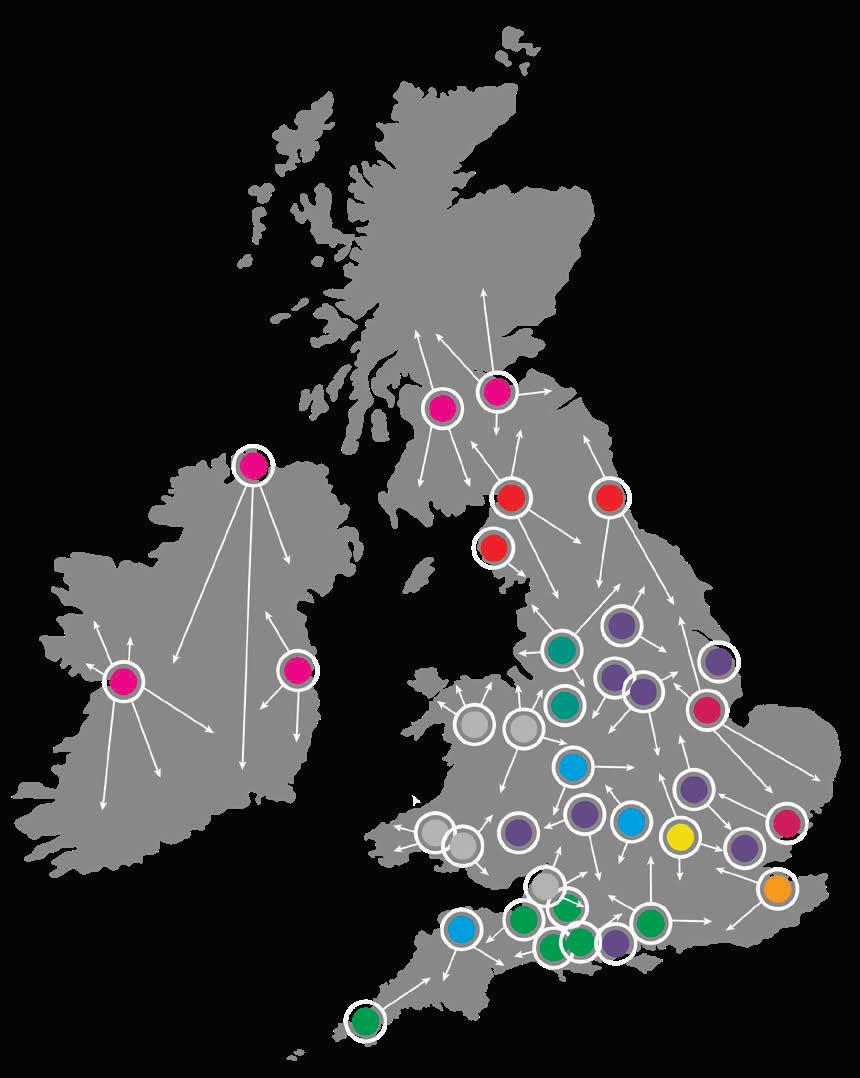
Number of members
£1.1bn+
Group turnover
What are your plans to help members over the next 12 months?
As the foodservice sector evolves, our focus remains on helping members adapt, innovate and succeed. Members benefit from a comprehensive range across all key foodservice categories, supported by strong supplier relationships and six supplier presentation days each year. These events help members discover new products, expand listings and identify innovation opportunities.
A key part of the Caterforce offer is our portfolio of five exclusive, award-winning own-brand ranges developed specifically for the independent foodservice sector. Ongoing investment ensures regular product innovation and range extensions aligned with changing customer demand.
We also deliver a comprehensive promotional programme via our Price Hub system, designed to drive sales and support both members and suppliers.
In addition to this, our group-wide digital capability allows suppliers to advertise their products to Caterforce’s extensive customer base. What sets us apart is our data-led approach to advertising, with performance reports that measure views, clicks, open rates, sales uplift, volume growth, customer type and customer count, providing suppliers and members with clear insights into campaign performance and a measurement of success.
Earlier this year we also launched our Food Safari initiative, where sales directors and customers visited some of London’s most exciting dining destinations to explore emerg-
Holdsworth Foods
Latest member
ing flavour trends and global cuisines. We also produce three bespoke Trend Guides for our members each year, offering insight into emerging food trends, menu ideas and product opportunities.
Events remain central to the Caterforce calendar, creating valuable opportunities for collaboration, learning and relationship building. Our flagship Caterforce conference on 12 November 2026 at Silverstone is already close to selling out months in advance, reflecting the strong engagement and momentum across the group. l
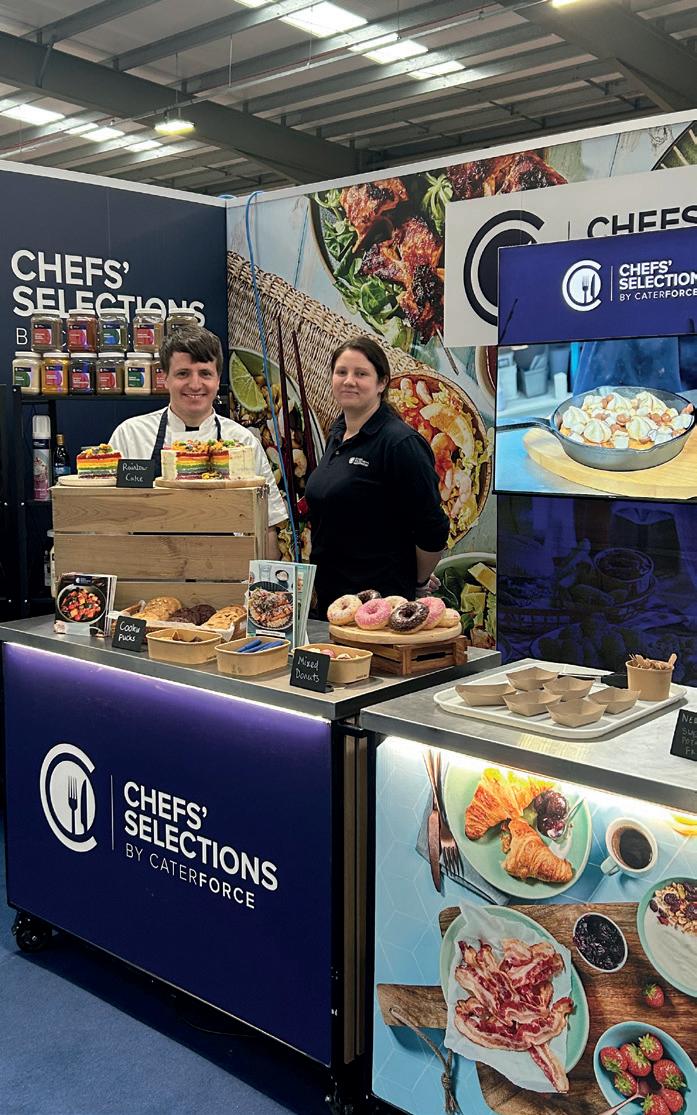
Gary Mullineux, managing director


50,000+






BUYING GROUPS
NBC
In partnership with
Number of members

PH: What has been your most significant achievement over the past 12 months?
DL: Supplier consolidation has continued at pace with significant changes to minimum order quantities, delivery points and direct accounts. Despite this, we have used our scale and what we do to continue to get access to great brands at great prices for both our members and our third-party customers. What really counts is what we do, as our group is very different to others – so much so that the term ‘buying group’ does not do it justice. The buying group landscape is very different, and we have seen so much change over the past six years that reinforces what we are doing is the right thing.
What is your unique selling point?
NBC is not just another buying group. Sure, we negotiate terms for our members, we provide some added-value services for those who need them. But fundamentally, we are a fully integrated buying and distribution group – NBC negotiates the terms and NDN delivers the brands. NDN is our wholly owned, non-competing central warehouse and logistics facility. It does not compete with its members. It provides the basic benefits our members and third-party customers need – a central ordering and invoicing point; net pricing – no retrospective claims; realistic minimum order quantities; and consolidated orders across the supplier portfolio. More importantly, it provides a safe route to market with our supplier partners. Ask our suppliers – this is what the team at Purity Soft Drinks thinks: “The consolidation of custom-
ers via NDN has proven to be very smooth and efficient, to the point we will be looking to extend this in the near future.”
What are your plans to help members over the next 12 months?
We need to continue with what we do well – working collaboratively with our supplier partners and providing a safe route to market while consolidation continues. We have had more than 70 applications for membership and third-party customer accounts in the past 12 months. We have to make sure they are the right fit for what we do rather than just chase a turnover number. Those that are applying for a customer account are clearly being let down by their own buying groups. For those that require specific services, we will work

Members serve 45,000+ outlets in retail, catering, hospitality and ecommerce channels
quietly in the background to provide them. And this messaging must be clear to those that wish to join the group. We do not charge fees; you can invest in the business through shareholding. In return, we expect a mutually beneficial working relationship.
What are the biggest challenges for your members over the next 12 months?
The challenges are never ending – cost pressures, a volatile economy, supplier consolidation, access to brands – to name just a few. What we need to do is ensure that they can at least get access to the brands at competitive net pricing and in realistic quantities so they can remain competitive and work on ways to be more efficient themselves to survive and prosper. l
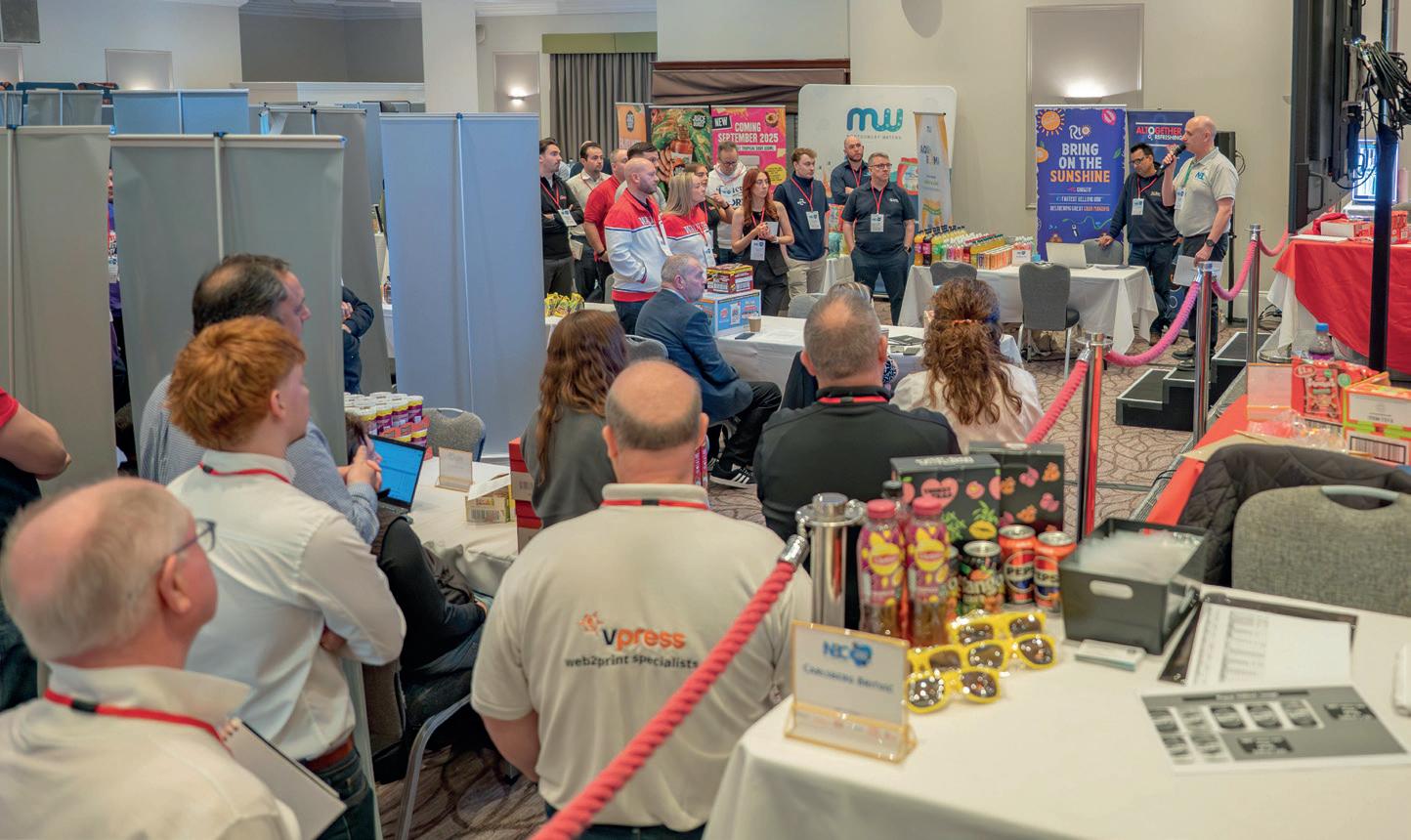
David Lunt, group managing director
Combined turnover
Lunt presenting at the recent NBC trade show
THE ALTERNATIVE BUYING GROUP
Our members service retail, foodservice, hospitality, e-commerce and export channels and deliver a wide variety of brands to over 45000 outlets.
NBC CAN BE YOUR PARTNER TO MAKE A REAL DIFFERENCE TO YOUR BUSINESS
BENEFITS OF BEING AN NBC MEMBER













BUYING GROUPS
Sterling Supergroup

PH: What has been your most significant achievement over the past 12 months?
DL: Celebrating our 60th anniversary in 2026 has been an important milestone, reflecting the strength of Sterling Supergroup. Over the past 12 months, that legacy has been matched by growth, with seven new members joining the group. Alongside this, engagement with Sterling Caterers Essentials has continued to increase, and our evolving events programme has strengthened collaboration, reinforcing the cooperative culture that has defined Sterling for six decades.
What is your unique selling point?
Sterling Supergroup is built on cooperation. As a not-for-profit, member-led buying group, our role is to support independent wholesalers in ways that suit their individual businesses. We deliver consistently competitive buying opportunities for members and provide exclusive access to the Sterling Caterers Essentials range, while ensuring wholesalers retain the flexibility and independence needed to respond effectively to their local markets.
What are your plans to help members over the next 12 months?
Over the next 12 months, our priority is, as ever, ensuring members stay competitive by delivering practical, targeted support that makes a measurable difference. We will continue to expand the Sterling Caterers Essentials range, increase the marketing materials available to members and work closely with suppliers to improve buying opportunities. A key milestone will be the launch of Sterling

Number of members
£500m+ Group buying power
Sphere in partnership with TWC in July, providing members with clearer, more accessible data to support confident decision making.
What are the biggest challenges for your members over the next 12 months?
Independent wholesalers continue to face economic uncertainty, rising operational costs and growing expectations around service and
availability. At the same time, competition at a local level remains intense. Balancing margin protection with the need to stay relevant and responsive is an ongoing challenge, particularly as data, technology and customer insight become increasingly important. This is why we are continually looking for ways to invest in technology, allowing us to mitigate as many of these challenges as possible. l
Daniel Larkin, chief commercial officer
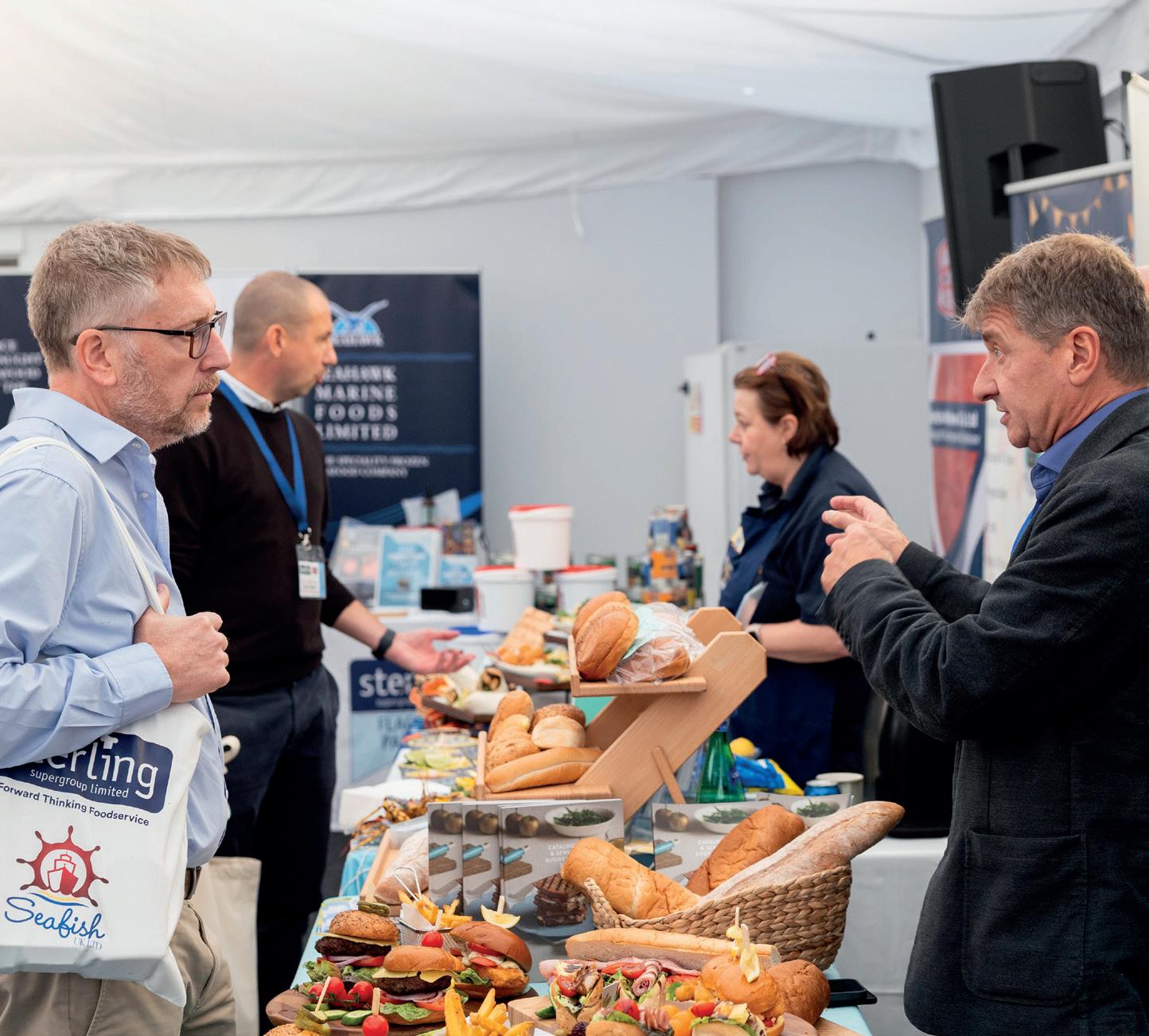
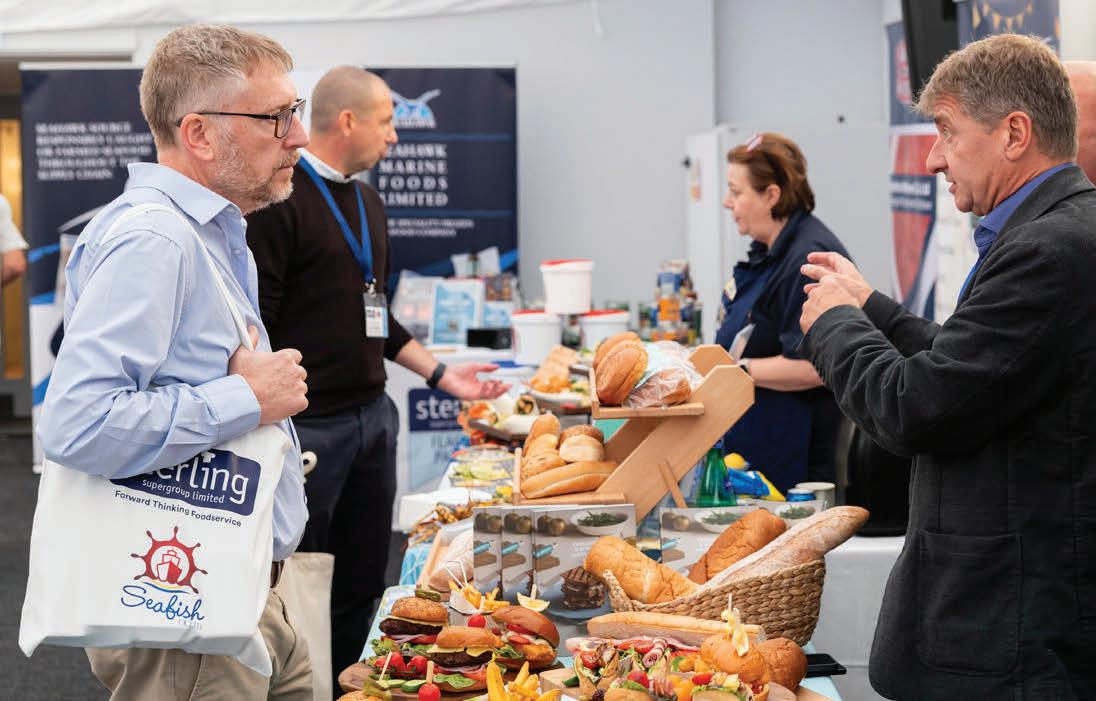
Delegates at the Sterling trade show
Celebrating 60 years with even more new members!
At Sterling Supergroup we know that to remain a trusted, award winning wholesale buying co-operative and market leader for 60 years, takes both hard work and fantastic partnerships.
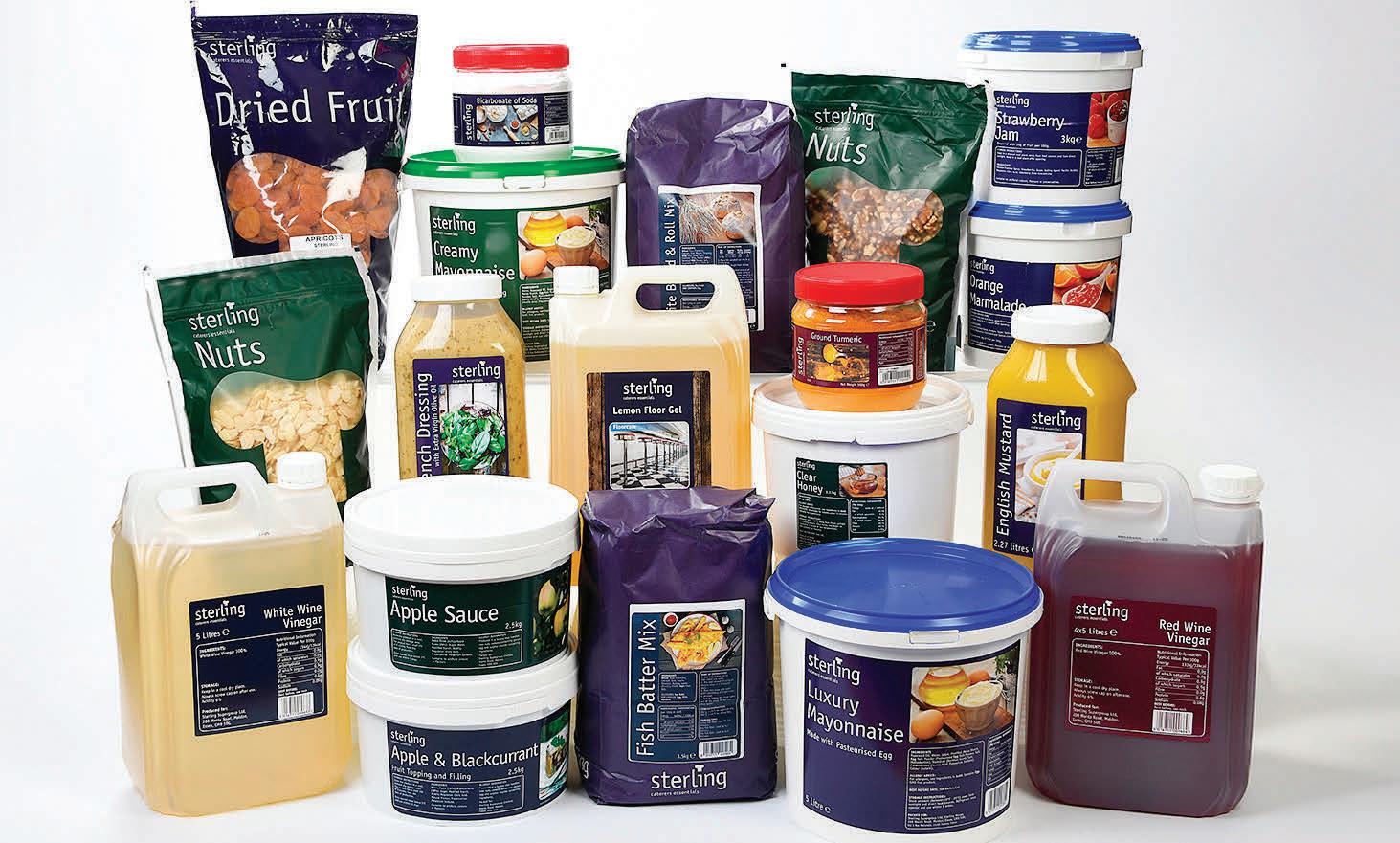
Decades of experience and our membership strength enables us to continue delivering quality product ranges like our fantastic Sterling Caterers Essentials at exceptionally competitive prices.
Here’s what our members say: “ThankstoSterling,we’veseenacceleratedgrowthin ourbusiness,duetohavingaccesstoadirectsupply ofproductsandbeingabletoshareinformationwith like-mindedpeopleinthegroup.Insummary,being partoftheSterlingSupergrouphashadahugely positiveimpactonourbusiness.” Introducing the Sphere

BUYING GROUPS
Sugro

Emma Senior, managing director
PH: What has been your most significant achievement over the past 12 months?
ES: Supplier collaboration has always, and continues to be, a core focus for us, so I’m delighted that we were once again awarded the number one buying group in the prestigious Advantage Survey.
We have now reached top spot in three of the past four years. ‘Reputation’ and ‘partnerships’ were identified as our key strengths, which is testament to how the team at Sugro work closely with our supplier partners to align on strategy and key focus areas.
What is your unique selling point?
The group’s unique selling point and focus continues to be our member-centric approach, characterised by a very strong sense of community among Sugro wholesalers.
Our key aim is to truly understand our membership, ensuring that any initiatives we provide match their needs. As an example, we are now able to offer members their own individual access to Brandbank, ensuring they have the most up-to-date information and images at their fingertips. Sugro UK has always been one of the first in the industry to adopt new ways of thinking and doing business. As an example, our digital offering has always been a key focus, with suppliers telling us we are at the forefront of these solutions.
What are your plans to help members over the next 12 months?
Providing key category insight is essential when wholesalers continue to be challenged with decreasing margins. To ensure we reach
£2.5bn Group buying power
Number of members

out total membership, we have launched an E-Learning Hub, which is a central digital platform, located on our well-established Drive Your Sales Portal. It will be used to host, manage and access educational content and training resources, with the support of the industry’s leading suppliers.
Another key support to our membership is our newly launched overrider system. This is a system designed to ensure our membership can identify gaps in their overrider earnings. With more than 40 suppliers on board, we have already seen examples where members have lost income due to not stocking an item within a supplier’s core range. We are continuing to onboard new suppliers and educate the members in using this intuitive system.
What are the biggest challenges for your members over the next 12 months?
It is fair to say that wholesalers have probably experienced the most difficult and challenging times over the past few years. The world seems to lurch into one crisis after another, with the Middle East war being no exception to that. Wholesaler overheads are increasingly strained with rising fuel costs and the impact of new government legislation, such as the increase to NI contributions and Day One Employee Rights, to name just a few.
We have just under 18 months before the new DRS scheme is implemented, which, while it’s a positive move to our environment, will create a huge burden to manufacturers, wholesalers and retailers. l


• Member-Owned Buying Group with Diversity and Focus on Growth at its Heart
• Industry Leading Promotions across all Impulse, Grocery, Food Service and Non-Food Categories
• Central Distribution and Central Invoicing Services
• Dedicated Business Development Support
• Events Calendar including two Annual Trade Shows
• Personalised Marketing Leaflets
• Full Category Support via Sugro Digital Drive Your Sales Magazine and Online Portal
• Opportunity to Join Sugro Insight Service (SIS)
• Member AI Accelerator Workshops
• Free of charge access to NIQ Brandbank images and assets
• Free of charge access to My Emissions carbon reporting platform
• Free of charge access to Trackable Overrider System
• Digital Signage and Procurement Services

BUYING GROUPS
Unitas

PH: What has been your most significant achievement over the past 12 months?
DC: As the UK’s largest wholesale buying group, we offer scale, efficiency and effectiveness for both members and suppliers. During the past 12 months, our members and supplier partners have seen firsthand how Unitas’ incredible scale and commitment to service continues to deliver incremental benefits for wholesalers and measurable return on investment from suppliers.
We leverage our unbeatable buying power to offer our members the best trading terms and conditions available, and, unlike other buying groups, every penny of those centrally negotiated terms goes directly to wholesaler members, who are the group’s sole owners.
At connect26, our annual trade show in Liverpool in March, we announced our plans to overhaul our existing services to deliver even stronger engagement platforms that will drive execution all the way to the consumer, which offers our members an incredible opportunity to step change their service.
While there is no doubt that our collective scale and strength delivers results, it is our agility, pace and innovation that sets us apart.
What is your unique selling point?
Unitas’ unrivalled scale means we can negotiate the best possible trading terms and advertising agreements with suppliers – and it works, as we are outperforming the market. We appreciate how important it is for suppliers to see a return on investment, and how future investment in our channel depends on results delivered now.
Number of members

What are your plans to help members over the next 12 months?
We have an industry-leading marketing service for our members, which includes bespoke deal brochures and digital capabilities, such as the Plan for Profit app, creating more than 1.5 million touch point opportunities for you to promote your business.
Already in 2026, we have launched two essential guides on how members can engage with the Unitas central office marketing team to achieve record results. Last year, we launched our groundbreaking Supplier Marketing Clinic, which has now been extended to benefit our members’ marketing teams.
We also have a raft of new initiatives launching over the coming months, including One Week Special promotions, exclusive pack formats for NPD, price-marked pack promotions and bespoke core range guides for out-of-home channels.
During the past year, we have also invested heavily in our own-brand range for both retail and foodservice to reflect consumer demand and market trends. We have strengthened our impulse offering through the launch of a new snacks range and expanded core grocery and household essentials.
We pride ourselves on the support we offer to our members. The Plan for Profit information resource includes core range advice, merchandising tips and planograms to offer guidance and a toolkit for independent retailers. Right now, our biggest ever research project is underway with wholesalers, suppliers and more than 300 independent retailers to shape
how we evolve Plan for Profit for the future to deliver even greater value for members and their customers.
Our promotions lead the industry – with 17 three-week offers across the year, which provides more than 4,000 individually crafted deals to keep shoppers flowing into independent stores and out-of-home outlets. Our promotional programme is built around key events in the calendar, and backed with huge support and sector-specific innovation from suppliers. These are widely publicised through depot, store, print and online materials, aimed at both customers and consumers, reaching in excess of 150,000 independent decision makers.
Between our trade show, conference and Meet the Member events, we facilitate more than 5,000 one-to-one meetings between members and suppliers, as well as providing essential insight, analysis, networking, celebration and entertainment.
What are the biggest challenges for your members over the next 12 months?
It is undoubtedly a challenging market, but our members are investing more into their businesses than ever before to increase distribution, drive volume and build genuine momentum across all channels.
Member growth remains positive, with new depots opening by Drinks Wholesale Group and Euro Wines, while Dhamecha and United Wholesale Grocers have plans to open new depots in Bristol and Manchester, respectively, in late 2026. l
David Cooke, chief operating officer
The UK’s largest wholesale buying group, Unitas provides multichannel expertise to its 124 wholesale members

As a group, we offer: unrivalled buying power and service powerful promotional programmes sector-leading category advice and marketing support annual programme of exclusive trade events … and so much more


BUYING GROUPS
The Wholesale Group

PH: What has been your most significant achievement over the past 12 months?
CR: Membership has grown over the past 12 months, but more importantly so has diversity and engagement among our members. In retail, member engagement with suppliers is up 76%. In foodservice, we now have 140 active members, 30% sales growth and visibility on £437m in sales-out data. We have ambitious plans to reach £5bn turnover.
What is your unique selling point?
The Wholesale Group remains the only buying group operating at scale across retail and foodservice. We offer no membership fees and complete transparency, supported by pioneering use of technology, exclusive own-brand ranges, customer marketing support, industry expertise and comprehensive data insight.
In partnership with
230 (serving nearly 350,000 customers)
Number of members
£4.5bn+ Group buying power
What are your plans to help members over the next 12 months?
The next 12 months will focus on stronger commercial support, better insight and more supplier collaboration. This includes enhanced marketing support, greater use of data and a busy events calendar bringing members and suppliers closer together.
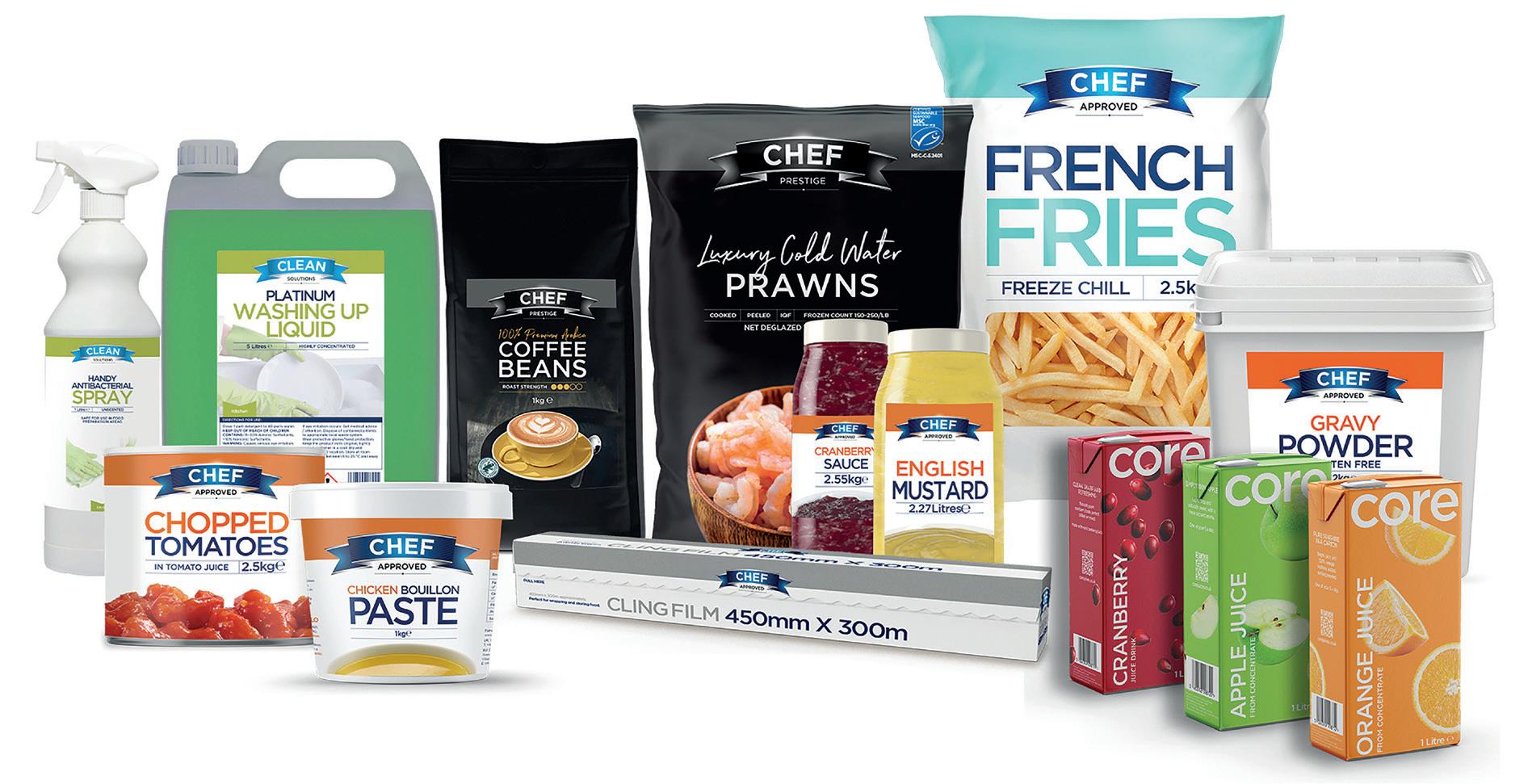
We are also investing in our own-brand portfolio, with around 350 products across Chef Approved, Chef Prestige, Core Juices and Clean Solutions. Recent developments include Core Juices, a structured Chef Approved and Chef Prestige coffee range, and a 12-strong Chef Approved cheesecake range, giving customers practical, portion-controlled dessert solutions.

22,000+ Total products
What are the biggest challenges for your members over the next 12 months?
Every business is managing rising costs, from employment and fuel to energy. Working closely with ShopAi, we’ve developed DASHAi, our internal AI business intelligence solution, to support forecasting and decision-making across the supply chain, helping members maximise margins. By improving data insight and anticipating key trading periods, members can make better decisions and manage ongoing pressures with confidence. l
For more information, please check out thewholesalegroup.co.uk
The Wholesale Group's own-brand range comprises more than 350 products with plans to grow it further
Coral Rose, managing director







Foodservice focus round-up
Tim Murray looks at the latest trends and developments

Three out of four UK consumers are actively looking for new flavours and taste sensations when they eat out, with almost two-thirds sharing their experience on social media.
That’s one of the key findings in foodservice business Paulig Pro’s new Taste the Future Flavour Trend Report. The wide-ranging document, which features insights from a panel of 15 chefs across 12 countries
and from interviews with chefs, guests and staff in 150-plus foodservice environments, backed up with a survey of 1,000 UK consumers, says that while looking for new flavours, diners are heading to dishes from Korean, Filipino, Taiwanese and Middle Eastern cultures.
The four key trends
The report identifies and breaks down four key trends: Fading Into Fusion (“Fusion is
becoming the new normal as a generation of chefs with multicultural backgrounds shape the menu”); Flavour Touchdown (“Rising diner expectations are driving restaurants to refine their flavour knowledge, offerings and storytelling”); Unlocking Parts Unknown (“Regional flavours and traditional cooking techniques are making their way onto menus”); and Beyond the Menu (“Tomorrow’s restaurants face new expectations around atmosphere, with storytelling art and music
75%
playing a key part”).
“Consumer research shows the need and want for new flavour profiles, such as Korean and Eastern Mediterranean, as well as flavours like Za’atar and pomegranate molasses,” says Martin Eshelby, Bidfood’s first culinary director.
Consumers looking for new flavours
“We’re also seeing techniques such as smoking, pickling and fermenting. With new flavours and techniques, it’s best to start with small plates or a signature dish. Diners understand more about global cuisines now, so it’s important chefs understand how to use different flavours.”
Asian sauce specialist Lee Kum Kee has noticed a similar demand for global and fusion flavours. “Demand for authentic global cuisines and fusion menus is accelerating,” says the company’s business development manager, Ivan Pan. “Increased exposure to international flavours through travel has piqued consumer interest.
“Britain’s culturally diverse demographic has fuelled demand for distinct food offer ings displaying authenticity. Social media platforms also inspire with visual appeal of fusion concepts. They blend the familiar with international techniques to broaden consumer appeal while maintaining cultural


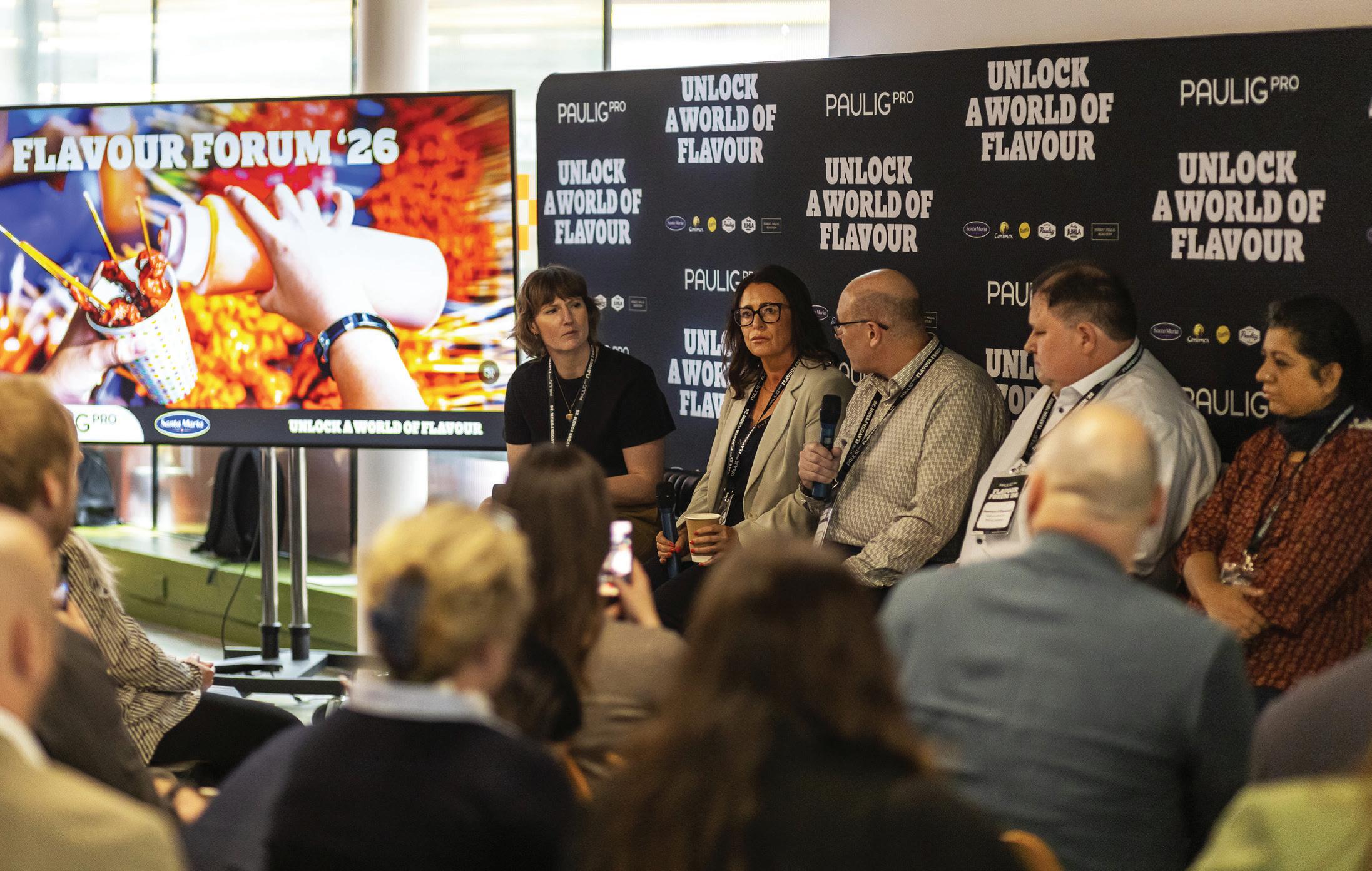
A panel at Paulig Pro’s recent forum. The company has highlighted four key trends to look out for

authenticity.”
Pan adds that chefs are under constant pressure to deliver consistent standards while also facing issues such as rising costs, limited space and labour shortages, which is where having the company’s sauces and seasoning to hand comes in.
Rising costs
Meanwhile, buying group The Wholesale Group has advised its members that certain products can ease pressure on kitchen staff – and solving operational problems in busy kitchen environments will prove popular for foodservice customers, particularly in competitive catering sectors. It has also reminded them that prepared products help offer “consistency, portion control, margin control and no waste”, and points to its Chef Approved own-brand products, taking in everything from bakery and juices to cleaning products.
Foodservice managing director at The Wholesale Group Coral Rose says: “[Own brands] simplify operations across multiple
channels including pubs, cafés, education, care and contract catering, which makes them the perfect addition to any wholesaler’s offer.”
Rose adds that the range can also help wholesaler members support caterers with problem-solving: “Work with your customers to support them to buy smarter, not just cheaper. Leverage exclusive ranges, own brand and added-value propositions that
“
Diners now understand more about global cuisines
match – and often exceed – the market leaders on quality, value, taste and consistency, without the price tag that comes with a brand name.”
High visual impact and bold flavours
Returning to trends, Bidfood is responding to the demand for bold flavours that have
bright visual impact and dishes from around the globe with a new recipe collection of chef-developed recipes. These are based on its own food and drink trends research.
The foodservice giant says the trends that are shaping menus this summer include feelgood whole foods, sweet heat flavours (think hot honey), loaded indulgence (striking and impactful that are plentiful, comforting and offer value), globally-inspired desserts and the continued influence of street food, especially from Korea.
Also at Bidfood, Caterers Campus, the company’s online learning and development platform, has gone past the 10,000-user mark. The platform, launched to help support hospitality and public sector customers during the pandemic, has expanded to cover 12 sectors and now includes 35 specialist modules, taking in everything from food safety to mental well-being. The company has also opened a new 86,098sq ft depot in Durham that will help consolidate its operations across the north-east and act as its hub in the area. It includes cold and chilled storage and a large

Deals across the sector
Talking of depots, KCS Cash & Carry has opened a new 30,000sq ft depot in Croydon, south London, which will serve foodservice operators, as well as independent retailers and trade customers. It’s part of KCS’ ambition plans to achieve double-digit growth year on year to the end of the decade.
beers, wines and spirits as part of an extended alcohol offer, as well as more Asian, Mediterranean and other world food lines. JJ also marked National Fish and Chip Day (5 June) with the launch of a campaign highlighting its one-stop shop range for fish & chip outlets.
10,000
JJ Foodservice has also announced plans for two new depots this year which will further extend its reach. The 33,000sq ft depot in Nottingham will open this summer, with the 28,000sq ft Ipswich site to follow later this year. They arrive as JJ has expanded its product range by almost 20% for foodservice operators, adding new premium
Users on Bidfood’s foodservice L&D platform
Meanwhile, Booker has refreshed its Food to Share range and added five new lines, giving operators the chance to offer more choice to customers for sharing boards, small plates and GLP-1-friendly dining. The latter is changing the way people dine out and further helping the shift towards smaller, portion-controlled dishes. Booker’s own-brand head, Karen Poole, says: “With consumers increasingly looking for food and dishes they might not
frickles to meet growing demand.
In deal news, C&C Group is merging Matthew Clark and Bibendum Wine to form a new on-trade wholesaler. Meanwhile, Matthew Clark Bibendum aims to create an improved offer for foodservice customers. Blakemore Food & Retail Solutions has extended its near-25-year partnership with Martson’s after inking a new deal which runs through to 2033, with Blakemore now supporting around 700 managed and partnership pubs across Martson’s 1,300-strong estate. The new deal will, the companies say, allow for deeper supply chain integration and allow for greater sustainability, innovation and improved operations.
Lastly, Bestway has signalled its intention to grow its foodservice, catering and on-trade arms with the appointment of a new foodservice director. Charles Abraham has joined the company from Gate Gourmet.l
SUPPLIER VIEWPOINT
Georgia Ladbrook Shopper marketing manager – impulse, BrewDog

Price-marked packs
Tamara Birch
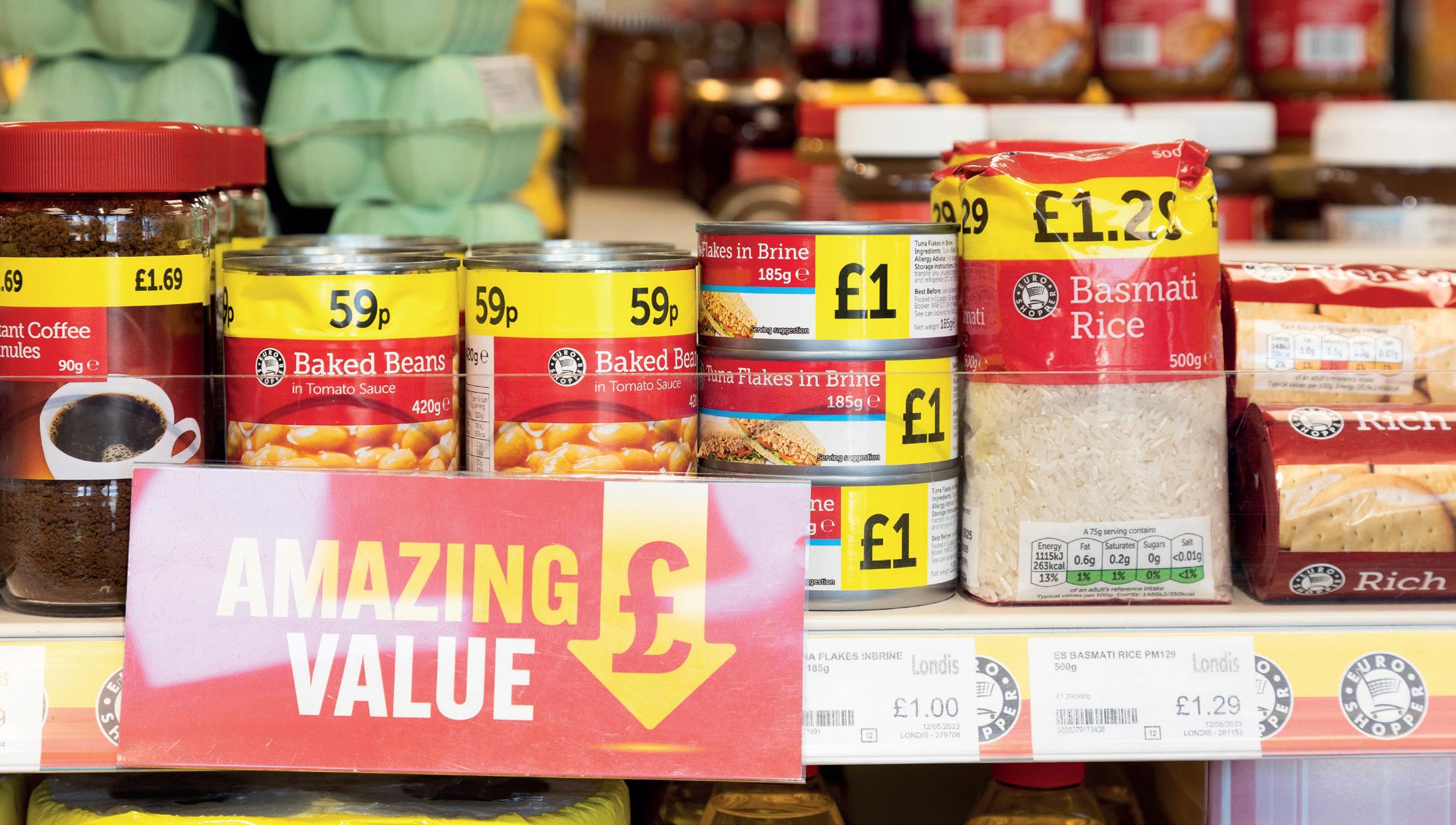
Many shoppers are currently on a budget, and offering value matters more than ever. Price-marked packs (PMP) reassure customers that they’re getting a fair deal, while helping retailers offer accessible prices that build trust.
Ed Merrett, wholesale controller at PepsiCo, says the PMP format value share has risen to 70% across 2025, compared to 68% in 2024. Elsewhere, Shaun Whelan, head of convenience at Jack Link’s, emphasises that PMPs are a vital mechanic across wholesale and convenience.
shopper confidence, while also driving cash margin and repeat purchase.”
Areas to focus on
The controversy around PMPs comes from profits and margins, but they remain a key driver of sales in the impulse channel. As a result, wholesalers need to focus on key categories their retail customers are looking for, such as soft drinks.
5.1%
Yearly growth of largeformat bagged snacks
“PMPs help wholesalers support their retail customers with clear value messaging and strong rate of sale,” he says. “Independent retailers will continue to look to wholesalers for products that deliver
A spokesperson from Red Bull says that 46% of soft drinks sales come from PMPs. Within sports and energy, for example, functional energy PMP formats account for 62% of sales. “They operate as a great way to draw shoppers to the fixture and give consumers confidence in their purchase, which ultimately encourages more sales,” the spokesperson says.
To help wholesalers meet this demand,
PMPs are becoming increasingly popular within the alcohol category in independent retail, particularly in beer, where 50% of four-pack lager sales within this channel are PMP. This is up from 33% two years ago and 47% last year. Morning consumers are also moving into this space as price-marking reduces complexity at the point of purchase and helps them make quicker decisions more confidently.
From a merchandising perspective, PMPs should sit within the category alongside all other relevant products. There is no need for them to be merchandised in a dedicated location. If a retailer is looking for lager, PMPs should be located within that space alongside non-price-marked products, ensuring a simple, intuitive and consistent shopping experience.
BrewDog recently launched our first foray into PMPs, introducing price-marked versions of our bestselling products: Punk IPA four-pack and Hazy Jane four-pack. This brings craft beer into the consumer’s consideration set at familiar and accessible prices, while delivering a strong margin chain for wholesalers and a clear value proposition for the end consumer.
PMPs provide clear and transparent communication of price from wholesaler to retailer to consumer. By displaying the price directly on pack, it removes any uncertainty for the consumer around cost, which is particularly important in independent retail environments.
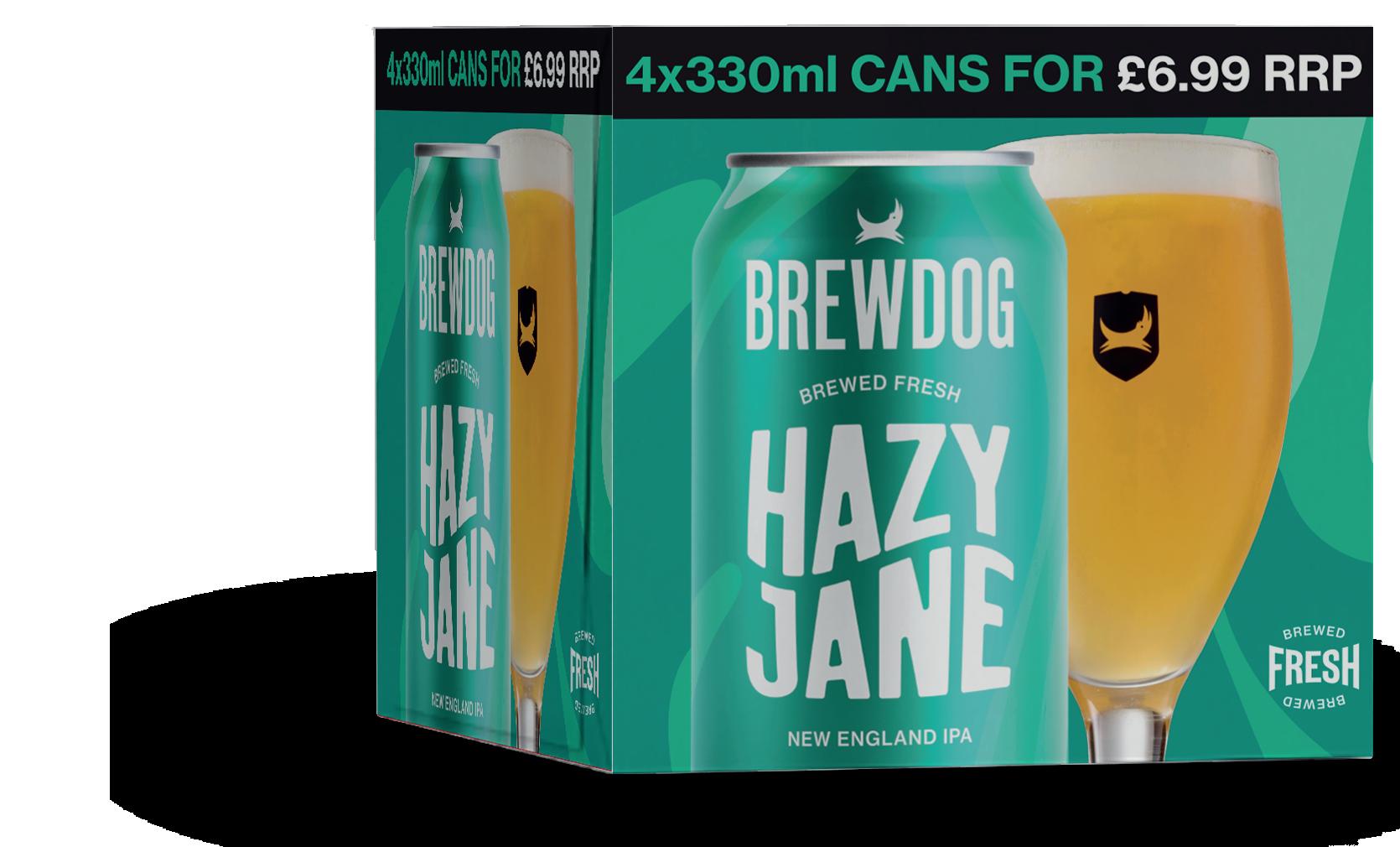




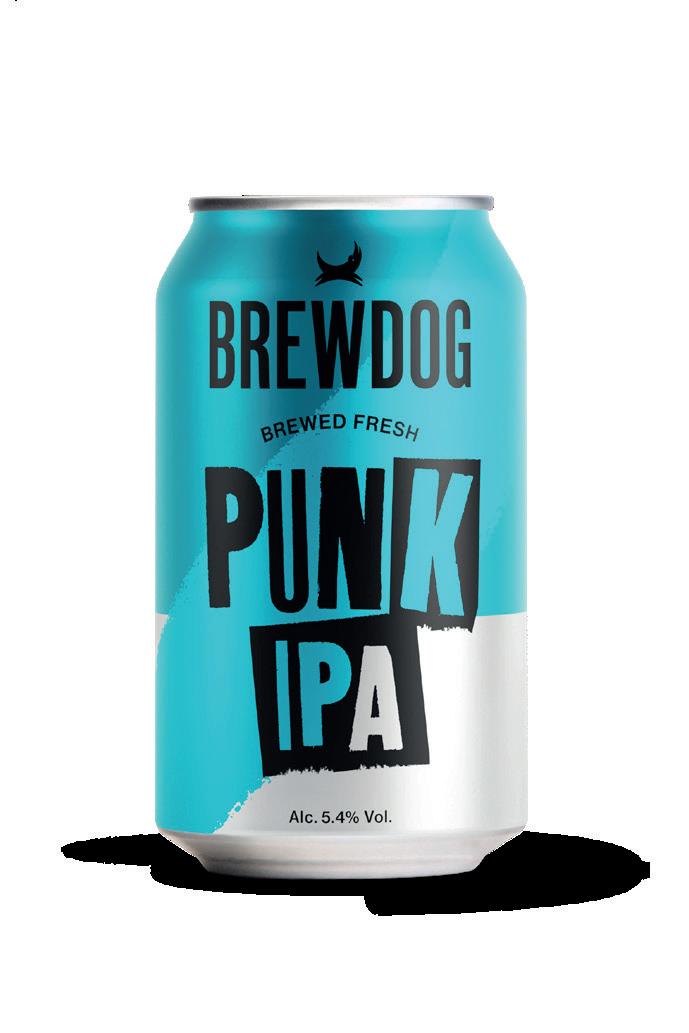


















Red Bull recently launched its latest Spring Edition, Cherry Sakura, in 250ml PMP and 473ml PMP formats.
Meanwhile, Alexander Wilson, category and commercial strategy director at Heineken UK, says that beer and cider PMPs also perform strongly, accounting for 48.7% of the value sales in the total category. “On the whole, this does vary by brand, but if you look at PMPs of smaller packs of beer and cider in the impulse channel, 51.2% of value sales come from standard packs,” he says.
This insight is backed by Georgia Ladbrook, shopper marketing manager –impulse at BrewDog, which is why the firm recently expanded into PMPs with the introduction of Lost Lager and Cold Beer Pint Can four-packs.
Visibility is also important. Steven Greaves, managing director UK and Ireland at Fini, recommends wholesalers use secondary displays and promotional activity to draw attention to products that offer value, standout and shopper appeal, or work with suppliers. “By working with Fini on acti-
Florette
Florette Crispy (90g) and Florette Mixed (125g), which are grown from three farmer-owned cooperatives, now feature a £1.25 price flash to communicate value and build shopper confidence.
vation and merchandising, wholesalers can better showcase PMPs in depot and support stronger sales momentum across the category,” he says.
Another controversial challenge with PMPs is price flexibility, but retailers aren’t tied to the marked price, and wholesalers play a strong role in educating their customers on this.
“
PMPs help attract new customers, boost basket spend and encourage repeat purchase
“Retailers and wholesalers can choose to sell below the marked prices during key trading periods,” advises Ladbrook. “The price-marking simply removes the need for permanent shelf-edge labelling, while still allowing full promotional freedom.”
Consider placing signage around the depot telling retailers of this fact, as many won’t
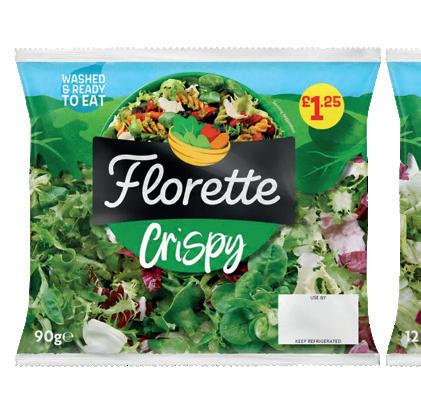
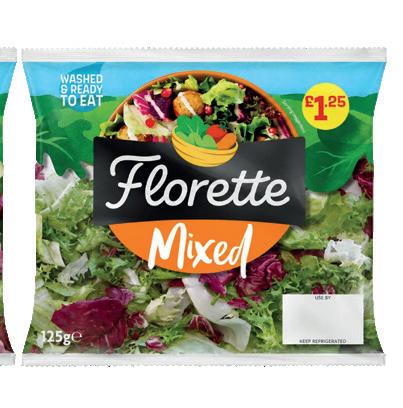
Soreen Lunchbox Loaves
The new PMP features a fresher-forlonger recipe designed to help stores reduce waste and sustain a stronger rate of sale.


PRODUCT NEWS
Mondelez
New listings via major wholesalers show £1.25 105g PMPs for Sour Patch Kids and £1 110g PMPs for Maynards Bassetts lines including Wine Gums, as well as Fizzy Fish Jellies and Classic Fruit Mix, among others.


Coca-Cola
The company has rolled out reducedprice PMPs for a limited time across selected 1.75l and 2l bottles from the Coca-Cola range.

know this is possible, especially if they are buying from your depot on promotion. This way, they can continue to offer more value to their customers.
The snacking opportunity
Bagged snacks appear in one in five convenience shopping baskets, with PMPs occupying a 71% share of these sales in independent stores. “The top 10 bestselling SKUs are all PMPs, and large-format PMPs are growing by 5.1% year to date,” says Stuart Graham, head of C&I and value channel at KP Snacks.
KP Snacks offers a wide range of PMPs that hold 40p-to-£1.35 price-marks, including Hula Hoops Big Hoops BBQ Beef, McCoy’s Flame Grilled Steak and Big Hoops Salted.
Meanwhile, Merrett has commented on a resurgence towards savoury snacks, and across 2025, 77% of consumers purchased them from convenience stores, with the category now worth £895m a year. But Merrett reminds wholesalers that PMPs are a way to tempt shoppers into trying launches.
“In fact, 63% of new product packs sold
Doritos Chilli Heatwave and Walkers Nuts
PepsiCo has launched £1.35 PMPs of its That’s Nuts flavours. These include Doritos Chilli Heatwave and Walkers Salt & Vinegar, which are available in 60g packs. The new packs arrived in depots in May.

BrewDog
The new PMP range includes four-pack pint cans of Lost Lager and Cold Beer, pricemarked at £7.25 and £5.49, respectively. This follows the success of a PMP launch last year.

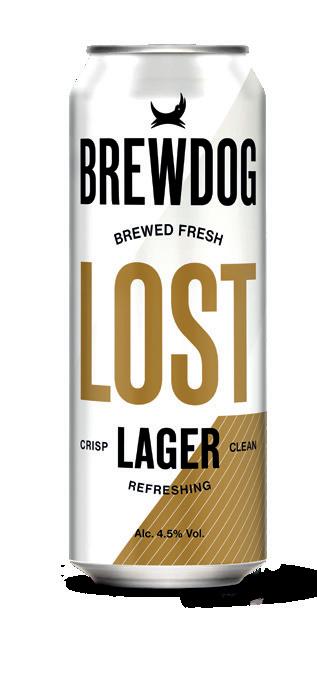
are PMPs, which has risen from 59% over the past year,” he says. “But, don’t forget that sharing bags dominate this space, accounting for 73% of PMP new product sales.”
Merrett adds that wholesalers stocking launches from bestselling brands, like its £1.35 PMP That’s Nuts range, in PMP formats can help retailers boost shopper trust and basket spend.
Confectionery PMPs
PMPs work well within confectionery as they offer a quick price comparison, encouraging incremental purchases.
A spokesperson from World of Sweets says that within confectionery, sharing bags and pocket-money treats are among the strongest PMP performers.
Wholesalers need to also dive into catering for and offering value for on-the-go missions. Hybrid working has seen more transient trade and retail customers are looking to offer value to drive repeat purchases.
46%
Soft drinks sales coming from PMPs
“PMPs allow shoppers to see a product’s value through a multitude of confectionery options,” says Lauren George, external communications manager at Mars Wrigley. “What’s more, consumers are more likely to come back to those brands that offer PMPs for repeat purchase.”
Well-merchandised PMPs will prompt purchase, and Ross Davison, head of convenience at Kepak (foods division), home of Rustlers, says that secondary sitings of PMPs in high-footfall areas will boost impulse sales.
“PMPs help to attract new customers, boost overall basket spend and encourage repeat purchase among both brand loyalists and those consumers looking for value-priced products that don’t compromise on quality,” he says.
KEY TAKEAWAYS
1. PMPs offer value
Many shoppers are on a strict budget as the cost-of-living crisis continues to grow, and PMPs reassure customers they’re getting a fair deal and build trust with store owners.
Wholesalers play a strong role in also educating their retail customers on the value opportunity PMPs offer.
Overall, value share of PMPs has risen to 70% across 2025, compared to 68% in 2024.
Suppliers, like Whelan, stress the importance of PMPs and say they remain – and will remain – a vital mechanic across both wholesale and convenience, as they offer a strong rate of sale for both parties.
2. Focus on the right categories
Margin and profits are controversial across the supply chain as they are often lower than their non-price-marked counterparts.

However, they remain a key sales driver in the impulse channel, and something that wholesalers and retailers need to offer.
As a result, focus on key categories where PMPs are known to thrive, including soft drinks, as well as beer and cider.
For soft drinks, 46% of sales come from PMPs, while beer and cider PMPs account for 48.7% of the value sales in the total category.
3. How you merchandise is key
The way you merchandise in depot is vital to increasing purchases.
Suppliers, including Davison, recommend dual-siting PMPs where possible in high-footfall areas to boost impulse buys from retail customers.
He says PMPs help attract new customers, boost spend in depot and encourage repeat purchase among shoppers that are buying on a budget.
Greaves recommends the same, as well as using promotional activity to draw attention to any PMP fixtures. This also includes working with manufacturers to ensure you have the right range to entice your retail customers l

The complete guide to alcohol
Tom Gockelen-Kozlowski
From a summer packed full of major sales opportunities to broader trends away from drinking, it can be hard to know exactly how wholesalers should approach this vital category in 2026.
Setting an example
In a challenging environment, suppliers are increasingly looking to the independent sector to maintain or grow value sales. And the UK cider market – down 8% in total volume year on year, according to TWC –is showing how it’s done.
Within convenience, the ‘crafted cider’ segment has increased in value by 10.4%, and Henry Westons Vintage 500ml format is now both the top-selling crafted cider and cider product overall in the UK convenience channel.
“Crafted cider is delivering disproportionate value growth. With significantly higher pricing per litre than the category average, it taps directly into what today’s drinkers are seeking: provenance, authenticity and flavour,” McKinnon adds.
10.4%
“Convenience retailers and their wholesale partners are playing an increasingly important role in the cider category,” says Sally McKinnon, head of marketing and strategy at Westons. “As shoppers drink less but trade up in quality, the channel is well placed to meet demand for premium cider, trusted brands and formats suited to drinking occasions.”
Crafted cider’s growth in convenience
Natalie Marshall, trade marketing manager at Aston Manor Cider, agrees that there are “strong signs of momentum and opportunity emerging”, led by suppliers responding to changing consumer behaviour.
“Aston Manor is at the forefront of this growth as the fastest-growing cider supplier, achieving 12% growth in volume year on year,” she adds.
For wholesalers and independent retailers,
SUPPLIER VIEWPOINT
Natalie Marshall
Trade marketing manager, Aston Manor Cider

As we head into summer, cider becomes a perfect choice for outdoor social occasions. With shoppers still feeling the pressure on household budgets, and 69% of occasions now taking place in the home, the warmer months offer wholesalers a strong opportunity to drive sales through trusted value brands that shoppers already know and love.
When shoppers are hosting barbecues or catering for groups, larger take-home formats and multipacks really come into their own. They make it easier to buy for groups while keeping spend under control, which is exactly what consumers are looking for.
In a market under pressure, brands that consistently deliver quality, value and strong rates of sale are what shoppers are actively seeking. That’s why valueled cider continues to outperform, particularly during the warmer months when demand peaks.
There are areas of enormous opportunity emerging. Wholesalers that take a critical approach to their range and make changes to reflect areas of demand can stand out and become a destination.
meanwhile, Marshall believes that category management is the not-so-secret to success: “Review your mainstream cider brands. Do all the brands you stock offer something unique and different? You can consider delisting some mainstream brands in favour of premium and value options in growth.”
Stocking the formats retailer customers are looking for is also vital, she says –as is boosting profitability via cross merchandising. “Summer socialising creates a clear opportunity to build bigger baskets. Linking cider with barbecue food, sharing snacks and seasonal lines helps retailers – and their shoppers – quickly build a complete occasion and encourages tradeup,” Marshall adds.
Soft drinks, hard sales
One of this summer’s most eye-catching new trends is the collaboration between much-loved soft drinks and the ready-todrink (RTD) market.
“RTDs continue to be one of the fastest-growing areas within alcohol, now worth
Modelo Especial
£824m, up 22.9% year on year – with premix making up almost half of the category at 47% of volume sales,” says Lucy Reidy, marketing manager, alcohol at AG Barr.
Last year, the company launched Ka Remix, which blends Caribbean white rum with Ka’s soft drinks. The four-strong line up includes Black Grape, Fruit Punch,
“
Summer socialising creates a clear opportunity to build bigger baskets
Pineapple and Karnival Twist.
Ka Remix is far from alone. Premium vodka brand Au has launched two RTD products with Tango in Orange and Apple flavours.
Highlighting the benefits this trend can bring to the independent channel, the range is available with a per-can RRP of £2.99.
“This collaboration reflects the growing
PRODUCT NEWS
Asahi Super Dry
crossover between alcohol and soft drinks, particularly within the flavour-led RTD market,” says Munnawar Chishty, chief marketing officer at Carlsberg Britvic.
Coca-Cola Europacific Partners (CCEP) has also taken another step into the RTD category with a new multipack for Absolut Vodka & Sprite. The six-can format features three flavours: Watermelon, Lemon & Lime and Pineapple.
“As social occasions evolve, consumers are looking for greater choice and flexibility. Moving into variety packs allows us to meet that demand while opening up new occasions for the brand,” says Elaine Maher, associate director, alcohol readyto-drink at CCEP. The new format follows the launch of Absolut Vodka & Sprite Pineapple this March.
And this isn’t the only activity completing for shelf space in a busy few months for RTDs. Now a summer staple, Aperol Spritz to Go brings the cocktail to a can format while premium tequila brand El Jimador has launched a Sparkling Margarita RTD
La Vielle Ferme Rose

The world’s fourth most valuable beer brand has now officially launched in the UK off-trade through Budweiser Brewing Group. It comes in a 12-pack, four-pack of bottles, four-pack of cans and single bottles.
Mythos
Soft launched in Booker in March, Carlsberg Britvic’s new Greek-style beer, Mythos, rolls out across the channels in September.

The popular Japanese beer is now available in a 4x440ml can format, with Asahi UK also launching a 10x440ml format for Peroni Nastro Azzurro. The multipacks are aimed at protecting retail sales and profits while aligning with shifting consumer needs.

Absolut Vodka & Sprite
The new ‘sharable’ multipack includes all three flavours in the RTD range – Original, Watermelon and the recently launched Pineapple variant. Multipacks continue to gain traction within the RTD market, with two-thirds of shoppers now favouring the format.

Affectionately known as ‘the chicken wine’ by many Brits, La Vielle Ferme Rose is now available in 200ml cans, in a case size of 12. The brand has gained popularity on TikTok. It is available in red, white and rosé variants.

Knight’s Vintage Aston Manor’s medium dry vintage cider was awarded its first Great Taste Award and Gold at the World Cider Awards this year.
Vintage Cider is currently outperforming the total cider market by 9% year on year.
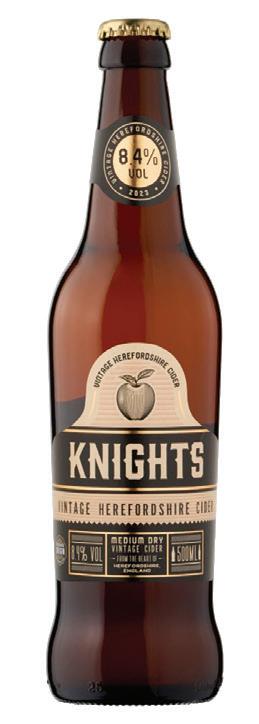
CATEGORY ADVICE

cocktail range. Not to be outdone, RTD veteran WKD launched WKD Cocktails in three flavours: Cheeky V, Venom and Blue Lagoon.
A summer full of opportunity
The chaos of Covid meant that sports fans were treated to a glut of postponed international events – all of which came to a halt in 2025. This year, the FIFA World Cup returns, creating a huge number of reasons for Brits to get together and – hopefully – celebrate.
Scottish beer brand BrewDog is running an aptly-titled ‘Underdog’ promotion across its core 4x330ml and 10x440ml multipacks, giving consumers the opportunity to win a ‘Year of Beer’.
portunities, building awareness and driving demand in wholesale,” says Maher.
One’s challenge, another’s opportunity
Part of the reason some brands are seeing flat sales is due to the UK’s changing drinking habits.
A recent report from Drinkaware UK showed that 44% of UK consumers now moderate their alcohol intake with low & no variants, explained Patrick McCaig, managing director at Otter Brewery.
44%
UK consumers who moderate their alcohol intake with low & no variants
Sport isn’t the only opportunity for get-togethers, though. Absolut Vodka and Sprite has partnered with Pride events in Manchester, Leeds, Blackpool and Glasgow, for example.
“Serving Absolut Vodka & Sprite at bars across these events creates valuable trial op-
“As a result, it is more important than ever for low & no beers to imitate their alcoholic counterparts to ensure no one misses out,” he adds.
The company recently launched Otter Zero, a “reimagined” low-alcohol IPA available in 500ml bottles. The product joins an ever-expanding roster of low and no-alcohol products, including recent launches from Peroni Nastro Azzurro 0.0% (new Limone di Sicilia and Arancia Rossa varieties) and Thatcher’s (Blood Orange 0.0%).
KEY TAKEAWAYS
1. Premium products protect value sales
Like the wider alcohol market, volume sales in the total cider category are down sharply as more consumers moderate the amount they drink.
The good news for wholesalers is that suppliers have identified the independent channel as a rare opportunity for growth in difficult times.
Convenience retailers and their wholesaler partners are playing an increasingly important role in the cider category, according to Sally McKinnon, head of marketing and strategy at Westons. While shoppers are drinking less overall, they continue to trade up in quality, putting the channel in a strong position to meet demand for premium products, trusted brands and formats suited to different drinking occasions.
2. Soft drink tie-ins are boosting RTD sales
RTDs remain one of the fastest-growing segments in alcohol, now valued at £824m and growing by 22.9% year on year.
Last year saw the launch of an RTD combining Caribbean white rum with popular soft drinks.
The category is also benefiting from the wider premium RTD trend, with brands continuing to expand into new flavour combinations inspired by wellknown soft drinks.
At the same time, major drinks companies are strengthening their RTD portfolios through new spirit-and-mixer partnerships, with products now available in flavours such as watermelon, lemon & lime and pineapple.
3. Low-and-no alcohol sales show no sign of slowing
One reason some alcohol categories are experiencing flat or declining sales is the continued shift in UK drinking habits. More consumers are choosing to moderate their alcohol intake, while others are actively seeking healthier lifestyle choices and cutting back on drinking altogether. This has led to growing demand for low- and no-alcohol alternatives across the on- and off-trade. l

Tobacco & next-gen nicotine
Tamara Birch
Tobacco and next-gen nicotine products are likely to change following the introduction of the Tobacco and Vapes Act and the upcoming Vape Duty Tax, and wholesalers need to prepare now to avoid major disruption in depot.
The Vape Duty Tax comes into effect from October 2026 and will see all vaping products sold in the UK carry a duty stamp, with the rate being £2.20 per 10ml of vaping liquid. Packaging must also be sealed in such a way that it cannot be opened without damaging either the packaging or the stamp, which cannot be reused.
and in-store display restrictions.
Wholesalers need to take a proactive role in reshaping their product ranges to protect retailer customers, according to Chris Allen, chief executive at Broughton. “Wholesalers need to actively phase out products most at risk of restriction and replace them with compliant alternatives that retailers can rely on long term,” he says.
Meanwhile, Angelo Yang, associate general manager for Elfbar UK, says wholesalers should work with the right suppliers.
October 2026
Vape Duty Tax comes into force
The Tobacco and Vapes Act includes the generational ban, prohibiting anyone born on or after 1 January 2009 from being able to buy tobacco, bringing the future of the category into question. Other changes include tighter rules on the advertising and sponsorship of tobacco products, and packaging, branding
“We will support wholesalers and the wider trade through engagement with trade associations and at industry events, providing practical advice and guidance on these changes,” he says.
“We will also work closely with wholesalers to optimise vaping ranges and planograms, advising on must-stock lines and top-performing flavours.”
Wholesalers also need to cater for chang-
SUPPLIER VIEWPOINT
Andrew Malm
UK market manager, Imperial Brands

The most prominent trend within tobacco, which shows no signs of slowing, is a market that is splitting into two distinct ends. One is a large and growing segment focused on value and economy brands, fuelled by cost-of-living pressures. The other is a smaller, but highly resilient and loyal segment dedicated to premium products.
Products in the two lowest pricing tiers, economy and value, currently account for 72% of all cigarette sales in the UK, so it’s clear that the quest for value remains a relentless one.
But, the illicit trade remains a huge challenge. Rising tobacco taxes, along with the cost-of-living challenge, is driving illicit trade in the UK, with many customers seeking cheaper products. In some cases, this means turning to illegal sources for their tobacco and vaping needs.
Addressing the threat posed by illicit products requires a collaborative approach across the industry. Retailers, distributors and manufacturers must work together to actively combat the illegal trade by staying vigilant and taking swift action when suspicious activity arises.
CATEGORY ADVICE
JTI cigarillo launch
JTI’s new Benson & Hedges Leaf
Wrapped cigarillo is available in England and Wales at a £6.95 RRP in 10-packs. It’s the brand’s first cigarillo aimed at adult smokers seeking lowerpriced tobacco.

PML launches Iqos Iluma i device
PML’s new device is available in Iluma i, Iluma i Prime and Iluma i One. New features include a touchscreen.

ing shopper missions, like the demand for value. Existing adult smokers are increasingly influenced by price – and with the ongoing cost-of-living crisis, Erika Viveiros, marketing director of JTI UK, says this has led to an increased demand for ultra-value products.
“Share growth currently stands at 20.5% of the combined tobacco market, and existing adult smokers are actively seeking premium-quality products at a lower price, which is why we continue to innovate our value product offering,” she says.
An example of this is JTI’s launch of Mayfair Gold, which, in January 2025, had its RRP reduced from £13.30 to £12.50.
“By prioritising these value-driven offerings, wholesalers can not only meet the needs of budget-conscious smokers, but also tap into a high-growth sector, ensuring they remain profitable in a competitive market,” Viveiros adds.
The value trend is also shaping the cigars and cigarillos market, but there’s a strong sales opportunity within cigarillos, with sales now worth £176.1m.
PRODUCT NEWS
Juul2 adds new flavour
Following its launch last October, Juul has added a new Peach flavour to the Juul2 range to further strengthen its offering to adult smokers.
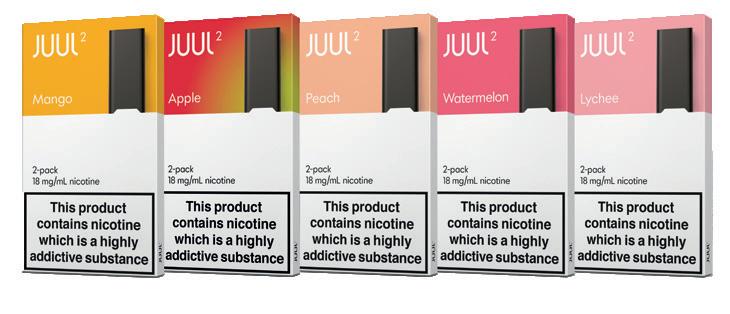
PML’s Delia sticks range
Compatible with Iqos Iluma, the Delia sticks range is available in Classic Red, Classic Gold and Classic Dark Green varieties.

“It’s vitally important to stock the right range rather than a big range, so we advise wholesalers to stock the top two or three brands in each of the four main cigar seg-
“
Existing adult smokers are increasingly influenced by price
ments, as the top 10 biggest sellers overall account for more than 90% of total sales,” says Prianka Jhingan, head of marketing at Scandinavian Tobacco Group UK.
The vape market
Fruit flavours are driving vape sales right now and are preferred by 83% of vape users. In fact, Andrew Malm, UK market manager for Imperial Brands, says this is because customers are seeking differentiated, less synthetic flavour ranges in line with customer
Imperial extends Paramount availability
Imperial has made the decision to extend the range of cigarettes to Northern Ireland. It has maintained the £12.50 RRP.

XQS range grows
STG has added three new mint variants to its range: Spearmint, Peppermint and Menthol. Menthol is available in 11mg and 17mg strengths.

preferences. This is followed by menthol, mint and mint combo flavours.
“Flavour choice for pod-based systems is a very important factor as customers make purchasing decisions,” he says. “In response, Imperial Brands has launched Sour Berry to expand its Blu vape flavour range. This flavour offers a more authentic flavour profile of wild berries, sharpened by tartness, to provide a more superior flavour for users, engaging their senses with distinct, vibrant berry notes.”
Similar to tobacco, vape sales are being largely dictated by a shopper’s budget. As a result, retailers have begun to transition towards rechargeable devices.
Not only is it a more cost-effective option, but customers have the flexibility to try different flavours. This also expands to big-puff devices.
“High-puff-count formats account for around 60% of the market and are driving category growth, which is led by the Lost Mary BM6000 as the top-selling device,” Yang says.

Wholesalers should have a wide range of flavours available in these formats, as well as a clear segmentation of product categories to help retailers navigate the category.
“By monitoring order patterns and customer demand, wholesalers can identify fast-moving lines, forecast more effectively and maintain consistent availability of popular products, strengthening retailer performance,” Yang adds.
The nicotine pouch opportunity
accordingly,” explains Jhingan.
“The main factor during the positive trajectory of the category is because a growing number of nicotine users are now discovering what a great option pouches are for them due to their discreet and portable nature and the flavours available.”
55%
Strength is important within nicotine pouches, and Malm says that 9-12mg strength products currently account for 43.4% of the market.
Nictoine pouch category yearly volume growth
UK nicotine pouch sales have now reached just under £230m. They are growing by 55% year on year in volume terms and have grown by 63% in the past 12 months.
“Following the disposable-vapes ban last summer, we know both tobacco smokers and an increasing number of vapers are now entering the nicotine pouch category in growing numbers, with sales increasing
Customer choice is also driven by the need for a fast-acting and intense nicotine kick, coupled with long-lasting flavour.
This is backed by Allen, who adds: “Scientific evidence, product characterisation and toxicological understanding are becoming central to market access. This has a direct knock-on effect for wholesalers, as only products backed by robust data and compliance will remain viable to distribute at scale.”
KEY TAKEAWAYS
1. Prepare for upcoming regulatory changes
The Tobacco and Vapes Act and the Vape Duty Tax are going to change how the tobacco and next-gen nicotine category operates.
The Vape Duty Tax, coming into effect from October, will see all vaping products sold in the UK carry a duty stamp. The rate of this will be £2.20 per 10ml of vaping liquid, and will likely see prices increase, which can have an impact on both wholesalers and your retail customers.
Tell your customers about this change as soon as possible to ensure they aren’t surprised when October comes around and will already have factored in any price increases.
2. Tap into shopper demand for value The cost-of-living crisis has seen retailers and suppliers report a shift towards value.
Within tobacco, this means offering tobacco products at a lower RRP, like JTI’s Mayfair Gold, or including cigarillos in your offering. Cigarillos command the largest market share in the cigar category.
In the vape and next-gen category, value can be shown in the devices available in depot. For example, bigpuff devices enable the user to have more puffs and try a wider range of flavours.
3. Pay attention to the growth in nicotine pouches
UK nicotine pouch sales have now reached just under £230m and are growing by 55% year on year in volume terms. The reason behind this, according to Jhingan, is because nicotine pouches are discreet as they fit under the top lip and are a convenient on-thego option. Shoppers are able to choose a wider range of strength options, too, with 9-12mg strengths accounting for 43.4% of the market.
Recent launches include XQS pouches from STG, which recently introduced a new mint flavour. JTI also recently rebranded its Nordic Spirit brand. l

SUSTAINABILITY & ESG