THE NEWS RECORD
FACES
&PLACES FALL 2026
S:8.5"
1
LETTER FROM THE EDITOR HAJRA MUNIR | EDITOR-IN-CHIEF
Hey, Bearcats! As a Cincinnati local myself, it’s easy to take the beauty of the mundane for granted. One of the best things about growing up here has been learning to love this city on my own — whether exploring one of its nationally ranked parks, taking a trip to the zoo for the Festival of Lights or joining thousands of others in experiencing BLINK, I’ve grown through every experience. For students at the University of Cincinnati, it’s easy for intriguing people and places to pass by unnoticed. The professor you’ve had for years could have once worked behind the scenes on “The Office.” Your classmate could be the owner of their own grilled cheese food truck. Or you could have gone through your entire college experience without realizing UC has a competitive dodgeball club. TNR Editor-in-Chief Hajra Munir at Findlay Market in Cincinnati on Sept. 26, 2026. TAVISH SWEENEY | CHIEF PHOTOGRAPHER
OUR STAFF Editor-in-Chief | Hajra Munir Managing Editor | Joe Carey Multimedia Editor | Chaz Timko Chief Photographer | Tavish Sweeney News Editor | Audrey Zelinski Features Editor | Avery Padgett
I’ve learned to slow down and appreciate what makes UC, “UC.” The most memorable moments don’t always make the biggest headlines. Sometimes, it’s the people you pass on MainStreet, the places you see every day or the communities you never knew existed until you took the time to look a little closer. We hope to capture these details in this first-ever edition of our “Faces and Places” issue. The stories in these pages invite you to see UC through fresh eyes — to notice everything that makes our campus more than just a place to attend class. With my own graduation date drawing near, I know there is still much of UC I have yet to discover. I hope this issue reminds you that there is always something, or someone, worth stopping to notice. Hajra Munir
Opinion Editor | Lela Walker Sports Editor | Colin Kunz Vodcast Producer | Bryana Hinkle Designer | Alessandro Sosa News Reporter | Chloe Hall Features Reporter | Aubrey Wineinger
FOLLOW US ON OUR SOCIALS! TikTok: thenewsrecord Instagram: thenewsrecord Twitter: NewsRecord_UC Facebook: The News Record
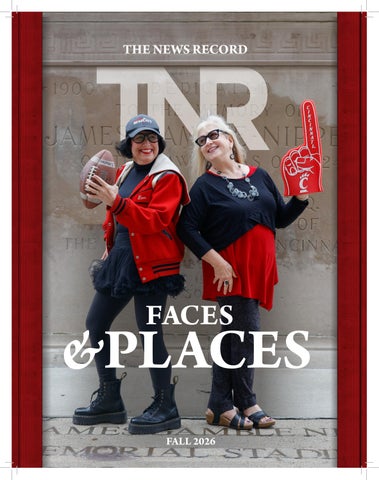
Sports Reporter | Denise Meads Opinion Reporter | Maeve Fagan Staff Photojournalist | Maggie Huss Student Sales Manager | Lucas Schmied Business Manager | Ginny McCabe Editorial Adviser | Jenny Wohlfarth COVER: Pam Kravetz, left, and Jane Garfield at UC’s Nippert Stadium on Sept. 22, 2026. KENNEDY GARMONG | STAFF PHOTOGRAPHER
LOVING THE NEWS RECORD? CHECK OUT OUR WEBSITE!
2
THE FIRST
BEARCAT LADIES JULIA VIANNA SISTE | STAFF REPORTER
Jane Garfield was another sister who followed suit. An interior design major, she was the Bearcat in the 1977-78 school year. “Two friends of mine who were already UC students said, ‘Man, she reminds us of the Bearcat,’” Garfield said. “They were telling me about it, and I was like, ‘Oh I'm going to be the Bearcat.’ ” The tradition remained strong for a few years, but after the 1980s it dwindled down, and the lady bearcat was slowly forgotten. UC then spent nearly 40 years without having a woman as a known member of the Bearcat team — that is, until Anya Brennan pounced in. Brennan, a 2026 costume design graduate, took the field by storm. She followed in the paw-steps of Garfield, who would dress up as characters like “Farrah-Bear,” a play on acclaimed actress Farrah Fawcett. In 1975, business student Debbie Friedman started a tradition. A proud member of the Sigma Delta Tau (SDT) sorority, Friedman joined the mascot team as the first-ever female Bearcat in the University of Cincinnati’s history. In a suit that looked just like the male Bearcat except with a big bow, she would cheer with the crowd during games and even marry Mr. Bearcat during Homecoming. After Friedman, members of SDT began auditioning each year to become the female Bearcat. During certain years, most of the women on the team were SDT sisters. They were sorority members graduating with varsity letters without having to play a traditional sport. Pam Kravetz was one of them. In the early 1980s, the fine arts major was even captain of the mascot team during her second year in the costume.
Jane Garfield, left, and Pam Kravetz at UC’s Nippert Stadium on Sept. 22, 2026. KENNEDY GARMONG | STAFF PHOTOGRAPHER
“I want to say I feel like I invented the costumes,” Garfield said. “Another time I was dressed in overalls because it was homecoming. And I started doing costumes, I got the boy bear to do it with me, and now it seems like they do it all the time.” Brennan worked as a costume designer for the Bearcat during most of her time at UC. She originally auditioned to be the mascot and was instead recruited for her costume design skills. By her third year, she started getting into the suit for smaller events “The Bearcat has a personality that would cater to people who are kind and outgoing,” Brennan said. So, while Friedman’s bow-donning female Bearcat may be a thing of the past, women have always been — and will always be — part of the mascot’s history.
Jane Garfield, left, and Pam Kravetz at UC’s Nippert Stadium on Sept. 22, 2026. KENNEDY GARMONG | STAFF PHOTOGRAPHER
3 Echoes of Light" installation during BLINK in Cincinnati on Oct. 8, 2026. HAJRA MUNIR | EDITOR-IN-CHIEF
BLINK CCM STUDENTS LIGHT UP
4
CCM STUDENTS LIGHT UP
AVERY PADGETT | FEATURES EDITOR
In the months leading up to BLINK, four students toiled away in a dimly lit room in the basement of the College-Conservatory of Music’s Mary Emery Hall. Lighting designer Jacob Kaplan and lighting programmer Jack Walter leaned over keyboards and discussed sequences while assistant lighting designer Lia Lubinsky bopped her head to music mixes and project manager Lucy Dunn coordinated with various local artists. Multi-colored lights flashed across their faces and patterns rippled over their screens as they prepared for one of the most intimidating projects any of them had ever taken on.
BLINK
This was the carefully selected team of lighting design and technology students tasked with creating CCM’s 2026 BLINK collaboration. BLINK, held every two years, is the country’s largest public light and art event located right in the heart of Cincinnati. Over four days in October, light installations danced across buildings in downtown Cincinnati and Northern Kentucky, bringing color and community to viewers. This collaboration between BLINK and CCM’s lighting design and technology major began in 2022 with a project between Hughes STEM High School and CCM. With the financial support of BLINK, high school and college students worked together to light up Hughes as an event satellite location. This partnership continued into 2024, allowing a team of CCM students to illuminate downtown’s Insane 51 mural. This year, CCM students took on a new scale with their “Echoes of Light” installation — they lit up Tristan Eaton’s mural at Elm Street Plaza, the largest continuous mural in Ohio. “The mural that we are lighting up is 10 portrayals of musicians that are either
Assistant lighting designer Lia Lubinsky of the "Echoes of Light" BLINK team monitors their installation during BLINK in Cincinnati on Oct. 8, 2026. TAVISH SWEENEY | CHIEF PHOTOGRAPHER
from or got their start in Cincinnati, and our project, the goal is to echo their stories in light,” Kaplan, a fourth-year, said. “Cincinnati has such a rich history that so many people just don't know about. And so part of this project is to show people that this mural isn't just about famous musicians, but it's about people from Cincinnati.” The four students mainly come from musical, installation and theatrical backgrounds, but each found their own unique way to contribute to the project. Walter built a model based on the
5
FACES AND PLACES | newsrecord.org
"Echoes of Light" installation during BLINK in Cincinnati on Oct. 8, 2026. HAJRA MUNIR | EDITOR-IN-CHIEF
construction and drafting Dunn made from a site visit, and all of them collaborated to overcome roadblocks and create the final product. Some of them had worked with each other before, but this was the first time they all worked together as a team. “This is kind of like the perfect team to do a project like this because we've all found sort of our niche thing that we can do really well,” Walter, a third-year student, said. This team isn’t the only thing that set this project apart. While most of BLINK’s projects use projection mapping, CCM’s installation was lit up using only theatrical fixtures, a nod to the students’ education. The installation ran in two five-minute segments, one honoring blues and jazz while the other played pop and rock. Lubinsky’s
The goal of BLINK is to bring communities together." Jacob Kaplan
mashups musicians, iconic names including James Brown, Doris Day, Bootsy Collins and Gloria Jones. As BLINK crept closer, work sessions began in earnest. Dunn said they would even see pinpricks of red, blue and green light when they closed their eyes. “It's a passion project, but also, it's very intensive in the fact that this is a big deal,” Walter said. After months of preparation, the installation debuted Oct. 8, the first day of BLINK. Before the event, Kaplan said he was most looking forward to seeing the installation come to life and sharing it with the public. After all, “The goal of Blink is to bring communities together,” Kaplan noted. “And for me, it's all about bringing joy to other people and getting other people to see what we've created.”
UC College-Conservatory of Music lighting design and technology students work on their "Echoes of Light" BLINK installation in the lighting design studio of UC's Mary Emery Hall on Sept. 24, 2026. From left: Lucy Dunn, assistant designer; Lia Lubinsky, assistant designer; Jacob Kaplan, lighting designer; and Jack Walter, programmer. RISHIT SINGH | STAFF PHOTOGRAPHER
6
BEARCATS
ON THE FEED DENISE MEADS | SPORTS REPORTER
A campus tour shows you where to go, but a student on your social media feed can show you what it really feels like to be a Bearcat. Outside the classroom, University of Cincinnati students are capturing campus culture and college life from their own point of view. Beyond the polished branded pages, their platforms offer a more personal look at what it means to call Cincinnati home. For first-year sports administration major Cecily Dipold, social media has become another way to share her new campus environment with friends back home. Dipold grew up moving around because of her father’s job, spending the longest stretch of her childhood in Bentonville, Arkansas. Although Ohio always felt familiar to her. When she visited UC, she knew almost instantly that she belonged. “I just stepped on campus and it felt like home,” Dipold said.
Tori Diggs, left, and Cecily Dipold at UC’s Nippert Stadium on Oct. 8, 2026. TAVISH SWEENEY | CHIEF PHOTOGRAPHER
What started with a simple makeup routine video led to partnerships with brands she grew up using, including Prada, Charlotte Tilbury and L’Oréal.
She began posting consistently in January 2026 and eventually switched her major from nursing to marketing. Her content has reached thousands of people, including a recipe video with about 500,000 views and a Tampax partnership that surpassed 2 million views.
“I just try to remind people, ‘I’m a normal girl,’” Dipold explained. “I just post videos on social media.” For second-year marketing major Tori Diggs, creating content has helped her come out of her shell and be more like herself. Growing up in a small town outside Columbus, Diggs was used to familiar faces and keeping to herself. UC gave her the chance to meet new people and let more of her personality show. Diggs said her hometown “minimized” her bubbly and outgoing personality. “Doing content has made me get back to my natural self.”
Still, Diggs doesn’t want her page to make life look perfect. “The beauty in life is not always organized,” she said. “It’s not always pretty. It’s not always aesthetic.” For both students, what happens online starts with something much more personal: simply letting people see who they are. Between the videos, brand deals and everyday posts, they give fellow students and future Bearcats a glimpse of UC that can’t be found on a campus map.
I just stepped on campus and it felt like home. Cecily Dipold
7
FACES AND PLACES | newsrecord.org
HISTORY OF UC BIG HEARTS & LITTLE ARCHITECTURE BUDDIES AT UC JILLIAN BLACKWELL | STAFF REPORTER
MAEVE FAGAN | OPINION REPORTER
Founded in 1819, the University of Cincinnati traces its roots to Cincinnati College and the Medical College of Ohio. Cincinnati College closed in 1825 due to financial difficulties, but Daniel Drake reestablished the college in 1835 and merged it with what was then the Cincinnati Law School. The University of Cincinnati was officially chartered in 1870 and has since grown into a campus featuring generations of architecture from around the world.
Every week, UC’s campus becomes a place where college students and younger students come together to learn, play and build relationships. Through College Mentors for Kids, about 30 students from Cincinnati Public Schools visit campus each week to spend time with their college mentors and explore new opportunities.
Langsam Library wasn’t established until 1879 and has since played an integral role in campus life. Its namesake, Walter C. Langsam, was the 21st president of the university. Its modern exterior features recognizable brown brick with accented windows surrounding the building. The current library was designed by Glaser, Myer & Associates and built in 1979. Van Wormer Hall, originally the Van Wormer Library, is one of the oldest standing buildings on campus. Built in 1899 and donated by Asa Van Wormer, it served as the university’s first library and features a 30-foot glass dome with Romanesque details. In contrast to Van Wormer, the Lindner College of Business building was constructed more than a century later in 2019, after Carl H. Lindner Jr. donated $11 million to build the college’s 225,000-square-foot facility. Initially named “The Union,” Tangeman University Center (TUC) was designed as a space for student activities and recreation. After decades of renovations and additions, TUC remains an essential part of student
The program works with students in third through sixth grade at three Cincinnati Public Schools: Oyler School, Sayler Park School and Mount Airy School. Students visit UC on either Tuesday or Wednesday to meet with their college mentors and participate in activities. The program is free for participating students and strives to introduce them to potential career paths and college opportunities. The organization has hosted firefighters, nursing students, members of the engineering club and others who lead activities and introduce students to their professions. “I have built connections with all of our students,” said Haley Achs, a fourthyear nursing major and president of
College Mentors for Kids at UC. “I have watched students grow through the program and grow out of the program and now that I am able to be president of this program, I am really excited to start the school year and have our first activity day.” Students interested in becoming mentors can fill out an application on the College Mentors for Kids website, connect with the executive team and complete a brief interview process. Once approved, new mentors are paired with a “little buddy” and given information about their first meeting. Mentors and their students are meant to form meaningful bonds that impact both of them. Groups are kept together if they participate for multiple semesters, with some mentor-buddy pairings lasting two to three years. “The students are getting paired with mentors who probably don’t have the same background or experiences growing up,” Achs said. “So not only do the little buddies learn from our mentors, but a lot of the time the mentors will learn from our little buddies too.”
Members of UC’s College Mentors for Kids student organization table during Oktoberfest in Cincinnati on Sept. 17, 2026. KENNEDY GARMONG | STAFF PHOTOGRAPHER
UC’s Tangeman University Center on Sept. 25, 2026. SEBASTIAN POPP | STAFF PHOTOGRAPHER
life on campus and represents the evolving nature of the university and its students . Every building on UC’s campus holds a distinct place in its history. The next time you study in Langsam late at night or go out to lunch in TUC, pay attention to the varied architectural designs that make the campus unique.
8
FROM L.A. SETS TO UC CLASSROOMS
BRYANA HINKLE | VODCAST PRODUCER
Drew Thomas outside of UC’s Mary Emery Hall on Sept. 29, 2026. TAVISH SWEENEY | CHIEF PHOTOGRAPHER
Long before Drew Thomas was teaching UC students the tools of the filmmaking trade, he was working behind the camera in Los Angeles. After 27 years in the film industry, Thomas now brings his experience from productions including “The Muppets,” “Sesame Street,” “Abbott Elementary” and “The Office” into UC’s classrooms. Today, Thomas is an assistant professor of film and television in the Media Production Department (MPRO) at UC’s College-Conservatory of Music. He and his wife moved to the Dayton area as they prepared to welcome their
first child, bringing his experience from L.A. into the classroom. For Thomas, even the smallest pieces of equipment can become important lessons. He wants students to leave the program with an understanding of the tools and techniques they may encounter on a film set. “By the time you guys get through MPRO and graduate, I want you to know what a Cardellini clamp is,” Thomas said. “I'm preparing you, hopefully preparing you, and our MPRO students; I want
you guys to know the craft as much as possible,” Thomas said. “Film and TV Production, it's a survey class, so the curriculum is a mile wide and a foot deep. It's to get you introduced to all these ideas, and you can take a deeper dive into cinematography as you move forward.” Thomas understands both the business and creative sides of filmmaking. While some of the skills he teaches may seem esoteric or unnecessary, he said he can usually point to a moment in his career when he has used them in a real production. “Even if you're going to be a writer and, you know, you're only going to be on set as a writer, knowing your craft is, I think, really, really important.”
9
FACES AND PLACES | newsrecord.org
THE STUDENT ENTREPRENEUR PAYING HIS WAY WITH GRILLED CHEESE LUCAS SCHMIED | STAFF REPORTER
Legend Clifford, a fourth-year marketing major with a minor in finance at UC, is also a self-made entrepreneur. Clifford owns and operates Grilla Cheez, a grilled cheese food trailer currently located in his hometown of Chillicothe, Ohio. Clifford was interested in entrepreneurship at a young age, growing up seeing his dad working in the food truck industry. “Being able to potentially build a legacy of my own, have my own things and my own freedoms — that really drew me to entrepreneurship,” Clifford said.
Because of this, he decided to move the food trailer back to Chillicothe, wherehe reconnected with his community and saw business skyrocket. Since March 11, 2026, Grilla Cheez has brought in more than $150,000 in sales and accumulated more than seven million views across all social media platforms. “I never thought I’d be a college student paying my college debt off from selling grilled cheese,” Clifford said.
He started his journey with Grilla Cheez in February 2025 by sending an offer on Facebook Marketplace for an old dirt bike hauling trailer with oil stains on the floor. Clifford didn’t know exactly what was in store for this trailer, but he ended up buying it anyway. From installing solar panels and plumbing sinks to managing social media and finances, Clifford had to build the business from the ground up. His vision for a grilled cheese business stemmed from the dish’s appeal as a comfort food and its potential to become the centerpiece of the Grilla Cheez brand. “I mean, everyone likes grilled cheese, right?” Clifford said. He prides himself on the quality of his trailer’s grilled cheese, noting that each one is placed on a toasted honey butter kaiser roll, which customers can load with bacon and Philly steak, with two house sauces also available. The trailer was first stationed in Newtown, a village east of Cincinnati. There, Clifford worked in the trailer between classes and grew his social media following, but Grilla Cheez didn’t take off as he had hoped.
Legend Clifford in the Theryoung Family Garden at UC’s Carl H. Lindner College of Business on Sept. 18, 2026. LUCAS SCHMIED | STAFF REPORTER
10
HAJRA MUNIR | EDITOR-IN-CHIEF
Michael Dempsey trains during a UC Boxing Club practice at Cincinnati Fitness & Boxing on Oct. 1, 2026. TAVISH SWEENEY | CHIEF PHOTOGRAPHER
MORE THAN SIX MINUTES
11
INSIDE THE UC BOXING CLUB The buzzer sounds, and for the next few minutes, there is nothing outside the ring. Gloves meet. Feet shuffle across the mat. Around them, dozens of students train. The gym hums around the two boxers in the center, with Jeff Perry, head coach of the University of Cincinnati Boxing Club and owner of Cincinnati Fitness & Boxing, occasionally stepping in to offer advice. While casual, the sparring still draws attention. As the two move around the ring, teammates pause their workouts to watch. For a few minutes, eyes turn toward the center of the gym before the room settles into its usual rhythm. At CFB, that blend of individual work and collective support is part of the culture. The training is demanding for the UC Boxing Club. Competitive boxers often train five to six days a week, supplementing practices with running, lifting, sparring and conditioning while balancing classes, jobs and other responsibilities. “None of my guys half-ass training,” Perry said. “They all view this as a serious sport.” Perry has watched students strategize to fit boxing into already busy schedules. Some have keys to the gym and train on their own when they cannot make regular practice times, sometimes coming in late at night after classes or work. (continued page 12)
12
INSIDE THE UC BOXING CLUB
Boxing is an individual sport when you're in the ring one-on-one; but training, it's a team sport. Coach Jeff Perry CONTINUED | PAGE 11
Building the gym The UC Boxing Club's roots stretch back more than a decade, but its story begins with Perry and the gym that eventually became its home. Perry opened CFB in 2009 after beginning boxing himself after a friend invited him to a class in his mid-20s. What he expected to be a one-off workout quickly became a lifelong passion. Perry continued training and eventually began coaching. When a local high school boxing team needed a place to practice, they began training at CFB. Among those first boxers were students who went on to attend UC and established the university's boxing club in 2011. The club remains student-run and open to athletes who simply want to learn boxing or train as well as those interested in competition. At any given practice, a UC boxer preparing for competition might be working the heavy bag just feet from a high school student learning the fundamentals. More than a workout Michael Dempsey is a third-year entrepreneurship major at UC and a boxing club team captain. The demands of the sport are balanced by the people around him, many of whom have become some of his closest friends. Dempsey lives with three other UC boxers, and he said those friendships make difficult practices easier to get through. “Everyone's always right there hyping you up for any fight,” Dempsey said. “You know that you have those people in your corner.” The fighters in the ring “Boxing is an individual sport when you're in the ring one-on-one; but training, it's a team sport,” Perry said.
Jeff Perry, head coach of the UC Boxing Club, ties the gloves of fighter Payton Woodruff during practice at Cincinnati Fitness & Boxing on Oct. 1, 2026. HAJRA MUNIR | EDITOR-IN-CHIEF
For the boxers, that team environment becomes a source of motivation. “You see somebody else work, and so you kind of want to work just as hard,” said Payton Woodruff, a third-year cybersecurity major at UC and the vice president of the boxing club. For Perry, that community is one of the most meaningful impacts of CFB. He has watched former students return to teach others, creating a cycle in which knowledge and experience are passed from one generation to the next. That growth can extend beyond boxing itself. Woodruff is one example. He became the 119-pound National Collegiate Boxing Association national champion in 2025 and became the 132-pound national champion in 2026, but Perry remembers a much different student first entering the gym.
Michael Dempsey trains during a UC Boxing Club practice at Cincinnati Fitness & Boxing on Oct. 1, 2026. HAJRA MUNIR | EDITOR-IN-CHIEF
13
FACES AND PLACES | newsrecord.org
“He would come to practice, he would work, but wouldn't talk to anybody,” Perry said. “Just a very quiet, shy kid.” Perry watched Woodruff grow more comfortable with his teammates, eventually becoming one of the most social people on the team. His experience reflects what Perry believes the sport can offer beyond competition: confidence, accountability and a community that enables people to depend on one another. Six minutes The work in the gym eventually leads somewhere else — the ring. For boxers who compete, months of preparation come down to a few minutes against another fighter — it becomes visible only when they step between the ropes. Dempsey said that’s what makes the sport so demanding. “There's a lot more to it than those six minutes in the ring,” Dempsey said. “It's all those hours leading up to every single fight.” UC's competitive success has made those minutes increasingly significant. The men's team ranked No. 2 nationally in 2025 and No. 5 in 2026, while individual UC boxers have claimed six NCBA national championships. But the rankings don’t capture everything that happens before the bell. The boxer in the ring is the person everyone sees. Behind them stand the teammates who trained with them, the coaches who mentored them and the friends waiting when the round ends. Back at practice, another pair of boxers moves toward the center of the ring. The gym hums around them, bags swinging, feet shuffling and teammates training nearby. For a few minutes, everyone's attention turns toward the ring. Then the sparring ends, and the room returns to its rhythm. The work continues. Payton Woodruff trains during a UC Boxing Club practice at Cincinnati Fitness & Boxing on Oct. 1, 2026. TAVISH SWEENEY | CHIEF PHOTOGRAPHER
Two boxers spar during a UC Boxing Club practice at Cincinnati Fitness & Boxing on Oct. 1, 2026. TAVISH SWEENEY | CHIEF PHOTOGRAPHER
14
NO FOAM, NO JOKE UC DODGEBALL TEAM MAGGIE HUSS | STAFF PHOTOJOURNALIST
For UC’s dodgeball team, the game doesn’t end when the last ball is thrown. The student-run club has built a closeknit community both on and off the court, traveling across the East Coast and competing in the National Collegiate Dodgeball Association.. “As a whole, I’d say [the team] is just really connected,” said Brett Sweeney, team head captain and a third-year insurance and risk management major. “I know there’s some club sports that are really just focused on playing, and that’s not true [for us] at all. We are super inclusive and connected, and everyone on the team is friends.” The UC dodgeball team is not the average foam or gym-style dodgeball game. Games are played 12-on-12 with 8½-inch rubber balls, and the game moves at a fast pace. “We have 15-second shot clocks,” said William Burkart Reyes, a team member and a second-year chemical engineering major. “As long as you have more than two balls and more than four people in on your side, there will be a 15 second shot clock where you have to throw a ball within what’s called the Legitimate Attempt Zone, which is basically just a three-foot bubble around your person.” The UC dodgeball team’s goal this season is to win the national championship. The top 16 of the league’s 25 teams qualify for the championship, which is played in a single-elimination format.
UC club dodgeball player Brett Sweeney (7) throws a ball during a National Collegiate Dodgeball Association tournament game against Miami University at the Northern Kentucky University Campus Recreation Center in Highland Heights, Ky., on Sept. 27, 2026. MAGGIE HUSS | STAFF PHOTOJOURNALIST
“We like to think that we’re very deep,” head coach Matt Rosinski said. “We’ve got 20-plus guys that are able to come in and play big minutes for our team.” Rosinski said that to be successful on the court, the team needs to know each other off it.
We’ve got 20-plus guys that are able to come in and play big minutes for our team." “Dodgeball is the forefront of how people came together, and that’s why we are a group, but you build the chemistry off the court, so going out or hanging out at someone’s house is what builds team chemistry and makes you care about the guys around you,” Rosinski said.
Coach Matt Rosinski
FACES AND PLACES | newsrecord.org
FUN CLUB FIRST, RUN CLUB SECOND SABERA CHOUDHURY | STAFF REPORTER
For its members, the Cincy Run Club is about more than mileage. “Becoming friends with people who make you want to do better are people who you want to be friends with,” said club member Margo Utz. The club was founded in 2024 by University of Cincinnati alum Malcom Doepke and a handful of his friends. Doepke graduated from UC in 2021 with a masters was inspired to form the group in May 2024 while searching for a running club to join himself. He says most of the clubs he found took themselves too seriously, and that he was hoping for a more social and relaxed environment. Rather than settle for a club that didn’t meet his needs, he started one of his own. Cincy Run Club has since established itself at UC as a place for students to form new friendships. With more than 150 runners this year, Doepke’s side project is now a flourishing community. Doepke sought to foster a group not only for hardcore runners but for a wide range of students. He says he has realized that goal through the Cincy Run Club, and his vision is reflected in the club’s motto: “We’re a fun club first and a run club second.”
Becoming friends with people who make you want to do better are people who you want to be friends with." Margo Utz Two people participate in the Cincy Run Club's weekly Wednesday night run near the Roebling Bridge in Covington, Ky., on Sept. 30, 2026. DELANEY MCCALLUM | STAFF PHOTOGRAPHER
15
16
EYES IN THE SKIES:
THE COMPLEX SOCIAL LIVES OF BIRDS AUBREY WINEINGER | FEATURES REPORTER
hierarchy, as well as the ranks and relationships of other birds. The researchers tested this by temporarily removing high-ranking birds from their groups. After several days away, the birds returned to their original groups. Instead of immediately reclaiming their positions, many fell near the bottom of the hierarchy. The opposite can happen, too. One bird that had been ranked last in its original group became the highest-ranking bird after being placed in a new flock. “The fortunes can just shift really drastically and really quickly in these birds,” Hobson said. Hobson has studied parakeets for about 20 years and established her UC lab in 2019. Although her research focuses on birds, Hobson said it can offer insight into a much broader question: how complex social behavior and cognition develop across species.
Elizabeth Hobson works in her UC office on Sept. 29, 2026. MAGGIE HUSS | STAFF PHOTOJOURNALIST
At first glance, a group of monk parakeets might not seem all that different from any other flock of birds. They fly together, interact with one another and go about their daily lives. If you watch closely though, a much more complicated story begins to take flight.
Once you start watching, you’re going to see these kinds of interactions between individual animals all over the place.
For Elizabeth Hobson, an associate professor in the University of Cincinnati’s Department of Biological Sciences, these interactions offer a window into the minds of animals. Hobson studies sociality and cognition, primarily in monk parakeets, examining how the birds make decisions within their social groups. Rather than looking directly into an animal’s brain, she studies which animals they interact with, fight with and pay attention to.
Elizabeth Hobson
“If a big fight breaks out in the group, all the birds will fly down to get closer to the fight,” Hobson said. “They’re craning their necks to see what’s going on.” Those observations have led Hobson and her team to believe that the birds understand much more about their social world than expected. They have found evidence that parakeets understand their own rank within a social
Humans also navigate complicated social systems where relationships and social standing can influence interactions. Studying animals provides researchers with another way to consider how complex social behavior may have evolved. For Hobson, the research also encourages people to pay more attention to the animals around them. “You can see birds and different kinds of animals interacting all the time,” she said. “Once you start watching, you’re going to see these kinds of interactions between individual animals all over the place.”
17
FACES AND PLACES | newsrecord.org
MEET THE CEO BEHIND FINDLAY MARKET AUDREY ZELINSKI | NEWS EDITOR
Kelly Lanser first worked at Findlay Market as a University of Cincinnati undergraduate studying communication. For a class assignment, she created a marketing plan using Findlay’s crowd-flow data. Today, Lanser serves as Findlay Market’s President & CEO. “When I came back to the market, my marketing plan was in my drawer; isn't that wild?” Lanser said. “This is just a place that gets in your blood and you love it, and we say that it's a Findlay family.”
This is just a place that gets in your blood and you love it, and we say that it's a Findlay family."
Lanser worked for other nonprofits before taking up an events and promotions position at Findlay in 2013. Lanser credits her success to working her way up through the organization. “I understand the businesses, the employees, challenges, needs, problems, barriers, all those things,” Lanser said. “I think it would have been a hard role for me to start if I hadn't already been here.” Lanser has recently been working on a capital campaign for the market. The campaign is scheduled to end in 2027 and will mark 175 years of continuous operation for the market. “Our goal was to raise $21 million to support the market, to support physical infrastructure, to support our food access and entrepreneurship programs and to create a reserve fund for the organization,” Lanser said. The campaign will bolster preexisting programs that prioritize food access and financial literacy in Cincinnati. The market uses a token system that allows low-income shoppers to get fresh produce for a discounted price. The market also partners with Produce Perks Midwest, Meals on Wheels and Mercy Health’s system to aid food access efforts in Cincinnati.
Kelly Lanser
The Findlay Kitchen program gives community members access to commercially licensed kitchens. The Findlay Launch and Findlay Learn programs support up-and-coming food-service business owners with the entrepreneurship side of running a food business. These programs prioritize people facing high barriers to entry to independent food service. Findlay has many moving parts, but Lanser says she loves the work for its people. “Like a true family, we are dysfunctional, and we fight, and we have each other's backs,” Lanser said. “We're the only Findlay market. It's like a little town. It's a real community inside of this place.”
Kelly Lanser at Findlay Market in Cincinnati on Sept. 11, 2026. AUDREY ZELINSKI | NEWS EDITOR
18
PRESERVING CINCINNATI’S SCIENTIFIC HISTORY
THE WINKLER CENTER AND OESPER COLLECTIONS ARIANA DELUCA | STAFF REPORTER A volume in UC’s John Miller Burnam Classics Library on Sept. 25, 2026. GRANT JONES | STAFF PHOTOGRAPHER
Tucked away from the rest of campus, two library archives quietly preserve Cincinnati’s rich history in science and medicine: the Henry R. Winkler Center for the History of the Health Professions located in the Medical Sciences Building and the Oesper Collections in the History of Chemistry located in Rieveschl Hall. Both provide researchers with vital resources in technology, engineering and math disciplines. The Winkler Center has served as a repository for Cincinnati’s health sciences history since its inception in 1974 as the Cincinnati Medical Heritage Center. Devhra BennettJones, the center’s archivist curator, said the collections "preserve Cincinnati’s rich medical and health history.” Archivists work to bring Cincinnati’s medical and health science history to visitors and researchers through various archives, exhibits and lectures. Exhibits are carefully curated to be visually interesting and lectures held by the center are hosted in rooms decorated with historical health and surgical equipment. The Oesper Collections, founded in 1986 by University of Cincinnati professor William B. Jensen, boast a similar mission. Mark Chalmers, a curator of the museum, says that the collection’s namesake, UC professor emeritus Ralph Oesper, would “think it’s a tragedy that every student in chemistry knows what a Bunsen burner is, but very few know anything about Bunsen himself.” Therefore, the collection places emph-asis on the people behind the history of chemistry, with a collection ofsigned portraits and autobiographies of prominent figures in chemistry. By keeping alive the historical elements of chemistry that most modern scientists are unaware of, the museum helps to
A collection of Orellius volumes within UC’s John Miller Burnam Classics Library on Sept. 25, 2026. GRANT JONES | STAFF PHOTOGRAPHER
preserve public memory of the people behind some of the field’s most significant advancements. For the many people that have contributed to the collection, the museum is a labor of love. Rudy Thomas, a UC research associate and carpenter, spends
hours restoring the museum’s pieces, including much of the cabinetry and equipment found in the period room, a replica of a 19th-century chemical laboratory. Starting in fall 2026, the Oesper Collections will hold open hours for the public. Chalmers encourages any student who is interested to come see the museum in person.
19
FACES AND PLACES | newsrecord.org
WHERE POETRY AND COMMUNITY MEET JORDAN CASTERLINE | STAFF REPORTER
The Elliston Poetry Room, located in Langsam Library, is the University of Cincinnati’s hub for creative writing and poetry. The room holds collections of international and local significance. Anyone can visit the room and handle any number of rare, selected works.
EXPLORING UC’S JOHN MILLER BURNAM CLASSICS LIBRARY JOE CAREY | MANAGING EDITOR
George Elliston, a Cincinnati poet, journalist, educator and arts advocate, gifted a chair of poetry to UC upon her death in 1946. Elliston’s gift helped establish the poetry collections, curatorial work and Poet-in-Residence program that continue today. Michael C. Peterson, a UC associate professor of English and curator of the Elliston Poetry Room, centers his curation philosophy around community building. “Archives should be networks of the communities that make them, and every archive serves its community uniquely,” he said. “Otherwise, every archive would be the same, and that’s not useful.” Peterson also values physical archives, so the Elliston offers a wide array of physical works that are available to the public. “The way digital repositories work in terms of accessibility presumes a lot of things about digital usage that
The Elliston Poetry Room in UC’s Walter C. Langsam Library on Sept. 24, 2026. CADE MORAN | STAFF PHOTOGRAPHER
Volumes in UC’s John Miller Burnam Classics Library on Sept. 25, 2026. GRANT JONES | STAFF PHOTOGRAPHER
are not always true,” he said. “Broadband access, having a computer at all, having a computer in a household, maintain a server that’s actually accessible, and more.” Peterson considers the Elliston “one of the most easily bookable and collaborative spaces on campus.” There are materials to create zines, notebooks, podcasts and more. The Elliston Poetry Room often hosts UC’s Visiting Writer’s Series, where authors read from their collections and answer questions. The Elliston also serves as a home base for Poetry Stacked, a recurring reading event featuring UC students, UC educators and writers from the wider Cincinnati poetry scene. Each year, a nationally recognized poet is invited to Cincinnati as the Elliston Poet-in-Residence, according to Peterson. The poets host two events: one reading of their work and another focused on a subject of their choosing. Notable poets in residence include Robert Frost, Denise Levertov, John Ashbery and Wendell Berry.
The John Miller Burnam Classics Library houses its vast collection in a sprawling, three-story labyrinth beneath the University of Cincinnati’s Carl Blegen Library complex. The collection is nationally recognized as a leading repository of works on the ancient Mediterranean, Greek and Roman worlds. With more than 300,000 print volumes and a few thousand digital titles, the library boasts a full spectrum of subjects within the broad definition of Classics, including archaeology, papyrology, epigraphy and paleography. Spanning five millennia of recorded history and vast geographic areas of the Mediterranean and the Near East, the collection is a key attraction for prospective graduate students and visiting scholars. Thanks to a longstanding department fund endowed by Luise Taft Semple, a niece of U.S. President William Howard Taft, new books arrive regularly. One of the library’s hidden gems is its Rare Book Collection. With items dating back to the 13th century, this trove is more of a museum than a reading room. Books are stored in protective covers designed by preservationists from Langsam Library and require staff permission for patron use. The collection is not available for loan, helping preserve these centuries-old pieces of history.
20
CHANGING CINCINNATI NIGHTLIFE: AP AFTER DARK VINCENT HOWE | STAFF REPORTER
Alex Pham, better known as AP, is a fourth-year at Northern Kentucky University, but his business has exploded across the river in Cincinnati. Beginning as a small, local party, “AP After Dark” has developed into a recognizable nightlife brand drawing crowds from both NKU and the University of Cincinnati. Tired of the party scene at NKU, AP was inspired to start “AP After Dark” in September 2025. "I thought, ‘why not just start throwing my own events and build this culture that I wanted to foster?’ People started coming to the events, they enjoyed it, and after that it started growing.”
Alex Pham (AP)
As attendance increased, he began moving his events into larger Cincinnati venues, including those in Over-theRhine (OTR), and reaching more of the UC student population. "I hosted at Flora & Flair, Sharkz and Top Cats.
I hosted at Flora & Flair, Sharkz and Top Cats. Naturally, a lot of that UC crowd was there, so it grew like wildfire."
An “80s in Aspen Party” at Good Judy’s in Cincinnati on Jan. 17, 2026. VINCENT HOWE | STAFF REPORTER
Naturally, a lot of that UC crowd was there, so it grew like wildfire,” AP said. He explained how his relationships with venue operators also furthered his expansion. “One of the owners at Top Cats is actually the GM of a couple other nightclubs in OTR, so I got to work with him on my summer events.” With larger crowds and more events around Clifton, safety is one of AP’s top priorities. He says his events have largely avoided serious problems. "I want people to have fun, but I want to make sure that they're also in a safe environment while doing so.” AP said another major part of his brand is making each party feel different. HWWe looks for concepts that encourage people to dress up and get involved in the event. “A lot of my ‘planning’ into
these parties is trying to find something that gets people excited to dress up for while also having something that isn't typically done.” For AP, unique themes distinguish his events from more traditional college parties. Despite the complex logistics and planning behind each event, AP said his main goal remains simple: make sure people enjoy themselves. He also sees his events as an exciting way for attendees to meet new people, saying, “It’s a lot easier to make connections at my parties simply because of how intimate my crowd is.” His message to prospective attendees? "Come ready to party.”
21
FACES AND PLACES | newsrecord.org
THE CINCINNATI ART MUSEUM PAINTS NEW PERSPECTIVES JIYA TRIVEDI | STAFF REPORTER
The Cincinnati Art Museum (CAM) is a cultural institution located in the Eden Park neighborhood of Cincinnati. One of the oldest art museums in the country, it was established in 1881 and features a collection of over 70,000 works of art spanning across 6,000 years of human history, including both artistic masterpieces and ancient artifacts. With free general admission, the museum makes art accessible to everyone. For University of Cincinnati students, they would never encounter outside of the winding halls of the College of Design, Architecture, Art and Planning. A biochemistry major can walk in and discover a love for oil painting, and a business student can leave with a new passion for pottery.
“We talk about making art accessible all the time, and we have a resource like the Cincinnati Art Museum which we as students should make more use of,” said Savannah Dipasquale, a second-year international business major. “Art makes people happy. Especially as students, I think if we’re happy, we’re more productive.” Many UC professors understand the value of CAM as a unique educational cincinnati opportunity, including Mark Raider, art a professor of modern Jewish history who regularly takes his students on field museum trips to the museum. “I think visiting a museum adds a lot to the learning anything that’s quite as rewarding and meaningful as the art museum for the students of UC. It has great value and merit. The building itself is magnificent and is a really useful learning opportunity.” Engaging with artwork in the museum The Cincinnati Art Museum on Sept. 23, 2026. can also teach students different perMAGGIE HUSS | STAFF PHOTOJOURNALIST spectives that they may not encounter in their classrooms or on campus. “Immersing in culture is beneficial to everybody,” Ray Kenley, a third-year marketing and psychology major, said. “It’s creative, vibrant and it's braided with empathy and perspective.” Reaan Fathima, a third-year business analytics and industrial management major, agrees. “By visiting the museum, students get a bunch of different perspectives,” Fathima said. "Interacting with artwork can help them make better decisions and understand people better and where they are coming from.” Visiting CAM requires no deep understanding of art, just a willingness to get lost in Van Gogh’s forest, escape into Egypt with Henry Ossawa Tanner and dance with Degas. After exploring the museum, students may leave not only knowing more about art, but also more about life, history and humanity.
Serving UC students, fans & alumni since 1955
MAKE IT A
BEARCATS CHRISTMAS One stop for everyone on your list.
FOR THE STUDENT
FOR THE PETS
FOR LITTLE BEARCATS
Campus favorites
Fur-ever fans
Start the tradition early
FOR PARENTS & ALUMNI
FOR GRANDMA & GRANDPA
STOCKING STUFFERS
Proud gear
Cozy at home
Small gifts, big spirit
VISIT US
321 Calhoun St.
Cincinnati, OH 45219 1-866-BEARCAT
@DuBoisUC on Instagram
uc.duboisbookstore.com
SCAN TO SHOP THE FULL GIFT LIST