The Wildcat Roar Volume 3









BELLA THIES
EDITOR-IN-CHEIF, SENIOR
MARY HATHAWAY
DESIGN EDITOR, JUNIOR
BRYCE ERVIN
PHOTOGRAPHY AND DESIGN, SOPHOMORE
JOSIE MOSELY
STAFF WRITER, SENIOR
OPHELIA
STAFF WRITER, JUNIOR
JACK OVERBY
STAFF WRITER, JUNIOR
JAMESON ROAM
STAFF WRITER, JUNIOR
ALLY MOSELER
STAFF WRITER, SOPHOMORE
ADA SCHMIDT
STAFF WRITER, FRESHMEN
For the past three years, I have had the honor of being a part of the Wildcat Roar. My time on the Wildcat Roar has led me to grow as a writer and person and it is only thanks to the mentors I have had that I have become the leader I am today. The opportunity to lead and train this wonderful group of people has been one of the best experiences of my life, and I would not trade it for the world. Therefore, it is my sincere hope that future generations of the Wildcat Roar will have the opportunity to grow confident in their voices as journalists and expand their horizons.
Although this will be my last issue as Editor-in-Chief, I could not be prouder of the growth I have seen in all of the 800NEWS staffers over the past year. Each member of the staff has given their all to this class and as a result, they have blossomed into fabulous writers, photographers, and graphic designers. They have developed their own unique journalistic voices and learned to write in a way that transforms the world for Jesus Christ.
In His Name,
Even as the Senior staff members embark on the next step of our journey, we have the privilege of knowing the future of the organization is in good hands.
In this issue, the writers reviewed popular movies, iconic locations around St. Louis, and even current Broadway productions. They were challenged to balance their opinion with a thorough exploration of the merits and shortcomings of the topics they examined. Through the use of their critical thinking and writing skills, the writers produced compelling pieces that incorporate nuance while simultaneously providing their personal opinion on the topic. From the Hunger Games to the Delmar Loop, the goal of this issue is to thoroughly evaluate the pieces of media and places that have formed our city and generation as a whole.
This issue thoroughly represents the culmination of skills the writers acquired through hard work and dedication to the journalistic process, so without further ado, I proudly present The Wildcat Roar’s Review Edition!
800 News and Bella Thies, Editor-In-Chief
Contact us at 800news@wcastl.org if you have any ideas, questions, or concerns.


Whether you are a theater fan or not, it is no secret that Broadway is the heart of New York City. From legendary classics like The Phantom of the Opera and Into the Woods, to newly beloved musicals such as The Notebook and Shucked, each show that has come and gone has had an incredible impact on Broadway as a whole. There is no doubt that Broadway’s current season will go down in history as well.
Today I will be reviewing my picks for the top five best musicals that are currently playing on Broadway. From musical scores to overall performance, these reviews will cover everything you need to know before your next visit to the lights of Broadway.
After the debut of Chess flopped at its opening in 1988, this first ever revival of the musical aims to change that. With an epic score written by Benny Anderson and Björn Ulvaeus of the Swedish pop group ABBA, Chess tells the true story of the world chess championship that took place at the height of Cold War tensions. An American, Freddie (played by the legendary Aaron Tveit), and a Russian, Anatoly (Nicholas Christopher), are bent under the weight of their pressures, their own drama, and their shared love for the brilliant chess strategist Florence (played by the dazzling Lea Michelle).
Although the script was revamped for this new revival, the music remains the heart of the show. Chess is truly driven by the star power of Tveit, Christopher, and Michelle. Their performances are unmatched, and each of their voices carry such power that even the not-so-great plot can be overlooked. Adam Schelker saw this show over Spring Break, and he was blown away by the cast:
“I loved the star-studded cast, and the 80s style music stayed in my head for weeks after. It is a very comedic show and it was really fun to watch.”
The ensemble is another wow factor of the show. With barely any time off stage, their presence brings an unstoppable energy to every scene. The choreography and overall staging is unlike any past production of Chess, and it brings a fresh feeling to the musical.
However, despite with the many changes, the overall plot is often lost in the midst of the spectacle. The script, now
involving heightened Cold War tensions and some 21st century slang, still lacks consistent storytelling. It and can be very difficult to follow.
Regardless, Chess is a star packed show that you do not want to miss. Its catchy tunes, incredibly impressive vocals, and dancing make it a spectacle that will go down in history.
Operation Mincemeat has defied the odds by making it to Broadway, and it is no doubt the funniest show on the market. The show follows the unbelievably true story about a British deception operation to confuse Nazis in World War II. The mission was this: dressing a corpse in the clothing of a British officer and setting it adrift on the coast of Spain in hopes to trick Hitler into shifting troops away from Sicily. It is a truly fascinating story and yes, it is as crazy as it sounds.
The show is extremely impressive with only 5 actors playing 87 different characters, and each punch line leaves the audience rolling with laughter. Despite its small cast, the show has become a classic, big, brassy Broadway experience. And that is what it truly is: an experience.
My only critique: there is not much melodic contrast between the music. Each big song kind of sounds the same, and it does not bring much to the score.
Operation Mincemeat is a well-oiled machine and shows Broadway what humor really is. However, humor is not all that
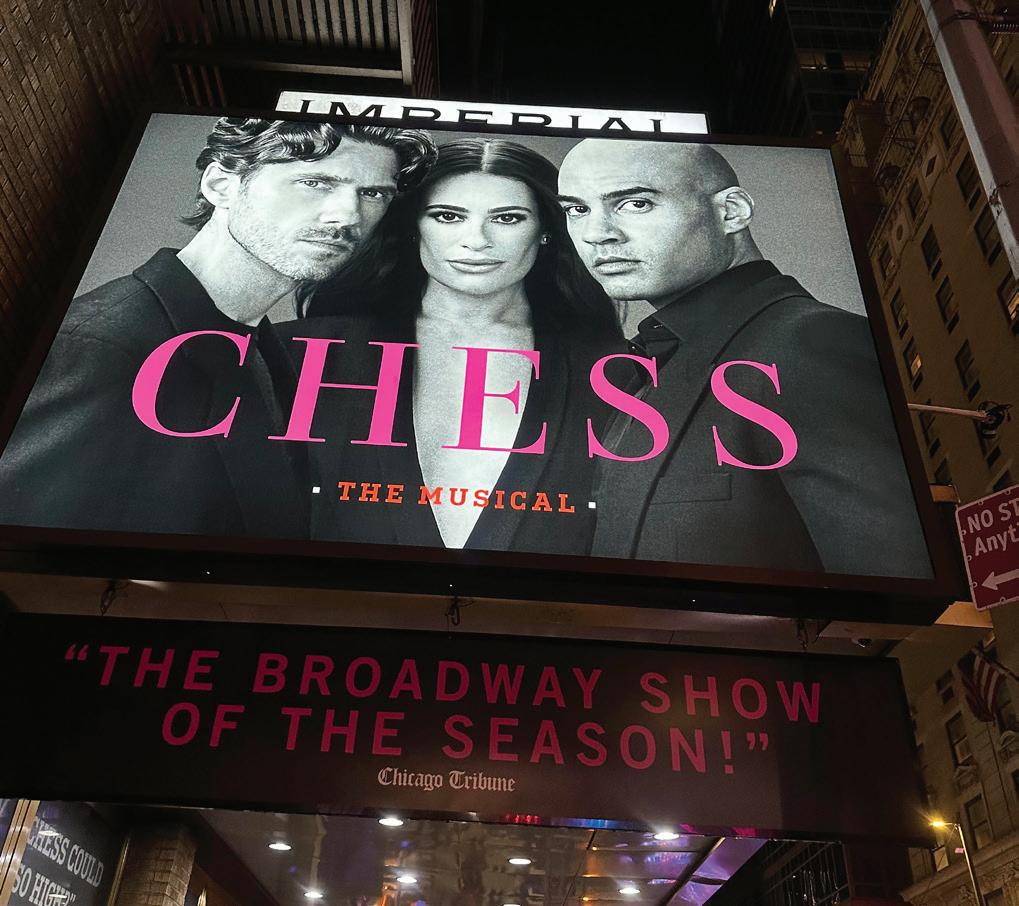
e outside of the Imperial eatre which currently houses Chess on Broadway. Photo by Adam Schelker.
this show has to offer. You will be surprised how much heart is in this production as well. It is an emotional roller coaster that is 100% worth the ride.
The Outsiders won the Tony Award for Best Musical in 2024, and for good reason. I mean, real rain on stage, a score unique to any other, and an emotional story that has already shaped generations? Say no more.
Based on another iconic novel, the story follows Ponyboy and his friends as they navigate life as greasers in Tulsa 1967, and challenge the norms of the society they live in. Packed with the meaningful message of staying gold, each performance touches the hearts of the audience and leaves them wishing for more.
On a technical note, the visual aspect of this show is unlike anything Broadway has ever seen. With simple yet extremely unique scene changes, The Outsiders is seamless and will never allow you any time to be bored during the performance. Additionally, the flow of the book is seamless. Each scene leads perfectly into each song with no obvious filler lines, a problem that many Broadway shows run into.
The Outsiders score is another unique part of the show, and truly proves that less is more. Written by Jamestown Revival, the songs feel acoustic and unplugged, with three part harmonies and choral parts that take them to the next level.
Overall, the cast of The Outsiders bring raw and real emotion to the stage. You are not just watching the plot points happening in front of you — you are feeling each thing along with the characters. The show is a unique and must see experience as it continues to gain popularity and love from New York and beyond.
2.
Another Tony Award winner, Maybe Happy Ending, has had theater fans in the palm of its hand since its opening last season. This wholesome story follows two retired human-like- helper bots as they form an unexpected yet strong connection. The show explores what it means to be human, but it does so in the eyes of a robot. The themes of love, true connection, and identity are strong and will stay with you long after the show ends.
Unlike most shows on Broadway right now, Maybe Happy Ending chooses emotion over extravagance. It is simple, yes, but it brings an overwhelming charm and warmth to the theatre, and its fresh concept is unique
and heartwarming. It is a pleasant surprise to see how much an audience can learn about humanity from a story about robots.
Maybe Happy Ending is so undeniably special in the most simple and sentimental way. It is moving and adorable, yet it has so much that the audience can learn from. Overall, the journey that Maybe Happy Ending brings you on is inspiring. It is a must see for anyone who appreciates good Broadway.
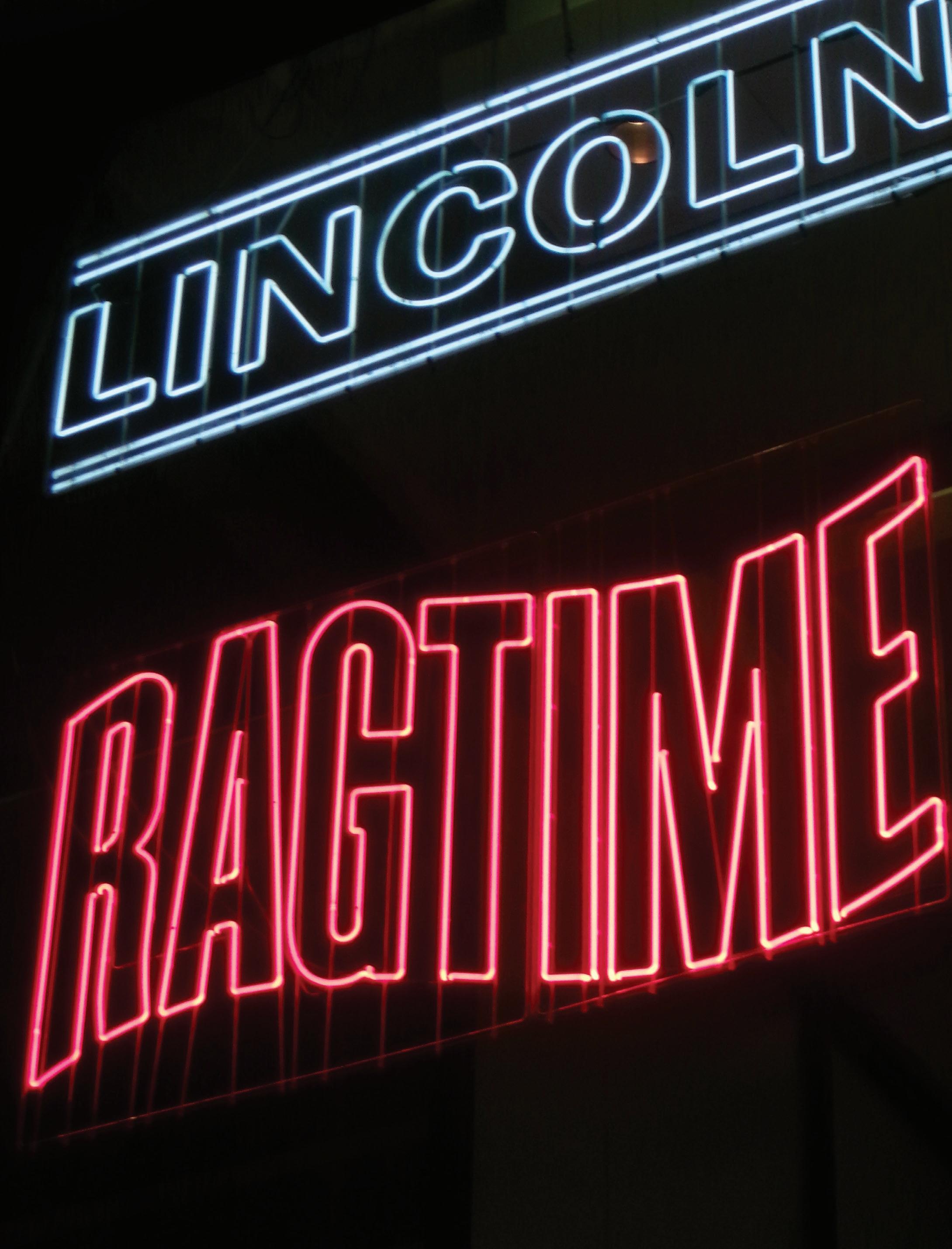
To no one’s surprise, Ragtime takes the cake for #1 show on Broadway right now. The revival of this 1996 musical is nothing short of magical. The story revolves around three distinct groups of people in the 1900s: well-off white Mother (the astonishing Cassie Levy), Jewish immigrant Tate (Brandon Uranowitz), and Black musician Coalhouse Walker Jr. (Joshua Henry). ToldPerformed simplistically yet emotionally, Ragtime is a breathtaking and relevant tribute to the importance of justice and hope, heavily reflecting America’s social and cultural upsets.
The scenic design of this show is simplistic and practically bare, meaning the show focuses on what really matters: the story. The performances of Cassie, Brandon, and Joshua alone are masterclasses in how to tell a good story, and theyd truly ground the show. Each note they sing and word they say is specific and packed with real meaning.
With one of the greatest scores in the history of musical theater, Ragtime’s music is beautiful and thrilling, leavinges each audience member with tears in their eyes. Iconic numbers such as “Wheels of a Dream” and “New Music” move the story forward in a perfect way, and haunts the audience throughout the rest of the show. Ginger Cox attended Ragtime this February, and had this to say about the performance:
“I was on the edge of my seat the entire time. It was so beautiful, the message was so important and pertains to what’s going on in our current political atmosphere. It was unlike anything I have ever seen.”
Ragtime is truly emotionally electric and life-changing. It is a megamusical that is urgent and checks on the current status of the “American Dream.” This show is a force to be reckoned with, and it would be a shame to miss it before it ends its run on August 2nd.
Broadway is ever changing, but one thing is for sure: it sets the standard that influences the way that people see the world. The works performed foster empathy and social change, and it often saysexpress the things that people are too scared to say on their own. It inspires and it tells stories that define generations. In the end, Broadway does not only reflect the world – it shapes it. And by attending a Broadway show, you can be a part of that change too.


OPHELIA FOLKEMER
At this year’s Academy Awards, the Best Picture lineup was stacked with films that ranged from retold classics to intimate yet comical character studies. Among them, One Battle After Another ultimately took home the top prize, solidifying its place as one of the most critically celebrated films of the year. But as with many award-winning films, critical acclaim and personal enjoyment do not always align.
Directed by Paul Thomas Anderson, a filmmaker widely regarded as one of the greatest working auteurs, One Battle After Another fits very comfortably within his legacy. Known for films like There Will Be Blood and Phantom Thread, Anderson has built a career on meticulous storytelling, morally complex characters, and an unmistakable visual style. His work does often demand patience and your complete attention (not necessarily a bad thing), but rewards viewers with layered narratives and lasting emotional impact you carry with you even after the credits roll.
One Battle After Another continues in that tradition. The film follows an aging revolutionary (Leonardo DiCaprio) who is pulled out of obscurity when his daughter mysteriously disappears. Forced to confront a past he thought he had buried, he sets out on a relentless search that leads him back to a familiar adversary: Steven Lockjaw (Sean Penn). Without directly referencing current events, the film feels deeply embedded in today’s cultural and political atmosphere, offering commentary that subtle yet wonderfully striking.
There is no denying that One Battle After Another is, on a technical level, an exceptional film. The screenplay is tightly constructed, leading to a reunion that feels well earned. Anderson’s direction is precise, allowing for plenty of action while maintaining a steady emotional undercurrent throughout. Visually, the film is stunning—the color grading in particular stands out, creating a distinct tone that elevates every shot with warm and cool tones perfectly fitting the emotion of the scene.
And then there’s Leonardo DiCaprio. In a career already filled with standout performances, his role in One Battle After Another ranks among his best. He brings a layered intensity to his character in a way that anchors the entire film. Without a doubt, DiCaprio gives a performance worth sitting down for the nearly three hours of film to appreciate.
All of this is to say: this is a good movie. Arguably, it’s more than that—it’s an important one.
But as a high school student and cinephile, it also just… wasn’t for me. As a viewer, I tend to gravitate toward films that prioritize atmosphere and aesthetics over intense action. Low-stakes, visually driven stories that leave room for escapism and personal interpretation. One Battle After Another, while visually beautiful, leans heavily into tension and thematic weight. It asks a lot of its audience, and while that’s part of what makes it so impressive, it also makes it a more demanding watch.
If you asked me what my favorite part of the film was, I wouldn’t point to a specific scene or line of dialogue. I would tell you it was the color grading. That alone says a lot about my experience as a viewer. While I recognize the brilliance of the storytelling and the performances, I never felt fully drawn into the film in the way I had hoped. And maybe that’s the film’s purpose. Perhaps that is exactly what Paul Thomas Anderson Intended.
Not every critically acclaimed film is meant to resonate with every audience. Sometimes, a movie can be objectively wellcrafted and still miss the mark on a personal level. One Battle After Another exists in that space for me. I would call it a film I respect more than I love.
While it didn’t fully resonate with me, One Battle After Another will absolutely find its audience. Fans of PTA’s previous work—especially those who appreciate slow-burn storytelling and character driven narratives—will likely find a lot to admire here.
On a platform like Letterboxd, where personal taste and critical evaluation often collide, I would give One Battle After Another a solid 3.5 out of 5 stars. It’s a rating that reflects both sides of the experience: admiration for the craft, and honesty about my own preferences.
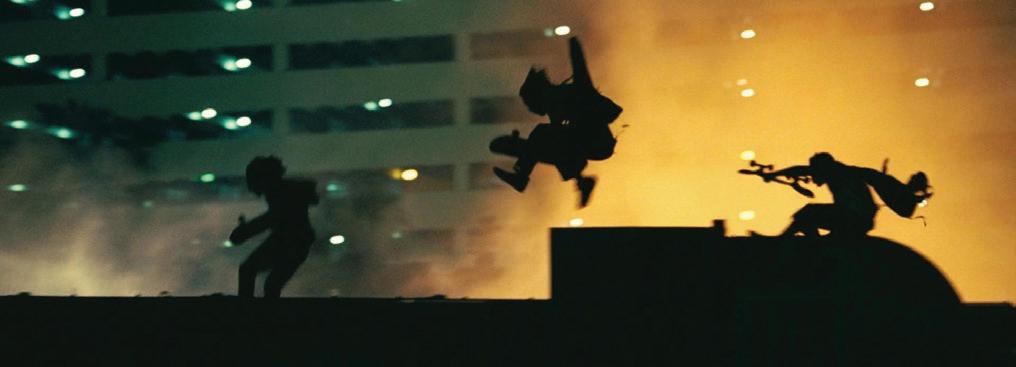
Still of three people on a rooftop from the film One Battle After Another

The Eastmost strip of Delmar Blvd. in University City, MO—colloquially nicknamed “The Loop”— has been a vibrant St. Louis hotspot of community, diversity, friendship, and fun for decades. The invigorating energy zipping through the air, the deep-rooted sense of pride and belonging, and the dreamy wonder conceived by a delicate harmony of cultures and experiences are what characterize this historic street. These are all sensations I have come to know very well over the years, and they simply cannot be fully articulated or done justice to in a single article; still, please enjoy my attempt to provide you with a glimpse into the life of an average Loop-lover!
WCA sophomore Lincoln Roam speaks to the restless nature of the Loop, noting:
“It never feels stale; there’s always a new restaurant opening or something exciting happening.”
Additionally, former Wildcat and current Junior at Whitfield Hana Inazu shares:
“I love how the Loop has so much character and you can always meet someone new with a really cool story. I also love the art everywhere and seeing everyone express themselves.”
Both students recognize the Loop’s lively atmosphere in different ways. For instance, Roam has observed the Loop’s perpetual novelty, a feature that contributes to its bubbliness and intrigue, ensuring that no two walks down the street are the same. On the other hand, Inazu focuses on the social and artistic aspects of the Loop, explaining how its widely diverse population gives it personality.
It is clear the Loop has no shortage of amazing qualities, but it certainly goes through its share of setbacks as well, specifically regarding its perceived downward trajectory in distinction, both from the outside world and within itself.
After considering some of the more recent architecture being implemented on Delmar and its potentially negative effects, Inazu reflects:
“I dislike the new construction on the Loop and how it’s becoming more modern because I feel like it’s taking away from the personality of the Loop.”
Sophomore at U-City High School Elliot Marchant also offers his opinion; he critiques:
“There’s way too many food places […] and not enough unique stores or experiences.”
Many of those who frequent the Loop have noticed an increase in popular chain restaurants like Papa John’s and Starbucks and in the development of contemporary buildings made for efficiency, seemingly at the expense of more fragile niches and mom-and-pop shops. They argue that the Loop is being watered down, losing some of its unique character to homogenization.
Although examples portraying the instability and standardization of smaller businesses are not insignificant, the models of flourishing Loop establishments (both old and new) and the efforts being made to enrich the Loop’s culture are far stronger, more numerous, and frankly more interesting, so please, take a journey down Delmar with me as I go through five of the hottest attractions to check out!
Founded in 1972 by big-time entrepreneur, visionary, and St. Louis enthusiast Joe Edwards, Blueberry Hill is a masterful creation with a funky, timeless pub-like feel (while also remaining family-friendly). Every square inch of every wall is decorated with action figures, album covers, taxidermied
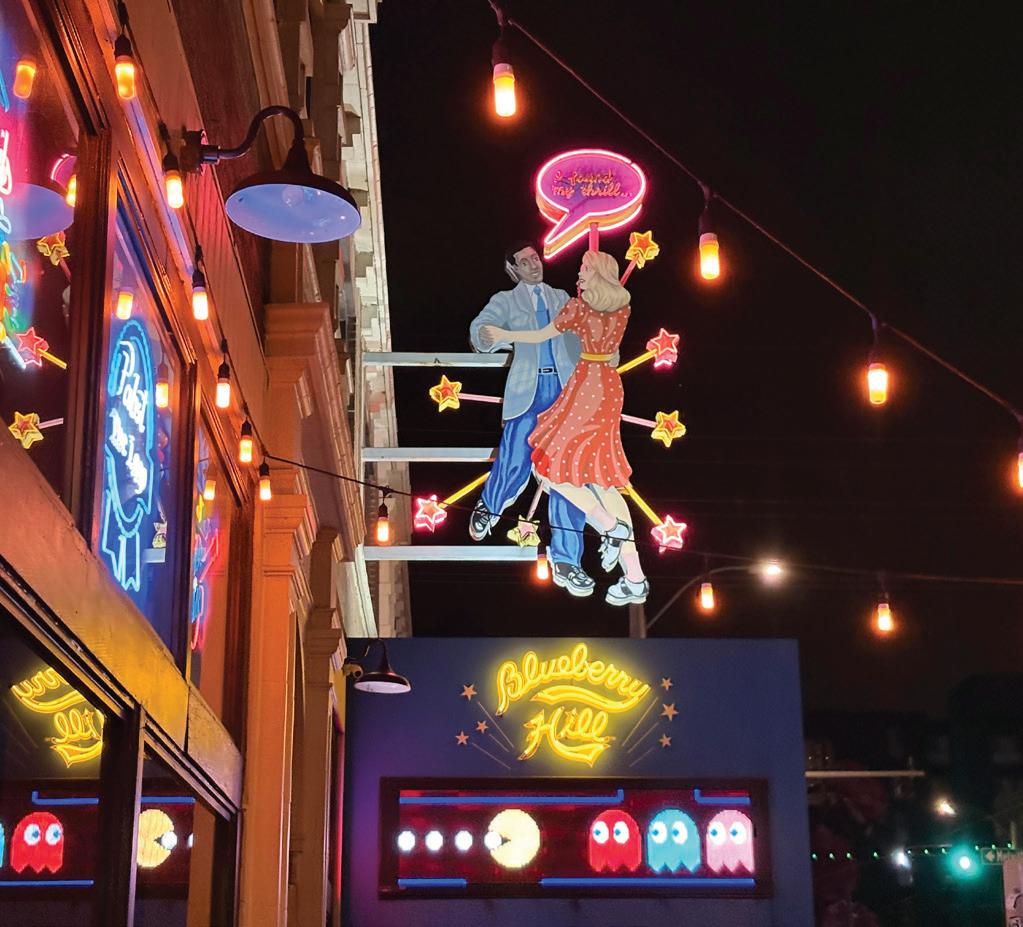
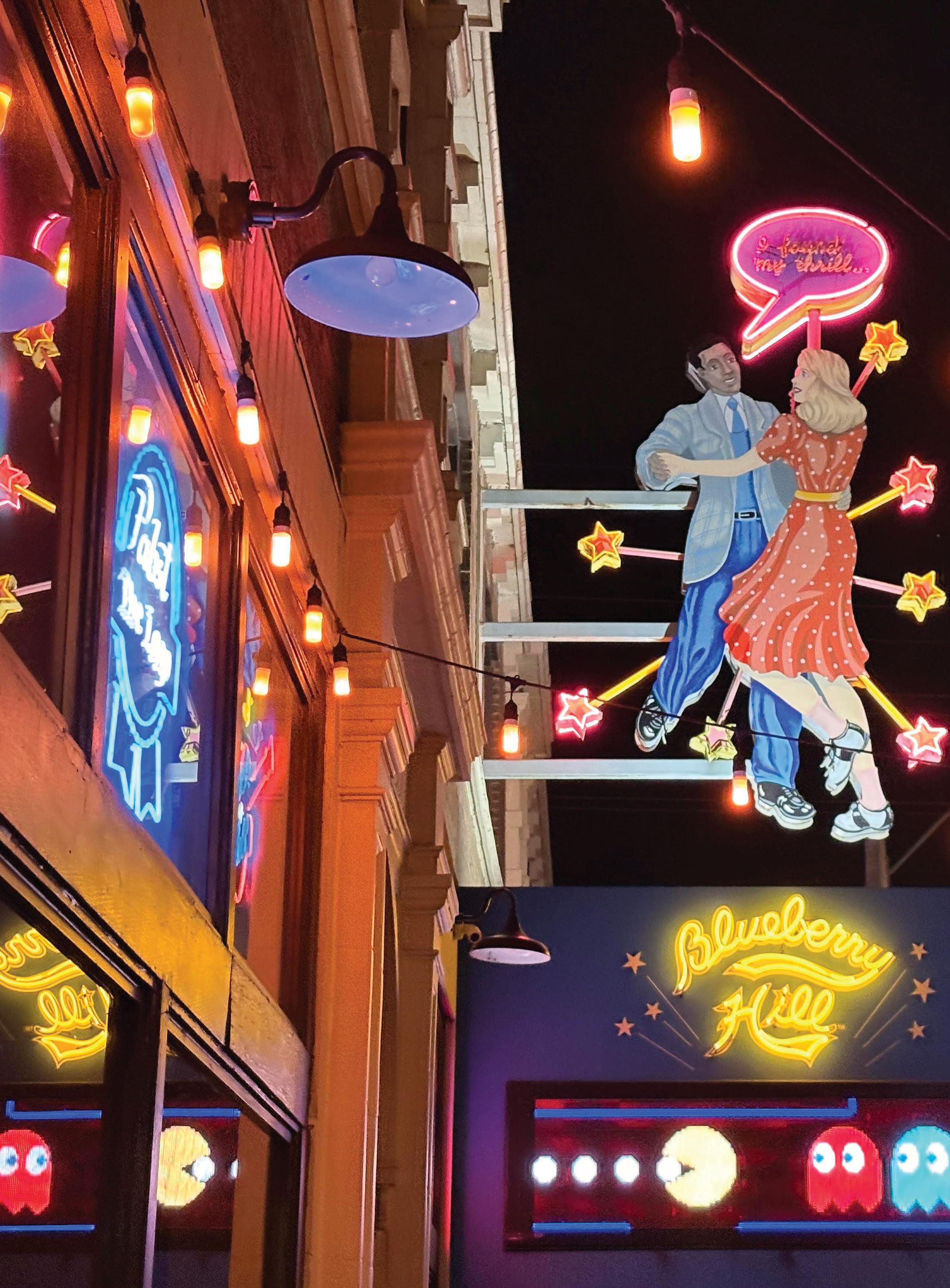
Cornerstone Blueberry Hill, nearly every surface emanating light of different shapes and colors, reflecting the restaurant’s playful, busy, and outlandish atmosphere. Photo by Jameson Roam.
animal heads, creepy puppets, and practically every fascinating trinket imaginable, many having to do with pop culture fads throughout the decades. To add to the magic, all your favorite classic arcade games are available to play, and there’s an almost-hidden “Duck Room” below the main floor of the building, where bands, comedians, and other ambitious artists put on shows. As if all that wasn’t enough to convince you of its greatness, Blueberry Hill has some of the best burgers in St. Louis! Hop over to this stunning spectacle of a restaurant the next time you have a free evening; you won’t be disappointed.
Arguably among the best thrift stores in St. Louis is Avalon Exchange, a quirky yet stylish hodgepodge of donated clothing, ranging from 80’s Halloween party to hardcore metal concert to formal first date to confident day at the gym. You can never go wrong browsing the aisles of this treasure chest of a store, and to call it a treasure chest is no exaggeration. Even if you’re not particularly drawn to fashion or shopping, Avalon is handing out unbelievable deals left and right. Hundreds of dollars lie in wait for you to find them. Don’t believe me? Come check it out for yourself.
On the benefits of going to Avalon, Roam remarks, “It’s always fun to try and find good deals and shop with friends,” and Marchant adds that he has “found a lot of clothes I love there.”
Also founded by Edwards, there truly is a magical quality to this new put-put place. Its courses are emotionally significant to St. Louisans, each of them themed around a different staple of St. Louis history and culture; there’s even a Blueberry Hill course! It’s a super fun outing for your friends, family, date, and anyone else you happen to come across. This place will be adored by all who enter.
4. Meshuggah Café
Yiddish for “crazy”, Meshuggah is the warmest, friendliest, coziest little nook in town. Many breakfast and lunch items such as eggs, bagels, sandwiches, and toast are served, along with delicious smoothies and, of course, coffee. It retains a relaxing and playful atmosphere by offering board games to play and a chalkboard for kids, along with comfortable seating and a pillow or two almost always at your disposal. One little-known fact about Meshuggah is that its bathroom walls are lined top to bottom with witty comic strips and poems like Calvin and Hobbes and Where the Sidewalk
Ends. In case you’re ever in the mood to stay on the toilet for hours on end—or just to finish some work and catch up with a friend, Meshuggah has got you covered.
Inazu expresses her love for Meshuggah by saying, “It’s really cozy and chill and I like to go there to get homework done with my friends, and also the coffee and food are amazing.”
Any genre of nerd, geek, gamer, or even mildly intellectual individual will love visiting The Wizard’s Wagon. They sell all kinds of comic books, board games, and other products in that arena. Settlers of Catan, Magic the Gathering, Marvel, DC, you name it! Whatever you’re a fan of, I can assure they have something for you to get excited about.
official title given to the structures is the “Gates of Opportunity,” and they couldn’t have been named more fittingly.
Two other honorable mentions that didn’t quite make the top five have to be the classic nostalgic record store Vintage Vinyl that has thousands of records and CD’s of every music style as well as the creativity playground Baked T’s, where you can bring your imagination to life by designing and printing your own t-shirt, hoodie, or other apparel with graphics, colors, and brands of your choosing.
Of course, that list only accounts for a small fraction of the Loop’s glory: there’s many thrift shops, diners, and cafés, as well as special places like a bowling alley, an old theater now functioning as a church, a concert venue, a karaoke lounge, a hotel with a beautiful rooftop view, an international grocery store, and our City Hall. There’s a tattoo parlor, a jewelry store, a bookstore, a library, a barbershop, and dozens of different places to get food or sweet treats.
However, the buildings themselves are not the only attractions that the Loop has to offer. The St. Louis Walk of Fame is a series of large brass stars embedded into the sidewalks on either side of the street with names of celebrities and historical figures who were either born in St. Louis or spent much of their life here, each accompanied by a bronze plaque describing their upbringing and accomplishments. This walk of fame includes many nationally recognizable names like Chuck Berry, Tina Turner, Maya Angelou, T. S. Eliot, Tennessee Williams, Dred Scott, Scott Joplin, and Ulysses S. Grant. In addition, there’s a trolley that travels the full length of the Loop and has a stop at the St. Louis History Museum, aimed at connecting University City with the city of St. Louis and providing more accessible local transportation. There have also been developments in the world of art, like a recent campaign that put murals up on dull building walls, a bronze statue honoring Rock & Roll icon Chuck Berry (a proud St. Louis native), and Delmar’s revered protectors, two giant lion statues—

JACK OVERBY
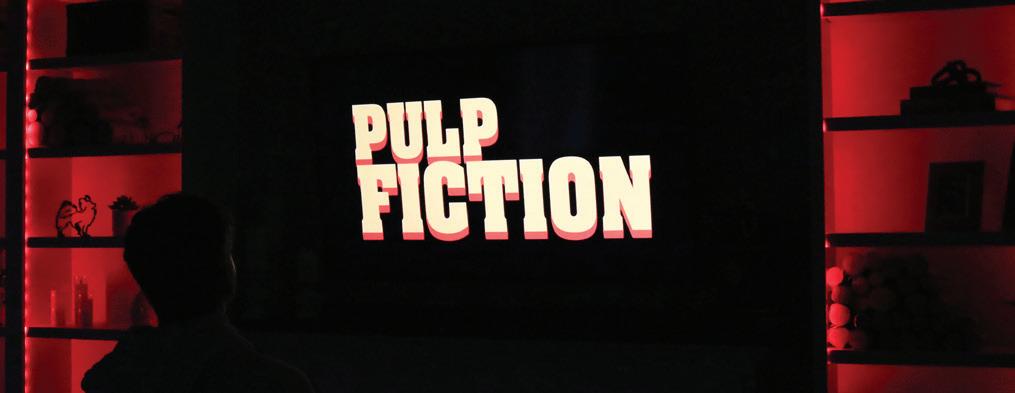
There is a moment in Pulp Fiction where a man accidentally gets his brains blown all over the back seat of a car, and the two hitmen responsible spend the next ten minutes arguing about whose fault it was and how to “unscrew” themselves out of this mess. If that sentence made you laugh — even a little — then Quentin Tarantino already has you exactly where he wants you, right in the palm of his beautifully deranged hand.
Released on October 14, 1994, Pulp Fiction is a crime “anthology” of sorts, following a rotating cast of Los Angeles lowlifes: two hitmen named Jules and Vincent, a washed-up boxer named Butch, a crime boss’s wife with a taste for foot massages and heroin, and a pair of diner robbers who bit off considerably more than they could chew. None of this unfolds in chronological order. In fact, the film opens with a scene that only makes complete sense once you’ve watched the entire thing and thought about it for a while. That is not an accident. That is Tarantino telling you, with supreme confidence, that he is in charge, and you will keep up.
The film’s most revolutionary quality is its structure — or more accurately, its deliberate lack of conventional structure. Pulp Fiction is divided into chapters — “Vincent Vega and Marsellus Wallace’s Wife,” “The Gold Watch,” and “The Bonnie Situation” — each a self-contained story that overlaps and intersects with the others in ways you do not fully appreciate until the credits roll. The opening robbery scene, for instance, lands completely differently the second time you encounter it, now understanding the moral transformation Jules has undergone by that point in the story. Time is scrambled on purpose, and it forces the audience to become an active participant rather than a passive observer. I have seen this film more times than I can count, and I still pick up something new each viewing. That is not a coincidence — that is architecture.
Critics have described the film as a touchstone of postmodern cinema, and it is widely considered a cultural watershed that influenced films and other media for decades after its release. They aren’t wrong, though “cultural watershed” feels almost too clean a phrase for something this chaotic. The better analogy might be a grenade thrown into a crowded room of Hollywood executives in 1994 — everyone walked out rethinking everything.
The dialogue alone rewrote the rulebook. Tarantino and co-writer Roger Avary understood something that most
screenwriters either do not know or are too afraid to use: the conversation before the violence is often more unsettling than the violence itself. Characters engage in extended conversations about hamburgers, foot massages, and the ethics of keying someone’s car — mundane topics elevated to philosophical significance — and these exchanges are not mere digressions, they establish character and create an unsettling juxtaposition with the violence that punctuates them. It is darkly hilarious and deeply uncomfortable, sometimes within the same breath. That balance is nearly impossible to pull off, and Tarantino does it almost effortlessly.
The film’s cultural footprint is staggering. In an interview with EBSCO, Roger Ebert called it “the most influential film of the decade”, given the host of imitations it spawned — and that’s the problem with imitators: they can copy the non-linear structure, they can steal the snappy dialogue format, they can curate a killer soundtrack, but they cannot replicate whatever it is that makes Pulp Fiction feel alive. Every copycat film proves the point. It was the first independent film to surpass $100 million at the U.S. box office, obliterating the notion that challenging, unconventional cinema could not also be wildly commercially successful. It did not just open a door for independent filmmakers — it knocked the door clean off its hinges.
Personally, this is the film that made me invested in movies. Not just as entertainment, but as a cornerstone of society — where structure, music, dialogue, and image are all being used simultaneously to say something. As film educator Robert Fox put it in Current Magazine, “This movie pushed the needle — no pun intended — as to what cinema could be.” That quote lands differently when you remember the needle in question belongs to an overdosing Uma Thurman. Tarantino knew exactly what he was doing. He always does.
Pulp Fiction is not a perfect film. It is something better than perfect. It is alive — messy, funny, brutal, stylish, and completely, unapologetically itself. Thirty years later, it still hits harder than movies that tried harder than Pulp Fiction did in the first place.

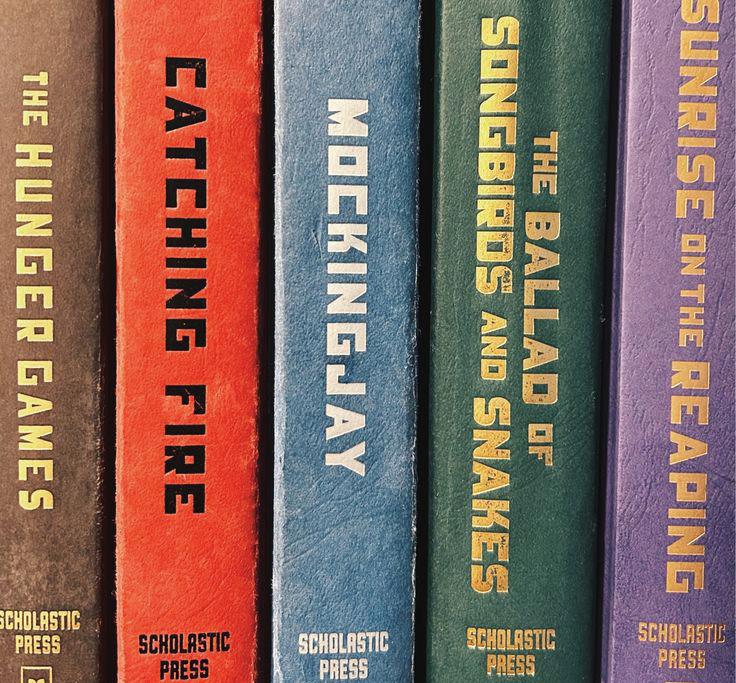
The Hunger Games is a book series many people have been immersed in for decades now. These books slowly enchant you as you fall in love with the complex storyline and compelling characters.The first three books gained such a following that the author Suzanne Collins decided to write two more books that were prequels to the award-winning series. All five books have now been adapted into movies, and the movie based on the most recent book, Sunrise on the Reaping, has the adaptation in theatres November 20th 2026.
Here is a short synopsis of what the book entails: In a place once known as North America, now known as Panem, is a very rich City surrounded by twelve Districts. Every year The Capitol likes to think they control all the Districts, there is something known as The Hunger Games! In the Hunger Games, two children, one boy and one girl from each district from the ages of twelve to eighteen, have to leave their families and compete in a live event that is aired on televisions all over Panem.
That is the basic premise for all of the books, and as the story evolves you become very connected to the characters. The prequels allow readers to see different aspects of older characters such as the President Coriolanus Snow and Haymitch who helps Katniss in the first book. The charm and feel of the books and characters stay the same throughout the series, which is why many long term fans remain deeply invested in the lore of the series.
Lyla Townsley, Freshman at Westminster Christian Academy, relates her thoughts about her favorite book in the series: “My favorite book in the Hunger Games series is probably the first one. It’s just a classic, and although I love the others, the first one just feels like it can’t be beat.”
Many hardcore fans are also very passionate about the movie adaptations! Starring Jennifer Laurence as Katniss Everdeen, and Josh Hutcherson as Peeta Mellark, the adaptations are seen as very accurate by critics and readers alike, which we all know is a very difficult feat.
A Hunger Games book review done by Tim Challies, a Reformed Baptist and Theologian, reveals that maybe The Hunger Games is more than just a good and evil trope teen fiction. Children who read the books are seeing pure evil
doing battle with pure good and enjoying that contrast. It is so clear, so unconfusing, so real.
“I think there is more here, though, than mere good versus evil. I think there is a kind of evil here that does battle with the moral relativism in our culture. There is no doubt that these games are purely evil, that it is wrong to pit a child against another child in a battle to the death. Children who read the books are seeing pure evil doing battle with pure good and enjoying that contrast. It is so clear, so unconfusing, so real. The few, the rich, the residents of the Capital—their children are in no danger, so for them these bloody games are mere entertainment.”
The Hunger Games is not just a series that falls into the category of good and evil, with all the dramatics of secret requited love and dystopian reality. It is a book series that can be bonded over because there is a clear sense of the good and evil in Panem, and we enjoy stories with feminist eldest daughters and a compassionate family friend.
In my opinion, the movies are a worthy adaptation of the books. I remember sitting in my sun room in middle school on the edge of my seat in suspense, eagerly turning each page. My love for the movies is in a different place in my heart, I am infatuated with the way the actors portrayed the characters. My critiques are only of the third book in the series: Mockingjay. I find the middle of the book extremely repetitive and it doesn’t get to the point very well. Finally I would recommend this book to all and this story is amazing.

The story behind the St. Louis Zoo ultimately shows how even since its founding it has been connected to the citizens of St. Louis. This is shown today through how the zoo operates by constantly putting an emphasis on citizens and interactions with animals, ultimately reflecting the zoo’s commitment to their original mission
Within the St. Louis Zoo, there are many well known older exhibits people have grown used to such as the monkey house where the cages are so close you feel like you are next to the monkeys. The dark and cold reptile exhibit, despite its age, remains a fan favorite for its variety of animals and interactive elements.
Newer exhibits include the McDonnell polar bear point established in 2015, the penguin house, some of the bigger cats, and the painted dog puppies, all of which serve as immersive experiences for all guests who attend at the St. Louis Zoo.
The giraffe feeding experience is also a fairly recent addition, and offers people to be uniquely close to a giraffe. It offers people a chance to see an inside into the lives of Giraffes, it also helps promote conservation efforts, and reaffirms the hard working notions zookeepers live by.
However, some of the older exhibits are noticeably in need of an update. Many show signs of wear and tear and it almost seems as if a monkey or reptile could escape from them.
Unlike the majority of zoos, the St. Louis Zoo is completely free as it is paid for by the tax payer money of the people who live in St. Louis. Furthermore, when people want to save money, they have the option of bringing their own food, but if people are interested in eating at the St. Louis Zoo, they can find a plethora of food options based on local dishes in St. Louis. While the quality of the food at the St. Louis Zoo is comparable to that of a cafeteria, the St. Louis Zoo contrasts with other zoos in the way it is able to implement a variety of cuisines and an allergy menu, as stated on their website.
People can find street parking in Forest Park, which is completely free. However, this requires zoo patrons to have a bit more of a walk from their vehicle. According to their website, The St. Louis Zoo offers camps in the fall when kids are off to get a chance to learn more about uprising
conservation. There are also Family programs listed on their website, like “the polar bear plunge”, where people can see the zoo exclusively after closing.
The zoo is also currently under construction because they are actively trying to build a new place referred to as Destination Discovery in their website. The website reports it has a focus on children, and sensory detail, more information will be provided later in the year.
The St. Louis Zoo Website also says they are building another location. The focus of the new location will be on conservation and it will be known as the Wildcare Park will feature endangered species.
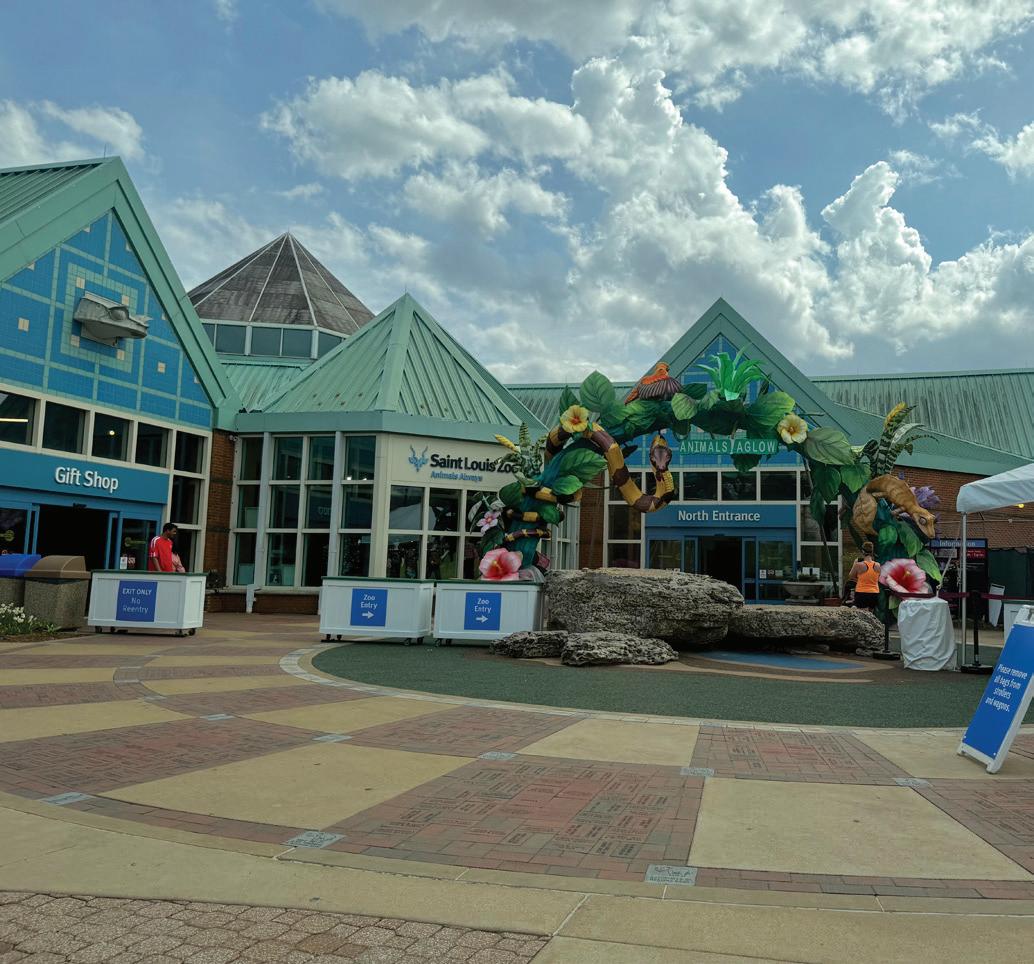
Furthermore, the St. Louis Zoo also hosts an annual Animals Aglow event, decorating the grounds with Chinese lanterns. The event puts emphasis on the Chinese cultural roots of many St. Louisians, including personality signs based on your Chinese zodiac with matching light display meant to look like lanterns. There is even a giant dragon at the center of the park that breathes fire. This once more showcases how phenomenal the St. Louis Zoo really is.
Ultimately, whether you live in St. Louis or are visiting from out of town, the St. Louis Zoo is one of the best attractions the city has to offer and you should definitely be sure to check it out!
“Top 5 New Broadway Musicals” Pg 4-5