SEPTEMBER 2020
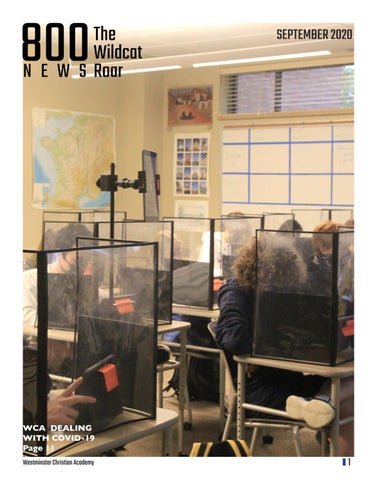
WCA DEALING WITH COVID-19 Page 11 Westminster Christian Academy
1
800 NEWS CO-EDITOR IN CHIEF MAGGIE LINDSTROM, JUNIOR
CO-EDITOR IN CHIEF EMMA HARRIS, JUNIOR
CO-EDITOR OF 800SPORTING MARTYBRINER, SENIOR
CO-EDITOR OF 800SPORTING BROOKE HIGHMARK, JUNIOR
STAFF WRITER
STAFF WRITER
STAFF WRITER
STAFF WRITER
COLIN RING, SENIOR
EMMA SMITH, SENIOR
2 STAFF
NOLAN JONES, JUNIOR
CJ FRANCOIS, FRESHMAN
ST
TAFF
STAFF WRITER
STAFF WRITER
STAFF WRITER
STAFF WRITER
STAFF WRITER
STAFF WRITER
MOOREA ATKINS, SENIOR
KAITLYN BUTLER, JUNIOR
SAM VESTAL, JUNIOR
STAFF WRITER BEN KNISLEY , SOPHOMORE
STAFF WRITER EVAN KOHN, JUNIOR
STAFF WRITER
ANDREW CAHILL, FRESHMAN
HOPE LINAM, JUNIOR
ELLIE JOHNSON, JUNIOR
ANAGI PIERIS, SOPHOMORE
STAFF WRITER GUS DUDA, JUNIOR
STUDENTS SERVING STUDENTS STAFF 3
CONTENTS
FEATURES
MR. ROHLFING PG. 7-8 WCA DEALING WITH COVID PG. 11 METHODS OF REDUCING STRESS PG. 14
4 CONTENTS
OPINIONS
SLEEP DEPRIVATION IN TEENS PG. 12 FOOD WASTE AT WCA PG. 13 TOO YOUNG FOR AN IPHONE? PG. 15 FAILING STEM INNITIATIVES PG. 16
NEWS
MODIFIED SCHEDULE PG. 6 ADAPTING TO CANVAS PG. 7 SCHOOL IPADS PG. 9
CONTENTS
SPORTS
GIRLS VOLLEYBALL PREVIEW PG. 18 SOCCER PREVIEW PG. 19 FIELD HOCKEY PREVIEW PG. 20 SOFTBALL PREVIEW PG. 21 BOYS CROSS COUNTRY PG. 22 GIRLS CROSS COUNTRY PG. 23 CALEN MOELLENHOFF PG. 24 ALEXIS HACKMAN PG. 25
STAFF ED
STAFF ED
WELCOMING DISCOURSE
Proverbs 18:15 — “The heart of the discerning acquires knowledge, for the ears of the wise seek it out. This is the new 800 news! We went through a huge change in staff as our seniors left the staff last year, so we are turning over a new leaf (just in time for fall!). This first issue is the first of many more to come from this new staff. We are all here in the newsroom working for the common goal of providing new content that informs not just our Westminster community, but the world. We believe every voice is unique, and we want nothing more for our staff members than the opportunity to express their individuality in a way that benefits the lives of others. It is our duty to face issues with courage and conviction and our hope to change and inform the world one article at a time- or at least the world of Westminster. We are beyond excited to begin this new journey as we find and discover more and more about ourselves and about each other. So tune in to the Wildcat Roar website to get exclusive looks at articles, videos, and sports.
Sincerely, Emma Harris and Maggie Lindstrom, Co-Editors-in-Cheif
STAFF EDITORIAL 5
WESTMINSTER STUDENTS ENJOYING MODIFIED SCHEDULE KAITLYN BUTLER Staff Writer
In order to safely return to school as the state of To the students’ satisfaction, the school announced Missouri works to counteract COVID-19, Westmin- on September 2nd the plan to continue with this ster Christian Academy has adopted a limited sched- adjustment for longer than intended, the faculty in ule omitting lunch and shortening classes by fifteen agreement with the student body. minutes. Fortunately, the student body appreciates the 1:15 dismissal, which opens up free time during the According to the announcement to parents over email, administrators recognize and value the day. benefits of a shorter school day: “Early dismissal “I‘ve had more opportunities to meet up with friends provides them a much-needed break from wearing after school, work on extracurricular activities, and masks, continues to reduce their risk of exposure, I have more time to do my homework,” said Elinor and gives them an opportunity to get their homework done earlier in the day.” Dana, junior. Forty-minute classes are additionally less overwhelming as opposed to hour-long periods. Students have reported lower levels of stress brought about by prolonged lessons or class work.
Administration will reassess after the end of the first quarter whether or not the schedule should be continued. For now, at least, Westminster students remain grateful for the modification.
“I can definitely feel that it goes by faster, so I don’t feel as worn out by the end of the day,” said Nyah Kim, sophomore. Moreover, the fifteen minutes shaved off of each class period has helped to alleviate boredom and quicken the approach of the end of the day. The frequent transition from class to class aids in refocusing attention, keeping students engaged. “Shortened classes make it easier for me to focus and pay attention in class. Having longer classes makes it harder to keep my energy up,” said Corinne Plumb, freshman. Photo by: Kaitlyn Butler
6 NEWS
CANVAS REPLACES CLASSROOM ELLIE JONES Staff Writer
As we all know, Google Classroom has been tossed to the side by a new app called Canvas. The question is, has the change been good? Or would some rather turn back time to the days where Google Classroom was the headmaster of Westminster during the 3 months of quarantine?
Teachers and students working with canvas. Photo by: Ellie Jones
Along with the shock to students that Classroom was not going to be a part of the classroom dynamic anymore, it also came with a shock to teachers as well. A tremendous amount of teacher training went into learning about this app and all of its moving parts. “40 plus hours of online training before August, and a week of training classes before normal teacher training. So we had to come back a week early, and had 40 hours of training online before,” said Brian Maloy, Westminster business teacher.
ing at home and learning online, and Canvas is more efficient for these circumstances.
Many students, even teachers have made it clear that if they would have had it their way, they would have stuck with Google Classroom. Canvas just does not do it for them. Here Maloy speaks for himself as well as advocates for the students who are not part of the Canvas fan club.
“One of the main reasons we decided to make the switch is because Canvas has the capability to do more than Google Classroom. Given the circumstances and the potential that we would have some or all students learning from home, we wanted a more robust system that would allow us to improve upon the way we conducted remote learning in the spring,” said Gall.
“Not a fan, I get that it has a lot of potential, but the pros do not outweigh the cons for me. With Google Classroom, integration was so much easier for my class and all of the assignments I’d created. It was also easier for students,” said Maloy.
Nothing is ever set in stone anymore. More and more students are switching to at-home learning daily. Some are home for 2 days, 2 weeks, or the rest of the semester because of the learning from home option given to everyone. Canvas is able to be more flexible for these times of uncertainty than Google There are many different questions students have about Can- Classroom was for the quarantine that took place before vas, one of them being, why did we switch to Canvas the first spring break. place? During the COVID-19 pandemic, while students were in quarantine during April through May, Google Classroom Gall and a few other members of staff went into this last minwas the home base for all classes. It seemed to go over well, ute change over from Google Classroom knowing that it was many people liked google classroom. However, Reilly Brophy, going to be difficult for kids and staff to grasp at first.“It was junior, has inserted her opinion about how she would prefer a tough decision, mainly because of what we knew we would Canvas over Google Classroom. be asking of our teachers and students. We’re seeing some “Yes, I like Canvas better than Google Classroom. I think it’s more organized, and easier to keep track of assignments,’ said Brophy. “Canvas has a “to-do” section and all of my assignments for every class show up so it is more organized and easier to keep track of my homework.”
of the difficulties that have come from this decision now. There’s certainly an adjustment period for teachers (myself included) and students alike. These required adjustments come with certain frustrations, frustrations that are understandable and merited,” said Gall, head of academic development.
Through these times of daily change and uncertainty, teachers The decision to switch to Canvas was partly due to the fact will always stick with the learning option that is more flexible that students need to be prepared and equipped for college because of the ever changing circumstances and the constant level learning, as Westminster is a college-preparatory school. unknown of what the future will hold. Another reason was because of the amount of students stay-
NEWS 7
THE MAN BEHIND THE SCREENS BROOKE HIGHMARK Co-Editor - 800 Sporting
Many wondered, “Who is the cinematic genius behind this masterpiece, and why is he working at a high school?” The credit belongs to the one and only Mike Rohlfing. On the last day of Spirit Week 2020, students were amazed after watching the teacher film project entitled “The Academy: A Star Wars Story.” (http://www.mikerohlfing.com/theacademy) Mr. Rohlfing currently works as the director of marketing and communications at Westminster. However, he has an impressive history of experience in the world of media and production. From experimenting with cameras as a child to winning four Mid-America Emmys and meeting some of the most famous people in the nation, Rohlfing’s journey has been nothing short of extraordinary. “I’ve always had a passion to entertain and be creative. Even from a young age, my cousins and I used to play around with technology and cameras,” said Rohlfing. Rohlfing kept his creative juices flowing as he entered into the gates of Westminster Christian Academy. Interestingly enough, he was taught by our very own Mr. Kim. Because he was one of the only students devoted to digital communications at the time, Mike was granted numerous unique freedoms and opportunities, including being Mr. Kim’s teacher’s assistant.
One example of the reality shows that was bought into was “Alternate Route,” an Esquire Network series where Rohlfing and his crew followed blogger and photojournalist Matt Hranek around the country as he explored exotic cultures and underwent various adventures. “After a while, I decided to leave the TV development world and decided to work full time as the executive producer for a show called “In Depth with Graham Bensinger” for two and a half years,” said Rohlfing. Rohlfing was able to travel across America to meet Bensinger’s impressive celebrity interviewees such as Kobe Bryant, Dale Earnhardt Jr., Mike Tyson, and more. After a stressful yet enjoyable experience, Rohlfing decided that it was time to lessen his traveling in order to be more present for his newborn baby girl. “Around that same time, I saw that there was a job opening at Westminster where my wife worked, and I used to joke to her about the possibility of us working together,” said Rohlfing. “Soon enough I was interviewing with Mrs. Peggy Johnson and got the job of Director of Marketing and Communications.” The job contains an abundance of diverse responsibilities and projects, and Rohlfing loves it.
After graduating in 2005, Rohlfing kick-started his career at Calvin College.
“The communications team is responsible for promoting, marketing, and advertising the school. We talk with the media, buy ads in newspapers and publications, and more. “I also visited the University of Kansas, the University of TulIt’s our job to get our name out there, make sure that people sa, and others, but Calvin College had the best facilities and at- know about our school, and make sure that our mission and mosphere for my success. It was rather small, so I was able to vision are clear for prospective students and their families,” have more of an impact at the school as well as receive more said Rohlfing. opportunities such as working at tv stations or concerts,” said Rohlfing. In addition to being responsible for all public communicaAfter graduating with a degree in media production, Rohlfing began his first job at a St. Louis production studio called Coolfire Media, a company that he had interned with during his time at Calvin. Throughout his time there, he created commercials for numerous prominent organizations such as Energizer, Build-A-Bear, and the Cardinals. Later on when he became the lead director of photography and editor for tv development, Coolfire started to create original content, pitching tv shows such as “Fast N’ Loud” to popular channels like HGTV, Discovery Channel, Esquire, Nickelodeon, etc.
8 IN-DEPTH
tions, the department is responsible for the “Chimes Magazine”, found both printed and on the Westminster website, posters all around the school relating to social distancing, one-way staircases, and more, and all emails that are sent out from the school, such as Dr. Mosbacker’s email for the cancellation of the first day of school. (https://wcastl.org/ alumni/chimes/) Rohlfing is personally in charge of running Westminster’s social media accounts, including the impressive Instagram page. (https://www.instagram.com/wcastl/?hl=en)
“What I love about working at Westminster is that I do feel truly invested in my work as well as the mission and the history of the school. I hope that what I create here can shine a light on our school and the work that God is doing here, and it’s a privilege to utilize my gifts and experiences to do that,” said Rohlfing. Rohlfing greatly enjoys the freedom and fun that he’s had at Westminster, so he’s not sure if he will ever go back to the fast-paced world of production. However, he still has a foot planted in the industry by occasionally working on side projects in his free time. One of Rohlfing’s proudest accomplishments was winning a short film project and making it all the way to the 2015 Cannes Film Festival Short Film Corner in France with a film called “EVT.” Although Rohlfing was privileged to work on many interesting projects and meet a lot of fascinating people throughout his career, one aspect that was missing from the job was a real emotional connection toward his work. “There were rare occasions where I was able to produce projects pro bono for charity organizations - The Pujols Family Foundation, Gateway 180 Homeless Shelter, among others- and those projects were often much more satisfying and edifying than the TV shows I was working on because I felt like they made a real difference for good causes,” said Rohlfing. After ten exhausting yet invaluable years of working in the television industry, Rohlfing learned that the best advice to
Mike Rohlfing Photo by: Westminster Communications give to people interested in pursuing the same career path is to “just get out and do it. Practice at it. Get internships. If you want to be successful in any creative field, you have to get your foot in the door and prove yourself,” said Rohlfing. if you want to see more of Mike Rohlfing’s work, check out his website: http://www.mikerohlfing.com.
Mike Rohlfing In Action Photo by: Westminster Communications
IN-DEPTH 9
MANAGED IPADS ARE NOW PART OF THE “NEW NORMAL” ANAGI PIERIS Staff Writer
Since the 2019-20 school year, WCA has begun to transition from privately-owned devices to school-sanctioned IPads for all grade levels. “There’s good things and bad things about the school IPads. I like having a keyboard to type on, but [having mandatory devices] can be uncomfortable sometimes” said Annika Pollack, sophomore. Current juniors are especially vocal about the new IPads. Before the uniform issued IPads, WCA students bought their own IPads up to ninth grade, with the majority purchasing laptops for the remainder of their high school years. However, just as the Class of 22 reached the level when they would traditionally get to bring their own laptops and computers, they were told our new policy of mandatory school-bought new IPads. As a result, English teachers across the board have begun implementing shared Google Docs for essay writing.
A seventh grade student from 2019-20 school year works on his school-issued IPad. Photo courtesy of WCA Roar Stock Photos.
“The reason we want to be able to look at your Google Docs as you are working on essays is because you highlight certain part of what [Ipads] helps with is: the school owned and passages for me to get back to you later on,” said Sara Lamanaged devices make it less necessary for our teachers to Barre, Literature of Western Civilization teacher. monitor. It doesn’t eliminate the necessity of monitoring, but because they are locked down to a certain degree, students “It also helps us to just check in periodically when you are cannot be as distracted in them as they otherwise would have assigned work time in class,” she said. been,” said Micah Gall, Director of Student Development and Upper School American Literature teacher. He elaborated on In addition to Apple Classroom, SafeSearch enabled on Safari, the possibilities, adding, “We want to use the best parts of and restrictions on Airdrop/ Password features, this year technology to help us in the classroom. To help us be efficient teachers provide an outlined, MLA formatted skeleton essay in spots as long as that efficiency is used to help us create with all the components of body paragraphs and introduction/ space for other things”. conclusion included, along with the strong recommendation to use the resource as a template. As with all major changes, mandatory licensed IPads have Unlike Google Docs, when students work in Pages (an alternative app available on the school IPads), teachers cannot immediately access their writing unless a student specifically brings their device for clarification. For the majority of students who attended Westminster before mandatory IPads, Pages is preferred to Google Docs considering the added features such as word search and page headings. In response to such concerns, some students are opting to simply copy and paste work into Google Docs, but use Pages as the primary app. “It’s not that we want our teachers to constantly monitor what our students are on when it comes to distractions, that’s
10 NEWS
streamlined the process of learning at school and home, while in other respects, made the daily routine of students more cumbersome. The bottom line? “Difficult circumstances create opportunity... It’s hard to do distance learning and adjust to new IPads in and of themselves [but] I think we’re making progress and will continue to do so,” said Gall.
THE UNIQUE WAYS OF WCA: THE BATTLE AGAINST COVID-19 CJ FRANCOIS & ANDREW CAHILL Staff Writers
Many schools have tried to come up with a good way to deal with school while trying to keep their students and faculty safe and healthy. Westminster Christian Academy has come up with their own unique solution for decreasing the spread of COVID-19 and keeping their students in school.
popular option. Public schools are not even coming into their building. They are doing all online classes so they don’t risk any outbreaks. While this does stop the spread, it makes it harder for a lot of students to learn. Although some private schools are also taking this method, very few of them are.
The students schedule, which usually ends at 3:00 pm, has been modified so that it ends at 1:15 pm instead. Students are not able to eat lunch to avoid being in a crowded cafeteria As of this moment, Westminster COVID cases, despite students coming to classes each day, are at zero. This demonstrates how well Westminster has done in creating and reinforcing protocols, such as students having their own, personal protective shields surrounding them at their desks for each class. This is not to imply that all of the choices by other schools have not been well thought out and researched. Each school has done what they think best benefits the students and faculty. However, it does show the uniqueness and problem solving skills of WCA.
for a long time. This is very different from many of the other schools near us. It’s a great idea to not have lunch, although the downside is that it prevents students from having a lot of social time during school. Despite the lack of social time, many students have liked this shortened schedule for different reasons. Alex Shoemaker, 9th grade, reports,”I enjoy the new schedule because I get more time to do my homework and my grades have improved because of that.” CBC, a private, Christian highschool for boys, is coming to school two days a week and staying home two days a week based on where your last name lands in the alphabet. This is a good way to allow students to come to school while also making sure the school doesn’t get crowded so that they can socially distance. John Burroughs, Chaminade, Villa Duchesne, Visitation Academy, and Whitfield are giving kids the choice to go to school full day, or stay home and do ZOOM classes. If kids choose to go to school, it will be like a normal day except with masks and health checks. If kids choose to stay home they can log into zoom for each class and learn from there. That way kids who might be in the high risk category can choose to stay safe at home while other students that Students hard at work, quipped with their personal want to go to school are able to take the risk. This hybrid plexi-gloass shields Photo by: Andrew Cahill option of coming to school or staying home is easily the most
NEWS 11
WHY TEENS SHOULD HIT “SNOOZE”
It’s time for schools to respond to the adolescent sleep deprivation epidemic.
KAITLYN BUTLER Staff Writer
At 6:00 a.m, most teens are stirred awake by the ring of their alarm clock, opening their eyes to feelings of dread and exhaustion. Here awaits a new day of heavy eyelids, brain fog, and late-night studying to top it off. Each hour of the night allotted to homework rather than sleep racks up the hours to be repaid over the weekend—yet most schools continue to contribute to their students’ sleep debt. According to a 2006 study by the National Sleep Foundation, “more than 87 percent of high school students” are sleeping under the recommended eight to ten hours. Ten to fifteen years later, as schools repeatedly fail to acknowledge scientific data and the complaints of their students, the American Academy of Pediatrics labels teen sleep deprivation an epidemic (Richter). And rightfully so; the disregard of an extra couple of hours poses grave health complications affecting both physical and mental well being. The majority of teens are at risk of mood swings, anxiety, irritability, impulsivity, and poor concentration and cognitive functioning (Dimitriu), hence why academic performance and sleep go hand in hand. Forgoing a couple of hours to study, therefore, may actually do students a disservice, inhibiting their ability to think clearly and critically. The Harvard Division of Sleep Medicine additionally links a lack of sleep to obesity and cardiovascular issues, long-term implications arguably more critical than a missing assignment (“Consequences of Inefficient Sleep”). The school day ends around 3:00 to 4:00, allowing six or so hours for homework, mealtime, hobbies, rest, and extracurricular activities in order to squeeze in the minimum of eight resting hours. It is simply unreasonable to expect teens to sleep for an adequate amount of time under such demands. Advanced Placement students, athletes, or actors especially are forced to compromise their schedule and, not surprisingly, pass up their sleep.
Students take time out of their sleep in order to accomplish all the aditional work school gives them. Photo courtesy of Elinor Dana the morning (“Teens and Sleep”). University of Washington biology professor Horacio de la Iglesia therefore asserts that “to ask a teen to be up and alert at 7:30 a.m. is like asking an adult to be active and alert at 5:30 a.m.” (qtd. in Urton). So why are students roaming the hallways as early as 7:30? The current scientific data contradicts justifications for early start times. In fact, the American Academy of Pediatrics suggests delaying the beginning of school until 8:30 at the earliest to optimize students’ mental and physical health (“Schools Start Too Early”). And no, the majority of teens will not consider this an opportunity to stay up later. A study monitoring the sleep of Seattle high school students after shifting the start of the day from 7:30 to 8:45 found a “significant improvement in the sleep duration of students” (Urton). They simply used the extra time to sleep in—to listen to their biological impulses.
As sleep affects multiple areas of students’ health and functioning, the benefits additionally extend to academic life. The Moreover, the root of the issue lies not only in students’ limit- Seattle high schools noted an increase in final exam scores, ed after-school time but also in the interruption of their bodily as well as a decrease in tardies and absences (Urton). slumber cycle. Sleep researchers have identified a shift in adolescents’ circadian rhythm, or their “internal biological clock” For the sake of the well-being and performance of our responsible for signaling sleep times. The delayed production students, beginning and ending the day an hour later seems of melatonin results in a sleep-wake cycle later than that of more than worthwhile. So hit the snooze button, students, their parents or teachers, communicating tiredness around teachers, and administrators—sleep is a necessity, not a 11:00 p.m. and waking students between 8:00 and 9:00 in privilege.
12 OPINION
OPEN WIDE
Eat it. Don’t Waste it.
ANAGI PIERIS STAFF WRITER
customed to senselessly tossing the entirety of a half full bag of Cheez-Its or dumping a nearly empty Starbucks cup into the recycling bin. Sadly, the WCA community isn’t unique: an estimated 130,020 primary and secondary schools across the country contribute to the roughly 530,000 tons of trash churned out in a year, 23.9% of which is food. Meanwhile, on college campuses the average student wastes 142 pounds of food a year.
You haven’t even touched your food! I want to see that plate licked clean, young man! Don’t you know there are children starving in Africa who would love to have a fraction of what you have?” Certainly any person between twelve and eighteen However, our school doesn’t have to follow in the same footsteps. Finishing off the few drops of a sports drink or bag or has heard similar versions of the age-old admonishment at chips doesn’t cost inordinate time or effort. Some of the food some time or another. waste can also be diminished by simply serving smaller portions and returning for more later. Plus, in most cases, eating Combined with the overexposure through the media, many teenagers have become desensitized to the very real dangers a healthy breakfast is enough to tide one over for the rest of of poverty and famines which peers face in developing coun- the day. In the interest of preserving resources for rising generations, there is no better time to start building sustainable tries. However, the issue of food waste is so rampant that habits than as a current high schooler or middle schooler. people are impacted domestically as well. For instance, 41.2 million people living in the United States are classified as ‘food insecure’. As it stands, the U.S. Department of Environmental Protection (EPA) estimates in 2017, already 40.7 million tons of food was wasted. This year, the most popular snacks in between school hours includes fruit snacks, chocolate muffins, and Mentos. “We sell about $150 worth of snacks and drinks during a typical day of school, mostly drinks [contribute to the net weight]. Usually I would say before\after school is the most busiest part of the day,” said Teresa Ingram, WCA Bookstore manager.“I think most students do not [ arrive and stock up for the week] because usually we have [kids who regularly patronize] the Bookstore,” said Mrs. Ingram, who has worked at the Bookstore for two years now and takes preventive measures to ensure food does not go to waste before being purchased. “Right now, we are running a bit low on granola bars and I just ordered a new shipment, but again, I am always careful to not order a lot at a time so that it does not actually go to waste. We know that everything has a shelf life and will not last forever,” added the Westminster mom of Addison and Landon, current seventh and eight graders. In contrast to most establishments, WCA as a whole goes to great pains in order to eliminate unnecessary waste, but in the end, students—the primary consumers—most influence the situation for better or worse.
An article on the federal government’s website added that food thrown in the trash ended up in landfills 94% of the time. However, beyond 2030 Food Loss and Waste Reduction goals set out by the EPA for the future, if the course of the nation’s consumer industry is to change, it must start among the people themselves. In the end, our government will not look over people’s shoulders on the way out the door of fast food chains, restaurants, theaters, or stadiums… neither should we expect them to. When students are attending school, of course there’s no parent or teacher to be counting the crumbs either, but there’s also no excuse. Looking back at 2019, on average 30-40 percent of food output was wasted at the consumer and retail levels. Still being in school ourselves, there is no expectation to lower the tide of pandemic food waste at the national level, retail level, or even statewide level, only to curb the remainder of one’s own meals to a minimum.
According to the National Resources Defense Council, 40% of food produced, packaged, and delivered in America is wasted yearly. Compounding the problem, plastics and cardboards relegated to the recycling bin often still contain a higher percentage of food traces left in corners or caked onto the bottoms of cups, which can nullify municipal efforts to recycle. Before enrolling at Westminster, students may have anyway been ac- Photo by:Anagi Pieris
OPINION 13
S.T.E.M- THE BIGGEST DISAPPOINTMENT OF THE 21ST CENTURY MOOREA ATKINS Staff Writer
I just started my senior year of high school, so that means it’s the last year I am able to participate in FIRST Robotics. I’ve been a leader on the team the past two years, and we’ve been to Championship eight out of the nine years we’ve been a team. It would make sense that a championship qualifying team would grow as time goes on - but the opposite is happening. The farther we have advanced as a team, the smaller our team has grown.
STEM stands for science, technology, engineering, and mathematics. Illustration by: Moorea Atkins I’m not a scientist, but over the years I’ve tried to figure out why this is happening. I’ve noticed the same is happening across the country as schools pour millions of dollars into STEM programs, only for engagement to drop dramatically. So why is STEM failing in a world where we need it the most? In my opinion, the entire point of science is to ask questions. Be curious, think outside the box. That’s what science is, pushing the limits of intelligence and what we know. Creativity pushes the mind to think bigger, to think and dream about things that are thought to be impossible. However, in our current education system creativity is suppressed for order and stability. There’s no room to think creatively because the teachers have to get through the curriculum. This is in no way the teacher’s faults, years of tradition have influenced the way they run their classrooms. In every science class, you are instructed on what to do. Your teacher gives you a lab and you follow the instructions. Never do they let you explore for yourself. (I do concede that total chaos is a problem, but organized creativity is the goal.) Even in advanced classes, you are instructed to follow directions
14 OPINION
and accept what you’ve been taught as truth. Asking questions about why things happen the way they do, or what happens if I did this are almost unheard of. Math and science classes in middle and high school are classes where the material is forced on you and you’re expected to repeat it back on a test, only to forget it once the test is over. One thing that is commonly overlooked in creativity is that in order to be creative, you have to accept the risk of failure. Especially in the world of STEM, failure is inevitable. If you did everything right all the time, you would never learn. Failure helps you think creatively, which helps you think bigger, which leads to success in a STEM field. By the time you get to a high paying job in a STEM field, you know from experience how to approach projects and avoid dangerous outcomes. But we’re not taught that it’s okay to fail. Our measure of success is in letter grades, and for most, anything less than an A or B means failure. This pressure to perform holds students back, especially in math and science. Failure is seen as an admission of faults, not trial and error. We’re taught that if we fail, we’ve done something wrong - but that’s the opposite of how failure should be approached. Students should be taught that failure means you’ve tried something and now you can change your approach and try again. Failure is not a cover for laziness or confessions of your imperfections. You see, it really doesn’t matter how much money is dumped into STEM programs. We don’t need fancy science buildings or million dollar equipment to learn basic skills in STEM. What we need is a change in how we approach the sciences. Students lose interest in math and science because they believe they won’t succeed. It’s not because students can’t do it or aren’t interested, it’s because they aren’t taught how to approach STEM fields. As someone who isn’t a scientist but appreciates the value of STEM in a rapidly evolving world, I want to see more students in STEM. Even if you don’t agree with me at all, something has to change. Whether that be education, funding, or making the sciences more accessible, our current STEM initiatives are failing, and disappointing millions of students every year.
HOW YOUNG IS TOO YOUNG FOR AN IPHONE? ELLIE JOHNSON Staff Writer
Look around. You can’t pass five people without four of them having their noses buried in a phone, and this is not limited to teenagers and millennials. Young children have been given phones earlier and earlier, some now getting them when they are as young as four years old. A recent survey conducted by Voucher Cloud of nearly 2,300 parents found that “the average age children receive their first cell phone is 6 years old, and 53 percent of children have a cell phone by the time they turn 7.” While giving children phones seems wrong to many of us, teenagers having them is the norm, so what is the right age?
life in their own imagination that constant access to a phone takes away. Think of your favorite childhood memories. I can almost guarantee that none of them are when you were on your phone. Memories are made out in the world with people, not on an iphone. As Walt Disney, American motion-picture producer, said, “There are no seven wonders of the world in the eyes of a child. There are seven million.”
According to PewResearch Center, the “optimal” time to give children cell phones is around the age of 13, but it varies from kid to kid depending on circumstances and their responsibility. If the child is being transported from activity to activity from different people, it might be helpful for the parent to have a means of communication with them regardless of the child’s age. However, there are many dangerous aspects of a cell phone that parents should consider when planning that trip to Apple. To start, according to Danielle Cohen, writer for Child Mind Institute, we as humans are not meant to be communicating with others through a screen, so it takes time to understand that others read what you type. Considering this, many children don’t fully understand what they message or post, accidentally bullying others. Similarly, there are dark sides of the internet that children are better off not being exposed to. That being said, there are ways to limit the kid’s interaction with the aspects of a cell phone that they are better off not having like Safari, Instagram, Snapchat, or even the Camera app. These tools can be very beneficial and might justify giving a young child a phone because it limits the abilities of the phone to ones only used for safety purposes. All things considered, there are aspects of constantly having a screen with you that can be detrimental to the development of a child. Dr. Jennifer Cross, child behavioral expert at Cornell, said, “We can hypothesize that screens could inhibit certain aspects of a child’s development by narrowing their focus of interest and limiting their other means of exploration and learning.” While adults must always be in touch with others, part of being a child is not having to be tethered to the world around them. There’s a beauty in a child’s wonder as they live
How young is too young for a smart phone. Illustration by: Ellie Johnson
FEATURES 15
FOUR TIME SENSITIVE WAYS TO DEAL WITH STRESS EMMA HARRIS Co Editor-in-Chief
As of August 19, students of Westminster Christian Academy have returned to school and, whether you love it or you hate it, whether you’re a student or a teacher, we all can agree on one thing: this is going to be a stressful year. As if school wasn’t hard enough, COVID-19, school administered Ipads and the wave of network problems that came with them, and a new technology learning curve thrown into the mix by the new Canvas system just made it harder. That being said, we might as well go into the year with effective ways to deal with stress the 2020-2021 school year will bring, as prepared as we can possibly be. Here are four ways to deal with the pressure that won’t take out of your valuable work time: 1. Make a Detailed To-Do List According to sources such as WebMD and HelpGuide.org, making a list of the things you need to accomplish can greatly reduce stress. For those who are ot organizational and are easily overwhelmed by school work, this is especially helpful, providing a visual instead of trying to envision everything in your head. If you’re an artist or just enjoy aesthetically pleasing things, you can spend a little extra time making it look nice. This method is a great way to relieve stress while also being efficient with your time! 2. Listen to Classical Music… Or Rock n’ Roll This can look different for different people; you might like enjoying a nice, calming piano prelude- or, you might jam your ears with the headphones of your choice and blast Nirvana, arguably the most notorious Grunge Rock band of all time. While classical music is proven to relieve stress, music genres relating to metal, rock, and grunge can actually help you process your emotions and get them out of your system. Additionally, this method of relaxation takes up absolutely none of your time and can be done either while working or during another method of relaxation. 3. (Quite Literally) Walk It Off Moving around releases endorphins into your brain (Healthline), which means it’s no surprise that study after study has shown that taking a ten minute break, which is little time and can be easily spared, to move around greatly reduces stress. To exercise you can take your dog on a walk, go on a run, walk up and down the stairs, or have an impromptu, oneman dance party. No matter what physical activity you settle on, you can listen to music as you move, killing two birds
16 FEATURES
Four ways to relieve stress that won’t eat up at your time. Infographic by: Emma Harris with one stone. 4. Talk Yourself and Your Life Up If you’re like me, you’re a fan of self-deprecatory talk. It’s easy to bash yourself and fall into self-pity for the condition of your life. However, talking down on yourself and constantly making negative remarks actually induces and strengthens stress, according to heart.org. So, instead of saying “I can’t do this,” say “I’m doing my best and that’s good enough.” It may feel silly, but what do you have to lose in trying it? School has been known throughout the ages to be stressful, and the 2020-21 school year is going to be no exception. So, whenever the stress feels too much, try out one (or more) of these coping methods. Until then, Godspeed, fellow WCA attendees, Godspeed.
PAGE 21
Page 21 Westminster Christian Academy
IN-DEPTH 17
2020 GIRLS VOLLEYBALL PREVIEW BROOKE HIGHMARK Co-Editor - 800Sporting
This year’s Westminster girls volleyball team has been challenged with a daunting task: to form a relatively brand new team and prepare them for a season during a national pandemic.
Every senior athlete desires the opportunity to represent their high school and participate in the sport that they love for one last time, especially if they are not continuing to play in college; hence, they are willing to undergo the necessary safety precautions and risks if it ensures that their season is preserved. “I have spent so much of my life and many many weekends playing volleyball both in high school and in club, so I really am hoping that we have a season so that I can finish my volleyball career off strong,” said Emma Volding, senior. The team is not allowing this adversity to crush their spirits, and they are using every opportunity to get better. Ideally, they will be able to play their first game at the end of September and get about eight to ten games in before districts. “We continue to fight through COVID battles everyday, but nothing is putting down our hard work. We have already conditioned twice as much as we had last year, and we put in so much hard work at practice,” said Pritchett.
Emma Volding receives a pass. Photo by: Marty Briner The team lost ten seniors from last year, roughly five-sixths of an average high school volleyball team. However, they have bounced back through their impressively large sophomore class, including former starters Abby Siess, Emma Fairchild, and Avery Stanfi in addition to Shelby Truitt and Ally Bishop. In order to cope with the safety precautions put in place for moderate-contract sports, the team has had to find creative ways to practice efficiently. “Once the school allowed us to move into phase two, we were able to start having somewhat normal practices, except we have to wear masks the whole time which can make breathing difficult. Also, contact within our team is an important part of encouragement, so it is challenging to stay socially distanced. However, I am overall super thankful to be able to practice with my team,” said Hailey Pritchett, junior.
18 IN-DEPTH
BOYS SOCCER PREVIEW 2020 SAM VESTAL Staff Writer
This year’s Fall soccer season is going to be anything but normal because of some setbacks caused by the new COVID-19 regulations. County executive, Sam Page, recently made an announcement that somewhat discouraged high school athletes throughout the county, but the Westminster soccer players are still hopeful for the season.
as they work with the other players and the coaching staff.
“The COVID regulations were hard at first because we couldn’t do what we normally do in practice, but we adapted to the changes and still work just as hard as we would under normal circumstances. We’re glad to have a chance to play and are preparing for the season like we are going to have a full season. We are getting ready to play games and we’re eager to play games against other teams as soon as we can,’’ said Jack Lemp, junior.
Some of the new talent on the boys soccer team will hopefully allow them to be successful in this year’s ever-changing season. Many of the boys are excited to get out onto the field and play against some new opponents to truly test their offseason work.
“I am really looking forward to learning from the older boys both on and off the field. I am excited to be challenged as a player but also in my character,” said Caiden Brophy, freshman.
The soccer team is very excited to display all of the work that they have put in over the past few months. Each and every day that the soccer team doesn’t play a game, the motivation While last year’s soccer team was filled with upperclassmen, and inspiration of the team grows even more. As the ever difthis year the team is facing much change by including several ficulties of this season of life continue, the boys varsity soccer freshmen and sophomores on the team. Many of these new team is making the best of their situation despite the many athletes hope to prove themselves and grow in their abilities challenges that they might face.
Tyler Hott, sophomore, strikes the ball up the field. Photo By: 800 Sporting Archive.
IN-DEPTH 19
2020 FIELD HOCKEY PREVIEW GUS DUDA Staff Writer
The field hockey team’s theme this year is “All in.” They plan on working their hardest to benefit themselves and other teammates. The eight year old program is looking to make its most memorable year of all time. “We have been preparing for the unexpected since our first 2020 team zoom meeting last April,” said Coach Schmer, head coach.
“The team has grown close through this weird experience” said Abby Sickels, senior captain. The team is looking to bounce back better than ever before after losing a total of thirteen seniors this past season. They have a strong returning presence of juniors, seniors, and some key freshman and sophomores that are stepping up this season. The four captains this year include Ellie Callier, senior, Abby Sickels, senior, KK Pruett, junior, and Kendall Sadler, junior. These captains have been working relentlessly to bring the team closer together and ultimately have the best season possible.
Covid has only been a minor setback for the field hockey team. They are still working hard in practices and plan on having a full season. The team has carefully followed the guidelines set in place by Athletic Director Mr. Snyder, Athletic “The captains have had an amazing impact on the team this Trainer Katherine Love, and the rest of the Westminster athletic staff. These guidelines consist of social distancing and year. They constantly encourage us and make sure we never give up” said Mia Scheulen, freshman. wearing masks before and after practices as well as during water breaks.
Photo by: Gus Duda
20 FEATURE
TENNIS OWNS FIRST WILDCAT WIN OF THE SEASON HOPE LINAM Staff Writer
senior. Even though COVID-19 was a temporary setback for the team, they are one of the only teams currently playing at Westminster. On top of that, they are winning most of the matches they play. Playing together as a team is what matters to them above anything else, and they would like to play as many games as possible in order to achieve their goals. “Some of my own and team goals for the rest of the season include putting forth a full effort daily, keeping a positive
Ava Hornburg, sophomore. Photo by: Hope Linam
The girls tennis team has started the year off strong after defeating Ursaline in their first match of the season. Girls varsity tennis looks forward to some new and challenging opponents this year due to the changing of class sizes. They hope to use these harder matches to prepare themselves for districts as they are highly favored to do well. Their sixth match of the season against Cor Jesu contributed to another one of their wins and their momentum leading up to districts. “The match against Cor Jesu wasn’t that important in itself. However, we are using these matches as good experience and learning opportunities to be ready for districts, which do matter,” said Hailey Colley, senior.
Hailey Colley, senior. Photo by: Marty Briner
mindset and attitude, and uplifting the spirits of my teamGirls tennis has a collection of great players this year even af- mates,” said Ava Horn, sophomore. ter losing five seniors last year. Since the team has had longer to prepare for their season, they have gotten a lot closer with Being one of the first teams able to play as well as succeed one another. this year has put the girls tennis program in the limelight for WCA athletics. The team looks forward to working hard, “I think we’ve continued to grow together and get to know growing closer as a team, and preparing for Districts by coneach other as the season has progressed. They are some of tinuing to dominate their opponents. the best girls I’ve ever had on a team. We cheer each other on more and more every match, and we are always laughing and having a good time on and off the courts,” said Hailey Colley,
IN-DEPTH 21
BOYS CROSS COUNTRY PREVIEW COLIN RING Staff Writer
After bringing back all top 5 runners from a squad that placed fifth at the state meet a year ago, hopes are high for the Westminster boys cross country team. Despite going the whole summer not knowing if there would be a season because of sports restrictions due to the Coronavirus, the group put in many hours of offseason work and prayed that it was going to pay off. That’s why, when low contact sports opened up for St Louis Country on September 8, the senior-laden group knew they had to make their second chance count. Senior varsity runner Hayden Turley is extremely thankful to be able to compete again - a sentiment echoed throughout the team.
of 16:56, and Moellenhoff, who ran a 17:24 as a sophomore, have the potential to be key pieces of this year’s varsity team “I came into this season injured, and I’ve been slowly working my way back to full health. This season I want to try and grow individually in speed in order to help the team as whole. Hopefully we will be able to make a deep run this season and maybe place at state!” said Freiner. In spite of the uncertainty that continues to surround which meets they are doing, and the anxiety of not knowing whether or not they will be allowed to compete in the postseason beyond their region in November. Caleb Moellenhoff is not scared to share his goal for the team this season.
“Our central goal as with anything we do is to glorify God, “Knowing how hard we’ve worked ever since the last season, and, through working hard with that in mind, I believe this team can do some great things.” nearly every day of the week, it’s really gratifying to know that my abilities can finally be tested.” Turley said. Do those “great things” consist of a podium finish at state Although Westminster has yet to have their first team com- or even the coveted state championship? No one knows for petition, Turley and many other members of the team decided certain, but, no matter what happens, the Westminster Boys to do an “unattached” race. This means they could not wear Cross Country team is going to enjoy the ride and the opportuWestminster jerseys or score as a team, but still compete in nity to compete. races at the Gateway Cross Country Challenge, on September 11th. The boys team ran their first race on Thursday, September 17 at the Lutheran North Invitational. The potential that was displayed in this race was evident for the entire team, Colin Ring, senior, finished 1st, Turley 3rd, and Thomas Gorline, senior, finished fifth out of a group of 75 runners. All three Cats ran faster paces than last season at the same time of year. Gorline observed the success of the race from a more modest perspective. “After an almost 9 month hiatus, we did very well,” said Gorline. It makes sense that Gorline would not want to get too excited after the first race because, as everyone knows, cross country is a long season and there is a lot of room to improve throughout. One source of instant improvement for the team will be the addition of both Hunter Freiner, senior top runner from last year’s squad, as well as Caleb Moellenhoff, senior, who was a huge part of Westminster’s 2018 team. Members of the boys Cross Country Team after the GateBoth Freiner and Moellenhoff are getting back into shape after way Cross Country Challenge. Photo by: Colin Ring nursing ongoing injuries. Freiner, who owns a personal record
22 SPORTING
GIRLS CROSS COUNTRY PREVIEW COLIN RING Staff Writer
No one really knew what to make of the Girls Cross Country Team going into the 2020 season, and many wondered if there’d even be a season because of the Coronavirus pandemic. Then the restrictions due to COVID were lifted, and many girls on the team ran in the Gateway Cross Country Challenge on September 11 – a meet where runners ran individually, or “unattached”, from their team. Although they may not have been racing as a team during the race by the meet standards, they definitely looked like one as all of the girls got out fast and finished strong. Annessa Shively, senior, finished in first place, Sabrina Holohan, freshman, taking third, Reagan Beachy, sophomore, claiming 10th place and Emma Smith finished in 25th.
ever the girls practice together, the time spent not only promises to bring a good workout, but also a good social time. “It is really fun being on a team with these girls because they are all so nice and encouraging to each other. I also like that cross country is a way that I can meet new girls that aren’t in my class and maybe who I wouldn’t have normally talked to at school. But being in practice each day really helps us get to know each other more,” said Holohan. Although the girls are determined to find success on the cross country course, they are also able to enjoy other aspects of the sport – something that will last them long after their high school careers have ended. The young squad runs again on September 26, at Priory High School.
“I think it was really great for all of us to get some experience and also really rewarding to finally get to run in a race after so many weeks of not knowing if we’d have a season or not,” said Shiveley. Competing in her first full high school cross country season, Shively might have a different definition of “hard” than most newcomers to the sport in high school because most “rookies” don’t win their first meet by 20 seconds. The rest of the girls varsity team will also be new to the sport at a varsity level, as no girl on the team has more than one year of high school cross country training with the exception of Kharis Perona, Junior. With such a young team comes a lot of room for improvement, and as the new runners begin to get more practice under their belts, the team might begin to see the full extent of their great potential. Sabrina Holohan, freshman, has already seen the effects of her hard work in the early season paying off. “I think that we will improve our times a lot [over the course of the season]. I already think we have started improving our endurance since the beginning of practice. We can run so much farther at practice without stopping than we did at the beginning of the year,” said Holohan. Although many of the girls are new to the sport and some of them don’t know each other that well, the team, including underclassmen like Holohan, has gelled exceptionally well in Kharis Perona, Reagan Beachy, Allie Lytle (Not Pictured) such a short amount of time. This chemistry contributes to a and Emma Smith are the only returners from last year’s love for cross country that goes well beyond running. Whenteam. Photo courtesy of Emma Smith
SPORTING 23
2020 GIRLS GOLF PREVIEW NOLAN JONES Staff Writer
Women’s golf is happening folks! For a while, nobody knew if we would have a golf season. However, golf was one of the only things that people could publicly do in quarantine, and yet girls golfers weren’t sure if they were going to have a season or not. Up until the big Sam Page announcement on September ninth, the team could practice but not compete. “The team has worked hard and had fun in practice even when they didn’t know what’s going to happen with their season. Now that they know, the girls are enthusiastic and ready to play”, said Mr. Bradley, head coach. Due to missing the first three weeks of the season, the golf team will have to play a lot more games per week than in a normal season, similar to the situation of the St. Louis Cardinals without the extreme of only having a couple of days off. Coach Bradley says that the team is not discouraged by this, and they are ready to play as much as they can. He even says that he’s heard things like “Play me as much as you want, Coach!” Coach Bradley is very optimistic and excited about this year. The team was fairly young last year, but this year they have some solid upperclassmen such as Ellie Johnson, junior, Morgan McKee, senior, and Charlotte Lackey, junior.
season on Wednesday, defeating Visitation by nine strokes. Ellie Johnson, junior, led the team with the best score in the last three matches with a 37 against Burroughs, 40 against Notre Dame, and a 32 against Nerinx hall. Ellie placed 20th at state last year and has had a good start to this season. Annika Pollack, Carolyn Muschick, Dayton Hayes, Kate Null, and Lily Charnes are all underclassmen looking to make their presence known on the team, and some already have, already having scored in the first three matches. The girls look ahead to Friday the 18th for the Cat Scratch Scramble. Hosted by WCA, the tournament consists of ten teams and is a “Two ball scramble” tournament. In a two ball scramble, every player has a partner, and they both hit the ball off of the tee; however, the players then decide which shot they like better between the two of them and hit their next shots from that spot. This process continues on for every round. This will be the third year that WCA hosts this tournament. The girls look forward to tournaments like this one because being a two ball scramble, it takes the pressure off and allows the girls to relax and have fun.
Depending on the day and the opponent, the teams pick six to eight players to play that day. However many it is, the two teams play each other with the same amount of kids, and each team takes their best four scores. The totals are then added up, and the lowest score wins the match.
In past years, the girls golf state championship has only had two classes. This year, however, there will be four classes like boys golf. There used to be two classes because there weren’t enough schools with girls golf teams to fill those four classes, but now there is. As a result, the girls do not know exactly who will be in their district or even their class. The cats started off their season this past Monday the 14th. The team started hot out of the gates, defeating John Bouroughs in their first match by 17 strokes. The next two days, Tuesday the 15th and Wednesday the 16th, the Cats kept it rolling, defeating Nerinx Hall by 13 strokes and Notre Dame by 14 strokes. The JV team also won their first match of the
24 SPORTING
The girls gathering around coach Bradley at their second match of the year. Photo by: Ellie Johnson
WHO CAN LEAD THE SWIM TEAM TO SUCCESS? EVAN KOHN Staff Writer
The 2020 Wildcat swim team is full of veterans, including seven seniors and seven juniors. These upperclassmen have already displayed strong leadership in the few practices that they’ve had. Jacob Schloss, Hugh Muschany, and Sam Parker Stillman have specifically through their ability to lead by example. Jacob will look to expand on a great sophomore season. In
freestyle swimmer and has been named a captain by Coach Kent Kehr. Sam Parker Stillman, senior, is similarly an exceptional hard worker. His main stroke is the breaststroke. He is a strong leader on the team who always shows the underclassmen how to act whether in a meet or practice; Sam is also a captain this year. This year’s boys swim team is promising, and they are working towards a strong showing at state.
Jacob Schloss and Will Richards, juniors, smile for the camera in the 11th and 12th grade commons. Photo by: Evan Kohn 2019, Schloss went to state in the 4x100 relay. The relay remains a strong event for the team as all four participants from last year are returning. He continues to work hard day in and day out to maximize his potential. “I make sure to finish every workout, so I can improve my times,” said Jacob Schloss, junior. Jacob is a leader on the team, always trying to encourage his teammates to work harder. In the swim team’s time trials, Jacob swam an impressive 5:58 in the 500 yard freestyle. This time led the team by nearly 20 seconds. He also swam his 50 freestyle in 24 seconds, a superb time, leading the team once again. Jacob is always one of the first swimmers in the pool. He consistently sets the standard for the rest of the team. Hugh Muschany started swimming his sophomore year, and he was a strong swimmer from the start. His impressive sophomore season nearly led him to state. His junior year, he made it to state in the 4x100 relay. Hugh is a phenomenal
SPORTING 25
FRESHMAN ALEXIS HACKMAN EARNS VARSITY SPOT ELLIE JONES Staff Writer
Many were shocked when two freshmen made this year’s varsity tennis team year over three seniors. However, talent trumps seniority every single day of the week. “I was not expecting to make varsity this year because I just came off of some serious health issues and was out for 8 months,” said Alexis Hackmann, freshman, “I only practiced a month before tryouts.” One thing is for certain, Alexis will never forget the moment she stepped onto the court on that first day of tryouts on August 10, 2020. She will never seem to get out of her head that churning in her stomach and the nerves that she felt on that 95 degree day. “I was so intimidated by all of the seniors, they seemed like they knew what they were doing, and I thought I did too, until I started hitting with the number one player on Varsity from the previous season,” said Hackmann. “The vibe was so real and intense, like something I had never felt before. My stomach was in my throat as I could see the coaches watching me from a distance.” You have never truly experienced the anxiety and the unknown that goes on during tryouts week until you have participated in it. It truly is one of the most nerve racking weeks of the entire year. “I have been playing tennis since 7th grade, you could say I was experienced. But when I walked onto those courts, all of my confidence seemed to fade,” said Hackmann. “But as I started playing, I remembered that the only person that could control my nerves was myself, and I had to realize that and calm myself down.” The sweat was dripping down her face and she began her challenge match. You could hear the screeches of shoes on the courts, as if they were running for their life. A few days later, the select number of 10 players were announced for the Varsity squad, including Hackmann. “I was absolutely shocked when I saw that I made Varsity. At the same time, I felt so proud and accomplished of the hard work that I put into this process,” said Hackmann. Alexis Hackman. Photos by: Ellie Jones
26 SPORTING
NO PAIN, NO GAIN
Caleb Moellenhoff is happy to be running again
COLIN RING Staff Writer
Caleb Moellenhoff is accustomed to the sound of the stampede, but, for the first time in a while, he is a part of it. After tearing his hamstring in the spring of 2019, Moellenhoff, a senior member of the Westminster Christian Academy cross country team, has endured a grueling rehabilitation process that has taken over a year and a half. He has dealt with the loss of seasons he will never get back. Yet, after all this pain, Moellenhoff is back for his senior cross country season and determined to enjoy it to its fullest. Moellenhoff’s injury story dates back to December of 2018, after having periodic pain in his hamstring: “I went to some physical therapists who never diagnosed the problem I was having but gave me all of these glute and hamstring strengthening exercises,” Caleb remembers. “I had slight improvements at times, and I continued to run in the mornings before school and play basketball after school.” Continuing to exercise made the injury worsen. The pain became unbearable for Moellenhoff, causing him to miss the 2019 track season. It wasn’t until months later, after countless days of wondering what was wrong with his leg, that he learned the devastating news: he had a torn hamstring. “By this time, it was June 2019, and I realized I at least wasn’t running again until the end of the summer”, reflected Caleb. As he predicted, when August rolled around, Moellenhoff’s hamstring had healed. Yet, even after enduring a long summer of inactivity with incredible patience, he still struggled to run. Moellenhoff’s injury, along with the lack of movement due to the recovery, had weakened and tightened his hamstring along with other parts of his lower body.
Although he avoided any long term damage by being cautious, the loss of seasons has still become a painful reality for him: “Before the injury, I had two and half years left at Westminster to compete in Cross Country and Track. I was so excited to continue to improve and compete alongside my teammates, and now I’m a senior. I’m not in very good shape, and I don’t have much time in high school running left.” Moellenhoff may not have competed in any events, but he was still a strong presence on the cross country and track teams over the past two years. He explains that he learned how to be a good “cheerleader” by watching a role model’s example: “When I was a freshman, Evan Parres of the class of 2018 was our team captain. He was the most talented runner on the team, but he dealt with a stress fracture for his last two years of high school. However, that didn’t stop him from coming to every meet, watching everyone else run, and supporting us. His example meant a lot to me, so I strived to emulate it.” The undying loyalty and support to the team that Caleb has exhibited is not a common occurrence. It would have been much easier to go home, watch T.V., do some homework, and forget about running altogether. It’s a true display of selflessness that he would be willing to support runners on the team because it had to constantly remind him of the agonizing reality that he couldn’t do the same. Now, as the cross country team continues to run around the track, Caleb can’t help but smile. He may not run as fast as he did when he was a sophomore, but he enjoys it with a renewed vigor, grateful for every step God gives him.
“For over a year, I have at least spent somewhere from 30 minutes to an hour doing the same and different exercises prescribed by either my doctor, trainer, or previously, my physical therapist,” he reveals. Throughout this strengthening process, Moellenhoff has been smart with his injury. He has had to slowly build up his muscular endurance, starting out with walking for short periods of time all the way to running. Whenever he feels that something is not right with his leg, he stops, even when it comes at a price: Caleb has had to watch both the 2019 cross country Moellenhoff was one of the team’s best runners during his season and 2020 track season from the sidelines. Sophomore year. Photo by: Caleb Moellenhoff
SPORTING 27
THE CROWN JEWEL-SAVED OR SHATTERED? HOPE LINAM Staff Writer
Everybody loves a good comeback story and hopefully this year’s senior athletes will have a good one to tell. Seniors are waking up everyday, visualizing the moment they play their first and last game of their senior season, and yet they still don’t know if games will happen. Even with the odds against them, these seniors are working day in and day out, practicing hard and practicing well, and why? It’s simple, a true comeback story at its finest: working towards a goal even when it seems impossible.
Unfortunate news was announced on September 9th, as St. Louis County executive, Sam Page, announced that high contact and moderate contact sports such as football, field hockey, soccer, volleyball, and softball will, as of right now, not be allowed to play games. For many, this announcement was disheartening and frustrating. “This announcement is ridiculous. Many teams outside St. Louis County are playing and not experiencing any problems. I also feel that the plan will backfire because athletes have been taking extra precautions to remain safe due to their season, but without a season a lot more people will stop taking those extra precautions,” said Jack Powers, senior. Fall athletes and seniors alike are doing the best they can to keep their hopes up, as they are still keeping their fingers crossed to play a game or two by the end of the season. Although it doesn’t look likely, all they can do right now is hope for the best. When playing a sport you’re working towards something, a reward, and that reward is games. “I am hopeful. AD Snyder is going to explore every option possible in order for us to have a season this fall. He has made it very apparent that the spring is the very last option to play football, but after a while you realize that you either enjoy the opportunity you have or lose it forever,” said Jack Powers, senior.
Nicki Mabry, senior. Photo by: Marty Briner
A vast majority of senior athletes have been playing their sport for as long as they can remember. Many of those same seniors aren’t going on to play college, so these seasons truly are their last chance to play highschool sports. And to have your last highschool season look different this year, is discouraging for most seniors. The biggest thing for all sports teams right now is keeping the team’s spirit alive and enthusiasm up for practice even though games might not happen. “It can be difficult when everyday feels like the same thing and there seems to be no point to it if there are no games, but our coaches have done a great job of keeping practice fun and the seniors have taken on the role of leading the charge energy-wise,” said Nicki Mabry, senior.
28 SPORTING
A great comeback happens when the protagonist of every story has many antagonistic forces against them, but they overcome and achieve their goal anyways. That is what these seniors are hoping for, and that is why these athletes are working so hard day after day because they just want to play games for the last time in highschool. Their senior season is “The Crown Jewel” they’ve been working their whole highschool career for, or even their whole life up to this point. So, will it be saved, or will it be shattered?