CONNECTING LEADERS, STRENGTHENING COMMUNITY • SEPTEMBER/OCTOBER 2026
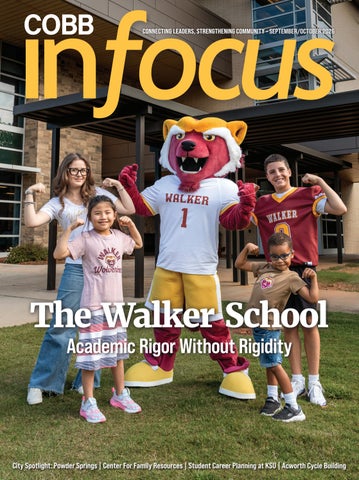
The Walker School Academic Rigor Without Rigidity
City Spotlight: Powder Springs | Center For Family Resources | Student Career Planning at KSU | Acworth Cycle Building
CONTENTS
Vol. XXII, No. 5 | SEPTEMBER/OCTOBER 2026
FE ATURE
Academic Rigor Comes With Room To Explore The Walker School gives students something increasingly hard to find: the opportunity to be challenged deeply without having to choose just one way to excel.
16 6
18
SHARPER FOCUS Find out what’s going on throughout Cobb County with our news updates.
12 RECRUITING When local employers hire for potential and drive, they gain fiercely loyal team members who can be trained quickly to fit the company’s specific operational needs.
14 COBB COMMUNITY FOUNDATION The federal Employer-Provided Childcare Credit under Internal Revenue Code Section 45F became significantly more valuable this year.
2
SEPTEMBER/OCTOBER 2026
24
20 16 CITY SPOTLIGHT Powder Springs is the fastestgrowing city in Cobb County thanks in part to a thriving downtown area, plenty of greenspace, and city officials who are smart about growth.
18 CENTER FOR FAMILY RESOURCES Celebrating 40 years of Thanks For Giving.
20 EDUCATION KSU’s Department of Career Planning and Development connects students with employers.
22 BUSINESS Renovating the old Acworth Cycle building was the perfect project for Melissa Hegert and CJ Fidurski.
22 28 LEGAL LESSONS Everything you wanted to know about SBA 7(a) loans but were afraid to ask.
30 INSURANCE SOLUTIONS Proper insurance coverage can save your company time and money.
32 FINAL FOCUS How to make family dinner night a special occasion for all involved.
ON THE COVER: The Walker School in Marietta is where students build strong foundations in literacy, mathematics, and communication while also exploring science, technology, engineering, art, music, and more. PHOTO: LARUCHE PHOTO
ATTENTION LEADERS OF COBB! If you’re reading this, chances are you are a local business owner, industry executive, nonprofit leader, civic/government official, a leader in education, or community organizer. You’re an individual who is among Cobb County’s premier influencers. We offer you an opportunity to share your entrepreneurial insights, your business acumen, and your thought leadership with a Leader Profile in Cobb In Focus. To learn more about our Leader Profile and other advertising possibilities, please contact info@nsmpag.com.
SEPTEMBER/OCTOBER 2026
3
FROM THE E D I TO R
Investing In Our Community BY CORY SEKINE-PETTITE
Photo by LaRuche Photo
Very early in my career, I wrote a profile on a student at The Walker School. Unfortunately, I cannot remember his name, but I’m sure he’s successful in his chosen industry because as a teenager he already was getting noticed and making headlines. I do remember knowing, even then, that this kid had a bright future. I also recall being incredibly impressed with the opportunities available to him at The Walker School. And that was nearly 30 years ago. Today’s Walker students have even more programs available to them. You can learn about what makes this K-12 school special in our cover feature, beginning on page 24. Speaking of bright futures and career opportunities, New South Publishing’s own success with local college interns — including a student from Kennesaw State University — prompted our article on KSU’s Department of Career Planning and Development (p. 20). In this article, I break down many of the ways the university assists students with their career goals, and I share stories from local employers who partnered with KSU to provide these future leaders with their first, real-world job experience in their chosen field. As one employer stated, this is an investment in future professionals that every employer should be making. Elsewhere in this issue, you will find more stories of people investing in our community — from the good folks at Cobb Community Foundation, to The Center for Family Resources, and the couple working to redevelop an Acworth landmark. That duo, Melissa Hegert and CJ Fidurski, spoke with our Editor-AtLarge, Denise K. James, about their plans for the Acworth Cycle building (p. 22). We’re excited for them, and we can’t wait to share more details in future issues as this project is completed. It is incredibly satisfying to find and share the many ways in which our local businesses, schools, and neighbors continue to support and improve our county. So, tell me, do you have a story to share? •
Contact Cobb in Focus We want to hear from you! Share your story ideas and comments with our editor. Visit cobbinfocus.com or send your suggestions to: cspettite@nspmag.com or New South Publishing, Attn: Cory Sekine-Pettite 9040 Roswell Road, Suite 210 Atlanta, GA 30350
New South Publishing Inc. PUBLISHER/MANAGING DIRECTOR Robyn Sobelson, PhD VICE PRESIDENT John Hanna ACCOUNT EXECUTIVES Sherry Gasaway Pete Fenlon MANAGING EDITOR Cory Sekine-Pettite EDITOR-AT-LARGE Denise K. James MARKETING COORDINATOR Mira Sawyer GRAPHIC DESIGNER Garon Hart CONTRIBUTORS LaRuche Photo, Photography Meghan Ritchie, Contributor Kevin DiPetrillo, Contributor Corrie Thrasher, Contributor PRODUCTION COORDINATOR Megan Willis CIRCULATION Amy Fine PRESIDENT EMERITUS Larry Lebovitz cobbinfocus.com @cobbinfocus facebook.com/cobbinfocus @cobb-in-focus-magazine Cobb in Focus™ is published six times a year by New South Publishing Inc., 9040 Roswell Road, Suite 210, Atlanta, GA, 30350. Direct all editorial and circulation queries to (770) 650-1102. Direct all advertising queries to the email addresses listed below. All information herein has been checked for accuracy to the best of the publisher’s ability. No responsibility is accepted for deletions, omissions, errors and/or inaccuracies. Material in this publication may not be reprinted without written permission from the publisher. Copyright 2026 by New South Publishing Inc. All rights reserved. Printed in the U.S.A. For advertising inquiries, email pfenlon@nspmag.com or sherry@knowatlanta.com.
4
SEPTEMBER/OCTOBER 2026
Cobb in Focus: Connecting Leaders, Strengthening Community OUR MISSION For over 20 years, Cobb in Focus has informed, inspired, and connected Cobb County’s most influential business and civic leaders through high-impact content that supports local growth, leadership, and innovation.
FOCUSED EDITORIAL IN EVERY ISSUE Cobb in Focus is the premier publication offering exclusive information, insights, advice, and analysis across the business, government, and nonprofit sectors. Each issue dives into the topics that matter most, including leadership, technology, and community.
BE SEEN IN COBB IN FOCUS To advertise, or learn more about how Cobb in Focus can help your business or organization, contact info@nspmag.com
FOLLOW US ON OUR SOCIALS!
OUR PARTNERS
@cobbinfocus
Marietta.com
WE WANT TO HEAR FROM YOU Share your stories, ideas, and comments with our editor, Cory Sekine-Pettite at cspettite@nspmag.com.
Vinings.com Austell.com Kennesaw.com Acworth.com Mabelton.com
facebook.com/cobbinfocus cobbinfocus_magazine @cobb-in-focus-magazine
Explore articles, stories, and news at our website: cobbinfocus.com New South Publishing, Inc. Cobb In Focus
|
KnowAtlanta
|
ALTA Net News
|
|
770.650.1102
AKFCF Quarterly
|
RSi Magazine
|
NYO SportsReport
S H A RP ER FOCUS Here’s a snapshot of what’s going on in your community.
Inaugural Cumberland Art Festival is Coming This Fall One Cumberland and Splash Festivals have partnered with presenting sponsor Genuine Parts Company for the inaugural Cumberland Art Festival. From Saturday, October 17, through Sunday, October 18, the Galleria on the Park will host this event for art lovers, families, and collectors. More than 100 local and regional artists will showcase their work, ranging from folk art and ceramics to jewelry, fiber art and many other media. The art festival is the first of its kind for the region and is intended to solidify Cumberland as a standalone district in close proximity to landmark regional destinations, such as The Battery Atlanta, Truist Park, Cumberland Mall, the Cobb Convention Center and the Cobb Energy Performing Arts Centre. In addition to the art market, the festival schedule includes live music, local cuisine, an interactive Kids Zone, and a large LED screen located on the festival grounds to keep visitors informed of all the game scores that weekend. Whether you are looking to discover new artists, take in some great music, score a unique piece of original decor for your home, or are simply interested in savoring an afternoon in the park with family and friends, the First Annual Cumberland Art Festival offers plenty of activities and a welcoming environment for everyone. Learn more at cumberlanddistrict.com/events.
6
SEPTEMBER/OCTOBER 2026
SHARPER FOCUS SHARPER FOCUS SHARPER FOCUS SHARPER FOCUS SHARPER FOCUS SHARPER FOCUS
EXPOSURE METER KSU’S ECONOMIC IMPACT. Kennesaw State University continues to be a major economic engine in metro Atlanta, growing its economic impact to more than $2.55 billion in fiscal year 2025, according to a University System of Georgia (USG) report. This marks an 11-percent increase over the previous year.
Ron Clark
Cobb Chamber Welcomes Ron Clark for Marquee Monday The Cobb Chamber’s Marquee Monday event series, presented by Superior Plumbing, continues on September 14 with a keynote from Ron Clark of the Ron Clark Academy in Atlanta. Clark is known around the world for his unmatched passion, innovative ideas, and the kind of energy that lights a fire in any room. Clark co-founded the Ron Clark Academy in Atlanta and built a national reputation for inspiring people to lead with joy. He’ll draw on his own experience to talk about what actually builds a winning culture, how to motivate a team that’s running on empty, and why creativity is a leadership skill, not just a buzzword. Registration is open through September 9. Tickets are $50 for Cobb Chamber members and $75 for non-members. Attendees may register for the event at https://tinyurl. com/5xxhb4f8. Parking is available at The Battery Red Deck for free up to two hours. For further parking options, please refer to the Battery Atlanta Parking Guide. A security screening will be required at check-in.
BACKPACK BASH. During the first weekend in August, volunteers for the 2026 Perkins&Will Backpack Bash gathered at Mableton Elementary School to distribute school supplies and backpacks to students. The sixth annual event set new personal records, raising $60,000 in funding and serving 918 students. Since its launch in 2021, the event has raised nearly a quarter of a million dollars and provided school supplies to more than 5,480 students at nine underserved schools in the Atlanta area. SAFETY VILLAGE. This past July, Atlanta-based Great American Green installed new synthetic turf at the playground inside Cobb County Safety Village, an 8-acre educational campus where thousands of students visit each year to learn essential safety skills. The installation reflects Great American Green’s ongoing commitment to enhancing recreational spaces that serve communities across Georgia. FOR A GOOD CAUSE. The nonprofit organization 10 Women of Hope will host its annual 10 Women of Hope Girls Night Out on Thursday, October 15. Early-bird tickets are available for $25 until October 9. Proceeds raised benefit the mission of 10 Women of Hope, which provides one-time financial support to stable single-parent families in Cobb County experiencing a critical need. More information is available at 10womenofhope.org.
SEPTEMBER/OCTOBER 2026
7
SHARPER FOCUS SHARPER FOCUS SHARPER FOCUS SHARPER FOCUS SHARPER FOCUS SHARPER FOCUS
LiveSafe Resources Hosts ‘A Fashion Affair’ Fundraiser On August 11, LiveSafe Resources hosted one of Atlanta’s premier fashion events, A Fashion Affair, at The Foxglove in Marietta. Cobb County Solicitor General Makia Metzger, a dedicated advocate for survivors of domestic and sexual violence, chaired this signature fundraiser supporting ‘Good Looks for a Good Cause.’ The night featured a runway fashion show curated and styled by Shaye Strager of Strager Style and A Stylist’s Closet. Guests enjoyed a fun-filled evening with hors d’oeuvres, drinks, raffle prizes, and a variety of pop-up boutiques for a night of fashion, fun, and philanthropy. Event sponsors included S.A. White Oil Company, Inc.; Allied World Assurance Company, Ltd; Cobb EMC; Johnson & Alday, LLC; Proda Technology; A 2nd Chance Bail Bonds; CROFT & Associates, Inc.; Cumberland Diamond Exchange; GGG Partners, LLC; Nora and Richard Guadet; The Pauley Family; Kaiser Permanente; and SouthState Bank. “Fashion Affair reminds us that when a community comes together, we can make a difference,” said Lisa Mello, CEO of LiveSafe Resources. “We are deeply grateful to every sponsor, designer, attendee, and supporter who helped make this event possible. Your generosity and commitment help create a path toward safety, healing, and hope for survivors of domestic violence and sexual assault and strengthen our ability to serve our community throughout the year.” For details on LiveSafe Resources’ programs and services for victims, or how to be part of the solution, visit livesaferesources.org.
8
SEPTEMBER/OCTOBER 2026
SHARPER FOCUS SHARPER FOCUS SHARPER FOCUS SHARPER FOCUS SHARPER FOCUS SHARPER FOCUS
CobbWorks to Receive $1.5M Department of Labor Grant In July, Lucy McBath (GA-06) announced that CobbWorks, Inc. would receive a $1.5-million federal grant from the U.S. Department of Labor YouthBuild program. This training program will be implemented in partnership with Construction Ready as the primary construction training provider and Cobb Adult Education as the education and GED preparation provider. “Today’s grant announcement is a reaffirmation of the transformational impact CobbWorks has on young jobseekers in our community,” said Rep. McBath. “I was proud to voice my support for this collaborative grant application, and I look forward to seeing how CobbWorks uses this investment to expand upon their mission. So much of my work in Washington focuses on making sure that every Georgian can get a good job and keep it. I look forward to continuing to do my part at the federal level.”
“We are deeply grateful to Congresswoman Lucy McBath for her unwavering support in securing this YouthBuild grant,” said Sonya Grant, Executive Director, President, and CEO of CobbWorks. “This investment represents more than funding; it is a commitment to the future of our young people and the strength of our community. Through this program, we will expand access to hands-on training, education, and career pathways for youth who need it most, helping them build sustainable, in-demand careers. CobbWorks, Inc. is Cobb County’s designated Local Workforce Development Board, operating two, fullservice American Job Centers leveraging Workforce Innovation and Opportunity Act resources in metro Atlanta. For more information on their services, visit worksourcecobb.org.
SEPTEMBER/OCTOBER 2026
9
SHARPER FOCUS SHARPER FOCUS SHARPER FOCUS SHARPER FOCUS SHARPER FOCUS SHARPER FOCUS
Town Center Community Names Mary Koronkowski Director of Community Investment and Impact Town Center Community announced recently the appointment of Mary Koronkowski as director of community investment and impact, adding a longtime Cobb County professional and community leader with experience in partnerships, placemaking, and community engagement to its leadership team. Koronkowski will lead efforts to deepen community partnerships, strengthen stakeholder engagement, and support initiatives that advance Town Center’s vision for a vibrant, connected community. “Mary’s experience building partnerships and creating connections across metro Atlanta makes her a tremendous addition to our team,” said Tracy Styf, executive director of the Town Center Community. “…We’re excited to have her join our team and look forward to the relationships and opportunities she’ll help build as we continue to grow.” Previously, Koronkowski served as donor development manager for March of Dimes – Georgia, where she led partnership development, fundraising, and community engagement initiatives across the region. Her work included executing one of the organization’s largest March for Babies events nationwide, exceeding fundraising goals by 20 percent. She also served as communications manager for the Cobb Community Foundation, leading strategic storytelling and communications efforts for the regional philanthropic organization. For more information about the Town Center Community, visit towncentercid.com.
Mary Koronkowski
Cobb Youth Leadership Announces New Class The Cobb Youth Leadership (CYL), a development program sponsored by the Leadership Cobb Alumni Association and Children’s Healthcare of Atlanta that focuses on developing leadership skills through interactive participation, has announced the members of its 20262027 class. Created in 1989, the program provides students a unique opportunity to learn about their community as well as meet and interact with students from other high schools. Students attending public or private high schools or home-school students in Cobb County must complete and submit an application for CYL in the spring of their sophomore year. Students participate in the program during their junior year of high school. For a complete listing of this year’s class, visit cobbchamber.org/cobb-youthleadership-announces-its-2026-2027-class. 10
SEPTEMBER/OCTOBER 2026
SHARPER FOCUS SHARPER FOCUS SHARPER FOCUS SHARPER FOCUS SHARPER FOCUS SHARPER FOCUS
Mableton Voters to Decide if City Will Move Forward With Redevelopment Plan This November, Mableton voters will decide on a referendum to grant the city redevelopment authority (targeting blighted areas), which would allow the city to establish Tax Allocation Districts (TADs) and issue redevelopment-related bonds. This economic tool would allow the city to revitalize underdeveloped areas and attract new businesses without increasing current property tax rates. Such redevelopment funding is common in Georgia and across the country. For example, the first TAD in Georgia was created in 1992 to help develop Centennial Olympic Park. Atlantic Station was
developed with help from TAD funding, and currently, the City of Atlanta has eight active TADs: Atlanta Beltline, Campbellton Road, Eastside, Hollowell/Martin Luther King, Metropolitan Parkway, Perry Bolton, Stadium Area, and Westside. According to Mableton officials, the goal is to encourage responsible growth, support local businesses, improve infrastructure, create jobs, and strengthen neighborhoods. The city has built a webpage with a wealth of information to help residents decide if TADs would be in their best interest. Voters will decide on Nov. 3, 2026. •
SEPTEMBER/OCTOBER 2026
11
R E CR U I TI N G
Tapping Cobb’s Homegrown Talent How local businesses can bridge the education-to-career gap BY MEGHAN RITCHIE, OWNER – TRUSTAL RECRUITING
12
SEPTEMBER/OCTOBER 2026
C
obb County boasts one of the most vibrant talent incubators in the Southeast. Between Kennesaw State University’s expanding career programs, specialized local high school academies, and regional technical colleges, our community is educating thousands of skilled, future professionals every year. At the same time, today’s emerging workforce faces anxiety over artificial intelligence reshaping or eliminating traditional entry-level roles. This landscape has forged a remarkably resilient, adaptable, and hungry generation of candidates who are eager to prove their irreplaceable human value. They do this through combining digital fluency with a strong desire for hands-on mentorship, creative problem-solving, and real-world accountability. They aren’t just looking for a foot in the door; they are fiercely motivated. How can Cobb’s small and mid-sized businesses capture this homegrown talent pool before enterprise competitors pull them away? The answer lies in modernizing how local employers engage, evaluate, and recruit early-career professionals. Shift from years of experience to trainable competency. The fastest way to disqualify great local talent is a rigid job description. When small businesses require three to five years of specialized experience for mid-level roles, they inadvertently price themselves out of dynamic, early-career candidates who possess the exact foundational skills, technological adaptability, and drive needed to excel. Instead of hunting for a candidate who has already done the exact job elsewhere, evaluate for core competencies such as analytical problem-solving and clear communication skills; high coachability, emotional intelligence; and cultural alignment; and comfort with modern business tools and quick learning agility. When local employers hire for potential and drive, they gain fiercely loyal team members who can be trained quickly to fit the company’s specific operational needs. Eliminate interview fatigue with speed to hire. Modern candidates, especially recent graduates eager to launch their careers, evaluate a company’s culture based on their recruitment experience. Lengthy, multi-week interview processes with uncommunicated gaps are the primary reason top candidates drop out of talent pools or accept competing offers. Local businesses can win top candidates simply by being nimble. Build authentic, local pipelines before graduation. Waiting until a role opens to begin recruiting is a reactive strategy. Winning local talent requires establishing a presence before candidates hit the job market. Local employers don’t need massive enterprise budgets to build effective talent pipelines. Simple, high-impact engagement strategies include: • Micro-internships: Offering defined, project-based work (10–20 hours) to KSU or local trade students to evaluate performance in real time.
• Classroom engagement: Serving as guest speakers, project judges, or résumé reviewers for local high school academies and university programs. • Community visibility: Highlighting local lifestyle perks, such as zero I-75 commutes, direct access to business leaders, and tangible local impact.
Meghan Ritchie
Operationalizing the strategy: Who leads the charge? A common objection from small business owners is: “We don’t have a dedicated HR Manager to do all of this.” The good news is that you don’t need a full-scale HR department to implement this strategy. In many growing Cobb businesses, this talent initiative is championed by an office manager or energetic department head who understands the company’s needs. To pull together a streamlined talent program without adding massive overhead, these leaders can leverage plug-and-play local resources: • To redefine job posts: Use simple AI prompting tools to rewrite rigid job descriptions into competency-focused posts, or benchmark skills using free resources like O*NET OnLine. • To accelerate hiring: Implement simple scheduling tech (like Calendly) to remove back-and-forth emails, or partner with a boutique local recruiting firm to manage initial candidate vetting, keeping the internal team focused purely on final interviews. • To build local pipelines: Tap into ready-made community networks. Connect with KSU’s employer portal (Handshake), reach out to Work-Based Learning coordinators within the Cobb County School District or academies like Cobb Innovation and Technology Academy, and engage with local workforce development initiatives through SelectCobb and CobbWorks.
The local advantage Keeping Cobb County’s educated, highly motivated talent right here in Cobb strengthens our entire economic ecosystem. When local business owners modernize their hiring criteria, streamline recruitment timelines, and offer hungry graduates a stage to prove themselves, they don’t just fill open seats; they build the next generation of leadership for our community. • Trustal Recruiting partners with locally owned and operated business leaders to streamline their hiring processes, connect with qualified local talent, and build high-performing teams. Learn more at TrustalRecruiting.com.
SEPTEMBER/OCTOBER 2026
13
C OBB C O U N T Y F O U N DAT I O N
Childcare: A Workforce Solution Hiding in Plain Sight BY SHARI MARTIN, COBB COMMUNITY FOUNDATION CEO
Y
ou might reasonably wonder why the CEO of a community to a limitation of 50 percent of the employer’s Georgia income tax foundation is writing about childcare tax credits. liability for the year. Unused operating credits may generally be A big part of our work at Cobb Community Foundation is carried forward for five years. listening — to families, nonprofits, businesses and others Here is the part that surprises many employers: They do not across our community — and looking for barriers that keep our have to build, own, or operate a childcare center. community from thriving. For example, families increasingly are An employer can contract with qualified, licensed childcare struggling with the cost of childcare. Parents are making difficult providers to provide care for employees’ children. That means decisions about whether they can afford to work, and employers employers can help employees pay for care in the communities are struggling to recruit and retain people. where they live and work rather than trying to create a one-sizeWhen we see a barrier, we want to understand what can be fits-all childcare solution of their own. That flexibility matters. done about it. In this case, we discovered something that far too Employees may use different providers based on where they live, few employers seem to know: Existing federal and Georgia tax the ages of their children, their schedules, and what works best law can make it surprisingly affordable for businesses to help for their families. An employer could their employees pay for childcare. have 10 participating employees using For families with young children, child10 different qualified providers. care is not simply a household expense. The opportunity is especially comIt can determine whether a parent can pelling because the benefit addresses accept a job, return to work after having a problem employees already are a baby, work full time or remain in the paying to solve. A raise may help workforce at all. with many household expenses, but Across the country, childcare remains one childcare assistance directly targets of the largest expenses facing working famione of the biggest barriers to staylies. Childcare Aware of America reports that ing employed. It also sends a clear b er 2 0 0 0 m e c e D ichael – the national average annual cost of childcare message: We want you here, and n d s on, M a in rt a Shari M reached $13,184 in 2025. For an infant in centerwe understand what it takes for you to based care, the national average was more than be able to work. $15,000. For families with two young children, The details matter, of course. Employers should work with their the numbers can quickly rival a mortgage payment. CPA or tax advisor to structure the program properly, confirm Employers feel the impact through recruiting challenges, absenthat expenditures qualify, understand applicable credit limitateeism, schedule disruptions, and turnover. A business may suctions, and coordinate the tax treatment of any related deductions. cessfully find the right employee, only to lose that person because At Cobb Community Foundation, we are committed to shardependable care is unavailable or unaffordable. In a tight labor ing this information and to making it easier for local employers market, childcare can become the difference between having the and their advisors to understand these incentives. Our Corporate workforce a business needs and constantly trying to rebuild it. Community Champions make work like this possible. Their supWhat many Georgia employers do not realize is that existing port allows Cobb Community Foundation to look beyond any tax law gives them a powerful way to help. The federal Employersingle organization or program and focus on barriers — like Provided Childcare Credit under Internal Revenue Code Section childcare — that affect families, employers, and ultimately the 45F became significantly more valuable this year. Employers strength of our entire community. can generally receive a federal tax credit equal to 40 percent of Affordable childcare is a complicated community challenge, and qualified childcare expenditures. Eligible small businesses can no single solution will solve it. But removing barriers often starts receive a 50-percent credit. The annual credit is capped at $500,000 by using the tools we already have. When existing tax incentives for most employers and $600,000 for eligible small businesses. allow employers to help working families, strengthen their own Georgia offers an additional incentive. Employers that provide workforce, and potentially recover a significant portion of what they or sponsor childcare for their employees can receive a state income spend, this is one tool far more businesses should know about. • tax credit equal to 75 percent of qualifying operating costs, subject
14
SEPTEMBER/OCTOBER 2026
CIT Y SPOTLIGHT
POWDER SPRINGS Powder Springs is the fastest-growing city in Cobb County thanks in part to a thriving downtown area, plenty of greenspace, and city officials who are smart about growth. Read on to find out more about what makes Powder Springs special, as told by Marsellas Williams, Powder Springs’ Economic Development Director.
16
SEPTEMBER/OCTOBER 2026
What is your town known for? The seven mineral springs inside our city were well-known to both the Creek and Cherokee, who used the water for its medicinal value and called the area Gunpowder Springs because of the gunpowder-like sediment. We were incorporated as Springville in 1838, and in 1859, the name was changed to Powder Springs. This history and more are shared at the Seven Springs Museum in the Historic Bodiford House on Marietta Street. Today, people still come here for the outdoors. The Silver Comet Trail runs right through the center of the city, and on a Saturday morning, you’ll see cyclists roll off the trail and straight into our downtown shops. Thurman Springs Park and its amphitheater anchor a downtown that hosts concerts, festivals, movie nights, the Powder Springs Seafood Festival, Juneteenth Unity Celebration, and our Christmas parade and tree lighting.
What is a new and exciting destination people will want to visit? Vesuvio Pizzeria Napoletana at 4469 Marietta Street. Massimo and Lindsay Andreozzi opened their first location in downtown Kennesaw in 2022, and Powder Springs is their first expansion. The reviews have been outstanding. Massimo told a reporter that Powder Springs is “on the cusp of growing.” When a successful operator chooses your downtown for their second location, that tells you something no marketing budget can. Near Vesuvio, you have Skint Chestnut Brewing Company (West Cobb’s first brewery) Sangster’s Cafe, The Book Worm Bookstore, and Powder Springs Bistro. Individually, those are good businesses. Together, they’re a walkable evening, and that’s an entirely different story than what we had 10 years ago.
What is the first thing about your town that a visitor or new resident should know? We are the fastest-growing city in Cobb County — and we’re being deliberate about it. We went from 13,940 residents in 2010 to 16,887 in 2020, and roughly 21,000 today. The Atlanta Regional Commission puts us among the 20 fastest-growing cities in the entire metro. That’s about a 24-percent increase since the last census. Growth by itself isn’t the point. Everything else here is
downstream of it — new rooftops downtown, new restaurants opening, a downtown master plan, and an updated Livable Centers Initiative plan called Springs in Motion. We’re building for the city we’re becoming, not just maintaining the one we were.
What makes your city the best place to have a business or start a nonprofit? The ease of doing business with the city. We’re small enough that you can get a decision-maker on the phone. They call my office, and if the question is about permitting or planning or an incentive, I can usually get them to the right person in the same conversation. Our mayor and council take genuine pride in being accessible, and that isn’t a talking point — it’s a competitive advantage.
What aspects of living in your city have changed the most over the past decade? Downtown. It isn’t close. Ten years ago, downtown Powder Springs was a place you drove through; today it’s a place you go. Thurman Springs Park — a $4.1-million investment — opened with the amphitheater, a splash pad, greenspace, and direct access to the Silver Comet Trail. Springside brought 226 residential units to the heart of downtown, across from the park. Put together, that’s the difference between a downtown with buildings and a downtown bustling with people at 7 p.m. on a Friday. The other change is who lives here. We are a growing, diverse, family-centered community, and our downtown is starting to reflect that — which is exactly what it should do.
Where do you see your city in the next 10 years? I think we will make downtown Powder Springs one of the best downtowns in the state — receiving national attention. Ten years out, I want visitors to be able to park once — or better, arrive by trail — and spend an entire day here. And I want us to be a place where people don’t just live and shop but build. We have residents starting businesses right now who drive inside the perimeter for resources they ought to be able to reach at home. The measure of a great downtown in 2036 won’t only be how many people visit it — it’ll be how many businesses got their start here and still are thriving. I want people to leave saying, “I love Powder Springs!” • SEPTEMBER/OCTOBER 2026
17
IN YO U R C O M M U N I T Y
Celebrating 40 Years Of Thanks For Giving
B
ack in the early 2000s, Cobb County resident Ken Myers joined his teenage children for their first Thanks for Giving volunteer experience with The Center for Family Resources (CFR). They came to help pack food boxes for local families. But Ken left that day with something far more meaningful — an inspiration that would stay with him for decades.
Molly Ream of Marietta, a current committee member and volunteer for Thanks for Giving.
18
SEPTEMBER/OCTOBER 2026
There was something hopeful about seeing neighbors, families, and volunteers working side by side to make sure other families could sit down to a home-cooked Thanksgiving meal. The experience stayed with him, and today, Myers is still serving. Since retiring, he has become an important part of Thanks for Giving, and he volunteers year-round at The CFR Choice Pantry. “Volunteering for Thanks for Giving all those years ago was something I never forgot, and it inspired me to donate through the years,” Myers said. “It was meaningful to see how a group of people could make such a difference for families.” Myers’ story is, in many ways, the story of Thanks for Giving itself — community members sharing Jeri Barr, the former CEO of The Center for Family Resources, who participated in the their time, resources, majority of Thanks for Giving events. and hearts to assist their neighbors. For 40 years, the program has brought the Cobb County Giving has provided about 60,000 families community together with one with enough food to feed their families heartfelt purpose: Making sure throughout Thanksgiving week. families facing difficult times One person who has witnessed nearly can still gather around the all of that history is The CFR Director of Thanksgiving table and Grants Management, Carolyn Bridges. continue traditions Bridges joined the agency in 1987, just that make the holione year after Thanks for Giving began. day meaningful. As the program director at the time, she Since its beginhelped turn a hopeful idea into an annual ning, Thanks for community tradition. In those early years, there was no online registration, no large-scale food collection network, and no guarantee enough food would arrive. Thanks for Giving began as a partnership with Cobb Division of Family & Children Services (DFACS), relying on
Thanks For Giving collections.
Thanks For Giving collections.
community relationships. Bridges wrote letters to churches, schools, principals, PTAs, and civic clubs asking them to hold food drives and help local families. The program operated out of the Cobb County Civic Center, and Bridges remembers lines stretching around the building. Many families were also registering for Cobb Christmas, a longtime partner program. “We did it on a wing and a prayer,” she remembered. “We were never sure we would be able to fill the entire need. But miraculously, the food came in every year. We always had lots of green beans
and corn,” she added with a laugh. Former CEO Jeri Barr, who joined The CFR in 1984 and led the organization for more than three decades, remembers when Thanks for Giving was primarily a food drive supported through the school system. The goal, she said, was to give families resources to create their own holiday meals. “It was about enabling people to do for themselves,” Barr said. “When families get a large box of food with everything they need inside, they can prepare it how they like it — in the tradition created by their own family.”
As the program grew, so did community support. Barr said former Board Chair Debbie Abernathy helped expand Thanks for Giving into a fundraiser by incorporating sponsorships and adding additional food drives, allowing the program to support The CFR’s food pantry beyond Thanksgiving. “People in our community think about their own Thanksgiving and what it means to them,” Barr said. “They want these families to have that same experience, so they host food drives, donate and volunteer to make it happen.” Volunteers and long-time community partners have been essential to that success. Lockheed Martin and Genuine Parts Company, this year’s presenting sponsors, have supported Thanks for Giving for decades. Both have provided financial support and brought employees to volunteer, demonstrating a lasting commitment to Cobb County families. “For 40 years, Thanks for Giving has shown us what is possible when a community comes together,” said The CFR’s current CEO, Melanie Kagan. “Every food drive, sponsorship, and volunteer shift represents someone choosing to make sure a family in Cobb County can gather around the Thanksgiving table with dignity and hope. We could not do it without our school district partners, community sponsors, food drive hosts, and hundreds of volunteers.” As The CFR celebrates 40 years of Thanks for Giving, the community can once again feed more than 1,000 families this year. While food drives can start earlier, the week-long volunteer event will take place Monday, November 16, through Friday, November 20. Volunteers will work in three shifts each day to receive, sort, pack, and distribute more than 75,000 pounds of food. To accomplish this, The CFR will need more than 500 volunteers. Forty years after the first boxes were packed, Thanks for Giving continues because people like Myers and countless others choose to show up. To be part of the 40th Annual Thanks for Giving legacy by sponsoring, donating or hosting a food drive, visit bit.ly/3RORh7Z. To learn more about group volunteering, contact DoraLocklear@thecfr.org. • SEPTEMBER/OCTOBER 2026
19
E D U CATI O N
Talent Match KSU’s Department of Career Planning and Development Connects Students With Employers BY CORY SEKINE-PETTITE
I
n today’s competitive academic and corporate environments, both hiring managers and graduates entering the workforce need every available advantage to find the ideal match. Leadership at Kennesaw State University’s Department of Career Planning and Development (DCPD) not only are equipping students with the knowledge, skills, and experiences to meet an evolving workforce headon, they are proving to local companies the benefits of partnering with the university on internships, career fairs, and other programs. According to KSU, career readiness is a significant part of the student experience for every Owl. Students have access to career coaches, career fairs, internships, and more. Here’s a breakdown of some of the opportunities students had this year: • Career coaching: More than 5,000 appointments this past year helped students choose a path, sharpen a résumé, practice interviewing, plan a career change, or explore where their major can take them. • Experiential learning credit: KSU processes and supports academic credit so students earn recognition for the time they spend working in their field through internships and co-ops. • Nine to 12 campus-wide career fairs a year: These fairs drew up to 10,000 student visits and more than 800 employers. The fairs cover a number of career types, from technology and engineering, to healthcare, education, government, and nonprofit work. • Career curriculum and classroom presentations: These build career development into the courses students are already taking. • Smaller-scale employer connections: These networking events include industry nights, recruiter tabling, mock interviews, etiquette dinners, and alumni panels that put students in the room with employers in their fields.
20
SEPTEMBER/OCTOBER 2026
KSU student Denise Santos and the Perimeter Floors team.
• Owl Trek site visits and on-campus job shadow days: These events give students a day inside a real workplace. Past hosts include Norfolk Southern, Brasfield & Gorrie, and Chemence. • Graduate outcomes reporting: KSU measures and tracks where Owls land after graduation, from full-time roles to graduate school, so the university can represent those results accurately. “We expanded an ecosystem approach to career development, strengthening partnerships across the university so that career readiness is embedded throughout the student experience, rather than delivered through a single office,” says Melanie Uken, DCPD Executive Director.
KSU Partners In Success In its most recent annual report, DCPD says it strengthens relationships with employers by creating multiple pathways to recruit KSU talent. And the results are impressive: more than 24,000 job postings, almost 43,000 active connected employers, more than 700 employer booths at KSU career fairs, and a 99-percent satisfaction rating from employers participating in DCPD programs. In fact, two students — and their employers — shared with us their experiences. “The internship gave me the opportunity to apply technical problem-solving in real industrial environments while
“For us, internships are also an excellent way to identify future talent and invest in developing the next generation of professionals.” — Steve Nixon, VP of Development at Perimeter Floors
Fall 2025 STEM Fair
learning from experienced professionals,” says David Xiao, a sophomore studying Electrical Engineering who interned recently with Applied Technical Services. “One of the biggest lessons I learned was the importance of attention to detail,” Xiao, continued. “The inspections we performed helped support decisions about equipment reliability and safety, reinforcing that even small observations can have a meaningDavid Xiao ful impact.” “The program helps us identify and engage high-potential talent early, build a strong pipeline for future hiring needs, and benefit from the fresh perspectives and ideas interns bring to the organization,” says Sherrie Epstein, Director of Talent Acquisition at Applied Technical Services. “Many interns return for a second internship, and a number have transitioned into full-time roles with ATS. We have had great success with KSU students and value our ongoing partnership with the university.” That satisfaction is shared by Steve Nixon, VP of Development at Perimeter Floors, who says it was rewarding to watch the development of intern Denise Santos over the course of this past spring semester. “Time and time again, [she] proved exceptional accuracy with a dedication to her work. She is extremely focused and took on every task head on to the best of her ability,” Nixon says. “Denise set a very high bar for the following interns joining us in the future.” For her part, Santos, a senior majoring in Information Systems, saw the real-world benefits of her computer coding skills after developing a Python program to help Perimeter Floors with a data migration problem. “The opportunity to apply something I learned in college to a real business environment was incredible,” she says. “My Information Systems and programming classes gave me the foundation to do a good job at Perimeter. Knowing that
Spring 2025 Education Fair
Brasfield and Gorrie Owl Trek site visit.
my coworkers could use a tool that I built makes my work feel meaningful and shows me how technology can make every-day processes more efficient.” Yes, the DCPD’s numbers are impressive to read on paper, but when one hears directly from students and employers who have benefited from the programs, the impact seems deeper, more tangible. “A strong internship program benefits everyone involved,” Nixon concludes. “Interns provide valuable support that helps improve efficiency, while also bringing fresh ideas and perspectives to the team. At the same time, they gain real-world experience that simply can’t be replicated in a classroom. For us, internships are also an excellent way to identify future talent and invest in developing the next generation of professionals.” If you own a business and would like to learn more about the DCPD, start by visiting campus.kennesaw.edu/offices-services/ careers/index.php. • SEPTEMBER/OCTOBER 2026
21
BUS IN E SS
The Cycle Of Life In downtown Acworth, an old building is finding new purpose. BY DENISE K. JAMES
A
s of now, a first-time visitor to downtown Acworth might not notice 4648 South Main Street, or what locals call the old Acworth Cycle building. Though it’s located across from the Red Top Brewhouse and close to other popular spots, the historic structure is easy to miss with its mostly empty parking lot and worn facade. A hand-drawn sign hangs on the front. “Acworth Cycles,” it reads. “ATC and Small Engines. Parts, Sales, Service. Pick-up and Delivery.” There’s also a disconnected phone number. But all of that is getting ready to change. When locals Melissa Hegert and CJ Fidurski, better known as “Durski,” developed interest in the building, it wasn’t just
Melissa Hegert and CJ Fidurski in front of the building as it looks today.
22
SEPTEMBER/OCTOBER 2026
old — it was an eyesore. “Motorcycle Mike” Mlaska, the former owner of Acworth Cycle, had passed away in 2023, leaving his business interior and exterior cluttered with junk and frozen in time. It was the perfect project for Hegert and Durski. They’d recently shut down their business, the Museum of Lamps and Plants, after a storm flooded them out. They needed more creative space, not only for the former shop’s custom-built lamps but for Durski’s latest passion: customizing go-carts. “I had seven vehicles at our house at one point, and Melissa came to me and said, ‘We look like an auto dealership,’” Durski says, laughing. “It was piling up.” Both Hegert and Durski hail from other states — California and Florida, respectively — but have come to love life in Cobb County. By the time they decided to open the Museum of Lamps and Plants, they’d fallen in love with the Acworth’s quirky charm and decided to live
downtown. “Acworth is this weird little town, and I love it,” Hegert says. “I walk everywhere here. It’s a mixture of different kinds of people.” It’s this sort of community spirit that the couple is employing to help revive the old building. One day in early 2025, the door to the former cycle shop was propped open, and, being naturally curious, Durski poked his head inside. He immediately saw the potential. First, the couple phoned city officials to ask if they could tidy up the property. They learned that Mlaska’s daughters owned the building and were overwhelmed by the task at hand. “They called us crying,” Hegert recalls. “They couldn’t believe we weren’t going to charge them for cleaning out the building!” Though Mlaska’s daughters initially planned to sell to other buyers, they were touched by Hegert’s and Durski’s selflessness and chose to work with them instead. The couple closed on the building in late July of this year with the vision of opening a community-centered space called D&B Makers Studio. The building needs extensive work before their dream is realized.
Center and right, renderings of what Melissa Hegert and CJ Fidurski envision for the building in 2027.
“Acworth is this weird little town, and I love it, I walk everywhere here. It’s a mixture of different kinds of people.” — Melissa Hegert Once the home of Lemon Motor Company, an automobile dealership that also sold Gulf gasoline in the mid-twentieth century, it has a storied history. Hegert and Durski say the building is worth saving, but it must be cleaned out. “It needs to be gutted,” Hegert admits. “The city does offer grants for the facade, so we’re applying for that. The first step is to get the outside looking nice.” Through their nonprofit, also known as D&B Makers Studio, the couple has begun fundraising with community events, including a comedy night and an evening of line dancing with their friendly and supportive neighbors. “Rob, who owns Red Top Brewhouse, has been awesome,” Durski says. “We are so grateful to him for his help.” Once open, D&B will focus on “artsy entrepreneurs,” whether visitors want to record a podcast, craft a piece of furniture out of wood, create a work of art, or customize a golf cart. Durski also will build his new brand, King Kustom, inside the space and continue customizing vehicles, such as the scooter he merged with a motorcycle. “It’s not fast, but it looks cool, and you can ride it without a motorcycle license,” he explains. “Realistically, as a brand, you want to start a trend, and that’s what I want to do.” “I have eight sewing machines from the 1960s and 1970s that were donated to us by a man who fixes them,” Hegert adds. “We are open to hosting all kinds of makers. We just want people from the community to come together.” •
SEPTEMBER/OCTOBER 2026
23
FE ATU R E
At Walker, Academic Rigor Comes With Room To Explore
PHOTOS: LARUCHE PHOTO
BY CORY SEKINE-PETTITE
24
SEPTEMBER/OCTOBER 2026
In Cobb County, The Walker School gives students something increasingly hard to find: the opportunity to be challenged deeply without having to choose just one way to excel.
A
student can love calculus and theatre. Robotics and French horn. Soccer and history. At The Walker School in Marietta, those combinations are not unusual. They are part of the point. For families looking for an academically ambitious school, Walker offers the expected markers of rigor: 26 AP courses, seven post-AP and Advanced Topics courses, 18 science and robotics labs, and a faculty in which 70 percent hold advanced degrees. Every graduate is accepted to college, and Niche’s 2026 rankings named Walker the No. 1 high school for STEM in Cobb County. Let’s explore what is behind those numbers. What happens when a school knows a student well enough to know when to push? With an average class size of 15, Walker teachers have the opportunity to understand how individual students think, where they are struggling, and where they are ready to go further. Rigor is not simply a higher-level course on a transcript. It is a teacher asking a better question, challenging a first answer, or encouraging a student to pursue an idea a little further. That philosophy begins early. Young students build strong foundations in literacy, mathematics, and communication while also exploring science, technology, engineering, art, music, and Spanish. In Lower School, students move from hands-on mathematical experiences toward increasingly abstract thinking while working in both whole- and small-group settings. The goal is not simply to move students faster. It is to help them understand why. By Middle School, students have more opportunities to shape their experience. They can explore Latin, Spanish, and French; pursue engineering, robotics, computer science, or digital media; and take on projects that ask them to apply what they know. Sixth-graders partner with the University of Alabama in Huntsville to launch and analyze a weather balloon. Eighth-graders design and race Newton cars before
analyzing their results and writing a formal report. Students who are ready for more can take advanced seminars in English, science, and U.S. history. By Upper School, that freedom becomes even more significant. Students can move beyond AP into courses such as Linear Algebra, Multivariable Calculus, and Advanced Topics in Mathematics. They can pursue concentrations in Engineering, Public Health or the Humanities, conduct research, complete capstone projects, and build schedules that reflect their individual interests. The humanities receive the same level of attention. Students develop as critical readers, persuasive writers, and thoughtful participants in discussion, with opportunities to explore everything from Civil Rights to Abnormal Psychology and U.S. Military Interventions. The message is consistent across disciplines: Go deeper. Ask better questions. Make something of what you discover.
More Than a STEM School Walk through Walker and the academic ambition is easy to see in the labs, robotics teams, and technology courses. But STEM is only part of the story. Students can pursue serious work in literature, history, languages, visual arts, music, theatre, and the humanities. The school encourages them to connect disciplines rather than treat them as separate worlds. That matters, because life after school rarely fits neatly into one subject. SEPTEMBER/OCTOBER 2026
25
An engineer has to communicate. A physician has to understand people. A business leader has to evaluate evidence, listen to competing perspectives, and make decisions when there is no obvious answer. Walker is preparing students for that kind of complexity. At Walker, learning is not only about what students know. It is also about how they approach difficult questions, respond to setbacks, communicate with others, and take responsibility for their own growth. One Walker graduate from the Class of 2015, who went on to Harvard and later graduate work at Columbia, recalled entering college feeling exceptionally prepared; some introductory engineering material at Harvard was content he had already encountered at Walker. That is a useful distinction. The goal is not simply to get students into impressive colleges. It is to help them arrive ready to contribute. The Class of 2026 offers another measure: Walker’s 122 seniors were accepted to 268 individual colleges and earned more $11 million in scholarship dollars, with acceptances including Case Western, Columbia University, Cornell University, University of Chicago, Emory University, University of Georgia, Georgia Tech University, Howard University, University of Michigan, Northwestern University, Spelman College, Tulane University, University of Virginia, and Vanderbilt University. The outcomes are impressive. But the habits behind them are more important.
Students Don’t Have to Choose One Lane Perhaps the most distinctive part of the Walker experience is that academic ambition does not require students to narrow themselves. A demanding schedule does not have to mean giving up athletics, music or the arts. Walker’s rotating schedule helps minimize the impact of athletic competitions and other activities on classroom learning, giving students room to pursue multiple interests. That might mean advanced science and theatre. Robotics and visual art. Football and French horn. Or something a student — and their parents — never expected when they first arrived. With 72 percent of students in grades 6–12 participating in athletics and extensive opportunities across the visual, performing and technical arts, students have room to discover what they are good at rather than having to arrive with the answer. For parents, that can be a meaningful distinction. You are not simply choosing a school that will help your child become
26
SEPTEMBER/OCTOBER 2026
At Walker, learning is not only about what students know. It is also about how they approach difficult questions, respond to setbacks, communicate with others, and take responsibility for their own growth.
better at what they already do. You are choosing a school where they can discover what else they might become.
A Strong Fit for Cobb County Families Walker has served the Marietta community since 1957 and today brings together approximately 1,000 students from PK3 through grade 12. For families in Cobb County, that combination of continuity, breadth, and proximity matters. Siblings can grow up within one school community. Two-way bus service provides access from multiple areas around metro Atlanta. Extended-day care is available for younger students until 6 p.m.
You are not simply choosing a school that will help your child become better at what they already do. You are choosing a school where they can discover what else they might become. And as the only non-sectarian independent school in Cobb County, Walker offers a distinctive educational environment for families who want the benefits of an independent school without requiring a particular religious identity. Most importantly, students encounter a community where relationships matter. Teachers know them. Coaches know them. Advisors know them. And because they are known, students can be challenged as individuals, not simply as members of an age group or as numbers on a transcript.
The Walker Difference For families considering independent schools in Cobb County, the question is not whether Walker offers academic rigor. It clearly does. The more interesting question is what kind of student that rigor is designed to produce. Not simply a student with an impressive transcript. A student who can think independently. Write clearly. Ask good questions. Listen to people who see things differently. Recover from a failed experiment. Pursue an idea beyond the assignment. And recognize that there is always another level of understanding to reach. That is the balance Walker offers: Rigor without rigidity. Individual attention without lowered expectations. Breadth without sacrificing depth. A student can find something they love, pursue it seriously, and still have room to discover something new. For families across Cobb County, that may be the most compelling reason to take a closer look at Walker. Because the goal is not to force students into one lane. It is to give them the knowledge, confidence and curiosity to decide where they want to go next. •
SEPTEMBER/OCTOBER 2026
27
LE G A L LE SSO N S
Everything You Wanted To Know About SBA 7(a) Loans (But Were Afraid to Ask) BY CORRIE THRASHER, FOUNDER OF THRASHER LAW
I
f you are thinking about buying a business, expanding an existing company, or funding a major growth initiative, chances are you have heard about U.S. Small Business Administration (SBA) 7(a) loans. You also likely have heard that obtaining one requires supplying enough documents to deforest a small country and answering questions about your finances that may seem far too intimate. Despite their reputation, SBA loans are not quite as mysterious or intimidating as they seem. They are one of the most common financing tools used in business acquisitions, yet many buyers and business owners still are unsure how they work, why lenders ask for so much information, and what it takes to get approved. As an attorney who regularly works on business transactions, I hear many of the same questions from clients navigating the process for the first time. Here are straightforward answers to some of the most common ones.
What exactly is an SBA loan? An SBA loan is a business loan that is partially guaranteed by the U.S. Small Business Administration. That guarantee reduces a lender’s risk and encourages banks to make 28
SEPTEMBER/OCTOBER 2026
loans that they might otherwise decline. The most common program used for business acquisitions is the SBA 7(a) loan. These loans can be used to purchase an existing business, acquire business assets, provide
The SBA does not write the check for the loan but instead provides a guarantee to approved lenders who make the actual loan. This distinction matters, because each lender has its own underwriting standards, processes, and preferences. Two lenders may review the same transaction under the SBA 7(a) program guidelines and reach completely different conclusions. As a result, choosing the right lending partner is often just as important as preparing a strong loan application.
Why do buyers use SBA financing to acquire businesses?
working capital, refinance certain debt, or fund expansion. Although the SBA provides a guarantee, it is important to understand that the borrower is still responsible for repaying the entire loan.
Do I get the loan from the SBA or a bank? The loan comes from a lender, typically a bank or specialized small-business lender.
SBA financing is one of the most popular tools for business acquisitions because it allows buyers to purchase a company without contributing the full purchase price up front. For example, instead of bringing several million dollars to closing, a qualified buyer may only need to contribute a percentage of the purchase price, with the balance financed through the SBA loan program. The repayment terms are often longer than conventional commercial loans, which can result in lower monthly payments and improved cash flow during the critical transition period after closing. For many entrepreneurs, SBA
financing makes business ownership possible when it would otherwise be financially out of reach.
to repay the loan. The more uncertainty involved, the more difficult the approval process may become.
How much money do I need to contribute?
What makes an SBA lender comfortable?
The answer depends on the transaction, but buyers often are expected to make an equity contribution of approximately 10 percent of the total project cost. In some situations, a portion of that contribution may come from a seller note if it meets SBA requirements. In other cases, lenders may require additional cash from the borrower. The key takeaway is that lenders generally want to see that the buyer has meaningful financial commitment to the transaction. A borrower who has invested personal funds demonstrates confidence in the business and shares risk with the lender.
Why does the SBA lender need so much information?
Corrie Thrasher
carefully review the guarantee obligations with your attorney, so you can understand the associated risks.
This is perhaps the most common frustration among borrowers. Lenders are not simply evaluating the business. They are evaluating the buyer, the management team, the industry, the historical financial performance of the company, projected future performance, and numerous legal and operational issues. Expect requests for tax returns, bank statements, financial statements, résumés, personal financial information, business projections, organizational documents, leases, licenses, and copies of transaction documents. Starting off with a business attorney experienced in SBA rules and regulations can help you feel more comfortable with the process and help structure the deal so it remains SBA-compliant.
What collateral does the lender care about?
What are personal guarantees on SBA loans and why do they matter?
What makes a lender nervous?
Most SBA loans require personal guarantees from owners with significant ownership interests. A personal guarantee means that if the business cannot repay the loan, the lender may pursue the individual guarantor’s personal assets to satisfy the debt. Many first-time buyers are surprised by this requirement, but lenders view personal guarantees as evidence that the owners are fully committed to the success of the business. Before signing, you should
Contrary to popular belief, SBA business acquisition loans are primarily cash-flow loans. Lenders care deeply about whether the business generates enough income to make loan payments. That said, collateral still matters. The lender may take a security interest in business assets, including equipment, inventory, accounts receivable, and other company property. Depending on the circumstances, the lender may also evaluate available personal assets. Collateral may not be the primary factor driving approval, but it remains an important part of the lender’s overall risk analysis.
Several issues routinely raise concerns during underwriting: • Declining revenue or profits • Dependence on a single customer • Poor bookkeeping or incomplete financial records • Significant pending litigation • High employee turnover • Unrealistic financial projections • A buyer with limited industry or management experience Lenders are looking for warning signs that could affect the company’s ability
The strongest applications typically share several characteristics: • Consistent historical earnings • Reliable financial records • Diversified customer relationships • Experienced management • Reasonable growth projections • Adequate working capital • Buyers who understand the industry and can explain their business plan A lender wants to feel confident that the business can continue operating successfully after the transition in ownership.
What should I do before I apply? Preparation can make a tremendous difference. Before beginning the loan process, gather financial records, review your personal credit profile, organize corporate documents, and work with experienced advisors. Your attorney, accountant, lender, and transaction team should be communicating early in the process to avoid costly delays. Most importantly, be prepared to answer difficult questions about the business, your experience, and your future plans. The more organized and transparent you are, the smoother the process is likely to be. SBA loans are powerful tools that help entrepreneurs buy and grow businesses every day. Understanding how lenders evaluate opportunities (and preparing accordingly) can significantly improve your chances of obtaining financing and reaching the closing table successfully. • Legal disclaimer: This article is for general informational purposes only and does not constitute legal advice. Readers should consult with a qualified attorney regarding their specific circumstances.
CORRIE THRASHER is the founder of Thrasher Law and provides ongoing legal counsel to business owners and executive teams who value consistent, seniorlevel judgment in business operations, growth, and complex transactions. Visit thrasherlegal.com. SEPTEMBER/OCTOBER 2026
29
INS U R A N CE SO L U T I O N S
Don’t Succumb To Cyber Fraud Proper insurance coverage can save your company time and money. BY KEVIN DIPETRILLO, PARTNER, POINTENORTH INSURANCE GROUP
30
SEPTEMBER/OCTOBER 2026
A standalone cyber policy, paired with employee awareness training and strong banking controls, can help your business prepare for a loss that could otherwise be financially devastating.
I
recently acquired a new client who came to us after experiencing every business owner’s nightmare: A $95,000 loss from a cyber scam and no insurance recovery. The company believed it had the right protection. Its previous insurance agent had assured the owners that their cyber coverage would respond. Unfortunately, both the business and the agent misunderstood an important limitation in the policy.
Ask better questions
Kevin DiPetrillo
How the fraud occurred The scam began with a phone call. A criminal contacted the company’s controller and persuaded her to sign into a fraudulent website using her real business credentials. That single action gave the criminals access to the company’s checking account. They quickly transferred $95,000 out of the account before the bank alerted the business. The company froze its accounts immediately, but by then, the funds had already been wired through receiving accounts and could not be recovered. This type of crime is known as social engineering fraud. Rather than trying to break through sophisticated computer defenses, criminals manipulate employees into giving them access, approving payments, or sharing sensitive information. Unfortunately, even well-run businesses can be vulnerable when a convincing request arrives by phone, email, or text.
Why insurance did not pay The business did have cyber coverage, but it was included as an endorsement on its Commercial Package Policy rather than purchased as a standalone cyber insurance policy. That distinction matters. Cyber endorsements added to business packages or business owners’ policies can provide a helpful starting point, but they are usually narrow in scope and carry lower coverage limits. They may also exclude — or severely limit — common events such as social engineering fraud, cyber extortion, ransomware, and certain technology failures. In this case, the policy showed a $50,000 cyber limit. However, even if the claim had met the policy’s narrow definition of covered fraud, the applicable sublimit would have been only $5,000. The client’s best possible outcome would have covered only a small fraction of the $95,000 loss. Ultimately, the insurance paid nothing.
Cyber insurance has evolved quickly, and policy language can vary significantly from one insurer to another. It is not enough to see the word “cyber” on a policy declaration page; business owners need to understand what events are covered, what limits apply, and what exclusions may affect a claim. When reviewing your coverage, ask your agent to walk through realistic scenarios, such as: • An employee enters credentials on a fraudulent website. • A scammer impersonates a vendor and requests a payment change. • Your business is locked out of its systems by ransomware. • Criminals threaten to release customer or employee data. • A fraudulent wire transfer or ACH payment leaves your business account. Ask a simple but important follow-up: “Would this specific loss be covered, and how much would the policy pay?” A knowledgeable agent should be able to explain the answer clearly, including any deductibles, exclusions, and sublimits.
Small businesses are targets Small and midsize businesses are not too small to attract cybercriminals. The 2024 Verizon Data Breach Investigations Report found that 43 percent of cyberattack targets were businesses with fewer than 500 employees. Criminals often focus on these organizations because they may have fewer technical safeguards, less formal employee training, and limited resources devoted to cybersecurity. At the same time, many owners underestimate the risk because they assume hackers only pursue large corporations. The good news is that cyber insurance pricing has become more competitive in recent years. If you considered coverage before and decided it was too expensive — or assumed a small endorsement was enough — this is a good time to take another look. A standalone cyber policy, paired with employee awareness training and strong banking controls, can help your business prepare for a loss that could otherwise be financially devastating. •
KEVIN DIPETRILLO is a Partner at PointeNorth Insurance Group. With a degree in Risk Management from The University of Georgia, he has been helping businesses and High Net Worth households with their insurance needs for 25 years. Visit pointenorthins.com to see how the company can serve your needs..
SEPTEMBER/OCTOBER 2026
31
FINA L FO CU S
Bring Back Dinner In The Dining Room This Fall BY DENISE K. JAMES
I
f you keep up with home and design trends, you’ve likely seen that open-concept floorplans aren’t the final word anymore. We still love them, sure, but there’s something to be said for different rooms with different vibes. There’s the living room for snuggling with a blanket and a book. There’s the sunroom for drinking coffee and pondering the day ahead. And there’s the dining room for reviving the tradition of a family dinner. But how? If you and your spouse stay busy with work, or you have distracted preteens and teens, it can be particularly difficult. So, we’ve come up with a list of pointers to help you negotiate one or two set dinners a week — or more if you choose!
Make the dining room a family space Has your dining room become a place where stacks of mail and miscellany stay out of sight? Get everyone involved with refreshing the space with a weekend of organizing and decorating. Whether it’s a coat of paint, a set of new chairs, or just cleaning out household junk, let everyone in the family weigh in on what would make the space feel special.
32
SEPTEMBER/OCTOBER 2026
Negotiate times like you would with your colleagues We don’t assume the people we work with are free for a meeting, so give your spouse and kids the same courtesy. Pull out phones and calendars and talk about what night would work for everyone to have a sit-down meal. For busy families, you might want to start with one night a week.
Lure everyone with easy food Does your family love pizza or Chinese takeout? Then grab some plates and forks, and let the meal be takeout. There’s no law (that we know of) insisting that a meal in the dining room has to be homemade, particularly when you’re trying to convince everyone that dining together can be easy and fun.
Keep the pressure low You might need to have a conversation with your son or daughter about their grades but save it for another time. The trick is to have the entire family enjoy — and look forward to — dining together, so save the serious stuff for a one-on-one. •