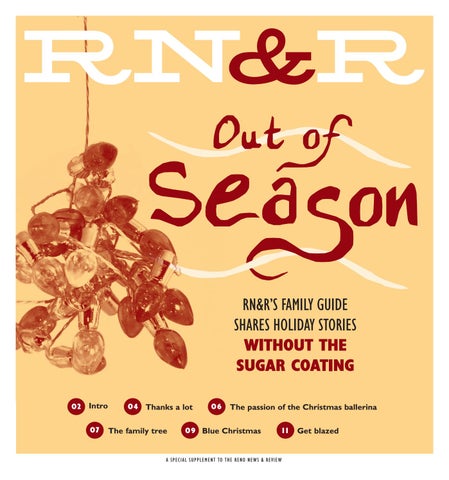
Rn&R’S FAmily Guide ShAReS holidAy StoRieS without the sugar coating 02 Intro 07
04 Thanks a lot The family tree
06
The passion of the Christmas ballerina
09 Blue Christmas
11 Get blazed
A SpeciAl Supplement to the Reno newS & Review
open wild winter weekends
Out of
Season
2 hAlf price child Admissions
RN&R’s Family Guide shaRes holiday stoRies without the suGaR coatiNG
with this ad
11:00 – 3:00
NOV 25 & 26 jaN 14 & 15 feb 18 & 19 w e at h e r p e r m i t t i N g
1-775-970-3111 | AnimAlArk.org
1265 Deerlodge Rd., from Reno Hwy 395 north, right on Red Rock, 11.5 miles, right on Deerlodge
T
hanks for picking up RN&R’s fall 2016 Family Guide. The holidays are a time for gathering with friends and loved ones. They’re also a time for reflection. As we move from the unprecedented craziness of this election period into the holiday season, I think many of us are feeling a bit more introspective than usual. We decided to run with that by presenting stories about families and the holidays—sans the sugar coating. Some are funny, others a little poignant. First up is a story from Arts Editor Kris Vagner. She and her brother Wayne were lifelong partners in their favorite sport—food snobbery. Kris shares a story about the first Thanksgiving she spent with in-laws after his passing. Josie Luciano reflects on the role The Nutcracker played in her young life and the suspension of disbelief that’s part and parcel of Christmas for youngsters.
Editor Brad Bynum Project Editor Jeri Chadwell-Singley News Editor Dennis Myers Arts Editor Kris Vagner Designers Sarah Hansel, Serene Lusano Contributors Anna Hart, Josie Luciano Advertising Sales Gina Odegard, Bev Savage, Emily Litt Distribution Director Greg Erwin
2 FAMILY GUIDE 11.17.16
A speciAl supplement to Reno news & Review
I also found myself recalling Christmases past, so I went through my box of holiday decorations and dug out a treasured belonging—a homemade ornament my father and mother made back when we were too poor to afford the store-bought variety. Anna Hart recounts the story of the Christmas when she came out to her parents—as a Democrat—and the chaos that ensued. And RN&R editor Brad Bynum writes about a different holiday entirely, the Fourth of July, and the time his father started a forest fire in Texas. I hope you’ll enjoy the musings we’ve compiled here. And I want to take this time to wish you all a happy, restorative holiday season with plenty of time to reminisce and catch up with the people you love. Regards, Jeri Chadwell-Singley RN&R Special Projects Editor
Distribution Manager/Operations Coordinator Kelly Miller Distribution Assistant and Driver Denise Cairns Distribution Drivers Alex Barskyy, Bob Christensen, Debbi Frenzi, Gary White, Jennifer Cronin, Jennifer Gangestad, Lori Ashley, Lori DeAndreis, Marty Lane, Marty Troye, Patrick L’Angelle, Tracy Breeden, Vicki Jewell President/CEO Jeff VonKaenel Director of Nuts & Bolts Deborah Redmond
Director of People & Culture David Stogner Director of Dollars & Sense Nicole Jackson Developers John Bisignano, Jonathan Schultz System Support Specialist Kalin Jenkins RN&R is printed at Sierra Nevada Media on recycled newsprint. Circulation of RN&R is verified by the Circulation Verification Council RN&R is a member of CNPA, AAN and AWN.
JOIN THE FUN this winter wintter at Sky Sky Tavern! Tavern!
Since 1948, the volunteer-based program m has taught oover ver 100,000 kids to ski & board. ve The non-profit 501(c)(3) offers adaptive programs, instructor training, p junior instru ruct ctor or ttra rain inin ingg, rac rracing, acin ingg, an aand nd a family atmosphere. Sky Tavern is located Highway than 30 ed d on the th Mt. Mt Rose R Hi h lless th minutes from downtown Reno. Kids Passes (ages 3-18) start at $145 | Adult Passes are $125 The eight-week kids program ($145) includes a two-hour morning lesson each weekend. A bus package ($240) is also available for children (9+) needing transportaion to Sky Tavern from an area drop-off location. Kids that do not ride the bus need to be accompanied by an adult member. Adult passes are $125 and require volunteering for two-hours each day of participation, while membership is $25 for non-skiing adults. Prices will increase after 12/31/16. Please visit www.skytavern.org for additional program details. www.skytavern.org
info@skytavern.com
775.323.5125
ARTS FOR ALL NEVADA is celebrating 30 years of providing art classes, school break art camps, exhibits and events for all ages and all abilities. Check the ArtsForAllNevada.org website for listings of upcoming classes and events.
SATURDAY DECEMBER 3, 10AM – 2PM
SUNDAY, DECEMBER 11, 3PM
Lake Mansion Jingles with Art & History FREE Open-to-the-public 8 hands-on art stations for kids, face painting, tours of the historic Lake Mansion main floor, a free book for each child, and visits and photos with Santa. No registration required.
Victorian Holiday Tea & Tour at the Lake Mansion. Guests will enjoy an elegant afternoon featuring finger sandwiches, tea and sweet treats. BYO special tea cup! Benefits Arts for All Nevada and the Lake Mansion. $30 per guest/2 guests for $50
RENT THE HISTORIC LAKE MANSION, ADJACENT ENCLOSED PAVILION AND COURTYARD. Make your end of the year and 2017 private events or meetings unique, affordable and memorable. Also available for public/private Paint & Sips and children/adult art birthday parties.
For more information: info@artsforallnevada.org • 775-826-6100 ext 2# • artsforallnevada.org A speciAl supplement to Reno news & Review
11.17.16 FAMILY GUIDE 3
Thanks a lot I thought I was doIng oK a few months after hIs death, but my fIrst thanKsgIvIng wIthout a brother reduced me to a hot mess graspIng for a cool head
by Kris Vagner
4 FAMILY GUIDE 11.17.16
T
hanksgiving is the ultimate potluck. For us foodies, it requires a balance of tradition and innovation—and just enough showmanship to dazzle fellow diners but not so much as to show up the host. The hosts, last year, were my in-laws, a large ranching family of lovely, clever, kindly people. When I married into this clan a few years ago, I got around 20 new siblings-in-law, most of who can throw down righteously in the kitchen. The turkey was already covered by Mom and Dad. I was assigned to a side dish. My strategy: corn custard—surprising but not ostentatious, humbly flavored, rich with cream and butter, a holiday favorite in my own family. On the night before Thanksgiving, in the Raley’s parking lot, I tried to remember the recipe. I searched my email archives on my mobile and found a version my mom had sent. I sneered to myself, as if I were still 15, as if I didn’t already have a kid and step kid, one on either side of the threshold of teen-hood, “Oh my god, Mom. Who puts flour in an egg-based custard?” Striding through the store’s electric doors in an insolent huff, I decided I’d call my brother. Surely he could confirm my hunch that the custard would set just fine without flour. My brother Wayne had been my lifelong companion in my favorite sport—food snobbery. At age 8, I was as proud as a parent when he stood on a chair, at age 5, to scramble eggs. In our 20s, when we both lived in Boston, we drank fancy coffees on Newbury Street and fixed lobster tail for New Year’s Eve. The day I moved out of town, when my kitchen things were all packed in boxes, Wayne appeared in my driveway with a hibachi and a Ziploc of marinated portabellas and grilled up a farewell feast. For us, cooking together was a shared act
A speciAl supplement to Reno news & Review
of generosity, connoisseurship and collaboration, an assertion of our shared values—which are industriousness, improvisation and silly jokes. If we ever handed you a plate of pierogi, it was really a plate of how much we liked to be creative, nurturing, competent and smug together in the kitchen. By the time I was 40, I’d long lived in the West, and Wayne was still back East. We were still inseparable food buddies. He grew cucumbers, pickled them in brine, and shipped them to Reno. When he came to visit, I busted out a bottle of long-soured Burgundy that I’d been saving for years, snipped a handful of thyme from the garden, and welcomed him with the best batch of beef bourguignon I’ve ever made. Don’t even get me started on Thanksgiving. I applauded his roastedpumpkin-infused vodka from 3,000 miles away. When I asked him how I should spice the tiny chocolate truffles I was making to decorate the Swiss Alps of whipped cream and lattice of drizzled butterscotch atop my homemade eggnog—cinnamon or clove?—he said, decisively, as if he’d been anticipating my call, “No spice. Canned pumpkin.” Just inside Raley’s, I picked up a shopping basket and snapped out of this stream of cooking memories and thought, “Shit!” It hit me suddenly, as if I hadn’t already realized and forgotten it 10 times over, that I was not going to call my brother. I hadn’t called in August to brag about how the highdesert heat yielded a basil crop superior to any I believed he could grow in hazy New England. I hadn’t called after the first snowfall to have him guess how I’d flavored the season’s first hot chocolate. (He would have said without thinking, “Ground cardamom and orange extract. Duh.”) I wasn’t ever calling again. My brother had died in April.
Grief, I found, is fickle and weird. I could be enjoying a perfectly nice afternoon, then see someone with the same haircut or sunglasses as my brother and spend the rest of the day struggling to concentrate on work. Seven months in, I was getting used to it, though. I’d reached a point where I could get through a whole day without falling apart. But I hadn’t thought to anticipate that Thanksgiving would be something difficult. I’d figured that feeling sad about lost loved ones on a holiday was for people who’d always spent holidays together and suddenly had to suffer the sight of an empty chair at the table. Turns out it’s also for people who liked to text each other pictures of fresh ravioli and call each other to scoff when someone tried to serve Cool Whip. On Thanksgiving Day we drove out to the in-laws’ ranch in Yerington. Around Fernley, I started wiping away the occasional tear and trying to stay in the holiday spirit. By the time we arrived in the neat, practical farmhouse yard—a gateway to a cozy, warm house full of people happy to see each other—I had to stay outside for a while to try to gain my composure. Seven months after the death, it seemed too late to bother anyone with the details. A sister-in-law asked where I’d gotten the corn custard recipe. I skipped over the sad parts and said, “It’s a classic from my family.” After dinner, I didn’t mention that the reason I wanted to duck away for a nap was because I couldn’t watch siblings playing cards together without crying. I could deal with kids OK though. It’s amazing the way you can find strength in various impossible situations when you’re a mom. A 9-year-old niece showed off a centerpiece, a pretty arrangement of branches from Pinterest. The girl brought a fancy tag and a fancy pen to each person and asked us each to write what we were thankful for, intending to hang the tags on the branches. “What did you write?” I asked her. “My family!” she beamed. “That’s so obvious,” said one of the younger grownups. “It’s not that obvious. Not everyone has their family,” I started. I cut myself off before the word “intact” and let the conversation continue without my laments. I paid attention instead to the smiles, traditions and love among the family I was with at that moment, which finally let me catch a groove of normalcy that day, join the card game, and let gratitude eclipse grief for a while. Ω
E. L. Cord ChiLd CarE CEntEr truCkEE MEadows CoMMunity CoLLEgE
Located on the dandini Campus Through a quality child care program, TMCC Child Care will provide care and education based on best practice.
Tips from an experT How to be ready for tHe Holidays after a deatH in tHe family Kristen Davis-Coelho—psychologist and Director of Behavioral Health at Renown—shared some tips on preparing for the holidays after the loss of a loved one. “Be … aware ahead of time that it is going to hit you harder at the holidays,” she said. “We have expectations for what we’re supposed to feel at this time of year—joy, gratitude—and that is not going to match how you’re feeling when you’re grieving.” Next, “Be thinking purposefully about how you want to handle the holiday. Sometimes people are tempted to reflexively throw out all of the old traditions because they’re scared it’s going to be too painful. That’s not the right direction to go. Step back and think, ‘What is my family going to need? What am I going to need?’” Some people end up keeping the old traditions. Others don’t. The important thing is to be aware of which choice is going to work for you. Also important, said Davis-Coelho, is to ask for support “from people you trust and know are reliable. Often people want to help but don’t know how. If you have some specific requests you can make from others, that can help them feel good—and helps you feel supported.” Examples include asking a friend to join you for holiday shopping or asking someone to watch the kids for a while so you can have some solo time. Finally, she offered, “If you can, work in a way to specifically connect to the person you’ve lost, a specific time for reminiscing for family and friends, a way to include them in the holiday, even though they’re not there.” (Thanks, Kristen! Wayne Fridrich Memorial Pumpkin Chocolate Truffles Day might well become its own holiday this year.)
Program Highlights • • • • •
Open to Community year round, Monday-Friday, 7am to 6pm Semester-Care and Extended-Care Well-developed policy guides High-quality Programming All employees meet state of Nevada Child Care Licensing requirements Accredited by the National Accreditation Commission (NAC)
Educating Children For Life E.L. Cord Child Care Center
7000 Dandini Blvd • Reno, NV 89512 775-674-7515 • www.tmcc.edu/childcare A speciAl supplement to Reno news & Review 11.17.16 FAMILY GUIDE 5
The passion of The ChrisTmas ballerina It’s hard to argue wIth holIday-themed tulle and sweepIng musIc
T
he Glassberg household was never big on holiday traditions. Turkey was our sometimeschoice for Thanksgiving—alternating years were fish. Christmas decorations were limited to one tree. Anything beyond this was “ostentatious” and “disrespectful to Jews.” And Hanukkah was observed about half the time (when my parents remembered). But there was one tradition that my sister, Ellie, and I did not fool around with—the annual PBS broadcast of Baryshnikov’s Nutcracker Ballet. We lived for dance theater in the way that other kids might live for parental freedom or square pizza on Fridays, and if I’m being completely honest—and totally shameless—I think the Nutcracker changed my life. Not in the sense that it motivated a ballet career past the age of seven, or that it instilled a profound appreciation for art and the psychological treatments of Russian-adapted ballet, but more in a “Christmasis-magic” sort of way. It’s hard to argue with holiday-themed tulle and sweeping music. The scene when Clara (Gelsey Kirkland) goes from waltzing politely on Christmas Eve to hallucinating a life-sized nutcracker (Mikhail Baryshnikov), a mouse king and—most importantly—a giant growing Christmas tree is the moment that inspired the following nightly routine from 1989 to 1993 during the month of December: Go to bed wearing a flowy nightgown. Wait until Ellie is asleep. Sneak out of bed. Plug in the Christmas tree. Dance around the tree until exhaustion. This display would always end the same way— with me throwing a slipper across the room at the mouse king, followed by a deep bow in my Clarainspired nightwear. I don’t remember what emotions overcame my tiny, twirling body during “The Nightly Passion of the Christmas Ballerina,” but I’m certain they included some confusing feelings for the man, Mikhail Baryshnikov, as well as a growing belief in a metaphysical world made of animated toys, spirits in general and Santa specifically. Because once you start believing in one of these three things, it has been proven that you automatically accept the other two as fact. This aura of magical thinking is actually kind of wonderful. Each day is infused with the knowledge that anything is probable because everything is possible, and, before you know it, you have discovered that a pillowcase doubles a mermaid tail, your stuffed
6 FAMILY GUIDE 11.17.16
A speciAl supplement to Reno news ews & Review
animals have moved positions in the night, and you have spent the entirety of second grade as a beautiful and wild Appaloosa horse named Nikomas. But there was one glitch in my fantasy matrix. I knew everything was pretend when it came to spirits and anthropomorphic animals—but not Santa. While my parents were content to ignore the details of Nikomas’s invisible bridle or my considerable mermaid tail-flipping technique, they were strangely informed about Santa. He comes once a year. OK. He travels in a sleigh pulled by flying reindeer. I guess so. He will bring you presents if you’re good. I’m in! I will be good, I promise! Also, he likes poppy seed moon cookies, a very small glass of milk—sometimes no milk at all—and his reindeer eat carrot sticks. All adds up to reality for me. Then, the year I turned seven—five days before Christmas—my parents asked me if I wanted to “be Santa this year.” Though I’d had my suspicions about Santa for years, I didn’t see the signs, because I didn’t want to see the signs. There could be consequences. What if the presents dry up? What if, when you stop believing in Santa, it short-circuits everything else— sentient toys, horses with inner lives, mermaids? But the damage was done. I had no choice but to play Santa, and so I stuffed Ellie’s stocking in silence, turning each item over in disbelief—the warm and practical socks, the yearly pair of running shorts, the orange at the bottom of the stocking. Suddenly, it all looked very much curated by my dad. The single sleigh bell strung on a piece of ribbon felt particularly insulting that night, but I threw it in anyway—letting its silvery crash be the soundtrack for my slow, glareeyed march down the hallway to my room. I didn’t dance around the tree that Christmas Eve. But the next night, I snuck into the living room, plugged in the lights, and with the kind of aggressive denial usually reserved for toddlers and politicians, started to twirl—around and around, spinning like a real life ballerina. Too old for this, doing it anyway, keeping the momentum going. It kind of worked. Not like a charm, but like a job this time—something I had to do. Twenty years later and I am passing the lie on. My daughter is four, well within the realm of belief for both Santa and PBS. Plus, now I have a grown-up job that makes it possible for me to put $20 a month towards an adult mermaid tail. It’s going to be magical. Ω
by Josie Luciano
The
family tree Reflections on chRistmas, layaway and homemade oRnaments
by Jeri ChadwellSingley
I never reached a point where I’d decided to make a concerted effort to quit being a creep—just like I hadn’t made a conscious effort to become one.
I
had no idea we were poor. I really had no idea that we were poor when I was a little girl. And, in truth, things had turned around by the time I was 9. It was something my parents, I think, took a lot of pride in keeping from us—my sisters and me. And, of course, part of it was the natural obliviousness that comes along with being too young to really comprehend such things. But mostly it was that my parents worked very hard to make sure that we girls had the things they hadn’t. Layaway was key in making this happen. Christmas gifts went on layaway in January. School clothes from K-mart were a complicated exercise in forecasting—part calculation, part intuition. How much would we each grow in the intervening months between layaway and the start of the school year? I started piecing things together many years later—when school clothes became something we purchased weeks before the start of classes and the Christmas season meant it was time to empty the change jar and divvy it up between us girls to be spent on buying gifts for one another. By then, my parents were setting aside money for my mother’s folks instead of relying on them to share the huge blocks of cheese and canned pork they received from commodities. My parents were always determined that they would provide a springboard from which my sisters and I could launch into our own lives. We would have the option of college. We could be the first ones in our family to get there. With the future secured, I found a personal fascination in understanding the past. My parents were happy to oblige with stories. My maternal grandmother, I learned, had grown up in a dirt-floored shack with her 15 brothers and sisters in Boise, Idaho. My maternal grandfather was illiterate. After returning home from Korea, he took a job as a mechanic. He would put off his work orders until evening hours when my grandmother could come to the shop and read them for him. I had actually wondered why my mother and aunt were always eager to lean over his shoulder and read aloud any Christmas or birthday card he received. And so Christmas seasons came and went. And cards were read aloud for my grandfather. And gifts became more plentiful and more expensive. I planned my college career and readied myself to set out on my own. My parents would remain on the east side of the state, where my father held down a well-paying mining job—a job that eventually allowed me to quit my own full-time job at Macy’s and spend my senior year at the University of Nevada, Reno focused on academics.
By 2010, the last of my grandparents had passed. My maternal grandfather went in 2009. I hadn’t spoken to him in years, not since shortly after he’d remarried following my grandmother’s death at the hands of woman with road rage. His new wife—whom the family had legitimately welcomed with open arms—had no interest in sharing his attention, and I’d quickly tired of my grandfather wavering back and forth on whether or not he’d have contact with his own children. By the time he grew ill, my heart was hardened against him. I’d listened to my mother cry one too many times when he’d sever contact with her just weeks after calling to say that he couldn’t possibly live without her in his life. I chose not to visit him in the hospital before his passing. Christmas took on an almost desperate significance to me as I settled into adulthood. I always came home—always wanted to, though things were markedly less pleasant most years. The family certainly didn’t gather together. There were fewer of us, anyway. My eldest sister had passed shortly before our shared birthday in 2007. My aunt died of breast cancer in 2011. And my remaining sisters and I, for some reason, often saw fit to be our worst selves. I was, at the time, evangelically atheist, and it was a rare Christmas that one of us didn’t do something to make my mother cry. I don’t know when things turned around for me. It’s more recent history but made hazy all the same by the powers of selective memory, brought on by heartache and an unconscious desire to put past transgressions behind me. I never reached a point where I’d decided to make a concerted effort to quit being a creep—just like I hadn’t made a conscious effort to become one. But I do remember the Christmas when I put aside my dark reflections on the family’s recent past. My parents had moved back to Nevada after a brief stint in Arizona. We were decorating the tree in their new house in Battle Mountain. I pulled a gingerbread man ornament out of the box of decorations. It was one of many—stars and soldiers and gingerbread men—my father had cut from the scrap wood behind our trailer the year of my first Christmas in 1985. My mother had lovingly painted them with the acrylic paints she’d saved for and collected for years before marrying my dad. These ornaments went on the tree every year—a honeyed reminder of where we’d come from. I looked the gingerbread man over, admired its faded paint. Then, I placed it front-and-center on the tree. When I pulled another from the box, my folks said to set it aside. That ornament and my repaired pride in where I’d come from were the best gifts I received. Ω
A speciAl supplement to Reno news & Review
11.17.16 FAMILY GUIDE 7
promote your holiday event!
get started at newsreview.com Reach thousands of online readers! Your event could be chosen to publish in RN&R! Get a free feed of your events directly on your own website!
Hunger doesn’t end when the bell rings. Free after school and summer meals open to all children ages 1-18. 775-331-3663 or fbnn.org for the site closest to you.
together we can solve hunger™ Kids Cafe is a program of the Food Bank of Northern Nevada. USDA funds meals. USDA is an equal opportunity provider and employer.
8 FAMILY GUIDE 11.17.16
Kids Cafe is a program of the Food Bank of Northern Nevada. USDA funds meals. USDA is an equal opportunity provider and employer.
A speciAl supplement to Reno news & Review
Blue Christmas I remember when I came out to my parents—as a Democrat by Anna Hart
A
h, the holiday season. It’s that special time of year when the entire family comes together to be thankful, break bread and talk about how much weight you’ve gained. My family is no different. In the Hart clan, there are always three things to count on—a plethora of food, a football game on the television, and enough alcohol to forget what happened the last time we all came together. This is not to say that my family isn’t great. They’re the best. But they’re also the worst. For some context, my family is complicated. Our family tree could rival the Buendías of One Hundred Years of Solitude, without the incest (I think). My father is the patriarch of the family. He is a 93-year-old, crotchety World War II veteran. My mother is an immigrant from the Philippines. And together, every year we welcome my brothers’ kids, grandkids and ex-wife, as well as any other family who wants to see how many leftovers they can snag. Needless to say, chaos always ensues. Most of my memories of our holiday dinners together are snapshots. One is of my great-nephew trying to put the turkey on his head. Another has my dad telling my now ex-boyfriend that he looks like an ogre. My favorite is being a kid and making martinis for my dad. (Is that not what you did at 6 years old?) I think one of the toughest holidays was when I came out to my parents—as
a Democrat. It was quite a shock, and I didn’t really blame them. I was a definite Republican as a child, raised under the gospels of Rush Limbaugh and Bill O’Reilly. Then, I grew up and found a world outside of Fox News. As I recall, I was sitting down at the table across from my parents when I told them I’d voted for Barack Obama. My mom immediately dropped everything and left the room. I realized what she was doing pretty quickly. My mom is totally deaf, save for when she is wearing the sound processor for her cochlear implant. When she wants to lay into me, she takes it out—both so she can’t hear my protests and so she doesn’t have to hear her own shrill voice, I’m sure. I expected nothing less than all of this. My parents wailed about how I’m lazy and ungrateful, but I was already mentally planning out my plate. Should I start with mashed potatoes or macaroni and cheese? I heard our front door open. I could just hear it over the sound of my father telling me I was a no-good, snot-nosed liberal. I saw the rest of my family peek through the door, mouth, “You’re on your own,” and close it again. For the next 10 minutes, my parents babbled about how I was breaking their hearts and single-handedly destroying the American Dream and how if I’d become a doctor like I was supposed to, this never would have happened. I continued to weigh the merits of various side dishes.
Finally, my dad went to fix himself a fourth cocktail, while my mom let in our family, all of whom were unwilling to make eye contact. In my naïveté, I thought the worst had passed as we all settled in to eat in front of the Jets and Patriots game. Then my brother’s ex-wife (who we’ll call Cheryl), walked in with my mother in tow. Cheryl is an infernal woman who has an uncanny ability to bring out the worst in my mother. Together they are notorious chismosas, who spread gossip around the family under the guise of concern. “Why are you being so disrespectful to your mother?” Cheryl asked. As a rule, I can’t stand Cheryl because she’s ridiculous. So I just laughed. “This is serious,” she said. “I don’t know what’s wrong with you. You have no respect for your family. And your mother told me that your boyfriend wants to fight your nephew because he made a pedophile joke about him.” Now I’m not good at baseball, so I was unprepared for all of this bullshit coming out of left field. So, too, was the rest of the family, who all started watching the scene Cheryl was intent on making. She’ll bring up anything to ensure she can publicly criticize people. But I was done. Cheryl could stuff it. “Hi Cheryl, once again, thanks for the input that no one asked for. Also, please stop gossiping with my mother,” I snapped and turned away.
This riveting exchange continued, until Cheryl finally pulled me aside and called me a “little bitch.” Then everyone else was suddenly incredibly invested in hearing my dad’s war stories for the hundredth time. So I ended my night calling around to find someone else’s family to eat pie with. After four years, I look back on that memory and laugh. I still can’t stand Cheryl, who manages to turn up at every holiday to see her kids and grandkids—my niece and nephews. She’s still got quite the mouth on her. But then, so do I, so we manage. And I expect a similar blowout from my parents this year, who are still hurt that I voted for “Crooked Hillary.” My Filipina mother will tell me once again that the white race is dying out, and we need to stop the Mexicans. My dad will say that under Obummer, this is the worst the country has been (despite having lived through the Great Depression). And I will continue to wonder what monster thought green bean casserole was a good idea. Still, everyone is a little older now, and things have changed. There are no more kids in the family to coddle. Every year seems to bring us less time to spend with each other. My dad’s 93 years are finally starting to catch up to him, leaving him markedly less ornery but also less exciting. Even though it’s painful to get through our gatherings sometimes, I still generally like my family. I wouldn’t change anything. Ω
A speciAl supplement to Reno news & Review
11.17.16 FAMILY GUIDE 9
why pay full price? 2-D Wok Taiwanese Cuisine: $20 value for
$10
Fitness Enterprise: $210 value for
Batch Cupcakery: $10 value for Bam!Dog: $10 value for
Lord Vapor:
$5
$25 value for
$12.50
Mellow Fellow Gastropub:
$5
$10 value for
Bavarian World: $25 value for
$84
$12.50
$5
Nikos Greek Kitchen: $10 value for
$5
$5
Nothing To It: $25 value for
Beer NV Taproom & Spirits:
Pinon Bottle Company:
Beefy’s: $10 value for
$25 value for
$12.50
Boomtown Steakhouse: $25 value for
$12.50
Calafuria: $25 value for
$12.50
Canvas Junkies: $20 value for
$10
Crafted Palette: $5 value for
$3
$10 value for
$10
$5
Rapscallion Seafood House: $25 value for
$15
Ryan’s Saloon & Broiler: $10 value for
$5
Sierra Safari Zoo: $20 value for
$10
The Daily Bagel: $25 value for
$12.50
DTR Fitness: $100 value for
$50
RnRsweetdeals.newsReview.com
10 FAMILY GUIDE 11.17.16
A speciAl supplement to Reno news & Review
never pay service fees!
Get
F
blazed
or three years in the mid ’80s, for reasons that aren’t clear to me now and were even less clear to me then, my family lived in Texas. It was something to do with a “job opportunity.” We lived in a little town called Waxahachie, which a quick Google search informs me is also known as “the gingerbread city.” It’s on the outskirts of Dallas. I don’t remember much about the town itself, except for a strange and beautiful building, the Ellis County Courthouse, which in my memory looks like a combination of a castle from a Russian fairytale and a fort from the Mexican-American War. Strangely enough, Google confirms that my mental image isn’t far off. For me, living in Waxahachie was just a hazy sliver of my childhood, but for my brother and sister, it was something much, much worse: it was their birthplace. Poor kids. Forever branded Texans. Besides the newborns, my memories of that place and time are scarce: I remember seeing a scorpion in the living room. I remember the time a skunk sprayed our dog, and he, in turn, stank up our garage. I remember my dad, who I think was frustrated and lonely, built a huge garden. I remember there was a large animal trap near the garden, intended to capture the feral dogs that dug up the garden, or the wild animals that stole from it. I remember climbing into that cage and getting trapped. I remember my mom coming to my rescue. I remember the only time it snowed in three years, and running outside to play like I was Han Solo on Hoth, gunning down Imperial probe droids. I remember the entire family hiding in the bathroom, the only room in the house with no windows, during a tornado scare. And I remember the time my dad started a forest fire. The Fourth of July is a strange holiday. It’s celebrated as Independence Day for this country, a separation from Britain—which is a bit haphazard given the history, what with the actual separation occurring two days earlier. And it falls less than two weeks after the summer solstice, the longest day of the year, and the literal and figurative height of summer. For that reason, the holiday is
synonymous not just with patriotic celebrations—but also with its close connection to its season. The Fourth of July is emblematic of midsummer in the same way that Halloween is connected to autumn, or Easter to spring, or Christmas to winter. These holidays are modern permutations of the seasonal holidays, connected to the solstices and equinoxes, and the cycles of the harvests, celebrated by many cultures. So the Fourth of July isn’t just a national celebration. It’s also a celebration of summer. That’s why it’s so closely connected to outdoor activities like barbecuing and picnics, and outdoors sports like baseball and swimming. And elementally, it’s connected to fire. The sun blazes hot all day long, and then we imitate that at night by popping off fireworks. And so it was, not long after dusk on a mid-July night, that my family gathered in the backyard with fireworks ready to launch. There was an empty field behind our house, with long grass that would blow in the wind and just a smattering of trees on the outskirts. Looking back, it’s a little strange to me that it was just the family. No friends, not even any neighbors. My father is generally very social. No family gathering was ever complete without some strange friend of my dad’s that none of the rest of us even knew. It speaks a lot of our time in Texas that even on the Fourth of July, maybe the most outgoing and social holiday of them all, we were on our own. “All right—check this out!” I remember Dad saying with the sort of forced enthusiasm only possible from a parent who isn’t having fun but sincerely hopes his kids are. He lit up three or four skyrockets, but instead of launching up and painting the sky in a flash of color, they blasted straight forward and into a tree. What I remember best about it was the timing. I think those skyrockets must have been made by the Acme company, because the timing was straight out of a Wile E. Coyote cartoon: Sizzle. Pop! Woosh. Crash! Pause. Blaze! The wick burned down, the fireworks shot off, flew, crashed, and after a brief pause, the tree was suddenly engulfed in flames. I remember my dad’s mouth dropping open,
by Brad Bynum
A cAutionAry tAle About texAs
tongue unfurled, as if illustrated by some Warner Brothers animator. “Get inside!” he shouted. This was, at the time, the most flummoxed I’d ever seen him. The rest of us went inside and watched through a window as he fought the fire—not with water, as my child mind had expected, but with a heavy, fire-resistant blanket which he used to literally beat back the flames. And when I think of Texas, that’s the image that comes to mind: my father having a blanket fight with tree that burned like a Biblical bush. He eventually won the fight, buried the burning tree, and came back inside. Years later, I understood how that whole celebration was close to farce—not just the wanton destruction of a tree, but that strange sense of celebrating a community-oriented holiday in near total isolation, like some weird frontier family. About that time, I started to realize that my parents hated living in Texas, where they never really fit in, and they started missing that little town where they had lived for a couple of years before moving to Texas, that little town where I was born, and where we would soon move back—Reno. Ω
A speciAl supplement to Reno news & Review
The Fourth of July is emblematic of midsummer in the same way that Halloween is connected to autumn, or Easter to spring, or Christmas to winter.
11.17.16 FAMILY GUIDE 11