
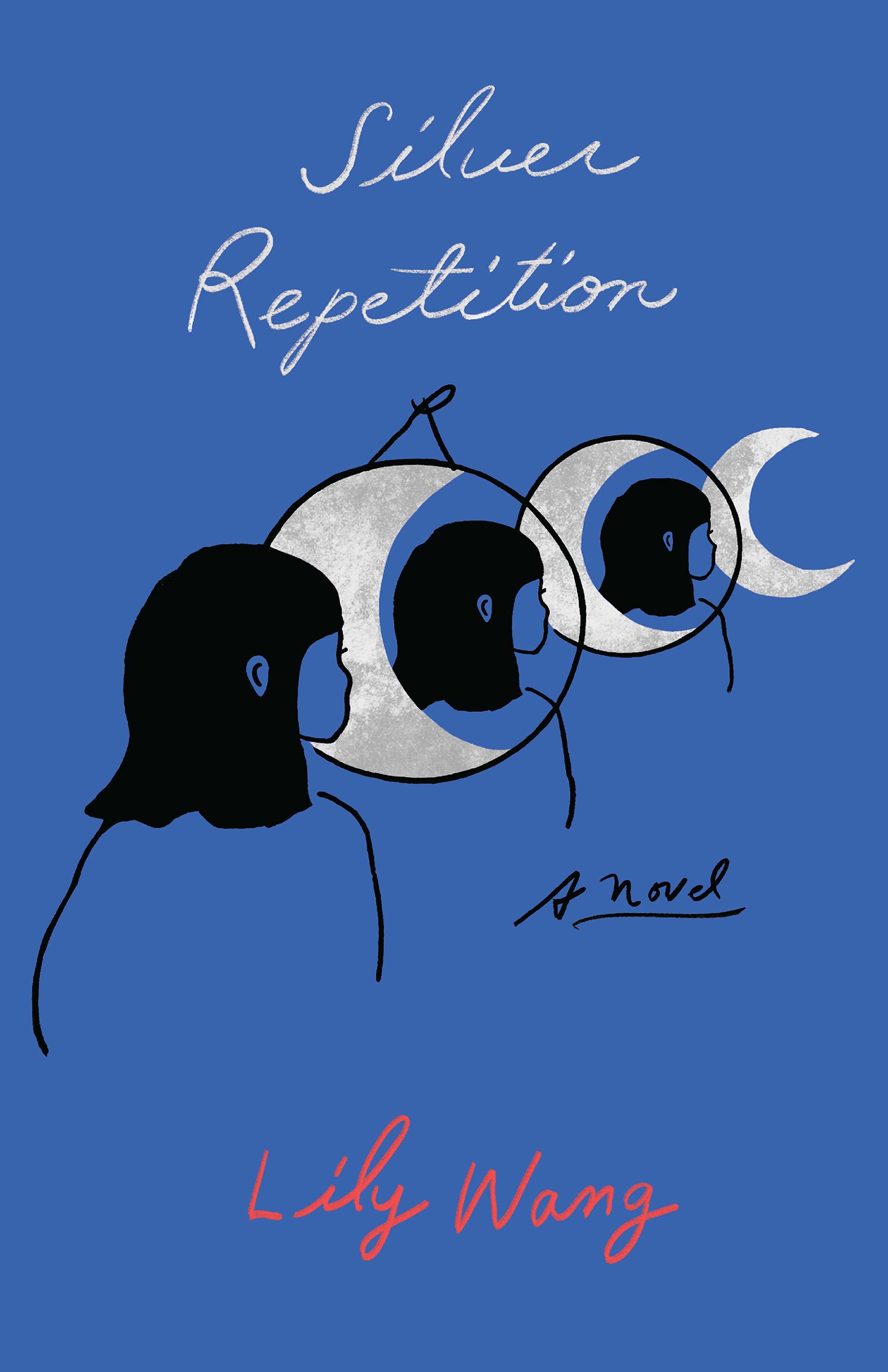
SILVER REPETITION
A NOVEL
LILY WANG
© 2024 by Lily Wang
All rights reserved.
No part of this book may be reproduced, in any form, without written permission from the publisher.
Requests for permission to reproduce selections from this book should be made through our website: https://thenewpress.com/contact.
e excerpt from Repetition and Philosophical Crumbs by Søren Kierkegaard on page vii is reproduced with permission of Oxford Publishing Limited through PLSclear.
Originally published in Canada by House of Anansi Press Inc., 2024 is edition published in the United States by e New Press, New York, 2024
Distributed by Two Rivers Distribution
ISBN 978-(-)2097-85)-) (pb)
ISBN 978-(-)2097-8)(-0 (ebook)
CIP data is available
e New Press publishes books that promote and enrich public discussion and understanding of the issues vital to our democracy and to a more equitable world. ese books are made possible by the enthusiasm of our readers; the support of a committed group of donors, large and small; the collaboration of our many partners in the independent media and the not-for-pro t sector; booksellers, who o,en hand-sell New Press books; librarians; and above all by our authors.
www.thenewpress.com
Book design and composition by Lucia Kim
Printed in the United States of America
(0 9 8 7 ) 5 4 - 2 (
For my mom
I can circumnavigate myself, but I cannot get beyond myself.
—Søren Kierkegaard
SILVER REPETITION
part 01
“This is cool,” I say, because no one’s speaking.
“I brought you here so you would think I’m a cool guy.”
We are in the Poetry Jazz Café. A young Muhammad Ali collapses against the wall behind the bar. Before us, a crowd, swaying along with the projection, shadows continuing their side-to-side movement with each loop of light. My date introduces me to his friend’s girlfriend. He tells me she just returned from Australia and is visiting her boyfriend, a musician whom we are here to watch. She holds her drink with four fngers blocking the label, the smooth ovals of her nails blushing under the subtle light. Her breath like mandarin oranges is the only one I can smell.
“He plays the trumpet,” my date leans in to tell me.
My date paid the cover. His name is Johnny. The Australian girlfriend gives me a polite look before scanning the stage. During the day, the bar is shut to the
public, situated between used-clothing stores with open fronts where construction vests hang like a slant of neon lanterns. People wander in the middle of the road, manoeuvring their baby strollers around parked cars and broken pieces of pavement. It’s quiet the way weekday afternoons are, when you can hear the puddles and the phone conversations and the clud-clud of skateboard wheels.
The deliberate atmosphere inside the café is the sharp purple of dreams, smoke-lit and narrow, swathed in silhouettes. Onstage, the lower half of his body obscured by the crowd, a rapper is chuckling; his mouth foats like a crescent on the surface of a lake. He could be singing or talking. The performance does not register as music to me. Johnny’s friend Erik stands behind the rapper, of to the left. I catch glimpses of gold as an ofbeat and attractive sound furls from the brass. He plays unaware, he tests notes, he exchanges tender glances with the other members of his band. Candles ficker on darkened hardwood, melting onto silver dishes, warming our faces. It might all be music.
I don’t look at Johnny much because he is handsome, which annoys me. He has a serious mouth, full lips, crooked bottom teeth. When no one’s watching, I wipe the stamp from my hand and drink from Johnny’s glass. I didn’t have any ID to prove my age. Johnny smiles and asks to try my ginger beer.
Erik wrote a poem about Johnny’s legs. That’s how the
two met. Johnny and Erik were at a bar high on cocaine once, and Erik had to get Johnny out of a fght. I must have made a face at “cocaine,” because Johnny says, “It’s part of the story, just listen.” He likes his stories. I tell him I’m not a spy. He tells me he kissed Erik.
There is an interlude. Erik steps down from stage, exchanges a few words with his band, and takes of his toque. He walks over to us and Johnny introduces me as his friend. Again, I feel the girlfriend’s polite gaze on me. I tell Johnny’s friends that I’ve never been to the bar before. Erik unrolls the hem of his toque and rolls it back up, scrunching the orange wool in his hands. He pulls his girlfriend in for a kiss. Oranges, mandarins. Johnny and I say our goodbyes and leave in a yellow cab.
Johnny and I had gone on three dates before he called it of. That was about a week ago. I didn’t know the frst date was meant to be romantic. I hadn’t been sure. I don’t know what tonight is supposed to be, but I’m glad to be here. I’m glad Johnny texted. I’m glad we’re giving it another shot.
In the taxi, the driver’s silent presence makes both Johnny and me nervous. Light clumps on the oily glass.
“It’s not nice to talk to me about kissing,” I say, once we’re out of the cab.
I show Johnny the text he sent me, the one about kissing. I remind him he rejected me.
Johnny stretches his neck. “I lost interest for an hour.”
We walk across his driveway below a cloudless sky. Johnny steers me from the front of the house to a side stairwell. He reaches over my head and pulls on a screen door—black mesh passing through the night air before my face—and pushes open the door behind it. Everyone I know is settling into basement apartments. I keep fnding myself at friends’ basement parties, turning my nose from wall to wall, peering down slender-necked vases full of artifcial lilies, spring just beyond my view. While I envy their independence, coating those feelings of envy is the stale yellow pollen left over from childhood. Summers spent sitting on the landlord’s porch steps until their returning van plugged out the light, sometimes crawling up to their living room from the shared laundry, stretching our weary bodies across their cobalt couch. We laid our underwear across their foorboards to dry, so drunk on sunlight, my parents’ faces would glow bright red. My mom, more than any of us, thirsted for light. She would sit at the top of our basement steps with the door cracked open, one hand at the base of her pregnant belly. “Move, you’re blocking the way.” Our landlord said those cruel words to her. It was rare for the landlord’s entire family of fve to be gone, and they always had dirty laundry that needed to be washed. My mom pulled up a chair and sat by the only window in our basement apartment, sat until snow caved her in, a ring of blue around the base of the house. When we moved her chair, there were four rings hollowed into the carpet.
Two more doors face us once we’re inside. Johnny gestures with slender fngers: one for his place and one for the laundry. I leave my boots by Johnny’s bike, kept vertically against the wall to conserve space, and let him lead the way into his living room. His basement is brighter than the one in my memory but just as yellow; time colours memory’s movement through me like water touching metal.
Johnny sits me down on his couch. I run my hands against the coarse threading of the cushions, studying the texture as a way to ward of my melancholy. I give each seat cushion a pat, counting three in total. The slipcover is orange-brown with fat felled seams, and despite its worn appearance, the couch gives of no smell. In fact, the basement apartment as a whole carries no scent, not a single spore in the air. Unsure of what to say, I keep my eyes focused on the patchwork cover, ofering a compliment about the stitching. Johnny brags to me about not having any roommates. He disappears into his bedroom and returns holding a banjo. He pulls up a stool and takes a seat in front of me. I watch him strumming; a strand of hair falls between his brows. He knows a few chords but not enough for a song. Still, it is the most romantic gesture he’s made yet. After three or four tunes, Johnny twirls the head of his banjo with one hand and gives the strings a slap. “You haven’t seen my room,” he says.
The fooring in Johnny’s bedroom is the same as in his living room, washroom, and laundry. His bed frame takes up
most of the space on the foor, his bedsheets a fowing chasm of white beneath the plain walls. Above his bed, cinched across a small window, is a piece of cloth evidently cut from the end of another curtain. Johnny changes with the light of. When he fnishes, he hands me a clean shirt from his closet so that I can change as well.
Mid-sleep, I open my eyes and fnd Johnny’s back turned to me. I raise my arm and his shadow grows another limb.
Johnny doesn’t wake until late afternoon the next day. I don’t use my phone for fear of draining its battery. There is nowhere to explore. I pull a wooden crate from beneath Johnny’s desk and fip through his collection of vinyl, knowing there’s not a single name I’ll recognize. I lose interest quickly and return the crate to its spot. Standing up, I spot the olive handle of a stiletto blade. The blade is over three inches long, slender, tapered to a needle-like point. It serves no purpose on the scattered desk. Something like pity moves me to clean up the cheap pencils next to the blade. I linger for a while after by the bedroom door, pencils in hand, wanting to press my face against the door like it’s a satin pillow or breastbone.
When Johnny fnally emerges, he isn’t at all surprised to fnd me reading his book on his couch. I lift up the Salinger. He says he hasn’t touched that one yet. I watch him do his laundry, sleepwalking in and out of his room with a white basket, the soft plastic sides fexing like cartilage.
In the story I’m reading, a man goes down to the beach for
some suntanning, then he goes back into his room and takes out a handgun. There is a girl at the beginning of the story, but then she isn’t mentioned again. I read this story once before and had retained no memory of the girl. Reading it again, I feel like it’s two stories. When the hunger is unbearable, I leave.
I feel like crying on the streetcar, but I am not alone. When I am home, the urge is gone.
Johnny apologizes over text. It takes him two days to think of me.
In those two days, I gather all the leaves in my backyard into large brown paper bags and move them to the front curb for pickup. Raking is more work than I thought. By this time of year, the leaves have mostly decomposed; what’s left has become matted and stringy, hard to clean of the tines. Each time I bring the rake up to the bag, I need to use one hand to steady the handle and the other to brush of the leaves and twigs. I give up on the rake and use both arms to gather the piles, rushing at the ground and hugging it, covering myself in dirt.
There is a smoke tree in my parents’ backyard, so most of what I collect is fuf. Come summertime the tree is covered in oval leaves of gold and green. It blooms, and slight winds carry the frothy, purple-burgundy clusters across our deck like dust. I can spend entire mornings just watching the tree sway. The clusters turn lighter in the fall. Sometimes yellow, translucent, in the rain.
Johnny texts me, “I had a dream about a cofee shop in Leslieville. Do you want to go there with me this week?”
Our tree is dying. I tear the frst bag when I try to close it; a twig springs loose and snags my skin.
I ask him, “When?”
The leaves around the base of the tree, the shrubs, I don’t touch. They will serve as mulch. Somehow the backyard feels smaller now, exposed.
I envision Johnny on the night he frst called, before he changed his mind, then changed it back again. We were cutting across campus, and we both had our hands in our pockets. There was tension in my neck and shoulders, but Johnny was relaxed; he had a serene look to him as he guided me with his elbow. I trod alongside him, so cold that I couldn’t stop speaking. That’s when I saw the overhead street lamps. White sparks were blooming beneath the lamps’ oval covers. Even as we crossed the intersection, I looked back and up at them—those sparks of snow under the orange glow.
“Look!” I kept saying.
Johnny meets me on the station platform downtown and we walk to the streetcar together with our hands in our pockets, sharing the sidewalk. He’s in a good mood today. Every few minutes, he jerks one hand out to gesture at something
before stufng it back where it’s warm. My eyes follow his swinging arm to the trees. Bean pods dangling from the branches. Long black pods like mummifed cocoons. I feel like all my hair could fall. Johnny makes a joke that I miss about the neighbourhood. The streets mostly look the same to me; some are just dirtier than others.
We think the cofee shop has closed down because the lights are of and there are stools stacked against the window, but when we step closer, we can see many people inside, in lines and in the seats, hanging their jackets on black wall hooks or draping them over armrests. Newspapers lie open on round tables, next to cups, plates, and little spoons for stirring. Upon our arrival—marked by a tinkling bell above the door—we are instantly greeted by the warm smell of espresso, sweet fg, chocolate shavings, orange peels drying in spirals, and other such ribboning scents. Bicolour croissants, topped with freshly whipped butter and faky salt, rest above a display case. When it’s our turn to order, Johnny steps forward and touches hands with the barista.
“I didn’t know if you’d be in today,” Johnny says. He orders two cofees. “Friend from high school,” he tells me after.
We take a seat by the entrance, facing the street. From the window, I see people step of the streetcar, holding on to their scarves and looking left and right before crossing the street. Johnny adds sugar to his cofee then mine, tearing the corners
of each single-serve before tilting the packs over our mugs together. He places the empty packs, two for each of us, on his saucer. He presses the tip of his fnger on a stray sugar crystal and edges it of the table. I am struck by Johnny’s indiference and begin to feel the mistake I’m making. Sitting across from Johnny on an antique seat with fringed throws, ornate and fowery. Even my porcelain mug has been rubbed to a shine! I feel myself as I really am, an acquaintance.
I hear the bell tinkle again and again as more people walk in. I excuse myself to use the washroom and must hold onto the railing during my descent. The basement, which seems to be shared with the establishment next door, bears no resemblance to the café upstairs. The toilet is low to the ground and crooked; I have to crouch close to the unclean tiles, many of which are chipped and sound hollow beneath my heels. I stand before the dimly lit mirror, tucking the front end of my shirt into my jeans. The sink is so shallow, it is like a bar of soap that has only been used on one side. I wet my hands to style my hair, slicking any loose strands back with my fngers before heading up. Even now, in the dim light, my hair sparkles from the snow on that frst night.
When I get back to the table, I say, “How do I know you like me if you don’t hold my hand?”
“You want to hold my hand?” Johnny laughs and ofers me what I desire most.
About the Author
lily wang (they/them) was born in Shanghai in 1997 and moved to Canada in 2004. The author of the poetry collection Saturn Peach, they have an MA in English and Creative Writing from the University of Toronto.

Click here to learn more about the book.