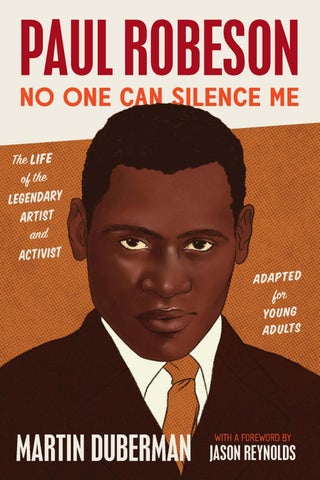
PAUL ROBESON NO ONE CAN SILENCE ME Adapted for Young Adults
MARTIN DUBERMAN Fore word b y Ja so n Re y n ol d s
5P_Duberman_PaulRobeson_36161.indd 5
12/1/20 2:22 PM
© 2021 by Martin Duberman Foreword © 2021 by Jason Reynolds All rights reserved. No part of this book may be reproduced, in any form, without written permission from the publisher. Requests for permission to reproduce selections from this book should be made through our website: https://thenewpress.org/contact-us/. First published in the United States by The New Press, New York, 2021 Paperback edition published by The New Press, 2026 Distributed by Two Rivers Distribution ISBN 978-1- 62079- 649- 4 (hc) ISBN 978-1- 62097- 661- 6 (ebook) ISBN 978-1-62097-984-6 (pb) CIP data is available The New Press publishes books that promote and enrich public discussion and understanding of the issues vital to our democracy and to a more equitable world. These books are made possible by the enthusiasm of our readers; the support of a committed group of donors, large and small; the collaboration of our many partners in the independent media and the not-for-pro!t sector; booksellers, who often hand-sell New Press books; librarians; and above all by our authors. www.thenewpress.org Composition by Dix! This book was set in Fair!eld Light Printed in the United States of America 10 9 8 7 6 5 4 3 2 1
1P_Duberman_PaulRobeson_39805_Paperback.indd 6
6/26/25 2:43 PM
5P_Dube
For the new generation of “Black Lives Matter” activists who will !nally give Paul Robeson his due as “The Great Forerunner”
5P_Duberman_PaulRobeson_36161.indd 7
12/1/20 2:22 PM
As an artist I come to sing, but as a citizen, I will always speak for peace, and no one can silence me in this. —Paul Robeson
5P_Duberman_PaulRobeson_36161.indd 9
12/1/20 2:22 PM
Contents FOREWORD BY JASON REYNOLDS
xiii
INTRODUCT ION PERFORMANCE AND PROTEST
xvii
1.
A BOY’S BAL ANCING ACT
1
2.
NEW ROLES IN PRI VATE AND PUBL IC L IFE
11
3.
A CAREER TAKES FL IGHT
25
4.
DRAMA ON AND OFF THE STAGE
33
5.
DISCOVERING AFRICA
47
6.
NA ZIS, COMMUNISTS—AND HOLLY WOOD
57
7.
THE WORLD GOES TO WAR
75
8.
HERO—AND TRA I TOR?
87
9.
AT THE PEAK OF FAME
101
10.
“THE STRUGGLE” HI TS HOME
113
11.
THE F IGHT FOR THE RIGHT TO TRAVEL
143
12.
BREAKDOWN AND REV I VAL
161
13.
BROKEN HEALTH
175
14.
FALL ING SILENT AT L AST
205
ACKNOWLEDGMENTS
22 3
FOR FURTHER INFORMAT ION ON PAUL ROBESON
225
PAUL ROBESON’S MUSIC AND MOV IES
227
SOURCES
229
IMAGE CREDI TS
245
INDEX
249
5P_Duberman_PaulRobeson_36161.indd 11
12/1/20 2:22 PM
Foreword JASON REYNOLDS
O! " S"#$%&"' ()%!*!+ *! ,-..—("'/0 ,-.-—1*#2 Rice Krispies and sugar milk still on my breath, I sat on the side of my parents’ bed. It had become tradition for my father and me to watch old movies, usually dusty cowboy !icks or goofy comedies where a slap on the head sounds like a bicycle horn. But on this day, there was something else, someone else, on the screen. A man towering over his co-stars, his body a little thicker, his hair a little thicker, his voice a little thicker. I remember his baritone sounding so strange to me, an alien timbre, because up until that moment I’d assumed my father had the deepest voice in the world. But this man on the television’s voice was deeper. Much deeper. “Who is that?” I asked my father. “That,” he said with a !icker of pride in his eyes, “is Paul Robeson.” I’d heard that lilt in my father’s voice a few times before then. That bell in his throat always seemed to ring at the mention of men he admired. Muhammad Ali. Dr. King. Michael Jordan. Stevie Wonder. His own father—my grandfather—a blind man named Brooke. And in this moment I knew to put Robeson on that list. But my father never said why. Didn’t give me any of his usual adventure tales about how he’d met Robeson at a grimy
5P_Duberman_PaulRobeson_36161.indd 13
12/1/20 2:22 PM
Foreword
diner somewhere or how he thought we might be related to him, because according to my father we were related to everyone. Instead, he just said Paul Robeson’s name, then turned back to the black and white moving across the screen. The truth is, I didn’t get it then. The "lm itself didn’t strike me, especially since I was used to Saturday morning movies involving small-town sheriffs or slapstick shenanigans. And I never had a chance to revisit the conversation because a few years later, my family changed. There were no more Saturday morning movies. No more sitting on the side of the bed, because my father slept in a different one, in a different house, and our relationship had become the Wild West, dry and overheated with no room for questions. But fortunately, years later when I got to college Robeson’s name was invoked, this time by a professor. And just like with my father, the professor who brought Robeson up seemed to have light sitting on the back of his tongue. All I knew was that name and that voice. But this teacher would unfold this man’s story, and the myth of the bottom-voiced giant would make the rest of us, including boredto-death seventeen-year-olds like me, feel like . . . more. Like the mere acknowledgment of his life could, and did, cast a spell on the uninspired, which is why it was such a shame I hadn’t heard anything about this man since I was six. Since my father. Nothing in middle school. Not a word in high school. This book, Paul Robeson: No One Can Silence Me, will "x that, will make sure your more-ness is made plain, now. Here you will learn: About a Black man whose father was a slave. xiv
5P_Duberman_PaulRobeson_36161.indd 14
12/1/20 2:22 PM
Foreword
About a Black man who, despite that, was a superstar college athlete as well as valedictorian. About a Black man who then becomes a lawyer. About a Black man who, after facing racism in the legal profession, becomes an actor and singer. About a Black man who sang in several languages and lived abroad. About a Black man who arguably became the most famous Black man in the world. And, with all the notoriety and success, understood he was still a Black man, and fought for the freedom of his people. Here’s what you will really learn: You. Maybe a you you have yet to meet. And maybe this will be the introduction of you, today, to future-you. Because though Paul Robeson’s story is impressive (you’ll see!) and explains why his name seems to lift off the tongues of all who say it, what his life really serves as is perhaps the greatest reminder of the possibilities of a single person. That’s right. This is a story about you. About me. About our potential to be whole, to be stocked with interest and ideas. To be fully free in the parts of ourselves we can control, and to "ght for freedom against the parts of our society that have convinced us that we are to be controlled. That we could be all that we are, limitlessly. That sitting on the side of the bed watching cops and clowns is a comfortable tradition, but one that at some point has to end. If not, we may never know what Paul Robeson knew—what you are about to "nd out—that there is a world within us, but there is no world without us.
xv
5P_Duberman_PaulRobeson_36161.indd 15
12/1/20 2:22 PM
Introduction
PERFORMANCE AND PROTEST
I! F0/%$"%' ,-34, )!0 )5 A(0%*6"’7 /07#- 8!)1! singers and actors stepped onto a stage in Kansas City, Missouri. Robeson’s eyes scanned the auditorium as he performed the "rst half of his concert. Both white and Black people had gathered to hear him—not unusual for one of the foremost Black artists of his time. But Robeson saw that the Black concertgoers had been seated in the top balcony—the worst seats and the farthest from the stage. When the program reached its intermission, Robeson left the stage, applause ringing in his ears. When he returned, he startled the audience by announcing that he’d complete the second half of his program—but only under protest. “I have made a lifelong habit,” he told the crowd, “of refusing to sing in southern states or anywhere that audiences are segregated”; he had agreed to perform the concert, he added, only after having been assured that there would be no separation by race in the auditorium. Though Robeson "nished the second half, he made a point of including in it a passionate rendition of the antisegregation ballad “Jim Crow.” And he sang it, as a
5P_Duberman_PaulRobeson_36161.indd 17
12/1/20 2:22 PM
Introduction
local critic later wrote, “with stronger feeling than he had put into any other number.” Several white audience members got the message and left in the middle of the song. By the end of the concert, a hundred more had followed them out. The very next day, Robeson learned that his hotel reservation in Santa Fe, New Mexico, where he was scheduled to sing, had been canceled. The head of the concert series tried to justify the cancellation by saying that New Mexico was close to “the southern states,” where opposition to racial equality was widespread. Robeson promptly refused to ful"ll the Santa Fe concert date. National newspapers reported both the Kansas City and Santa Fe incidents. And an editor of the Call, a Black newspaper in Kansas City, wrote to thank Robeson “for the stand you took against segregation in our Municipal Auditorium here.” She called Robeson’s act “a good start” and hoped it would inspire the city’s Black residents to protest race-based separation in tax-supported buildings. Performance and protest were mingled throughout Paul Robeson’s life. He was an extraordinary artist of strong principles who harbored a deep belief that the world could become a better, fairer place—and who paid a high personal price for holding fast to his ideals. In this regard he was a forerunner of other gifted, famous Americans of color. One of them was boxing champion Muhammad Ali, who was stripped of his titles in 1966 after his religious beliefs and opposition to the Vietnam War led him to refuse to be drafted into the military. Two years later, runners Tommie Smith and John Carlos were booed after raising their "sts—a gesture that has been called both a xviii
5P_Duberman_PaulRobeson_36161.indd 18
12/1/20 2:22 PM
Paul Robeson’s 1917–1918 Rutgers yearbook photograph
Black Power salute and a human rights salute—as they stood on the winners’ podium of the Mexico City Olympic Games while “The Star-Spangled Banner” played. Closer to the present, quarterback Colin Kaepernick was shunned by the National Football League after kneeling during the national anthem in 2016 to protest racial injustice and police brutality. That same year, the entire Indiana Fever team of the Women’s National Basketball Association also took a knee in protest, and three WNBA teams were "ned for wearing Black Lives Matter T-shirts. As the BLM movement grew, Black WNBA players such as Natasha Cloud and Renee Montgomery stepped away from their professional careers for whole seasons to work for justice and reform. As both a legendary performer and an early champion of Black rights, Paul Robeson stands tall in the history of American arts xix
5P_Duberman_PaulRobeson_36161.indd 19
12/1/20 2:22 PM
Introduction
and in the history of the nation’s—and the world’s—struggle for equality. As a performer he achieved enormous acclaim, only to fall from grace when his conscience clashed with the politics of his time. Today, amid calls for social change and a reckoning with racism, Robeson’s unwavering insistence on the dignity of all people is as powerful and inspiring as ever. When Paul Robeson, whose father had been enslaved, graduated from Rutgers University at the top of his class in 1919, it was widely predicted that he would become “the leader of the colored race in America.” His magnetic personality and his sweeping range of abilities and gifts made that prediction seem entirely likely. His achievements in the two decades after graduation con"rmed it. Following graduation from Columbia University with a law degree, Robeson became an internationally renowned star of stage and screen, as well as a singer who regularly sold out concert halls as the foremost interpreter of Black spirituals and work songs. By 1940 Robeson had become esteemed among many white and almost all Black people—although for different reasons. Black Americans saw in him proof that, when given the opportunity, they could reach the highest rungs of the ladder of achievement. White Americans praised him as proof that “the system” worked: that anyone could rise to the top through hard work and determination—together with the right attitude, which meant a lack of disrespect or combativeness. Those who knew Robeson personally were well aware that, even early on, he was far more complicated than his public image xx
5P_Duberman_PaulRobeson_36161.indd 20
12/1/20 2:22 PM
Paul Robeson in the first-year class at Columbia Law School, 1920
as a “striver” who played by the rules. They knew that throughout the 1930s he’d increasingly immersed himself in the study of Africa, and that he’d become a passionate critic of racism and an outspoken champion of oppressed peoples everywhere. Those convictions never changed. In fact, over time, they deepened, as Robeson came to see that his own fame and success did not re!ect the lesser opportunities open to most people. Up to the end of World War II in 1945, it was still possible for him to believe that democracy would spread at home after the defeat of fascism abroad: racial barriers in the United States would disappear, and the colonized countries in Africa and Asia would be freed from the yoke of imperialism. xxi
5P_Duberman_PaulRobeson_36161.indd 21
12/1/20 2:22 PM
Introduction
Yet if Robeson’s progressive views remained constant over the years, the political landscape shifted dramatically after the war. In the United States especially, the climate of opinion swerved to the right, culminating in the 1950s with the rise of “McCarthyism,” a government-sponsored witch hunt designed to punish dissenters of all kinds. Throughout Robeson remained steadfast, refusing to abandon his principles. The country’s failure to make good on its promises of democracy brought out in him not submission but uncompromising anger. His refusal to submit brought down on his head the zealous wrath of the conservative right—and the FBI. Branded a communist and a traitor, he had his passport lifted, preventing him from the travel that had been a vital part of his life. His concert and acting offers dried up, and under constant stress and surveillance, his health deteriorated. Within a single decade, Robeson’s image shifted from public hero to public enemy. He became an outcast, cut off from opportunities and audiences alike, who spent the last decade of his life living in a room in his sister’s house in Philadelphia. This extraordinary turnabout in one of the great American success stories was not simply a tragedy for Robeson himself. It was a marker in the decline of American leadership in the international struggle for a fairer, more just world—a struggle that continues to this day. This book tells Paul Robeson’s story.
xxii
5P_Duberman_PaulRobeson_36161.indd 22
12/1/20 2:22 PM
Click here to learn more about the book.