Erased
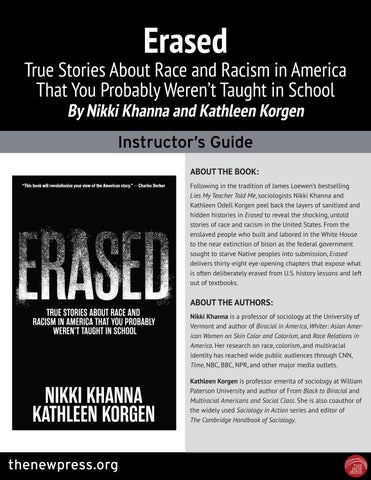
True Stories About Race and Racism in America That You Probably Weren’t Taught in School By Nikki Khanna and Kathleen Korgen Instructor’s Guide ABOUT THE BOOK: Following in the tradition of James Loewen’s bestselling Lies My Teacher Told Me, sociologists Nikki Khanna and Kathleen Odell Korgen peel back the layers of sanitized and hidden histories in Erased to reveal the shocking, untold stories of race and racism in the United States. From the enslaved people who built and labored in the White House to the near extinction of bison as the federal government sought to starve Native peoples into submission, Erased delivers thirty-eight eye-opening chapters that expose what is often deliberately erased from U.S. history lessons and left out of textbooks.
ABOUT THE AUTHORS: Nikki Khanna is a professor of sociology at the University of Vermont and author of Biracial in America, Whiter: Asian American Women on Skin Color and Colorism, and Race Relations in America. Her research on race, colorism, and multiracial identity has reached wide public audiences through CNN, Time, NBC, BBC, NPR, and other major media outlets. Kathleen Korgen is professor emerita of sociology at William Paterson University and author of From Black to Biracial and Multiracial Americans and Social Class. She is also coauthor of the widely used Sociology in Action series and editor of The Cambridge Handbook of Sociology.
thenewpress.org
OVERVIEW
OVERVIEW
Most Americans learn a whitewashed history of the United States that tends to gloss over the racism that flows from the creation of our nation to the present time. Erased stands as a powerful corrective. Through vivid storytelling, Khanna and Korgen bring thirty-eight largely forgotten stories of racism to readers— from the enslaved people who built and labored in the White House, to the near extinction of bison as the federal government sought to starve Native peoples into submission, to the nation’s role in the Nazis’ atrocities and the sterilization of U.S. women and girls. Khanna and Korgen point out that the deliberate whitewashing of history we encounter today is nothing new—but has always been a tactic of those striving to maintain power. Learning the true history of the United States, including the stories highlighted in Erased, gives us a fuller picture of the American story and can put us on the path to a more just future.
2
This guide provides instructors with tools to easily integrate Erased into their courses. Erased contains thirty-eight stand-alone entries organized into nine chapters. Because each entry tells a self-contained story, instructors need not assign the book sequentially. They may choose to assign a single entry, several entries, an entire chapter, or readings organized around a particular theme. To support this flexibility, this guide includes a thematic index that groups entries according to major topics commonly taught in sociology, history, race and ethnic studies, education, American studies, and first-year seminar courses at the end of this instructor’s resource. The themes allow instructors to quickly identify readings that align with course units on race, slavery, citizenship, segregation, immigration, Native American history, Asian American history, Latinx history, public policy, science, medicine, education, and social movements. The guide contains four sections which include: 1. Summaries of chapters and each of the entries within them. 2. Discussion questions instructors can assign for individual chapters, entries, and the whole book. 3. In class and out of class activities. 4. A breakdown of the individual entries into themes commonly covered in courses that cover race and racism.
THE NEW PRESS DISCUSSION GUIDE
SUMMARIES Many Americans learn a version of history that erases the racial conflicts endemic to the story of our nation. People and events do not simply vanish from history on their own. Powerful individuals, institutions, and societies decide which stories to celebrate and hold up and which to avoid and keep hidden. By examining the stories they suppress, we gain a more complete understanding of the American experience and the forces that continue to shape our nation today. The facts presented in Erased reveal how governments created racial categories, how slavery shaped the nation, and how racial discrimination drove violence, displacement, inequality, and resistance from colonial America through the post—Civil War era. They also help us understand that these forces continue to shape the United States today.
CHAPTER 1: The Ridiculousness of Race Race is not a fixed biological reality. Colonial and later American governments created, revised, and enforced it as a social and political system to maintain a racial hierarchy that privileged those considered white. 1. The White Woman Who Discovered She Was Black Louisiana officials classified Susie Phipps, a woman who had lived her entire life as a white woman, as black because of a distant ancestor, revealing the arbitrary nature of racial categories. 2. When the Irish Weren’t White Nineteenth-century white Protestant Americans often regarded Irish immigrants as a separate and inferior race before gradually accepting them as white. 3. Blood Quantum and “Real” Indians
SUMMARIES
INTRODUCTION: The Whitewashing of American History
Federal officials imposed or encouraged blood quantum rules that many Native nations adopted for tribal membership, reshaping Indigenous identity and citizenship while restricting who qualified as Native American.
THE NEW PRESS DISCUSSION GUIDE
3
SUMMARIES (cont.) CHAPTER 2: Slavery and Struggle Slavery built wealth, shaped national institutions, inspired persistent resistance, and continued in different forms long after the 13th Amendment passed in 1865. 4. How All of America Was Complicit in Slavery Slavery enriched not only the South but also Northern businesses, institutions, and consumers, tying the entire nation to the exploitation of enslaved labor. 5. Slavery and the White House Enslaved people helped build, maintain, and serve the White House, placing slavery at the center of one of the most well-known symbols of American democracy. 6. Enslavers Weren’t Just White While the vast majority of slaveholders in the United States were white, some people of other racial and ethnic backgrounds also owned enslaved people, illustrating how thoroughly slavery shaped American economic and social life. 7. The Man Who Mailed Himself to Freedom and Other Stories of Defiance Enslaved people continually challenged bondage through everyday acts of resistance, daring escapes, and direct confrontations with slaveholders and the institution of slavery. 8. The Civil War Didn’t End Slavery After the Civil War, governments and employers created new systems of forced labor that continued to ruthlessly exploit black Americans for close to another century.
4
THE NEW PRESS DISCUSSION GUIDE
CHAPTER 3: Borders and Belonging From the colonial era to the present, American governments have used racially biased laws and policies to decide who belongs, who qualifies for citizenship, and who deserves protection. 9. States That Banned Black People Several states outside the South prohibited black people from living within their borders, demonstrating that racial exclusion shaped the nation far beyond the states of the Confederacy. 10. Citizens Deported by Their Own Country At various points in U.S. history, the federal government has revoked or denied the citizenship rights of Americans of color and, in some cases, expelled them from the country. 11. When Love Cost Women Their Citizenship For decades, American women could lose their citizenship simply by marrying foreign-born men from certain nations, revealing how the law treated women’s identities as dependent on their husbands. 12. Turning Away Jewish Refugees Fleeing Nazis As Jewish people sought refuge from Nazi persecution, U.S. officials turned many away, forcing desperate families back to a continent where many would face persecution, concentration camps, and death.
THE NEW PRESS DISCUSSION GUIDE
5
SUMMARIES (cont.) CHAPTER 4: Destruction and Displacement Governments and private citizens used violence, forced removal, and incarceration to destroy communities of color and seize land, resources, and power. 13. White Terrorism and Black Communities White mobs attacked and destroyed thriving black communities across the United States, targeting black success—including economic prosperity—in order to reinforce the racial hierarchy. 14. Stolen Children, Erased Cultures Government-run boarding schools brutally separated Native American children from their families and attempted to erase Indigenous languages, cultures, and identities. 15. Caged by Their Own Country During World War II, the U.S. government confined more than 120,000 people of Japanese descent, most of them U.S. citizens, in concentration camps because of their race and ancestry. 16. Highways as Weapons of Destruction Federal and local officials routed highways through thriving urban neighborhoods, disproportionately destroying black and Hispanic communities and displacing thousands of residents.
6
THE NEW PRESS DISCUSSION GUIDE
CHAPTER 5: American Apartheid White Americans built systems of segregation that restricted where black people could live, learn, travel, and pursue education, often far beyond the South. 17. Segregation Wasn’t Just Southern Communities across the United States practiced racial segregation through laws, customs, and violence, making enforced racial separation a national rather than a regional system. 18. Keeping Neighborhoods White Government agencies, banks, developers, and homeowners worked together to keep many neighborhoods racially segregated and the wealthier ones inaccessible to people of color. 19. “Leave by Sundown”—Or Else! Hundreds, possibly thousands, of towns used threats, intimidation, and violence to drive out black residents and prevent them from living within their borders. 20. When Universities Shut Out Black Students Colleges and universities excluded or segregated black students for much of American history, and many practiced racial discrimination even after the abolishment of formal racial barriers. 21. Tests Rigged for Failure Governments created literacy tests designed to disadvantage black Americans, while voter registrars administered them arbitrarily to deny many the right to vote.
THE NEW PRESS DISCUSSION GUIDE
7
SUMMARIES (cont.) CHAPTER 6: Terror and Trauma Americans used violence, intimidation, and fear to seize land, suppress political participation, enforce racial hierarchies, and limit freedom of movement. 22. Hunger Warfare and the Near-Extinction of Bison U.S. officials and settlers killed bison herds to starve Native nations and force them onto reservations. 23. The Mass Lynching You Never Learned About White mobs in Los Angeles carried out one of the largest mass lynchings in American history against Chinese residents, revealing how anti-Asian violence shaped the experiences of Chinese immigrants and other Asian Americans. 24. Blood at the Ballot Box White supremacists used violence, intimidation, and murder to overturn the gains of Reconstruction, removing black Americans from elected office and suppressing their voting rights. 25. The Mother Who Made America Look Mamie Till-Mobley transformed personal tragedy into a catalyst for change when she insisted that the nation witness the brutal reality of her son’s racially motivated murder. 26. Traveling While Black—or Jewish Black and Jewish travelers faced discrimination, exclusion, and danger as they navigated roads, hotels, restaurants, and public accommodations across the United States.
8
THE NEW PRESS DISCUSSION GUIDE
CHAPTER 7: Plunder and Profits Individuals, businesses, universities, and governments accumulated wealth by exploiting people of color and benefiting from the theft of their land and labor. 27. The Reverse Underground Railroad Kidnappers abducted thousands of free black Americans in the North and sold them into slavery in the deep South. 28. Ivory Towers, Slavery, and Seized Land Many colleges and universities built their wealth and prestige by profiting from slavery, land seized from Native American tribes, or both. 29. Racist Housing Policies That Built White Wealth Government housing policies helped millions of white families build wealth while excluding many black families from the same opportunities. 30. Reparations Paid—to Enslavers The U.S. government compensated some slaveholders for the loss of enslaved people while providing no compensation to the people who had endured slavery.
THE NEW PRESS DISCUSSION GUIDE
9
Policing SUMMARIES Public (cont.) Relations CHAPTER 8: Science and Suffering Scientists, doctors, and government officials used pseudoscience to justify racial inequality, violate human rights, conduct gruesome and often deadly experiments, and restrict, sterilize, or eliminate people they considered undesirable. 31. Fake Science, Real Oppression Scientists developed theories of racial difference based on inaccurate or manipulated data that portrayed some groups as naturally inferior and used those claims to justify racial discrimination and inequality. 32. America’s Blueprint for the Nazis American eugenics laws and racial policies helped inspire Nazi officials as they developed their own system of racial classification and persecution. 33. Medical Abuse of Black Bodies Doctors and researchers repeatedly exploited black Americans in medical experiments and denied them basic rights and protections. 34. Sterilizing Women Without Consent Government officials and medical professionals sterilized thousands of women of color without their knowledge or consent in order to control who could have children.
10
THE NEW PRESS DISCUSSION GUIDE
CHAPTER 9: Racism as Recreation Racial prejudice permeated American culture as racial stereotypes, humiliation, violence, and dehumanization became popular entertainment and lynchings became public spectacles. 35. Mockery as a National Pastime Performers, publishers, and audiences popularized racist caricatures that mocked people of color and normalized racial and religious stereotypes. 36. When Lynching Was a Spectator Sport Some white communities turned lynchings into public events, drawing crowds who treated violence against black people as entertainment. 37. Human Zoos Zoos, world’s fairs, circuses, and other venues displayed Native Americans and people from colonized nations in exhibits that portrayed them as curiosities rather than as fully human beings. 38. When Racism Rhymed Many Americans grew up singing songs and reciting rhymes that spread racist ideas and stereotypes to millions of Americans.
AFTERWARD: Why These Stories Matter The people, events, and policies featured in this book reveal that the inequalities we see today did not emerge by accident. By acknowledging that these overlooked stories of racism—and others like them—are integral parts of our nation’s history, we gain a more complete and honest understanding of where we are today. Only when we recognize the injustices of the past—and how they shape the present—can we move our nation closer to its founding promises.
THE NEW PRESS DISCUSSION GUIDE
11
DISCUSSION QUESTIONS 12
Policing DISCUSSION Public QUESTIONS Relations Classroom Discussion Questions Before discussing an entry or chapter, ask students to write answers to one or more of the following questions. 1. What surprised you most? 2. What is one important dimension of this topic that school curriculums tend to overlook? Why do you think students should learn about it? 3. Why do you think many accounts of American history do not include this story? 4. Who benefits when this story is forgotten? 5. Write a one or two sentence summary of what you read and describe how it relates to one of the themes you already covered in the course. At the end of the discussion, ask them to write an answer to one or more of the following questions: 1. Whose point during the classroom discussion did you agree with the most? Why? 2. Whose point during the classroom discussion did you disagree with the most? Why? 3. What’s a question or point you can make now that no one raised during the class discussion? 4. How does learning about this make you feel? Why? 5. If you were teaching a U.S. history course in a K-12 school, would you want to cover this in your class? Why?
End-of-Book Discussion Questions 1. 2. 3. 4. 5.
What themes appear across multiple chapters? Why is it important that you know these stories? What U.S. institutions contribute to historical erasure? How does historical erasure affect present-day inequalities? Which chapter or entry should be required reading in every U.S. history course? Why?
THE NEW PRESS DISCUSSION GUIDE
ACTIVITIES In-Class Activities Historical Erasure Reflection Time: 5 minutes Have students write and be prepared to share answers to the following questions: • Identify one person, event, or policy from the reading you had not learned about before. • Why do you think this story is often overlooked, and what might change if more people learned it?
Pattern Finder Time: 5–10 minutes Ask students: “Which of the following patterns do you see most in this reading?” • Possible patterns: • exclusion • resistance • government action • government inaction • economic exploitation • violence • resilience • resentment Pair up with a classmate, share your answers, and discuss. Talk, Compare, Reflect Time: 5 minutes Ask students to do the following: 1. Share the story from the reading that disturbed, surprised, or affected you the most. 2. Listen as your partner explains their choice. 3. Discuss why learning difficult histories can be uncomfortable. Why is it important to remain open to those feelings rather than avoid them?
THE NEW PRESS DISCUSSION GUIDE
ACTIVITIES
Should This Be Taught? Time: 5 minutes Ask students: “Should every high school student learn this story? Why or why not?” Have them write a two-sentence response and discuss it with a classmate.
13
Policing ACTIVITIES Public (cont.) Relations In-Class Activities (cont.) Connecting the Dots Time: 10-15 minutes Divide students into groups of 3–4. Ask each group to discuss: 1. What story from the reading surprised you most? 2. Why do you think this story is not widely known? 3. What larger theme does this story reveal about American history? Then, have the members of each group come up with one sentence they can agree on that completes the following statement: “This reading helps show why __________________________.” Ask one member of each group to share the sentence with the class.
Out-of-Class Activities Local History Investigation Using resources from your local library and/or historical society, identify and research an important race-related event from your region that you did not previously know about. Create a one-page history of the event using bullet points. Present your findings to the class and explain why you think others should know about it. Interview Project Ask two people whether they ever learned about one topic from Erased. If they did, ask what they remember learning. Then share the information from the book with them and compare their responses to what Erased explains.
14
THE NEW PRESS DISCUSSION GUIDE
THEMES & ENTRIES The thematic groupings are a teaching tool rather than a rigid classification system. Many entries connect to multiple themes. For example, an entry on housing discrimination may also relate to government policy, economic inequality, and segregation. You can use the themes in whatever way best supports your course’s objectives and student learning outcomes. The Social Construction of Race
#1 The White Woman Who Discovered She Was Black #2 When the Irish Weren’t White #3 Blood Quantum and “Real” Indians #31 Fake Science, Real Oppression
Slavery, Resistance, and Its Legacies #4 How All of America Was Complicit in Slavery #5 Slavery and the White House #6 Enslavers Weren’t Just White #7 The Man Who Mailed Himself to Freedom and Other Stories of Defiance #8 The Civil War Didn’t End Slavery Citizenship, Immigration, and Belonging #9 States That Banned Black People #10 Citizens Deported by Their Own Country #11 When Love Cost Women Their Citizenship #12 Turning Away Jewish Refugees Fleeing Nazis Indigenous Erasure and Survival #3 Blood Quantum and “Real” Indians #14 Stolen Children, Erased Cultures #22 Hunger Warfare and the Near-Extinction of Bison Racial Terror and Political Violence #13 White Terrorism and Black Communities #23 The Mass Lynching You Never Learned About #24 Blood at the Ballot Box #25 The Mother Who Made America Look #36 When Lynching Was a Spectator Sport
THE NEW PRESS DISCUSSION GUIDE
THEMES & ENTRIES
Using the Themes in This Guide
15
Policing THEMES Public & ENTRIES Relations (cont.) Using the Themes in This Guide (cont.) Segregation and Oppression #17 Segregation Wasn’t Just Southern #18 Keeping Neighborhoods White #19 “Leave by Sundown”—Or Else! #20 When Universities Shut Out Black Students #21 Tests Rigged for Failure #26 Traveling While Black—or Jewish Housing and the Geography of Inequality #16 Highways as Weapons of Destruction #18 Keeping Neighborhoods White #19 “Leave by Sundown”—Or Else! #29 Racist Housing Policies That Built White Wealth Government Policies and Racial Inequality #9 States That Banned Black People #15 Caged by Their Own Country #16 Highways as Weapons of Destruction #29 Racist Housing Policies That Built White Wealth #30 Reparations Paid—to Enslavers Wealth, Labor, and Economic Exploitation #4 How All of America Was Complicit in Slavery #27 The Reverse Underground Railroad #28 Ivory Towers, Slavery, and Seized Land #29 Racist Housing Policies That Built White Wealth #30 Reparations Paid—to Enslavers Science, Medicine, and Eugenics #31 Fake Science, Real Oppression #32 America’s Blueprint for the Nazis #33 Medical Abuse of Black Bodies #34 Sterilizing Women Without Consent Racism as Entertainment #35 Mockery as a National Pastime #36 When Lynching Was a Spectator Sport #37 Human Zoos #38 When Racism Rhymed
16
THE NEW PRESS DISCUSSION GUIDE
Gender, Race, and Reproduction #10 Citizens Deported by Their Own Country #11 When Love Cost Women Their Citizenship #34 Sterilizing Women Without Consent Education, Memory, and Historical Erasure #14 Stolen Children, Erased Cultures #20 When Universities Shut Out Black Students #28 Ivory Towers, Slavery, and Seized Land Resistance, Activism, and Social Change #7 The Man Who Mailed Himself to Freedom and Other Stories of Defiance #25 The Mother Who Made America Look Democracy, Voting, and Political Power #9 States That Banned Black People #13 White Terrorism and Black Communities #24 Blood at the Ballot Box
THE NEW PRESS DISCUSSION GUIDE
17
The New Press PULISHING IN THE PUBLIC INTEREST Thank you for engaging with this book published by The New Press; we hope you enjoyed it. New Press books and authors play a crucial role in sparking conversations about the key political and social issues of our day. To find your next read and learn more, follow us on social media and visit us at thenewpress.org
ACADEMIC REQUESTS To request an Exam / Desk Copy for course use the QR code below fill out our Academic Requests form or email academic@thenewpress.org
SCAN QR CODE FOR DESK AND EXAM COPY REQUESTS
18
THE NEW PRESS DISCUSSION GUIDE