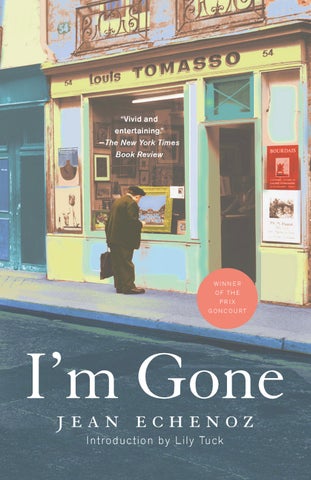
I’m Gone A Novel
Jean Echenoz
Translated by Mark Polizzoti
with an introduction by lily tuck
The New Press gratefully acknowledges the Florence Gould Foundation for supporting publication of this book.
Copyright © 1999 by Les Éditions de Minuit, 7, rue Bernard-Palissy, 75006 Paris
English translation copyright © 2001 by Mark Polizzotti
Introduction copyright © 2014 by Lily Tuck
All rights reserved.
No part of this book may be reproduced, in any form, without written permission from the publisher.
Requests for permission to reproduce selections from this book should be mailed to: Permissions Department, The New Press, 120 Wall Street, 31st floor, New York, NY 10005.
Originally published in France as Je m’en vais by Les Éditions de Minuit, 1999
First published in the United States by The New Press, New York, 2001
This edition published by The New Press, 2014
Distributed by Perseus Distribution
ISBN 978-1-59558-999-6 (paperback)
ISBN 978-1-62097-001-0 (e-book)
The Library of Congress has cataloged the hardcover edition as follows: Echenoz, Jean.
[Je m’en vais. English]
I’m gone : a novel / Jean Echenoz ; translated by Mark Polizzotti. pages cm
ISBN 1-56584-628-1 (hc.)
I. Polizzotti, Mark. II. Title.
843'.914—dc21
PQ2665.C5 J413 2001
00-064601
The New Press publishes books that promote and enrich public discussion and understanding of the issues vital to our democracy and to a more equitable world. These books are made possible by the enthusiasm of our readers; the support of a committed group of donors, large and small; the collaboration of our many partners in the independent media and the not-for-profit sector; booksellers, who often hand-sell New Press books; librarians; and above all by our authors.
www.thenewpress.com
Composition by dix! This book was set in Stempel Garamond
Printed in the United States of America
2 4 6 8 10 9 7 5 3 1
I NTR O DU C TI O N
Lily Tuck
“I’m going,” Felix Ferrer declares to his wife without further explanation, neither to her nor to the reader. He is relieved but also, perversely, put out that she does not make more of a fuss. Then, getting on the metro at the Corentin- Celton stop, he stares at the advertisement panels for floor coverings, dating services, and real estate listings before opening his briefcase and taking out a catalogue featuring Persian art that he reads until it is time to get off at the Madeleine stop.
Jean Echenoz in I’m Gone, his ninth novel—which won the Prix Goncourt in 1999—with his purposely quotidian and meticulous details that belie an emotional response sets up a pattern of irrelevance (or is it an ambivalence?) that is specific to and indicative of the narrative’s brilliant indirection, a fundamental characteristic of Echenoz’s oeuvre.
Felix Ferrer (so named, according to Echenoz, because he liked the sound of the name, which reminded him of the actor Mel Ferrer and the singer Nino Ferrer, and also because the initials F.F. pleased him), like many of Echenoz’s heroes, is fiftyish, fairly good-looking, hapless, restless, desperate, and an inveterate womanizer. Ferrer, the owner of a struggling art gallery, learns from his assistant, a man named Delahaye, about a ship called the Nechilik filled with valuable Paleoarctic art (mammoth tusks covered with blue vivianite, snow goggles made from reindeer antlers, a whale carved in baleen, knickknacks made of seal ulna and muskox horn, etc.) run aground and abandoned for the past forty years on an ice floe in the Arctic, and decides to go find it and bring back the art.
Long before writing this novel, Echenoz claims he saw a photograph of the shipwrecked Nechilik in an old National Geographic magazine and, intrigued, copied down the details of the story in his notebook—a commercial boat, 23 meters long, built in 1942 and registered in Saint John, New Brunswick—so that he could use them later. He also claimed that the real Nechilik, which held no artifacts and was by then stripped of everything but two oil lamps, turned out to be his “MacGuffin” (a term made popular by Alfred Hitchcock signifying a plot device in the form of an objective that the protagonist pursues with little narrative explanation or importance), which in itself is a telling fact about the author’s subversive approach to the art of fiction.
An art, perhaps, best described by Ken Kesey as “a lie in the service of the truth.”
Critics have variously called Jean Echenoz a magician, a gambler, and a juggler. Like a magician, Echenoz creates the illusion that improbable events might in fact be probable; like a gambler, he takes risks, such as avoiding a linear narrative, switching points of view, jumping locations, foretelling, and providing his characters with no plausible motives. Gary Indiana in Bookforum writes that Echenoz shows us “a wholly different way of thinking of ourselves and our predicament, a juggler of verbal knives who, if not for his preternatural grace, could easily slice his arm off while displaying a hypnotic and arguably pointless skill. I say ‘arguably’ because the vastly entertaining is often mistaken for pointless.”
Echenoz’s prose is grimly and hilariously funny, as Mark Polizzotti’s excellent translation proves. The description of Ferrer’s lover’s door, which, instead of bearing a name, has a photo “depicting the lifeless body of Manuel Montoliu, an ex-matador-cum-banderillero, after an animal named Cubatisto had opened his heart like a book on May 1, 1992.”
A description of the stable of artists represented by Ferrer’s gallery is risibly recognizable: “naturally some painters, like Beucler, Spontini, Gourdel, and especially Martinov—who was rather visible these days and worked only in yellow— as well as a few plastic artists. Eliseo Schwartz, for example, who, specializing in extreme temperatures had invented
closed-circuit blowers . . . or Charles Estrellas, who haphazardly installed little hillocks of glazed sugar and talcum powder. . . . Marie-Nicole Guimard, who dealt in blow-ups of insect bites . . .” (In this case, Echenoz is not sure where he got the names except for Eliseo Schwartz and Charles Estrellas, who made an appearance in his previous novel, Chopin’s Move.) During a tryst, he describes a woman’s black bra falling to the floor and looking like a pair of outsized sunglasses. “Better to laugh,” Echenoz has told an interviewer, “otherwise things tend to be . . . un peu catastrophique, n’est ce pas?” Likewise, the description of the Inuit guide’s weapon is not easily forgotten: “Napaseekadlak’s knife had a handle made of oosik, the bone that acts as a walrus’s sexual organ and whose qualities of suppleness, resistance, and porosity give it an ideal grip.” (The Arctic guides Napaseekadlak and Angoutretok, according to Echenoz, have real Inuit names that luckily, he says, work out well, as the names are fittingly romanesque— i.e., fanciful.)
Inert objects, cars, the metro, and especially the weather are freely anthropomorphized: “Those clouds don’t look so good, lined up and determined like a professional army. Moreover, the weather has turned suddenly, as if winter were losing patience, threatening to be in ill humor and shoving autumn aside with hostile gusts to take its place as soon as possible.” The fabulous is evoked with an equal amount of ease, as the description of Suzanne, Ferrer’s ex-wife, shows: “It’s just that she has always been a neolithically violent person, and Ferrer sometimes wonders if he didn’t meet her at
the mouth of a cave: Suzanne holding a club in one hand, a flint hatchet stuck in her belt. That day she was wearing a pterodactyl-wing suit under a trench coat cut from an ichthyosaur’s eyelid, and sporting an iguanodon’s nail fitted to the shape of her head.”
No stranger to the vagaries of human behavior— Echenoz majored in sociology—he makes observations on character that are pithy and perfect; one of my favorites is his description of the judge who grants Ferrer and Suzanne their divorce: “The judge was a gray-haired woman, at once calm and tense: calm in that she felt accustomed to being a judge, tense in that she knew she would never be entirely accustomed to it.”
Meantime, in I’m Gone, the gallery assistant Delahaye has died—mysteriously, of course—only to be resurrected later in the form of a murderous character named Baumgartner in a twist that echoes the denouement of Graham Greene’s The Third Man.
Echenoz’s novels are not easy to classify, and harder still to describe is his style, where the terms “postmodern,” “minimalism,” “experimental,” and so on are both overused and too facile to provide any meaningful clarity or application. The French have tried by hailing Echenoz as the leader of the “école du dérisoire” (the school of the derisory), which refers to how French authors subvert the now overly familiar and clichéd conceits of spy novels, detective stories, and thrillers. Echenoz’s work has also been compared to that of Raymond Queneau (one of Queneau’s most
I’m Gone
“I’m going,” said Ferrer. “I’m leaving you. You can keep everything, but I’m gone.” And as Suzanne’s gaze drifted toward the floor, settling for no good reason on an electrical outlet, Felix Ferrer dropped his keys on the entryway table. Then he buttoned up his overcoat and walked out, gently shutting the front door behind him.
O utside, without a glance at Suzanne’s car whose foggedup windows kept silent beneath the streetlamps, Ferrer began walking the six hundred yards toward the CorentinCelton metro stop. At nearly nine o’clock, this first Sunday evening in January, the train was all but deserted. Only a dozen men were inside, unattached, as Ferrer seemed to have become in the last twenty-five minutes. Normally he would have rejoiced to find two empty facing benches, like a little compartment for himself alone, which in the metro was his preferred seating arrangement. But on this evening
he scarcely gave it a thought, distracted but less preoccupied than he would have imagined by the scene that had just been played out with Suzanne, a woman of difficult character. Having envisioned a more vehement response, cries interspersed with threats and fiery insults, he was relieved, but somewhat put out by his own relief.
He set down his valise, which contained mainly toiletries and a change of underwear, and at first he stared straight ahead, mechanically skimming over the advertising panels for floor coverings, dating services, and real estate listings. Later, between the Vaugirard and Volontaires stations, Ferrer opened the valise to remove an auction catalogue featuring traditional Persian artwork, which he leafed through up to Madeleine, where he got off.
Around the Madeleine church, strings of unlit Christmas lights hovered above streets still more deserted than the subway. The decorated windows of the high-priced shops reminded the nonexistent pedestrians that they would survive the end-of-year festivities. Alone in his overcoat, Ferrer skirted the church toward an even number on Rue de l’Arcade.
To find the building’s entry code, his hands forged a path under his clothing: the left one toward the address book slipped into an inside pocket, the right toward his glasses stuffed into a breast pocket. Then, having passed through the main door, ignoring the elevator, he firmly attacked the service stairs. He reached the sixth floor less out of breath than I would have imagined, in front of a badly repainted
brick-red door whose hinges bespoke at least two attempted break-ins. No name on the door, just a tacked-up photo curling at the corners, depicting the lifeless body of Manuel Montoliu, an ex-matador-cum-banderillero, after an animal named Cubatisto had opened his heart like a book on May 1, 1992: Ferrer tapped lightly on the photo twice.
While he waited, the nails of his right hand dug into the inner surface of his left forearm, just above the wrist, where numerous tendons and blue veins intersected under whiter skin. Then, her hair very dark and very long, no older than thirty nor shorter than five foot ten, the young woman named Laurence who had just opened the door smiled at him without saying a word before closing it behind them both. And the next morning at around ten, Ferrer left for his studio.
publishing in the public interest
Thank you for reading this book published by The New Press. The New Press is a nonprofit, public interest publisher. New Press books and authors play a crucial role in sparking conversations about the key political and social issues of our day.
We hope you enjoyed this book and that you will stay in touch with The New Press. Here are a few ways to stay up to date with our books, events, and the issues we cover:
• Sign up at www.thenewpress.com/subscribe to receive updates on New Press authors and issues and to be notified about local events
• Like us on Facebook: www.facebook.com/ newpressbooks
• Follow us on Twitter: www.twitter.com/thenewpress
Please consider buying New Press books for yourself; for friends and family; or to donate to schools, libraries, community centers, prison libraries, and other organizations involved with the issues our authors write about.
The New Press is a 501(c)(3) nonprofit organization. You can also support our work with a tax-deductible gift by visiting www.thenewpress.com/donate.
Click here to learn more about the book.