
Eating Behind Bars
Ending the Hidden Punishment of Food in Prison
with Alex Busansky and Dr. Aishatu R. Yusuf
Impact Justice
Leslie Soble
© 2025 by Impact Justice
A ll rights reserved.
No part of this book may be reproduced, in any form, without written permission from the publisher.
Portions of this book were initially published by Impact Justice in 2020
Requests for permission to reproduce selections from this book should be made through our website: https: //thenewpress.org /contact-us/.
Published in the United States by The New Press, New York, 2025
Distributed by Two Rivers Distribution
ISBN 978-1- 62097-840-5 (paperback)
ISBN 978-1- 62097-937-2 (ebook)
CIP data is available
The New Press publishes books that promote and enrich public discussion and understanding of the issues vital to our democracy and to a more equitable world. These books are made possible by the enthusiasm of our readers; the support of a committed group of donors, large and small; the collaboration of our many partners in the independent media and the not-for-profit sector; booksellers, who often hand-sell New Press books; librarians; and above all by our authors.
www.thenewpress.org
Book design and composition by Bookbright Media
Composition by Bookbright Media
This book was set in Wolfgang, Acumin Variable, and Loos.
Printed in the United States of America
10 9 8 7 6 5 4 3 2 1
Preface by Alex Busansky and Dr. Aishatu R. Yusuf v ii
Introduction
Food is a universal human right. It is not conditional on being good or bad, rich or poor, left or right. 1
José Andrés, chef and founder of World Central Kitchen
Good food nourishes the body. It also does much more. We turn to food for pleasure and comfort. What we cook and eat affirms who we are, both as individuals and as members of families and communities. We can trace our personal and collective stories through ingredients and recipes that document origin, migration, and cultural exchange. Shared meals connect us, expanding and strengthening the web of relationships on which we rely. There is a reason people have been breaking bread together since the dawn of our species: Preparing a meal or enjoying one made by someone else is a fundamental part of the human experience.
Every day, nearly 6 m illion meals are served to people held in U.S. prisons and jails. As you’ll learn in the following pages, the nature of those meals and the overall eating experience have no parallel outside of confinement. Incarcerated people routinely endure hunger, malnourishment, and food that is tasteless, spoiled, or not intended for human consumption. They typically eat in tense, humiliating environments that hinder digestion and strip away any comfort the meal might provide—experiences that leave
lasting emotional scars. In other words, a positive relationship with food, so elemental to the human condition and vital to health and well-being, is systematically denied to people in jail and prison. This largely hidden crisis is only now beginning to receive the attention it deserves.
“In the worst conditions you can imagine—a fter hurricanes, earthquakes, bombs, and gunfire—the best of humanity shows up” to ensure our fellow humans do not go hungry, chef and World Central Kitchen founder José Andrés has written. 2 Throughout history, people have routinely cooked and served meals to those in need—from ancient religious precepts to feed the hungry to the soup kitchens that spread from Europe to the United States during the Great Depression, from the Black Panthers’ free breakfast for schoolchildren as part of their revolutionary efforts to strengthen Black communities to charitable organizations that deliver meals to those too sick to cook for themselves.
The growing movement for food justice digs deeper to address systemic inequities so that more people can nourish themselves: Urban farmers are reclaiming land to supply fresh produce to neighbors, economic incentives are bringing community-owned grocery stores to historically marginalized areas, and programs are helping recent immigrants access the food they need to cook meals that taste like home. The food justice movement is also increasingly aligned with efforts to improve health, reduce food waste, and respond to a changing climate. This book is about the potential for that movement to reach the millions of people behind steel gates, barbed wire, and concrete walls in carceral facilities across America, where they are out of sight and often ignored.
As an ethnographer and folklorist specializing in food and foodways, I have explored a wide range of food-related topics but had never given much thought to the experience of eating in prison until September 2018 when an Impact Justice job posting caught my attention. The organization was seeking a researcher to lead a nationwide investigation into the state
of food in prison and its consequences. I quickly penned a cover letter, acknowledging that while I had limited knowledge of the criminal legal system, I could leverage my extensive experience studying food as both a biological need and an expression of identity and culture, and so began my immersion into the world of the carceral eating experience. I share this because, not that long ago, I was not so different from many readers of this book: unaware of the crisis of eating behind bars and its profound repercussions.
It can be difficult to grasp the full scope of mass incarceration in the United States. While the country accounts for about 4 percent of the world’s inhabitants, it holds roughly 20 percent of the global incarcerated
If Incarceration Were a U.S. City, It Would Be the Fifth Largest















Sources: U.S. Census Bureau (2023) and Prison Policy Initiative (2023)

population. Although the United States no longer tops the list in terms of our rate of incarceration (with El Salvador, Cuba, and Rwanda now ahead), we still lock up 614 of every 100,000 residents. Each U.S. state incarcerates more people per capita than most countries. Even Massachusetts, with the lowest incarceration rate among the 50 states (241 per 100,000 residents), proportionally has more people behind bars than Iran, and far more than Australia, Canada, Norway, or Japan.3
To convey the reach of the carceral apparatus another way, if incarceration were a city, it would be the fifth largest in the country, more populous than Phoenix or Philadelphia. Nearly 2 m illion people are confined in prisons, jails, juvenile facilities, immigration detention centers, and other
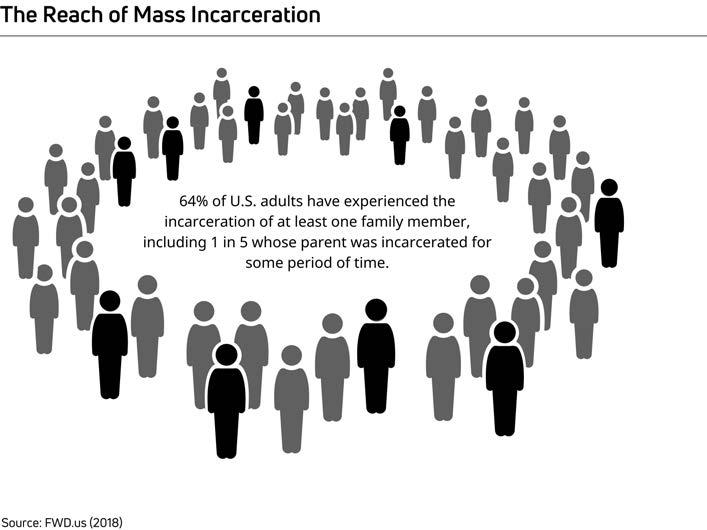
institutions of confinement on any given day, with exponentially more passing through over the course of a year.4 The vast reach and constant churn of the carceral system have resulted in a society where, as of 2018, more than half of all U.S. adults had at least one family member who had spent time in prison or jail, including one in five whose parent was incarcerated at some point.5
It bears repeating what others have thoroughly documented: The burden of mass incarceration is borne disproportionately by people of color, particularly Black Americans, as well as individuals of all races from lowincome communities. While one in twenty white men born in the United States in 2001 will be incarcerated at some point in their lives, the predicted rates among Black and Latinx men are one in five and one in eight, respectively.6 Black women are incarcerated at nearly twice the rate of white women, and nearly half of all Black transgender women will spend time in prison or jail.7 Nonwhite individuals are also more likely to receive and serve longer sentences. 8 The emotional, physical, and financial toll of missing and supporting an incarcerated loved one also disproportionately impacts people of color. For instance, half of all Black women have a loved one who is incarcerated, and one in four Black children will experience a parent’s incarceration by their early teens.9, 10
Incarceration is both a cause and a consequence of poverty. An estimated 40 percent of all crimes are directly linked to poverty, and roughly 80 percent of incarcerated individuals were low-income before their confinement.11 Incarceration often creates a vicious cycle that perpetuates poverty across generations: One in three people serving time in a state prison has a parent who was also incarcerated.12 Lower-income communities of color that lose members to mass incarceration are also the same communities where affordable, healthy, and culturally relevant food is often least available. When the food provided in jails and prisons is even worse, these facilities exacerbate patterns of ill health in communities
already grappling with profound inequities. This is a prime example of “food apartheid,” a term coined by activist Karen Washington to describe the systemic racism and underlying drivers of inequality that permeate our food system, reminding us that a so-called food desert is neither naturally occurring nor desolate.13
Food insecurity has serious repercussions for physical, mental, and behavioral health. Rates of heart disease, diabetes, and hypertension rise in tandem with food insecurity.14 People who are food insecure generally experience significant stress, which not only taxes their bodies but also can lead to unhealthy coping mechanisms. Given the systemic inequities that underlie both food insecurity and mass incarceration, it’s not surprising that four of the five states with the highest rates of food insecurity—A rkansas, Louisiana, Mississippi, Oklahoma—are also among the five states with the highest rates of incarceration.15
For many people, the problem persists after release, largely because a history of incarceration suppresses employment opportunities and wages, which jeopardizes access to stable housing and nutritious food. A 2019 study found that about one in five formerly incarcerated individuals struggle with food insecurity—double the rate of the general population— with even higher rates among formerly incarcerated women of all races and formerly incarcerated Black people of all genders.16 When adults are food insecure, so are their children, which can negatively impact their physical, mental, and behavioral development in ways that can have lifelong consequences.
Precisely because food is integral to one’s identity, it has been used to dehumanize, humiliate, punish, and control groups of people throughout history. During the Spanish Inquisition and in Nazi Germany, Jewish people were coerced into eating pork, often considered the most offensive of
nonkosher foods. Native American tribes forcibly severed from traditional food sources had to subsist on government commodities like white flour and lard. More recently, as thousands of unaccompanied Central American children crossed the southern United States border to escape violence in their home countries, some Americans complained that their tax dollars were being used to buy corn tortillas, the culturally appropriate food staple, when FEMA had already purchased flour tortillas.
Food in prison is similarly used to control, punish, and shame. “I can’t express enough how much people are aware of the terrible food they are exposed to. . . . It is depressing . . . brings down morale, increases stress, and leaves people hopeless,” wrote one person with an incarcerated loved one. In this way, the poor quality of meals—breakfast, lunch, and dinner, day after day—profoundly affects the overall environment and safety of a facility. Several corrections leaders told us that, for many years, the prevailing attitude was to “fill them up so they go to sleep” by providing plenty of sugary, fat-heavy calories. From references to “feeding times” to the routine appearance of packaged foods marked “not for human consumption,” the quality of food in prison sends a clear message: You are not worthy; you are less than human. These stigmatizing insinuations and accompanying images, like grimy trays filled with unidentifiable slop, permeate the culture as another symbol of the horrors of prison. This only further distances us from the actual human beings who are incarcerated, making the degrading experience of eating behind bars seem acceptable and unchangeable.
While there has never been a golden age of prison food, the quality of the food sank to new lows as the incarcerated population skyrocketed— from half a million people in 1980 to more than 2.4 m illion behind bars at the peak in 2008.17 With few exceptions, a nationwide trend of poor and declining quality has continued unabated. Budget cuts and stagnant spending have resulted in fewer hot meals, smaller portions, lower-quality
ingredients, fewer fresh fruits and vegetables, and more prepackaged foods. Inadequately equipped and poorly supervised kitchens further degrade the quality. While media outlets have exposed appalling conditions in for-profit prisons operated by corporations such as CoreCivic and the GEO Group, the problem runs much deeper than privatization.
A person sentenced to state prison serves nearly three years on average— that’s approximately 3,000 meals behind bars—and many people are incarcerated for far longer.18 All the while, they are consuming ultraprocessed meals high in salt, sugar, and refined carbohydrates, and low in fruits, vegetables, quality proteins, and essential nutrients. In a nation where Michael Pollan’s mantra to “eat food, not too much, mostly plants” has become a common axiom, people in prison are fed a diet that for decades everyone else has been advised to avoid.19 Research shows that just one month of unhealthy meals can lead to long-term increases in cholesterol and body fat, raising the risk of diet-related diseases. 20 An unhealthy diet also suppresses the immune system, making incarcerated people more vulnerable to viruses and other illnesses. 21 In addition to declines in physical health, nutrient deficiencies contribute to a wide range of mental health and behavioral issues. 22
While some people enter prison in far less than optimal health, often in part because they come from food-insecure communities, the food they consume while incarcerated nearly guarantees they will leave prison even less healthy and more traumatized. Those who begin their sentences in decent health are also likely to deteriorate physically, mentally, and emotionally. For this reason and others—including the extraordinary amount of food wasted in carceral facilities simply because it’s too awful to eat—I cannot imagine, over six years into this work, a food justice movement that doesn’t include the voices and concerns of people who are or have been incarcerated.
The first part of this book draws heavily from Impact Justice’s 2020 report, also titled Eating Behind Bars. This groundbreaking, original report was the product of eighteen months of fact-fi nding, with an emphasis on state prison systems, where more than half of all incarcerated people are held. My colleagues at Impact Justice and I began by thoroughly reviewing the limited body of existing research on prison food, alongside other scholarly literature, relevant litigation, and media coverage. To fill in the significant gaps, we conducted our own investigation, which included surveying 250 formerly incarcerated individuals from 41 states, as well as 230 people with an incarcerated or formerly incarcerated family member or friend. We also carried out in-depth interviews with formerly incarcerated people and their loved ones, facilitated focus group discussions in two prisons, and spoke informally with incarcerated individuals at all seven facilities we were able to visit.
To understand the operational realities of serving food in prison, we systematically reviewed food-related policies and practices in all fifty states. This involved analyzing publicly available information, surveying thirtyfive state departments of corrections (we reached out to all fifty but only thirty-five responded), and interviewing more than three dozen corrections professionals. We observed food service operations firsthand by visiting prisons in California, Maine, Virginia, and Washington—the only states to grant our request at the time. We also consulted with experts in public health, medicine, psychology, law, and other relevant fields, as well as individuals working to improve food quality in schools, hospitals, and food assistance programs.
Since the release of our 2020 report, we have surveyed or spoken with hundreds more people who are or have been incarcerated. We have v isited
Impact Justice 2019
National As sessment
sur veys from former ly incarcer ated people in 41 states 250
sur veys from friends and family members of incarcer ated people
43
inter views with current and former corrections staff in 12 states
11
in-depth inter views with former ly incarcer ated people
50
state policies reviewed and 35 state agencies sur veyed
additional prisons and jails around the country, and sampled (or, sometimes with relief, not been invited to sample) the food. We have also developed relationships with corrections staff and leaders that have deepened our understanding of the significant challenges that stand in the way of meaningful change.
Part One of this book takes you on a journey through the hidden world of eating behind bars. We take a close look at the food itself, primarily through the recollections of people who are or were incarcerated, and discuss carceral facilities as major sources of food waste. We explore how the food provided erodes physical health, mental and emotional wellness, and human dignity. We also describe the eating environment and its impact, and examine commissaries and canteens as expensive, additional drivers of poor nutrition that nevertheless provide a way for incarcerated people to reclaim a sense of self and connect with one another. The final
chapter of Part One dissects the “prison food machine” to explain why and how food in prisons and jails is typically unhealthy, unappealing, and wasteful.
In Part Two we pivot to envision a very different experience of eating behind bars and discuss pragmatic ways to make progress toward that vision and address the human rights, health equity, and environmental crises surrounding the food currently available in carceral facilities. We explore a variety of initiatives and innovations, including some spearheaded by Impact Justice, that are disrupting and reconfiguring prison food systems to provide food that is better for incarcerated people and the planet. These initiatives include “farm-to-tray” programs that increase access to fresh produce and other nourishing foods inside carceral facilities while supporting small growers and producers. We also highlight efforts to promote more cooking from scratch as the best way to provide nutritious and appealing meals that also reduce food waste. Some of these initiatives not only improve the eating experience, but also provide life skills and job training that boost an individual’s employment prospects after release. Additionally, we discuss how grassroots organizations are on the front lines of raising awareness and changing public policies that can become the backbone of lasting change, reminding us that anyone can play a role in advancing the movement for food justice inside jails and prisons.
It’s easy to bash the food on most prison trays. It’s much harder to navigate the nuances of a multifaceted issue, laden with politics and power dynamics, and where change depends on forming genuine partnerships with corrections professionals. The challenges I wrestle with daily were magnified during the process of writing this book for a broad audience.
As someone who has never been incarcerated or directly impacted by the criminal legal system, the question of whether I am the most appropriate
person to tell this story is always present in my mind. To explain my role, I often relay an anecdote a fellow folklorist shared at a conference years ago: When a taxi driver asked what her job was and she answered, “I’m a folklorist,” the driver replied, “Oh, folklore! Small things, big meanings!” As an ethnographer and folklorist who specializes in food, I help people make sense of the bigger meanings in this quotidian topic, weaving together my knowledge with the insights of people who have lived experience in an effort to address a grave injustice.
It’s also tricky to navigate the ethics of praising a department of corrections for taking steps to improve food and the eating experience, especially when harm persists through both the food provided and incarceration overall. I put substantial thought into which initiatives and advances to include—recognizing that none are perfect—and which aspects of those examples to share (or not share), because the road to change is rarely smooth. However, on most days, I genuinely believe these incremental steps can serve as a foundation for more significant transformations in the future.
Throughout this book, the term “corrections” is used when referring to agencies and professionals because that is how the profession describes itself. The word “carceral” is used to reference any environment in which people are confined, to emphasize the reality of incarceration. While many people, myself included, reject the notion that any human being requires “correcting” by the systems that exist today, healing and personal growth can occur while someone is incarcerated. A far better eating experience would support this healing and growth. Even as we envision and build systems that invest in human potential rather than perpetuating endless punishment, and that use incarceration sparingly or not at all, we have a moral obligation to treat those who are incarcerated with care and dignity. This includes access to nourishing food. Not only is this the right thing to do, it also has wide-reaching benefits. Nearly everyone we incarcerate is
eventually released, and our families and communities are stronger when those people return home healthy.
The issue of food in prison and the deeply harmful conditions of confinement are intrinsically linked to larger, vexing questions about justice, accountability, and healing in a country that invests so heavily in punishment. How can we hold people accountable for harm without inflicting more harm on them and their communities? How do we balance personal responsibility with the reality that no one operates independent of context, and not everyone has equal opportunity to thrive? And how do we reconcile the fact that most people who cause harm have also been harmed, and require support to heal from the trauma they have experienced?
This book doesn’t have the answers, but it does make one thing clear: We’re not making anyone safer by wielding food as a weapon of punishment. Safety comes when people’s fundamental needs for shelter, sustenance, connection, and purpose are met, and when we treat each other with care and respect. This isn’t outside the realm of possibility, especially when it comes to food. We are fortunate to live in a country where nourishing food is still abundant. We don’t have to choose between providing healthy, appealing food in prison and healthy, appealing school lunches, for example. It is possible to have both. Everyone deserves and should have food that tastes good and is good for them. At the heart of this book is a reckoning: If we are what we eat, as the saying goes, then who are the parents, children, siblings, partners, co-workers, neighbors, and friends who are incarcerated, and who do we want them to become?
Whether we experience abundance or lack, spend hours preparing elaborate meals or rely primarily on the microwave, we all have feelings, stories, thoughts, and opinions about food. By biological necessity and cultural design, it’s one thing we have in common. So pause and think for
a moment about the role of food in your own life—the joy, the pain, the sacred, the mundane—and then read on.
Leslie Soble Senior Program Manager
Food In Prison Project, Impact Justice
About the Authors
Leslie Soble, an ethnographer and folklorist who specializes in food and foodways, is an internationally recognized voice on the carceral eating experience. In addition to leading the Food in Prison Project at Impact Justice, she is founder and artistic director of Story Soup, which facilitates dialogue across cultures and generations through food. She lives in Washington, DC.
Alex Busansky has spent the entirety of his career championing justice, working within existing legal systems, leading nonprofit organizations, and spearheading creative interventions that expand opportunity for system-impacted people. He is founder and president of Impact Justice and a board member of the Ms. Foundation. He lives in Berkeley, California, with his family.
Dr. Aishatu R. Yusuf is a recognized change maker with expertise in the systemic barriers that keep individuals and communities from reaching their potential. As vice president of innovation programs at Impact Justice, she oversees a portfolio of transformational projects that tackle complex social problems from an intersectional perspective. She lives in Oakland, California.
Operating nationally, Impact Justice is known for its bold ideas and boundary-breaking programs that challenge America’s obsession with harsh and endless punishment.

Click here to learn more about the book.