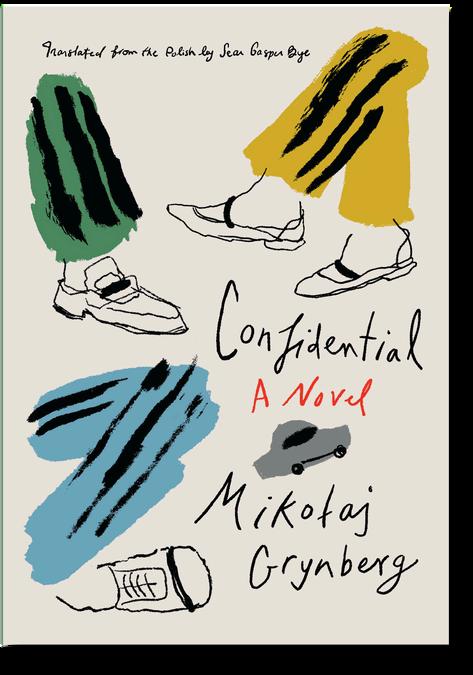

MIKO Ł AJ GRYNBERG
Translated from the Polish by Sean Gasper Bye
This publication has been supported by the ©POLAND Translation Program

© 2020 by Mikołaj Grynberg
English language translation © 2025 by Sean Gasper Bye
All rights reserved.
No part of this book may be reproduced, in any form, without written permission from the publisher.
Requests for permission to reproduce selections from this book should be made through our website: https://thenewpress.com/contact.
Published in the United States by The New Press, New York, 2025 Distributed by Two Rivers Distribution
ISBN 978-1-62097-880-1 (hc)
ISBN 978-1-62097-890-0 (ebook)
CIP data is available
The New Press publishes books that promote and enrich public discussion and understanding of the issues vital to our democracy and to a more equitable world. These books are made possible by the enthusiasm of our readers; the support of a committed group of donors, large and small; the collaboration of our many partners in the independent media and the not-for-profit sector; booksellers, who often handsell New Press books; librarians; and above all by our authors. www.thenewpress.com
Composition by Dix Digital Prepress and Design
This book was set in Centaur MT Printed in the United States of America 2 4 6 8 10 9 7 5 3 1
If I have a smoke, I’m shot, If I have a shot, I’m smoked.
—Zygmunt Grynberg
The Cacophony of the Past
Unless you know how to outrun events and, cursing the past, write a happy ending. You don’t, I can tell. You got stuck, your feet are tangled in dry roots. A drought does you no good, what you could really use are months of downpours; that would make the roots slippery, you’d pull yourself out faster. Meanwhile I suggest you practice saying goodbye to your memories. For years you’ve been running behind, you’ve got to get a handle on linear time. Being locked in a memory loop is the preserve of old men, who’ve been cut off from retrospection by the passage of years. It’s time to set time free. Take it slow, your system plays tricks on you, abrupt changes could send it into shock. Trade the circle for a timeline, not a segment—I’m sounding like some weird geometry problem. I can’t promise that, when time finally moves forward, your life will be rosy. Everything has downsides, and not many upsides. Pull your head out of the cacophony of the past. It’s where you’re from, but nobody’s left there except you. Look around and throw out the things your children won’t want to
inherit. Do the same in your mind, even though that’s much harder. What you can do is tell the story in lamentations. That sometimes works, it lets you put a subject at a safe distance. Safe, as in a distance that gives you a wider perspective to think about your own life. Is that something you’ve ever reflected on? Whether you’re living well? Whose life you’re living? It doesn’t matter now if they’d be proud of you, that’s over. Think about tomorrow, starting today.
Englishmen
Now they were just about there, they just had to leave the square and walk two hundred meters.
“If he starts screaming at the whole street again, you all go on your own this time,” she said.
Ever since the boys were born, Sunday lunches at her in-laws had become mandatory. Not every week, luckily, but at least once a month. It was always the same script, one hundred percent.
They emerged from around the street corner and glanced at that same spot—the balcony on the third floor. He’d be standing there waiting, even though it was just a quarter to two. They could see him from far off, a red-haired older gentleman gesticulating energetically. The closer they got, the more clearly they could hear he wasn’t restricting himself to just wildly waving his arms.
“How goddamned old are you?! Can’t you stick to a schedule?! I’ve been standing here for fifteen minutes scared to death that something had happened to you! How dare you put my nerves through this?!”
“I meant what I said, I can’t take this anymore.”
“Come on, Mom, don’t let it get to you. This is just how Grandpa is.”
She glanced at her husband. He shrugged helplessly and gave a kind smile, raising his bushy eyebrows. She didn’t want to seem hysterical, but she got fed up long ago with these balcony scenes.
“He’s acting like a lunatic. Maybe this time you’ll actually say something to him?” she asked, though she knew the answer full well.
“What can I say? He’s telling the truth, he’s scared to death and there’s nothing we can do about it. Let’s agree that once he dies, we’ll stop visiting him.” He looked at her with a warm smile.
“You think Grandpa’s going to die today?” asked one of their sons.
“Hopefully not yet.”
“What about you, Mom? Would you like Grandpa to die today?”
“I’d rather he didn’t. We’re in for plenty of excitement as it is.”
Ignoring the increasingly noisy shouts coming from the balcony, they reached the stairwell, passed the mailboxes and went up the stairs. They never took the elevator; it was so tiny that there was no way all four could fit inside.
Grandpa was waiting in the open door. First he bent down to his older grandson and hugged him tight and a little too long.
“My firstborn, my firstborn. Let me see you. Boy, you sure look smart. Who’d have thought you’d be born at all!”
Next came the younger one’s turn. He hugged him too tight as well.
“You’ve got a mop of black hair, maybe it’ll lighten up. Good thing you’re not a redhead.”
Without taking his eyes off the boys, he hugged his son, and finally greeted his daughter-in-law, saying:
“You’ve given me beautiful grandsons. Come in, all of you.”
“Dad, next time could you spare us the screaming from the balcony? We were supposed to come at two, we were fifteen minutes early, and you’re terrified we’re late?”
“It’ll all be fine, don’t worry. I was worried you’d gotten hit by a car or some other disaster . . . The most important thing is we’re all alive and we’re together. Incidentally, I wonder how many great-grandsons I’ll get to see. Well boys, can I count on you?”
“I don’t know if you’ll live long enough,” said the younger grandson.
“Look, what a joker!” Grandpa laughed and grinned.
After the greetings, they went through to the dining room, which held a large round table. The white tablecloth, gold-edged
plates and silver cutlery—everything was already prepared. Sitting at the table was an old woman, tiny and hunched. For years she’d been suffering from Alzheimer’s, and she didn’t react to the noise that filled the room.
“Boys, say hello to Grandma,” said Father.
They didn’t like getting close to her, they didn’t understand what was wrong with her. They rarely heard her speak, and when she did, it was hardly ever in Polish. They went up to her, quickly kissed her on the cheek and sat down in their places. Sometimes a barely noticeable smile flickered across her wrinkled face, whether consciously or not, it was hard to say.
Grandpa’s housekeeper had cooked lunch. She placed the pots and pans on the windowsill and left, despite sincere invitations to join everyone at the table. Homemade chicken noodle soup, ground cutlets, mashed potatoes, and lettuce with sweet cream, which no one ate except Grandpa. The younger grandson quickly wolfed down his whole meal so he could get seconds of the soup before it disappeared back into the kitchen. Later he politely asked to be excused from the table and sat down on the floor, where he played with his toy cars.
The rhythm of their lunches was unchanging. It all lasted about an hour and a half, then Grandpa would catch forty winks and they, with no one to stop them, would leave.
“Did you hear the one about the bodybuilder from Dachau? He picked up a brick and then he was pooped!”
“oh God!” wailed Grandma in Polish.
Silence fell, and the parents’ eyes turned toward their elder son.
“He didn’t learn that from me!”
“My friends at school taught it to me,” said the youngest member of the family, without an ounce of embarrassment.
“Why did you decide to share it with us at this very moment?” asked Father.
“I just remembered it.”
“Look at him, he just remembered it! And did you know that some people have never been able to forget?” asked Grandpa, enraged.
“Yeah.”
“And how, may I ask?”
“From you guys, you keep talking about it. I don’t get why you’re always going on about Jews.”
“Because we are Jews,” replied Grandpa.
“All of us?”
Grandpa looked around and smiled.
“Yes, all of us.”
“Me too?”
“You too.”
The boy returned for a moment to his toy cars.
“I’d rather be an Englishman,” he said after a long silence. “Can I tell you something?” asked Grandpa. “Sure.”
“I’d rather be an Englishman too.” Grandpa reached for his glass of tea, but by then it had gone so cold he lost interest. He got up from the table and went to take a nap.
About the Author
Mikołaj Grynberg is a photographer, author, and trained psychologist. He is the author of Survivors of the 20th Century, I Accuse Auschwitz, The Book of Exodus, and Jesus Died in Poland, as well as I’d Like to Say Sorry, but There’s No One to Say Sorry To (The New Press). I’d Like to Say Sorry, but There’s No One to Say Sorry To, his first work of fiction, was a finalist for the Nike, Poland’s top literary prize. He lives in Poland.
About the Translator
Sean Gasper Bye has translated work by some of Poland’s leading writers, including Małgorzata Szejnert, Szczepan Twardoch, and Remigiusz Ryzin´ski. He is a winner of the EBRD Literature Prize. He lives in Philadelphia.