AFTERGLOW
AFTERGLOW
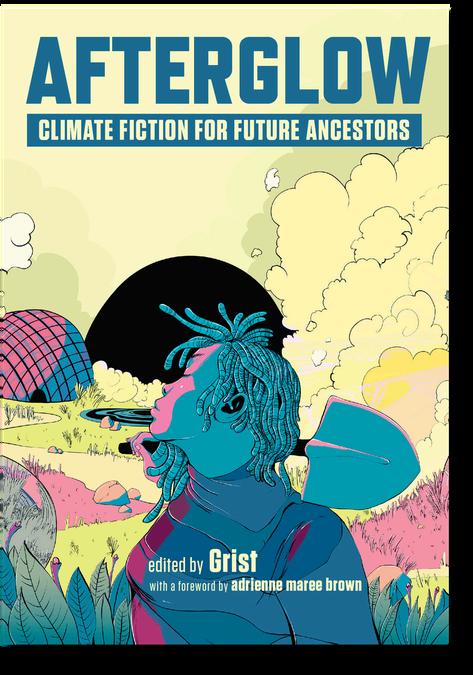
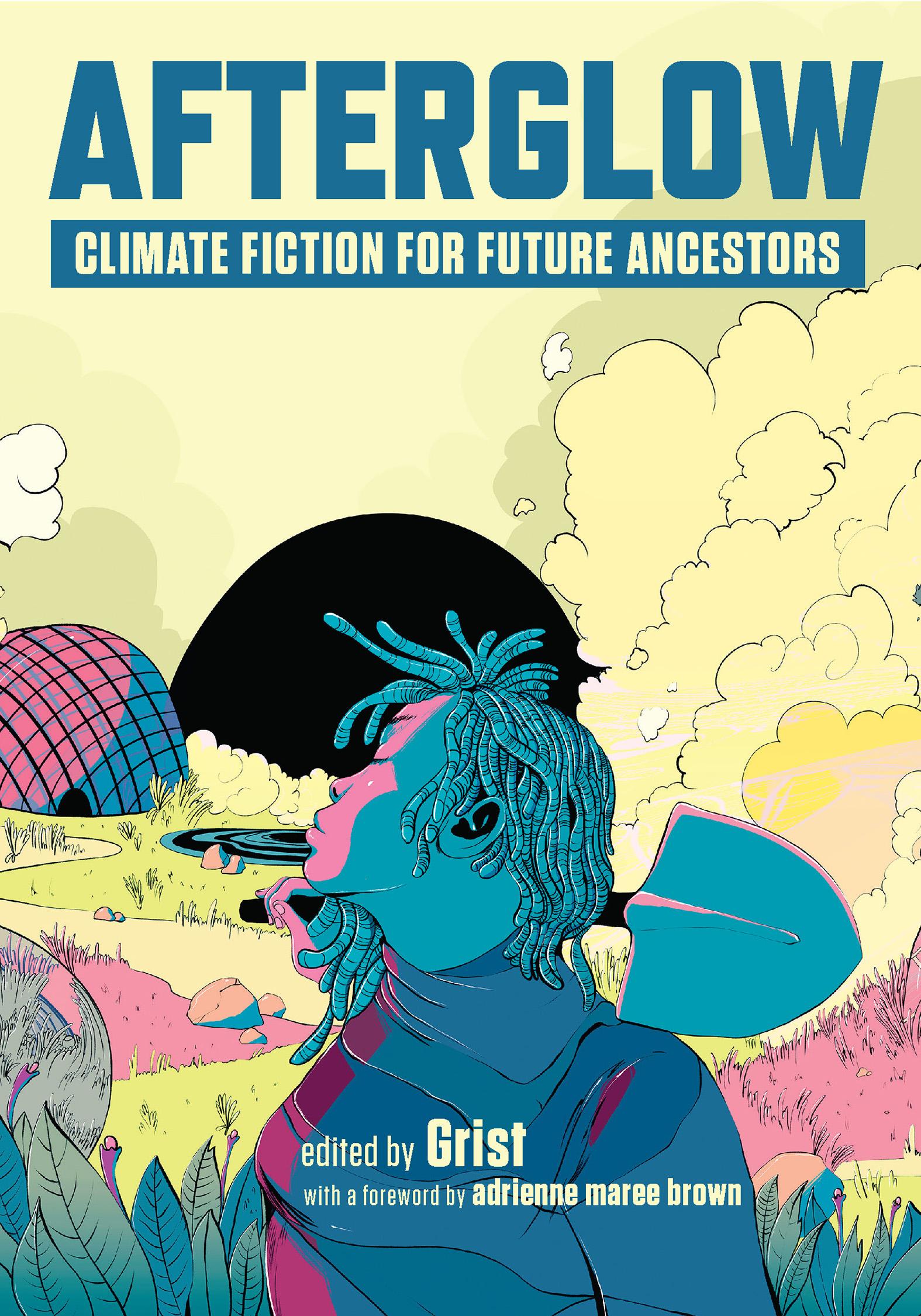
CLIMATE FICTION FOR FUTURE ANCESTORS
EDITED BY GRIST
Compilation © 2023 by Grist
Foreword © 2023 by adrienne maree brown
Individual stories © 2023 by each author
Requests for permission to reproduce selections from this book should be made through our website: https: //thenewpress.com /contact.
Published in the United States by The New Press, New York, 2023
Distributed by Two Rivers Distribution
ISBN 978-1- 62097-758-3 (pb)
ISBN 978-1- 62097-770-5 (ebook)
CIP data is available
The New Press publishes books that promote and enrich public discussion and understanding of the issues vital to our democracy and to a more equitable world. These books are made possible by the enthusiasm of our readers; the support of a committed group of donors, large and small; the collaboration of our many partners in the independent media and the not-for-profit sector; booksellers, who often hand-sell New Press books; librarians; and above all by our authors.
www.thenewpress.com
Book design and composition by Bookbright Media
This book was set in Janson Text and Refrigerator Deluxe
Printed in the United States of America
10 9 8 7 6 5 4 3 2 1
Foreword by adrienne maree brown vii
Editor’s
Marissa Lingen
Abigail Larkin
Michelle Yoon
Renan
Savitri Putu Horrigan
FOREWORD
W!iting ficti(n )ll(w, -, t( .!/)0 )l(-., t( .!/)0 (nt( pages that we hope others will read, and to craft worlds we hope others will visit.
We are already dreaming beyond this current moment, these crises, these norms. Dreams are the foundation for what we attempt to turn into reality. Democracy was a dream (and some might argue it still is in most places, even for those who claim to be practicing it); the abolition of slavery was a dream (and some should argue it still is, while the prison industrial complex thrives); every garden we find nourishing was first a dream. The structures of our society emerged from someone dreaming it thus, for better and for worse— supremacy was dreamt up from insecure minds, racism was dreamt up from a fear of di 1erence. When we know things need to change, dreaming together is
one of the places we can start. I have been blessed to experience many kinds of collective dreaming, both as a movement worker and as a fiction writer. My movement work was primarily facilitation, holding space and process for groups of change-makers— people who see injustice in the world and take responsibility. I have facilitated rooms full of people committed to changing the world, listening as they dreamed together a future in which everyone has access to everything they need, a future where we care about the Earth and the children of our species in equal measure and as collective points of self-care. I have held rooms in which people debated over the priorities of the future—How can we sustain human life on earth? Eradicate racism and other systems of supremacy? Return land to Indigenous stewardship?
As a fiction writer, I often return to my memories of those rooms. The heroes of my fiction are inspired by people who want to take responsibility for the future at a collective level, especially young people. I often write about communities who are experiencing at a small scale what is changing at the grandest scale in the world. I write both to uplift these stories and strategies, and to cast the spell into the world’s imagination. It could be like this. We could have reparations and regain our dignity. We could relinquish our reliance on technologies of illusion and embrace who and what we are, the beauty of our brief and miraculous lives.
I am also, like many of the writers around me, obsessed with imagining futures in which humans are thriving in right relationship to the planet. I have written stories in which humans oper-
ate in much smaller units, interconnected but living in harmony with what the land can sustain. In an age of wildfires and political inflammation, I am writing a series of stories in which we find an ally in the water itself. I intentionally try to follow in the footsteps of writers who have tackled climate change head-on. Octavia E. Butler wrote us the Parable of the Sower and Parable of the Talents from directly inside the climate crisis, and then the incredible Xenogenesis / Lilith’s Brood collection about how humans continue two hundred years after a climate apocalypse. Butler was writing us warnings. Kim Stanley Robinson is another incredible writer of climate fiction, telling stories of how humans persist despite having made the Earth inhospitable. Alexis Pauline Gumbs, Alex DiFrancesco, Rivers Solomon, Nalo Hopkinson, and others o1er us visions and pathways forward with their fiction.
But what do we do if our dream space is colonized, as I believe it is?
To colonize a place and people is to settle among them and seize political control over their land, lives, labor, beliefs, and practices. Much of the world we now live in was colonized at some point, meaning the majority of humans live in a post- colonial architecture, both physical and ideological. The dominant culture in the United States, from which I write this foreword to you, is a mix-up of various colonial e1orts which both collaborated and battled over territory. One of the winning ideas was capitalism, an economic system rooted in private ownership of resources and competition-based development. As long as capitalism dictates
the relationship of our species to our planet, we are losing the long game, the one in which human life gets to continue on Earth.
To decolonize is to heal the colonial wound—from the land, from the culture, from the practices, from the mind. But for many people, when we begin to speak of possible solutions—like a collaborative people- centered economy, like replacing punitive culture with a culture of accountability, like centering the needs of our children in our decision-making—it feels impossible. They cannot imagine it. In many ways, the work of decolonizing the future is the work of decolonizing our imaginations.
We have to tell stories in which the protagonists are those whose stories are least often told, recentering our attention away from the elite, the celebrities, the influencers. Making money from the exploitation of Earth and labor is an old story, boring and familiar. The stories we need to hear are of those who are aware of their conditions, attentive to what is changing in the world around us, and finding compelling paths forward. We have to literally rewire our brains to be interested in our creation and continuation, more than our destruction.
In my writing, I look for the least likely hero, and I follow their humanity, their impulse to live, their creativity in the face of challenges. I want to show how good a slow and connected future could feel. I am working to write stories where everything is not urgent, but where the pace of small pleasures and rooting into place dictate the pace of action.
I am working to decolonize my mind by writing stories that
reach back through my own lost lineage, to listen for my original instructions. I am writing stories in which the Indigenous and Black and brown people win not through domination, but through protecting what is sacred, and surviving all the way through to pleasure.
The Imagine 2200 climate-fiction contest, from Fix, Grist’s solutions lab, invited writers from all over the world and across genres to participate in this exercise together. The stories in this collection are a variety of attempts to decolonize our thinking of the future, particularly on this planet, and to show what hope and utopia look like through lenses beyond our own.
Reading through the twelve stories published here allows us to dream about future climate conditions together, seeding ideas into each other’s dream spaces; to realize where our dreams are overlapping and learn where our imaginations have been constrained by our realities. The writers have so many origin stories themselves, covering all manner of place, race, gender, ability, and life experience.
As one of the fortunate judges of this contest, alongside Sheree Renée Thomas, Kiese Laymon, and Morgan Jerkins, I got to open all of these portals into what people thought life on Earth could look like in 2200. Some saw us rediscovering nature, some saw us adapting to live underwater, and some saw a future beyond humanity. Every story has beauty in it—in our imaginations the future is beautiful and there is always a new horizon.
“Broken from the Colony” is a gorgeous tale in which trans
girls find acceptance and security among coral as sole survivors of a storm that submerges their Caribbean island. My notes for this story were “wow wow super wow”—we enter this mysterious, poetic flow of a story already submerged, experiencing with the protagonist an unexpected storm survival. I cannot stop thinking of this story, and the idea that the adaptations we go through to be our truest selves right here and now are actually strengthening our capacity to adapt when deeper changes unfold.
“The Cloud Weaver’s Song” is a story of weaving clouds to catch water in a realm of drought, and what it might look like to imagine and act beyond that scarcity. The story feels like it has always been here—like a traditional story, a story of magic that we all need to understand. A story that already feels true even as it is fantastical in every way. I can see the world, and I can see these mythical beings who are supporting the possibility of life for their whole community. This story is also a reminder that often, the way forward is only clear to those to whom no one will listen. We have to be willing to act on what we know, take risks to unveil the path to those we love. This is one of the most beautiful direct action stories I’ve ever read.
In “The Secrets of the Last Greenland Shark,” the last four creatures on Earth make an amazing discovery as the oldest of them finally returns home. This story will also stick with me— lately I have been really sitting in humbling meditation on the idea that the Earth will survive us, and that life will continue in some form beyond us, and that even though I feel a deep grief for
what my species is up to, the future beyond us could still be curious and celebratory. This story is a gift. The ending was a deep and unexpected pleasure.
These three are just a small preview of what you are about to experience in this collection.
Read these stories slowly, give yourself time in between them to really feel the worlds that have been built in these pages. Feel the fears that sparked these imaginings, and consider the solutions. Soften into the hope, brilliance, and tenacity of these dreams.
adrienne maree brown
EDITOR’S NOTE
A , t3/ n/tw(!4 w/)5/! )t Fi6, t3/ ,(l-ti(n, l)7 )t t3/ n(nprofit climate news site Grist, I spend a lot of time talking to people who are coming up with amazing solutions to the climate crisis. The job is by definition hopeful, which is great, because Fix believes that together everyone can build a cleaner, more equitable future. We write about the people and organizations doing just that.
About two years ago we started to wonder how fiction might help us bring more people into imagining that better future. I was given the great opportunity to create and lead Imagine 2200, an initiative that was as much a call to action as it was a short story contest. We wanted to connect with writers who could use their imagination to shape our climate present by envisioning our climate future. The contest drew more than 1,100 entries from
eighty-five countries. Our call clearly spoke to the hearts and minds of writers worldwide.
Speculative fiction writers Tobias Buckell, Andrew Hudson, and Sarena Ulibarri spent two months reading, discussing, and debating those entries. They whittled them to twenty stories, each of which presented a unique vision of a future where we not only survive, but thrive. They handed them to our judges, adrienne maree brown, Sheree Renée Thomas, Kiese Laymon, and Morgan Jerkins, who selected three winners and nine runners-up.
The anthology you’re holding collects those twelve amazing stories. In it, you’ll join the last four creatures on Earth as they reminisce in their final moments. You’ll visit a society that farms the skies for water. And you’ll learn how a group of rebels keeps biodiversity alive. Reading this collection, you’ll discover how hope and liberation mean di 1erent things to di 1erent people.
I hope that you see yourself in these stories and futures, and that you find in them ways that we, together, can co- create the abundance we deserve, and heal from violence and extraction. That’s what it means to be a future ancestor.
Tory Stephens Climate Fiction Creative Manager
AFTERGLOW
AFTERGL OW
Lindsey Brodeck
It’, /)!l8 ,-00/! )n. (nl8 ) 0(nt3 -ntil t3/ l),t (f t3/ pods leave for the Kepler planets. Renem secured a contract for two; of course she wants me to go with her.
I need time to clear my head. She doesn’t understand why, because it isn’t like we’ll be leaving anything behind. Our living situation is squatting on the good days and bench-sleeping on the bad. And there’s no need to talk about family. Renem never knew her parents, and I buried what was left of mine years ago. We’ve been together for over half my life. Sometimes I wonder if it’s more out of necessity than love.
I’m at Antimatter and the dance floor is packed as usual. It isn’t exactly an upstanding place, but I feel at home here, like I can step out of my skin and become a part of something bigger. There’s someone passing out Tangle tablets in the corner. It’s
gray market, probably reverse engineered. I scan it quickly—only a 0.1 percent chance of meth-mod. A good sign, but not a promise; it could still be laced with some other addictive compound. I pay the price and pop one in my mouth. As the tab dissolves, my nagging thoughts dissolve along with it. The only trace is a saccharine ache on my teeth. Soon, I am nothing but free energy mixing in with the crowd.
Usually, everyone here is so much inside their own synthinduced bliss that it’s rare you’ll ever get bothered. Tonight must be one of those rare occasions, because I can feel someone’s eyes on me. I stop dancing and try to locate the source, but every time I strain to make sense of the shapes around me it’s like I’m going the wrong way on a kaleidoscope. Blurring out of focus, everything vague and undefined. But still beautiful. There’s someone running toward me, doubling back, cutting out large loops and spirals. The movement makes my head spin. I see a flash of wings as thin as cobwebs.
The crowd is shifting and feverish and I lose the jumble of colors as quickly as I first found it. If only the rainbow strobe would shut o1, just for a minute. I slump down to the sticky floor, burying my face in my hands. I rub my eyes open and they sting from the sweat. But I notice something promising, something on the concrete. It is bright and yellow, glowing. It looks like a trail.
Following a near-invisible line through a packed dance floor is no small feat, especially when you’re on nothing but hands and bare knees and a mid-grade party drug. By the time I’m outside,
I’ve had more drinks spilled on me than a champagne girl in one of those awful gentleman orgs. Need to stop thinking about that before I get even more nauseous. My vision is cutting out and soon my memory will go along with it. But not before I see it.
I’m up on the rooftop and the line is hardly linear; it’s more like a maze of unspooled thread. Eventually it makes its way up a halfbroken brick wall, circling a tall mural that must span over twenty feet. I don’t know what I am expecting, but it isn’t this.
Long wings, bubbling eyes, a body that glows green in the moonlight. It’s the most beautiful insect I’ve ever seen. I move closer, reaching out to make contact. I trace what I can with my fingertips and take in a deep breath. It isn’t paint that forms the image but something heady: laced with decay, multi-textured, alive. My optic mod explodes with names right before my vision goes. The words are all that’s left imprinted on my eyelids: Xanthoria parietina, Lichina pygmaea, Hypnum cupressiforme.
“I saw something amazing tonight.”
I’m back with Renem somehow, in our half-roofed abandoned building. She’s holding me, stroking my hair. But I know she’s angry. I’m shaking in her arms.
“It’s always easy to find you, at least.”
Animosity underneath those eight easy words. She doesn’t consider that sometimes I don’t want to be found. And she won’t ever consider it, not if she wants to keep her savior complex going.
I try to keep the upcoming fight at bay, pleading to her that this
time it was di 1erent. “There was someone who sent a message to me,” I say.
She turns away. Her dark, strong face is framed by moonlight streaming in through the gaps.
“Stop acting like a child, Talli.” Renem spits out my name like it’s a curse. “When are you going to grow up?” At this she lets go and stands up, her warmth escaping with her.
My conciliatory e1orts evaporate along with the heat. “Oh, so it’s the adult choice to be slaves on 452b?” I retort. I shiver as the sweat saturating my dress turns cold. “You know we’ll never make the debt up. They designed it that way.”
She shakes her head, as if the point I’m making isn’t one that matters at all. “You’ve seen the pictures. Those planets are our only hope. I could make a life for us.”
She comes back to me then, trying to get under the pile of blankets. I pull away. The night is warm enough without her.
I’m seeing bees everywhere: ads in my feed— useless things like costumed clothing and jewelry and products I could never a 1ord— and people on the street adorned with antennae and shimmery wings. I see real bees too, landing on scrawny little plants growing through the concrete and buzzing around the flowering vines that move like snakes around the downtown ruins. Maybe they’ve always been there, but it’s the first time I’m really noticing them. I keep my optic mod on constantly so I can identify and log each new species. My favorites are the small, mostly black insects I’ve
always assumed were flies. Now they are bees and have beautiful names: Ceratina acantha, Hylaeus annulatus, Chelostoma philadelphi, Lasioglossum imitatum, Sphecodes monilicornis. I can tell them apart even with the mod switched o1 ; yellow slits near the eyes are a trademark of Hylaeus, and Sphecodes ’ bright red abdomen is instantly identifiable. There is something in my head too, a faint but unshakable hum. It reminds me of what a hot, lazy summer should sound like. Whenever I bring up any of this with Renem, she says I’m wasting both of our time.
It’s becoming easier to distinguish the real from the fake— separating the trendy insect body mods from the type of figure I saw weeks ago. And I’m noticing something surprising inside me, a feeling I wouldn’t expect myself to feel. As more of the rich leave for virgin planets and the afterglow of their ships leave me with green-yellow retinal burns, I’m not filled with worry or despair. If anything, I’m hopeful.
I’m in downtown Brexton-Maine when I spot one of them. Even with my sober mind, it’s still hard to fully describe what I see. Maybe the person has some type of field scatterer on them, making them harder to track. But it’s one of them. I know it; I feel it, and when I look down, there’s that same wandering fluorescent yellow line.
I lose the figure quickly but I continue following the line. It leads me to a warehouse about ten blocks from where Renem and I are currently staying. I should have been spending my time scavenging in the outer zone landfills and selling what I could. At least, that’s what Renem would want me to do.
I’m not scared to go inside. But when I push open those heavy metal doors, I am surprised at what I hear and see: an incessant, relentless droning, thousands of seedlings, and a single person dressed in white. A beekeeper’s uniform.
“I take it you followed our trail?”
I say something to respond, but the words come out jumbled. The roar encases me, maddening and sweet, and the bright white of the fluorescent lights gives the warehouse a supernatural glow.
“More and more people are finding us.” The veil hood comes o1, revealing dark eyes and a tumble of long brown hair. “I’m Wyl. They / them.” Their cheeks are red-flushed and shining.
“What’s your name?”
“Talli,” I say. “She / hers.”
“Welcome, Talli. The rest of those who found us today are upstairs.”
Their words give me a twinge of unexpected sadness. My reaction must be obvious, because Wyl gives me a wry smile and a raised eyebrow, as if to say, “What, you thought you were the only one?” Somehow I hadn’t expected others to have found this place. The mural at Antimatter, the figure in the street, it all seemed like it was designed just for me. My own map to something, a map that could save me. Save us, I mean.
As I follow them to the back of the warehouse, weaving through rows of wildly varying plant starts, I locate the source of the hum. Large beehives, which isn’t surprising, but also structures that I can’t quite name: huge stacks of hollowed-out
wooden tubes and tracts of soil in tanks that stretch half the width of the entire wall.
“Only a few bee species live in hives, you know,” Wyl says.
We walk up the industrial staircase, eventually surpassing the level of the ceiling lights. Above us is a steel trapdoor. They release the latch and push. And then there is blinding sunlight, dozens of people, and rows upon rows of flowers, vegetables, and berry bushes, and fruit trees filled with jays and chickadees.
“The world is in a lot better place than they would have us believe,” Wyl says. “Yes, there is destruction, but there is also cause for hope. So much hope.”
Wyl doesn’t need to clarify the “they” they are speaking of. It’s clear they’re talking about StarSpace.
The group is a diverse one: a wave of colors and expressions that come together to form a single, composed image. I turn to face Wyl, but they have already woven their way into the center of the crowd.
“For those of you just arriving, welcome.” Wyl pauses for a moment, and smiles warmly at us. “The Keepers’ mission is simple. We are a group of people who have recognized a way of being that has been present on Earth for thousands of years. A way of being that centers community and kin-making with all animate beings. It is also a way that has been recognized by other people, on other planets. Tell me—” They pause, and gesture to a young man in the front of the crowd. “What pronoun would you use to describe what you see here?” Wyl points to a bee meandering
lazily through the air. Unconsciously, I move closer. The insect lands on a purple sunflower— Echinacea purpurea— right next to me. The bee is no honeybee; the metallic green of its head and thorax makes that abundantly clear. I know the name to give it: Agapostemon virescens.
The man smiles in a self- conscious way, like he is afraid of being tricked. His flushed cheeks are almost as red as his shirt. “It’s on a flower?”
Wyl smiles, but shakes their head. “That is what I assumed you would say, but we’re here to show you a di 1erent way of seeing the world, and the inhabitants we share the world with. Our mission is more than beekeeping, gardening, and rewilding. We’re fighting for a semantic shift too. What do any of you know about 452b, the first planet the pods landed on all those years ago?”
I’m never one to speak up in crowds, but something compels me to answer.
“The plant people living there, they can hardly tell anything apart,” I say. “Not just from each other, but from anything that is alive. Everything is connected. That’s why their language is so hard to understand.”
Wyl nods, and I assume I’ve given the right answer.
“You’re close, but that isn’t quite it.”
I stay silent. My cheeks are now flushed too.
“You are correct about one thing. The Heliogen language is certainly di 9cult to translate into our own. English speakers inherited a language of imperialists, one that objectifies and capi-
talizes on virtually everything it comes into contact with. The language of the Heliogens is far di 1erent. Their language emphasizes the connections between us, not the arbitrary boundaries intended to separate us. Heliogens even have a pronoun for everyone, and everything. And that pronoun is se. A Heliogen would never say, ‘It is flying through the air,’ because they recognize the similarities we share with other animate beings as being far more important than our di 1erences. Se is the ultimate form of respect, expressing the connection we—or should I say ‘se’—share with all others. This bee, se pollinates our flowers; the flowers, se give us nourishment and beauty. Our words are just as important as our actions. They shape our mind, our way of seeing, our sense-making.”
It is beautiful, what Wyl is saying, but also di 9cult to grasp. As I try to think about the way the language I speak influences the way I understand the world, I feel my thoughts go fuzzy.
“We can even use se to describe ourselves, for it is incorrect to think of ‘you’ or ‘me’ as composed of only human-ness. In fact, se are working together with trillions of prokaryotic cells. So this makes us amalgamations, holobionts, chimeras, constantly changing, yet one.”
Wyl pauses for a moment to catch their breath. I realize I have been holding mine.
“And finally, there is another way of seeing that we find equally important, a way of seeing that recognizes change and connection as the constant. Think of the Passamaquoddy people—my
people—who are indigenous to the very ground we stand on. We have a multitude of words for ‘river,’ ‘field,’ and ‘wind,’ among many others; words that are both animate nouns and verbs. Think of a river. How strange it is that English has only one word to describe a force that is constantly in flux. The Passamaquoddy, by contrast, have distinct words to describe where the river widens out, kskopeke; where se comes back in, ksepiqe; where se divides or comes back together, niktuwicuwon —just to name a few. It is di 9cult to change the relationship you have with your language, but it is not impossible. First, it takes awareness.”
Wyl keeps giving more examples, like how classifying a field as a thing, as an “it,” makes it that much easier for the land to be exploited and disrespected. Instead, if we think of a field as part of something connected and important, as an expression of the land at a point in time— pomskute, a field goes along—we will tend to it—to se— all the more justly.
“Everything shifts once you realize that it is our responsibility to take care of our home, if there is to be any hope for se to, in turn, take care of us,” Wyl says. “Nature is resilient, ever- changing, adaptable. And our role as steward, as changer, is nothing new. Humans have been changing nature for tens of thousands of years. As far as geological time goes, it is only recently that this change has turned disastrous and destructive.”
From radical rewilding to inner-city gardening, Wyl explains the Keepers’ vision as one that includes a multitude of solutions. I look around: rich soil, large trees, an abundance of food and
flowers. The scene is nothing like the sterile monocrops I’m used to seeing advertised by FarmCo. Se is half-wild and beautiful, tended by humans and thriving on top of concrete.
It has only felt like a few minutes since I arrived, but the setting sun tells otherwise. Wyl has finished talking, and I find myself sitting next to them, watching the empty clouds fill with color. I ask them how long they’ve been with the Keepers.
“A few years now.” Wyl smiles and shades their eyes. “I can hardly remember what my life was like before them.”
“If what you were saying is true, if there are thousands of you . . .”
“Then why haven’t you ever seen us?” I nod.
“You have. You just didn’t know it.” They stop for a moment and pick a flower from a nearby bed. Gaillardia aristata. “That’s the problem with how people think about us. Like we must all be wearing homemade clothes and living in communes or something. Of course, some of us are that way.” They laugh and twirl the flower between their thumb and forefinger. The petals are yellow-bordered and red like the sky’s fading streaks. “But the point is, anyone can become a Keeper, if they want to.”
“I want to.” My voice comes out as a whisper.
Wyl doesn’t say anything at first, but the silence isn’t uncomfortable. After a few moments, they answer.
“I was hoping you’d say that. You seem right for us, Talli. And you’ve already become quite the citizen scientist.”
I look at them quizzically. They laugh. “Don’t worry, we’re not tracking you. The logs you post are public, that’s all.”
I smile, feeling my body relax back to where it had been. At this moment, I convince myself everything will be okay. That Renem and I will be okay, and that I can make her see how much this place makes sense for us. That Earth is not a doomed planet. That there is so much possibility and potential right here.
It’s too much to think about, so I try to shift back into the present. I ask Wyl if they’ve ever been outside of Brexton-Maine. Their laugh is small and intimate.
“Where haven’t I been?” They pause for a moment before continuing. “I first started with them in New Texas, with all the Pleistocene rewilding that went on there.”
I feel my jaw drop. “I heard about that. You dropped o1 giant tortoises and camels in the desert. Carnivores, too. Lions, cheetahs. The leaders there were furious.”
“They were.” Wyl grins. “It worked beautifully. We bought thousands of acres of unused, forgotten land. Of course, not fencing o1 that land made a few people angry. But it was worth it. We started with a few hundred animals, all from critically endangered species. Now se are thriving, and the land is more life-giving than se has been for thousands of years.”
Wyl trails o1. Their hair is softly blowing, and backlit by the remains of the sunset.
“You know, we’ve done some rewilding at a smaller scale close by,” they say. “Do you want to see it?”
I can’t find words strong enough to express my eagerness, so all I do is nod my head yes.
They lead me out of the building, to their car parked on the street behind it. “I haven’t been in one of these in ages,” I say.
Wyl grins again. “They’re a lot cheaper when you don’t have to pay for electricity through the city.”
We drive. After half an hour, we’ve made it to the swampy part of the city, where flooding is the norm and anyone unlucky enough to still be living here is used to their homes being full of mold and rot. They pull o1 abruptly. The huge, abandoned lot doesn’t seem like an important place. It is marshy, overgrown, and filled with mosquitoes. But Wyl gets out of the car anyway and I follow, treading through muck and reeds until we get to a medium-sized pond. They had said this rewilding would be at a smaller scale, but I wasn’t expecting something this small, this insignificant.
“Is this it?” I ask, trying to keep the disappointment out of my voice.
“Nightfall is almost here. Be patient.” They crouch and beckon me to follow suit.
Wyl was right; the sky is soon devoid of color and the heat of the day escapes into the air. At least some of the mosquitos escape with it. My back aches, and I scratch the swelling welts on my legs and arms. I am in the midst of making up some excuse when I hear something. It is vaguely human and squawky, a throaty, almost musical sound.
“We’ve brought life back into hundreds of places like this. Puspahkomike, wetlands . Have you spotted one yet?”
I shake my head, even though they probably can’t see me in the dark. I feel embarrassed to ask it, but I go ahead anyway. “What is that noise?”
Wyl’s voice is little more than a whisper. “Frogs, Talli. Hundreds and hundreds of frogs.”
“It can’t be,” I whisper back. “Haven’t they been extinct here for decades?” I know I’m right; I read a few years back about a fungus spreading throughout most of the Northeast, one that killed o1 frogs, salamanders, and other amphibians.
“At one point, yes. But there were some species that weren’t susceptible to the chytrid. And we brought se here.”
I keep my mouth shut, but in my head I wonder what’s so great about bringing a few frogs back. The Pleistocene rewilding, that I can understand. But this, it seems like a lot of e1ort for nothing at all.
“Frogs are a keystone species, you know,” Wyl says as if reading my mind. “Just like the megafauna we introduced in the Southwest. Ever since bringing se here, other animals have come back too. Snakes, birds, small mammals. This little pond is a fully functioning ecosystem.”
My eyes aren’t the only things adjusting. I peer closely at a collection of wet, shiny rocks; of course, they aren’t rocks, but round, gleaming, beautiful frogs.
We are back in the car, and I want to stay in this moment forever. I force time to slow down, to notice everything surrounding me. The way Wyl’s nose curls up ever so slightly, the smattering of freckles across their face. Their deep brown eyes that look just like Renem’s. Renem. Wyl is playing some type of sad, sweet music that helps stretch out the time. It is wordless, classical-sounding. But someone like me wouldn’t know. It seems like Wyl is driving slower than they have to, maybe they feel the gravity of the situation too. I’m suspended on one endpoint of a pendulum’s arc, and I’m not sure if I’ll ever be able to swing back. My real life isn’t rewilding and honoring the world with new words; it is tense conversations, struggling to survive, and convincing Renem we don’t have to leave Earth.
Wyl breaks the silence. “Can you spare a few more hours?” they ask. “I need to show you one more thing.”
We’re already in my part of the city, only a few minutes away from the long-abandoned butcher shop Renem and I are currently calling home. It’s been hours since I last contacted her.
“If you have to go back, I understand.” Wyl stops the car and taps their fingers nervously on the dashboard.
“A few hours won’t hurt,” I say.
Wyl smiles and pulls a U-turn. “It’ll be worth it. I promise.”
Those few hours pass quickly. We—well, mostly Wyl—talk about everything from the flawed rhetoric of twentieth- century environmentalists—“Their intentions were good, but why was ‘Save the Earth’ their motto? Why didn’t they just say ‘Save
ourselves’?”—to the Keepers’ terraforming projects in Siberia, the Sahara, and along the Gulf of Mexico. Their chatting makes time snap back into a more natural pace, but it still isn’t fast enough for me to forget about the growing knot in my stomach.
As if on cue, I receive a message from Renem: Where are you?
Even though there isn’t any audio accompanying the neurotext, I know her tone is sharp and accusatory. I also know that she is probably worried. I ignore it for close to half an hour, but eventually reply: I’m trying to figure out something for us.
Her response is hardly a surprise. You’re crazy if you think that cult can save you.
It could save us , I reply.
We’re leaving tomorrow.
The sky cracks and goes red. I cower in the passenger seat and cover my ears. Another swarm of shiplets breaking through the atmosphere. The crimson streak soon fades into blackness. I had forgotten that it’s tomorrow. The pang in my stomach intensifies.
“We’re almost there,” Wyl says.
We’re out in the open countryside, or what has been turned into countryside. The bones of some now-useless industrial compound stick out of the rolling grasses and flowers, its strangeness amplified by the full moon. The road curves sharply. It’s di 9cult to see it all clearly, but as we pass around a large hill, dozens of small houses, rows of half-wild gardens, and glinting solar panels come into stark relief.
“I thought you’d like to see one of our communities.” Wyl steps
out of the car and gestures for me to follow. We walk to one of the garden plots; the intertwined pea and squash tendrils snake around the trellis and appear alien in the moonlight.
Wyl plunges their hand into a bag tied around the trellis and pulls out a gleaming handful. “Seeds can be planted anywhere. They don’t need perfect conditions to grow.” They drop several into my outstretched palm and close my fingers around se tightly. “Nature never went away in our city. I know you know this. Se just needs tending— stewardship. Will you be one of our Keepers?”
As I’m about to reply, I hear the ping of another message. Tears spring to my eyes, tears equally composed of mourning and relief. The drops land wet and alive and seep into the soil below me. I take my gaze upward, away from the seeds in my hand and eyeto-eye with Wyl. And I nod.