ISSN 2832-4072
CONSTRUCTIONTECHREVIEW.COM
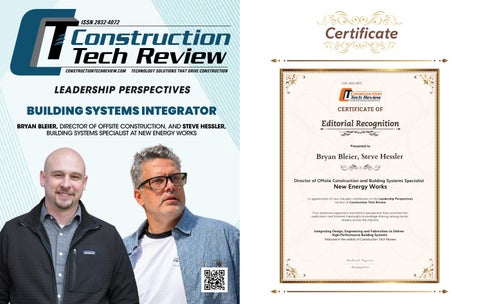
Certificate TECHNOLOGY SOLUTIONS THAT DRIVE CONSTRUCTION
LEADERSHIP PERSPECTIVES
BUILDING SYSTEMS INTEGRATOR BRYAN BLEIER, DIRECTOR OF OFFSITE CONSTRUCTION, AND STEVE HESSLER, BUILDING SYSTEMS SPECIALIST AT NEW ENERGY WORKS
ISSN 2832-4072
TECHNOLOGY SOLUTIONS THAT DRIVE CONSTRUCTION
CERTIFICATE OF
Editorial Recognition Construction Tech Review (ISSN 2832-4072) Presented to ValleyMedia, Inc. 600 S ANDREWS AVE STE 405, Bryan Bleier, Steve Hessler FT LAUDERDALE, FL 33301
www.constructiontechreview.com Director of Offsite Construction and Building Systems Specialist
New Energy Works
in appreciation of your valuable contribution to the Leadership Perspectives section of Construction Tech Review Your extensive experience and distinct perspective have enriched the publication and fostered meaningful knowledge sharing among senior leaders across the industry.
Integrating Design, Engineering and Fabrication to Deliver High-Performance Building Systems Featured in the edition of Construction Tech Review
Managing Editor
LEADERSHIP PERSPECTIVE
INTEGRATING DESIGN, ENGINEERING AND FABRICATION TO DELIVER HIGH-PERFORMANCE BUILDING SYSTEMS
from reduced waste, site disturbances, improved quality control, and shorter construction schedules. Enclosure Systems director Bryan Bleier says, “Through the IDf MA process, we’re able to fully think through the building and the assembly process before we ever make any sawdust. By coordinating all the details, interfaces, and sequencing in the digital environment and then bringing that thinking into a controlled manufacturing environment, we can improve both the performance of the building and the consistency of how it gets built. We see tremendous opportunity at the intersection of high-performance building and off-site manufacturing, and we’re excited to be part of that ongoing conversation.”
By,Bryan Bleier, Director of Offsite Construction, and Steve Hessler, Building Systems Specialist, New Energy Works
Editor’s Note: Construction leaders are increasingly looking beyond sequential project delivery to integrate design, fabrication
and assembly from the earliest stages of development. This perspective underscores the business value of connecting digital coordination, off-site manufacturing and technical craftsmanship to improve building performance, efficiency and delivery.
Bringing Digital Innovation Back to DfMA
Supporting this workflow is an ongoing investment in digital and technological innovation. The evolution of IDf MA is about restoring the original intent behind Df MA rather than reinventing it. Hessler says "When Df MA reached the architecture, engineering, and construction industry, it became pretty siloed, just like a lot of things do in our industry. It was incredibly effective in the aerospace and automotive industries because it brought together multiple perspectives, disciplines, companies, and regions into one integrated model that ultimately produced a better product.”
Steve Hessler
From Sequential Delivery to Integrated Design
For decades, the AEC industry has relied on a sequential project delivery model in which design, fabrication and construction occur as largely independent elements. While this process has become the standard, this approach also creates inefficiencies, from redesigns and scheduling conflicts to material waste and increased costs. As projects become more complex, many firms are rethinking how buildings are designed and delivered. By combining traditional craftsmanship with digital design, engineering and advanced manufacturing, a new approach called Integrated Design for Manufacturing and Assembly (IDf MA), coordinates disciplines from project inception through fabrication and installation and is a foundational reason why the AEC industry needs to move from sequential delivery to integrated delivery.
Bryan Bleier
Traditionally, construction follows an on-site workflow in which each trade depends on the completion of the previous one. IDf MA is a different approach that brings all project principals together early, allowing decisions to be made collaboratively before construction begins. New Energy Works Building Systems Specialist Steve Hessler explains, “IDf MA integrates the best practices of classic craftsmanship with forward-thinking technological advances. I think there's a lot of magic between them. If you're searching for old-school craftsmanship while constantly finding new processes and cutting-edge tools to support it, that's the space to live in." The crux of IDf MA philosophy is Df MA (Design for Manufacture and Assembly), an engineering methodology that combines Design for Manufacturing (DFM) and Design for Assembly (DFA). Through this foundation and standardized, repeatable processes, IDf MA optimizes construction by
considering how building components will be manufactured, transported and assembled as a complete system rather than as independent parts.
Coordinating Every Element Before Construction
As opposed to treating architecture, engineering, fabrication and construction as isolated disciplines, IDf MA aligns every aspect of a project into one cohesive workflow. The result is buildings that perform better, are delivered more efficiently, and cost less to own over their entire lifecycle. Designers, engineers, fabricators and builders collaborate simultaneously, ensuring that structural systems, mechanical, electrical, plumbing, enclosure performance, energy efficiency, constructability and environmental impacts are all considered together from the earliest stages of design. One of the most important components of this process is off-site manufacturing. This is when building components are fabricated as precision-engineered kits of parts in a controlled environment, allowing them to be manufactured more efficiently, transported more quickly and assembled on-site with greater speed and accuracy. By designing components specifically for fabrication and assembly, projects benefit
see tremendous opportunity at the intersection of high-performance building and off-site manufacturing, and we’re excited to be part of that ongoing conversation. While the AEC industry continues to change, cohesive delivery methods like IDf MA represent the future of highperformance building. By combining workflows, advanced digital technologies, off-site manufacturing, and time-tested craftsmanship, IDf MA is helping to redefine how buildings are conceived and constructed. It’s a better way to build because it aligns design, engineering, fabrication, and construction into a seamless process. From designers and tradespeople to building owners and occupants, every step of the collaborative IDf MA process works toward a common goal: creating high-performance buildings that reduce waste, lower costs, improve efficiency, and deliver resilient, sustainable structures built to perform for people and the planet.