2 Mission Statement and Method 3 Letter from the Executive Director
4 Board of Directors and Message from Board Chair
5 Donor and Board Member Spotlight
6-7 Appleseed’s Multi-System Approach to Poverty
8 The Foster Care Crisis Created by Fentanyl
9-11 Behavioral Incentives for Baby Success (BIBS) 12 Over 40% of Homeless Students Drop Out of High School
Guaranteed Payment for Attendance (GPA)
Lowest National WIC Participation with Highest Need 15 Create State WIC
16 Siloed Data Prohibits Evidence-Based Policymaking
17 The Family Success Lab at NMDOH
18 NM Appleseed’s Rapid Response to the SNAP Crisis
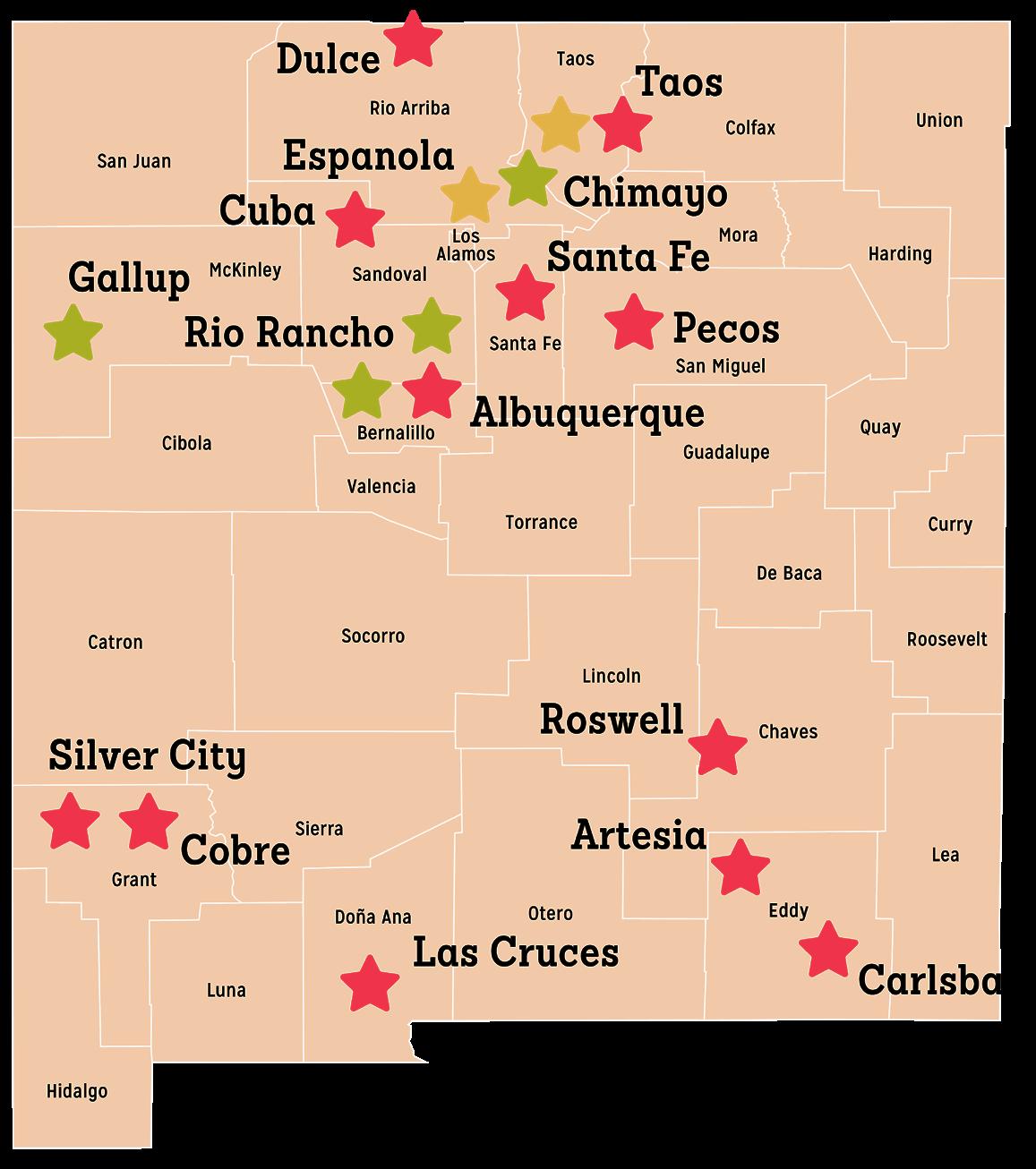
19 NM Appleseed’s Program Locations
20 Cash Transfers: The News vs. The Reality
21 Conditional Cash Transfers: Payment Tied to Behavior
22-23 Thank You to Our 2024-2025 Donors
24 Appleseed’s 2024-2025 Program Targets
Mission Statement
New Mexico Appleseed's mission is to end poverty in New Mexico. We want to ensure that every child and family has the necessary support and opportunities to lift themselves out of poverty. We seek permanent and dramatic positive change.
Method
New Mexico Appleseed focuses on systemic solutions to the causes and consequences of poverty. We work from the tiniest communities to the state, tribal and federal government to define problems and create solutions. New Mexico Appleseed's work is thoughtful, innovative, and effective.
Dear Wonderful Appleseed Family,
There are heartbreaking problems in New Mexico that we have somehow collectively agreed to live with. We have deemed them "unsolvable." I just completely disagree with that diagnosis. I think New Mexico’s problems are not only solvable, but that the solution is well within our reach. Solving them requires vision, execution, and funding. New Mexico Appleseed has the first two in spades. What we need to do our work is the funding.
Consider the fentanyl crisis flooding our child welfare system. The standard response—removing substance-exposed infants from their mothers—creates exactly the kind of early trauma that neuroscience tells us produces lifelong disadvantage. We are building the first program in the country that keeps these mothers and babies together through evidence-based recovery support. This is strategic intervention at the moment when families can either be permanently fractured or genuinely preserved.
Or consider homeless high school students, who graduate at a rate of 13% not because they lack intelligence, but because survival and education are fundamentally incompatible without economic stability. We created direct financial support—not as charity, but as the foundation for a genuine path out of poverty. We are the only organization in America doing this work.
New Mexico has the highest WIC eligibility rate in the nation but the lowest participation rate. We understand why. The amount of money is anemic and the burden to go into the clinic is insurmountable. While others have documented this failure, we are creating solutions to both the enrollment and the quality of the support.
These interventions address root causes rather than symptoms, build genuine partnerships rather than deliver services, and operate at the systems level rather than the individual level. When you invest in New Mexico Appleseed, you are not funding temporary relief. You are purchasing permanent change in the systems that trap families in poverty. Most philanthropy rents solutions. Donating to New Mexico Appleseed is buying them. Your capital can serve families one at a time, or it can change the architecture that determines whether families succeed at all. Thank you for your loyalty and generosity. We hope that we continue to make you proud.
Jenny Ramo, NM Appleseed Executive Director
2025 Board of Directors
Caroline Garcia Chair/Treasurer
TXNM Energy
Linh Nguyen
Secretary
Lumina Found ation for Education, Inc
Dale R. Dekker
Past Board Chair
Dekker/Perich/Sabatini
Kara Bobroff
One Generation
Dr. Veronica Garcia
Santa Fe Public Schools
Randi McGinn
McGinn, Mont oya, Love & Curry
Leslie Cervantes
Retired
Lori Addison
Beck Total Office Interiors
David Kistin
Sandia National Laboratories
Jennifer Ramo
New Mexico Appleseed
A Message From Our Board Chair
Throughout my career at KPMG, I examined countless investment portfolios—each evaluated through the lens of risk, return and long-term value creation. Yet none have delivered returns as profound or enduring as those I've witnessed at New Mexico Appleseed. Over the past eight years, I have observed this organization confront some of our most intractable social challenges with discipline, innovation, and measurable impact.
My continued commitment to Appleseed stems from a rigorous evaluation of opportunity cost. The economics of inaction are staggering—nutritional deficits impeding cognitive development, cycles of intergenerational poverty that erode economic productivity, perpetuating systemic inefficiencies, and substantial federal allocations remaining unclaimed. These are not abstract problems; they are compounding liabilities on society's balance sheet whether acknowledged or not.
As a fiduciary by training and conviction, I recognize in Appleseed an exceptional value proposition: a catalyst for systemic change, executed with the precision and efficiency of a well-managed enterprise. This is not philanthropy in the traditional sense—it is strategic social investment, producing demonstrable returns in human and economic capital.
I extend an invitation to discerning investors to consider Appleseed as part of a truly diversified portfolio. In my professional estimation, the marginal utility of capital invested here far exceeds that of conventional investment vehicles, while the cost of inaction grows with devastating precision.
Lori Addison has been helping clients across the Southwest "realize the potential of their space"— building Beck Total Office Interiors from its New Mexico roots into a multi-state operation serving Arizona, Texas, and beyond. With more than forty employees dedicated to creating "functional, productive, and beautiful environments," Lori has proven that staying locally owned and independent can be a winning strategy—even as competitors sold out to national conglomerates. “We've experienced tremendous growth because people here truly value doing business with other New Mexicans."
With operations spanning multiple states, Lori could direct her philanthropic investments anywhere. But she's found something exceptional right here in New Mexico: New Mexico Appleseed. As both a major donor and board member, Lori has seen firsthand what sets New Mexico Appleseed apart. “What really resonated with me about Appleseed's work is its focus on evidence-based, systemic change," Lori says. "It's not just about handouts; it's about addressing the root causes of poverty in lasting ways." Lori credits Founder and Executive Director Jenny Ramo as a major influence, calling her "such a light" and "incredibly inspiring." "Programs like BIBS are tackling these huge, seemingly unsolvable problems like drugexposed births," she says. "It's one of those things that everyone has just given up on, but Jenny and Appleseed actually have a solution that could be nationally replicated. Just like the child hunger work they've done that's been adopted by dozens of states, their work on homelessness and foster care is even more deserving of national attention— and it is even more high-impact." Appleseed takes on challenging problems like a dare. “They just keep digging deeper and deeper to find root causes and solve them.”
Lori Addison Principal & Owner Of Beck Total Office Interiors
"I'm in a fortunate position running a thriving business across multiple states, and I could donate anywhere," Lori says. "But I have not seen a more effective, high-impact organization than New Mexico Appleseed. There's just nothing more important to me than helping kids and families, and Appleseed is actually solving these problems in ways that will transform lives for generations. "
"DALLAS DOESN'T NEED OUR MONEY. PHOENIX DOESN'T NEED OUR MONEY," SHE SAYS WITH A LAUGH . "KEEPING MY INVESTMENT RIGHT HERE IN NEW MEXICO REALLY MATTERS—ESPECIALLY WHEN YOU FIND AN ORGANIZATION LIKE NM APPLESEED DOING WORK THIS EFFECTIVE."
Outside of work, Lori finds joy and balance on the tennis court. "If I'm not working, you'll find me playing tennis or enjoying my kids," she says. Lori sees how much joy she gets from her family, and she just wants that for all families in New Mexico. “Please join me in supporting New Mexico Appleseed in a big way. This is an organization that can change New Mexico entirely if they are funded at an adequate level. This work matters.”
Appleseed's Multi-System Approach to Poverty
The Problems
Vulnerable families need help across the systems and need systems to work together. New Mexico is not alone in treating problems blindly to their risk and protective factors. This means that despite all best and well-intentioned efforts by government and philanthropy, too many New Mexican families are unable to escape the inter-generational effects of poverty.
Ample research shows that many symptoms of vulnerable families are causal and/or correlated. For instance, a child's lack of stable housing is a risk factor for child neglect. Food insecurity is a risk factor for low educational outcomes. The correlations are too many to list, but critical to recognize if you want to understand and address the needs of New Mexico's most vulnerable families.
NM Appleseed’s Solutions
All of New Mexico Appleseed's work uses a multidimensional lens to address the complex root causes of poverty.
Guaranteed Payment for Attendance (GPA) is the intervention that pays inadequately-housed students $500 a month to go to school, tutoring, turn in their homework and get social emotional support. We understand that it’s not just the housing that needs to be addressed, but the impact of all of that on getting a high school diploma. A high school diploma is one of the keys to having financial stability and escaping the cycle of poverty.
Behavioral Interventions for Baby Success (BIBS) addresses the intersection between pregnant moms addiction, poverty, and babies’ removal to child protective services. To save mom’s and babies from this fate, we must look to the whole person. We live across academic disciplines from medicine to address the addiction to economics to address the cycle of poverty.
WIC Expansion is about understanding the behavioral economics behind why eligible families do not sign up for this benefit and what we can do to help them make that
decision. One of the main factors is that eligible people cannot travel to clinics. As well, people who are pregnant don't always know they are pregnant in time to stop using substances. So, we need to find a way to connect pregnancy testing to benefits uptake. WIC participation doesn’t just support nutrition, it is also a protective factor for child removal at birth for substance use.
The Family Success Lab at the New Mexico Department of Health: Appleseed’s creation to look across data silos to see what risk in protective factors for good and bad outcomes we can see in the data.
Approximately 16,000 multi-system families in New Mexico cost $900 million a year in social services.
1) This is expensive
2) We do not know who these families are
3) We do not know what services they are receiving
4) Without an evidence-based policymaking tool, we do not know if any of these services and interventions are effective
Unsolvable Problem: The Foster Care Crisis Created by Fentanyl
Every year in New Mexico, hundreds of babies are born exposed to substances, and the Fentanyl crisis has made this problem exponentially worse. Fentanyl has fundamentally changed the substance use landscape. It's exponentially more potent than heroin and increasingly mixed into other drugs without users' knowledge.
Parental substance use disorders represent a significant risk factor for child maltreatment that cannot be ignored. In New Mexico, at least 49 infants and children who were born substance-exposed have died since 2019. At the same time, research consistently shows that children achieve better outcomes when they remain with their biological parents, even when those parents struggle with substance use disorders.
Babies born exposed to substances are caught in a dangerous and stark binary trap: Either remove infants to foster care (causing trauma, poor developmental outcomes, and family separation) or leave babies with actively using mothers (risking neglect, abuse, or death). Neither option serves children or families well.
New Mexico Appleseed decided to find a solution to this cruel dichotomy of choices.
NM Appleseed's Solution Design Process
Appleseed uses a combination of communitybased participatory research, academic research, and a team of issue area experts to co-create interventions.
Lived Experience Design Team: Appleseed's design process for finding a solution began by convening mothers who had given birth to substance-exposed infants. These women with lived experience form our core design team, meeting regularly to share their experiences with the child welfare system, substance use treatment, and the daily realities of trying to parent while struggling with addiction. They have the final say in every substantive decision.
Academic Research: Decades of research has been done in the economic arena of cash transfers (the provision of money with the freedom to spend it as the recipient wishes) and the medicine arenas of addiction treatment.
The addiction medicine intervention is called "contingency management" and involves immediate positive reinforcement with something desirable as a small treat or even a raffle ticket. That is a simple behavioral intervention, but it works. Cash transfers, on the other hand, are focused on the provision of cash for the purpose of meeting basic needs and give the recipient complete agency over how the money is spent.
The research pointed us to the need for a novel intervention to address both the addiction and the poverty that compound maltreatment risk, but
NM Appleseed's Solution: Behavioral Incentives for Baby Success (BIBS)
no one had combined these two disciplines to create a unique intervention that closes that binary trap .
Medical Expert Design Team: We partner with physicians at UNM Health Sciences Center's Milagro and FOCUS clinics to better understand how they treat these issues of addiction in pregnancy and what their observations and experiences are. Milagro serves pregnant women with substance use disorders, providing comprehensive prenatal care integrated with medication-assisted treatment. FOCUS is the next step after Milagro family practice clinic.
These healthcare providers understand that traditional approaches are failing and are eager to contribute to and pilot new interventions.
NM Appleseed’s Solution: Behavioral Incentives for Baby Success (BIBS)
BIBS solves the binary trap of having to choose between baby being removed to foster care because of mom's use or staying with mom and risking increased abuse or neglect because of her use. BIBS addresses both the addiction and the poverty risk factors for moms early in pregnancy to increase the likelihood of healthy moms and baby staying together.
BIBS demonstrates a paradigm shift from punitive approaches (threaten removal to force compliance) to supportive interventions (provide resources that enable success). This shift aligns with growing national recognition that punishment-driven approaches to addiction often don't work and push deeper into poverty and addiction at the earliest moment families most need support, not more failures requiring punishments.
The BIBS Intervention : The BIBS pilot should begin in the spring of 2026 at the Milagro clinic. There will be approximately 20 participants and will focus on fentanyl using women under 20 weeks pregnant. Participants will receive $225 per event contingent on negative drug screens or treatment compliance. The program continues through pregnancy and 12 months postpartum, addressing both addiction during pregnancy and the high postpartum relapse period.
The pilot will rigorously evaluate outcomes including child welfare involvement rates, substance use patterns, birth outcomes, and maternal and infant mortality. NMDOH will handle evaluation, allowing Appleseed to focus on technical assistance and program refinement.
If the pilot succeeds, Appleseed will work to scale BIBS statewide, potentially serving hundreds of families annually and dramatically reducing infant removals related to substance exposure. The program could become a national model for preventing child maltreatment through innovative combination of evidence-based interventions.
The BIBS program holds significant potential to improve early childhood outcomes for substanceexposed newborns while simultaneously reducing
the likelihood of foster care placement. By providing financial support that enables access to critical services, promoting positive caregiverchild relationships, and stabilizing family environments, the program creates conditions that allow vulnerable infants to thrive. In states like New Mexico, where substance-exposed infants are a growing concern, the BIBS program could serve as a transformative model for improving the lives of these children and their families, leading to better long-term outcomes for both individuals and communities.
““I’VE LIVED THROUGH THE STRUGGLE OF BEING A MOTHER IN RECOVERY, AND I’VE SEEN HOW HARD IT CAN BE TO REBUILD WHILE CARRYING BOTH LOVE AND PAIN. THE BIBS PROGRAM GIVES MOTHERS THE TOOLS, COMPASSION, AND OPPORTUNITY TO TRULY TRANSFORM THEIR LIVES. I BELIEVE THIS PROGRAM WILL CHANGE COUNTLESS FUTURES— NOT JUST FOR WOMEN, BUT FOR THEIR CHILDREN AND ENTIRE COMMUNITIES.”
MICHELLE MIRAMON-DURAN, CPSW SUPERVISOR, DUKE CITY RECOVERY TOOLBOX
“THE BIBS INTERVENTION
Prevent intergenerational trauma by supporting pregnant people to achieve substance abstinence and economic stability before birth, reducing the likelihood of child welfare involvement and improving life and health outcomes for both parent and baby.
• Target Population: Pregnant individuals under 20 weeks of gestation who are active or recent fentanyl users
• Core Intervention: $225 per week for weekly clean drug screens or treatment compliance
• Support Services: Voluntary access to prenatal care, case management, and mental health support (offered but not required for payment eligibility)
• Funding Status: $300,000 pilot funding secured from New Mexico Department of Health
• Implementation Sites: Launching at UNMH Milagro and FOCUS clinics
• Evidence Base: Combines proven contingency management approaches with economic support to address both substance use and financial instability simultaneously
“THE BIBS PROJECT GIVES HOPE, SECURITY, AND FAITH TO MOTHERS EXPECTING A CHILD WHO ARE STRUGGLING, BUT MOST OF ALL, A FOUNDATION WITH BUILT-IN SUPPORT TO HELP THEM SUCCEED. AS A MOTHER WHO STRUGGLED WITH ADDICTION THROUGH A PREGNANCY AND CAME OUT IN THE END WITH NO ONE TO SHOW ME THAT LIFE COULD BE DIFFERENT, I AM PROUD TO HAVE BEEN A PART OF CREATING SOMETHING THAT MAY HELP SO MANY PEOPLE.”
LUCIA ROT U NNO, CPSW AT THE LIFE LINK, SANTA FE, NM
The Binary Trap
Babies Born To Low-Income Mot hers With Substance Use Disorder
The Binary Trap Two Impossible Choices
Choice 1: Stay with Mother
Unaddressed Addiction
Financial Instablity
Increased Ri sk of Abuse, Neglect, and Trauma
The Third Path: Behavioral Interventions for Baby Success (BIBS)
Addresses BOTH Root Causes Substance Use Disorder Treatment
Financial Stability
Baby Stays Safely with Recovering Mother
Choice 2
Enter Foster Care
Separation from Mother
Foster Care Instability
Trauma of Remova l and Attachment Disruption
Appleseed's Solution (BIBS): Babies are able to stay with their mothers, and mothers get the support they need to safely care for their babies.
Over 40% of Homeless Students Drop Out of High School
Homeless students face their own daily binary trap: Attend school or work to afford food and shelter. They can either earn or they can learn. Neither option is sustainable. If they attend school, they go without income for survival needs. If they work, they miss school and eventually drop out. Research shows youth without a high school diploma are 4.5 times more likely to experience homelessness as adults—making lack of a diploma the single greatest risk factor for adult homelessness.
NM Appleseed Solution Design Process
With all of our work, we began with a research question. How do we improve graduation rates for inadequately housed or homeless students? That starts the process of questions that open up more questions and more questions until we finally get to an answer to test.
Making matters worse, New Mexico faces a massive housing crisis that is rapidly destroying educational opportunity for vulnerable students. Across the state, housing costs have become unaffordable for working families, creating waves of homelessness and housing instability that devastate students' ability to complete high school.
In many parts of New Mexico, rents have climbed 40-50%, while wages have remained largely stagnant for service workers, educators, and other middle-income earners. Families who were stably housed even a year ago now face eviction, utility shutoffs, overcrowded living conditions, and complete lack of housing.
“
APPROXIMATELY, 350 STUDENTS WERE LIVING IN CAMPS OR OTHER TEMPORARY HOUSING ARRANGEMENTS THAT QUALIFY AS HOMELESS UNDER FEDERAL STANDARDS.
DR. GERRY WASHBURN, SUPERINTENDENT, CARLSBAD MUNICIPAL SCHOOLS
Design Team: Appleseed's design process for GPA began by convening homeless liaisons from school districts statewide and students experiencing homelessness. The design team met repeatedly to understand what actually prevented school attendance and graduation. The answer was consistent: Money. Students needed cash to pay for gas to get to school, food to eat during the day, clean clothes, and rent. Counseling, tutoring, and financial literacy all help, of course—but lack of money is the real barrier to graduation.
Academic Research: There are decades of global research about using cash to incentivize behavior and dismantle financial barriers to participation. The evidence was clear. Direct cash support reduces barriers to school completion, particularly for students facing housing and food insecurity. The traditional educational response has vacillated between ignoring the problem and simply offering more support services. Students definitely need support, but if they can't even access it because they don't have money to get to school or have electricity to do homework at night, then none of those services are helpful or relevant.
State Experts: We continue to partner with the New Mexico Public Education Department to understand implementation realities and scale requirements. This partnership proved essential—PED understood both the scope of the problem (over 9000 McKinneyVento students statewide) and the bureaucratic requirements for statewide programs.
NM Appleseed's Solution: Guaranteed Payment for Attendance (GPA)
NM Appleseed’s Solution: Guaranteed Payment for Attendance (GPA)
GPA provides homeless high school students with $500 per month deposited directly into their bank accounts. The material requirements are that the student must maintain 90% attendance, complete 90% of homework on time, and participate in twice-weekly tutoring sessions.
The program includes financial literacy training, teaching students how to budget, save, and manage bank accounts—skills often not taught at home when families are in crisis. Students learn to balance immediate needs (food, transportation today) with longer-term goals (saving for after graduation).
The weekly tutoring serves multiple functions. It provides actual academic support students need to catch up and stay current, it creates regular connection with a caring adult who monitors wellbeing, and it's a requirement that keeps students accountable without being punitive. If you miss tutoring, you don't lose all your money, but your tutor will call to check in and help solve whatever barrier kept you away.
GPA explicitly includes 'compassionate exceptions' recognizing that absences related to housing instability (moving homes, caring for siblings while parents work multiple jobs, lack of transportation) don't count against students. The program focuses on solving problems, not punishment.
GPA breaks the cycle by ensuring students can complete high school despite housing instability. As New Mexico's housing crisis continues and potentially worsens, GPA provides a scalable intervention that can adapt to serve more students. The program's success has attracted national attention, with other states inquiring about replication. New Mexico has the opportunity to lead the nation in demonstrating how to educate students
through housing crises rather than watching them disappear from schools as families lose stable housing.
A Legislative Win and 2025 Launch : Based on pilot success, Appleseed successfully advocated in the 2024-2025 legislative session for $6.4 million in state funding through the GRO fund pilot program.
The expansion now serves 330 inadequately housed sophomores, juniors, and seniors across multiple districts statewide. Albuquerque Public Schools, Artesia, Carlsbad, Cobre, Dulce, Las Cruces, Monte Del Sol Charter School in Santa Fe, Pecos, Santa Fe, Taos, and Silver City will all have participating students.
THE FIRST GPA PILOT
GPA launched as a pilot in Cuba and West Las Vegas school districts in 2020-2021, serving 46 students.
Results exceeded expectations: 93% graduation rate compared to typical 50-60% rates for homeless students in New Mexico.
Appleseed is working side-by-side with all of the participating districts and PED on a weekly (often more frequently) basis as the lead substantive issue expert. We are providing training for homeless liaisons and program coordinators, offering technical assistance on program implementation, and troubleshooting to districts and schools, and helping PED evaluate outcomes and refine intervention protocols.
The greater impact extends beyond individual graduates. GPA challenges the assumption that homeless students fail because they lack motivation or ability. They fail because they're making impossible choices between survival and education in a system that doesn't acknowledge this reality.
Unsolvable Problem: Lowest National WIC Participation with Highest Need
New Mexico ranks first nationally in WIC eligibility, but lowest in uptake. This means that we have the highest percentage of pregnant people and young children who qualify for this federal nutrition program, yet the fewest actually accessing the program. Thousands of eligible pregnant women and parents with children ages 0-5 go without essential nutrition support despite qualifying for benefits.
The greater impact extends beyond nutrition alone. WIC enrollment connects families to the healthcare system, identifies high-risk pregnancies earlier, and provides a platform for other interventions like BIBS. Many women first access prenatal care because of WIC referrals. The program serves as a gateway to comprehensive support.
This main explanation for the participation gap isn't that families don't want help or don't know about WIC. It's because federal law requires in-person application and reauthorization appointments, creating insurmountable barriers for both rural and urban families. In rural New Mexico, families may live hours from the nearest WIC office. Taking a day off work, finding childcare, and driving long distances for a one-hour appointment isn't feasible when you're barely making ends meet.
In urban areas, the barriers are different but equally prohibitive: parents working multiple jobs can't take time off during business hours, families without reliable transportation can't get to offices, and undocumented families fear immigration consequences from accessing government programs, even though WIC eligibility isn't tied to immigration status for children born in the US.
WIC BINARY TRAP
Families can either spend an entire day traveling to WIC offices for in-person appointments (losing wages, childcare costs, and transportation expenses that may exceed the benefit value), or they can go without nutrition support (harming infant health and maternal wellbeing). Neither option solves the problem.
NM Appleseed’s Solution Design Process
In addition to the significant social science research mentioned above that Appleseed did to better understand the impact of WIC and the role it can play outside of the basic nutritional improvement, Appleseed spoke to experts around the state and the country to see where there were opportunities to change the system.
NM Appleseed's Solution: Create
State WIC
Lived Experience Experts: Appleseed’s approach to WIC expansion began with community research, talking with WIC-eligible families about why they weren't enrolling or staying enrolled. The answers were consistent. The in-person enrollment requirement was the primary barrier, followed by lack of awareness about eligibility and concerns about immigration consequences.
Issue Experts: We worked with early childhood education centers, which already serve lowincome families and have trusted relationships with parents. This helped us understand the existing infrastructure that connects families with WIC services, identifying key enrollment barriers and highlighting opportunities to make the system better.
State Experts: We then partnered with the New Mexico Department of Health, which administers WIC, and legislative leadership including Senator Michael Padilla, who agreed to champion funding for mobile outreach. We researched evidence from other states that had successfully increased WIC participation through mobile units and communitybased enrollment.
Appleseed's WIC expansion strategy addresses multiple barriers simultaneously through three interconnected interventions:
Rural Mobile Outreach Units: The New Mexico Department of Health is already operating mobile WIC units but needs funding to expand statewide coverage. We are requesting $3-6 million in state
funding through Senator Padilla's leadership to dramatically increase mobile unit availability in rural communities. These units bring WIC services directly to communities, eliminating travel barriers that prevent enrollment and reauthorization.
State WIC Supplement Program: We're conducting comprehensive community and academic research to support New Mexico becoming the first state in the nation to supplement federal WIC benefits with state dollars. This supplement would expand eligibility to populations currently excluded from federal WIC— particularly undocumented pregnant people and children—while also increasing benefit amounts for all participants. This aligns with state priorities around child hunger prevention, early childhood development, and prenatal care expansion.
Early Engagement Behavioral Interventions: We're researching behavioral economics interventions to connect women with WIC and prenatal care at the earliest possible moment— potentially when purchasing pregnancy tests. This could involve retail partnerships with QR codes on pregnancy test packages linking to enrollment information, or other early touchpoints that reach women before they've navigated the complex healthcare system. The goal is to engage moms when they first learn they're pregnant.
Unsolvable Problem: Siloed Data Prohibits Evidence-Based Policymaking
Despite unprecedented funding, dedicated professionals, and researchbacked programs, too many families remain trapped in intergenerational poverty. The problem isn't lack of effort or resources, it's that every system operates with blinders on to what the others can and are doing.
Research demonstrates that family circumstances are deeply interconnected: housing instability predicts child neglect; food insecurity correlates with poor educational outcomes; parental incarceration links to childhood mental health problems; lack of prenatal care increases both infant mortality and later child welfare involvement. These connections are well-documented in academic literature, yet New Mexico's systems cannot see these patterns in the families they serve because data remains siloed across disconnected agencies.
Consider a newborn discharged from the hospital with a concerned social worker noting signs of paternal drug use and housing instability. Two years later, that same child shows up at a preschool screening with developmental delays. At age eight, the child's P.E. teacher refers the family to child protective services. By fourteen, this student is failing classes.
NM Appleseed’s Solution Design Process
Appleseed's approach began in 2015 by convening experts from across systems: child welfare workers, public health officials, early childhood educators, behavioral health providers, researchers, and families who had navigated multiple systems simultaneously. These conversations revealed that frontline workers intuitively understood connections between systems but had no way to act on this knowledge.
We researched data integration models in other states and internationally, examining evidence on risk and protective factors across domains. The academic research was clear: linked administrative data could identify high-risk families early, target intensive services where they'd have greatest impact, evaluate program effectiveness rigorously, and measure cost savings from prevention.
We developed a phased approach: start with a small research lab within an existing agency, establish robust data governance and privacy protections, demonstrate value through pilot studies answering critical policy questions, then expand scope and capacity based on proven results.
NM Appleseed’s Solution: The Family Success Lab at NMDOH
In 2020-21, Appleseed secured legislative funding to create the Family Success Lab (FSL) at the New Mexico Department of Health. The FSL uses linked administrative data from multiple state agencies to discover and deploy evidence-based, datainformed, and scalable solutions to challenges facing vulnerable children and families.
Appleseed's Solution:
The Family Success Lab at NMDOH
The FSL goal is to operate on four core principles:
(1) Linked data for whole-family understanding, connecting de-identified records across agencies to see patterns invisible in isolated data; (2) Risk and protective factors analysis, identifying what predicts poor outcomes and what prevents them; (3) Program evaluation and evidence-building, rigorously assessing whether interventions work and for whom; and (4) Cross-generation and crossagency insights, examining how interventions affect entire family systems rather than just target individuals.
The Family Success Lab represents more than research—it's building infrastructure for New Mexico to fundamentally change how it makes policy and funding decisions. Instead of relying on intuition or studies from other states, policymakers will have rigorous evidence about what works, for whom, and at what cost. Most fundamentally, the Family Success Lab transforms the possible. Problems that appear unsolvable— intergenerational poverty, child maltreatment, educational failure—become addressable when we can finally see the full picture of family circumstances and identify interventions that break these cycles. Evidence-based policymaking should not be aspirational—it should be standard practice. The Family Success Lab is making that possible in New Mexico.
The Family Success Lab is conducting its first major evaluation study: assessing whether New Mexico's substantial investment in home visitation programs prevents child maltreatment and improves family outcomes.
Ultimately, Appleseed creations, such as the Family Success Lab, help our own work. When we advocate for expanding GPA statewide, the FSL can provide data on how the program affects participants and even younger siblings. When we propose BIBS as an alternative to child removal, it will evaluate whether it actually decreases substance exposed birth and prevents foster care placement. When we work to expand WIC access, it can demonstrate return on investment in reduced healthcare costs and improved child development.
PROVING THE MODEL'S VALUE
The Family Success Lab is conducting its first major evaluation study: assessing whether New Mexico's substantial investment in home visitation programs prevents child maltreatment and improves family outcomes. The FSL will also evaluate BIBS and GPA.
Map Key
Guaranteed Payment for Attendance (GPA) School District Locations
Women, Infants, and Children (WIC) Expansion Locations
Behavioral Incentives for Baby Success (BIBS) Locations
Nov 8, 2025: New Mexico is facing an unprecedented child hunger catastrophe. It is a perfect storm of furloughs, layoffs soaring food costs, and the stoppage of Supplemental Nutrition Assistance Program benefits that are immediate threats to the health and well-being of children across our state. What is a clear humanitarian failure will quickly become educational and mental health failures, as well.
In early childhood, inadequate nutrition impedes development of executive function, working memory and attention regulation. School-age children demonstrate developmental delays, cognitive deficits and long-term academic underperformance. Adolescents show elevated rates of anxiety, depression, dysthymia and suicidal ideation.
Read that last one again. That’s not just about nutrition. It’s also about the trauma of not knowing where your next meal is going to come from.
New Mexico Appleseed has created Operation MESA (Meal Expansion for Student Assistance) as a rapid response that uses existing infrastructure and legal authority to feed children immediately. The SNAP crisis is just one of many that families are facing, and Operation MESA is a long-term solution that can be operational as long as children and families need it to be.
The best part about Operation MESA is that cities, counties, schools and communities can implement most of these recommendations without state
permission. That said, Gov. Michelle Lujan Grisham’s continued leadership on the child hunger front, along with that of the Legislature, would be incredibly helpful to get statewide buy-in and more children fed.
Open all after-school meal programs to the community. New Mexico has hundreds of U.S. Department of Agriculture after-school meal sites operating around the state that can serve anyone under 18 in their community who needs a meal. These meals are completely reimbursable by the USDA and support local economies by purchasing food and hiring staff.
Implementing Operation MESA could turn every after-school feeding site into an immediate community resource, ensuring children have access to nutritious food during critical afternoon and evening hours when nothing is in the cupboard at home. Communities could add flu shots, food bank pickup locations, and connect children and families with any services they offer.
Enforce state Breakfast After the Bell law
In 2011, New Mexico Appleseed wrote the nation’s first law requiring high-poverty schools to serve breakfast after the bell rings so 100% of students could receive free meals after the start of the school day. Yet, most school principals and superintendents routinely ignore the law, such that 60% of students in New Mexico are still unable to access free school breakfast.
Every school required to offer Breakfast After the Bell must make meals available to students to eat between passing periods, upon arrival or during appropriate breaks. Feeding your students breakfast is not optional.
Emergency grocery benefits for students.
The New Mexico Legislature and the governor could provide emergency food assistance specifically for households with children that operates similarly to the Summer EBT program that feeds families when school is out and school meals are not being served. Every eligible family would receive $120 per child for every month SNAP is disrupted. These benefits can be issued immediately on EBT cards. This provides stability for families and reduces the anxiety and stress that hungry children bring into classrooms.
It is a smaller ask of the Legislature than covering the entirety of the state SNAP benefits and has the additional benefit of mitigating educational damages.
The current hunger crisis represents both a moral test and an academic emergency. Will we allow New Mexico's children to go hungry and watch our educational outcomes plummet? Or will we mobilize Operation MESA to ensure no child goes without food, and every child can focus on learning?
This is going to be a long-term problem as the economy evolves. Operation MESA is a long-term solution. The evidence is clear. The infrastructure exists. The legal authority exists. New Mexico citizens and leadership at every level must act now.
Jennifer Ramo is a lawyer and the executive director of New Mexico Appleseed, a nonpartisan anti-poverty organization focused on creating systemic policy change through evidencebased interventions.
Cash Transfers: The News vs. The Reality
When Headlines Contradict Common Sense : It's deeply concerning when a casually written headline wipes out decades of rigorous humanitarian research in the public mind. Something that had so much evidence behind it as an effective intervention can immediately lose funding and public support by one thoughtless headline.
That's precisely what happened with cash transfers in the last few months. A few oversimplified articles about a single study generated headlines in the New York Times and the Wall Street Journal, for example, claiming "cash transfers don't help parents" or "cash assistance shows disappointing results," undermining years of evidence from hundreds of studies across multiple continents. These headlines contradict the research and basic common sense..
Let's state the obvious truth: people without money need money to meet basic needs. A family that can't afford rent, food, or transportation doesn't need more case management; they need economic resources.
The Headlines vs. the Research : The Wall Street Journal and New York Times highlighted the
Baby's First Years study, finding limited cognitive development from cash transfers of just $333 monthly ($10 daily). It represents a profound misunderstanding of c hild development to expect that $10 daily—barely enough for a McDonald's meal—could somehow produce measurable changes in brain function, cognitive development, and executive functioning for children living in poverty.
When reading headlines about the evaluation of any intervention, think twice. Look beyond simplified narratives and ask what was actually measured, what amount was provided, and whether the program design matched its stated goals.
Meanwhile, from the World Bank to Nobel Prize-winning J-PAL researchers, the evidence shows concrete, life-changing results: In Kenya, GiveDirectly recipients increased assets by 61%, purchasing metal roofs, livestock, and incomegenerating equipment. In Mexico, Oportunidades recipients increased preventive healthcare visits by 50% and children experienced reduced illness, decreased anemia, and increased height. In Brazil, Bolsa Família increased school enrollment by 5.5-6.5% and reduced dropout rates significantly.
B enefits of
Tied to Conditions
The
Cash
Conditional Cash Transfers: Payment Tied to Behavior
Cash Plus Purpose
New Mexico Appleseed harnesses this power through strategic investments that produce outcomes exceeding the value of the dollars spent. Our Guaranteed Payment for Attendance (GPA) program provides $500 monthly to homeless high school students who maintain school attendance.
This isn't simply about meeting basic needs; it's about breaking intergenerational poverty through education. When a homeless student graduates, they access substantially higher lifetime earnings and opportunities. Our 93% graduation rate compared to 61% statewide represents thousands of lives permanently altered through a modest investment.
Basic Income for Baby Success (BIBS) combines cash transfers with contingency management for pregnant women with substance use disorders. Weekly payments of $250-500 for negative drug
screens create immediate stability while preventing family separation, NICU stays, and foster care placements.
Each family preserved represents significant cost savings across multiple systems while supporting healthy child development and maternal recovery. These programs leverage incentives aligned with recipients' deepest aspirations. The cash addresses immediate survival needs while the conditionality creates pathways to lasting transformation.
The true story of cash transfers lies in their extraordinary potential to transform generations with relatively modest investments. When GPA helps a homeless student graduate, that student's future children become dramatically more likely to graduate themselves. When BIBS helps a mother maintain sobriety during pregnancy, her child enters the world with fundamentally better prospects. Through targeted cash transfers, we're not just changing individual lives—we're rewiring the inheritance of poverty itself, creating ripples of opportunity that will extend for generations to come.
�� T homas and Carol Aageson
�� Samantha Adams
�� Dylan Albrecht
�� Jeffrey Allen
�� Victoria Anaya
�� Derek Anderson
�� Jennifer Anderson and Christopher Boone
Anonymous
Anonymous
Anonymous
Anonymous
Jarratt Applewhite
�� Jan Avent and Dave Rossetti
�� Natalie Beller
�� David Bernstein and Erika Rimson
�� Ellen and Paul Biderman
�� Kathleen Blake and Robert Ballance
�� Nancy and Cliff Blaugrund
�� Alan and Bronnie Blaugrund
�� Stuart Bluestone
�� Kara Bobroff
��
Julia Bowdich and John Carey
Ann Bromberg
�� Martha Brown
��
Neil Canavan
�� Carlton Caves and Karen Kahn
�� Michael Chynoweth
�� John Cronin
�� Callie Darsey
�� Dale and Diane Dekker
�� Therese Dixon
�� Randy and Cynthia Edwards
�� Marina Efroymson and Eric Maxon
�� Miriam Efroymson
�� James Folkman
�� Debra Wechter Friedman
�� Daniel and Susan Friedman
�� Eleanor Gage
�� Caroline Garcia
�� Pea Garr
�� Joseph and Catharine Goldberg
�� Martha D. Goodman
�� Veronika Gordeladze
�� Robert and Barbara Gorham
Brad Gravelle
�� Marilyn Gregg
�� Eugene Gritton a nd Gwendolyn Owen-Gritton
�� Jeri Berger-Hertzman
�� Lenore Horowitz
�� Andrew and Brenda Horvath
�� Tameka Huff
�� Matthew Hurteau
�� Lisa Jacobs
�� Aubry Jones
�� Victor and Mary Jury
�� Joshua Kass and Ruth Stein
�� Susan and Sam Keith
�� Thomas and Greta Keleher
�� Martin and Sidney Kistin
Richard Klein
Timothy Knowles
�� Paul and Ruth Kovnat
�� Magdalena Krajewski
�� Linda Reed Lockett
�� Robert Loftis
�� Jodie Lord
�� Bruce and Marilynn Lovett
�� Melanie Ludwig
Diego Matek
�� Sallie McCarthy
�� Randi McGinn
�� Esther and Ralph Milnes
�� Fred and Arlyn Nathan
�� Dawn Nieto-Gouy and Robert Gouy
�� Faye Butler North and Chuck North Thank
Carlo Nunez
�� Nancy Oakes
�� Stuart and Janice Paster
�� Bogdan Pathak
�� Liz and Larry Pearsall Charitable Fund
�� Arlan Preblud
�� Barry and Roberta Ramo
�� Joshua Ramo and Nora Abousteit
�� Penny Rembe
�� Ann and Russ Rhoades
�� Charles Rhykerd, Jr. and Kristina Hansen
�� Roberta Rivera
�� Dr. Gwen Robinson and Dr. Dwight Burney III
�� Jerrald Roehl
�� Joshua and Katie Rubin
�� John and Terri Salazar
�� Mariana Saldana
�� Leah and Todd Sandman
�� Keith Sherman
Jean Shimanek
Donald Smith
�� Shirley Starks
Milton Strauss
�� Becky Swords
�� Alex and Alexis Tappan
�� Louise Campbell-Tolber and Steven Tolber
Maria Isabella Todd Espat
�� Lynn and Crain Trojahn
�� Marcia and Gregory Unnever
Daina A Urbaitis
�� William Van Loan
Connor Vaught
Andrew Wallerstein and Mary Sloane Family Fund
�� Charles and JD Wellborn
�� Lisa Wheelis
�� Bill and Janislee Wiese
�� Andrew and Kristen Wiese
Rodney Wilson
�� Jennifer and Richard Winkler
�� Peter A. Winograd
�� Lynne Withey
�� Judy Zanotti
�� Michael Zodorozny
Foundatio ns
�� American Online Giving Founda tion
�� Brindle Foundation
�� Diana and Cheste r French Stewart
Family Foundation
�� Fidelity Charitable Gift Fund
�� Jonathan and Kathleen Altman Foundation
�� King Family Endowment Fund
Raikes Foundation
�� Still Point Fund
�� UK Online Giving Foundation
�� W.K. Kellogg Foundation
Corporate Sponsors
�� Beck Total Office Interiors
Chevron
�� Infinite Circle Solutions
�� Mcginn, Carpenter, Montoya, Love PA
Sandia National Laboratories
�� School House Connections
�� Tinkertown Museum
Donations and pledges received from November 1, 2024 through November 10, 2025.
We have made every effort to ensure this list is as accurate as possible. Please accept our deepest apology if your name has been omitted or listed incorrectly.
Questions? Please contact Jennifer Ramo at jramo@nmappleseed.org. Thank you.
Guaranteed Payment for Attendance (GPA)
$6.2 Million From legislature to fund program 93%
Graduation rate goal
132 How many homeless students would graduate without GPA
The Family Success Lab at NMDOH
The only evidence based policy making lab in the state of New Mexico, started by NM Appleseed
Two
Number of NM Appleseed programs the Lab is evaluating for impact across everything from public education to mental health
Women Infants and Children (WIC)
Highest percentage of WI C eligible ⇄
Lowest percentage of WIC enrolled
$3,000,000
What New Mexico Appleseed is trying to get for the WIC program to increase the number of prenatal to five recipients in rural NM
31.9%
The number of WIC eligible women, infant, and children who have enrolled in WIC
Behavioral Incentives for Baby Success (BIBS)
First of Its Kind providing incentives and concrete financial support to pregnant women with substance use disorder to prevent drug exposed babies
$300,000
What NM DOH pledged to pay f or pregnant women with substance use to participate in NM Appleseed's addiction treatment foster care avoidance program