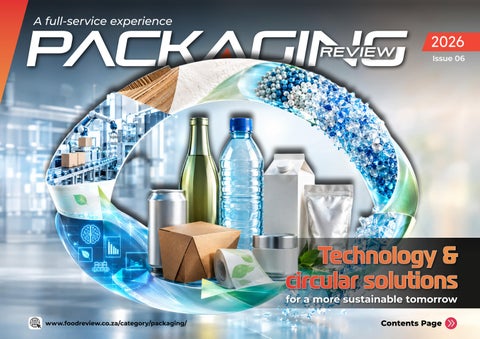
A full-service experience
Review
2026 Issue 06
Technology & circular solutions for a more sustainable tomorrow
www.foodreview.co.za/category/packaging/
Contents Page
CONTENTS
A full-service experience
4 NEWS Award-winning concept to simplify e-commerce packaging
Review Issue 06 2026
7
Mono-material mascara packaging bridges prestige and sustainability
printers and converters of shrink sleeves & flexible packaging
Tetra Pak commissions new PolyAl recycling plant 7 INDUSTRY TALK The sensory side of plastic packaging
With the manufacturing plant consisting of 10-colour and eight-colour MPS EPW560’s and a full complement of the latest offerings in finishing equipment for the conversion and inspection of our products, ISW maintains the highest level of quality and is one of only a handful of narrow web printers capable of producing wide lay flat shrink sleeves, achieving a L/F of 276mm from a printed web width of 575mm. By offering assistance and advice with every step from concept to design, production and application; we are there to ensure our clients achieve their desired vision efficiently, affordably and consistently.
8 ALTRON DOCUMENT SOLUTIONS Epson digital label presses redefine shelf appeal 9 BIDVEST PACKAGING Packaging that covers every angle 11 BUCKLE PACKAGING New bag-closing system reduces waste at flour milling facility
12
12 CAMA GROUP AI sharpens the human edge in packaging 14 EYEC
17
Rethink print quality control with AI 16 FUTAMURA Home-compostable fruit label launched ahead of PPWR deadline 17 PLASTIC REBOOT – SOUTH AFRICA Floatable polyolefin sleeves and the future of circular PET packaging 19 POLYOAK PACKAGING South Africa welcomes its first Eco-Flat Wine Bottle
16
21 PMD PACKAGING Small pack solutions for growing markets 23 PROGETTO INTERNATIONAL The case for a single-source packaging line 25 SEALGLOBAL.CO Designing out forever chemicals
www.iswshrink.co.za
27 SENSETEK Aluminium packaging advances product integrity and sustainability
16 Edendale Rd West Eastleigh, Edenvale.
29 TEGMAN Fibre to film – the components that keep packaging running
2
PACKAGING REVIEW // I SSUE 06
19
Through an innovative and out of the box approach to our clients’ needs, we are not only willing, but also able to provide practical and efficient cost-saving solutions to most printing and packaging challenges. A pioneering narrow web flexographic printer, ISW specializes in, while not confined to, the manufacturing of highly decorative and complex shrink sleeves, self-adhesive and wraparound labels, and various forms of flexible packaging. By working closely with local and international suppliers, and utilising specially developed in-house processes a multitude of innovative finishes including the likes of thermochromic, glow in the dark, domed, holographic and high lustre metallics along with specialised multi-perforation solutions for promotional items are achieved.
Tel: (011) 609 1488 Fax: 086 515 7409 Email: sales@iswshrink.co.za 2019/279539/07 VAT Reg 4870259860
FROM THE EDITOR
Engineering the circular shift P
The team EDITORIAL
EDITOR: Abby Vorster +27 (0)71 359 4519 abby.vorster@media24.com LAYOUT & DESIGN: David Kyslinger
ADVERTISING
ackaging is under pressure to do more with less. Reduce waste. Improve efficiency. Use smarter materials. Meet evolving regulatory requirements. And, increasingly, design for a circular economy. For manufacturers, converters and brand owners, the challenge is turning these ambitions into practical solutions that work reliably on the production floor. This is the focus of our 2026 edition of Packaging Review. Across these pages, we explore how technology, engineering and collaboration are helping to move the packaging industry from sustainability goals to measurable action. Starting with machinery and automation, moving to materials, coatings and quality control, a common thread is clear: the future of packaging will depend on solutions that deliver operational performance and environmental progress. Equipment reliability is central to this shift. Buckle Packaging’s bag-closing system demonstrates how the right machinery can reduce product waste while improving consistency. Tegman’s filtration and belting solutions support reliable production across the packaging value chain. These technologies highlight the often-overlooked role that dependable equipment and components play in achieving more sustainable output. Material innovation is equally important. Polyoak Packaging’s award-winning Eco-Flat Wine Bottle and GreenCape’s floatable polyolefin sleeve case study demonstrate how local innovation and collaboration across the value chain can help make circularity more achievable at scale. SealGlobal.Co’s PFAS-free coatings show how regulatory and environmental considerations can also be incorporated into packaging design from outset. Also featured in this edition, EyeC and Cama Group explore the growing role of AI and automation in quality control and production, showing how intelligent technologies can enhance human expertise through defect classification and predictive maintenance. PMD Packaging responds to demand for smaller pack formats across African markets, while Progetto International highlights the potential of integrated, single-source automation to simplify production and improve efficiency. Whether you are involved in procurement, production, packaging development or brand management, Packaging Review offers practical insights into the technologies and ideas shaping what comes next.
KEY ACCOUNT MANAGER: Pepa Giesing +27 (0)72 187 2757 pepa.giesing@media24.com KEY ACCOUNT MANAGER: ὰCándida Giambò-Kruger +27 (0) 71 438 1918 candida.giambo-kruger@media24.com
INTERNATIONAL SALES
Germany/Austria/Switzerland: Eisenacher Medien Erhardt Eisenacher +49 228 249 9860 info@eisenacher-medien.de Italy: Ngcombroker Giacomo Rotunno +39 370 101 4694 g.rotunno@ngcombroker.com Taiwan: Ringier Trade Media Sydney Lai +886 4 2329 7318 sydneylai@ringier.com.hk
CIRCULATION
Rotary filling equipment Inline pump filling equipment
CIRCULATION MANAGER: Rae Morrison Rae.Morrison@media24.com
PUBLISHING TEAM
General Manager: Dev Naidoo Head of Content & Digital Strategy: Varushka Padayachi Production Manager: Angela Silver Group Art Director: David Kyslinger
MEDIA24 MEDIA CFO: Luxolo Dywili
MEDIA24 CORPORATE
CEO MEDIA24: Minette Ferreira CFO MEDIA24: Raj Lalbahadur
JOHANNESBURG OFFICE
Media24 B2B, Building 13, The Woodlands Office Park, 20 Woodlands Drive, Woodmead, Sandton PO Box 784698, Sandton 2146 Tel: +27 11 867 6111
Round bottle labelling
Gravity filling equipment
POSTAL ADDRESS PO Box 784698, Sandton, Johannesburg, 2146 Published by Media24 (PTY) Ltd
The views expressed in this journal, other than those specifically stated, are not necessarily those of the publisher.
Enjoy the read!
Advertisers’ index
Advertiser URL Page ISW SHRINK............................................iswshrink.co.za............................................... 2 IJP Filling & Labelling...........................www.labelling.co.za......................................3 Filmatic Packaging Systems..............www.filmatic.com..........................................6 Altron Document Solutions.................documentsolutions.altron.com...................8 Bidvest Packaging................................www.bidpaperplus.co.za............................ 10 Buckle Packaging.................................bucklepackaging.co.za................................ 11 CAMA Group...........................................camagroup.com............................................13 EyeC........................................................www.eyec.com..............................................15
3
PACKAGING REVIEW // I SSUE 06
While precautions have been taken to ensure the accuracy of the content and information given to readers, neither the editor, publisher, or its agents can accept responsibility for damages or injury which may arise therefrom.
Advertiser URL Page Futamura................................................www.futamuragroup.com.......................... 16 Montgomery Group Africa...................www.propakcape.co.za.............................. 18 Polyoak Packaging...............................polyoakpackaging.co.za.............................20 PMD Packaging Systems.....................pmdpackaging.co.za...................................22 Progetto International.........................progetto.co.za..............................................24 SealGlobal.Co........................................sealglobal.co.................................................26 Sensetek................................................sensetek.co.za.............................................28 Tegman...................................................tegman.co.za............................................... 30
Entry level filling equipment
Front and back labelling
Pharmaceutical labelling & coding
NEWS Award-winning concept to simplify e-commerce packaging Mondi, a global leader in sustainable packaging and paper, has developed an award-winning packaging concept that combines a corrugated outer box with a recyclable, lasermarked flexible packaging. The concept was recognised with the German Packaging Award 2026 in the Sustainability category. Designed for e-commerce and bag-in-box applications, the concept can be applied across a range of flexible packaging formats. It demonstrates how innovative packaging design can support circularity and improve supply chain efficiency. The concept uses laser marking technology to apply artwork directly onto the flexible packaging during converting, eliminating the need for conventional decorative printing and associated printing plates. This enables personalisation, fast artwork updates and greater design flexibility, allowing customers to respond quicker to market trends. It can be adapted across a variety of flexible packaging formats, from reels to pre-made pouches such as the re/cycle StripPouch, or larger pre-made bags as the re/cycle FlexiBag, supporting design for recycling by simplifying material structures and reducing decorative elements. Depending on application requirements, bio-based feedstocks or
post-consumer recycled content can also be incorporated. The concept helps customers benefit from shorter lead times, increased supply chain agility and greater flexibility when introducing new products or designs. By combining Mondi’s corrugated and flexible packaging expertise, it enables customers to explore complete bag-in-box solutions from a single source. “Customers are facing increasing pressure to meet sustainability targets while managing increasingly complex product portfolios and changing consumer demands. This concept supports circularity with the use of bio-based materials and greater artwork flexibility in a single solution, helping brands respond more quickly to market requirements while progressing towards their circularity goals,” says Jens Koesters, manager technical service, R&D and innovation, Mondi Consumer Flexibles. Mondi is working with customers and partners to explore broader commercial implementation of the concept for pet food, home care and personal care products, as well as e-commerce packaging formats. • Mondi’s new packaging concept can be adapted across a variety of flexible packaging formats
KHS maintains EcoVadis platinum rating The KHS Group has received an EcoVadis platinum rating for the second consective time. This rating confirms the outstanding sustainability achievements of the business and honours the progress it has made. With 89 out of 100 points, KHS has further improved its score from the previous year and cemented its position among the world’s top-rated companies. “Winning our second platinum award is a great success for us all here at KHS. In a rating system that’s undergoing dynamic development and imposing increasingly stringent requirements, we’ve achieved an excellent result,” says Nicole Pohl, senior ESG manager at KHS. This means that KHS continues to be among the top 1% of over 175 000 companies vetted every year. The rating organisation defines up to 21 sustainability criteria for assessment in the fields of environment, labour law and human rights, ethics and sustainable procurement. The renewed pioneering role of KHS shows that ecological and social
4
PACKAGING REVIEW // I SSUE 06
responsibility isn’t just an empty phrase but is actively practiced – and measurably so – by the systems supplier headquartered in Dortmund, Germany. Sustainability targets are pursued consistently while progress is documented and continuously developed. According to KHS, EcoVadis gave the company an exceptionally positive evaluation. This is demonstrated in the endorsements category, which evaluates a company’s formal recognition and promotion of external sustainability initiatives and principles. Thanks to the continuous further development of this commitment, KHS gained more points in this section compared to the previous year. “We see EcoVadis as a yardstick measuring our own sustainability achievements in the direct context of the market and competition,” explains Pohl. “With this, we’re enabling our stakeholders to make a reliable and measurable comparison to our progress throughout the entire value chain.” •
Alpla strengthens its presence in Turkey Expanding its production capacity in Turkey, the international packaging and recycling specialist has commissioned two state-of-the-art plants in İzmir and Adana. The investments, which total approximately €30 million, will strengthen customer proximity, shorten supply routes and create additional capacity for highquality packaging solutions. The two new plants complement Alpla’s production network in Turkey and significantly increase its nationwide capacity. At the same time, the company is reinforcing Turkey’s position as one of its most important markets within the Africa, Middle East & Turkey (AMET) region. “Turkey combines industrial strength, a dynamic consumer goods industry and significant future potential. With these new facilities, we are creating the conditions to support our customers even more
The İzmir opening took place on 15 September
Alpla’s Adana facility was officially opened on 14 September effectively and continue growing alongside them as a reliable partner,” says Philipp Lehner, CEO of Alpla Group. ALPLA has been active in Turkey since 1992 and now operates plants in Kocaeli, Ankara, Konya, Adana and İzmir. The country is one of the company’s most important production and competence centres within the AMET region, accounting for around one-third of its capacities and business activities. “Turkey plays a key role in our regional strategy. We are now able to cover a broader geographical area and further strengthen our position as a system provider. Over the coming years, we intend to continue expanding our activities,” explains Javier Delgado, regional managing director AMET at Alpla. The packaging group has established modern production facilities covering approximately 50 000m2 in İzmir and 20 000m2 in Adana. İzmir is designed as a versatile production platform for PET preforms, closures, HDPE and PET bottles. Adana focuses on PET preforms as well as HDPE and PP packaging solutions. The sites supply customers in the beverage, food and dairy sectors, as well as home care and personal care applications. They were officially opened in the presence of CEO Philipp Lehner, COO Walter Ritzer and numerous guests. The Austrian Ambassador, Gabriele Juen, was also present in İzmir. •
NEWS Syntegon opens new OSD Customer Centre in Fellbach
Mono-material mascara packaging bridges prestige and sustainability For three decades, Texen has been mastering the complexity of mascara packaging, positioning itself as an industry leader serving global mass and prestige brands. In 1995, Lancôme’s Eternicils hit the shelves. This iconic mascara stood out for high-performance wear, as well as sophisticated and innovative packaging with an exquisite design. Its creation was the result of a collaboration between L’Oréal and the bespoke beauty packaging manufacturer, Texen. This marked the start of a new era of manufacturing excellence.
“We are historically recognised as an expert in the design and manufacture of complex mascaras”
TX Lancome Lash Idole Curl Goddess
5
PACKAGING REVIEW // I SSUE 06
TX Mayet mascara line
Since the initial collaboration, Texen has perfected its expertise, expanded its facilities and developed its capacity for innovation. Christophe Wojciechowski, development manager at Texen Mayet, says: “We are historically recognised as an expert in the design and manufacture of complex mascaras, capable of developing designs and shapes that others cannot produce. But what sets us apart is our ability to create entry-level as well as high-end products.” Starting with luxury solutions for Lancôme, Givenchy and Dior to creations for Maybelline or Rimmel, Texen’s expertise adapts to the creative brief, to deliver the right mascara solution on a global level. Knowledge of the pack’s interplay between formula, wiper and applicator ensures high-performance designs, which come to life at its state-of-the-art facilities. Production, decoration and assembly are fully automated, optimised using Industry 4.0 technologies. Today, Texen is part of a growing group within PSB Industries. It is committed to the beauty industry’s ecotransition, with a transparent, responsible and forwardlooking approach. Its latest launch is Lancôme’s Lash Idôle Curl Goddess, which features a mono-material design made entirely of recyclable polypropylene, with a brushed aluminium effect, achieved through custom inmould engraving. “It’s a story of trust,” says global account manager, Bruno Lucchesini, speaking about the relationship with the client. “An international presence and our recognised expertise enable us to support global launches with agility and efficiency. It’s all about collaboration, technical mastery and, ultimately, a shared passion for excellence.” •
A strategic lifecycle partner to the pharmaceutical, biotech and food industries, Syntegon has opened its new OSD Customer Centre in Fellbach, following the move from Waiblingen. Cleanrooms, a powder laboratory, and state-of-the-art equipment create ideal conditions for pharmaceutical and nutraceutical trials involving solid oral dosage forms (OSD) such as capsules and tablets. From lab to production, customers benefit from extensive knowledge transfer, helping accelerate the timeto-market of new pharmaceuticals and dietary supplements. “With a double-digit million investment in Fellbach, we are sending a strong signal in support of our growth strategy and creating an environment that aims to always be one step ahead,” says Thomas Hartkämper, executive vice president pharma solid at Syntegon. “The OSD Customer Centre supports customers and employees in taking formulation and manufacturing processes to a new level.” Spanning 7 900m², the customer centre and production facilities have moved even closer together.
Cleanrooms, a powder laboratory and stateof-the-art equipment create ideal conditions for trials with capsules and tablets
“Short distances, digital processes and a future-proof infrastructure create the framework for genuine collaboration on an equal footing,” says site manager, Markus Reitz. Within the first few months after the move from Waiblingen, delivery reliability has already increased by 10% thanks to improved cross-departmental collaboration, agile work methods, and greater efficiency. The OSD Customer Centre offers pharmaceutical and nutraceutical developers and manufacturers an ideal location to test future formulations or existing products on the production equipment. Capsule fillers and sealers as well as tablet presses are available for this purpose in Fellbach. The successful OSD Academy will be held in Fellbach, in addition to Schopfheim. While the event in Schopfheim, from 20 to 22 October will focus on coating, the first session in Fellbach is scheduled for 2027. •
NEWS
Tetra Pak commissions new PolyAl recycling plant To help convert used beverage cartons into new industrial products, Tetra Pak has backed this progress with targeted Tetra Pak has commissioned a new PolyAl processing plant in infrastructure investment, including a monitoring system, Germiston, Gauteng. The R19 million investment aims to increase which gives real time visibility of collection points and buyback South Africa’s carton recycling rate by 40% by 2030. centres across the country. Furthermore, a team of graduates The focus of the plant is to is deployed across all nine separate the polyethylene and provinces to work directly with aluminium layer, known as PolyAl, buyback centres and collectors, from used beverage cartons resolving on the ground once the paper fibre has been challenges every two weeks. recovered for papermaking. The Mpact recovers the paper recovered PolyAl is processed fibre from used cartons at into pellets, which manufacturing its mill, while Timber Plastics partner Timber Plastics converts manufactures the recycled into finished products including PolyAl into finished products. outdoor furniture, roof tiles and Petco works with waste pipes. The Council for Scientific reclaimers, buyback centres and and Industrial Research (CSIR) has municipalities to channel cartons supported product development, into the recycling system. Tetra Pak’s staff and industry stakeholders celebrate helping validate applications such The producer responsibility the company’s milestone as roof tiles designed to compete organisation, which coordinates with traditional cement products and pipes being developed as an collection under South Africa’s extended producer responsibility alternative to conventional high-density polyethylene (HDPE) piping. regulations, has seen its liquid board packaging scheme Masale Manoko, head of sustainability for Tetra Pak Southern performance grow from 8% to 33% under this partnership. Africa says the investment builds on several years of progress in the The waste pickers who collect and sort cartons remain country’s carton recycling rate, which has grown from 8% in 2023 to essential to the process. 33% in 2026. “The process involves partners at each and every stage,” Manoko explains. “We cannot do it alone.” Government has signalled continued review of the extended producer responsibility framework, aimed at strengthening requirements for producers not yet investing at Tetra Pak’s level. “I’m hopeful this plant will continue to unlock new value while innovating on new products,” Manoko comments. “Watch the space, there’s a lot more to come.” •
Tetra Pak’s new PolyAl processing plant in Germiston, Gauteng
6
PACKAGING REVIEW // I SSUE 06
INDUSTRY TALK
The sensory side of plastic packaging Plastic is emerging as a multisensory packaging material that shapes how consumers experience a product before they even open it.
P
ackaging not only transports goods, but also entices
feels so natural that its tactile quality alone awakens the desire
the buyer. According to research, innovative designs
to own the fragrance.
and extraordinary haptics increase attention directly at
In addition, plastic retains its shape much better than cardboard
the point of sale. The design freedom of plastic creates new
does in everyday life. It neither kinks nor tears. This haptic
possibilities for brands to clearly differentiate products and unlock
stability conveys to the consumer the reassuring feeling of
additional sales potential.
uncompromising freshness and safety.
A purchasing decision is made in milliseconds, and brands that don’t not stand out disappear.1 Modern design is rediscovering
Minimalism is more meaningful
plastic as a material that can trigger consumer impulses at the
Plastics packaging can brighten up everyday segments of the
point of sale and embed them in shoppers’ awareness.
supermarket. For example, the brand Method revolutionised the
2
point of sale for household cleaners with its drop-shaped, crystal-
to the fore with packaging becoming a minimalist art object that
A tactile trigger closes the sale
clear bottles made of pure recyclate. This packaging shows the
radiates elegance and high quality.
The decision to purchase is significantly controlled by touch.
vibrant colours of the cleaning products.⁴ The result is a visual
Brand research calls this ‘neuropackaging’ – the targeted
pop-art effect on shelf.
activation of the brain through sensory stimuli. In this case,
Together with the ergonomic grip and a perfectly balanced
Bold design gives an entirely new perspective to the sustainability debate. Recyclate no longer hides its origin but
“Plastics packaging can brighten up everyday segments of the supermarket”
rather celebrates it. For example, Chanel consciously uses
plastic is unbeatable. It immediately takes on body heat and
pressure point of the spray head, at the first glance, the
recycled, bio-based materials for the caps of its limited-
flexibility for modern packaging, transforming the medium’s
allows organic forms, which perfectly adapt to the hand.
object promises fun and enjoyment instead of the laborious
edition fragrances.⁶
classic protective value into a sales-active factor. •
US cult brand Glossier demonstrates ‘neuropackaging’ with
task of housework.
Instead of artificial perfection, the French fashion house celebrates the characteristic matte surface of the recycled
its fragrance Glossier You.³ The weighty flacon features an ergonomic cap moulded from high-quality plastic with a deep
The new look of recycled
material. This noble flaw functions at the point of sale as a
thumb recess that invites an intuitive grip. When held, the bottle
In furniture design, Kartell has already proven the inherent value
visible certificate of authenticity for implemented environmental
of aesthetics in plastic material.⁵ This concept is now conquering
awareness. It serves the visual conscience of the modern buyer at
the packaging industry with a consistent ultra-clean aesthetic.
a premium level.
Brands are reducing everything unnecessary – no aggressive
2. https://www.sciencedirect.com/science/article/pii/ S2949824424000405 3. https://www.glossier.com/en-de/products/glossier-you
The quiet migration to digital
4. https://methodproducts.co.uk/beyond-the-bottle/packaging/
components. The pure, flawless material effect of plastic comes
On pack information is now provided via digital channels to not
5. https://www.kartell.com/de/de/ktde/
disturb packaging aesthetics. Clever packaging simplifies its
6. https://beautymatter.com/articles/chanel-introduces-biobasedfragrance-cap
As the first global movement of the packaging industry, the Plastic is Fantastic association gives plastic the voice it deserves: powerful, clear and fact-based.
PACKAGING REVIEW // I SSUE 06
1. https://pdfs.semanticscholar. org/982e/3c09ad917cc28d2ff78a2c48eaa6f107b4de.pdf
labels, no disruptive material mixtures and no visible technical
Did you know?
7
References:
appearance on the shelf by outsourcing data via the QR code. The customer scans the packaging with a smartphone to find out more about the product’s origin and environmental footprint etc., making it interactive. App-connections as well as video or gaming elements are also possible via augmented-reality applications. Modern packaging design connects function, perception and information into an inseparable unit. Plastic offers the ultimate
Connect with Plastic is Fantastic online:
ALTRON DOCUMENT SOLUTIONS
Epson digital label presses redefine shelf appeal Marco Engelbrecht, specialist product manager at Altron Document Solutions, explores how digital label printing transforms brand recognition and consumer engagement.
C
rowded shelves mean your product can’t play hide and seek. It needs to be front and centre. I loved labels as a youngster. My boombox, bicycle and school lunch box were branded with colourful labels. These labels were my brand, identity and style. Fast forward to today and, in my role as product manager at Altron Document Solutions for the production division, it is my responsibility to bring solutions to market that will diversify our customers’ print businesses and enhance their customers’ experience. Just as my creative labels were my identity, the same applies to brands. Brand recognition is determined by the label on the product, and it attracts consumers’ attention. This is the difference between a product staying on the shelf or being purchased.
film and metallised paper are some of the substrates on which these presses can deliver beautiful results. This means you can produce wine, craft beer and spirits labels; health and beauty labels; pharmaceutical and healthcare labels, and many more. Marco Engelbrecht The label printing process is quick with minimal setup and preparation time, making it ideal for short to medium runs. Variable data can also be added to your labels, allowing you to personalise labels for different stores, regions and languages with ease. Looking back, those labels on my boombox, bicycle and lunch box were more than decoration, they were a statement. Today, brands need that same power of expression. With our Epson digital label printing solutions, every product can carry a label that tells its story, captures attention and creates a lasting impression and, of course, helps secure that trolley ride to the cashier. • C
M
Y
CM
MY
CY
New presses offer a superior experience One of the differentiating solutions we recently launched is the Epson SurePress label press. Available in two ranges, water-based inkjet and UV inkjet, these presses will most definitely enhance your customers’ experience, with both presses reaching more than 90% of Pantone colours. The water-based inkjet press, with a six-colour ink set consisting of CMYK, orange and green, plus optional white, gives the SurePress L-4733A/AW a wide colour gamut for precise colour matching and colour consistency throughout the production run. The L-6534VW configuration is CMYK plus a high-opacity white ink. It also comes with the choice of orange ink for an expanded colour gamut, or digital varnish printed in-line to provide powerful embellishment with a gloss or matte finish. Built for flexibility and reliability The presses are designed and engineered by Epson for flexibility, consistency and reliability, delivering repeatable, high-quality printed labels with minimal downtime and waste. Cast-coated, machine-coated, uncoated, film, clear
8
PACKAGING REVIEW // I SSUE 06
CMY
K
Connect with Atron Document Solutions online:
BIDVEST PACKAGING
Packaging that covers every angle Bidvest Packaging brings together five market-leading specialist businesses to provide one of Southern Africa’s most comprehensive portfolios of packaging and labelling solutions.
A
lthough each business operates independently and brings deep expertise to its respective market, their complementary capabilities enable Bidvest Packaging to serve customers across the food and beverage, healthcare, pharmaceutical, retail, industrial and manufacturing sectors. Sustainability is central to the group’s strategy. Its portfolio spans recyclable paperboard, responsibly sourced paper,
Aluminium Foil Converters
Founded in 1982, Aluminium Foil Converters (AFC) has established itself as a leading supplier of foil lidding, closures and wrapping solutions to national brands across the dairy, food, wine and beverage, pharmaceutical, confectionery and agrochemical industries.
aluminium, compostable materials and innovative plantbased packaging solutions, helping customers reduce their environmental footprint without compromising quality, performance or brand presentation. This commitment is supported by internationally recognised quality, food safety, pharmaceutical and environmental certifications, responsible manufacturing practices, recycling initiatives and continued investment in innovation.
The company offers a comprehensive range of converting capabilities, including flexographic and gravure printing, laminating, punching, embossing, guillotining and slitting, enabling it to deliver tailored flexible packaging solutions to meet specific customer requirements. Food safety is a key priority, particularly given the critical role packaging plays in protecting product integrity. AFC operates an ISO 22000:2018 certified food safety management system and works closely with customers to identify and implement measures that enhance food safety for the end user. With decades of industry experience, specialist technical capabilities and a partnershipdriven approach, AFC continues to provide high-performance packaging solutions where product protection, quality and compliance are paramount. Connect with Aluminium Foil Converters online:
Lufil Packaging
Having established a strong position in the fast-food and foodservice packaging market, Lufil Packaging manufactures and distributes an extensive range of paper bags, wraps and tissue products. Its offering also serves the retail, hospitality, quick-service restaurant and industrial sectors, giving customers access to a broad portfolio from a single specialist supplier. Sustainability is a key focus for Lufil. The company exclusively procures FSC certified materials and has steadily expanded its range of environmentally friendly products, with around 90% of its current portfolio offering environmental benefits. Its approach is guided by circular economy principles, with a focus on ensuring products are either recyclable or biodegradable. Lufil is FSC and FSSC 22000 certified and participates in the Extended Producer Responsibility (EPR) system through Fibre Circle. The company is also developing innovative alternatives to conventional packaging materials, including an aqueous-coated paper designed to replace poly-coated paper in takeaway chicken bags, offering a recyclable alternative without compromising functionality. Connect with Lufil Packaging online:
Masterpack
Through its Cape Town and Gauteng operations, Masterpack provides specialist paperboard and paperbased packaging solutions. Its portfolio includes folding cartons, header and blister cards, paper bags and package inserts, serving diverse markets including food, healthcare, pharmaceutical, personal care, confectionery and home care. Masterpack Cape has a strong focus on food packaging and operates to stringent BRCGS food packaging safety standards. It also holds FSC and PEFC certifications, supporting responsible sourcing of raw materials, and participates in the Fibre Circle EPR programme. The recent installation of a six-colour UV press has further enhanced production capabilities, enabling instantly dry packaging, improved efficiency and reduced lead times. Masterpack Gauteng specialises particularly in healthcare packaging, producing folding cartons and package inserts to meet demanding pharmaceutical requirements. Its capabilities include six-colour offset printing, UV printing, hot-stamp foiling, embossing, PET windows, die-cutting, gluing and leaflet folding. The facility holds ISO 9001, FSSC 22000 and FSC certifications and is approved to manufacture packaging in accordance with SAHPRA requirements. Connect with Masterpack Gauteng online:
Connect with Masterpack Cape online:
Continues next page
9
PACKAGING REVIEW // I SSUE 06
BIDVEST PACKAGING
Green Home
Established in 2007, Green Home is South Africa’s first and longest-running compostable food packaging company. The business pioneered the introduction of bagasse and plantbased bioplastic packaging to the local market and continues to champion alternatives to conventional petroleum-based single-use plastics. Green Home’s philosophy is built around two simple principles: its products are made from plants and are compostable after use. Its extensive portfolio includes hot and cold cups, sugarcane takeaway containers, Kraft food containers, biodegradable cutlery, bamboo cocktail accessories, serviettes and other foodservice packaging products. The company’s compostable products are designed to return to the biological cycle after use, breaking down into compost that can support healthy plant growth. Green Home is a founding member of the Organics Recycling Association of South Africa (ORASA), which promotes the development of composting and organic recycling infrastructure in the country. With a long-standing commitment to sustainable innovation, it continues to help the foodservice industry make more environmentally responsible packaging choices.
Connect with Green Home online:
Bidvest Labels
Bidvest Labels brings together the expertise of S&N Labels and Rotolabel to provide a comprehensive portfolio of labelling, product identification and traceability solutions. Bidvest Labels S&N Labels specialises in self-adhesive labels and tags, including blank labels, thermal transfer ribbons, price-marking systems and tagging products. Its ISO 9001:2015 certification reflects the company’s focus on quality, while significant production capacity enables it to meet high-volume label requirements within demanding lead times. S&N is also FSC certified and continues to reduce waste, increase recycling and replace plastic roll cores with paper alternatives where feasible. Bidvest Labels Rotolabel has established a reputation as a pioneer in sustainable self-adhesive labelling. Its FSC certification and liner-backing recycling programme support responsible production, while its CleanFlake™ PET wash-off label enables clean separation of labels during recycling, supporting bottle-to-bottle production of foodgrade rPET. Together, S&N Labels and Rotolabel combine technical expertise, innovation and sustainability to help customers meet evolving labelling, traceability and environmental requirements. Connect with Bidvest Labels online:
A comprehensive packaging partner Collectively, the five businesses represent decades of manufacturing expertise, technical knowledge and market leadership. Their complementary capabilities enable Bidvest Packaging to provide focused, end-to-end solutions that combine innovation, sustainability, quality and service. As part of the Bidvest Group, these businesses are well positioned to help customers navigate increasingly complex packaging requirements while delivering long-term value.
10
PACKAGING REVIEW // I SSUE 06
BUCKLE PACKAGING
New bag-closing system reduces waste at flour milling facility Buckle Packaging delivers a reliable bag closing system with the Fischbein MFS industrial sewing system to help one of South Africa’s leading wheat flour millers prevent product loss.
R
eliable packaging equipment is essential to maintaining product quality, reducing waste and ensuring efficient production. Buckle Packaging recently completed the installation of an industrial bag closing system for one of South Africa’s largest wheat flour millers, providing a solution to ongoing challenges with its previous bag closing equipment. Understanding the challenge The miller approached Buckle Packaging because it was experiencing inconsistent bag closures with it bag closing equipment. The stitching was not always reliable, resulting in some wheat flour product sifting through the stitch holes in the bag. This not only affected the overall quality and presentation of the finished product but also created concerns around product loss and the reliability of the packaging process. After assessing the application and the client’s specific requirements, Buckle Packaging’s team recommended the Fischbein MFS industrial sewing system with an automatic folding device. The MFS system was the ideal solution for this application. The automatic folding device folds the top of the bag before it is sewn closed, creating an improved barrier that helps prevent fine products, such as wheat flour, from sifting through the stitching. This provides a cleaner, more secure and reliable bag closure while maintaining a consistent and professional finish. Did you know?
Buckle Packaging brings stability and innovation to its clients’ businesses. The company has more than 45 years of experience in packaging, coupled with strong supplier relationships and deep industry knowledge.
11
PACKAGING REVIEW // I SSUE 06
Finding the right solution Fischbein equipment has established a worldwide reputation for quality, reliability and performance. Used by leading companies and industrial operations across the globe, Fischbein bag closing systems are trusted in demanding packaging environments where
“Fischbein bag closing systems are trusted in demanding packaging environments”
Distributed locally by Buckle Packaging, Fischbein equipment has established a worldwide reputation for quality, reliability and performance
consistent performance is essential. Manufactured using high-quality European components, the equipment is designed for durability and long-term operation. However, selecting the correct equipment is only one part of delivering a successful solution. The Buckle Packaging team worked closely with the client to understand the production requirements. The team recommend the most suitable system and assisted with the installation and setup of the machine. “By combining the right equipment with the right technical guidance, we were able to provide a bag closing solution specifically suited to the client’s wheat flour packaging operation,” sates Matthew Mason, Buckle Packaging’s marketing manager.
The result is a more reliable and consistent bag closure, improved product containment and a higher-quality finished package. To find out more about Buckle Packaging’s commitment to helping businesses find the right packaging solutions for their specific applications contact Matthew Mason on +27 (0)11 613 8024 or +27 (0)72 548 7954. •
Connect with Buckle Packaging online:
CAMA GROUP
AI sharpens the human edge in packaging The packaging industry is moving beyond traditional automation towards a new generation of intelligent production systems. Driven by digitalisation, AI and advanced data management, packaging lines are becoming more connected, predictive and adaptable.
D
igital twins, AI-driven analytics, predictive maintenance and collaborative robotics are reshaping machine performance and operational decision-making, helping manufacturers improve efficiency, flexibility and production continuity. Rather than replacing human expertise, these technologies strengthen it, giving operators and technicians the insights they need to make faster, more informed decisions in increasingly complex production environments.
For Cama, this evolution is not only a technological shift, but a way to design packaging systems that are more flexible, intuitive and efficient, while keeping operators at the centre of the production process. Digital twins, AI and predictive intelligence Among the technologies driving smart manufacturing, digital twins and AI play an increasingly strategic role. Digital twins provide a real-time view of machine
performance, while AI turns operational data into actionable insights. Together, these technologies enable predictive maintenance by continuously analysing machine parameters and operating conditions to identify potential failures before they result in unplanned downtime. This proactive approach improves production continuity, reduces maintenance costs and supports faster, more informed decision-making. However, the true value lies in the ability to transform information into industrial intelligence. Advanced analytics can identify trends, anomalies and opportunities for improvement, while human expertise remains essential for interpreting results, validating insights and choosing the most effective actions. By combining digital twins, AI and operator knowledge, manufacturers can build more resilient and efficient production environments, capable of adapting to complex operational requirements. Smart format changeovers and connected operations Increasingly varied demand is making production batches smaller and format changeovers more frequent and Continues next page
12
PACKAGING REVIEW // I SSUE 06
“The true value of smart manufacturing lies in the relationship between technology and people”
CAMA GROUP
demanding. What was once a largely manual process, dependent on operator experience, is now evolving into a guided and increasingly automated activity, fully integrated into machine logic. Today, advanced technologies support every stage of the changeover process, indicating what to do, when to do it and where to intervene. Augmented reality and human-machine interfaces make access to information faster and more intuitive: through a tablet, operators can consult instructions, documentation and adjustment parameters directly at the point where the intervention is required. The direct connection with the controller makes it possible to guide operations safely, reducing errors and intervention times. At the same time, tool-less solutions make manual adjustments simpler, more ergonomic and more efficient, while sensor technologies verify the correctness of interventions in real time. This approach reflects Cama’s focus on making format changeovers faster, more controlled and easier to manage, combining automation, ergonomics and digital guidance. The result is a faster, more repeatable and safer format changeover process. Downtime is reduced, procedures become standardised and operators can work with greater precision and less effort. In an automated production environment, ease of use directly affects line efficiency, process continuity and the quality of the result.
machine information and remote access systems must be protected through secure, controlled infrastructures. User authentication, secure remote connections, access traceability and network segmentation help safeguard industrial know-how while ensuring operational continuity. In this context, cybersecurity is not only a protective measure, but an essential enabler of connected manufacturing. Harness the value of human expertise The future of packaging production will be increasingly digital, predictive and connected. Yet the true value of smart manufacturing lies in the relationship between technology and people. Intelligent systems can collect data, recognise patterns and support decision-making, but human expertise remains essential for interpreting context, validating insights and driving continuous improvement. Collaborative robotics and intelligent support Smart manufacturing also extends beyond machine control. Collaborative robots and autonomous mobile robots (AMRs) help manufacturers rethink material handling, intralogistics and the interaction between people, machines and production flows. By automating repetitive and physically demanding tasks, these technologies allow operators to focus on activities that require greater expertise, supervision and decision-making. The objective is not to replace people, but to improve ergonomics, increase efficiency and create more flexible production environments. This same approach is transforming technical assistance. Cama’s focus on connected services and intelligent support reflects the need to reduce downtime and maintain production continuity. By combining remote connectivity with AI-based analysis, service teams can identify potential issues earlier, accelerate diagnostics and support customers more effectively. Cybersecurity in connected manufacturing As packaging machines become increasingly connected, cybersecurity becomes a fundamental component of smart manufacturing. Production data,
13
PACKAGING REVIEW // I SSUE 06
Therefore, the factory of the future is not simply automated. It is intelligent, connected and human-centred: a production environment where technology enhances skills, improves efficiency and supports more resilient industrial operations. By combining automation expertise, digital tools and a human-centred approach, Cama supports manufacturers in building smarter, safer and more resilient packaging operations. • USS Pactech is the South African agent for CAMA
Connect with Cama Group online:
Technology inspired by human talent
Cama Group is a leading supplier of advanced technology secondary packaging systems continuously investing in innovative solutions. www.camagroup.com - sales@camagroup.com
EYEC
Rethink print quality control with AI Not every speck on a printed label or sheet is a defect, and yet traditional inspection systems cannot always tell the difference. The result is unnecessary stops, wasted material and frustrated operators. What if quality control could understand what it sees, rather than simply flagging anything unfamiliar? EyeC sets out to answer this question, with its solution changing how packaging manufacturers think about quality, waste and compliance on the production line.
T
he packaging industry continues to transform. While modern packaging lines operate at high speeds and with increasingly demanding quality requirements, manufacturers face pressure to reduce waste, improve productivity and make better use of skilled personnel. This is why traditional production processes, once reliant on manual oversight and static quality control, are progressively being replaced by automated, networked and intelligent systems. The shift is not only about efficiency but also about redefining how packaging is designed, produced and
recycled. Artificial Intelligence is found at the centre of this evolution, enabling smarter, more adaptive and sustainable manufacturing practices. Smarter than a simple comparison Inspection systems have been standard in packaging production for some time. Intelligent in-line solutions like the EyeC ProofRunner series perform 100% inspection at full production speeds, examining every label, sheet or carton. They compare print output against press-ready files,
“EyeC’s pre-trained AI adds contextual understanding by classifying all detected variations” AI-powered defect classification
Continues next page
14
PACKAGING REVIEW // I SSUE 06
EYEC
automatically identifying deviations and flagging them. What is new is their ability to understand what they are looking at, rather than simply detecting changes – this is where contextual AI classification steps in. A dust particle and a genuine ink smear might trigger the same alert, leading to unnecessary production stops and inefficiencies. EyeC’s pre-trained AI adds contextual understanding by classifying all detected variations. Trained with hundreds of thousands of images from real print jobs, the system categorises defects by type and significance, such as material flaws, dust, spots, or streaks, and evaluates their impact. The software understands which issues require immediate correction, and which can be documented without interrupting production. In practice, this means fewer false stops, faster production and more confidence in catching genuine defects. This capability is also particularly valuable
for recycled materials, where optical irregularities are common but not always critical. Compliance at production speed Pre-trained AI matters because regulation is moving faster than the materials themselves. Since the new EU Packaging and Packaging Waste Regulation (PPWR) came into force in August 2026, binding targets for recycled content and material reduction are now the law. This makes inspection one of the practical points where compliance either works on the line or it doesn’t. The underlying training approach of EyeC’s AIclassification model is what makes it workable at scale. The system has already learned to handle the variability of recycled substrates, making compliance attainable without slowing production. Because the
model is pre-trained rather than built from scratch for each customer, it is ready for use without the lengthy calibration typically required to adapt a quality system to a new material or job type. At the same time, it shows what smart manufacturing ultimately requires: production systems that can adapt to changing conditions, make sense of the data they generate, and use that information to improve the next process step. Automated print inspection already provides this quality data directly during production. This information can support faster decisions and further automation within the production process. The EyeC Quality Link uses inspection data from the printing process to identify and remove defective material automatically and support defect removal during subsequent converting steps, such as a rewinder. For packaging manufacturers, this is where AI and smart
manufacturing create practical value. They enable a more efficient quality control process with fewer manual checks, faster responses to relevant defects, less unnecessary waste, and better use of production time. •
Connect with EyeC online
100 % lnspection, Safety & Quality new
Prepress
lnspection
Sample
lnspection
100 % lnline lnspection
lncoming Quality lnspection
for Your Entire Printing Process.
15
PACKAGING REVIEW // I SSUE 06
FUTAMURA/SPONSORED CONTENT
Home-compostable fruit label launched ahead of PPWR deadline Futamura, a film manufacturer based in the UK, and Bio4life, a Dutch labelstock producer, have introduced a certified home and industrial compostable PSA label. It is designed to help retailers and packers eliminate conventional plastic stickers from fresh fruit and vegetables.
F
utamura’s NatureFlex™ cellulose films provide the home compostable facestock while Bio4life’s technology delivers the required certified home compostable adhesive. The outcome is a high-performance label that is renewable, food-safe and compatible with industrial and home composting systems. The label is suitable for a range of fresh produce such as apples, citrus fruits, avocados and kiwis. Traditionally produced PSA labels use fossil-based plastics and non-compostable adhesives, making them a contamination risk in organic waste streams and anaerobic digestion processes. This is because consumers dispose
of the label together with the fruit and vegetable skins. As the stickers are too small to be separated and as most other materials, especially conventional plastics, do not break down under anaerobic condition, this can lead to contamination of the digestate. Fruit and vegetable labels produced using NatureFlex™ films are suitable for anaerobic digestion. This means they break down during the process and therefore, do not contaminate it. Compostable without compromise The new compostable PSA label meets the growing demand for environmentally responsible packaging solutions. Bio4Life delivers certified home and industrial compostable label stock, without compromising performance, printability, or application efficiency. NatureFlex™ films provide a renewable, cellulose-based face stock derived from responsibly managed wood pulp. The films are available in clear, white or metallised variants to fit all client requirements. Their mechanical properties make them well suited to die-cutting and dispensing. Being stiffer than other bio-based and compostable alternatives, they can be used at a thinner
16
PACKAGING REVIEW // I SSUE 06
grammage, whilst still maintaining excellent machineability. They showcase excellent printability to achieve a highly decorative finish and great adhesive key. Cellulose films are inherently anti-static, which aids the machineability of the film through conversion. NatureFlex™ cellulose films also have a high barrier to oils and chemicals, which can prevent any transfer through the label, preserving the quality of the label over time. Time to transition ahead of the deadline The countdown to the Packaging and Packaging Waste Regulation (PPWR) implementation on 12 February 2028 places urgency on the transition to mandated compostable produce labels, with the UK and Europe’s fresh produce industry now facing just one remaining harvest cycle to complete trials and testing. This restricted timeline highlights the need for close collaboration across the supply chain to ensure fully compliant solutions are trialled, tested and ready ahead of PPWR requirements. Gerard Benthem, sales manager at Futamura comments: “Compostable fruit and vegetable labels are a great innovation, which supports a truly circular economy. Bio4life and Futamura have a shared vision for the future of labelling, and we hope to help brands and retailers transition away from conventional plastics to renewable and compostable label materials.”
“This partnership showcases how collaboration can accelerate the shift toward packaging that supports a circular economy”
Marcel de Oude, co-owner of Bio4life, adds: “Our home compostable adhesive technology BioTAK® is designed to work together with renewable home compostable substrates like NatureFlex™. This partnership showcases how collaboration can accelerate the shift toward packaging that supports a circular economy. We’re proud to bring this innovation to market with Futamura.” •
Connect with Futamura online:
PLASTIC REBOOT – SOUTH AFRICA
Floatable polyolefin sleeves and the future of circular PET packaging Problematic shrink sleeves made from PET, PETG and PVC can disrupt PET bottle recycling. Plastic Reboot – South Africa explores how collaboration across the plastics packaging value chain unlocks PET bottle recyclability through floatable polyolefin shrink sleeves as a redesign solution.
P
ET (polyethylene terephthalate) bottles are one of the most widely used packaging formats in the food and beverage sector, protecting products, extending shelf life and enabling efficient distribution across global supply chains. Yet packaging can quickly become waste when it is not designed with recycling in mind. Materials that are functional for production and marketing can disrupt recycling systems, making thoughtful material selection one of the most important steps in designing packaging for a circular economy for plastics. Plastic Reboot – South Africa works with stakeholders across the plastics value chain to promote the uptake of circular solutions for the food and beverage sector. A key focus area of this initiative is the elimination of problematic and unnecessary plastics by providing direct support to the private sector to support mid- and upstream circular plastics interventions. Did you know?
The SA Plastics Pact is a voluntary initiative that brings together businesses, government and civil society to accelerate the transition to a circular plastics economy.
A case study developed by GreenCape, the secretariat of the South African (SA) Plastics Pact, highlights how early adopters of polyolefin shrink sleeves succeeded in improving the recyclability of PET beverage bottles. The case study shows that this progress is depended on close collaboration between value-chain role players. Download the case study here: https://greencape.co.za/library/addressingproblematic-shrink-sleeves-on-pet-bottles/
Challenges with PET, PETG or PVC shrink sleeves PET beverage bottles are one of the most successfully recycled packaging formats in South Africa, with 67% reportedly collected for recycling in 2024. However, the 360° formfitting label that fully wraps around the bottle – commonly known as a shrink sleeve – presents a significant challenge to this otherwise effective recycling stream. Shrink sleeves made from PET, PETG (polyethylene terephthalate glycolmodified) or PVC (polyvinyl chloride) materials have been identified by the SA Plastics Pact as a priority problematic and unnecessary plastic item. Among the 12 priority items outlined on the Phase 1 list, PET, PETG and PVC shrink sleeves currently represent the largest share by weight still being placed on the market by Pact members. This makes these shrink sleeves a high-impact opportunity for intervention. The challenge lies in how these materials behave during recycling. PET, PETG and PVC sleeves are difficult to separate from PET bottles during standard recycling processes. As a result, they contaminate the recycling stream or require costly manual removal. In many cases, bottles that are technically recyclable are rejected during sorting and are ultimately landfilled or become litter in the environment because of the sleeves attached to them. Floatable polyolefin material offers a viable substitute Members of the SA Plastics Pact Action Groups have identified several pathways to address the shrink sleeve
“SA Plastics Pact members have been collaborating to address the situation of problematic shrink sleeves”
challenge, including replacing them with labels, eliminating the sleeves entirely or substituting the sleeve material. For some products, replacing shrink sleeves with smaller labels can improve recyclability while still providing essential product information. However, labels do not always offer the same branding space or product protection as shrink sleeves. For many applications, elimination is not practical because shrink sleeves perform important functions. They provide space for regulatory information and branding, and they sometimes protect the product from light exposure. Material substitution using floatable polyolefin sleeves has emerged as the most viable near-term solution. Polyolefin materials include polyethylene (PE) and polypropylene (PP). Unlike PET, PETG or PVC sleeves, these materials can be separated from PET bottles during recycling through float-sink processes. The floatable polyolefin material collects at the top of the tank where it can be easily captured and removed, whilst the PET material sinks to the bottom. This compatibility preserves the sleeve’s pre-recycling functional advantages while allowing the bottle material to be recovered during recycling. Colabs deliver best practice examples SA Plastics Pact members have been collaborating to address the situation of problematic shrink sleeves. There are success stories emerging from these partnerships, which provide some best practice examples. Woolworths, a leading multinational brand owner and retail company, has been working with MCC, a locally operating multinational supplier and label manufacturer, to find an alternative. PP, a floatable polyolefin material compatible with PET recycling processes, provided a solution. In 2023, Woolworths transitioned its first product line to PP shrink sleeves. Since then, more product lines have followed. Continues next page
17
PACKAGING REVIEW // I SSUE 06
PLASTIC REBOOT – SOUTH AFRICA
SPUR Corporation, a leading multinational franchised casual-dining restaurant group, conducted test trials with printing supplier and a PET bottle manufacturer, Polyoak Packaging, to identify floatable polyolefin material as a suitable alternative. In 2024, SPUR transitioned the shrink sleeves on its sauce bottles supplied to restaurants, to polyolefin material. Unlocking full circularity at scale Collective action across the value chain can enable a marketwide transition to polyolefin shrink sleeves. To unlock the full circularity of this shift, importers, brand owners and retailers need to take up polyolefin shrink sleeves on PET beverage bottles at scale. The broader circularity benefits include the decreased use of virgin fossil-based plastic, less waste to landfill, and reduced plastic leakage into the environment. The SA Plastics Pact provides a platform for knowledge sharing and collaboration and supports brand owners and retailers to accelerate the adoption polyolefin shrink sleeves on PET beverage bottles. This article is based on the case study, Shrinking the Problem? Addressing Problematic PET, PETG and PVC Shrink Sleeves on Food and Beverage Bottles, produced by GreenCape under Component 3 (Private Sector Engagement) of Plastic Reboot – South
18
PACKAGING REVIEW // I SSUE 06
Africa. The case study was funded by the Global Environment Facility (GEF). Furthermore, the contents of this article are the sole responsibility of GreenCape and do not necessarily reflect the views of the GEF Secretariat. • Connect with GreenCape online:
Connect with SA Plastics Pact online:
POLYOAK PACKAGING
South Africa welcomes its first Eco-Flat Wine Bottle Polyoak Packaging, in partnership with Packamama, Safripol and Stellenbosch Vineyards, has introduced the novel Eco-Flat Wine Bottle to the South African wine market. The new bottle offers a lightweight and space-efficient packaging format designed to support sustainability targets and improve supply chain efficiency for wine producers.
M
anufactured locally by Polypet, part of Polyoak Packaging, the 750mℓ Eco-Flat Wine Bottle is produced using Packamama’s patented flat-bottle design. It weighs just 63g, making it up to 80% lighter than a traditional glass wine bottle. The reduced weight and distinctive flat profile enable significant efficiencies in transport and storage, helping producers to lower logistics costs while reducing associated carbon emissions. The bottle is produced using AspireR25, a recycled PET (rPET) resin developed by Safripol. AspireR25 contains 25% locally sourced post-consumer rPET, collected and recycled in South Africa, and converted into premium-grade material for wine bottles. The bottle is converted at Polyoak’s world-class manufacturing facility in Cape Town, ensuring consistent quality and reliable supply for the wine industry. Supporting a more sustainable wine sector Life cycle assessment data for PET bottles clearly demonstrates that replacing virgin PET with Continues next page
Polyoak Packaging’s Eco-Flat Wine Bottle weighs 63g, making it up to 80% lighter than a traditional glass wine bottle
19
PACKAGING REVIEW // I SSUE 06
Did you know?
In 2009, Polyoak’s shareholders donated 10% of share ownership and future dividend income to educate the children of Polyoak Packaging Group employees and our broader community – giving them the opportunity to fulfil their dreams and establish themselves within their chosen careers. Unlike other bursaries, the Polyoak Family Educational Foundation bursary is not for a specific industry or academic level. Bursaries are for matriculants who have the desire and determination to study further, offering life-changing opportunities to young people who might be otherwise overlooked.
“The 750mℓ Eco-Flat Wine Bottle is produced using Packamama’s patented flatbottle design”
POLYOAK PACKAGING
recycled PET delivers substantial environmental benefits across key impact categories. These include reductions in carbon emissions, energy consumption and resource use. By incorporating post-consumer recycled content, the Eco-Flat Wine Bottle contributes to a more circular packaging solution, whilst supporting the broader sustainability goals of the wine sector. Importantly, the utilisation of locally sourced recycled material also actively sustains local jobs by creating market demand for post-consumer resin. This strengthens South
Africa’s recycling value chain and supports the development of a circular plastics economy. A practical solution with many advantages The Eco-Flat Wine Bottle is available in dead leaf green and colourless formats and can be paired with a range of closure colours, offering flexibility for producers across different wine styles and brand portfolios. An integrated oxygen barrier provides a shelf life of up to 24 months, making the format well suited to all still wines produced for easy drinking.
An award-winning innovation Polyoak Packaging was awarded the South African Plastics Recycling Organisation SAPRO 2026 Gold Award for Best Innovation for its Eco-Flat Wine Bottle, in collaboration with Packamama, SAFRIPOL and Stellenbosch Vineyards. This recognition is a great reflection of what is possible when local expertise, collaboration and a willingness to rethink packaging come together. From the recycled PET material to the lightweight, spaceefficient design, the Eco-Flat Wine Bottle is helping the industry push packaging forward, and Polyoak Packaging is proud to be part of this journey. Polyoak Packaging is grateful to everyone who helped bring this innovation to life.
20
PACKAGING REVIEW // I SSUE 06
C
M
Y
CM
MY
CY
CMY
K
The flat bottle format also delivers measurable supply chain efficiencies. The design allows bottles to be crosspacked and flat-packed, improving space utilisation throughout distribution. Compared with traditional glass bottles, the Eco-Flat Wine Bottle is up to 40% more spaceefficient per pallet, enabling greater transport density and reducing the overall carbon footprint of wine shipments. Sales executive for Polyoak Packaging, Roger Kerr notes that the introduction of the Eco-Flat Wine Bottle represents an important step for the industry. “The wine sector is under increasing pressure to reduce its environmental impact while maintaining product quality and brand integrity. By combining recycled materials with a more efficient bottle design, the Eco-Flat Wine Bottle provides producers with a practical packaging solution that delivers sustainability and operational advantages.” The innovation has already received industry recognition, with Polyoak Packaging being a nominee in the Western Cape Economy Innovation Awards, hosted by the Cape Chamber PPK031-7.pdf 1 2026/08/07 09:01 of Commerce and Industry. This acknowledgement highlights
the role of the Eco-Flat Wine Bottle in advancing sustainable packaging innovation while boosting the competitiveness of South African wine producers. With global markets increasingly focused on carbon reduction and responsible packaging, the Eco-Flat Wine Bottle provides the South African wine industry with a scalable, locally produced packaging alternative that aligns with evolving trade requirements while strengthening the country’s circular economy. •
Connect with Polyoak Packaging online:
PMD PACKAGING
Small pack solutions for growing markets Portion control and hygiene requirements are driving demand for small-pack formats across African and global markets. PMD Packaging’s small-pack machinery range meets this need, delivering versatile vertical form fill and seal and horizontal sachet solutions, handling liquids, powders and granules across multiple pack formats.
P
MD Packaging (PMD) is constantly investing in new solutions for packaging systems to suit the food and beverage manufacturing industry, as well as the pharmaceutical and nutraceutical manufacturing industries. Furthermore, the economic profile of Africa is of great interest to the business. Innovation meets market demand “Many end users of common domestic products simply don’t have the resources to purchase the big packs and the result is often manual interference to satisfy the need for small packs,” explains Mike Spencer, managing director of PMD Packaging. Small entrepreneurs have no choice but to measure portion size as best they can and manage their hygiene issues accordingly. This naturally introduces the consumer to hygiene risks coupled with the possibility of being over charged. These trends reveal rising pressures to make small packs available, which are produced in compliance with health and safety requirements and to meet the needs of the modern world. To complement its very successful VFFS machines, PMD now offers an additional range of machines with a multitude of special dosing systems, plus auto baling and shrink-wrap solutions. This move is designed to satisfy many markets including, small entrepreneurs and large companies that need to offer small portions. Three machines, multiple applications PMD’s range of small pack machines includes: 1. Taurus is a mini VFFS machine for three side seal or pillow pack requirements. The Taurus is available Continues next page
21
PACKAGING REVIEW // I SSUE 06
“To complement its very successful VFFS machines, PMD now offers an additional range of machines” The new Taurus small pack machine by PMD Packaging
PMD PACKAGING
with quick change over dosing capability for liquids, powders or granules. 2. Sigma 1 is a high speed VFFS machine for small packs, producing up to 100 packs per minute. 3. Apollo is a horizontal sachet machine for three or four side seal requirements and either single or twin lane capacity. “We design them, we build them, we maintain them, we improve them, we develop them,” says Mike Spencer. “And above all we have technical support for everything we make.” •
SNACK PACKAGING A closer look at PMD Packaging Since its inception in 1966, PMD has been manufacturing high-quality packaging machinery. The Sigma range of vertical form fill and seal packaging machines complies with world-class standards. Under the guidance of Mike Spencer, PMD works in partnership with a number of international brands to offer a wide range of packaging and processing machinery. PMD services a loyal client base globally and throughout Africa, with regional representation in Johannesburg, Cape Town and Durban. PMD’s success is based on its work ethic, as well as an excellent track record of successful installations and back up service for many leading multi-national companies.
Sachets produced on the Apollo and Taurus machines
Over the years, the company has put technical development at the top of its agenda. The result is that PMD’s products are widely recognised as leaders in the field of food packaging machinery. The company now has many machines installed in a broad cross section of industries and countries throughout the world. PMD represents several leading international suppliers including Matcon, Delfin, Teepack, New Projects, Proxes and Symach to name a few. Pat Galleymore, technical director, heads up PMD’s manufacturing and demo facility in Northriding, Johannesburg, supported by an experienced and qualified team.
Connect with PMD Packaging online:
C
M
Y
CM
MY
CY
Packing snacks since 1966 With representation in Gauteng, Cape Town and Durban,
CMY
K
we are able to offer quick and effective sales, technical and service support. Contact us for all your snack packing requirements
WEIGHING I DOSING I END OF LINE PACKAGING
PMD Packaging Systems (Pty) Ltd
PMD Packaging Jonwill D130
22
PACKAGING REVIEW // I SSUE 06
Suppliers of Packaging and Processing Machinery
www.pmdpackaging.co.za l sales@pmdpackaging.co.za l (011) 795 1994
PROGETTO INTERNATIONAL
The case for a single-source packaging line Progetto International automates the full journey from carton to pallet. The company believes in long-term relationships, working alongside its clients to tailor solutions that truly fit their goals.
M
ost manufacturers automate their packaging line one machine at a time. First, a carton erector is installed. Then a wrapper gets upgraded the following year. A palletiser waits for capex approval the year after that. Each purchase solves a problem in isolation – but the line as a whole is still a patchwork of equipment from different suppliers, running on different controls, backed by different service contracts. Progetto International (Progetto) takes a different view: the packaging line is one system, not a collection of machines, and it should be specified, built and supported that way. Based in Killarney Gardens, Cape Town, Progetto designs, manufactures and installs automated equipment across the entire secondary packaging and palletising process. This includes carton erectors, carton sealers and case packers at the front end, with pallet conveyors, palletisers and pallet wrappers at the back end. Rather than manufacturers sourcing separate vendors for design, machinery and controls, Progetto manages the entire lifecycle under one roof: one design team, one point of contact and one line built to work together because it was specified together. Solutions for flat-packs to finished pallets It starts the moment a flat-packed carton needs to become a box. Progetto’s carton erectors form and set up cases
Did you know?
Progetto designs and delivers smarter solutions that anticipate its customers’ needs, helping to keep them ahead in a rapidly changing world. Every machine Progetto builds and services reflects its commitment to accuracy, durability and reliability, with no shortcuts. automatically, feeding directly into case packers that load product at the pace dictated by the client’s upstream line – no operators standing at a bench folding and packing by hand. Carton sealers close and tape or glue each case to a consistent standard, every time, regardless of shift or operator fatigue. From there, the case moves seamlessly onto Progettobuilt pallet conveyors, engineered around the real footprint and flow of the client’s floor rather than a standard catalogue module. Palletising cells stack to the pattern, product mix and cycle time of the operation’s needs. And pallet wrappers – from entry-level turntable units through to fully automatic, PLC-controlled systems with power pre-stretch and integrated conveyor feed – secure the load for transport, using no more film than the load actually requires.
“Progetto’s message to South African manufacturers is straightforward: you no longer need five suppliers for one packaging line” Because every stage is designed as part of one continuous line, hand-offs between machines are engineered in from the start, not bolted together after the fact and debugged on the manufacturer’s floor. Built and supported locally Progetto’s single-provider model extends past installation. When a production manager calls with a fault code at 06h00, Progetto’s team can be on-site the same day, working on a system they built and understand end to end – from the carton erector to the wrapper. This local capability also means that clients don’t have to automate an entire line at once. Many clients start with one bottleneck – a manual case-packing station, an underspecified wrapper – and expand from there, with each new Continues next page
23
PACKAGING REVIEW // I SSUE 06
PROGETTO INTERNATIONAL
stage engineered to slot into the line Progetto already knows. It’s a philosophy that suits the South African manufacturing environment where capital is planned carefully and every machine needs to earn its keep from day one. The real value of a fully integrated line Automate a packaging line end to end, and the benefits are easy to measure. These include: • fewer manual handling injuries • tighter and more consistent packaging quality • reduced film and consumable costs • meaningfully higher throughput with the same headcount redeployed to higher-value work. None of this happens by accident, and it rarely occurs when purchasing machines one at a time from different suppliers.
24
PACKAGING REVIEW // I SSUE 06
It happens when the whole line, from carton to pallet, is specified as one system, built to a standard that holds up under daily use, and is backed by a team that is a phone call away rather than a flight away. Progetto’s message to South African manufacturers is straightforward: you no longer need five suppliers for one packaging line. You need one partner that can take you from flat carton to wrapped pallet – and which remains involved, locally, long after installation. • Connect with Progetto International online:
SEALGLOBAL.CO
Designing out forever chemicals The EU’s ban on PFAS in food-contact packaging has taken effect. For manufacturers still reliant on fluorochemical coatings, the window to change is closing. SealGlobal. Co’s Paperised Packaging™ range, formulated without PFAS or PFOS from outset, shows what barrier chemistry looks like when it is designed for compliance rather than racing to catch up.
T
he packaging industry has spent the last two years bracing for a single date: 12 August 2026. On this day, the European Union’s Packaging and Packaging Waste Regulation (PPWR, Regulation (EU) 2025/40) moved
from legal text to daily reality. With it comes one of the most consequential shifts the industry has faced in a generation – a binding restriction on PFAS (also known as forever chemicals) in food-contact packaging.
The cost of convenience For decades, PFAS and PFOS-based coatings were the industry’s quiet workhorse. They made paper grease-proof, water-resistant and durable at a fraction of the cost of any alternative. This convenience came at a price, for which the planet is still paying. PFAS compounds don’t break down, they accumulate in soil, waterways and human tissue, and regulators worldwide have finally caught up to the science. The PPWR sets firm thresholds: 25 ppb for any individual PFAS substance; 250 ppb for total non-polymeric PFAS; 50 ppm for total PFAS including polymeric forms, and critically, there is no grandfathering clause. Packaging manufactured before the deadline still cannot be sold into the EU market after it if it exceeds those limits. Canada has moved on a parallel track, with federal restrictions on legacy PFAS in packaging already in force, with further tightening expected. The direction of travel is unmistakable, and it is global.
“SealGlobal. Co’s Paperised Packaging™ range is designed entirely without PFAS or PFOS in its formulation”
Continues next page
25
PACKAGING REVIEW // I SSUE 06
SEALGLOBAL.CO
Chemistry ahead of the calendar This is precisely the moment SealGlobal.Co has been building toward since its first Upcycled Packaging® innovations. The company didn’t arrive at PFAS-free coatings because a regulation forced its hand. SealGlobal.Co’s Smart Chemistry for Packaging Design® philosophy has always started from the same question: what does the world need less of? Less plastic. Less toxicity. Less waste travelling further than it should. The PPWR’s PFAS ban simply confirms, in binding legal language, what its chemistry teams have treated as a baseline for years. SealGlobal.Co’s Paperised Packaging™ range is designed entirely without PFAS or PFOS in its formulation. Its barrier coatings, release lacquers, cold and heat seals, and overprint varnishes deliver the grease, oil and moisture resistance required by FMCG brands, without a single intentionally added fluorochemical. This matters because the ban of the PPWR is not a marketing checkbox – it is a binary compliance test. Brand owners will need Certificates of Analysis from accredited laboratories confirming PFAS status for every food-contact packaging type they place on the EU market, and self-declarations alone will not suffice. Manufacturers that haven’t already reformulated are now racing against a closing window, because barrier alternatives require genuine qualification testing and shelf-life validation. This is not something a supply chain can bolt on in the final quarter before the deadline. Rethink packaging at the material level It’s important to note that PFAS-free compliance, as a singular concept, is not the finish line. It is the entry price. The deeper opportunity in PPWR, and in the wave of packaging regulation following it across Canada, the UK and parts of Asia, is the opportunity to rethink packaging at the material level and not just the chemical one. This is why SealGlobal. Co’s coatings are engineered for paper substrates that repulp and biodegrade genuinely – not paper laminated to plastic films that merely appear recyclable on shelf. Through
26
PACKAGING REVIEW // I SSUE 06
its partnership with BASF, SealGlobal.Co has paired this chemistry with the scale to bring plastic-reducing, paperbased packaging to brands that want sustainability designed into their supply chain, and not bolted on as an afterthought. There is a reason why SealGlobal.Co describes its approach as being guided by the African philosophy of Ubuntu rather than having a slogan about ‘circularity.’ A regulation can tell an industry what to stop using. It cannot, by itself, tell an industry what to build instead. This is the difficult, more complex work, designing coatings that protect a product, perform on a converting line, and leave nothing behind, which will be found in a landfill or waterway decades from now. The PPWR deadline is a forcing function. For SealGlobal. Co, it is also a vindication of a chemistry programme built for this moment years in advance. Paperised Packaging™, coated without PFAS or PFOS, isn’t the company’s answer to a new rule. It is what packaging should have looked like all along. • Connect with SealGlobal.Co online:
SENSETEK
Aluminium packaging advances product integrity and sustainability Tournaire’s nearly two-century journey of innovation offers South African manufacturers an alternative to conventional packaging solutions. Represented locally by Sensetek, the French aluminium packaging specialist brings cuttingedge technology that transforms how industries approach product protection, sustainability and regulatory compliance.
P
ackaging performance can determine a product’s success or failure. For procurement specialists managing sensitive products – from pharmaceutical actives to essential oils – traditional packaging materials often present frustrating compromises. Glass brings fragility concerns and transport complications. Multi-material composites create recycling challenges. Plastic solutions may lack the barrier properties crucial for product integrity. Yet Tournaire’s monobloc aluminium technology eliminates these trade-offs entirely. The company’s seamless construction approach, perfected since the 1930s, creates packaging that combines exceptional protection with practical durability. Unlike welded or assembled containers, these monobloc canisters eliminate weak points that compromise product safety. For South African companies dealing with extreme temperature variations during transport and storage, this structural integrity translates directly into reduced product losses and enhanced reliability. Technical innovation that solves real problems Tournaire’s SYSTEM PLUS® closure technology exemplifies how technical innovation addresses everyday packaging challenges. Developed in the 1980s and refined continuously since then, this aluminium-plastic hybrid sealing system provides airtight protection even under the most demanding conditions. This reliability represents cost savings and regulatory compliance assurance when transporting temperature-sensitive compounds or for chemical manufacturers dealing with volatile substances. The recently introduced OMNI+® closure range takes innovation a step further by addressing sustainability requirements without compromising performance. These 100% recyclable aluminium containers
feature detachable plastic tamper-evident rings, enabling effective separation for recycling whilst maintaining security features required by brands. This forward-thinking approach provides futureproof packaging solutions when navigating increasingly complex environmental regulations. Industry specific solutions Tournaire’s approach is distinguished in its recognition of the unique packaging challenges faced by different industries. The company’s pharmaceutical-specific Type 8 closures, featuring chlorobutyl elastomer stoppers, demonstrate a deep understanding of the storage requirements of APIs. For South Africa’s growing pharmaceutical manufacturing sector, such specialised solutions eliminate the complexity of managing multiple supplier relationships whilst ensuring regulatory compliance. In the cosmetics and fragrance sectors, where barrier properties directly impact product quality and shelf life, Tournaire’s aluminium containers provide exceptional protection against light, oxygen and humidity. For local manufacturers developing premium product lines or international brands establishing South African operations, this protection translates into extended product life and reduced waste, which are critical factors in markets where distribution networks may be extended. Sustainability that makes commercial sense Tournaire’s commitment to circular economy principles addresses one of the most persistent challenges in modern packaging – balancing environmental responsibility with practical performance. Aluminium’s infinite recyclability without quality degradation provides a genuine alternative to downcycling approaches that characterise many conventional packaging materials. The company’s eco² innovation philosophy, combining ecological responsibility with economic value creation, resonates well in the South African context, where businesses increasingly face pressure to demonstrate environmental stewardship whilst maintaining competitiveness. Life Cycle Assessments backing Tournaire’s Did you know?
The standard Tournaire Alu/PE closure does not contain PFAS. Therefore, it is a preferred solution for food applications subject to the new European packaging regulations.
Continues next page
27
PACKAGING REVIEW // I SSUE 06
SENSETEK
sustainability claims provide the transparency that procurement teams require when justifying packaging decisions to stakeholders. Local partnership, global expertise Through its partnership with Tournaire, Sensetek brings international packaging expertise to South African markets. Tournaire’s continuous innovation programme, evidenced by developments like the OMNI+® closure range, ensures that partnerships remain relevant as regulatory and market requirements evolve.
Supplied by Sensetek
Supplied by Sensetek In markets where packaging decisions increasingly influence brand perception, regulatory compliance and environmental impact, Tournaire’s comprehensive approach provides the technical excellence and strategic foresight that forward-thinking companies require. A select range of Tournaire’s packaging is available locally from Sensetek, giving South African manufacturers access to packaging solutions that don’t just meet today’s requirements – they anticipate tomorrow’s challenges. • Connect with Tournaire online: Connect with Sensetek online:
28
PACKAGING REVIEW // I SSUE 06
Sensetek.indd 1
Supplied by:
Tel 011 608 4944 | Fax 011 608 4948 | Email sales@sensetek.biz
Sensetek.indd 1
2018/03/28 7:54 AM
Tel 011 608 4944 Fax 011 608 4948 Email sales@sensetek.biz
Tel Tel 011 608 4944 | Fax 011 608 4948 | Email sales@sensetek.biz 011 608 4944 Fax 011 608 4948 Email sales@sensetek.biz Sensetek.indd 1
2017/11/01 12:00 PM
TEGMAN
Fibre to film – the components that keep packaging running Everyone sees the finished package, yet we seldomly notice the filtration and belting behind it – until the line stops. A clogged filter, a misaligned belt, a screening surface that cannot take the heat: when one of these applications stop, the entire line stops. Tegman designs the filtration, separation and conveying solutions that keep packaging production running, from the manufacture of materials to the final shrink-wrap tunnel.
T
he packaging industry relies on efficient manufacturing processes, dependable filtration and reliable conveying systems to maintain product quality and keep production moving. From paper cartons and corrugated boxes to bottles, containers, labels and shrink-wrapped products, the equipment behind the packaging is just as important as the finished product. Tegman supports the packaging industry at two key stages: 1. the manufacture of packaging materials 2. the final packaging process. With expertise in industrial filtration, separation and specialised conveyor belting, Tegman provides practical solutions designed to improve efficiency, reliability and product handling.
Wedge wire filter cylinder
Ladder belt
29
PACKAGING REVIEW // I SSUE 06
Filtration solutions for packaging manufacture Packaging manufacturers produce a diverse range of products, including paper and board cartons, corrugated boxes, folding cartons, paper bags, labels, flexible packaging, plastic containers, bottles, tubs, trays, caps, closures and sleeves. Many manufacturing processes involve fibres, liquids, coatings, inks, adhesives, polymers and process water. Effective filtration and separation are therefore essential for removing unwanted material, maintaining consistent production and protecting downstream equipment. Tegman supplies a comprehensive range of filtration and separation products manufactured from Wedge Wire, perforated plate and woven wire mesh. These materials can be incorporated into: • rotary drum filters • general process filters and strainers
• filter baskets and cylinders • screen cylinders • drum screens and drum mesh • custom-manufactured filtration components. For manufacturers of paper and board packaging, Tegman also offers specialised solutions for pulp preparation and fibre processing. These include Wedge Wire and perforated baskets, hydra-pulper strainer plates, drum washers, thickener drums and screen cylinders, supporting processes such as fibre separation, washing, coarse and fine screening and stock preparation. Did you know?
Correct belt selection is essential. Wire belts are available in various materials, including mild steel, galvanised steel, SS304 and SS316, allowing the belt specification to be matched to the operating environment. Factors such as temperature, product weight and size, belt speed, required airflow, open area and tunnel configuration all influence performance. Tegman works with customers to identify the appropriate belt construction for the application, helping to minimise tracking problems, premature wear and unnecessary production downtime.
Engineered for efficient filtration Wedge Wire is particularly suited to applications requiring accurate separation, high throughput, mechanical strength and a reduced tendency to clog. Its V-shaped profile creates precise continuous slots while maintaining a high open area, allowing efficient flow through the screening surface. Tegman supplies Wedge Wire in stainless steel grades, including SS304, SS316 and SS316L, with different aperture sizes available to suit specific filtration requirements. Wedge Wire can also be fabricated into flat screens, cylinders, baskets and customised components, allowing Tegman to provide solutions matched to the customer’s equipment and operating conditions. Where different screening characteristics are required, perforated plate and woven wire mesh provide additional options for general filtration and straining. This broad product range enables Tegman to recommend the appropriate screening media according to factors such as aperture, flow rate, temperature, material characteristics and operating environment. Wire conveyor belting for shrink-wrap tunnels Tegman’s offering to the packaging industry extends beyond manufacturing and filtration to the final packaging stage. Shrink wrapping is widely used to protect, secure and group products such as bottles, cans, cartons, trays and Continues next page
“Tegman provides practical solutions designed to improve efficiency, reliability and product handling”
Balance weave belt with chain
Honeycomb belt
TEGMAN
multipacks. During this process, wrapped products travel through a heated shrink tunnel where controlled heat shrinks the film securely around the products. The conveyor belt operating within the tunnel is a critical part of this process. It must withstand operating temperatures while providing reliable product movement and, in many applications, sufficient open area for effective airflow and heat transfer. Tegman supplies a range of wire conveyor belts suitable for shrink-wrap tunnels and associated heating, drying, cooling and conveying applications, including: • Balance weave belts, which are versatile wire belts offering strength, smooth operation and reliable tracking. Various configurations can be supplied depending on the application and product being conveyed.
• Honeycomb belts, which are designed with an open conveying surface that allows effective airflow and heat transfer, making them suitable for processes where circulation through the belt is important. • Ladder belts, featuring a high open area and smooth conveying surface. These belts provide excellent airflow around products. Their positive sprocket-driven design also promotes accurate tracking through the system. • Rod belts, which is a versatile conveying solution that can be selected according to product size, loading, support requirements and equipment configuration. One supplier, multiple packaging solutions What sets Tegman apart is its ability to support multiple stages of the packaging process through one experienced industrial supplier. From Wedge Wire, perforated plate and mesh filtration systems used in the manufacture of packaging materials to specialised wire conveyor belts operating inside shrink-wrap tunnels, Tegman provides standard products and customised solutions. Supported by in-house engineering and fabrication capabilities, components can be manufactured to suit specific equipment and process requirements where standard solutions are not sufficient. For packaging manufacturers focused on production efficiency, consistent quality, equipment reliability and reduced downtime, having the correct filtration and conveying components is critical. Tegman delivers filtration, separation and conveying solutions, from manufacturing the packaging to moving the final product through the shrinkwrap tunnel, ultimately helping to keep the packaging industry moving. • Connect with Tegman online:
30
PACKAGING REVIEW // I SSUE 06