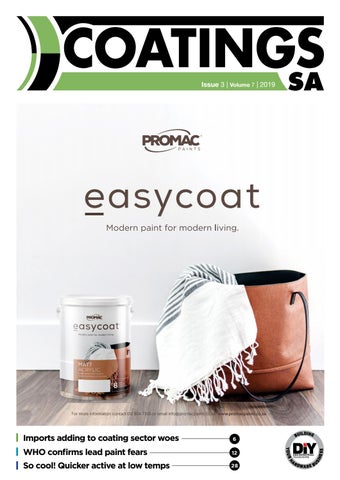
Issue 3 | Volume 7 | 2019
So cool! Quicker active at low temps
28
AND INDUSTRIAL TRADE NEWS
AR
NESS
12
ILDING
SI
WHO confirms lead paint fears
BU
H
6 YO U R
Imports adding to coating sector woes
D WA R E B U
EDITORIAL EDITOR Johann Gerber Tel: 011-713-9042 Email: johann.gerber@newmedia.co.za SUB EDITOR Gill Abrahams Email: gill.abrahams@newmedia.co.za LAYOUT & DESIGN Nazreen Bhyat Email: nazreen.bhyat@newmedia.co.za
ontents
ADVERTISING ADVERTISING EXECUTIVES Natalie Sanders Tel: 082-450-2317 Email: natalies@intekom.co.za Eva Cookson Tel: 076-662-0785 Email: Eva.Cookson@newmedia.co.za
Issue 3 | Volume 7 | 2019
PHOTOGRAPHS
Unless previously agreed in writing, Coatings SA owns all rights to all contributions, whether image or text. SOURCES Shutterstock, supplied images, editorial staff.
DISTRIBUTION & SUBSCRIPTIONS Felicity Garbers Email: felicity.garbers@newmedia.co.za UPDATE YOUR DETAILS HERE Email: register@media24.com Web: www.diytradenews.co.za PUBLISHING TEAM GENERAL MANAGER Dev Naidoo PUBLISHING MANAGER Johann Gerber Email: johann.gerber@newmedia.co.za PRODUCTION MANAGER Angela Silver ART DIRECTOR David Kyslinger MANAGEMENT MANAGING DIRECTOR Aileen Lamb COMMERCIAL DIRECTOR Maria Tiganis BRAND STRATEGY DIRECTOR Andrew Nunneley CHIEF FINANCIAL OFFICER Venette Malone HEAD OF HR Camillah West CEO: MEDIA24 Ishmet Davidson Head Office: New Media, a division of Media24 (Pty) Ltd New Media House, 19 Bree Street, Cape Town PO Box 440, Green Point, Cape Town 8051 Tel: +27 (0)21 417-1111 Web: www.newmedia.co.za
Johannesburg Office:
Ground floor, Media Park, 69 Kingsway Avenue, Auckland Park, 2092 Postal Address: PO Box 784698, Sandton, Johannesburg, 2146 Tel: +27 (0)11 877-6111 Fax: +27 (0)11 713-9024
PRINTING Printed and Bound by Novus Print ISSN: 2617-9369 Published on behalf of New Media, a division of Media24 (Pty) Ltd
While precautions have been taken to ensure the accuracy of its contents and information given to readers, neither the editor, publisher, or its agents can accept responsibility for damages or injury which may arise therefrom. All rights reserved. © DIY Trade News. No part of this publication may be reproduced, stored in a retrieval system or transmitted in any form or by any means, photocopying, electronic, mechanical or otherwise without the prior written permission of the copyright owners.
News
4
Leaded paint remains a concern
12
Product feature: Pico – smallest paint matching device
20
Company profile – Curechem: Committed to quality
21
Feature: Sustainable rheological additives
24
Company profile: Global company offers sustainable solutions
25
Technical: So cool! Quicker active at low temperatures
28
Food for Thought: Ethics – valued principle or not?
34
Under pressure
T
he rhythm and beat to my alltime favourite Freddie Mercury, song title, masterpiece is a memory I treasure. I remember when I first heard the original, and the lyrics are something we can still relate to today. This is very true for our own industry at the moment. Paint retail sales are flat, speak to suppliers they will confirm sales are indeed flat, and you then look at the numerous issues we are facing it the picture is bleak. In this issue alone, Deryck Spence from SAPMA urges government to take action over potential dubious spray paint being dumped in the country. The World Health Organisation (WHO) is concerned about the lead quantities in decorative paint. Raw material suppliers and paint manufacturers, including retailers are concerned about the health of the coatings manufacturing sector.
ed’s note
Our government is not doing enough to protect an industry creating thousands of jobs. As in the song, we need to Johann Gerber push back and start protecting our industry. You must argue against your sector becoming a dumping ground for cheap inferior products. Protect your work force. A united paint coatings sector speaking with one voice to safeguard the industry is a move in the right direction to ensure long-term solutions and growth. So let’s participate in industry discussions and join together for the benefit of our industry. c
news
Government funding aids jobless
The SA Paint Manufacturing Association (SAPMA) has recently been awarded three important training grants, including one for training jobless individuals, from the Chemical Industries Education and Training Authority (CHIETA).
T
ara Benn, Training and Administration Manager for SAPMA, says two of the grants are for Gauteng-based employed students, and the other for 20 unemployed students in Limpopo province. The Gauteng grants will enable SAPMA to train students in two subjects: • Tinting and matching of paint, and the handling and storage of hazardous chemicals • Basic health and safety principles in and around the workplace The Limpopo grant will also cover training in the above topics, but will also include tuition in basic surface coating
technology and coating applications. Benn says the CHIETA grants will provide a tremendous boost to SAPMA’s training arm, the SA Paint Industry Training Institute’s quest to intensify training of both employed and jobless individuals. “The Limpopo training, to be provided in Polokwane, will give SAPMA the opportunity to expand its operations and assist members who are not based in Gauteng to expand their business and assist unemployed students to get to know more about the industry,” she explains. SAPMA will use the facilities of one of its members to complete the Limpopo training, while two member companies will assist with the Gauteng training scheduled for August and September 2019. c
Arkema to acquire Lambson
T
hese solutions will complement the offering of Sartomer, a global leader in photocure resins, while helping speed up its development in this fast growing market. This deal will also strengthen the share of specialties in Arkema’s product portfolio, in line with its long-term plans. Lambson develops and markets a wide range of photoinitiators for curing, boasting a market with growth estimated at around 5% per year. These photoinitiators, used to initiate polymerisation reactions during the UV-curing process, perfectly
complement Sartomer’s resin range. The development of this integrated offering will enable Sartomer to better meet its customers’ challenges, in particular in the electronics, 3D printing, digital ink, composites and high performance coatings markets. Closing of the deal is expected in fourth quarter 2019, subject to approval by the antitrust authorities in the relevant countries. c For more information, visit www.arkema.com
Aerosol spray paint with questionable lead levels dumped in SA SAPMA has appealed to the DoH and SAMRC to investigate the lead content of increasing number of dumped aerosol paint SA.
D
eryck Spence, executive director of SAPMA, has told the two government departments that SAPMA member, Sprayon Paint, as well as the Aerosol Manufacturers’ Association (AMA), has alerted SAPMA to the fact that the local retail market is being flooded by cheap paint aerosol cans being sold at low prices detrimental to local manufacturers. “Not only does this threaten local manufacturing, but the dumping of the Chinese aerosol spray cans also harms the work that SAPMA is doing on the reduction of lead in paint as there is obviously no control on the lead content of products being
illegally imported into the country,” Spence has told government bodies. He says SAPMA is concerned whether the imported paint in aerosols, predominantly sold in bright primary colours, are lead free. The lead content of bright coloured paint is usually very high. “SAPMA would appreciate remedial action being taken by investigating all imported paint products from China so that it can be established whether they are in line with the import tariff codes as well as within the prescribes of the lead in paint legislation,” Spence has urged government departments. Spence says Prof Angela Mathee,
4 | Coatings SA
director of the SA Medical Research Council, has promised immediate investigation of the aerosol imports. She has for long shared SAPMA’s desire to combat leaded paints. “Furthermore, the authenticity of some Chinese coating imports, generally, is highly questionable. There have already been cases of coatings imports from China that turned out to be sea water, and titanium dioxide shipments that turned out to be sea sand. Neither of these shipments was stopped by South African customs,” Spence adds. For more information, call 011-615-1195.
Don’t follow the herd!
your local partner in colour pigments At Delta Colours we strive to be the leading supplier of an extensive range of high quality pigments and additives from world class manufactures. We offer excellent customer service, technical support, local stock availability and next day product delivery. Our extensive product range includes ultramarine blues, metallics, organics, fluorescence, pearls, glitters, thermo-chromes, cadmiums, lead chromates, iron oxides, CICP’s, phthalo’s, carbon black, buff & grey titanium dioxides, selected additives and cutting-edge technology in anti-corrosive packages. Visit our newly revamped website for more information!
follow an expert pigment supplier
Phone: +27 21 876 4167 · Email: orders@deltacolours.com 71 Village Artisan, Cabriére Street, Franschhoek 7690 Western Cape, South Africa
WWW.DELTACOLOURS.COM
news
Imports add to coatings industry’s woes
The South African coatings industry has experienced a challenging year as a result of escalating raw material and electricity tariffs, the national economic slump and other disruptive factors such as load shedding, Aggie Argyrou, chairman of the SA Paint Manufacturing Association (SAPMA), told the association’s members at the AGM in Pretoria.
“
T
ransport costs were negatively affected by the rising price of fuel, the depreciation of the rand, and the difficulty in recovering excess costs from already financially stressed consumers. My experience after 31 years in the coatings industry is that DIY home improvement paint sales are invariably one of the first market categories to show a decline when the economy is not doing well,” Argyrou, who is a director of Warrior Paints, stated in his chairman’s report. He is more optimistic about business prospects for the year ahead and urged SAPMA members to place more emphasis on the training of staff, stressing that every training programme offered by SAPMA was now accredited with the various Sector Education and Training Authorities (SETAs) and government funded. South African coating manufacturers should also keep a close eye on the increasing level of imports of raw materials, Sanjeev Bhatt, vice chairman of SAPMA, warned at the meeting. Bhatt, managing director of Synthetic Polymers, told the meeting that some local paint producers had applied for a temporary rebate on the import duty that applied to titanium dioxide, which will assist in lowering the cost of locally manufactured coatings. Solvent-borne resin producers had also applied for duty protection on acrylic resins following the sudden spurt of resin imports from countries such as Taiwan, Egypt and the UAE. “I would urge coatings manufacturers to keep a close watch on imported products landing in South Africa to ensure that the volume of cheap and sub-standard imports is controlled,” he urged the meeting.
SAPMA has already in the past expressed concern about the lack of suitable import duty protection to prevent the dumping of raw materials and resins, and reminded the Department of Trade and Industry that any product imported into the country would have to meet the compulsory specifications of the National Regulator for Compulsory Specifications (NRCS). SAPMA implored the DTI to utilise the services of the NRCS to control any imports that could threaten the survival of the industry. c For more information, visit www.sapma.org.za
Aggie Argyrou, chairman of SAPMA, urged members to place more emphasis on staff training in future at the SAPMA AGM.
6 | Coatings SA
Sanjeev Bhatt, managing director of Synthetic Polymers and vice chairman of SAPMA.
OMEGA FINE PRODUCTS – THE ONE-STOP-SHOP RAW MATERIAL SOLUTION FOR THE COATINGS INDUSTRY
Our goal is to help you achieve your goal whilst being leaders in the supply of dolomite, calcium carbonate and related products to the coatings industry. We pride ourselves on offering high quality, value adding products at a fair and reasonable price.
pecialist in functional fillers WHY OMEGA FINE PRODUCTS: or the coatings industry. • We work with you – finding solutions to your problems. • Our CK93focus is on quality with stringent quality control standards.
NAMWOL
Wollastonite
Dolomite
• Impressive service delivery – before, during and after sales service.
Calcined Kaolin
OUR FOCUS IS ON QUALITY, QUALITY, QUALITY
• Our solutions driven approach allows us to help our customers achieve their goals. • Our continuous value added product development assures we stay ahead of the game.
Talc
Dolomite Dolomite
Silica
W NE New Improved Quality Control.
Silica
+27 (0) 11 316 2064 • +27 (0) 11 316 5727
• We listen. Decorative Stones
Calcium Carbonate Calcined Kaolin
Also available from Omega fine chemicals – Calcined Kaolin, Talc, Silica, Wollastonite and Decorative Stones We are pleased to announce that although Talc is not being manufactured locally anymore, Omega Fine products have imported stock immediately available with more arriving late September
Omega Fine Products (Pty) Ltd
Omega Chemicals (Pty) Ltd Decorative Stones TEL: +27 (0) 11 316 2064 | EMAIL: orders@ofpc.co.za
info@omegachemicals.co.za • www.omegachemicals.co.za Mica
Est 1970 WEB: www.omegafineproducts.co.za
news
Training for technical sales staff welcomed The SA Paint Manufacturing Association’s new training course for technical sales representatives has been enthusiastically welcomed, says Tara Benn, Training and Administrative Manager for SAPMA.
T
ara says the two-day training course aims to make sales personnel of member producers more conversant with paint technology when dealing with existing or potential customers. “Although SAPMA offers technical training for the coatings sector only a small percentage of students who qualify actually become paint chemists. Many are employed in other capacities, particularly in sales and marketing where their technical knowledge is often decisive in securing contracts,” Tara explains. SAPMA therefore condensed the technical aspects of its training into a special two-day course during which paint technology will be taught without time-consuming laboratory testing
or intensive chemistry aspects of the curriculum, which sales personnel basically do not require. “The new Technical Sales Training Programme will help manufacturers’ sales personnel when they pitch for business with retailers, assist them in convincing paint contractors to select their company’s paints, and convince and influence architects to specify their factory’s paints and coatings for construction projects,” Tara states. SAPMA tutor, Mike Adams, recently trained 20 Dulux staff members who afterwards commented most favourably about the new knowledge they obtained. Here are some of the trainees’ views: “This insightful introduction to paint contained a nice mix of history of paint, early technical developments from first
findings to current day paint, colour aspects, as well as a little input about chemistry, theory and problem-solving. It kept the pupils, who ranged from totally inexperienced people to experts, fully engaged.” “The SAPMA condensed training module is relevant for individuals new to the paint industry wanting to gain an understanding of paint, and more experienced individuals wanting a refresher course. The content was professionally facilitated in an easy to understand format.” “The training was ideal as an introduction to paint. It covers the basics and is interesting. It has some technical topics but these do not discourage but rather creates excitement about the chemistry of paint.” c
For more information, contact Tara Benn: Call 011-615-1195 | Email training@sapma.org.za | Visit www.sapma.org.za.
8 | Coatings SA
news
AkzoNobel to strengthen aerospace coatings business
AkzoNobel has announced its intention to acquire French aerospace coatings manufacturer Mapaero. The intended acquisition will strengthen its global position in aerospace coatings, notably in the structural and cabin coating sub-segments, and contribute directly towards delivering the company’s 2020 guidance.
E
stablished in 1992 and specialising in sustainable water-based and advanced eco-friendly products, Mapaero operates a production facility in France and has around 140 employees. “The world class product ranges from both companies are an excellent fit and by combining our expertise we’ll be able to strengthen our global position in the steadily growing aerospace coatings market,” said Thierry Vanlancker, AkzoNobel CEO. “The transaction will enable us to provide our customers with a much wider portfolio of innovative and sustainable products. It also demonstrates our commitment to continue investing in strategic growth opportunities as we progress further with our Winning Together: 15 by 20 strategy and
will be accretive towards our 15% return on sales target.” “AkzoNobel’s offer is an exciting opportunity. Our activities are complementary to those of AkzoNobel and we are ideally placed to help further improve their existing portfolio and service levels. There’s clearly a strong match in the combination,” added Eric Rumeau, president and CEO of Mapaero. AkzoNobel’s offer is subject to customary information and consultation procedures with Mapaero’s employee representative bodies and regulatory approvals. The transaction is expected to be completed in the second half of 2019. c For more information, visit www.akzonobel.com
10 | Coatings SA
news
BCF scoops coveted awards British Coatings Federation (BCF) picked up two wins at the 2019 Trade Association Forum (TAF) Best Practice Awards.
A
warded to the Association that best demonstrates proactivity in increasing engagement of members in the activities of their association, BCF won TAF’s Membership Engagement Award after showing outstanding membership growth (56% in six years), 98% membership satisfaction and 99% retention of full members. In addition, since moving office into a dedicated headquarters in Coventry, the Federation has seen a 26% increase in attendance at member meetings. “A priority for us as an association is in ensuring a high level of membership satisfaction in our activities and with how we represent the coatings, printing inks and wallcoverings industries. This win is huge for us, as at our core, we strive for strong membership engagement and member services that best support
our industry and the companies we represent,” says Ali Brown, BCF’s head of membership. The second award win went to BCF’s Tania Morrill, for Young Achiever of the Year. Having moved to the UK from Vancouver, Canada in January 2015, Tania has worked at BCF since her arrival in the country. Originally project managing PaintCare, BCF’s circular economy initiative for leftover paint, Tania quickly progressed, and is currently the association’s head of marketing. In the role, she has transformed BCF’s marketing, building an in-house team responsible for launching innovative and award-winning member campaigns, and delivering best in class events. Tania is the strategist behind many of BCF’s commercial activities, in addition to leading BCF’s careers efforts and promotion of the industry to the next generation of talent.
11 | Coatings SA
“Tania is a very driven and highly motivated individual who made an immediate impact upon BCF organisation by immersing herself in several projects. She has been very influential in changing and improving the way in which their organisation works with the introduction of software and other tools, which have been implemented as part of their responsibilities. As a natural extrovert, Tania is quick to build relationships, both internally and within the membership, and has become a great spokesperson for industry. Starting at the bottom, opportunity and potential has been well harnessed to ensure that she is now a key member of the senior management team. She richly deserves this recognition of her determination to succeed,” explains Linda Cavendar, chief executive of the Trade Association Forum. c
news
Leaded paint remains a concern Despite bans and special awareness week, most countries still have leaded paint. The week of 20-26 October will this year be International Lead Poisoning Prevention Week – a call to action for individuals, civil society organisations, industry and governments to work together to ban lead paint.
T
he World Health Organisation (WHO) has estimated that 143 000 deaths every year result from lead poisoning with leaded paints a major contributor. Lead exposure is now estimated to lead to 600 000 new cases of children having intellectual disabilities every year with 99% of this happening in developing countries. Dr Olga Speranskaya, senior policy advisor at the International Persistent Organic Pollutants Elimination Network (IPEN), has helped nongovernmental organisations implement more than 70 projects on toxic chemicals in Azerbaijan, Armenia, Belarus, Georgia, Moldova, Kazakhstan, Kyrgyzstan, Russia, Ukraine and Uzbekistan. She was named UN Environment Champion
of the Earth in 2011 and received the Goldman Environmental Prize in 2009. Here she speaks about lead poisoning through paints in Europe – a topic SAPMA has fought against for more than a decade in South Africa. Q. Where do we find leaded paint? A. Leaded paint is recognised as being a problem across the world. Most developed countries banned decorative lead paint over 40 years ago. They adopted regulations to control lead content in paints used at home, at schools or kindergartens. However, studies conducted by the International Persistent Organic Pollutants Elimination Network (IEPN) over the last nine years in more than 55 countries show that high levels of lead in paint still exist in most of
12 | Coatings SA
these countries. Such paints are still widely sold in low and middle-income countries, such as those in Eastern Europe, the Caucasus and Central Asia. Data collected by the network in nine out of 12 of these countries shows lead levels to be greater than 10 000 parts per million (ppm) in 7-20% of paints tested. It is very important that data on leaded paint keeps being collected as it is still lacking in most countries and could help to eliminate lead in paint. Lead must be eliminated from all paints including ones used in industry, like anticorrosive paints, which often contain extremely high levels of lead – sometimes making up 20-30% of the paint’s dry weight. IPEN studies show that such paints are often sold for household use without any warnings.
news Q. What danger does leaded paint pose? A. Leaded paint represents one of the most widespread sources of lead exposure to small children and babies, and leads to lifelong intellectual disabilities. Even a low level of lead exposure might damage a child’s developing brain, resulting in lower IQ and learning disabilities. According to WHO, lead exposure can also affect the immune, reproductive and cardiovascular systems, kidneys, and the skeleton. Lead is released into the dust, soil and air when painted surfaces begin to deteriorate or when a previously painted surface is scraped in preparation for repainting. Children can get dust on their hands and ingest it. They can also directly ingest lead paint by chewing on toys painted with it and may also pick up and swallow paint chips. This might be even more harmful for their health as the concentration of lead is normally higher in paint chips than in dust. Q. Is it possible for people and businesses to know whether paint contains lead? A. The best way for people to know that paint does not contain lead is for a country to adopt and enforce strong bans on lead paint. Consumers can read the list of ingredients on paint cans, yet labels generally do not carry meaningful information about lead content or the hazards of lead paint and in some cases are simply wrong. In some countries, national legislation requires information on the binding substance and solvents that the paint may contain, but not on lead. Paints tested by IPEN in various countries had labels indicating the name of the paint manufacturer, batch number and manufacturing or expiration date. There was no information about possible lead content or warnings on the effects of lead on children or babies. IPEN has identified paints with high lead levels of above 10 000ppm in nearly all countries studied. Some paint cans from these states were marked as not containing lead, despite laboratory analyses showing a high concentration.
Q. What can governments do? A. Governments can protect consumers’ right to know about what chemicals are in the products they buy and hold the manufacturers and sellers responsible when they provide unreliable, insufficient or false information. In order to minimise lead exposure and provide consumers with an option to avoid lead paint purchases, manufacturers should be legally required to indicate the presence of lead in their products and warn of the possible danger to health from lead exposure. There is also a concern that cheap paints are purchased for inside and outside schools and hospitals. The lead content of these paints has typically never been examined. Banning lead paint should therefore be included in public procurement policy. Online and chain stores can also cause a significant problem. They often order a small number of paints under unknown names. When all cans are sold, they order more of the same paint, but under a different name, making it hard to monitor. In some countries, paint manufacturers complained that chain stores often order paints from smallscale manufactures which do not follow high environmental standards, and try to produce cheap paints for less. This is a troubling situation harming responsible paint producers. To ensure there is no leaded paint on the national markets, governments have to develop and enforce legislation to control lead in paints. However, according to an IPEN report from 2017, paints with prohibited lead content continue to be manufactured and sold in several countries where regulatory controls have entered into force. This mainly happens because countries lack a strategy and budget for monitoring and enforcing of leaded paint regulations. The majority of developing countries and countries in transition do not have accredited laboratories that have the capacity to test lead in paints. To improve the situation, governments need to establish a relationship with an accredited lab or have national labs get accredited
13 | Coatings SA
through the Environmental Lead Proficiency Analytical Testing programme for analysing samples of lead in paint. Q. What scientific or legislative progress has taken place in the fight against lead paint in the past two years? A. IPEN’s study of leaded paint in 55 countries provides a strong justification to adopt and enforce regulations that will ban the manufacture, import, export, distribution, sale and use of paints with total lead concentrations greater than 90 parts per million (ppm) — a value that can occur in paints due to indirect contamination during the production cycle. According to UN Environment, 90ppm lead content in paint is consistent with the most restrictive standard in the world and is recommended for all paint. To help countries develop or improve their legislation on lead paint, UN Environment, WHO and the US Environment Protection Agency in cooperation with other partners, have developed a model law and guidance on leaded paint. This is now available in English, French, Russian and Spanish. Ukraine used this model law to develop draft national legislation on lead paint. Ukrainian nongovernmental organisations and IPEN experts took part in the discussion surrounding and drafting of the new legislation. When adopted, Ukraine will become the first country in the Eastern Europe, Caucasus and Central Asia region to set up a national standard of 90 ppm on lead content in paint. The Global Alliance to Eliminate Lead Paint is a global partnership set up by UN Environment and nWHO. The aim is for all countries to adopt legally-binding regulations to control leaded paints by 2020. The International Persistent Organic Pollutants Elimination Network aims to help achieve this goal and is committed to generate data and support capacity building activities to help countries eliminate leaded paint for good. c
news
New approach to marketing Wacker is taking a new approach to product marketing – the company will be offering pyrogenic silica on CheMondis and PINPOOLS, two online marketplaces for selling chemical raw materials and specialty products.
T
agent in cosmetics, pharmaceuticals and foods. Key customers for the product are in the sealants, adhesives, paints and coatings, food and animal-feed industries. The company markets the product throughout the world under the HDK® Pyrogenic Silica brand name. Since late July, it is also offering a selection of products on the CheMondis and PINPOOLS online marketplaces. Industrial customers will be able to use either platform to order a total of nine HDK® grades with a wide range of surface and rheological characteristics. “By deciding to sell our pyrogenic silica
Pic cred: Wacker
hrough the use of internet platforms such as these, Wacker intends to gain experience with digital B2B trading venues and, over the long term, acquire new customers and open up additional marketing channels for its product portfolio. The Group is one of the largest manufacturers of pyrogenic silica. Based on amorphous silicon dioxide, this powder has a wide variety of applications. It is used, for instance, as filler for silicones, for thermal insulation, as an additive to control liquid flow characteristics, and as an anti-caking
Munich-based chemical company Wacker is now marketing a variety of pyrogenic silica products from its HDK® line on the CheMondis and PINPOOLS internet platforms. With this approach, the chemical group hopes to acquire new customers and markets for this highly versatile product.
14 | Coatings SA
online, we hope to take advantage of the opportunities afforded by digitalisation while raising the profile of a product that can be used as an additive in so many different applications,” says Maria-Anna Biebl, director of the HDK® business team within the Wacker Silicones division. The decision to sell products on CheMondis and PINPOOLS was the result of an intense selection process. “We’ve looked at a lot of online marketplaces in recent weeks,” says Axel Schmidt, chief digital officer for Customers, whose responsibilities include developing digital business models at the company. “We were especially looking for platforms that would complement our existing sales activities as effectively as possible and would help us reach out to new customers and markets.” The two startups ultimately made the most convincing offers. “The collaboration we’ve begun with CheMondis and PINPOOLS is another building block in our strategy of testing and opening up new sales channels for our products,” adds Schmidt. CheMondis (www.chemondis.com), a start-up founded by the Lanxess specialty chemicals company, and PINPOOLS (www.pinpools.com), introduced in 2016, and is Europe’s leading B2B marketplaces for chemicals. CheMondis is now used by 650 companies from all over Europe to sell more than 7 500 products. “Wacker’s listing on CheModis is another powerful signal that customer-friendly technology is going to succeed on the market,” emphasizes CheMondis managing director Sebastian Brenner, adding, “We are looking forward to collaborating and to growing our existing network even further with Wacker.” PINPOOLS currently hosts 500 active buyers and vendors. The marketplace serves as a trading platform for more than 5 000 products with a focus on paint and coatings, construction and the food and animal feed industry. “We are very happy to provide another prestigious company like Wacker with direct access to new customers”, says PINPOOLS CEO Alexander Lakemeyer. c
AN H C
,A GE
DAPT & ASSI
MI LA TE
The polymer that creates colour Synthetic Polymers produces high-quality polymers for various myriad sectors such as decorative coatings, automotive coating, medium to heavy industrial coating and wood coating etc. Solvent based polymers are Synthetic Polymers core focus; however, our plant also has the capability of producing water-based polymers. A wide variety of resins including acrylics, aminos, saturated polyesters and the more popular alkyd resins as well as some specialist resins are produced using the strictest quality standards in our plant. Research and development take place in our state-of-the-art laboratory with the latest equipment and highly qualified polymer chemists. Convenient delivery with our twenty-metric ton bulk delivery vehicle with lead times between twenty-four and seventy-two hours.
• Long oil alkyds • Medium oil alkyds • Short oil alkyds • Short & Medium chain stopped alkyds • Urethane alkyds & Oils • Styrenated alkyds • Hydroxy functional acrylics • Thermoplastic acrylics • Specialty alkyds • Amino resins • Thermoset acrylics • Saturated oil free polyesters
010 596 4444 | sgb@syntheticpolymers.co.za | www.syntheticpolymers.co.za
news
DuPont partners with Habitat for Humanity
DuPont, a global science and innovation leader, recently announced a new corporate partnership with Habitat for Humanity International. The partnership enables DuPont to support Habitat for Humanity home building projects with donations of energy-efficient building products while also providing employees with meaningful volunteer opportunities.
“P
roviding safe, affordable shelter is critical to many communities across the globe and we are proud to collaborate with Habitat for Humanity International to help them build efficient, sustainable homes,” said Patrick McCrummen, DuPont’s Global Community Impact Leader, adding, “What’s also special about this partnership is that it offers volunteer opportunities for our employees to make a meaningful difference in people’s lives in their local communities.” The company also actively supports major Habitat programmes such as the Jimmy & Rosalynn Carter Work Project and the annual Home Builders Blitz. “By partnering with DuPont, Habitat can better address the worldwide need for decent, affordable homes,” said Julie Davis, vice president for corporate and cause marketing. “Our goal is to provide peace of mind for homeowners through better, more efficient designs, and partnerships like this one help us accomplish that.”
HABITAT FOR HUMANITY Driven by the vision that everyone needs a decent place to live, Habitat for Humanity began in 1976 as a grassroots effort on a community farm in southern Georgia, US. The organisation has since grown to become a leading global non-profit working in local communities across all 50 states in the US and in more than 70 countries. Families and individuals in need of a hand up partner with Habitat for Humanity to build or improve a place they can call home. Habitat homeowners help build their own homes alongside volunteers and pay an affordable mortgage. Through financial support, volunteering or adding a voice to support affordable housing, everyone can help families achieve the strength, stability and self-reliance they need to build better lives for themselves. c To learn more, visit habitat.org. To learn more about the organisations providing crucial support through donated products, visit https://www.habitat.org/support/gifts-in-kind.
16 | Coatings SA
WHEN PAINT HAS TO STICK, BE TOUGH AND SHOW! tough stick
resilient
Sunfast 887 is formulated for Water Based Road Marking Paints, smooth substrate coatings and general coatings with superior binding and excellent durability! Composed of modified Acrylic Terpolymer Emulsion, Sunfast 887 offers desirable features for the manufacture of coatings that operate under extreme conditions!
Application: Road Marking Paints, smooth substrate coatings and general coatings with superior binding and scrub resistance.
Anyone travelling on a newly painted road will appreciate the contrast of white or yellow paint against the tarmac, yet often this lasts for only a short period before it reverts to a faded or hardly noticable smudge on the road.
Water Based • Ease of application • Wash with water • No strong solvent odors.
Sunfast 887 was developed to solve this dilemma.
Storage conditions: Protect from frost and heat. Store in tightly closed containers . Temp +5oC to +35oC. Tight resealing of opened drums is recommended.
PROPERTIES Appearance:
Milky white liquid
Ionic state:
Anionic / Non-ionic
Solid content:
45 - 46%
ph-value:
8.0 - 9.0
Viscosity:
500 - 2000 cps
SG:
1.01 - 1.04
MFT:
20oC
Stability:
Excellent
Dried film:
Clear / Hard
Storage stability: Approximately 6 months after delivery, if stored in original unopened drums under the stated conditions. Packing: 200 kg Drum / 1 ton flowbin Contact Sancryl directly for further information or to order stock. www.sancryl.co.za +27 (0)31 902 1422
SUNFAST 887 The Road Ahead Is Clear!
Manufacturing a tough paint that adheres to smooth surfaces AND offers excellent scuff resistance is no mean task!
Paints made on Sunfast 887 makes this job easy: It sticks like crazy and resists wear and tear like buffalo skin!
Just right for tough Africa conditions! www.sancryl.co.za •
+27 (0)31 902 1422
SANCRYL 5784 Sancryl Chemicls Coatings SA FP sept’19 ad+editorl
product feature
Pico – smallest paint matching device Pico by Palette, measures the colour of a surface and finds the best paint matches among one or more paint colour collections. Designed for trade and DIY painters, designers and architects, Pico significantly improves the traditionally time-consuming colour matching process, and is a leap forward, pairing seamlessly with its smartphone app.
T
he Pico device performs at the same level of accuracy as existing colour matching devices. Thanks to Palette’s latest generation technology, the device is a magnitude smaller, more robust and affordable. KEY FEATURES Accuracy: It has been verified by third-parties* to be among the most accurate colour matching tools available. Matching accuracy on collections of thousands of colours is typically 90% or higher. The device has been designed to be more sensitive on near-white colours (the most critical and popular paint tints). *Third parties include Benjamin Moore, Dulux Australia, NCS, PPG, Plascon, Paintsmiths, British standards,RAL and many more.
Fast: Sampling a colour takes less than one second, with the best paintmatch almost instantaneously available for the user to view. Seamless pairing: Setting up the device with the Pico app takes less than a minute. Once the initial setup is complete, pairing the device with the app is automatic and instantaneous. No need to navigate through Bluetooth settings. Just open the app, turn on the device, and it is ready to use. Robust: Built almost entirely from brushed aluminium, the Pico device is tough and able to withstand significant abuse without any deterioration in quality. Its sensor is recessed and protected by a cap when not in use, which also doubles as a calibration tile, keeping the device accurate at all times. A lanyard helps keep the device conveniently attached. Low cost: The price is R1 500 per unit. This accessible RRP enables the device to be distributed to a wider pool of consumers, including DIY painters who have never been able to afford such tools in the past. White labelling: Palette is able to white label the Pico device to suit your corporate style.
ANALYTICS The app tracks all user interactions and the data is anonymously stored. This generates powerful analytical insights for paint retailers and manufacturers. Example data insights include identification of trending colours, geographical distribution of users, e-commerce conversion rates, and length of time that the Pico is used for. It will be available from Lejn in South Africa. For more information, call 032-946-2892 or email cliff@mack.co.za
20 | Coatings SA
PICO APP The Pico App acts as the device’s screen and instantly matches any sampled colour to thousands of built-in paint colours. It also enables useful additional features to progress the customer towards purchasing their desired paint. The Pico App is available for free for iOS and Android devices. The app has many built in features: • Paint colour matching • Visualiser • Compare colours • Create custom colour collections • Share colours • A project builder • Store finder • Colour data • White labelling.
company profile
Committed to quality
Curechem has over the last two decades expanded its commodity chemicals business as far as the subcontinent. As it enters its third decade of operation, it has its sights firmly set on continuing to deliver on its promises to its clients – excellent quality, excellent performance at the best price.
CURECHEM TEAM: BACK ROW – Rezan Kivido, Chris Lefasa, Rockey Mboweni, Nicol Rikgotso, Vusi Phakathi, Jeffrey Monnya, Lebo Marabutse, Seagern Mohlala, Mohummad Reveni, Takunda Shiripinda, Abel Fakude, Phillip Ncgana, Sydney Musa, Tumelo Mohlokoane, Melita Sinyela, Nyaradzo Jairios. 2nd ROW FROM BACK – Edwin Maruma, Monnya Zhira, Solly Lekgoathi, Zivaishe Mangen, Kenny Naidoo, Takudzwa Chisvo, Patrick Muifha, Rendani Nthangeni, Tendani Ramarumo. 3rd ROW FROM BACK – Seipathi Mokale, Preetha Dayalal, Anup Chand, Urmil Mahajan, Mpho Moletsane, Boitumelo Mangope, Raksha Gayadin, Phumza Kalo. 2nd ROW FROM FRONT – Theresa Jongwe, Mahlatse Mothibi, Sean Perry, Merrille Maynard, Luyolo Madasi, Arelene Verasammy. FRONT ROW–Mubeena Muhammad, Nonhlanhla Mashaba, Alisha Bishop, Mukonazwothe Mambeda, Shadrack, Manoj Joshi.
F
ounded in 1998, local chemical supplier, Curechem, has expanded its local roots into sub-Saharan Africa as well as into the subcontinent with an office in Delhi, India. Its growth is attributed to key strategies and relationships enabling the business to offer clients quality product and competitive prices. Its South African branch serves as a base of operations. The business is able to leverage on the excellent local infrastructure and road network to deliver key commodity chemicals and this has helped the business establish its network. It now has offices Zimbabwe, Zambia, Mozambique and Tanzania
Key to export success is Curechem’s commitment to Total Quality Management. This is a philosophy that extends to all facets of operation. ISO Standards drive its quality programme and is poised for accreditation from the International Standards Organisations. The Zimbabwe office has already been awarded with ISO 9001:2000 in 2006 and its Johannesburg office in 2008. The India office was awarded with ISO 9001:2008 in 2010 and the Zambia office in 2017. The quality chemicals available from the company are making it a one-stop-shop for all chemical raw material requirements central to the manufacture of architectural paints.
21 | Coatings SA
Curechem has partnered with reputable manufactures of binders, titanium dioxide, solvents and other additives for both PVA and alkyd paint manufacturing. “Curechem goes the extra mile for its customers by offering technical assistance and troubleshooting services to clients through its experienced and dedicated paint chemists,” says Sean Perry, newly appointed managing director of Curechem South Africa. Apart from paint industrial chemicals, the business’s speciality field include supplying mining chemicals, agrochemicals, industrial chemicals and water treatment chemicals. It mission
company profile for the future is to become a market leader in supply of chemicals in Africa through timely delivery of quality products in a manner that is superior to its competitors and to fulfil its commitments to its customers, employees and all stakeholders –never compromising integrity and ethical standards. “We aim to strive for mutually beneficial association with our suppliers and forging synergistic alliances, to continuously build an organisation of highly efficient, highly effective, top performing people, who are proud of its association with Curechem,” concludes Perry. c For more information, call 011-397-6364
ADMIN AND PROCUREMENT: FRONT ROW – Sydney Musa, Mahlatse Mothibi, Anup Chand, Urmil Mahajan, Nonhlanhla Mashaba. 2nd ROW – Manoj Joshi,Phillip Ncgana, Mirrelle Maynard, Mpho Moletsane, Phumza Kalo. BACK ROW – Sean Perry, Melita Sinyela, Zivaishe Mangena, Muhammad Reveni.
SALES: FRONT ROW – Mukunazwothe Mambeda, Mubeena Muhammad, Anup Chand, Urmil Mahajan. 2nd ROW – Manoj Joshi, Luyolo Madasi, Nyaradzo Jairios, Arlene Bishop. BACK ROW – Patrick Muifha, Raksha Gayadin, Sean Perry, Zivaishe Mangena.
DIRECTORS: Urmil Mahajan,Anup Chand.
We aim to strive for mutually beneficial association with our suppliers and forging synergistic alliances, to continuously build an organisation of highly efficient, highly effective, top performing people, who are proud of its association with Curechem,” concludes Perry
WAREHOUSE AND LOGISTICS: FRONT ROW – Solly Lekgothi, Mahlatse Mothibi, Alisha Bishop, Muyaradzi Zhira. 2nd ROW – Chris Lefasa, Edwin Marume, Jefferey Monnya, Takunda Shiripinda, Kenny Naidoo, 3rd ROW – Lebo Marabutse, Rendani Nthangeni, Zivaishe Mangena BACK ROW – Rockey Mboweni, Rezan Kivido, Nichol Rikgotso, Muynaradzi Zhira, Tumelo Mohlokane
22 | Coatings SA
PRODUCTS OFFERED BY CURECHEM All type of Alkyd Resin Acrylic Emulsion Single and Mix Drier Mineral Oil and Silicone Deformer Wetting and Dispersing Agent Flow and Levelling Additive Surface Additive Antiskinnig agent (MEKO) Antisettling Agent or Rheology Modifier (Bentonite Clay and Organoclay) Wetfilm and Dryfilm Biocides Calcined Kaolin Superwhite Calcium Carbonate Barium Sulphate Pigments MEG MPG NP9 Coaelsing Agent for WB Paints (Ruanta C-12) Soya Lechathin Zinc Phosphate Sodium Hexameta Phosphate Solvents
67 Webb Road Jet Park Tel: +27 11 397 6364
feature
Sustainable rheological additives
Rheology is something which is very important to the overall success of a paint formulation. This additive impacts levelling and setting, and controls the paint’s stability, application, open-time and sagging.
T
he CHT Group has set itself the goal of supporting its customers in all markets around the world as a preferred partner and leading reference for sustainable chemical solutions. The CHT Construction & Assembly Business Field is following the group’s sustainability objective by developing rheological modifiers based on guar and xanthan gum for paints and coatings applications, its Agocel – sustainable rheological additives range. The combination of both green product groups encourages CHT Group’s customers worldwide to take part in the challenge of developing sustainable products to shape a better future. “We are always open for innovations and we are committed to ensuring that our raw materials meet the requirements of the most cutting-edge solutions,” says Invin Reddy from the CHT Group. GUAR GUM Guar gum is a polysaccharide derivative from the seeds of the legume Cyamopsis Tetragonoloba, a sustainable plant that requires no pesticides or artificial irrigation and has little impact when chemically modified. With guar gum based thickeners used in architectural paints, excellent application properties can be achieved. The production of Guar gum’s advantages are: • No demanding soil • No pesticides required • No artificial irrigation • The entire plant can be used and is safe for human and animal consumption • Low energy and resource demand • Low chemical demand. However, pure Guar powder needs to be modified to increase its performance. The powder is put through a propoxylation process, which increases its water retention properties. The produced Guar derivatives are then cross-linked to delay its swelling time.
CHT Guar derivatives Chemical basis
Product
Agocel I-5 D
Agocel I 115 D
Viscosity level
HPG
Lowshear
Low
HPG
+
Medium
MediumHigh
Agocel I 30 D
HPG
Agocel I 155 D
Modified HPG
Highshear
High
Dosage (%)
+++
++
++
+++
++
+++
+
Characteristics
0.4-1.2
Superior antisplattering application properties
0.,3-1.0
All round product for architectural paints. Excellent application properties and stability
0.3-1.0
High viscosity product combined to good application properties
0.15-0.6
Improvement of ant-settling and low shear rate properties
XANTHAN GUM Xanthan gum is another natural polysaccharide. This derivate is produced by the action of a bacterium in sugars. The complex molecule of xanthan gum develops a rheological profile with a particularly high degree of pseudoplasticity. This parameter affects the final formulations with an excellent anti-settling behaviour avoiding the formation of syneresis and improving the application properties of trowelling or spraying.
The CHT Group has two products in its Xanthum gum core range Product
Chemical basis
Retarded swelling time
Viscosity level
Lowshear
Highshear
Dosage (%)
Characteristics
Agocel V 500 D
Xanthan
Yes
High
+++
+
0.01-0.5
Very efficient in the low-shear rate. Positive influence on the anti-setting behaviour
Agocel V 600
Xanthan
No
Medium/ High
++
+
0.01-0.5
Good stability in silicate systems and acidic products
SUMMARY Guar gum is a cost-effective and sustainable HEC alternative which is recommended for use in architectural paints with medium to high PVC content and DIY products. The Xanthan gum rheology additive offers excellent anti-settling behaviour, is very effective at low dosages and is a sustainable chemistry. It is recommended for architectural paints, plasters and putties, pigment basis as well as waterborne coatings. c For more information, contact the CHT Group at 031-700-8496.
24 | Coatings SA
company profile
Global company offers sustainable solutions
The CHT Group based in Germany has evolved from a humble supplier of dyes to servicing major consumer sectors and establishing itself as a key player and raw material supplier to industries across the globe.
C
HT Group is a chemical company which has its headquarters in Tübingen, Germany. Its global activities are supported by representatives in over 60 countries. From humble beginnings supplying dyes and auxiliaries for over 60 years, the organisation now supplies products that improve the quality and functional characteristics of textiles, construction materials, paper, paints, coatings and care-agents. The success of the business is built on its core customer focus combined with outstanding quality of products and services. Innovation plays a key role within the company and it’s positioned to deliver sustainable products and process solutions to its customers. Sustainability is the
foundation of the company and corresponds to its culture and identity as a global business enterprise. It operates in the following six industries: • Textile and textile care • Paints and coatings • Construction and building • Consumer care • Paper and pulp • Rapid prototyping and mould-making Water-based paints and coatings meet modern standards which do not affect consumer’s health; they are also environmentally friendly. The performance of water-based systems is approaching the standards of conventional solvent-based systems, and can
25 | Coatings SA
be considered a technology of the future. The business has embraced sustainability across three pillars: economical, ecological and social. This is the foundation of the business and corresponds with its culture and identity. The CHT Group is positioned as an innovative business with sustainable products and process solutions. The impact of small ingredients can be tremendous as is evident by its additives contributing to its systems and increasing its performance. These additives influence specifically the properties and the behaviour of paints and coatings. Its portfolio includes substrate wetting agents, rheology additives, defoamers and deaerators as well as surface additives.
company profile AREAS OF EXPERTISE SUBSTRATE WETTING AGENTS
systems mostly surfactant-like components are used for the purpose of homogenisation and stabilisation. Applying such products in various process steps creates negative side effects such as the formation or stabilisation of foam in large quantities. In order to decompose foam rapidly or even to prevent its formation, CHT offers a comprehensive portfolio of effective defoamers for water-based coating systems. HYDROPHOBIC AGENTS
Surface defects can be prevented through the use and application of wetting agents. The wetting agent ensures that the correct tension relationship between the substrate and the coating is maintained. Substrate wetting agents reduce the surface tension between the surface of the substrate and the wetting liquid. In this way wetting results are comparable to solvent-borne systems, but can be obtained with water-borne formulations. LEVELLING AND SURFACE ADDITIVES
A homogeneous coating surface without any defects depends on a great number of factors and variables. During the drying or curing process of water-borne coatings there exists a lot of streaming and concentration differences in the coating matrix. This can lead to a certain surface structure similar to that of an orange peel. The change of density, temperature and surface tension is crucial for this process. The formation of this kind of structure can be prevented by adding specific levelling and surface additives. With the organomodified siloxanes especially developed for this application the surface structure tension of the complete coating film can be lowered and balanced. The formation of structures and defects can be avoided or clearly reduced, and an optically homogeneous coating surface can be achieved. DEFOAMERS
In the production of water-borne and water-based coating
Water or high humidity together with ever changing weather conditions are the main reasons for all kinds of damage caused by corrosion on metallic, wooden or mineral constructions and buildings. For water-borne paints and plasters typically a combination of polysiloxanes and silicone resins are used as water repellents. The polysiloxanes are mainly responsible for the early water resistance and the beading effect, whereas the silicone resins generally reduce the water uptake. In contrast to organic resins, silicone resins have higher water vapour permeability, which is required for a moisture exchange. If the water vapour permeability is not ensured, mould may develop in the interior. RHEOLOGICAL ADDITIVES
The quality of a coating or particularly of paint is not only determined by its function or its aesthetic properties. Stabilities and the processing behaviour of a material are also very important. In their combination of pseudoplastic behaviour and optimised water retention the natural, rheological additives of CHT support the durability and the simplified or improved application of paints and plasters. Guar ethers with retarded swelling perform very well through its water retention power, preventing skin formation through rapid water evaporation. Furthermore, these products bind water in such a way that high absorption substrates do not create a scenario for humidity and the coating dries evenly over the whole section. c For more information on CHT Group, contact Tel: 27 31Â 700 84 96
26 | Coatings SA
HIGH PERFORMANCE ADDITIVES -
Substrate Wetting Agents Levelling and Surface Additives Defoamers Hydrophobic Agents Rheological Additives
FOR SUSTAINABLE AND ENVIRONMENTALLY COMPATIBLE SOLUTIONS info.southafrica@cht.com
+27 31 700 8436
www.cht.com 1 CHT
technical paper
SO COOL! QUICKER ACTIVE AT LOW TEMPERATURES By Udo Schonhoff, Carlos Feito, Frank Abschlag und Elke Piron
Several industrial, maintenance and marine spray coatings have very high requirements in terms of sag stability. The systems are typically spray applied in high layer thickness of around 1000 Âľm or even more in one pass. This high demand of the systems limit the selection of suitable rheology modifiers.
O
rganic thixotropes provide are typically used as they provide the properties to fulfill this specific need. However, this class of rheology modifiers has complex requirements in terms of incorporation and activation. Elevated temperatures, at a specified range, combined with high shear, for a defined period of time, in accordance with the system, which can be based on a manifold of binder chemistries and various solvent composition are required to achieve optimum performance.
Various processing methods are used to produce coating systems. In case of the most commonly used batch-by-batch processing technique, the necessary energy to obtain and adjust the activation temperature is normally generated by friction during dispersion. The end temperature is dependent on parameters such as disperser speed and pigment/extender loading level and has a strong influence on the entire processing time. External heating or cooling equipment is
COMPARISON TO OTHER THICKENER CLASSES Organic rheological additives provide outstandingly high low shear viscosity in combination with a strong thixotropic flow character in non-aqueous systems. As described in figure 1, in comparison to organoclays, the low shear viscosity is much higher. With respect to practical relations this means that organic thixotropes are providing potentially the highest film build properties. Organoclays are more beneficial in terms of levelling combined with well-balanced anti sag performance.
often not available so that active temperature control during processing is either not possible or only available on a lab scale. In such cases, rheology modifiers which are suitable for use over a wider temperature range show significant benefits. Post correction procedures currently play a minor role under real life production conditions as most commercially available organic thixotrope grades require higher shear forces for proper activation than usually available in the letdown stage.
it is necessary to shift the melting point of the castor wax upwards by the addition of higher melting point components. This broadens the range of compatible solvents, as well as raises the general activation temperature. However, none of the ricinus oil derivatives are suitable for systems formulated with high polarity solvents, such as oxygenated solvents e.g. ketones and esters. The second class of rheology modifiers for the mentioned spectrum of applications is based on diamide waxes, which consists of a different general molecular structure, as described in Figure 2.
Once properly activated, the molecules orientate themselves towards each other forming a fibrillar structure (Figure 3) due to the nature of the amide functionality. The driving forces for this formation are intermolecular interactions such as hydrogen bonding- and van-der-Waals forces.
CHEMICAL BACKGROUND The first generation of organic thixotropes is based on ricinus oil derivatives. These products are excellent organic thixotropes or “rheological additives�, providing good performance when incorporated and activated in a specific manner. Pure castor waxes are typically limited for use in aliphatic solvent based- and solvent-free systems. To generate a rheology modifier suitable for solvents of higher polarity, such as aromatics,
28 | Coatings SA
NEW
In Focus: Your new lead-free alternative TICO® - High Performance Pigments are your non-toxic and environmentally friendly alternative to lead containing pigments. The proprietary TICO ® hybrid structure with a shell of organic pigment bonded to a core of inorganic pigment particles combines full color saturation, opacity and high gloss with superior processing properties and high durability. Heubach´s newest high-performance yellow, orange and red pigment preparations for the paint and coatings industry: > TICO ® Yellow 588 N > TICO® Yellow 595 N > TICO® Yellow 597 N
> TICO® Orange 622 N > TICO® Red 640 N > TICO® Red 655 N w w w. he ub achcolor.com
technical paper
The visualized intermolecular interactions become relevant after activation of the additive, which is similar to castor waxes. Mechanical forces applied along with specific temperature, which have to be in line with the relevant solvency forces, over a defined period of time need to be applied to the system for proper activation. The rheological structure is then built up by a redistribution of crystalline phases of the rheological additive accompanied by cooperative self- assembly of certain molecules producing the described microstructure. The melting point of the diamide waxes is generally higher than of castor oil derivatives. This enables this class of rheology modifiers to be used in the largest range of solvent polarities. However, the potential activation temperatures are usually higher than with ricinus oil derivatives. This new class of diamide rheology modifiers has been developed to be provide proper activation at markedly lower temperatures than traditional grades based on similar chemistries. This is especially of great importance in solvent-free systems were the activation temperatures are normally high. The main advantage of such low temperature activation is cost saving in the manufacturing process. The process can be carried out without external heating and is faster. Another major focus of the development was, to generate organic thixotropes which provide stable activation over a wider temperature range. This results in increased process robustness under real life conditions were temperature variations often occurring, e.g. as differences between summer and winter. INDUSTRY AND MARINE APPLICATIONS THIXATROL® PM 8054 and THIXATROL® PM 8056 are newly developed diamide based rheology modifiers dedicated predominately for non-aqueous industrial, marine and protective coatings. For all organic thixotropes, THIXATROL® PM 8054 and THIXATROL® PM 8056 need specific process temperatures and mixing times in order to achieve their maximum performance. However, in comparison to currently available organic thixotrope grades, both products are less temperature sensitive and provide a broader solvent compatibility. The following study identifies the ideal activation conditions to achieve optimum performance and was carried out in an epoxy based marine primer. As visualized in figure 4, THIXATROL® PM 8054 and THIXATROL® PM 8056 provide excellent low shear viscosity build over a wide range of activation temperatures.
Based on these results it can be concluded that THIXATROL® PM 8054 achieves the best results at a temperature range from 50°C to 70°C. THIXATROL® PM 8056 has a much wider temperature window of 45°C to 70°C for activation. In comparison to the application temperature range of 50°C and 60°C for the market reference product, it is clearly indicated that the use of both grades results in markedly more flexibility
Conventional Diamide
The rheological activity of THIXATROL® PM 8054 and THIXATROL® PM 8056 after activation at the same activation temperature of 63°C, display only minor differences when compared to each other (figure 5). However, the resulting viscosities at low and mid shear rates are markedly higher than with the market reference. Furthermore, the new organic thixotropes provide clear advantages in terms of the maximum applyable layer thickness after spray application. As displayed in figure 6, layer thickness of up to 1200 µm can be applied in one spray pass.
In figure 7, the viscoelastic characteristics of the tested coating, generated in a structure recovery test, are shown. This test simulates the behavior of the system after application using high shear forces, which are relevant during spray application.
Conventional Diamide
Conventional Diamide
30 | Coatings SA
The polymer that creates colour Synthetic Polymers produces high-quality polymers for various myriad sectors such as decorative coatings, automotive coating, medium to heavy industrial coating and wood coating etc. Solvent based polymers are Synthetic Polymers core focus; however, our plant also has the capability of producing water-based polymers. A wide variety of resins including acrylics, aminos, saturated polyesters and the more popular alkyd resins as well as some specialist resins are produced using the strictest quality standards in our plant. Research and development take place in our state-of-the-art laboratory with the latest equipment and highly qualified polymer chemists. Convenient delivery with our twenty-metric ton bulk delivery vehicle with lead times between twenty-four and seventy-two hours.
• Long oil alkyds • Medium oil alkyds • Short oil alkyds • Short & Medium chain stopped alkyds • Urethane alkyds & Oils • Styrenated alkyds • Hydroxy functional acrylics • Thermoplastic acrylics • Specialty alkyds • Amino resins • Thermoset acrylics • Saturated oil free polyesters
010 596 4444 | sgb@syntheticpolymers.co.za | www.syntheticpolymers.co.za
technical paper
In the first rotational measuring step the structure of the coating was disrupted by high shear forces. In a second oscillatory step, the behavior after the removal of shear, was analyzed. This step visualizes the properties of the coating after impact on the substrate. When the displayed damping factor (tan delta) is below 1, the elastic behavior of the sample is dominant. The smaller this value is, the stronger the samples structure will be. A strong structure indicates excellent sag stability and should consequently correlate with the results generated in practice. As it can be seen in figure 7, all samples display strong elastic behavior soon after removal of shear. However, both samples with THIXATROL® PM 8054 and THIXATROL® PM 8056 rebuild their structure noticeably quicker than the material formulated with the market reference. This is shown by the first measuring points of lower tan delta values, which indicate a stronger structure. With the market reference product the structure recovery occurs with a slight time delay. Comparing samples with PM grades, slight benefits for THIXATROL® PM 8056 can be noticed. These results strongly correlate with the sag stability data shown previously in figure 6. INTERCOAT ADHESION TEST As the tested types of coating is typically applied in multi-layer build-up, is intercoat adhesion is of significant importance. Therefore, the influence of rheological additives on the intercoat adhesion is usually tested. In this assessment the epoxy primers equipped with the individual organic thixotropes has been applied on a metal substrate and cured. After re-coating a cross- cut test with a connected tapepeel test based on DIN EN ISO 2409 was performed and the intercoat adhesion judged.
In accordance with our experience high temperature and humidity during curing of the primer could be critical for the intercoat adhesion. Therefore, a temperature of 40°C together with 100% of humidity was chosen. As it can be seen in Figure 8, neither the new products showed indications of an intercoat adhesion failure. This was only the case with the negative reference which shows a total loss of the topcoat adhesion after the tape-peel test. PROCESSING VARIATIONS As also the method of incorporation has got an influence on the resulting viscosity of the final system, two different activation procedures were performed. In the first case, the additive portion was added before pigments and filler and dispersed with the entire system until the activation
temperature of 66°C was reached. Here, the energy to obtain the relevant temperature was generated only by shear. By this method two batches were manufactured using two different tip speed values. In another process, the THIXATROL® PM 8054 quantity was post-added to an already dispersed system. Due to the markedly lower system viscosity, the dispersion tip speed needed to be markedly lower compared to the first case. This resulted also in lower friction so that an external heat source was necessary to control the temperature during the activation process.
Comparing the results in terms of viscosity at low shear rates and sag stability of material generated by both methods, only rather slight differences could be noticed. The highest viscosity values and the highest achievable layer thicknesses are to be obtained after millbase addition of the organic thixotrope. However, the results of the post-added activated THIXATROL® PM 8054” are also surprisingly good. Viscosity values and maximum applicable layer thicknesses are only slightly lower than with millbase addition. Consequently, this method is suitable to be used for screening of organic thixotropes or, if the equipment allows, in production scale. In such the activation of the organic thixotrope and the pigment dispersion could be done separately. Furthermore, the new organic thixotropes can be used in processes were only lower shear can be applied. For more information, contact Carst & Walker on 011-489-3600.
Acknowledgement We say thank you to the Cologne lab team Anja Wingerath, Wolfgang Fuchs, Jörg Bungarten, Parwis Adli, Vimal Saimi and Sebastian Heinz.
Literature Rheology Handbook, 2013, Elementis Specialties, Inc., East Windsor, NJ Maity, G. C., J. Phys.Sci., 2007 Suzuki, M., Abe, T., Hanabusa, K., J. Colloid Interface Sci., 2010 De Loos, M., van Esch, J., Kellogg, R. M., Feringa, B. L., Angew. Chem. Int. Ed., 2001, 40 van Esch, J., de Feyter, S., Kellogg, R. M., de Schryver, F., Feringa, B. L., Chem. Eur. J., 1997, 3(8) van Esch, J. H., Schoonbeek, F., de Loos, M., Kooijman, H., Spek, A. L., Kellogg, R. M., Feringa, B. L., Chem. Eur. J., 1999, 5(3)
32 | Coatings SA
01 2017
Discover Quinacridone Pigments PINK GOING GREEN RENEWABLE RAW MATERIALS FOR HIGH-PERFORMANCE PIGMENTS
Clariant is the only pigment producer to offer high-performance quinacridone pigments based on renewable raw materials. HostapermŽ Pink E, one of our most important polycyclic pigments based on renewable bio-succinic acid, reflects Clariant’s switch to more sustainable production. These quinacridone pigments produce brilliant colors and are on par with petrochemical-based pigments regarding durability. Our quinacridone pigments are used in applications such as automotive, industrial and decorative coatings.
Pigments based on renewable raw materials reduce petrochemical consumption and boast a low carbon footprint without changing any key performance characteristics.
WWW.CLARIANT.COM
food for thought
Ethics – valued principle or not? The English dictionary defines ethics as moral principles that govern a person’s behaviour or the conducting of an activity. By Deryck Spence
S
ynonyms of the word listed are moral code, morals, morality, moral stand, moral principles, moral values, rights and wrongs, principles, ideals, creed, credo, ethos, rules of conduct, standards (of behaviour), virtues, dictates of conscience. As a businessman who has had the privilege of working for international companies, both locally and abroad, ethics is a word that I have during my career, taken for granted, as well as its international understanding and interpretation in Europe, Australasia and the Americas. It is a moral line drawn in the sand and I personally defend the need for an ethical code, for not only ordinary life, but particularly in business and indeed in politics. Ethics is the guiding light of any responsible and successful organisation, or indeed country. It is an unwritten law, a standard of behaviour, whether it is applied to family, business or politics. Or is it? Some feel so strongly about ethics that the “Code of Ethics” is as important as its strategic intent or mission statement of the organisation. I have also heard ethics defined as, “An emotional
and worthless remnant of Western ideology of the colonial era”. A moral code if you like, based on moral principles. A code of ethics is a guide of principles designed to help professionals conduct business honestly and with integrity. When applied to business, a code of ethics document may outline the mission and values of the business or organisation, how professionals are supposed to approach problems, the ethical principles based on the person’s or organisation’s core values, and the standards to which the professional is held, a code of professional practice and an employee code of conduct. Business ethics is the study of appropriate business policies and practices regarding potentially controversial subjects including corporate governance, insider trading, bribery, discrimination, corporate social responsibility, and fiduciary responsibilities. The law often guides business ethics, but at other times business ethics provide a basic guideline that businesses can choose to follow to gain public approval, or not, if and when it suits them.
34 | Coatings SA
A code of ethics is important because it clearly lays out the rules for behaviour and provides the groundwork for a preemptive warning. Regardless of size, businesses count on their management to set a standard of ethical conduct for other employees to follow. It provides guidance, a set of common ethical standards to promote consistency in behaviour across all levels of employment – a code that governs the actions and working relationships of politicians, board members and top management with employees and dealings with other stakeholders. All references regarding ethics are easily researched and in most ethical organisations, unquestioned. And yet, I have been embroiled in an ethical argument with a government department regarding an ethical question that resulted in an independent forensic investigation to establish whether or not there was an ethical obligation to be honest fair, competitive, transparent, and principled. I find it incomprehensible to defend a situation whereby you defend your actions of what is tantamount to insider trading by affording an advantage to a single stakeholder (for whatever reason) that damages the business and relationship with what is stated as a valued stakeholder. Yet, the result of the forensic investigation concluded: “They were unable to pass on an opinion regarding the ethics of the Government department because there were no established and printed Codes of Ethics, and recommended that a code of ethics be developed.” So, ethically speaking, if an organisation does not have an established Code of Ethics, all of the above is not worth the paper it is printed on. Makes you think, doesn’t it? c
TAWAZON CHEMICAL COMPANY LLC.
Specialist Supplier to the Coatings/Inks/Fibreglass markets
Coatings and Inks • Binders - Aditya Birla Epoxies and Ancillaries • Pigments * SparChrome – Chrome Pigments * SparColour - Classical Organic Pigments * SparFast – Organic Mid and High Performance Pigments incl Chrome Replacement * Iron Oxides * Green Pigment replacement for Green Chrome * AP 89 (1) Certifications for Ink Applications
• Lamberti Thickners and PUD’s • IECPE Malaysia - Plant Equipment and Turnkey Projects • Additives • Specialty Extenders
Placing trust where it belongs
www.TAWAZON.com Email: Denzil.MOHANLAL@Tawazon.ae | Landline: +27 31 271 3135 | Mobile: +27 82 886 6431 | Fax: +27 86 452 2659
PRODUCTS & SERVICES ACROSS THE SPECTRUM
Resins Polymer dispersions UV monomers, oligomers Photoinitiators Anticorrosive pigments & additives Dispersants Defoamers Adhesion Promoters Extenders Rheological Additives Additives Technical Assistance PUD Dispersions
www.carst.co.za www.carst.co.za
Johannesburg Johannesburg
Cape Cape Town Town
Paul Edge Paul Edge paul.edge@carst.co.za paul.edge@carst.co.za
Jenny Rossouw Jenny Milburn jenny.milburn@carst.co.za jenny.rossouw@carst.co.za
Durban Durban
Port Port Elizabeth Elizabeth
T [031] 3138500 8500 (T) 031 313 F [031] 3138516 8516 (F) 031 313
T [041] 3973600 3600 (T) 041 397 F [041] 3973601 3601 (F) 041 397
(T) 011 489 T [011] 4893600 3600 F [011] 4893601 3601 (F) 011 489
Andrew Dutton Andrew Dutton andrew.dutton@carst.co.za andrew.dutton@carst.co.za
(T) 021 506 T [021] 5064560 4560 F [021] 5064561 4561 (F) 021 506
Paul Edge Paul Edge paul.edge@carst.co.za paul.edge@carst.co.za