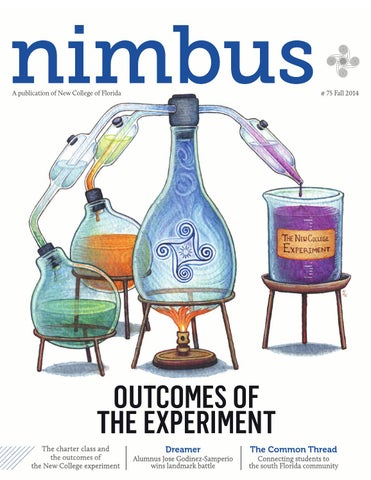
A publication of New College of Florida
# 75 Fall 2014
OUTCOMES OF THE EXPERIMENT The charter class and the outcomes of the New College experiment
Dreamer
Alumnus Jose Godinez-Samperio wins landmark battle
The Common Thread
Connecting students to the south Florida community
*
Managing Editor Jessica Rogers VP of Alumnae/i Affairs NCAA Communications Committee Colin Boyle-Communication’s Chair Mitch Silverman Jordan Clark Michael Dexter Hazel Bradford Shannon Strischek Art Direction/Design Jessica Moats Illustration Emma Lazauski Contributors Jessica Rood Director of Communications and Marketing
23
Kim Butler Creative Services Manager
Dreamer
David Gulliver News Services Manager
Alumnus Jose Godinez-Samperio wins landmark battle
Glen Van Der Molen NCAA Alumnae/i Coordinator
7 Outcomes of the Experiment The charter class and the outcomes of the New College experiment
17 Profiles Empowerment through education: Paul Scudder, Abby Oakes, Jono Miller, Daughters for Life Duos
Also inside this issue: On Campus > 3 We Heard You > 6 Op Ed > 14 In the Community > 15 Chapter News > 27 Class Notes > 29
ike our Nimby-doodle? Submit your version of the Nimbus masthead *L for consideration to ncf.edu/submissions
Publisher Office of Communications & Marketing New College of Florida 5800 Bay Shore Road Sarasota, FL 34243-2109 941.487.4153 communications@ncf.edu NCAA Board of Directors Executive Committee Chair – Susan “Spozy” ’Sapoznikoff ’83–’87 Vice Chair – Frazier Carraway ’72–’76 Treasurer – Chad Bickerton ’05–’09 Governance Chair – Maia Hinkle ’05–’07 Communications Chair – Colin Boyle ’89–’95 Immediate Past Chair – Robert Lincoln ’77–’83 Hazel Bradford ’75–’80 Jordan Clark ’04–’08 Michael Dexter,’07–’11 Carla Eastis ’88–’92 Cindy Hill ’89–’93, Thomas Knight ’03–’07 Gera Peoples ’94–’97, Albert “Rick” Schofield ’85–’88 Mitchell (Mitch) Silverman, ’91–’94, Norman (Norm) Stein ’69–’73 Shannon Strischek ’05–’09 Shannon Duvall VP of Advancement & Executive Director of the Foundation Dr. Donal O’Shea President of New College For a full board listing, visit ncf.edu/bot and ncf.edu/foundation-bot
ON CAMPUS
At left: 1969 Sarasota Kennel Club Benefit Above: NCF student and therapy dog on Z-Green (2014).
THEN & NOW Puppy Love: New College has a history of animals on campus. The New College student alliance (Now) brings dogs from the local animal shelter on campus during mid-terms to give our students a much-needed study break. Do you know more about Then? Tell us! (ncf.edu/submissions)
Read the message from the chair, Susan “Spozy” Sapoznikoff ’83, of the alumnae/i association: ncf.edu/message-from-the-chair
CAMPUS NEWS
Sailing team competes in national championship n a probable first for New College, the co-ed sailing team qualified for the national championship in the sport: The team placed sixth among 10 colleges competing in a South Atlantic Intercollegiate Sailing Association Championship in Jacksonville on April 26-27. The top-six finish qualified the team for the 2014 ICSA National Intercollegiate Sailing Championship, June 3-6, at the U.S. Naval Academy in Annapolis, Maryland. With its two top sailors unable to attend the championship, however, New College placed last in the championship event. In the April regionals, New College edged out North Carolina State University, Georgia Tech, Rollins College and University of North Carolina at Wilmington to make the cut.
I
“
We all went as one team, one family and with our team spirit and improvement in the sport of sailing, we accomplished what seemed impossible when I started coaching here.
”
-Hillary Noble, who competed as a student for University of South Florida before heading the New College team.
FELLOWSHIP
Two Students Named to Inaugural Class of Frost Scholars
Kaitlin Statz (left) and Timothy Duff (right) have full scholarships for graduate degrees at University of Oxford.
tudents Timothy Duff and Kaitlin Statz have been awarded full scholarships for master’s degrees at England’s renowned University of Oxford, as members of the inaugural class of Frost Scholars. The scholarship program was created by the philanthropic foundation of Patricia Frost, a member of the Florida University System’s Board of Governors. It provides 10 full Oxford scholarships a year for Florida residents graduating from the state’s public colleges who are pursuing further study in science, technology, engineering or math programs. Duff, from the Tampa area, will continue his studies in mathematics. His New College professors called him among
S
the brightest math students they have ever seen. He’ll be in good company: Oxford is home to Andrew Wiles, who in 1995 completed the proof of Fermat’s Last Theorem – a task that had confounded mathematicians for 358 years. Statz, from Mexico Beach and now of Sarasota, will study archaeological sciences. Her professors praise both her sophisticated and exacting research skills and her extraordinary talent in archaeological illustration. Her thesis examined the historical depiction of Silbury Hill, Windmill Hill and Avebury Stone Circle, part of the collection of sites that includes Stonehenge. She’ll be pursuing her graduate studies within a short drive of those sites.
Co-chairs: Kathleen ’64 and Stephen Raskin & Katie and Peter Hayes
Saturday, November 1, 2014 6:00 p.m. | College Hall Bayfront
For tickets, go to www.donate.ncf.edu/ clambake2014 or call 941-487-4800 Proceeds benefit New College of Florida
ON CAMPUS MEDIA
FELLOWSHIP
NPR examines Florida college performance metrics
New College Again Finds Fulbright Success
he Florida university system Board of Governors is employing performance metrics for some of its funding this year, and a regional NPR station story explained how the metrics may not accurately measure New College’s strengths. The story, which aired on WGCU and was widely read online, pointed out two significant flaws in the Board’s system. It grades schools on percentage of students employed or in graduate school within one year of graduation, and on the average salaries of students working in Florida one year after graduation. The story notes that about 30 percent of New College students attend graduate school within a year of graduation, but more than 65 percent attend within five years. It also quoted Marhsall Criser, chancellor of the state university system, as saying that the state may start counting students employed outside Florida. Alumnus Dr. Jack Collins ’88, interviewed for the story, said the state’s system clearly doesn’t capture New College’s outcomes. “New College is absolutely recognized nationally as a thought leader, as a producer of high quality education and high quality students,” he said. “My first thoughts were that the measures must be off and that they weren’t measuring the right things.”
ive students at New College of Florida have been awarded prestigious Fulbright grants for 2014 and will study and work in Belarus, China, Taiwan, India and Germany. This year’s recipients are Erich Barganier (St. Petersburg, Fla.), Robert Matthew Klinkel (Orlando, Fla.), Laura Robinson (Jacksonville, Fla.), Katharine Williams (Valrico, Fla.) and Richard Zay (Inverness, Fla.). All graduated in May. In addition, two students were named as alternates: fourth-year student Robert Hincapie and Lorna Hadlock, a 2013 graduate. New College now has 58 Fulbright recipients in the last 10 years, and 80 in its history. Barganier (Russian/Music) is an English language teaching assistant in Belarus. He is proficient in several instruments and plans to incorporate music into his teaching. He plans a career as an ethnomusicologist, preserving musical traditions for a group like UNESCO. Klinkel (Psychology/Spanish/Chinese) will be an English language teaching assistant in Taiwan. He is fluent in Chinese and Spanish, has traveled widely in China and has taught in community literacy programs. He plans graduate study in language acquisition. Robinson (Political Science/International Studies) is pursuing a research project in India. She spent four months there in 2013 and has returned to examine best practices for increasing inclusion of women in government. She plans graduate study and a career dedicated to increasing women’s role in political processes globally. Williams (Economics/Chinese/Spanish) is pursuing coursework and a research project in China, examining alternative energy and sustainable development projects. She plans to work as an economist for the World Bank or United Nations, to assist developing nations in creating policies that create both economic growth and sustainable development. Zay (German Studies) is an English language teaching assistant in Germany. He lived and worked in Germany to gather material for his senior thesis on the films of Werner Herzog, and plans graduate study and a career in teaching German language and culture.
T
CAMPUS NEWS
Flag football club splits series with Ringling College Continuing a burgeoning crosstown rivalry, New College and Ringling College of Art and Design split their two-game series but brought in thousands of dollars of donations for two local nonprofit organizations. New College’s Null Set won the fall game in a 20-0 drubbing, but the Fighting Armadillos turned the tables in April with a 10-6 win. The games brought together hundreds of students from the two campuses, as well as, spectators from the Sarasota community, and joint performances from the schools’ a capella groups. The fall game raised $1,700 in cash and 629 pounds of food for Sarasota’s All Faiths Food Bank. The spring game raised more than $800 and several boxes of school supplies for Visible Men Academy, a Bradenton charter school that focuses on providing academic, character and social education to at-risk boys.
F
Read more On Campus news at nimbe.ncf.edu/oncampus
www.ncf.edu
ON CAMPUS
What’s Happening Commencement and orientation, from beginning to end ORIENTATION
With 240 students, the New College 2014 cohort is the biggest group of first years in at least a decade, and possibly the College's history.
At New College, it is customary for the wearing of academic apparel at the ceremonial occasions by faculty and students to be optional. This tradition may have started as a nod to the Florida climate, but it is symbolic of the innovative, independent spirit displayed by both faculty and students.
COMMENCEMENT
Keynote speaker and honorary degree recipient, Jennifer Granick '86, lives in San Francisco and is the Director of Civil Liberties at the Stanford Law School's Center for Internet and Society (CIS). Jennifer practices, speaks and writes about internet law, computer crime and security, electronic surveillance and hacker rights. From 2001 to 2007, Jennifer was executive director of CIS and taught cyberlaw, computer crime, Internet intermediary liability, and Internet law and policy. Then she spent three years at the Electronic Frontier Foundation and a year at the D.C. based firm ZwillGen before returning to Stanford Law School. Before teaching at Stanford, Jennifer spent almost a decade practicing criminal defense law in California. She earned her law degree from University of California, Hastings College of the Law, and her undergraduate degree in 1990 from New College in political science with Gene Lewis.
5
New College of Florida | nimbus
Timothy Duff, Tampa, was this year's student commencement speaker. Duff played bass in the New Cats jazz band and is fond of burritos and sushi. He also is the author of a senior thesis titled “Deformations, Discrete Sampling and Robust Toric Ideals,” on applications of computational algebraic geometry to certain statistical problems. Tim’s AOC, of course, was mathematics, and last year he received a Goldwater Scholarship, awarded to the nation’s most promising students in math and science. Duff was also one of the inaugural winners of Florida’s 2014 Frost Scholarships, and is pursuing his master’s degree at Oxford University.
WE HEARD YOU
Best of Social Media “ With New College’s DIY approach to education, I learned to recognize myself as the broker of my own ambition. Now I’m working at my dream job, which didn't exist before I helped vision it. I was able to recognize possibility and turn it into actuality. New College taught me that.” – Sam Greenspan (’04), Producer, 99% Invisible
NEW COLLEGE:
(9)
The 20 Public Colleges With The Smartest Students – BusinessInsider.com
People Reached:
Likes:
(15,584) (402)
“Ah, @NewCollegeofFL, my heart still softens” – @collegiatekid
#DidUKnow? “ Three Florida universities were named to @Forbes “Best Value” list @UFLorida @NewCollegeofFL @floridastate”
“ Came home today to two postcards from @NewCollegeofFL. Best college visit experience. #FutureNCFBound #NCFvisit” – Ian Eberle
– Board of Governors / @FLBLOG
WHAT’S ON YOUR MIND? “ I just wanted to say thanks to NCF staff and volunteers for such a smooth move in. And ditto the kudos to the parents for raising these great kids and encouraging this unique opportunity to grow and learn at NCF.”
369
Likes, Comments & Shares “Two Frost Scholars: Congrats to Timothy Duff and Kaitlin Statz!”
– Shar Jordan to New College Parents
Connect with New College ncf.edu/resources-for-alums
facebook.com/NewCollegeofFlorida
youtube.com/NewCollegeofFL
twitter.com/NewCollegeofFL, @NewCollegeofFL
www.ncf.edu
COVER STORY / OUTCOMES
Learn &Â Leap Outcomes of the Experiment
BY DAV I D GU LL I V E R
I LLU S T R AT I O N S BY E M M A L A Z AU S K I
Sarasota has always been a place people came to see. Sometimes they came for a week or two; sometimes they stayed for a lifetime. The summer of 1964 brought a different class of visitors - 101 young people from across the country. Though they stayed only a few years, this place they called home changed them in ways they are still realizing today. Fifty years later, members of the first Charter Class talked about their thrilling, chaotic and defining years here, revealing a series of shared themes and the enduring effects of their New College experience. 7
New College of Florida | nimbus
The “Blue Goose” bus transported students from their temporary residence, the Landmark Hotel on Lido Key, to campus in 1964.
A sense of something special
It began, as so many Florida stories do, on the beach. With the Pei dormitories still rising from the field by the airport, the inaugural class had to live off-site, and the College backers – with support from the star-struck Sarasota community – lined up an alternative, the luxury Landmark Hotel on Lido Key. Put a 101 young, brilliant, freethinking teenagers in a beachfront hotel and you can predict the results. During the days, students read Rachel Carson books on the sands, and at night they swam in water teeming with bioluminescent algae. They chipped golf balls from fourth-floor rooms, out through patio doors and into the swimming pool. The bland, faux-chic artwork came off the walls, sometimes never to return, and the late Bill Thurston, who would become one of the greatest American mathematicians, reprogrammed the elevator buttons to send people to the wrong floors. The Charter Class was a melting pot of students, because Dean of Admissions Robert Norwine had employed a savvy strategy. He and his recruiters courted
top students from small towns, like Fay Clayton, from a farm in central New Jersey, and Esther Barazzone – “southern West Virginia via three years in Florida,” she said. They targeted students from Chicago, the Midwest and the West, like John Cranor, Rachel Findley, Paul Hansma and Chuck Hamilton, who were off the radar of the Ivy League schools. And they appealed to offbeat students like Inge Fryklund, known to her northern Virginia high school counselors for cutting classes to attend sessions of Congress or climb the Washington Monument. As they came together, talking on the beaches and in the classrooms, the teenagers realized something special was happening. They may have come from widely diverse backgrounds, but they were united in a dedication to learning. “We were so excited to meet each other - to know there are more people like us in the world,” said Inge Fryklund. “It didn’t feel all that unusual that people would spend hours and hours in the library or in the lab, or hours and hours just talking to each other.”
Some were daunted, at first, by the intellectual level of their fellow students. “They totally intimidated me, many of them,” Barazzone said. “They were brilliant, and pretty sophisticated, compared to me.” Clayton hadn’t heard of many of the books they discussed, let alone the philosophy they debated. And then, there was the manner of speech. “One guy would frequently say, ‘I would conjecture,’” she said. “It was very impressive for a while, until I realized he was saying, ‘I am just guessing!’” When their classes began, the community of ideas promised in that four-part, slip-covered brochure quickly came to life. A typical class might be a lecture on “the nature of man” or “what is beauty.” A philosophy professor might start the discussion, then hand off to – or debate with – an anthropologist. After that, maybe a historian, or a psychologist. “They demonstrated the integrity of ideas before us, and it was so exciting to watch,” Esther Barazzone said. In science and math classes, the feeling was similar. Rachel Findley had been >>
www.ncf.edu
8
“We are trying to see what we are and what we think. We are searching, we are flexible. We want to resolve ourselves. I can’t say now what I will be when I’m through here. I’m here to learn to think, and that is no easy task.”
The Commitment to Learning
History professor Laszlo Deme talks with student.
a top math student in high school, but now, as a member of an upper-level group lead by Prof. Bill Smith, felt challenged. “I felt like I’d been given the key to something I didn’t know about,” Findley said. “It was different, and I couldn’t even conceive of how different it was.” Paul Hansma was one of just a few physics students. Classes were in a discussion format, and students had to present their solutions on the chalkboard – a method teachers employ today at University of California – Santa Barbara, where he has taught for 39 years. “It’s a good way to teach physics and to teach students to think on their feet,” he said. “And it kind of embarrasses you into doing your homework, so you’re on your toes.” Renowned British historian Arnold Toynbee was a visiting professor for the year. That was a major draw for John Cranor, at the time a history student, — but New College enticed him to study other fields as well. “I characterized New College as an intellectual candy store,” he said. Cranor took a class in microbiology, out of pure curiosity, then one in art history and returned for three more, practically enough for an art history minor.
9
New College of Florida | nimbus
Chuck Hamilton found the faculty’s unorthodox, in-depth style immensely appealing. “The opportunity to take one book and spend four weeks on it was a real gift,” he said. In all, it was the right environment for a collection of students who knew their capabilities but not what they wanted to do. As a young Barazzone told a local newspaper reporter when classes began:
“ I characterized New College as an intellectual candy store.” -John Cranor
As John Gustad, the College’s first dean, laid out in his guiding principles: “Each student is responsible, in the last analysis, for his own education.” The contract was the tangible expression of that principle. For fifty years now, students and their advisors have been negotiating that document – a plan each semester for courses to take and personal goals to meet. It was the vehicle by which someone like Fryklund could explore her curiosity. Her area of concentration was experimental psychology and anthropology, but she also took Russian all three years. (New College’s initial curriculum was designed for students to complete their degrees in three longer academic years.) “We kind of made it up as went along,” Fryklund said. “It was a great opportunity to explore whatever looked interesting.”
OUTCOMES / COVER STORY
Hansma, too, took initiative in his education. When he came to New College, he brought with him a Van de Graaff generator and an accelerator tube he had built at home in Denver. On campus, he built another accelerator tube and a vacuum tube to use with it. Chuck Hamilton was finding a guide in Laszlo Deme, an esteemed history professor and refugee from Hungary. “He was interesting and always intellectually curious. He helped me question everything and develop my own perspectives, and then defend them,” Hamilton said. “He didn’t always agree with me—but it didn’t matter. I was developing a way of thinking.” As their New College careers progressed, Barazzone and Clayton were no longer intimidated by colleagues or professors; Barazzone had taken to regularly challenging a few of them. And Clayton, advised by psychology professor David Gorfein, had launched an unusual and offbeat experiment for her thesis: To study nipple preference among kittens, she raised a litter in her dorm room. To look at dominance among kittens, she adopted a pregnant cat from a shelter, and then divided the resulting litter between the mother and a surrogate she built from materials including a heating pad, a clock (to replicate a heartbeat) and baby bottles. The surrogate, perhaps predictably, didn’t work well, so Clayton had to set an alarm and get up every two hours for feeding – which her roommate Anna Navarro dutifully tolerated. “Anna is a saint!” Clayton said. Rachel Findley and Bill Thurston, perhaps crossing paths with McClain, were in the library’s mathematics section, where they read night after night. Findley, who would marry Thurston in
a few years, said that kind of independent work was crucial to his development as a mathematician. “He was figuring it out on his own,” she said. “It gave him a unique way of looking at math that made a big difference when he got to grad school. He already had a sense that he could figure things out. “He developed a confidence, the ability to visualize things that he might not have gotten at a program like MIT’s. In advanced math classes, it would have been given to him instead of him going out and getting it. He had to figure out how to learn it and see it on his own.” As Thurston wrote, in his widely noted 1994 journal article “On Proof and Progress in Mathematics”: “My mathematical education was rather independent and idiosyncratic, where for a number of years I learned things on my own, developing personal mental models for how to think about mathematics. This has often been a big advantage for me in thinking about mathematics.” Bill Thurston
The Confidence to Leap
During the third year, Paul Goodman, a writer and intellectual opposed to the Vietnam War, came to campus to speak. Goodman instead read his poetry, leaving most of the students disappointed, even irate. Chuck Hamilton was an exception. Leap forward seven years. Hamilton was in New York City. With no experience or training, he launched a publishing company. Among many other titles, he published three volumes of Goodman’s work, landing a lead review in the New York Times Book Review. The lesson, Hamilton said, is that at New College, he and his friends developed an “entrepreneurial view of life.” He could have gone the conventional route, he said, getting a job at a publishing company and trying to learn the business. But that might have put him a decades-long career treadmill, and he would never have published the Goodman books. “Instead I just did it, and kept on going,” he said. “At New College I learned to be confident, to get out there, take some conscious and considered risks and then take responsibility. And this applied in all areas, whether intellectual, career, business or relationships.” Around the same time, John Cranor seemed to have it all figured out. After New College, he attended Harvard Business School. After a stint in the Army, he landed in the management track at the consumer giant General Foods. Then he got a call from a corporate headhunter, asking if he’d consider a job with a Midwestern firm that made and sold ice scrapers. Its annual sales: $2.5 million, a fraction of General Mills’ total. He said yes, doubled sales in a year and positioned himself for his next job. At PepsiCo, he rose to chief executive officer of its subsidiary, the KFC restaurant chain. >>
www.ncf.edu
10
Esther Barazzone, too, was breaking from what seemed like her path. Guided by two professors, George Mayer and Gresham Riley, she marched through her courses in philosophy and history, which made up her self-designed major in intellectual history. She was looking at graduate programs when they took her aside, she recalled, and essentially said, “You’ve come a long way, but you have a good deal farther to go. We think that you’d be helped by a Fulbright, an international experience before graduate school.” So she went on a Fulbright to Spain. That too changed her perspectives. She was planning on attending University of Pennsylvania on a full scholarship in American Studies and instead shifted to Columbia for European intellectual history. When she taught her first class at Hamilton College, she threw out the chronological template and taught it as a discussion of ideas and concepts, just as she had been taught at New College.
some of the money would go to the completion of the arts center. The rest, he requested, would fund a scholarship program for AfricanAmerican students. Rachel Findley, too, felt sheltered from the racial division. Growing up in Illinois, she was unsure what she would find in Florida. “I was a little nervous about going south of the Mason-Dixon line,” she said. “I was already an advocate The Landmark Hotel on Lido Key was the dazzling for civil rights and I was a first “dorm” for New College students, filling in little anxious.” until Pei Dormitory was finished in 1965. She was soon comforted by the southerners she met. Later, as they rolled across the middle “Even though they had southern accents, of nowhere in Alabama, the bus stopped. they had pretty reasonable points of view.” A black woman stepped into the entry Many, in fact, shared her passion for well of the bus, the doors closed and she activism. In spring 1965, she and classstood there as the bus drove on. mates Sarah Dean and Gordon Jarrell Later the driver told Cranor that if the went to Alabama for a civil rights march company knew, there’d be trouble, but from Selma to Montgomery. they had an informal arrangement with After organizers’ plans unraveled, the black community. If people waited at they joined a group of Tuskegee University certain stops, the buses would pick them students in front of the state capital. up and take them into town for a quarter. They ended up trapped, with a line of white counter-protesters on New College was born in the 1960s. It one side and state troopers on was not so much a child of its times but “ You need to get out there, the other. When violence of its students, who brought the generaseemed imminent, city police take some conscious and tion’s belief in equality and justice with swept in and arrested Findley them to south Florida. But many Charter considered risks, and take and the other protesters. Class members, drawn from the more Charter Class members’ responsibility.” -Chuck Hamilton tranquil Midwest, had no experience commitment to equality took with the issues of the times. different forms. Fay Clayton That changed for John Cranor on his For a kid who grew up in Kansas, it was tutored black students who were bus trip from Kansas to New College. an “eye-opening” experience. “And I pioneers in the newly integrated Sarasota “Here’s where my New College never would have had it unless I went to schools. She and friends also took education began,” he said. “At 2 a.m. in a New College,” he said. more subversive action, painting over bus station in Tupelo, Mississippi. I got The experience stayed with him. the “white” and “colored” signs on gas off the bus, went in, and saw two things Decades later, PepsiCo told its division station restrooms. I’d never seen before. There were three presidents the company would donate Chuck Hamilton, before starting restrooms, labeled ‘men,’ ‘women’ and $1 million to the colleges of their choice, his publishing company, taught in ‘colored,’ and two drinking fountains, on their behalf. Cranor, consulting with public schools in what was then called labeled ‘white’ and ‘colored.’” New College about its needs, agreed that Spanish Harlem.
A Commitment to Justice
11 New College of Florida | nimbus
OUTCOMES / COVER STORY
Hamilton and his classmates would keep improving their world, transforming themselves time after time, as the world saw fit. Almost three decades later, Clayton would take that commitment to the highest level. In 1993, she represented the National Organization for Women before the U.S. Supreme Court in a case intended to stop anti-abortion protesters’ tactic of blocking access to clinics. The court ruled 9-0 in her favor.
Restless Reinvention
Esther Barazzone eventually found out what she would be. The first-year from a small town became the president of a college, Chatham University, in 1992. Over two decades, she led major changes, including the addition of graduate programs, the development of the first net carbon-zero campus in the world, and the creation of an award-winning program in international education. Recently, she directed another fundamental reinvention of the college. Chatham, a women’s college in its undergraduate program for 145 years, will admit men starting in 2015. Chatham had a rich history, but despite the expanded academic programs, it faced declining undergraduate enrollment (even as the graduate programs quadrupled overall enrollment) as demand for single-sex education fell. Barazzone relied on a guiding principle based on what she learned in her Charter Class years: “What if this institution didn’t exist, but the raw materials did?” “At New College you really learned to problem-solve, to not be guided by the way things were in the past,” she said. “The way I’ve led change was to never be guided primarily by tradition. It would always reassert itself, so focus on trying to find the best idea to move forward.” Her classmates, too, refused to be guided by their past. Even as he continued
to write on American radicalism, Chuck Hamilton went on to get a master’s degree in business administration. From there, he worked in philanthropy as executive director of the J.M. Kaplan Fund and the Clark Foundation for 30 years, then as a philanthropic consultant. Then he learned that Bessemer Trust, a privately held wealth manager, needed someone to reinvigorate its philanthropic advisory division. Hamilton responded, and insisted that he would only work half-time. He got the job. “There’s something about the New College experience,” he said.” It gave me a place to question, explore and take risks. And that helped me become independent, entrepreneurial and humble in the face of so many challenges.” Fay Clayton became a mother shortly after graduation, then a Montessori teacher in Chicago. She went to law school at night, and graduated first in her class. She worked for several law firms before joining friends and forming their own boutique firm, Robinson, Curley & Clayton. In one case, she worked with a young Chicago attorney named Barack Obama. Rachel Findley
At New College, she said, psychology was a hard science, and it made her into “a scientist of sorts,” and that serves her well now. “As a lawyer, it helps me separate the ‘BS’ from the facts,” she said, laughing. More seriously, she said, it gave her the tools to attack problems – “and if that didn’t work, how to change gears.” Teaching for 39 years at one college sounds at first like the epitome of stability, but Hansma’s career has been anything but. He began his career in the field of low-temperature physics and superconductivity, but switched to surface physics, and then to the development of scanning tunneling microscopes. But his most notable work may be in the discovery of the importance of a protein in bones that prevents fractures, and the development of a device that measures that protein. A Mayo Clinic study used the device in a study of fractures in diabetes patients. He now works part-time for the University and a company producing the device and other instruments. “Relative to other people - I know in physics,” he said, ‘I do have a certain >>
President John Elmendorf, center, chats with students in 1966.
fearlessness about research, which is a questions from her former law professor, work, and why isn’t it,” she said. “I lose little surprising, because I do tend to fear.” Justice Antonin Scalia. interest when something is working well.” Hansma then apologized for keeping While working for Cook County, That led to her work overseas. his conversation short, because he she would regularly pester her boss, It began in 2001, when her sister was needed to complete a project on a State’s Attorney Richard M. Daley, with unable to go on an election observer brain-computer interface system. memos about how certain systems mission to Kosovo. Fryklund called the And when Nimbus reached Inge would run better. Daley would tell her State Department, which, said it was Fryklund, she was hastily packing a bag to go ahead, she recalled, and when he desperate and would send her if she and trying to keep the weight down. was elected mayor of Chicago, he could send her resume within an hour. She was flying to Afghanistan A week later she was in Kosovo. the next morning. Since then, she has worked in “ The way I’ve led change was Serving as an election Tajikistan, in Iraq with the U.S. to never be guided primarily observer for the Organization Agency for International Developfor Security and Cooperation in ment, and in Afghanistan with by tradition. It would always Europe was just the latest USAID, the United Nations, reassert itself, so focus on iteration in a career of finding U.S. Army and the U.S. Marine ways to make things work better. Corps for roughly five of the last trying to find the best idea to She married a classmate, Ray 10 years. She has worked with the move forward.”-Esther Barazzone Bennett, just before graduation, Afghan court system and the and completed her doctorate in mayor of Kandahar and as an psychology by age 26. drafted her to serve as the city’s parking advisor to the military on Afghan legal She left a major law firm that wouldn’t administrator. Then, as a consultant, and governance issues. accept her being both a mother and an she helped the Chicago Election So if she suffers from jet lag, she knows attorney, and worked for the Cook County Commission develop a computerized where to place the blame. “New College State’s Attorney as a prosecutor. In her last signature comparison system to comply has given me a willingness to go and case as a practicing attorney, Holland v. with the Motor Voter Act. do whatever is looking interesting at the Illinois (1989), she argued before the U.S. All of her jobs have been “to figure out moment, and not worrying about how Supreme Court, and won. She took logically how something is supposed to it works out.”
13 New College of Florida | nimbus
OP ED
“ We Look Before and After” 100 years of New College BY A . M C A . ( “M AC ” ) M I LLE R , ‘6 4, E M E R I T U S P RO F E S S O R , N EW CO LLE GE O F F LO R I DA
Looking backward Take a running leap, skip back 50 years, and it’s 1964. New College has 101 students, 10 faculty, and three required Core Courses, aimed at “basic literacy” in Humanities, Social Sciences, and Natural Sciences. Students’ achievements were assessed twice over at year’s end—once by Comprehensive Divisional Exams (“Comps”) with questions written by the professors, and again by nationally norm-referenced multiple-choice exams designed to test the New College academic program itself. In its early days, New College offered no credit to transfer students, so all its second-year students shared a first-year background. The overall curriculum, then, was to be an “hourglass” pattern of introductory wide learning (first year), an intense and narrowed “Area of Concentration” (second year), and then expansion to a wider and often interdisciplinary Senior Project before graduation (third year). Initially, “old” New was no public college; it was private – with high expectations and tuition. The core programs fell apart. Then came the Contract System, which lingers today. It tried to draw sponsors and students closer, but it came to verge on the “open curriculum” where “excellence” battled with relevance. At its most flexible, the system was summarized by “one, two, three”—students’ contracts were anything one faculty member approved; the Area of Concentration was anything two approved, and the Senior Project was OK if three professors blessed the Bacc Exam. USF saved us from the fiscal crash of 1975, then we then spun off into our (precariously funded) status as the Resident Honors College of Florida. So now... a tiny sparkling jewel we are, teetering in the wide tiara of Florida’s universities. One defunding flick of a legislative finger, and we’re shucked into the mud. Now, the next 50 years.
Looking forward: Watch out, this is dark Because, of course, “you can’t manage what you can’t measure,” Florida shall fulfill its policy: “to seamlessly lash the educational system to the employment needs of the State.” (I do love that verb lash.) From kindergarten through graduate school, a seamless flow of well-managed widgets! A liberal-arts education, after all, did consist mainly of students learning how to model their own complex intellectual and personal identities. Faculty helped. But future faculty become even fewer, and more distant, contingent labor. (MOOCs don’t need a union.) “Seminars” become “units” become “credit hours.” Creeping Requirementalism burgeons. Fresh from the production line, students roll. Is this too bleak a vision? In the dark of feudal Europe, who could have foreseen democracy, capitalism, or socialism? Something yet unseen might replace the strictures of corporate plutocracy. “Our sweetest songs are those that tell of saddest thought” Still... the coming half-century might turn a curious full circle. Just as New College, blessed with hard-won local and national funding, arose from the scrub between Sarasota and Bradenton in the 1960’s, so might we persist in the 2060’s as an “Island of Excellence”—this time, a literal island. (Climate-change, don’cha know.) It would be tough to float the Palm Court, but it could be done. New College would offer a fine view of combers over the condo-reefs of Siesta and Longboat. We could bob the waves as an enclave of eccentric intellect. Our visitors (let’s call them “edu-tourists”) could marvel at, and even measure, the output
of undergraduates engaged in real research. That alone would keep cash flowing. Then, when drones from Tallahassee snooped too close, we could lift anchor—or fire up the dirigible, and sail free! One thing’s certain: Excellently odd people, if they can afford it, will always find a place to huddle. That place could be New College. That’s my bright vision. The light at the end of the tunnel is lava Standardization reigns. Even supposing New College floats, I can’t forget that classic science-fiction tale “The World as Will and Wallpaper” (R. A. Lafferty, 1973) where the Young Adventurer sets forth to find the New, but discovers that the future—land and ocean plated over with interlocked floating platforms—offers only one reiterated pattern of buildings. Stores. Personalities. The same ones, over and over the same. New College, of course, won’t be there. Join the conversation on twitter #Nimbus
www.ncf.edu
14
The Common Thread Connecting students to the South Florida community BY DAV I D GU LL I V E R NEW COLLEGE HAS A TRADITION OF BEING ENGAGED WITH ITS COMMUNITY. Past students tutored children in Sarasota public schools. They volunteered to teach when the city’s black community set up its own “freedom schools”. They protested against the Vietnam War, for civil rights and in favor of farm workers. The common thread of building community is woven into the very fabric of New College. Fifty years after its first classes arrived, students still give their energy and ingenuity to Sarasota and Bradenton, and in new ways.
Yadira Lopez and Matt Klinkel
Speaking Your Language New College students turn language talents to adult literacy programs In the spring, most fourth-year New College students work day and night on their thesis projects. Matt Klinkel spent every Tuesday night in a classroom in North Sarasota, teaching English as a second language. Matt is near-fluent in both Chinese and Spanish, proficient in French and has a smattering of three Eastern European
languages. The 2014 graduate and Fulbright winner has shared his talent in the Sarasota community. In 2013, he volunteered with the Sarasota County Literacy Council, which teaches adults how to read. Matt was paired with a minister from Venezuela, and met his family and congregation. He then worked with the literacy council to have its volunteer certification classes taught on the New College campus. Thirty-three students took the class, and about 20 worked as literacy teachers that year. The council linked Matt with Sarasota’s Head Start program, which offers an English class for parents. He and fellow New College student Yadira Lopez teach practical English– basic vocabulary, skills like: resume writing, how to interview for a job or speak with a teacher about their children. Matt enjoys being part of his students’ lives. They often discuss their struggles with visas, their efforts to attain citizenship, their work and their families. “It’s been really rewarding for me to get to know them,” he said. He and Yadira make a good team. He’s skilled in explaining grammar and usage, and Yadira, a native Spanish speaker of Cuban ancestry, knows the complexities of grasping a second language. “It’s almost like going back home, in a way,” she said.
Navigating Life In sailboats, students learn to navigate life and the classroom Sail Future is about second chances. The nonprofit program, created by 2014 graduate Michael Long and run entirely by New College students, pairs high school students who have serious academic or discipline problems with mentors close enough in age to be able to relate to them. They team up on homework, on trust and dialogue exercises, and most importantly on a sailboat. One fundamental component is that both student and mentor are novice sailors, making them equal partners in the lessons. The lure of wind and water is the key, Long explained. “These students would never buy into a traditional mentoring program,” he said. But it’s more than just the reward. Sailing offers
15 New College of Florida | nimbus
lessons, metaphors for life. Every day on the water is linked to an idea, like teamwork, perseverance, and confidence. One day’s lesson was to be at the line when the whistle blows. In a sailing race, a boat that’s off the line is at a severe disadvantage. In school, Long told the class, those at the starting line are the class valedictorian and the A students. But they wanted to prove a lesson, so Long and partner Cornell “CJ” Lee, the program’s sailing director, started hundreds of yards off the line, far behind the students. With their skill and experience, they soon shot past the other boats. That sent their message: “You can start way behind the line, and you can still catch up and pass everyone,” Long said.
IN THE COMMUNITY
classes. He also worked with St .Stephen’s Tony Haakman, teaching Latin to middle-schoolers. Haakman and New College’s Prof. David Rohrbacher developed the teaching internship program, going into its sixth year. Typically, New College students spend a week observing, then do a week of jointly planned tasks, and then write and teach from their own lesson plans. “The teachers work closely with the students, they mentor them and give them career advice,” Rohrbacher said. “They’ve really Wesley Thorpe, at center, and St. Stephen's students turned this into an amazing educational experience for the students.” St. Stephen’s art teacher Mollie Grady said Thorp developed an instant rapport with her students. Partnership makes New College students “It helps with Wes being closer to their age,” Grady said. teachers for a month “They felt a connection to him that they might not have felt with a teacher. He was able to introduce them to art and At New College, student Wesley Thorp studies art, with a music and ideas that were relevant to them.” specialty in plein-air painting, and has taken classes in Latin. Thorp hopes to eventually work in arts education, and said He spent January 2014 teaching both subjects in high school. the experience was important for him. Thorp is one of five New College students who taught at St. “I got a chance to see the way teachers created different versions Stephen’s Episcopal School in Bradenton for their indepenof the same course based on the needs of the students in the dent study project. Students pair up with one or more individual classes, which is not an experience that you get going teachers with whom they share an interest. through high school and just being in the courses,” he said. “It Thorp’s area of concentration is fine arts, so he assisted with definitely made me more interested in the teaching profession.” the Advanced Placement art, video production and photography
Classroom Connections
Stars in the Skies
Anthropology students use skills, can-do spirit to aid museum The lights dimmed in Bishop Planetarium and a figure appeared on the dome, a man with a white moon on his forehead, placing stars in a dark sky. He is Black God, a creator figure in Navajo mythology. The show is the creation of New College students Nova Jones and Maia Owen, who were volunteer interns at South Florida Museum in Bradenton. Their January independent study project in ethnoastronomy, the study of how cultures regarded celestial objects, brought Navajo mythology to life, from their anthropology studies to the planetarium screens. Gabrielle Vail, visiting assistant professor of international and area studies, and a New College alumnus, worked with the museum to develop several projects for students. Students prepared materials for exhibitions of the museum’s collection of hand fans and an exhibit of Japanese dolls, and catalogued anthropologists’ pictures of South and Central America and their research journal. Like Jones and Owen, anthropology student Garrett Murto created a separate planetarium show on Incan myths. To produce their 10-minute shows, they researched the history and legends of the stars, then determined how they aligned and
Nova Jones and Maia Owen
where to place them. They also had to learn the planetarium’s new software, which even the director had yet to use. They came away impressed with what they learned about the culture and their own capabilities. “The planetarium dome is a very imposing screen and for me to see a creation of my own on that screen was an awesome effect,” Murto said. “As a first-year student, it’s exciting to be getting involved in the community with a project like this,” Owen added.
www.ncf.edu
16
PROFILE / DAUGHTERS FOR LIFE DONOR DUOS
Empowerment through Education Two familes share a belief and a goal
DR. KAREN HAMAD AND ATTORNEY SUE JACOBSON HAVE DIFFERENT
heritages and different faiths, but their mothers instilled in them a common belief: Educating women can change the world. Hamad and her mother, Renee, and Sue and her mother, Dorothy, have been early and enthusiastic supporters of New College of Florida’s partnership with the Daughters for Life Foundation. That partnership has bloomed this fall, bringing five Middle Eastern women to the college on full four-year scholarships. The program’s hope is that by empowering women with a college education, they can bring change to one of the most volatile parts of the world. “If you educate women, it’s been shown that they go home and raise up their communities,” says Karen, an internal medicine specialist in Sarasota. “They use that education to improve not only their own lives but the lives of the people they live with and of the children they have. The more you educate these girls, the more they realize that they shouldn’t spend their life behind a burka, that they shouldn’t be locked in rooms or married off to men 50 years their senior.” That concept, that “ If you educate women, women will drive change in their homelands, is at the it’s been shown that they go home and raise heart of the Daughters for Life Foundation. Dr. up their communities. Izzeldin Abuelaish created They use that educathe foundation to honor his three daughters, who were tion to improve not only their own lives but killed when an Israeli tank mistakenly fired a shell into the lives of the people their home. they live with and of Born in the Gaza Strip, the children they have." Abuelaish practiced medicine in both his -Dr. Karen Hamad Palestinian homeland and Israeli hospitals. The foundation embodies his belief that educating young women from various ethnic, national, and religious backgrounds can bring peace to the Middle East. These two mother-daughter pairs parallel that notion
17 New College of Florida | nimbus
BY B ET H LU B E R E C K I
of cooperation across cultural lines. “I’m very excited about the idea of us, a Jewish mother and daughter, partnering with a mother and daughter with an Arab background,” says Sue. “I think it sends a message and conveys what we believe: Let’s join hands on this.” This idea of multinational unity hits close to home for the Hamads, who serve as an example of how different cultures can blend together. Dorothy and Sue Jacobson
Renee was born and grew up in Cairo, Egypt, and is of Jewish descent. She married a Palestinian Christian, and the couple raised their two children in the United States, encouraging and financially supporting them throughout their educational paths. Once her children were grown, Renee focused on her own education, finishing the bachelor’s degree she’d started in Cairo by graduating Phi Beta Kappa from Eckerd College. “My parents are really brave, and our whole lives they told us that it’s about tolerance,” says Karen. “Maybe if you meet people from another part of the world and they eat like you and cry like you and study like you and worry like you, maybe they won’t be so ‘other.’ That’s what I hope.” The Hamads expect the “ Education gives you program to be an eye-opening experience not only for the tools to be able its participants but also for to work with people, the rest of the college to be able to confront population and the local whatever issues community as a whole. exist in your day-to“Being able to communicate with these women and day life. Education ask them questions as to expands your world, how they live will be like and, for women in opening a window into a particular, it just has different culture,” says a tremendous ripple Renee, who recently finished a stint as president of the effect.” -Sue Jacobson board of the Women’s Resource Center of Sarasota County and now is immediate past president. “Hopefully the gaps will narrow and the culture differences will diminish.” Sue and Dorothy share the same desires through their support of the initiative. “I don’t think you can do much in this world without an education,” says Sue, of counsel at Kirk Pinkerton in Sarasota. “Education gives you the tools to be able to work with people, to be able to confront whatever issues exist in your day-to-day life. Education expands your world, and, for womenin particular, it just has a tremendous ripple effect.” The two have both seen in their own lives the power an education can have. “My mom went to college in an era when not every girl went to college, but her father thought that was really important,” says Sue. Dorothy received her bachelor’s degree from University of Buffalo, and pursued her master’s degree from Elmira College while raising her family. “I wanted to go on,” says Dorothy. “And it was good because my children were in high school then. They would see me studying and so it became important to them.” Now they look forward to giving other women these same kinds of skills with which to navigate—and hopefully change—the world.
Karen and Renee Hamad
“This will really foster leadership in women,” says Sue, who has served in local and national Jewish organizations. “Not only will they be getting a college education, but they’ll be exposed in a big way to other people with different backgrounds. It will help them see the bigger world, and I think that will have a positive influence on whatever they want to do. And if there are more female leaders in the world, there will be more peace in the world, period. ” “I really think that the only way the violence and hatred over in the Middle East is going to stop is when there are enough women educated that they don’t allow it to continue anymore,” says Karen. “Someone has to empower them to stop all of that, and it has to start with one person. So this is a way to really make a big change with an individual at a time.” The Hamads and the Jacobsons joined many other generous donors who donated to the Daughters for Life fund at the New College Foundation. In its first year of fundraising, the Foundation raised over $240,000 for the first cohort of scholars to attend New College on full four-year scholarships. The Foundation is now actively raising money for the next cohort of scholars and working on meeting a $250,000 challenge gift match. To donate to the Daughters for Life Scholars program, please contact the New College Foundation at foundation@ncf.edu or 941-487-4800.
www.ncf.edu
18
PROFILE / PAUL SCUDDER
‘Scudderfest’
Chemistry alums plan to honor their mentor BY A B BY W E I N G A RT E N
STEVEN WHEELER ’98 RECENTLY RECEIVED THE NATIONAL SCIENCE
Foundation’s award for promising young science faculty. The Texas A&M University professor is an expert in non-covalent bonds between molecules, and has been teaching for more than a decade. And when he prepares to teach a new topic, he thinks of his New College mentor: How would Scudder explain this? “For 35 years, Prof. Paul Scudder’s enthusiasm impelled Wheeler and hundreds of other New College students to make their scientific marks on the world, as college professors, in the chemical industry and as physicians.” Scudder stepped down as chair of the Natural Sciences division, but still teaches. His proteges, though, believe it’s time to recognize his contributions to his field. Wheeler and fellow alumni Justin Walensky ’00 and Korin Wheeler ’97 have organized a tributary symposium called “Scudderfest: Thirty-Five Years of Advances in Chemistry and Chemical Education,” to be held on January 23 and 24 at New College. “Scudderfest is our attempt to pay tribute to the impact Scudder has had on our education, our careers and our lives,” Wheeler said. Wheeler was Scudder’s teaching assistant for Organic Chemistry 1 and 2, and spent many Saturday mornings grading exams in the professor’s office.
19 New College of Florida | nimbus
“Scudder’s passion and enthusiasm was contagious and inspiring, and I try to emulate his style in all of my teaching. I hope I can spark the interest of my students the way Scudder has done for his all these years.” Scudder began teaching at the College in 1978, after turning down a chemical industry position that paid almost twice as much, he said. He was simply that impressed by the College students’ questions at his interview, because they shared his same inquisitiveness about science. “People don’t go into the sciences because they love to memorize; they are drawn in by the mystery and fun of figuring things out,” Scudder said. “I’m less concerned about teaching as I am about learning. Learning requires a dialogue with students, because the teacher needs to know where the confusion lies to be able to clear it up.” Scudder has reached countless students, far beyond New College. He is the author of a definitive textbook, the 432-page Electron Flow in Organic Chemistry: A Decision-Based Guide to Organic Reaction Mechanism, first published in 1992. Scudder updated the book for the 2013 second edition. He describes the book as “a way of taking the usually heavily memorization-taught field of organic chemistry and turning the learning of it into a critical thinking puzzle.” As a professor, Scudder most enjoyed watching his students piece together puzzles during courses in advanced organic chemistry and structure elucidation. “The most rewarding aspect of teaching at New College is the student interaction,” Scudder said. “I learned more chemistry trying to find the answers to students’ questions like, ‘Why didn’t it do this instead of that in this reaction?’”
Register for 'Scudderfest' at: www.chem.tamu. edu/rgroup/wheeler/Scudderfest/
ABBY OAKES / PROFILE
Charting Her Course Abigail Oakes lauded for environmental, community work BY DAV I D GU LL I V E R
A JULY MORNING THUNDERSTORM LEFT CHOPPY WATER and a bit of a breeze on Sarasota Bay. It was time for Abigail Oakes to teach her class. Oakes, a Natural Sciences student soon to start her fourth year at New College, was on campus for the summer. She had just completed a stint as a teaching assistant in biology Prof. Sandra Gilchrist’s PUSH/SUCCESS program, which teaches lab and leadership skills to middle and high school students. Now she was running her own program. For her thesis on science education, Oakes was using sailing as a way to teach ninth-graders from Sarasota’s Booker High School. The thunderstorm forced them to flip the schedule. So instead of sailing first, they met in the Natural Sciences classroom at the Caples waterfront. With protractors, string and tape measures, they modeled the distances covered when a sailboat tacks at various angles along a course. Finally, it was time to turn the day’s lesson into practice. Oakes, an assistant, and the six students hurried to rig the sailboats. “This is the part that’s fun for me,” she said. “The reason I like New College is that I can make it my own.” In her three-plus years, she’s done just that, and gained national recognition in the process. In 2014, she was one of 50 students nationwide to be awarded a Udall Scholarship for demonstrating a commitment to a career related to the environ-
ment. She also was named a national Newman Civic Fellow for service to the Sarasota-Manatee community. A self-described high school “nerd” with a 4.4 GPA, Oakes charted a challenging academic course when she arrived in Sarasota. As she devoted her first two years to classes like calculus, biology, and organic chemistry, Oakes also founded a campus chapter of Circle K International, partnering with a local Kiwanis chapter. The club drew 30 members, coordinated on food and book drives, volunteered with Miracle League Baseball, Brush Up Sarasota and the Senior Friendship Center, and tutored at Robert L. Taylor Community Center. They were named the strongest new club by the Florida District of CKI. New College President Donal O’Shea recognized that initiative in his nomination letter for the Newman fellowship: wrote, “She is the embodiment of a student leader who demonstrates strategies beyond direct service to seek long-term solutions to social issues, who inspires and engages others, and who demonstrates the motivation and potential for effective and long-term civic engagement.” Oakes insists there’s nothing special about how she finds time for both studies and service. “That’s what I enjoy doing, to be honest,” she said. “People ask, ‘Why do you wake up at 6 a.m. to play baseball with special needs kids?’ That’s just what I like to do.” Meanwhile, she also was developing her skills in science education. In January 2013, she pursued an independent study project on science education with a Sarasota children’s science museum. Then she spent her summer working for the National Science Foundation-funded National Ecological Observatory Network. She developed ways the group could customize its educational outreach programs to Latino and Hispanic groups. “That’s when I got really passionate about education and about the environment,” she said. It also likely impressed the Udall Foundation, established in honor of former Rep. Morris K. Udall, who represented Arizona for 30 years, and his brother Stewart Udall, who served as secretary of the interior. The foundation selected Oakes and the other winners from 489 applications nationwide. She receives a $5,000 scholarship for her senior year, as well as training and networking through the Foundation’s programs. Oakes melded her science studies and community service into her senior thesis project, tentatively titled “Sailing for Science Education,” using the sailboat as a way to teach concepts in physics, algebra and biology.
www.ncf.edu
20
PROFILE / JONO MILLER
New College’s Navigator Moves On Biologist, steward and teacher Jono Miller retires—mostly—after 44 years BY A B BY W E I N G A RT E N FOR MORE THAN FOUR DECADES, JONO MILLER’S LIFE HAS
intertwined with New College. He has been a student, a teacher, coordinator of the Natural Sciences program, assistant to the vice president of finance, chair of the landscaping committee, the unofficial campus steward. Titles, though, don’t do justice to Miller’s service. At a farewell party in July, Provost Stephen Miles best summed up his role: “You remind us of our obligations and our aspirations.” His journey with the College began in 1970, along with his partner Julie Morris, when the two students enrolled in an environmental biology class with Prof. John Morrill. In 1981, seven years after graduation, Miller and Morris became dual coordinators of the College’s Environmental Studies Program. Miller is legendary for taking groups of students down the Peace River and into wetlands. In the Ten Thousand Islands, he taught them how to navigate the mangrove-filled waters at night. “We rafted up the canoes and the students turned on their headlamps and, heads down, started studying their nautical charts, trying to make the charts match the landscape instead of starting from the landscape. They were getting nowhere,” Miller said. “We had them turn the lights off and use their noses, ears and the soles of their feet. They gradually figured out there could only be one place on the chart that accounted for the sound of birds roosting on pilings, the smell of the stoppers on an Indian mound and the cooler water temperature from the changing tide.” Miller profoundly affected his students. Ray Conner said participating in these expeditions, and the experience inspired her to follow her current environmental path. She is a farmer and co-owner of Evandale Farm in New Hampshire. “One of the things Jono emphasized as a teacher was getting to know the place where you live. When you understand where you are, you can be a part of nature in an integral, important way,” Conner says. “Now, everywhere I go, I dig in, literally and figuratively.” Miller’s dedication to the environment goes beyond the campus boundaries. He has served on local governmentappointed advisory boards for a combined total of 65-plus years.
21 New College of Florida | nimbus
His many administrative roles also had an impact – often unusual and beyond the expected, Miles and John Martin, vice president for finance and administration, told the crowd at the July 1 party. As a staff committee inspected the designs for new dormitories, Miles said, Miller noted there was something missing and pointed it out. “So Jono is responsible for the closets in Dort and Goldstein,” Miles said. Martin noted that the ospreys nesting at Pritzker Marine Biology Research Center owe their homes to Miller. And Jono designed the New College logo on the Academic Center, Miles said. Simply, he said, Miller has made his mark on New College, and “it’ll be here for a long time to come.” Miller, though, said he’ll probably never finish his work with the College. He plans to volunteer in the campus restoration area, along with other projects: a book on cabbage palms for the University Press of Florida, designing a tree house, and working on a Myakka River documentary and a folk song. The New College Alumnae/i Association is planning a Miller retrospective for the 2015 reunion.
REUNION
Meet Our Mini-Class Lecturers
Alumnae/i Reunion Weekend Join us October 30—November 2, 2014
Based on input from the alum community, we have moved reunion weekend to October/November this year, which allows us include the Halloween PCP in our events along with the New College Foundation’s Clambake, with its most popular and well attended events by alums and the community. There will also be the ever popular mini-classes, a historical Ghost Tour, trick-or-treating, open houses and much more! Our inaugural class is celebrating its 50th anniversary this year; what an exciting mark for our alum family! This year also poses a seminal date for our classes entering in 1974, 1984, 1989, 1994 and 2004. If you would like to coordinate a gathering for your group or to volunteer, please contact a member of the Special Events Committee (Thomas Knight ’03, Michael Dexter ’07, Gera Peoples ’94, Cindy Hill ’89 or Frazier Carraway ’72) at ncalum@ncf.edu. Highlights: ►N ew Topics New College presents John Peters ’64: “A Life Worth Hendrick Smith, Pulitzer Prize Living”, Bob Knox-Emeriti Faculty, author and former NY times editor English: “The Art of the Novel”, (His latest book “Who Stole the Mac Miller-Emeriti Faculty, British American Dream”) and American Literature: “Creativity: ►P anel Presentations from the Overlapping Lives”, David GorfeinCharter Class Former Faculty, Psychology: ►O pen Houses, Trick-or-treating “The Evolution of a Research Career” ►M orning Yoga ► Historical Ghost Tour with ►M ini-classes: Doug BerggrenMac Miller Emeriti Faculty Philosophy and ► Halloween Palm Court Party Register online ncf.edu/reunions. Clambake will be $150 per person: ncf.edu/clambake
Dan Chambliss ’71 is a Distinguished Sociology professor at Hamilton College. After graduating from New College, Dan received a masters and Ph.D. from Yale University. Dan has written several books, focused on sociology, with his most recent “How College Works” being published earlier this year. “How College Works” reveals the importance of interpersonal relationships in the undergraduate years of schooling. Dan will be hosting a virtual miniclass during reunion this year to discuss his research and writing. Dr. Raymonda “Ray” Burgman ’71, has an extensive history teaching and working on economic and social issues. She will bring this experience to reunion to host a miniclass on Women in Leadership. She is the former Associate Provost of New College of Florida, is the Director of HERS Institutes. Higher Education Resource Services (HERS), an educational non-profit affiliated with the University of Denver (DU), is dedicated to advancing women leaders and advocating gender equity in higher education. Dr. Burgman leads the planning and delivery of the three signature HERS programs for leadership development for women in higher education. As the former Associate Provost at New College of Florida, Dr. Burgman has had a broad range of responsibilities. She supported programs focused on student academic success, assisted with faculty development efforts, served as a resource for with diversity efforts, worked on assessment and accountability issues and assisted the Provost in dealings with external relations, including the Board of Governors of the University System and the Southern Association of Colleges and Schools (SACS). Previously, Burgman was an Associate Professor of Economics and Management and Special Advisor to the President at DePauw University. At DePauw she also served as assistant dean in academic affairs and the program coordinator for the national Consortium for Faculty Diversity (CFD). Burgman has also served on the faculty at the University of South Florida and Santa Fe College. Burgman received her doctorate in Economics from the University of Florida, with a specialty in public finance. She earned a bachelor’s degree from New College. Stephanie Hudey ’05 is a second-year medical student at USF. She was recently awarded the Young Investigator Scholarship for her research on HIV. Stephanie will be hosting a miniclass during reunion centered on the medical student route and on her research. David Anderson ’04 returned to the United States in August and is pursuing a Ph.D. in immunology at Washington University in St. Louis. David was awarded the National Science Foundation Graduate Research Fellowship for a proposal he was researching since his time at New College. David returned from Chile where he was the director of science education at the International Preparatory School in Santiago, Chile. David will be talking about his research and experience obtaining a research fellowship. In addition to miniclasses, David will be hosting a coffee talk this year to discuss the effects of discrimination under the defense of marriage act on the careers of binational same-sex couples in academia.
www.ncf.edu
22
FEATURE / DREAMER
dreamer. Alumnus Jose Godinez-Samperio Wins Landmark Battle BY R AC H E L G O M E Z
23 New College of Florida | nimbus
AS A HIGH SCHOOL SENIOR, JOSE GODINEZ-SAMPERIO TOLD HIS Due to issues related to his immigration status, Godinezacademic counselor that he was interested in law and politics, Samperio was rejected by several colleges and scholarship and she suggested he become a lawyer. programs before New College of Florida accepted him, and the He followed that advice, and progressed steadily. He studied College’s foundation found private grants to cover his entire anthropology at New College, then graduated with honors tuition. “I’m very grateful to them,” he said. from Florida State University’s law school. With help from his academic advisor, Prof. Tony Andrews, The last step, though, Godinez-Samperio got his stopped him cold. When he in anthropology, studied “ The academic rigor at New College is degree tried to gain admission to the Hebrew, passed the National Florida Bar, Godinez-Sampeunparalleled,” Godinez-Samperio said. Latin Examination cum laude rio landed in a complex and and developed an independent “I learned a lot of great writing skills intense legal battle, and study project about the history became the center of national of the political left in Mexico. that helped me in law school. The media attention. He also co-hosted a community thesis also was a great experience.” That three-year battle radio show on Latin affairs. ended in a historic victory. In “The academic rigor at New May, Florida lawmakers College is unparalleled,” passed landmark legislation, that cleared the way for the Godinez-Samperio said. “I learned a lot of great writing skills that Florida Bar Association to admit him to practice law. helped me in law school. The thesis also was a great experience.” He and his counselor could not have foreseen it, but that At his graduation in 2008, former Gov. Bob Graham in his career talk a decade ago would prove momentous not only for commencement speech lauded Godinez-Samperio’s civic Godinez-Samperio, but countless other young men and activism as an example to follow. women as well. New College’s then-General Counsel Steve Pfeiffer, who had previously taught law at Florida State University, helped steer GODINEZ-SAMPERIO, NOW 28, IS A SO-CALLED “DREAMER,” AN Godinez-Samperio toward FSU College of Law. While at New undocumented immigrant brought to the U.S. as a child. College, Godinez-Samperio also took a summer course at FSU He was 9 years old when his parents brought his family to that opened doors to FSU’s Center for the Advancement of this country from Pachuca, Mexico on tourist visas. Instead of Human Rights, whose administrators found private funding returning to Mexico when their visas expired, they stayed and for his law studies. settled in the Tampa area. When Godinez-Samperio was accepted to FSU, Pfeiffer Godinez-Samperio’s father and mother worked farming and called FSU law professor Sandy D’Alemberte, who had served factory jobs while he learned English and became an Eagle as president of the university from 1994 to 2003, as well as a Scout. He went on to attend Armwood High in Hillsborough former state legislator and past president of the American Bar County, graduating valedictorian of his senior class in 2004, Association. “When Jose was admitted to FSU, Steve called me the same year his counselor suggested he become a lawyer. and said to look out for Jose,” D’Alemberte recalled. However, as an undocumented immigrant, he could not get While at FSU, Godinez-Samperio took several of D’Alemin-state tuition, on-campus jobs, government scholarship berte’s courses, and became close friends with the professor funds or loans. He couldn’t even get private bank loans. His and his wife. He graduated with honors in 2011. only chance was private scholarships to cover tuition and fees. Before taking the bar exam the same year, Godinez“There was no way we could afford college, much less law Samperio told the Florida Board of Bar Examiners that he school,” Godinez-Samperio said. didn’t have immigration status. Since test-takers do not >>
www.ncf.edu
24
FEATURE / DREAMER
“ He was an outstanding student and served his community. What better person could be the role model for this policy change in Florida?” Steube said.
have to show proof of citizenship or federal law prevents giving taxpayerimmigration status, Godinez-Samperio funded public benefits to undocumented was allowed to take the exam. immigrants. Justices instead urged the But when he passed the bar exam and Florida Legislature to intervene and its moral character test, the Florida Bar exempt Florida from that law. refused to admit him because he was not State Rep. Greg Steube, a lawyer, a U.S. citizen, and sent his case to the researched Florida statutes and concluded Florida Supreme Court. that Godinez-Samperio should be able to D’Alemberte took on his student’s practice law. “It didn’t make sense to me Supreme Court case pro bono. “There are that he could’ve studied to become a doctor people you’d want to see thrown out of and never run into this, but since he wanted the bar, but Jose is someone you’d want to to be a lawyer, he couldn’t do that,” he said. see in it,” D’Alemberte said. “He’s shown On May 1, Steube, a Sarasota Republican, an interest in public service. He’s bright sponsored an amendment allowing law and diligent and hardworking…just school graduates who are not U.S. citizens Jose at his commencement at New College everything you’d want to see in a lawyer.” to be admitted to the bar under certain As the case unfolded, a contentious circumstances. swirl of legalities and politics erupted. “It was surreal,” Even then, with the solution almost in hand, GodinezGodinez-Samperio said about all of the attention. “When Samperio had doubts. He could not believe that the legislature I submitted my application for the bar, I never expected it.” that had attempted to pass an Arizona-style immigration law Then, in 2012, Godinez-Samperio’s immigration status changed in 2011, that had for so long denied in-state tuition to undocuunder President Obama’s “Deferred Action for Childhood mented immigrant students, would come together to support Arrivals” program. Through this program, Godinez-Samperio a bill allowing an immigrant to practice law. received a work permit, a Social Security card and a Florida “From the very beginning there was a lot of support from driver’s license. He began working at Gulf Coast Legal Services, the legislature, but I didn’t think it would work out because helping with immigration cases. D’Alemberte said the immigraI’ve had so many bad experiences with them,” he said. tion law experience Godinez-Samperio received at Gulf Coast But the bill passed and Gov. Rick Scott signed it into law on Legal Services helped in his own case. May 12, clearing the way for Godinez-Samperio to practice law. Meanwhile, Godinez-Samperio went public with his “He was an outstanding student and served his community. predicament before a Florida legislative committee in April What better person could be the role model for this policy 2011. “That’s what a lawyer is about — telling the truth,” he change in Florida?” Steube said. told NBC News at the time. At this point in time, Godinez-Samperio is the only He also lobbied on Capitol Hill for the DREAM (Development, undocumented immigrant in Florida to have met all of the Relief, and Education for Alien Minors) Act, met President Obama requirements in the approved bill. and co-founded the DREAM Bar Association, a new organization In July, the state Board of Bar Examiners recommended for undocumented legal professionals and law students. Godinez-Samperio be admitted to the Florida Bar, the last “During this whole process, he handled himself with good hurdle before the final action by the court. While he waits, judgment and maturity,” D’Alemberte said. “He also got a lot Godinez-Samperio is still working as a paralegal at Gulfcoast of good experience because of his own case.” Legal Services, helping with affordable housing and tax However, the Florida Supreme Court ruled unanimously cases. Now, finally, he believes the struggle is over. in March that it could not help Godinez-Samperio, saying “I feel incredible,” he said. “I feel that this is a historic moment.”
25 New College of Florida | nimbus
PROGRAMMING/ACHIEVEMENT
01 02 05
03
06
04
Student Travel and Research Grants The New College Foundation and Alumnae/i Association awarded 56 students travel and research grants, totaling $45,000. We are very thankful for the support we’ve received from all of our alumnae/i, parents and community friends.
Breakfast Book Conversation Donors giving at the highest level, our President’s Circle Society, attended an engaging and lively breakfast book conversation with President Donal O’Shea. This year’s book, “I Shall Not Hate,” by Dr. Izzeldin Abuelaish, was also read by the incoming class of 2013.
Scholarship Reception Generous donors to New College’s Scholarship program as well as Student Travel and Research Grants mingled with student recipients at a recent thank you reception.
Holiday Reception Top donors to the New College Fund enjoyed a holiday reception at College Hall, the former Charles Ringling Mansion. Guests were treated to a historical tour of the building by Ron McCarty, curator of the Ca’d’Zan at the John and Mable Ringling Museum of Art.
Welcome to our 2014 Daughters for Life/New College Scholars! We are honored to announce our first cohort of Daughters for Life scholars, who arrived from the Middle East at New College in August 2014. Daughers for Life, a private non-profit in partnership with the New College Foundation grants scholarships to Middle Eastern women to study at New College for their undergraduate career.
The New College Fund Goes True Blue It was blue skies for New College during the spring end-of-year giving challenge fundraising campaign. The effort rounded out a year’s worth of fundraising efforts, yielding gifts from alumnae/i, friends, faculty, staff and students. During the Giving Challenge, New College raised over $90,000 with 404 donors, winning fourth place for the most amount of donors and earning second place for the most dollars raised, all in 24 hours! These funds allow New College to continue to offer students a personal and collaborative learning environment. A heartfelt thank you to all who’ve contributed.
01
04
02
05
Here is our first cohort of scholars: Leen Al Fatafta, Amman, Jordan Najla Fawwaz, Eilaboun, Israel Rasha Masara, Latakiya, Syria Loureen Sayej, Ramallah, Palestine Ayah Tafesh, Gaza Strip, Palestine (not pictured)
03
06
You can support scholarships for next year’s Daughters for Life cohort of students by emailing foundation@ncf.edu or by calling the New College Foundation at 941-487-4800.
www.ncf.edu
26
CHAPTER NEWS / ALUMNAE/I EVENTS BOSTON, MA
TAMPA, FL
Tristan Zucker ’09, Roger Filmyer ’09 , Kathleen McQueeney ’08
January 28, 2014 Meet and greet at the Havard Club with New College President Donal O’Shea
Claire Carraway ’75, Frazier Carraway ’72, Amy Nath ’00
May 22, 2014 Tampa Bay Alum gathering at CBD’s Pizza
SARASOTA, FL
April 24, 2014 Chapter event at Marina Jack At left: Jenni Maglio ’89, Jack Collins, Michelle Colins, and Lark Baxter ’75 Above: Joan Verizzo ’71, Darlene Needleman
27 New College of Florida | nimbus
NEW YORK CITY, NY
January 25, 2014 Meet and greet at the Yale Club with New College President Donal O’Shea Above: NCAA New York chapter event with President Donal O’Shea in January 2014. At left: Group at New York chapter event January 2014.
NewMusicNewCollege Please join us for five captivating programs of contemporary, avant-garde and experimental music. For concert dates and ticket prices, go to donate.ncf.edu/ events or call 941-487-4800.
CLASS NOTES
Fay Clayton ’64, Esther Barazzone ’64, and Chuck Hamilton ’64 had a two-day retirement party in NYC for Anna Navarro ’64 following her retirement in February. The pictures in the back were taken from the first 1964 NC directory. Above (left to right): Fay Clayton, Anna Navarro, Chuck Hamilton, and Esther Barazzone.
1960s Jerry Neugarten ’65, a retired lawyer in Chicago, is campaigning for an independent and free chess program in Chicago Public Schools. Research shows that chess can improve children’s grades, test scores, behavior and attendance. Discussions on a new program are continuing. You can read more about Neugarten’s campaign at: http://il-chess.org/index.php/ youthnews/608-cps-media-coverageand-public-documents As a follow-up, special edition of his book “Deep Feeling, Deep Healing: The Heart, Mind, and Soul of Getting Well (2011),” Andy Bernay-Roman ’68, has fine-tuned his focus to expound on the psychological principles of the healing and therapeutic relationship that apply to touching and massage with the publication of “Deep Feeling, Deep Healing:
29 New College of Florida | nimbus
Mind/Body Wisdom for Bodyworkers (2012).” Although body-workers primarily focus on the treatment of the soft tissue of the body, they are in fact treating the whole person and often encounter an expression of emotion or memories triggered by touch. In this book, massage therapists and bodyworkers learn how psychoneuroimmunology (PNI) validates the mind/body link so they can better support clients and help them facilitate positive changes that last over time.
1970s Laura Breeze ’70 has accepted a new position as gift planning officer for the Red Cross. She is part of the Red Cross national team, that covers Manatee, Sarasota, Charlotte, DeSoto, Hardee,
Lee, Collier, Hendry and Glades counties. Breeze, who will be based in Sarasota, formerly served as advancement director for the Education Foundation from 2007-2014. William C. Dudley ’71, president and chief executive officer of the Federal Reserve Bank of New York, was recently elected chairman of the Economic Club of New York. “I am honored to be elected chairman of the Economic Club of New York,” said Dudley. “This organization provides an important forum for discussion of some of the most challenging economic and social issues facing business and political leaders today. I look forward to contributing to the Club’s rich legacy as chairman and promoting the intellectual discourse and debate that these issues require.”
The Economic Club of New York is a non-profit, non-partisan organization with more than one thousand members from academia, business, finance and government for a century. The Club provides a structured forum in which selected top leaders, from both the U.S. and abroad, can address key social, economic, and political issues and is one of the premier speaking platforms for economic policy addresses. As founding director of the Institute for Stem Cell and Regenerative Medicine at University of Washington Medicine in Seattle, Dr. Randall T. Moon ’73 was recently featured in a video clip, showcasing tremendous advances that are changing the course of medicine: http://vimeo.com/ 96127445. Moon was also elected into the American Academy of Arts and Sciences in 2013. Pre-production has started on the feature length documentary “Riding the Neon Buffalo,” the dramatic, exciting, good, bad, and wildly lugubrious story of the American Indian casinos since their inception in 1989. Ross Ackerman Vachon ’72 is the film’s producer, writer and narrator.
Oregon scientist, Christopher Doe ’77, is among the newly elected members of the 2014 American Academy of Arts and Sciences. Doe is a professor of biology and a member of the University of Oregon’s Institute of Neuroscience and Institute of Molecular Biology. He also is a Howard Hughes Medical Institute investigator. Doe studies the development of the central nervous system and in particular, how stem cells make neurons. Much of his research is done using fruit flies and zebra fish. He earned a bachelor’s degree in developmental biology at New College and a doctorate in developmental neurobiology at Stanford University. The academy is among the nation’s most prestigious honorary societies and a leading center for independent policy research. Olga Ronay ’77 welcomes Novo Collegians to the High Cove community, an intentional, sustainable community in the North Carolina Mountains that emphasizes arts, environment and
lifelong learning in a new-urbanist setting. Many of its members are New College community members. Professor Emeritus John Moore is a resident wood sculptor and advisor on all things classical, while Professor David Brain takes the stage occasionally with his band, Passerine. Residents include artists in photography and glass, a bunch of good cooks and a world record holder for human-powered flight. We also enjoy more contemplative arts like walking in the woods, gathering around a bonfire and rocking on the porch. Alums are invited to attend the New College fall gathering October 10-12, 2014. Clancy Cavnar ’78 recently published a book as a co-editor, “The Therapeutic use of Ayahuasca,” with Beatriz Caiuby Labate. Published by Springer Books, it stems from a conference instigated by another alumnus, Rick Doblin`71, at the Multidisciplinary Association for the study of Psychedelics Psychedelic Science. The book presents a series of perspectives on the therapeutic potential of the ritual and clinical use of the Amazonian hallucinogenic brew, ayahuasca, in the treatment and management of various diseases and ailments, especially its role in psychological well-being and sub-
The New College “Bones” softball team had a very successful season this past spring. In the regular season, the team had a 12-2 record and tied with “One-Eyed Jacks” for first place. Unfortunately they lost the tie-breaker to officially take second place for the season. The Bones went on to the win the post-season tournament, defeating the OneEyed Jacks 17-16 in a thrilling championship game, with the tying run being thrown out at home in the last inning. The Bones have been playing for 29 years with a combination of New College students, faculty, staff and alumni. Pictured (from left to right): Kneeling: Frank Alcock, Rick Coe, Brandan Cole Standing: Gordon Bauer, Jason Coleman, Chad Bickerton ’05, Mark Johnson, Dirl Warner, Norm Worthington ’77, Keith Sommers ’09, Joey Iglesias, Steinur Bell Not Pictured: Doug Langston, Daniel Anderson-Little ’12, Jordan Jones
www.ncf.edu
30
CLASS NOTES
stance dependence. Biomedical and anthropological data have been presented and critiqued on the use of ayahuasca for treating depression, PTSD, and substance dependence in different settings, such as indigenous contexts, neo-shamanic rituals, contemporary therapeutic circles, and in ayahuasca religions, in both South and North America.
1980s Elizabeth Green ’81 has been named on the 2014 Florida super lawyers list, a rating service for outstanding lawyers from more than seventy practice
areas, who have attained a high degree of peer recognition and professional achievement. The selection process is multi-phased and includes independent research, peer nominations and peer evaluations. To be named a rising star is a distinction given only to the top 2.5 percent of lawyers under the age of 40 or those who have been practicing law for 10 years or less. Green practices bankruptcy law at Baker Hostetler in Orlando. Shelly Wyatt ‘84 successfully defended her doctoral dissertation “Examining Facebook as a Digial Immersive Environment for French Language Learners” on October 14, 2013 at the University of Central Florida. Her degree, a Ph.D. in Education, with a concentration in Instructional Technology and Design, was officially conferred on December 14, 2013.
31 New College of Florida | nimbus
1990s After nearly 8 years at the Shedd Aquarium in Chicago, Melissa Williams ’90 has moved to the Pacific Northwest become the Executive Director of the Feiro Marine Life Center. She lives in the woods, manages 1/10th of the budget and staff and couldn’t be happier! Nicholas Tampio ’91 was tenured and promoted to Associate Professor of Political Science at Fordham University in May 2014. Nick and his wife Gina are raising four sons in Westchester, New York. Nick has also been participating in the national debate about the Common Core educational standards. The Chronicle of Higher Education recently named Amy Laitinen ’92 as one of the top ten innovators of 2013 for her work on competency-based education. http:// chronicle.com/article/Helping-CollegesMove-Beyond/138805/ She is deputy director for higher education at the New America Foundation and focuses on federal policies to increase quality and transparency in higher education. International law firm, Greenberg Traurig LLP has elevated Drew Altman ’93 to shareholder. Altman, a member of the corporate & securities practice group at the firm’s Miami office, focuses his practice on securities matters, capital markets transactions, mergers and acquisitions, financing transactions and general corporate and business law matters. Altman received a law degree, magna cum laude, in 2006 from the University of Florida, Levin College of Law.
Matthew W. Grieco ‘94 and his wife Kimberly joyously welcomed their first child, Oliver William Grieco, to the world September 2013. Oliver already owns a New College flag football jersey and wears it regularly. Matthew works as an assistant solicitor general in the appeals bureau of the New York State Attorney General’s office. Fiona Lewis ’94 has written a new book, “Broken in Soft Places.” She is the author of several novellas and novels of lesbian love and desire. Lewis, who also goes by the name Fiona Zedde, lives and writes in Atlanta, GA. After a run of 4 1/2 years as a faculty research and outreach scientist at the University of Georgia’s Carl Vinson Institute of Government, Jason Evans ’95 is thrilled to be returning to Florida as an assistant professor of environmental science at Stetson University in DeLand. Jason’s wife, Sharon Levine ’97, and their 3-year son, Isaac, are excited to start this new adventure. Congratulations to Kari Debbink ’96 who has completed her Ph.D. in microbiology and immunology with Ralph Baric at University of North Carolina, Chapel Hill in spring 2014 and has now joined Adam Lauring’s lab for postdoctoral studies at the University of Michigan. There she is studying the population dynamics of influenza viruses. Shanon Ingles ’98 is currently conceptualizing, writing and designing an interactive, self-paced mobile game for Next Generation Science Standards
(NGSS) called “GALXYZ,” at a new educational gaming start-up in Silicon Valley. Ingles also runs her own “momand-pop” creative shop called Stray, where she provides copy services and creative direction for digital advertising agencies on the West Coast.
2000s Natan Gold ’00 is working at an advanced software technology company, CustomPlay. The company has developed software that fundamentally changes the way we watch movies, making the experience customizable. Experiences like graphic violence or action sequences can be edited to customize the viewer’s experience. This could change the way movies are filmed and released - the studio can demand a film be rated by the MPAA as a PG-13 and still simultaneously release the same movie to the same theaters as a more adult rated-R film. For more information, visit customplay.com. Michelle Sanchez ’02 has been named assistant professor of theology at Harvard Divinity School, effective July 1, 2014. “With this appointment, I hope to foster renewed interest in the Christian movements of reform and complicated legacies of Protestantism in conversation with the ongoing study of religion, politics, and ethics at Harvard,” said Sanchez. “My research is driven by a fascination with the complex interrelationships between theology, politics and rapid social change that marked sixteenth-century Europe—relationships that play a crucial role in shaping the religious and political landscape of the present-day United States and beyond,” added Sanchez. “I especially look forward to guiding students toward ways of reading theology that are attentive not only to the traditions themselves, but also to how theological writing responds to concrete historical conditions and general human concerns.”
Sanchez holds a bachelor’s degree from New College of Florida in philosophy and religion and a master of divinity degree from Harvard Divinity School. She has served as a teaching fellow in courses at Harvard, ranging from those on the reformation and early modern Europe to contemporary religion and public life. Dylan Jones ’02 has launched a new theater company, Little Grey Hat Productions in the Sarasota-Bradenton area. In addition to recently producing Jason Robert Brown’s two-character musical “The Last Five Years,” he is developing a program with the South Florida Museum called “Theater Under the Stars,” with the goal of producing musicals and plays in their spanish courtyard and Bishop Planetarium. Jones also continues to mentor New College students in the Windmill Theater Company. Gwendolyn Roberts ’03 enrolled in a two year program this year at the Academy of Experiential Midwifery Education and will continue working with families as a full-spectrum doula while training to become a certified professional midwife. She also serves as associate editor of the quarterly magazine, SQUAT Birth Journal with an international subscription base and free online archive. Her partner, Austin Brown ’03, is running customer success for academic publishing startup Scholastica, working with founder and C.E.O. Brian Cody ‘02. “Come and visit us in Charlottesville!” David Anderson ’04 recently wrote a letter to the editor in response to the recent special issue “Diversity in Academe 2014” in the Chronicle of Higher Education regarding lesbian, gay, bisexual, and transgendered members of academia (http://chronicle.com/blogs/letters/
academia-has-a-place-for-lgbt-scholars/). For the past few years, Anderson was director of science education at the International Preparatory School in Santiago, Chile. He was recently awarded a National Science Foundation graduate research fellowship in biology and biomedical sciences at Washington University in St. Louis. Stephanie Hudey ’05 was recently awarded the Young Investigator Scholarship for her research on H.I.V. Hudey, a second-year medical student, worked with University of South Florida Health school’s John Sleasman, M.D., professor of internal medicine and pediatrics. Hudey was also awarded $2,000 by the Conference on Retroviruses and Opportunistic Infections for her work titled “Persistently Activated CD27+CD80+ B Cells Following ART Correlate with Macrophage Activation.” In addition to the scholarship, which covers Hudey’s travel and expenses to the group’s conference held in March in Boston, her abstract was accepted for poster presentation at the conference. The winning research is based on work completed last summer funded by the U.S.F. health research scholarly concentration summer stipend program. The annual Conference on Retroviruses and Opportunistic Infections brings together top scientists from around the world to share the latest studies, important developments, and best methods in the ongoing battle against HIV/AIDS and related infectious diseases. Lauren Fields ’06 recently published “Dysfunction (2013),” a novel published by Rebel Satori Press, and “Countrycide (2014),” a short story collection from Lethe Press.
www.ncf.edu
32
CLASS NOTES
Jacqueline Wang ’06 will be starting a doctoral program in African and African American Studies with a primary field in history at Harvard University. She received the following email from Harvard: “We had many worthy applicants and the overall pool was the most competitive we have ever had. But you stood out as a young scholar of remarkable capability and potential. We are confident that you belong here in the Harvard program. My colleagues on the graduate admissions committee were uniform in praise and excitement about your application. As one commented: Jacqueline Wang is ‘The top of the top.
Her writing is lucid, mature, and intensely interesting; her statement of purpose is persuasive and exciting. We should do everything we can to recruit her.’ I concur wholeheartedly.” New College offers Jackie a sincere congratulations.
in Bucharest, Romania and is currently into her second year. Cruceanu is forming an official European chapter of New College alumnae. Interested Novo Collegians should contact her at rcruceanu@yahoo.com.
Upon graduating in 2012, Raluca Cruceanu ’07, published research in a scientific article abroad. She was admitted to the University of Florida’s summer learning program (SLP) in Dentistry where she worked in dental labs, one-on-one with U.F. professors and U.F. admission representatives. She was admitted to Dental graduate school
Destiny Lyals ’08 was accepted into Stetson University’s clinical mental health graduate program. She began January 2014. Congratulations to Makenzie Pryor ’09 who is now working as an Emergency Room scribe at Manatee Memorial Hospital.
IN MEMORIAM Don Modesto ’79 of Pinellas Park passed away May 26, 2013 from cancer. He was a long-time aikido practitioner, most famously as Mitsugi Saotome’s uke in the first Aikido Friendship Demonstration that Stanly Pranin organized in 1985. He also trained at Saotome Sensei’s “Reimeijuku” in Japan. Most recently, he was training at the Jionjuku Dojo in Largo, FL. A candlelight memorial service was held in February in the outdoor thatch classroom for recent graduate, Ariel Gonzales ’09. Gonzalez passed away after an accident in Nicaragua. He graduated from New College in May 2013 with a degree in Neurobiology. Gonzalez was a beloved student, activist, and friend, with a generous heart and a huge smile for everyone he encountered. Former Professor Rodger W. Griffin Jr. passed away in August 2013. Griffin was instrumental in creating New College’s chemistry lab. He was a member of the faculty from 1965 to 1975 and served on the committee which wrote tenure policy. Donations can be made to the New College
33 New College of Florida | nimbus
New College's The Catalyst, September 23, 1966
chemistry department for research. “Rodger W. Griffin was my chemistry professor. He was the best professor I ever had,” said Ann Tamzin Rosenwasser, MD `68. A member of the charter class, Judith Randall Shealy ’64 passed away November 2013. Shealy graduated from the University of Miami and settled in Atlanta before marrying her husband, Steve. After retiring from Home Depot, she greatly enjoyed her volunteer work at the Georgia Aquarium.
PICTURE PERFECT
A breathtaking display of origami cranes hang in the Gender and Diversity Center. Inspiration for this program stemmed from a touching story of a 12-year-old girl, Sadako Sasaki, who died of leukemia nearly ten years after the drop of the first atomic bomb on Hiroshima. Citing a Japanese legend that promised the maker of one thousand paper cranes, a wish, Sadako Sasaki and her classmates began furiously folding.
www.ncf.edu
34
NEW COLLEGE ALUMNAE/I ASSOCIATION NEW COLLEGE FOUNDATION, INC. THE KEATING CENTER 5800 BAY SHORE ROAD SARASOTA, FL 34243-2109
Connect with New College
facebook.com/NewCollegeofFlorida
youtube.com/NewCollegeofFL
twitter.com/NewCollegeofFL, @NewCollegeofFL
NEW COLLEGE 2014
Graduates By The Numbers
144 50,000
Number of 2014 Florida baccalaureate recipients
1
2
Number of New College 2014 Graduates
Number of New College 2014 Truman Scholars Odds of winning:
Number of New College 2014 Goldwater Scholars
1.8 million
(1 in 10,000 )
Number of 2014 U.S. baccalauareate recipients
*G oldwater Scholarships recognize the most
5
Number of New College Fulbrighters in 2014 O dds of winning: less than
( 1 in 1,000 ) * F ulbright Scholarships allow students to teach or conduct research abroad.
*T ruman Scholarships recognize students with a dedication to and future in public service.
O dds of winning:
promising students in math and science.
(1 in 30,000 )
2
Number of New College 2014 Frost Scholars Odds of winning:
(1 in 3,000 ) * F rost Scholarships provide Florida state university graduates with full scholarships to a master’s degree program at University of Oxford.
Visit www.ncf.edu/alum for more information on our alumnae/i.