BeyondLCATheory: InsightsfromtheField
Our survey explores how professionals are using Life Cycle Assessment (LCA) tools in real-world environmental sustainability efforts. From key impact categories to tool limitations, the results reveal both common practices and persistent challenges

About our survey respondents
25 organisations of different sizes and from different sectors such as manufacturing, consulting, research, aviation, construction, telecom, recycling and food/forestry.
80% of the organizations are defined as large (> 250 employees)
Among the large organizations 70% already perform LCA (Life Cycle Assessment), 20% only do CCF (Corporate Carbon Footprint) and the remaining 10% only do PCF (Product Carbon Footprint).
The micro and small organizations that answered the survey do not calculate their environmental impacts yet
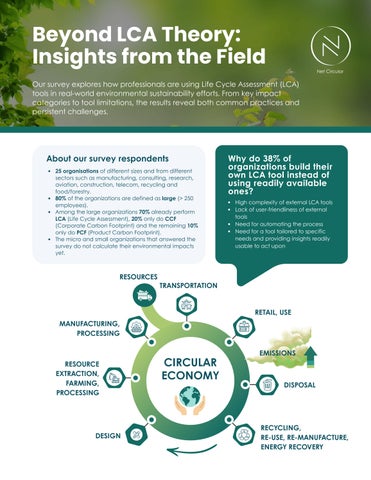
RESOURCES
TRANSPORTATION
MANUFACTURING, PROCESSING

RESOURCE EXTRACTION, FARMING, PROCESSING
CIRCULAR ECONOMY
Why do 38% of organizations build their own LCA tool instead of using readily available ones?
High complexity of external LCA tools
Lack of user-friendliness of external tools
Need for automating the process
Need for a tool tailored to specific needs and providing insights readily usable to act upon
RETAIL, USE

EMISSIONS
DISPOSAL
DESIGN

RECYCLING, RE-USE, RE-MANUFACTURE, ENERGY RECOVERY
Is Climate Change the only impact category that matters in practice?
Out of 11 Impact categories covered by LCA tools, respondents only use between 1 and 5 categories to improve the sustainability of their internal processes such as the development of circular strategies, ecodesign, etc Climate Change is used by all of them, then Water Use is the second most used indicator and then Depletion of Resources.
How are LCA results being used beyond regulatory compliance?
The 4 main uses of LCA results highlighted by the survey are the followings:
1 Environmental Product Declarations (EPD) – 60% of the LCA respondents
2.Ecodesign – 47% of the LCA respondents
3 Regulatory reporting – 40% of the LCA respondents
4 Customers/supplier requests - 40% of the LCA respondents
What is the ecodesign strategy being most influenced by LCA?
Material selection
Which step of the LCA methodology is considered the most complex by professionals?
The inventory and data collection - 86% of the LCA respondents
Uncertainty analysis turned out to be the second most complex step
CONCLUSION
While all respondents use Climate Change as an environmental impact indicator, most rely on just a few out of the 11 available environmental categories in LCA tools. LCA results are mainly used for EPDs, ecodesign, and compliance, with material selection being the top ecodesign focus
However, data collection and achieving high data quality remain the biggest challenges, and limited trust in results as well as underused tool capabilities highlight the gap between potential and practice
The findings highlight that, despite growing use, significant progress is still needed to make LCA fully usable and capable of supporting comprehensive, actionable environmental assessments
CLIMATE CHANGE
PHOTOCHEMICAL OZONE FORMATION
What are the 3 main challenges when doing LCA?
Data quality turns out to be the main challenge for 93% of the respondents
Lack of transparency behind the data used and the modelling
Scattered data within the organisation
How much do users really trust their LCA results?
Median LCA results trust is 65%. Trust ranges from 20 to 80%
Are LCA tools used to their full potential? 65%
Median use of tool capabilities is 45% Tool capabilities usage ranges from 10 to 100%. 45%
Author:

Madeleine Vandenabeele Environmental Analyst
m vandenabeele@net-circular com
Website: www.net-circular.com