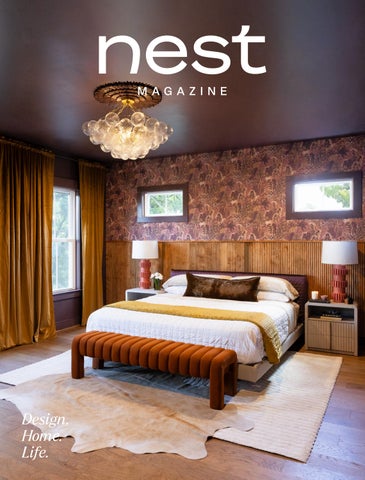
Design. Home. Life.
NEST MAGAZINE | WINTER 2026
1
The feel of home A home is shaped by so much more than floor plans and color palettes. It’s the materials around us every day, the texture of a wall, the weight of a fabric, the grain of a wood floor, that quietly influence how a space feels to live in, often in ways we can’t explain. In this issue of NEST Magazine, we explore how material choices bring depth, warmth, and character to a space. From plaster walls and natural stone to layered textiles and updated finishes, small decisions can shift how we experience our homes. Thoughtful design is not only about what we see. It’s about what we feel, what we touch, how a space holds light, and how it evolves over time. I hope these pages offer you a moment to slow down, to be inspired, or to gather ideas. And if you ever want help reimagining your own space, or looking for the next, I’m always just a call or text away.
2
NEST MAGAZINE | WINTER 2026
NEST MAGAZINE | WINTER 2026
3
TA B L E O F C O N T E N T S
Winter 2026 IN EVERY ISSUE 4 Editor’s Note A closer look at the materials, makers, and details that shape the places we call home.
5 Ask a Nester We asked our panel of agents and brokers to weigh in on the materials shaping today’s homes. Expect strong opinions, surprising favorites, and at least a few design debates.
HOME 16 Unexpected Materials From plaster and cork to leather and limewash, discover the surprising surfaces making their way into, or back into, today’s homes.
40 A Field Guide to Tile A practical guide to the materials, layouts, and patterns that shape one of the hardest-working surfaces in the home.
44 What is Builder Grade? Every new home starts somewhere. Here’s how to take a builder-grade home and make it your own.
40
DESIGN 8 HOUSE TOUR: Modern Eclectic A 1970s home gets a soulful second act through natural materials, collected treasures, and an intuitive approach to design from homeowner and
8
designer, Theresa Butler.
22 HOUSE TOUR: San Francisco Designer Showcase A celebration of craftsmanship, creativity, and bold design solutions from some of the Bay Area’s most talented designers.
34
48 Get the Look Love our cover? We’ve rounded up the paint colors, furnishings, and finishing touches you need to recreate the look at home.
LIFE 6 Local Love Celebrating the makers and materials that make a house feel like a home.
34 Beyond the Surface Four designers share how thoughtful material selections can transform the way a space looks, feels, and functions.
L ETTER FROM THE EDITOR
“The mixture of weird textures and organic surfaces creates an interesting dialogue.” ~ Kelly Wearstler, Interior Designer
Lately, I’ve found myself paying closer attention to the things I touch every day. The smooth edge of a handmade mug that somehow feels better in winter. The grain of an old wood table that’s softened over time. The cool weight of stone beneath busy feet on a morning when everyone is rushing out the door. They’re small moments, easy to overlook, but they’ve reminded me that the materials surrounding us have a quiet way of shaping how we experience home. As we worked on this issue, that idea surfaced again and again. It appeared during our cover shoot as light moved across textured walls, while touring beautifully designed homes, and in conversations with designers about their work. We weren’t simply talking about finishes or trends. We were exploring how materials shape the feeling of a space and why some homes stay with us long after we’ve left them. The homes we remember are rarely defined by a single dramatic design moment. Instead, they come together layer by layer: handcrafted tile, natural wood that grows richer with age, plaster walls with quiet depth, and collected pieces that tell the story of the people who live there. Those details don’t demand attention. They quietly earn it. In the pages ahead, you’ll tour homes where thoughtful material choices create warmth and personality, explore the surfaces shaping today’s interiors, take a closer look at one of the hardest-working elements in any home—tile—and discover how intentional updates can transform even buildergrade spaces. You’ll also see how the right materials can add depth, character, and lasting beauty to spaces of every style, from historic homes to new construction. I hope this issue inspires you to look a little closer at the details around you. Not because every room needs a renovation or every surface needs replacing, but because the best homes are never finished. They evolve over time, collecting beauty, memories, and meaning.
Jasmine Listou Bible Editor-In-Chief
6 6
NEST MAGAZINE || SUMMER SUMMER 2024 NEST MAGAZINE WINTER 2025 2025 New Eden Mulberry Wallpaper by Graham & Brown
Q & A
Publisher Jonathan Kauffmann Editor-In-Chief Jasmine Bible Design Director Paigelee Hodges Senior Editor Aaron H. Bible Contributing Staff Megan Chandler Willy Clair Gilly Davison Emily Fenger Taylor Marrow Elise Moya-Watkins Taylor Titus Contributing Videographers Graeme Jenvey Perri Young Cover Photo Tom Daly Since its founding in 2015, NEST Magazine has been the place where design, home, and lifestyle converge. Published twice annually in Charlottesville, VA, in every issue we deliver fresh ideas, emerging trends, and inspired insights.
1135 Rose Hill Dr., Suite 100 Charlottesville, VA 22903 nestrealty.com/magazine
Ask a Nester Every home is a study in materials. Some define a home’s character, while others shape the way it looks, feels, and lives over time. We asked the agents of Nest Realty about the finishes and textures they encounter on a daily basis. Their responses reveal the choices they gravitate toward, the trends they’re ready to leave behind, and the enduring appeal of thoughtful design.
Expect the Unexpected
Been There, Done That
Nest Realty agents have a sharp eye for emerging design trends. More than 40% favor mixed metals, followed by plaster and clay finishes (23%), glass and acrylic (22%), and concrete, which continues to make a strong statement at 18%.
Some trends are starting to lose their appeal. Nearly 60% of Nest agents say gray-washed wood feels overdone, followed by all-white walls (25%). Glossy finishes (15%) and matching metals throughout (3%) also landed on the list of things they’re ready to leave behind.
The Test of Time When it comes to lasting value, nearly 60% of Nest agents believe solid wood is the smartest investment. Natural stone followed at 33%, while quality tile and timeless textiles also earned recognition for their durability and enduring appeal.
Mix it Up Mixing materials is an art, but contrast leads the way. Nearly 47% of Nest agents favor combining varied textures, while 29% prefer a consistent palette. Another 24% enjoy balancing cool and warm tones for added depth.
Be Afraid, Be Very Afraid Kids, animals, red wine, dinner parties… all make certain materials feel off limits, and we get it. That’s why 47% of Nesters say that white furniture, while they may secretly love the look, is a no-go for them and their clients. 37% have stayed away from marble countertops by the same logic. And 16% are afraid of glass-top tables, which is totally understandable for obvious reasons.
More Texture, Please Texture transforms a space. Woven textiles ranked first with 45% of Nest agents, followed by wood grain and custom millwork (26%) and wallpaper or wall treatments (24%). Stone elements finished at 5% but remain a worthwhile design accent.
Money Back Guaranteed When investing in materials, Nest agents overwhelmingly prioritize quality flooring, earning 61% of responses. Custom cabinetry followed at 26%, while natural stone countertops and surfaces received 10% for their lasting value and timeless appeal.
A Warm Welcome Creating a cozy home starts with layered textiles, according to Nest agents. Rugs, pillows, and draperies topped the list, followed by natural wood (32%), warm matte color drenching (11%), and brass or bronze accents (5%).
NEST MAGAZINE | WINTER 2026
5
LO CA L LOV E
Crafted Close to Home This season, we’re celebrating the makers, materials, and details that make a house feel deeply lived in. Cooler weather turns us back inside. Winter settles in and home becomes our whole world for a while. We start to notice what surrounds us: the surfaces we run a hand across, the objects on shelves and mantles, our favorite mug, the textures and materials that give a room its feel. Whether it’s a piece of custom woodwork, a hand-thrown ceramic centerpiece, a well-worn countertop, perhaps an heirloom quilt with real weight, everyday objects have a way of becoming part of a living, breathing home. And we slow down enough to notice what surrounds us. The craftsmanship in everyday objects is worth paying attention to.
6
NEST MAGAZINE | WINTER 2026
NEST MAGAZINE | SUMMER 2026
9
10
NEST MAGAZINE | SUMMER 2026
HOUSE TOUR
Modern Eclectic TEXT BY JASMINE BIBLE + PHOTOGRAPHY BY MARC MAULDIN
Just beyond a pair of striking chartreuse front doors, lives a home where warm woods, sculptural stone elements, rich grasscloth, and fearless color come together in unexpected harmony. This 1973 ranch feels fresh, vibrant, and deeply personal. For Atlanta-based interior designer Theresa Butler, this house meant more than a renovation, it marked a new beginning, where every decision was guided by instinct. After more than two decades balancing a career in medicine with a growing design business, Butler found herself entering a new chapter. Following the loss of her husband, she downsized from a 6,000-square-foot home to this 1,900-square-foot ranch in Mableton, Georgia. Though the house required a complete renovation, down to the subfloor, she immediately recognized its potential. The soaring vaulted ceilings, original cedar walls, and midcentury architecture offered the perfect foundation for a home that would become an extension of both her design philosophy and herself. Unlike the carefully orchestrated projects she creates for clients, Butler approached her own home with remarkable freedom. “I let the house tell me what it wanted,” she says.
THERESA BUTLER Firm: Theresa Butler Interiors Home Location: Atlanta, Georgia Year Built: 1973 Insta: @theresabutlerinteriors Website: theresabutlerinteriors.com
NEST MAGAZINE | WINTER 2026
9
12
NEST MAGAZINE | SUMMER 2026
HOUSE TOUR
HOUSE TOUR
Instead of beginning with a detailed master plan, the renovation unfolded organically. One decision led to the next, allowing each room to evolve naturally over time. That intuitive approach gives the home its layered, collected quality—one that feels curated through experience rather than assembled from a checklist. The living room sets the tone for the rest of the home. In quintessential mid-century modern style, the soaring cedar ceilings and exposed beams immediately draw the eye upward. Instead of painting over the original wood, Butler leaned into it, adding luxurious gold-hued grasscloth wallpaper to create warmth and balance. The art and furnishings tell a story of their own. Vintage finds mingle with custom pieces Butler designed and built herself, creating a space that feels collected over time instead of purchased all at once. And, true to her reputation as a plant lover, greenery is never an afterthought—it adds softness, texture, and a sense of life to every corner. “I don’t really believe in design rules,” Butler explains. “I make decisions based on how a room feels.” And that philosophy is evident everywhere. Each object has a purpose, every material contributes texture, and nothing feels overly precious. In the kitchen, natural materials become the focal point. Cristallo quartzite wraps the island, backsplash, and countertops, its translucent veining catching light throughout the day. Butler originally considered backlighting the stone but quickly realized it didn’t need any embellishment. She shares, “There’s so much beauty in natural stone, and you find new things within it to appreciate as time goes on.” Warm white oak cabinetry, understated hardware, and a custom hood keep the focus on the quartzite, while handmade Roman shades soften the abundance of natural light. Even the painted window trim was faux-finished to match the cabinetry, creating a seamless, furniture-like appearance. If the kitchen feels serene, the primary suite is a wonderfully enveloping retreat. The walls are drenched in a vibrant green, and the ceiling was hand painted by Butler who used three subtly different shades of green paint to create a soft, cloud-like effect. On the headboard wall, she used walnut-stained birch plywood paneling, interspersed with an ornate trim moulding, to add architectural interest. Above, a sculptural chandelier designed by Noz Nozawa and inspired by stacked jewelry, provides an elegant focal point. Butler doesn’t choose paint colors based on formulas or directional light. “I live with samples,” she says. “I pay attention to how they make me feel.”
NEST MAGAZINE | WINTER 2026
13
That same confidence extends into the adjoining bathroom, where vertically fluted green tile stretches from floor to ceiling inside the shower, creating a dramatic spalike backdrop. Clean-lined oak cabinetry and simple mirrors allow the ornate tile that extends all the way to the ceiling to take center stage. Then there’s the office. Any assumptions that Butler plays it safe disappear the moment you step inside. Wrapped in a panoramic mural of dancing cranes against saturated pink walls, the space is equal parts creative studio and joyful escape. A burl wood desk anchors the room, while arched cabinetry keeps supplies beautifully organized. Overhead, Butler and one of her designers hand-painted the ceiling using a stencil inspired by the room’s rug, proving that some of the home’s most memorable details are also its most personal. It’s a room that celebrates creativity without
14
NEST MAGAZINE | WINTER 2026
sacrificing function—a fitting workspace for someone who believes homes should tell the stories of the people who live in them. Throughout the house, Butler pairs contemporary lighting with vintage finds, handcrafted furniture with collected artwork, and bold color with timeless materials. The result is eclectic, but never chaotic. Every room feels connected because each one begins with the same foundation: natural materials chosen for their beauty, longevity, and ability to grow richer with age. In your own home, remember that the most memorable interiors aren’t built by following rules. They are built by trusting your instincts, embracing materials with soul, and allowing your home to evolve over time into something uniquely you.
G E T T H E LO O K
Natural Wonder From heritage wallcovering maker Schumacher, this high-performance grasscloth delivers the rich texture and tonal variation of the real thing with the durability and easy maintenance of embossed vinyl. Horizon Grasscloth in Wheat by Schumacher, $95/yard, decoratorsbest.com
Golden Hour Inspired by famed interior designer Noz Nozawa’s stackable rings, this sculptural chandelier pairs luminous ice onyx with vintage gold leaf for a statement that is both timeless and modern. Riviere Light Chandelier by Noz Nozawa for Corbett Lighting, $5,900, perigold.com
Solid Ground Crafted from lightweight Mactan stone, this vintage tessellated coffee table celebrates the natural texture and character that make stone furnishings so enduring. Vintage Maitland Smith Style Mactan Tessellated Stone Wedge Coffee Table, $895, cherish.com
Woven In
Going Green
Warm russet tones and subtle pinstripes bring effortless texture to this woven lumbar pillow, making it the perfect finishing layer for a sofa, bed, or favorite chair. Ynez Pinstripe Pillow in Russet, $140, arhaus.com
Fluted ceramic tile brings subtle dimension to walls, while its glossy green glaze adds depth, movement, and an unmistakably organic feel. It’s an easy way to make a kitchen or bath feel custom. Curve Fluted Green 3D Glossy Ceramic Tile, $10/sq ft, tilebar.com
Rooted
Stone Cold
A burl wood veneer brings the swirling beauty of natural grain to this waterfall desk, creating the look of a rare wood statement piece at a more approachable price. Its clean silhouette adds warmth and sculptural style to any workspace. Volume Desk, 48”, $799, westelm.com
With its crisp silhouette and softly veined marble, this minimalist side table proves that sometimes the simplest materials make the strongest statement. A timeless accent that works beautifully beside a sofa or favorite reading chair. Biagio Round Side Table in White, $469, luluandgeorgia.com
NEST MAGAZINE | WINTER 2026
15
unexpec material Return of the Real TEXT BY AARON H. BIBLE
Some of the most interesting materials in homes right now have actually been around for decades, or even centuries. Here’s why they’re finally getting credit.
ted
ls
Certain materials fall from favor and disappear for decades, only to return when the design conversation shifts. What is notable about the current moment is how many are returning at once, and how varied they are. Zillow’s 2025 Trend Report found mentions of “nostalgia” in home listings up 14 percent over 2023, and use of the word “vintage” up nine percent. Breeze block and glass block. Limewash and Venetian plaster. Reclaimed wood. Cement. Cork. Each has its own origin story, peak era, decline, and revival. Some are among the oldest building and finishing materials on record. What they share is a quality that synthetic and massproduced alternatives never quite replicated: they are physical, tactile, and honest. They also tend to improve with time rather than degrade, developing patina, character, and a relationship with light.
breeze block and glass block Breeze blocks—decorative concrete screen blocks—originated in the early 20th century as a functional solution for ventilation and shade in warm climates. Their peak came during the mid-century modern era of the 1950s and ‘60s, when their geometric patterns and ability to filter both light and air made them a signature of residential architecture across the American Southwest and Florida. As modern HVAC became standard, their functionality diminished and the aesthetic fell out of step. But a mid-century modern revival in the 2000s and 2010s brought them back; first in architecture, then in residential interiors. Contemporary applications include room dividers, partition walls, feature walls, patio walls, and kitchen accent elements. The block uniquely provides visual separation without enclosure and modulates light without blocking it. Glass block has a longer history, as Swiss architect Gustave Falconnier invented a hollow blown glass brick in 1886, and Le Corbusier and Auguste Perret used early versions in notable projects. Owens-Illinois company introduced the mass-market version to America at the 1933 Chicago Century of Progress Exhibition, and the material reached peak residential use during the Art Deco and Streamline Moderne periods of the 1930s and ‘40s, then saw a second wave in the 1980s and early ‘90s in bathroom shower walls, basement windows, and kitchen partitions, before becoming associated once again with dated renovation aesthetics. Contemporary glass block comes in thinner profiles and a wider range of textures, finishes, and colors. Applications have expanded beyond the bathroom to kitchen backsplashes (with LED lighting), interior partition walls, entryway sidelights, and closet dividers. The material’s core function has not changed: it transmits natural light while providing privacy.
NEST MAGAZINE | WINTER 2026
17
plasterfinish Decorative plaster has been used as a wall finish across Mediterranean civilizations for thousands of years. Venetian plaster, stucco veneziano, was developed during the Renaissance using lime putty and marble dust applied in multiple layers and burnished by hand to a high sheen. In the 20th century, it was replaced by drywall and paint, which were faster to apply, among other differences. But plaster’s current resurgence encompasses several related finishes: Venetian plaster, textured plaster, stoneeffect plasters, and the orange-peel texture, once considered a builder-grade accident, now applied deliberately for its tactileness. Plaster absorbs and diffuses light, creating variation across a wall that shifts throughout the day. Minor imperfections and wear tend to blend in over time, and the finish patinas. Stone-effect plasters deliver the visual depth of marble or slate without the weight, cost, or maintenance of real stone. Current residential use is common in small areas: powder rooms, bathrooms, and accent walls. Plaster can be worked to a polished, honed, or brushed surface, all with different reflective properties; and skims and plaster coats can be found in a myriad of modern homes and remodels.
limewash and whitewash Limewash is among the oldest wall treatments on record, with use documented in ancient Egypt and Greece. Made from crushed limestone, water, and natural pigments, it penetrates the substrate rather than forming a film on the surface. The result is a soft, matte finish with natural tonal variation. Limewash is naturally antibacterial, mold-resistant, and low in VOCs. It fell out of widespread residential use in the mid-20th century as synthetic paints became dominant. The current resurgence has been supported by brands such as Portola Paints, Romabio, and Backdrop, who are producing accessible lime-based finishes. Whitewash is a related but distinct treatment: a more diluted lime-based solution applied to wood or masonry to lighten the surface while preserving natural grain and texture. Historically used on exterior wood structures and farm buildings, it is now being applied to interior wood paneling, brick, exposed beams, and fireplace surrounds.
wood paneling, exposed beams, and wood drenching Wood paneling peaked in American residential interiors during the 1950s through the 1970s, and fell from favor sharply in the 1980s as smooth drywall and minimalist aesthetics took hold. The recent resurgence is distinct from that earlier era in a key way: the material being specified is largely reclaimed rather than new-cut veneer. Reclaimed wood sourced from demolished barns, factories, and industrial buildings carries patina, nail holes, and weathering that new-cut panels cannot replicate. Exposed ceiling beams crafted from reclaimed wood are trending in open-concept homes and great rooms. The most recent development is what designers are calling wood drenching: the application of coordinated wood tones across floors, walls, ceilings, and built-ins within a single space. Both reclaimed and newly harvested wood surfaces are both cited for their acoustic benefits and air quality properties associated with natural, untreated materials. Tambour paneling (vertical wooden slats in rounded or curved profiles) has also emerged as a distinct subcategory.
NEST MAGAZINE | WINTER 2026
19
polished concrete and microcement Polished concrete has been used in commercial and industrial settings for decades, but residential adoption accelerated in the 2000s alongside the industrial-chic loft aesthetic. Polished concrete can be used for flooring, countertops, fireplace surrounds, and other architectural surfaces. Durable, low maintenance, and surprisingly versatile, it pairs especially well with radiant floor heating. Homeowners also gravitated toward pigmented and textured cement applications, giving options over the cold, uniform gray that defined its early, maximalist residential use. Microcement is a renovation-friendly development: a cement-based decorative coating applied at 2 to 3mm thickness directly over existing surfaces, including tile, plaster, timber sheeting, and old concrete, without demolition. It is waterproof, stain-resistant, and seamless, eliminating grout lines. Compatible with underfloor heating systems, it distributes heat evenly across the surface. Available in a wide range of colors and finishes, this technique has become a standard for full bathroom wraps, kitchen surfaces, and floors in renovation projects where removing existing substrate is impractical.
20
NEST MAGAZINE | WINTER 2026
cork Cork flooring has been in use since at least the late 19th century. The material is naturally sound-absorbing, thermally insulating, water-resistant, antimicrobial, and lightweight. The U.S. Library of Congress, built in 1897, has original cork floors still intact. Cork material reached peak residential popularity in the U.S. between 1920 and 1960, used widely in postwar bungalows and mid-century modern homes. By 1952 it represented just two percent of total floor tiles as vinyl, laminate, and wall-to-wall carpet displaced it. Cork comes from the bark of the cork oak tree, Quercus suber, found primarily in southwestern Europe and northwestern Africa. The bark is harvested without felling the tree and regenerates over approximately nine years. Current applications have expanded significantly. Cork wall tiles, wallpaper, paneling, and furniture surfaces are all in use. Elle Decor documented the trend in April 2025, and Domino has covered expanded use cases including bathroom surfaces and tub surrounds; international builders and designers have shown interest in cork as a structural material beyond decorative application.
terrazzo Terrazzo has the longest documented history of any material on this list. Archaeological evidence of terrazzo-like floors has been found in ruins in Turkey dating back 8,000 to 10,000 years. The material as it is recognized today was developed by Venetian workers in the 15th century, who collected marble scraps left over from palazzo construction and embedded them in clay for their own terraces, giving the material its name from the Italian word for “terrace.” Cement later replaced clay as the binder. The first documented U.S. installation was at the Vanderbilt residence in New York City in 1890. Italian craftsmen who immigrated to the U.S. brought the technique with them, and by the post-WWI period terrazzo was being used in signature American buildings including the Empire State Building and Radio City Music Hall. It was the flooring of choice in homes across the American Southeast through the ‘60s, then fell from favor in the mid-1970s as vinyl and carpet took over. The contemporary revival began in the early 2000s and has accelerated steadily. The introduction of epoxy resin as a binder reduced cracking, opened up a broader color range, and allowed for finer chip sizes and more intricate patterns. Applications have expanded from flooring to countertops, backsplashes, and walls, as pictured in this bathroom by Fireclay Tile.
24
NEST MAGAZINE | WINTER 2026
HOUSE TOUR
SAN FRANCISCO DECORATOR SHOWCASE S
ince 1977, the San Francisco Decorator Showcase has united the Bay Area’s most visionary designers, artists, and craftspeople, transforming remarkable homes while raising millions to support educational opportunities for San Francisco students. For the 2026 Showcase, more than 20 designers reimagined an 1897 Queen Anne Victorian in Pacific Heights, exploring the power of color, pattern, texture, and craftsmanship. What emerged was a masterclass in materials. Wallpaper climbs walls and ceilings. Limewash, lacquer, stone, wood, and brass are layered in ways that feel daring and deeply considered. The rooms that spoke to us most were generous in saturation and pattern, yet restrained in palette. They challenged our assumptions about what a kitchen, bathroom, bedroom, or gathering space could be. Let’s explore...
The L’Arrivée Designer: Kendall Wilkinson Design Insta: @kendallwilkinsondesign Website: kendallwilkinson.com As the home’s first impression, the foyer feels both grand and inviting. From pale blue walls to tailored drapery and stone flooring, every element contributes to a sense of quiet refinement.
“The L’Arrivée unfolds from an intimate tented passage into an expansive hall, with Ainsley lighting inspired by fashion pleating, drapery, and La Galerie Dior in Paris.” Kendall Wilkinson, Designer
TEXT BY JASMINE BIBLE + PHOTOGRAPHY BY MICHAEL P.H. CLIFFORD, PAUL DYER, R. BRAD KNIPSTEIN PHOTOGRAPHY, JOSÉ MANUEL ALORDA, LAUREN ANDERSEN/SEN CREATIVE, CHRISTOPHER STARK
NEST MAGAZINE | WINTER 2026
23
Well Played: The Game Room +
Well Played, Ladies: A Sunlit Hideaway Designer: Aly Gay Design Insta: @alygaydesign Website: alygaydesign.com The game room strikes a balance between playful energy and quiet comfort. The bold color palette, custom millwork, and exquisitely tailored furnishings create a space where you want to stay and play a game or six with your closest friends. The sunroom is a fever dream of beauty. Vibrant blue floral wallpaper by Thibaut completely transforms the space, while the overstuffed floral sofa, pink fabric stretched across the pitched ceiling, and pink tassels all come together to dance in the sunlight.
“I wanted the space to feel like stepping into an English garden—where the lines between indoors and out begin to blur, and the room feels lush, collected, and full of charm.” Aly Gay, Designer
24
NEST MAGAZINE | WINTER 2026
HOUSE TOUR
“We really got to have fun with the layering. Starting with the Acacia hardwood floors to the lacquered walls, fabric ceilings, and layers of velvets, mohair, linen, and fringe, every element was chosen to bring depth and personality. We kept layering and editing until everything felt collected, warm, and full of life.” Aly Gay, Designer
26
NEST MAGAZINE | WINTER 2026
The Pheasantry + The Bakehouse Designer: Tineke Triggs Insta: @tineketriggs Website: tineketriggs.com Utterly sumptuous, richly layered materials create a sense of drama in the living room, dubbed The Pheasantry. On the walls, birds gracefully descend into the room from the gold ceiling above. Satin black millwork frames the room, filled with sculptural furnishings in textural fabrics. Velvet, silks, and lacquer, oh my. Vintage Ferruccio Brunati chairs mingle with a Fondazione Vico Magistretti sofa, set beneath the artwork, “Shimmering Chanteuse” by Victoria Miller Art. Depth and character continue in the bakehouse and pantry. Warm wood cabinetry rests on wood floors placed in a classic Herringbone pattern. Dramatic stone graces the countertops and backsplash, drawing the eye up to the sculptural hood and high-gloss black brick walls. In the Pantry, a hand-painted mural by Caroline Lizarraga extends from the walls up onto the barrelvaulted ceiling, creating a jewel box of pattern and texture.
“There’s a gentleness in the way it’s composed. Warm woods, shadowed tones, and delicate silhouettes create a layered stillness, where light moves softly and nothing feels hurried. It’s not about a statement, but about a feeling. Arrival. Comfort. The quiet rhythm of coming home.” Tineke Triggs, Designer
La Salle de Sérénité Designer: Lizette Marie Interior Design Insta: @bylizettemarie Website: lizettemarie.com Rich walnut millwork and dramatic cherry blossom marble establish a rich palette throughout the primary bath. Inspired by the home’s Queen Anne Victorian architecture, floor-to-ceiling paneling wraps the room in warmth while concealing storage and utility spaces. Brass detailing and softly textured limewashed walls provide contrast to the boldly veined stone, allowing each material to stand on its own. The result is a space more like a beautifully appointed room than a traditional bathroom.
“The evolution of the primary bath begins with a bit of architectural deception. Upon entry, the space does not immediately announce itself as a bathroom, but rather as a beautifully paneled sanctuary of sable-toned millwork and dramatic stone.” Lizette Marie, Designer
NEST MAGAZINE | WINTER 2026
29
Chapel + Station Designer: AubreyMaxwell Design Firm + Perez Construction Insta: @aubreymaxwelldesign + @perezconstructionsf Website: aubreymaxwell.com + perezconstruction.com At the top of the home, the “Chapel” is a space designed for gathering and reflection. Defined by a rich mix of natural materials and handcrafted details, there are layers of warmth, texture, and depth throughout the space. A piece of stained glass by Lenox Stained Glass is suspended
30
NEST MAGAZINE | WINTER 2026
in front of the window, casting beautiful hues across the room. The decidedly groovy color palette extends onto the fireplace, clad in green square tiles by Da Vinci Marble. Celestial Pebble chandeliers dance across the ceiling in both the main living area and the dining room. In the bathroom, curves are an unexpected delight, both in the shower walls and the wood cabinetry. Dijon finger tiles placed in a vertical straight stack are paired with honed green quartzite countertops and black terrazzo tiles underfoot. Together, the two rooms demonstrate how thoughtfully chosen materials can create spaces that invite both connection and contemplation.
“When the team at AubreyMaxwell first walked us through their vision for the Chapel, they kept circling back to one idea: material as conceptual storytelling. Surfaces chosen for being ancient and humble, but still gloriously grand.” Perez Construction
“Guided by a mission to enwrap the soul, entice the body, and awaken the mind, we turned to materials both ancient and elemental—limewash, clay, stone, wood, wool, and silk. Humble in origin yet transcendent in effect, they form a tactile liturgy of texture and tone.” AubreyMaxwell Design Firm
HOUSE TOUR
La Chambre Bleue Designers: Kristine Renee and Deborah Costa of the Jeanne Renee Interior Design Studio Insta: @lesjeannerenee Website: jeanne-renee.com At the top of the home, in a magical guestroom, you’ll find an explosion of pattern and color that shouldn’t make sense, but it does. Wallpaper soars from the walls and up onto the complex ceilings, creating a canopy of color overhead. A dramatic four-poster bed wrapped in quilt-inspired textiles anchors the room, while the surrounding layers of texture, patterns in varying sizes, and collected furnishings lend a sense of warmth and whimsy. The trim and doors are finished in a cheerful coral that echoes the same coral hue found in the bedding and draperies.
“Overlooking the San Francisco Bay, the room is imagined as a Parisian-inspired pied-àterre. Drawing from its setting, a luminous blue mural reflects the fog’s quiet, transient beauty over the water below. Soft, layered tones and richly textured materials create an atmosphere of Victorian romance, refined through a modern sensibility.” Jeanne Renee Interior Design Studio
NEST MAGAZINE | WINTER 2026
33
BEYOND THE
SURFACE 34
NEST MAGAZINE | WINTER 2026
Materials don’t just shape how a home looks…they shape how it lives. Close your eyes and think of a place where you felt completely at peace. Maybe it was a beach, your toes buried in warm sand, the sun beating down on your face. Perhaps it was a shady patch of grass beneath swaying trees; or a cozy bed layered with soft linen sheets, a cloud-like duvet, and a view. Now think beyond the view. Think about the materials that surrounded you. The weathered wood beneath your fingertips. The cool stone underfoot. The rustle of tall grass. The warmth of sun-soaked fabric. Materials do more than shape how a space looks: they shape how it feels. They influence how we experience our homes, how rooms age over time, and the emotions they evoke as we walk through the door. By thoughtfully incorporating natural textures, handcrafted finishes, and materials that tell a story, you can create a space that feels calming, inspiring, energizing, or deeply comforting. The following projects demonstrate the power of materials in action. From reclaimed wood and handcrafted tile to layered textiles and sculptural lighting, we see the ways that four different designers use materiality to bring depth, character, and connection to a room.
NEST MAGAZINE | WINTER 2026
35
Some materials arrive with a story already built in. For this outdoor entertaining space, designer Bryan Frost of Bryan Frost Interiors centered the design around a reclaimed barn beam salvaged from a New Hampshire barn built in the 1800s. Now used as the fireplace mantel, it sets the tone for the entire project. “That beam was already carrying more than a century of life in its grain and its cracks,” says Frost. “It doesn’t need you to be careful with it. It invites you to just live alongside it.”
Collected Over Time Space: Covered Outdoor Kitchen + Veranda Location: Orlando, Florida Designer: Bryan Frost of Bryan Frost Interiors Photographer: Debbie Kamp
36
NEST MAGAZINE | WINTER 2026
That philosophy extends throughout the space. Handcrafted Moroccan zellige tile introduces variation and texture, while a specially formulated exterior plaster softens the fireplace and hood. Woven baskets, rattan pendants, aged brass, and abundant greenery create layers that feel collected over time rather than installed all at once. Frost believes those details are what transform a beautiful room into a memorable one. “That’s what makes a space feel lived in rather than decorated, approachable enough that guests feel at ease the moment they walk in, and layered enough that there’s always something new to notice,” he says. “A vacation that never asks you to pack a bag.”
What was once a cluttered and inefficient back entry now serves as a laundry room, mudroom, wet bar, pantry, and pet station—all within a single, cohesive space. For designer Rima Nasser of TEW Design Studio, the challenge wasn’t fitting all of those functions into one room. It was making them feel like they belonged together. “Mudroom, laundry, and wet bar functions were intentionally designed to live together in one unified space,” says Nasser. “Consistent finishes across cabinetry, walls, and ceilings help the room feel expansive rather than divided into zones.”
Beauty in the Everyday Space: Laundry Room Location: Durham, North Carolina Designer: Rima Nasser of TEW Design Studio Photographer: Abigail Jackson
The room’s material palette does much of the heavy lifting. Cabinetry painted in Woodharbor Designer White wraps the perimeter, creating a seamless backdrop for the various functions housed within. The sealed black walnut countertops introduce durability and contrast, while the wallpapered backsplash adds a perfect punch of pattern and personality. It serves as a focal point without overwhelming the space. Custom cabinetry conceals laundry supplies, pantry storage, and pet essentials, while a pocketing gate keeps four-legged family members safely contained without disrupting the room’s visual flow. Nassar has created a utilitarian space that feels polished and practical. Proof that thoughtful materials can elevate even the most mundane everyday routines.
NEST MAGAZINE | WINTER 2026
37
Layers of Light Space: Primary Bathroom Location: Raleigh, North Carolina Designer: Sarah Riley of Vibe Cabinetry and Design Co. Photographer: Aura Lake Photography
38
NEST MAGAZINE | WINTER 2026
This primary bathroom in Raleigh, North Carolina, started out feeling smaller than it actually was. A full wall separated the shower from an oversized jetted tub, breaking the room into a series of disconnected spaces. Rather than expanding the footprint, designer Sarah Riley of Vibe Cabinetry & Design Co. used materials to make the room feel more open and cohesive. “We actually fell in love with the niche tile first, and that became the starting point for the whole palette,” says Riley. That tile inspired a mix of deep blue ceramic wall tile used throughout the room. To keep the walls from feeling flat, Riley combined both smooth and dimensional versions of the same Moda tile in a deep blue. “Because three is the magic number, we used roughly two-thirds flat tile and one-third deco,” she says. “There’s rhythm and movement without it feeling chaotic.” A larger-format floor tile in a warm, light tone creates contrast while helping the room feel less busy. Riley also eliminated visual barriers wherever possible. The zero-entry shower and frameless glass enclosure allow the tile to continue uninterrupted, making the room read as one continuous space rather than a collection of separate elements. The vanity received the same thoughtful treatment. Finished in a warm wood tone and lifted on furniture-style feet, it bridges the darker wall tile and lighter flooring while bringing another natural material into the room. By sticking to a narrow color palette and focusing on texture and scale, Riley transformed an ordinary bathroom into an oasis that feels calm, elegant, and personal to the homeowners.
Mulberry Retreat Space: Primary Bedroom Location: Richmond, Virginia Designer: Jasmine Bible Photographer: Tom Daly
Inspired by a bedroom designed by Kim SpradlinWolfe and Chelsea Meissner on HGTV’s Rock the Block, this primary suite was conceived as a study in materiality. We wanted every surface to contribute to the room’s experience—to create a space that feels as good as it looks. The transformation began with the paint. By color-drenching the walls in a moody mulberry color, Carob Chip by Pittsburgh Paints, the room immediately felt more grounded and cocooning. From there, we turned our attention to the feature wall. Graham & Brown’s New Eden Mulberry wallpaper became the focal point, bringing shades of plum, rust, pink, and golden brown into the space. To balance the movement of the pattern, fluted wood paneling stained in Golden Mahogany was installed below, adding warmth and architectural detail. Texture plays a leading role throughout the room. Golden velvet drapery frames the windows, while wool and a natural hide rug add warmth underfoot. The bed is layered with Belgian linen sheets, a quilted coverlet, and plenty of fluffy pillows. A rust-colored bench at the foot of the bed echoes tones found in the wallpaper, while sculptural ceramic lamps add an earthy counterpoint to the softer fabrics. Even the lighting contributes to the material story. A cluster chandelier of hand-blown glass spheres reflects light throughout the room during the day and casts a soft glow at night. The finished space feels less like a bedroom and more like a retreat. By combining wallpaper, wood, velvet, glass, and layered textiles, the room proves that materials can completely change the way a space feels—without changing its footprint at all.
NEST MAGAZINE | WINTER 2026
39
A Field Guide to Tile Understanding the materials and layouts that shape a space. PHOTOGRAPHY + TILE SOURCES ZIA TILE, FIRECLAY TILE, AND TILEBAR
Tile is one of the hardest-working materials in the home. It can add texture, pattern, color, and durability, while standing up to decades of daily use. From handcrafted ceramic to natural stone, each tile material brings its own strengths, limitations, and personality. Understanding the differences can help you choose the right tile for your project and ensure it performs as beautifully as it looks...
40
NEST MAGAZINE | WINTER 2026
A Field Guide to Tile
Porcelain The Shape-Shifter Porcelain can look like just about anything these days—marble, limestone, terrazzo, wood, even handmade tile. It’s durable, water-resistant, and easy to maintain, which is why you’ll find it everywhere from bathrooms to patios.
Material
Best For
Price
Maintenance
Indoor/Outdoor
Designer Notes
DIY Friendly
Porcelain
Floors, showers, patios
$$
Low
Both
Durable and versatile
Yes
Ceramic
Backsplashes, walls
$-$$
Low
Indoor
Great for color and pattern
Yes
Natural Stone
Floors, showers, fireplaces
$$$-$$$$
High
Mostly Indoor
Timeless but requires sealing
No
Cement
Statement floors/walls
$$$
Medium-High
Indoor
Beautiful pattern and patina
No
Terrazzo
Floors, countertops, backsplashes
$$$-$$$$
Low-Medium
Both
Speckled and full of character
No
Zellige
Backsplashes, feature walls
$$$
Medium
Indoor
Handmade variation is the appeal
No
Terracotta
Mudrooms, kitchens, patios
$$-$$$
High
Both
Warm, organic character
No
Glass
Backsplashes, accents
$$-$$$
Low
Indoor
Reflects light beautifully
Moderate
NEST MAGAZINE | WINTER 2026
43
A Field Guide to Tile
Ceramic The Creative One Ceramic is the material behind many of the tile designs people save to their Pinterest boards. From simple subway tile to colorful handmade styles, it offers nearly endless possibilities for adding color, pattern, and character to a space.
Natural Stone The Timeless One No two pieces of natural stone are exactly alike. Formed over millions of years, marble, limestone, slate, and quartzite bring depth, movement, and variation that simply can’t be manufactured. Whether used on a kitchen island, shower wall, or fireplace surround, natural stone has a way of making a space feel grounded, enduring, and quietly luxurious.
Cement The Statement Maker Cement tile has a softer, more matte appearance than many other tile materials. It’s often chosen for its graphic patterns and old-world character, especially in spaces where a little personality goes a long way.
Terrazzo The Comeback Kid First developed in Italy as a way to use leftover stone building fragments, terrazzo has been enjoying a major revival. Made from chips of marble, quartz, glass, or other materials set into a cement or resin base, it brings pattern and movement without the commitment of a bold print. You’ll find it everywhere from floors and countertops to sinks and furniture.
42
NEST MAGAZINE | WINTER 2026
Tile Layouts
Zellige The Imperfectionist Made by hand in Morocco, authentic zellige tile is known for its uneven surface, color variation, and glossy finish. If you like things to look perfectly uniform, it probably isn’t for you. If you like materials with an abundance of personality, it’s hard to beat.
Brick (Running Bond)
Stacked Vertical
Terracotta The Warm Welcome With its earthy color and natural variation, terracotta has a way of making a room feel warmer, and a bit more relaxed. It is often used in high-traffic areas like kitchens, mudrooms, and outdoor spaces where the wear and patina only add to the charm.
Stacked Horizontal
Herringbone
Glass The Light Catcher Unlike most tile materials, glass doesn’t absorb light—it bounces it back into the room. That’s one reason it’s often used in kitchens and bathrooms, where a little extra brightness can go a long way.
Chevron
Checkerboard
The material is only half the story. Before making a selection, consider both the tile itself and the installation pattern that will bring it to life. Basketweave
NEST MAGAZINE | SUMMER 2026
45
What is Builder Grade? 44
NEST MAGAZINE | WINTER 2026
Builder grade isn’t necessarily a bad thing. Every new home starts somewhere. Here’s how to make it your own. Walk into a new production home and you’ll recognize its white cabinets, plain hardware, carpeted interiors, and standardized can lights. Not wrong, just not yours. Builder grade refers to the materials, finishes, and fixtures that production builders select when outfitting a home at scale, usually in some kind of new construction development or spec home. The goal is broad marketability and predictable cost, where everything is functional, neutral, and chosen for wide appeal. For the builder, it’s a rational system; for the new homeowner, a clean slate. But there are many ways to make it yours. If you are still in the building process, the builder’s design center lets you upgrade finishes before construction is complete, though options are typically limited to
what the builder stocks. An interior designer, brought in early, can help you navigate those choices with your furniture and your specific lifestyle in mind. After closing, a contractor or a capable weekend DIYer can handle many of the swaps we’ve suggested below without structural work. We’ve focused on the finishes and surfaces with the most visible impact, without delving into appliances, cabinetry, windows, or closets, which can also be upgraded at the build phase. So if you’re in the market for a brand new home, here’s where most people start the process of customization.
Hardware Hardware is the most underestimated upgrade in any home and almost always the cheapest. Door handles, cabinet pulls, hinges, towel bars, faucets, switch plates: these are the things
you touch and see every day, and in a production home they are typically the same lightweight metal in a finish that approximates bronze or chrome. Replacing hardware costs less than almost any other upgrade and can take less than an afternoon. The return is disproportionate. A kitchen with stock cabinets and quality pulls tends to read differently than the same kitchen with builder hardware still in place. The cabinet boxes are identical, but the visual weight has shifted. As for finishes, matte black, brushed nickel, and unlacquered brass are doing the most work in current residential interiors, each with a distinct character and a range of price points to match. Buy the best hardware you can afford in a finish you won’t tire of, and put it everywhere. Cohesion is key.
NEST MAGAZINE | WINTER 2026
45
Light Fixtures The flush-mount orb is perhaps the most universal symbol of buildergrade lighting. It provides light. It does nothing else. Walk into most production homes built in the last 30 years and you will find one in nearly every room and hallway. Replacing it is among the first things most homeowners do, for good reason. A fixture sits at eye level or above it, in the center of the ceiling or at the top of a wall, and it communicates something about the space whether you intend it to or not. Begin your home’s upgrade by identifying the rooms where lighting has the most impact: the entry, the kitchen, the primary bedroom, the dining area. Address those before touching secondary spaces. A pendant over a kitchen island typically changes the room more than a new flush-mount in a hallway. A considered fixture in an entry sets a tone the rest of the house can follow. When the wiring is already run, installation is just a few hours per fixture.
Countertops Builder-grade countertops are often laminate. Laminate holds up reliably and costs very little, which is exactly why builders use it. What it typically doesn’t do is develop any character over time or carry the visual weight that stone and engineered alternatives bring to a kitchen or bathroom. The countertop upgrade tends to be the highest-cost swap on this list and the one with the most consistent return, in daily use and at resale. Quartz is the workhorse choice: durable, low-maintenance, and available in a range that runs from convincingly stone-like to genuinely distinctive. Natural stone like quartzite, marble, or soapstone, costs more and asks more in terms of care, but nothing quite replicates the depth of a material that formed over millions of years. The decision is less about which material and more about where to spend. A kitchen island in stone with standard counters on the perimeter is a
46
NEST MAGAZINE | WINTER 2026
For the builder, it’s a rational system. For the new homeowner, it’s a clean slate.
defensible choice. Full replacement in a small kitchen often delivers more than a partial upgrade in a large one. Either way, it is one of the few changes in a home you tend to notice every single day.
Interior Doors Hollow-core doors are typically builder standard because they are inexpensive and light. They are also one of the few elements in a home you can assess with your eyes closed. Close a hollow-core door and close a solid-core door and the difference is usually immediate. One sounds like a cabinet. One sounds like a room dividing from another room. Solid-core doors typically add acoustic separation, a physical weight that changes how a space feels, and a surface that holds paint better and hangs more precisely over time. The upgrade tends to be most meaningful in rooms where privacy matters: bedrooms, bathrooms, home offices. A shaker-profile, solid-core door in a painted finish is one of the simpler ways to give a production home an architectural presence it didn’t come
with. The door itself often swaps onto existing hardware. The result is something you’ll notice every time you close one and stop noticing (in the best way) shortly after.
Flooring Carpet and sheet vinyl are common builder defaults for bedrooms and secondary spaces. Both are easy to understand and easy to outgrow. Carpet can trap allergens, ages visibly, and tends to limit what a room can feel like regardless of how it is furnished. Sheet vinyl does its job without anything more. Hardwood, engineered or solid, is often the replacement that changes a home’s character most completely. It tends to read differently underfoot, reflects light differently, and ages in a way that vinyl and carpet don’t. Engineered hardwood is the practical choice in many situations: dimensionally stable, compatible with radiant heat, available in a wide range of species and finish profiles, and generally less vulnerable to humidity than solid wood. Luxury vinyl plank has improved significantly and performs well in high-traffic areas, though it doesn’t tend to carry the same weight at resale as real wood. The floor is the largest surface in any room and sets the tone for everything placed on top of it.
Trim and Moulding Production builders typically use the same profile throughout: a narrow base at the floor, basic casing around doors and windows, and not much else. A room with more considered moulding tends to read differently. Upgrade options range from simple to involved. Swapping flat base moulding for a taller, layered profile is often a project that changes a room’s proportions noticeably. Adding crown moulding at the ceiling draws the eye up and can give a space a completeness that standard drywall corners don’t provide. Board and batten, pictureframe moulding, and wainscoting add architectural character to walls that a builder typically leaves plain. Most of
these materials are among the least expensive on this list, while the return tends to be among the highest.
Paint and Wall Treatments Builder-grade paint is typically applied in a flat neutral that photographs well and offends no one. It is designed to disappear. The upgrade is not simply a matter of color, it’s about finish, application, and how the wall reacts to light. A limewash or plaster treatment can turn a flat surface into something with real dimension. Brands like Portola Paints and Romabio have brought lime-based finishes within reach of
a standard painting budget, and the result tends to be a wall that shifts tone through the day, and develops a quality that a builder’s paint typically cannot produce. For homeowners not ready to commit to a textured treatment, the simpler version still delivers: quality paint in a considered color, applied in a finish that suits the room.
Landscaping The builder’s landscaping package is typically the outdoor version of everything inside: functional, neutral, and finished to a minimum. Sod to the property line. A few foundation shrubs. One ornamental tree. It reads like a
home that has been completed rather than lived in. Landscaping is the upgrade that compounds. A tree planted now is larger in five years. Native plantings establish themselves and tend to ask less over time than turf. A defined front walkway, a low border along the foundation, a small patio: these are incremental changes that shift how a house sits on its lot and how it reads from the street. The mistake many new homeowners make is treating landscaping as the last item on the list. Curb appeal is the first impression set, for guests and eventually for future buyers.
NEST MAGAZINE | WINTER 2026
47
Get the Look
Love the look of our cover story? We’ve got everything you’ll need to create this look in your own bedroom.
Curtain Call Never underestimate the power of drapery. These gold velvet panels frame the room, soften the light, and add another layer of texture, making the entire space feel warmer and more finished. Miulee Golden Velvet Draperies, Set of 2 Panels, $48, amazon.com
Design. Home. Life.
Woodland Wonder Bring the outdoors in with a wallpaper that feels both timeless and transportive. Hand-painted florals, winding branches, and warm autumnal hues create a layered, immersive backdrop that balances bold pattern with a calming sense of nature. New Eden Mulberry Wallpaper, $200/double roll, grahambrown.com
Hide and Chic Natural cowhide brings an organic layer that helps balance the room’s more refined finishes. No two hides are exactly alike, making each one a work of art underfoot. Indoor Cowhide Rug, 5’ x 7’, $210, wayfair.com
Sunburst Society Add instant drama and presence to any light fixture with a ceiling medallion. We love the way the heavily textured surface of this one is giving strong Art Deco energy, creating a focal point before the chandelier even enters the conversation. 24” Eryn Ceiling Medallion, Primed, $84, wayfair.com
Golden Grain A little texture goes a long way. These reeded maple planks introduce warmth, rhythm, and subtle architectural interest, turning a plain wall into a statement feature without overwhelming the room. Unfinished Maple Wood Reeded Wall Plank, $15, lowes.com. Varathane Golden Mahogany Wood Stain, 1 qt, $20, acehardware.com
48
NEST MAGAZINE | WINTER 2026
Bubble Trouble
Part chandelier, part jewelry, this showstopping fixture features dozens of ribbed glass globes clustered together like a floating cloud. It catches the light beautifully and brings a sense of whimsy to the room. Gold Chandelier with Ribbed Glass Globes, $390, wayfair.com
Desert Glow
Part sculpture, part lighting, these playful table lamps feature stacked geometric forms in a warm terracotta finish. Their earthy color feels right at home among the room’s natural materials and rich textiles. Alveena Table Lamps in Orange, $165, wayfair.com
Plum Fiction Rich, moody, and impossible to ignore, the paint color Carob Chip walks the line between plum, chocolate, and charcoal. The dusty rose undertone keeps it from feeling heavy, creating a color that shifts beautifully throughout the day. Carob Chip PPG1047-7 by Pittsburgh Paints, ppgpaints.com
Curve Appeal
A raised pattern adds dimension without competing for attention. We love the way its soft geometric lines echo the room’s curved forms while providing a neutral foundation for all of the bold colors and textures. Ayjah Indoor Rug, 8’ x 10’ in Cream, wayfair.com
Concrete Jungle
We chose these nightstands because they mimic the look of cast concrete while offering the warmth and practicality of wood construction. The fluted drawer fronts add texture, while the soft curves keep them feeling modern and approachable. Modern Fluted Nightstands, Set of 2, $255, wayfair.com
Bench Press
With oversized channel tufting and a sculptural silhouette, this bench feels equal parts furniture and art piece. Oyan Channel Tufted 63” Bench in Brown Velvet, $187, wayfair.com
NEST MAGAZINE | WINTER 2026
49
52
NEST MAGAZINE | WINTER 2026
nestrealty.com