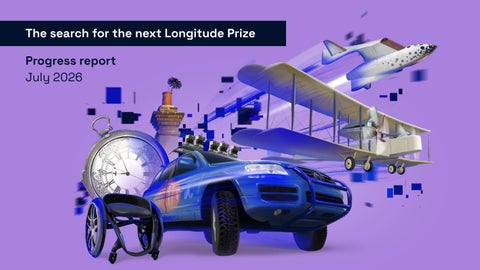
The search for the next Longitude Prize Progress report July 2026
We are searching for the topic of the next Longitude Prize
2
Contents About the Longitude Prize Our work so far What we have planned Partner with us Our compendium of proposed Longitude Prizes About us
3
About the Longitude Prize
by Tris Dyson Founder and Executive Director of Challenge Works
The Longitude Prize is one of the world’s most prestigious technology prizes. Three centuries ago, the British government launched the world’s first challenge prize. They offered up to £20,000 to the inventor who could find a way to accurately measure a ship’s longitude at sea. The winner, the H4 Chronometer, pictured left, saved lives and ships. It’s now part of the permanent display in the museum at the Royal Observatory. Over the centuries that followed, challenge prizes like the Longitude Prize created innovations ranging from driverless cars, to private spaceships, transatlantic flight and smart wheelchairs. It’s even thanks to a challenge prize that the UK ended the barbaric practice of sending young children to sweep chimneys in the 19th century: the Society of Arts offered a prize for designing extensible brushes, and once these were available, parliament was moved to act. Challenge prizes are a proven method to drive technological breakthroughs. They create powerful incentives that motivate innovators often with unexpected approaches and backgrounds - to solve problems that matter.
4
The Longitude Prize is reborn To mark the original Longitude Prize’s 300th anniversary in 2014, with the backing of the prime minister’s office and a group of prominent scientists led by Lord Martin Rees, we relaunched the Board of Longitude and initiated a new programme of Longitude Prizes. The first, the Longitude Prize on Antimicrobial Resistance, offered £8m for breakthroughs in diagnostics that would allow doctors to prescribe antibiotics only to those who need them. That was won by Sysmex Astrego in 2024 - their test can distinguish between viral and bacterial infections in just 45 minutes, instead of several days for a lab test. The second, the Longitude Prize on Dementia, offered a reward of £4.5m for AI technologies to help people with dementia live independently for longer. It was won by CrossSense in 2026. In 2025, we launched the Longitude Prize on ALS: £7.5m on offer - plus access to data and support - between now and 2031 for breakthroughs in treating motor neurone disease.
The winning solution of the Longitude Prize on Antimicrobial Resistance (top) is now on permanent display at the Science Museum. The team from Sysmex Astrego (bottom) received the £8m prize after a decade of R&D.
5
What’s next for the Longitude Prize We’re now turning our attention to the fourth modern Longitude Prize and beyond. For that, we need an inspiring topic - a step-change in capability, underpinned by a breakthrough in technology, that would create global impact. A topic that would capture the public’s imagination and inspire innovators to enter. We also need ambitious sponsors and partners: forward-looking organisations willing to fund the prize, and provide in-kind support. We are currently engaging widely: with scientists and engineers, with entrepreneurs and investors, and with our existing and potential future funders, to map out the future of the Longitude Prize. This report sets out what we’ve done so far - and the inspiring concepts they’ve helped us generate for the next Longitude Prize. If you think you can help one of these happen, if you have an idea that’s better, or you’re keen to get involved in our next phase of idea generation - please get in touch.
The Longitude Prize is an initiative of Challenge Works, part of the research and innovation foundation Nesta. It is governed by the Board of Longitude, a group of leaders in science and technology founded by Lord Martin Rees, and currently chaired by Prof Dame Wendy Hall.
6
Our work so far
7
Our approach Since kicking off our search for the next Longitude Prize in April, we’ve had dozens of meetings, calls, workshops and emails with experts; we’ve racked our own brains and those of our existing funders and collaborators. We’ve shared 27 concepts so far for what the next prize could focus on. We also have many more ideas in our back pocket: variations on the ideas we’ve published, ideas we’re still thinking about, ones we think are strong but tough to explain, ideas we’re waiting for feedback and validation on. All of these are conversation starters: we are experts in innovation, entrepreneurship and funding, but we rely on the kindness and generosity of experts to guide us towards the most robust and credible prize ideas. So if you think something isn’t quite right in one of our prize ideas - or its difficulty is pitched too high or too low - then we want to know. And if you think you could help fund or join with us in delivering one, we want to hear from you too. The following pages highlight some of the work we’ve done over the past few months to engage these communities and why we think an expert-driven process is the right way to design the next Longitude Prize. We start with three ideas championed by three of the leading scientists and technologists who sit on our Board of Longitude - the committee that will have the final say on whether the topic we pick is audacious enough to earn the title of a Longitude Prize: Wendy Hall, Roger Highfield and Dave Delpy. These give a taste of the level of ambition and clarity they want to see. 8
Experts and organisations consulted
9
Wendy Hall’s Longitude Prize idea
by Prof Dame Wendy Hall FRS FREng Computer Scientist at Southampton University
Alongside my work as a computer scientist, I’ve had the pleasure over the past decade of being part of the Board of Longitude, and recently becoming its chair. I think a Longitude Prize on advancing brain-computer interfaces would be amazing. Not because the science and technology is exciting, even though it is. But because it would be a game changer, in particular for people with paralysis and other conditions that affect mobility. Imagine you could safely and confidently navigate complex environments in a powered wheelchair - using just your mind? → Read Wendy Hall’s Longitude Prize idea in full.
10
Roger Highfield’s Longitude Prize idea
by Roger Highfield Director of Science at the Science Museum
I’ve been thinking about one domain where the right incentive could be genuinely game‑changing: quantum technology. One reason is the UK government has committed around £2 billion to quantum technologies. The National Quantum Computing Centre (NQCC) is working to overcome the barriers to scalable, practical machines. So what about a Longitude Prize for Quantum Computers? The original Longitude Act offered a sliding scale of rewards, rising with accuracy. I wonder whether a similar structure could accelerate quantum computing. → Read Roger Highfield’s Longitude Prize idea in full.
11
Dave Delpy’s Longitude Prize idea
by Prof Dave Delpy CBE FRS FREng FMedSci Medical Physicist at UCL, former CEO of EPSRC
The second biggest cause of death in accidents - after brain trauma is bleeding to death. Many people survive car crashes, assaults, or injuries on the battlefield, only to die afterwards from blood loss. I used to be editor of the engineering magazine Ingenia - and I learned about some of the approaches in an article we published. These range from injectable foams to sponges and balloons. But none of them have quite hit the spot and none are yet widely available. So I would offer a Longitude Prize to whoever can design a device, material or technology capable of staunching bleeding from trauma to the torso, in a wide range of real-world situations. Something that could be carried by ambulance crews to routinely save lives. → Read Dave Delpy’s Longitude Prize idea in full.
12
Expert prize ideation workshops With the kind support of UCL Policy Impact Unit and the Government Office for Science, we ran two expert workshops in June to explore and develop fresh prizes related to two priority areas: metamaterials and future construction. Participants included representatives of: The Advanced Research & Invention Agency (ARIA), the Defence Science & Technology Laboratory (DSTL), Dark Matter Labs, Homes England, the Faraday Institution, Henry Royce Institute, Shell, Metamaterials Network, Ramboll Foundation and many more. Their prize ideas are gathered in the compendium at the end of this report.
13
Our focus on metamaterials
by Ian Sillett Director of Technology Frontiers at Challenge Works
In my nearly 20 years of innovation experience, I have researched, seen, assessed or tried to sell countless technologies, services and ideas. Although many went on to become successful commercial products only one can help to prevent wars and climate change at the same time. Metamaterials have a bewildering array of applications, from creating perfectly flat lenses, improved insulation, to replacing critical minerals in electronics and batteries. That last use case alone could prevent huge environmental damage from mines, halt our reliance on rare earths from volatile regions and supercharge the green transition. It’s because of this huge potential that we convened an expert workshop, and have chosen to explore Longitude Prize ideas in this dynamic sector. → Example prize idea: Longitude Prize on Omnifocal Spectacles.
14
Our focus on future construction
by Kathy Nothstine Director of Cities & Societies at Challenge Works
The way we build homes hasn’t significantly changed in decades. While other sectors have been revolutionised by AI and automation, construction firmly relies upon legacy methods - while being one of the world’s most carbon-intensive industries. That’s why I’m exploring how a Longitude Prize could transform construction and unblock the pipeline of new homes - and why I convened a group of academic, engineering, industry and policy thinkers around this topic as part of the Longitude Prize campaign. Some areas we’re particularly interested in are the scalability gap - unlocking housebuilding without sacrificing quality, and the sustainability of new building in an age of climate change. → Example prize idea: Longitude Prize on Adaptive Materials. 15
Why we consult experts
by Olivier Usher Director of Development at Challenge Works
In early 2020, I worked on the design of the Longitude Prize on Dementia. We had lots of in-person engagement with patients and their families planned, which were rudely shifted onto Zoom like so much else when covid hit. But for this project, lockdown was a blessing in disguise: because in holding online focus groups with dementia patients and their families, it quickly became obvious that our deeply-ingrained stereotypes of older people as technologically backward were a load of nonsense. Here was a group of people, happily engaging with us on a newfangled videoconferencing platform none of us had even heard of a few months earlier, telling us about all the technological tricks – smartphones, Amazon Echos, apps and so on – that they were already using to maintain their independence. Our preconception – that the prize would have to focus on low-tech solutions, on services or on “dumbed down” tech that hid its sophistication from its users – evaporated in that 90 minute Zoom call. Seeking that expertise - in this case from patient advocates - gave us the confidence to think bigger and more outlandish thoughts, and to confidently set a bold technological focus for the prize. And from there, you can draw a straight line to CrossSense’s £1m grand prize-winning smart glasses, pictured right. For the sparks of insight we need in picking the topic of a prize, the input that comes from real humans, with deep expertise, whether from science, technology, business or their own life experiences, is hard to beat. That’s why expert workshops are such a key part of our work when planning a Longitude Prize.
16
What we have planned
17
Forthcoming ideation and fundraising Over the coming months, we have lots more activity planned. We’ll be continuing to meet and discuss ideas with our networks, in particular with funders and partners in construction and metamaterials. We have more workshops planned: on neurotechnologies, and on planetary restoration. If you’re an expert with ideas and networks in these topic areas, please reach out. We’re also looking into doing a US roadshow for the Longitude Prize: while the prize’s origin is in the UK and we are based in London, we work globally. Our Longitude Prize on ALS in particular has significant American backers. We’ll be participating - and talking about our plans - at the Labour and Conservative Party annual conferences. Then, later in the autumn, we’ll share back what we’ve found over the course of this campaign of research and engagement: which ideas we think have the most potential, which have the greatest traction with funders and which we think should proceed to launch.
18
Our focus on planetary restoration
by Claire Rhodes Managing Director at Challenge Works
Our approach to ecosystems is broken. On a global scale, we don’t fund, or prioritise, the repair of ecosystems enough. And when we do invest, the success rates are too low because we don’t know what really works. We need solutions that help us intervene quicker, more successfully and at greater scale. We need innovations in data, monitoring and modelling of ecosystems so we understand them better. And we need new technologies and approaches that let us intervene more effectively. I think a Longitude Prize, focused on creating new technologies that can help us rebuild forests or wetlands, clean up waste and repair damaged land could be a part of the solution. That’s why I plan to convene an expert workshop to explore prize ideas in September. If you think you could be part of this, please reach out. → Example prize idea: Longitude Prize on Glacier Protection. 19
Our focus on neurotechnologies
by Caroline Purslow Head of Health at Challenge Works
I lead the delivery of the Longitude Prizes on Dementia and ALS. I’ve seen the excitement they’ve unlocked, the new technologies developed, and the enthusiasm they’ve created in the neuroscience and neurotechnology communities. That’s why I think the human brain is a fertile area for future Longitude Prizes. My team is currently hard at work on two related areas: whether a Longitude Prize could incentivise creating technologies that give early warning of - and actionable guidance about how to avoid - brain disorders like Alzheimer’s or Parkinson’s, many years before they hit. And whether a prize could accelerate the development of brain-computer interfaces (Wendy Hall’s favourite Longitude Prize idea). We’ll be workshopping ideas in September - if you want to participate, please reach out. → Example prize idea: Longitude Prize on Neuro Resilience. 20
Partner with us Longitude Prizes are ambitious, global projects. The prize purse, alongside communications, non-financial support, judging and testing means budgets typically above £10m. But the rewards are huge too. Research shows challenge prizes typically generate at least a 10x return on investment in teams over and above the prize amount. They ensure multiple shots at the goal not just the winning team, but the finalists too. And they generate huge public interest and coverage. For funders, they set an ambitious agenda for today, provide a huge brand-building opportunity, and create a lasting legacy for the future. Prizes make history. If you are interested in discussing how your organisation could fund a Longitude Prize, including being a title sponsor, please reach out to us at longitudeprize@challengeworks.org. We are interested in all of the prize topics set out in this report, and any you may have.
The funders of the three Longitude Prizes to date are: ● Innovate UK ● Nesta ● BIRAC ● The Alzheimer’s Society ● The MND Association ● Alan Davidson Foundation ● My Name5 Doddie ● Fight MND ● LifeArc ● Answer ALS ● The Packard Center ● The 10,000 Brains Project Funders of Challenge Works’ other prizes include: Toyota Mobility Foundation, DSIT, Government of Canada, USAID, European Commission, Coefficient Giving, Bernard van Leer Foundation, UK Space Agency, JPMorgan Chase Foundation, Intuitive Foundation and many others.
21
A compendium of prize ideas
22
This is our Longitude Prize longlist This is our current longlist: the ideas we think are most compelling for what the next Longitude Prize could focus on. They have come from the experts who participated in our workshops, from members of the Board of Longitude, from individuals and collaborators we work with across our portfolio, and from the experienced challenge prize designers and managers within our team. They are conversation starters - initial proposals, not a final design. We want your feedback and your ideas - on how they could be improved, which are the most compelling, whether any should be deprioritised. Please reach out to us: longitudeprize@challengeworks.org.
23
Proposed Longitude Prize for
Cognitive Mobility Awarded to the team that successfully demonstrates a user using a mobility aid to navigate complex, real-life environments using only their neural signals. Integrating brain-computer interfaces with off-the-shelf wheelchairs is limited by technical constraints, low data bandwidth, and high mental fatigue. Current hardware cannot safely interpret noisy or intermittent neural signals, leading to dangerous manoeuvres in public spaces. A purpose-built device bridges these signal gaps through rigorous testing and patient-scoring process, ensuring the final solution is practical, safe, and restores true autonomy.
24
Proposed Longitude Prize for
Neuro Resilience Awarded to the team that develops a precision forecasting system capable of predicting individual neurodegenerative risk and disease subtypes years before clinical symptoms appear - and providing actionable clinical recommendations on how to prevent them. Clinical care remains reactive because conditions like dementia or Parkinson's are typically recognised only after irreversible brain damage has occurred. Current diagnostic tools cannot reliably forecast individual disease trajectories or the specific timing of symptom onset. Integrating longitudinal biological and digital signatures allows for a transition to proactive, personalised medicine. This technology would provide actionable predictions that can inform screening, guide personalised interventions, and ultimately delay or prevent the onset of neurodegenerative disorders
25
Proposed Longitude Prize for
Subterranean Power Awarded to the team that installs a high-voltage underground cable over a 10km route connecting a renewable energy source to the national grid, without conventional trenching, navigating typical route obstacles, and achieving the best combination of installation speed, cost-efficiency, and minimal surface disruption. Connecting new renewable energy to Britain's grid currently requires either expensive, disruptive trenching or visible overhead pylons, and neither can scale to meet the urgent grid expansion required for net zero. A breakthrough here unlocks a critical bottleneck in Britain's clean energy transition: getting power from where it's generated to where it's needed, quickly, cheaply, and without altering the landscape.
26
Proposed Longitude Prize for
Clean Space Awarded to the team that develops an spacecraft that can remove debris fragments between 1cm and 10cm in diameter from Earth orbit. Earth’s orbits are a global commons with no single actor responsible for remediation. The exponential growth of debris creates a collision risk that threatens to render orbits containing critical satellite services unusable, yet commercial incentives to invest in removal remain weak. There is presently no consensus around the best technical approach to active debris removal for the most threatening debris category (1-10cm). A challenge prize to surface the best solution would provide mission concept around which action, innovation and investment to a generational environment threat could finally be galvanized.
27
Proposed Longitude Prize for
Quantum Compass Awarded to the team that develops a portable, stand-alone quantum navigation prototype for use on aircraft. The winner would be the team that demonstrated the highest accuracy and lowest drift rate over the course of a transatlantic flight from London to New York. Modern infrastructure, aviation and shipping is dangerously reliant on GPS, which is vulnerable to solar storms and malicious interference such as jamming. A significant outage would cost the UK economy over £1 billion every day, yet current quantum alternatives are too large and expensive for practical use and have not been proven in real world conditions. Quantum sensors allows for a "quantum compass" that could navigate by measuring the Earth's magnetic and gravitational fields or using inertial navigation. This provides a resilient replacement for GPS, ensuring global transport remains operational even when signals from space are lost.
28
Proposed Longitude Prize for
Abundant Resources Awarded to the team that develops a synthetic material capable of functionally replacing a critical mineral in high-volume electronics with zero performance loss. Global electronics manufacturing relies on scarce minerals like indium and gallium. This creates extreme supply chain fragility, price volatility, and geopolitical risk for national security, as well as substantial environmental impacts from mining. Current alternatives are inefficient or costly. A synthetic breakthrough using abundant elements secures technology sovereignty and ensures economic stability by decoupling industrial growth from volatile, finite resource markets.
29
Proposed Longitude Prize for
Robotic Astronauts Awarded to the team that develops a highly dexterous robotic system and demonstrates it can autonomously replace a micro-component on a live satellite using human-standard tools in a zero-gravity environment. Robotic systems currently lack the fine manipulation required to manage delicate space infrastructure. This limitation prevents on-orbit maintenance, forcing the abandonment of valuable satellites and increasing dangerous space debris. By mastering fine motor control and tool use in zero-gravity environments, robots can extend satellite lifespans and safely decommission dead hardware. This creates a sustainable space economy and ensures critical infrastructure remains operational without constant human intervention.
30
Proposed Longitude Prize for
Glacier Protection Awarded to the team that demonstrates a scalable, localised, and reversible cooling technology that increases the albedo of a thinning glacier during the peak summer melt. We are likely to miss the global 1.5-degree target, and direct air carbon capture is too slow to prevent the immediate impacts of heat events. Solar Radiation Modification (SRM) offers a solution but remains controversial due to its lack of precision and controllability. This provides an immediate intervention, by increasing the amount of sunlight reflected off a glacier, to prevent catastrophic heatwaves or ice-sheet melting while the world decarbonises. If we don't develop localised cooling, key tipping points will be crossed, and warming will accelerate, leading to irreversible sea-level rise.
31
Proposed Longitude Prize for
Zero Waste Awarded to the team that develops a cascading enzymatic system that can perform multiple steps for breakdown and recovery without the enzymes negatively interfering with each other. Current circular economy approaches often result in 'down-cycling', as multi-layer materials like juice cartons or EV batteries are nearly impossible to separate without extreme heat and toxic solvents. Tools like AlphaFold can predict structures, but cannot yet operate in the chemically complex environments where recycling actually occurs. It removes the need for high-heat incineration and toxic chemical solvents, replacing them with low-energy biological processes that work in real-world, complex settings.
32
Proposed Longitude Prize for
Urban Health Intelligence Awarded to the team that develops an intelligent network of sensors, data and software that can gives dramatically earlier diagnosis of oncoming extreme heat or air quality events, and intervenes to actively manage city infrastructure to measurably cut incidence of heatstroke and respiratory conditions. Pollution and extreme heat in cities are big killers, but we often can't do much to predict, let alone prevent, them. Urban data silos create a lag between heat, pollution, and public health signals. Legal and technical barriers between stakeholders mean we only react once hospital admissions spike, closing the window for preventative action. This intelligence platform synchronises environmental sensors and smart city infrastructure with clinical feeds to detect early signals and enable preventative action – such as restricting vehicles, adjusting traffic lights or increasing irrigation of green areas – to protect vulnerable populations.
33
Proposed Longitude Prize for
Clean Rivers Awarded to the team that develops an intelligent network of sensors, data and software that can monitor, proactively manage and prevent land and water pollution linked to land use, through providing dramatically earlier warning of pollution incidents. Land use such as farming has large impacts on ecosystems, particularly rivers and lakes. Current water management is reactive and siloed, detecting pollution like phosphate spikes only after contamination occurs. Conventional sensors miss the fast-moving window between soil saturation and river contamination. By integrating soil health metrics and intelligent resource networks, the system helps to predict impending cascades so that we can decide how and when to adjust farming practices, shifting water quality management from disaster response to proactive prevention. Such a system would trigger early messaging to farmers, automate insurance or subsidy payments and create both the information and incentives needed to make changes. 34
Proposed Longitude Prize for
Living Buildings Awarded to the team that successfully develops a biological or biochemical material that can be injected, sprayed, or grown directly within an existing building envelope to deliver measurable improvements in energy efficiency. Decarbonising global building stock requires minimally invasive, highly insulating retrofit solutions, yet current materials like petrochemical foams are toxic, flammable, and carbon-intensive. Biological alternatives such as mycelium, bacterial bio-cements, and bio-polymers that could grow into perfectly fitted, low-carbon insulation remain largely unproven at the scale and reliability required for real-world building applications. Developing a validated biological insulation material unlocks a globally scalable, minimally invasive retrofit solution, providing the construction and insurance industries with the safety data needed to move from petrochemical dependency towards low-carbon alternatives.
35
Proposed Longitude Prize for
Deconstruction Awarded to the team that develops an autonomous deconstruction system capable of un-building structures without cross-contamination, distinguishing and separately extracting structural materials including timber, steel, and copper, ensuring outputs are ready for immediate re-entry into the supply chain. The construction industry is the largest contributor to global landfill waste. Traditional demolition crushes valuable high-energy materials like steel and timber into mixed-rubble slurry that is nearly impossible to recycle, effectively burying frozen carbon because we lack the robotic dexterity and visual intelligence to take buildings apart as carefully as we put them together. By turning old buildings into high-purity material mines, this solution lowers the cost of raw materials for new projects and eliminates the carbon emissions associated with extracting and processing virgin steel and timber, incentivising a truly circular economy.
36
Proposed Longitude Prize for
City-Wide Cooling Awarded to the team that successfully designs a zero-carbon, modular district cooling system at neighbourhood scale, eliminating refrigerants that contribute to global warming, incorporating circularity through productive reuse of waste heat, and demonstrating a viable path to retrofitting into dense city fabric without prohibitive infrastructure costs. Urban cooling is overwhelmingly reliant on individual units using refrigerants with high GWP, creating a vicious cycle where cooling demand accelerates the very warming it tries to address. Existing district cooling systems require enormous municipal buy-in and prohibitive upfront infrastructure costs, making them inaccessible for most cities, particularly in emerging markets. Centralising cooling at the district level achieves efficiency impossible for standalone units, shifting the burden from individual to city infrastructure and providing a blueprint for municipalities to move district cooling from a luxury to a standard utility that stabilises the power grid and restores the urban microclimate. 37
Proposed Longitude Prize for
Nature Repair Awarded to the team that demonstrates an engineered microbe or microbial consortia capable of surviving in non-sterile, wild environments while performing active restoration. Most lab-engineered microbes die in complex natural environments (the 'In-Situ Survival Gap'). Current bioremediation is slow, tackles one pollutant at a time, and struggles to compete with established methods like excavation and thermal treatment. A successful ‘Nature IVF’ inoculant would allow us to seed life back into dead zones by providing the biological infrastructure for nature to take over while competing with less sustainable practices and current bioremediation techniques on time, cost and overall effectiveness.
38
Proposed Longitude Prize for
Wearable Kidneys Awarded to the team that can create a portable dialysis machine that weighs no more than 2kg and takes up less than 2500 cubic centimetres, with autonomy of at least 12 hours. Dialysis machines are big and bulky and require users with kidney failure to spend extended periods of time physically attached to them. This is a serious constraint on their mobility and freedom. A portable, wearable kidney machine would allow individuals greater independence by no longer tying their dialysis to a bulky and immovable machine.
39
Proposed Longitude Prize for
Quantum Coherence Grand prize awarded to the first team to demonstrate, in a deployed, 100 qubit quantum processor, a median coherence time across all qubits of 1 second or more, while simultaneously maintaining high fidelity. In theory quantum computers can do all sorts of amazing things. But nobody has been able to build one that works properly. The main problem is building quantum processors with qubits that remain stable over a period of time. It would set a clear technological goal that is far in advance of what is known to be possible right now. The prize would be particularly valuable because it would set a public benchmark: teams competing to solve it would be publicly graded on a leaderboard, which provides independent validation of their capability.
40
Proposed Longitude Prize for
Artificial Blood Awarded to a team for creating a synthetic substitute for human blood that does not require refrigeration. People need blood after surgery or trauma. It's a constant struggle to get enough donations; human blood is highly perishable and is also an infection risk even when screened. Creating a synthetic substitute would bypass the need for human blood altogether - like synthetic insulin did for diabetes.
41
Proposed Longitude Prize for
Trauma Treatment Awarded to the team that creates a practical device, treatment or method for controlling bleeding from trauma, that works for parts of the body where blood flow can't be restricted by a tourniquet. When people are injured, often it is not the trauma that kills them, but blood loss following the injury - it's the second most frequent cause of death from injury in the UK, after brain trauma. This is an issue in accidents, as well as for injuries received by soldiers in combat situations or victims of assaults. For limb injuries, a tourniquet can cut off blood flow and halt the bleeding, but for trauma to the abdomen this isn't possible. A device, treatment or method of halting bleeding for abdominal injuries would save many lives.
42
Proposed Longitude Prize for
Omnifocal Spectacles Awarded for creating tunable varifocal spectacle lenses that allow people to see with 20/20 vision at a given, broad range of practical distances, on demand. Modern spectacles allow people with imperfect vision to see more clearly at a given range. This has been the status quo for centuries. Variable focal ranges can be achieved by alternating or combining lenses, which are impractical both for everyday users and for a huge range of industrial applications that use lenses in medicine, manufacturing, engineering and physical sciences. A practical, tunable lens for optical waves would unlock game-changing quality of life improvement for millions of visually impaired people worldwide. In turn, this would be a gateway to industrial applications for tunable metalenses that radically improve imaging, sensing, communications and other lens-based technologies.
43
Proposed Longitude Prize for
Cold Computing Awarded to the innovator that produces the highest-performing, scalable non-electrical computing chip with radically improved energy efficiency. All computers today are electrical - they rely on currents passed through transistors, which generate heat, reducing efficiency, and are limited by the speed at which electrons can travel. Our answer for overcoming this has been massive scale and energy consumption, putting huge pressure on performance, economies and the planet. It is possible to perform mathematical computations with non-electrical signals, such as light or other waves. If we can develop and scale such processors, we could exponentially increase computing power, especially relative to energy demand, and ameliorate the need for planetary cost to scale with compute.
44
Proposed Longitude Prize for
Construction Supermaterials Awarded for creating materials for a building envelope that offer a desirable level of thermal insulation at dramatically reduced thickness and weight, while remaining cost-competitive, circular, scalable and practical. Thermal efficiency in buildings is an imperative climate mitigation and public health response in the context of a rapidly warming and more volatile climate. Traditional building materials achieve thermal efficiency only at the cost of significant trade-offs in volume, weight, cost and degradability. Metamaterials have the capability to bypass this tradeoff, but are underdeveloped and manufacturing needs to scale. Metamaterial super insulators can achieve thermal efficiency for a fraction of the volume/weight, could be adaptable or tunable to different conditions, and could be sustainable, cheap and scalable, if properly supported, revolutionising the cost and desirability of climate-adapted construction.
45
Proposed Longitude Prize for
Alternative Materials For metamaterial solutions that nullify economic, environmental or geopolitical risk by providing alternatives to technologies based on supply chains involve that scarce, contested resources or destructive extraction. Many of our most important emergent technologies, such as photovoltaics and semiconductors, depend on the extraction of scarce resources. Competition for these resources is a major source of geopolitical tension, ecological destruction, and socioeconomic hardship. Rising demand for lithium, cobalt and other rare earth materials is only set to exacerbate this trend. Metamaterials derive their valuable properties of their molecular structure, not, as in the case of rare earths, their chemical composition. Synthetic alternatives could thus substitute demand for natural resources and simultaneously provide new economic drivers to catalyse scalability in metamaterial manufacturing.
46
Proposed Longitude Prize for
Deconstructable Batteries Awarded to the creator of a battery that meets the technical requirements to power a humanoid robot and 95% of the component mass is recoverable without pyrometallurgy or hydrometallurgy. The twin forces of the energy transition and physical AI are driving demand for batteries of all shapes, sizes and specs. Unfortunately batteries draw on some of the world’s most damaging, fragile and contested supply chains, and there are few end-of-life solutions. Dead batteries can rarely be recycled or reused and innovation in other technical parameters is, if anything, exacerbating their linearity. A deconstructable battery for a humanoid robot would pre-empt the next major mass-produced electronic innovation being founded on another generation of batteries with no end-of-life plan that cause barely mitigated environmental devastation, and catalyse design-for-disassembly for a range of mid-size mobile electronics and robotics. 47
Proposed Longitude Prize for
Climate-Adaptive Materials Awarded to the team that engineers a commercially viable, adaptive material or envelope system that autonomously switches between heating and cooling based on ambient conditions, significantly reducing reliance on traditional infrastructure. The built environment consumes vast energy for climate control, relying on carbon-intensive, static materials that ignore changing weather, locking buildings into inefficient patterns. As climate change impacts escalate, there is a global demand for materials that increase the adaptability and resilience of urban environments. This material, deployable internally or externally, will regulate indoor temperatures by adapting to environmental fluctuations. By developing novel materials that respond autonomously, our cities can drastically reduce operational energy demand, extend building lifespans, cut greenhouse gas emissions, and minimize strain on power grids during extreme weather. 48
Proposed Longitude Prize for
No Demolition Waste Awarded to the best innovators linking AI surveying software with automated deconstruction hardware. Winning systems must digitally catalogue reusable inventory, guide machinery to detach elements intact, and sort salvaged goods for commercial reuse. Current infrastructure demolition relies on brute force, destroying valuable components. We tear down buildings "blind," lacking the smart scanning and automation required to salvage intact materials before heavy impact occurs. Mapping a building's "DNA" enables a shift from reckless demolition to strategic, data-driven disassembly. This creates local stockpiles of reclaimed parts, drastically cutting the energy needed to manufacture new materials.
Proposed Longitude Prize for
Infinite Building Lifecycles Awarded to the team that develops a viable construction material or modular building system that can be reconfigured or regenerated indefinitely without loss of structural integrity, demonstrating the feasibility of constructing a complete dwelling exclusively from these closed-loop, permanent components. Construction materials are historically designed with a finite lifespan, destined for eventual obsolescence and replacement. This linear "take-make-dispose" model drives continuous resource depletion, as even "sustainable" materials eventually degrade and require the manufacturing of new replacements. By rethinking the chemical and structural makeup of building blocks, we can create materials designed for indefinite lifecycles. This eliminates future construction waste entirely and ensures that the footprint of building a home is a one-time ecological cost rather than a recurring environmental burden.
50
About us
The Longitude Prize is an initiative of Challenge Works. We design and run challenge prizes to spark innovation in science, technology and society. We are part of Nesta, the research and innovation foundation. We are innovation experts, experienced in identifying opportunities for new ideas, and deeply embedded in science, technology and entrepreneurship. We are problem-centred, working with sector experts, drawing on research and engaging with people with lived experience to drive real-world impact. We are thought leaders in challenge and mission-driven innovation for impact. Challenge prizes catalyse innovation to tackle pressing problems where solutions are lacking. They offer a series of incentives in return for solving a defined challenge. We work with government, commercial and philanthropic funders around the world to run challenge prizes that create real change. Since our foundation in 2012, we have run over 100 challenge prizes and awarded over £370m, creating breakthrough innovations, helping innovators thrive and unlocking systemic change. Our team of 40+ professionals combines expertise in design, innovation, programme and financial management, research, evaluation and communications. We work across sectors, but have a particular focus on our core priority areas: frontier technology, climate response, cities and societies, and global health. Cover illustration: Anastasia Zotova. Other illustrations: Daniel Spacek. 51
Challenge Works Nesta 58 Victoria Embankment London EC4Y 0DS longitudeprize@challengeworks.org longitudeprize.org Nesta is a registered charity in England and Wales 1144091 and in Scotland SC042833. 52